




The handwritten notes on Class 6 Science Chapter 5 Measurement of Length and Motion have been prepared for quick 2026-27 revision. The PDF covers SI units, correct scale reading, curved-line measurement, reference point, motion and rest, and the three main types of motion.
- Best use: revise this PDF after reading the NCERT Curiosity chapter once.
- PDF focus: unit conversions, measuring rules, reference point logic and motion examples.
- Chapter value: this chapter connects daily measurement with basic physics ideas.
Chapter5MeasurementofLengthandMotionHandwrittenNotes.pdf?page=1&dpi=150)
Chapter5MeasurementofLengthandMotionHandwrittenNotes.pdf?page=2&dpi=150)
Chapter5MeasurementofLengthandMotionHandwrittenNotes.pdf?page=3&dpi=150)
Chapter5MeasurementofLengthandMotionHandwrittenNotes.pdf?page=4&dpi=150)
Chapter5MeasurementofLengthandMotionHandwrittenNotes.pdf?page=5&dpi=150)
Chapter5MeasurementofLengthandMotionHandwrittenNotes.pdf?page=6&dpi=150)
Chapter5MeasurementofLengthandMotionHandwrittenNotes.pdf?page=7&dpi=150)
Chapter5MeasurementofLengthandMotionHandwrittenNotes.pdf?page=8&dpi=150)
Chapter5MeasurementofLengthandMotionHandwrittenNotes.pdf?page=9&dpi=150)
Chapter5MeasurementofLengthandMotionHandwrittenNotes.pdf?page=10&dpi=150)
Chapter5MeasurementofLengthandMotionHandwrittenNotes.pdf?page=11&dpi=150)
Chapter5MeasurementofLengthandMotionHandwrittenNotes.pdf?page=12&dpi=150)
Chapter5MeasurementofLengthandMotionHandwrittenNotes.pdf?page=13&dpi=150)
Chapter5MeasurementofLengthandMotionHandwrittenNotes.pdf?page=14&dpi=150)
Chapter5MeasurementofLengthandMotionHandwrittenNotes.pdf?page=15&dpi=150)
Chapter5MeasurementofLengthandMotionHandwrittenNotes.pdf?page=16&dpi=150)
Chapter5MeasurementofLengthandMotionHandwrittenNotes.pdf?page=17&dpi=150)
Chapter5MeasurementofLengthandMotionHandwrittenNotes.pdf?page=18&dpi=150)
Chapter5MeasurementofLengthandMotionHandwrittenNotes.pdf?page=19&dpi=150)
Chapter5MeasurementofLengthandMotionHandwrittenNotes.pdf?page=20&dpi=150)
Chapter5MeasurementofLengthandMotionHandwrittenNotes.pdf?page=21&dpi=150)
Chapter5MeasurementofLengthandMotionHandwrittenNotes.pdf?page=22&dpi=150)
Chapter5MeasurementofLengthandMotionHandwrittenNotes.pdf?page=23&dpi=150)
Chapter5MeasurementofLengthandMotionHandwrittenNotes.pdf?page=24&dpi=150)
Chapter5MeasurementofLengthandMotionHandwrittenNotes.pdf?page=25&dpi=150)
Chapter5MeasurementofLengthandMotionHandwrittenNotes.pdf?page=26&dpi=150)
Chapter5MeasurementofLengthandMotionHandwrittenNotes.pdf?page=27&dpi=150)
Chapter5MeasurementofLengthandMotionHandwrittenNotes.pdf?page=28&dpi=150)
Chapter5MeasurementofLengthandMotionHandwrittenNotes.pdf?page=29&dpi=150)
Chapter5MeasurementofLengthandMotionHandwrittenNotes.pdf?page=30&dpi=150)
Chapter5MeasurementofLengthandMotionHandwrittenNotes.pdf?page=31&dpi=150)
Chapter5MeasurementofLengthandMotionHandwrittenNotes.pdf?page=32&dpi=150)
Student Feedback: In a Collegedunia study check, 74% of Class 6 students said the unit-conversion and motion-type pages helped them revise this chapter faster.
|
Table of Contents |
Class 6 Science Chapter 5 Handwritten Notes Overview
Class 6 Science Chapter 5 begins with Deepa visiting a cloth shop and tailor for a new school uniform. The chapter uses this everyday story to explain why people measure length and why different tools are needed for different objects.
The handwritten PDF keeps the chapter short and test-ready. Students revise body-part units like handspan and angula, standard SI units, the correct way to place a scale, and the reason a reference point is needed for describing position.
Measurement of Length and Motion Video Revision
Source: Magnet Brains on YouTube
SI Units and Length Conversion
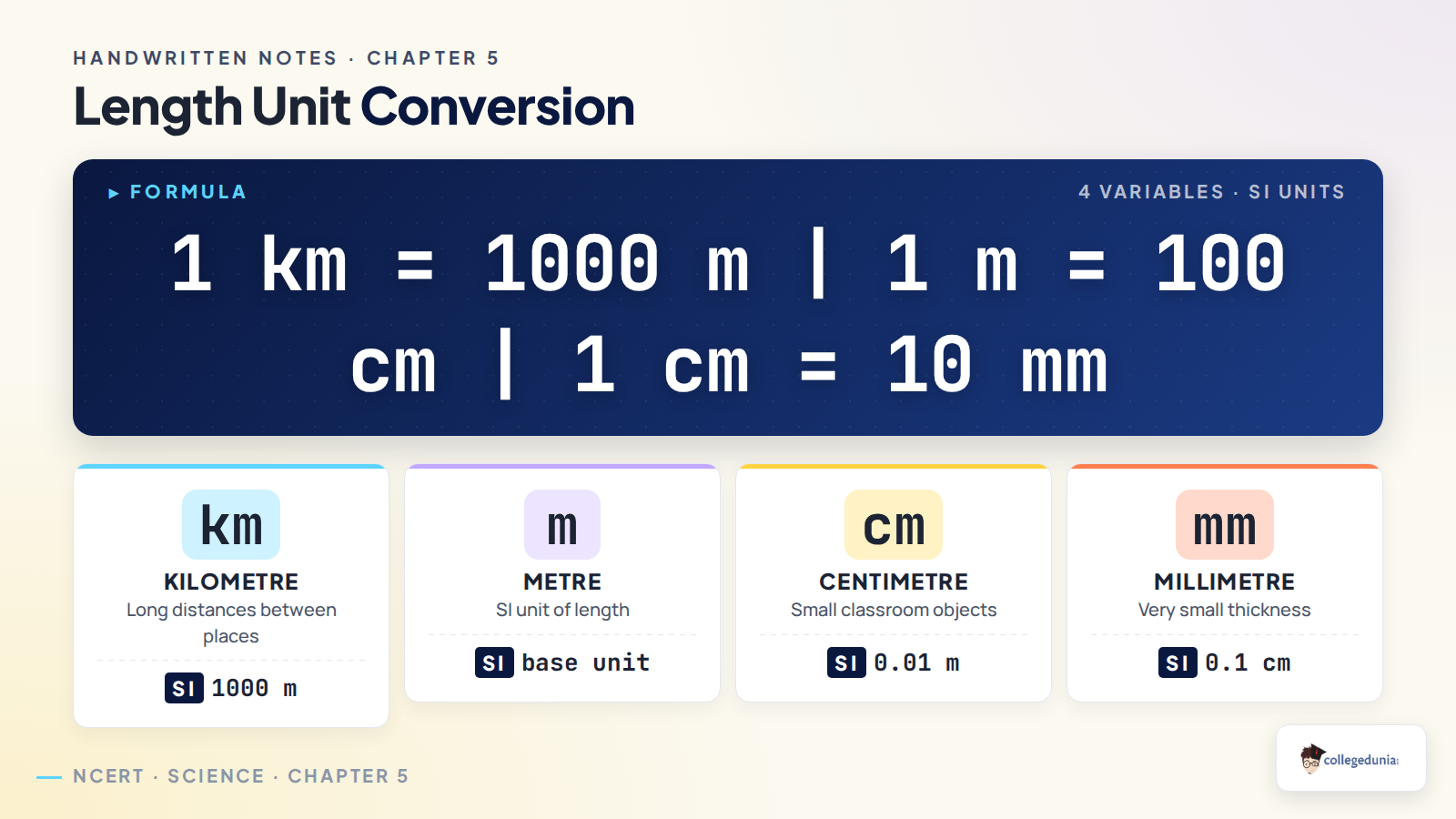
The SI unit of length is metre, written as m. A metre is divided into 100 centimetres, and one centimetre is divided into 10 millimetres. For long distances, students use kilometre.
Always write both parts of a measurement: the number and the unit. For example, 12 cm is complete, but writing only 12 is incomplete. The PDF also reminds students that unit symbols such as km, m, cm and mm are written in lowercase.
- 1 km = 1000 m
- 1 m = 100 cm
- 1 cm = 10 mm
Correct Way to Measure Length
The scale should touch the object and lie along its length. If the scale is tilted, or if the object is not aligned properly, the reading becomes incorrect. The eye should be directly above the mark being read.
If the zero end of a scale is broken, students can start from another clear full mark. For example, if one end reads 1.0 cm and the other end reads 10.4 cm, the object length is 10.4 cm - 1.0 cm = 9.4 cm.
For a curved line, a flexible tape or thread is used. The thread follows the curve first, then it is straightened and measured with a scale.
Reference Point, Rest and Motion
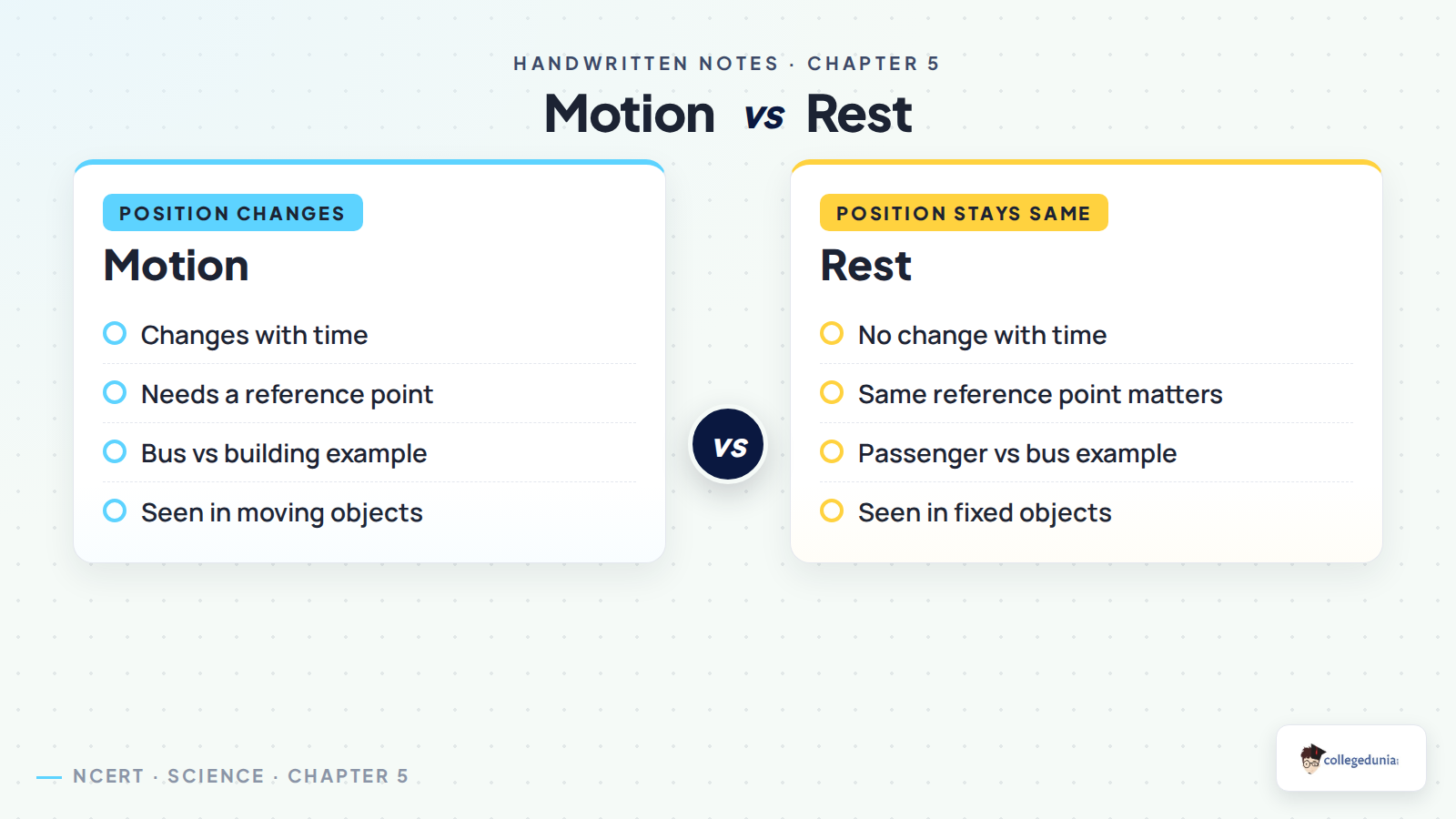
A reference point is a fixed point used to describe position. Deepa and her friends compare the school and garden from different houses, so their answers differ. If all of them use the same bus stand as the reference point, their comparison becomes the same.
An object is in motion if its position changes with respect to a reference point with time. An object is at rest if its position does not change with respect to that reference point with time. The same object can be at rest for one reference point and in motion for another.
Types of Motion in Chapter 5
The chapter explains three common types of motion through simple activities. A falling eraser or a car moving on a straight road shows linear motion. A whirled eraser tied to a thread shows circular motion. A swing shows oscillatory motion.
| Motion type | Meaning | Example |
|---|---|---|
| Linear motion | Motion along a straight line | Car on a straight road |
| Circular motion | Motion along a circular path | Merry-go-round |
| Oscillatory motion | To and fro motion about a fixed position | Swing |
When an object repeats its path after a fixed time interval, its motion is periodic. Circular and oscillatory motions can be periodic because they repeat their paths.
Exercise Reasoning from the PDF
The handwritten PDF includes reasoning for the main exercise questions. It explains suitable units for different lengths, true-false statements, why handspan is not a standard unit, and how to convert 1.5 km into 1500 m.
The PDF also covers activity-based questions such as measuring a curved bottle base, estimating notebook length using coins, listing objects measured in mm, cm and m, and choosing suitable material for making a metre scale.
Key Takeaways for Quick Revision
- The SI unit of length is metre.
- Measurement needs a number and a unit.
- Body-part units differ from person to person.
- Correct eye position prevents reading error.
- Curved lines can be measured using thread or flexible tape.
- A reference point is needed to describe position.
- Motion means change in position with time.
- Linear, circular and oscillatory motion are the key motion types.
Common Mistakes to Avoid
- Do not write 1 km = 100 cm. The correct relation is 1 km = 1000 m.
- Do not forget the unit after the number while writing length.
- Do not measure with a tilted scale.
- Do not call handspan a standard unit.
- Do not classify a swing as circular motion. It is oscillatory motion.
More Class 6 Science Handwritten Notes
| Chapter | Handwritten Notes |
|---|---|
| Chapter 1 | The Wonderful World of Science |
| Chapter 2 | Diversity in the Living World |
| Chapter 3 | Mindful Eating: A Path to a Healthy Body |
| Chapter 4 | Exploring Magnets |
Measurement of Length and Motion Class 6 Handwritten Notes FAQs
Ques. What is covered in Class 6 Science Chapter 5 handwritten notes?
Ans. The notes cover SI units, unit conversion, measuring length correctly, curved-line measurement, reference point, motion, rest and motion types.
Ques. Are these handwritten notes based on the 2026-27 NCERT Curiosity textbook?
Ans. Yes. The PDF follows Class 6 Science Curiosity Chapter 5 Measurement of Length and Motion for the 2026-27 NCERT syllabus.
Ques. What are the three types of motion in this chapter?
Ans. The chapter explains linear motion, circular motion and oscillatory motion with daily-life examples such as a car, merry-go-round and swing.



Comments