




NCERT Notes for Class 6 Vocational Education Kaushal Bodh Chapter 3 Maker Skills help students revise the 2026-27 project in a practical way. The chapter covers simple machines, toys from waste, propeller motion, wheel-and-axle cars, bicycle parts, maintenance and safe repair habits.
- Best for quick revision: use these notes before writing activity records or project-file answers.
- Project focus: revise lever toys, propeller boats, rubber-band cars and bicycle checks.
- Exam focus: learn definitions, examples, safety rules and maintenance steps.
Chapter3MakerSkillsNotes.pdf?page=1&dpi=150)
Chapter3MakerSkillsNotes.pdf?page=2&dpi=150)
Chapter3MakerSkillsNotes.pdf?page=3&dpi=150)
Chapter3MakerSkillsNotes.pdf?page=4&dpi=150)
Chapter3MakerSkillsNotes.pdf?page=5&dpi=150)
Chapter3MakerSkillsNotes.pdf?page=6&dpi=150)
Chapter3MakerSkillsNotes.pdf?page=7&dpi=150)
Chapter3MakerSkillsNotes.pdf?page=8&dpi=150)
Chapter3MakerSkillsNotes.pdf?page=9&dpi=150)
Chapter3MakerSkillsNotes.pdf?page=10&dpi=150)
Chapter3MakerSkillsNotes.pdf?page=11&dpi=150)
Chapter3MakerSkillsNotes.pdf?page=12&dpi=150)
Chapter3MakerSkillsNotes.pdf?page=13&dpi=150)
Chapter3MakerSkillsNotes.pdf?page=14&dpi=150)
Chapter3MakerSkillsNotes.pdf?page=15&dpi=150)
Chapter3MakerSkillsNotes.pdf?page=16&dpi=150)
Chapter3MakerSkillsNotes.pdf?page=17&dpi=150)
Chapter3MakerSkillsNotes.pdf?page=18&dpi=150)
Chapter3MakerSkillsNotes.pdf?page=19&dpi=150)
Chapter3MakerSkillsNotes.pdf?page=20&dpi=150)
Chapter3MakerSkillsNotes_flat_MobileCard.pdf?page=1&dpi=150)
Chapter3MakerSkillsNotes_flat_MobileCard.pdf?page=2&dpi=150)
Chapter3MakerSkillsNotes_flat_MobileCard.pdf?page=3&dpi=150)
Chapter3MakerSkillsNotes_flat_MobileCard.pdf?page=4&dpi=150)
Chapter3MakerSkillsNotes_flat_MobileCard.pdf?page=5&dpi=150)
Chapter3MakerSkillsNotes_flat_MobileCard.pdf?page=6&dpi=150)
Chapter3MakerSkillsNotes_flat_MobileCard.pdf?page=7&dpi=150)
Chapter3MakerSkillsNotes_flat_MobileCard.pdf?page=8&dpi=150)
Chapter3MakerSkillsNotes_flat_MobileCard.pdf?page=9&dpi=150)
Chapter3MakerSkillsNotes_flat_MobileCard.pdf?page=10&dpi=150)
Chapter3MakerSkillsNotes_flat_MobileCard.pdf?page=11&dpi=150)
Chapter3MakerSkillsNotes_flat_MobileCard.pdf?page=12&dpi=150)
Chapter3MakerSkillsNotes_flat_MobileCard.pdf?page=13&dpi=150)
Chapter3MakerSkillsNotes_flat_MobileCard.pdf?page=14&dpi=150)
Chapter3MakerSkillsNotes_flat_MobileCard.pdf?page=15&dpi=150)
Chapter3MakerSkillsNotes_flat_MobileCard.pdf?page=16&dpi=150)
Chapter3MakerSkillsNotes_flat_MobileCard.pdf?page=17&dpi=150)
Chapter3MakerSkillsNotes_flat_MobileCard.pdf?page=18&dpi=150)
Chapter3MakerSkillsNotes_flat_MobileCard.pdf?page=19&dpi=150)
Chapter3MakerSkillsNotes_flat_MobileCard.pdf?page=20&dpi=150)
Chapter3MakerSkillsNotes_flat_MobileCard.pdf?page=21&dpi=150)
Chapter3MakerSkillsNotes_flat_MobileCard.pdf?page=22&dpi=150)
Chapter3MakerSkillsNotes_flat_MobileCard.pdf?page=23&dpi=150)
Chapter3MakerSkillsNotes_flat_MobileCard.pdf?page=24&dpi=150)
Chapter3MakerSkillsNotes_flat_MobileCard.pdf?page=25&dpi=150)
Chapter3MakerSkillsNotes_flat_MobileCard.pdf?page=26&dpi=150)
Chapter3MakerSkillsNotes_flat_MobileCard.pdf?page=27&dpi=150)
Chapter3MakerSkillsNotes_flat_MobileCard.pdf?page=28&dpi=150)
Chapter3MakerSkillsNotes_flat_MobileCard.pdf?page=29&dpi=150)
Chapter3MakerSkillsNotes_flat_MobileCard.pdf?page=30&dpi=150)
Chapter3MakerSkillsNotes_flat_MobileCard.pdf?page=31&dpi=150)
Chapter3MakerSkillsNotes_flat_MobileCard.pdf?page=32&dpi=150)
Chapter3MakerSkillsNotes_flat_MobileCard.pdf?page=33&dpi=150)
Chapter3MakerSkillsNotes_flat_MobileCard.pdf?page=34&dpi=150)
Chapter3MakerSkillsNotes_flat_MobileCard.pdf?page=35&dpi=150)
Student Feedback: In a Collegedunia review of common Class 6 project doubts from over 7,900 students, Maker Skills became easier when students revised each model as a machine-plus-motion pair.
- 71% needed one table connecting toys with simple machines.
- 64% confused wheel-and-axle examples with pulley examples.
- 59% wanted a bicycle-maintenance checklist for project files.
Maker Skills Chapter 3 Quick Map
Maker Skills teaches students to observe machines, build working toys and understand bicycle maintenance. The chapter starts with simple machines around us and ends with repair habits that keep bicycles safe. Important: every activity needs a sketch, clear instructions, safety care and testing notes.
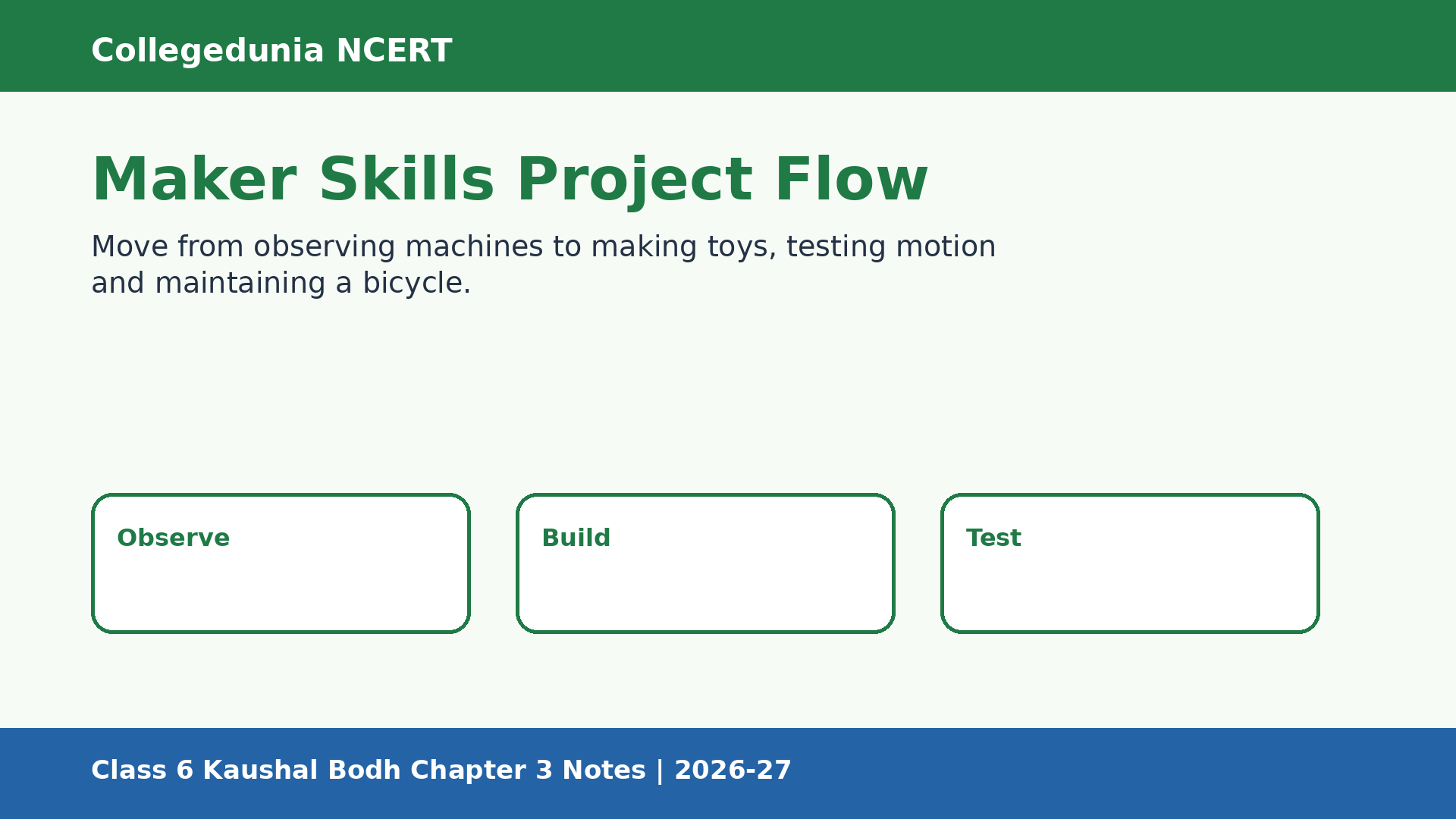
| Stage | What Students Do | Output |
|---|---|---|
| Observe | Find simple machines in daily tools and surroundings. | Examples table |
| Build | Make lever, propeller and wheel-and-axle toys. | Working models |
| Study | Identify bicycle parts and machine links. | Bicycle parts chart |
| Maintain | Check tyres, chain, brakes, nuts, bolts and tools. | Maintenance checklist |
Simple Machines in Class 6 Maker Skills
Simple machines make work easier by changing force, motion or direction. A lever turns around a fulcrum. A wheel and axle helps movement. A propeller pushes water or air. Screws, wedges and inclined planes also appear in tools and bicycles.
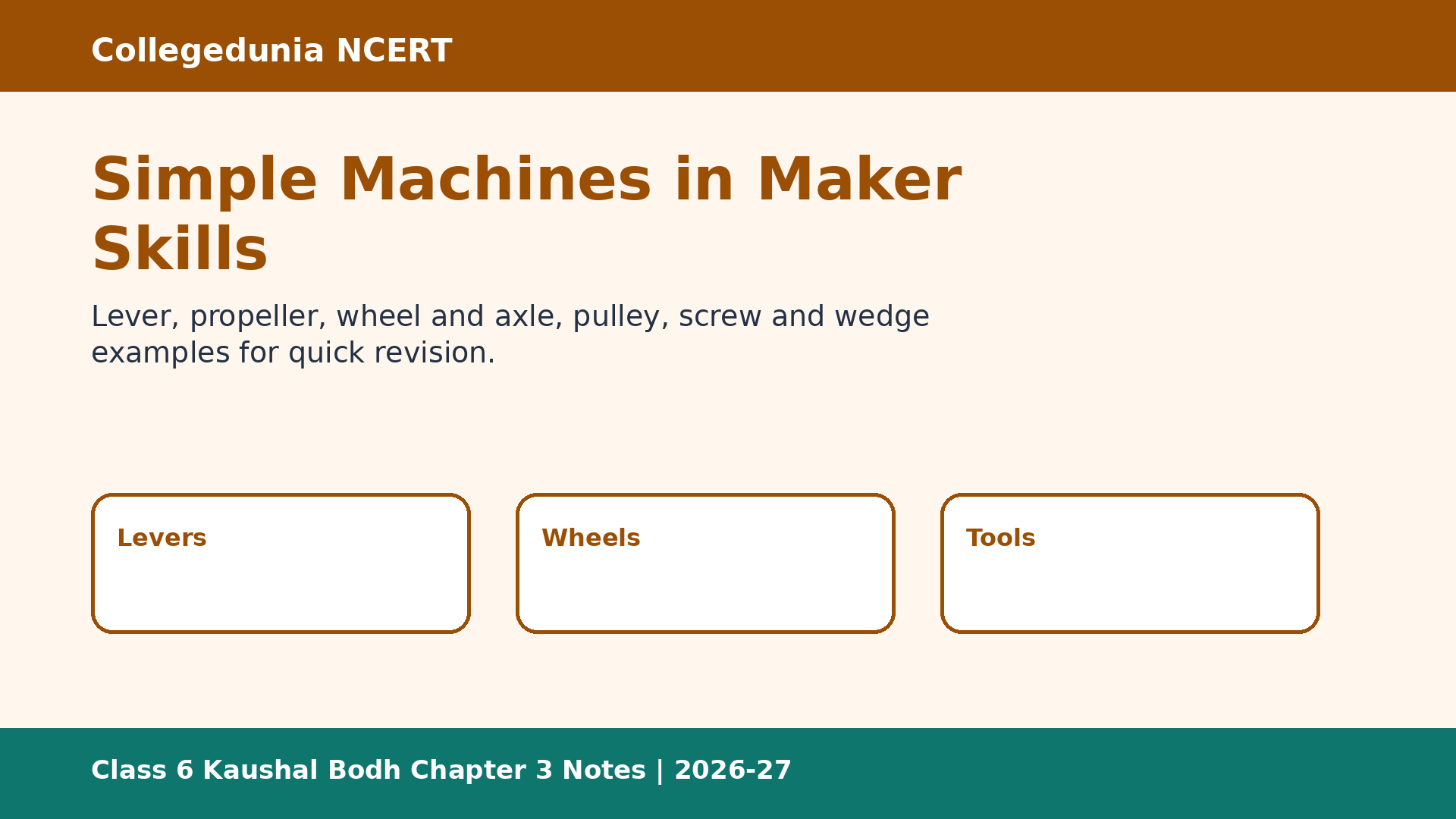
- Lever: spoon used to open a lid, catapult arm or bicycle brake lever.
- Wheel and axle: rubber-band car, cart wheel or bicycle wheel.
- Propeller: paddle wheel in the elastic-band boat.
- Screw and wedge: bicycle bolts, cutter edge, knife or tyre lever edge.
Lever Toys in Maker Skills
The catapult and robotic arm explain how levers work. In a catapult, the spoon moves around a fixed point and releases stored energy. In a robotic arm, many joined levers move together, so the far end opens and closes.
- Use soft paper balls while testing a catapult.
- Keep the robotic-arm joints free enough to move.
- Mark measurements where sticks are joined.
- Write first-use instructions for another student.
Propeller Boat and Wheel-and-Axle Car
The propeller boat shows how blades push water. The rubber band stores energy when twisted and turns the paddle when released. The rubber-band car and balloon car show how wheels and axles reduce effort and help smooth movement.
| Model | Simple Machine | Revision Point |
|---|---|---|
| Catapult | Lever | Fulcrum, effort and load can be identified. |
| Robotic arm | Multiple levers | Several levers move together. |
| Propeller boat | Propeller | Blades push against water. |
| Rubber-band car | Wheel and axle | Axles must stay straight and balanced. |
Bicycle Parts and Maintenance Checklist
A bicycle is a complex machine because many simple machines work together. Wheels, pedals, chain, brakes, brake levers, nuts, bolts and tyres help the rider move, steer and stop.
- Tyres: check air pressure and look for punctures.
- Brakes: check whether the brake lever slows the wheel properly.
- Chain: clean dirt and apply a small amount of oil or grease.
- Nuts and bolts: use the correct spanner size with adult guidance.
Safety Rules for Maker Skills Activities
Maker Skills uses sharp tools, elastic bands, glue, bicycle tools and Internet searches. Students must work under teacher guidance, keep the area clean and avoid unsafe testing.
- Use cutters, scissors, tyre levers and glue guns carefully.
- Do not point catapults or elastic toys at people.
- Do not upload, download or share personal information during DIY searches.
- Clean the workspace and store tools after every activity.
Related Class 6 Kaushal Bodh Resources for Maker Skills
| Resource | Use It For | Link |
|---|---|---|
| NCERT Book PDF | Read the official chapter text and activities. | Maker Skills NCERT Book PDF |
| Handwritten Notes | Revise the project in notebook-style format. | Class 6 Maker Skills Handwritten Notes |
| Solutions | Check activity questions and short answers. | Class 6 Maker Skills Solutions |
Class 6 Vocational Education Kaushal Bodh Notes Chapter List
| Chapter | Notes Link |
|---|---|
| Chapter 1 School Kitchen Garden | School Kitchen Garden Notes |
| Chapter 2 Biodiversity Register | Biodiversity Register Notes |
| Chapter 3 Maker Skills | Maker Skills Notes |
| Chapter 4 Animation and Games | Animation and Games Notes |
| Chapter 5 School Museum | School Museum Notes |
| Chapter 6 Cooking without Fire | Cooking without Fire Notes |
Class 6 Maker Skills Notes FAQs
Ques. What is Maker Skills in Class 6 Kaushal Bodh?
Ans. Maker Skills is a project where students learn simple machines, make toys from waste and study bicycle maintenance.
Ques. Which simple machines are covered in Maker Skills?
Ans. The chapter covers levers, propellers, wheel and axle, pulley examples, screws, wedges and inclined-plane ideas.
Ques. What toys are made in Maker Skills Chapter 3?
Ans. Students can make a catapult, robotic arm, propeller boat, rubber-band car, balloon car or similar simple-machine model.
Ques. Why is bicycle maintenance included in Maker Skills?
Ans. Bicycle maintenance helps students connect simple machines with real repair checks such as tyres, brakes, chains, nuts and bolts.



Comments