



The NCERT Class 7 Social Science Chapter 10 notes for The Constitution of India: An Introduction explain the meaning of a constitution, the Constituent Assembly, Preamble values, rights, duties and amendments for the 2026-27 NCERT textbook. The PDF helps students revise the chapter through timelines, tables and simple answer frames.
- Best for revision: Constitution meaning, Preamble values, adoption dates and key features.
- Use with the PDF: read the rulebook analogy before writing long answers.
- 2026-27 focus: follows Exploring Society: India and Beyond, Part 1, Chapter 10.
Chapter10TheConstitutionofIndia%E2%80%94AnIntroductionNotes.pdf?page=1&dpi=150)
Chapter10TheConstitutionofIndia%E2%80%94AnIntroductionNotes.pdf?page=2&dpi=150)
Chapter10TheConstitutionofIndia%E2%80%94AnIntroductionNotes.pdf?page=3&dpi=150)
Chapter10TheConstitutionofIndia%E2%80%94AnIntroductionNotes.pdf?page=4&dpi=150)
Chapter10TheConstitutionofIndia%E2%80%94AnIntroductionNotes.pdf?page=5&dpi=150)
Chapter10TheConstitutionofIndia%E2%80%94AnIntroductionNotes.pdf?page=6&dpi=150)
Chapter10TheConstitutionofIndia%E2%80%94AnIntroductionNotes.pdf?page=7&dpi=150)
Chapter10TheConstitutionofIndia%E2%80%94AnIntroductionNotes.pdf?page=8&dpi=150)
Chapter10TheConstitutionofIndia%E2%80%94AnIntroductionNotes.pdf?page=9&dpi=150)
Chapter10TheConstitutionofIndia%E2%80%94AnIntroductionNotes.pdf?page=10&dpi=150)
Chapter10TheConstitutionofIndia%E2%80%94AnIntroductionNotes.pdf?page=11&dpi=150)
Chapter10TheConstitutionofIndia%E2%80%94AnIntroductionNotes.pdf?page=12&dpi=150)
Chapter10TheConstitutionofIndia%E2%80%94AnIntroductionNotes.pdf?page=13&dpi=150)
Chapter10TheConstitutionofIndia%E2%80%94AnIntroductionNotes.pdf?page=14&dpi=150)
Chapter10TheConstitutionofIndia%E2%80%94AnIntroductionNotes.pdf?page=15&dpi=150)
Chapter10TheConstitutionofIndia%E2%80%94AnIntroductionNotes.pdf?page=16&dpi=150)
Chapter10TheConstitutionofIndia%E2%80%94AnIntroductionNotes.pdf?page=17&dpi=150)
Chapter10TheConstitutionofIndia%E2%80%94AnIntroductionNotes.pdf?page=18&dpi=150)
Chapter10TheConstitutionofIndia%E2%80%94AnIntroductionNotes.pdf?page=19&dpi=150)
Chapter10TheConstitutionofIndia%E2%80%94AnIntroductionNotes.pdf?page=20&dpi=150)
Chapter10TheConstitutionofIndia%E2%80%94AnIntroductionNotes.pdf?page=21&dpi=150)
Chapter10TheConstitutionofIndia%E2%80%94AnIntroductionNotes.pdf?page=22&dpi=150)
Chapter10TheConstitutionofIndia%E2%80%94AnIntroductionNotes.pdf?page=23&dpi=150)
Chapter10TheConstitutionofIndia%E2%80%94AnIntroductionNotes.pdf?page=24&dpi=150)
Chapter10TheConstitutionofIndia%E2%80%94AnIntroductionNotes.pdf?page=25&dpi=150)
Chapter10TheConstitutionofIndia%E2%80%94AnIntroductionNotes_flat_MobileCard.pdf?page=1&dpi=150)
Chapter10TheConstitutionofIndia%E2%80%94AnIntroductionNotes_flat_MobileCard.pdf?page=2&dpi=150)
Chapter10TheConstitutionofIndia%E2%80%94AnIntroductionNotes_flat_MobileCard.pdf?page=3&dpi=150)
Chapter10TheConstitutionofIndia%E2%80%94AnIntroductionNotes_flat_MobileCard.pdf?page=4&dpi=150)
Chapter10TheConstitutionofIndia%E2%80%94AnIntroductionNotes_flat_MobileCard.pdf?page=5&dpi=150)
Chapter10TheConstitutionofIndia%E2%80%94AnIntroductionNotes_flat_MobileCard.pdf?page=6&dpi=150)
Chapter10TheConstitutionofIndia%E2%80%94AnIntroductionNotes_flat_MobileCard.pdf?page=7&dpi=150)
Chapter10TheConstitutionofIndia%E2%80%94AnIntroductionNotes_flat_MobileCard.pdf?page=8&dpi=150)
Chapter10TheConstitutionofIndia%E2%80%94AnIntroductionNotes_flat_MobileCard.pdf?page=9&dpi=150)
Chapter10TheConstitutionofIndia%E2%80%94AnIntroductionNotes_flat_MobileCard.pdf?page=10&dpi=150)
Chapter10TheConstitutionofIndia%E2%80%94AnIntroductionNotes_flat_MobileCard.pdf?page=11&dpi=150)
Chapter10TheConstitutionofIndia%E2%80%94AnIntroductionNotes_flat_MobileCard.pdf?page=12&dpi=150)
Chapter10TheConstitutionofIndia%E2%80%94AnIntroductionNotes_flat_MobileCard.pdf?page=13&dpi=150)
Chapter10TheConstitutionofIndia%E2%80%94AnIntroductionNotes_flat_MobileCard.pdf?page=14&dpi=150)
Chapter10TheConstitutionofIndia%E2%80%94AnIntroductionNotes_flat_MobileCard.pdf?page=15&dpi=150)
Chapter10TheConstitutionofIndia%E2%80%94AnIntroductionNotes_flat_MobileCard.pdf?page=16&dpi=150)
Chapter10TheConstitutionofIndia%E2%80%94AnIntroductionNotes_flat_MobileCard.pdf?page=17&dpi=150)
Chapter10TheConstitutionofIndia%E2%80%94AnIntroductionNotes_flat_MobileCard.pdf?page=18&dpi=150)
Chapter10TheConstitutionofIndia%E2%80%94AnIntroductionNotes_flat_MobileCard.pdf?page=19&dpi=150)
Chapter10TheConstitutionofIndia%E2%80%94AnIntroductionNotes_flat_MobileCard.pdf?page=20&dpi=150)
Chapter10TheConstitutionofIndia%E2%80%94AnIntroductionNotes_flat_MobileCard.pdf?page=21&dpi=150)
Chapter10TheConstitutionofIndia%E2%80%94AnIntroductionNotes_flat_MobileCard.pdf?page=22&dpi=150)
Chapter10TheConstitutionofIndia%E2%80%94AnIntroductionNotes_flat_MobileCard.pdf?page=23&dpi=150)
Chapter10TheConstitutionofIndia%E2%80%94AnIntroductionNotes_flat_MobileCard.pdf?page=24&dpi=150)
Chapter10TheConstitutionofIndia%E2%80%94AnIntroductionNotes_flat_MobileCard.pdf?page=25&dpi=150)
Chapter10TheConstitutionofIndia%E2%80%94AnIntroductionNotes_flat_MobileCard.pdf?page=26&dpi=150)
Chapter10TheConstitutionofIndia%E2%80%94AnIntroductionNotes_flat_MobileCard.pdf?page=27&dpi=150)
Chapter10TheConstitutionofIndia%E2%80%94AnIntroductionNotes_flat_MobileCard.pdf?page=28&dpi=150)
Chapter10TheConstitutionofIndia%E2%80%94AnIntroductionNotes_flat_MobileCard.pdf?page=29&dpi=150)
Chapter10TheConstitutionofIndia%E2%80%94AnIntroductionNotes_flat_MobileCard.pdf?page=30&dpi=150)
Chapter10TheConstitutionofIndia%E2%80%94AnIntroductionNotes_flat_MobileCard.pdf?page=31&dpi=150)
Chapter10TheConstitutionofIndia%E2%80%94AnIntroductionNotes_flat_MobileCard.pdf?page=32&dpi=150)
Chapter10TheConstitutionofIndia%E2%80%94AnIntroductionNotes_flat_MobileCard.pdf?page=33&dpi=150)
Chapter10TheConstitutionofIndia%E2%80%94AnIntroductionNotes_flat_MobileCard.pdf?page=34&dpi=150)
Chapter10TheConstitutionofIndia%E2%80%94AnIntroductionNotes_flat_MobileCard.pdf?page=35&dpi=150)
Chapter10TheConstitutionofIndia%E2%80%94AnIntroductionNotes_flat_MobileCard.pdf?page=36&dpi=150)
Student Feedback: In a Collegedunia poll of 10,420 Class 7 students before the 2026 school exams, 78% said Chapter 10 became easier after they grouped the Constitution under rules, rights, duties and values.
|
Table of Contents |
The Constitution of India Notes Highlights
The Constitution of India: An Introduction explains why a country needs shared rules. The safest revision line is that a constitution limits power, protects rights and sets national goals.
| Topic | What to remember | Exam cue |
|---|---|---|
| Constitution | Basic principles and laws of a nation | Use in definition answers |
| Rulebook example | Shared rules settle disputes fairly | Use for why we need a constitution |
| Preamble | Justice, liberty, equality and fraternity | Use for value-based answers |
| Amendment | Formal change made through constitutional method | Use for relevance today |
Why a Constitution Works Like a Rulebook
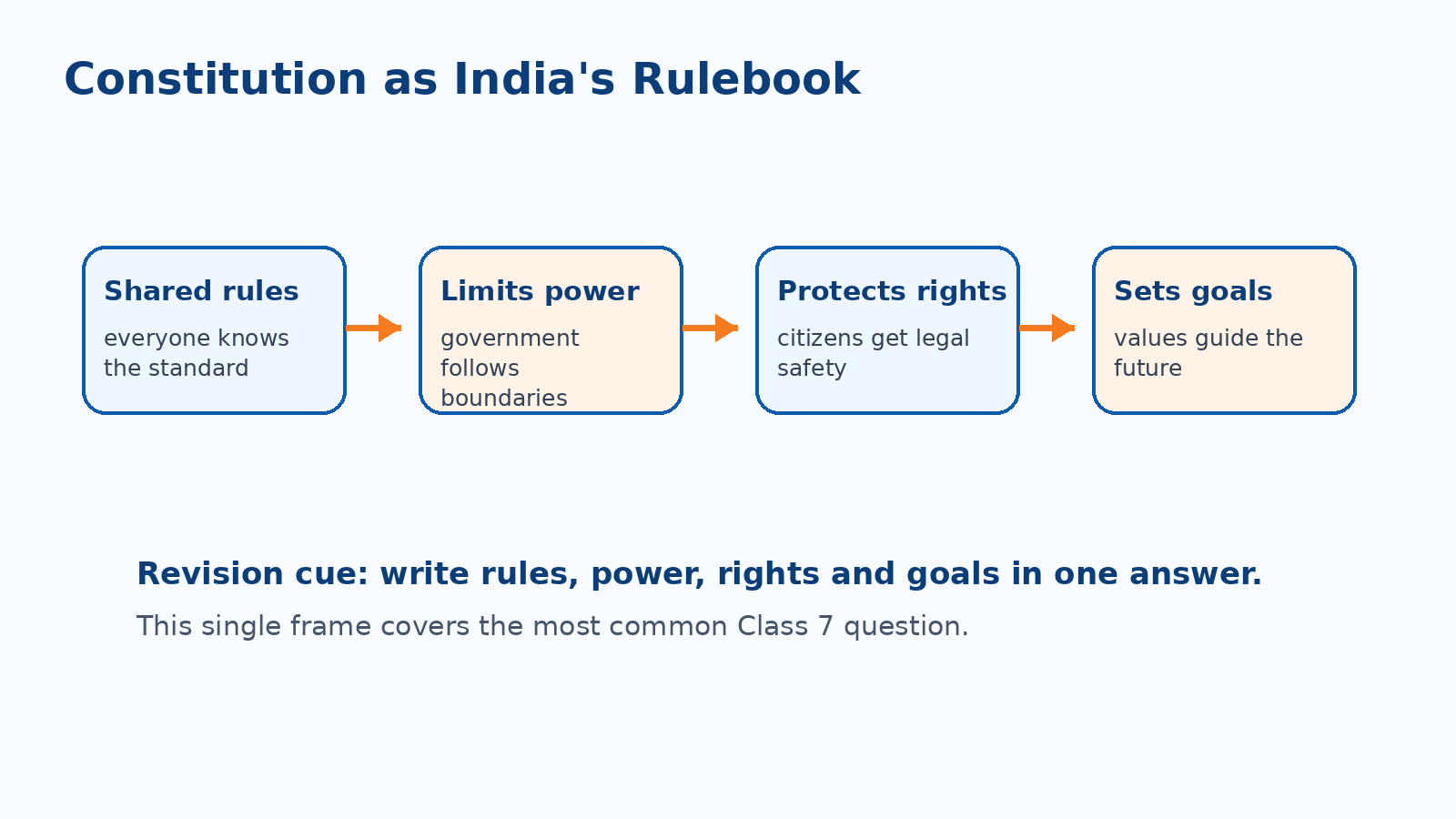
The NCERT chapter uses a game rulebook to explain the idea. A rulebook matters only when everyone accepts it. A constitution works in the same way for a country because it gives a common standard for power, rights and fairness.
- Rules: everyone knows what is allowed.
- Limits: government power is controlled by law.
- Rights: citizens get protection from unfair action.
The Constitution of India Class 7 Video Explanation
Source: Magnet Brains on YouTube
Preamble Values in The Constitution of India

The Preamble gives the guiding values of the Constitution. Justice, liberty, equality and fraternity are the four value words students should revise in order.
| Value | Meaning | How to use it in answers |
|---|---|---|
| Justice | Fairness in social, economic and political life | Use for equality and welfare |
| Liberty | Freedom of thought, belief and worship | Use for individual freedom |
| Equality | Equal status and opportunity | Use for equal citizenship |
| Fraternity | Dignity, unity and brotherhood | Use for national unity |
Making and Relevance of India's Constitution
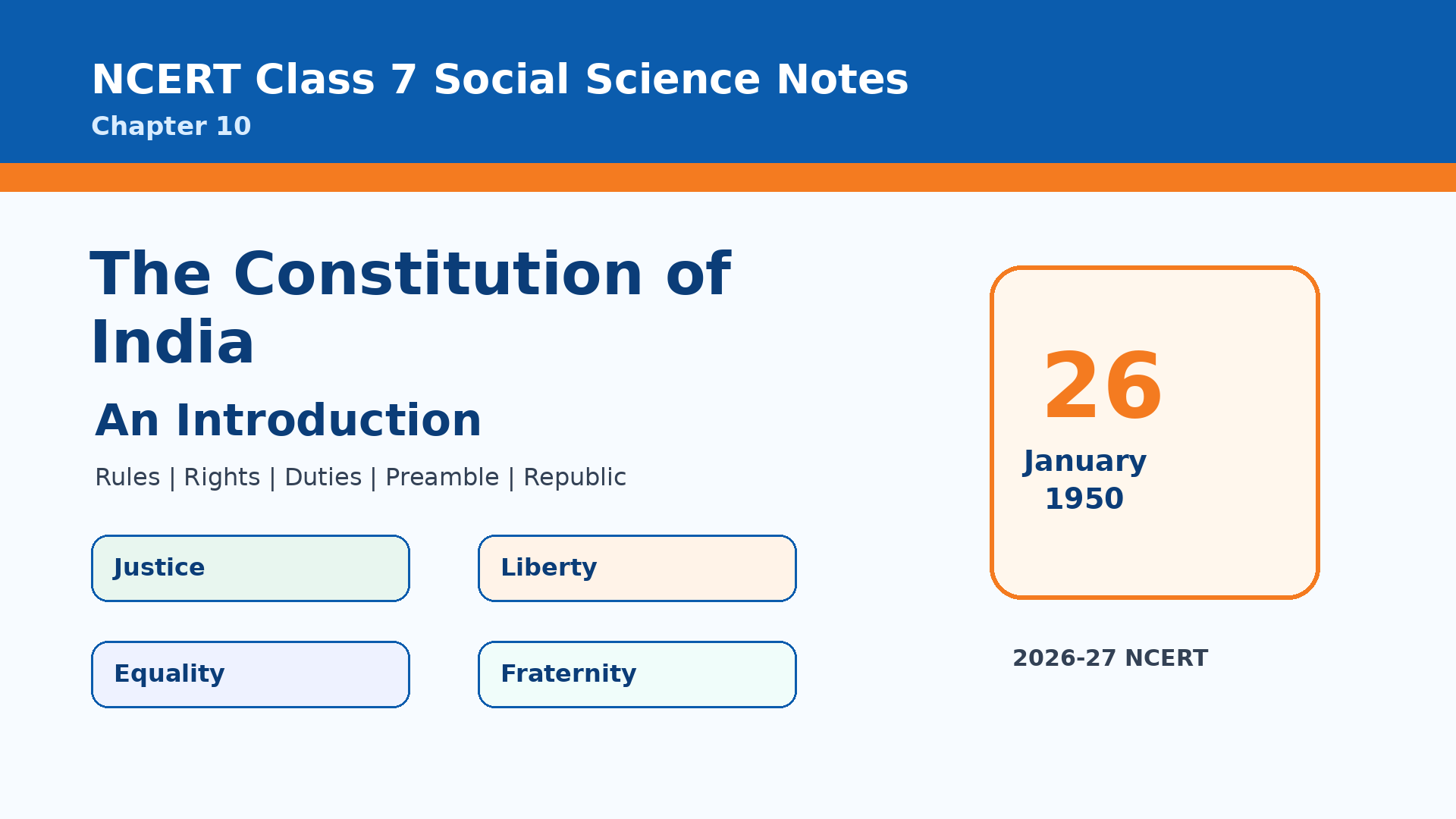
The Constituent Assembly began work in 1946. The Constitution was adopted on 26 November 1949 and came into effect on 26 January 1950. Students should not swap these two dates.
- Freedom-struggle ideals shaped the demand for dignity and rights.
- Debates helped fit constitutional ideas to India's diversity.
- Amendments help the Constitution respond to new needs.
More Class 7 Social Science Chapter 10 Resources
Use these related NCERT resources when you want Chapter 10 in another format. The official book PDF is useful for source reading, while handwritten notes help with quick recall.
| Resource | Best use | Link |
|---|---|---|
| NCERT Solutions | Practice textbook questions and activities | Open NCERT Solutions |
| NCERT Book PDF | Read the official chapter | Open Book PDF |
| Handwritten Notes | Revise terms, dates and Preamble values quickly | Open Handwritten Notes |
All Class 7 Social Science Part 1 Notes
The table below keeps the same resource type together, so students can move chapter by chapter through Class 7 Social Science Part 1 notes.
| Chapter | NCERT chapter title | Notes link |
|---|---|---|
| Chapter 1 | Geographical Diversity of India | Open Notes |
| Chapter 2 | Understanding the Weather | Open Notes |
| Chapter 3 | Climates of India | Open Notes |
| Chapter 4 | New Beginnings: Cities and States | Open Notes |
| Chapter 5 | The Rise of Empires | Open Notes |
| Chapter 6 | The Age of Reorganisation | Open Notes |
| Chapter 7 | The Gupta Era: An Age of Tireless Creativity | Open Notes |
| Chapter 8 | How the Land Becomes Sacred | Open Notes |
| Chapter 9 | From the Rulers to the Ruled: Types of Governments | Open Notes |
| Chapter 10 | The Constitution of India: An Introduction | Current notes |
| Chapter 11 | From Barter to Money | Open Notes |
| Chapter 12 | Understanding Markets | Open Notes |
Class 7 Social Science Chapter 10 The Constitution of India Notes FAQs
Ques. What is a constitution?
Ans. A constitution is a country's basic rulebook. It gives principles, government structure, citizen rights, duties and national goals.
Ques. When did the Indian Constitution come into effect?
Ans. The Indian Constitution came into effect on 26 January 1950. It was adopted earlier, on 26 November 1949.
Ques. What are the main values in the Preamble?
Ans. The main values are justice, liberty, equality and fraternity. They guide the spirit of the Constitution.
Ques. Why is the Constitution still relevant today?
Ans. It is relevant because its values guide India, while amendments allow lawful changes when society faces new needs.



Comments