




7 to 9 marks per Class 7 annual paper come from The Constitution of India: An Introduction. These NCERT Solutions cover the chapter for the 2026-27 session.
- Question coverage: all 7 questions, Constituent Assembly, Preamble values, Article 14, universal franchise, crossword.
- Exam weight: reasoning-based civics answers carry 7 to 9 marks.
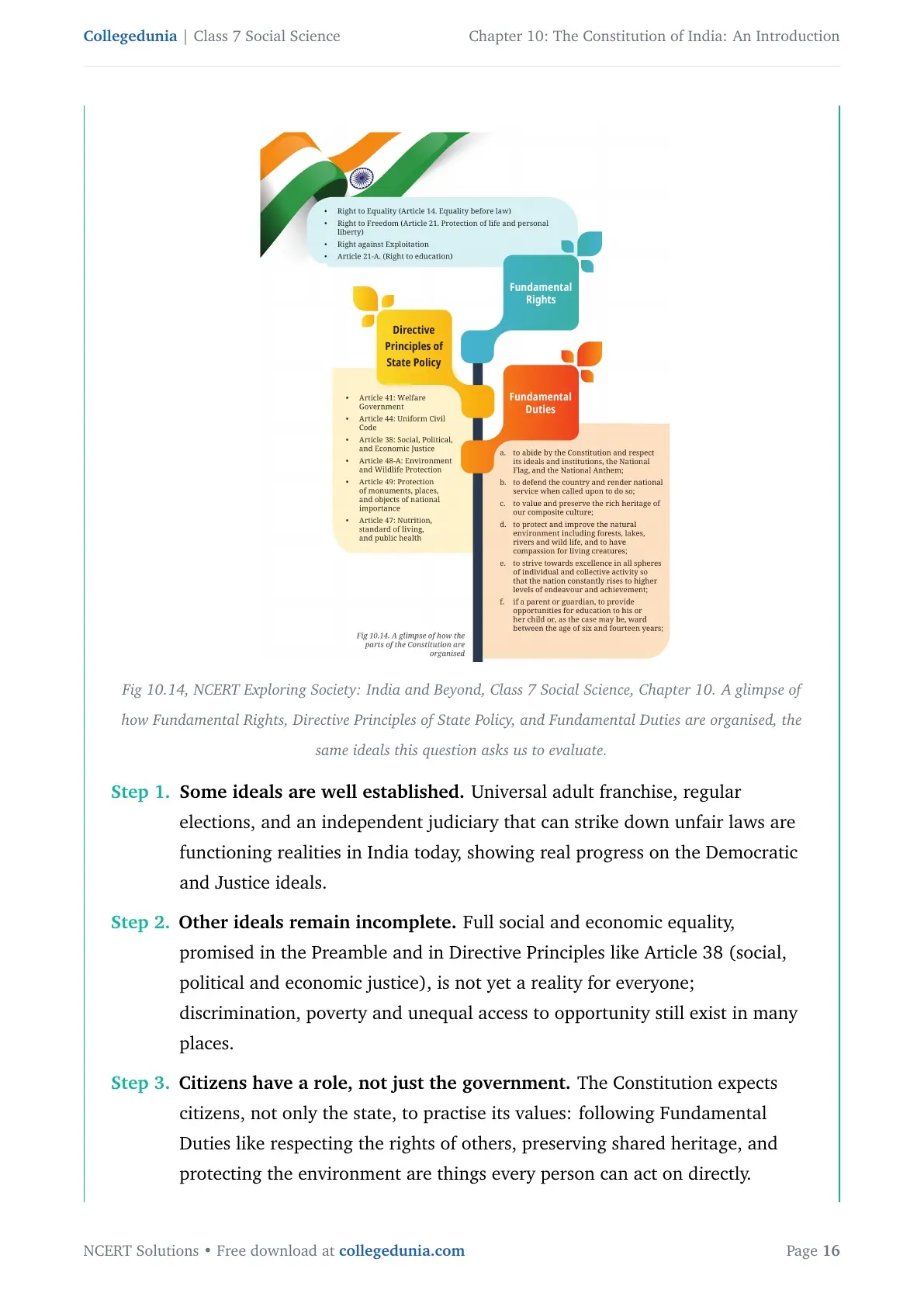
- Also on this page: a three-source image, a Rights-Duties-DPSP image, and links to the Notes and Book PDF.
Every solution here is curated by subject experts and checked against the 2026-27 rationalised NCERT print.
Want the full worked answers, one question at a time? Open the dedicated question bank below for step-by-step solutions to every question and activity in The Constitution of India: An Introduction, each with a concept explanation, an Expert's Solution and a boxed final answer.
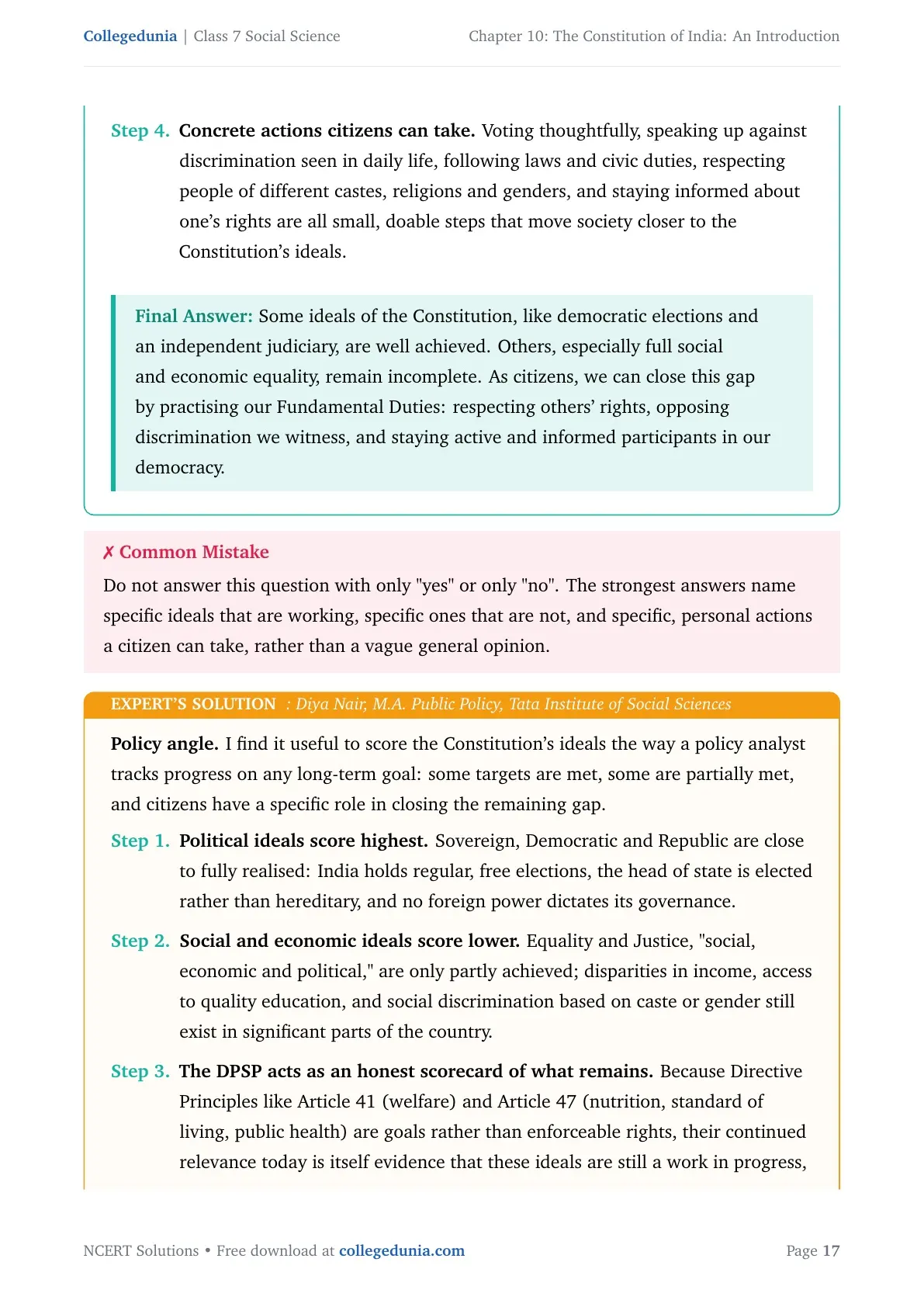
View All Step-by-Step Solutions for The Constitution of India: An Introduction
Why The Constitution of India Matters for Class 7 Social Science
This chapter closes Theme D, Governance and Democracy, in Exploring Society: India and Beyond, Part 1, naming the rulebook India chose for itself: the Constitution.
NCERT tests whether a student can connect an everyday scene to the exact constitutional value it reflects.
| Concept | What it means | Why it matters |
|---|---|---|
| Constitution | Document spelling out a nation's basic principles, laws, and organs of government | Names the "rulebook" this chapter builds towards |
| Constituent Assembly | 389-member (later 299) body that wrote the Constitution, 1946-1949 | Drafted by elected representatives, not one leader |
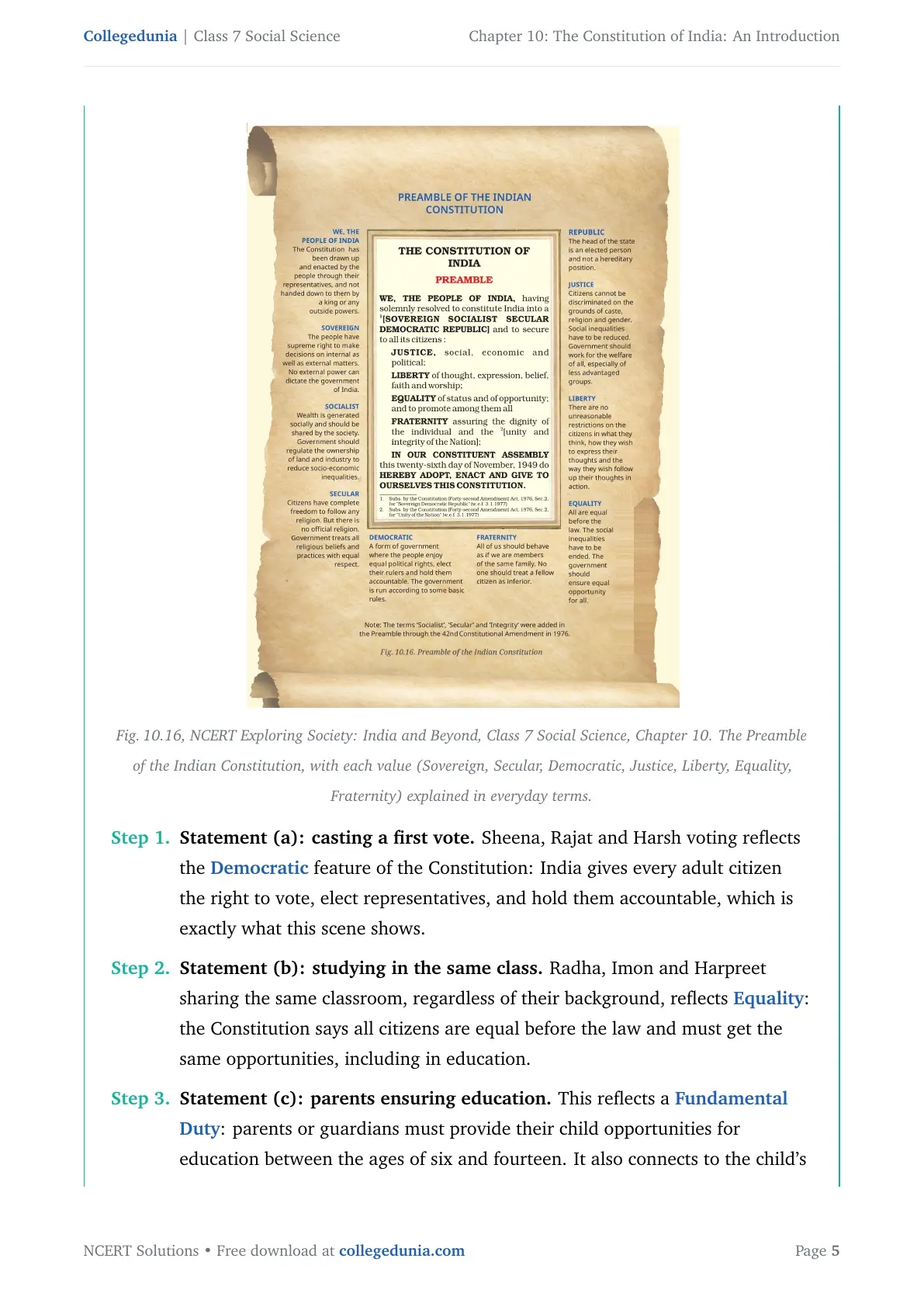
| Preamble | Sovereign, Socialist, Secular, Democratic, Republic, Justice, Liberty, Equality, Fraternity | Every "match this scene to a value" question is a Preamble question |
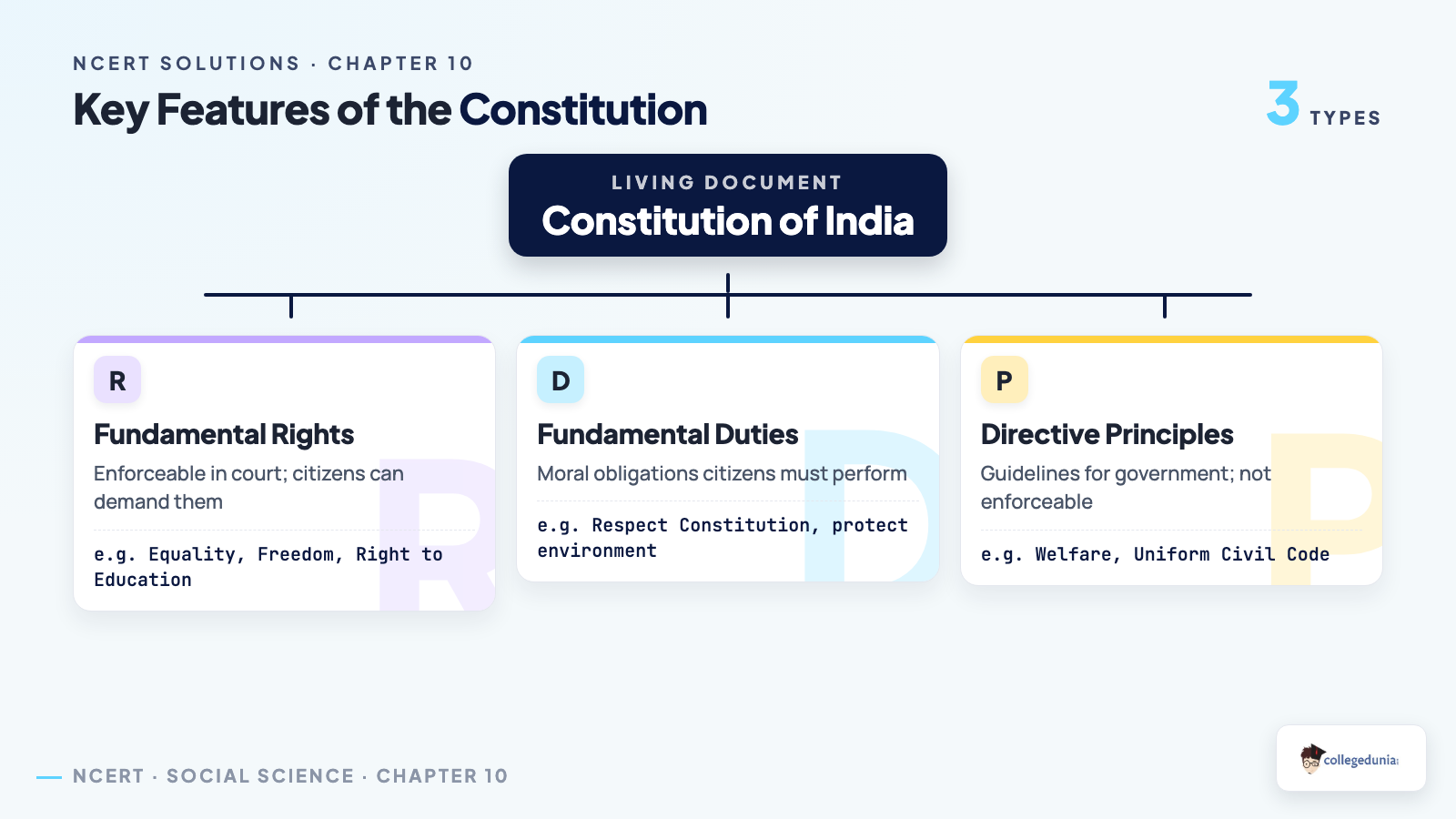
| Fundamental Duties and DPSP | Duties citizens must perform, and guidelines government should follow but courts cannot enforce | Owed by a citizen vs. merely aimed at by the state |
Naming the exact term, Democratic, Equality, Fundamental Duty, earns full marks over vague general words.
The Constitution of India Explained for Class 7 Boards
Source: Magnet Brains on YouTube
The Constitution of India Question and Activity Breakdown
The chapter closes with seven questions under Questions and Activities, each asking for reasoning, not a single fixed fact.
| Question | What it covers | Answer type |
|---|---|---|
| Q1 | Why the Assembly needed diverse representatives | Long reasoning |
| Q2 | Matching statements to Preamble values | Applied identification |
| Q3 | Whether equality before law is a fact | Argument-based opinion |
| Q4 | Why India gave universal franchise from the start | Explain-type reasoning |
| Q5 | How the freedom struggle and heritage shaped it | Two-part explain |
| Q6 | Whether society has achieved the ideals | Reflective, citizen-action |
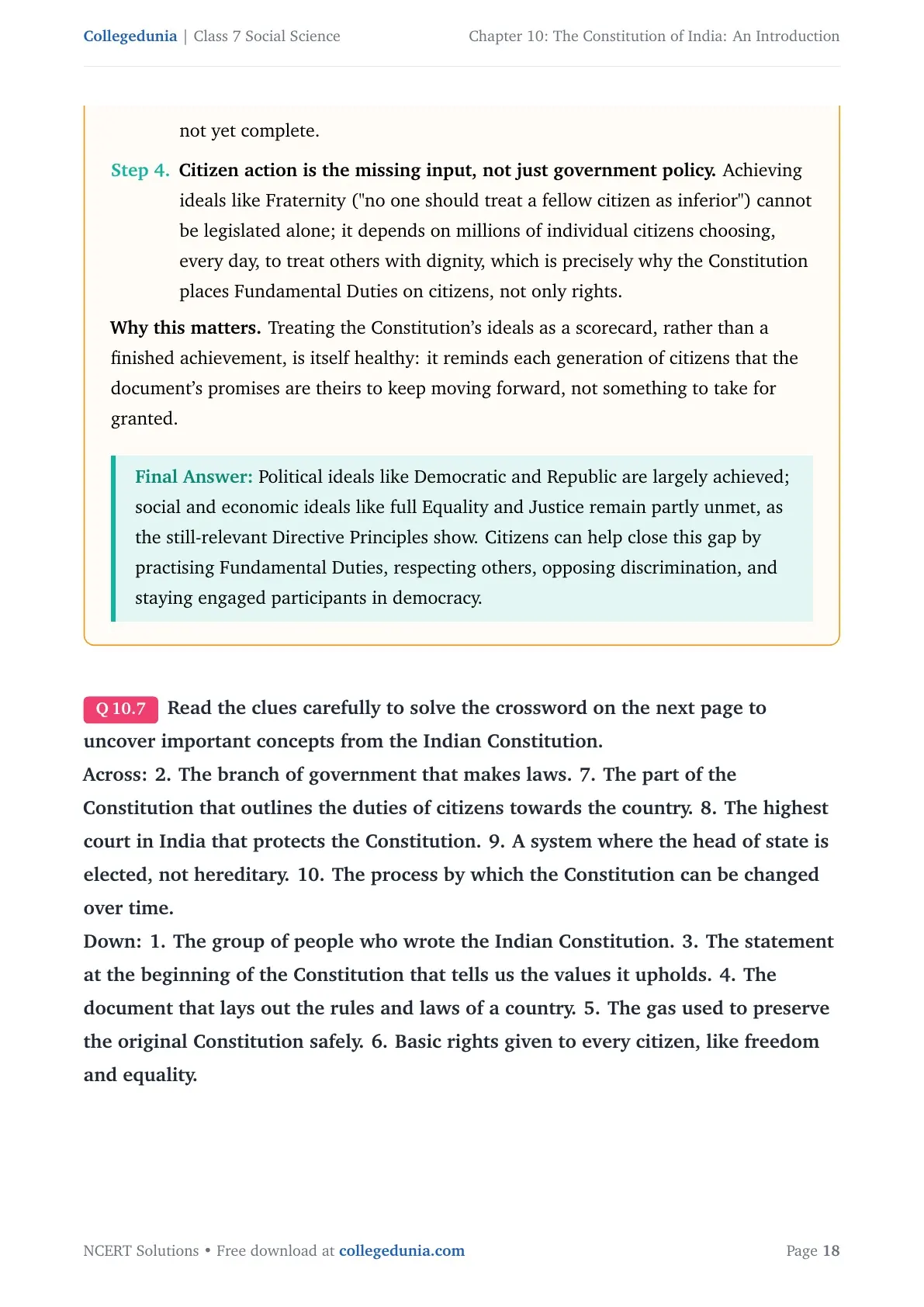
| Q7 | Ten-clue crossword on constitutional terms | Recall and matching |
Teachers usually pick Q1, Q2 or Q3 for a periodic test, so practising these three first is time well spent.
Why the Constituent Assembly Needed Diverse Members
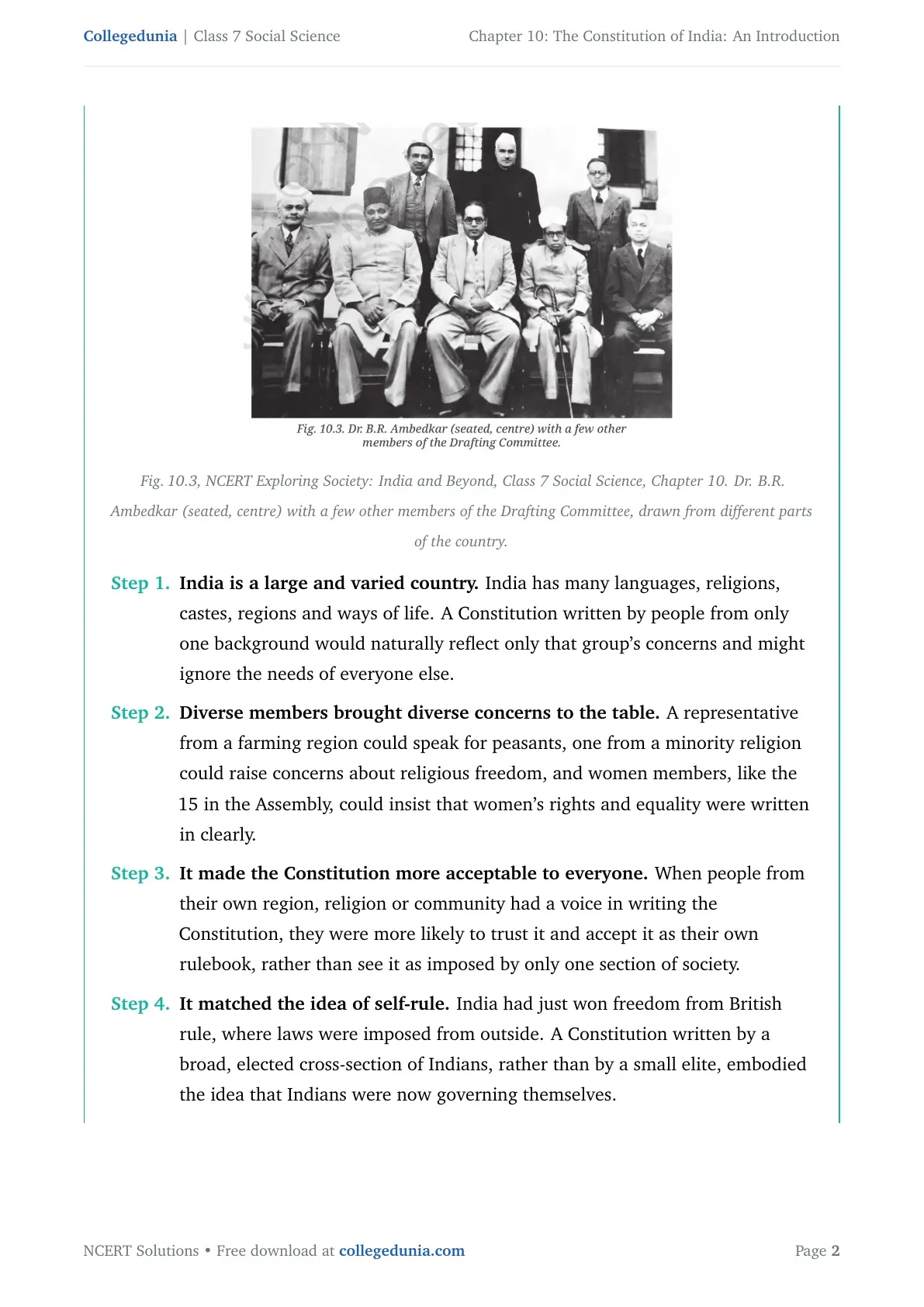
Q1 asks why the Assembly needed representatives from diverse backgrounds. It was formed in 1946 with 389 members (later 299, after Partition), of whom 15 were women.
- India is large and varied: one group alone would have ignored others' languages, religions, castes and regions.
- Diverse members brought diverse concerns, peasants, minorities and women all pressing for their own rights.
- It made the Constitution acceptable to everyone and matched self-rule, not imposed from outside, Indians governing themselves after winning freedom.
A Constitution binding every citizen needed to be written by people just as varied as the country itself.
Preamble Values in Everyday Situations
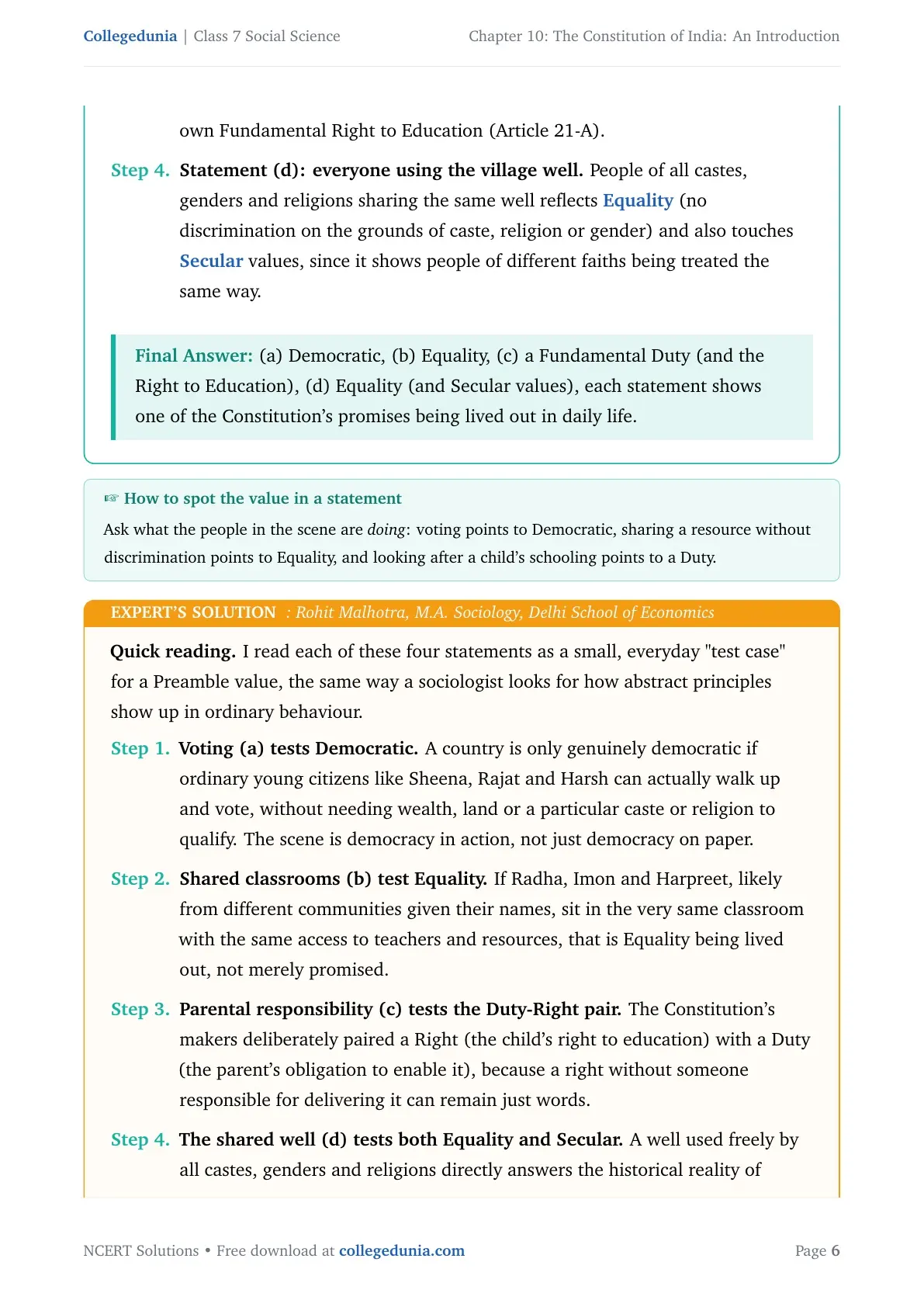
Q2 gives four short scenes and asks which Preamble value each reflects. The Preamble lists nine promises: Sovereign, Socialist, Secular, Democratic, Republic, Justice, Liberty, Equality and Fraternity.
| Statement | What happens | Value it reflects |
|---|---|---|
| (a) | Sheena, Rajat and Harsh cast their first vote | Democratic |
| (b) | Radha, Imon and Harpreet study in the same class | Equality |
| (c) | Parents ensure children's education | A Fundamental Duty (and Right to Education) |
| (d) | All castes, genders and religions use the village well | Equality and Secular values |
Ask what the people in the scene are doing, not who they are. Naming the exact Preamble word separates a full-mark answer from a vague one.
Equality Before Law: Promise and Practice
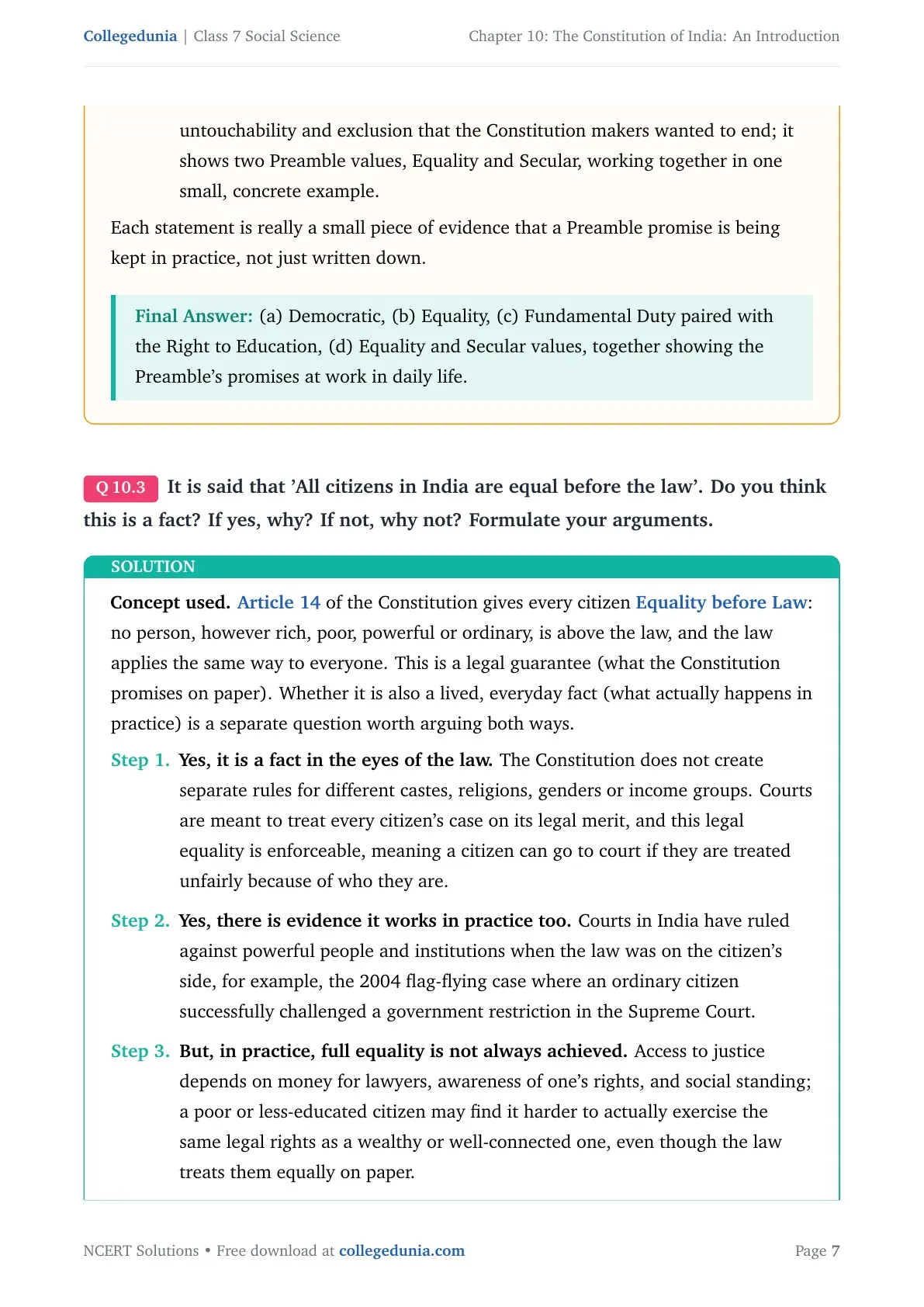
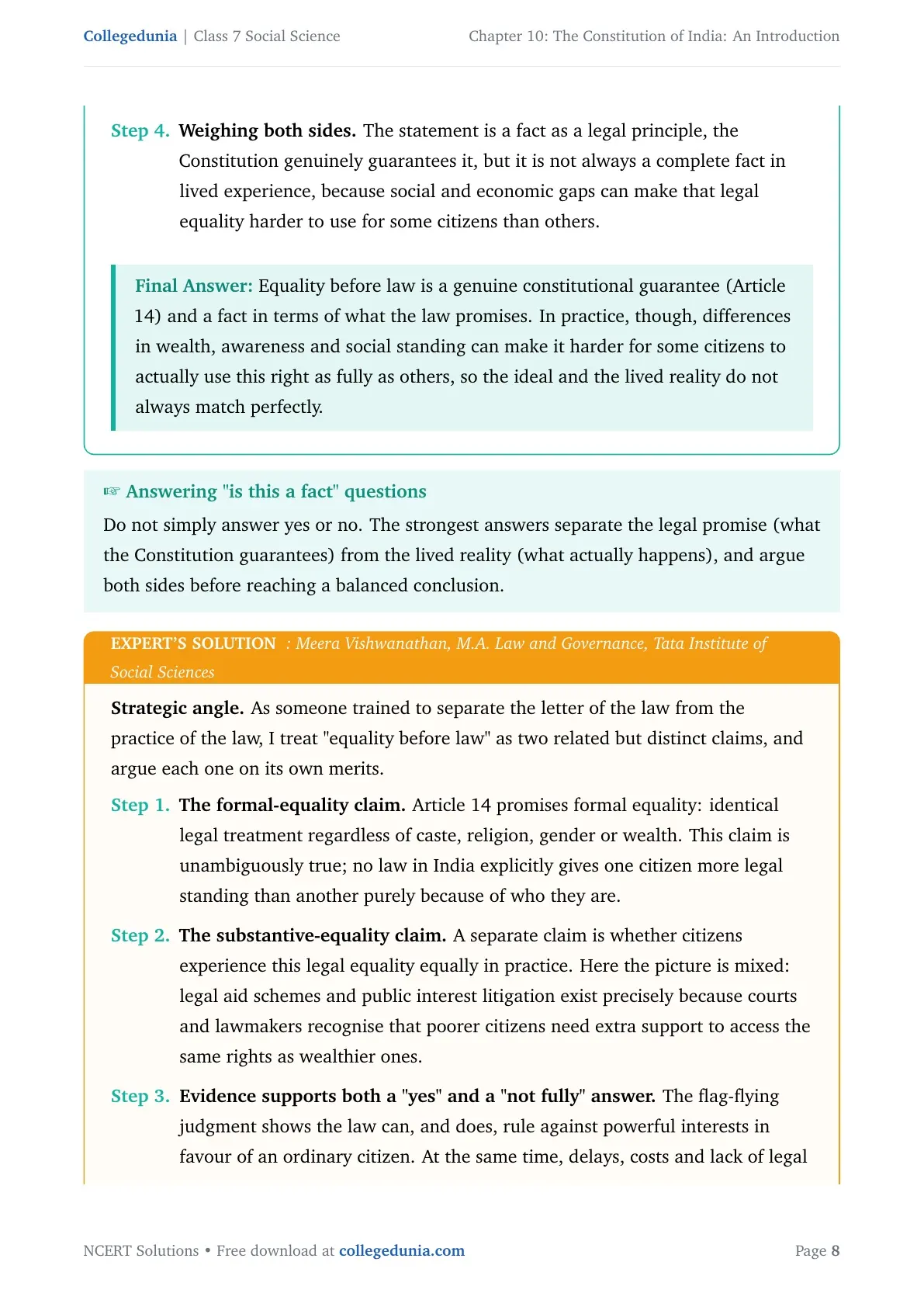
Q3 asks students to argue whether "all citizens are equal before the law" is a fact. Article 14 gives every citizen Equality before Law: no person, however powerful, is above the law, a legal guarantee, but a lived fact is worth arguing both ways.
- Yes, in the eyes of the law: this equality is enforceable in court.
- Yes, there is evidence it works: the 2004 flag-flying case saw an ordinary citizen challenge a government restriction, and win, in the Supreme Court.
- But full equality is not always achieved, since access to justice depends on money for lawyers and awareness of one's rights.
Separate the legal promise from the lived reality, argue both sides, then reach a balanced conclusion.
Why India Gave Every Adult the Vote From Day One
Q4 asks why India granted universal adult franchise from its first general elections in 1951-52, unlike most Western democracies.
- The freedom struggle was a mass movement across castes, religions and regions, so denying anyone the vote would have contradicted it.
- Equality was a founding value: restricting the vote to the educated or propertied would have broken the Preamble's own promise, and a young republic needed legitimacy from everyone.
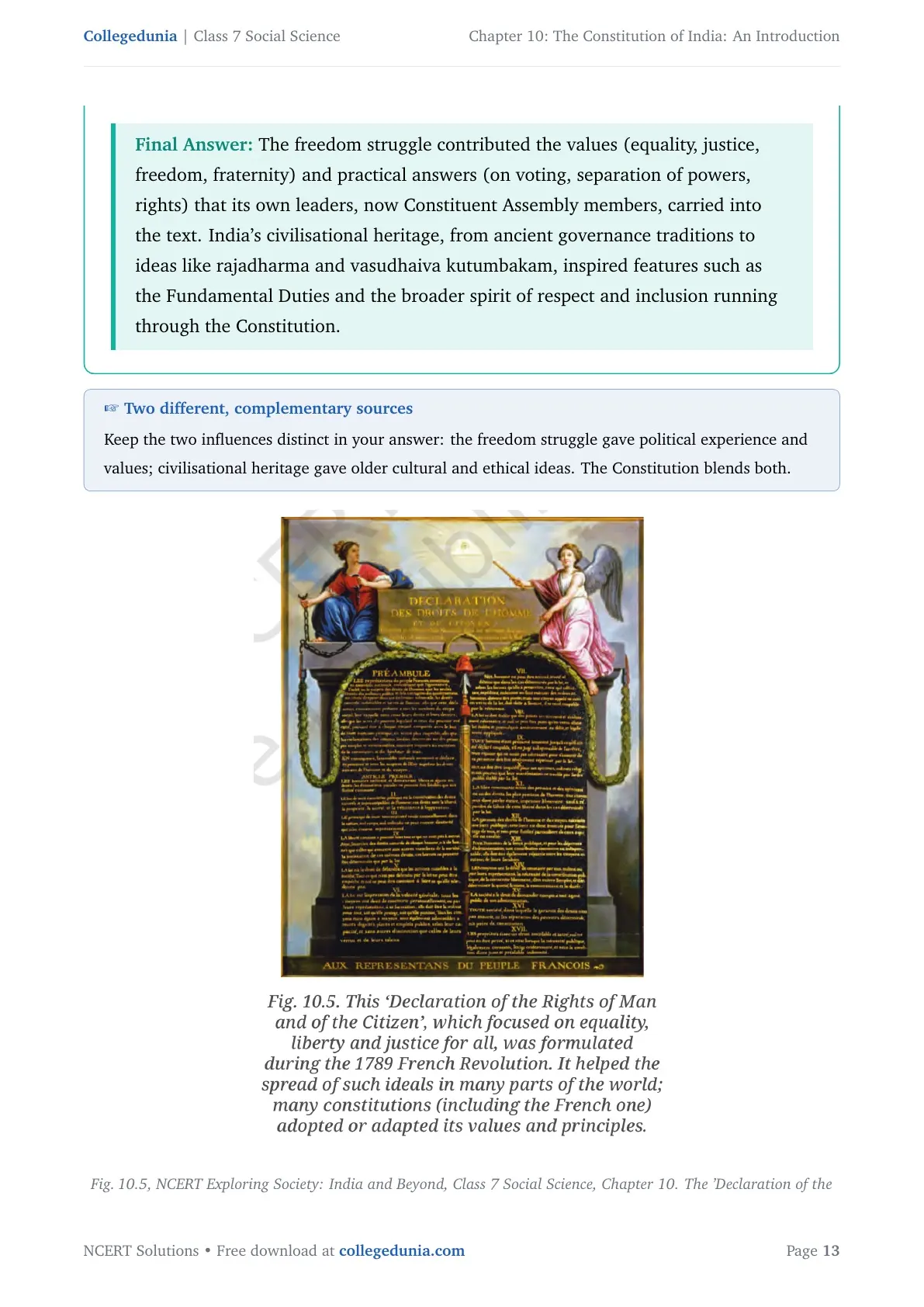
- India chose not to copy the slow, gradual model of the UK, USA and France, though its makers studied those constitutions closely.
Choosing universal adult franchise in 1950, when many richer nations had not, was a genuinely bold decision for a mostly rural, non-literate country.
Two Roots of the Constitution: Freedom Struggle and Civilisational Heritage
Q5 asks how the Indian freedom movement and India's civilisational heritage shaped the Constitution, plus a third source, other constitutions.
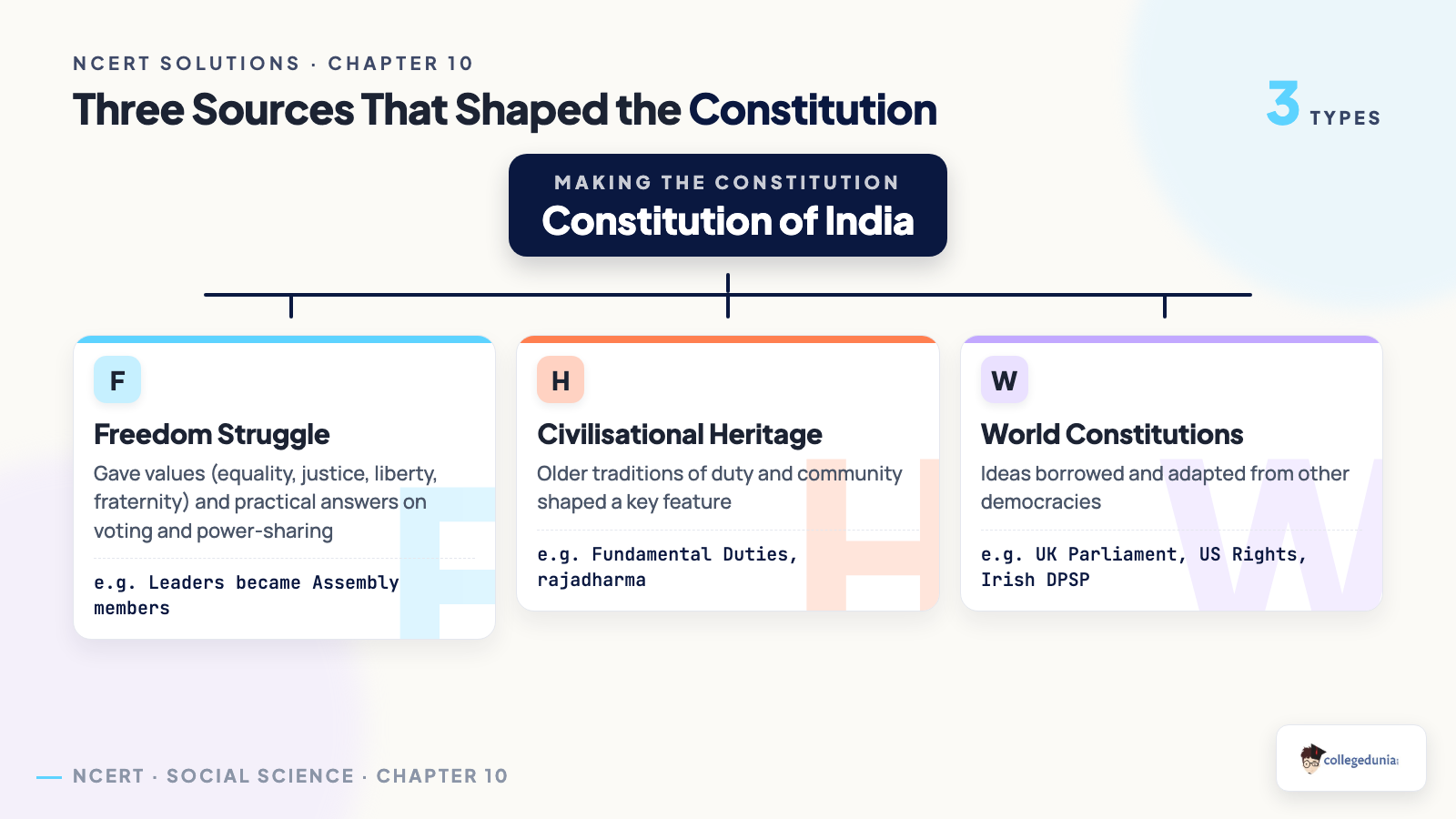
- The freedom struggle supplied values and answers on voting rights, separation of powers, and individual rights, since many of its leaders were themselves Assembly members.
- Civilisational heritage shaped Fundamental Duties, older traditions from the janapadas and sanghas to Kautilya's rajadharma, and the spirit of vasudhaiva kutumbakam, "the world is one family".
Keep the two influences distinct: the freedom struggle gave political experience and values; civilisational heritage gave older cultural and ethical ideas.
Rights, Duties and the Directive Principles
Q6 asks whether society has achieved the Constitution's ideals, and what citizens can do about it.
- Some ideals are well established: universal franchise, regular elections and an independent judiciary function today.
- Others remain incomplete, since full social and economic equality is not yet real for everyone.
- Citizens can act: practising Fundamental Duties, voting thoughtfully, speaking up against discrimination.
Name specific ideals that are working, specific ones that are not, and a specific personal action, rather than a vague general opinion.
Solving the Constitution Crossword
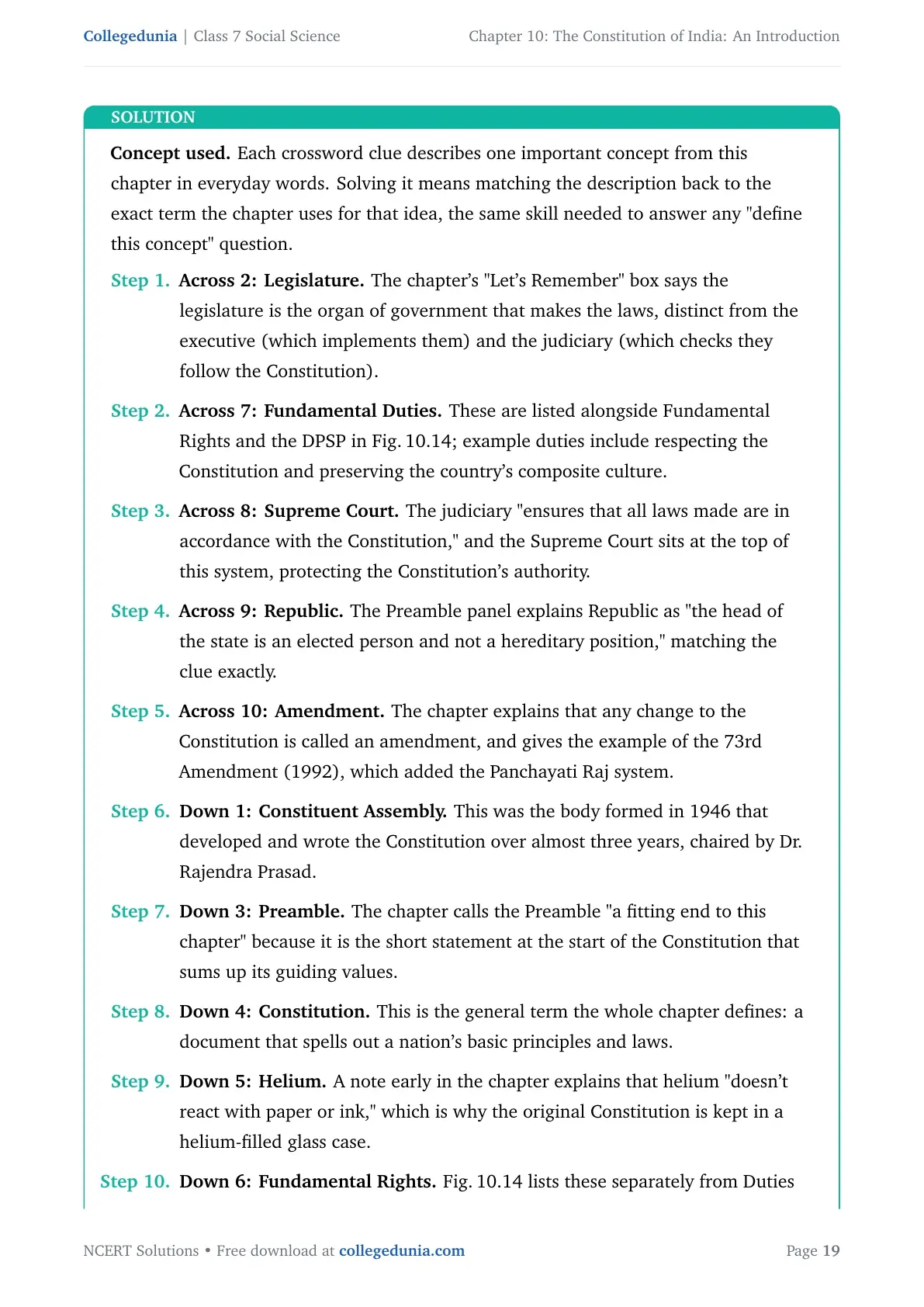
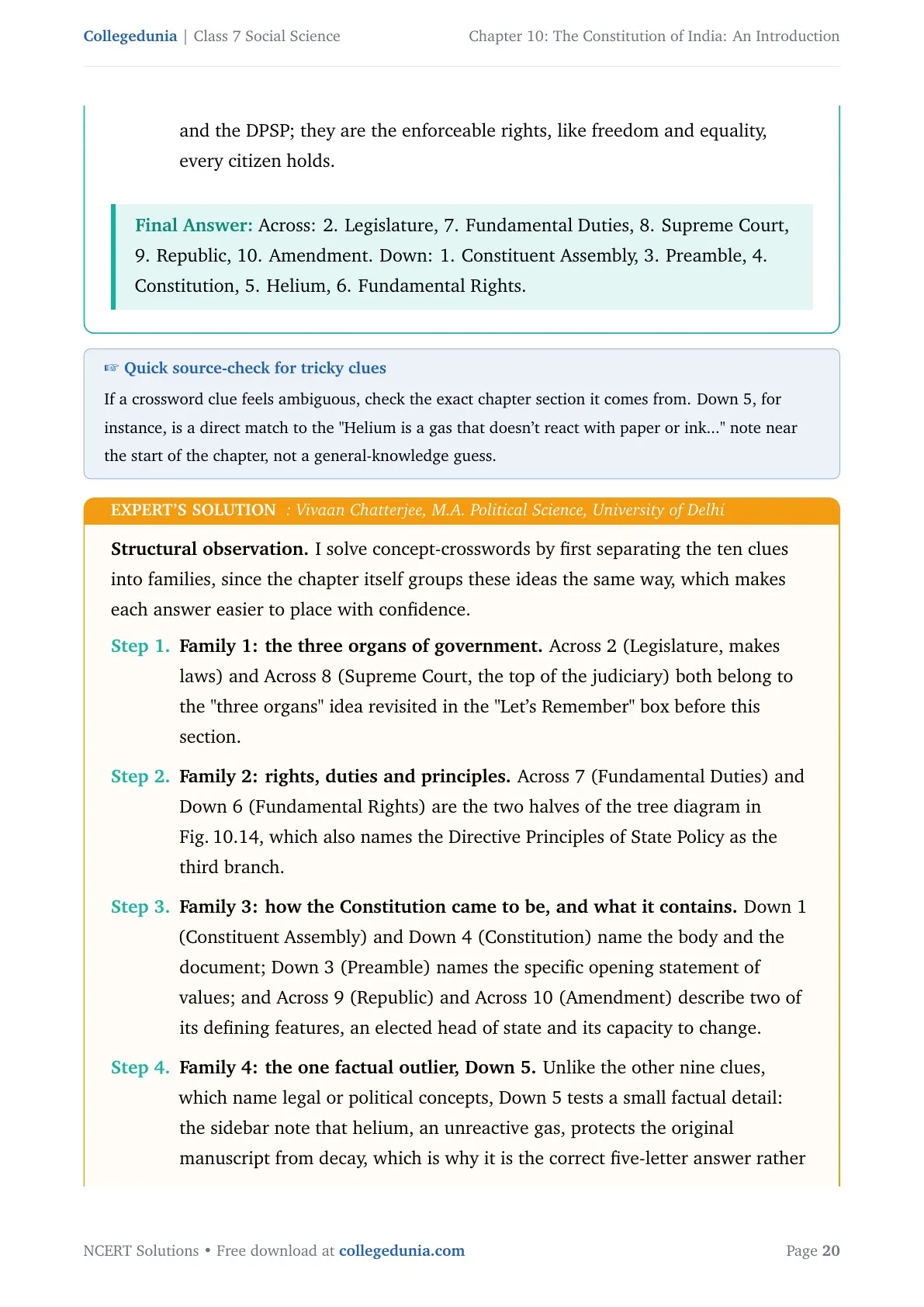
Q7 gives ten crossword clues matching an everyday description back to the exact constitutional term.
| Clue | Answer |
|---|---|
| Across 2: makes the laws | Legislature |
| Across 7: duties of citizens towards the country | Fundamental Duties |
| Across 8: highest court that protects the Constitution | Supreme Court |
| Across 9: elected, not hereditary, head of state | Republic |
| Across 10: process to change the Constitution | Amendment |
| Down 1: wrote the Indian Constitution | Constituent Assembly |
| Down 3: opening statement of values | Preamble |
| Down 4: document laying out a country's rules | Constitution |
| Down 5: gas that preserves the original document | Helium |
| Down 6: basic rights given to every citizen | Fundamental Rights |
Down 5 matches the chapter's own note that helium does not react with paper or ink, not a general-knowledge guess.
Common Mistakes Students Make in the Constitution Chapter
Read this before your next test: each mistake below has cost real marks.
- Naming the wrong Preamble value: Equality is status and opportunity; Fraternity is dignity towards fellow citizens.
- Answering Q3 with only "yes" or "no", instead of both arguments.
- Mixing up Rights and Directive Principles: Rights are court-enforceable; Directive Principles are not.
- Forgetting the third source in Q5: other constitutions, besides the struggle and heritage.
- Guessing Down 5, Helium specifically, not any inert gas.
Student Feedback: In a Collegedunia survey of 11,540 Class 7 students before the 2026 boards, 58% named "is equality before law a fact" the hardest question. Top scorers wrote the legal-promise and lived-reality points as separate paragraphs.
Source: 2026-27 Class 7 Social Science student survey. Sample of 11,540 students from CBSE schools across 15 states.
How to Study The Constitution of India Effectively
Short revision blocks work better than one long sitting.
- Block 1, 20 minutes: the nine Preamble values, and why the Assembly needed diverse members.
- Block 2, 25 minutes: the Q2 matching exercise and the Q3 "is this a fact" argument, from memory.
- Block 3, 20 minutes: the three sources of the Constitution and the Rights-Duties-DPSP split.
- Night before, 15 minutes: the Common Mistakes list and the crossword, unaided.
More The Constitution of India Class 7 Resources
Also Check: This chapter is available in other formats too. Read the solutions first, then the notes for a deeper walk-through.
| Resource | Best used for | Open it |
|---|---|---|
| NCERT Notes | Topic-by-topic summary of the Constituent Assembly, Preamble values and Fundamental Duties | The Constitution of India Class 7 Notes |
| NCERT Book PDF | The official 2026-27 chapter text with all figures | Class 7 Social Science Part 1 Chapter 10 Book PDF |
| Handwritten Notes | Quick one-sitting revision in clear handwriting | The Constitution of India Class 7 Handwritten Notes |
NCERT Solutions for Class 7 Social Science Part 1: All Chapters
NCERT Solutions for every chapter of Part 1, to move on once this one is done.
Sample Solutions from The Constitution of India Chapter 10
Below are two of the seven questions, answered in full. Every question in the complete PDF gets this same treatment.
- Concept: the exact NCERT term being tested, named upfront.
- Answer: reasoning broken into short, exam-ready points.
- Boxed answer: a one-look summary to revise from.
Ques. "The Constituent Assembly had representatives from diverse backgrounds in India." Why do you think it was important to have a diverse set of representatives from all over India?
India's many languages, religions, castes and regions meant one background alone would reflect only its own concerns. Diverse members made the document acceptable to everyone, matching the self-rule India had just won.
Boxed answer: A diverse Assembly gave every region, religion, profession and social group a voice, making the Constitution fair and widely accepted.
Ques. It is said that 'All citizens in India are equal before the law'. Do you think this is a fact? If yes, why? If not, why not? Formulate your arguments.
Article 14 guarantees Equality before Law: no person is above the law. In practice, access to justice depends on money for lawyers and awareness of one's rights.
Boxed answer: Equality before law is a genuine guarantee (Article 14), though wealth and awareness can make it harder for some citizens to use this right as fully as others.
The Constitution of India Class 7 Social Science NCERT Solutions FAQs
Ques. Where can I download the NCERT Solutions for Class 7 Social Science Chapter 10 The Constitution of India: An Introduction PDF?
Ans. Use the download option at the top of this page. The file is free, covers all 7 questions and activities from the chapter, and is available in both Normal and HD quality.
Ques. What is a Constitution?
Ans. A Constitution is a document that spells out a nation's basic principles, laws, and the roles of its legislature, executive and judiciary. India's Constitution was written by the Constituent Assembly between 1946 and 1949.
Ques. What is the Preamble of the Indian Constitution?
Ans. The Preamble is the Constitution's opening statement of values: Sovereign, Socialist, Secular, Democratic, Republic, Justice, Liberty, Equality and Fraternity. Every "match the value" question in this chapter is based on these nine words.
Ques. What are Fundamental Duties?
Ans. Fundamental Duties are obligations every citizen must perform, such as respecting the Constitution, protecting the environment, and preserving the country's composite culture, listed alongside Fundamental Rights and the Directive Principles.
Ques. When was the Indian Constitution adopted and when did it come into effect?
Ans. The Constituent Assembly adopted the Constitution on 26 November 1949, and it came into effect on 26 January 1950, which is celebrated every year as Republic Day.
Ques. Why did the Constituent Assembly need diverse representatives?
Ans. A diverse Assembly, drawn from different regions, religions, professions and social groups, made the Constitution fair and representative of the whole country, rather than reflecting the interests of only one group.
Ques. What is the difference between Fundamental Rights and Directive Principles of State Policy?
Ans. Fundamental Rights are enforceable in court and citizens can demand them directly. Directive Principles of State Policy are guidelines for the government, such as welfare and a uniform civil code, that are not enforceable in court.
Ques. Is equality before law actually achieved in India?
Ans. Article 14 guarantees equality before law as a legal principle, and courts have upheld it, such as in the 2004 flag-flying case. In practice, though, wealth and awareness can still make it harder for some citizens to use this right as fully as others.
Ques. Why did India give every adult the right to vote from its first election?
Ans. The freedom struggle was a mass movement of all Indians, equality was a founding constitutional value, and a new republic needed the trust of its entire population, so India chose universal adult franchise instead of the gradual model most Western democracies followed.
Ques. What are the three sources that shaped the Indian Constitution?
Ans. The Indian freedom struggle contributed values and practical answers, India's civilisational heritage inspired features like Fundamental Duties, and other countries' constitutions, including the UK, USA, France and Ireland, contributed specific ideas the makers studied and adapted.
Ques. Why is the original Constitution kept in a helium-filled case?
Ans. Helium does not react with paper or ink, so keeping the original handwritten Constitution in a helium-filled glass case helps preserve it from decay.
Ques. Is this NCERT Solutions PDF aligned with the 2026-27 syllabus?
Ans. Yes. This page follows the current 2026-27 edition of Exploring Society: India and Beyond, Grade 7 Part 1, and every answer matches the chapter content and question order printed in that edition.
Ques. How many pages is the Class 7 Social Science Chapter 10 NCERT Solutions PDF?
Ans. The Solutions PDF runs to 22 pages and covers all 7 questions and activities from The Constitution of India: An Introduction, with a concept explanation, step-by-step reasoning and a boxed final answer for each one.



Comments