



The NCERT Class 7 Social Science Chapter 3 Climates of India notes explain weather, seasons, climate regions, monsoon winds, disasters and climate change from the 2026-27 NCERT textbook. The PDF helps students revise the chapter with maps, tables, source figures and quick exam-ready points.
- Best for revision: weather vs climate, climate factors, monsoon, disasters and climate change.
- Use with the PDF: read each table, then revise the diagrams and key definitions.
- 2026-27 focus: follows the Exploring Society India and Beyond Part 1 chapter order.
Chapter3ClimatesofIndiaNotes.pdf?page=1&dpi=150)
Chapter3ClimatesofIndiaNotes.pdf?page=2&dpi=150)
Chapter3ClimatesofIndiaNotes.pdf?page=3&dpi=150)
Chapter3ClimatesofIndiaNotes.pdf?page=4&dpi=150)
Chapter3ClimatesofIndiaNotes.pdf?page=5&dpi=150)
Chapter3ClimatesofIndiaNotes.pdf?page=6&dpi=150)
Chapter3ClimatesofIndiaNotes.pdf?page=7&dpi=150)
Chapter3ClimatesofIndiaNotes.pdf?page=8&dpi=150)
Chapter3ClimatesofIndiaNotes.pdf?page=9&dpi=150)
Chapter3ClimatesofIndiaNotes.pdf?page=10&dpi=150)
Chapter3ClimatesofIndiaNotes.pdf?page=11&dpi=150)
Chapter3ClimatesofIndiaNotes.pdf?page=12&dpi=150)
Chapter3ClimatesofIndiaNotes.pdf?page=13&dpi=150)
Chapter3ClimatesofIndiaNotes.pdf?page=14&dpi=150)
Chapter3ClimatesofIndiaNotes.pdf?page=15&dpi=150)
Chapter3ClimatesofIndiaNotes.pdf?page=16&dpi=150)
Chapter3ClimatesofIndiaNotes.pdf?page=17&dpi=150)
Chapter3ClimatesofIndiaNotes.pdf?page=18&dpi=150)
Chapter3ClimatesofIndiaNotes.pdf?page=19&dpi=150)
Chapter3ClimatesofIndiaNotes.pdf?page=20&dpi=150)
Chapter3ClimatesofIndiaNotes.pdf?page=21&dpi=150)
Chapter3ClimatesofIndiaNotes.pdf?page=22&dpi=150)
Chapter3ClimatesofIndiaNotes.pdf?page=23&dpi=150)
Chapter3ClimatesofIndiaNotes.pdf?page=24&dpi=150)
Chapter3ClimatesofIndiaNotes.pdf?page=25&dpi=150)
Chapter3ClimatesofIndiaNotes_flat_MobileCard.pdf?page=1&dpi=150)
Chapter3ClimatesofIndiaNotes_flat_MobileCard.pdf?page=2&dpi=150)
Chapter3ClimatesofIndiaNotes_flat_MobileCard.pdf?page=3&dpi=150)
Chapter3ClimatesofIndiaNotes_flat_MobileCard.pdf?page=4&dpi=150)
Chapter3ClimatesofIndiaNotes_flat_MobileCard.pdf?page=5&dpi=150)
Chapter3ClimatesofIndiaNotes_flat_MobileCard.pdf?page=6&dpi=150)
Chapter3ClimatesofIndiaNotes_flat_MobileCard.pdf?page=7&dpi=150)
Chapter3ClimatesofIndiaNotes_flat_MobileCard.pdf?page=8&dpi=150)
Chapter3ClimatesofIndiaNotes_flat_MobileCard.pdf?page=9&dpi=150)
Chapter3ClimatesofIndiaNotes_flat_MobileCard.pdf?page=10&dpi=150)
Chapter3ClimatesofIndiaNotes_flat_MobileCard.pdf?page=11&dpi=150)
Chapter3ClimatesofIndiaNotes_flat_MobileCard.pdf?page=12&dpi=150)
Chapter3ClimatesofIndiaNotes_flat_MobileCard.pdf?page=13&dpi=150)
Chapter3ClimatesofIndiaNotes_flat_MobileCard.pdf?page=14&dpi=150)
Chapter3ClimatesofIndiaNotes_flat_MobileCard.pdf?page=15&dpi=150)
Chapter3ClimatesofIndiaNotes_flat_MobileCard.pdf?page=16&dpi=150)
Chapter3ClimatesofIndiaNotes_flat_MobileCard.pdf?page=17&dpi=150)
Chapter3ClimatesofIndiaNotes_flat_MobileCard.pdf?page=18&dpi=150)
Chapter3ClimatesofIndiaNotes_flat_MobileCard.pdf?page=19&dpi=150)
Chapter3ClimatesofIndiaNotes_flat_MobileCard.pdf?page=20&dpi=150)
Chapter3ClimatesofIndiaNotes_flat_MobileCard.pdf?page=21&dpi=150)
Chapter3ClimatesofIndiaNotes_flat_MobileCard.pdf?page=22&dpi=150)
Chapter3ClimatesofIndiaNotes_flat_MobileCard.pdf?page=23&dpi=150)
Chapter3ClimatesofIndiaNotes_flat_MobileCard.pdf?page=24&dpi=150)
Chapter3ClimatesofIndiaNotes_flat_MobileCard.pdf?page=25&dpi=150)
Chapter3ClimatesofIndiaNotes_flat_MobileCard.pdf?page=26&dpi=150)
Chapter3ClimatesofIndiaNotes_flat_MobileCard.pdf?page=27&dpi=150)
Chapter3ClimatesofIndiaNotes_flat_MobileCard.pdf?page=28&dpi=150)
Chapter3ClimatesofIndiaNotes_flat_MobileCard.pdf?page=29&dpi=150)
Chapter3ClimatesofIndiaNotes_flat_MobileCard.pdf?page=30&dpi=150)
Chapter3ClimatesofIndiaNotes_flat_MobileCard.pdf?page=31&dpi=150)
These notes follow the 2026-27 NCERT Class 7 Social Science textbook and focus on the climate terms, monsoon stages and disaster examples students need for quick revision.
Student Feedback: In a Collegedunia student poll of 12,480 Class 7 students before the 2026 school assessments, most students said the monsoon section became easier after they linked winds with land and sea heating.
Climates of India Notes: What the Chapter Covers
Climates of India teaches students why India has snowy mountains, hot deserts, wet coasts and mild hill regions in the same country. The chapter also connects climate with crops, clothing, festivals, travel and safety.
| Chapter area | What students revise | Answer clue |
|---|---|---|
| Weather and seasons | Daily change and yearly cycle | Time scale matters |
| Climate types | Alpine, arid, wet and semi-arid regions | Match region with feature |
| Monsoon | Moist winds and rainfall | Land heats faster than sea |
| Disasters | Cyclone, flood, landslide and forest fire | Cause plus safety response |
Climates of India Class 7 Video Recap
Source: Magnet Brains on YouTube
Weather, Seasons and Climate Difference for Class 7
Students often mix weather with climate. Weather is the condition of the atmosphere at a place and time. Climate is the usual pattern studied over many decades. Weather changes quickly; climate shows the long pattern.
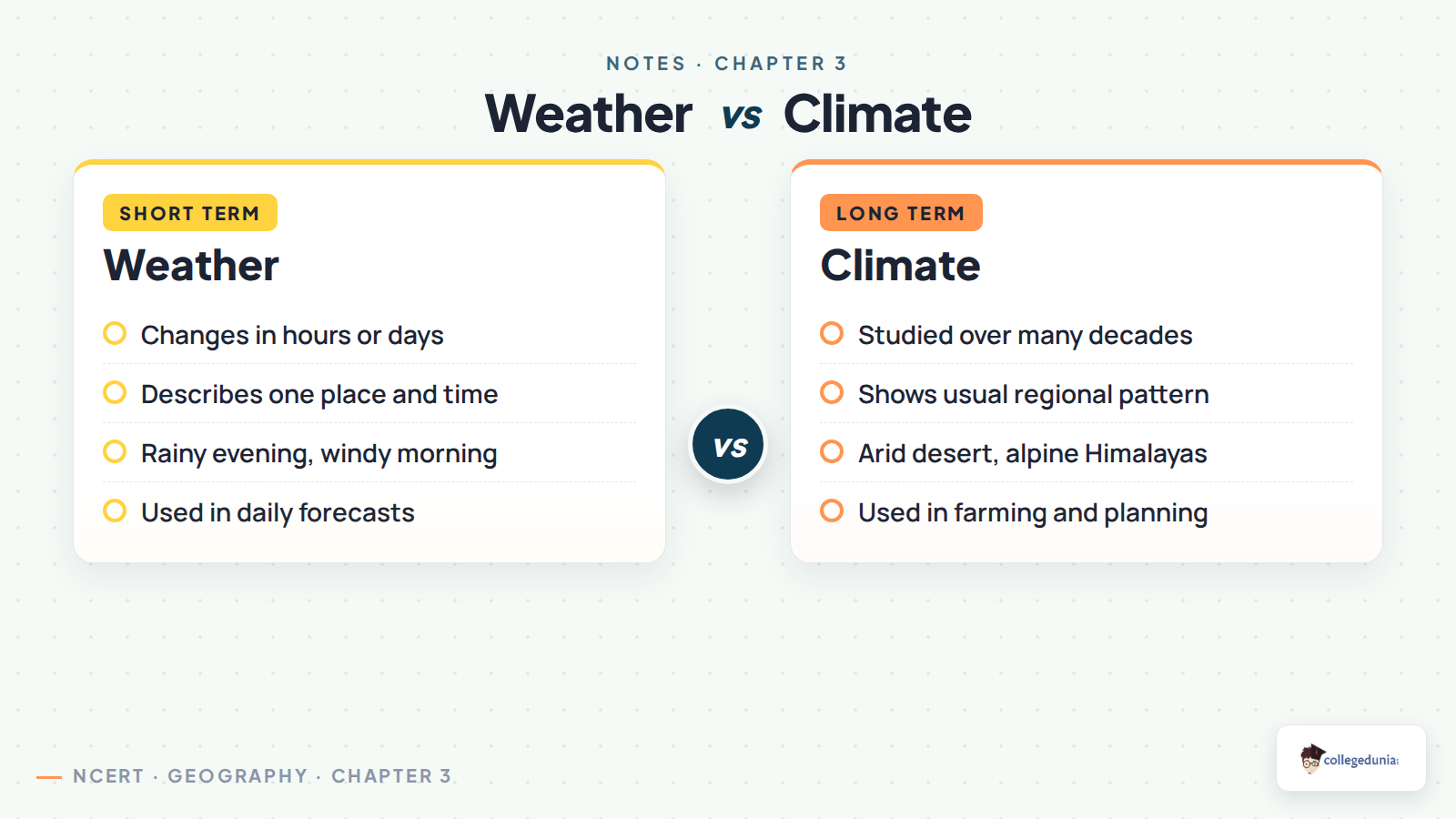
- Weather: a rainy evening, windy morning or hot afternoon.
- Season: summer, monsoon or winter returning each year.
- Climate: arid Thar Desert, alpine Himalayas or wet western coast.
- Ritus: Indian tradition groups the year into six seasonal rhythms.
Climate Types and Factors Across India
India has many climates because its landforms and location change from region to region. Latitude, altitude, sea distance, winds and topography decide how hot, cold, wet or dry a place feels.
| Factor | Effect on climate | Class 7 example |
|---|---|---|
| Latitude | Places near the Equator are warmer | Kanniyakumari is warmer than Srinagar |
| Altitude | Higher places are cooler | Himalayan towns have cold winters |
| Distance from sea | Coasts have milder temperatures | Mumbai is more moderate than inland areas |
| Topography | Mountains and deserts shape rainfall | Western Ghats receive heavy rain |
Indian Monsoon Winds and Rainfall Pattern
The monsoon is a seasonal wind system. In summer, land heats faster than the sea. This creates low pressure over land, so moist winds move in from the surrounding seas and bring rain.
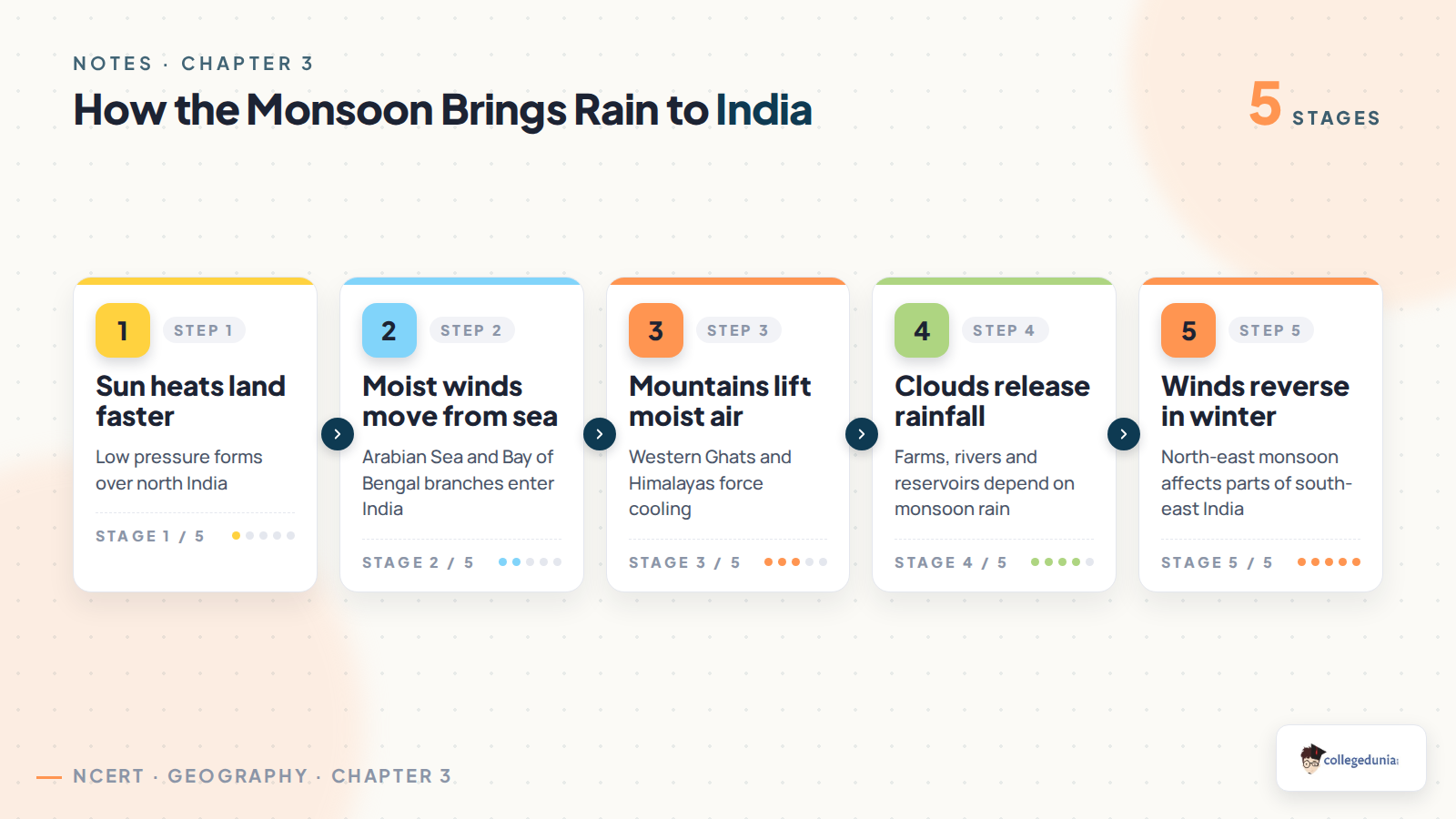
- The Arabian Sea branch brings heavy rain to the western coast.
- The Bay of Bengal branch moves toward eastern and northern India.
- Mountains force moist air upward, so clouds cool and release rain.
- The north-east monsoon later affects parts of south-east India.
Climate Disasters and Climate Change in Climates of India
Extreme weather can turn into a disaster when people, crops, houses or roads are harmed. The chapter names cyclones, floods, landslides and forest fires. It also explains why climate change is a long-term risk.
| Topic | Meaning | Revision tip |
|---|---|---|
| Cyclone | Rotating storm with low pressure near the sea | Mention eye, wind and rain |
| Flood | Water overflows into normally dry land | Add rainfall, river overflow or poor drainage |
| Landslide | Rock, soil or debris suddenly moves down a slope | Link with hills and heavy rain |
| Climate change | Long-term shift in temperature and rainfall patterns | Add fossil fuels and deforestation |
Class 7 Social Science Chapter 3 Cross Resource Links
Use these chapter resources together for textbook reading, quick revision and question practice.
| Resource | Use it for | Link |
|---|---|---|
| NCERT Notes | Quick revision before class tests | Climates of India Class 7 Notes |
| NCERT Book PDF | Official textbook reading | Class 7 Social Science Chapter 3 Book PDF |
| NCERT Solutions | Textbook question answers | Class 7 Social Science Chapter 3 Solutions |
| Handwritten Notes | One-shot revision | Class 7 Social Science Chapter 3 Handwritten Notes |
All Chapters in Class 7 Social Science Part 1 Notes
The same notes series helps students revise the Exploring Society India and Beyond Part 1 textbook in chapter order.
| Chapter | Notes page |
|---|---|
| Chapter 1 | Geographical Diversity of India Notes |
| Chapter 2 | Understanding the Weather Notes |
| Chapter 3 | Climates of India Notes |
| Chapter 4 | New Beginnings Cities and States Notes |
Climates of India Class 7 Notes FAQs
Ques. What is climate in Class 7 Social Science Chapter 3?
Ans. Climate is the usual pattern of weather in a region over many decades. It helps students understand why places have different heat, rain and wind patterns.
Ques. What is the difference between weather and climate?
Ans. Weather changes over hours or days. Climate is the long-term pattern of a place, studied through many years of weather records.
Ques. Which factors affect the climate of India?
Ans. Latitude, altitude, distance from the sea, winds and topography affect the climate of India. These factors create different regional climates.
Ques. Why is the monsoon important for India?
Ans. The monsoon brings most of India's seasonal rainfall. It supports crops, rivers, reservoirs, forests and daily water use in many regions.



Comments