



The NCERT Class 7 Social Science Chapter 5 notes for The Rise of Empires explain empire, tribute, trade routes, guilds, Magadha, the Nandas, Alexander, Chandragupta Maurya, Kautilya, Ashoka, edicts and Mauryan life for the 2026-27 NCERT textbook. The PDF helps students revise Chapter 5 through timelines, tables, diagrams and activity answer frames.
Chapter5TheRiseofEmpiresNotes.pdf?page=1&dpi=150)
Chapter5TheRiseofEmpiresNotes.pdf?page=2&dpi=150)
Chapter5TheRiseofEmpiresNotes.pdf?page=3&dpi=150)
Chapter5TheRiseofEmpiresNotes.pdf?page=4&dpi=150)
Chapter5TheRiseofEmpiresNotes.pdf?page=5&dpi=150)
Chapter5TheRiseofEmpiresNotes.pdf?page=6&dpi=150)
Chapter5TheRiseofEmpiresNotes.pdf?page=7&dpi=150)
Chapter5TheRiseofEmpiresNotes.pdf?page=8&dpi=150)
Chapter5TheRiseofEmpiresNotes.pdf?page=9&dpi=150)
Chapter5TheRiseofEmpiresNotes.pdf?page=10&dpi=150)
Chapter5TheRiseofEmpiresNotes.pdf?page=11&dpi=150)
Chapter5TheRiseofEmpiresNotes.pdf?page=12&dpi=150)
Chapter5TheRiseofEmpiresNotes.pdf?page=13&dpi=150)
Chapter5TheRiseofEmpiresNotes.pdf?page=14&dpi=150)
Chapter5TheRiseofEmpiresNotes.pdf?page=15&dpi=150)
Chapter5TheRiseofEmpiresNotes.pdf?page=16&dpi=150)
Chapter5TheRiseofEmpiresNotes.pdf?page=17&dpi=150)
Chapter5TheRiseofEmpiresNotes.pdf?page=18&dpi=150)
Chapter5TheRiseofEmpiresNotes.pdf?page=19&dpi=150)
Chapter5TheRiseofEmpiresNotes.pdf?page=20&dpi=150)
Chapter5TheRiseofEmpiresNotes.pdf?page=21&dpi=150)
Chapter5TheRiseofEmpiresNotes.pdf?page=22&dpi=150)
Chapter5TheRiseofEmpiresNotes.pdf?page=23&dpi=150)
Chapter5TheRiseofEmpiresNotes.pdf?page=24&dpi=150)
Chapter5TheRiseofEmpiresNotes.pdf?page=25&dpi=150)
Chapter5TheRiseofEmpiresNotes.pdf?page=26&dpi=150)
Chapter5TheRiseofEmpiresNotes_flat_MobileCard.pdf?page=1&dpi=150)
Chapter5TheRiseofEmpiresNotes_flat_MobileCard.pdf?page=2&dpi=150)
Chapter5TheRiseofEmpiresNotes_flat_MobileCard.pdf?page=3&dpi=150)
Chapter5TheRiseofEmpiresNotes_flat_MobileCard.pdf?page=4&dpi=150)
Chapter5TheRiseofEmpiresNotes_flat_MobileCard.pdf?page=5&dpi=150)
Chapter5TheRiseofEmpiresNotes_flat_MobileCard.pdf?page=6&dpi=150)
Chapter5TheRiseofEmpiresNotes_flat_MobileCard.pdf?page=7&dpi=150)
Chapter5TheRiseofEmpiresNotes_flat_MobileCard.pdf?page=8&dpi=150)
Chapter5TheRiseofEmpiresNotes_flat_MobileCard.pdf?page=9&dpi=150)
Chapter5TheRiseofEmpiresNotes_flat_MobileCard.pdf?page=10&dpi=150)
Chapter5TheRiseofEmpiresNotes_flat_MobileCard.pdf?page=11&dpi=150)
Chapter5TheRiseofEmpiresNotes_flat_MobileCard.pdf?page=12&dpi=150)
Chapter5TheRiseofEmpiresNotes_flat_MobileCard.pdf?page=13&dpi=150)
Chapter5TheRiseofEmpiresNotes_flat_MobileCard.pdf?page=14&dpi=150)
Chapter5TheRiseofEmpiresNotes_flat_MobileCard.pdf?page=15&dpi=150)
Chapter5TheRiseofEmpiresNotes_flat_MobileCard.pdf?page=16&dpi=150)
Chapter5TheRiseofEmpiresNotes_flat_MobileCard.pdf?page=17&dpi=150)
Chapter5TheRiseofEmpiresNotes_flat_MobileCard.pdf?page=18&dpi=150)
Chapter5TheRiseofEmpiresNotes_flat_MobileCard.pdf?page=19&dpi=150)
Chapter5TheRiseofEmpiresNotes_flat_MobileCard.pdf?page=20&dpi=150)
Chapter5TheRiseofEmpiresNotes_flat_MobileCard.pdf?page=21&dpi=150)
Chapter5TheRiseofEmpiresNotes_flat_MobileCard.pdf?page=22&dpi=150)
Chapter5TheRiseofEmpiresNotes_flat_MobileCard.pdf?page=23&dpi=150)
Chapter5TheRiseofEmpiresNotes_flat_MobileCard.pdf?page=24&dpi=150)
Chapter5TheRiseofEmpiresNotes_flat_MobileCard.pdf?page=25&dpi=150)
Chapter5TheRiseofEmpiresNotes_flat_MobileCard.pdf?page=26&dpi=150)
Chapter5TheRiseofEmpiresNotes_flat_MobileCard.pdf?page=27&dpi=150)
Chapter5TheRiseofEmpiresNotes_flat_MobileCard.pdf?page=28&dpi=150)
Chapter5TheRiseofEmpiresNotes_flat_MobileCard.pdf?page=29&dpi=150)
Chapter5TheRiseofEmpiresNotes_flat_MobileCard.pdf?page=30&dpi=150)
Chapter5TheRiseofEmpiresNotes_flat_MobileCard.pdf?page=31&dpi=150)
Chapter5TheRiseofEmpiresNotes_flat_MobileCard.pdf?page=32&dpi=150)
Chapter5TheRiseofEmpiresNotes_flat_MobileCard.pdf?page=33&dpi=150)
Chapter5TheRiseofEmpiresNotes_flat_MobileCard.pdf?page=34&dpi=150)
Chapter5TheRiseofEmpiresNotes_flat_MobileCard.pdf?page=35&dpi=150)
Chapter5TheRiseofEmpiresNotes_flat_MobileCard.pdf?page=36&dpi=150)
Chapter5TheRiseofEmpiresNotes_flat_MobileCard.pdf?page=37&dpi=150)
Chapter5TheRiseofEmpiresNotes_flat_MobileCard.pdf?page=38&dpi=150)
- Best for revision: empire features, Magadha, Mauryas, Ashoka and reasons empires decline.
- Use with the PDF: read the timeline first, then revise key terms and activity frames.
- 2026-27 focus: follows Exploring Society: India and Beyond, Part 1, Chapter 5.
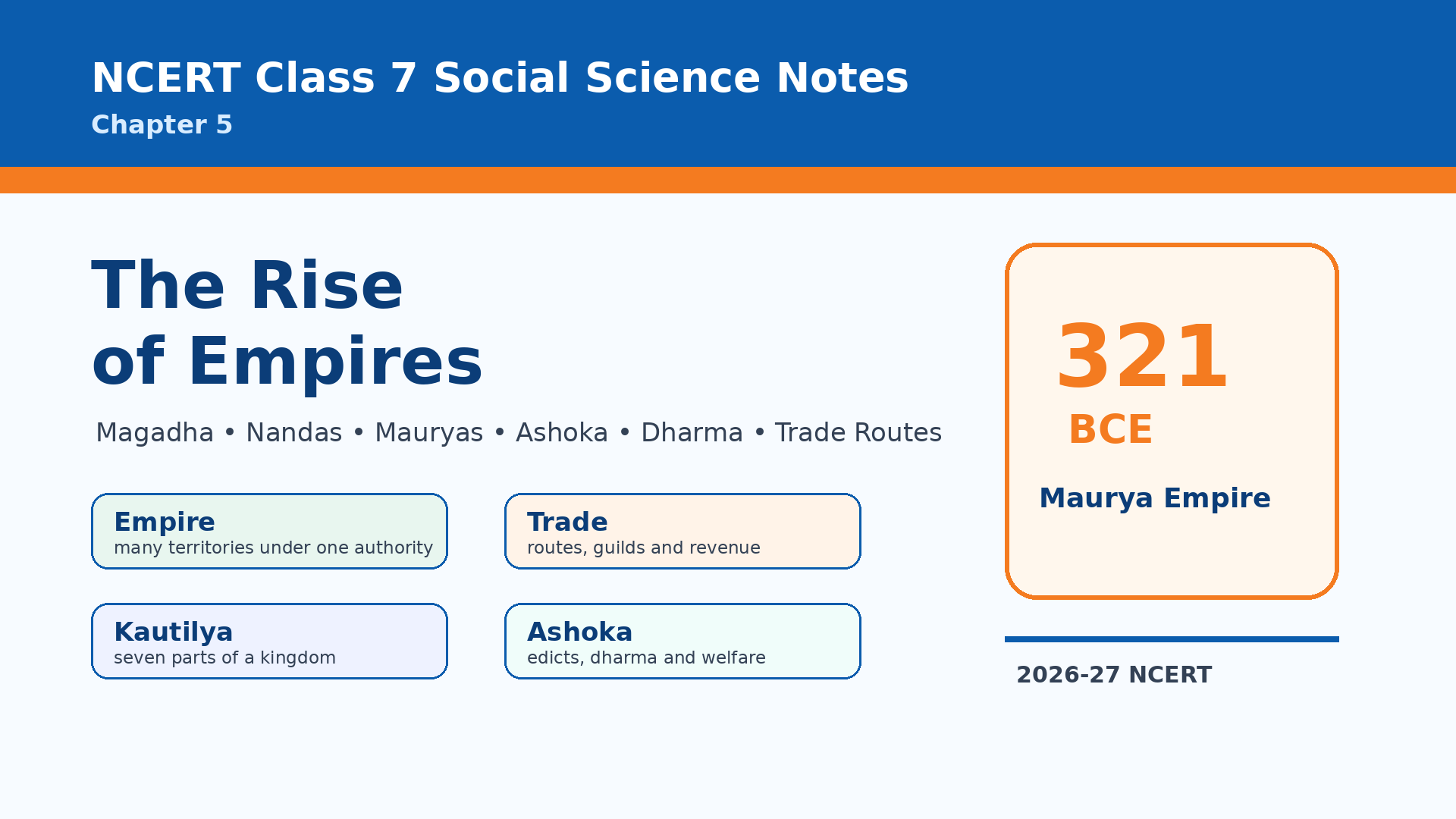
Student Feedback: In a Collegedunia revision poll of 6,180 Class 7 students, 74% said Chapter 5 became easier after they studied empire features, Magadha and Ashoka as one connected timeline.
Chapter 5 The Rise of Empires Notes Highlights
The Rise of Empires explains how powerful kingdoms became empires by controlling resources, routes, armies, taxation, local rulers and public communication. Students should revise Chapter 5 as a cause-and-effect story from Magadha to the Mauryas, not as a list of names.
| Topic | What to remember | Exam cue |
|---|---|---|
| Empire | A large territory made of many smaller territories under central authority | Compare it with kingdom |
| Trade and guilds | Routes, goods, tax revenue and shrenis supported imperial power | Connect economy with army |
| Magadha | Fertile land, rivers, iron, forests, elephants and strong rulers helped it rise | Use five-point answer |
| Ashoka | Kalinga war, edicts, dharma, welfare and religious tolerance | Link with national symbols |
How Kingdoms Became Empires in Class 7 Social Science
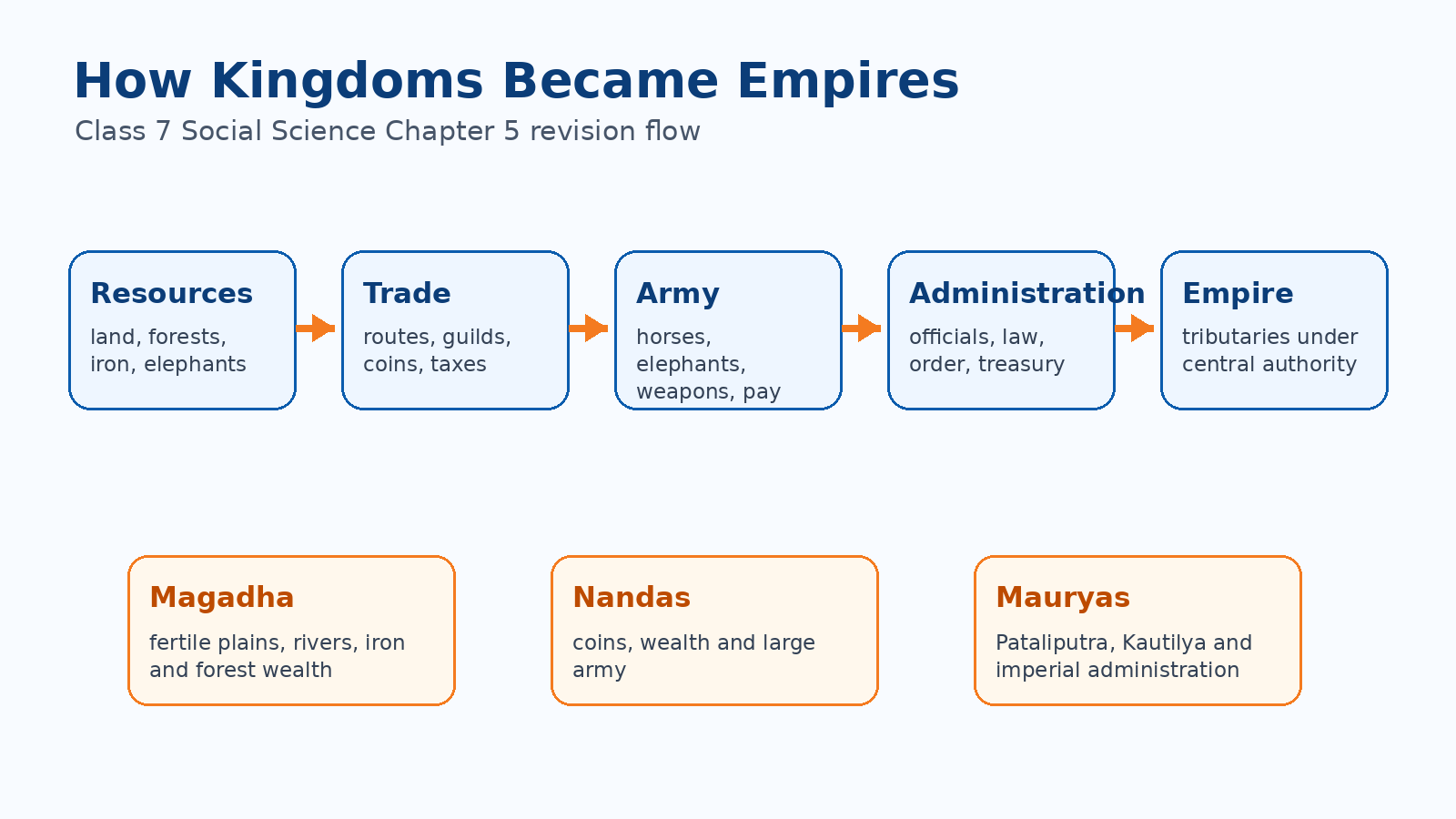
NCERT shows that empires needed more than conquest. A ruler needed resources, trade routes, tax collection, officials, army strength and communication networks. Smaller rulers often remained in place as tributaries if they accepted the emperor's overlordship.
- Economic base: crops, forests, mines, guilds, coins and trade routes.
- Military base: paid soldiers, horses, elephants, iron weapons and forts.
- Administrative base: officials, law, treasury, roads and public welfare.
The Rise of Magadha Class 7 Video
Source: Magnet Brains on YouTube
Magadha Nandas and Mauryas Revision
Magadha's rise is central to Chapter 5. The region had fertile Ganga plains, river transport, forests, elephants, nearby minerals and expanding trade. These advantages supported agriculture, crafts, army power and tax collection.
| Ruler or dynasty | NCERT link | Revision point |
|---|---|---|
| Ajatashatru | Early Magadhan ruler | Helped establish Magadha as a strong centre |
| Mahapadma Nanda | Founder of Nanda dynasty | Unified many smaller kingdoms |
| Dhana Nanda | Last Nanda ruler | Rich but unpopular in accounts |
| Chandragupta Maurya | Founder of Maurya Empire | Built power with Kautilya's guidance |
Ashoka Dharma and Edicts
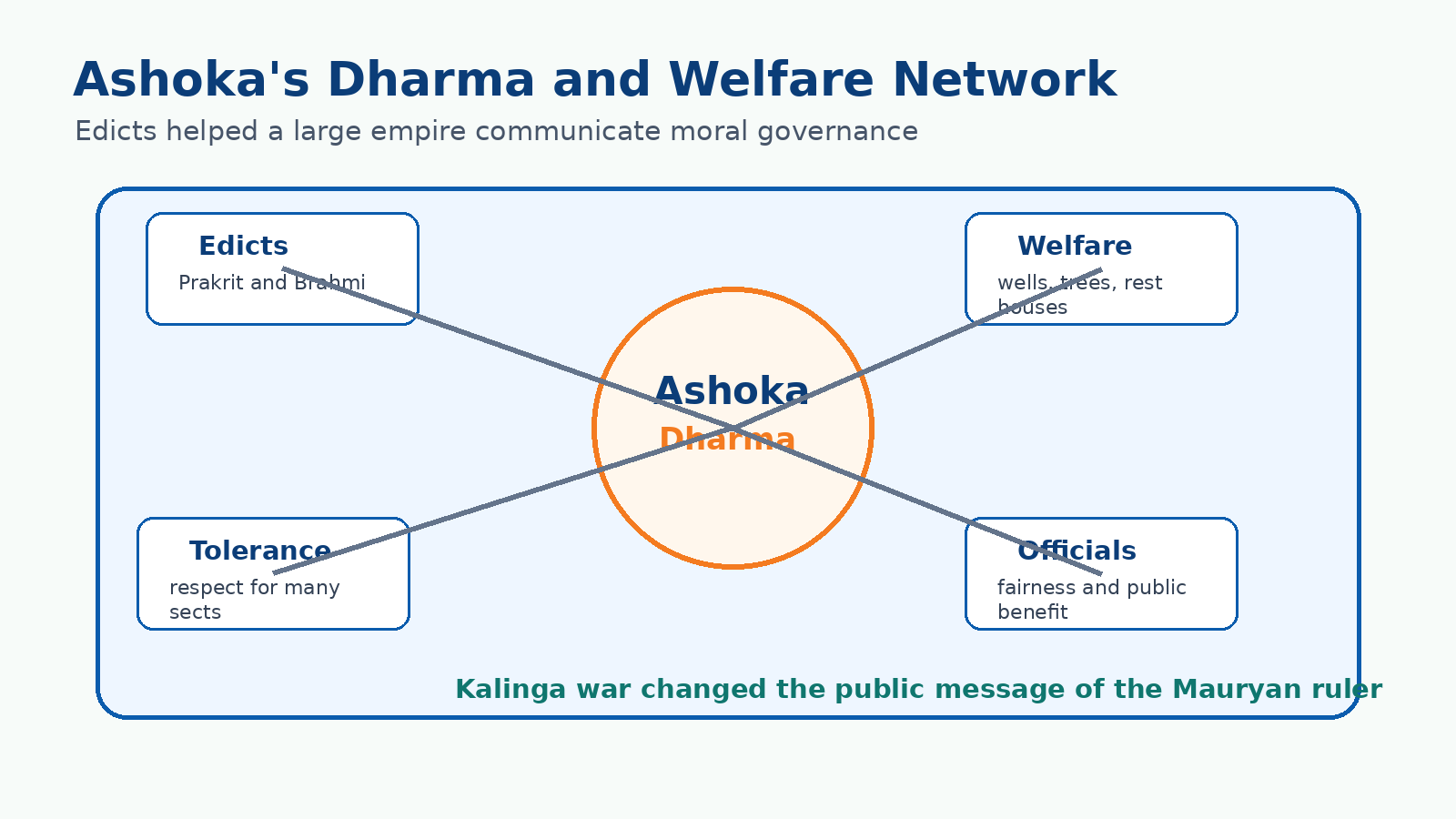
Ashoka is remembered for a major change after the Kalinga war. His edicts presented him as Devanampiya Piyadasi, a ruler who cared about dharma, welfare, fair officials, respect among sects, and public communication. Most edicts were in Prakrit and written in the Brahmi script.
- Dharma: duty, truth, moral law, right conduct and harmony.
- Welfare: medical care, wells, shade trees, rest houses and less cruelty to animals.
- Legacy: Sarnath lion capital and dharmachakra influenced modern India.
How to Use the Class 7 Chapter 5 Notes PDF
Start with the timeline in the PDF, then revise the key terms: empire, tributary, guild, satrap, saptanga and dharma. For long answers, use a four-part frame: definition, causes, examples and impact. For Magadha, always connect geography with economy and military strength.
- Use the empire versus kingdom table for Question 1.
- Use the Magadha five-point frame for the transition from kingdoms to empires.
- Use Ashoka's edicts, welfare measures and symbols for the long opinion answer.
More Class 7 Social Science Chapter 5 Resources
Use these related NCERT resources when you want Chapter 5 in another format. The official book PDF is useful for maps and artefacts, while handwritten notes are useful for a fast last-minute scan.
| Resource | Best use | Link |
|---|---|---|
| NCERT Solutions | Practice textbook questions and activities | Open NCERT Solutions |
| NCERT Book PDF | Read the official maps, edicts, artefacts and chapter text | Open Book PDF |
| Handwritten Notes | Revise terms, dates and flowcharts quickly | Open Handwritten Notes |
All Class 7 Social Science Part 1 Notes
The table below keeps the same resource type together, so students can move chapter by chapter through Class 7 Social Science Part 1 notes.
| Chapter | NCERT chapter title | Notes link |
|---|---|---|
| Chapter 1 | Geographical Diversity of India | Open Notes |
| Chapter 2 | Understanding the Weather | Open Notes |
| Chapter 3 | Climates of India | Open Notes |
| Chapter 4 | New Beginnings: Cities and States | Open Notes |
| Chapter 5 | The Rise of Empires | You are here |
| Chapter 6 | The Age of Reorganisation | Open Notes |
| Chapter 7 | The Gupta Era: An Age of Tireless Creativity | Open Notes |
| Chapter 8 | How the Land Becomes Sacred | Open Notes |
| Chapter 9 | From the Rulers to the Ruled: Types of Governments | Open Notes |
| Chapter 10 | The Constitution of India: An Introduction | Open Notes |
| Chapter 11 | From Barter to Money | Open Notes |
| Chapter 12 | Understanding Markets | Open Notes |
Class 7 Social Science Chapter 5 The Rise of Empires Notes FAQs
Ques. What is an empire in Class 7 Social Science Chapter 5?
Ans. An empire is a large territory made of many smaller kingdoms or regions under one supreme authority.
Ques. Why did Magadha become powerful?
Ans. Magadha had fertile land, rivers, forests, elephants, iron resources, trade routes and strong rulers.
Ques. What were guilds in The Rise of Empires?
Ans. Guilds were associations of traders, craftspeople, moneylenders or agriculturists who made rules and supported economic activity.
Ques. Why is Ashoka important in Chapter 5?
Ans. Ashoka is important for the Kalinga war, edicts, dharma, welfare measures, religious tolerance and symbols that influenced modern India.



Comments