




Class 7 Social Science Chapter 5 The Rise of Empires is where most students mix up a kingdom with an empire, or forget the Nandas came before the Mauryas. These NCERT Solutions cover every question with the exact concept, date and boxed answer an examiner wants in 2026-27.
- Question coverage: All 9 questions, empire vs kingdom, Magadha's rise, Alexander, the Mauryas, Kautilya's saptanga and Ashoka's dhamma.
- Exam weight: these reasoning questions carry 6 to 8 marks in the annual paper.
- Also on this page: a saptanga diagram, a kingdom-vs-empire comparison image, and links to the Notes and Book PDF.
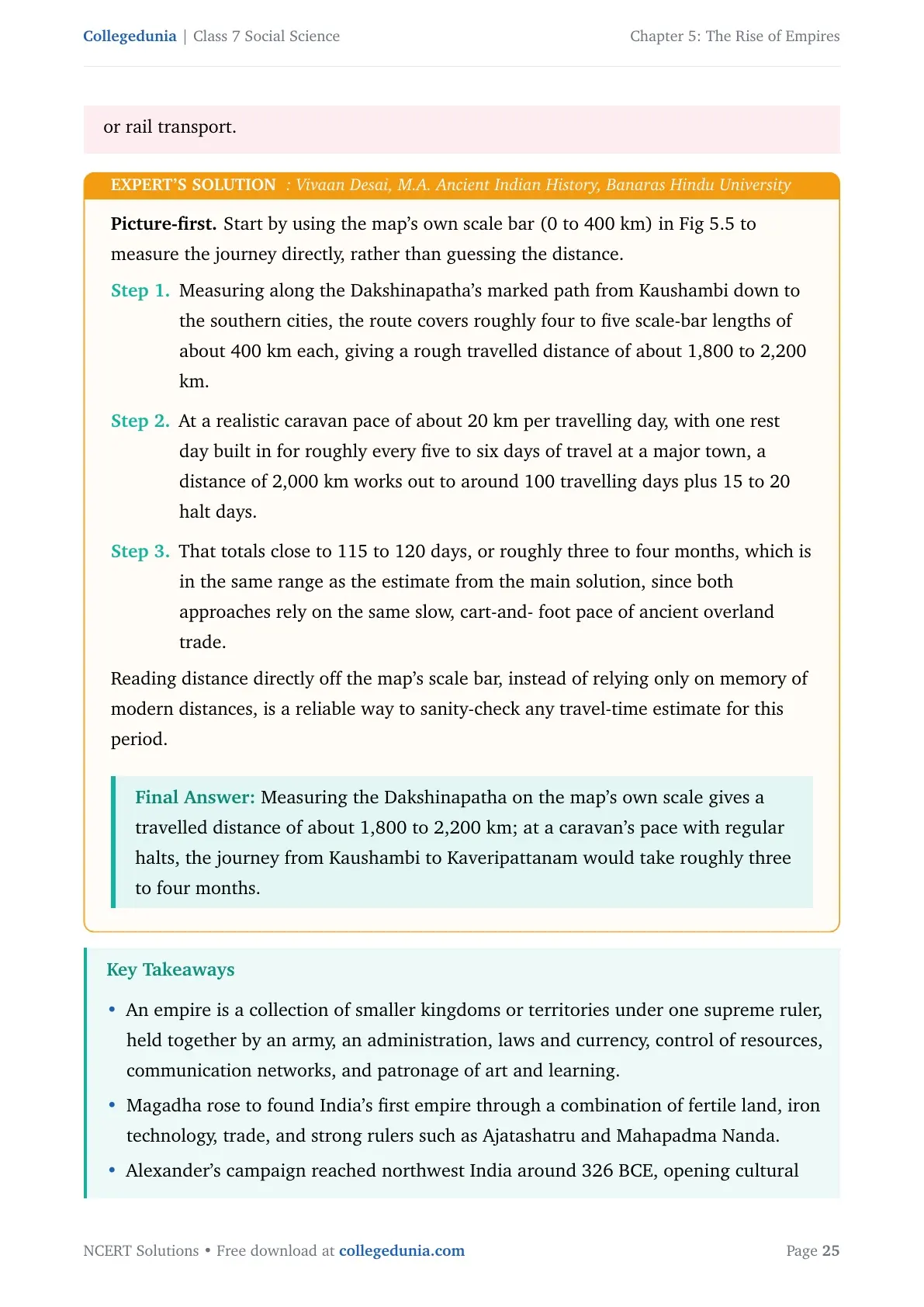
Every solution here is curated by subject experts, checked against the 2026-27 NCERT print, in plain Class 7 language.
Want the full worked answers, one question at a time? Open the dedicated question bank below for step-by-step solutions to every question and activity in The Rise of Empires, each with a concept explanation, an Expert's Solution and a boxed final answer.
Why The Rise of Empires Matters for Class 7 Social Science
This chapter moves Class 7 Social Science, Exploring Society: India and Beyond, Part 1, from geography into history, tracing how small, warring sixth-century BCE kingdoms fused into India's first empire. NCERT tests why Magadha rose and other kingdoms did not, which is what these NCERT Solutions walk through.
| Concept | What it means | Why it matters |
|---|---|---|
| Empire | Kingdoms under one ruler, paying tribute | India's history is kingdoms merging, not staying separate |
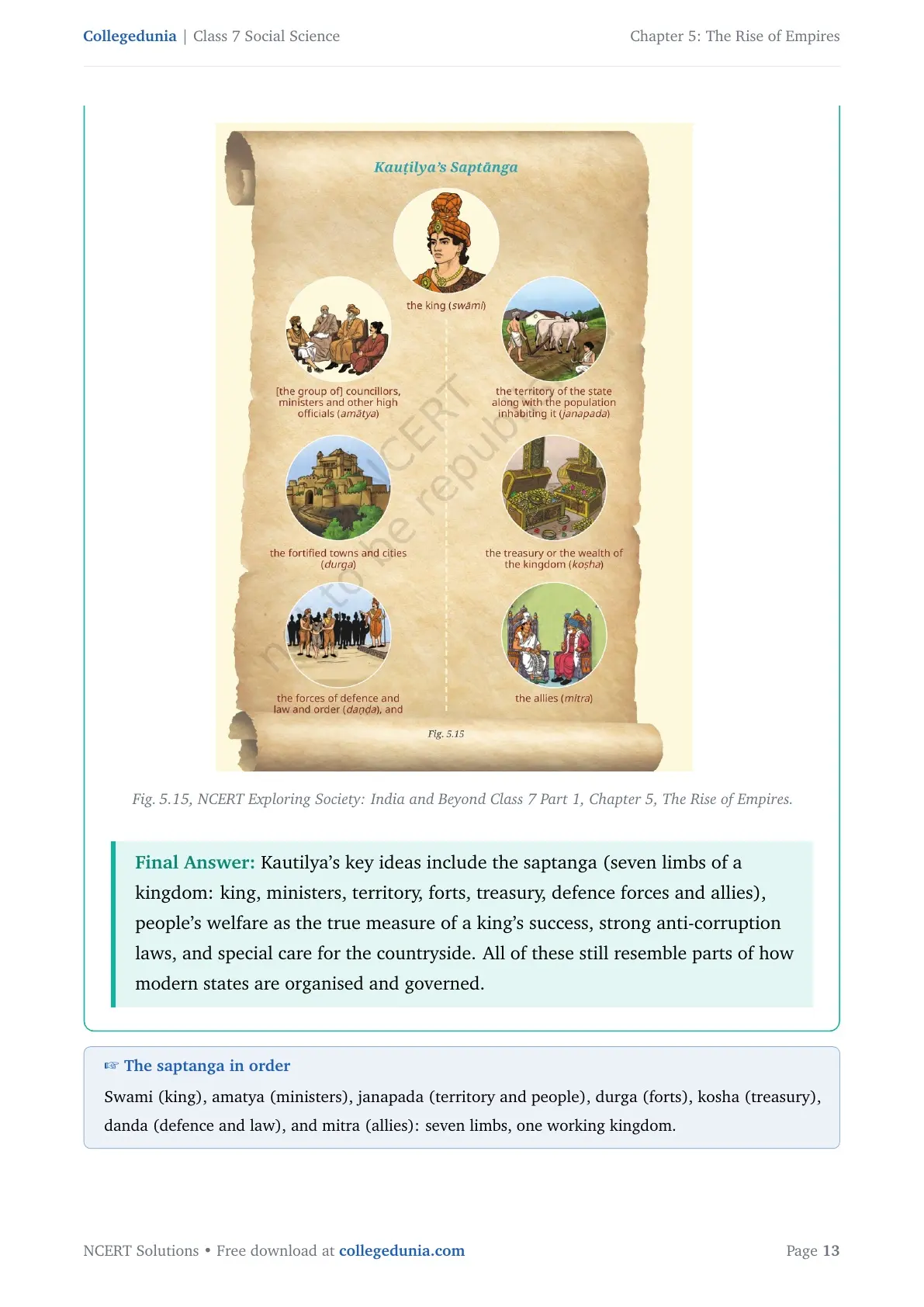
| Saptanga | Kautilya's seven limbs of a kingdom | Maps onto a modern state: ministers, treasury, army, allies |
| Dhamma | Ashoka's code of non-violence after Kalinga | Shaped the national emblem, flag symbol, founding scripts |
| Trade routes | Uttarapatha and Dakshinapatha, linking north and south | Carried the goods and revenue funding every empire here |
Naming the exact feature or limb, not just the general idea, earns full marks.
The Rise of Empires Question and Activity Breakdown
The chapter closes with nine Questions and Activities, mostly reasoning or opinion rather than a fixed fact, so NCERT rewards structure and evidence, not a one-line reply.
| Question | What it covers | Answer type |
|---|---|---|
| Q1 | Empire features vs a kingdom | Long answer |
| Q2 | Factors behind Magadha's rise | Long answer |
| Q3 | Why Alexander is an important world figure | Reasoning |
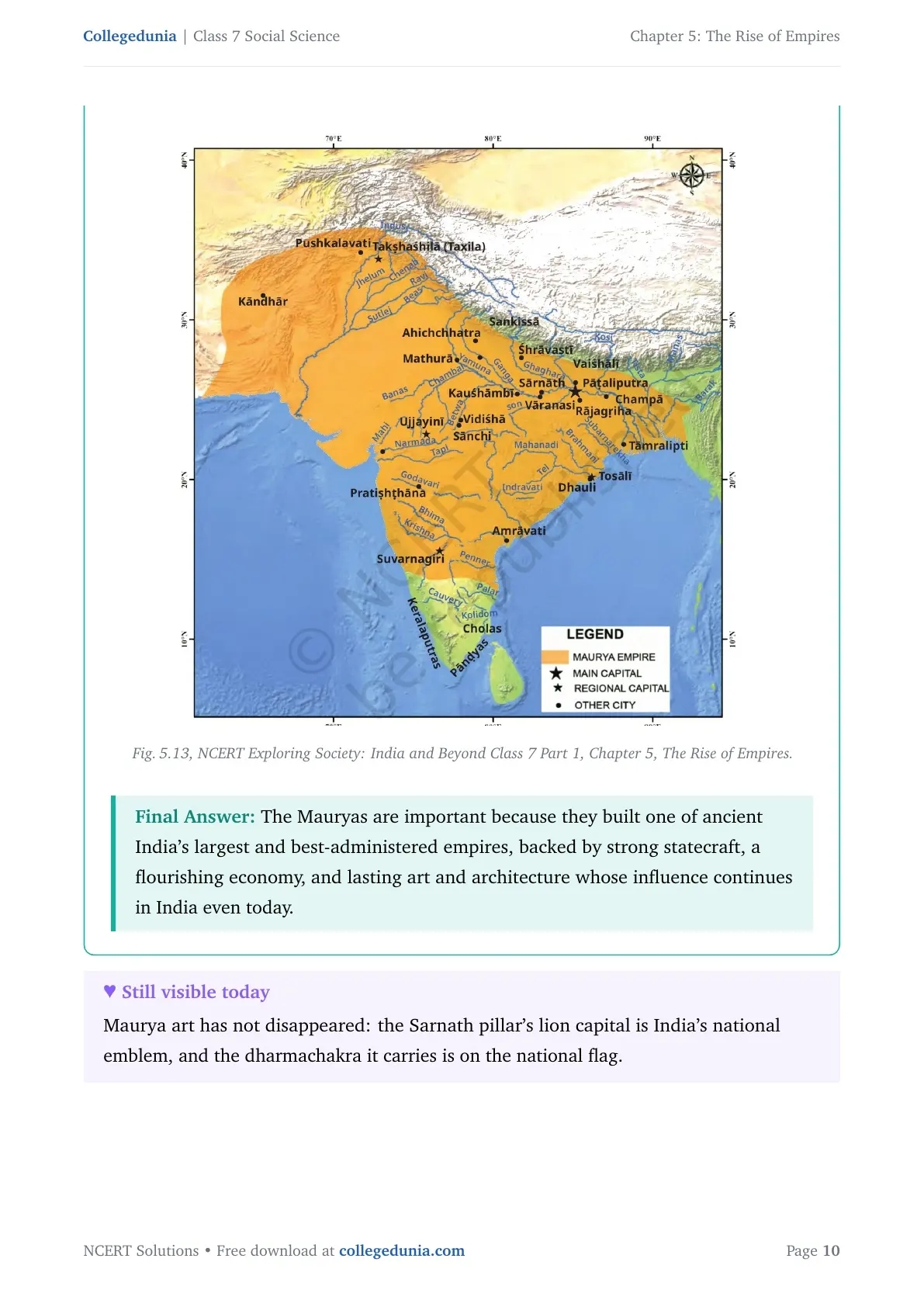
| Q4 | Why the Mauryas matter in Indian history | Reasoning |
| Q5 | Kautilya's key ideas and modern parallels | Reasoning |
| Q6 | Unusual things about Ashoka's lasting influence | 250-word essay |
| Q7 | An Ashokan edict as evidence of tolerance | Source-based opinion |
| Q8 | Researching the Brahmi script | Class project |
| Q9 | Planning a 3rd century BCE trade-route journey | Applied reasoning |
Teachers usually pick Q1, Q2, Q4 and Q5 for a periodic test.
What Makes an Empire Different From a Kingdom
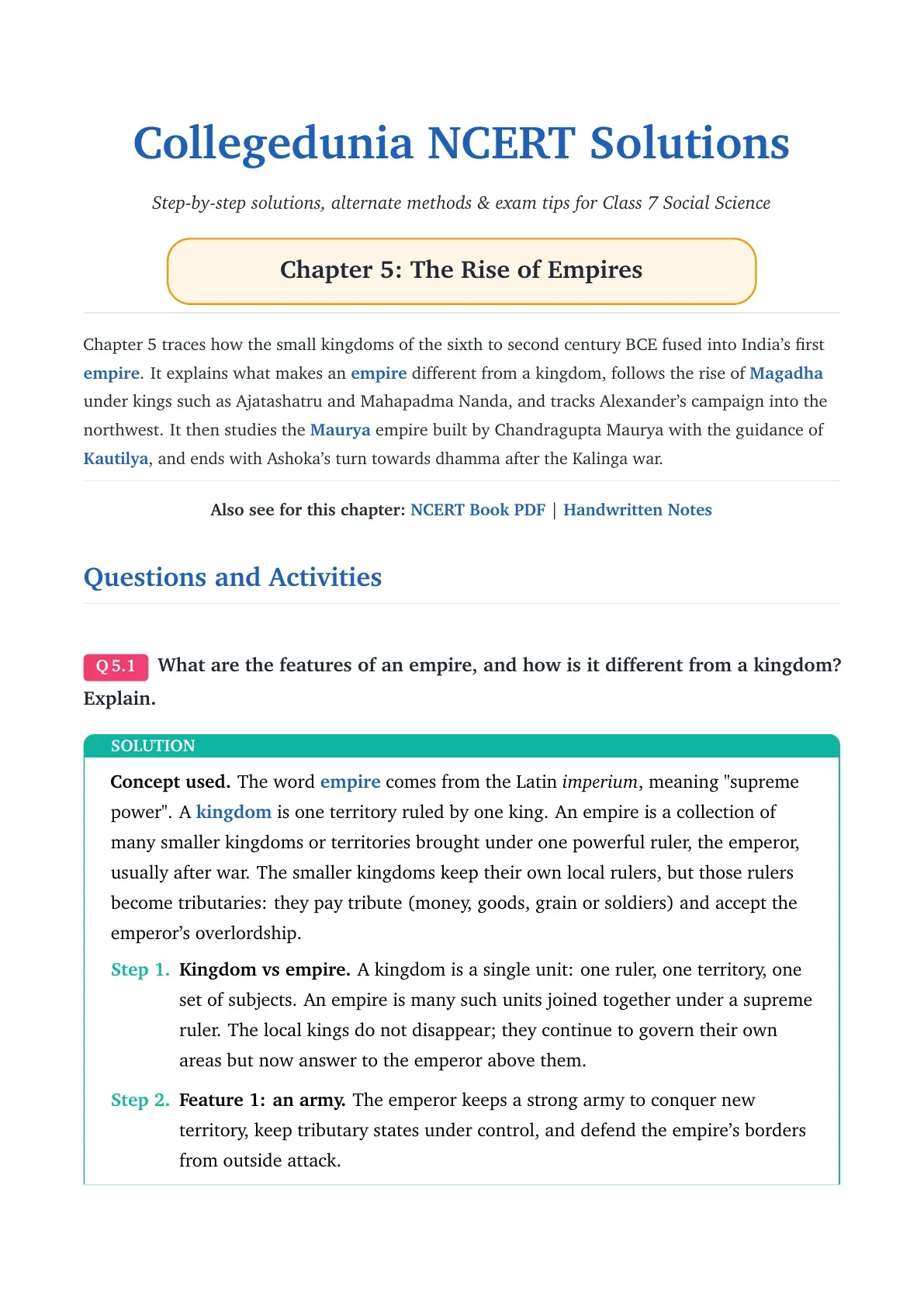
The word empire comes from the Latin imperium, meaning supreme power. A kingdom is one ruler over one territory; an empire brings many kingdoms under one emperor, with local rulers staying on as tributaries, paying tribute in money, goods, grain or soldiers.
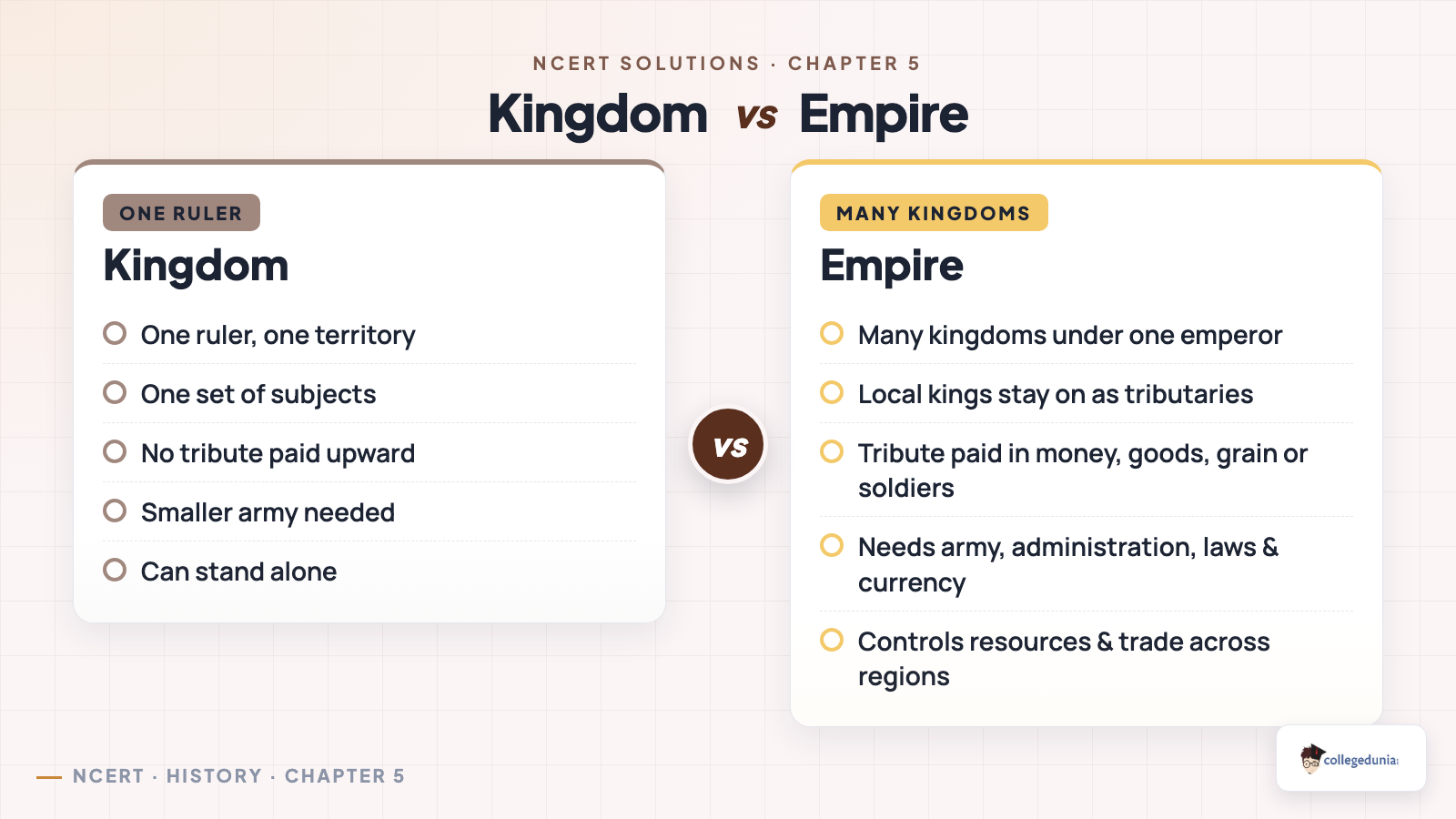
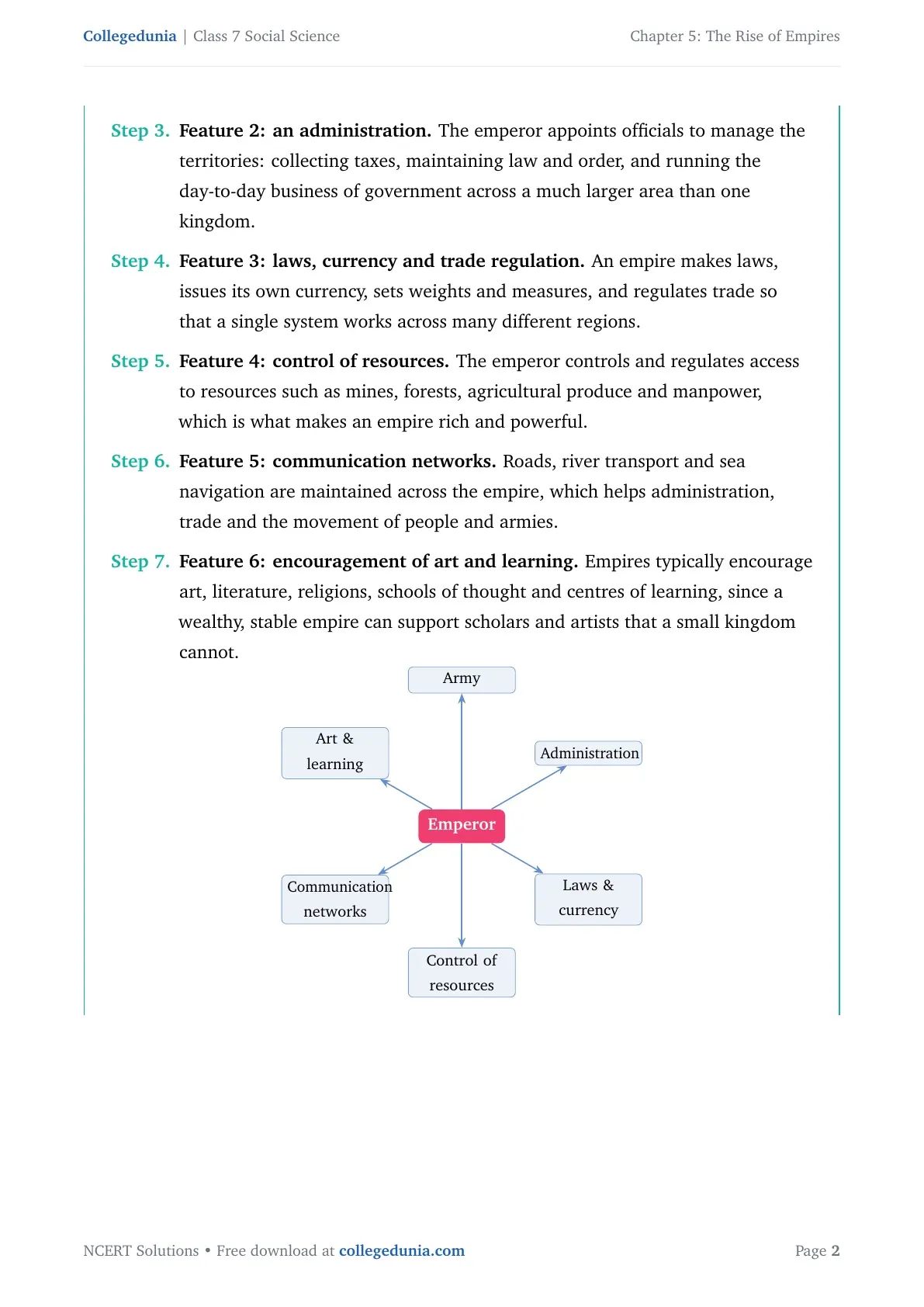
NCERT lists six features a kingdom needs to become a lasting empire; naming these six, not just "the emperor has more power", earns full marks on Q1.
- An army to conquer, control tributaries, and defend borders.
- An administration collecting taxes and running a larger area.
- Laws, currency and trade regulation across many regions.
- Control of resources, mines, forests, farmland, manpower.
- Communication networks, roads, river and sea routes.
- Encouragement of art and learning, which only a wealthy empire sustains.
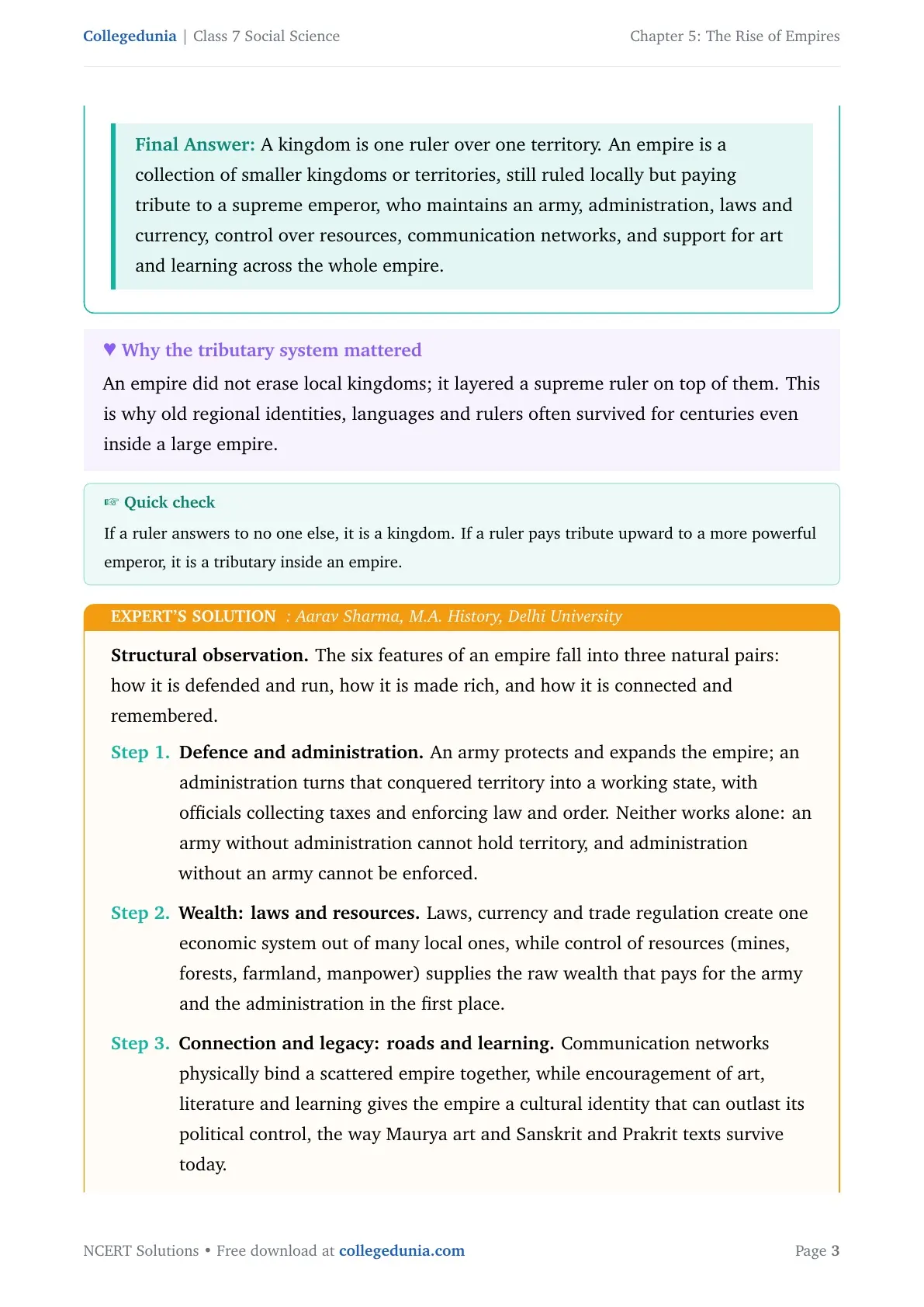
An empire layered a supreme ruler over local kingdoms rather than erasing them. This is why old regional identities and rulers often survived for centuries inside a large empire.
The Rise of Empires Explained for Class 7 Boards
Source: PW Little Champs on YouTube
How Magadha Grew Into India's First Empire
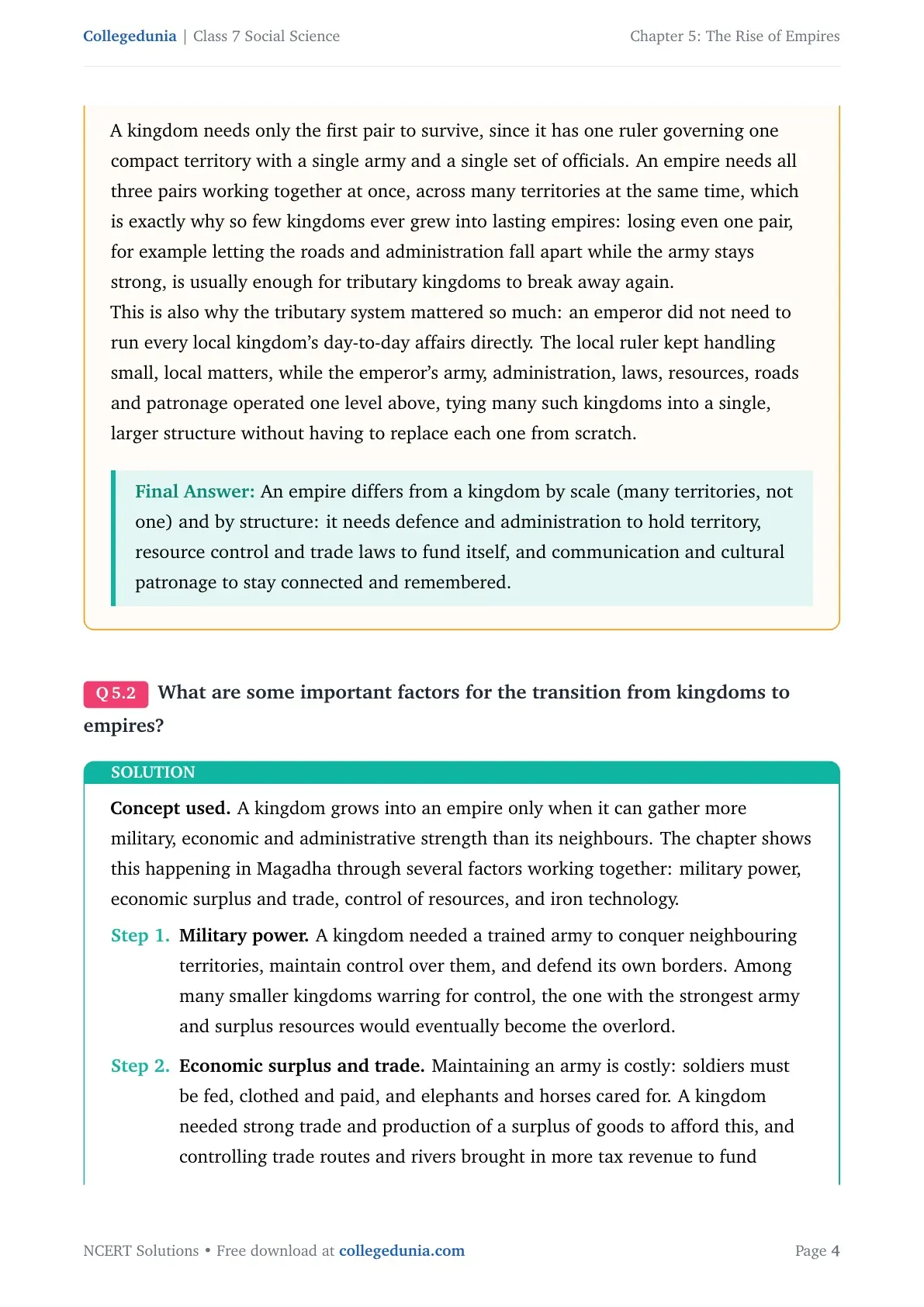
A kingdom grows into an empire only by gathering more military, economic and administrative strength than its neighbours. Magadha did exactly this, and Q2 asks for the factors behind it.
| Factor | How it helped Magadha |
|---|---|
| Military power | A trained army let Magadha conquer neighbouring kingdoms |
| Economic surplus and trade | Surplus goods and river trade paid for soldiers and elephants |
| Control of resources | Rivers and trade brought timber, minerals and tax revenue |
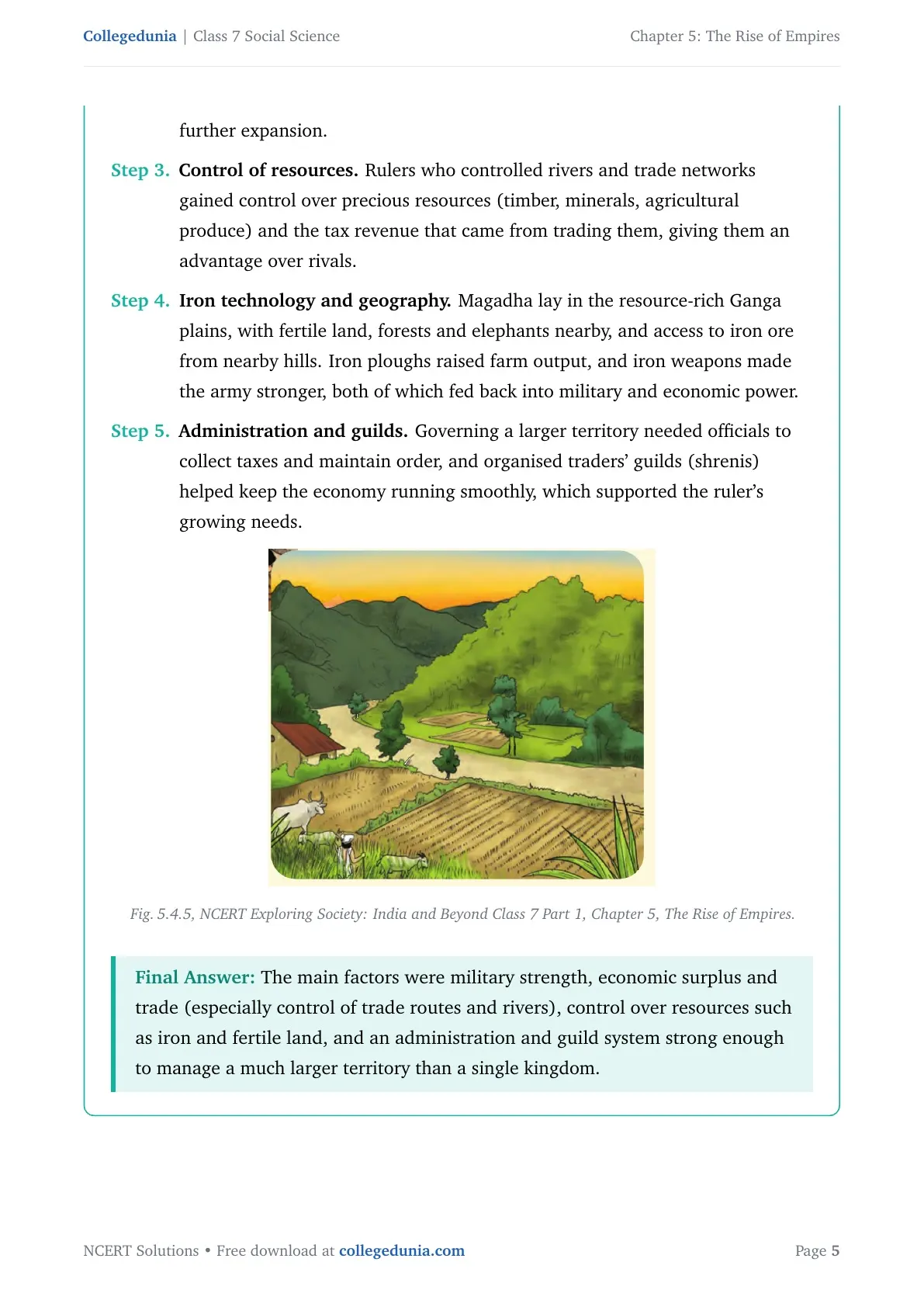
| Iron technology and geography | Fertile Ganga plains plus iron ore raised farm and army strength |
| Administration and guilds | Officials and traders' guilds (shrenis) ran the larger territory |
These factors reinforced each other: fertile land and iron built a stronger base, funding a bigger army, winning more territory and trade, paying for an even larger army. This loop, not conquest alone, turned a kingdom into an empire under Ajatashatru and Mahapadma Nanda, and later the Mauryas.
Alexander's Campaign and Why It Still Matters
Q3 asks why Alexander of Macedonia is remembered as an important world figure. NCERT frames this around scale, speed and cultural contact, not lasting administration, since his empire broke apart soon after he died.
| Date | Event |
|---|---|
| 334 to 331 BCE | Campaign against the Persian Empire |
| 326 BCE | Battle against King Porus at the Hydaspes, Punjab |
| 323 BCE | Death in Babylon, age 32 |
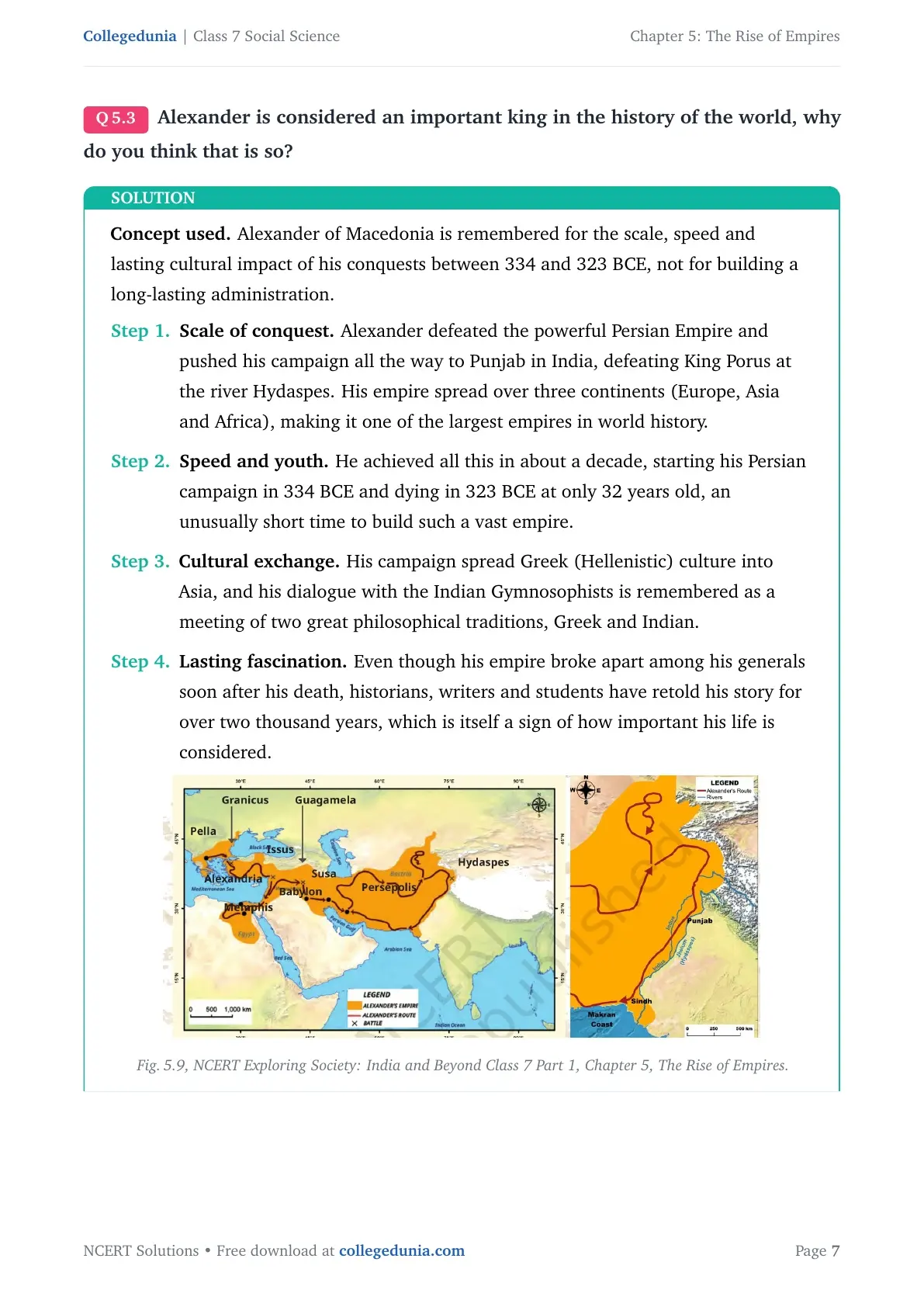
Alexander defeated the Persian Empire and reached Punjab, building an empire spanning three continents in about a decade; his dialogue with the Indian Gymnosophists is remembered as a meeting of two great philosophical traditions.
Chandragupta Maurya, Kautilya and the Saptanga
The Maurya empire, founded by Chandragupta Maurya around 321 BCE, is one of the largest, best-organised empires in Indian history, built on Magadha's strengths plus the guidance of Kautilya, whose ideas fill the Arthashastra. His central idea, the
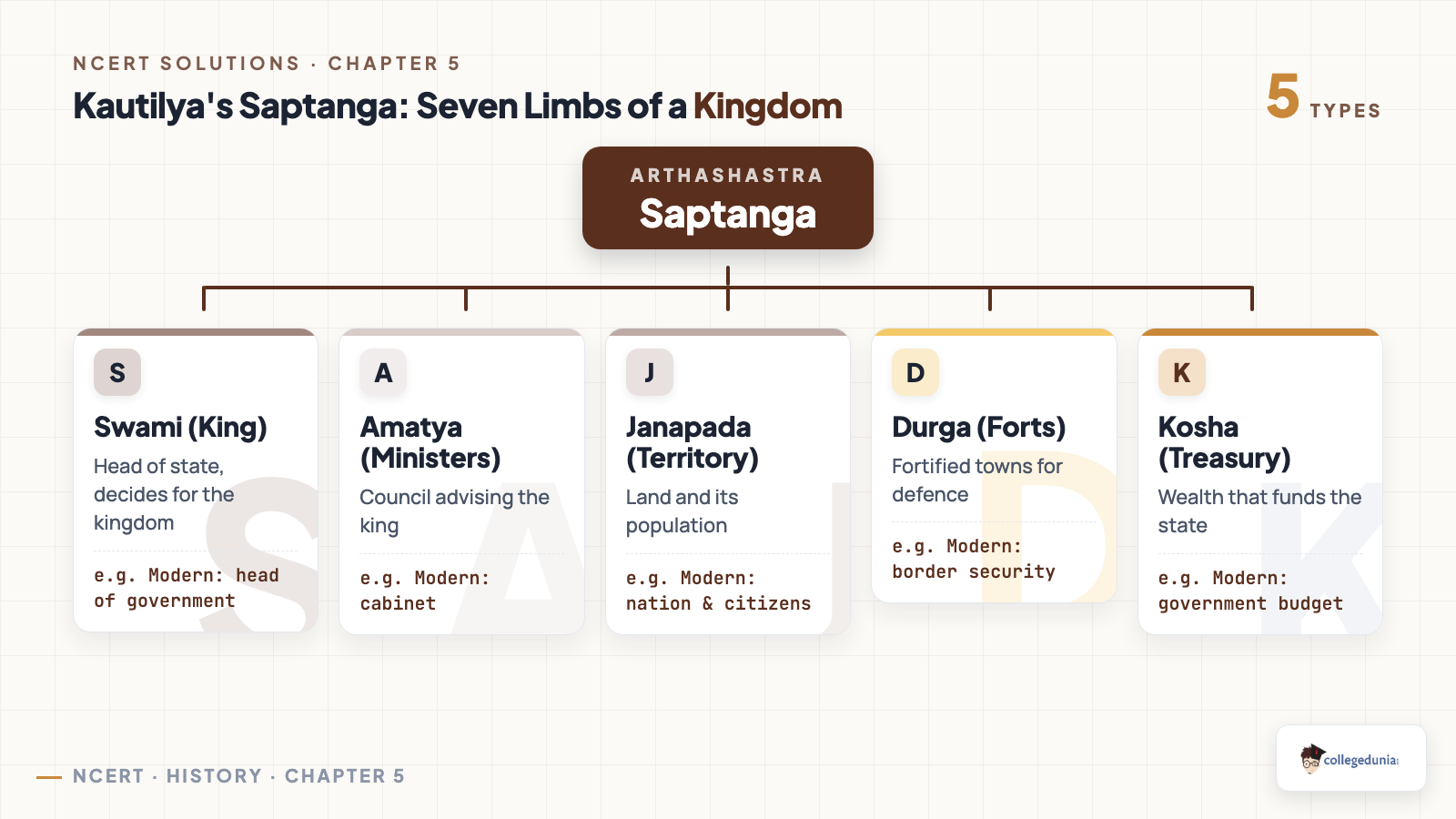
| Saptanga limb | What it means | Modern parallel |
|---|---|---|
| Swami | The king | Head of state |
| Amatya | Council of ministers | Cabinet of ministers |
| Janapada | Territory and population | A nation and its citizens |
| Durga | Fortified towns and cities | Border security infrastructure |
| Kosha | The treasury or wealth | Government budget, tax revenue |
| Danda | Forces of defence and law and order | Armed forces and police |
| Mitra | Allies | Foreign relations and diplomacy |
Kautilya also insisted a king's happiness lies in his subjects' happiness. This welfare-first idea, not just the seven limbs, is why the saptanga still reads as sound advice today.
Ashoka's Turn Towards Dhamma After Kalinga
Ashoka (268 to 232 BCE), Chandragupta's grandson, is unusual among conquering emperors for how he responded to his own victory: the Kalinga war, which Q6 and Q7 both build on.
- Admitting the war. Ashoka openly recorded Kalinga in his edicts, unusual for an image-conscious ruler.
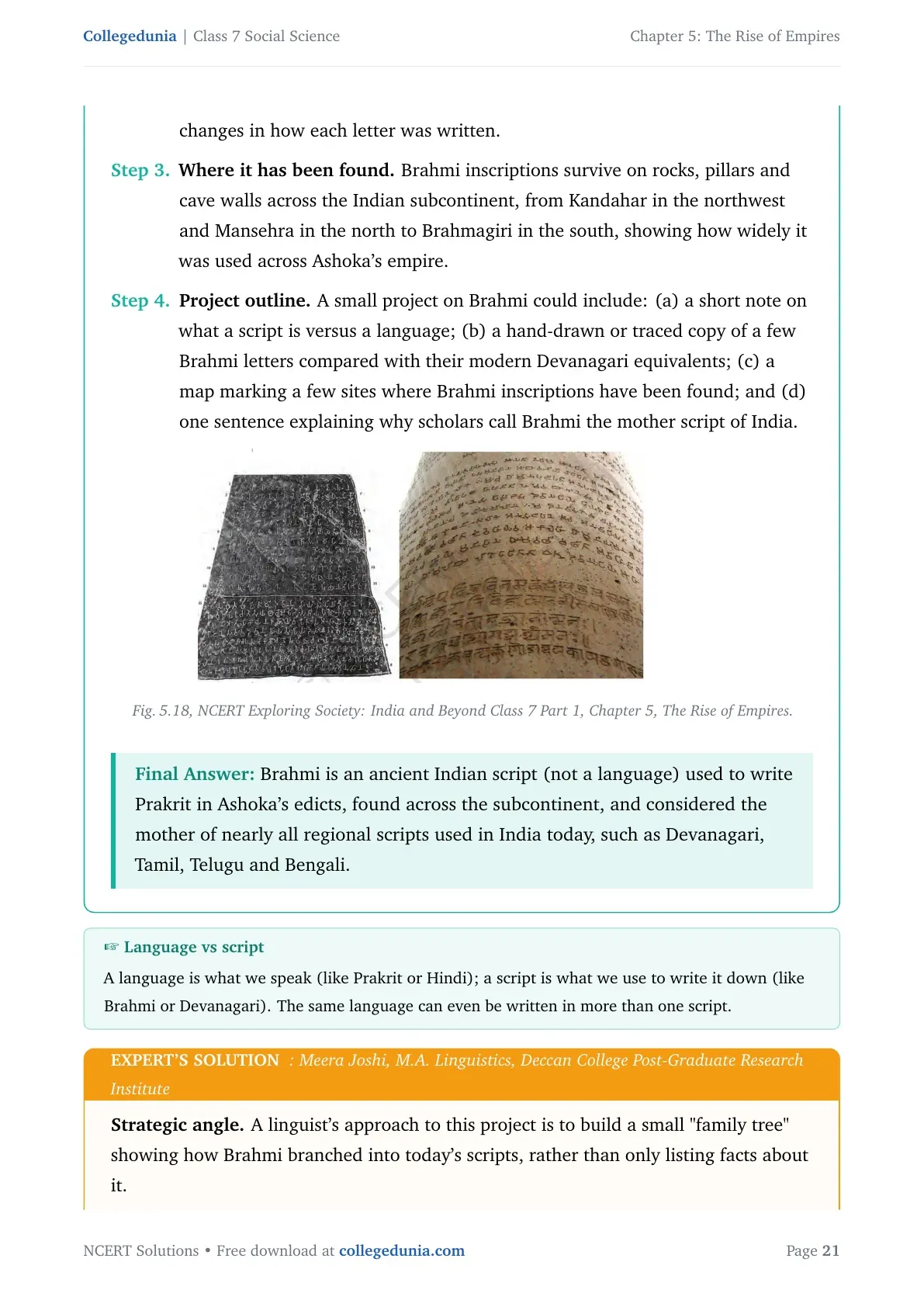
- Communicating in Prakrit and Brahmi. Edicts were carved in everyday Prakrit so ordinary people could read them.
- Extending welfare widely. Medical care for people and animals beyond his borders, plus rest houses and wells along roads.
- Actively supporting other faiths. Q7's edict names officers of Dhamma serving Buddhists, brahmans, Ajivikas and Jains by name, active tolerance, not mere non-interference.
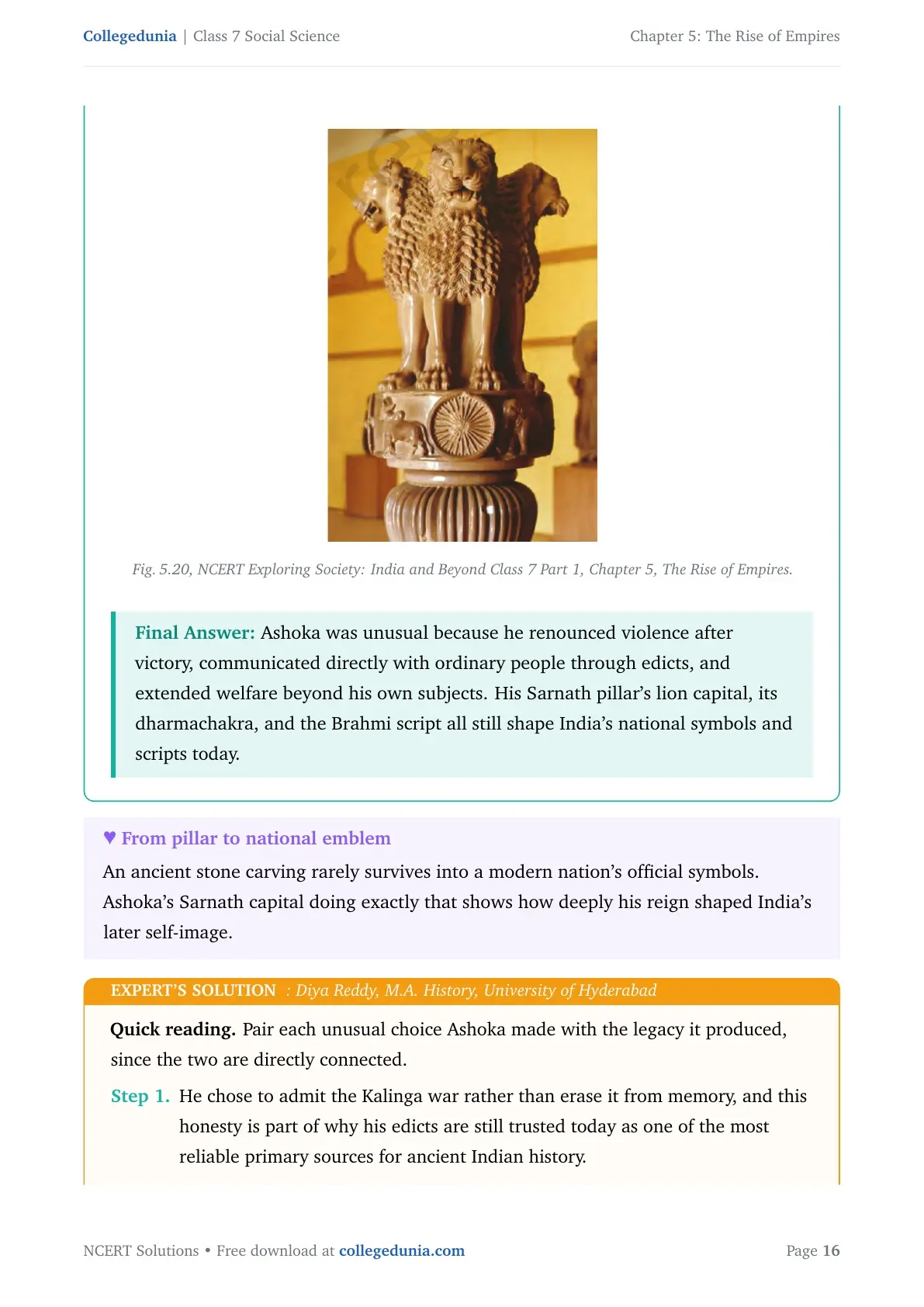
Much of this still shapes India today: the lion capital of his Sarnath pillar is India's national emblem, its dharmachakra sits on the national flag, and Brahmi is the mother of nearly all regional Indian scripts.
Trade Routes, Brahmi Script and Ancient Indian Journeys
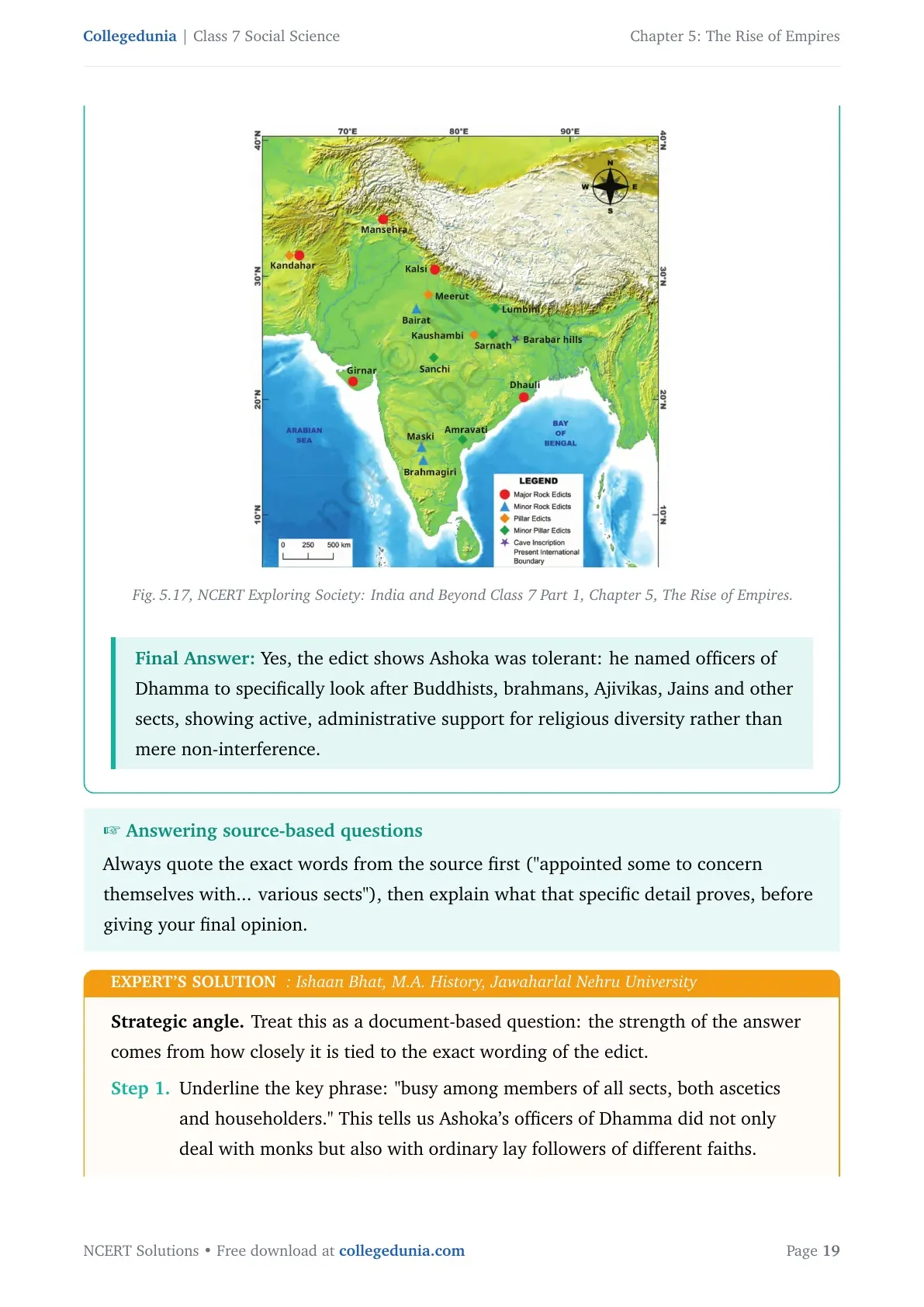
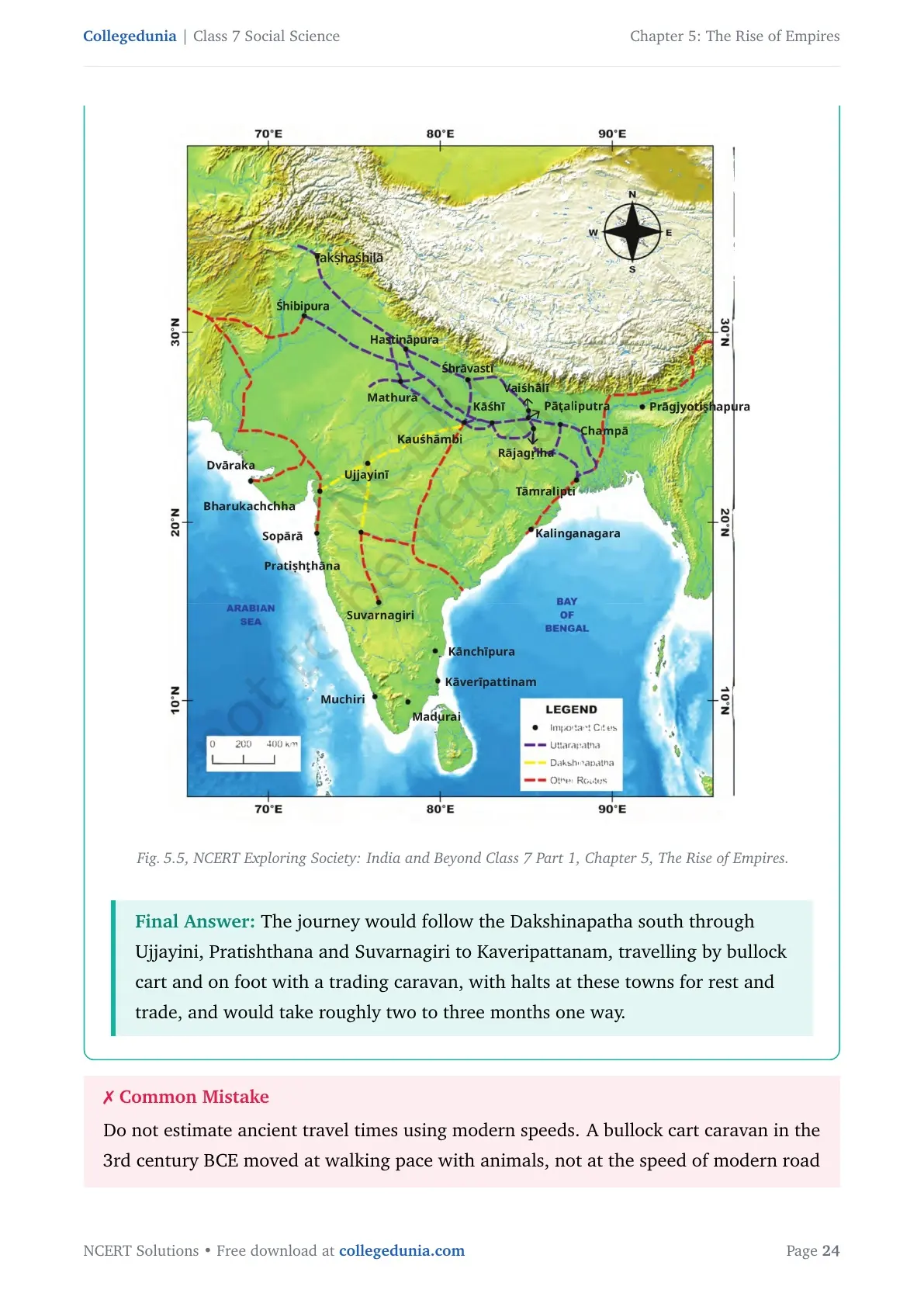
Q8 and Q9 both use the chapter's map of ancient trade routes: the Uttarapatha north, the Dakshinapatha running south through the Deccan.
| Topic | Key fact |
|---|---|
| Brahmi script | Used for Ashoka's Prakrit edicts; ancestor of Devanagari, Tamil, Telugu, Bengali |
| Kaushambi to Kaveripattanam | Roughly 1,800 to 2,200 km via Ujjayini and Pratishthana |
| Mode of travel | Bullock cart and foot, in a guild-organised caravan |
| Estimated travel time | Two to three months, at roughly 15 to 25 km a day |
A script is not a language: Brahmi is the script; Prakrit, the language it wrote, is different entirely. Nearly every modern Indian script evolved from Brahmi, so Q8's project works best as a small family tree, not a list of facts.
Common Mistakes Students Make in The Rise of Empires Chapter
Read this before your next test. Each mistake below has cost real marks on Class 7 papers.
- Treating "empire" and "kingdom" as the same, just bigger. The difference is structure: tributary kingdoms under one emperor.
- Naming only military conquest for Magadha's rise. Q2 also expects economic surplus, iron technology and administration.
- Mixing up the saptanga limbs. Each of the seven has one meaning; Q5 rewards the exact match.
- Forgetting Ashoka admitted Kalinga himself, why his edicts are trusted as a primary source.
- Confusing Brahmi (a script) with Prakrit (a language) in Q8's project.
Student Feedback: In a Collegedunia survey of 12,140 Class 7 students before the 2026 boards, 61% named the saptanga question the hardest to answer fully. Top scorers wrote all seven limbs first, then matched each to its modern parallel.
Source: 2026-27 Class 7 student survey, 12,140 students, CBSE schools, 15 states.
How to Study The Rise of Empires Effectively
This chapter mixes definitions, dates and open-ended reasoning, so short revision blocks beat one long sitting.
- Block 1, 25 minutes. Empire-vs-kingdom distinction and the six features of an empire, Q1.
- Block 2, 30 minutes. Magadha's rise and Alexander's three key dates, then the saptanga's seven limbs from memory.
- Block 3, 25 minutes. Ashoka's Kalinga turning point and the Q7 edict extract, noting why each point is tolerance.
- Night before, 20 minutes. Re-read Common Mistakes and answer Q1, Q2 and Q5 from memory.
More The Rise of Empires Class 7 Resources
Also Check: This chapter is also available in other formats: read the solutions first, then the notes for a deeper walk-through.
| Resource | Best used for | Open it |
|---|---|---|
| NCERT Notes | Topic-by-topic summary of empires, Magadha, Mauryas, Ashoka | The Rise of Empires Class 7 Notes |
| NCERT Book PDF | Official 2026-27 chapter text with all figures | Class 7 Social Science Part 1 Chapter 5 Book PDF |
| Handwritten Notes | Quick one-sitting revision in clear handwriting | The Rise of Empires Class 7 Handwritten Notes |
NCERT Solutions for Class 7 Social Science Part 1: All Chapters
The table below lists NCERT Solutions for every chapter of Part 1, so you can move on once this one is done.
Sample Solutions from The Rise of Empires Chapter 5
Below are two of the nine questions answered in full. Every question in the complete PDF gets:
- Concept used: the exact NCERT term being tested.
- Step-by-step answer: reasoning in short, exam-ready points.
- Boxed answer: a final summary to revise from.
Ques. What are the features of an empire, and how is it different from a kingdom?
Boxed answer: A kingdom is one ruler over one territory. An empire is a collection of smaller kingdoms, still ruled locally but paying tribute to a supreme emperor who maintains an army, administration, laws, resources, roads and patronage of art and learning.
Ques. What were some of Kautilya's key ideas, and which of these can you see even today?
Boxed answer: Kautilya's ideas in the Arthashastra include the saptanga (swami, amatya, janapada, durga, kosha, danda, mitra), people's welfare as the true measure of a king's success, and strong anti-corruption laws, all resembling how modern states are organised: a government head, a cabinet, a treasury, armed forces and foreign alliances.
The Rise of Empires Class 7 Social Science NCERT Solutions FAQs
Ques. Where can I download the NCERT Solutions for Class 7 Social Science Chapter 5 The Rise of Empires PDF?
Ans. Use the download option at the top of this page. The file is free, covers all 9 questions and activities from the chapter, and is available in both Normal and HD quality.
Ques. What is an empire, and how is it different from a kingdom?
Ans. A kingdom is one ruler over one territory. An empire is a collection of many smaller kingdoms or territories brought under one supreme ruler, the emperor, who maintains an army, an administration, laws and currency, control of resources, communication networks, and support for art and learning across the whole empire.
Ques. What factors helped Magadha grow from a kingdom into an empire?
Ans. Magadha's rise came from military power, economic surplus and trade, control of resources such as rivers and forests, iron technology that raised farm output and army strength, and an administration and guild system that could manage a much larger territory.
Ques. Why is Alexander considered an important figure in world history?
Ans. Alexander conquered an unusually vast empire spanning three continents in about a decade, defeated the Persian Empire, reached as far as Punjab where he fought King Porus at the Hydaspes river, and spread Greek culture across Asia, a legacy historians still study today.
Ques. What is Kautilya's saptanga, and what are its seven limbs?
Ans. The saptanga is Kautilya's idea that a kingdom needs seven limbs to function: swami (the king), amatya (ministers), janapada (territory and population), durga (fortified towns), kosha (the treasury), danda (defence and law and order), and mitra (allies).
Ques. Why did Ashoka turn towards dhamma after the Kalinga war?
Ans. Ashoka was troubled by the death and destruction of the Kalinga war and chose, unlike most victorious kings, to give up violence and adopt non-violence and tolerance. He communicated this dhamma through edicts carved in Prakrit and Brahmi across his empire.
Ques. Why is the Brahmi script called the mother of Indian scripts?
Ans. Brahmi is an ancient script used to carve Ashoka's Prakrit edicts. Nearly every modern Indian script, including Devanagari, Tamil, Kannada, Telugu, Odia and Bengali, evolved from Brahmi over many centuries, which is why scholars call it the mother script of India.
Ques. Is this NCERT Solutions PDF aligned with the 2026-27 syllabus?
Ans. Yes. This page follows the current 2026-27 edition of Exploring Society: India and Beyond, Grade 7 Part 1, and every answer matches the chapter content and question order printed in that edition.
Ques. How long would a journey from Kaushambi to Kaveripattanam take in the 3rd century BCE?
Ans. Following the Dakshinapatha trade route by bullock cart and on foot, over roughly 1,800 to 2,200 km with halts at towns such as Ujjayini and Pratishthana, the journey would realistically take about two to three months one way.
Ques. How many pages is the Class 7 Social Science Chapter 5 NCERT Solutions PDF?
Ans. The Solutions PDF runs to 26 pages and covers all 9 questions and activities from The Rise of Empires, with a concept explanation, step-by-step reasoning and a boxed final answer for each one.



Comments