




The NCERT Notes for Class 8 Arts (Kriti) Chapter 18 Arts of the People, With the People, For the People explain knotting, patchwork, papier-mache, everyday materials and community art for the 2026-27 syllabus.
- Chapter focus: art made with thread, paper, cloth and natural fibre.
- Best use: revise activity steps, material choices and reflective answers.
- PDF support: download the complete notes after the preview below.
Chapter18ArtsofthePeople,WiththePeople,ForthePeopleNotes.pdf?page=1&dpi=150)
Chapter18ArtsofthePeople,WiththePeople,ForthePeopleNotes.pdf?page=2&dpi=150)
Chapter18ArtsofthePeople,WiththePeople,ForthePeopleNotes.pdf?page=3&dpi=150)
Chapter18ArtsofthePeople,WiththePeople,ForthePeopleNotes.pdf?page=4&dpi=150)
Chapter18ArtsofthePeople,WiththePeople,ForthePeopleNotes.pdf?page=5&dpi=150)
Chapter18ArtsofthePeople,WiththePeople,ForthePeopleNotes.pdf?page=6&dpi=150)
Chapter18ArtsofthePeople,WiththePeople,ForthePeopleNotes.pdf?page=7&dpi=150)
Chapter18ArtsofthePeople,WiththePeople,ForthePeopleNotes.pdf?page=8&dpi=150)
Chapter18ArtsofthePeople,WiththePeople,ForthePeopleNotes.pdf?page=9&dpi=150)
Chapter18ArtsofthePeople,WiththePeople,ForthePeopleNotes.pdf?page=10&dpi=150)
Chapter18ArtsofthePeople,WiththePeople,ForthePeopleNotes.pdf?page=11&dpi=150)
Chapter18ArtsofthePeople,WiththePeople,ForthePeopleNotes.pdf?page=12&dpi=150)
Chapter18ArtsofthePeople,WiththePeople,ForthePeopleNotes.pdf?page=13&dpi=150)
Chapter18ArtsofthePeople,WiththePeople,ForthePeopleNotes.pdf?page=14&dpi=150)
Chapter18ArtsofthePeople,WiththePeople,ForthePeopleNotes.pdf?page=15&dpi=150)
Chapter18ArtsofthePeople,WiththePeople,ForthePeopleNotes.pdf?page=16&dpi=150)
Chapter18ArtsofthePeople,WiththePeople,ForthePeopleNotes.pdf?page=17&dpi=150)
Chapter18ArtsofthePeople,WiththePeople,ForthePeopleNotes.pdf?page=18&dpi=150)
Chapter18ArtsofthePeople,WiththePeople,ForthePeopleNotes.pdf?page=19&dpi=150)
Chapter18ArtsofthePeople,WiththePeople,ForthePeopleNotes.pdf?page=20&dpi=150)
Chapter18ArtsofthePeople,WiththePeople,ForthePeopleNotes.pdf?page=21&dpi=150)
Chapter18ArtsofthePeople,WiththePeople,ForthePeopleNotes.pdf?page=22&dpi=150)
Chapter18ArtsofthePeople,WiththePeople,ForthePeopleNotes.pdf?page=23&dpi=150)
Chapter18ArtsofthePeople,WiththePeople,ForthePeopleNotes_flat_MobileCard.pdf?page=1&dpi=150)
Chapter18ArtsofthePeople,WiththePeople,ForthePeopleNotes_flat_MobileCard.pdf?page=2&dpi=150)
Chapter18ArtsofthePeople,WiththePeople,ForthePeopleNotes_flat_MobileCard.pdf?page=3&dpi=150)
Chapter18ArtsofthePeople,WiththePeople,ForthePeopleNotes_flat_MobileCard.pdf?page=4&dpi=150)
Chapter18ArtsofthePeople,WiththePeople,ForthePeopleNotes_flat_MobileCard.pdf?page=5&dpi=150)
Chapter18ArtsofthePeople,WiththePeople,ForthePeopleNotes_flat_MobileCard.pdf?page=6&dpi=150)
Chapter18ArtsofthePeople,WiththePeople,ForthePeopleNotes_flat_MobileCard.pdf?page=7&dpi=150)
Chapter18ArtsofthePeople,WiththePeople,ForthePeopleNotes_flat_MobileCard.pdf?page=8&dpi=150)
Chapter18ArtsofthePeople,WiththePeople,ForthePeopleNotes_flat_MobileCard.pdf?page=9&dpi=150)
Chapter18ArtsofthePeople,WiththePeople,ForthePeopleNotes_flat_MobileCard.pdf?page=10&dpi=150)
Chapter18ArtsofthePeople,WiththePeople,ForthePeopleNotes_flat_MobileCard.pdf?page=11&dpi=150)
Chapter18ArtsofthePeople,WiththePeople,ForthePeopleNotes_flat_MobileCard.pdf?page=12&dpi=150)
Chapter18ArtsofthePeople,WiththePeople,ForthePeopleNotes_flat_MobileCard.pdf?page=13&dpi=150)
Chapter18ArtsofthePeople,WiththePeople,ForthePeopleNotes_flat_MobileCard.pdf?page=14&dpi=150)
Chapter18ArtsofthePeople,WiththePeople,ForthePeopleNotes_flat_MobileCard.pdf?page=15&dpi=150)
Chapter18ArtsofthePeople,WiththePeople,ForthePeopleNotes_flat_MobileCard.pdf?page=16&dpi=150)
Chapter18ArtsofthePeople,WiththePeople,ForthePeopleNotes_flat_MobileCard.pdf?page=17&dpi=150)
Chapter18ArtsofthePeople,WiththePeople,ForthePeopleNotes_flat_MobileCard.pdf?page=18&dpi=150)
Chapter18ArtsofthePeople,WiththePeople,ForthePeopleNotes_flat_MobileCard.pdf?page=19&dpi=150)
Chapter18ArtsofthePeople,WiththePeople,ForthePeopleNotes_flat_MobileCard.pdf?page=20&dpi=150)
Chapter18ArtsofthePeople,WiththePeople,ForthePeopleNotes_flat_MobileCard.pdf?page=21&dpi=150)
Chapter18ArtsofthePeople,WiththePeople,ForthePeopleNotes_flat_MobileCard.pdf?page=22&dpi=150)
Chapter18ArtsofthePeople,WiththePeople,ForthePeopleNotes_flat_MobileCard.pdf?page=23&dpi=150)
Chapter18ArtsofthePeople,WiththePeople,ForthePeopleNotes_flat_MobileCard.pdf?page=24&dpi=150)
Chapter18ArtsofthePeople,WiththePeople,ForthePeopleNotes_flat_MobileCard.pdf?page=25&dpi=150)
Chapter18ArtsofthePeople,WiththePeople,ForthePeopleNotes_flat_MobileCard.pdf?page=26&dpi=150)
Chapter18ArtsofthePeople,WiththePeople,ForthePeopleNotes_flat_MobileCard.pdf?page=27&dpi=150)
Chapter18ArtsofthePeople,WiththePeople,ForthePeopleNotes_flat_MobileCard.pdf?page=28&dpi=150)
Chapter18ArtsofthePeople,WiththePeople,ForthePeopleNotes_flat_MobileCard.pdf?page=29&dpi=150)
Chapter18ArtsofthePeople,WiththePeople,ForthePeopleNotes_flat_MobileCard.pdf?page=30&dpi=150)
Chapter18ArtsofthePeople,WiththePeople,ForthePeopleNotes_flat_MobileCard.pdf?page=31&dpi=150)
Chapter18ArtsofthePeople,WiththePeople,ForthePeopleNotes_flat_MobileCard.pdf?page=32&dpi=150)
Chapter18ArtsofthePeople,WiththePeople,ForthePeopleNotes_flat_MobileCard.pdf?page=33&dpi=150)
Chapter18ArtsofthePeople,WiththePeople,ForthePeopleNotes_flat_MobileCard.pdf?page=34&dpi=150)
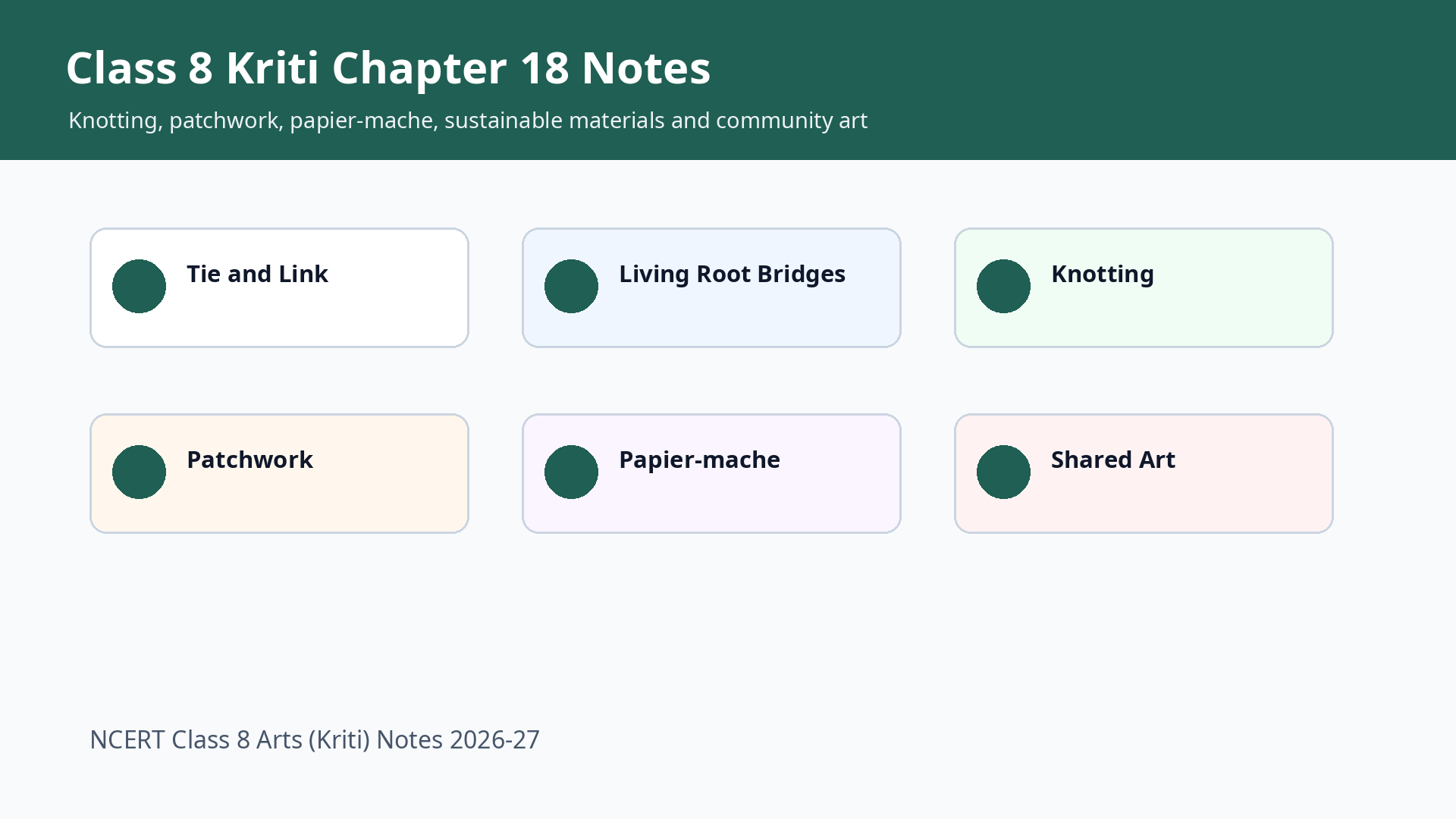
Class 8 Arts Kriti Chapter 18 Notes Overview
Chapter 18 shows that art is part of daily life. Clothes, baskets, plates, bands, quilts and painted paper objects can all carry skill, patience and human connection. The chapter asks students to respect artists who keep such practices alive.
- Material lens: thread, rope, cloth, paper, water, glue and pigment.
- Social lens: shared memory, cooperation, appreciation and community value.
- Sustainability lens: natural fibres, old fabric and old newspaper become useful art.
Tie and Link: Knotting and Natural Networks
Tie and Link begins with natural networks such as roots. The textbook describes living root bridges of Meghalaya, where communities guide strong secondary roots across streams. This example shows how human skill and nature can work together.
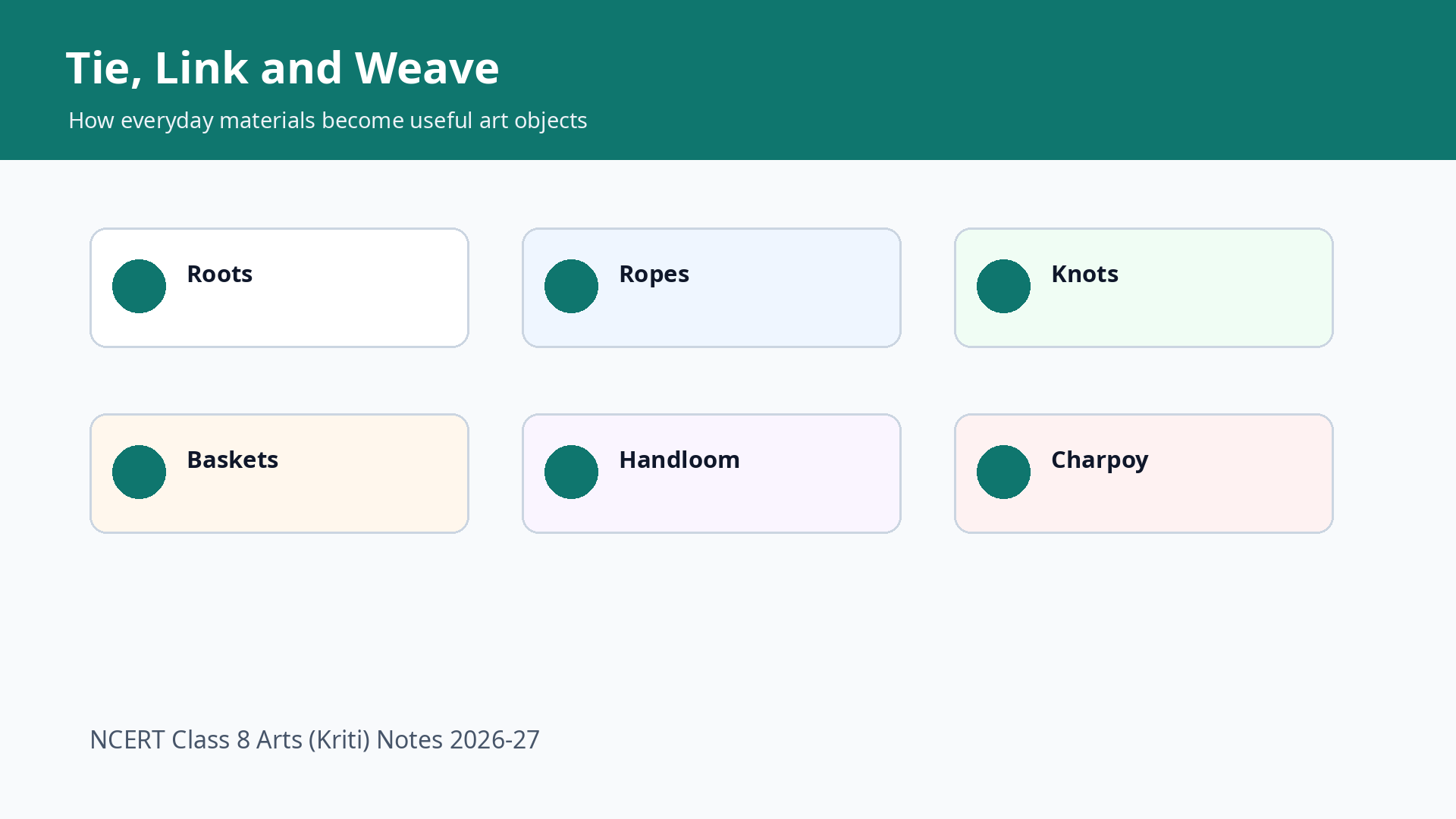
| Technique | Material | Use in the chapter |
|---|---|---|
| Knotting | Cotton, jute or natural fibre | Friendship band, wrist band or rakhi. |
| Weaving | Thread or fibre strips | Baskets, handloom fabric, fans and charpoy. |
| Linking | Roots, rope or fibre | Support, connection and strength over time. |
Patch and Match: Patchwork as Shared Memory
Patchwork joins pieces of old fabric to make a larger surface. It can become a quilt, cradle, bag, cushion cover, table mat or dhurrie. The chapter compares society to a patchwork quilt because each individual helps shape the larger picture.
Safety matters in this activity. Needles should be stored in a sponge or thick cloth, and scissors should be used carefully in groups.
Papier-mache: Pulp, Mould and Paint
Papier-mache uses soft paper, water and glue to make a strong three-dimensional form. Students soak newspaper, squeeze it, grind it into pulp, add glue, apply it over a greased mould, let it dry, release it, sand it and paint it.
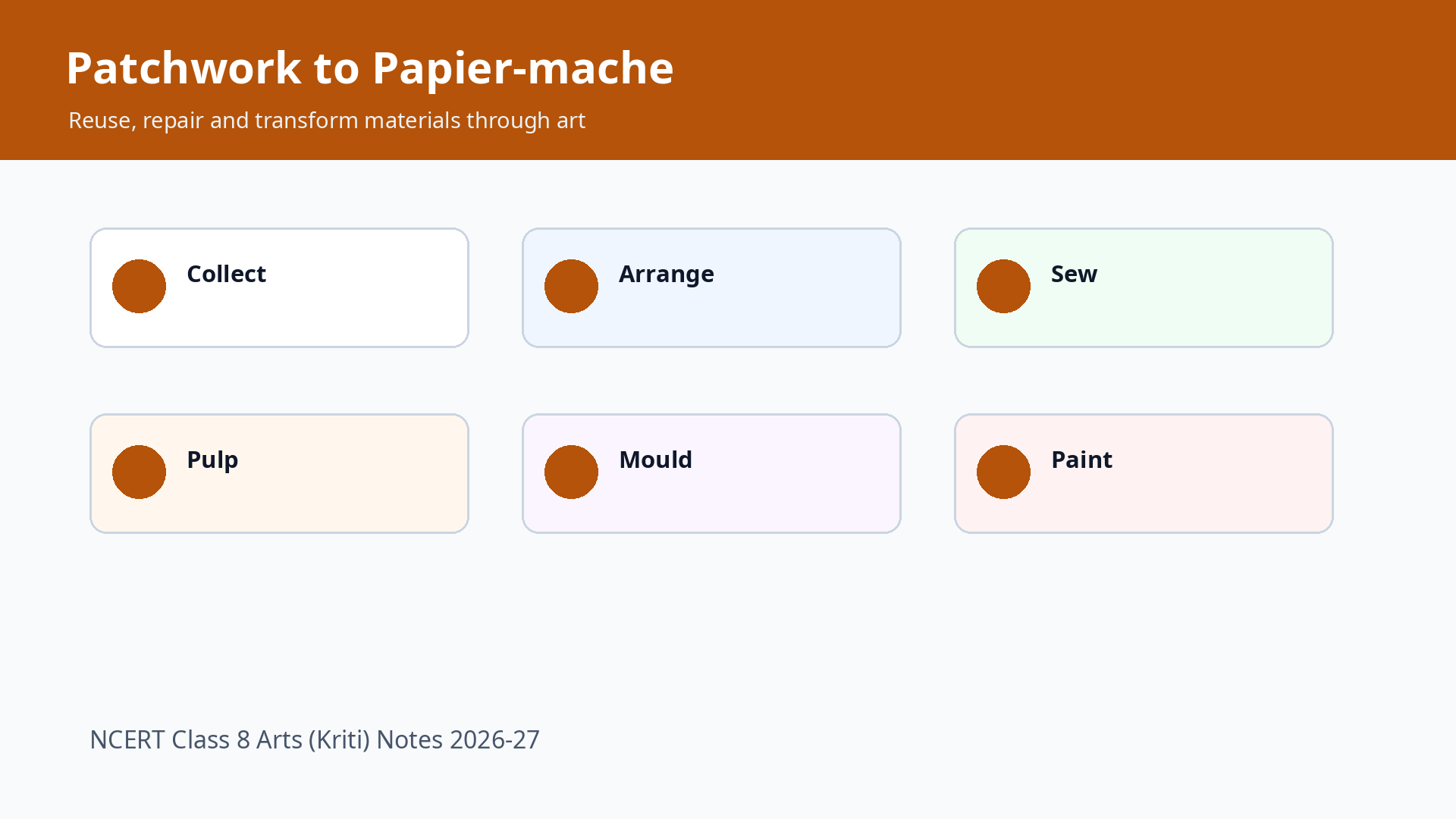
The chapter gives the example of a Kashmiri papier-mache box with a Chinar tree motif. This shows how the same base technique can carry different regional motifs, colours and stories.
Community Art and Sustainability Lesson
Source: YouTube education channel
Class 8 Arts Kriti Chapter 18 Related Resources
| Resource | Class 8 Arts Kriti Chapter 18 Link |
|---|---|
| NCERT Book PDF | Download Chapter 18 NCERT Book PDF |
| NCERT Solutions | Open Chapter 18 NCERT Solutions |
| Handwritten Notes | Download Chapter 18 Handwritten Notes |
Class 8 Arts Kriti Notes for All Chapters
| Chapter | Notes Link |
|---|---|
| Chapter 15 Elements and Principles of Visual Art and Design | Download Chapter 15 Notes |
| Chapter 16 Still Life in Colour | Download Chapter 16 Notes |
| Chapter 17 People in Places | Download Chapter 17 Notes |
| Chapter 19 Campaign for Art Awareness | Download Chapter 19 Notes |
Class 8 Arts Chapter 18 Notes FAQs
Ques. What is covered in Class 8 Arts Kriti Chapter 18 notes?
Ans. The notes cover Tie and Link, knotting, patchwork, papier-mache, sustainable material use, community art and activity-based revision.
Ques. What is patchwork in Chapter 18?
Ans. Patchwork is a technique where small pieces of old fabric are joined and sewn to create a larger fabric surface such as a quilt, bag or mat.
Ques. What is papier-mache?
Ans. Papier-mache is a technique where paper, water and glue are mixed into pulp, moulded into a form, dried, smoothed and painted.



Comments