




The NCERT Notes for Class 8 Arts (Kriti) Chapter 7 Indian Classical Music help students revise the 2026-27 chapter through Carnatic tala, alankara practice, swara notation and South Indian instrument awareness.
- Resource focus: quick revision notes for Indian Classical Music in Class 8 Arts Kriti.
- Chapter link: follows the NCERT Reprint 2026-27 chapter on Carnatic tala and ensemble instruments.
- Best for: classroom recitation, oral revision, tala-count practice and worksheet preparation.
Chapter7IndianClassicalMusicNotes.pdf?page=1&dpi=150)
Chapter7IndianClassicalMusicNotes.pdf?page=2&dpi=150)
Chapter7IndianClassicalMusicNotes.pdf?page=3&dpi=150)
Chapter7IndianClassicalMusicNotes.pdf?page=4&dpi=150)
Chapter7IndianClassicalMusicNotes.pdf?page=5&dpi=150)
Chapter7IndianClassicalMusicNotes.pdf?page=6&dpi=150)
Chapter7IndianClassicalMusicNotes.pdf?page=7&dpi=150)
Chapter7IndianClassicalMusicNotes.pdf?page=8&dpi=150)
Chapter7IndianClassicalMusicNotes.pdf?page=9&dpi=150)
Chapter7IndianClassicalMusicNotes.pdf?page=10&dpi=150)
Chapter7IndianClassicalMusicNotes.pdf?page=11&dpi=150)
Chapter7IndianClassicalMusicNotes.pdf?page=12&dpi=150)
Chapter7IndianClassicalMusicNotes.pdf?page=13&dpi=150)
Chapter7IndianClassicalMusicNotes.pdf?page=14&dpi=150)
Chapter7IndianClassicalMusicNotes.pdf?page=15&dpi=150)
Chapter7IndianClassicalMusicNotes.pdf?page=16&dpi=150)
Chapter7IndianClassicalMusicNotes.pdf?page=17&dpi=150)
Chapter7IndianClassicalMusicNotes.pdf?page=18&dpi=150)
Chapter7IndianClassicalMusicNotes.pdf?page=19&dpi=150)
Chapter7IndianClassicalMusicNotes.pdf?page=20&dpi=150)
Chapter7IndianClassicalMusicNotes.pdf?page=21&dpi=150)
Chapter7IndianClassicalMusicNotes.pdf?page=22&dpi=150)
Chapter7IndianClassicalMusicNotes.pdf?page=23&dpi=150)
Chapter7IndianClassicalMusicNotes.pdf?page=24&dpi=150)
Chapter7IndianClassicalMusicNotes.pdf?page=25&dpi=150)
Chapter7IndianClassicalMusicNotes.pdf?page=26&dpi=150)
Chapter7IndianClassicalMusicNotes.pdf?page=27&dpi=150)
Chapter7IndianClassicalMusicNotes.pdf?page=28&dpi=150)
Chapter7IndianClassicalMusicNotes_flat_MobileCard.pdf?page=1&dpi=150)
Chapter7IndianClassicalMusicNotes_flat_MobileCard.pdf?page=2&dpi=150)
Chapter7IndianClassicalMusicNotes_flat_MobileCard.pdf?page=3&dpi=150)
Chapter7IndianClassicalMusicNotes_flat_MobileCard.pdf?page=4&dpi=150)
Chapter7IndianClassicalMusicNotes_flat_MobileCard.pdf?page=5&dpi=150)
Chapter7IndianClassicalMusicNotes_flat_MobileCard.pdf?page=6&dpi=150)
Chapter7IndianClassicalMusicNotes_flat_MobileCard.pdf?page=7&dpi=150)
Chapter7IndianClassicalMusicNotes_flat_MobileCard.pdf?page=8&dpi=150)
Chapter7IndianClassicalMusicNotes_flat_MobileCard.pdf?page=9&dpi=150)
Chapter7IndianClassicalMusicNotes_flat_MobileCard.pdf?page=10&dpi=150)
Chapter7IndianClassicalMusicNotes_flat_MobileCard.pdf?page=11&dpi=150)
Chapter7IndianClassicalMusicNotes_flat_MobileCard.pdf?page=12&dpi=150)
Chapter7IndianClassicalMusicNotes_flat_MobileCard.pdf?page=13&dpi=150)
Chapter7IndianClassicalMusicNotes_flat_MobileCard.pdf?page=14&dpi=150)
Chapter7IndianClassicalMusicNotes_flat_MobileCard.pdf?page=15&dpi=150)
Chapter7IndianClassicalMusicNotes_flat_MobileCard.pdf?page=16&dpi=150)
Chapter7IndianClassicalMusicNotes_flat_MobileCard.pdf?page=17&dpi=150)
Chapter7IndianClassicalMusicNotes_flat_MobileCard.pdf?page=18&dpi=150)
Chapter7IndianClassicalMusicNotes_flat_MobileCard.pdf?page=19&dpi=150)
Chapter7IndianClassicalMusicNotes_flat_MobileCard.pdf?page=20&dpi=150)
Chapter7IndianClassicalMusicNotes_flat_MobileCard.pdf?page=21&dpi=150)
Chapter7IndianClassicalMusicNotes_flat_MobileCard.pdf?page=22&dpi=150)
Chapter7IndianClassicalMusicNotes_flat_MobileCard.pdf?page=23&dpi=150)
Chapter7IndianClassicalMusicNotes_flat_MobileCard.pdf?page=24&dpi=150)
Chapter7IndianClassicalMusicNotes_flat_MobileCard.pdf?page=25&dpi=150)
Chapter7IndianClassicalMusicNotes_flat_MobileCard.pdf?page=26&dpi=150)
Chapter7IndianClassicalMusicNotes_flat_MobileCard.pdf?page=27&dpi=150)
Chapter7IndianClassicalMusicNotes_flat_MobileCard.pdf?page=28&dpi=150)
Chapter7IndianClassicalMusicNotes_flat_MobileCard.pdf?page=29&dpi=150)
Chapter7IndianClassicalMusicNotes_flat_MobileCard.pdf?page=30&dpi=150)
Chapter7IndianClassicalMusicNotes_flat_MobileCard.pdf?page=31&dpi=150)
Chapter7IndianClassicalMusicNotes_flat_MobileCard.pdf?page=32&dpi=150)
Chapter7IndianClassicalMusicNotes_flat_MobileCard.pdf?page=33&dpi=150)
Chapter7IndianClassicalMusicNotes_flat_MobileCard.pdf?page=34&dpi=150)
Chapter7IndianClassicalMusicNotes_flat_MobileCard.pdf?page=35&dpi=150)
Chapter7IndianClassicalMusicNotes_flat_MobileCard.pdf?page=36&dpi=150)
Chapter7IndianClassicalMusicNotes_flat_MobileCard.pdf?page=37&dpi=150)
Chapter7IndianClassicalMusicNotes_flat_MobileCard.pdf?page=38&dpi=150)
Chapter7IndianClassicalMusicNotes_flat_MobileCard.pdf?page=39&dpi=150)
Chapter7IndianClassicalMusicNotes_flat_MobileCard.pdf?page=40&dpi=150)
Chapter7IndianClassicalMusicNotes_flat_MobileCard.pdf?page=41&dpi=150)
Chapter7IndianClassicalMusicNotes_flat_MobileCard.pdf?page=42&dpi=150)
Chapter7IndianClassicalMusicNotes_flat_MobileCard.pdf?page=43&dpi=150)
Chapter7IndianClassicalMusicNotes_flat_MobileCard.pdf?page=44&dpi=150)
Chapter7IndianClassicalMusicNotes_flat_MobileCard.pdf?page=45&dpi=150)
Chapter7IndianClassicalMusicNotes_flat_MobileCard.pdf?page=46&dpi=150)
Chapter7IndianClassicalMusicNotes_flat_MobileCard.pdf?page=47&dpi=150)
Chapter7IndianClassicalMusicNotes_flat_MobileCard.pdf?page=48&dpi=150)
Chapter7IndianClassicalMusicNotes_flat_MobileCard.pdf?page=49&dpi=150)
Chapter7IndianClassicalMusicNotes_flat_MobileCard.pdf?page=50&dpi=150)
Chapter7IndianClassicalMusicNotes_flat_MobileCard.pdf?page=51&dpi=150)
Chapter7IndianClassicalMusicNotes_flat_MobileCard.pdf?page=52&dpi=150)
In This Article
Class 8 Arts Kriti Chapter 7 Notes Overview
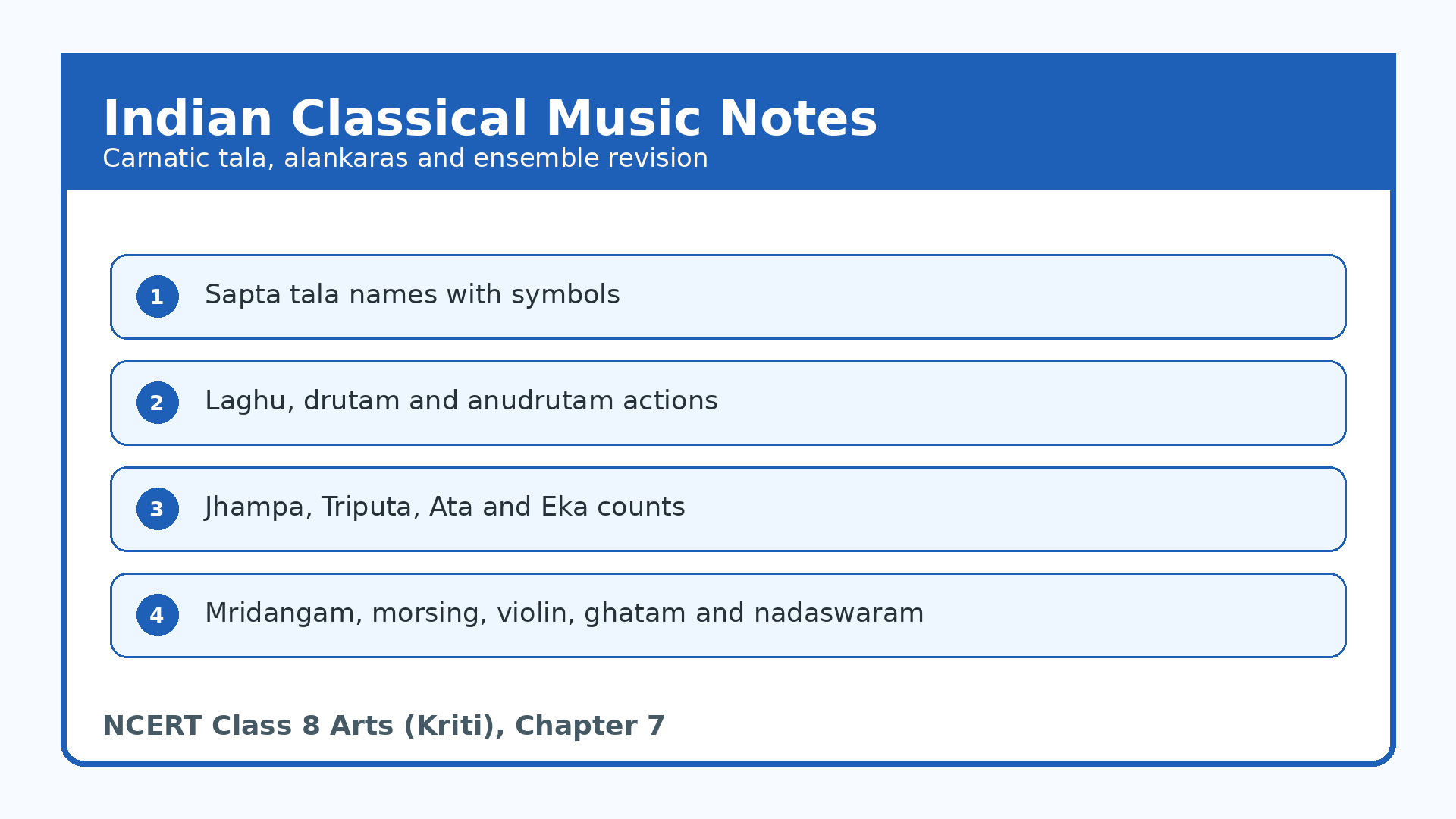
Class 8 Arts Kriti Chapter 7 Indian Classical Music introduces students to Carnatic music through tala practice. The chapter explains how a tala cycle is built from angas, how jathi changes the laghu count, and how swara patterns are sung while the hand keeps time.
- Students revise seven main talas: Dhruva, Mattya, Rupaka, Jhampa, Triputa, Ata and Eka.
- The notes explain laghu, drutam and anudrutam with their classroom actions.
- The PDF summarises the four printed alankara examples and their beat totals.
Sapta Tala and Angas
The sapta tala system gives students a structured way to count musical time. In this chapter, the most important idea is that a tala is not only a name. It is a repeated pattern of actions and counts.
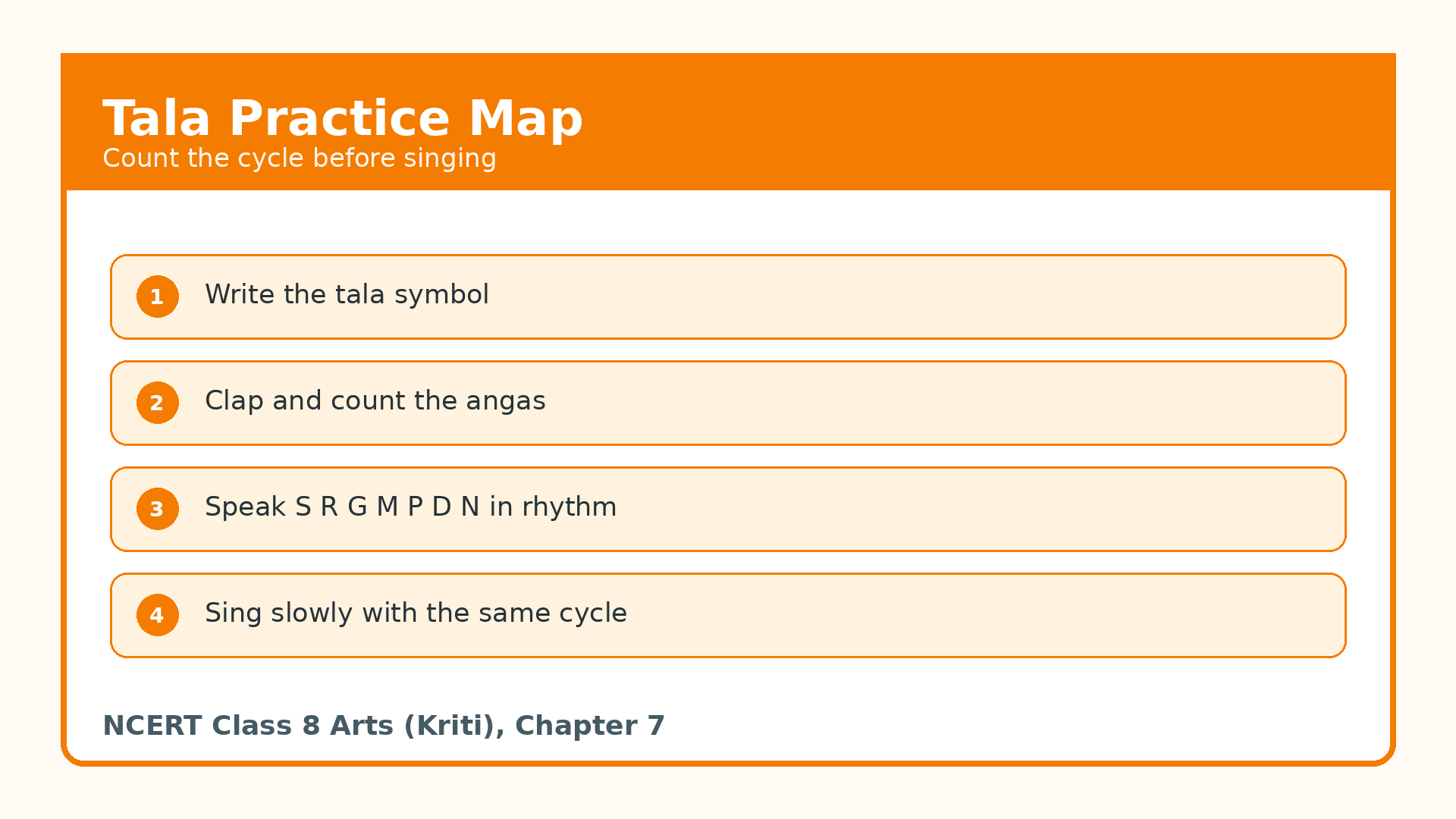
| Anga | Action | Notation | Revision Point |
|---|---|---|---|
| Laghu | Clap and finger counts | I | Count changes with jathi |
| Drutam | Clap and wave | O | Usually counted as two beats |
| Anudrutam | Single beat | U | Usually counted as one beat |
Alankara Practice and Beat Counts
The NCERT chapter prints four main practice examples for this grade: Mishra Jathi Jhampa, Thrisra Jathi Triputa, Khanda Jathi Ata and Chatushra Jathi Eka. Students should read each example as a count pattern first and a swara pattern second.
- Mishra Jathi Jhampa: I7 U O, so 7 plus 1 plus 2 equals 10 beats.
- Thrisra Jathi Triputa: I3 O O, so 3 plus 2 plus 2 equals 7 beats.
- Khanda Jathi Ata: I5 I5 O O, so 5 plus 5 plus 2 plus 2 equals 14 beats.
- Chatushra Jathi Eka: I4, so the cycle has 4 beats.
Indian Classical Music Chapter Video
Source: YouTube music education channel
Carnatic Ensemble Instruments
The chapter also shows instruments used in South Indian classical performance. The ensemble image names mridangam, morsing, violin and ghatam. Another image shows nadaswaram artists, linking the chapter to double reed wind instruments from South India.
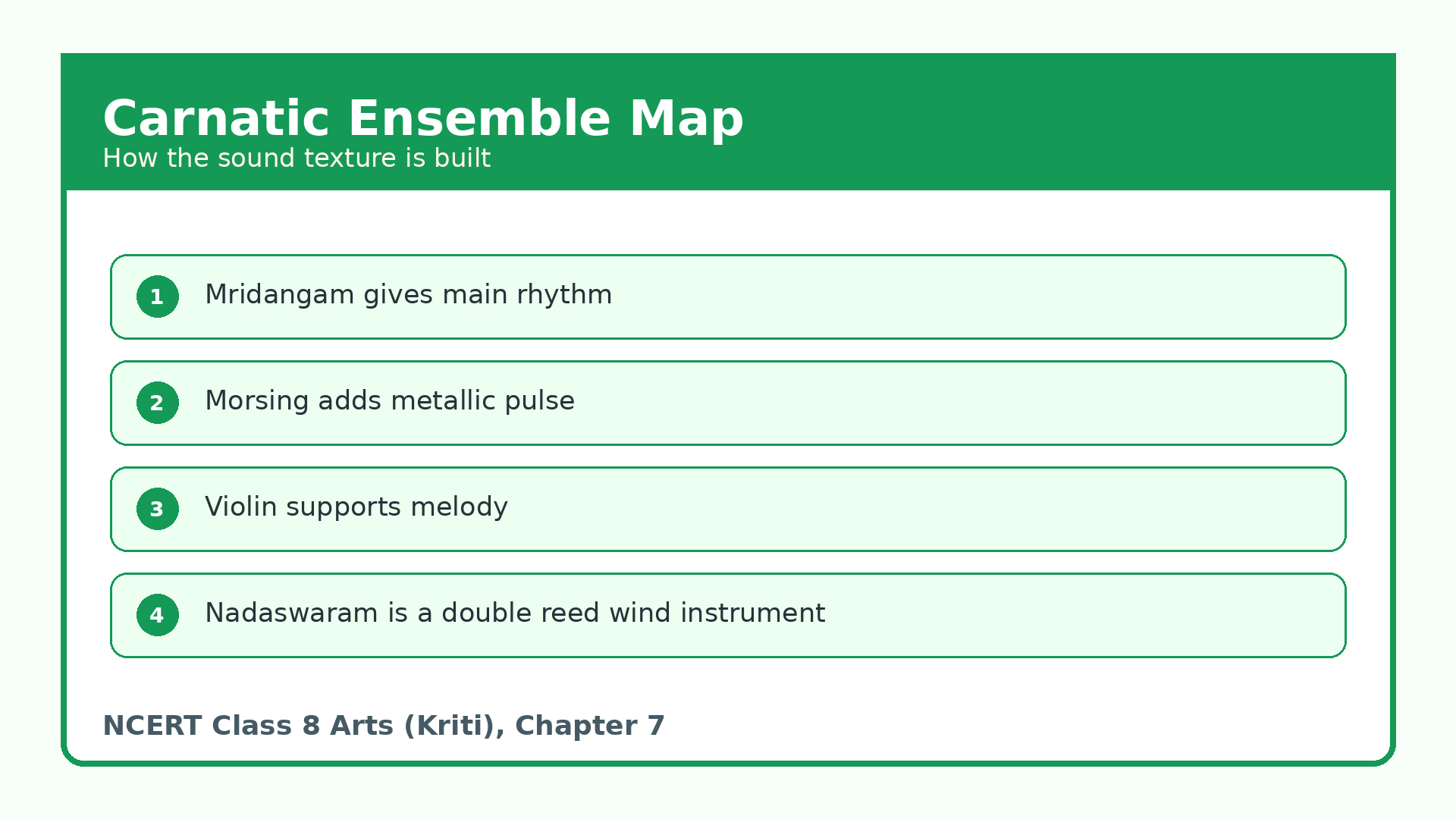
| Instrument | Role in Revision |
|---|---|
| Mridangam | Main percussion support in Carnatic performance |
| Morsing | Metallic pulse and mouth-resonance colour |
| Violin | Melodic support in many Carnatic concerts |
| Ghatam | Clay-pot percussion tone |
| Nadaswaram | Double reed wind instrument from South India |
Sri Gananatham Bhajare and Raag Asavari
The second half of the chapter moves from tala exercises to full music material. Sri Gananatham Bhajare is given as a kriti in Ragam Ishamanohari and Talam Rupaka, composed by Muthuswami Dikshitar. Students also revise pallavi, anupallavi, charanam and the faster madhyama kala portion.
- Raag Asavari: the lakshan table gives thaat, aroh, avroh, pakad, varjit swar, komal swar, vadi, samvadi and singing time.
- Hindustani practice: the chapter prints Raag Asavari Lakshan Geet in Teentaal and Sargam Geet in Jhaptal.
- Activity 7.1: students accompany a composition and compare lower and higher tempo to observe mood change.
Bhakti Sangeet and Sufi Qawwali
The chapter also explains devotional music. The Bhakti movement encouraged forms such as bhajans and kirtanas and names poets such as Mirabai, Tulsidas, Purandara Dasa and Kanakadasa. The Sufi section explains inner devotion and the growth of Qawwali, especially in Punjab and western India.
| Section | Key Revision Point |
|---|---|
| Bhakti Sangeet | Devotional singing, bhajan and kirtana traditions |
| Sufi Qawwali | Music linked with inner devotion and spiritual experience |
| Assessment | Sing basic songs, keep tala and understand Bhakti movement music |
Class 8 Arts Kriti Chapter 7 Related Resources
| Resource | Class 8 Arts Kriti Chapter 7 Link |
|---|---|
| NCERT Book PDF | Download Chapter 7 NCERT Book PDF |
| NCERT Solutions | Open Chapter 7 NCERT Solutions |
| Handwritten Notes | Download Chapter 7 Handwritten Notes |
Class 8 Arts Kriti Notes for All Chapters
| Chapter | Notes Link |
|---|---|
| Chapter 2 One Stage, Many Scripts | Download Chapter 2 Notes |
| Chapter 3 From Page to Stage | Download Chapter 3 Notes |
| Chapter 4 Applause and Advice | Download Chapter 4 Notes |
| Chapter 5 Discovering the Elements of Music | Download Chapter 5 Notes |
| Chapter 6 Musical Instruments | Download Chapter 6 Notes |
Indian Classical Music Class 8 Arts Kriti Notes FAQs
Ques. What is covered in Class 8 Arts Kriti Chapter 7 notes?
Ans. The notes cover Carnatic tala, sapta tala names, laghu, drutam, anudrutam, jathi, alankara beat counts and Carnatic ensemble instruments.
Ques. What are the three angas in this chapter?
Ans. The three angas are laghu, drutam and anudrutam. Laghu uses clap and finger counts, drutam uses clap and wave, and anudrutam is a single beat.
Ques. Is this notes PDF based on the 2026-27 NCERT book?
Ans. Yes. The PDF follows the NCERT Class 8 Arts Kriti Reprint 2026-27 chapter Indian Classical Music.



Comments