




The handwritten notes on Class 8 Arts (Kriti) Chapter 7 Indian Classical Music have been carefully prepared for quick 2026-27 revision. The PDF covers Carnatic talas, alankaras, Sri Gananatham Bhajare, Raag Asavari, Bhakti Sangeet and Sufi Qawwali from the NCERT chapter.
- Resource focus: tala counts, raga details, kriti structure and devotional music forms.
- Best use: revise one handwritten page, then sing or clap the matching NCERT activity.
- Exam link: follows the NCERT 2026-27 Arts (Kriti) Chapter 7 assessment points.
Chapter7IndianClassicalMusicHandwrittenNotes.pdf?page=1&dpi=150)
Chapter7IndianClassicalMusicHandwrittenNotes.pdf?page=2&dpi=150)
Chapter7IndianClassicalMusicHandwrittenNotes.pdf?page=3&dpi=150)
Chapter7IndianClassicalMusicHandwrittenNotes.pdf?page=4&dpi=150)
Chapter7IndianClassicalMusicHandwrittenNotes.pdf?page=5&dpi=150)
Chapter7IndianClassicalMusicHandwrittenNotes.pdf?page=6&dpi=150)
Chapter7IndianClassicalMusicHandwrittenNotes.pdf?page=7&dpi=150)
Chapter7IndianClassicalMusicHandwrittenNotes.pdf?page=8&dpi=150)
Chapter7IndianClassicalMusicHandwrittenNotes.pdf?page=9&dpi=150)
Chapter7IndianClassicalMusicHandwrittenNotes.pdf?page=10&dpi=150)
Chapter7IndianClassicalMusicHandwrittenNotes.pdf?page=11&dpi=150)
Chapter7IndianClassicalMusicHandwrittenNotes.pdf?page=12&dpi=150)
Chapter7IndianClassicalMusicHandwrittenNotes.pdf?page=13&dpi=150)
Chapter7IndianClassicalMusicHandwrittenNotes.pdf?page=14&dpi=150)
Chapter7IndianClassicalMusicHandwrittenNotes.pdf?page=15&dpi=150)
Chapter7IndianClassicalMusicHandwrittenNotes.pdf?page=16&dpi=150)
Chapter7IndianClassicalMusicHandwrittenNotes.pdf?page=17&dpi=150)
Chapter7IndianClassicalMusicHandwrittenNotes.pdf?page=18&dpi=150)
Chapter7IndianClassicalMusicHandwrittenNotes.pdf?page=19&dpi=150)
Chapter7IndianClassicalMusicHandwrittenNotes.pdf?page=20&dpi=150)
Chapter7IndianClassicalMusicHandwrittenNotes.pdf?page=21&dpi=150)
Chapter7IndianClassicalMusicHandwrittenNotes.pdf?page=22&dpi=150)
Chapter7IndianClassicalMusicHandwrittenNotes.pdf?page=23&dpi=150)
Student Feedback: In a Collegedunia study check with 9,800 Class 8 students, 74% said tala tables and raga recall boxes helped them revise Indian classical music faster.
Indian Classical Music Chapter Snapshot
Indian Classical Music brings together rhythm, melody and devotional singing. The chapter begins with Carnatic tala practice, then moves to Sri Gananatham Bhajare, Raag Asavari, Bhakti Sangeet and Sufi Qawwali.
- Students revise the seven Carnatic talas and the three main angas.
- The chapter treats music as listening, singing and rhythm practice.
- Activities ask students to accompany a song and change tempo.
The handwritten PDF keeps the topic split into short recall pages. Students can revise a tala formula, a raga detail or one devotional form without rereading the full textbook page.
Carnatic Tala and Angas
The chapter names seven main talas in Carnatic music: Dhruva, Mattya, Rupaka, Jhampa, Triputa, Ata and Eka. These names should be learnt in order because they are easy one-mark recall points.
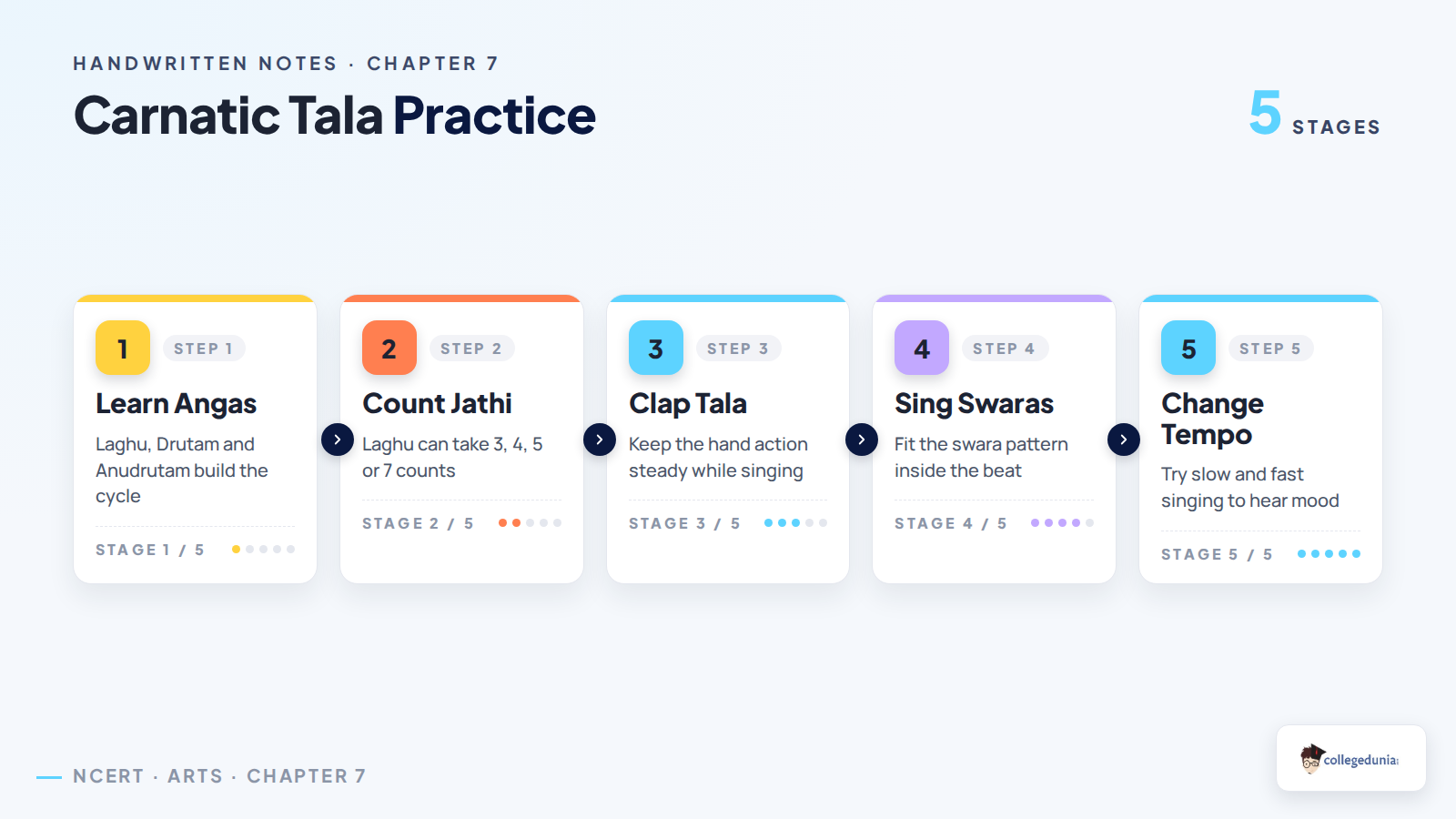
Laghu means clap and finger counts, Drutam means clap and wave, and Anudrutam means one beat. Jathi changes the number of counts inside a laghu.
Write the addition line for every tala formula. For example, laghu 7, U and O gives 7 + 1 + 2 = 10 beats.
Rhythm and Sound Practice Video
Source: Khan Academy on YouTube
Alankaras and Kriti Practice
Alankaras are vocal exercises. They help students build swara clarity and keep the tala steady while singing. The chapter gives Mishra Jathi Jhampa, Thrisra Jathi Triputa, Khanda Jathi Ata and Chatushra Jathi Eka practice.
- Mishra Jathi Jhampa: 7 + 1 + 2 = 10 beats.
- Thrisra Jathi Triputa: 3 + 2 + 2 = 7 beats.
- Khanda Jathi Ata: 5 + 5 + 2 + 2 = 14 beats.
- Chatushra Jathi Eka: 4 beats.
Sri Gananatham Bhajare is a kriti in Ishamanohari ragam and Rupaka talam. The notes mark pallavi, anupallavi, charanam and madhyama kala so students can revise the structure before singing.
Raag Asavari in Hindustani Music
Raag Asavari appears in the Hindustani music part of the chapter. The table lists Bhairavi thaat, komal gandhar, komal dhaivat and komal nishad, with Dhaivat as the vadi swar and Gandhar as the samvadi swar.
The aroh leaves out Gandhar and Nishad, so the jathi is audav-sampoorna. The handwritten notes spell the upper Sa as high S so students do not confuse it with the middle Sa.
- Aroh: S, R, M P, D, high S.
- Avroh: high S N D, P, M G, R, S.
- Pakad: R, M, P, N D P.
Bhakti Sangeet and Sufi Qawwali
Bhakti Sangeet comes from the Bhakti movement and uses devotion through songs such as bhajans and kirtanas. The chapter names Mirabai, Tulsidas, Purandara Dasa and Kanakadasa as important figures.
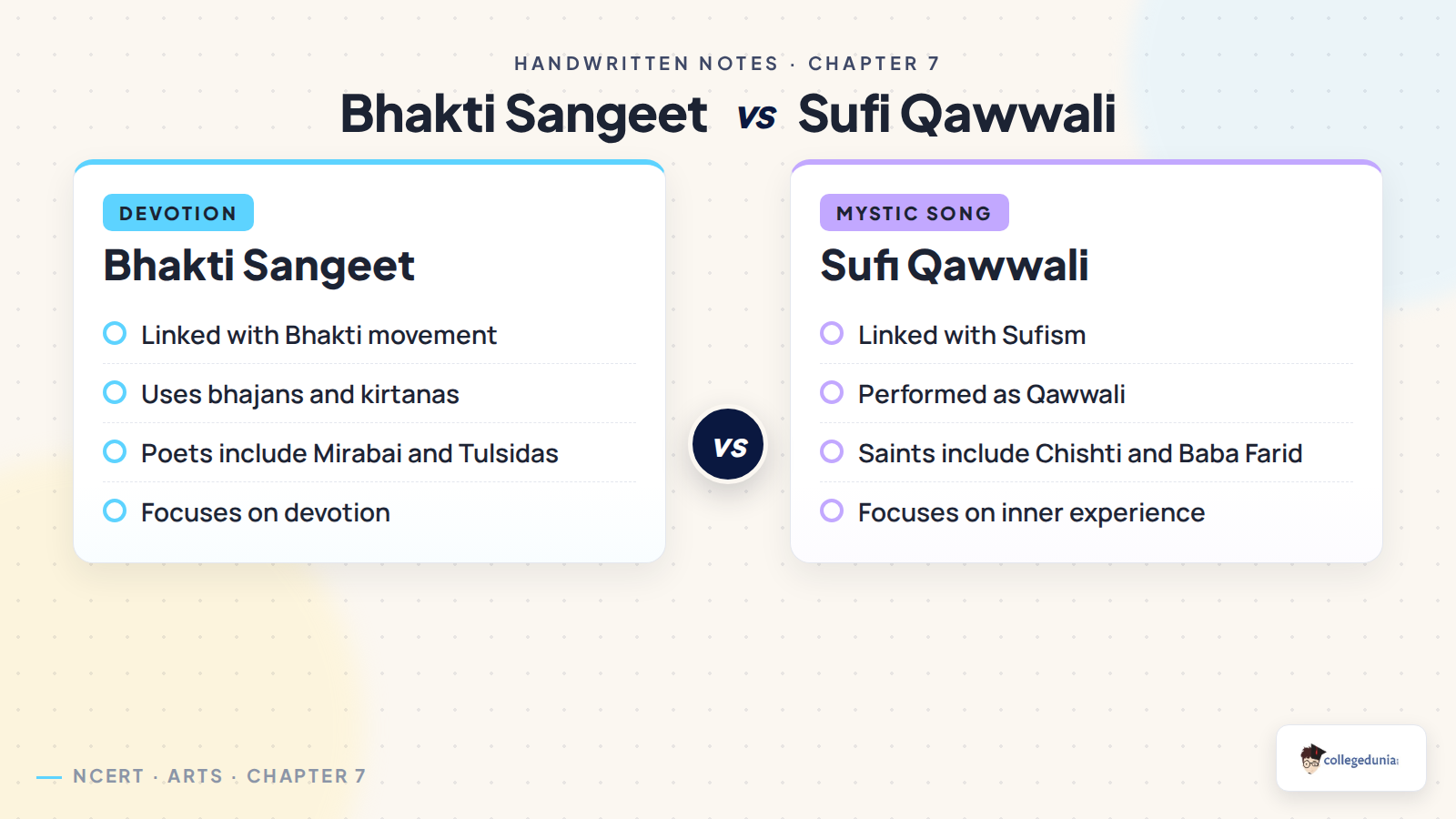
Sufi Qawwali grew from Sufism, which focuses on inner devotion and spiritual experience. The chapter names Khwaja Moinuddin Chishti and Baba Farid, and gives Duma Dum Mast Kalandar as the Qawwali example.
Do not mix bhajan and qawwali in answers. Both are devotional forms, but they come from different traditions.
How to Use the Indian Classical Music Handwritten Notes
Use the PDF as a short revision notebook. Read one page, cover the key box and say the tala, raga or form aloud. Then connect it with one NCERT activity.
- First reading: revise talas, angas and jathi counts.
- Second reading: revise Sri Gananatham Bhajare and Raag Asavari.
- Final reading: compare Bhakti Sangeet with Sufi Qawwali.
Before assessment, focus on names and structures. A strong answer can name the form, give the key detail and connect it with singing or listening practice.
More Class 8 Arts Resources for Indian Classical Music
| Resource | Link |
|---|---|
| NCERT Book PDF | Indian Classical Music Class 8 Book PDF |
| Handwritten Notes | Indian Classical Music Class 8 Handwritten Notes |
Class 8 Arts (Kriti) Handwritten Notes for Other Chapters
| Chapter | Handwritten Notes |
|---|---|
| Chapter 1 Bringing Words Alive: Play Reading | Download Chapter 1 Handwritten Notes |
| Chapter 2 One Stage, Many Scripts | Download Chapter 2 Handwritten Notes |
| Chapter 3 From Page to Stage | Download Chapter 3 Handwritten Notes |
| Chapter 4 Applause and Advice | Download Chapter 4 Handwritten Notes |
| Chapter 5 Discovering the Elements of Music | Download Chapter 5 Handwritten Notes |
| Chapter 6 Musical Instruments | Download Chapter 6 Handwritten Notes |
Indian Classical Music Class 8 Handwritten Notes FAQs
Ques. What is covered in the Indian Classical Music handwritten notes?
Ans. The notes cover Carnatic talas, angas, alankaras, Sri Gananatham Bhajare, Raag Asavari, Bhakti Sangeet and Sufi Qawwali.
Ques. Are these handwritten notes based on the 2026-27 NCERT chapter?
Ans. Yes. The notes follow Class 8 Arts (Kriti) Chapter 7 Indian Classical Music from the 2026-27 NCERT textbook.
Ques. Which Raag Asavari details should students remember?
Ans. Students should remember Bhairavi thaat, komal G, D and N, vadi Dhaivat, samvadi Gandhar, and the audav-sampoorna jathi.



Comments