



NCERT Class 8 Science Chapter 10 Light: Mirrors and Lenses Notes explain concave mirrors, convex mirrors, laws of reflection, ray behaviour, convex lenses and concave lenses for the 2026-27 NCERT Curiosity textbook.
- Best for diagrams: covers incident ray, reflected ray, normal, angle of incidence and angle of reflection.
- Useful for comparisons: includes mirror and lens image rules in simple tables.
- Free PDF: download full chapter notes with ray diagrams, examples and exam answer frames.
Chapter10Light:MirrorsandLensesNotes.pdf?page=1&dpi=150)
Chapter10Light:MirrorsandLensesNotes.pdf?page=2&dpi=150)
Chapter10Light:MirrorsandLensesNotes.pdf?page=3&dpi=150)
Chapter10Light:MirrorsandLensesNotes.pdf?page=4&dpi=150)
Chapter10Light:MirrorsandLensesNotes.pdf?page=5&dpi=150)
Chapter10Light:MirrorsandLensesNotes.pdf?page=6&dpi=150)
Chapter10Light:MirrorsandLensesNotes.pdf?page=7&dpi=150)
Chapter10Light:MirrorsandLensesNotes.pdf?page=8&dpi=150)
Chapter10Light:MirrorsandLensesNotes.pdf?page=9&dpi=150)
Chapter10Light:MirrorsandLensesNotes.pdf?page=10&dpi=150)
Chapter10Light:MirrorsandLensesNotes.pdf?page=11&dpi=150)
Chapter10Light:MirrorsandLensesNotes.pdf?page=12&dpi=150)
Chapter10Light:MirrorsandLensesNotes.pdf?page=13&dpi=150)
Chapter10Light:MirrorsandLensesNotes.pdf?page=14&dpi=150)
Chapter10Light:MirrorsandLensesNotes.pdf?page=15&dpi=150)
Chapter10Light:MirrorsandLensesNotes.pdf?page=16&dpi=150)
Chapter10Light:MirrorsandLensesNotes.pdf?page=17&dpi=150)
Chapter10Light:MirrorsandLensesNotes.pdf?page=18&dpi=150)
Chapter10Light:MirrorsandLensesNotes.pdf?page=19&dpi=150)
Chapter10Light:MirrorsandLensesNotes.pdf?page=20&dpi=150)
Chapter10Light:MirrorsandLensesNotes.pdf?page=21&dpi=150)
Chapter10Light:MirrorsandLensesNotes_flat_MobileCard.pdf?page=1&dpi=150)
Chapter10Light:MirrorsandLensesNotes_flat_MobileCard.pdf?page=2&dpi=150)
Chapter10Light:MirrorsandLensesNotes_flat_MobileCard.pdf?page=3&dpi=150)
Chapter10Light:MirrorsandLensesNotes_flat_MobileCard.pdf?page=4&dpi=150)
Chapter10Light:MirrorsandLensesNotes_flat_MobileCard.pdf?page=5&dpi=150)
Chapter10Light:MirrorsandLensesNotes_flat_MobileCard.pdf?page=6&dpi=150)
Chapter10Light:MirrorsandLensesNotes_flat_MobileCard.pdf?page=7&dpi=150)
Chapter10Light:MirrorsandLensesNotes_flat_MobileCard.pdf?page=8&dpi=150)
Chapter10Light:MirrorsandLensesNotes_flat_MobileCard.pdf?page=9&dpi=150)
Chapter10Light:MirrorsandLensesNotes_flat_MobileCard.pdf?page=10&dpi=150)
Chapter10Light:MirrorsandLensesNotes_flat_MobileCard.pdf?page=11&dpi=150)
Chapter10Light:MirrorsandLensesNotes_flat_MobileCard.pdf?page=12&dpi=150)
Chapter10Light:MirrorsandLensesNotes_flat_MobileCard.pdf?page=13&dpi=150)
Chapter10Light:MirrorsandLensesNotes_flat_MobileCard.pdf?page=14&dpi=150)
Chapter10Light:MirrorsandLensesNotes_flat_MobileCard.pdf?page=15&dpi=150)
Chapter10Light:MirrorsandLensesNotes_flat_MobileCard.pdf?page=16&dpi=150)
Chapter10Light:MirrorsandLensesNotes_flat_MobileCard.pdf?page=17&dpi=150)
Chapter10Light:MirrorsandLensesNotes_flat_MobileCard.pdf?page=18&dpi=150)
Chapter10Light:MirrorsandLensesNotes_flat_MobileCard.pdf?page=19&dpi=150)
Chapter10Light:MirrorsandLensesNotes_flat_MobileCard.pdf?page=20&dpi=150)
Chapter10Light:MirrorsandLensesNotes_flat_MobileCard.pdf?page=21&dpi=150)
Chapter10Light:MirrorsandLensesNotes_flat_MobileCard.pdf?page=22&dpi=150)
Chapter10Light:MirrorsandLensesNotes_flat_MobileCard.pdf?page=23&dpi=150)
Chapter10Light:MirrorsandLensesNotes_flat_MobileCard.pdf?page=24&dpi=150)
Chapter10Light:MirrorsandLensesNotes_flat_MobileCard.pdf?page=25&dpi=150)
Chapter10Light:MirrorsandLensesNotes_flat_MobileCard.pdf?page=26&dpi=150)
Chapter10Light:MirrorsandLensesNotes_flat_MobileCard.pdf?page=27&dpi=150)
Chapter10Light:MirrorsandLensesNotes_flat_MobileCard.pdf?page=28&dpi=150)
Student Feedback: In a Collegedunia revision poll of Class 8 Science students, 76% said this chapter became easier after they separated mirror rules from lens rules.
Light Mirrors and Lenses Notes Overview
Class 8 Science Chapter 10 starts with spherical mirrors. A concave mirror curves inward and can enlarge a nearby object, while a convex mirror curves outward and gives a wider view.
The chapter then explains the two laws of reflection and moves to lenses. Convex and concave lenses change image size because light passes through curved transparent surfaces.
Mirrors Lenses and Reflection Video Lesson
Source: Physics Wallah on YouTube
Concave and Convex Mirrors in Class 8 Science Chapter 10
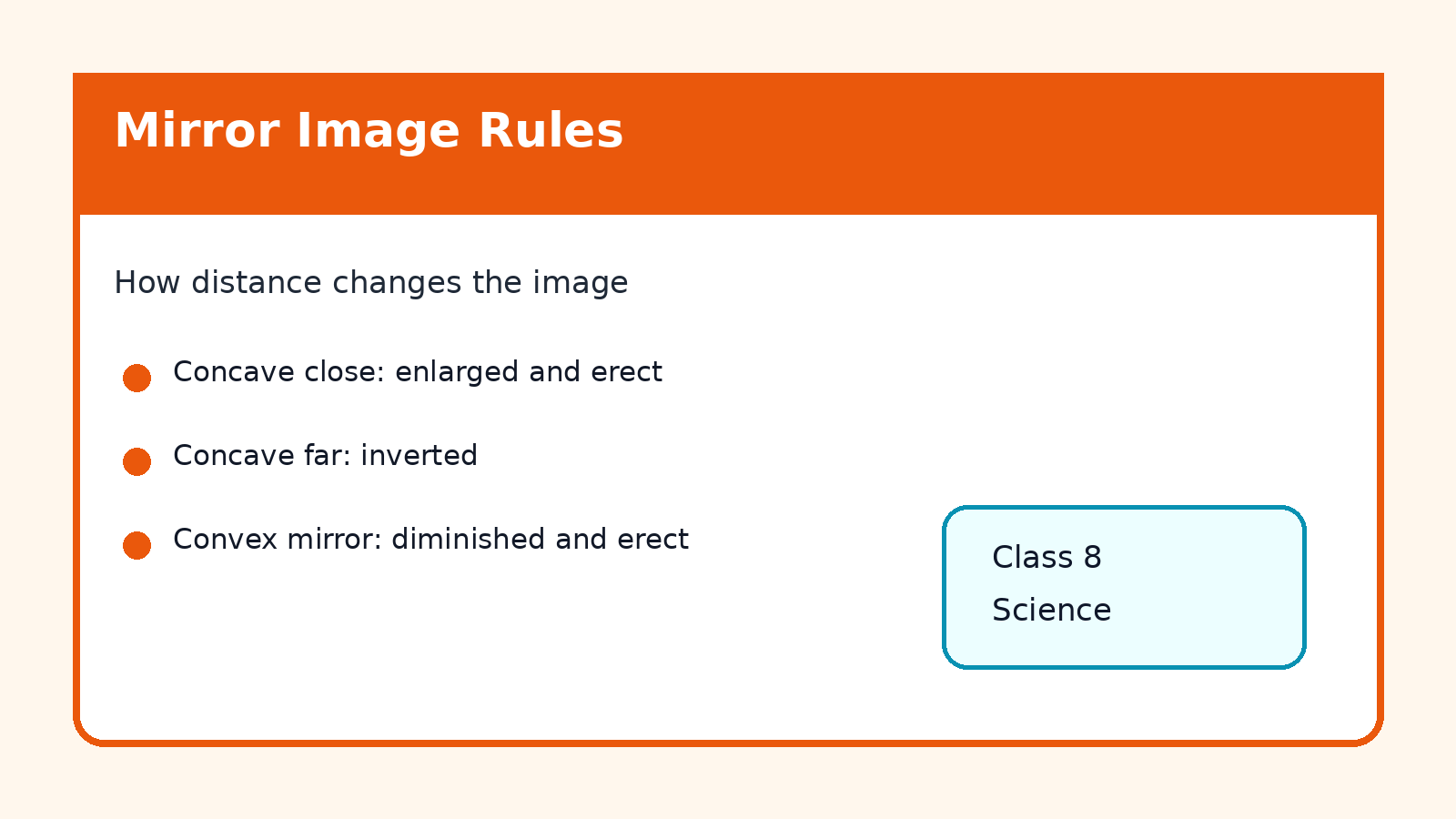
A concave mirror has an inward reflecting surface. When an object is close to it, the image is erect and enlarged. When the object is moved away, the image becomes inverted.
| Mirror | Image rule | Use |
|---|---|---|
| Plane mirror | Erect and same size | Looking mirror |
| Concave mirror | Close object appears enlarged, far object may appear inverted | Torch reflector, dental mirror |
| Convex mirror | Always erect and diminished | Vehicle side-view mirror, road safety mirror |
Laws of Reflection and Ray Diagram Terms
The incident ray falls on the mirror. The reflected ray comes back from the mirror. The normal is drawn at right angles to the mirror at the point of incidence.
- First law: angle of incidence is equal to angle of reflection.
- Second law: incident ray, reflected ray and normal lie in the same plane.
- Common mistake: angles are measured from the normal, not from the mirror surface.
Convex Lens Concave Lens and Image Rules
A convex lens is thicker in the middle than at the edges. It can make nearby text look enlarged, just like a magnifying glass. A concave lens is thinner in the middle and gives a diminished erect image.
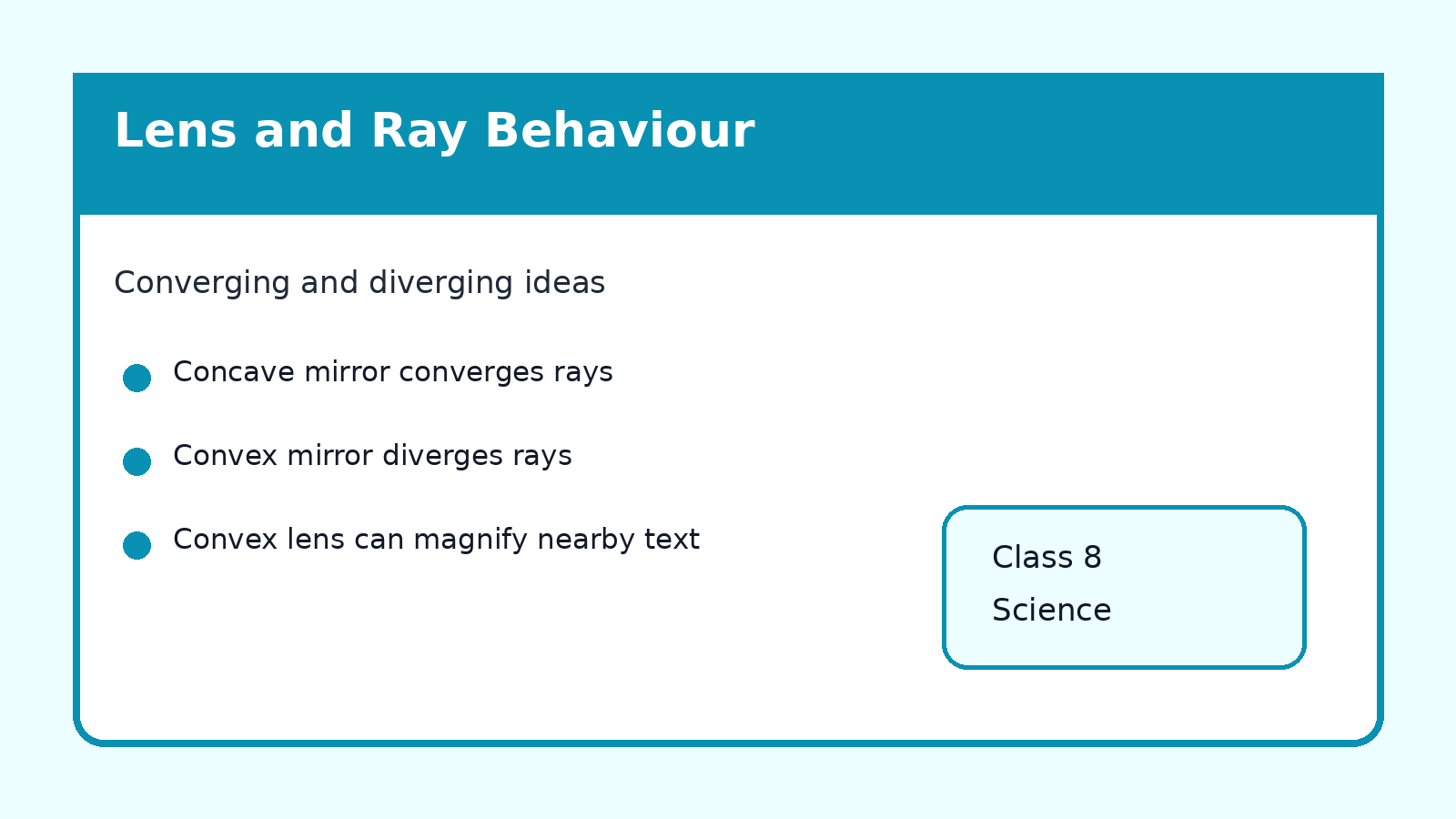
A convex lens converges parallel beams of light, while a concave lens diverges them. A convex lens can also concentrate sunlight, so students should never look at the Sun directly or through the lens.
Mirrors form images by reflection. Lenses form images when light passes through transparent curved surfaces. This difference helps students avoid mixing mirror and lens rules.
Light Mirrors and Lenses Related Resources
| Resource | Link |
|---|---|
| NCERT Solutions | Class 8 Science Chapter 10 NCERT Solutions |
| NCERT Book PDF | Class 8 Science Chapter 10 NCERT Book PDF |
| Handwritten Notes | Class 8 Science Chapter 10 Handwritten Notes |
Class 8 Science Curiosity Notes for All Chapters
| Chapter | Notes |
|---|---|
| Chapter 7 | Particulate Nature of Matter Notes |
| Chapter 8 | Nature of Matter Elements Compounds and Mixtures Notes |
| Chapter 9 | The Amazing World of Solutes Solvents and Solutions Notes |
| Chapter 10 | Light Mirrors and Lenses Notes |
Student Doubts on Class 8 Science Chapter 10
Light Mirrors and Lenses Class 8 Notes FAQs
Ques. What is a concave mirror?
Ans. A concave mirror has a reflecting surface curved inward. It can form an enlarged erect image when the object is close.
Ques. Why are convex mirrors used in vehicles?
Ans. Convex mirrors form erect diminished images and show a wider area behind the vehicle.
Ques. What are the two laws of reflection?
Ans. The angle of incidence equals the angle of reflection. The incident ray, reflected ray and normal lie in one plane.
Ques. What is the difference between convex and concave lenses?
Ans. A convex lens is thicker in the middle. A concave lens is thinner in the middle and gives a diminished erect image.



Comments