



NCERT Class 8 Vocational Education Chapter 3 Working with Wood and Bamboo Notes explain wood types, bamboo structure, carpentry tools, joints, prototypes, costing and school repair work for the 2026-27 Kaushal Bodh textbook.
- Project focus: observe workshop methods, make a prototype and finish a simple product.
- Best use: revise tool safety, joints, bamboo steps and costing tables.
- Answer focus: write exact steps, safety rules and material choices.
Chapter3WorkingwithWoodandBambooNotes.pdf?page=1&dpi=150)
Chapter3WorkingwithWoodandBambooNotes.pdf?page=2&dpi=150)
Chapter3WorkingwithWoodandBambooNotes.pdf?page=3&dpi=150)
Chapter3WorkingwithWoodandBambooNotes.pdf?page=4&dpi=150)
Chapter3WorkingwithWoodandBambooNotes.pdf?page=5&dpi=150)
Chapter3WorkingwithWoodandBambooNotes.pdf?page=6&dpi=150)
Chapter3WorkingwithWoodandBambooNotes.pdf?page=7&dpi=150)
Chapter3WorkingwithWoodandBambooNotes.pdf?page=8&dpi=150)
Chapter3WorkingwithWoodandBambooNotes.pdf?page=9&dpi=150)
Chapter3WorkingwithWoodandBambooNotes.pdf?page=10&dpi=150)
Chapter3WorkingwithWoodandBambooNotes.pdf?page=11&dpi=150)
Chapter3WorkingwithWoodandBambooNotes.pdf?page=12&dpi=150)
Chapter3WorkingwithWoodandBambooNotes.pdf?page=13&dpi=150)
Chapter3WorkingwithWoodandBambooNotes.pdf?page=14&dpi=150)
Chapter3WorkingwithWoodandBambooNotes.pdf?page=15&dpi=150)
Chapter3WorkingwithWoodandBambooNotes.pdf?page=16&dpi=150)
Chapter3WorkingwithWoodandBambooNotes.pdf?page=17&dpi=150)
Chapter3WorkingwithWoodandBambooNotes.pdf?page=18&dpi=150)
Chapter3WorkingwithWoodandBambooNotes.pdf?page=19&dpi=150)
Chapter3WorkingwithWoodandBambooNotes.pdf?page=20&dpi=150)
Chapter3WorkingwithWoodandBambooNotes_flat_MobileCard.pdf?page=1&dpi=150)
Chapter3WorkingwithWoodandBambooNotes_flat_MobileCard.pdf?page=2&dpi=150)
Chapter3WorkingwithWoodandBambooNotes_flat_MobileCard.pdf?page=3&dpi=150)
Chapter3WorkingwithWoodandBambooNotes_flat_MobileCard.pdf?page=4&dpi=150)
Chapter3WorkingwithWoodandBambooNotes_flat_MobileCard.pdf?page=5&dpi=150)
Chapter3WorkingwithWoodandBambooNotes_flat_MobileCard.pdf?page=6&dpi=150)
Chapter3WorkingwithWoodandBambooNotes_flat_MobileCard.pdf?page=7&dpi=150)
Chapter3WorkingwithWoodandBambooNotes_flat_MobileCard.pdf?page=8&dpi=150)
Chapter3WorkingwithWoodandBambooNotes_flat_MobileCard.pdf?page=9&dpi=150)
Chapter3WorkingwithWoodandBambooNotes_flat_MobileCard.pdf?page=10&dpi=150)
Chapter3WorkingwithWoodandBambooNotes_flat_MobileCard.pdf?page=11&dpi=150)
Chapter3WorkingwithWoodandBambooNotes_flat_MobileCard.pdf?page=12&dpi=150)
Chapter3WorkingwithWoodandBambooNotes_flat_MobileCard.pdf?page=13&dpi=150)
Chapter3WorkingwithWoodandBambooNotes_flat_MobileCard.pdf?page=14&dpi=150)
Chapter3WorkingwithWoodandBambooNotes_flat_MobileCard.pdf?page=15&dpi=150)
Chapter3WorkingwithWoodandBambooNotes_flat_MobileCard.pdf?page=16&dpi=150)
Chapter3WorkingwithWoodandBambooNotes_flat_MobileCard.pdf?page=17&dpi=150)
Chapter3WorkingwithWoodandBambooNotes_flat_MobileCard.pdf?page=18&dpi=150)
Chapter3WorkingwithWoodandBambooNotes_flat_MobileCard.pdf?page=19&dpi=150)
Chapter3WorkingwithWoodandBambooNotes_flat_MobileCard.pdf?page=20&dpi=150)
Chapter3WorkingwithWoodandBambooNotes_flat_MobileCard.pdf?page=21&dpi=150)
Chapter3WorkingwithWoodandBambooNotes_flat_MobileCard.pdf?page=22&dpi=150)
Chapter3WorkingwithWoodandBambooNotes_flat_MobileCard.pdf?page=23&dpi=150)
Chapter3WorkingwithWoodandBambooNotes_flat_MobileCard.pdf?page=24&dpi=150)
Chapter3WorkingwithWoodandBambooNotes_flat_MobileCard.pdf?page=25&dpi=150)
Chapter3WorkingwithWoodandBambooNotes_flat_MobileCard.pdf?page=26&dpi=150)
Chapter3WorkingwithWoodandBambooNotes_flat_MobileCard.pdf?page=27&dpi=150)
Chapter3WorkingwithWoodandBambooNotes_flat_MobileCard.pdf?page=28&dpi=150)
These NCERT notes follow the 2026-27 Kaushal Bodh project sequence and keep material choice, tool safety, prototype making, product finishing and repair records in simple revision order.
Student Feedback on Wood and Bamboo Notes
In a Collegedunia classroom check with 1,140 Class 8 students, learners revised the project faster after separating materials, joints, workflow and costing into short tables.
Working with Wood and Bamboo Notes Overview
Chapter 3 introduces carpentry as a project. Students observe a workshop, study wooden and bamboo objects, sketch a model, make a prototype, build a simple product and record the cost.
- Wood is used in doors, benches, shelves, toys, tools, sports goods and buildings.
- Bamboo is a fast-growing grass with hollow culms used for craft and utility items.
- Prototype means the first model made to test a design before final making.
Wood, Bamboo and Material Choice
Natural wood may be hard or soft depending on the tree. Hardwood such as babool, mango and teak is useful for strong products. Softwood such as pine and deodar is easier for beginners to cut and shape.
| Material | Chapter use | Revision point |
|---|---|---|
| Hardwood | Construction, frames and outdoor furniture | Harder to work with |
| Softwood | Shelves, packing boxes and simple objects | Better for first products |
| Engineered wood | Plywood and MDF | Made from wood particles or fibres |
| Bamboo | Pen stands, holders and craft items | Light, strong and hollow |
Important: Wood is renewable only when trees are replaced and material is used carefully.
Bamboo and Wood Craft Video Revision
Source: Bamboo Craft on YouTube
Workshop Visit and Tool Safety
The workshop visit helps students understand how raw wood or bamboo becomes a finished object. Students ask about wood choice, tool use, cutting, joining, finishing and safety.
| Tool or step | Use | Safety habit |
|---|---|---|
| Measuring tape and ruler | Measure length, width and height | Check twice before marking |
| Hand saw | Cut wood or bamboo | Clamp the material in a bench vice |
| Plane and file | Smoothen and shape surfaces | Move with control |
| Hand drill | Make holes for screws or bolts | Keep the drill perpendicular |
| Sandpaper | Smooth edges before finishing | Wear a mask if dust rises |
Common Joints and Fasteners
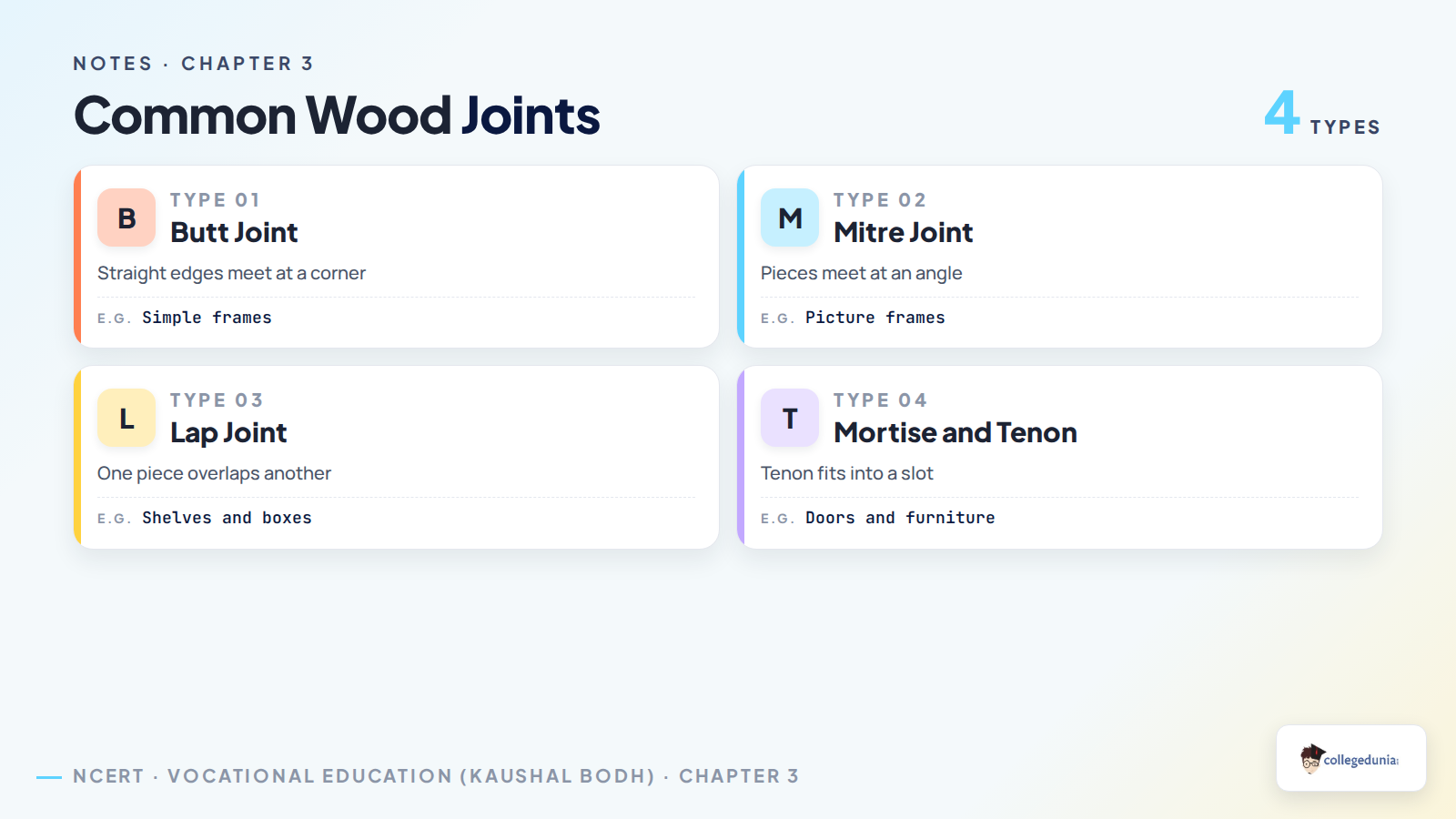
Most wooden and bamboo products are assembled from many parts. Joints connect those parts. Nails, screws, nuts, bolts, glue and bamboo twine can also hold parts together.
| Joint or fastener | Meaning | Where it is used |
|---|---|---|
| Butt joint | Straight edges meet at a corner | Simple frames and boxes |
| Mitre joint | Pieces meet at an angle | Picture frames |
| Lap joint | One piece overlaps another | Shelves and boxes |
| Mortise and tenon | A tenon fits into a matching slot | Doors, chairs and tables |
| Hinge | Allows movement | Doors, lids and cupboards |
Prototype and Product Workflow
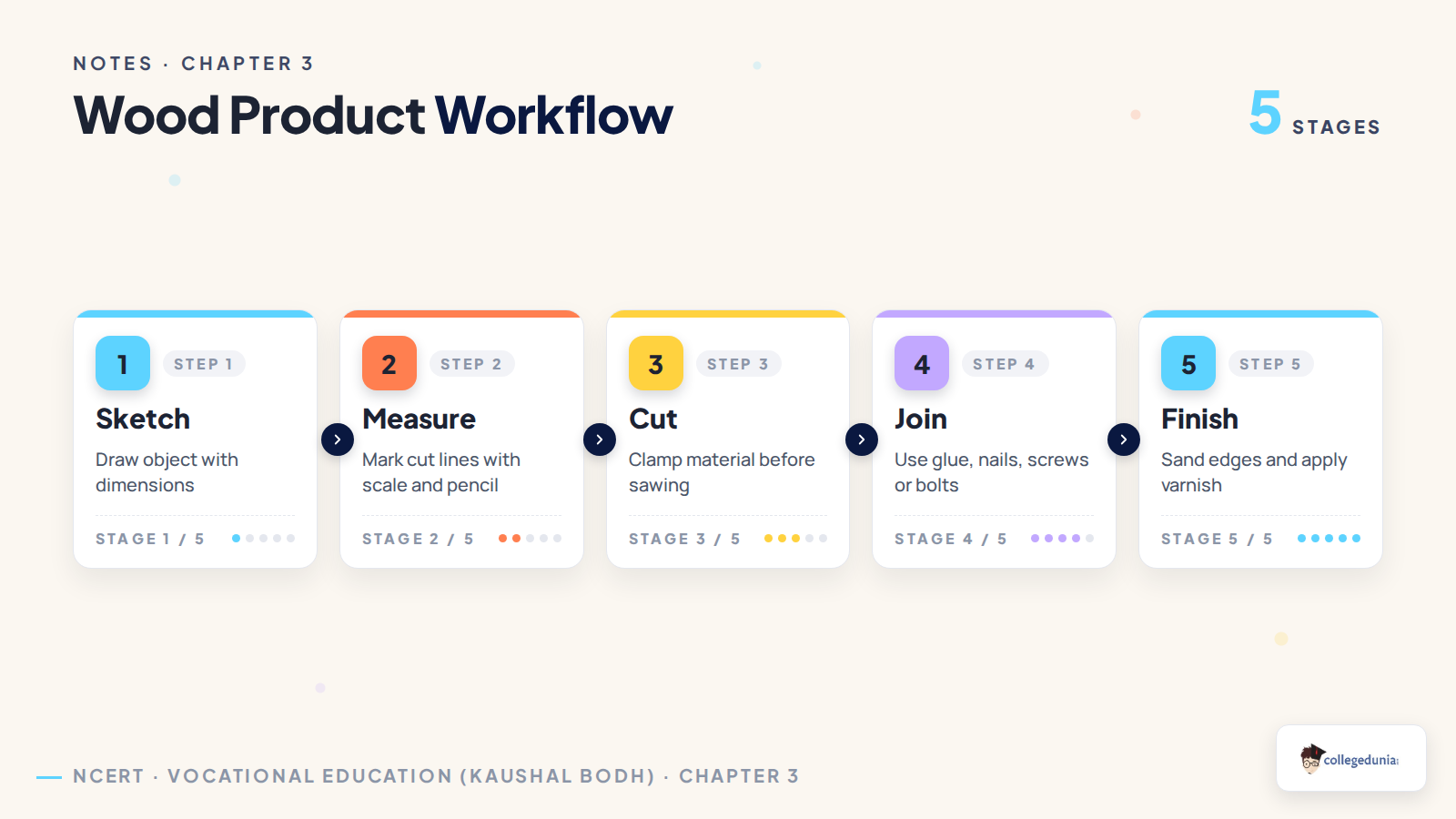
A prototype is made before the final product. It checks whether the sketch, dimensions, cutting and joining method work in three dimensions. Cardboard and waste softwood are good practice materials.
- Sketch the object with length, width, height and thickness.
- Collect material, mark the design and cut carefully.
- Assemble the parts with glue, tape or simple fasteners.
- Show the model to peers and note feedback.
Wood product steps: sketch, measure, mark, cut, plane, drill, assemble, sand, varnish or paint. For bamboo, students cut internodes, smooth the surface, assemble parts and finish the product.
Costing, Repairs and Reflection
Costing teaches students to record every material used in the product. The cost table includes wood or bamboo, nails, paint, varnish, sandpaper and other items.
| Task | What to record | Why it matters |
|---|---|---|
| Cost estimate | Quantity, cost per item and total cost | Helps decide selling price |
| Repair work | Loose screws, rough edges or weak hinges | Extends product life |
| Timeline | Periods spent on each activity | Shows planning skill |
| Reflection | What was difficult and how experts helped | Shows learning from others |
Related Resources for Class 8 Kaushal Bodh Chapter 3
| Resource | Use it for | Link |
|---|---|---|
| NCERT Solutions | Activity answers and reflection questions | Open Solutions |
| NCERT Book PDF | Official chapter text and activity tables | Open Book PDF |
| Handwritten Notes | Quick visual recap before project work | Open Handwritten Notes |
All Class 8 Vocational Education Notes Chapters
| Chapter | Notes Link |
|---|---|
| Chapter 1 Hydroponics: Growing Plants without Soil | Open Notes |
| Chapter 2 Feeding and Caring for Farm Animals | Open Notes |
| Chapter 3 Working with Wood and Bamboo | Current Notes |
| Chapter 4 Home Automation | Open Notes |
| Chapter 5 Water Audit for Water Management | Open Notes |
Working with Wood and Bamboo Class 8 Notes FAQs
Ques. What is a prototype in Class 8 Kaushal Bodh Chapter 3?
Ans. A prototype is the first model of a product. It helps students test shape, size, joining and design before making the final object.
Ques. What is the difference between hardwood and softwood?
Ans. Hardwood is generally harder to cut and used for strong products. Softwood is easier to cut, shape and finish, so it suits beginners.
Ques. Which joints are covered in Working with Wood and Bamboo?
Ans. The chapter covers butt joint, mitre joint, lap joint and mortise and tenon joint, along with fasteners such as nails and screws.
Ques. How do students estimate the cost of a wood or bamboo product?
Ans. Students list each material, quantity, cost per item and total cost. They may also compare the product with a similar market item.



Comments