




NCERT Class 8 Vocational Education Chapter 5 Water Audit for Water Management Notes explain water audit, data collection, flow rate, rainwater availability, leak repair, greywater reuse and future demand for the 2026-27 Kaushal Bodh textbook.
- Project focus: measure water use, compare primary and secondary data and reduce wastage.
- Best use: revise before field survey, spreadsheet work, water-saving action and project viva.
- Answer focus: always write data source, unit, formula and final saving estimate.
Chapter5WaterAuditforWaterManagementNotes.pdf?page=1&dpi=150)
Chapter5WaterAuditforWaterManagementNotes.pdf?page=2&dpi=150)
Chapter5WaterAuditforWaterManagementNotes.pdf?page=3&dpi=150)
Chapter5WaterAuditforWaterManagementNotes.pdf?page=4&dpi=150)
Chapter5WaterAuditforWaterManagementNotes.pdf?page=5&dpi=150)
Chapter5WaterAuditforWaterManagementNotes.pdf?page=6&dpi=150)
Chapter5WaterAuditforWaterManagementNotes.pdf?page=7&dpi=150)
Chapter5WaterAuditforWaterManagementNotes.pdf?page=8&dpi=150)
Chapter5WaterAuditforWaterManagementNotes.pdf?page=9&dpi=150)
Chapter5WaterAuditforWaterManagementNotes.pdf?page=10&dpi=150)
Chapter5WaterAuditforWaterManagementNotes.pdf?page=11&dpi=150)
Chapter5WaterAuditforWaterManagementNotes.pdf?page=12&dpi=150)
Chapter5WaterAuditforWaterManagementNotes.pdf?page=13&dpi=150)
Chapter5WaterAuditforWaterManagementNotes.pdf?page=14&dpi=150)
Chapter5WaterAuditforWaterManagementNotes.pdf?page=15&dpi=150)
Chapter5WaterAuditforWaterManagementNotes.pdf?page=16&dpi=150)
Chapter5WaterAuditforWaterManagementNotes.pdf?page=17&dpi=150)
Chapter5WaterAuditforWaterManagementNotes.pdf?page=18&dpi=150)
Chapter5WaterAuditforWaterManagementNotes.pdf?page=19&dpi=150)
Chapter5WaterAuditforWaterManagementNotes.pdf?page=20&dpi=150)
Chapter5WaterAuditforWaterManagementNotes_flat_MobileCard.pdf?page=1&dpi=150)
Chapter5WaterAuditforWaterManagementNotes_flat_MobileCard.pdf?page=2&dpi=150)
Chapter5WaterAuditforWaterManagementNotes_flat_MobileCard.pdf?page=3&dpi=150)
Chapter5WaterAuditforWaterManagementNotes_flat_MobileCard.pdf?page=4&dpi=150)
Chapter5WaterAuditforWaterManagementNotes_flat_MobileCard.pdf?page=5&dpi=150)
Chapter5WaterAuditforWaterManagementNotes_flat_MobileCard.pdf?page=6&dpi=150)
Chapter5WaterAuditforWaterManagementNotes_flat_MobileCard.pdf?page=7&dpi=150)
Chapter5WaterAuditforWaterManagementNotes_flat_MobileCard.pdf?page=8&dpi=150)
Chapter5WaterAuditforWaterManagementNotes_flat_MobileCard.pdf?page=9&dpi=150)
Chapter5WaterAuditforWaterManagementNotes_flat_MobileCard.pdf?page=10&dpi=150)
Chapter5WaterAuditforWaterManagementNotes_flat_MobileCard.pdf?page=11&dpi=150)
Chapter5WaterAuditforWaterManagementNotes_flat_MobileCard.pdf?page=12&dpi=150)
Chapter5WaterAuditforWaterManagementNotes_flat_MobileCard.pdf?page=13&dpi=150)
Chapter5WaterAuditforWaterManagementNotes_flat_MobileCard.pdf?page=14&dpi=150)
Chapter5WaterAuditforWaterManagementNotes_flat_MobileCard.pdf?page=15&dpi=150)
Chapter5WaterAuditforWaterManagementNotes_flat_MobileCard.pdf?page=16&dpi=150)
Chapter5WaterAuditforWaterManagementNotes_flat_MobileCard.pdf?page=17&dpi=150)
Chapter5WaterAuditforWaterManagementNotes_flat_MobileCard.pdf?page=18&dpi=150)
Chapter5WaterAuditforWaterManagementNotes_flat_MobileCard.pdf?page=19&dpi=150)
Chapter5WaterAuditforWaterManagementNotes_flat_MobileCard.pdf?page=20&dpi=150)
Chapter5WaterAuditforWaterManagementNotes_flat_MobileCard.pdf?page=21&dpi=150)
Chapter5WaterAuditforWaterManagementNotes_flat_MobileCard.pdf?page=22&dpi=150)
Chapter5WaterAuditforWaterManagementNotes_flat_MobileCard.pdf?page=23&dpi=150)
Chapter5WaterAuditforWaterManagementNotes_flat_MobileCard.pdf?page=24&dpi=150)
Chapter5WaterAuditforWaterManagementNotes_flat_MobileCard.pdf?page=25&dpi=150)
Chapter5WaterAuditforWaterManagementNotes_flat_MobileCard.pdf?page=26&dpi=150)
Chapter5WaterAuditforWaterManagementNotes_flat_MobileCard.pdf?page=27&dpi=150)
Chapter5WaterAuditforWaterManagementNotes_flat_MobileCard.pdf?page=28&dpi=150)
Chapter5WaterAuditforWaterManagementNotes_flat_MobileCard.pdf?page=29&dpi=150)
Chapter5WaterAuditforWaterManagementNotes_flat_MobileCard.pdf?page=30&dpi=150)
Chapter5WaterAuditforWaterManagementNotes_flat_MobileCard.pdf?page=31&dpi=150)
These NCERT notes follow the 2026-27 Kaushal Bodh project order and keep measurement, survey, calculation and conservation steps in one revision flow.
Student Feedback on Water Audit Notes
In a Collegedunia classroom check with 1,040 Class 8 students, learners revised the project faster after separating water audit into collect, measure, analyse and act stages.
Water Audit Notes Overview
Water Audit for Water Management is a Human Services project in the Class 8 Kaushal Bodh book. It teaches students to study water use in homes, schools and local communities through measured data.
- Water audit: a systematic check of water use and water wastage.
- Primary data: survey, flow-rate and household-use readings collected by students.
- Secondary data: population, rainfall, supply norms and official records from reliable sources.
- Project result: a practical report with calculations and water-saving suggestions.
Water Audit Cycle
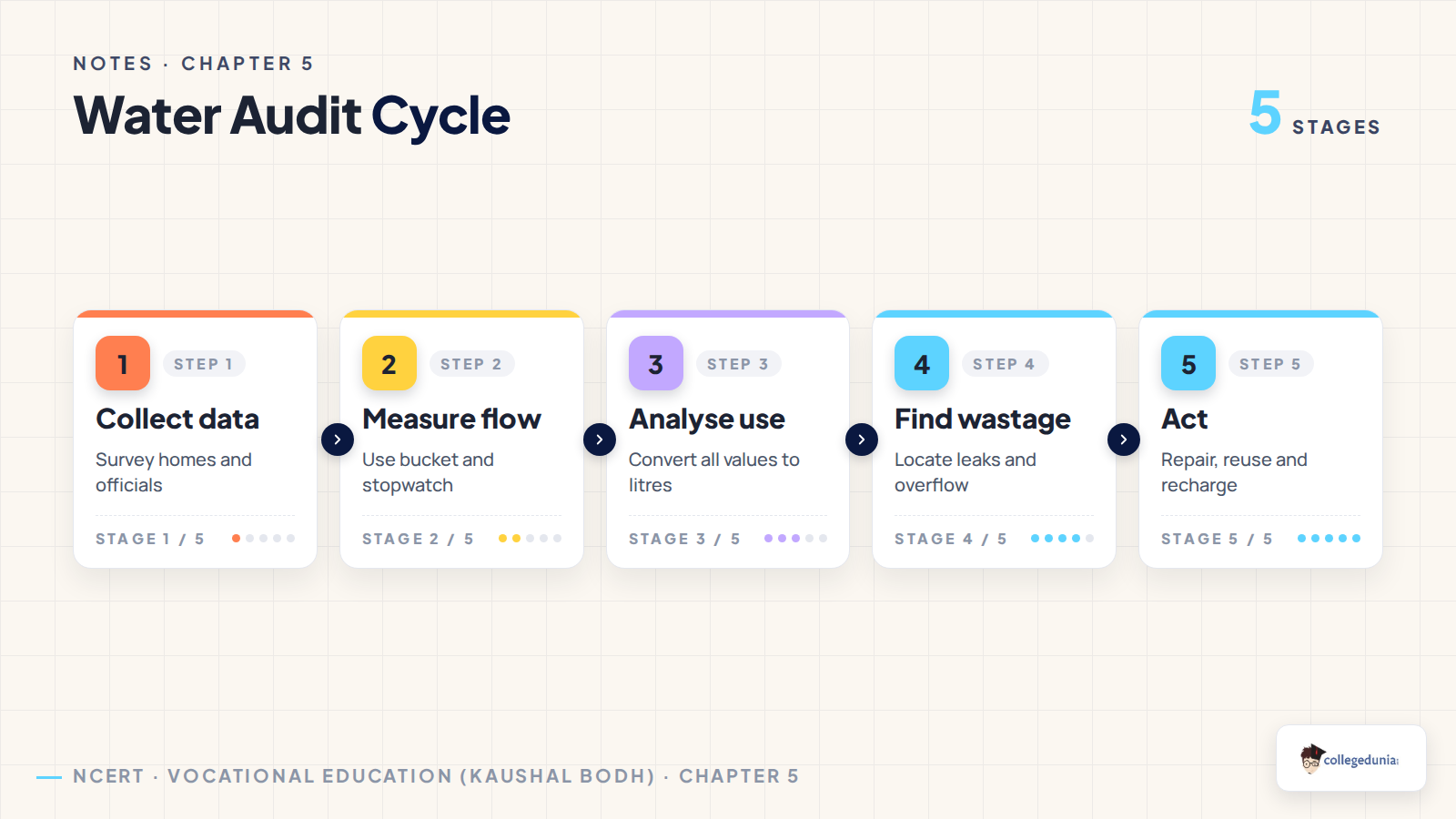
The chapter follows a clear cycle. Students collect data, measure flow, analyse use, locate wastage and suggest action. This turns a local water problem into a measurable project.
| Stage | What students do | Project evidence |
|---|---|---|
| Collect data | survey families and officials | forms and interview notes |
| Measure flow | use bucket, bottle and stopwatch | litres per minute readings |
| Analyse use | convert every entry to litres | spreadsheet totals and averages |
| Find wastage | record leaks, overflow and full-throttle taps | wastage table with location |
| Act | repair, reuse, recharge or reduce flow | saving estimate and reflection |
Freshwater Conservation Video Revision
Source: Khan Academy on YouTube
Measurement Methods and Formulae
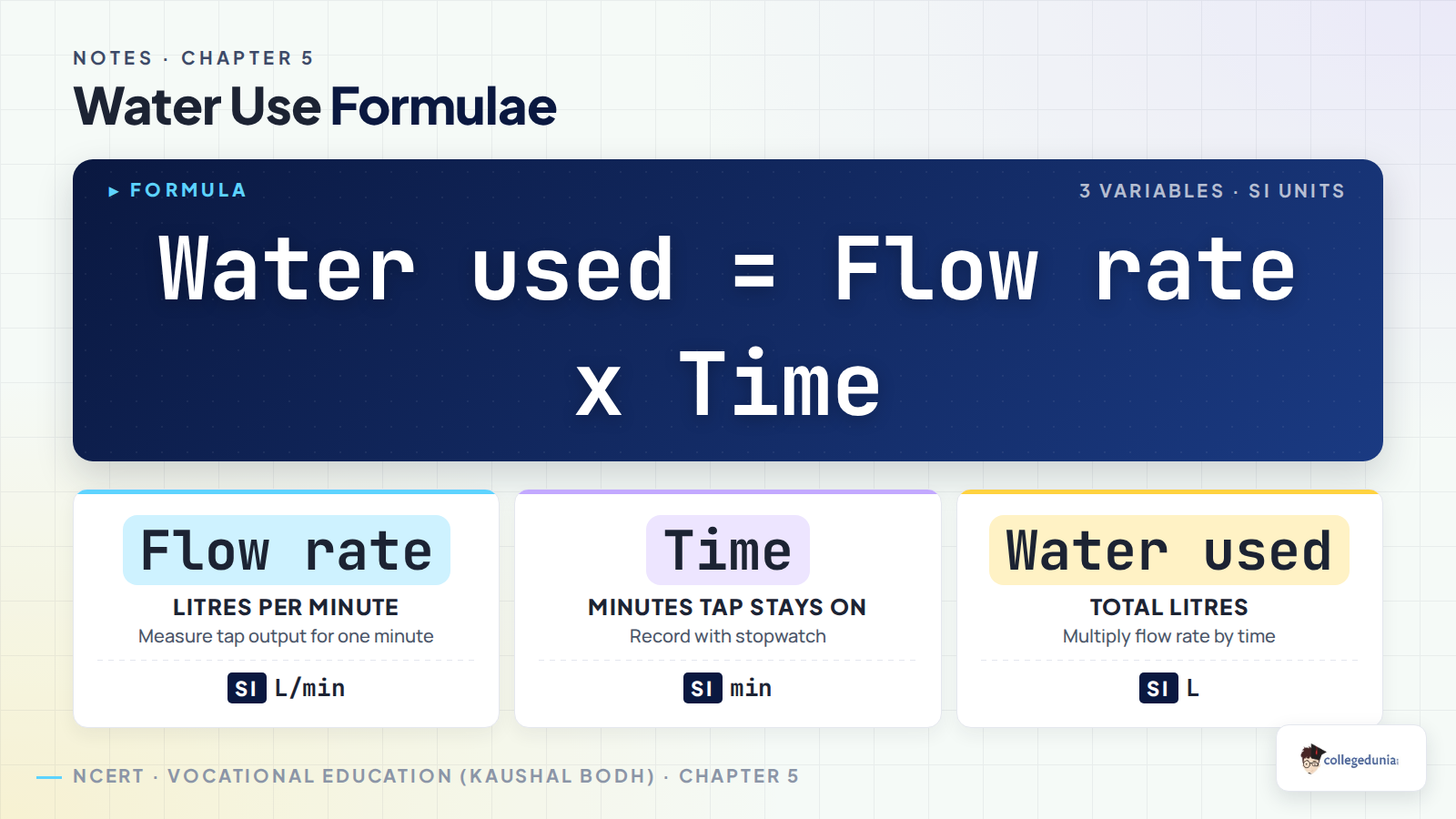
Water measurement begins with units. Small amounts may be measured in millilitres, daily household use in litres and large supply or storage in cubic metres.
- 1 litre equals 1000 millilitres.
- 1 cubic metre equals 1000 litres.
- Flow rate is the water collected from a tap in one minute.
- Water used equals flow rate multiplied by time the tap stays on.
| Measurement | How to find it | Use in audit |
|---|---|---|
| Bucket capacity | fill with a known 1 litre bottle | convert bucket count to litres |
| Tap flow rate | collect water for one minute | estimate washing or bathing use |
| Tank capacity | use dimensions or official data | estimate storage available |
| Rainwater | area multiplied by rainfall | compare local availability |
Household Survey and Spreadsheet Work
Activity 3 asks students to estimate average consumption in a household. A group can collect data from at least ten families and then enter the values in a notebook or spreadsheet.
- Use one row for one family.
- Use one column for one activity such as clothes, utensils, bathing or cooking.
- Convert all values to litres before adding them.
- Divide total family consumption by family members to find per person use.
| Survey item | Data to record | Calculation note |
|---|---|---|
| Family size | number of members | needed for per person average |
| Clothes washing | machine cycle or bucket count | convert to litres |
| Utensils | tap flow and time | flow rate times minutes |
| Bathing | buckets or shower time | bucket capacity or flow rate |
| RO filter | treated and rejected water | note wasted water separately |
Rainwater Availability and Secondary Data
Activity 4 uses secondary data to estimate rainwater availability. Students must record the source and year for population, rainfall and district or town area.
- Area tells how much land receives rainfall.
- Rainfall gives the depth of water received in metres.
- Population tells how many people depend on available water.
- Reference proves the data came from a reliable source.
The book also compares average consumption with prescribed norms. It mentions 55 litres per person per day for rural areas and 135 litres per person per day for urban areas under the Jal Jeevan Mission reference used in the chapter.
Water Saving, Recharge and Greywater Reuse
Activity 6 moves from calculation to action. Students inspect taps, pipes, tanks and common water points to identify wastage. Small repairs often save large amounts over time.
- Record the location and type of wastage.
- Measure dripping or leaking water with a bucket and stopwatch.
- Start with simple fixes such as tightening taps or replacing washers.
- Use flow caps or aerators where full tap flow is not needed.
Groundwater recharge methods include contour bunds, check dams, percolation tanks and borewell recharge. Greywater from sinks, baths, washing machines and kitchens can be reused for safe purposes after proper treatment.
Future Water Requirement and Viva Prep
Activity 8 asks students to estimate future demand. For example, a housing society of 100 homes or a hostel of 1000 students will increase local water requirement.
| Viva question | Short answer point |
|---|---|
| What is a water audit? | A systematic study of water use and wastage. |
| What is primary data? | Data collected first-hand by survey, observation or measurement. |
| Why use litres? | One common unit makes comparison easier. |
| How is tap water use calculated? | Flow rate multiplied by time the tap is on. |
| What is greywater? | Domestic wastewater that can be reused safely after treatment. |
Related Resources for Class 8 Kaushal Bodh Chapter 5
| Resource | Use it for | Link |
|---|---|---|
| NCERT Solutions | Project questions and reflection answers | Open Solutions |
| NCERT Book PDF | Official project text and activity tables | Open Book PDF |
| Handwritten Notes | Quick scanned recap for project work | Open Handwritten Notes |
All Class 8 Vocational Education Notes Chapters
| Chapter | Notes Link |
|---|---|
| Chapter 1 Hydroponics: Growing Plants without Soil | Open Notes |
| Chapter 2 Feeding and Caring for Farm Animals | Open Notes |
| Chapter 3 Working with Wood and Bamboo | Open Notes |
| Chapter 4 Home Automation | Open Notes |
| Chapter 5 Water Audit for Water Management | Current chapter notes |
Water Audit for Water Management Class 8 Notes FAQs
Ques. What is a water audit in Class 8 Kaushal Bodh?
Ans. A water audit is a systematic study of how water is used, wasted, measured and saved in a home, school or locality.
Ques. What is the formula for water used from a tap?
Ans. Water used equals tap flow rate in litres per minute multiplied by the time the tap stays on.
Ques. What is primary data in a water audit?
Ans. Primary data is first-hand data collected through surveys, interviews, observations and direct measurements by students.
Ques. What is greywater?
Ans. Greywater is wastewater from sinks, baths, washing machines and kitchens that can be reused safely after proper treatment.



Comments