




These Sequences and Progressions revision notes sum up the whole eighth chapter of the new Ganita Manjari book in one place. Our sequences and progressions class 9 maths notes explain patterns, the nth-term rules, arithmetic progressions, sum formulas, and a first look at geometric growth in plain language.
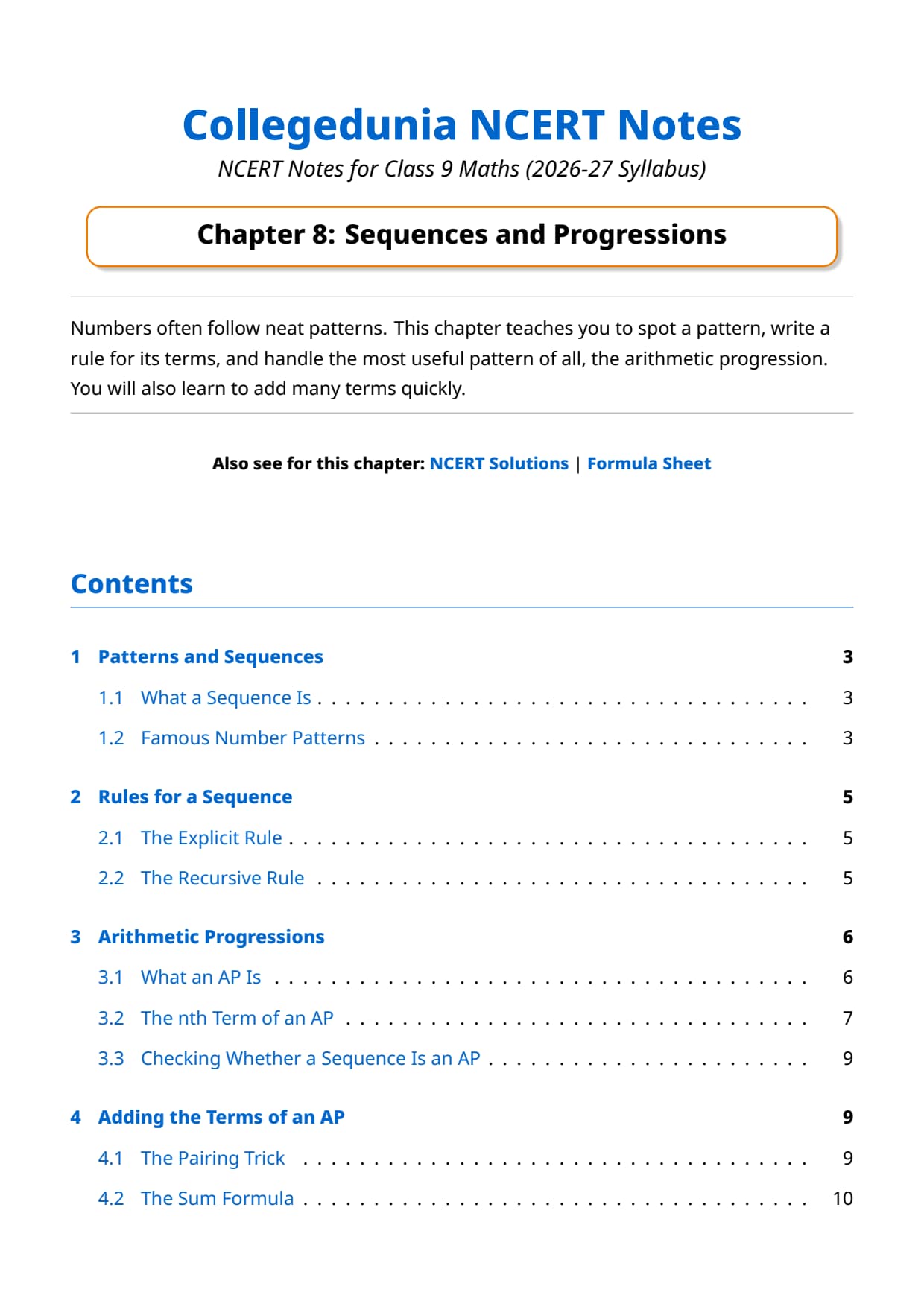
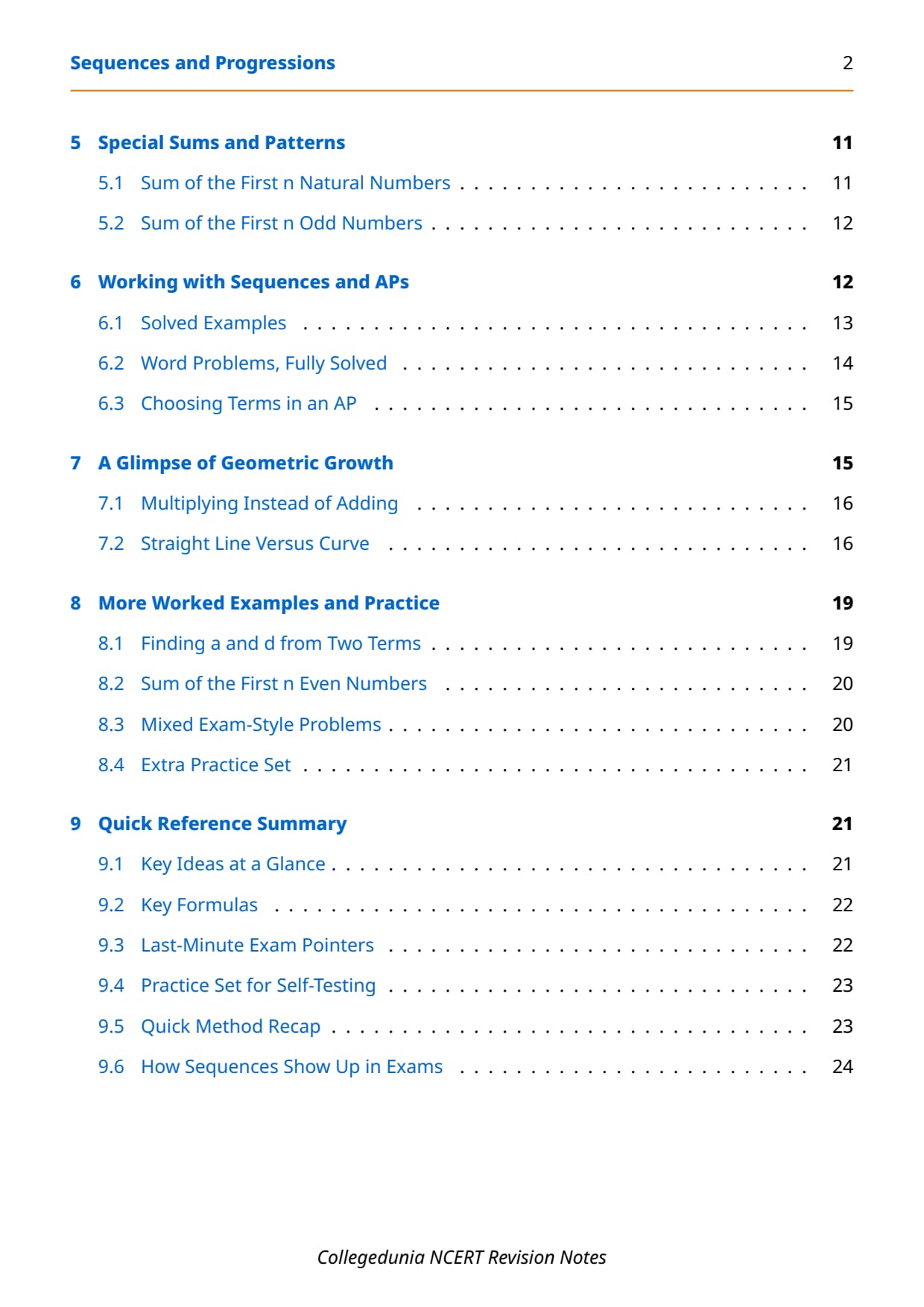
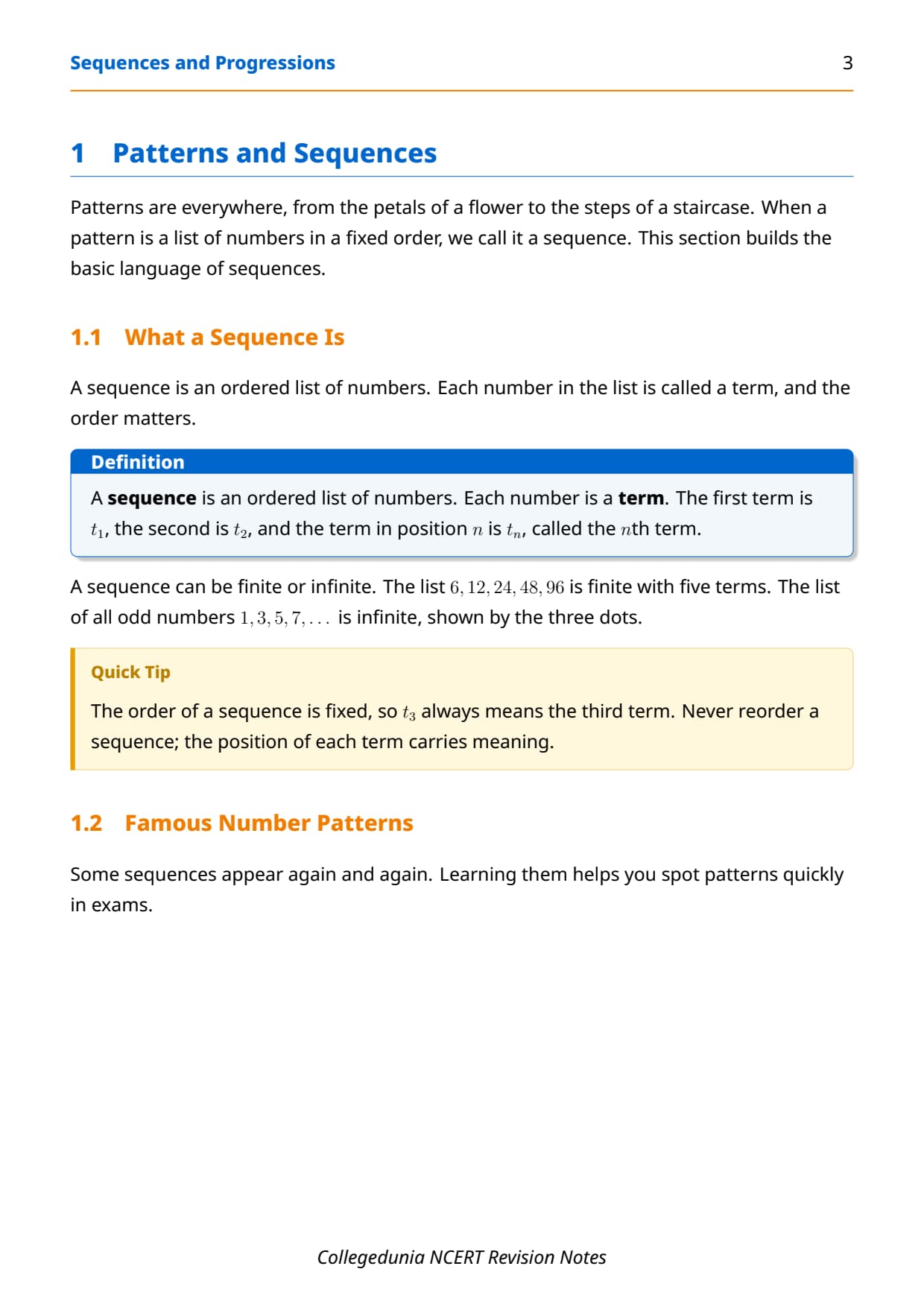
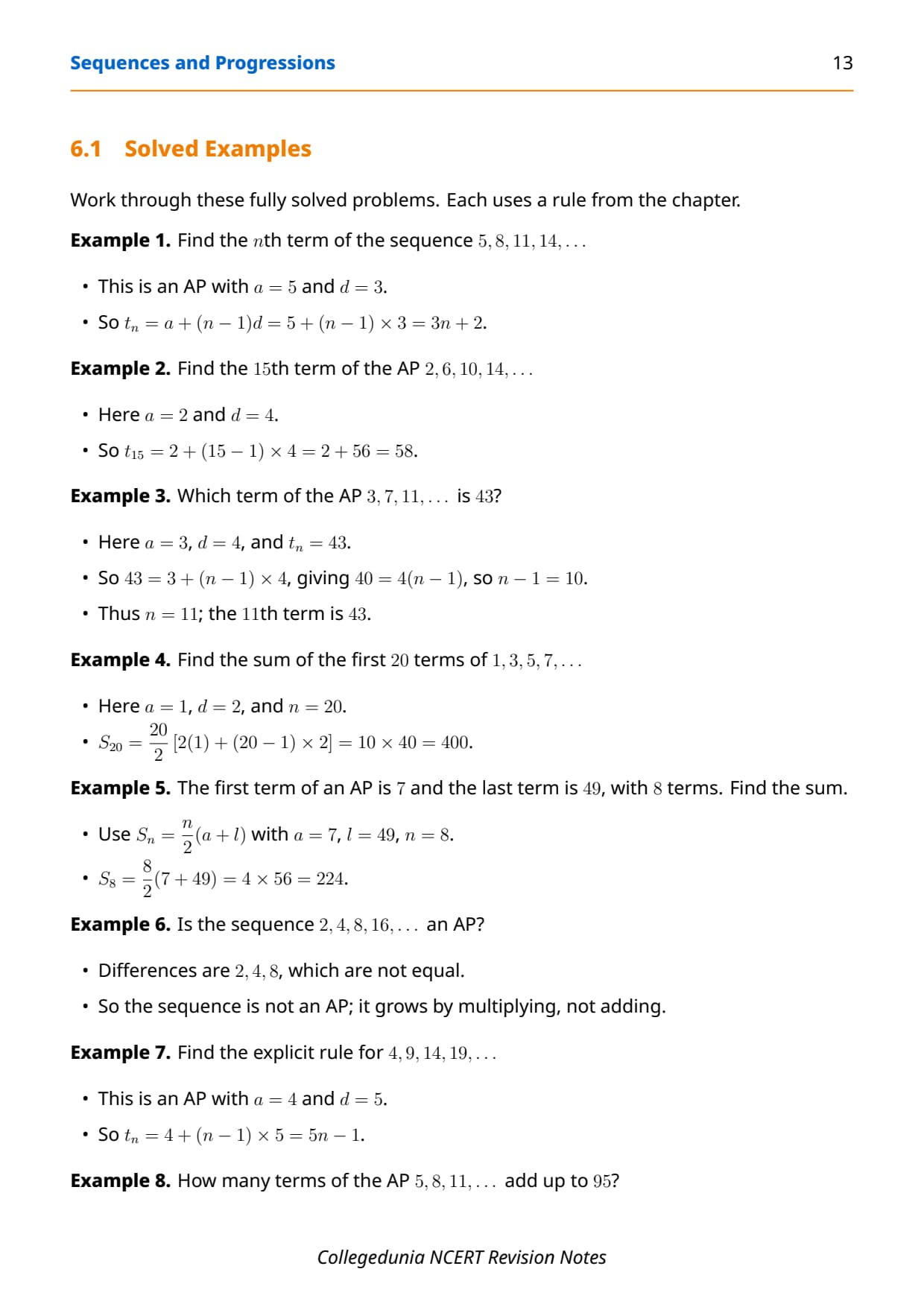
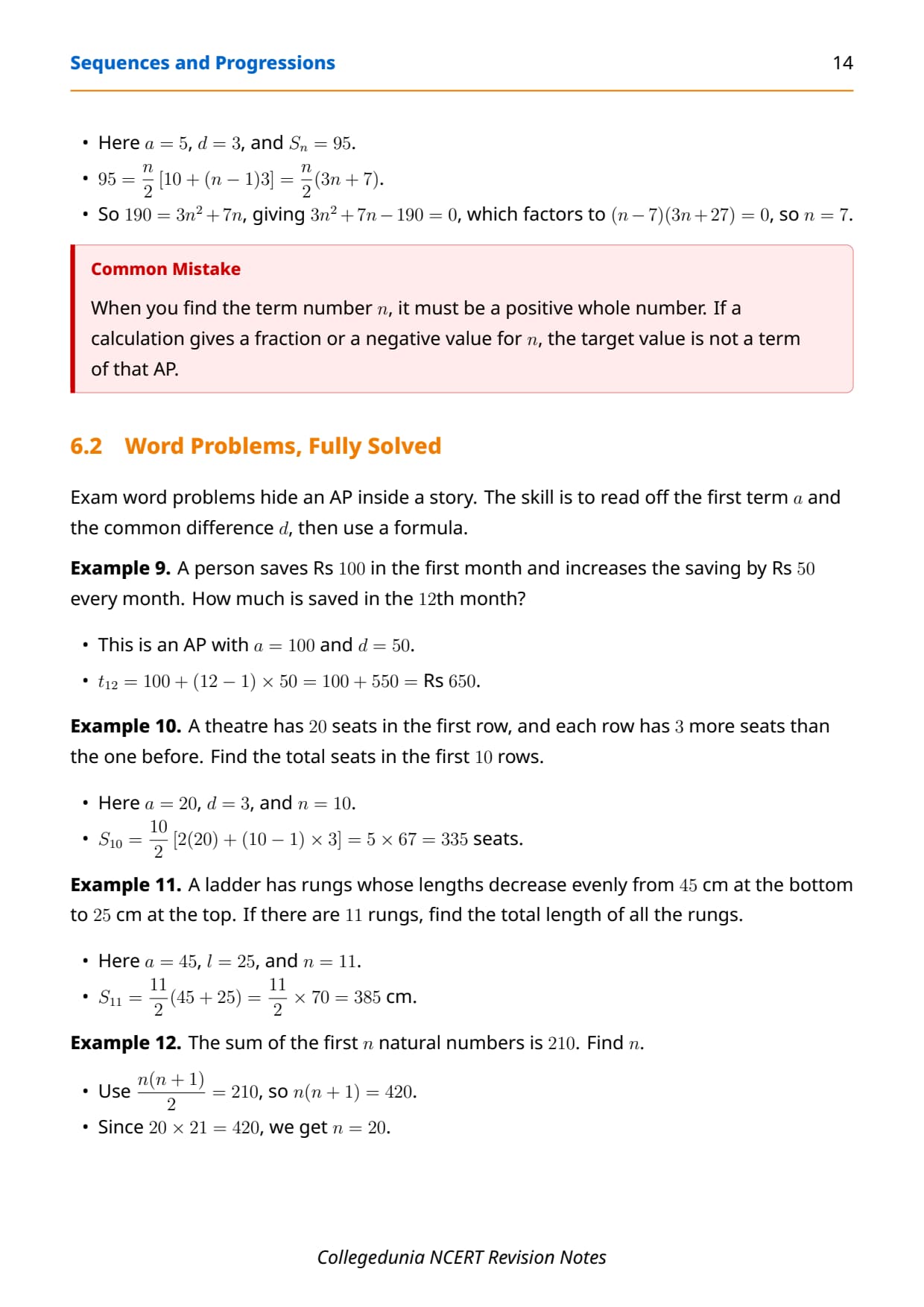
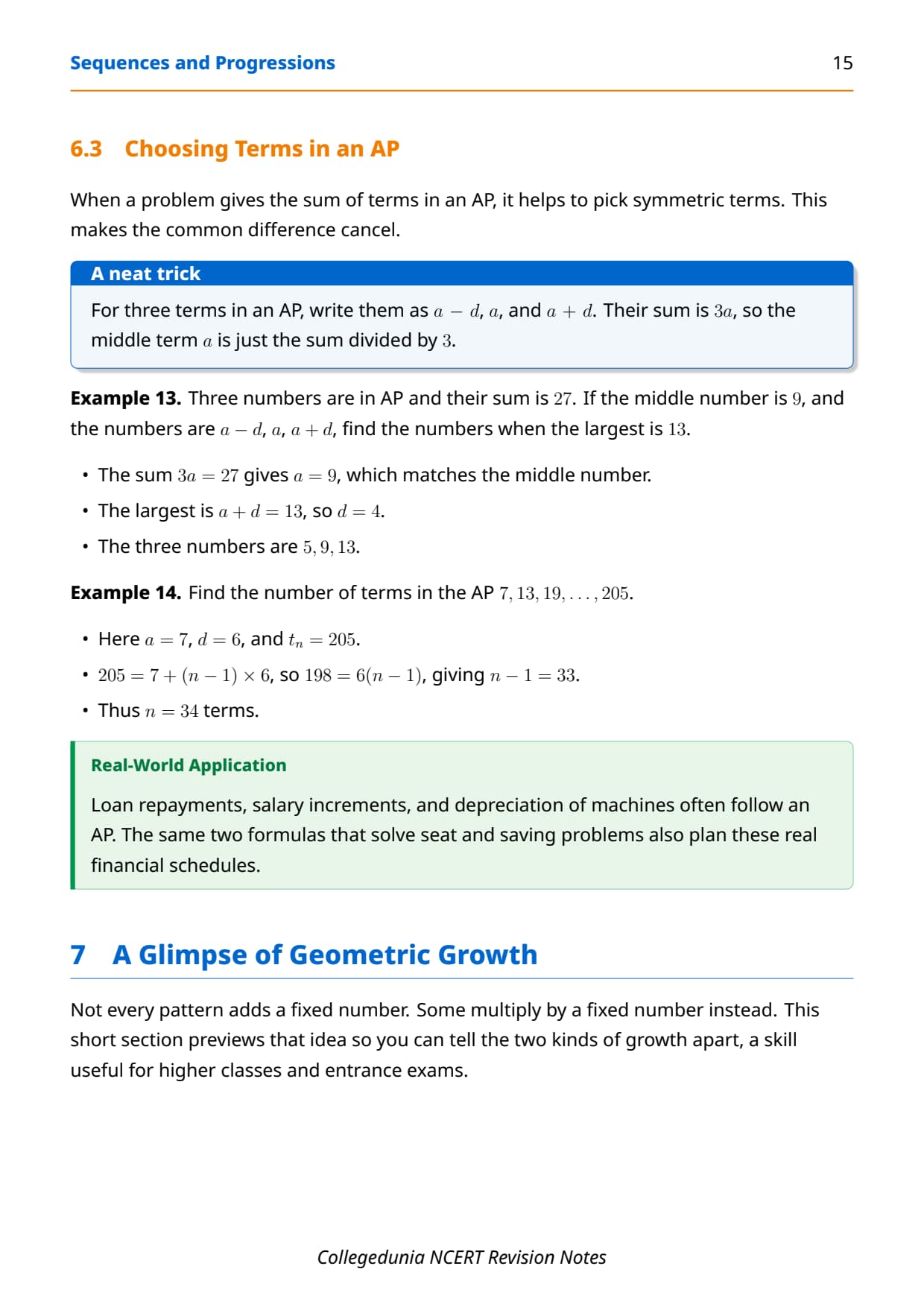
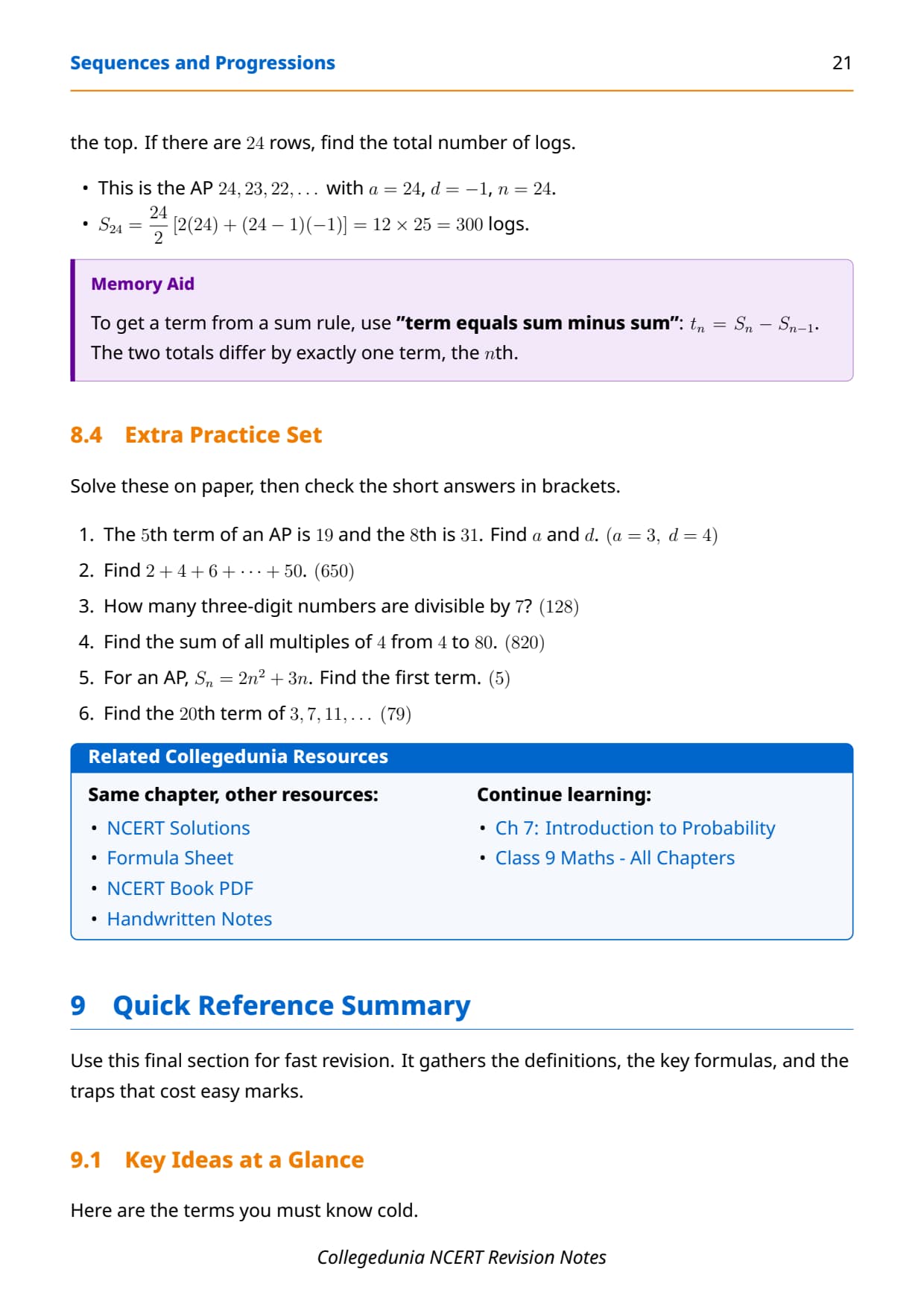
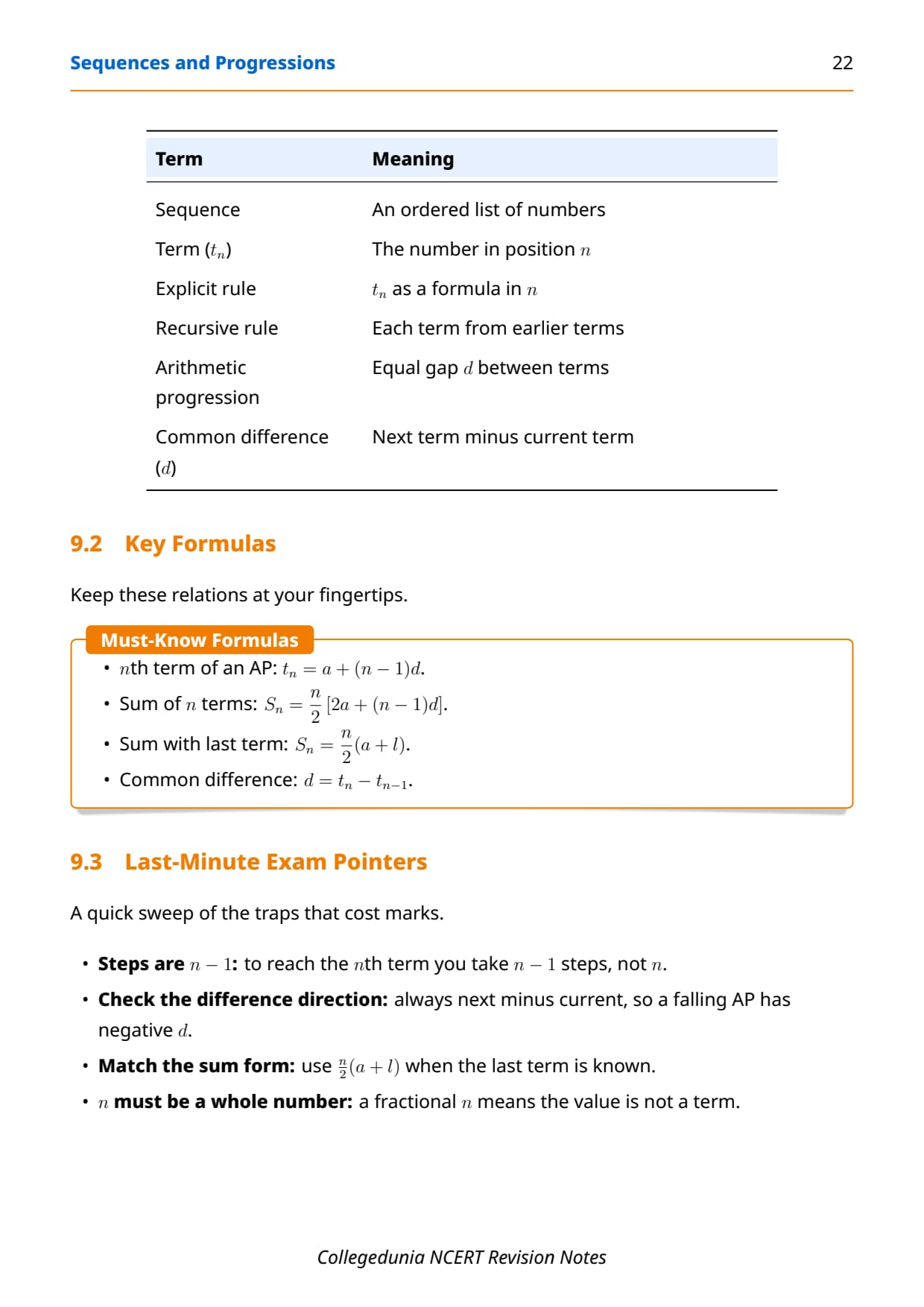
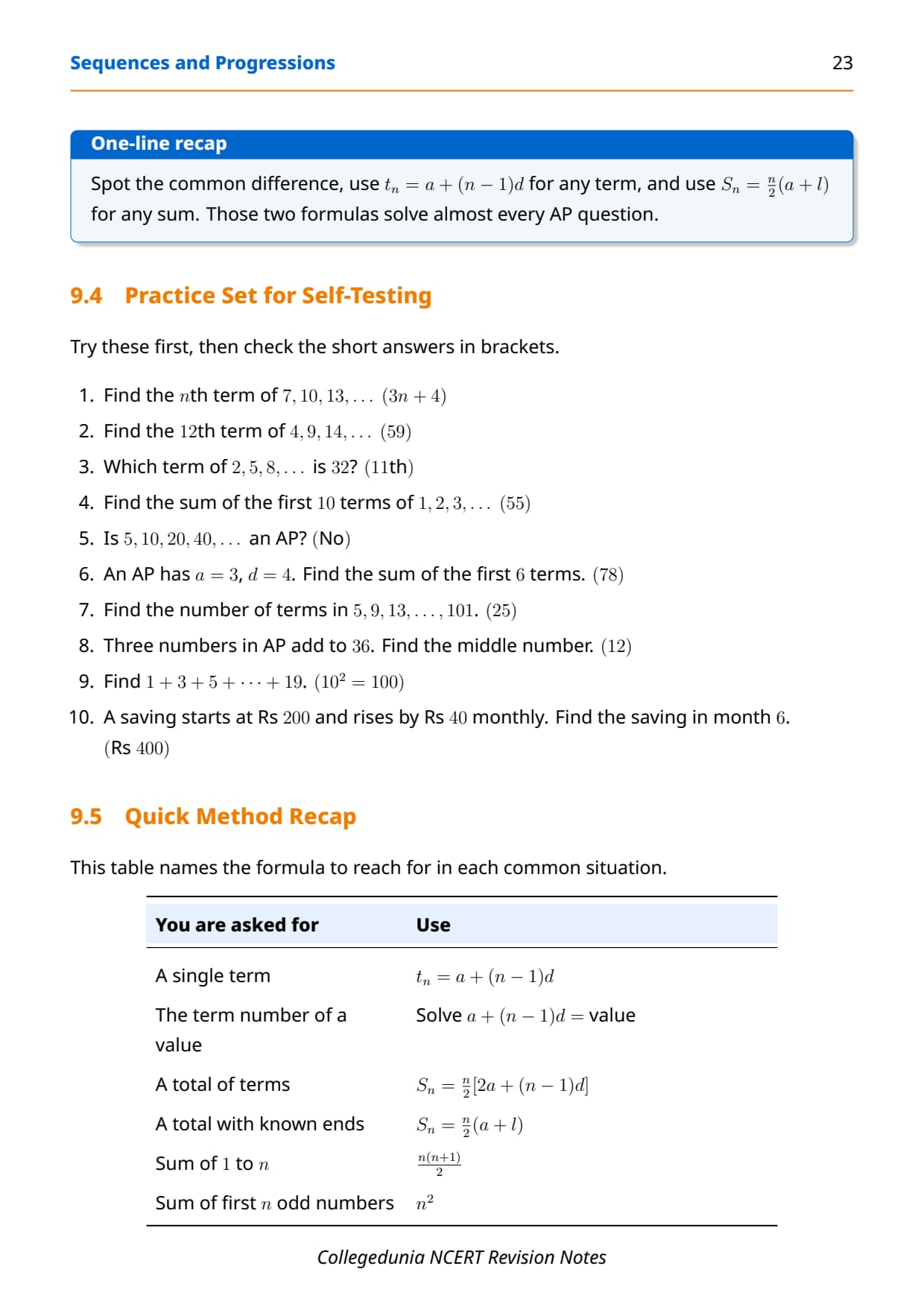
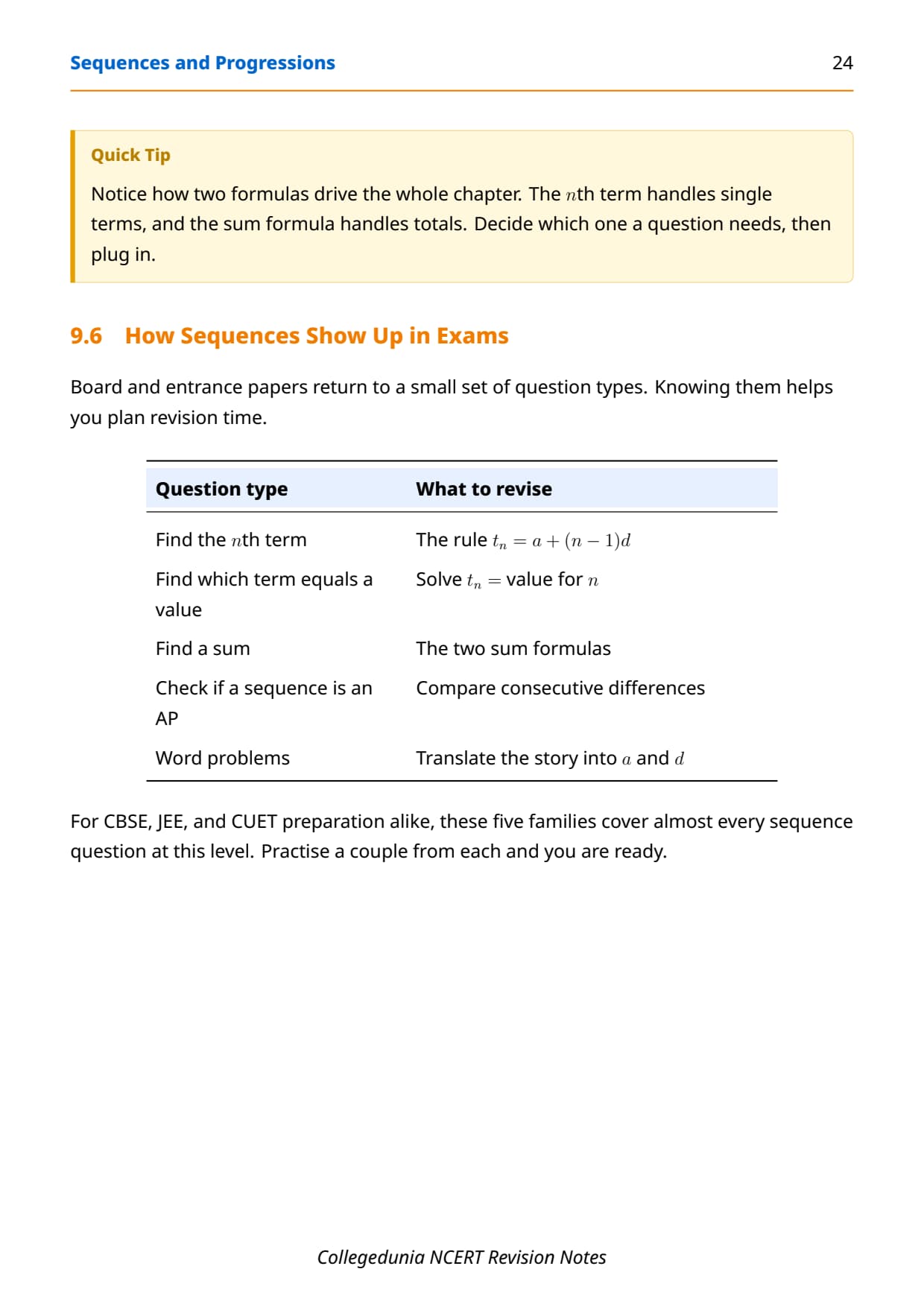
- What they cover: sequences, nth-term rules, arithmetic progressions, and sum formulas.
- Who they help: Class 9 students who want a fast, clear revision before a test.
- Why they save time: both key formulas sit on one short page.
These notes are prepared by subject teachers, matched to the current 2026-27 NCERT Ganita Manjari book, and written so a Class 9 student can revise the whole chapter quickly.
What Do Class 9 Maths Sequences and Progressions Notes Cover?
The sequences and progressions class 9 maths notes cover the full chapter in short, simple parts. You first learn what a sequence and a term are, and how explicit and recursive rules work. Then you meet the arithmetic progression, its nth term, and how to add its terms fast. The notes end with special sums and a short look at geometric growth.
Video Walkthrough
Source: Physics Wallah Foundation on YouTube
Sequences and Progressions Class 9 Maths Topic-by-Topic Summary
Here is a short summary of each main topic. Read one part at a time and try a quick example as you go.
Sequences and Their Rules
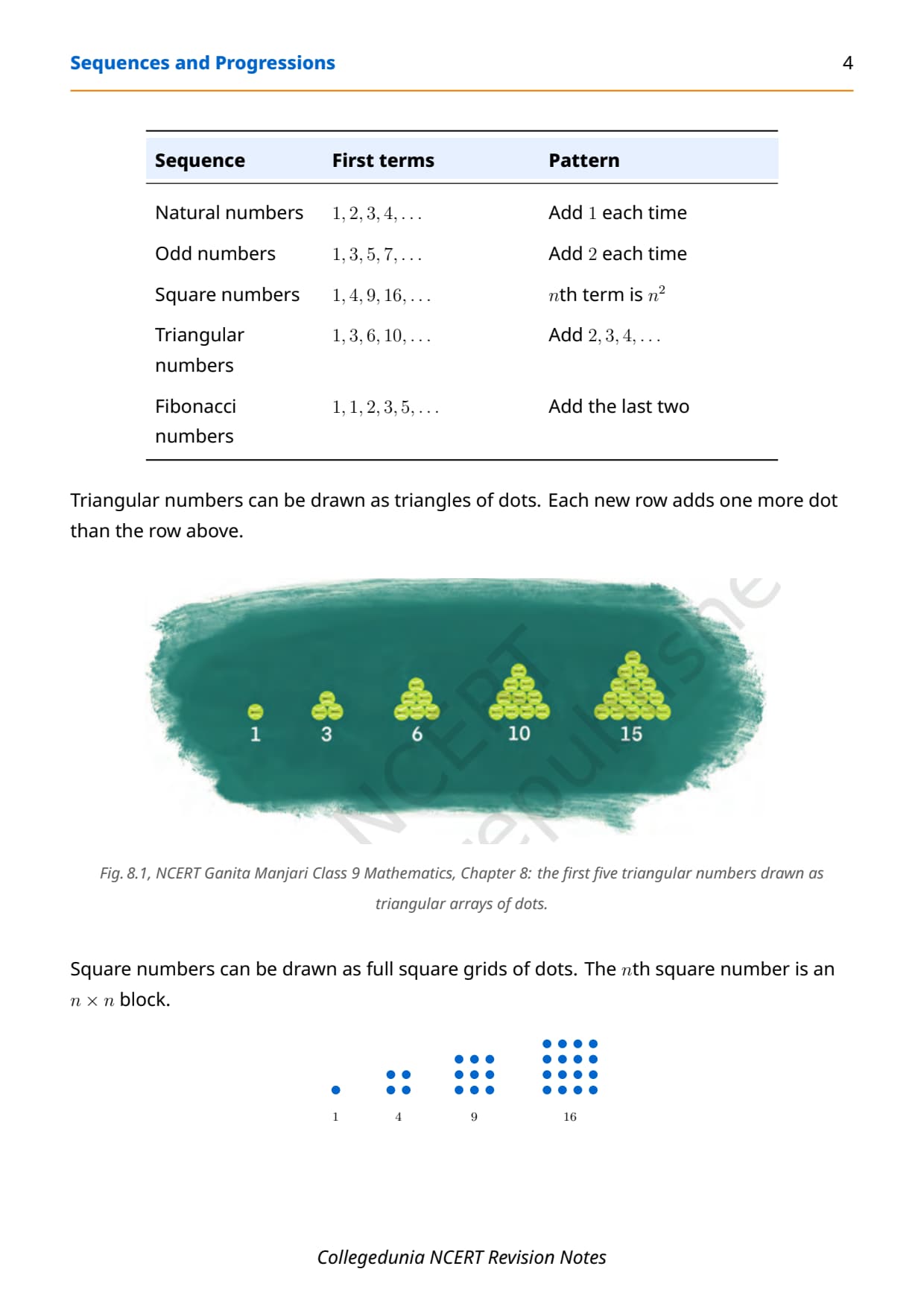
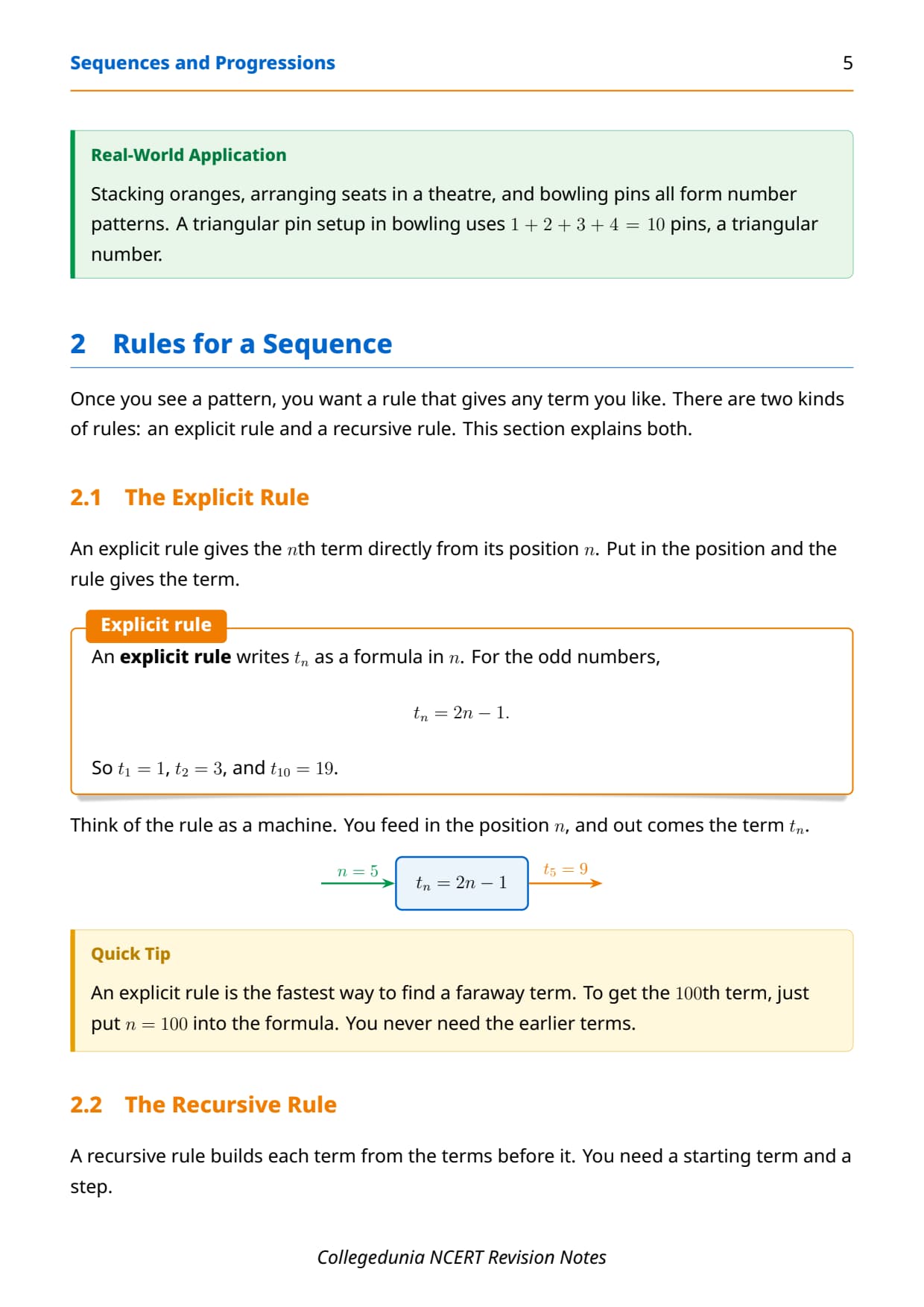
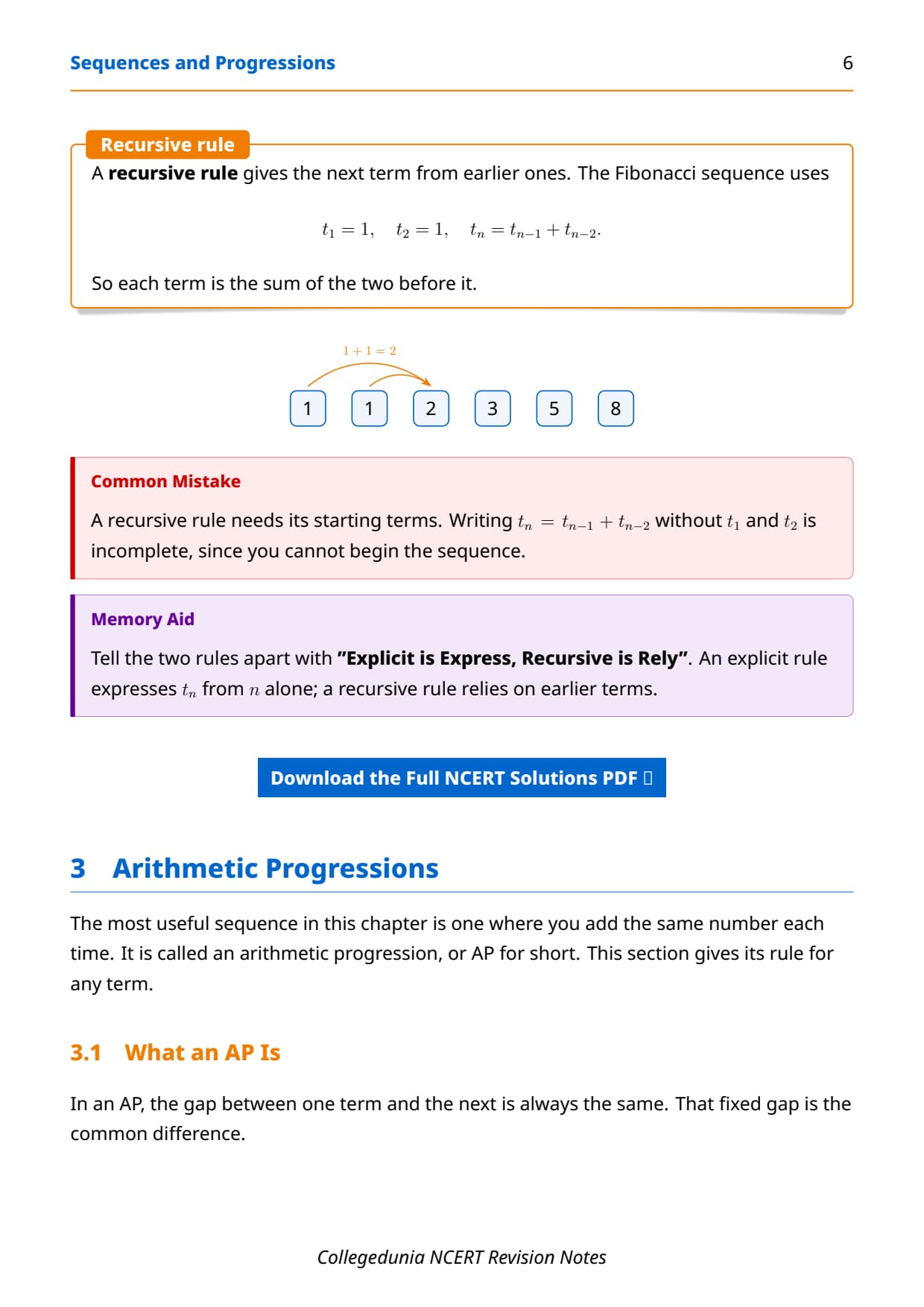
A sequence is an ordered list of numbers, and each number is a term. The term in position n is tn, the nth term. Famous patterns include the natural numbers, odd numbers, square numbers n2, triangular numbers, and the Fibonacci numbers. There are two kinds of rules. An explicit rule gives tn directly from n, like tn = 2n - 1 for the odd numbers. A recursive rule builds each term from earlier ones, like the Fibonacci rule tn = tn-1 + tn-2, which needs its starting terms.
Arithmetic Progressions
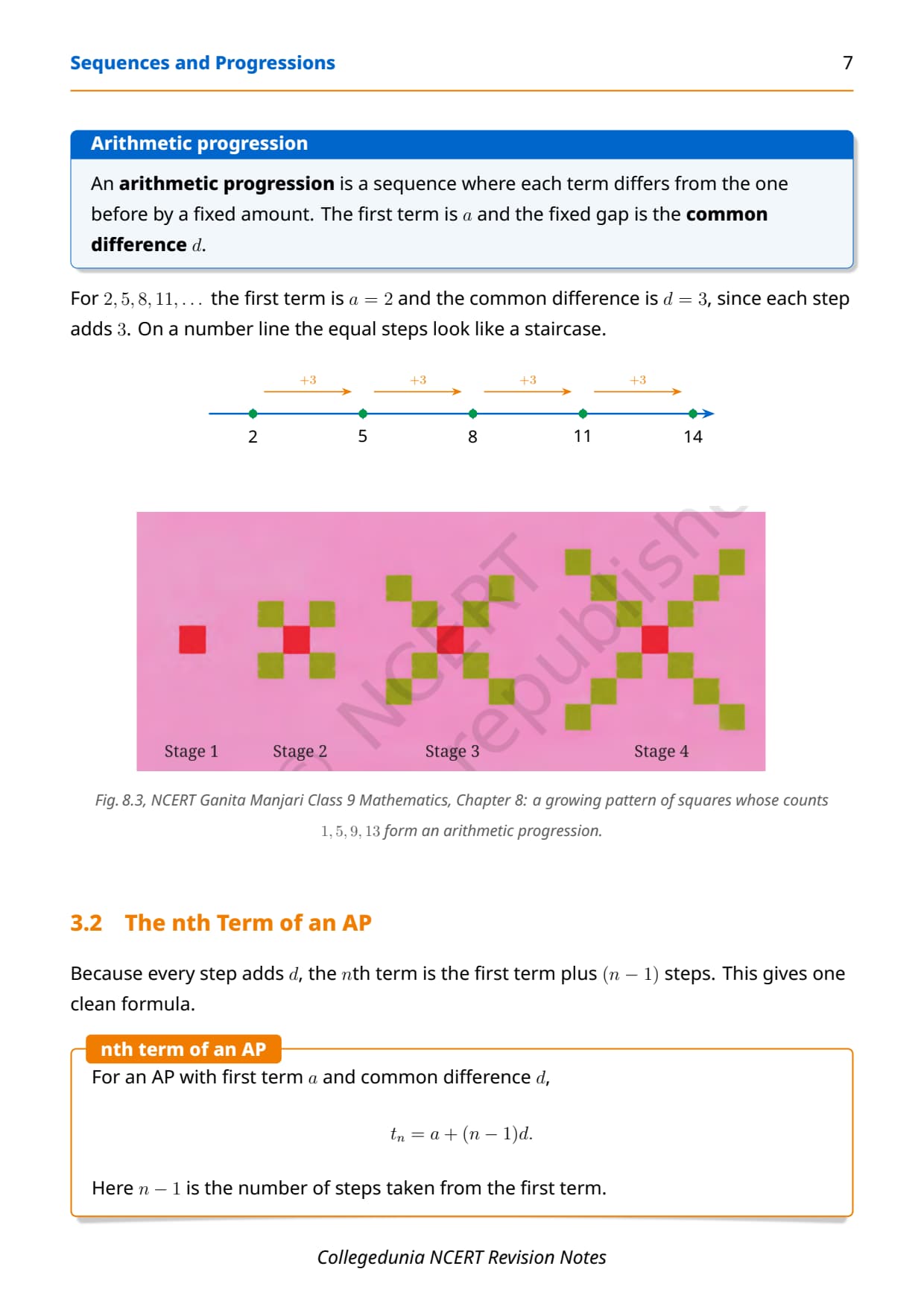
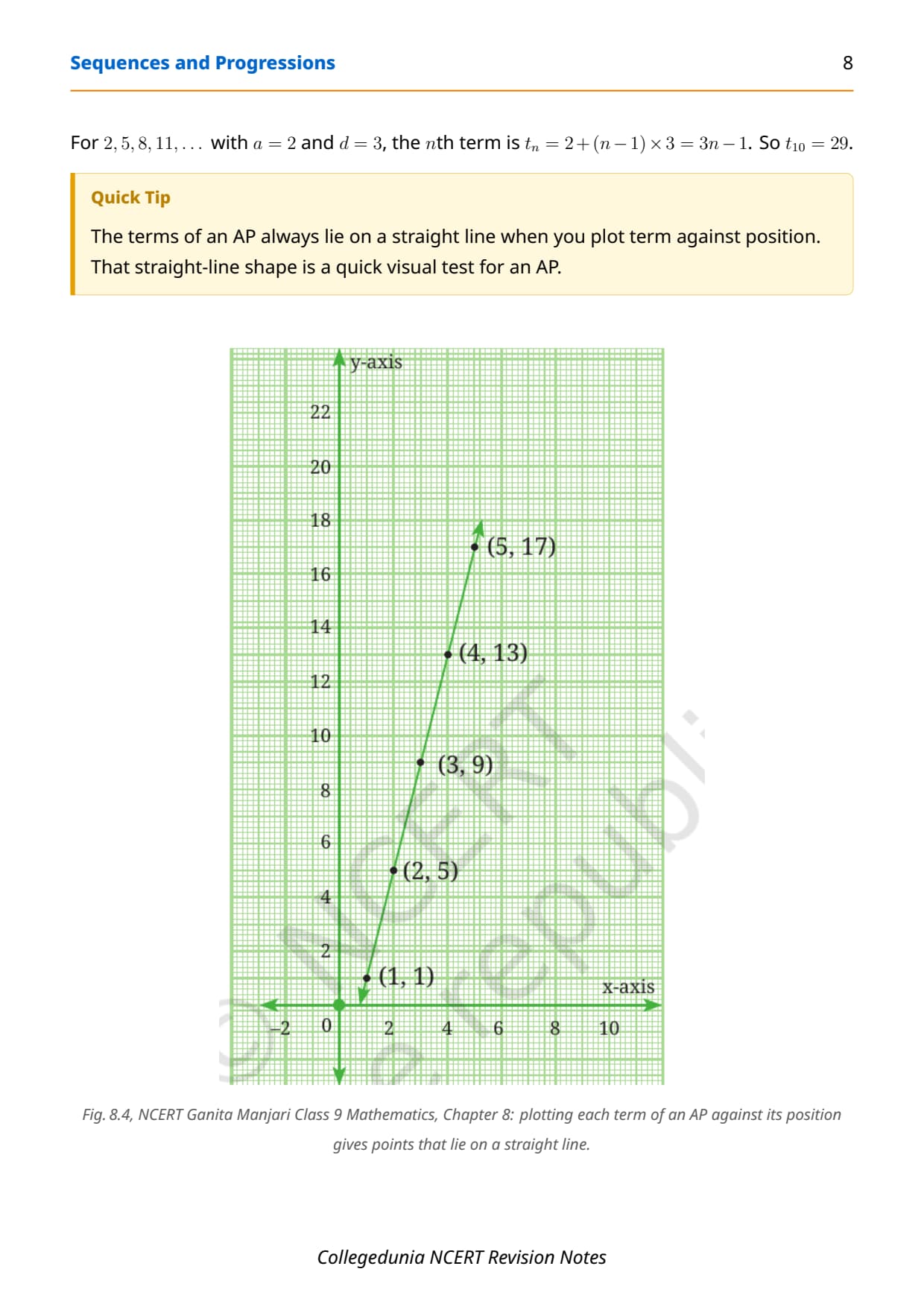
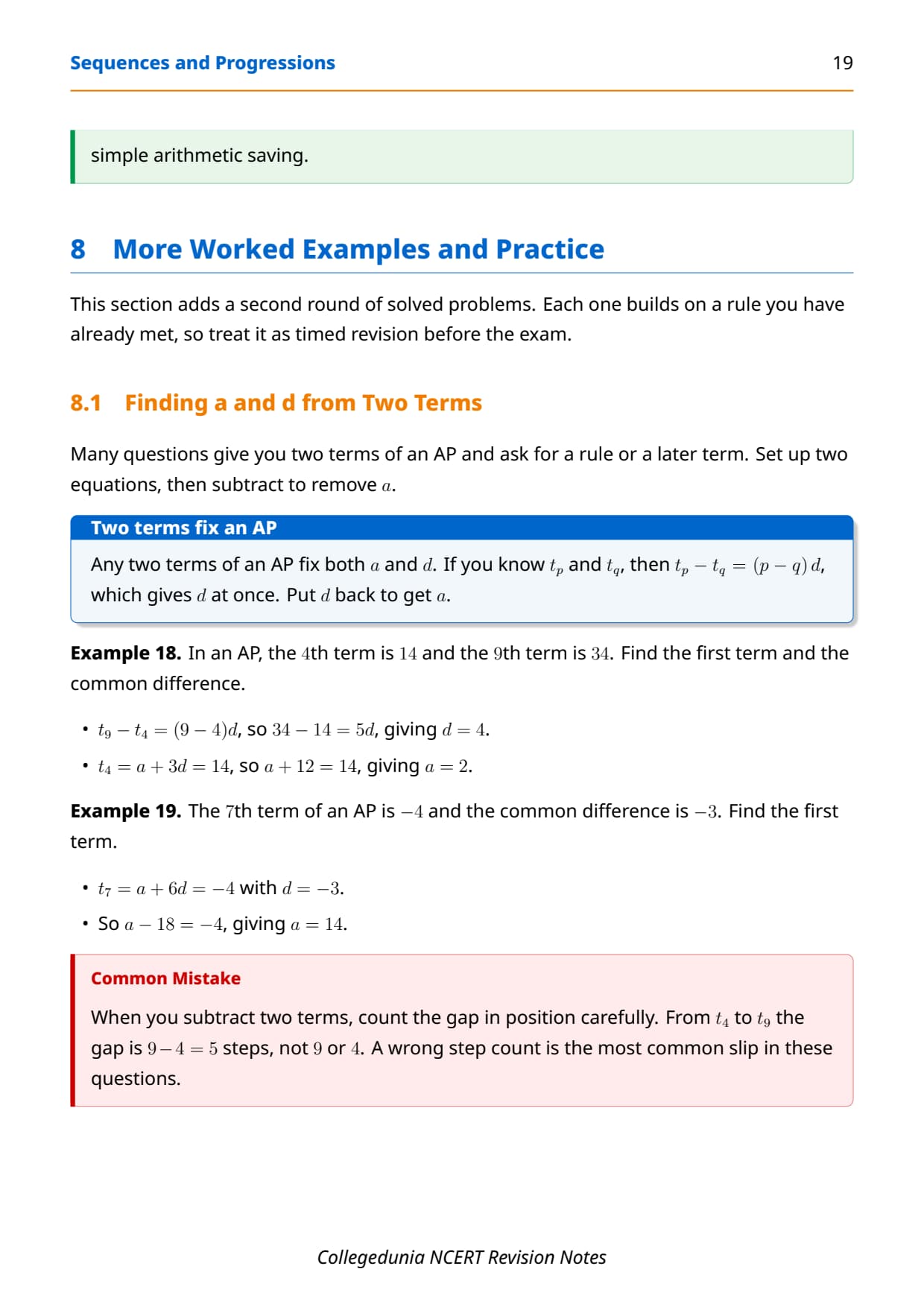
An arithmetic progression, or AP, is a sequence where each term differs from the one before by a fixed amount. The first term is a and the fixed gap is the common difference d. For 2, 5, 8, 11, , a = 2 and d = 3. The nth term is tn = a + (n-1)d, because you take n-1 steps from the first term. To test if a sequence is an AP, subtract each term from the next. If every difference is the same, it is an AP. A negative d means the AP decreases.
Sums and a Glimpse of GP
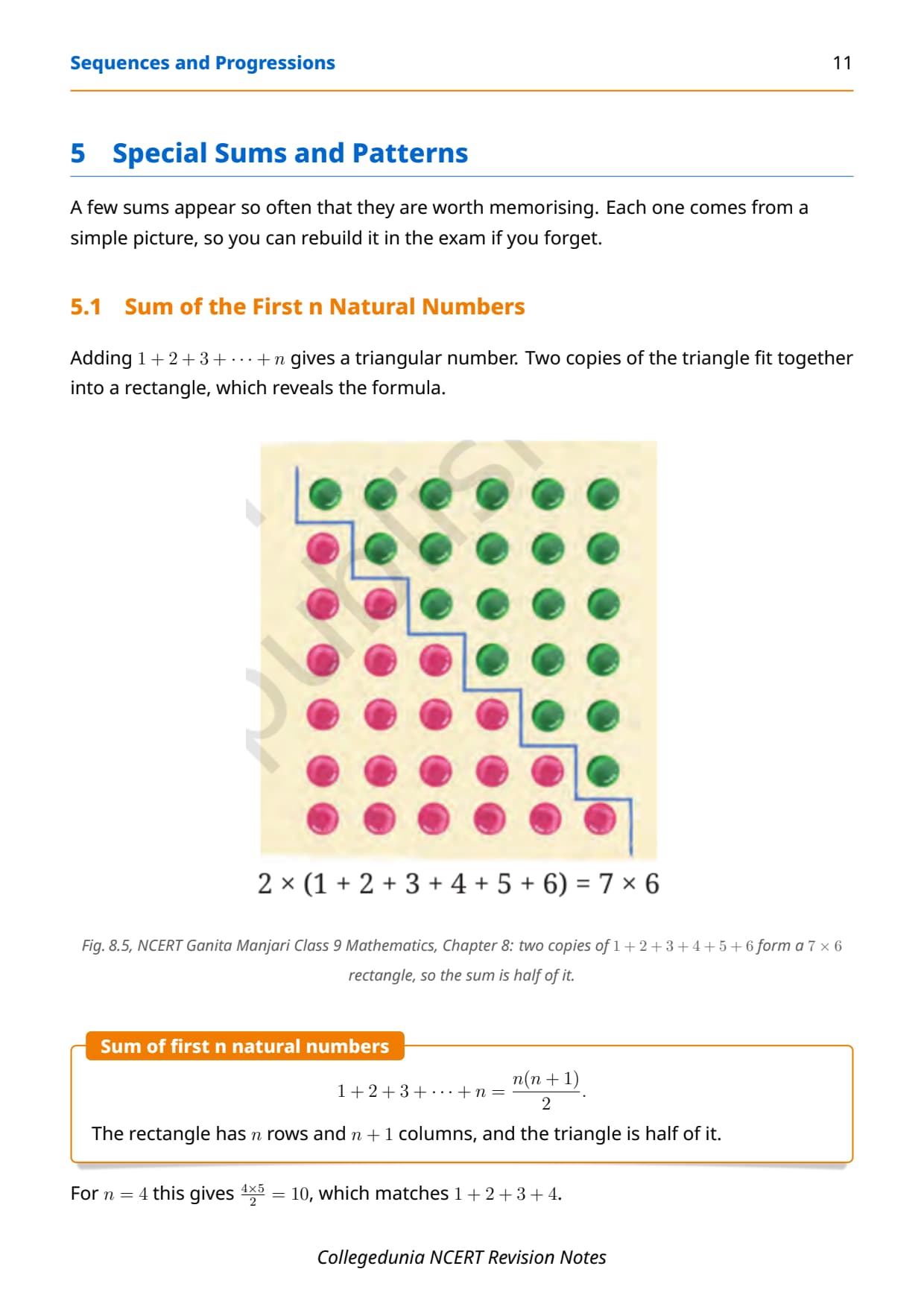
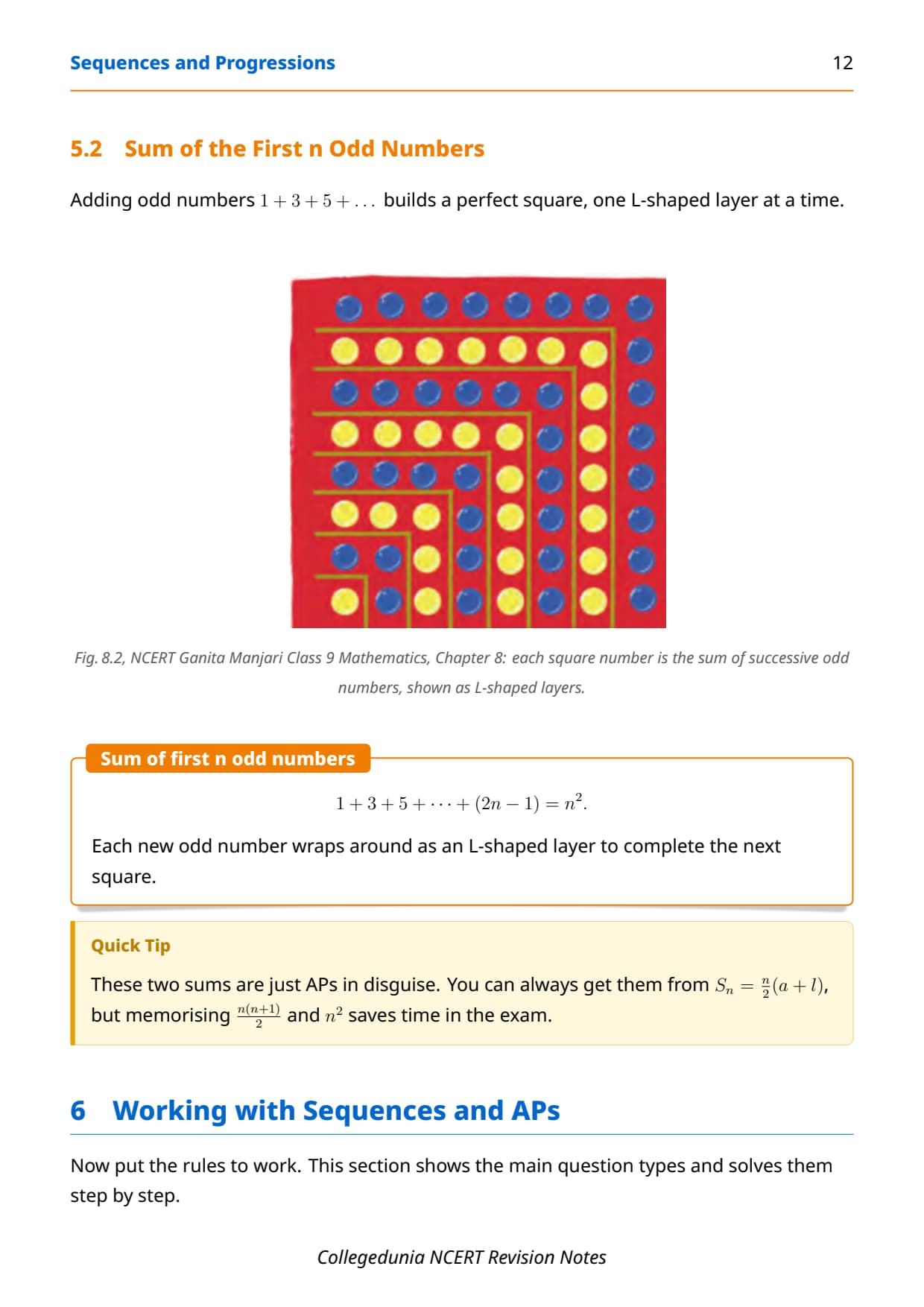
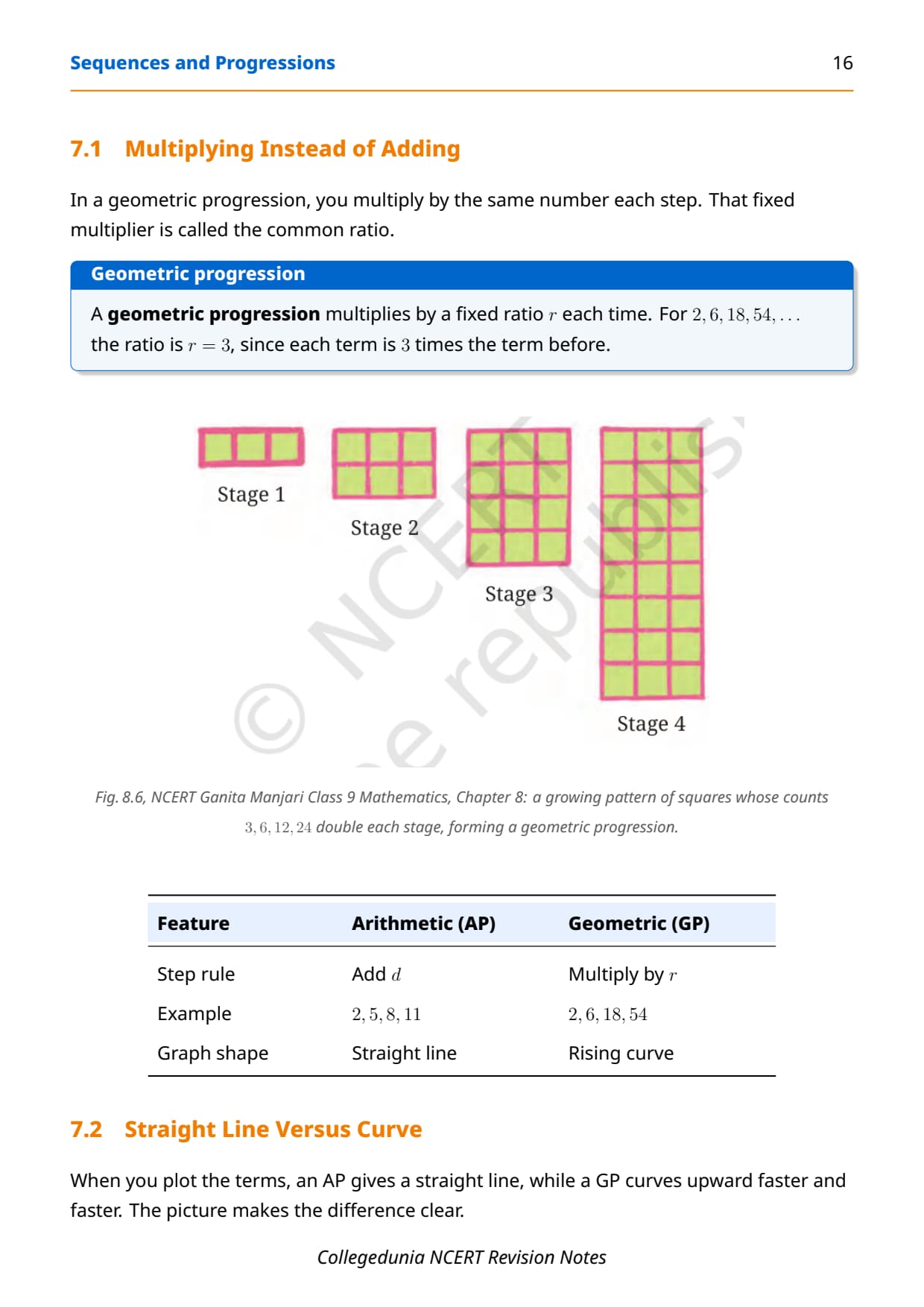
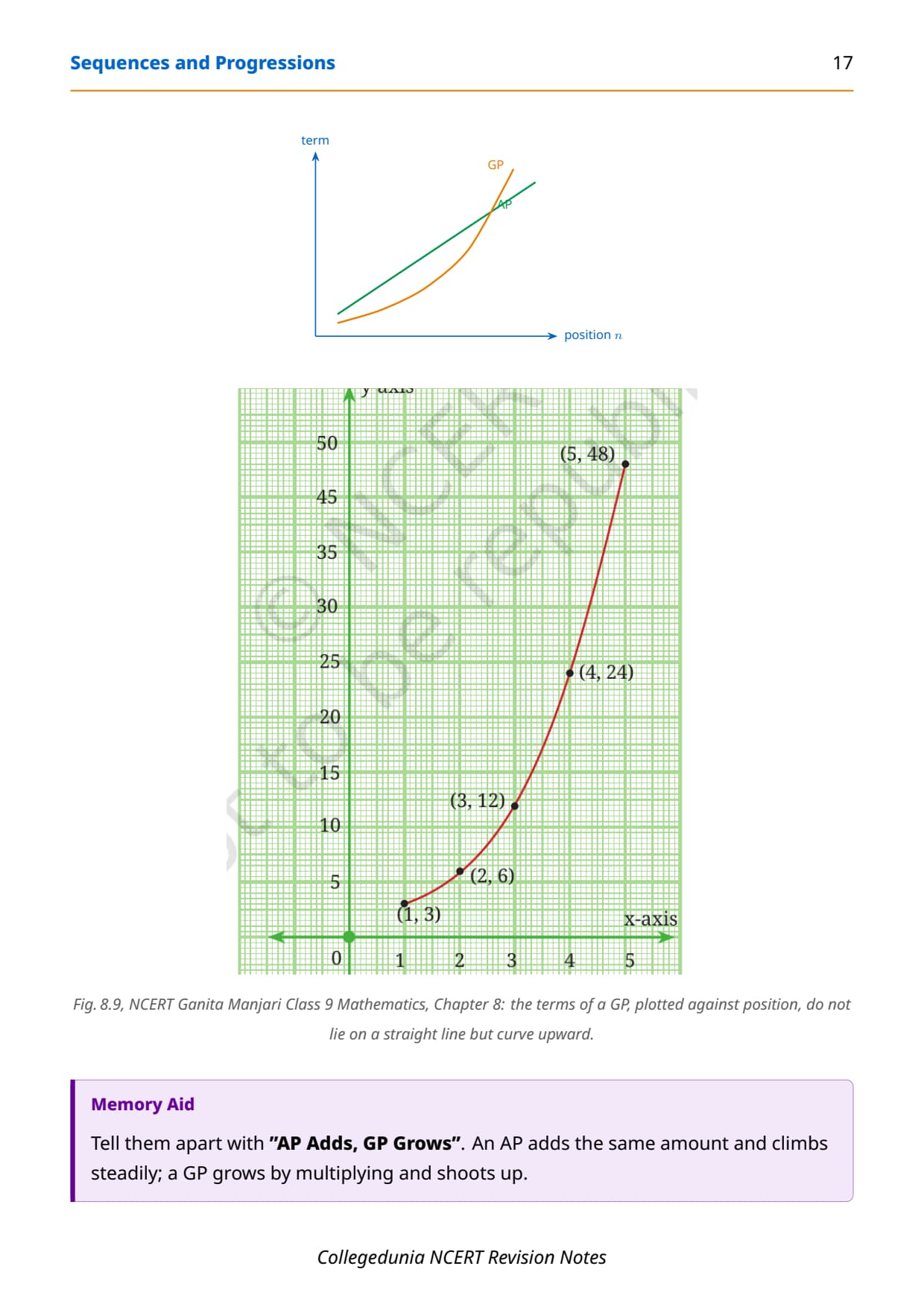
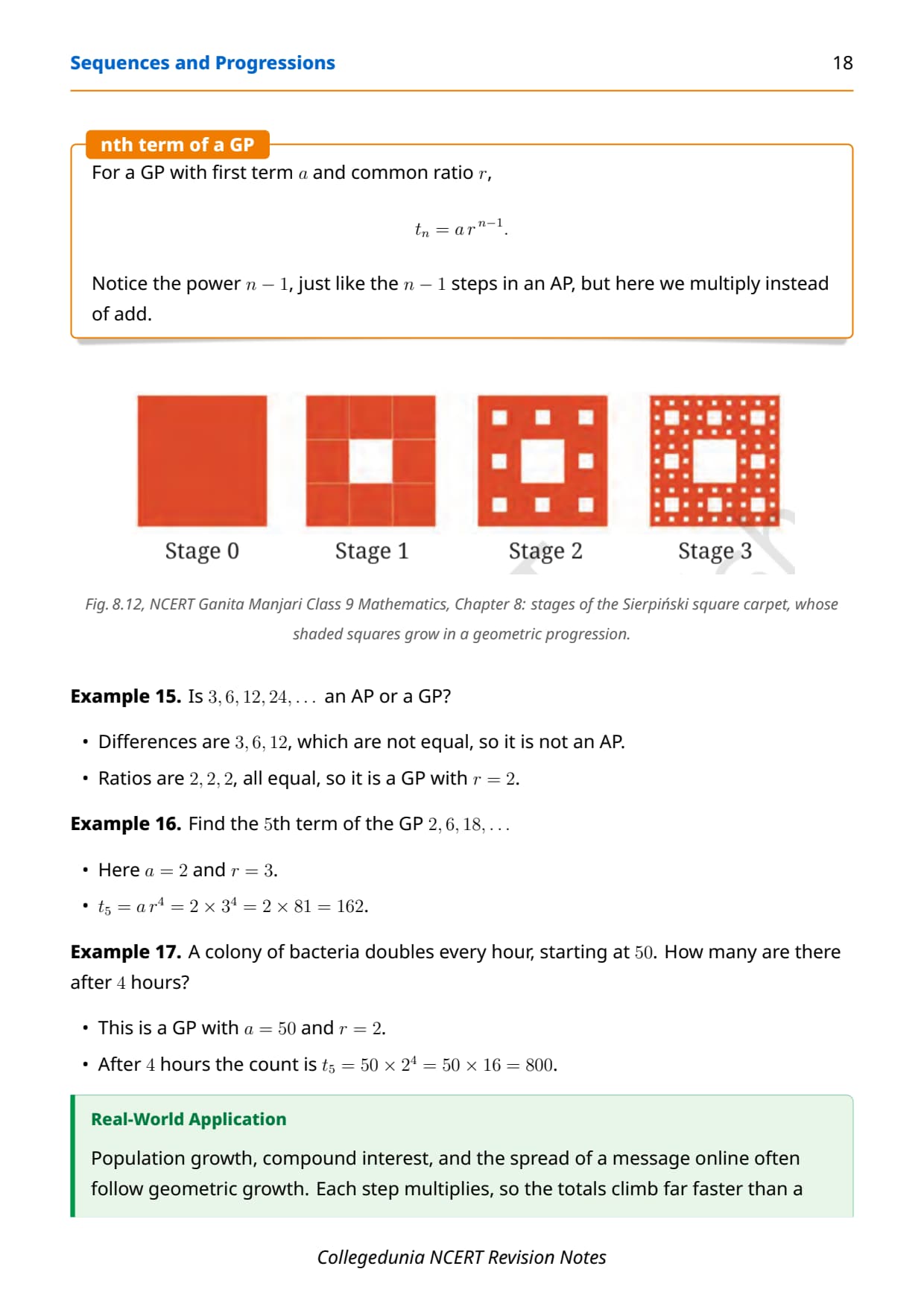
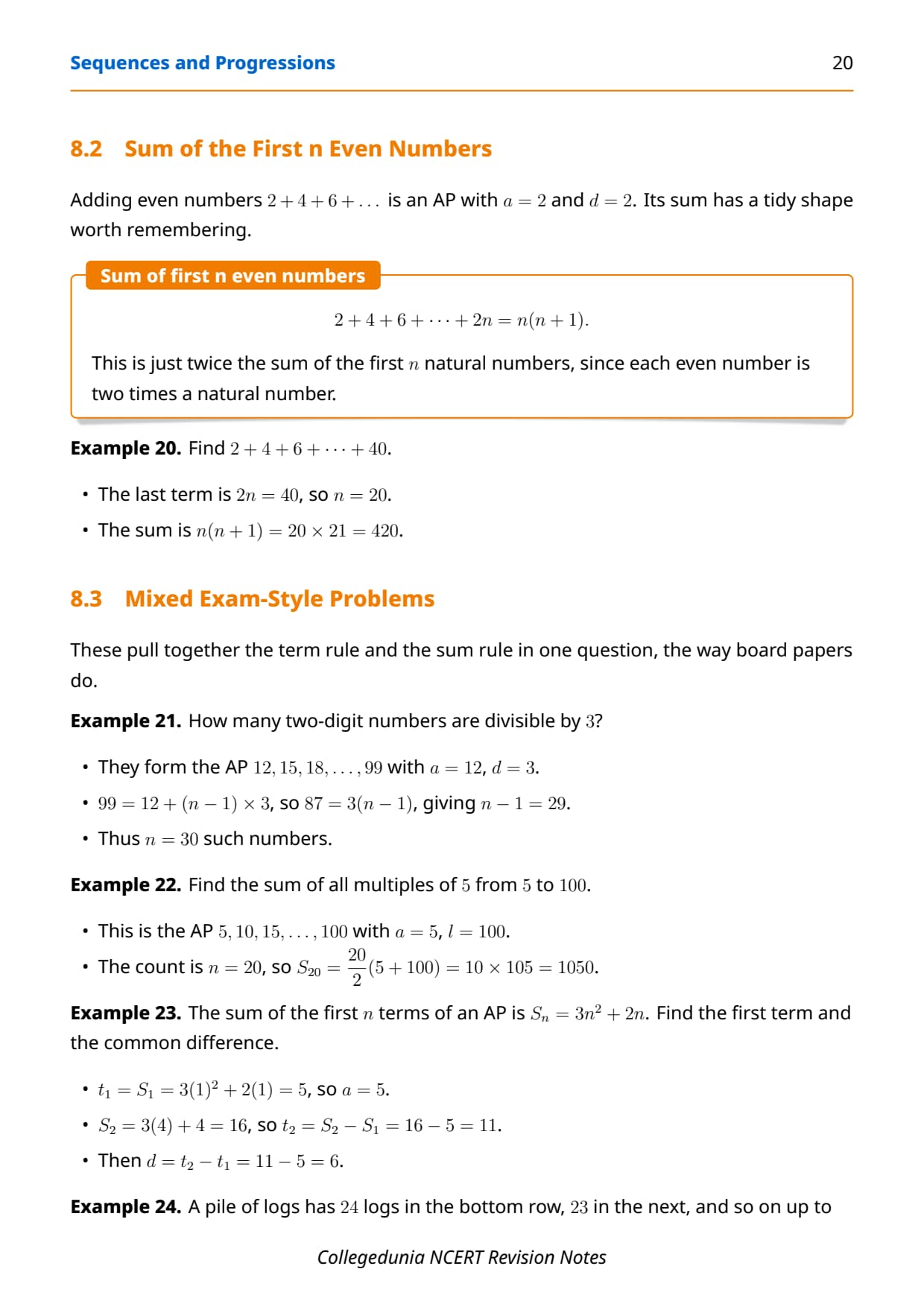
The sum of the first n terms of an AP is Sn = n2[2a + (n-1)d], or Sn = n2(a + l) when the last term l is known. Two special sums are worth memorising: 1 + 2 + + n = n(n+1)2 and the sum of the first n odd numbers is n2. Not every pattern adds a fixed number. A geometric progression multiplies by a fixed ratio r each step, like 2, 6, 18, 54, , with nth term tn = a r n-1.
Key Points and Results to Remember in Sequences and Progressions
These are the must-know facts and formulas from the chapter. Keep this short list handy for last-minute revision.
| Point | What it means |
|---|---|
| Common difference | d = tn - tn-1, the fixed gap in an AP. |
| nth term of an AP | tn = a + (n-1)d. |
| Sum of an AP | Sn = n2[2a + (n-1)d] = n2(a + l). |
| Sum of 1 to n | n(n+1)2. |
| Sum of first n odd numbers | n2. |
| nth term of a GP | tn = a r n-1, a fixed ratio each step. |
How to Revise Sequences and Progressions Quickly
To revise fast, skim the sequences and progressions class 9 maths notes above, then find the nth term of one AP and check if a given sequence is an AP. Next, add the first 10 terms of an AP using a sum formula. This short loop fixes the chapter. The time you need depends on whether this is a revision or a first read.
Revision mode
1-2 hours
If you have done this chapter once and are revising.
First-read
4-6 hours
If you are learning Sequences and Progressions for the first time.
How will Collegedunia's Notes Help You with Sequences and Progressions?
Collegedunia gives you these sequences and progressions class 9 maths notes as one clean revision page that matches the new book exactly. You get the rules, the two formulas, and the common traps together, so revision is quick.
- 2026-27 book match: Every rule follows the new Ganita Manjari chapter, not the old syllabus.
- Plain language: Short sentences and simple words make each idea easy to read.
- Both formulas together: The nth term and sum rules sit in one place for fast recall.
- Free PDF: Download the notes and revise offline before your annual exam.
More Sequences and Progressions Maths Class 9 Resources
NCERT Notes for Class 9 Maths: All Chapters
Use the table below to open the NCERT Notes for any other chapter of the new Class 9 Maths book.
| Chapter | Resource |
|---|---|
| Chapter 1 | Coordinates Notes |
| Chapter 2 | Linear Polynomials Notes |
| Chapter 3 | The World of Numbers Notes |
| Chapter 4 | Algebraic Identities Notes |
| Chapter 5 | Circles Notes |
| Chapter 6 | Perimeter and Area Notes |
| Chapter 7 | Introduction to Probability Notes |
| Chapter 8 | Sequences and Progressions Notes |
Sequences and Progressions Class 9 Maths Notes FAQs
Ques. Where can I download the Sequences and Progressions Class 9 Maths Notes PDF?
Ans. You can download the Sequences and Progressions Class 9 Maths Notes PDF directly from this page. Both the Normal and HD versions are free.
Ques. How many pages are the Sequences and Progressions Class 9 Maths Notes?
Ans. The notes run to about 22 pages. They cover patterns, nth-term rules, arithmetic progressions, and sum formulas with clear examples.
Ques. Is Sequences and Progressions part of the new Class 9 Maths book?
Ans. Yes. Sequences and Progressions is Chapter 8 of the new Ganita Manjari book for the 2026-27 syllabus. It sets up the AP work for Class 10.
Ques. What is the nth term formula of an AP?
Ans. For an AP with first term a and common difference d, the nth term is tn = a + (n-1)d.
Ques. Are these notes enough to revise the full chapter?
Ans. Yes. The notes list every rule, formula, and common mistake, so they work well for a quick revision before the exam.



Comments