




These Introduction to Probability revision notes sum up the whole seventh chapter of the new Ganita Manjari book in one place. Our introduction to probability class 9 maths notes explain the probability scale, experimental and theoretical probability, counting outcomes, and the complement rule in plain language.
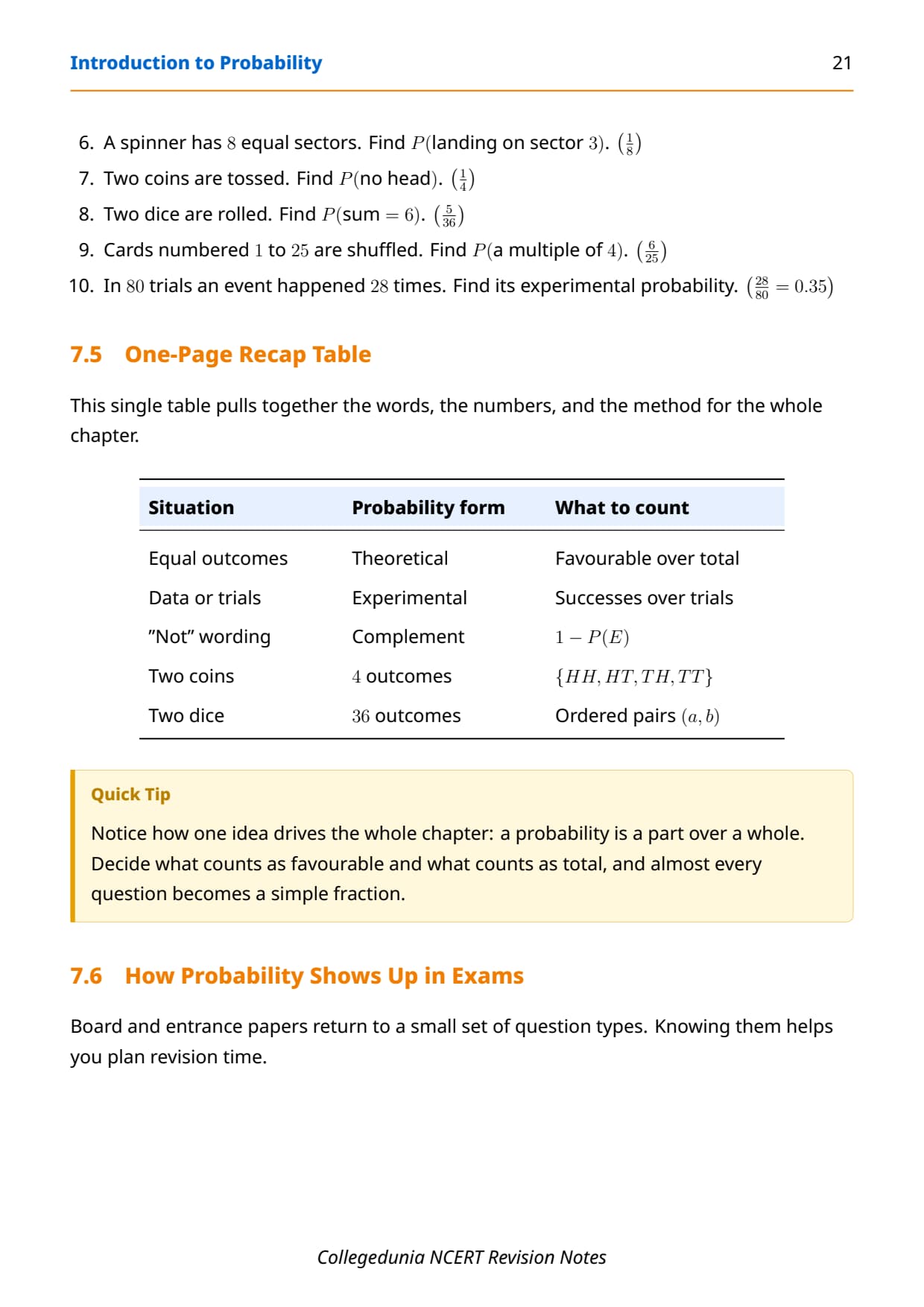
- What they cover: the probability scale, experimental and theoretical probability, and counting outcomes.
- Who they help: Class 9 students who want a fast, clear revision before a test.
- Why they save time: both formulas and the key rules sit on one short page.
These notes are prepared by subject teachers, matched to the current 2026-27 NCERT Ganita Manjari book, and written so a Class 9 student can revise the whole chapter quickly.
What Do Class 9 Maths Introduction to Probability Notes Cover?
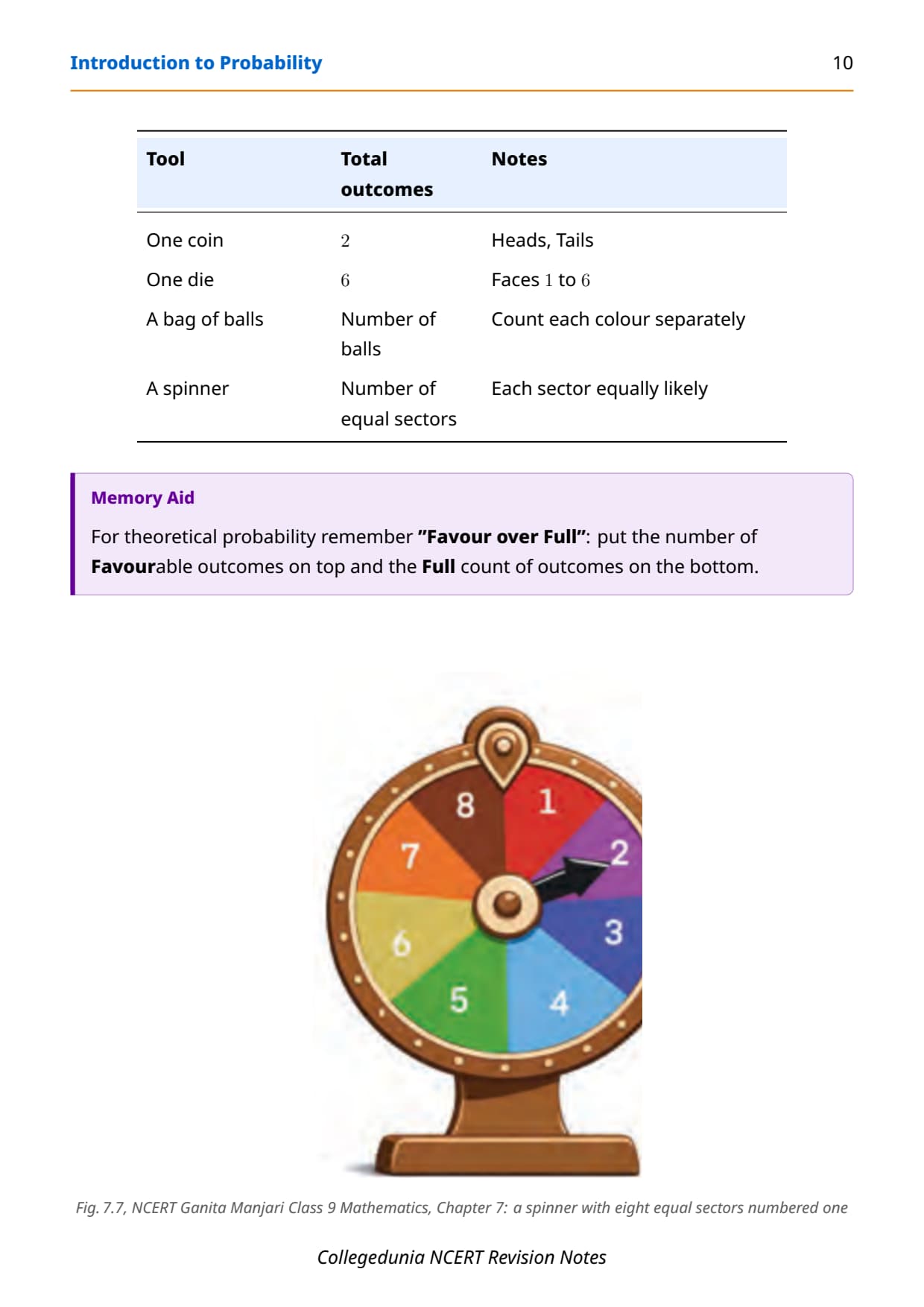
The introduction to probability class 9 maths notes cover the full chapter in short, simple parts. You first learn the key terms, like outcome, event, and sample space. Then you meet the probability scale from 0 to 1, experimental probability from data, and theoretical probability from equally likely outcomes. The notes end with counting outcomes for two coins or two dice and the complement rule.
Video Walkthrough
Source: Magnet Brains on YouTube
Introduction to Probability Class 9 Maths Topic-by-Topic Summary
Here is a short summary of each main topic. Read one part at a time and try a quick example as you go.
Probability Terms and the Scale
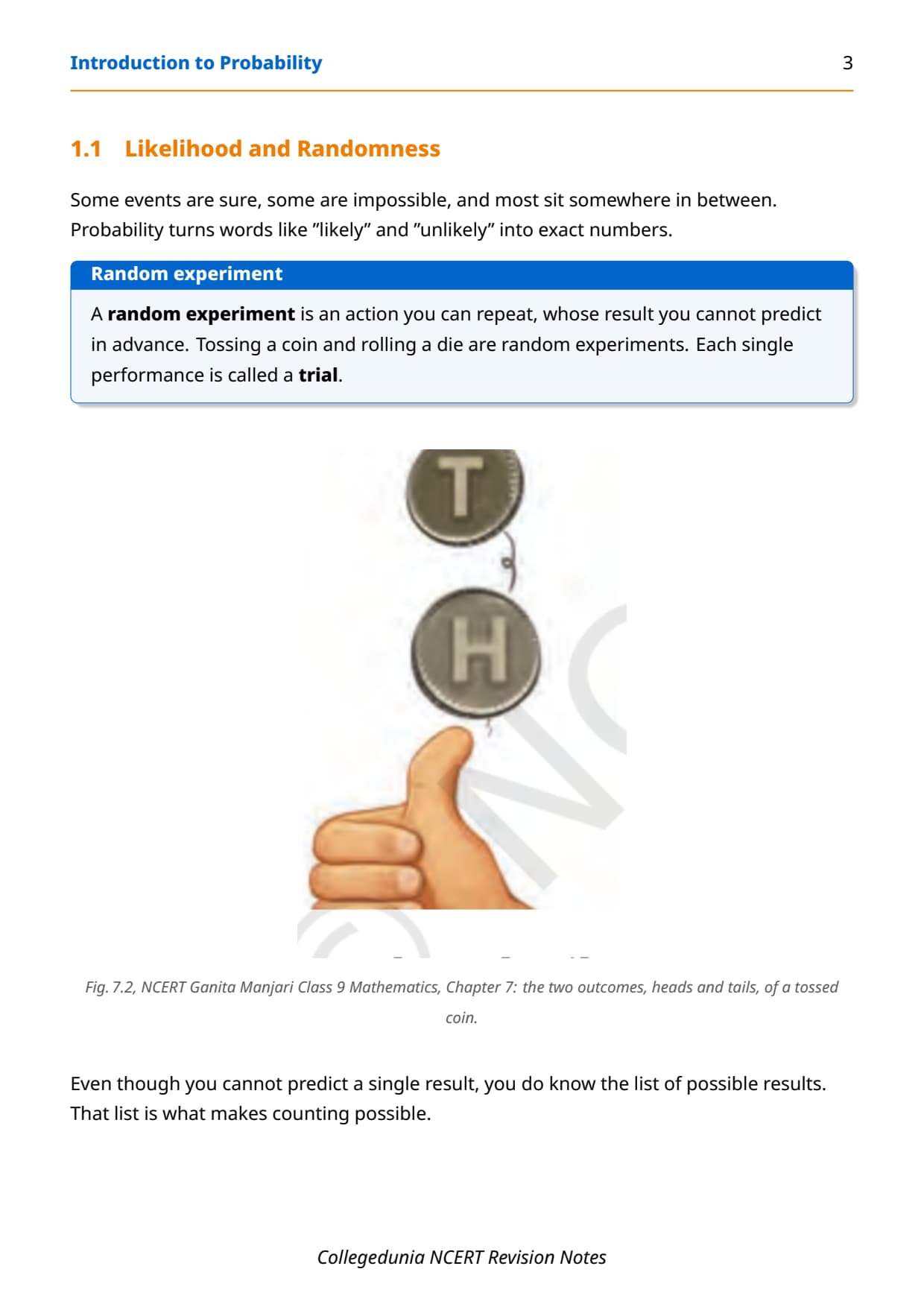
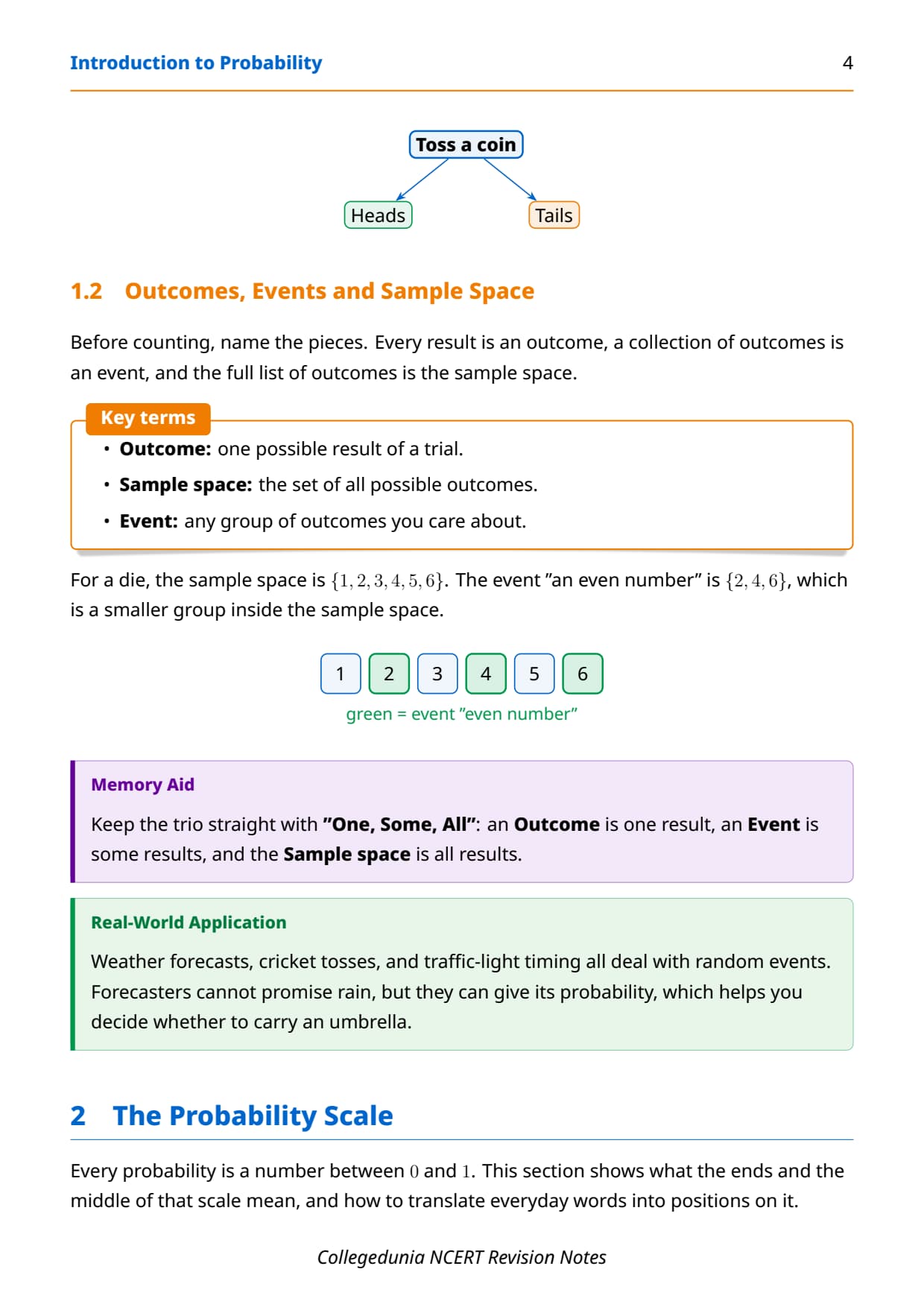
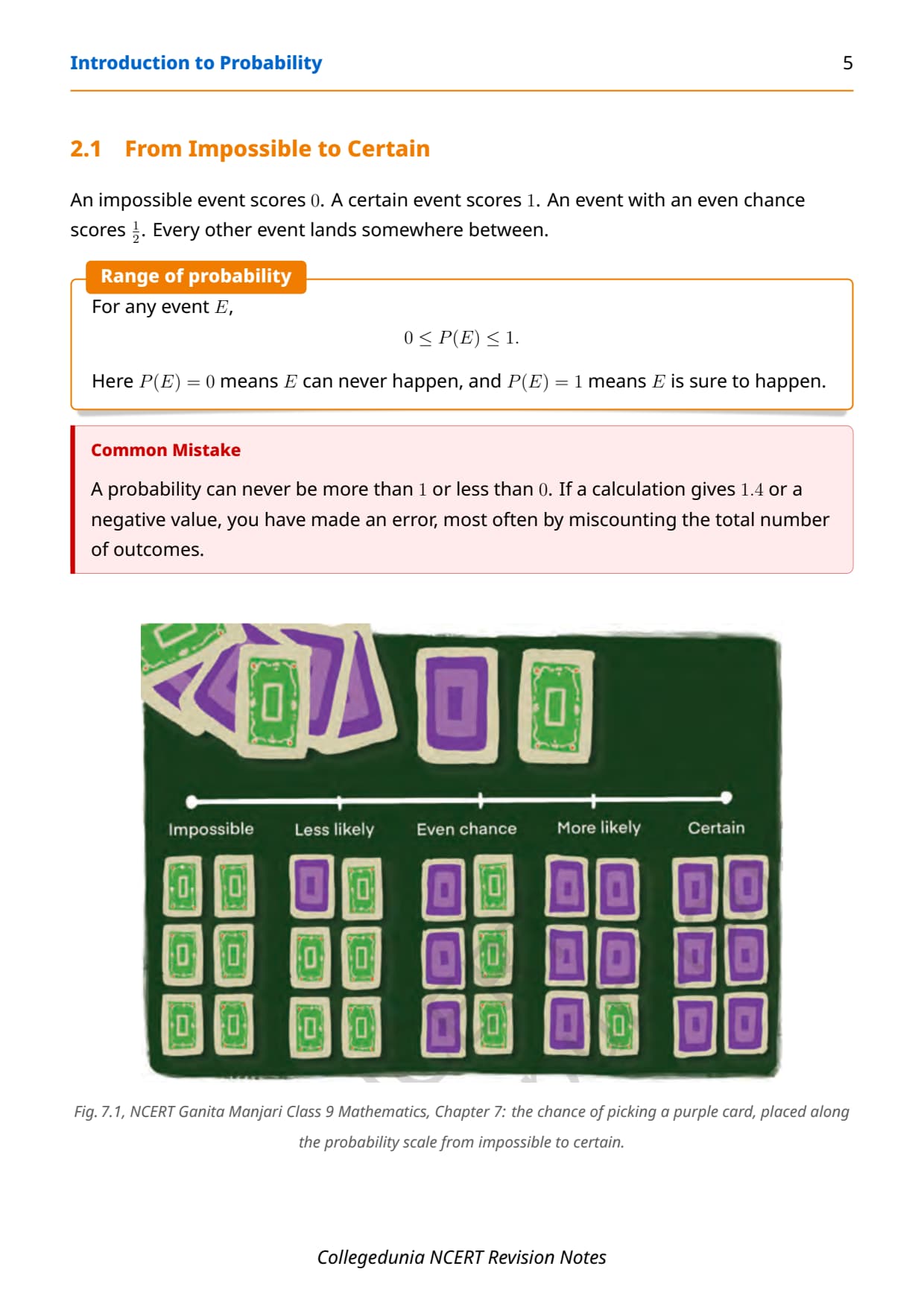
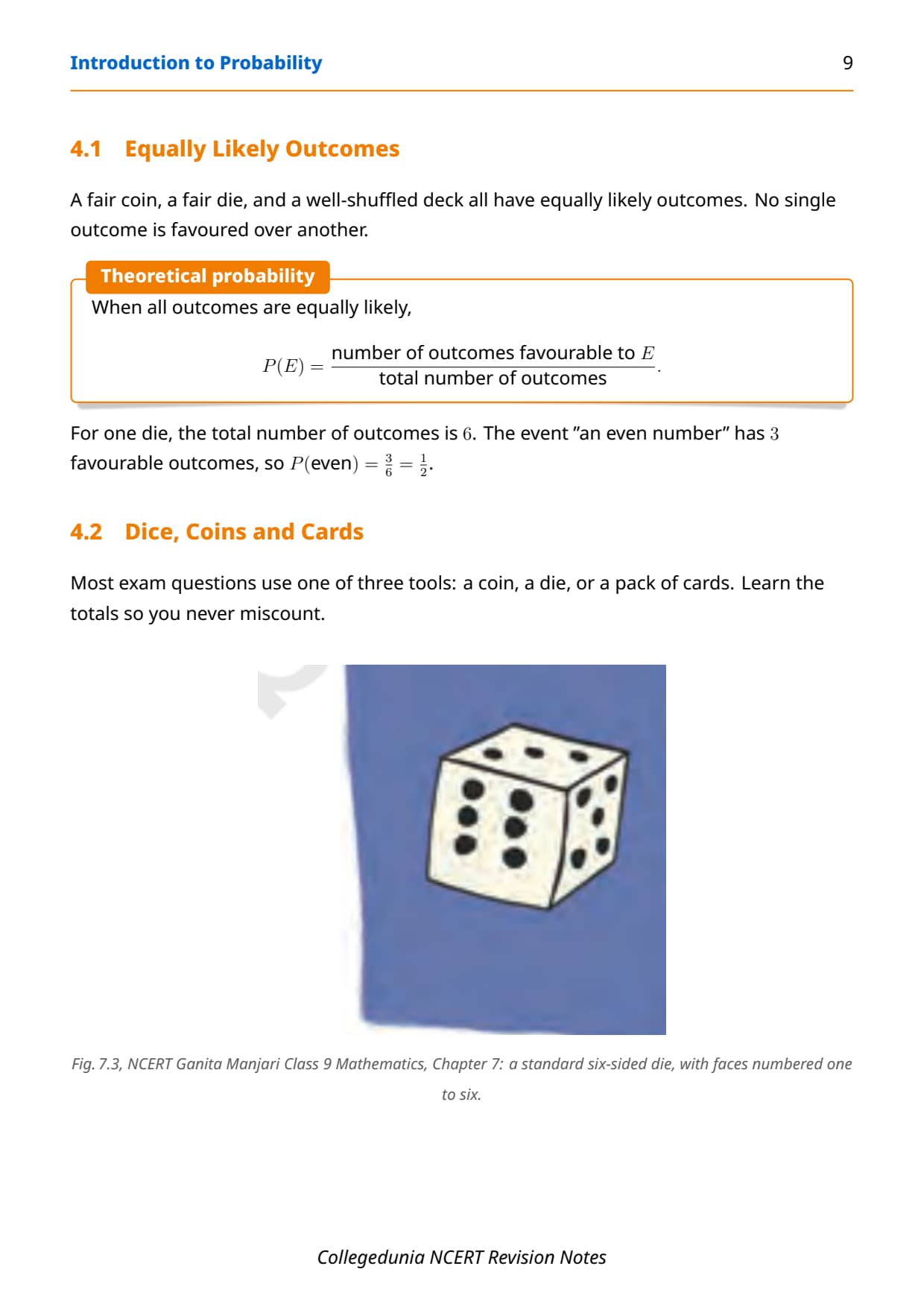
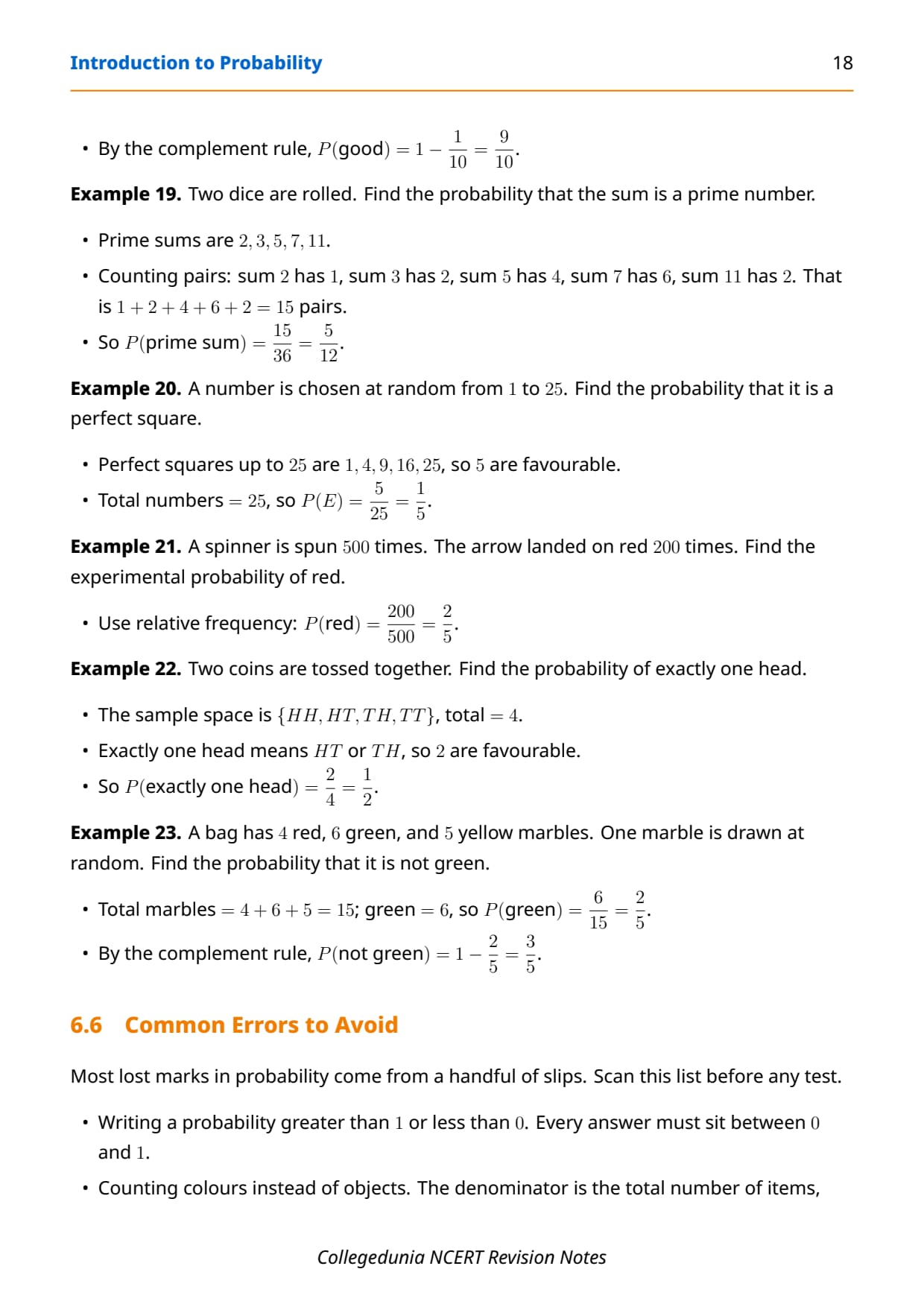
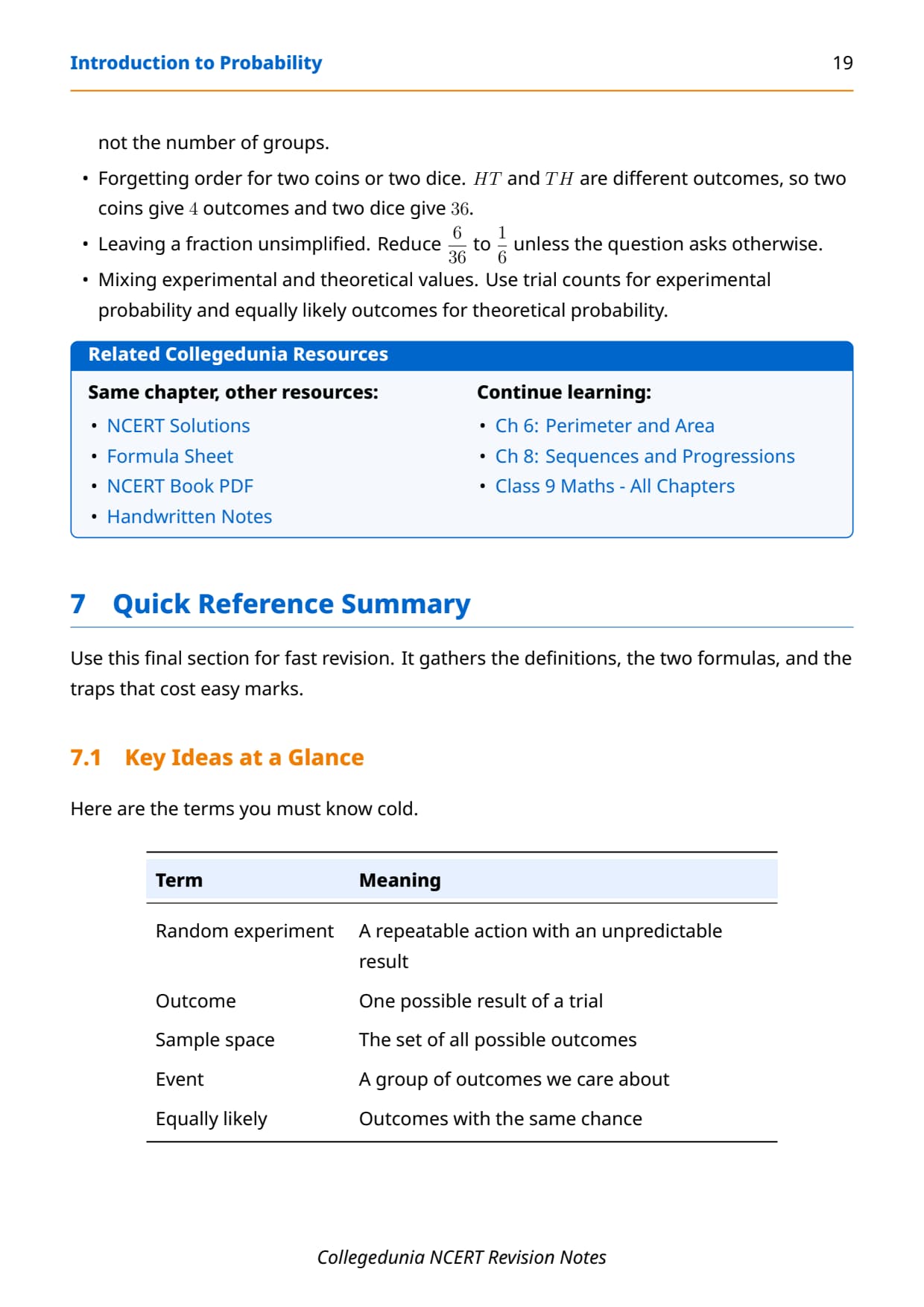
A random experiment is a repeatable action whose result you cannot predict, like tossing a coin. One result is an outcome, the full list of results is the sample space, and any group of outcomes is an event. For a die, the sample space is 1, 2, 3, 4, 5, 6. Every probability is a number between 0 and 1, so 0 ≤ P(E) ≤ 1. An impossible event scores 0, a certain event scores 1, and an even chance scores 12. A probability can never be more than 1 or less than 0.
Experimental and Theoretical Probability
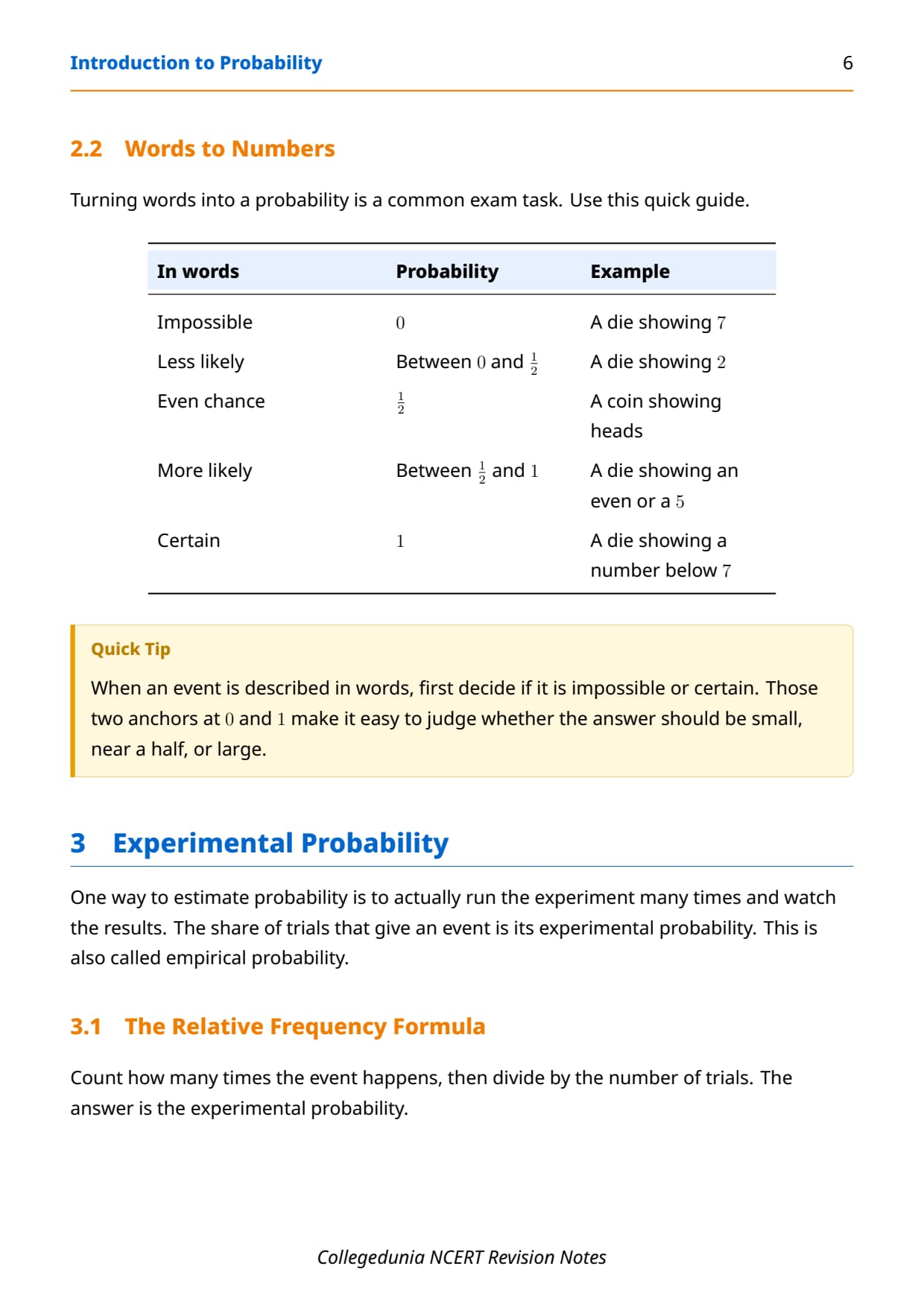
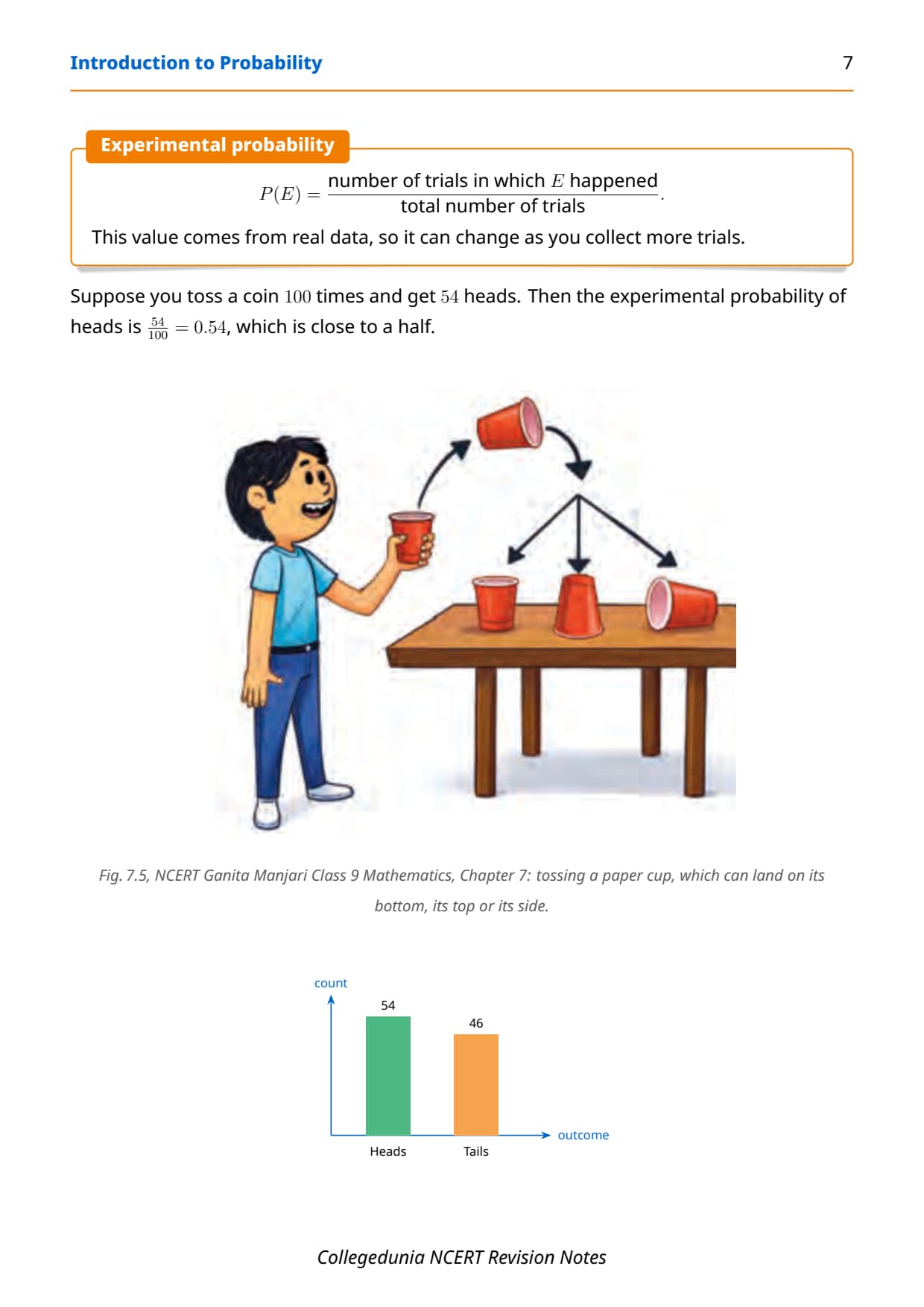
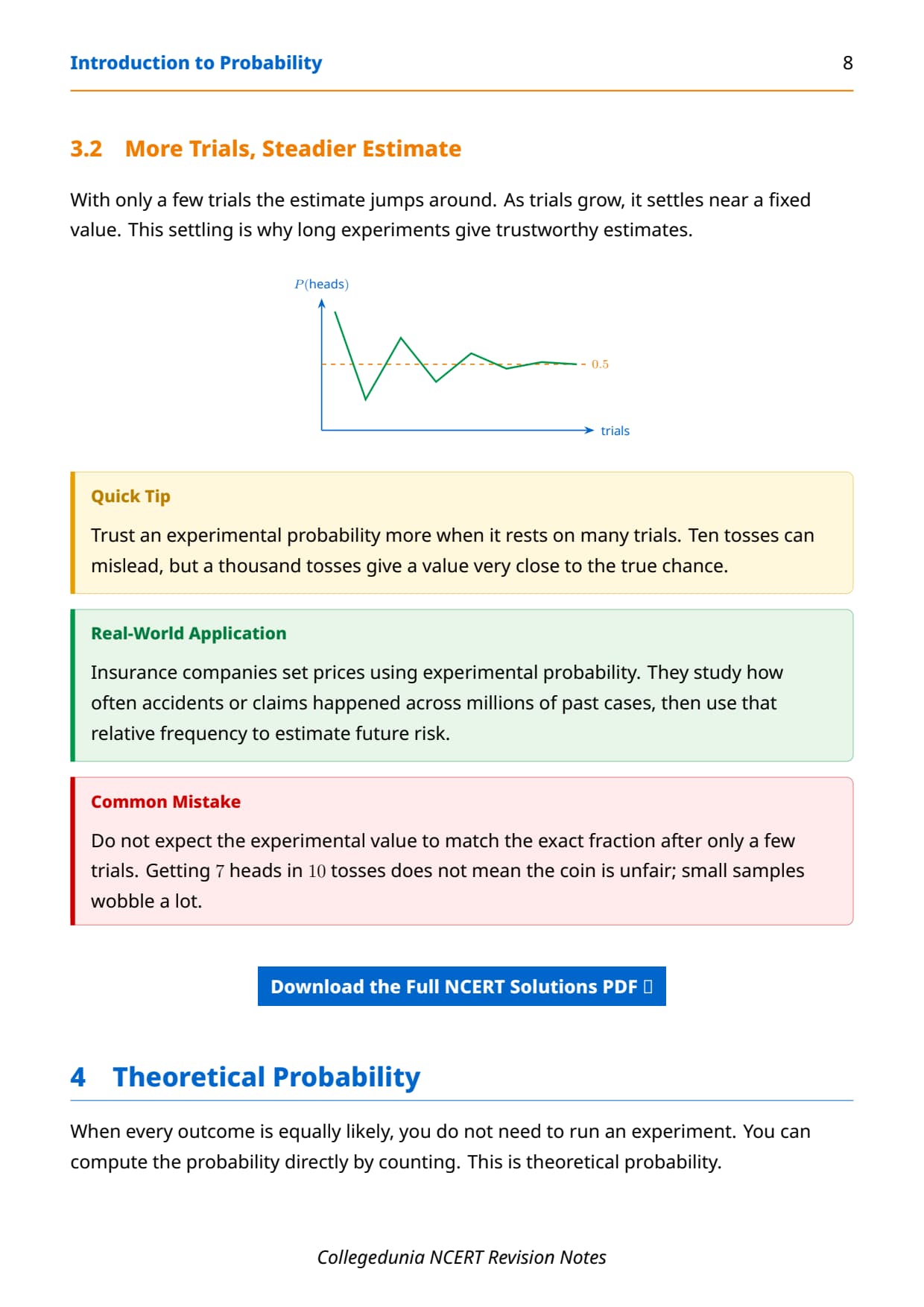
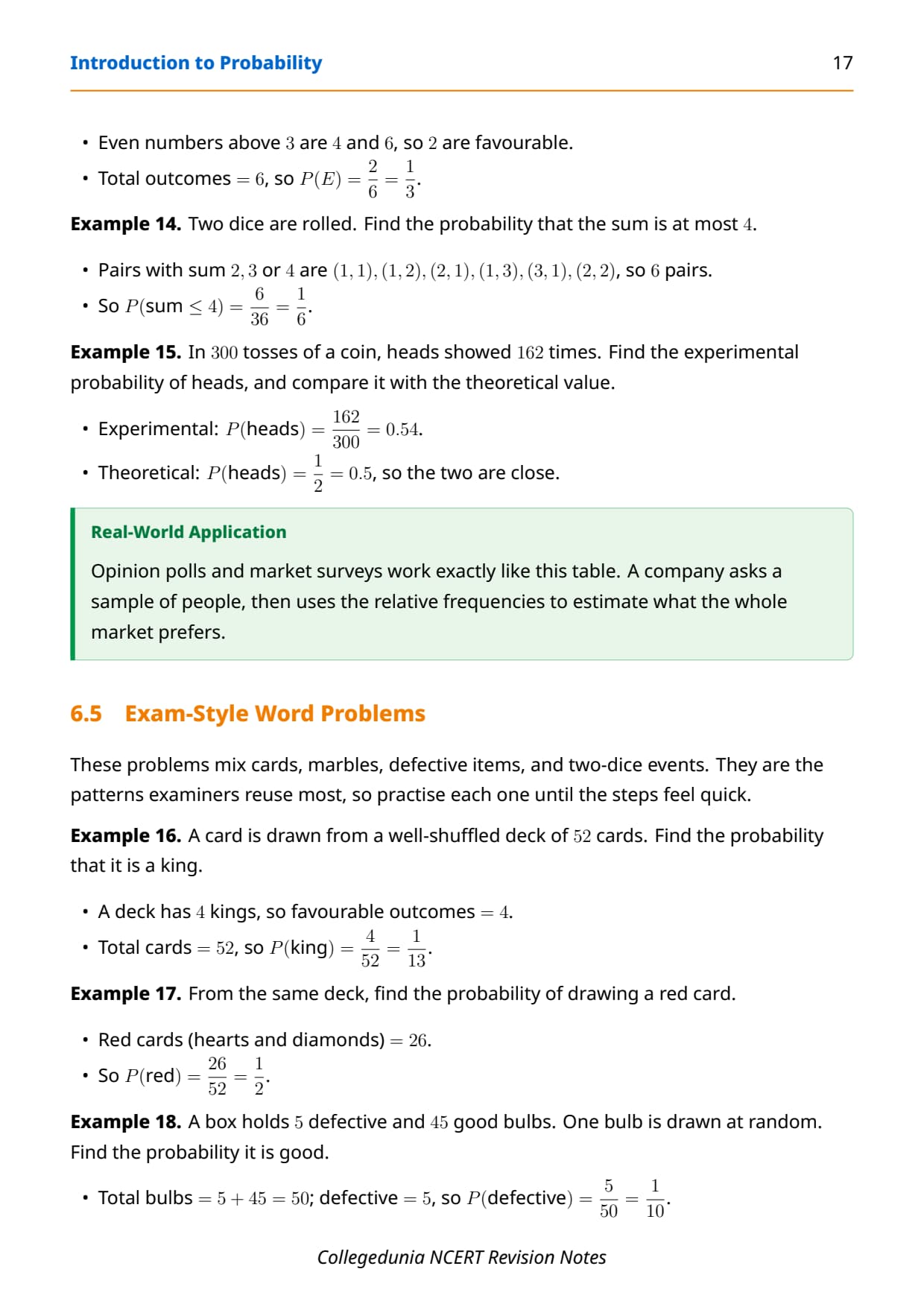
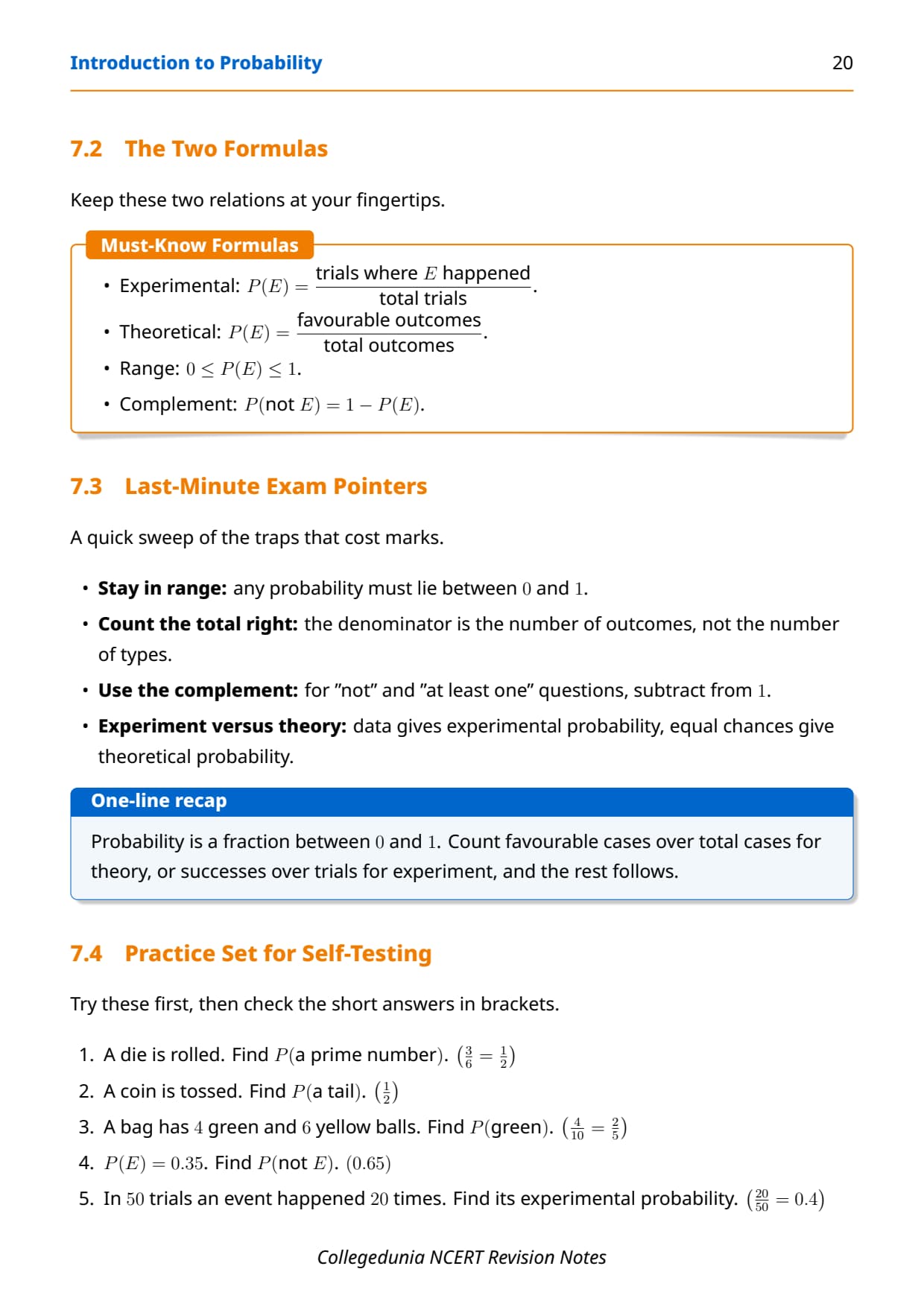
Experimental probability comes from running an experiment many times. It is the number of trials where the event happened divided by the total trials. If you toss a coin 100 times and get 54 heads, the experimental probability is 0.54. With more trials, this value settles near a fixed number. Theoretical probability is used when all outcomes are equally likely. It is the number of favourable outcomes divided by the total outcomes. For a die, P(even) = 36 = 12.
Counting Outcomes and the Complement Rule
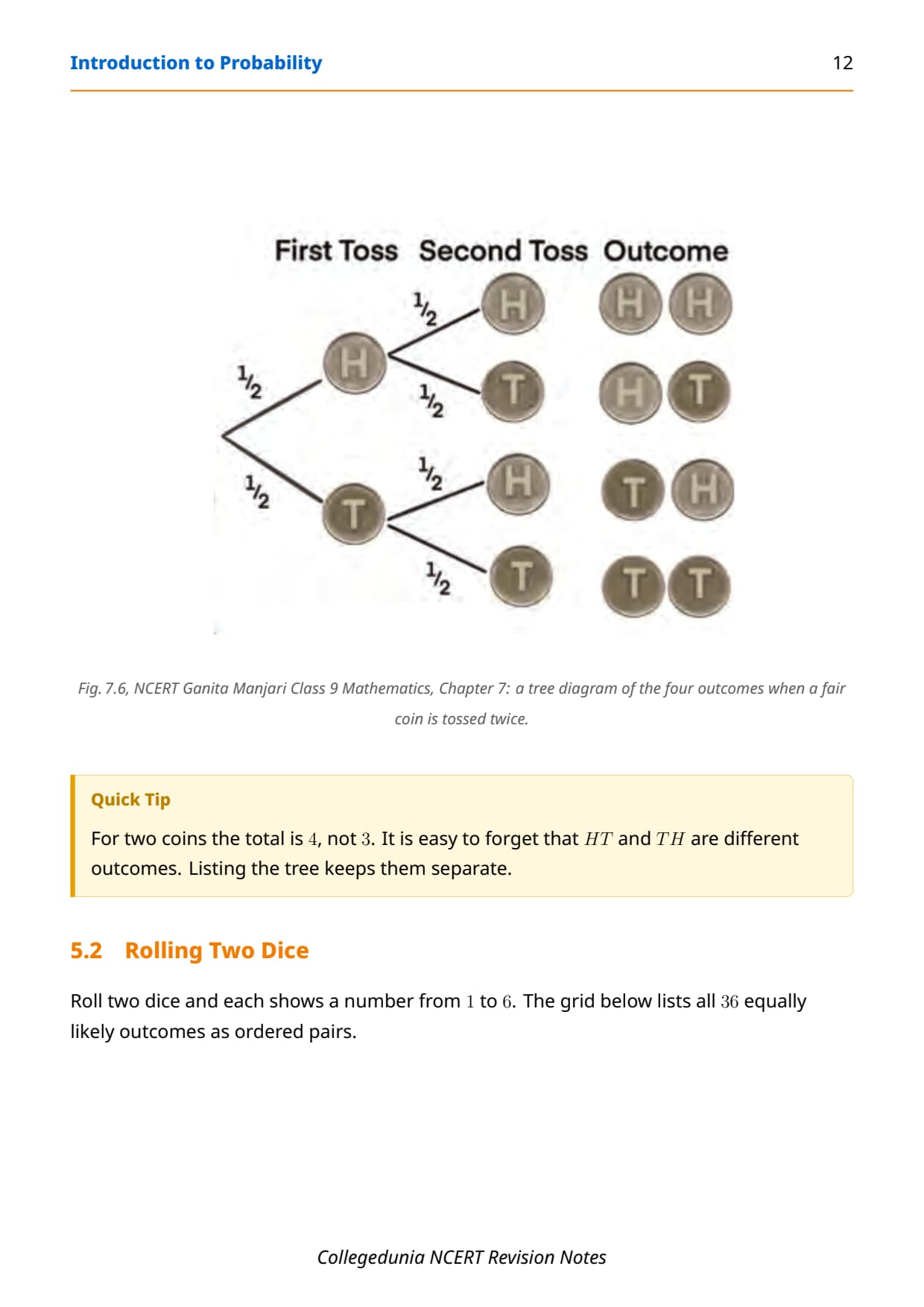
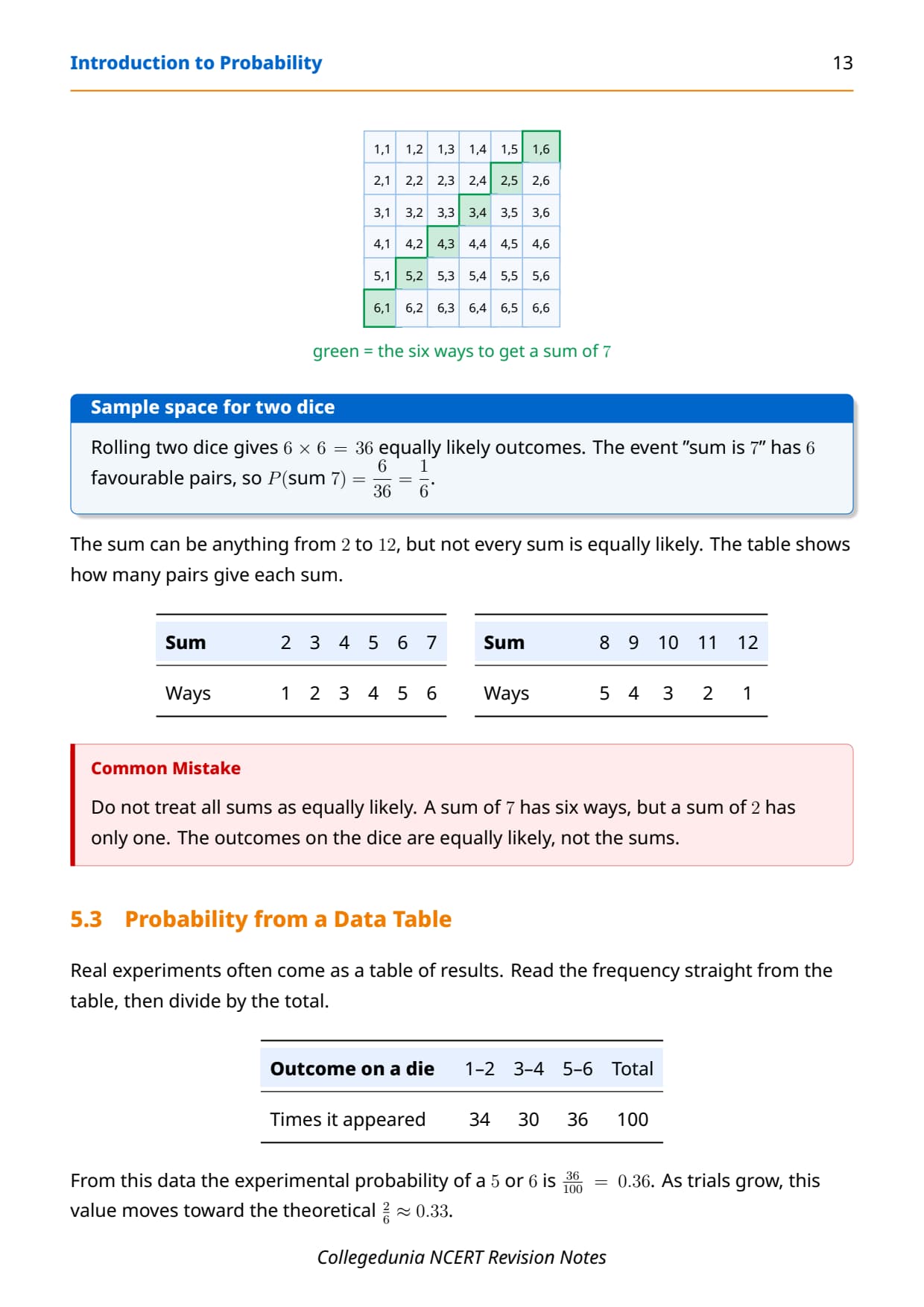
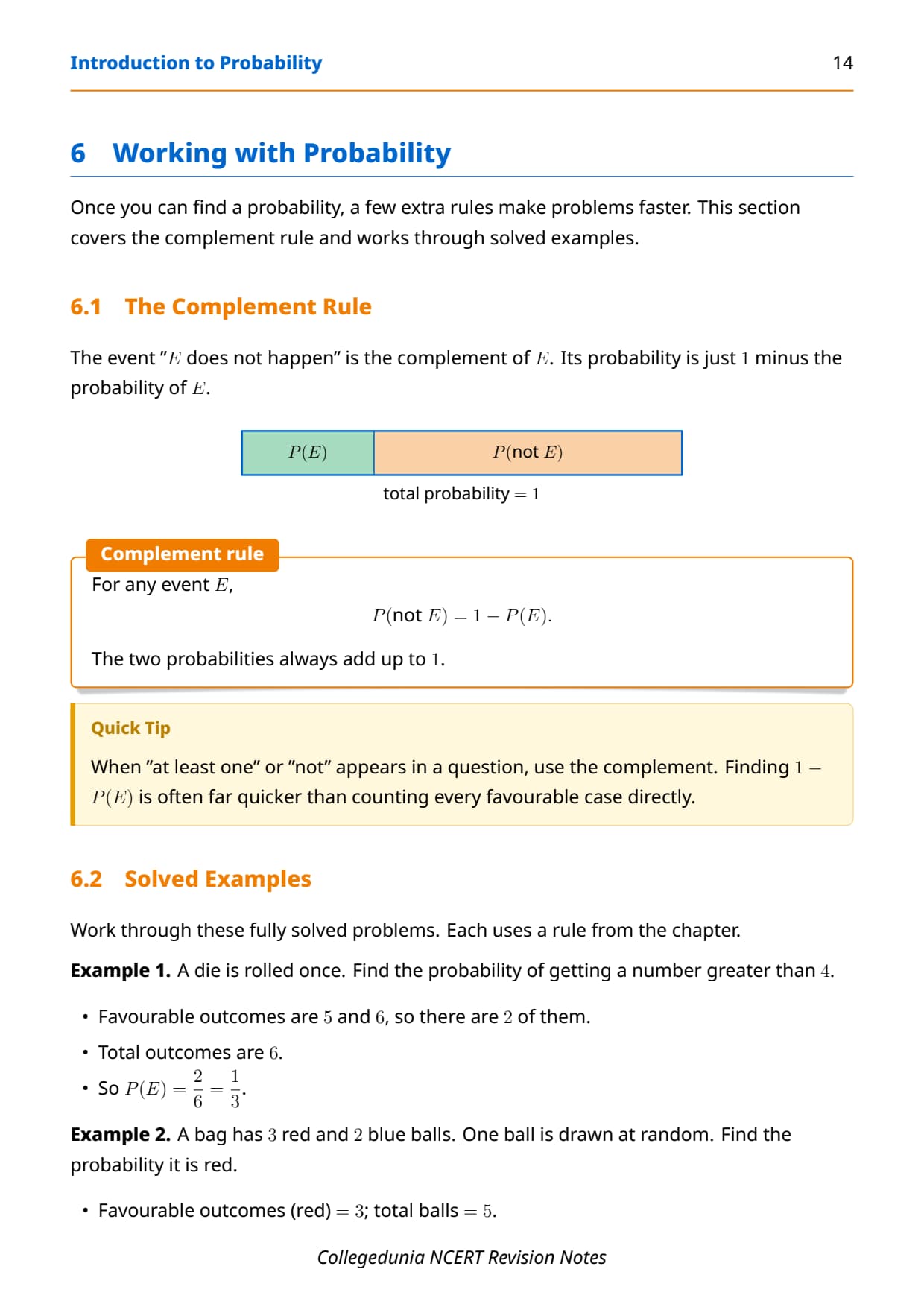
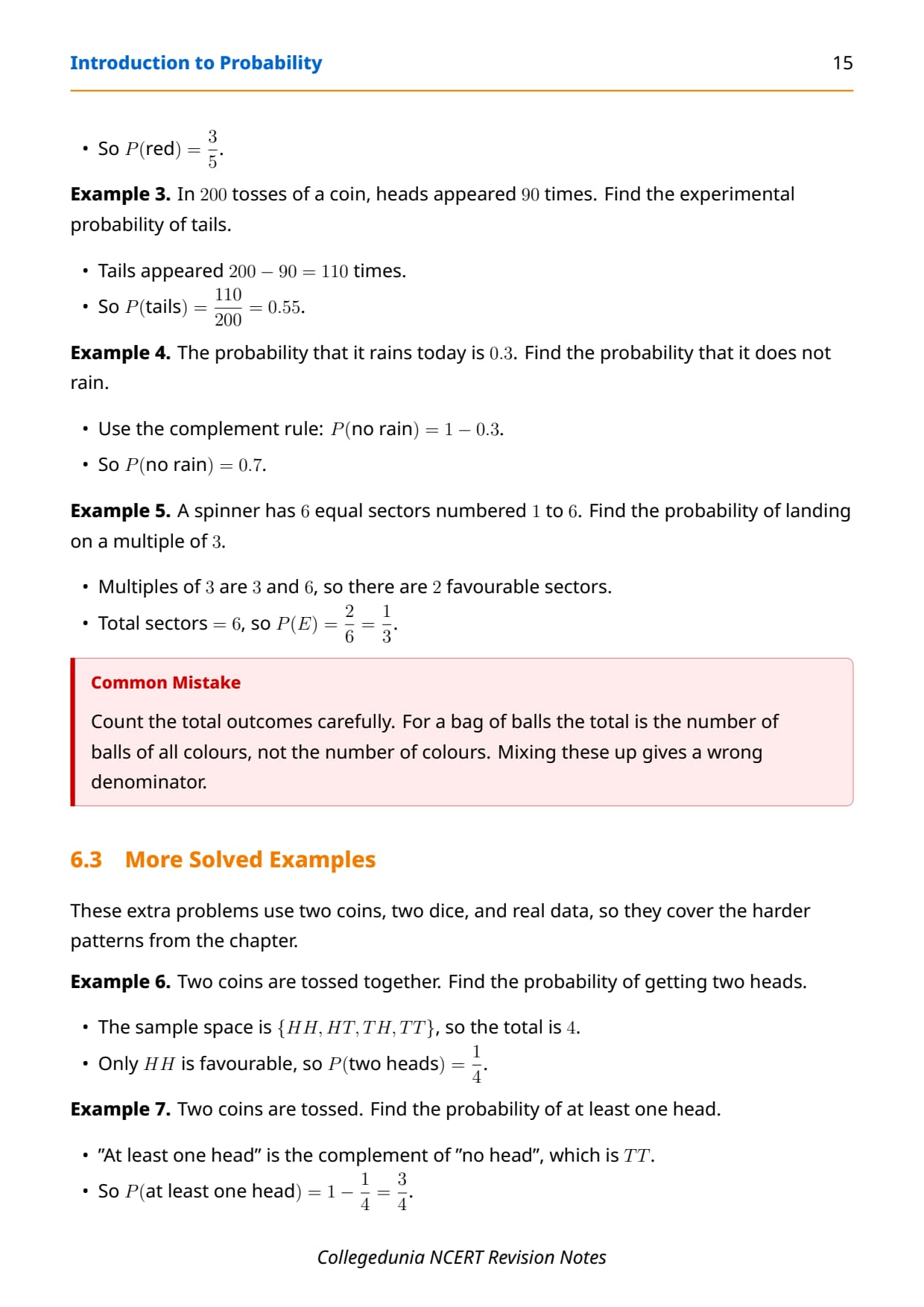
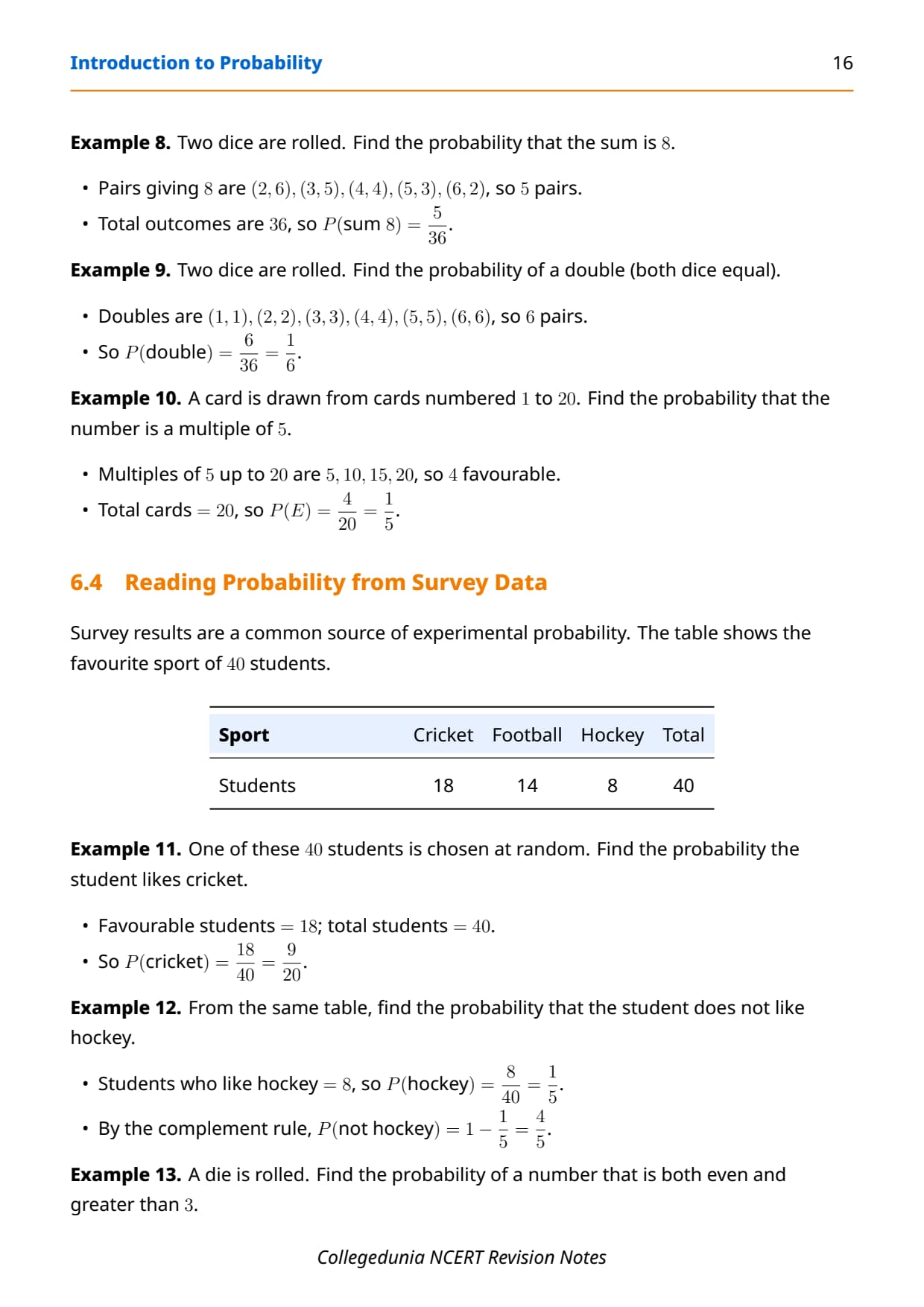
For two coins, the sample space is HH, HT, TH, TT, so there are 4 outcomes, since HT and TH are different. For two dice, there are 6 × 6 = 36 outcomes, and the event "sum is 7" has 6 pairs, so its probability is 636 = 16. The complement of an event is that it does not happen, and P(not E) = 1 - P(E). Use the complement for "not" or "at least one" questions, since it is often quicker than counting every case.
Key Points and Results to Remember in Introduction to Probability
These are the must-know facts and formulas from the chapter. Keep this short list handy for last-minute revision.
| Point | What it means |
|---|---|
| Range | 0 ≤ P(E) ≤ 1 for every event. |
| Experimental probability | Trials where E happened over total trials. |
| Theoretical probability | Favourable outcomes over total outcomes. |
| Complement rule | P(not E) = 1 - P(E). |
| Two coins | 4 outcomes: HH, HT, TH, TT. |
| Two dice | 36 outcomes, one for each ordered pair. |
How to Revise Introduction to Probability Quickly
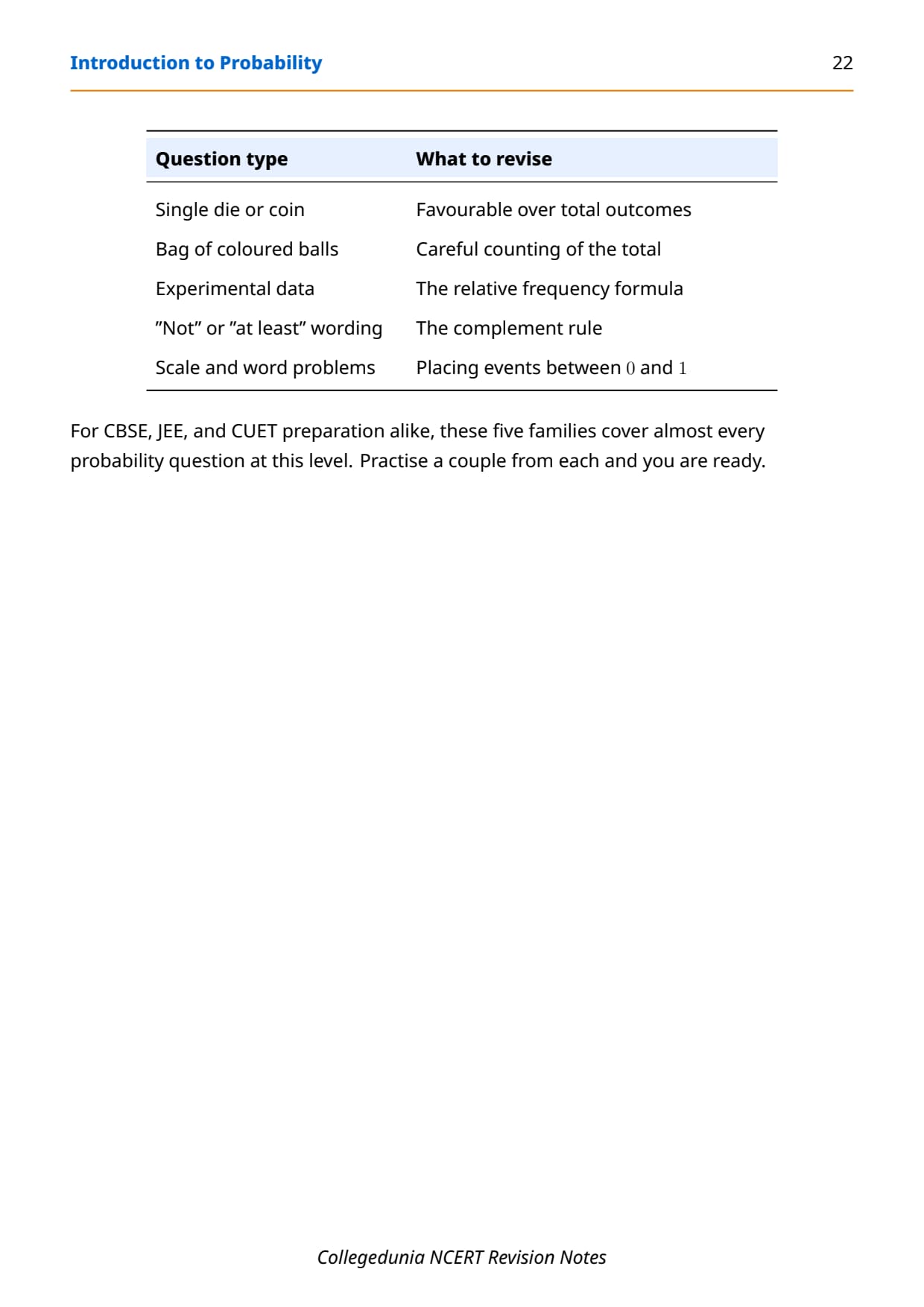
To revise fast, skim the introduction to probability class 9 maths notes above, then work one die problem and one bag-of-balls problem. Next, find one two-dice probability and use the complement rule once. This short loop fixes the chapter. The time you need depends on whether this is a revision or a first read.
Revision mode
1-2 hours
If you have done this chapter once and are revising.
First-read
3-5 hours
If you are learning Introduction to Probability for the first time.
How will Collegedunia's Notes Help You with Introduction to Probability?
Collegedunia gives you these introduction to probability class 9 maths notes as one clean revision page that matches the new book exactly. You get the terms, the two formulas, and the common traps together, so revision is quick.
- 2026-27 book match: Every idea follows the new Ganita Manjari chapter, not the old syllabus.
- Plain language: Short sentences and simple words make each idea easy to read.
- Both formulas together: The experimental and theoretical rules sit in one place for fast recall.
- Free PDF: Download the notes and revise offline before your annual exam.
More Introduction to Probability Maths Class 9 Resources
NCERT Notes for Class 9 Maths: All Chapters
Use the table below to open the NCERT Notes for any other chapter of the new Class 9 Maths book.
| Chapter | Resource |
|---|---|
| Chapter 1 | Coordinates Notes |
| Chapter 2 | Linear Polynomials Notes |
| Chapter 3 | The World of Numbers Notes |
| Chapter 4 | Algebraic Identities Notes |
| Chapter 5 | Circles Notes |
| Chapter 6 | Perimeter and Area Notes |
| Chapter 7 | Introduction to Probability Notes |
| Chapter 8 | Sequences and Progressions Notes |
Introduction to Probability Class 9 Maths Notes FAQs
Ques. Where can I download the Introduction to Probability Class 9 Maths Notes PDF?
Ans. You can download the Introduction to Probability Class 9 Maths Notes PDF directly from this page. Both the Normal and HD versions are free.
Ques. How many pages are the Introduction to Probability Class 9 Maths Notes?
Ans. The notes run to about 22 pages. They cover the scale, experimental and theoretical probability, and counting outcomes with clear examples.
Ques. Is Introduction to Probability part of the new Class 9 Maths book?
Ans. Yes. Introduction to Probability is Chapter 7 of the new Ganita Manjari book for the 2026-27 syllabus. It sets up the basics for Class 10 probability.
Ques. What is the difference between experimental and theoretical probability?
Ans. Experimental probability comes from real trial data, using successes over trials. Theoretical probability uses equally likely outcomes, taking favourable over total outcomes.
Ques. Are these notes enough to revise the full chapter?
Ans. Yes. The notes list every term, formula, and common mistake, so they work well for a quick revision before the exam.



Comments