




These Circles revision notes sum up the whole fifth chapter of the new Ganita Manjari book in one place. Our circles class 9 maths notes explain the parts of a circle, chords and arcs, the angle rules, cyclic quadrilaterals, and all 12 theorems in plain and simple language.
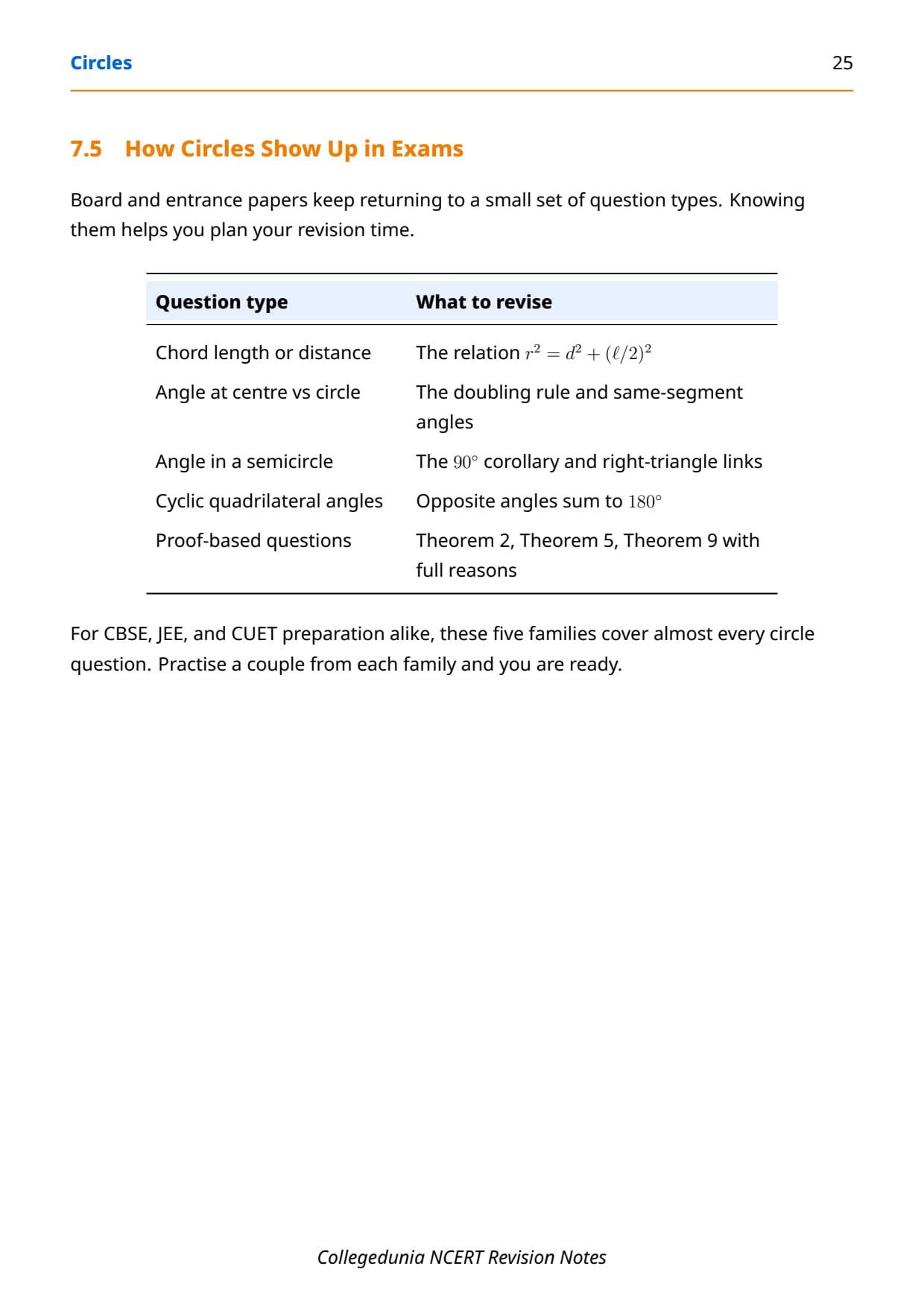
- What they cover: circle parts, chords, arcs, angle rules, and cyclic quadrilaterals.
- Who they help: Class 9 students who want a fast, clear revision before a test.
- Why they save time: every theorem and key formula sits on one short page.
These notes are prepared by subject teachers, matched to the current 2026-27 NCERT Ganita Manjari book, and written so a Class 9 student can revise the whole chapter quickly.
What Do Class 9 Maths Circles Notes Cover?
The circles class 9 maths notes cover the full chapter in short, simple parts. You first learn the parts of a circle, like the centre, radius, chord, and diameter. Then you meet the chord rules, the distance of a chord from the centre, and the angle an arc makes. The notes end with the angle in a semicircle and the cyclic quadrilateral rule, covering all 12 theorems.
Video Walkthrough
Source: PW Class 9 - NEEV on YouTube
Circles Class 9 Maths Topic-by-Topic Summary
Here is a short summary of each main topic. Read one part at a time and try a quick sketch as you go.
Parts of a Circle and Its Symmetry
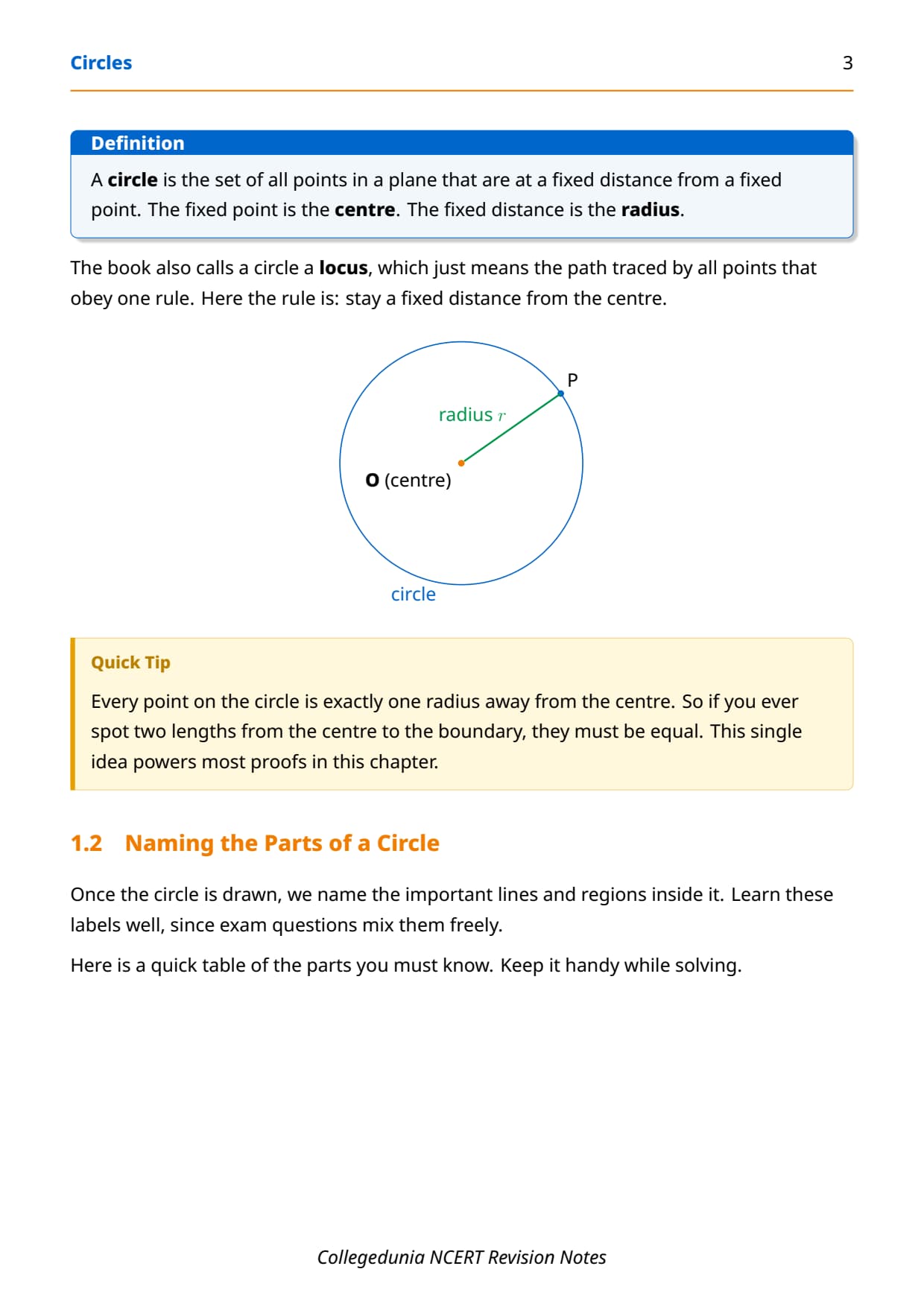
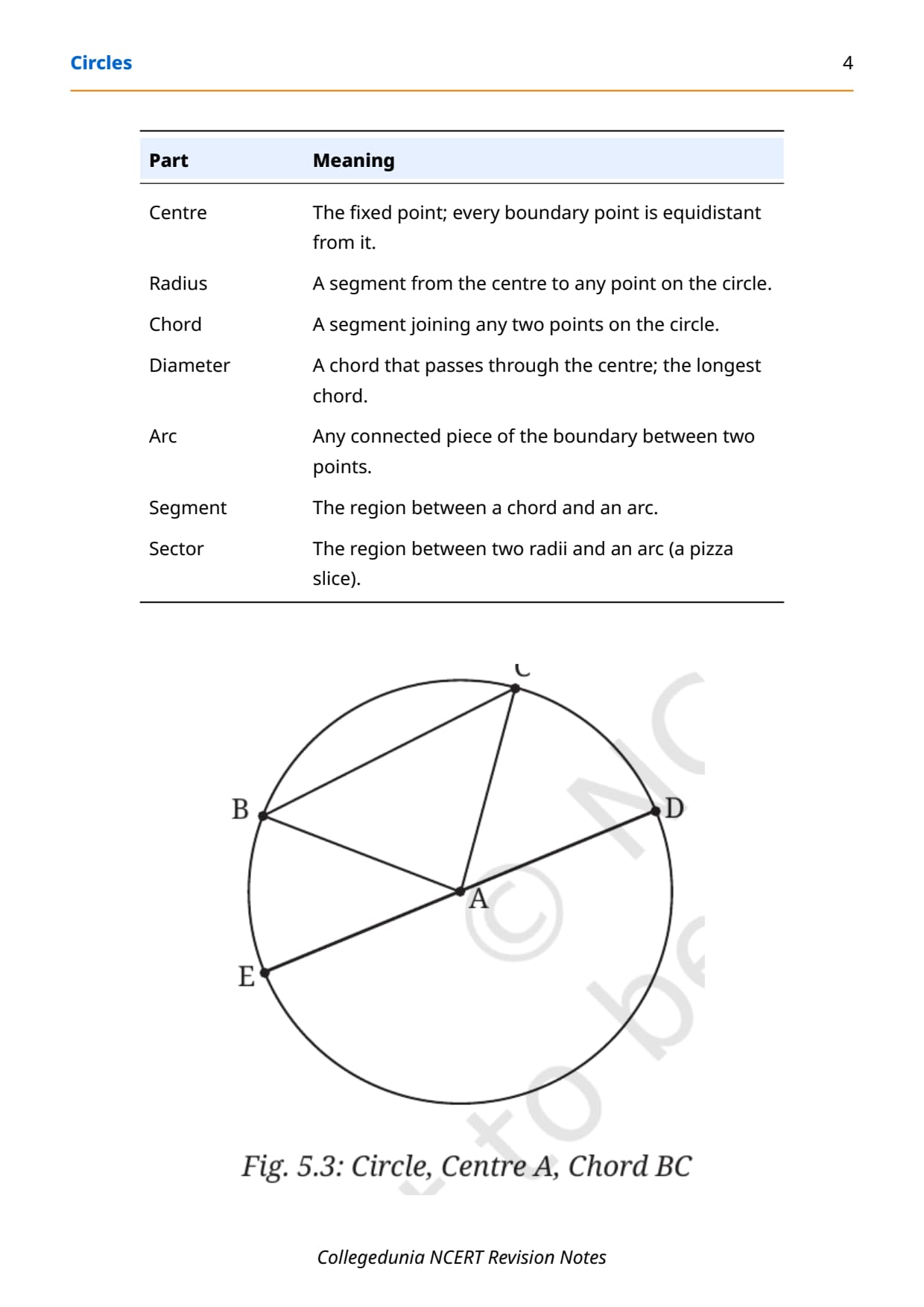
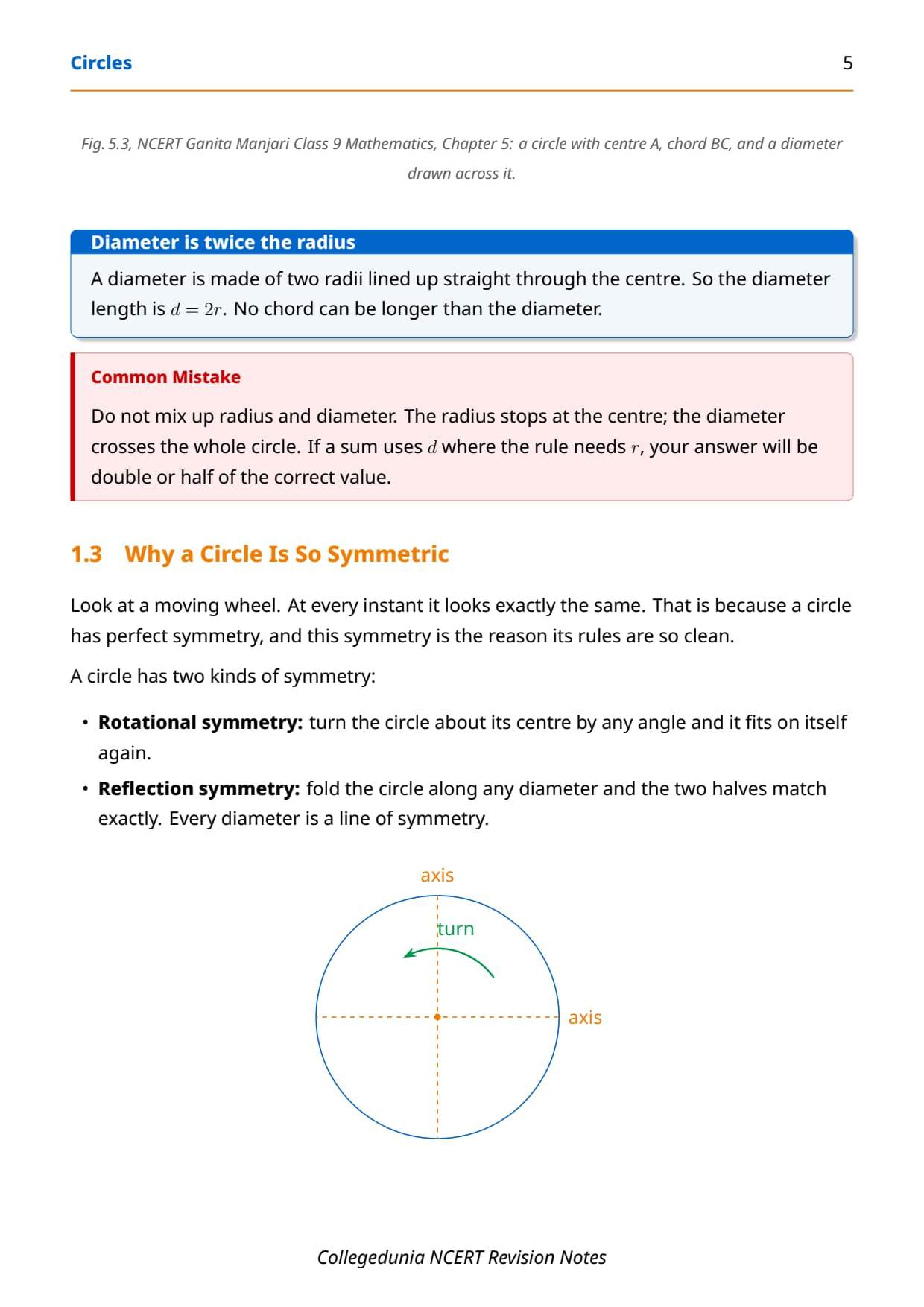
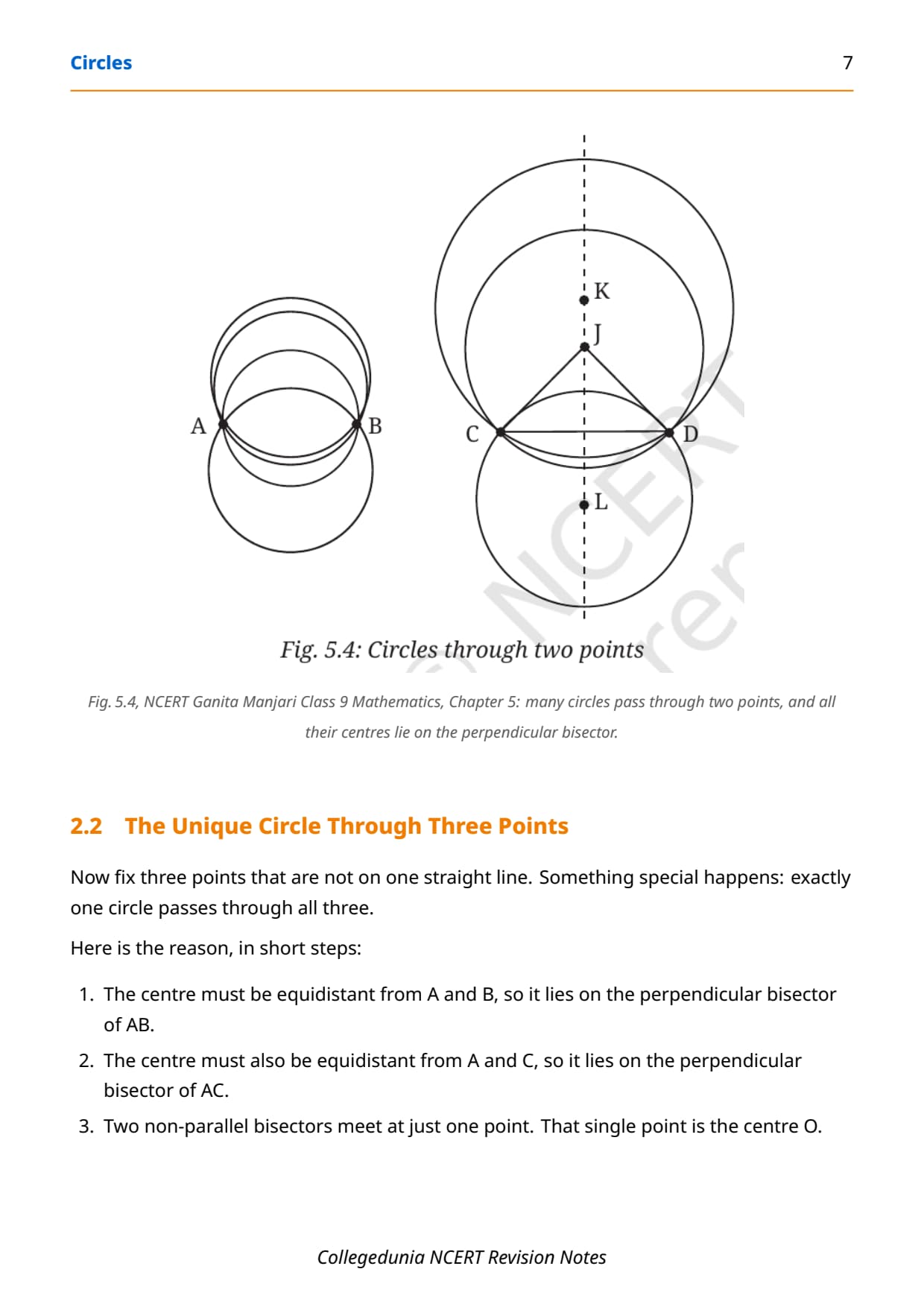
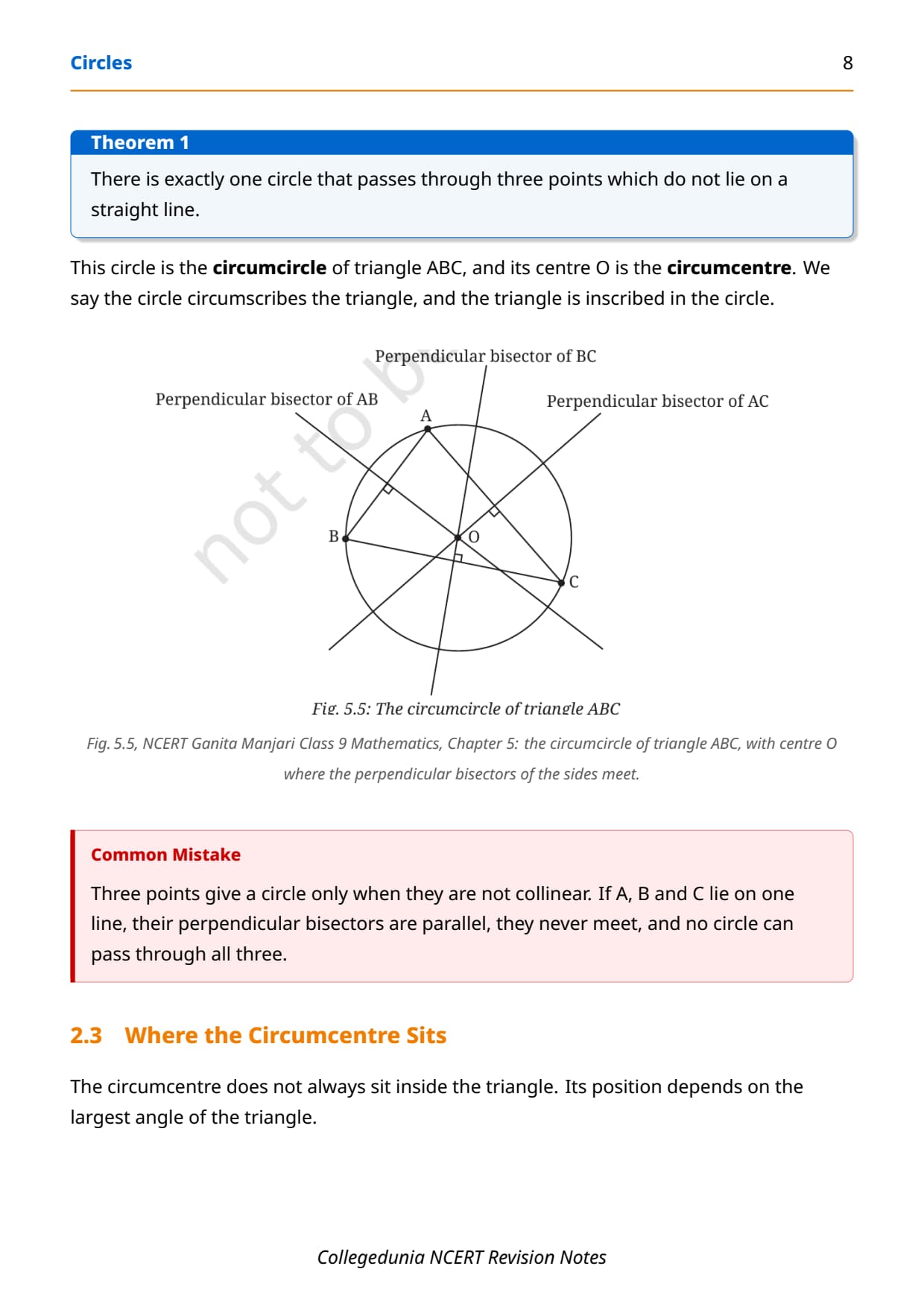
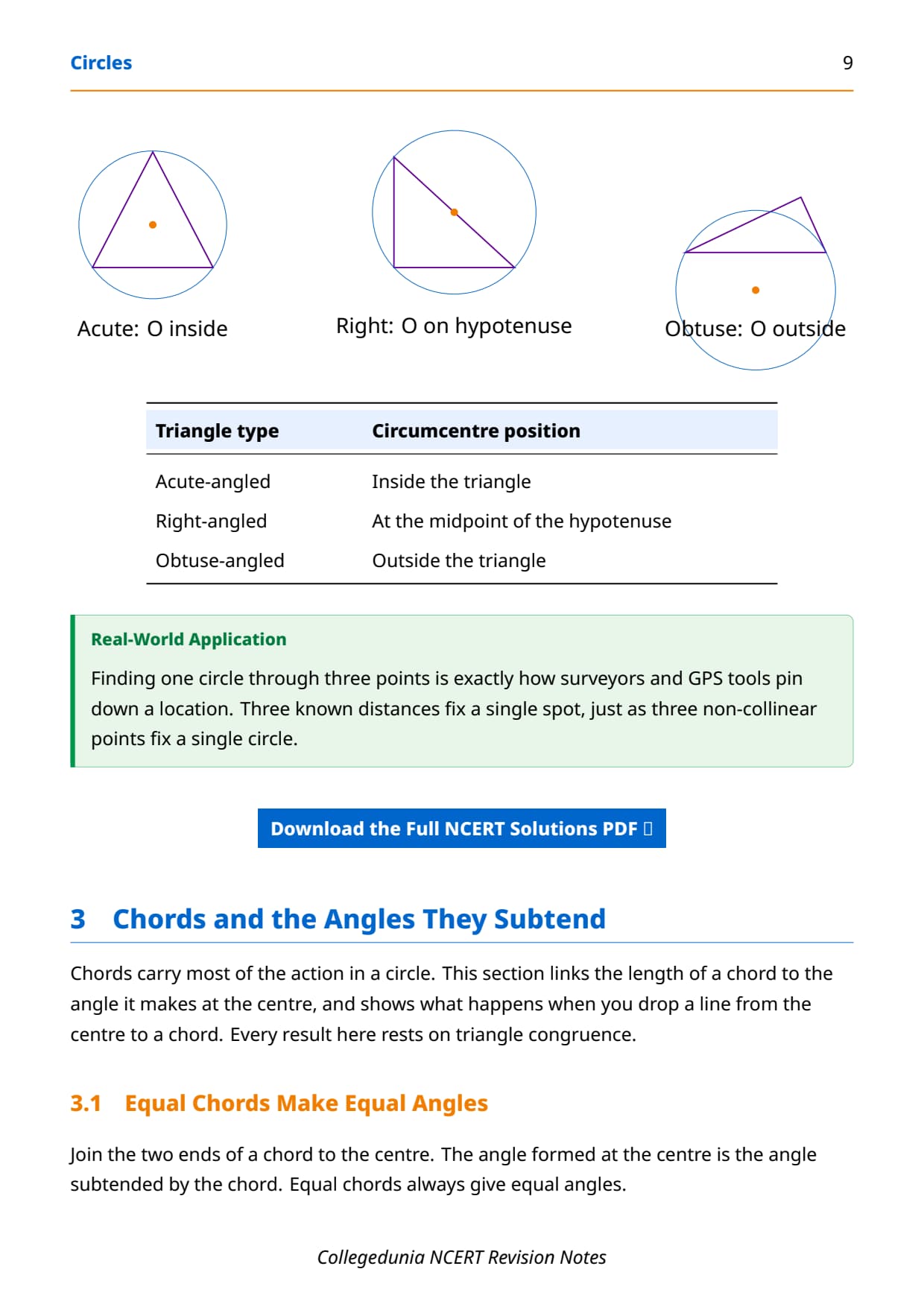
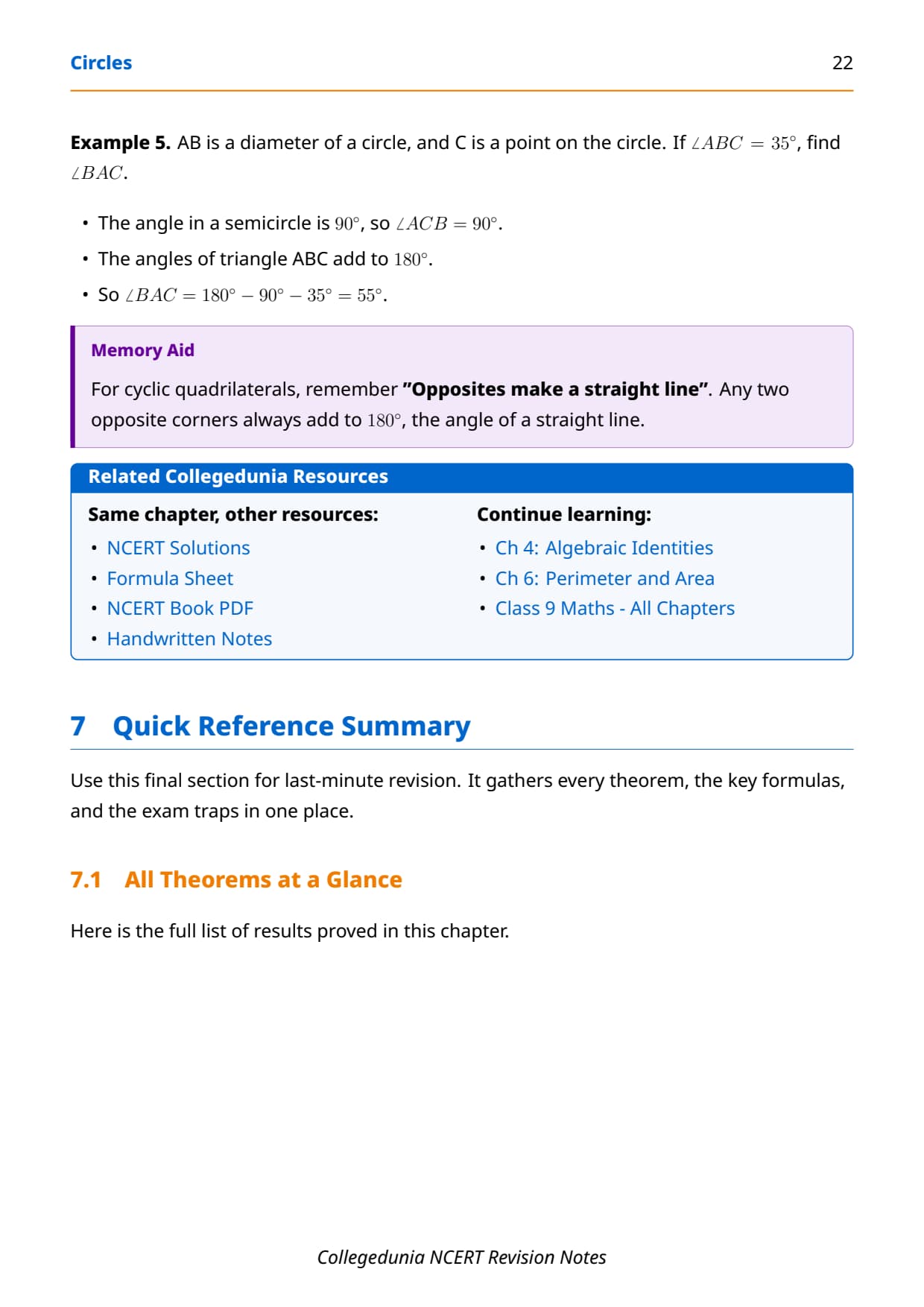
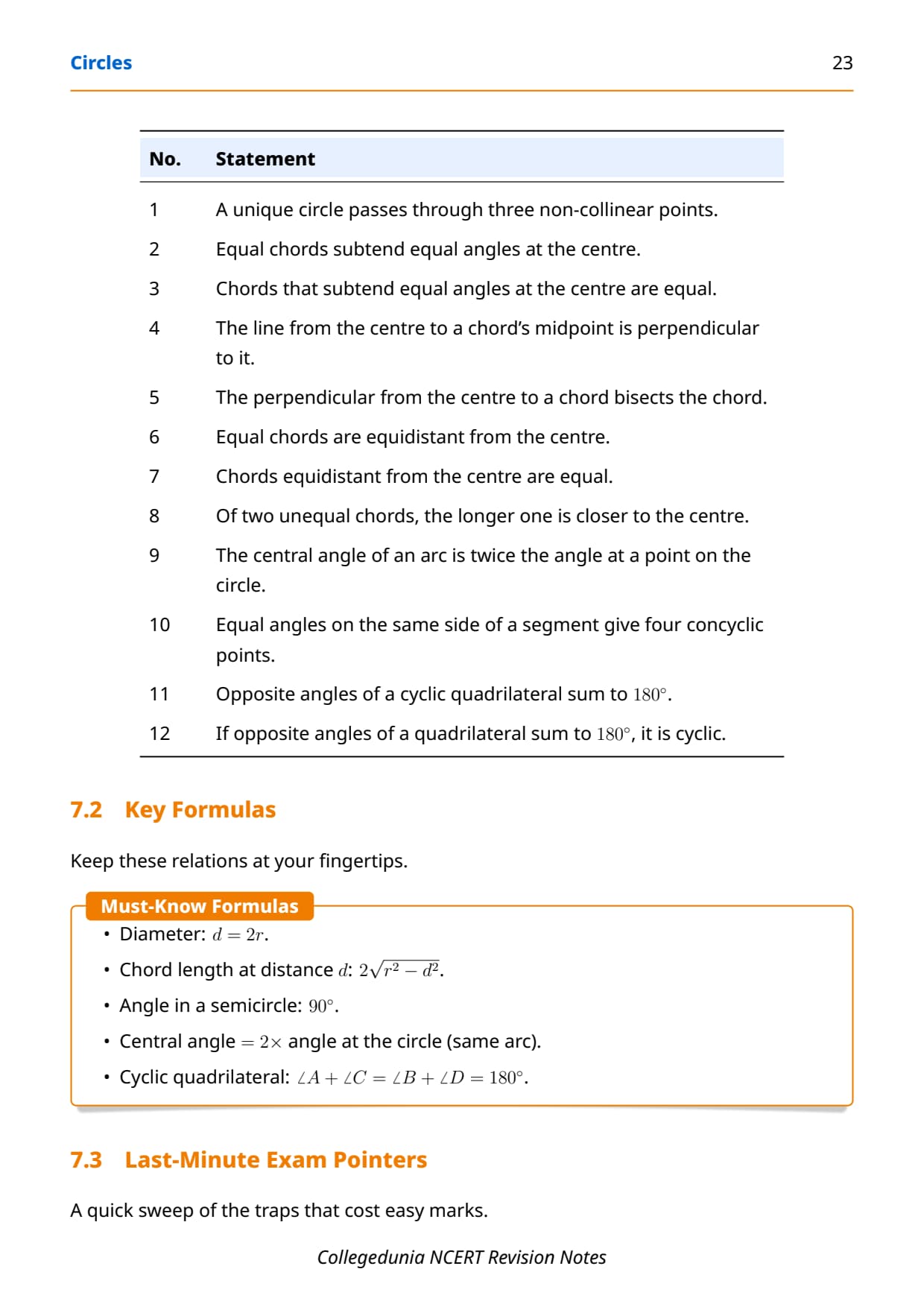
A circle is the set of all points at a fixed distance from a fixed centre, and that distance is the radius. A chord joins two points on the circle, and a diameter is a chord through the centre, so d = 2r. The diameter is the longest chord. An arc is a piece of the boundary, and the region between two radii and an arc is a sector. A circle has rotational symmetry about its centre and reflection symmetry across every diameter. Three points that are not on one line fix exactly one circle, called the circumcircle.
Chords, Arcs, and Angles
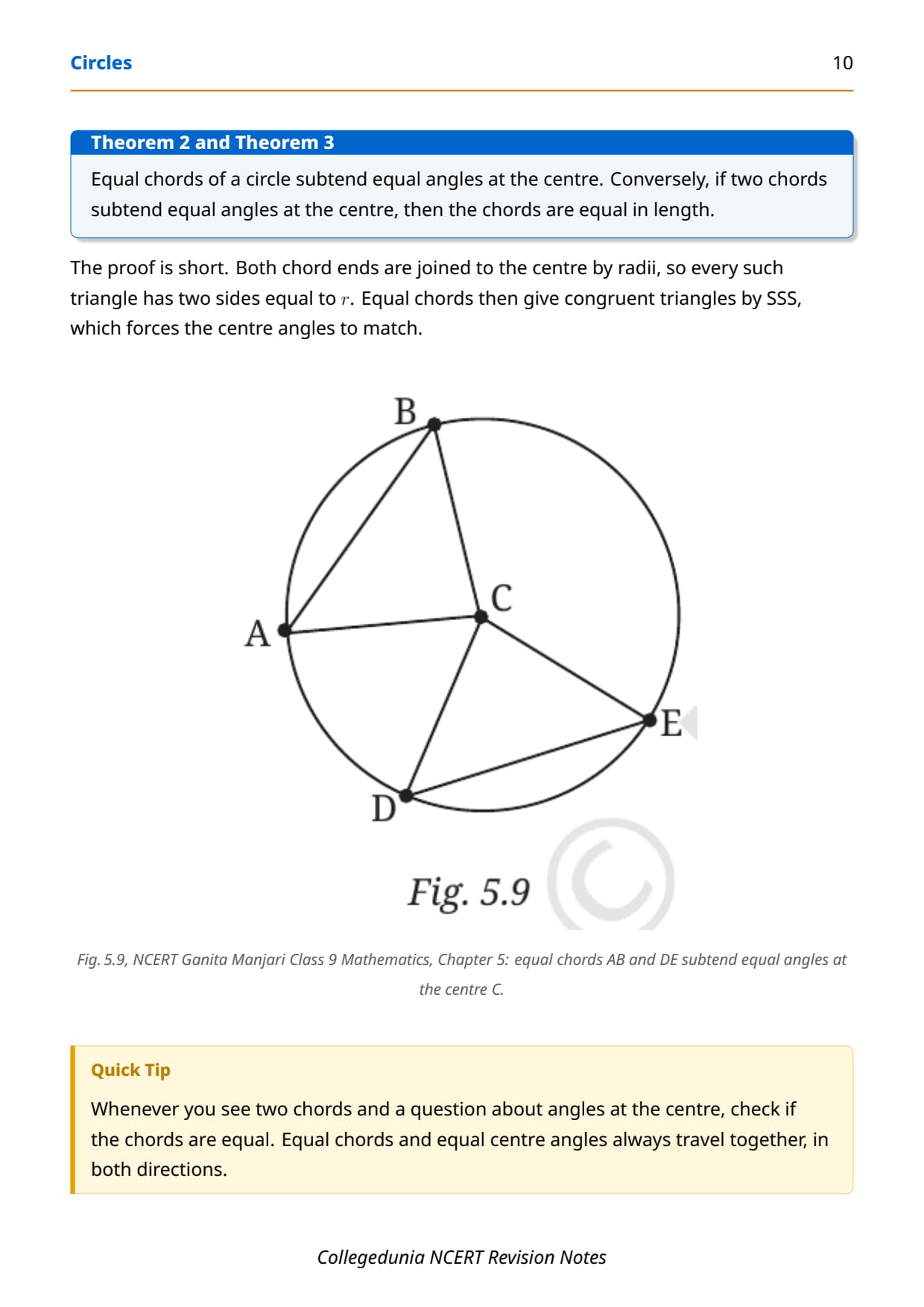
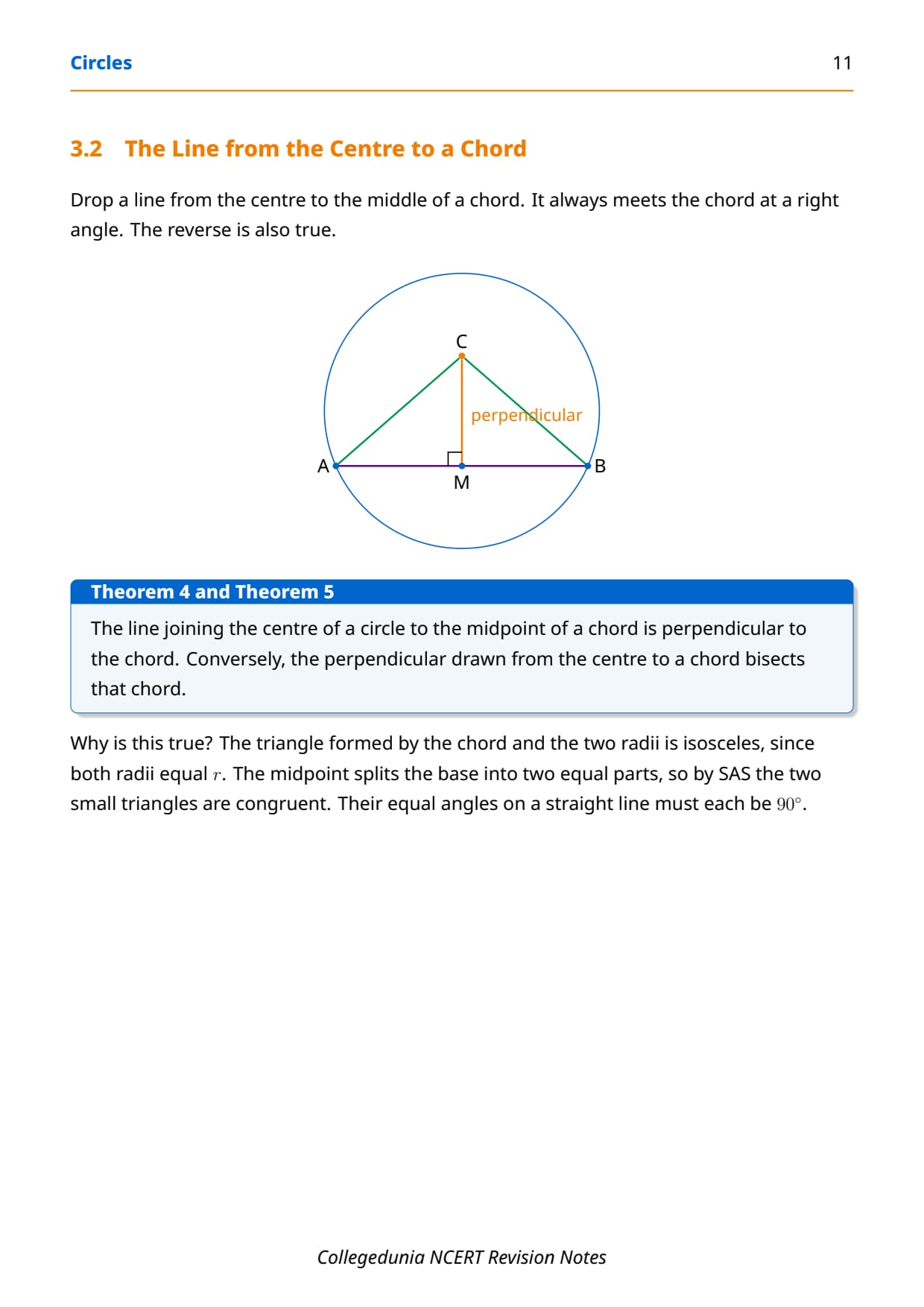
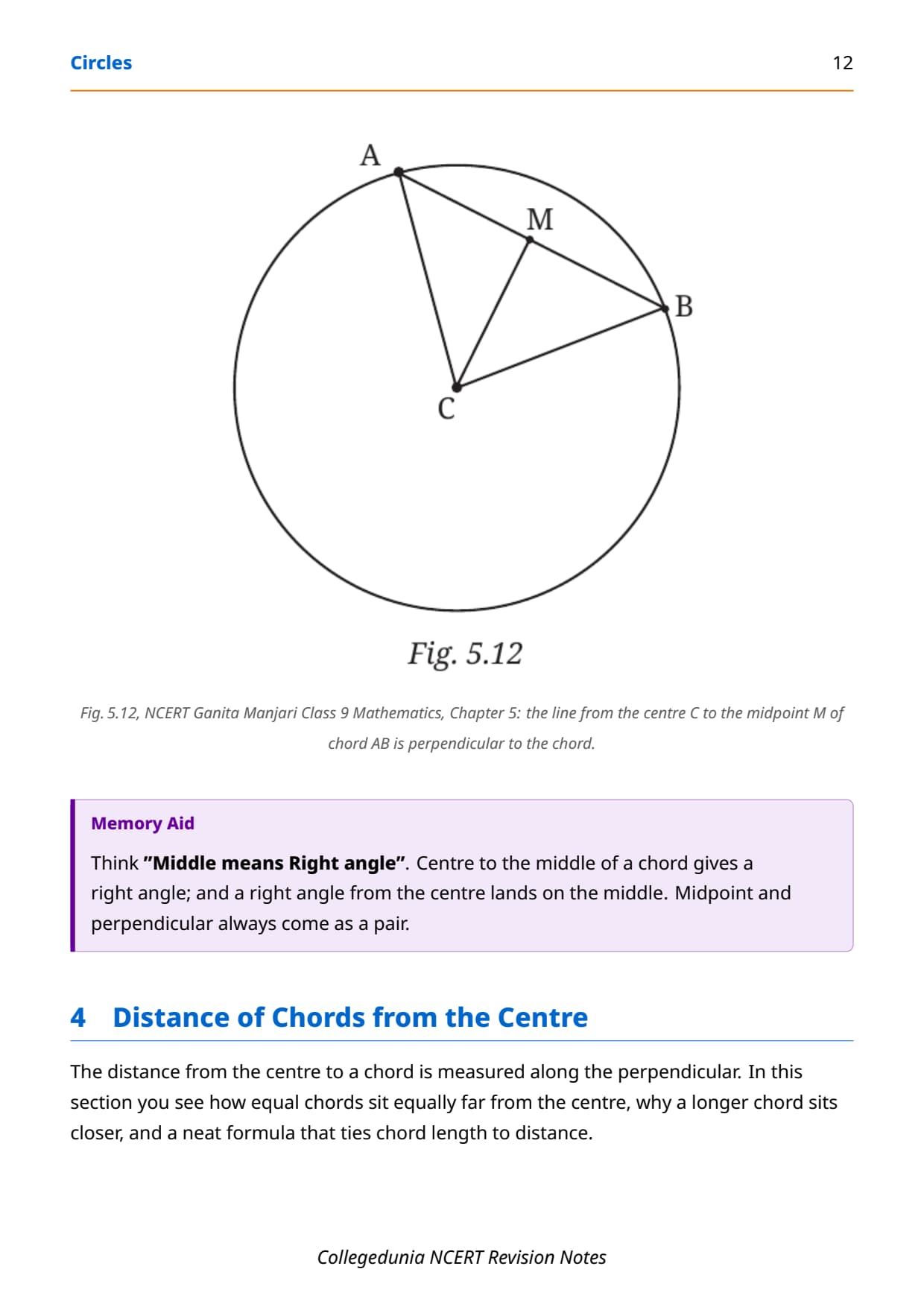
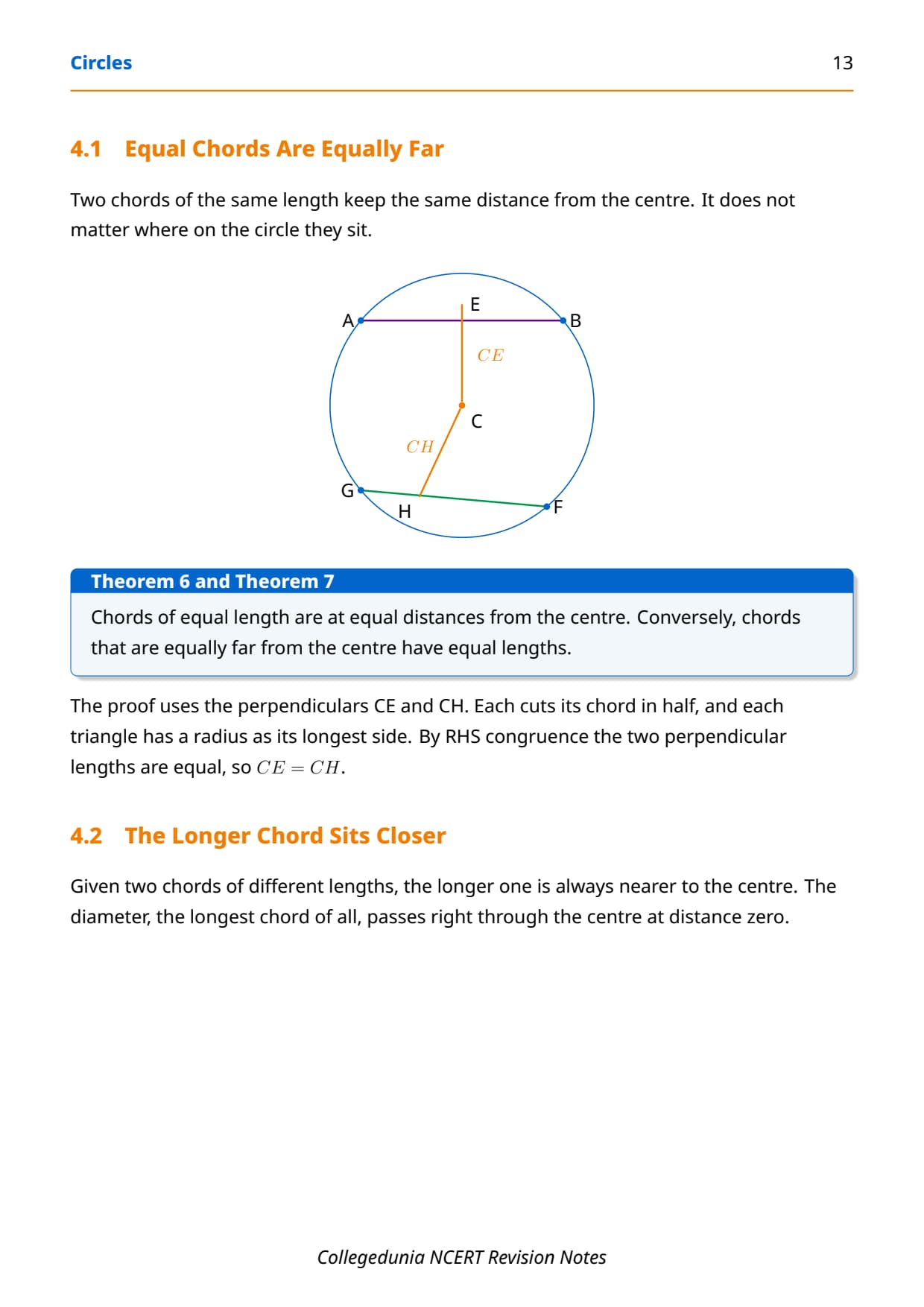
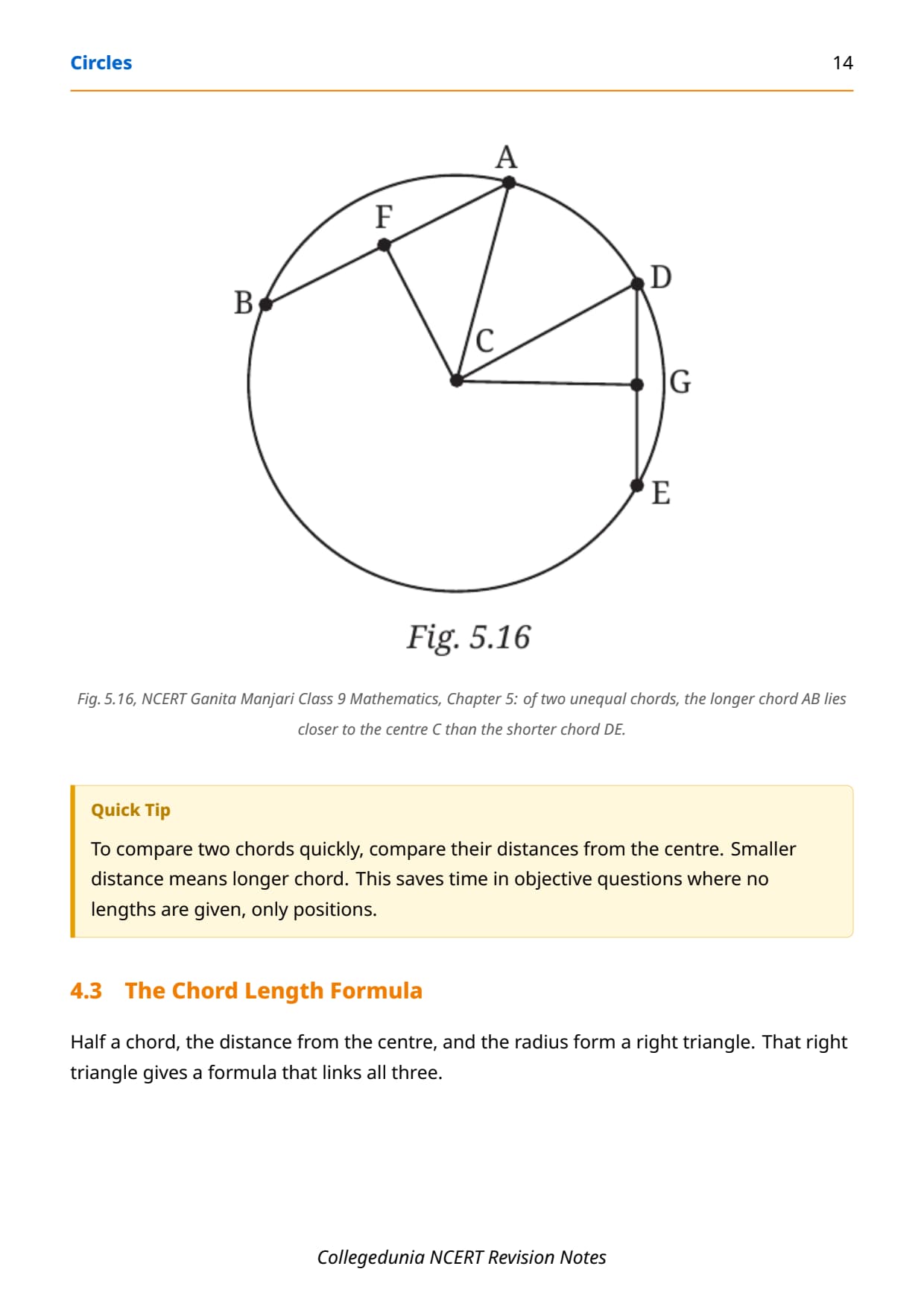
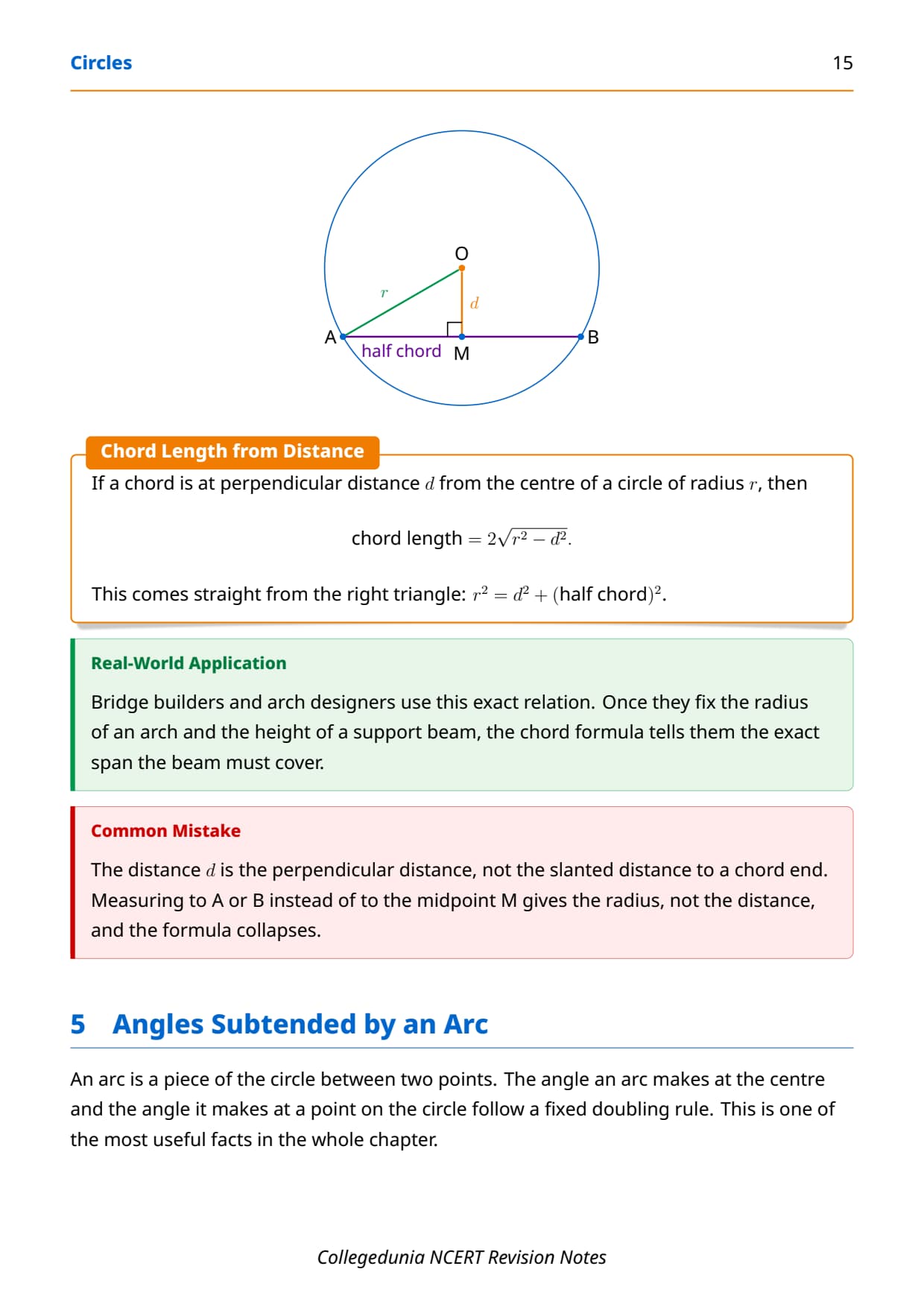
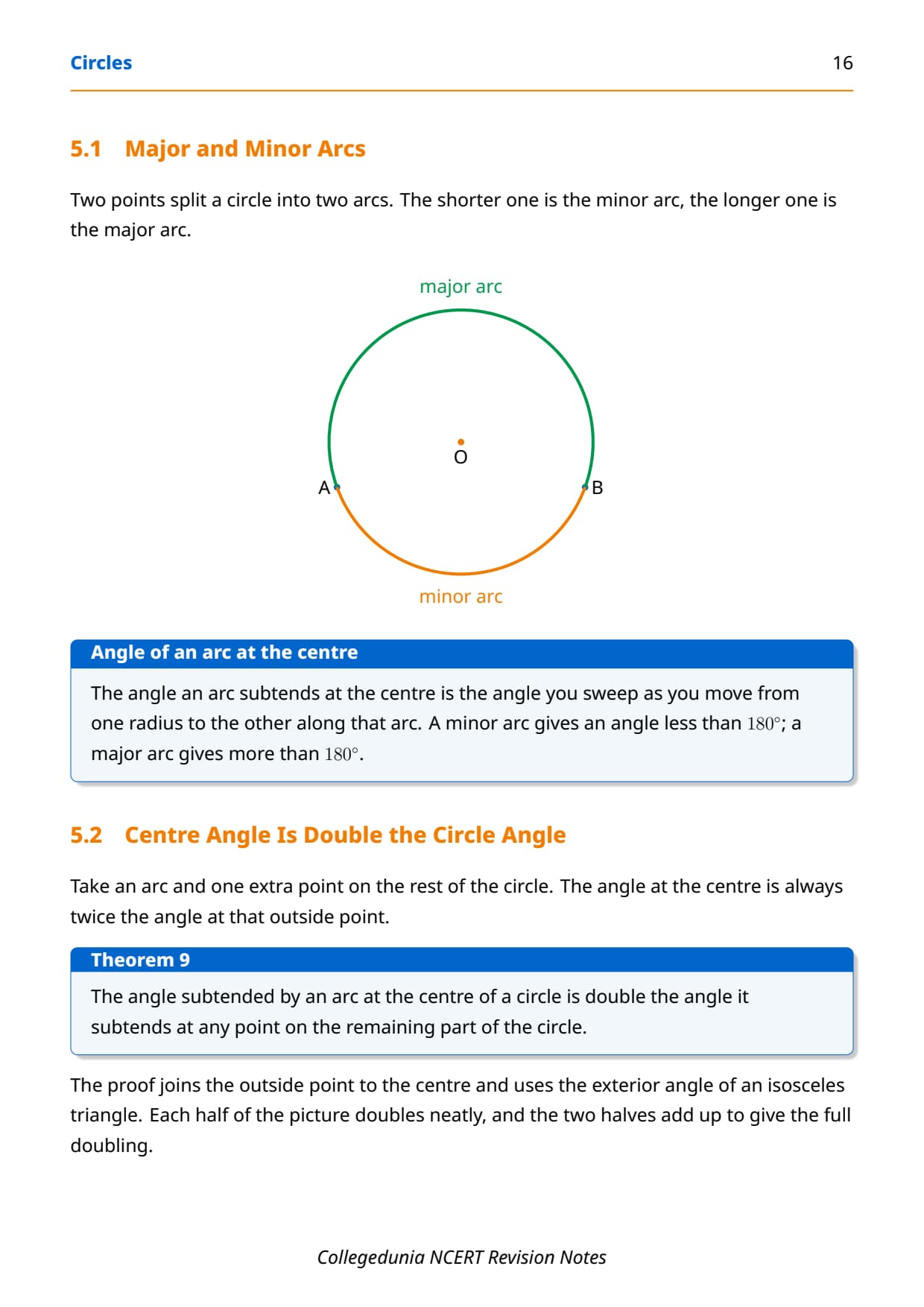
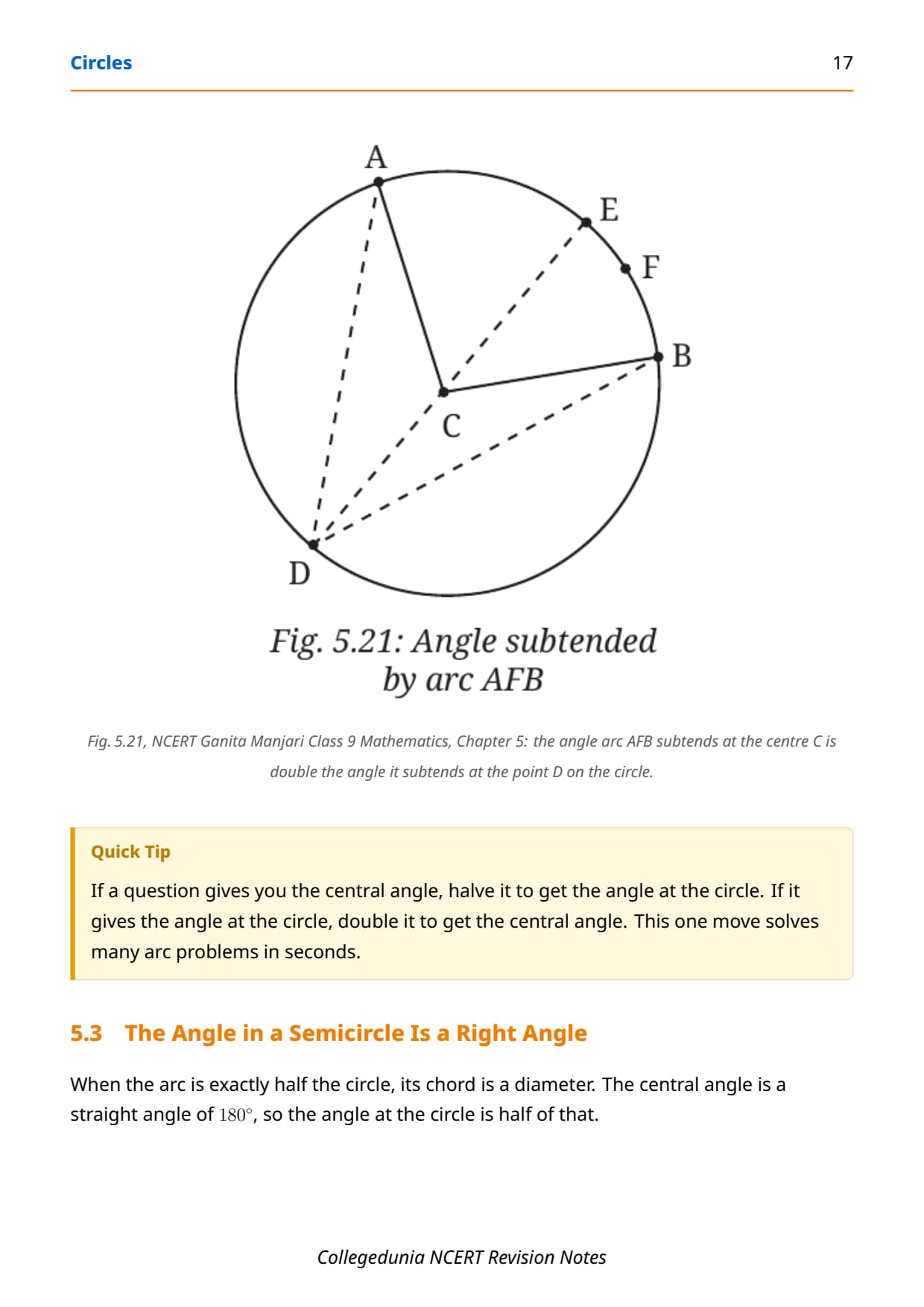
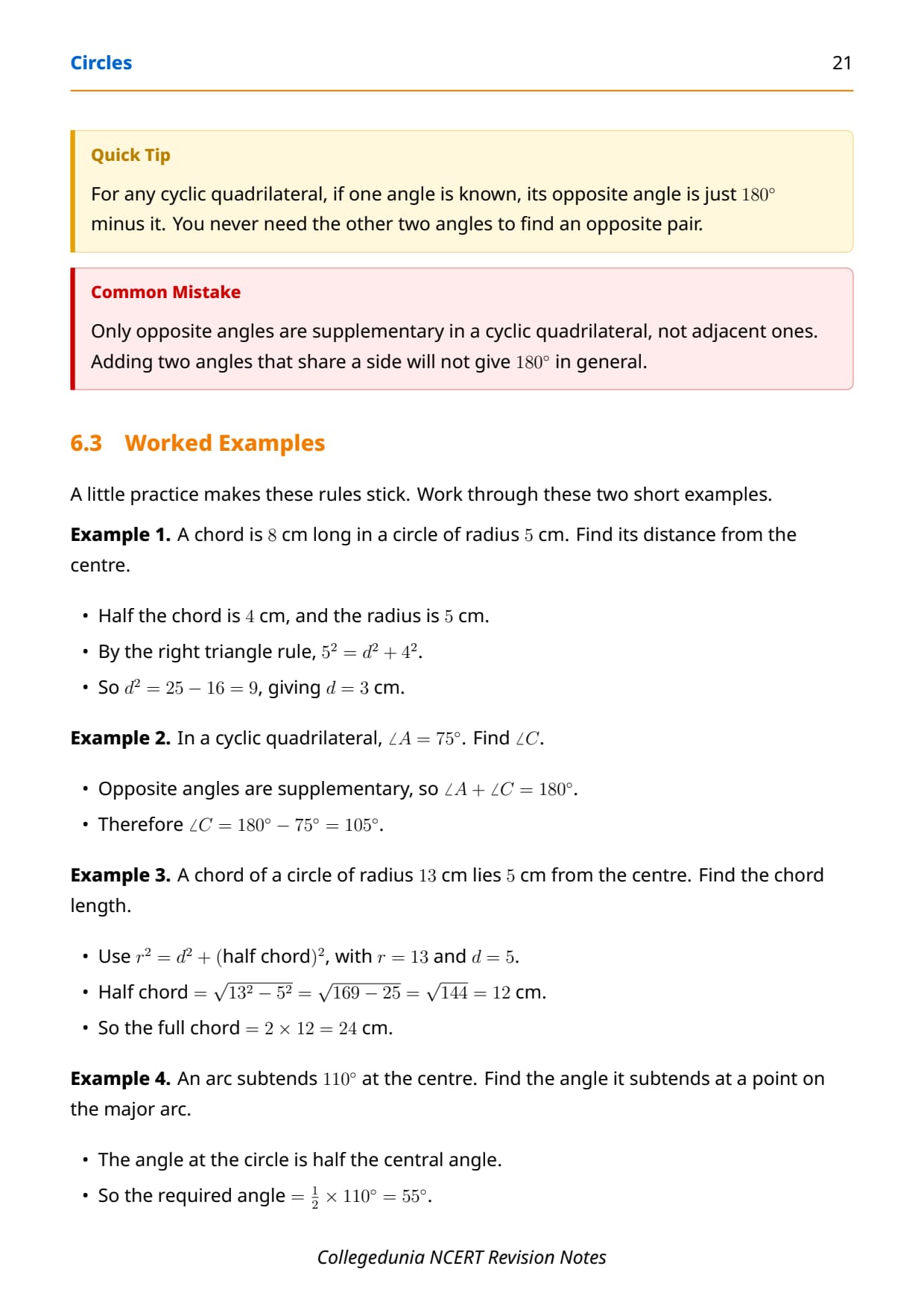
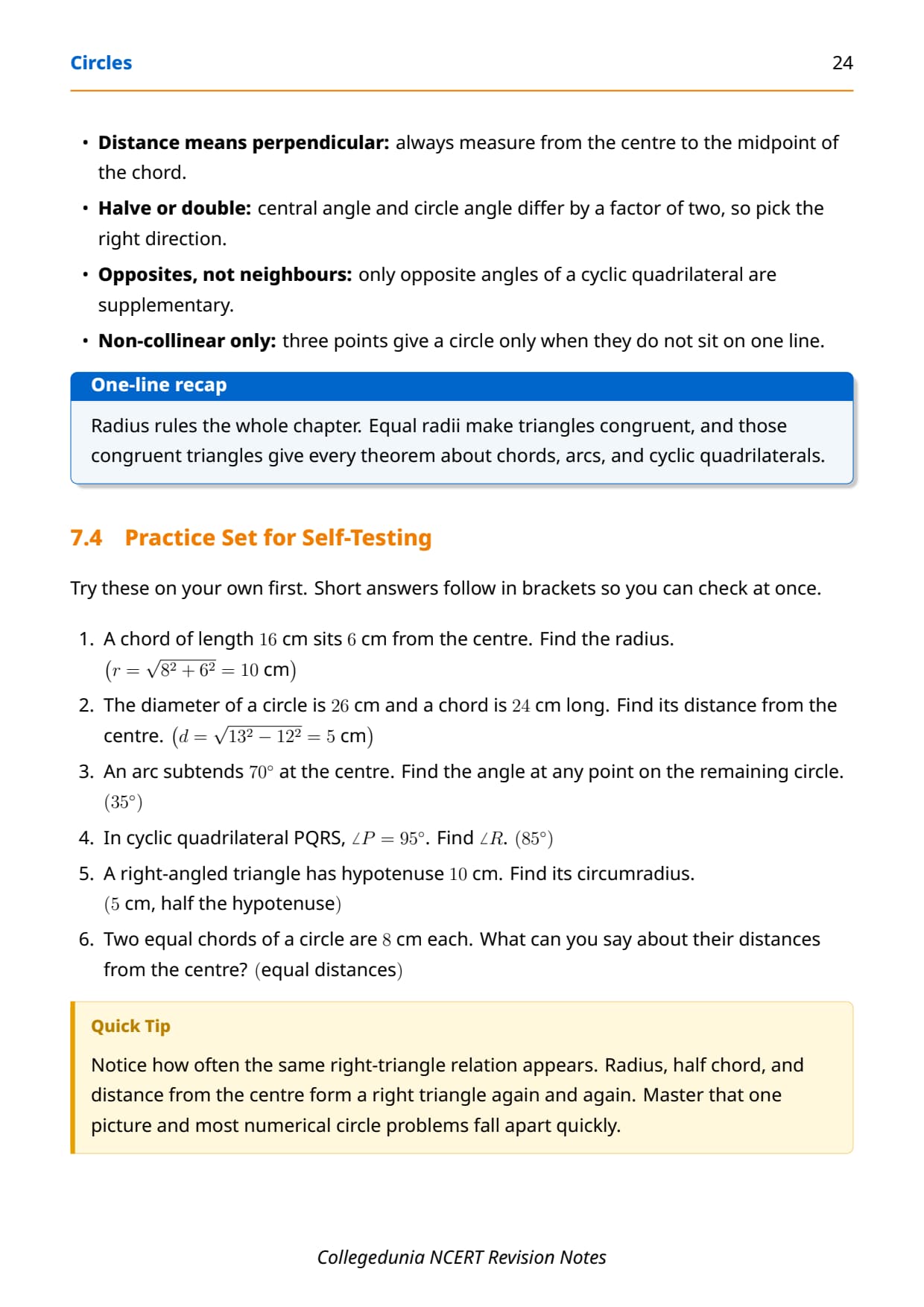
Equal chords subtend equal angles at the centre, and the reverse is also true. The line from the centre to the midpoint of a chord meets it at a right angle, and a perpendicular from the centre bisects the chord. Equal chords sit at equal distances from the centre, and a longer chord sits closer. If a chord is at distance d in a circle of radius r, its length is 2√r2 - d2. The angle an arc makes at the centre is always twice the angle it makes at any point on the rest of the circle.
Semicircles and Cyclic Quadrilaterals
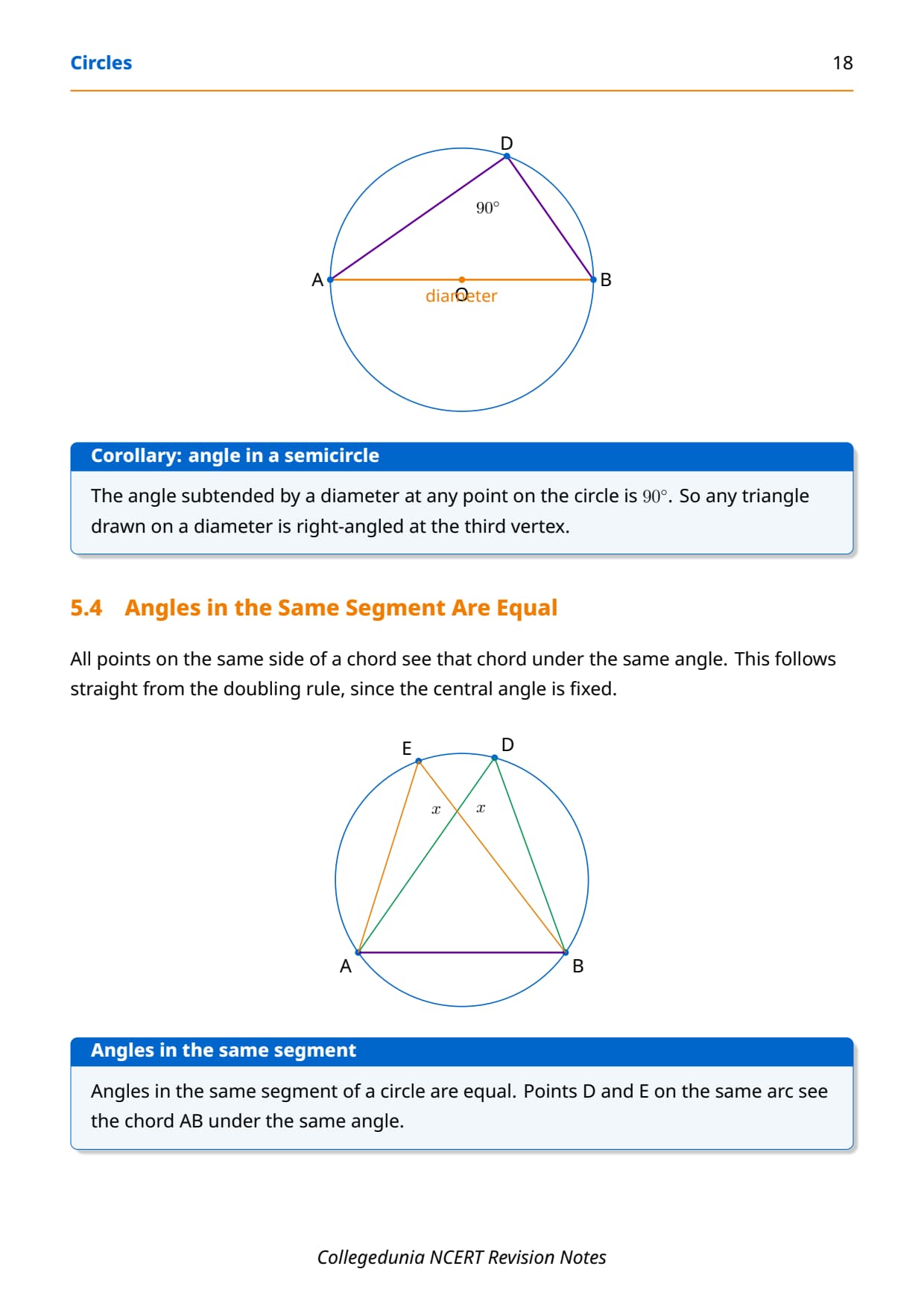
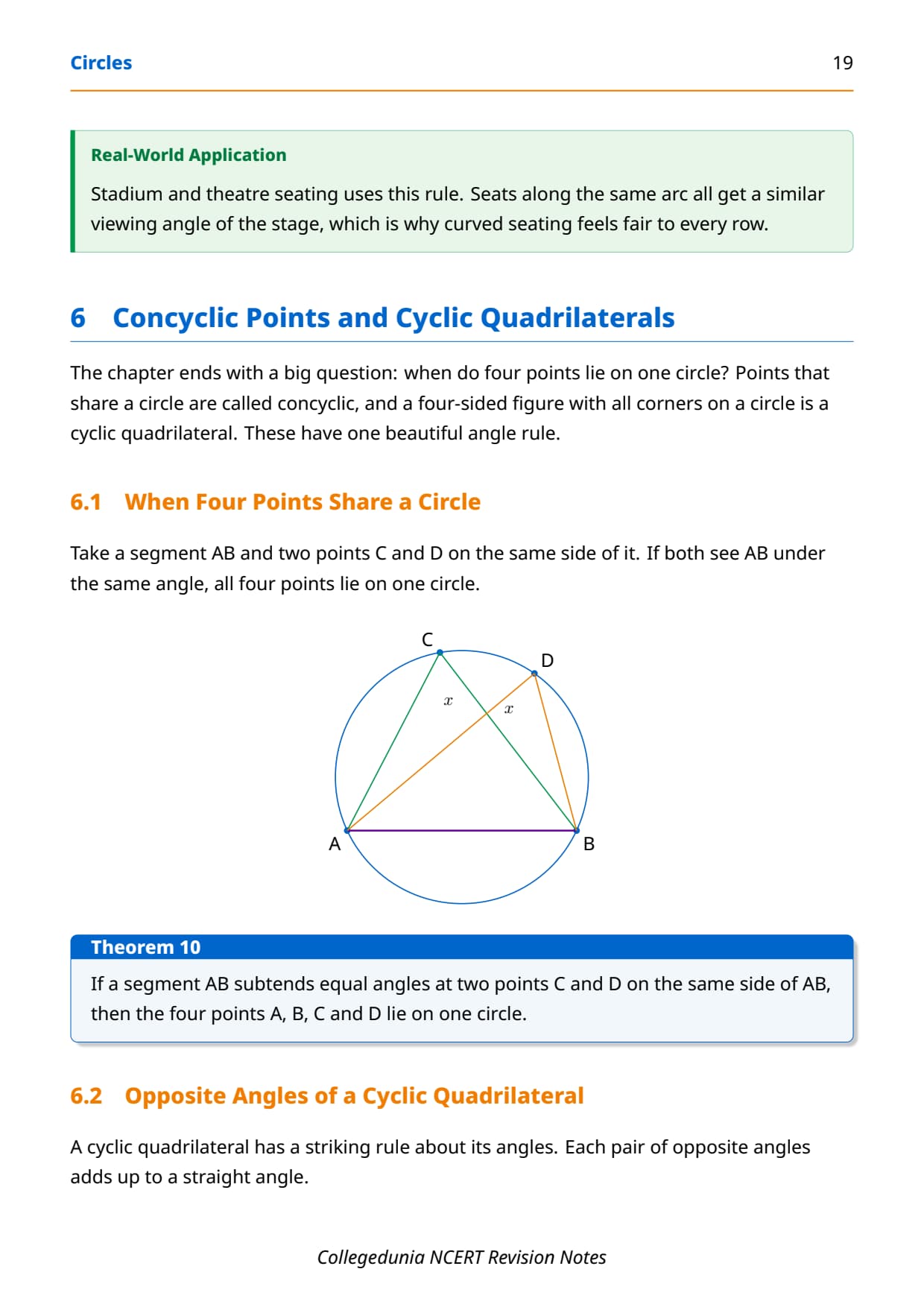
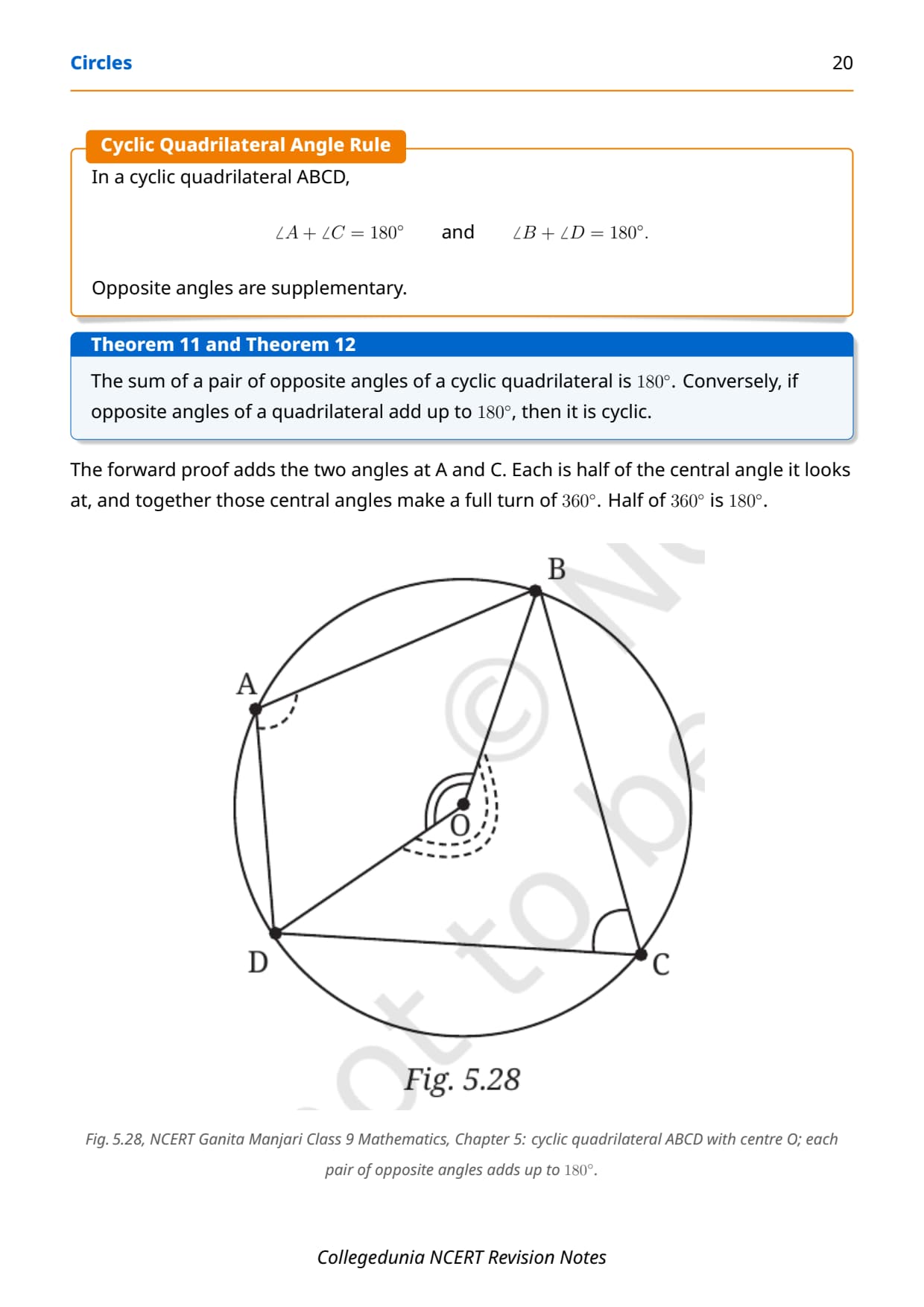
When a chord is a diameter, the angle it subtends at any point on the circle is 90∘, so any triangle drawn on a diameter is right-angled. Angles in the same segment of a circle are equal. If a segment subtends equal angles at two points on the same side, all four points are concyclic. In a cyclic quadrilateral, opposite angles are supplementary, so ∠ A + ∠ C = 180∘ and ∠ B + ∠ D = 180∘. If one angle is known, its opposite is just 180∘ minus it.
Key Points and Results to Remember in Circles
These are the must-know facts and formulas from the chapter. Keep this short list handy for last-minute revision.
| Point | What it means |
|---|---|
| Diameter | d = 2r; it is the longest chord of the circle. |
| Chord length | 2√r2 - d2 for a chord at distance d. |
| Perpendicular from centre | Always bisects the chord, and the reverse holds too. |
| Arc angle rule | Central angle is twice the angle at the circle. |
| Angle in a semicircle | The angle on a diameter is 90∘. |
| Cyclic quadrilateral | Opposite angles add to 180∘. |
How to Revise Circles Quickly
To revise fast, skim the circles class 9 maths notes above, then draw one circle and label the centre, radius, chord, and diameter. Next, work one chord-length sum and one cyclic quadrilateral angle. This short loop fixes the chapter. The time you need depends on whether this is a revision or a first read.
Revision mode
1-2 hours
If you have done this chapter once and are revising.
First-read
4-6 hours
If you are learning Circles for the first time.
How will Collegedunia's Notes Help You with Circles?
Collegedunia gives you these circles class 9 maths notes as one clean revision page that matches the new book exactly. You get the theorems, the formulas, and the common traps together, so revision is quick.
- 2026-27 book match: Every theorem follows the new Ganita Manjari chapter, not the old syllabus.
- Plain language: Short sentences and simple words make each rule easy to read.
- All 12 theorems together: The chord, arc, and cyclic rules sit in one place for fast recall.
- Free PDF: Download the notes and revise offline before your annual exam.
More Circles Maths Class 9 Resources
NCERT Notes for Class 9 Maths: All Chapters
Use the table below to open the NCERT Notes for any other chapter of the new Class 9 Maths book.
| Chapter | Resource |
|---|---|
| Chapter 1 | Coordinates Notes |
| Chapter 2 | Linear Polynomials Notes |
| Chapter 3 | The World of Numbers Notes |
| Chapter 4 | Algebraic Identities Notes |
| Chapter 5 | Circles Notes |
| Chapter 6 | Perimeter and Area Notes |
| Chapter 7 | Introduction to Probability Notes |
| Chapter 8 | Sequences and Progressions Notes |
Circles Class 9 Maths Notes FAQs
Ques. Where can I download the Circles Class 9 Maths Notes PDF?
Ans. You can download the Circles Class 9 Maths Notes PDF directly from this page. Both the Normal and HD versions are free.
Ques. How many pages are the Circles Class 9 Maths Notes?
Ans. The notes run to about 22 pages. They cover all 12 theorems, chord and arc rules, and cyclic quadrilaterals with labelled diagrams.
Ques. Is Circles part of the new Class 9 Maths book?
Ans. Yes. Circles is Chapter 5 of the new Ganita Manjari book for the 2026-27 syllabus. It proves all the chord, arc, and cyclic quadrilateral results.
Ques. How many theorems are in the Circles chapter?
Ans. There are 12 theorems, covering chords, distances from the centre, arc angles, the angle in a semicircle, and cyclic quadrilaterals.
Ques. Are these notes enough to revise the full chapter?
Ans. Yes. The notes list every theorem, formula, and common mistake, so they work well for a quick revision before the exam.



Comments