




The NCERT class 10 civics book pdf chapter 1 Power-sharing is the official CBSE textbook chapter, free to read and download for the 2026-27 session.
Chapter 1 opens the Democratic Politics II book with two real stories, Belgium and Sri Lanka. It explains why power-sharing is the very spirit of democracy and sets up the four forms of power-sharing you study all year.
- Official NCERT textbook PDF of Chapter 1, with every case study, glossary box, cartoon, and exercise exactly as printed.
- Covers the Belgium and Sri Lanka stories, majoritarianism, accommodation, the prudential and moral reasons, and the four forms of power-sharing.
- According to the 2026-27 CBSE Class 10 Civics syllabus, useful for board revision and as the base text for solutions and notes.
This page hosts the official NCERT Class 10 Civics textbook chapter, according to the 2026-27 CBSE syllabus and checked page by page against the printed Power-sharing chapter.
Student Feedback: What 11,540 students told us about this chapter
71% of Class 10 students said the hardest part of Chapter 1 was keeping the Belgium and Sri Lanka facts apart in the exam. 4 out of 5 students told us that reading the NCERT textbook chapter first, especially the two case studies, made the comparison questions much easier to answer.
Students reported spending on average 3 to 4 hours on the full chapter across a first read and one revision. Toppers said learning the four forms of power-sharing straight from the NCERT book helped them score full marks on the most common 3-mark and 5-mark board questions.
Source: 2026-27 Class 10 Civics student poll. Sample of 11,540 students from CBSE schools across 14 states, taken before the 2026 board exams.
What the NCERT Book for Class 10 Civics Chapter 1 Power-sharing Covers
The PDF above is the complete official NCERT chapter, exactly as printed in the 2026-27 Democratic Politics II textbook. Power-sharing is the first chapter and one of the easiest to score in. It uses two true stories, Belgium and Sri Lanka, to show why sharing power keeps a country united.
- Belgium and Sri Lanka: two democracies that handled their language groups in opposite ways, with opposite results.
- Two reasons: the prudential reason (avoids conflict) and the moral reason (it is democracy itself).
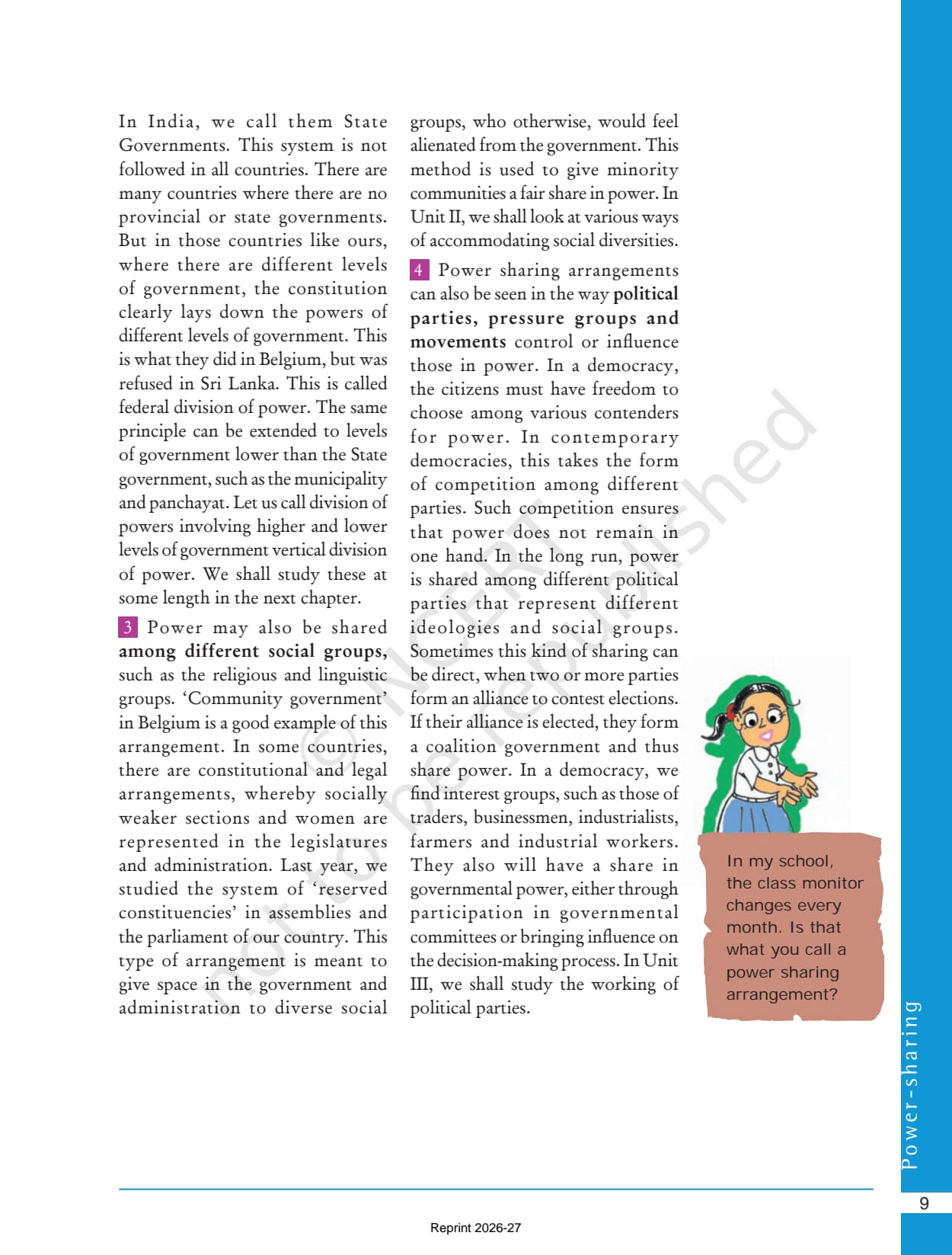
- Four forms of power-sharing: among organs, among levels, among social groups, and among parties and pressure groups.
Power-sharing Explained in Simple Language for Class 10
Source: Magnet Brains on YouTube
The Belgium and Sri Lanka Stories in Class 10 Civics Chapter 1
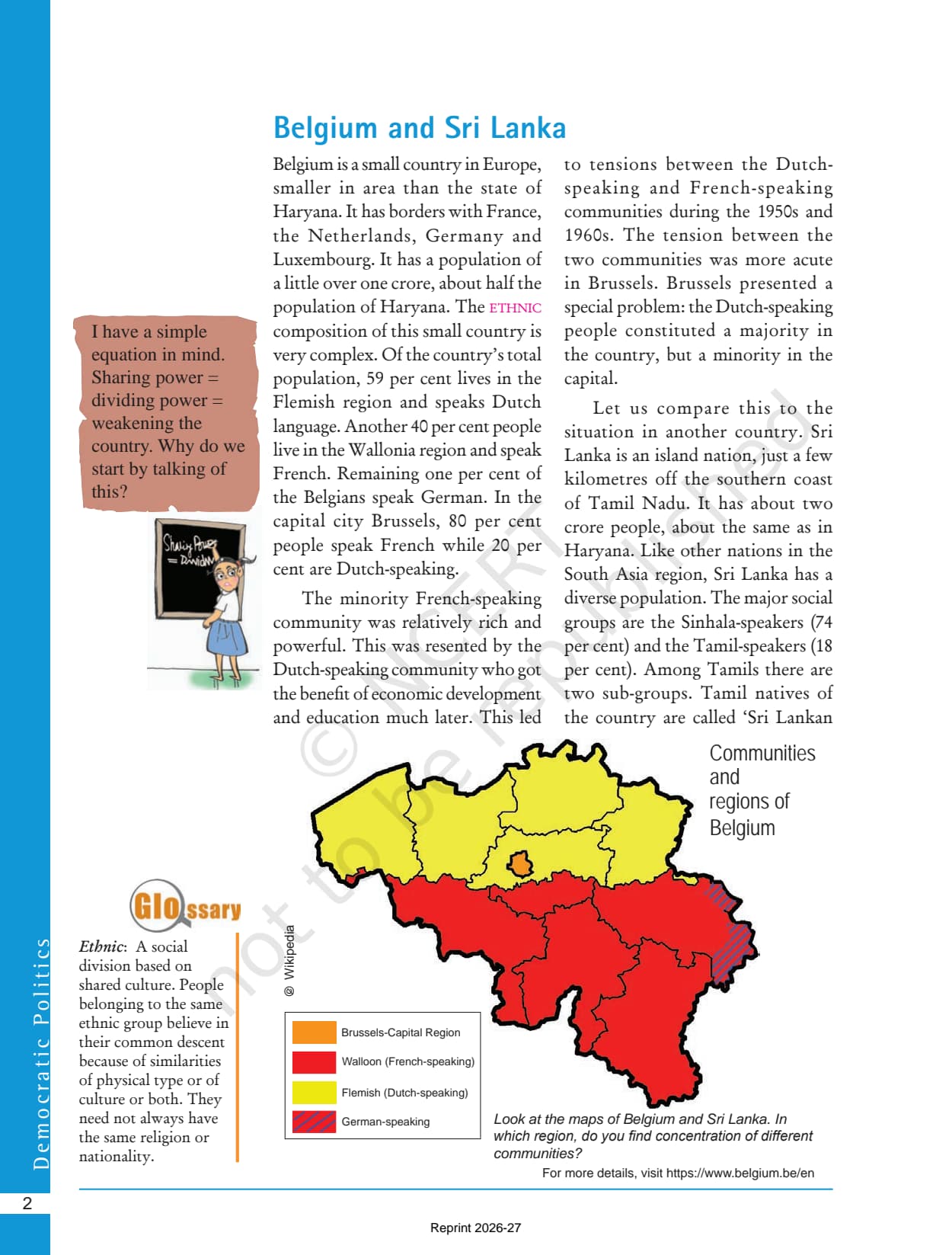
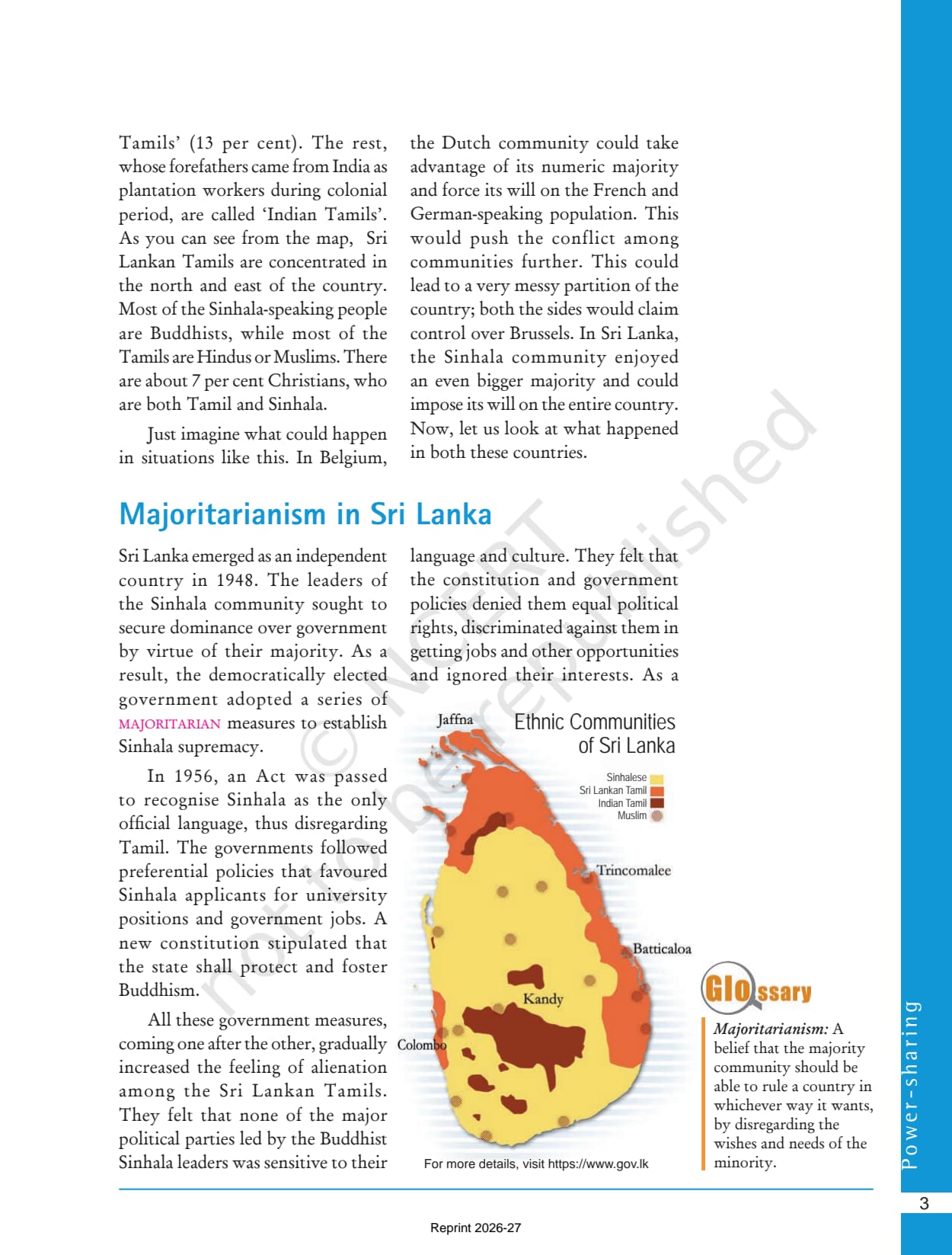
The chapter opens with two small countries that faced the same problem in different ways. In Belgium, 59% speak Dutch (Flemish region), 40% French (Wallonia), and 1% German; Brussels has a French-speaking majority but a Dutch minority. In Sri Lanka, the main groups are Sinhala-speakers (74%) and Tamil-speakers (18%). Both are democracies, but their choices led to very different futures.
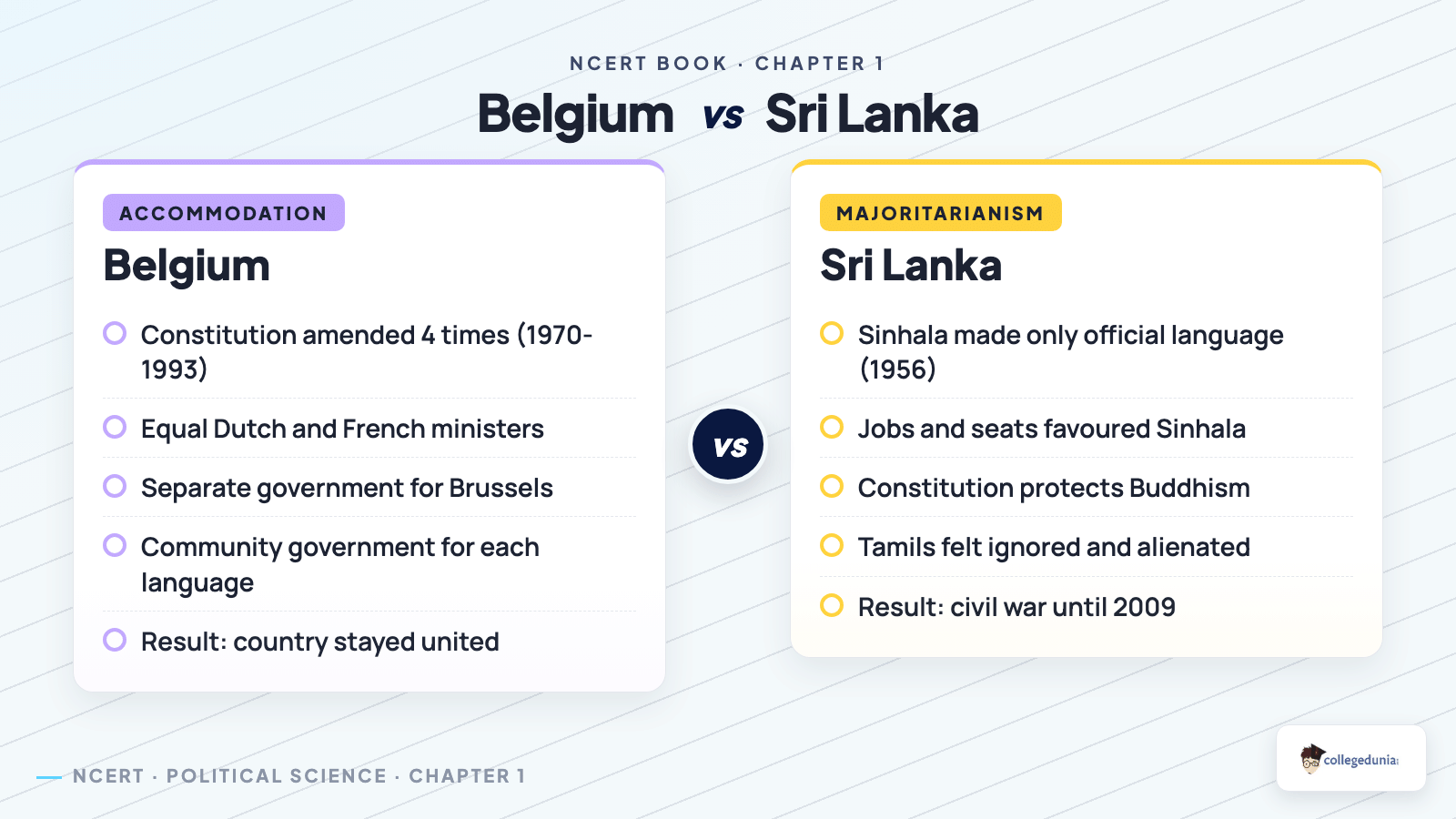
| Feature | Belgium | Sri Lanka |
|---|---|---|
| Main communities | Dutch (59%), French (40%), German (1%) | Sinhala (74%), Tamil (18%), others |
| Approach to power | Shared power through accommodation | Majority forced its will (majoritarianism) |
| Result | Stayed united; civil strife avoided | Civil war that ended only in 2009 |
The main lesson: a country stays united when the majority respects other groups; when a majority forces its will, it can break the country apart.
Majoritarianism in Sri Lanka and Why It Failed
Sri Lanka became independent in 1948. The Sinhala majority wanted control of the government, a belief the chapter calls majoritarianism, and passed laws that pushed the Tamils out of public life.
- In 1956, an Act made Sinhala the only official language, ignoring Tamil.
- Jobs and university seats favoured Sinhala applicants.
- A new constitution said the state would protect Buddhism.
This made the Tamils feel like outsiders. Their struggles for Tamil and regional self-rule grew into a civil war that ended only in 2009, showing that forcing the majority's will can undermine a nation's unity.
Accommodation in Belgium: How Leaders Shared Power Fairly
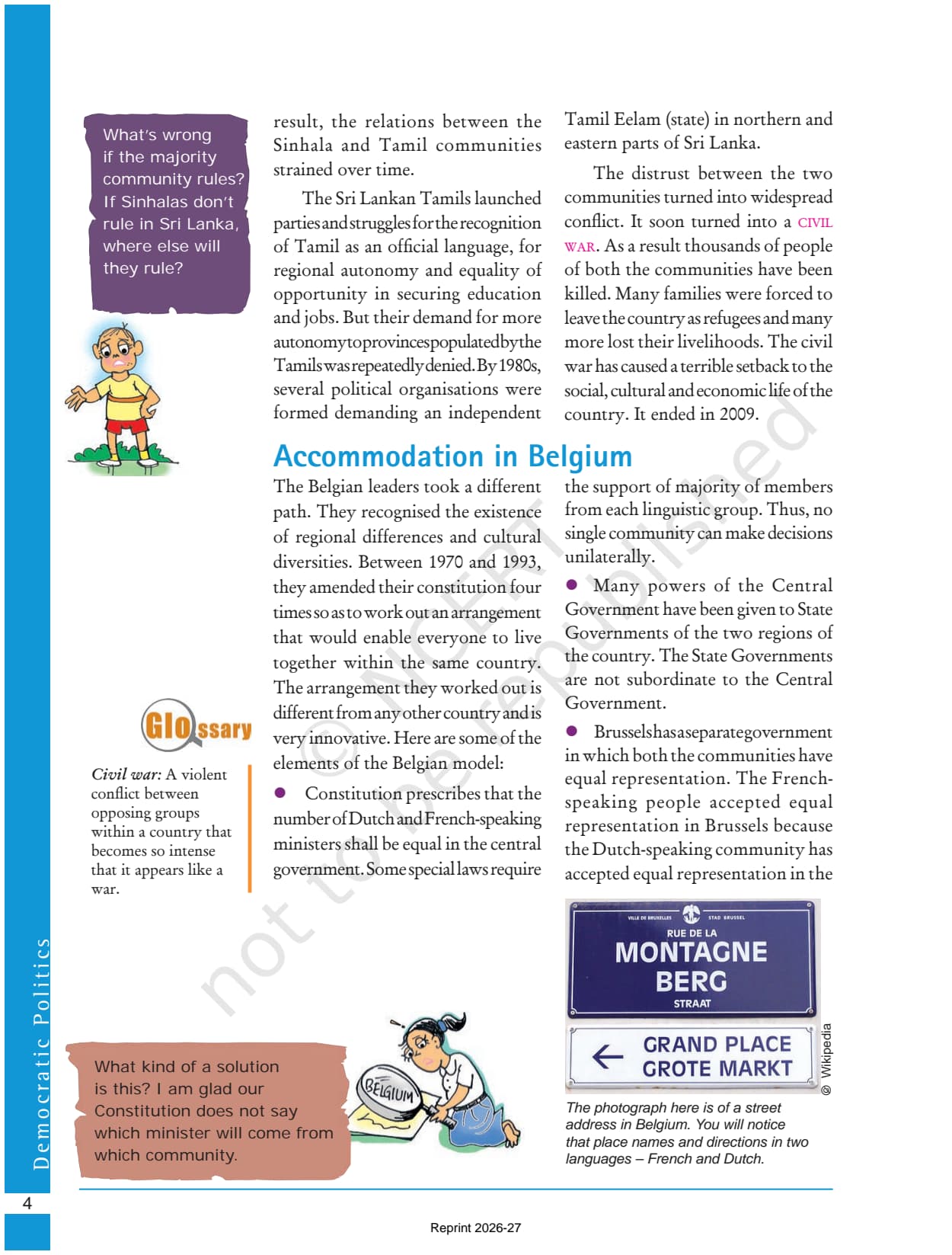
Belgium took the opposite path. Between 1970 and 1993, leaders amended the constitution four times so every community could live together, an approach the chapter calls accommodation.
- Equal ministers: equal Dutch and French-speaking ministers in the central government.
- State governments: many central powers were given to the two regions, which are not under the centre.
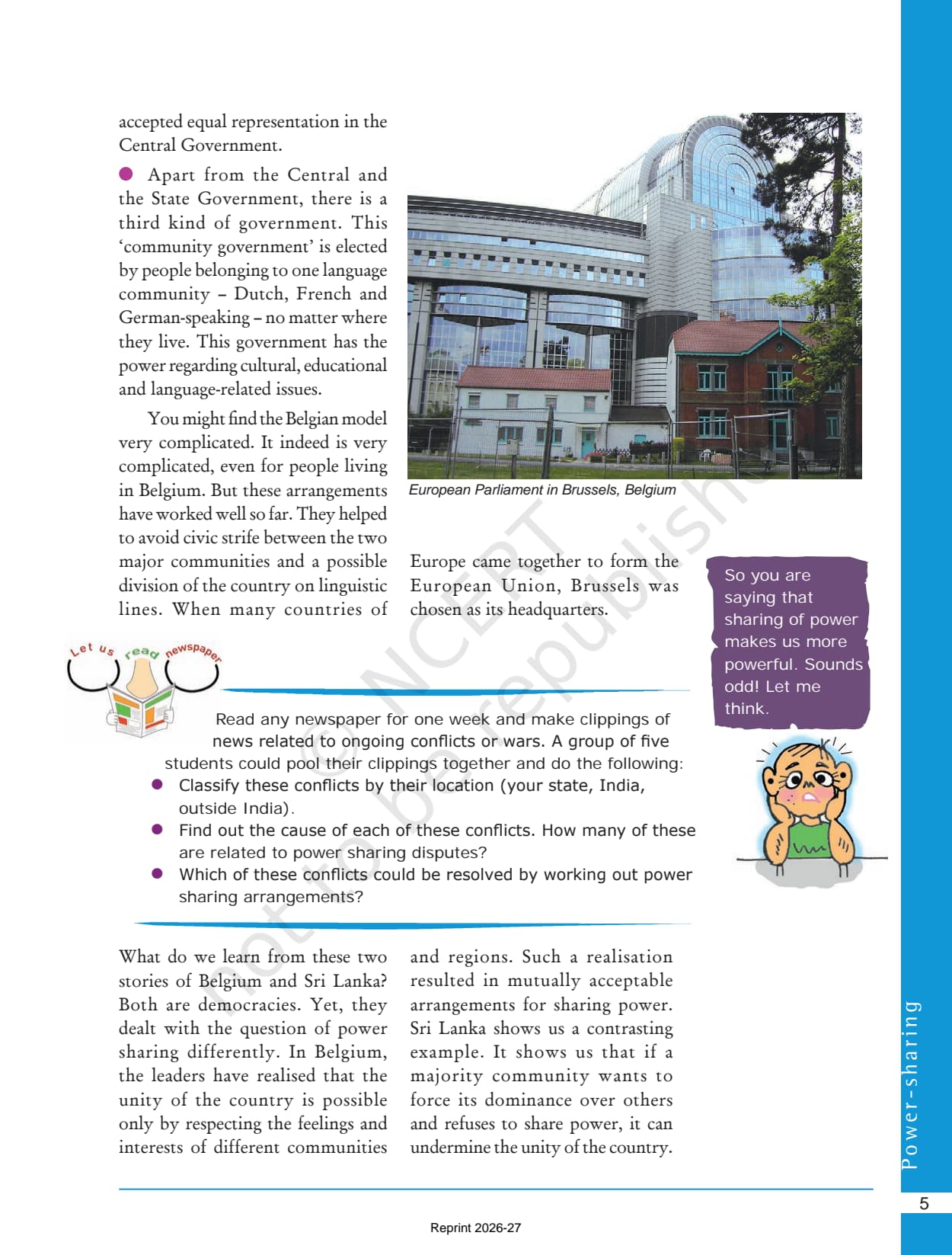
- Brussels: a separate government with equal representation for both communities.
- Community government: elected by each language group, it controls cultural, educational, and language issues.
The model looks complicated, but it has worked, avoiding civic strife and stopping the country from splitting on language lines.
Why Power-Sharing Is Desirable: The Prudential and Moral Reasons
The chapter gives two reasons for sharing power, prudential and moral. Both appear in board questions, often as a 3-mark question asking for one of each.
| Type of reason | What it says |
|---|---|
| Prudential reason | Power-sharing reduces conflict between social groups. Since conflict often leads to violence, sharing power keeps political order stable. |
| Moral reason | Power-sharing is the very spirit of democracy. People affected by power have a right to be consulted on how they are governed. |
Prudential reasons stress better outcomes; moral reasons treat power-sharing as valuable in itself. A common exam mistake is mixing up the two, so learn one solid example of each.
The Four Forms of Power-Sharing in Class 10 Civics Chapter 1
The chapter lists four forms of power-sharing in modern democracies. This is the most tested part and the base for the next chapters on federalism and social divisions. Learn all four with one example each.
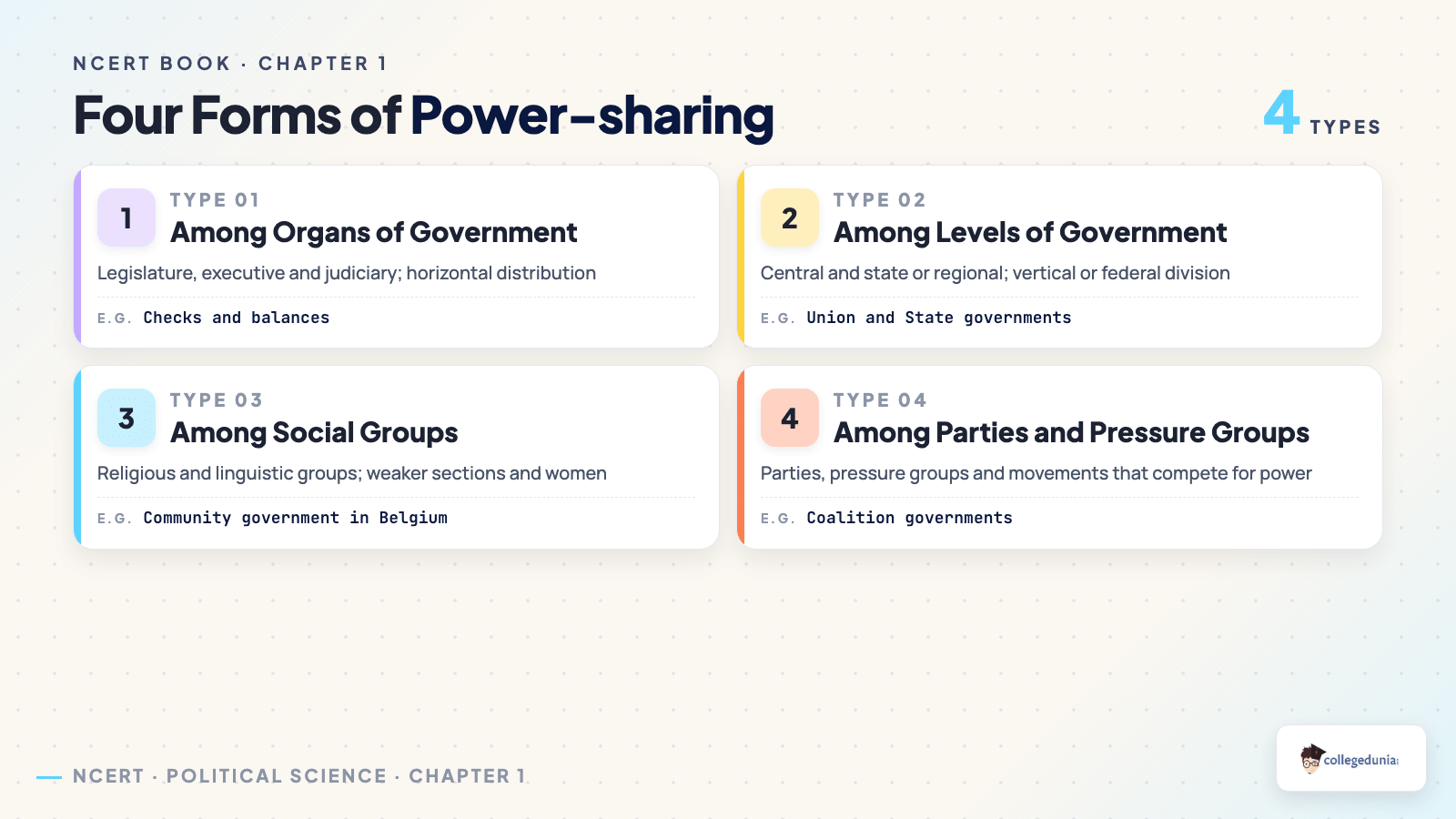
| Form | Power is shared among | Example |
|---|---|---|
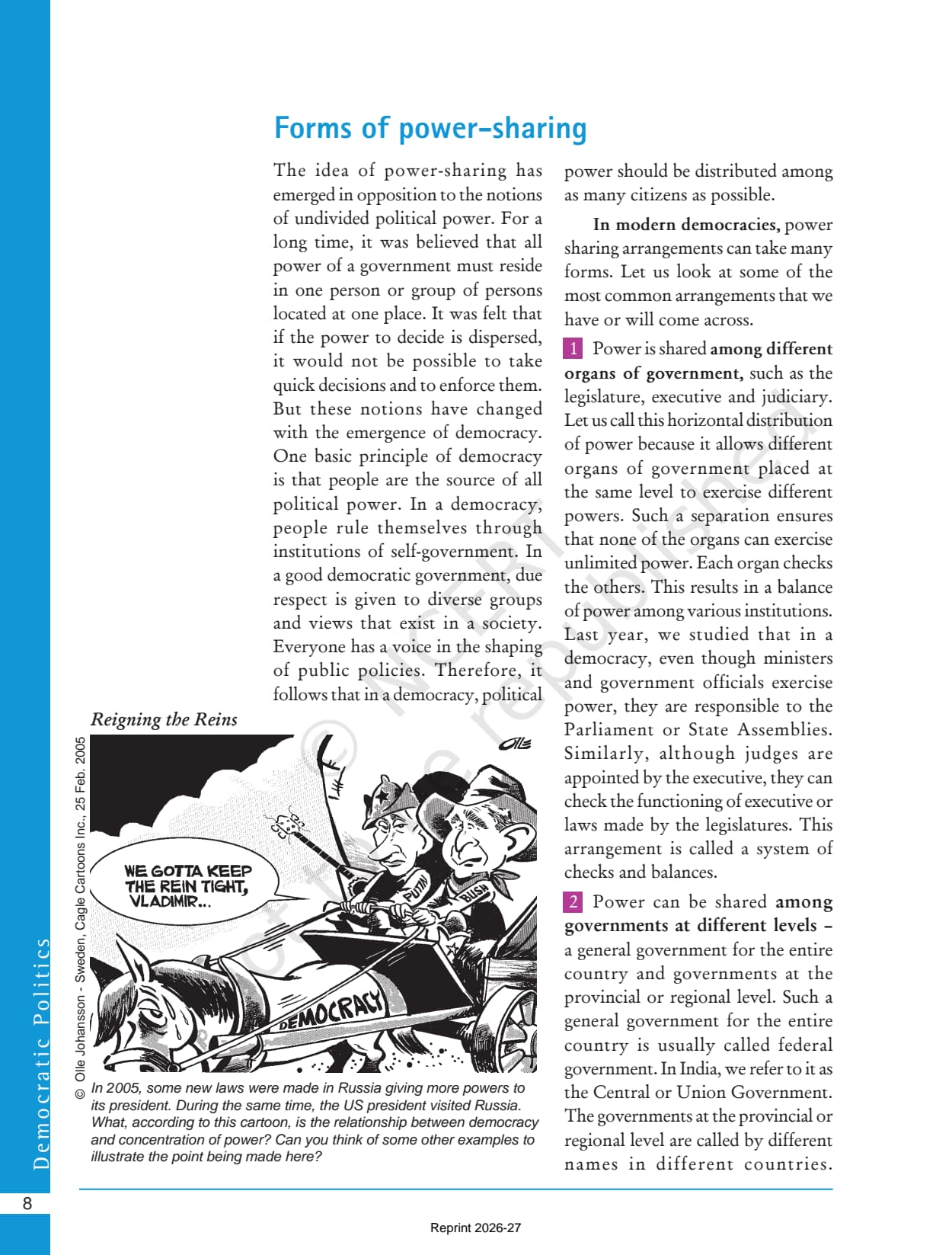
| 1. Among organs of government | Legislature, executive, and judiciary (horizontal distribution) | Checks and balances between the three organs in India |
| 2. Among levels of government | Central and state or regional governments (vertical or federal division) | Union, State, and local governments in India |
| 3. Among social groups | Religious and linguistic groups; weaker sections and women | Community government in Belgium; reserved constituencies in India |
| 4. Among political parties and pressure groups | Parties, pressure groups, and movements that compete for power | Coalition governments; interest groups influencing decisions |
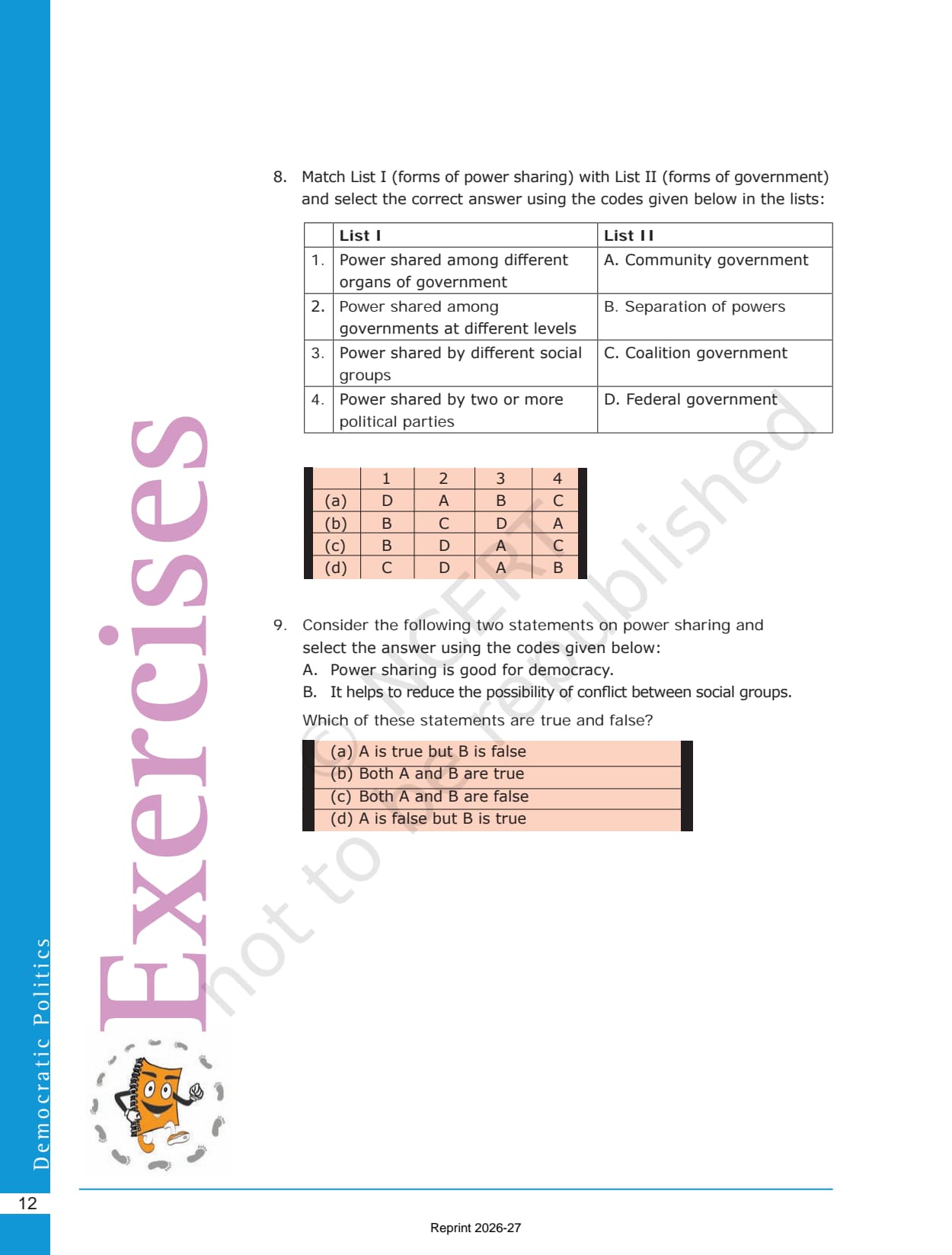
Form 1 is the horizontal distribution (organs at the same level check each other); Form 2 is the vertical or federal division between higher and lower levels.
Exercises and Special Boxes in the NCERT Book Chapter 1
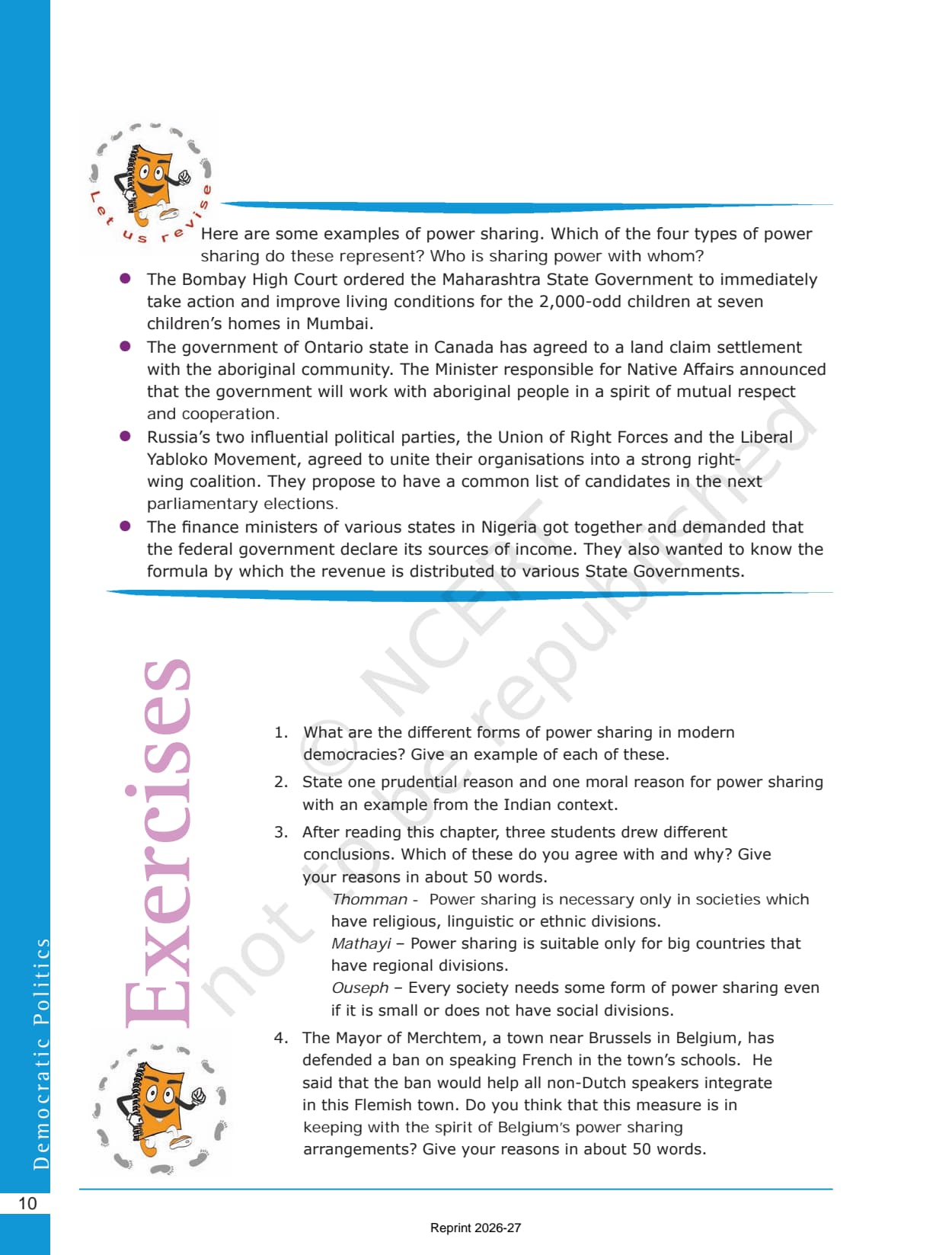
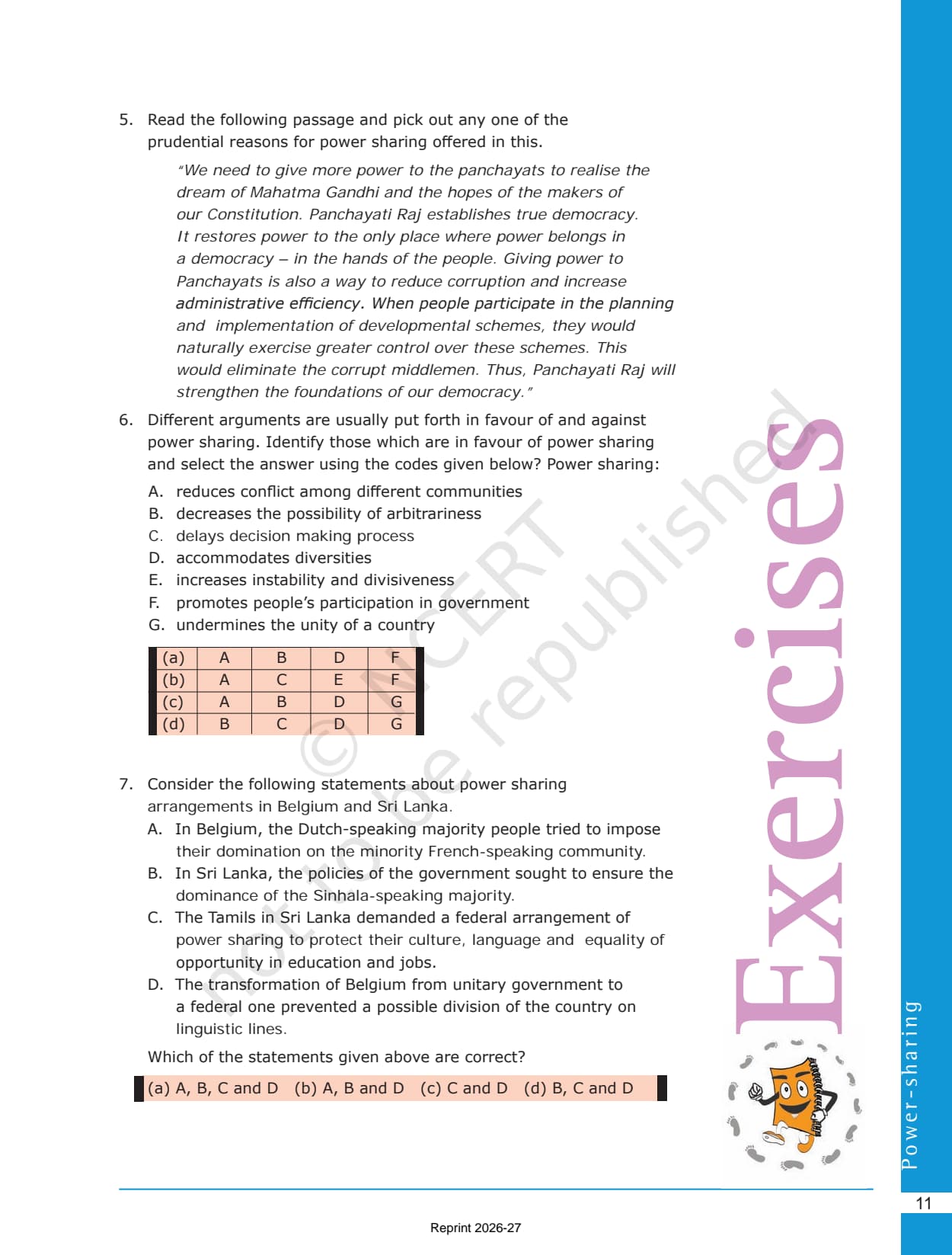
The chapter ends with an Exercises section, plus glossary boxes and cartoons. The questions test the case studies, the two reasons, and the four forms.
| Exercise question | What it tests |
|---|---|
| Q1 | The different forms of power-sharing in modern democracies, with an example of each. |
| Q2 | One prudential reason and one moral reason for power-sharing, with an Indian example. |
| Q3 | Three students' conclusions about who needs power-sharing; pick and defend one view in about 50 words. |
| Q4 | The Merchtem case: whether banning French in a town's schools fits the spirit of Belgium's power-sharing. |
Learning the exact glossary definitions (ethnic, majoritarianism, civil war, prudential) from the textbook helps you write precise one-mark answers.
Other Resources for Class 10 Civics Chapter 1 Power-sharing
Read the official NCERT Book chapter above, then revise with the matching NCERT Solutions, revision notes, and handwritten notes. All resources for Class 10 Civics Chapter 1 Power-sharing are linked in the table below.
| Resource | What it covers | Open |
|---|---|---|
| NCERT Book PDF | Official Class 10 Civics Chapter 1 textbook, with every case study, glossary box, and exercise. | You are here |
| NCERT Solutions | Step-by-step answers to all exercise questions of the chapter. | Power-sharing Class 10 NCERT Solutions |
| Notes | Concept-first revision notes on the two case studies, the two reasons, and the four forms. | Power-sharing Class 10 Notes |
| Handwritten Notes | Scanned-style handwritten pages for last-minute board revision. | Power-sharing Class 10 Handwritten Notes |
NCERT Book for Class 10 Civics (Democratic Politics II): All Chapters
Related Links: Use the table below to open the official NCERT Book PDF for the other chapters of Class 10 Civics. Every chapter ships with the same official textbook PDF, chapter overview, and board-ready FAQ.
| Chapter | NCERT Book PDF link |
|---|---|
| Chapter 1 | Power-sharing NCERT Book PDF (You are here) |
| Chapter 2 | Federalism NCERT Book PDF |
| Chapter 3 | Gender, Religion and Caste NCERT Book PDF |
| Chapter 4 | Political Parties NCERT Book PDF |
| Chapter 5 | Outcomes of Democracy NCERT Book PDF |
NCERT Book Class 10 Civics Chapter 1 Power-sharing FAQs
Ques. What does Chapter 1 Power-sharing cover in the Class 10 Civics NCERT Book?
Ans. Chapter 1 of the Class 10 Civics NCERT Book teaches why democracies share power. It begins with two real stories: Belgium, which shared power through accommodation, and Sri Lanka, which let the majority Sinhala community dominate through majoritarianism. It then gives two reasons for power-sharing, a prudential reason (it reduces conflict) and a moral reason (it is the spirit of democracy). The chapter ends with the four forms of power-sharing: among organs of government, among levels of government, among social groups, and among political parties and pressure groups. The chapter is according to the 2026-27 CBSE Class 10 Civics syllabus.
Ques. What is majoritarianism in Class 10 Civics Chapter 1?
Ans. Majoritarianism is the belief that the majority community should be able to rule a country in whichever way it wants, by ignoring the wishes and needs of the minority. In the NCERT Book, Sri Lanka is the main example. After independence in 1948, the Sinhala majority passed laws making Sinhala the only official language in 1956, favoured Sinhala applicants for jobs and university seats, and gave Buddhism special protection in the constitution. These steps made the Sri Lankan Tamils feel ignored and led to a long civil war that ended in 2009.
Ques. What are the four forms of power-sharing in Class 10 Civics?
Ans. The NCERT Book gives four forms of power-sharing. First, power is shared among different organs of government, the legislature, executive, and judiciary, which is the horizontal distribution of power. Second, power is shared among governments at different levels, such as the central and state governments, which is the vertical or federal division. Third, power is shared among different social groups, such as religious and linguistic groups, seen in Belgium's community government and India's reserved constituencies. Fourth, power is shared among political parties, pressure groups, and movements that compete for power and influence decisions.
Ques. What are the prudential and moral reasons for power-sharing?
Ans. The NCERT Book gives two sets of reasons for power-sharing. The prudential reason is that power-sharing reduces conflict between social groups. Since social conflict often leads to violence and political instability, sharing power keeps the political order stable. The moral reason is that power-sharing is the very spirit of democracy. In a democracy, people who are affected by power have a right to be consulted on how they are governed. Prudential reasons stress better outcomes, while moral reasons treat the act of power-sharing as valuable in itself. A common board question asks for one reason of each type.
Ques. How did Belgium share power between its communities?
Ans. Belgium shared power through what the NCERT Book calls accommodation. Between 1970 and 1993, Belgian leaders amended the constitution four times so that all communities could live together. The number of Dutch and French-speaking ministers in the central government was made equal. Many central powers were given to the two regional state governments, which are not under the central government. Brussels got a separate government with equal representation for both communities. A third kind of government, the community government, was elected by each language group to handle cultural, educational, and language issues. This model helped Belgium avoid civil strife.
Ques. Is the Class 10 Civics Chapter 1 Power-sharing NCERT Book PDF free to download for 2026-27?
Ans. Yes. The official NCERT Book PDF for Class 10 Civics Chapter 1 Power-sharing is free to read and download on this page for the 2026-27 session. It is the complete chapter as printed in the Democratic Politics II textbook, including the Belgium and Sri Lanka case studies, the section on majoritarianism, the accommodation model in Belgium, the prudential and moral reasons, the four forms of power-sharing, and the full Exercises. You can pair the book with the linked NCERT Solutions and revision notes for the same chapter so that you read the textbook and revise from one place.
Ques. What is power-sharing in democracy?
Ans. Power-sharing means distributing political power among different organs of government, different levels of government, different social groups, and different political parties so that no single group holds all of it. The NCERT Book explains that in a democracy people are the source of all political power. So power should be shared with those affected by its exercise. Power-sharing keeps a country united, reduces conflict, and gives diverse groups a fair stake in the system. It is the central idea of Chapter 1 and the base for the chapters on federalism and social divisions that follow.



Comments