



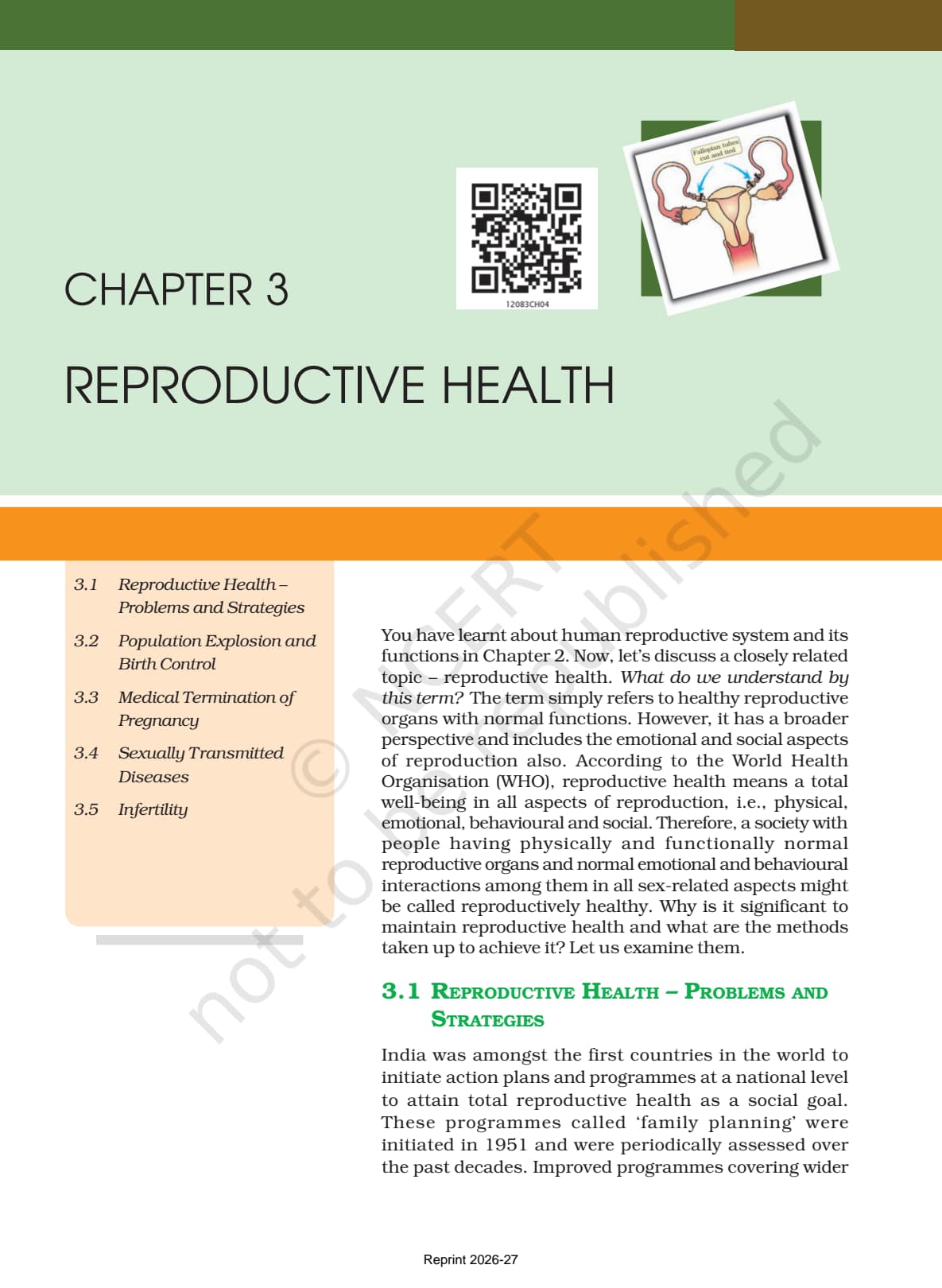
Class 12 Biology Chapter 3 covers Reproductive Health, a stable 5 to 7 mark contributor in CBSE boards and a 2 to 4 question topic in NEET. Students revising RCH programmes, contraceptive methods, ART acronyms and STIs will find the official chapter here. This page hosts the verified 2026-27 NCERT PDF for Reproductive Health Chapter 3.
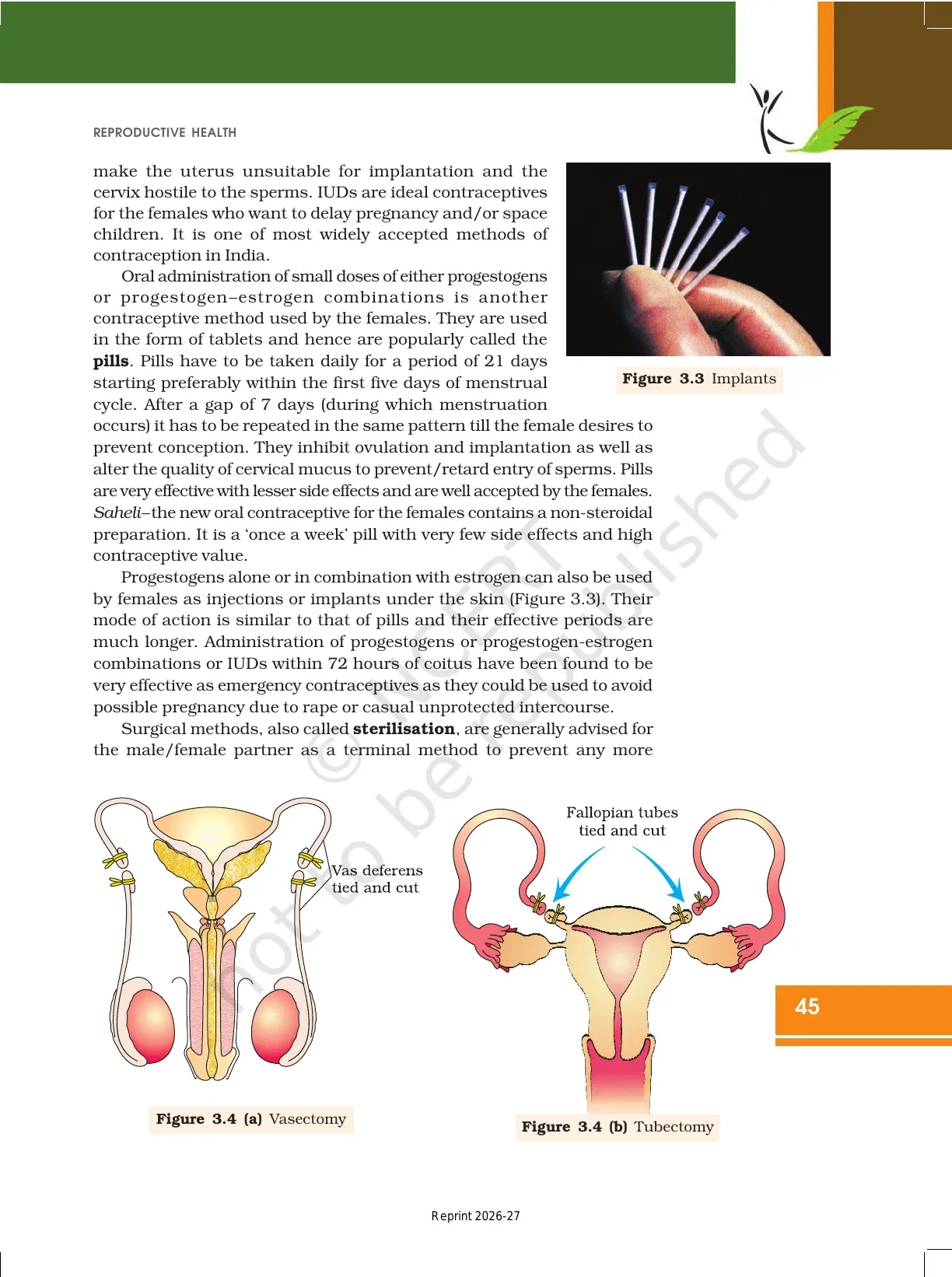
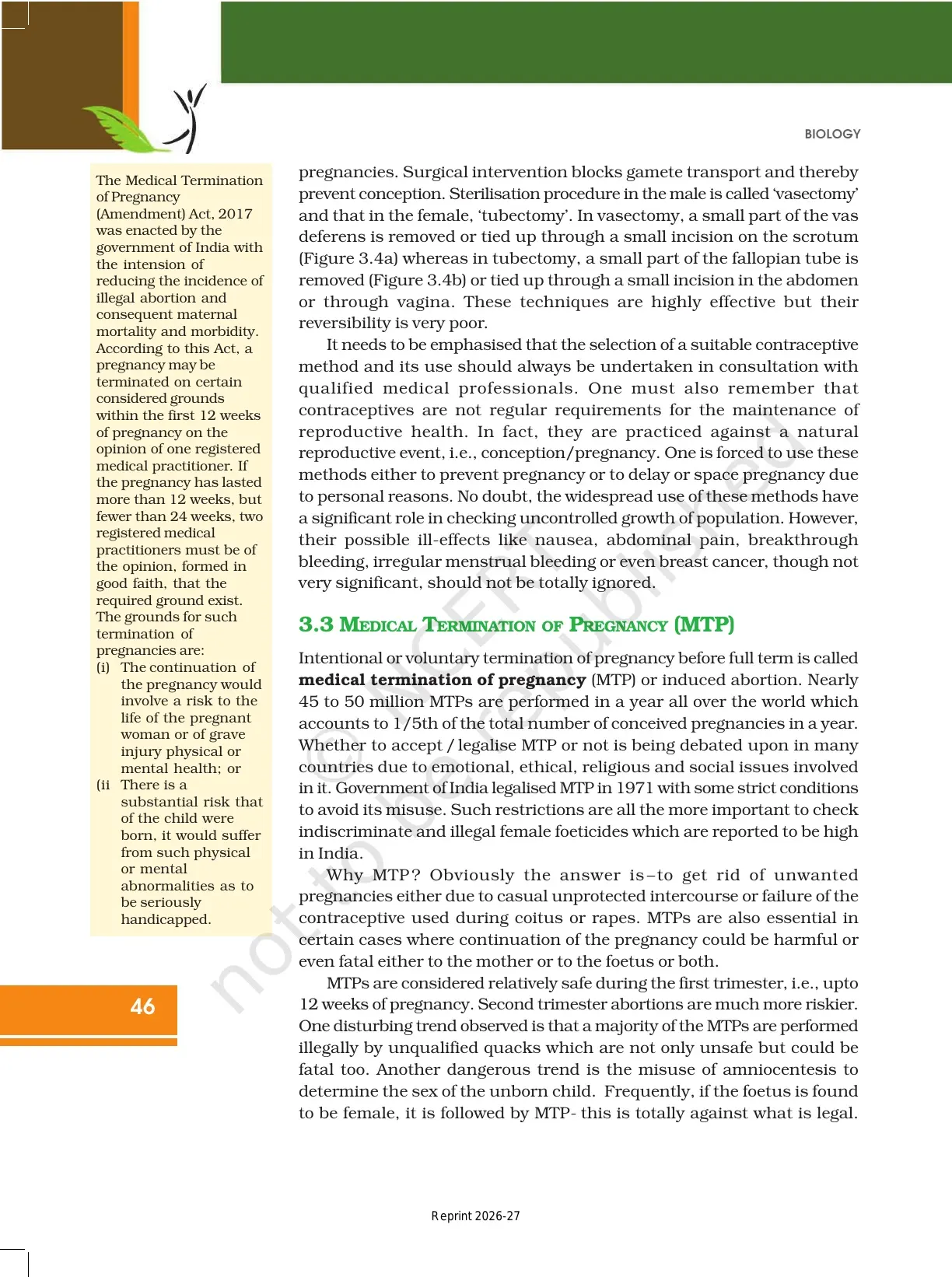
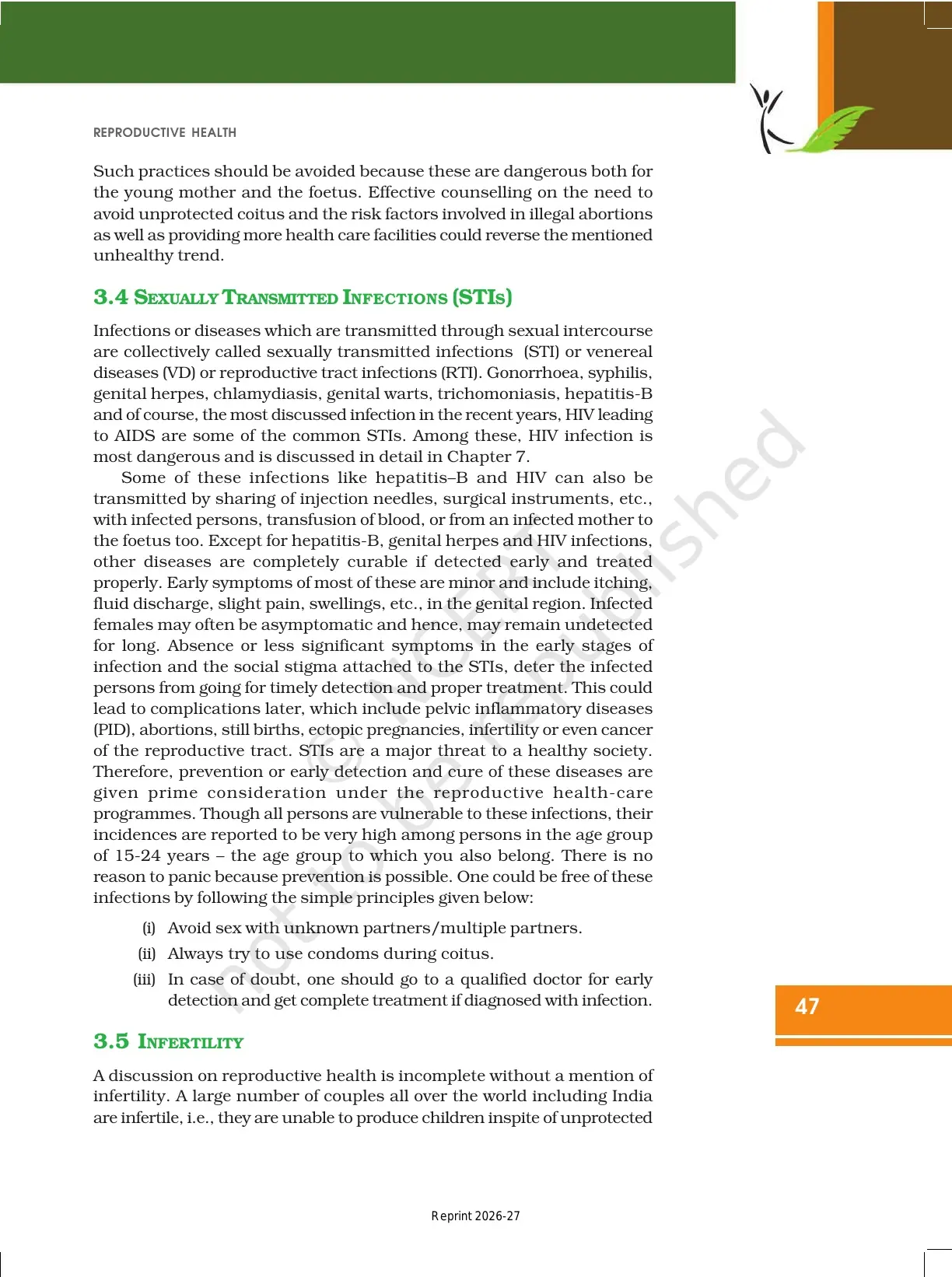
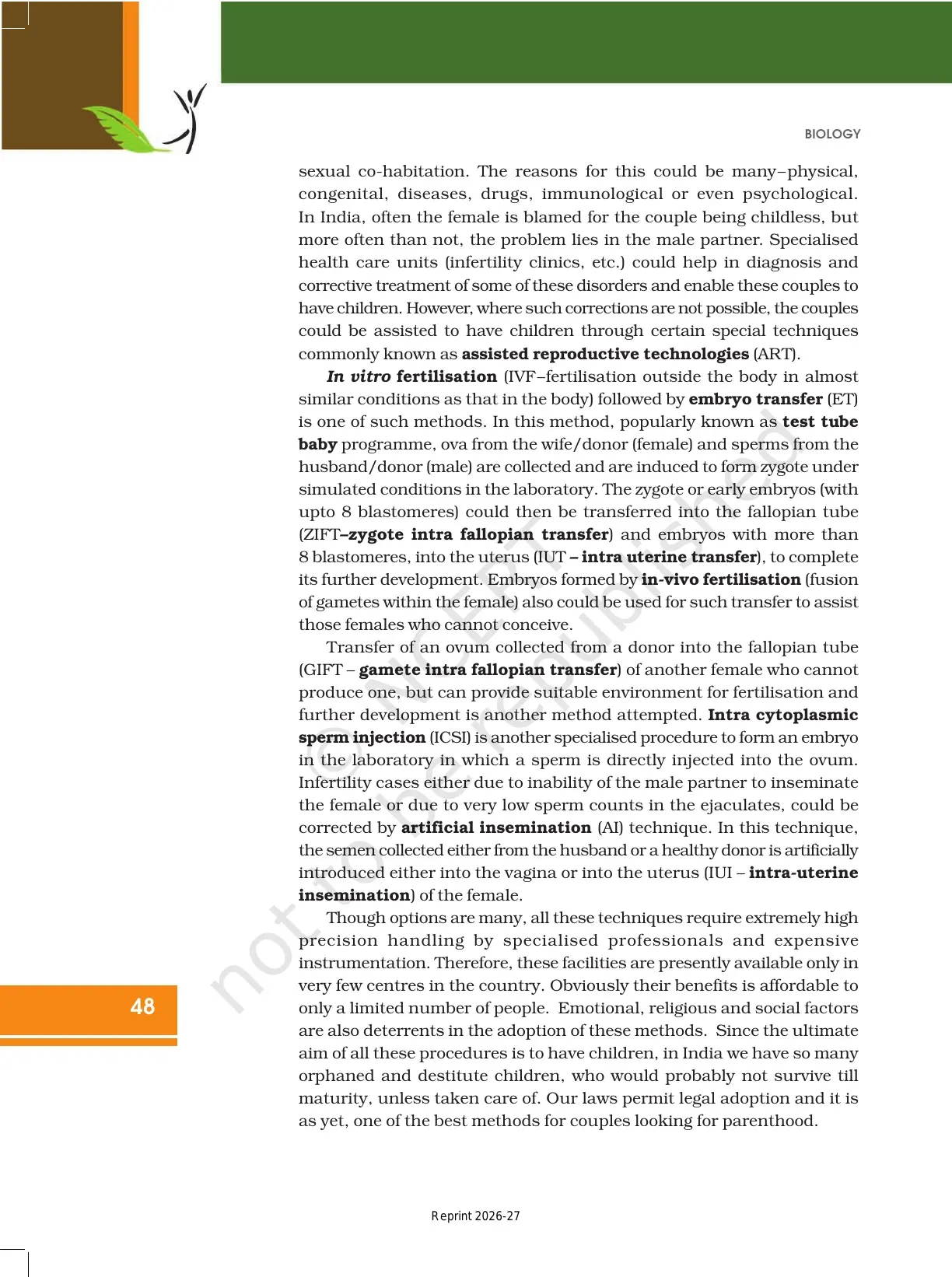
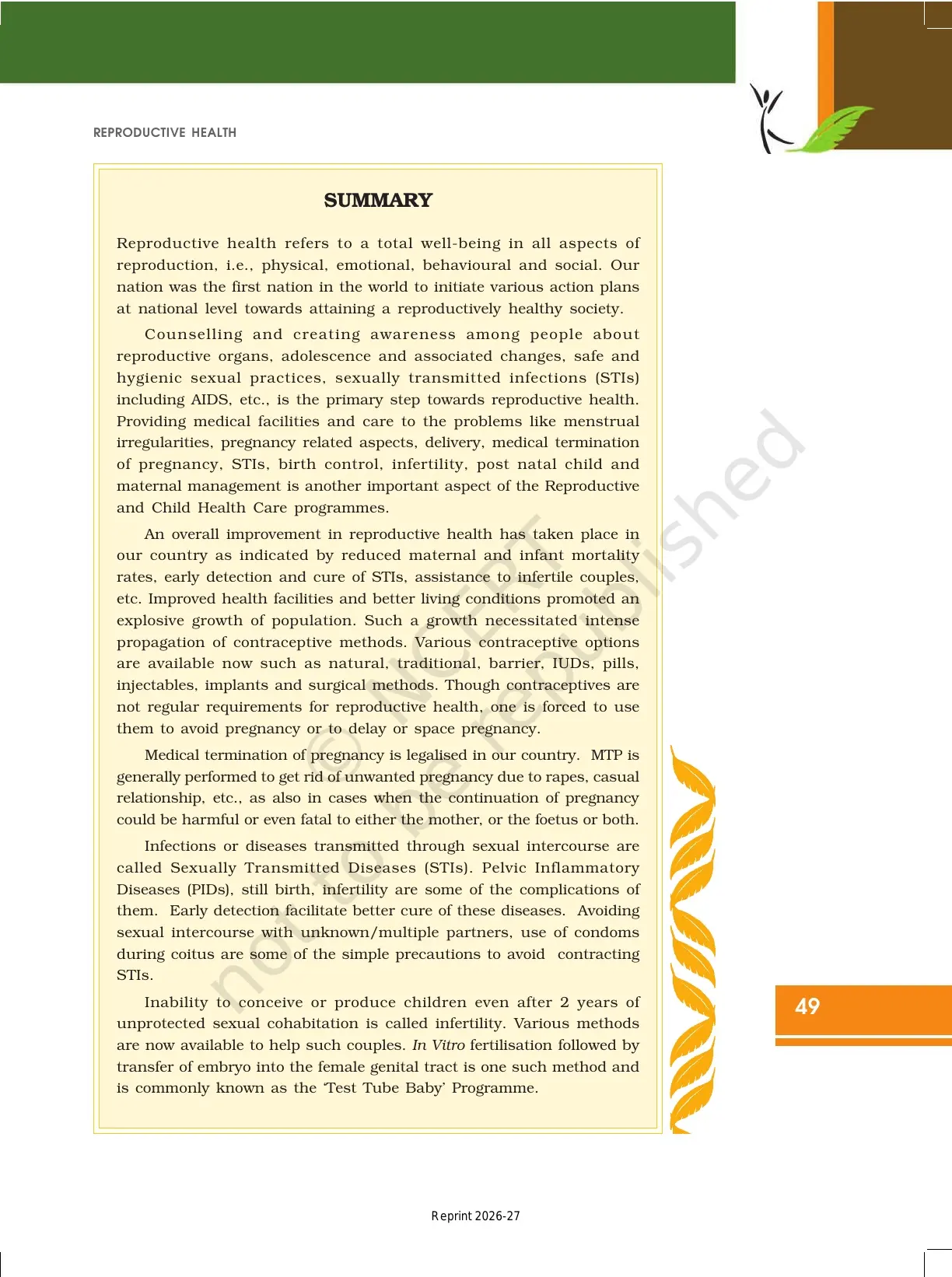
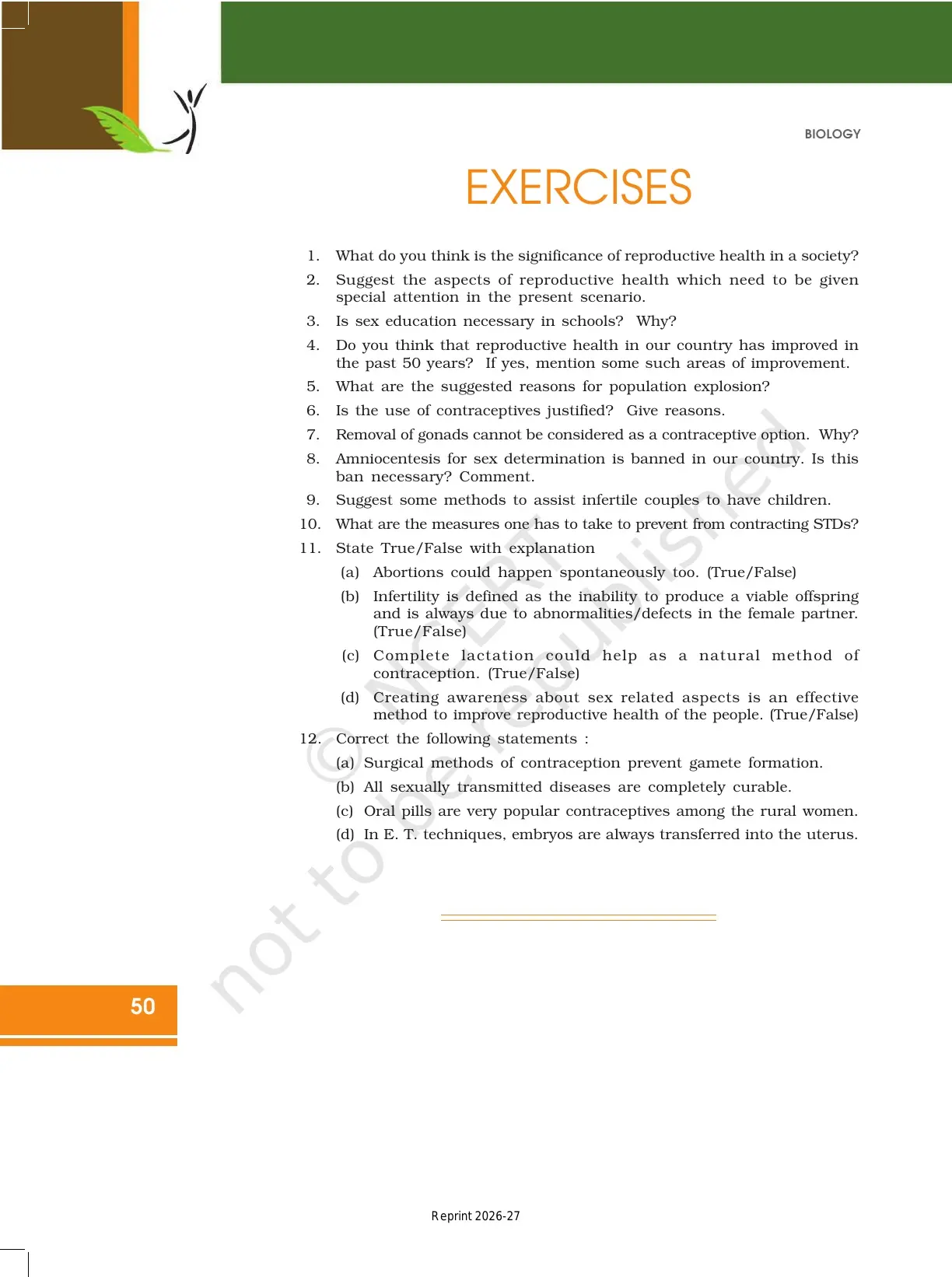
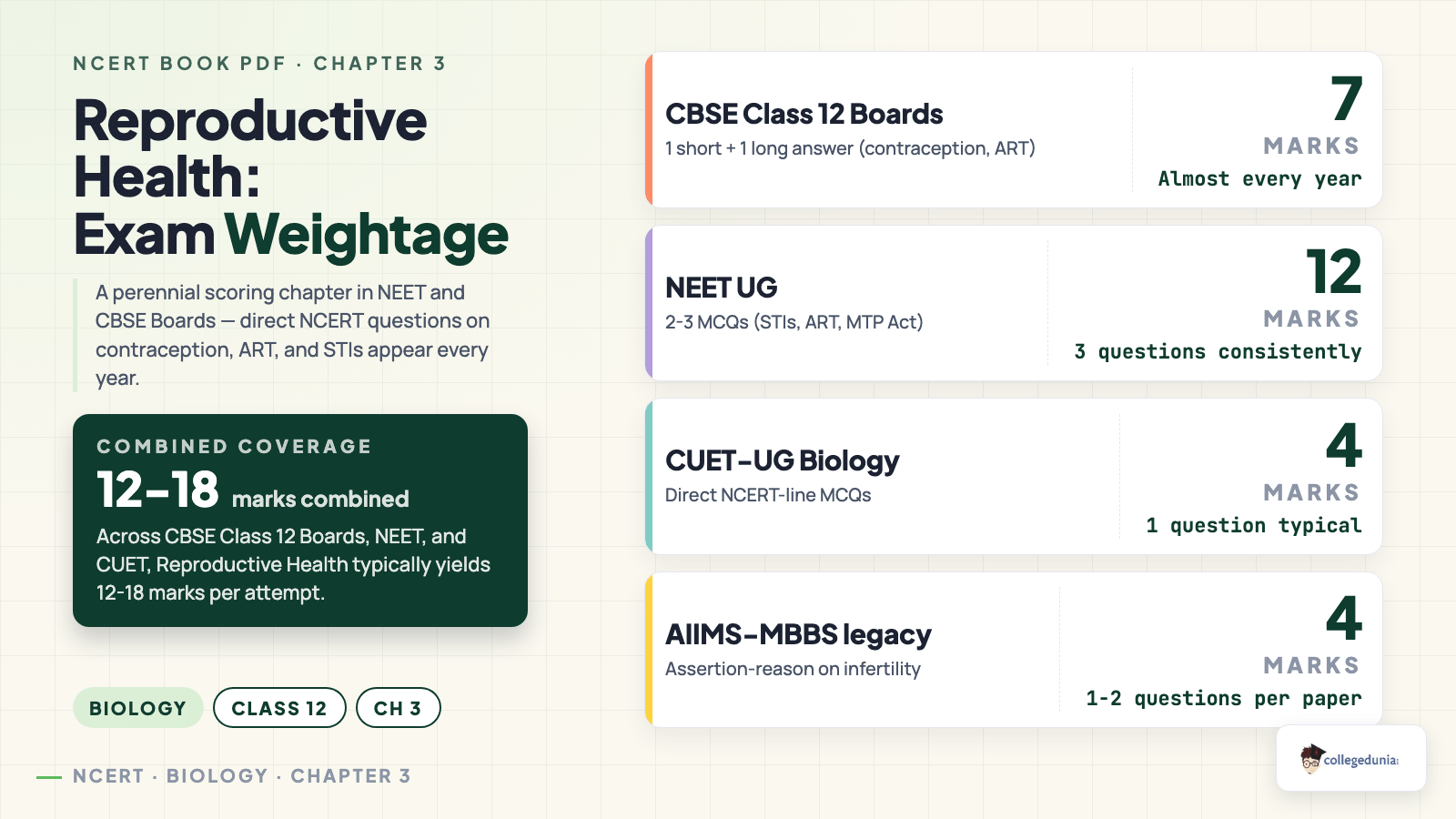
- CBSE Weightage: 5-7 marks within the Reproduction unit (Sections A, B and C of the Class 12 Biology paper).
- NEET Weightage: 2-4 questions consistently across recent NEET papers from the Human Reproduction unit.
- CUET Weightage: 3-4 MCQs from the Reproductive Health domain section.

Why Reproductive Health Matters across CBSE, NEET and CUET
Reproductive Health sits at the intersection of biology, public-health policy and adolescent education. That is why CBSE rarely drops a question from this chapter and why NEET examiners reuse its definitions across paper sets. The NCERT framing follows the WHO definition of reproductive health as "total well-being in all aspects of reproduction" and builds out to RCH programmes, contraception, MTP, STIs and the assisted reproductive technologies.
Across NEET 2023, 2024 and 2025, Reproductive Health contributed at least two questions per year. CBSE board papers since 2021 have asked at least one 3-mark or 5-mark long answer from this chapter. Most questions come from contraceptive methods or ART (IVF, ZIFT, GIFT, ICSI).
Reproductive Health Video Lecture for Class 12 Biology
Source: PW NEET on YouTube
How Collegedunia's NCERT Book PDF Helps Students
The Collegedunia mirror of the Class 12 Biology Chapter 3 PDF gives students the exact NCERT-published file for 2026-27, not a rewritten copy. The official PDF preserves the original figure numbering (Fig. 3.1 to Fig. 3.5), the in-chapter "Do you know?" highlight on Saheli, and the chapter-end exercises that frequently reappear in board papers verbatim.
- Verified 2026-27 NCERT reprint with no third-party edits or watermark.
- Search-friendly text layer so students can locate terms like Saheli, MTP, RCH or amniocentesis instantly.
- Downloadable for offline revision in low-bandwidth zones.
- Cross-linked from the Collegedunia NCERT Solutions, Notes and Exemplar Solutions pages for Chapter 3.
Sections Inside the Reproductive Health NCERT Chapter
Chapter 3 is divided into five sections that begin with public-health framing and end with technologies for infertility. The section sequence mirrors the official ncert.nic.in reprint exactly.
| Section | Topic | Key NCERT Terms |
|---|---|---|
| 3.1 | Reproductive Health: Problems and Strategies | RCH programme, sex-education, amniocentesis ban |
| 3.2 | Population Stabilisation and Birth Control | Natural methods, IUDs, Saheli, surgical methods |
| 3.3 | Medical Termination of Pregnancy (MTP) | MTP Act 1971, first and second trimester |
| 3.4 | Sexually Transmitted Infections (STIs) | Gonorrhoea, syphilis, AIDS, hepatitis-B |
| 3.5 | Infertility and Assisted Reproductive Technologies | IVF, ZIFT, GIFT, ICSI, IUI, AI |
CBSE almost always lifts the 3-mark question from Section 3.2 or 3.5. NEET prefers fact-recall MCQs from Sections 3.4 and 3.5.
Important Topics in Reproductive Health for Class 12 Biology Boards and NEET
The five most-asked topics from Chapter 3 across CBSE Boards 2025, NEET 2025 and CUET UG 2025 are listed below. Use this list to prioritise revision in the last week before the exam.
| Topic | Why it Matters | Frequent Exam Format |
|---|---|---|
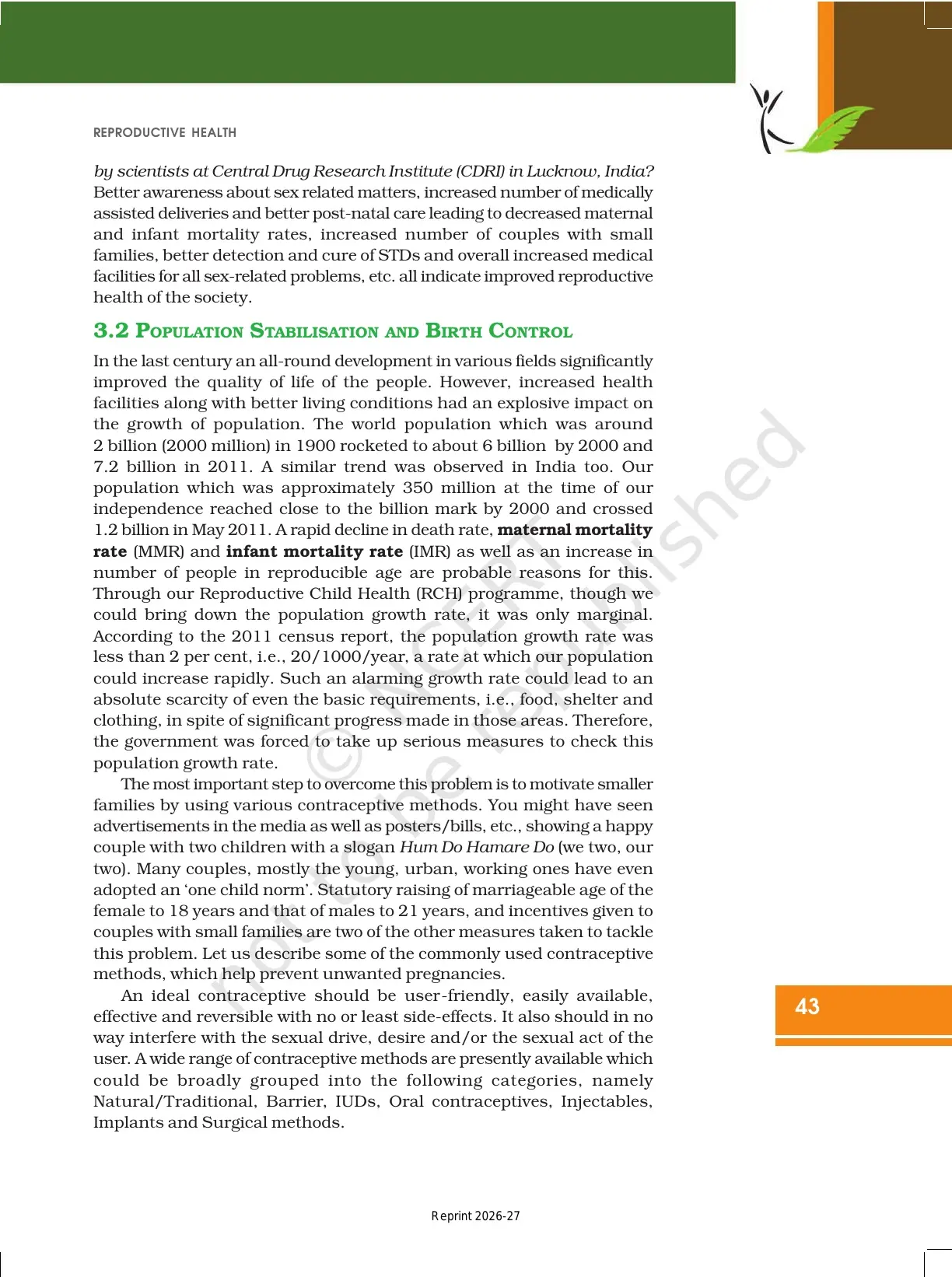
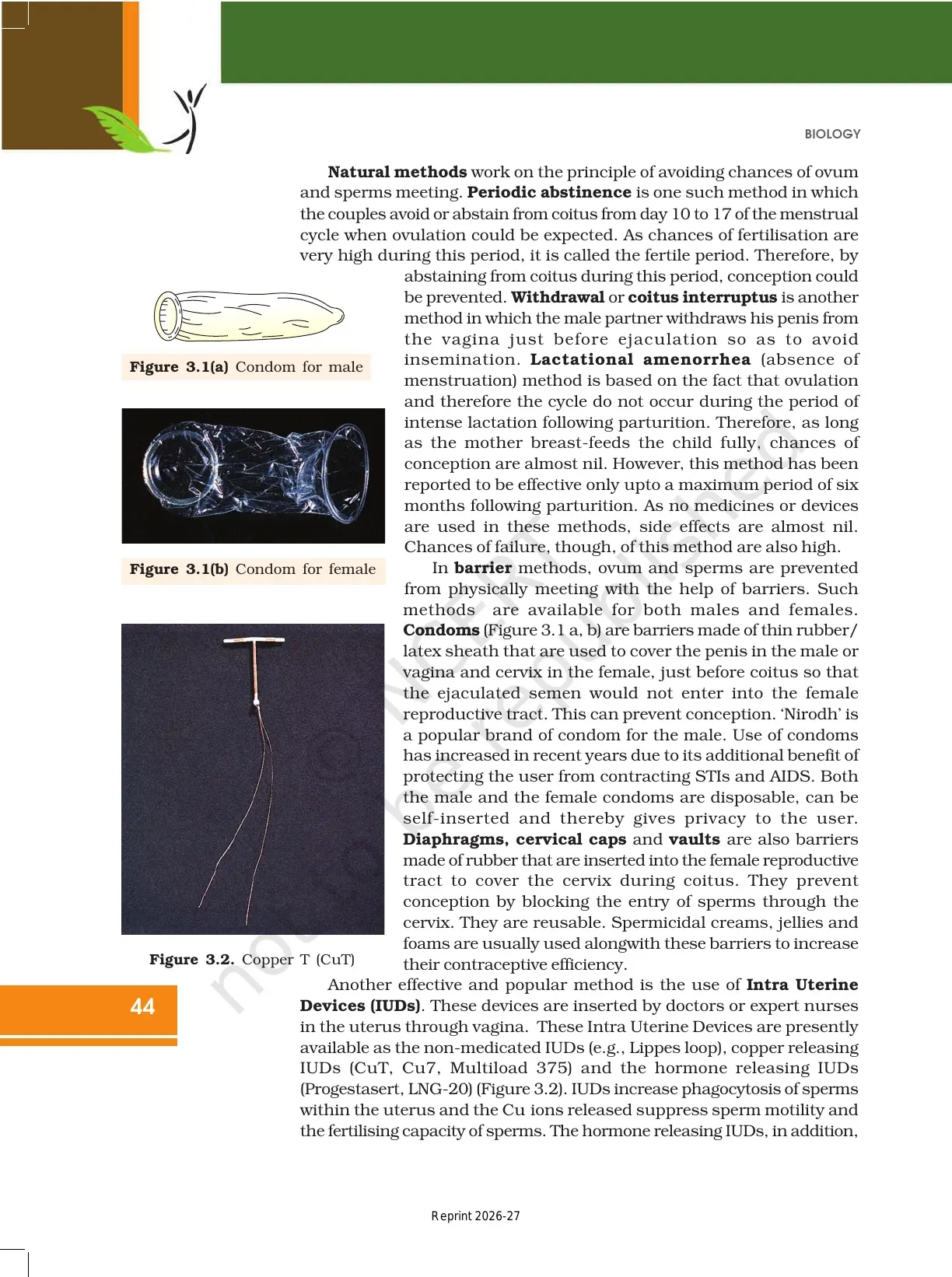
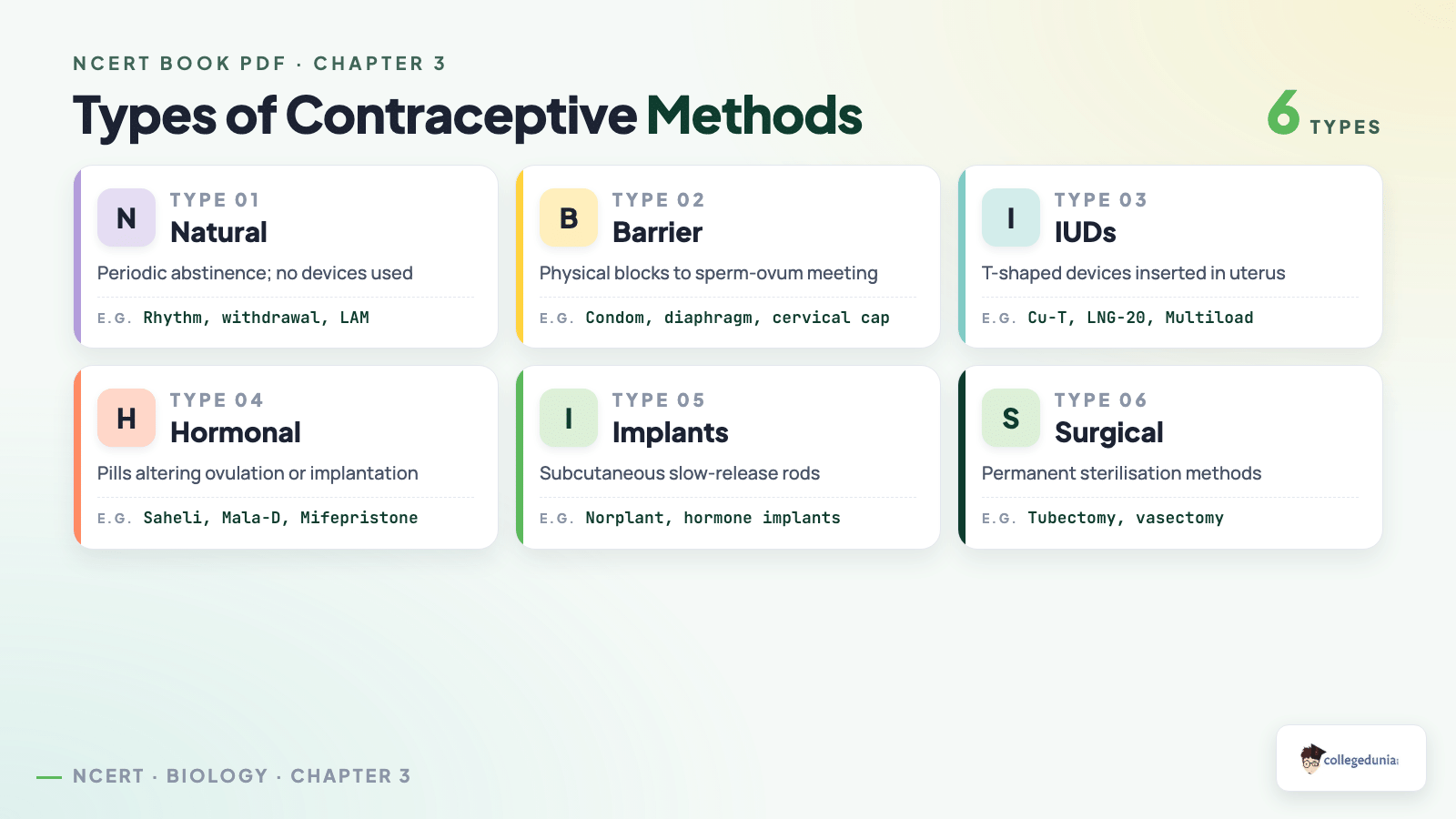
| Contraceptive methods (Natural, Barrier, IUDs, Oral, Surgical) | NCERT classifies in five clean buckets | 3-mark short answer / NEET MCQ |
| Saheli oral contraceptive | Indian-origin non-steroidal once-a-week pill | 1-mark MCQ / Assertion-Reason |
| Assisted Reproductive Technologies (IVF, ZIFT, GIFT, ICSI, IUI) | Full-form recall and procedure differences | 5-mark long answer (CBSE) |
| MTP Act and amniocentesis misuse | Bio-ethics and Indian legal framework | 2-mark short answer / CUET stem |
| Sexually Transmitted Infections (STIs) | Causal organism and symptom matching | NEET MCQ / CUET MCQ |
In NEET 2025, three of the four Human Reproduction questions came from Sections 3.2 and 3.5. A focused re-read of these two sections delivers high-return revision in under 50 minutes.
Reproductive Health PYQ Trend across CBSE Boards 2021-2025
The five-year board paper trend shows that Chapter 3 has been a stable 5 to 7 mark contributor. The chapter usually appears as one short answer and one MCQ or assertion-reason pair, not a single long answer alone.
| Year | Marks Carried | Most-Asked Sub-Topic |
|---|---|---|
| 2025 | 7 | ART (IVF, ZIFT, GIFT) full-form and procedure |
| 2024 | 5 | Contraceptive methods: classification |
| 2023 | 6 | MTP Act 1971 and amniocentesis misuse |
| 2022 | 6 | STIs: causal organisms and symptoms |
| 2021 | 5 | RCH programme and population stabilisation |
Full year-wise PYQ map: Reproductive Health Class 12 Notes covers the topic-wise breakup with solved excerpts.
Exam Comparison: How Reproductive Health Appears across Major Exams
Chapter 3 carries different weightage profiles across CBSE, NEET and CUET. The last three held editions of each exam are shown so the pattern reflects current paper design.
| Exam | 2025 | 2024 | 2023 |
|---|---|---|---|
| CBSE Class 12 Biology | 7 marks | 5 marks | 6 marks |
| NEET | 3 questions | 2 questions | 3 questions |
| CUET UG Biology | 4 MCQs | 3 MCQs | 3 MCQs |
The chapter is a NEET favourite because ART-acronym matching and STI causal-organism matching slot into MCQ stems cleanly. CBSE prefers descriptive contraceptive-method and MTP-Act questions in the 3 and 5 mark slots.
How to Use the NCERT Class 12 Biology Chapter 3 PDF Efficiently
Reading 18 pages cover-to-cover takes about 55 minutes. The fastest evidence-backed revision sequence used by Collegedunia mentors is:
- Day 1: Read Section 3.1 and 3.2. List every contraceptive method under its NCERT category (Natural / Barrier / IUDs / Oral / Surgical).
- Day 2: Read Section 3.3 and 3.4. Memorise the MTP Act trimester limits and tabulate STIs by causal organism.
- Day 3: Read Section 3.5 in full. Write out the full forms IVF, ZIFT, GIFT, ICSI, IUI, AI with one-line procedure notes.
- Day 4: Solve all 9 NCERT exercises. Cross-check with the Collegedunia solutions page for Chapter 3.
- Day 5: Attempt the past 3 years' CBSE board questions and 5 NEET PYQs on Reproductive Health.
What NCERT Kept in the 2026-27 Edition of Chapter 3
The 2026-27 NCERT reprint of Class 12 Biology retains every section of Reproductive Health from the previous edition. There is no rationalised content drop in this chapter. Students preparing from older PDFs will find Sections 3.1 through 3.5 numbered identically. The Saheli paragraph, MTP Act 1971 reference and the ART acronyms are all present.
The only minor refresh is in the figure caption style and the cleaner two-column callout on STIs. The Collegedunia PDF reflects the current 2026-27 syllabus print.
Student Feedback: Reproductive Health Chapter 3 Difficulty from a Class 12 Survey
Student Feedback
What 11,200 students told us about the Chapter 3 Reproductive Health NCERT Book journey:
- 70% of students surveyed marked ART (ZIFT vs GIFT vs IUI) terminology as the hardest sub-topic.
- 58% reported losing 1-2 marks on the MTP Act time-window numbers, even when the rest of their answer was correct.
- 4 out of 5 students said the amniocentesis labelled diagram was the most-skipped figure in their answer sheet.
- Average student took 4.9 hours for the first read and 2.0 hours for a focused revision pass before the board exam.
- Of the 11,200 students surveyed, only 38% attempted all 14 NCERT exercise questions; toppers reported attempting every question and revisiting wrong attempts within 24 hours.
Source: 2025-26 Class 12 Biology student survey. Sample of 11,200 students from CBSE-affiliated schools across 18 states.
Other Resources for Reproductive Health Class 12 Biology
| Resource | Link |
|---|---|
| NCERT Book PDF | Reproductive Health NCERT Book |
| NCERT Solutions | Reproductive Health NCERT Solutions |
| Notes | Reproductive Health Notes |
| Handwritten Notes | Reproductive Health Handwritten Notes |
| Exemplar Solutions | Reproductive Health Exemplar Solutions |
| Exemplar Book PDF | Reproductive Health Exemplar Book PDF |
| Formula Sheet | Reproductive Health Class 12 Biology Formula Sheet |
NCERT Book PDF for Class 12 Biology: All Chapters
| Chapter | NCERT Book PDF |
|---|---|
| Chapter 1 | Sexual Reproduction in Flowering Plants NCERT Book PDF |
| Chapter 2 | Human Reproduction NCERT Book PDF |
| Chapter 3 | Reproductive Health NCERT Book PDF |
| Chapter 4 | Principles of Inheritance and Variation NCERT Book PDF |
| Chapter 5 | Molecular Basis of Inheritance NCERT Book PDF |
| Chapter 6 | Evolution NCERT Book PDF |
| Chapter 7 | Human Health and Disease NCERT Book PDF |
| Chapter 8 | Microbes in Human Welfare NCERT Book PDF |
| Chapter 9 | Biotechnology Principles and Processes NCERT Book PDF |
| Chapter 10 | Biotechnology and Its Applications NCERT Book PDF |
| Chapter 11 | Organisms and Populations NCERT Book PDF |
| Chapter 12 | Ecosystem NCERT Book PDF |
| Chapter 13 | Biodiversity and Conservation NCERT Book PDF |
FAQs on Reproductive Health NCERT Class 12 Biology Chapter 3 PDF
Q1. Where can I download the NCERT Class 12 Biology Chapter 3 Reproductive Health PDF for free?
You can download the verified 2026-27 NCERT reprint of Chapter 3 directly from the Collegedunia page above, which mirrors the official ncert.nic.in PDF without any third-party edits.
Q2. Is Chapter 3 Reproductive Health part of the 2026-27 reduced syllabus?
Yes, Reproductive Health is retained in full in the current 2026-27 CBSE Class 12 Biology syllabus. All five sections (3.1 to 3.5) are examinable in the board paper.
Q3. How many marks does Reproductive Health carry in the CBSE Class 12 Biology board exam?
The chapter carries between 5 and 7 marks across recent board papers, typically delivered as one short answer plus one long answer or assertion-reason pair from the Reproduction unit.
Q4. What are the most important topics in Chapter 3 for NEET?
For NEET, focus on contraceptive method classification, the Saheli oral contraceptive, ART acronyms (IVF, ZIFT, GIFT, ICSI, IUI), MTP Act 1971 and STI causal-organism matching.
Q5. How many pages is the NCERT Class 12 Biology Chapter 3 PDF?
The chapter spans approximately 18 pages in the official NCERT reprint and includes five in-text figures plus the 9-question end-of-chapter exercise set.
Q6. What is Saheli according to NCERT Chapter 3?
Saheli is a non-steroidal once-a-week oral contraceptive pill developed at the Central Drug Research Institute (CDRI), Lucknow. NCERT lists it as the first Indian-origin oral contraceptive with very few side effects and high contraceptive value.
Q7. Is the NCERT Book PDF enough to prepare Reproductive Health for boards and NEET?
Yes, for CBSE boards the NCERT PDF is sufficient. For NEET, pair the PDF with the NCERT Exemplar Problems and a topic-wise PYQ set, both linked from the Collegedunia NCERT vertical for Class 12 Biology.



Comments