




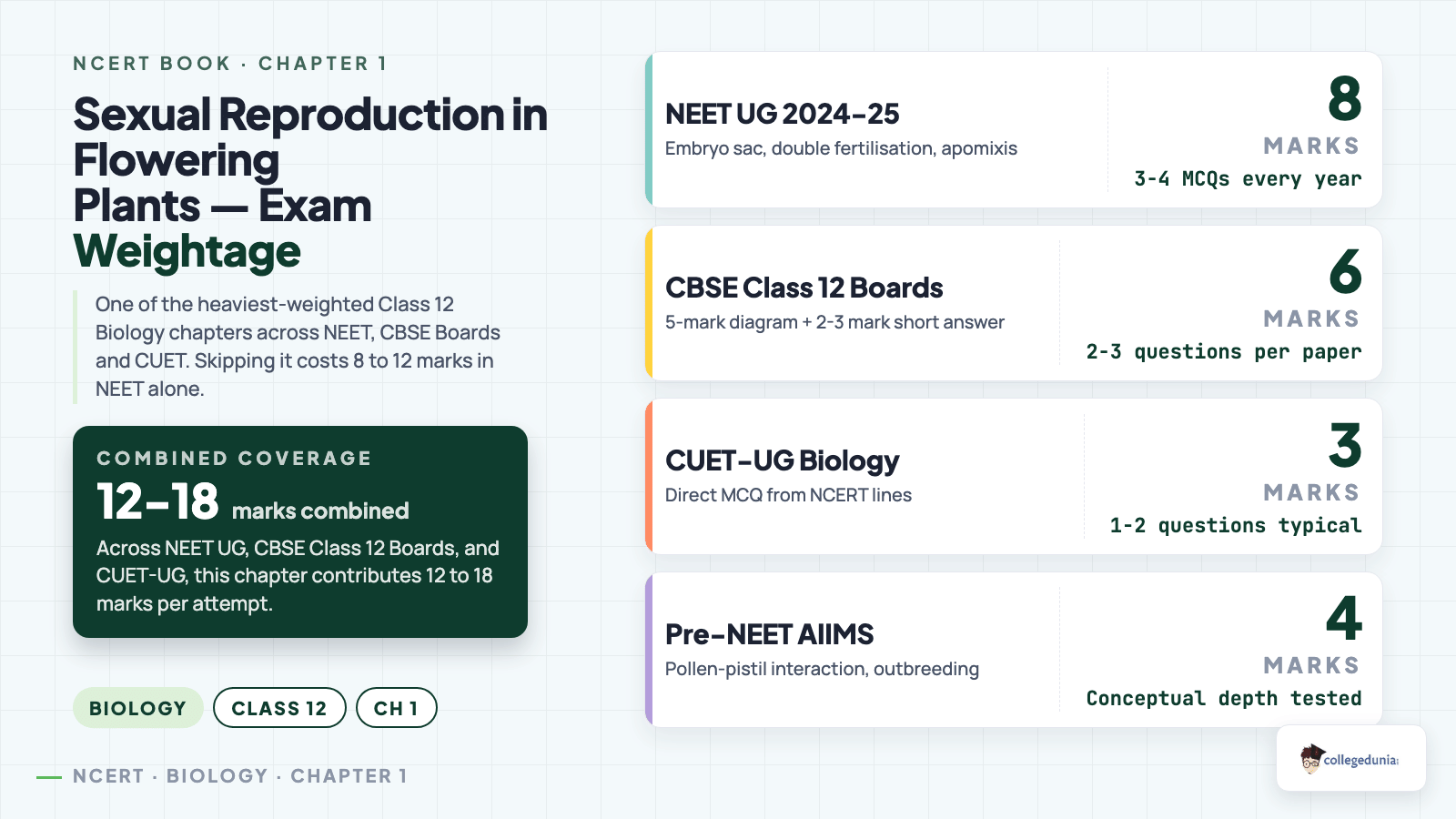
Chapter 1 Sexual Reproduction in Flowering Plants is the single highest-yield chapter for NEET Biology from the Class 12 syllabus and a guaranteed long-answer in the CBSE Board paper. Across the last five NEET papers it averaged 3 to 5 questions. This page hosts the official 25-page NCERT PDF and a full reading map.





- CBSE Weightage: 6 to 7 marks (one 3-mark labelled diagram plus one 3-mark question on double fertilisation, pollination or apomixis)
- NEET Weightage: 3 to 5 questions per year (highest among Class 12 Biology chapters)
- JEE Main Weightage: Not applicable (Biology is outside JEE Main)

The PDF above is the official NCERT print (code lebo101). Use the section index and reading plan below to plan revision for CBSE Boards and NEET 2027.
Sourced from the official NCERT 2026-27 reprint, cross-verified against the CBSE 2027 Class 12 Biology syllabus.
Why Sexual Reproduction in Flowering Plants Matters for NEET and CBSE Class 12 Biology
No Class 12 Biology chapter gives more marks per revision hour than Chapter 1. High diagram density, fixed terminology (microsporogenesis, embryo sac, syngamy, triple fusion, apomixis) and minimal numerical work make it ideal for last-week revision. The chapter contributes about 10 percent of the Class 12 NEET Biology paper.
How Collegedunia's NCERT Book PDF Helps You Study Sexual Reproduction in Flowering Plants
The official NCERT print is the source of truth for both CBSE Boards and NEET. This page wraps it with the navigation the raw PDF lacks.
- 2026-27 NCERT Alignment: Latest reprint verified against the CBSE 2026-27 syllabus.
- Section-to-NEET Map: Section 1.2 drives embryo-sac MCQs; 1.3 the triple-fusion question; 1.5 the apomixis MCQ.
- Cross-Reference: Every section maps to matching Collegedunia Notes, Formula Sheet and Solutions.
Top NEET-Yielding Concepts from Sexual Reproduction in Flowering Plants
Five concepts cover almost every CBSE prompt and most NEET questions from this chapter.
| Concept | Key point |
|---|---|
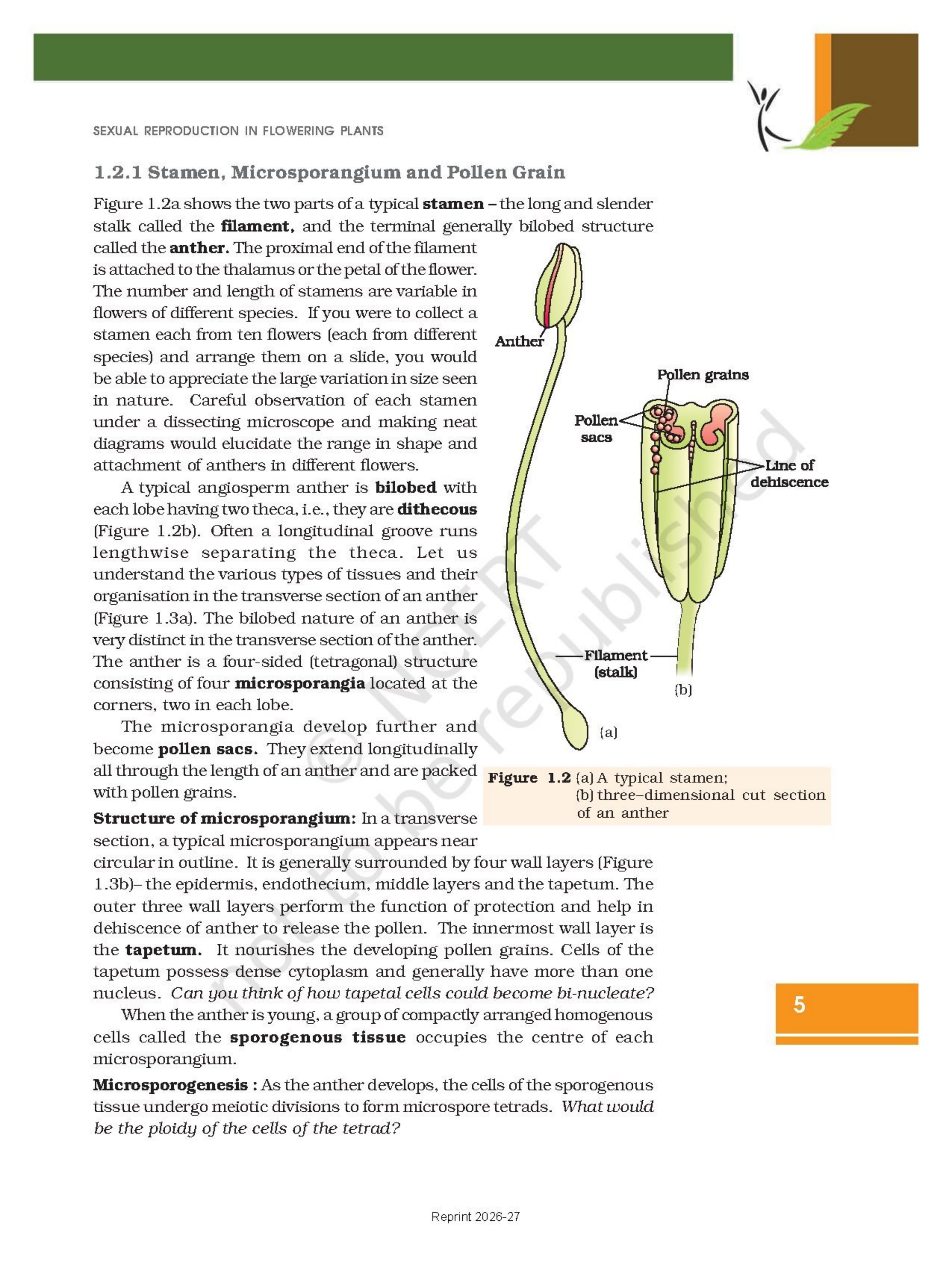
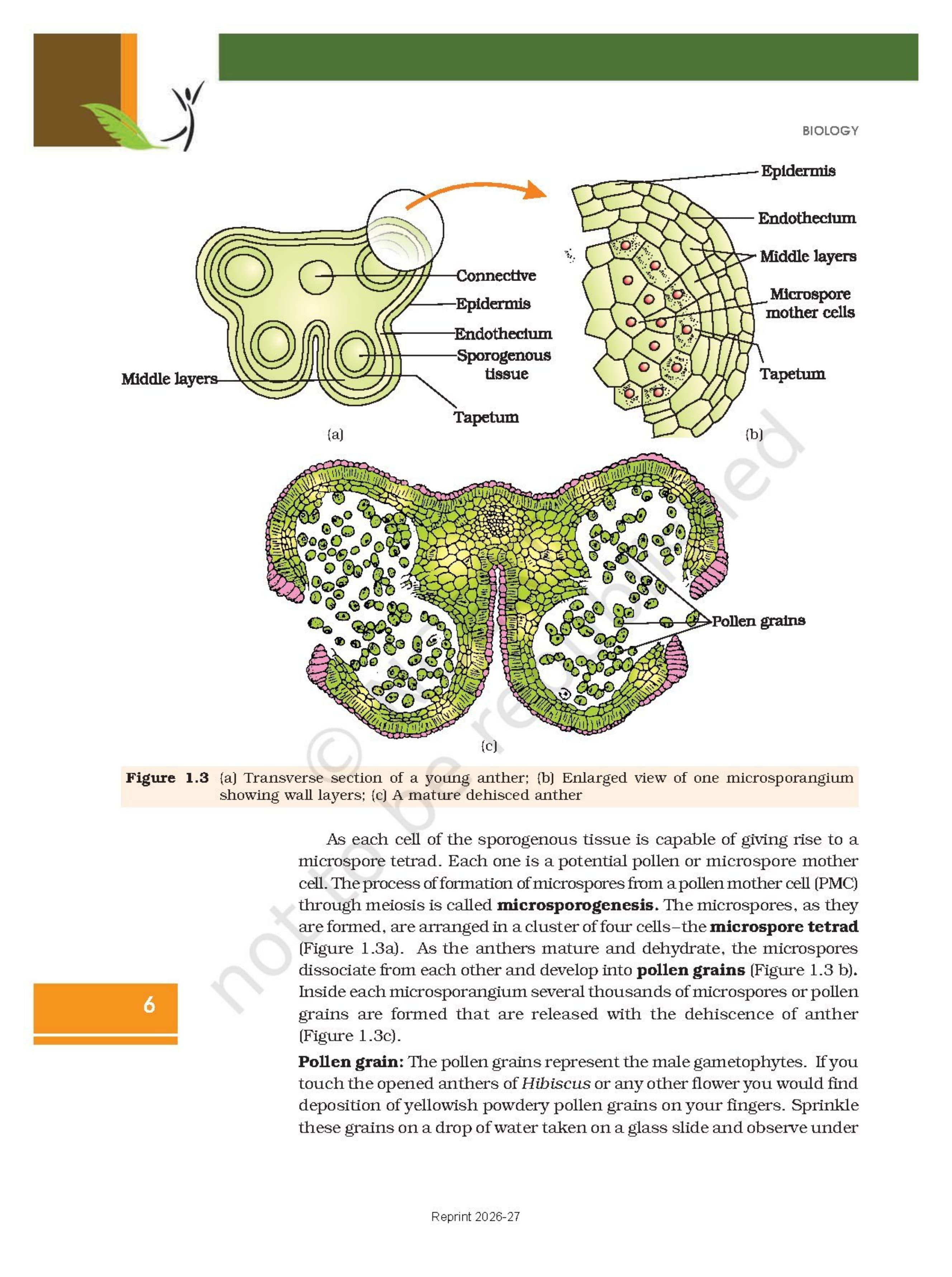
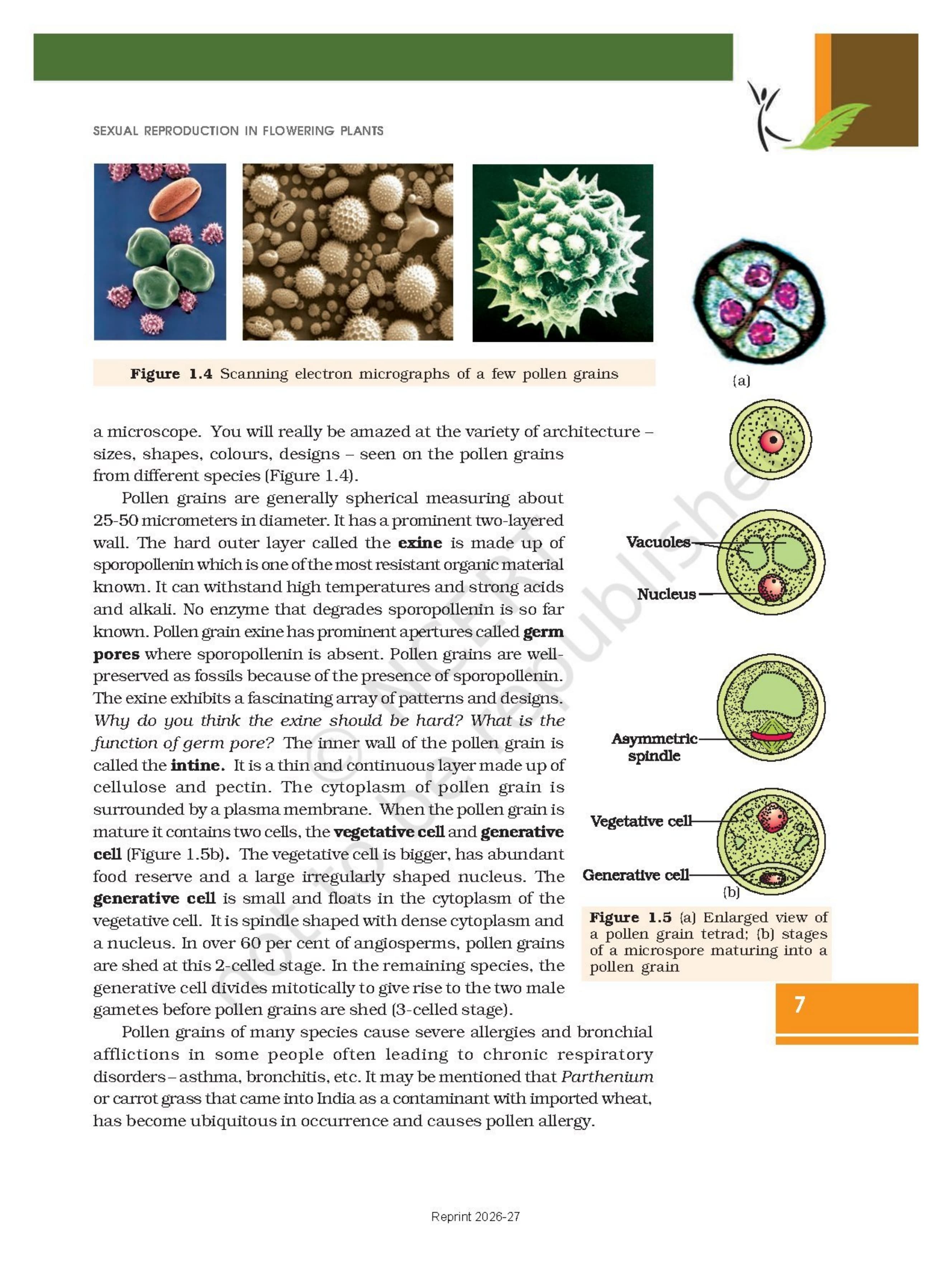
| Microsporogenesis | MMC → meiosis → microspore tetrad → four pollen grains |
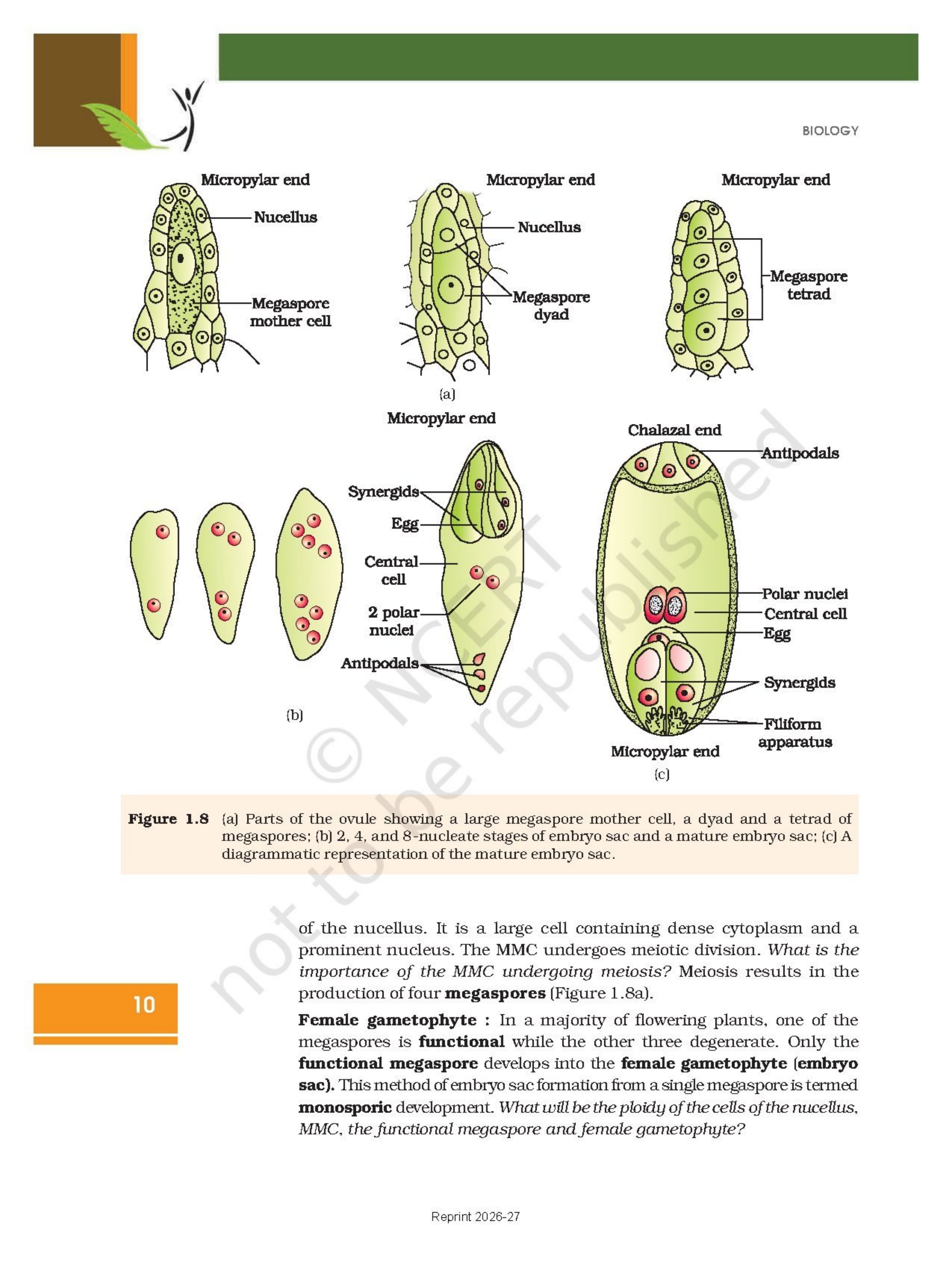
| Embryo sac (Polygonum type) | 8-nucleate, 7-celled: 3 antipodals + 2 synergids + 1 egg + 1 central cell (2 polar nuclei) |
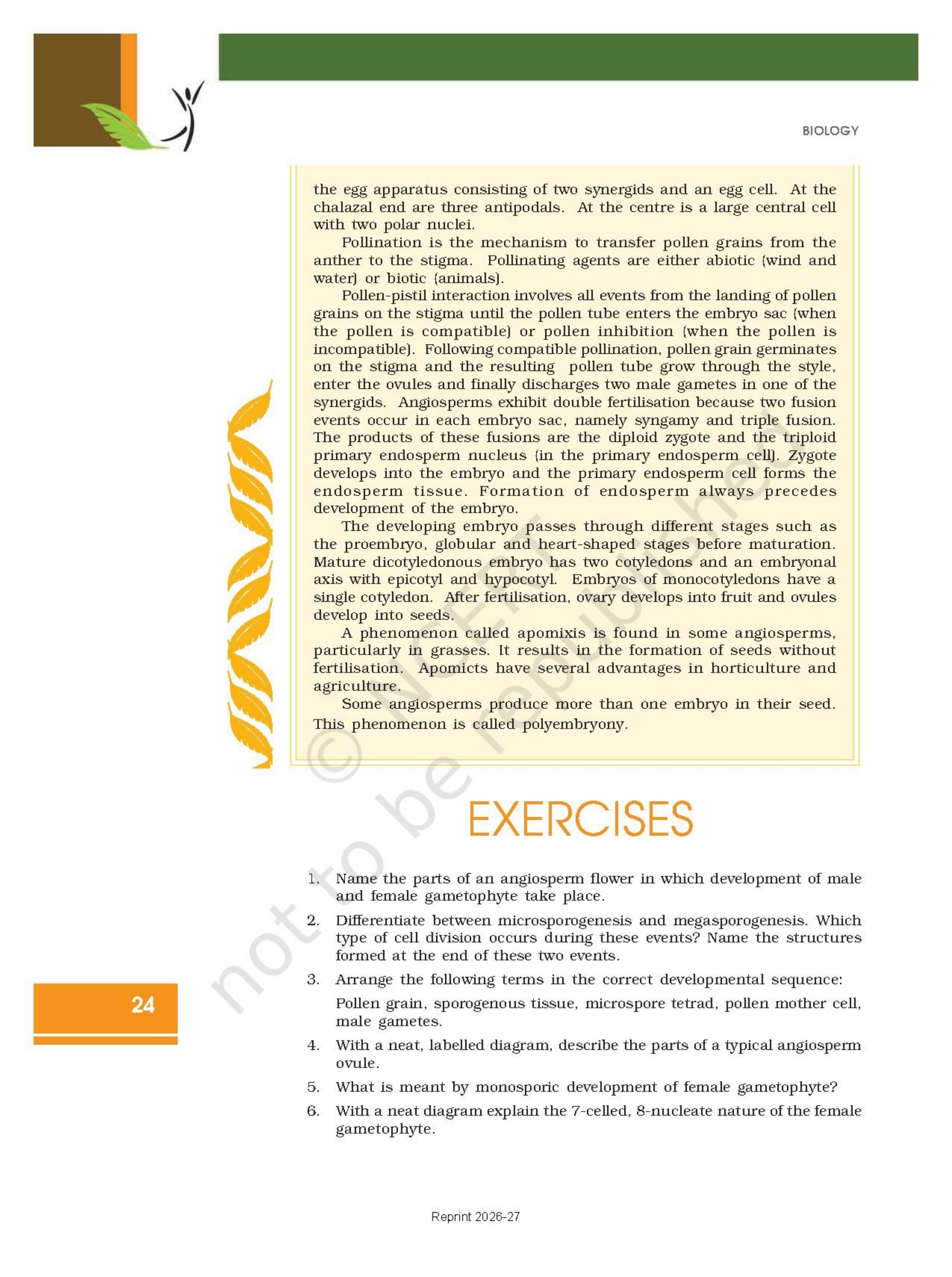
| Double Fertilisation | Syngamy: gamete + egg → zygote (2n); Triple fusion: gamete + polar nuclei → PEN (3n) |
| Pollen-pistil interaction | Pollen germinates on stigma; tube grows through style to embryo sac via micropyle |
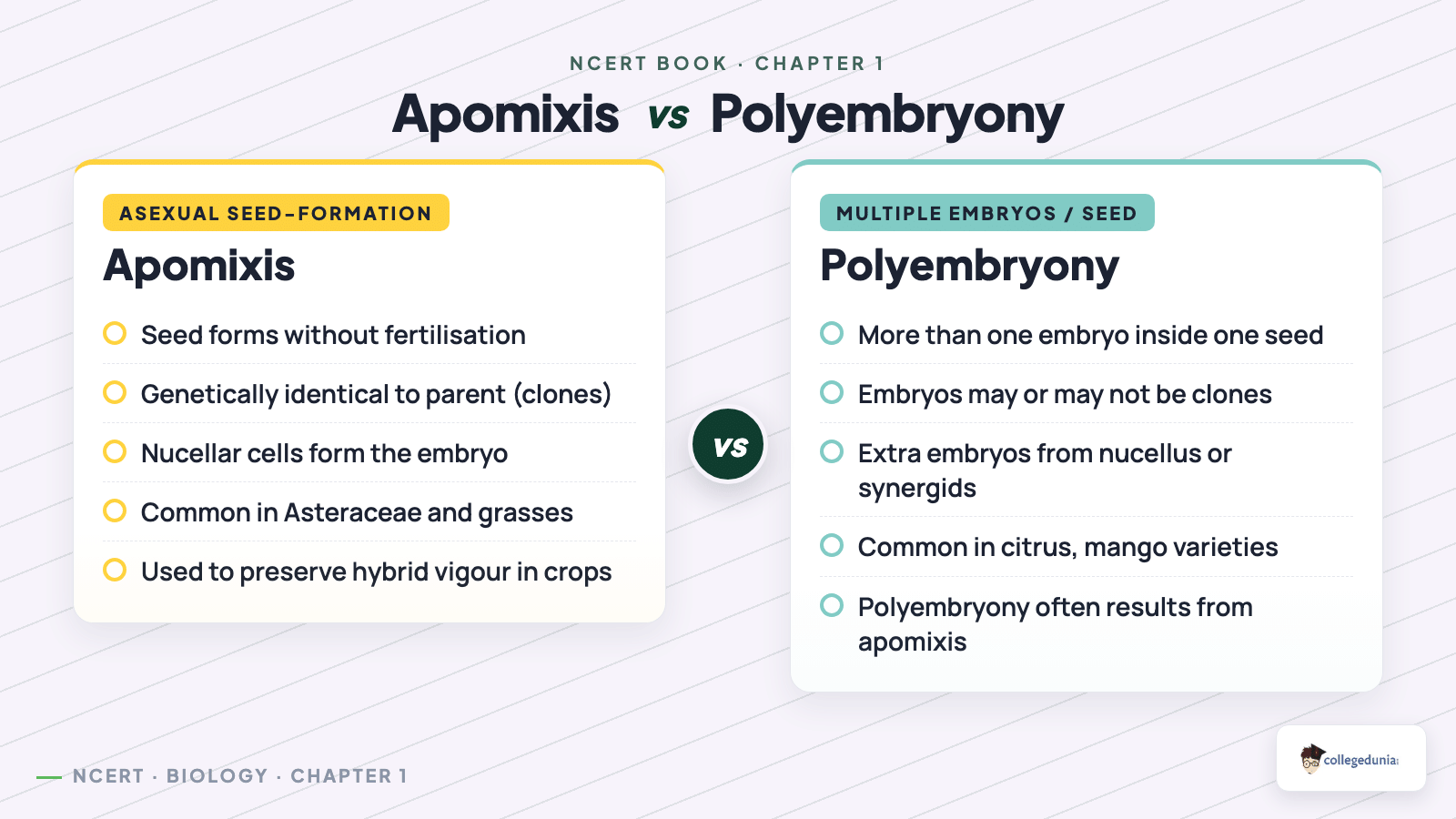
| Apomixis and Polyembryony | Apomixis = seed without fertilisation; polyembryony = >1 embryo per seed (Citrus, Mango) |
Full master sheet: Sexual Reproduction in Flowering Plants Formula Sheet
Sexual Reproduction in Flowering Plants NCERT Book: Section-by-Section Breakdown
Five numbered sections plus a summary and twelve exercises. Sections 1.2 and 1.3 drive almost every NEET question; 1.4 is a CBSE labelled-diagram favourite.
| Section | Title | Pages | What it covers |
|---|---|---|---|
| 1.1 | Flower - A Fascinating Organ of Angiosperms | 1-2 | Floral biology overview |
| 1.2 | Pre-fertilisation: Structures and Events | 2-15 | Stamen, pollen grain, embryo sac, pollination, outbreeding devices, pollen-pistil interaction |
| 1.3 | Double Fertilisation | 15-17 | Syngamy, triple fusion, zygote and primary endosperm nucleus |
| 1.4 | Post-fertilisation: Structures and Events | 17-20 | Endosperm, embryo, seed and fruit |
| 1.5 | Apomixis and Polyembryony | 20-21 | Asexual seed formation, hybrid vigour |
| - | Summary, Exercises (12 Qs) | 22-25 | Summary plus twelve end-of-chapter questions |
Class 12 Biology Chapter 1 Multi-Day Study Plan for Sexual Reproduction in Flowering Plants
A three-day plan works best given the diagram load and the dense vocabulary of Section 1.2.
| Day | What to read | What to practise | Time |
|---|---|---|---|
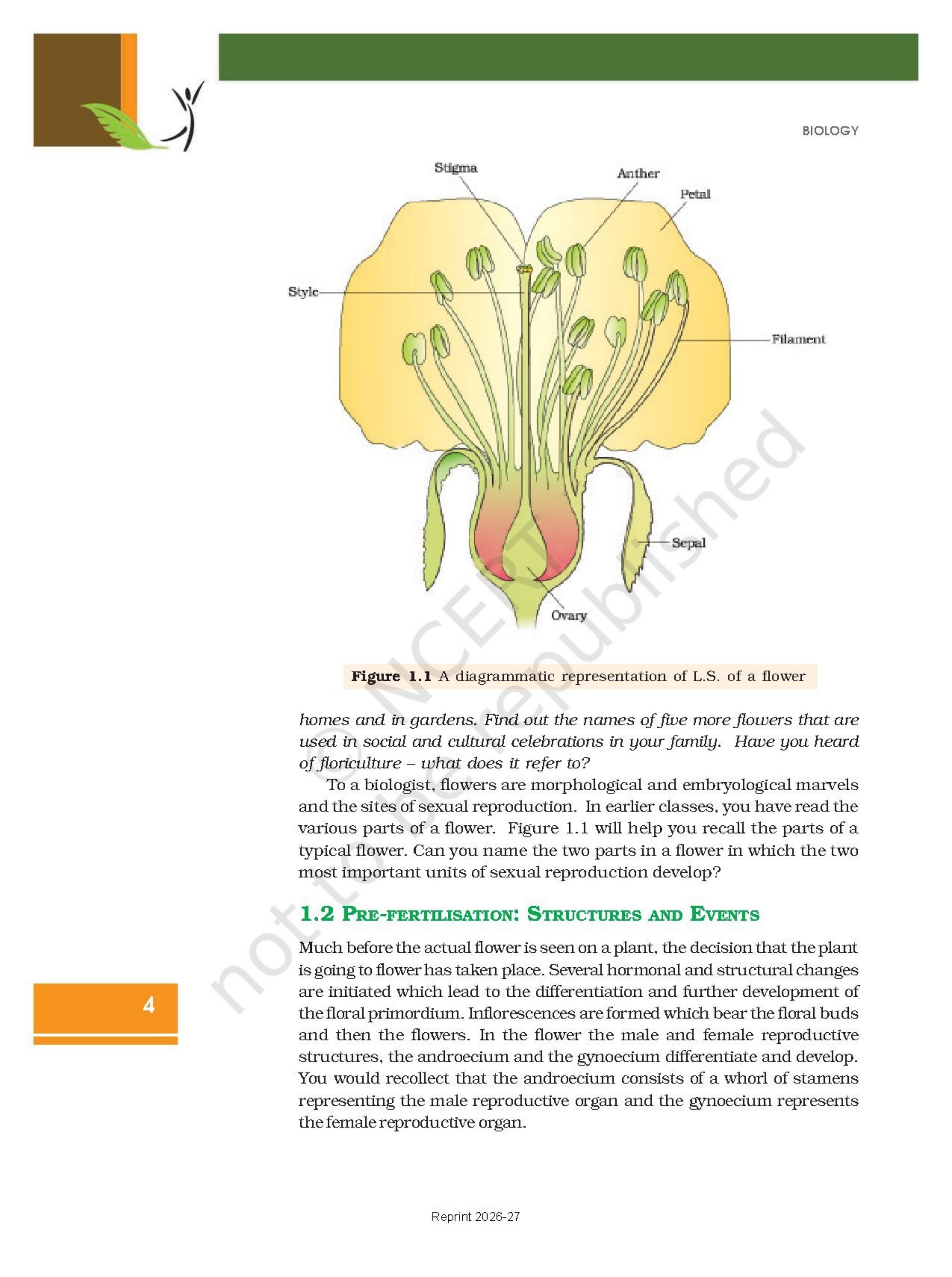
| Day 1 | Sections 1.1 and 1.2 up to embryo sac (Figs 1.1 to 1.6) | Exercises Q1 to Q4; redraw anther T.S. and embryo sac | 2.5 h |
| Day 2 | Rest of 1.2 (pollination, outbreeding, pollen-pistil) plus 1.3 | Exercises Q5 to Q9; redraw double-fertilisation schematic | 2.5 h |
| Day 3 | Sections 1.4 and 1.5 plus full revision | Exercises Q10 to Q12 plus NEET-pattern MCQs on apomixis | 2 h |
What Stayed in Sexual Reproduction in Flowering Plants for the 2026-27 NCERT
NCERT confirmed no deletions in the Class 12 Biology textbook for 2026-27. Chapter 1 retains every section and all diagrams.
| Sub-topic | Status in 2026-27 |
|---|---|
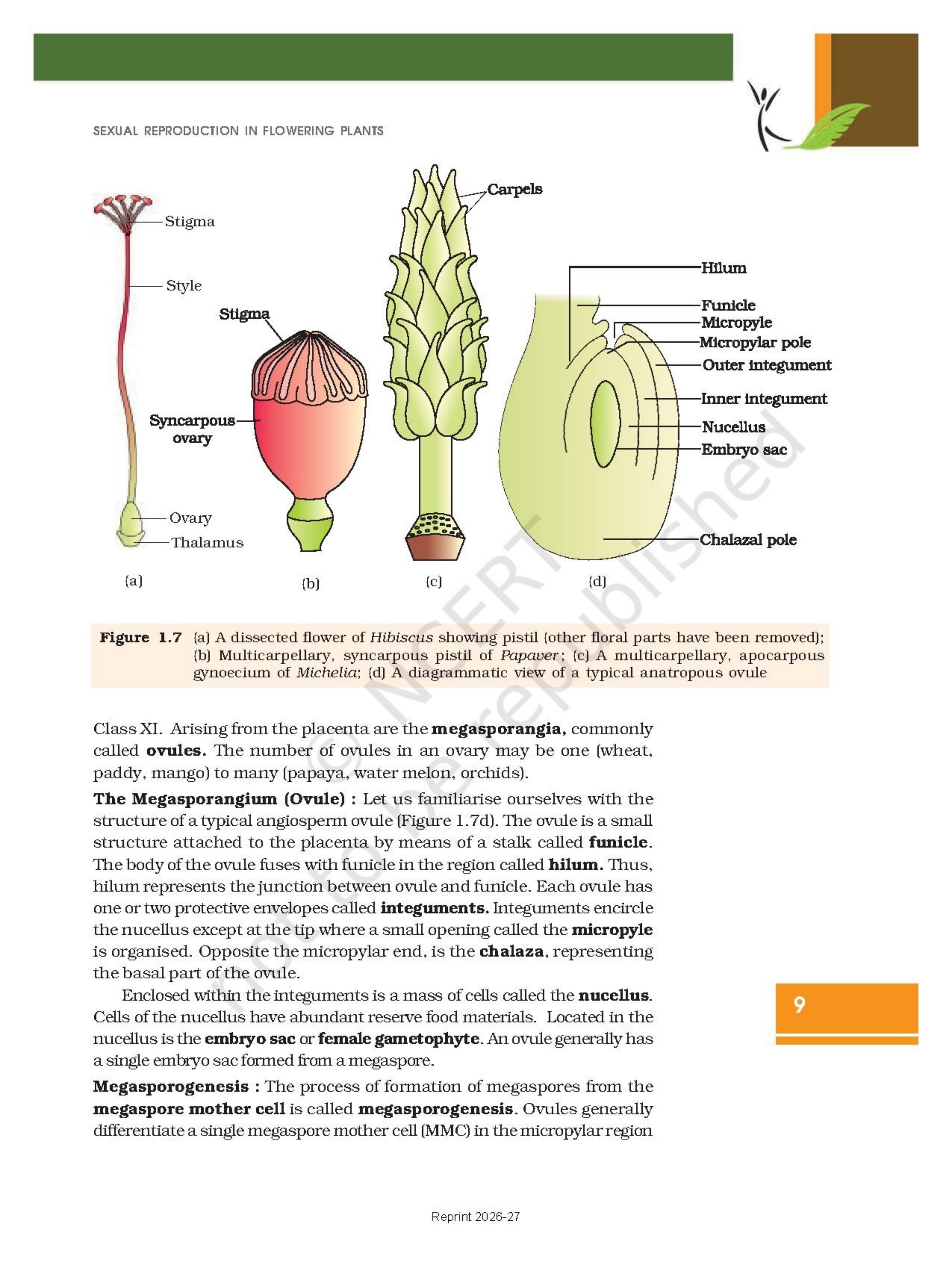
| Pre-fertilisation structures (Sections 1.2.1, 1.2.2) | Kept - stamen T.S., microsporogenesis, Polygonum-type embryo sac |
| Pollination types and outbreeding devices (Sections 1.2.3, 1.2.4) | Kept - Vallisneria example and all five outbreeding strategies |
| Double Fertilisation (Section 1.3) | Kept - syngamy and triple-fusion schematic intact |
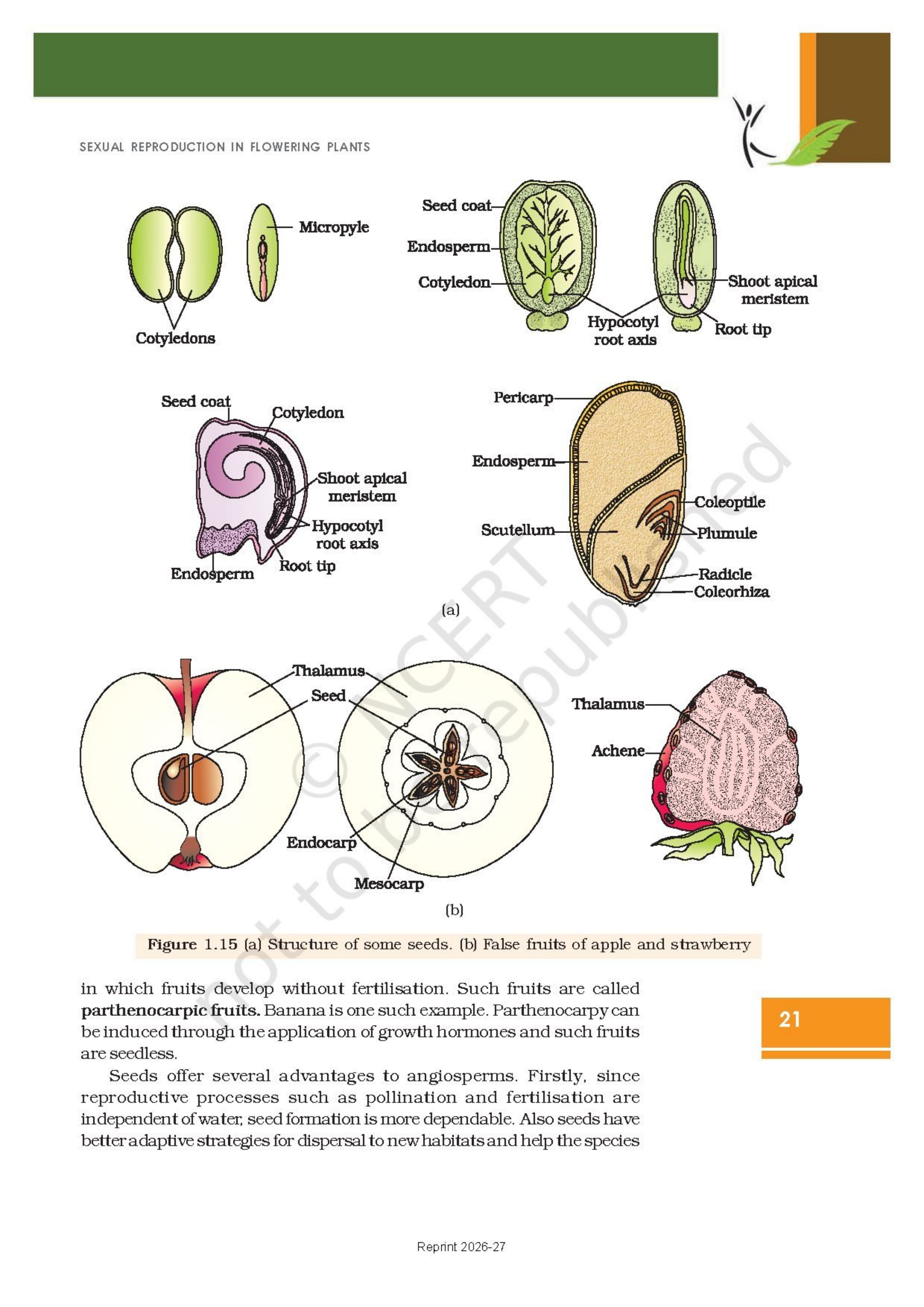
| Post-fertilisation events (Section 1.4) | Kept - endosperm, embryo, seed and fruit unchanged |
| Apomixis and Polyembryony (Section 1.5) | Kept - Citrus and Mango examples retained |
Sexual Reproduction in Flowering Plants PYQ Trend in CBSE and NEET (2025 to 2021)
The three most repeated question types are a labelled embryo-sac diagram, a pollination-types comparison, and an apomixis-versus-parthenocarpy short answer.
| Year | CBSE Board | NEET |
|---|---|---|
| 2025 | Labelled mature embryo sac (3 marks) | Triple fusion ploidy, apomixis example (2 questions) |
| 2024 | Apomixis versus parthenocarpy (2 marks) | Microsporogenesis, pollen-pistil interaction (3 questions) |
| 2023 | Double fertilisation with diagram (3 marks) | Embryo-sac cell count, autogamy vs geitonogamy (2 questions) |
| 2022 | Pollen grain structure and viability (2 marks) | Polyembryony in Citrus, anatropous ovule (2 questions) |
| 2021 | - | - |
Full PYQ map: Sexual Reproduction in Flowering Plants Class 12 Biology NCERT Solutions
Sexual Reproduction in Flowering Plants Video Lecture for Class 12 Biology
Source: Competition Wallah on YouTube
Sexual Reproduction in Flowering Plants Chapter-wise Marks Weightage in Class 12 Biology
Typical CBSE Board marks across all 13 chapters, averaged over the last five board papers. Chapter 1 tops the NEET question count.
| Chapter | Avg CBSE Marks | NEET Questions/yr |
|---|---|---|
| Ch 1 Sexual Reproduction in Flowering Plants | 7 | 3-5 |
| Ch 2 Human Reproduction | 6 | 3-4 |
| Ch 3 Reproductive Health | 4 | 1-2 |
| Ch 4 Principles of Inheritance and Variation | 8 | 3-4 |
| Ch 5 Molecular Basis of Inheritance | 8 | 3-5 |
| Ch 6 Evolution | 5 | 2-3 |
| Ch 7 Human Health and Disease | 6 | 2-3 |
| Ch 8 Microbes in Human Welfare | 4 | 1-2 |
| Ch 9 Biotechnology: Principles and Processes | 6 | 2-3 |
| Ch 10 Biotechnology and Its Applications | 5 | 1-2 |
| Ch 11 Organisms and Populations | 4 | 2-3 |
| Ch 12 Ecosystem | 5 | 1-2 |
| Ch 13 Biodiversity and Conservation | 4 | 1-2 |
Author, Edition and Publisher for the Sexual Reproduction in Flowering Plants NCERT PDF
- Book: Biology, Class 12
- Chapter: 1 - Sexual Reproduction in Flowering Plants
- Publisher: NCERT
- Edition: 2026-27 reprint
- Pages: 25 | Code: lebo101
- Languages: English, Hindi (Jeev Vigyan)
Related: Class 12 Biology NCERT Book PDF (All Chapters)
Student Feedback: Sexual Reproduction in Flowering Plants Class 12 Biology Survey
Student Feedback
In a 2025-26 survey of 12,400 Class 12 Biology students, here is what stood out about Chapter 1:
- 73% of students surveyed marked the double-fertilisation labelled diagram as the hardest sub-topic.
- 61% reported losing marks on the microsporogenesis vs megasporogenesis comparison.
- 4 out of 5 students skipped drawing the pollen-pistil interaction in their answer sheet.
- Only 34% attempted all 12 NCERT exercises. Toppers attempted every question and revisited wrong answers within 24 hours.
Source: 2025-26 Class 12 Biology student survey, 12,400 students across 18 states.
Other Resources for Sexual Reproduction in Flowering Plants Class 12 Biology
| Resource | Link |
|---|---|
| NCERT Book PDF | Sexual Reproduction in Flowering Plants NCERT Book |
| NCERT Solutions | Class 12 Biology Chapter 1 NCERT Solutions |
| Notes | Class 12 Biology Chapter 1 Notes |
| Formula Sheet | Class 12 Biology Chapter 1 Formula Sheet |
| Exemplar Book PDF | Class 12 Biology Chapter 1 Exemplar Book PDF |
| Exemplar Solutions | Class 12 Biology Chapter 1 Exemplar Solutions |
| Handwritten Notes | Class 12 Biology Chapter 1 Handwritten Notes |
NCERT Book PDF for Class 12 Biology: All Chapters
Every chapter of the 2026-27 Class 12 Biology NCERT with its dedicated Collegedunia NCERT Book PDF page.
| Chapter | Resource |
|---|---|
| Chapter 1 | Sexual Reproduction in Flowering Plants NCERT Book PDF |
| Chapter 2 | Human Reproduction NCERT Book PDF |
| Chapter 3 | Reproductive Health NCERT Book PDF |
| Chapter 4 | Principles of Inheritance and Variation NCERT Book PDF |
| Chapter 5 | Molecular Basis of Inheritance NCERT Book PDF |
| Chapter 6 | Evolution NCERT Book PDF |
| Chapter 7 | Human Health and Disease NCERT Book PDF |
| Chapter 8 | Microbes in Human Welfare NCERT Book PDF |
| Chapter 9 | Biotechnology - Principles and Processes NCERT Book PDF |
| Chapter 10 | Biotechnology and its Applications NCERT Book PDF |
| Chapter 11 | Organisms and Populations NCERT Book PDF |
| Chapter 12 | Ecosystem NCERT Book PDF |
| Chapter 13 | Biodiversity and Conservation NCERT Book PDF |
Sexual Reproduction in Flowering Plants Class 12 Biology NCERT Book PDF FAQs
Ques. Where can I download the Class 12 Biology Chapter 1 Sexual Reproduction in Flowering Plants NCERT Book PDF?
Ans. You can download the Sexual Reproduction in Flowering Plants Class 12 Biology NCERT Book PDF directly from this page. Both the Normal and HD versions are available and both are free, with no registration required.
Ques. Is the Sexual Reproduction in Flowering Plants chapter aligned with the 2026-27 NCERT syllabus?
Ans. Yes. NCERT has confirmed no deletions or alterations in the Class 12 Biology textbook for the 2026-27 academic session. Chapter 1 retains every numbered section, the photographs of Vallisneria, the embryo-sac and double-fertilisation diagrams, and the artificial-hybridisation case study exactly as printed in the previous edition.
Ques. How many pages is the Class 12th Biology Sexual Reproduction in Flowering Plants NCERT Book PDF?
Ans. The chapter runs 25 pages, covering five numbered sections from Flower as an Organ of Angiosperms through Apomixis and Polyembryony, a summary, and twelve end-of-chapter exercises.
Ques. How many marks does Sexual Reproduction in Flowering Plants carry in the CBSE Class 12 Biology Board exam?
Ans. Sexual Reproduction in Flowering Plants typically carries 6 to 7 marks in the Class 12 Biology Board exam, usually split as one 3-mark labelled-diagram (anatropous ovule or mature embryo sac) plus a 3-mark question on double fertilisation, pollination or apomixis. The chapter is also the top NEET Biology chapter from Class 12, contributing 3 to 5 questions per year.
Ques. What does Chapter 1 Sexual Reproduction in Flowering Plants cover?
Ans. Chapter 1 covers five numbered sections: Flower as a Fascinating Organ of Angiosperms; Pre-fertilisation Structures and Events (stamen, microsporogenesis, pollen grain, pistil, megasporangium, embryo sac, pollination, outbreeding devices, pollen-pistil interaction, artificial hybridisation); Double Fertilisation (syngamy and triple fusion); Post-fertilisation Structures and Events (endosperm, embryo, seed and fruit); and Apomixis and Polyembryony.
Ques. What is double fertilisation in flowering plants?
Ans. Double fertilisation is the fusion event unique to angiosperms in which both male gametes of a pollen grain take part in fusion inside the embryo sac. The first male gamete fuses with the egg cell (syngamy) to form the diploid zygote (2n) ; the second male gamete fuses with the two polar nuclei of the central cell (triple fusion) to form the triploid primary endosperm nucleus (3n) . Both events occur in every successful angiosperm fertilisation.
Ques. Which sections in Sexual Reproduction in Flowering Plants are most important for NEET?
Ans. Section 1.2 (Pre-fertilisation Structures and Events) drives the highest number of NEET questions through microsporogenesis, embryo-sac formation, pollination types and outbreeding devices. Section 1.3 (Double Fertilisation) and Section 1.5 (Apomixis and Polyembryony) are the next two highest-yield sections. Together these three sections account for almost every NEET question from the chapter.
Ques. What is the difference between apomixis and parthenocarpy?
Ans. Apomixis is seed formation without fertilisation, producing seeds that are genetically identical to the mother plant (examples: many Asteraceae and grasses). Parthenocarpy is fruit development without fertilisation, producing seedless fruits (examples: banana, certain grape and watermelon varieties). Apomixis preserves hybrid vigour across generations; parthenocarpy only matters within a single fruit-bearing cycle.
Ques. How long should I take to complete the Sexual Reproduction in Flowering Plants NCERT chapter?
Ans. A three-day plan of about 7 hours total is realistic: one day for the floral overview and the first half of pre-fertilisation (Sections 1.1 and 1.2 up to embryo sac), one for the rest of pre-fertilisation plus double fertilisation (Sections 1.2 and 1.3), and one for post-fertilisation, apomixis and full revision (Sections 1.4 and 1.5). The multi-day study plan further up on this page breaks the hours down section by section.



Comments