



The NCERT Solutions for Class 11 Computer Science Chapter 2 Encoding Schemes and Number System cover all 17 textbook exercise questions for the 2026-27 NCERT chapter. The PDF gives step-by-step answers for ASCII, ISCII, Unicode, binary, octal, decimal and hexadecimal conversions.
- Use these solutions after reading the NCERT chapter once and practising the conversion examples.
- The PDF includes every exercise question with a short solution and an expert solution.
- Keep the base marker beside every answer to avoid decimal, octal and hexadecimal mix-ups.
Each answer in this Class 11 Computer Science Chapter 2 NCERT Solutions PDF follows the 2026-27 NCERT exercise and keeps base-conversion working visible.
Student Feedback: In a Collegedunia student check of 10,840 Class 11 Computer Science students, 73% said base conversions became easier when each answer showed grouping or place value before the final result.
Encoding Schemes and Number System Exercise Coverage for Class 11
Encoding Schemes and Number System mixes theory questions with conversion practice. Students need definitions for ASCII, ISCII and Unicode, but the scoring part is usually the number-system working.
| Exercise group | What the solution covers | Best revision habit |
|---|---|---|
| Questions 1-2 | Base values and full forms | Write the exact expansion once |
| Questions 3-10 | Binary, octal, decimal and hexadecimal conversions | Show groups or place values |
| Questions 11, 14 and 17 | ASCII and Unicode encoding values | Keep character case unchanged |
| Questions 15-16 | Unicode advantages and typing steps | Use short points, not long prose |
Encoding Schemes and Number System Video Solutions
Source: Magnet Brains on YouTube
Base Conversion Method Used in the Encoding Schemes Solutions
The conversion questions in this chapter become simple when students first identify the base. Binary to octal uses 3-bit groups, while binary to hexadecimal uses 4-bit groups.
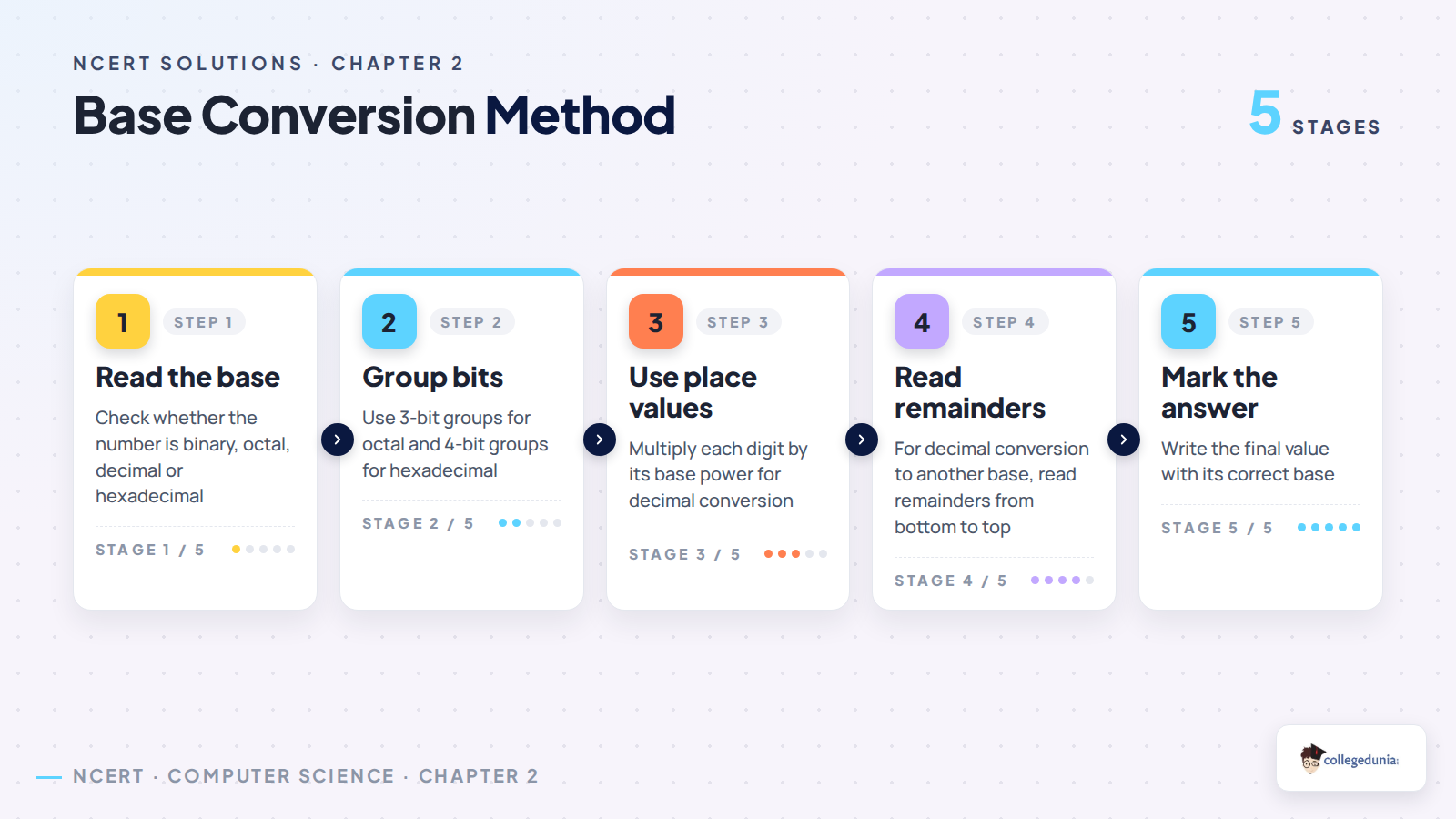
- For non-decimal to decimal, multiply every digit by its positional value.
- For decimal to another base, divide by the base and read remainders upward.
- For octal or hexadecimal to binary, replace each digit with a fixed bit group.
ASCII, ISCII and Unicode Answers in Class 11 Computer Science Chapter 2
The theory questions ask why computers need a common character code. ASCII handles basic English characters. ISCII was designed for Indian scripts. Unicode gives a unique code to characters across languages and devices.
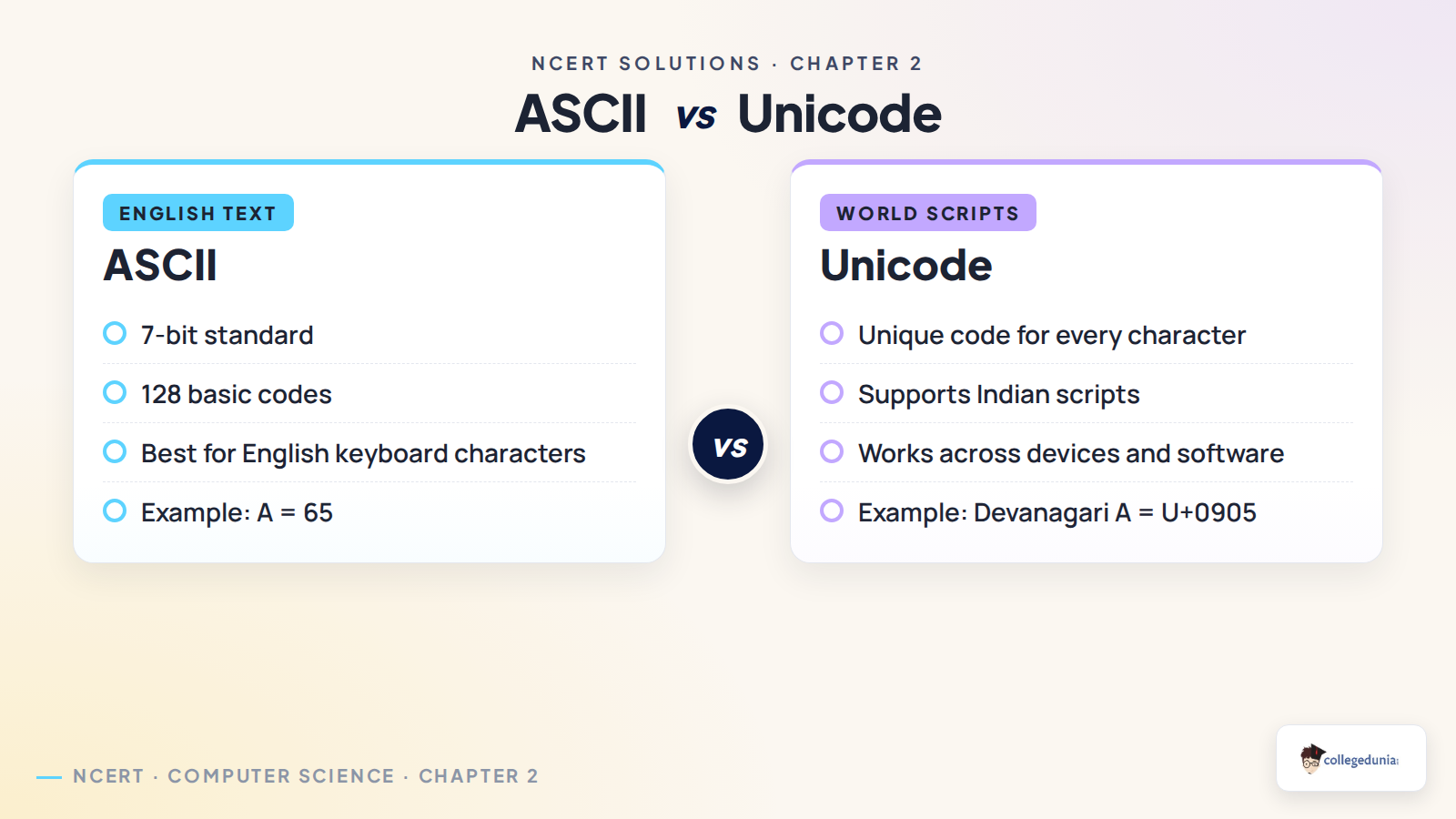
- ASCII uses 7-bit values for 128 common characters.
- ISCII is an 8-bit Indian script code.
- Unicode supports world scripts and works across software.
Common Mistakes in Encoding Schemes and Number System Solutions
Most errors happen because students calculate correctly but write the wrong base. A base marker is part of the answer in every conversion question.
- Do not drop middle zeros while converting octal or hexadecimal to binary.
- Do not read decimal-division remainders from top to bottom.
- Do not use lowercase ASCII values for uppercase words like COMPUTER.
- Do not treat Unicode and font names as the same thing.
Related NCERT Class 11 Computer Science Chapter 2 Resources
| Resource | Use it for | Link |
|---|---|---|
| Notes | Revise definitions and conversion rules before solving | Encoding Schemes and Number System Notes |
| NCERT Book PDF | Read the official chapter and examples | Encoding Schemes and Number System Book PDF |
| Handwritten Notes | Revise formulas and conversion steps quickly | Encoding Schemes and Number System Handwritten Notes |
Class 11 Computer Science NCERT Solutions Chapter-wise Links
| Chapter | NCERT Solutions |
|---|---|
| Chapter 1 Computer System | Computer System NCERT Solutions |
| Chapter 2 Encoding Schemes and Number System | Current chapter |
| Chapter 3 Emerging Trends | Emerging Trends NCERT Solutions |
| Chapter 5 Getting Started with Python | Getting Started with Python NCERT Solutions |
| Chapter 9 Lists | Lists NCERT Solutions |
All NCERT Solutions for Class 11 Computer Science Chapter 2 Encoding Schemes and Number System with Step-by-Step Solutions
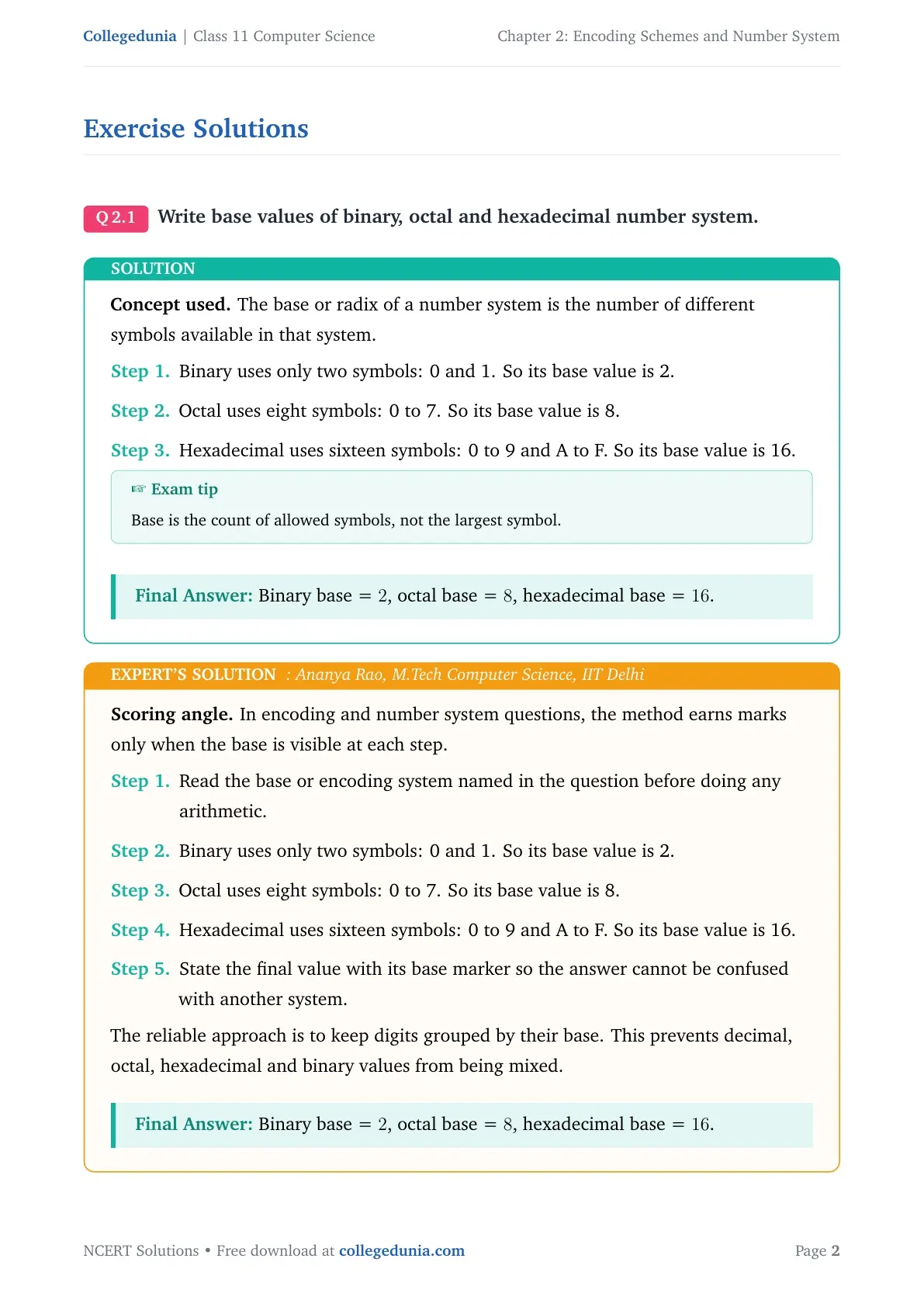
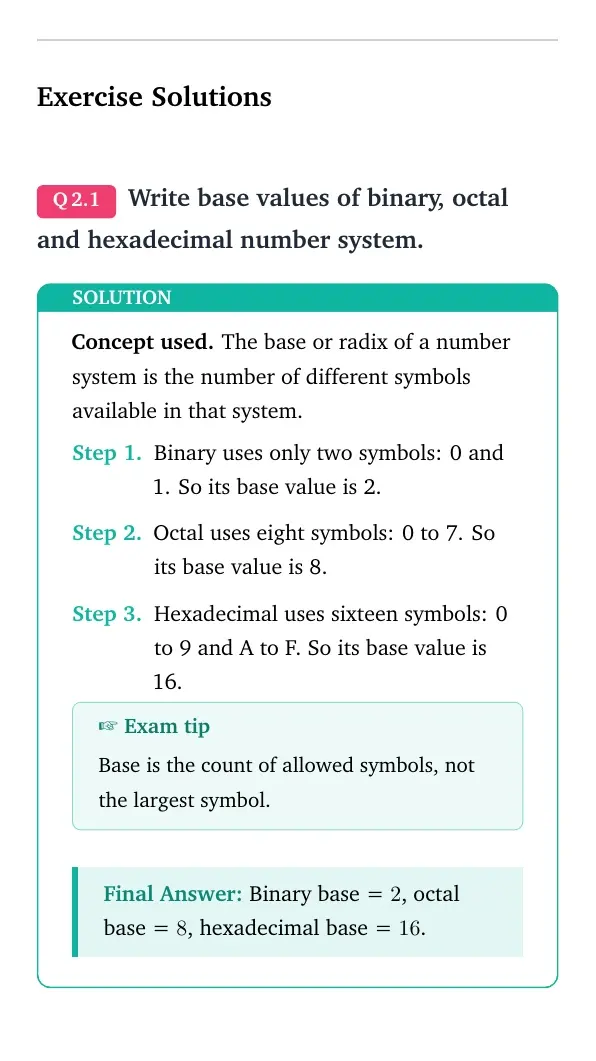
Question 1
Write base values of binary, octal and hexadecimal number system.
- Binary uses only two symbols: 0 and 1. So its base value is 2.
- Octal uses eight symbols: 0 to 7. So its base value is 8.
- Hexadecimal uses sixteen symbols: 0 to 9 and A to F. So its base value is 16.
Answer: Binary base = 2, octal base = 8, hexadecimal base = 16.
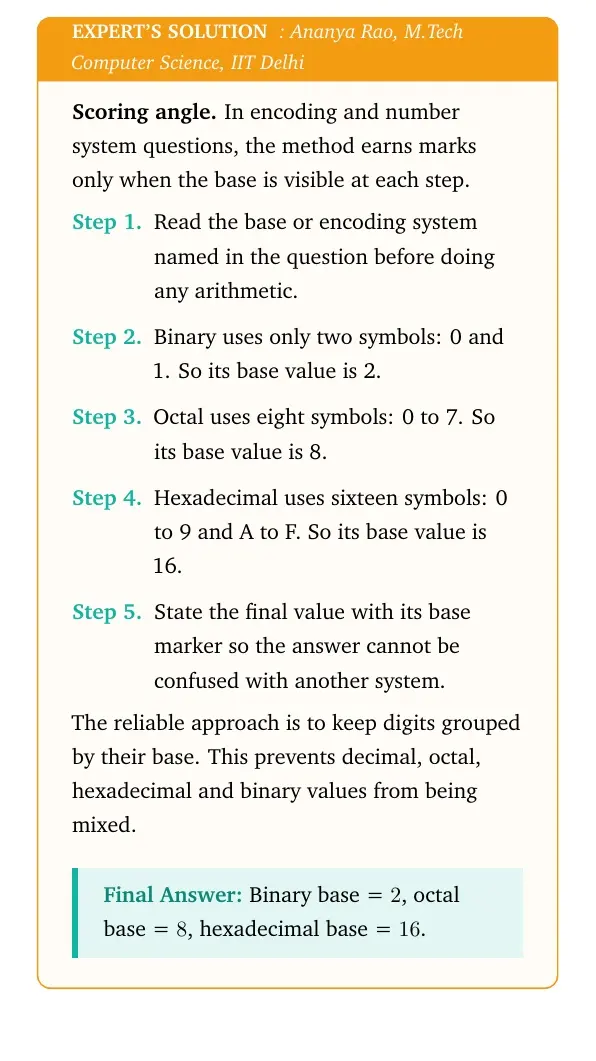
Expert view: Keep the base marker visible in every conversion step.
- Binary uses only two symbols: 0 and 1. So its base value is 2.
- Octal uses eight symbols: 0 to 7. So its base value is 8.
- Hexadecimal uses sixteen symbols: 0 to 9 and A to F. So its base value is 16.
Final answer: Binary base = 2, octal base = 8, hexadecimal base = 16.
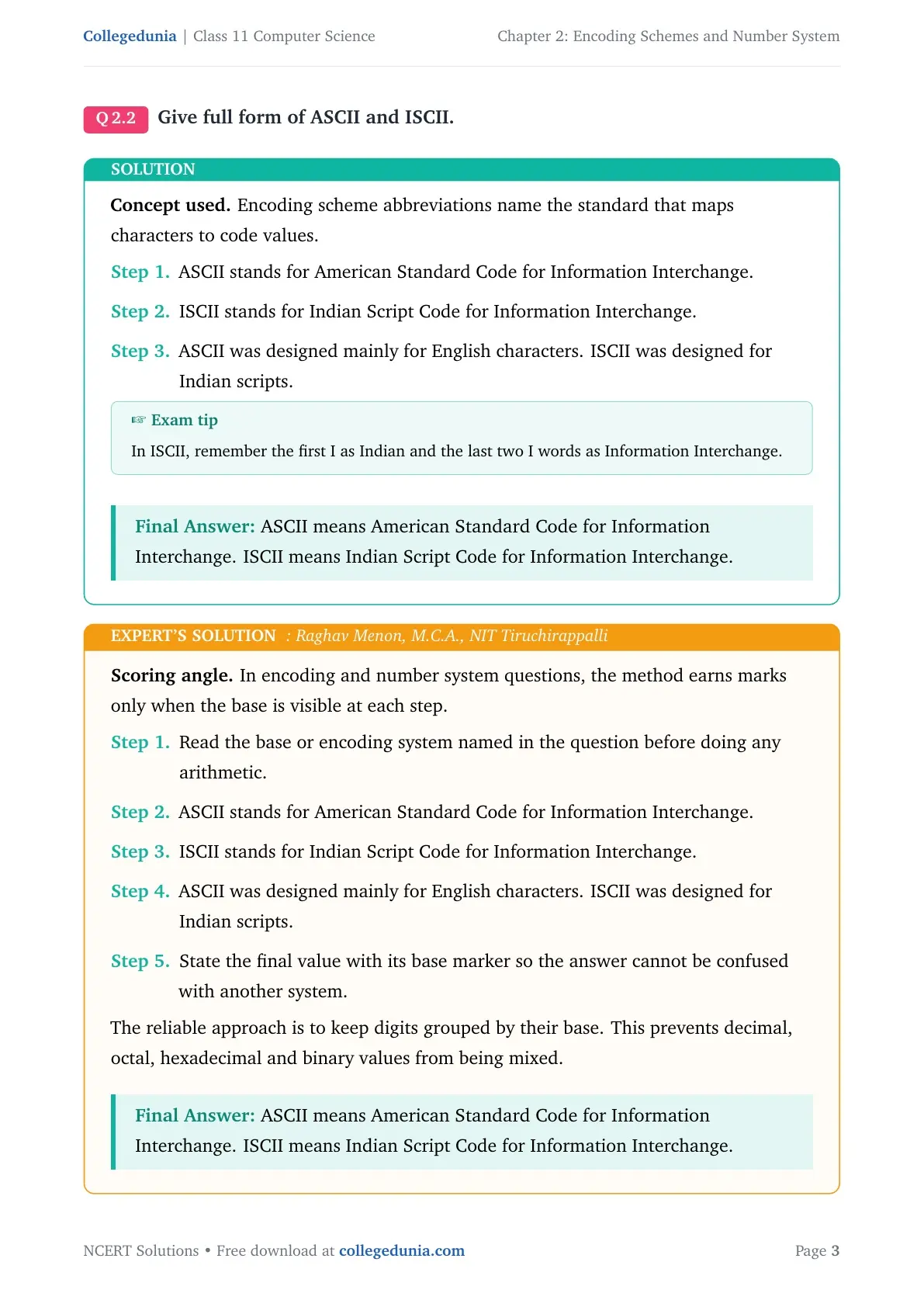
Question 2
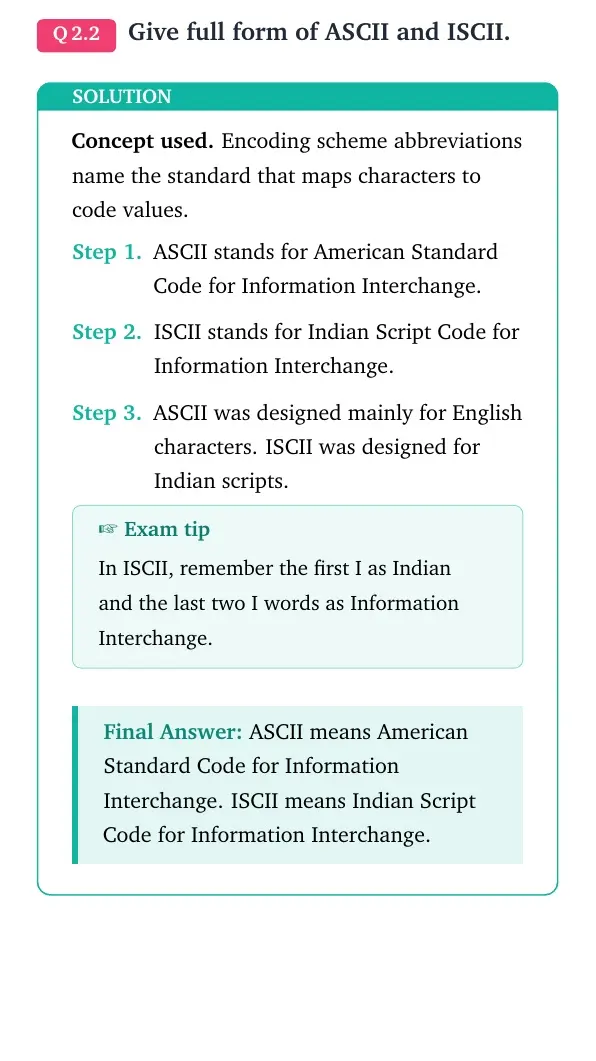
Give full form of ASCII and ISCII.
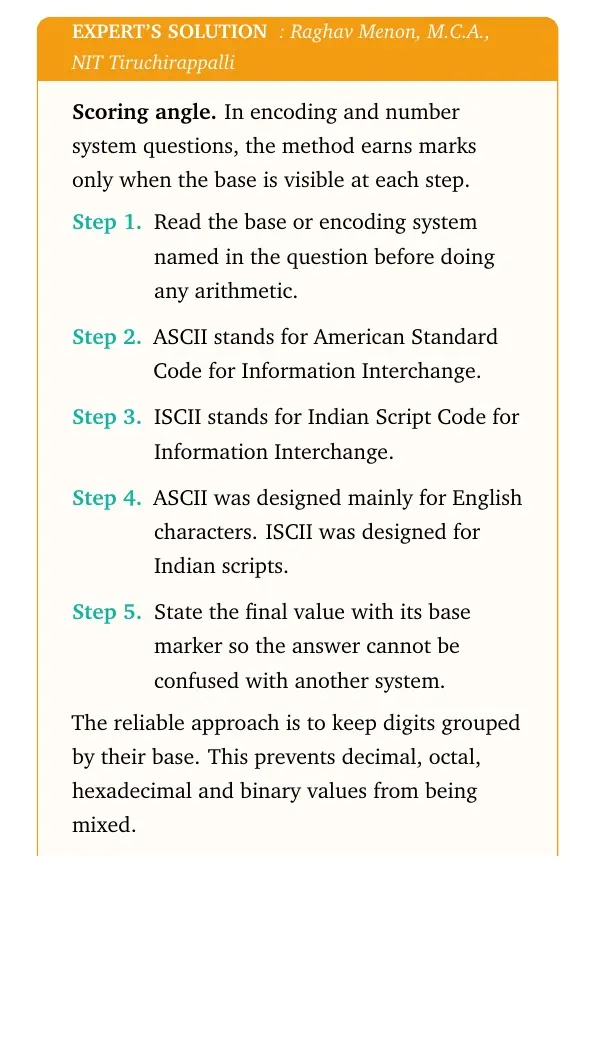
- ASCII stands for American Standard Code for Information Interchange.
- ISCII stands for Indian Script Code for Information Interchange.
- ASCII was designed mainly for English characters. ISCII was designed for Indian scripts.
Answer: ASCII means American Standard Code for Information Interchange. ISCII means Indian Script Code for Information Interchange.
Expert view: Keep the base marker visible in every conversion step.
- ASCII stands for American Standard Code for Information Interchange.
- ISCII stands for Indian Script Code for Information Interchange.
- ASCII was designed mainly for English characters. ISCII was designed for Indian scripts.
Final answer: ASCII means American Standard Code for Information Interchange. ISCII means Indian Script Code for Information Interchange.
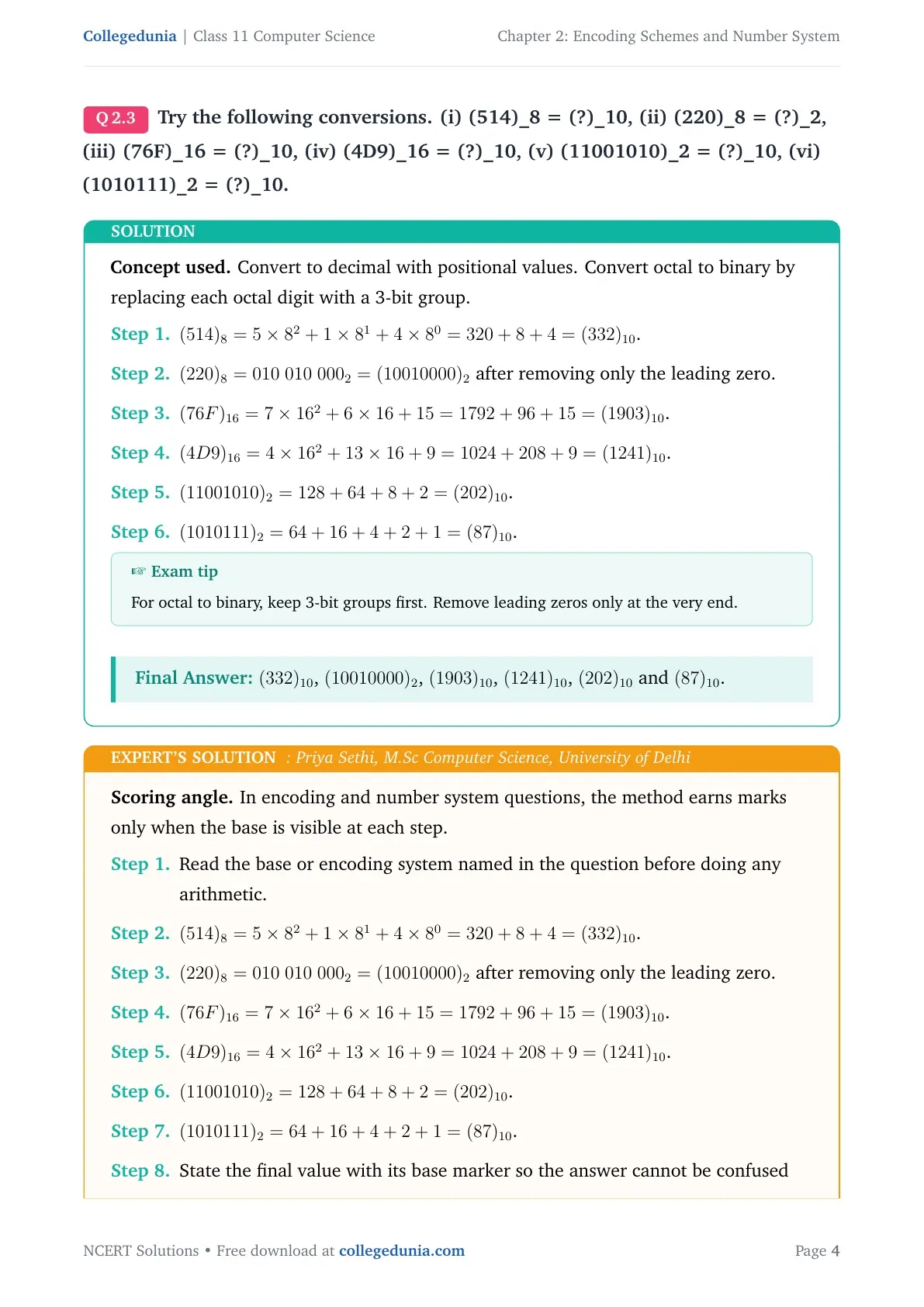
Question 3
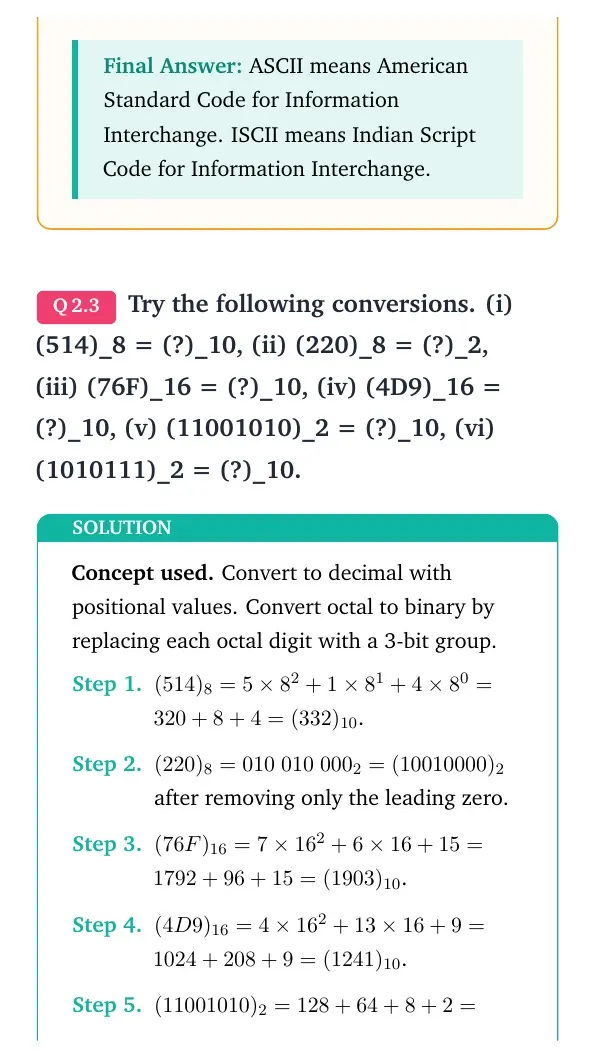
Try the following conversions. (i) (514)_8 = (?)_10, (ii) (220)_8 = (?)_2, (iii) (76F)_16 = (?)_10, (iv) (4D9)_16 = (?)_10, (v) (11001010)_2 = (?)_10, (vi) (1010111)_2 = (?)_10.
- (514)_8 = 5\times8^2 + 1\times8^1 + 4\times8^0 = 320 + 8 + 4 = (332)_{10}.
- (220)_8 = 010\ 010\ 000_2 = (10010000)_2 after removing only the leading zero.
- (76F)_{16} = 7\times16^2 + 6\times16 + 15 = 1792 + 96 + 15 = (1903)_{10}.
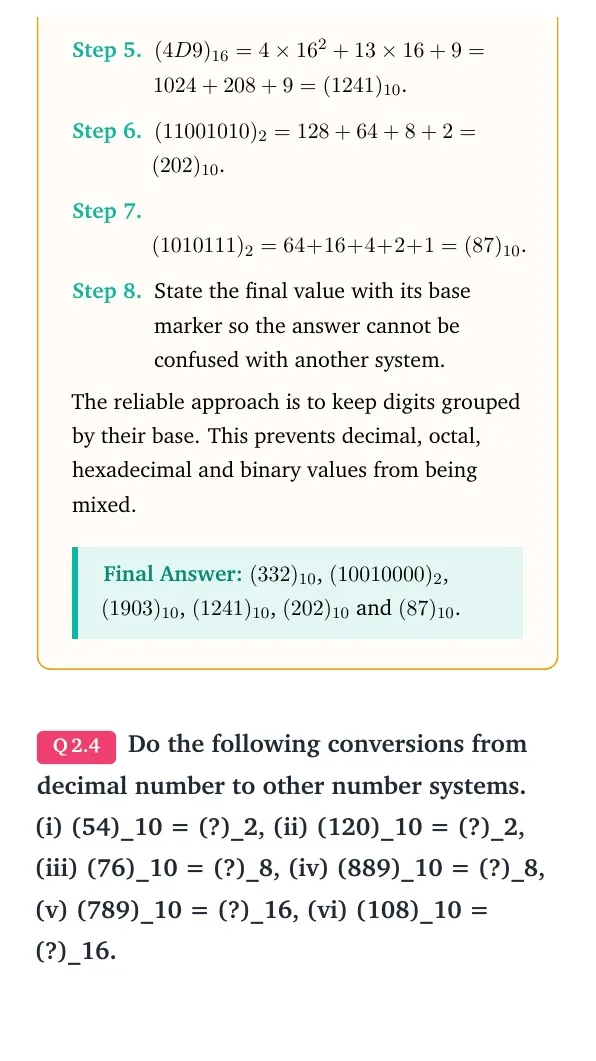
- (4D9)_{16} = 4\times16^2 + 13\times16 + 9 = 1024 + 208 + 9 = (1241)_{10}.
- (11001010)_2 = 128 + 64 + 8 + 2 = (202)_{10}.
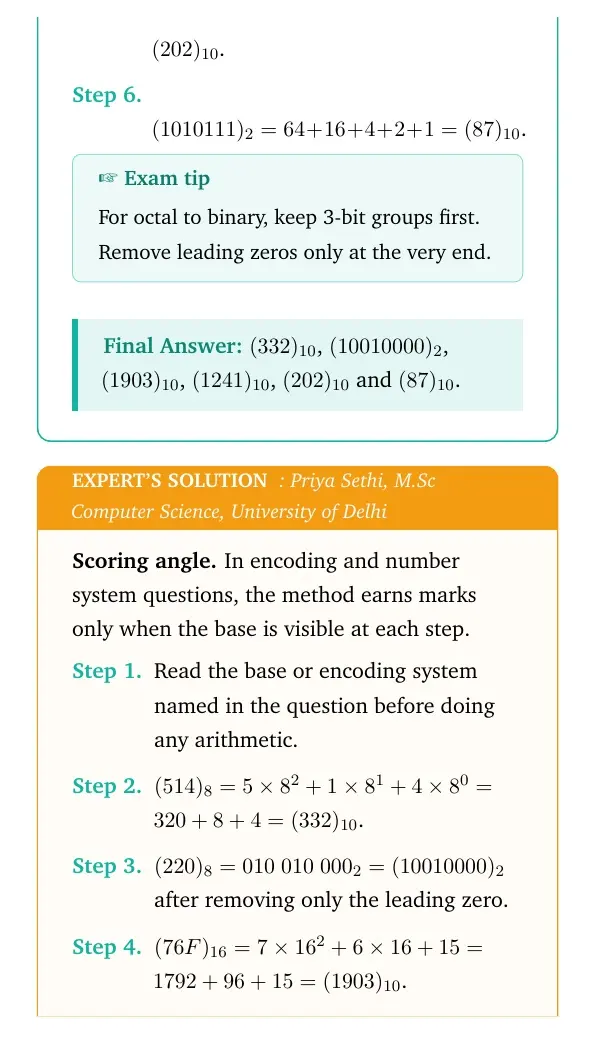
- (1010111)_2 = 64 + 16 + 4 + 2 + 1 = (87)_{10}.
Answer: (332)_{10}, (10010000)_2, (1903)_{10}, (1241)_{10}, (202)_{10} and (87)_{10}.
Expert view: Keep the base marker visible in every conversion step.
- (514)_8 = 5\times8^2 + 1\times8^1 + 4\times8^0 = 320 + 8 + 4 = (332)_{10}.
- (220)_8 = 010\ 010\ 000_2 = (10010000)_2 after removing only the leading zero.
- (76F)_{16} = 7\times16^2 + 6\times16 + 15 = 1792 + 96 + 15 = (1903)_{10}.
- (4D9)_{16} = 4\times16^2 + 13\times16 + 9 = 1024 + 208 + 9 = (1241)_{10}.
- (11001010)_2 = 128 + 64 + 8 + 2 = (202)_{10}.
- (1010111)_2 = 64 + 16 + 4 + 2 + 1 = (87)_{10}.
Final answer: (332)_{10}, (10010000)_2, (1903)_{10}, (1241)_{10}, (202)_{10} and (87)_{10}.
Question 4
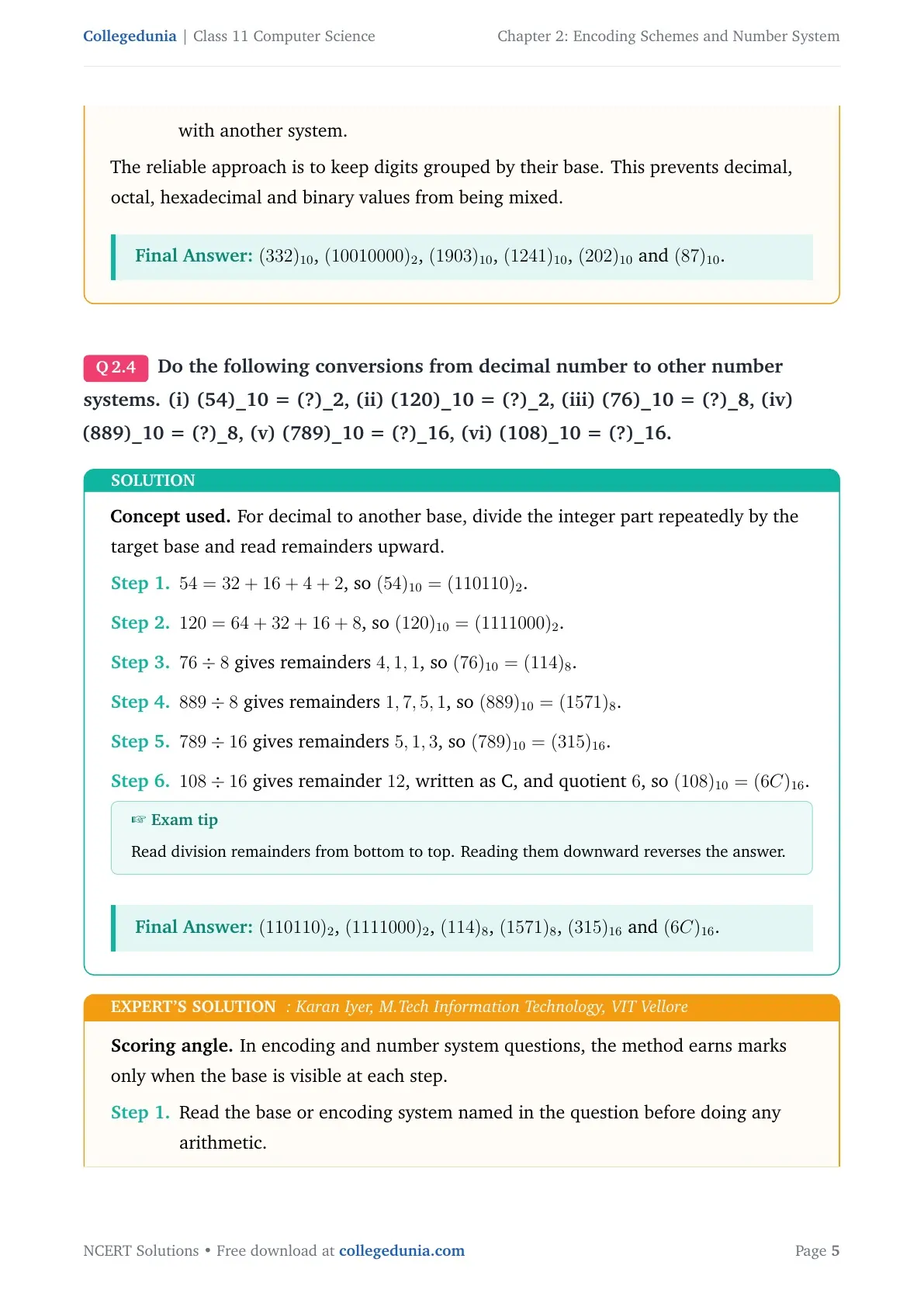
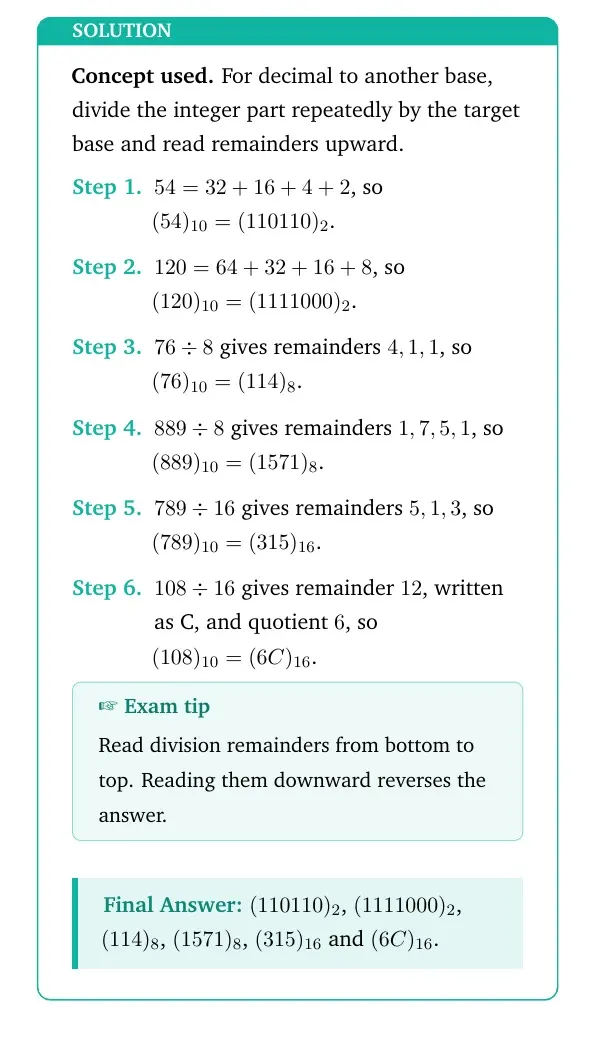
Do the following conversions from decimal number to other number systems. (i) (54)_10 = (?)_2, (ii) (120)_10 = (?)_2, (iii) (76)_10 = (?)_8, (iv) (889)_10 = (?)_8, (v) (789)_10 = (?)_16, (vi) (108)_10 = (?)_16.
- 54 = 32+16+4+2, so (54)_{10}=(110110)_2.
- 120 = 64+32+16+8, so (120)_{10}=(1111000)_2.
- 76\div8 gives remainders 4,1,1, so (76)_{10}=(114)_8.
- 889\div8 gives remainders 1,7,5,1, so (889)_{10}=(1571)_8.
- 789\div16 gives remainders 5,1,3, so (789)_{10}=(315)_{16}.
- 108\div16 gives remainder 12, written as C, and quotient 6, so (108)_{10}=(6C)_{16}.
Answer: (110110)_2, (1111000)_2, (114)_8, (1571)_8, (315)_{16} and (6C)_{16}.
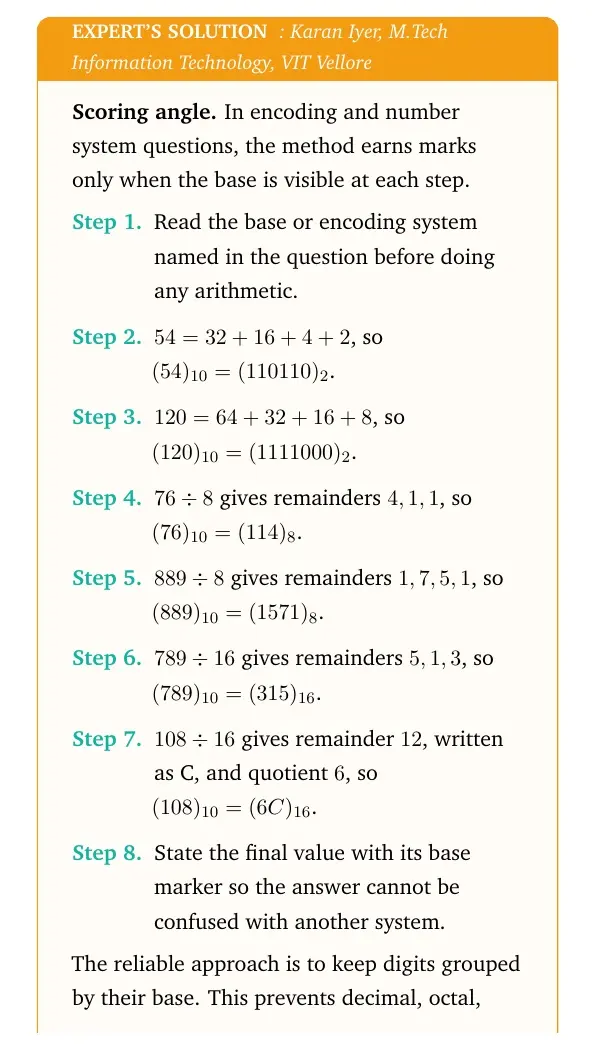
Expert view: Keep the base marker visible in every conversion step.
- 54 = 32+16+4+2, so (54)_{10}=(110110)_2.
- 120 = 64+32+16+8, so (120)_{10}=(1111000)_2.
- 76\div8 gives remainders 4,1,1, so (76)_{10}=(114)_8.
- 889\div8 gives remainders 1,7,5,1, so (889)_{10}=(1571)_8.
- 789\div16 gives remainders 5,1,3, so (789)_{10}=(315)_{16}.
- 108\div16 gives remainder 12, written as C, and quotient 6, so (108)_{10}=(6C)_{16}.
Final answer: (110110)_2, (1111000)_2, (114)_8, (1571)_8, (315)_{16} and (6C)_{16}.
Question 5
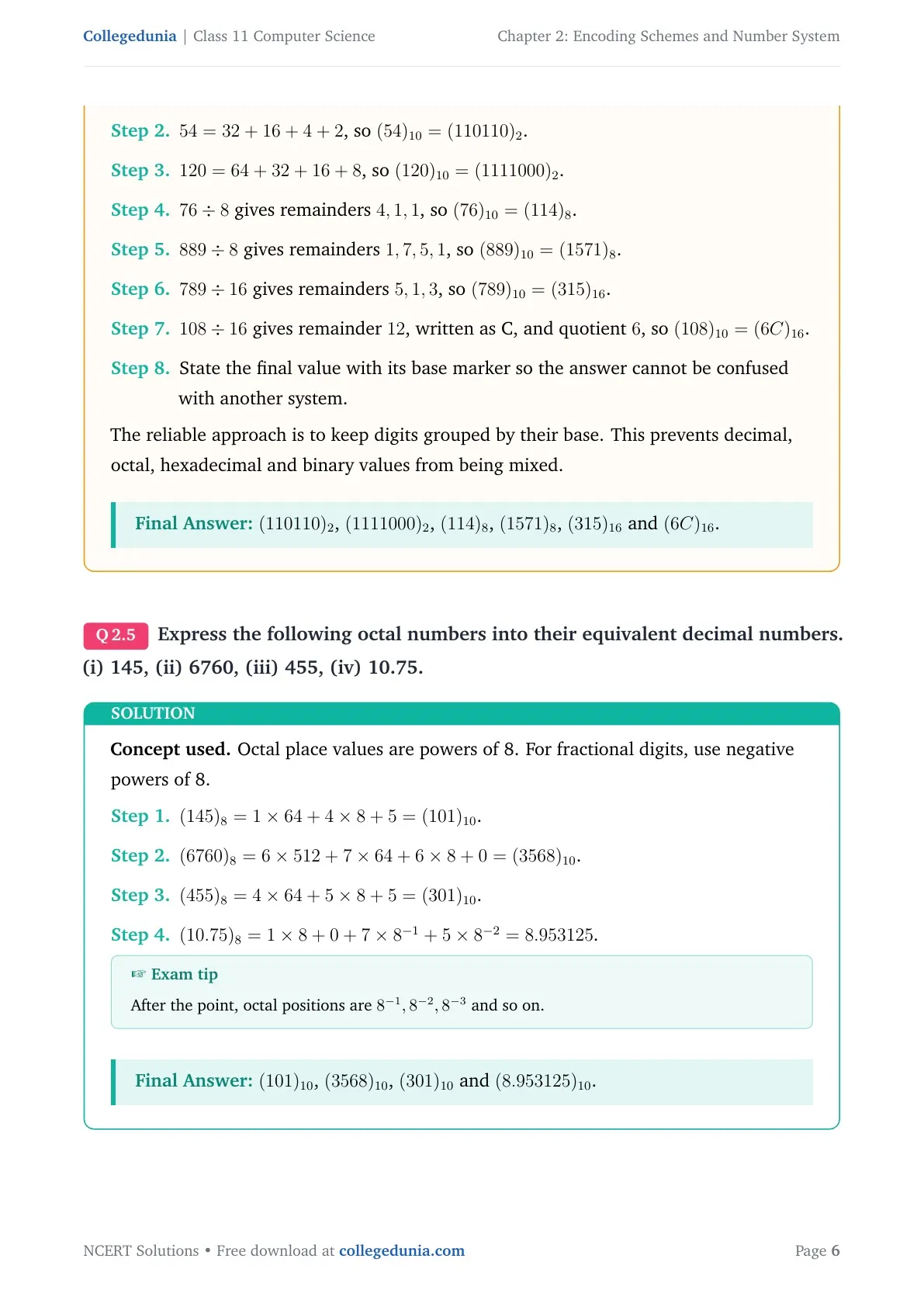
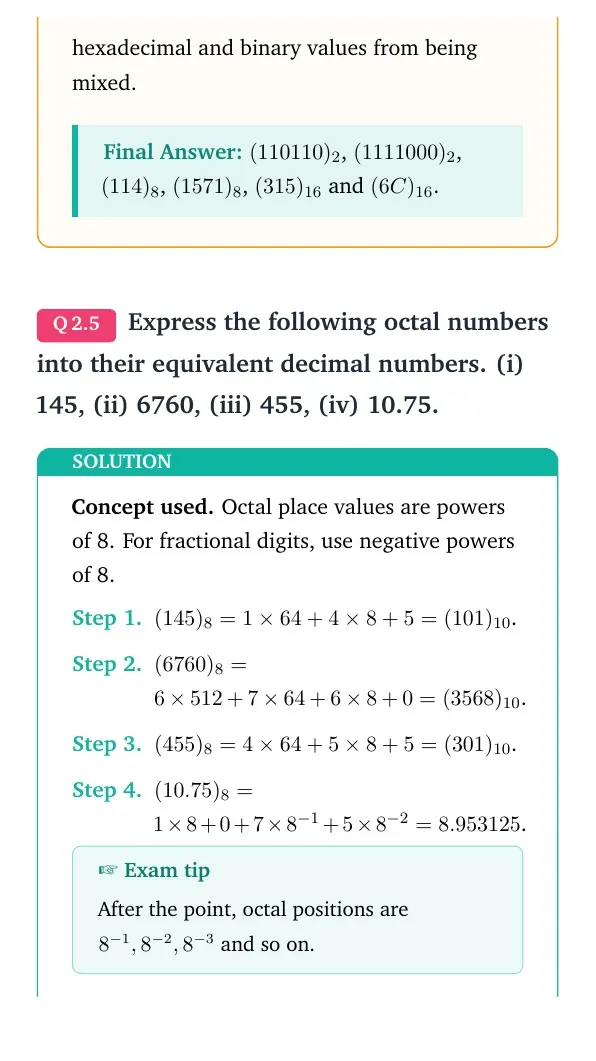
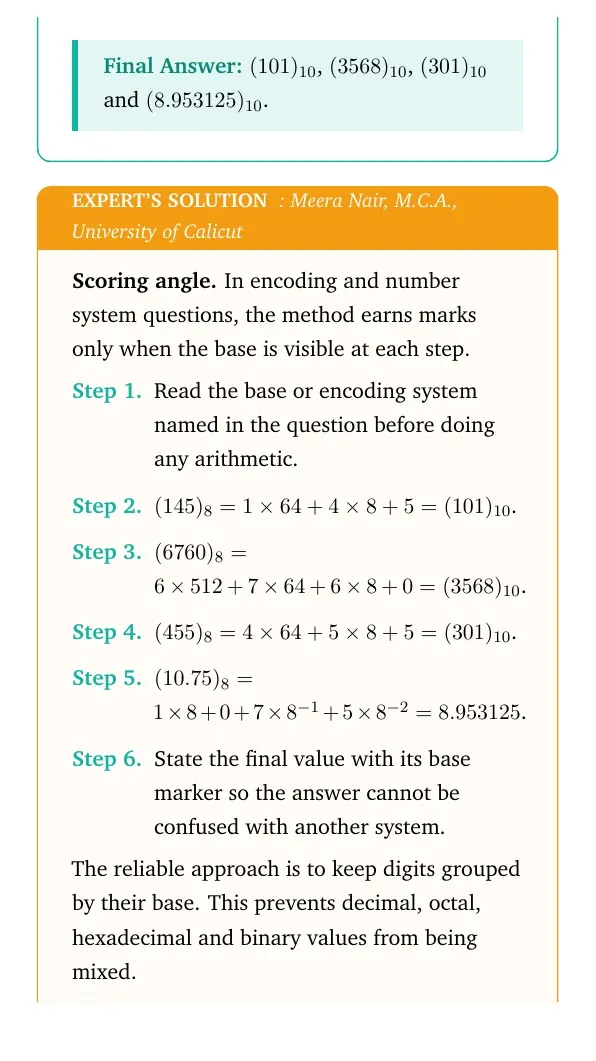
Express the following octal numbers into their equivalent decimal numbers. (i) 145, (ii) 6760, (iii) 455, (iv) 10.75.
- (145)_8 = 1\times64 + 4\times8 + 5 = (101)_{10}.
- (6760)_8 = 6\times512 + 7\times64 + 6\times8 + 0 = (3568)_{10}.
- (455)_8 = 4\times64 + 5\times8 + 5 = (301)_{10}.
- (10.75)_8 = 1\times8 + 0 + 7\times8^{-1} + 5\times8^{-2} = 8.953125.
Answer: (101)_{10}, (3568)_{10}, (301)_{10} and (8.953125)_{10}.
Expert view: Keep the base marker visible in every conversion step.
- (145)_8 = 1\times64 + 4\times8 + 5 = (101)_{10}.
- (6760)_8 = 6\times512 + 7\times64 + 6\times8 + 0 = (3568)_{10}.
- (455)_8 = 4\times64 + 5\times8 + 5 = (301)_{10}.
- (10.75)_8 = 1\times8 + 0 + 7\times8^{-1} + 5\times8^{-2} = 8.953125.
Final answer: (101)_{10}, (3568)_{10}, (301)_{10} and (8.953125)_{10}.
Question 6
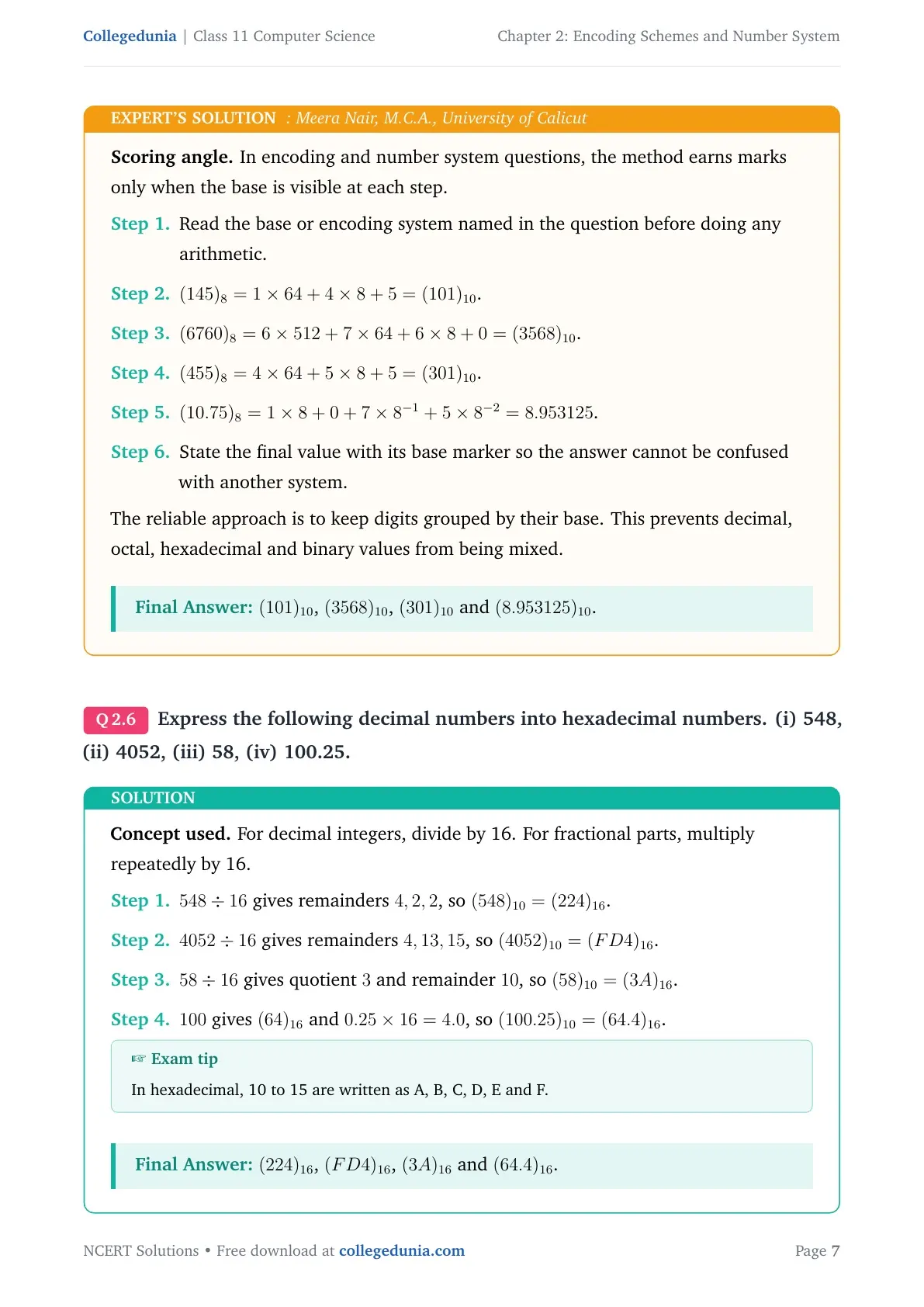
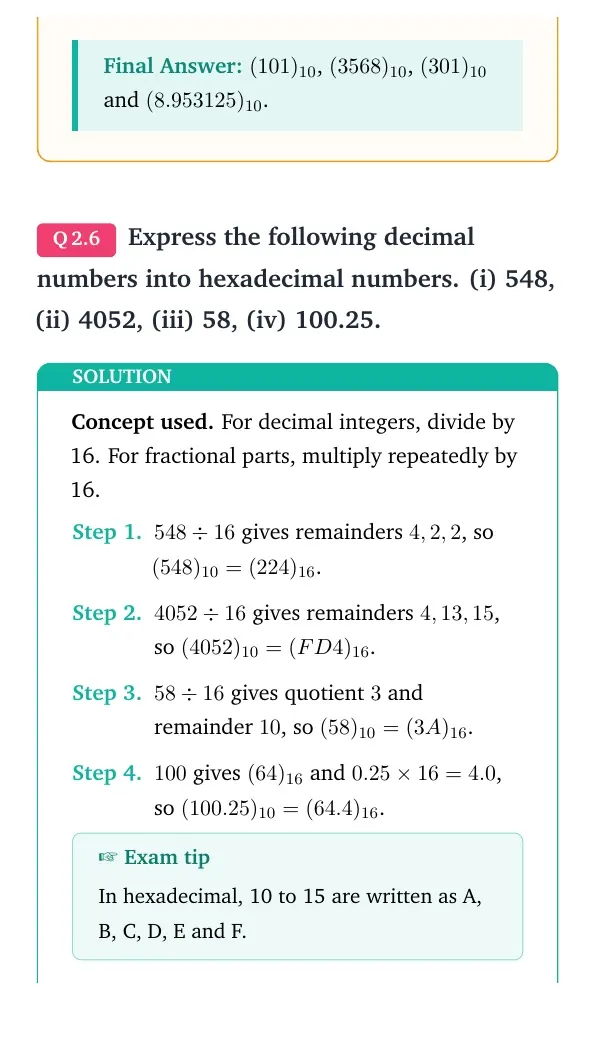
Express the following decimal numbers into hexadecimal numbers. (i) 548, (ii) 4052, (iii) 58, (iv) 100.25.
- 548\div16 gives remainders 4,2,2, so (548)_{10}=(224)_{16}.
- 4052\div16 gives remainders 4,13,15, so (4052)_{10}=(FD4)_{16}.
- 58\div16 gives quotient 3 and remainder 10, so (58)_{10}=(3A)_{16}.
- 100 gives (64)_{16} and 0.25\times16=4.0, so (100.25)_{10}=(64.4)_{16}.
Answer: (224)_{16}, (FD4)_{16}, (3A)_{16} and (64.4)_{16}.
Expert view: Keep the base marker visible in every conversion step.
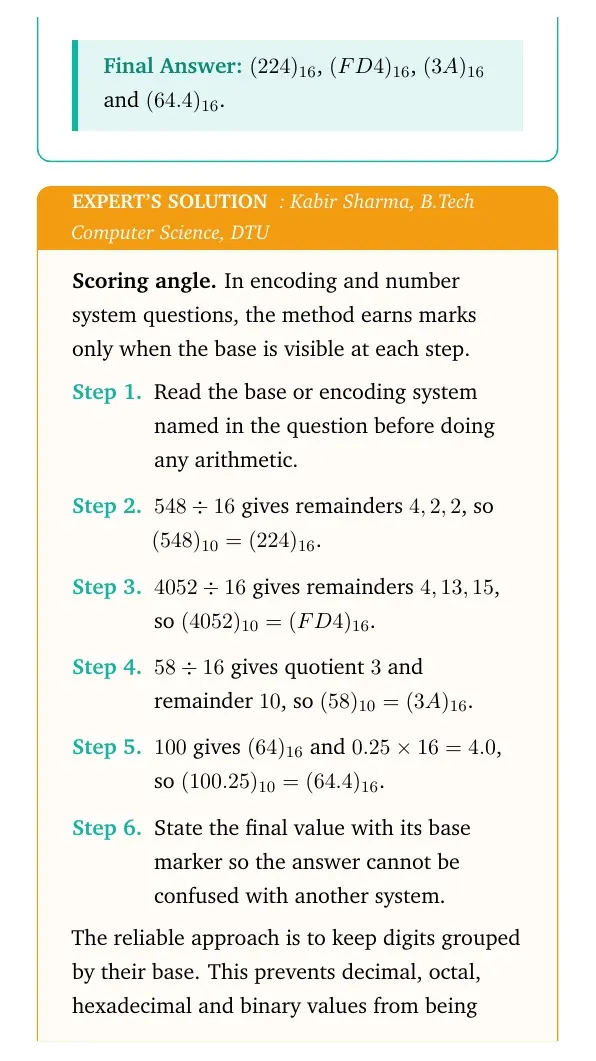
- 548\div16 gives remainders 4,2,2, so (548)_{10}=(224)_{16}.
- 4052\div16 gives remainders 4,13,15, so (4052)_{10}=(FD4)_{16}.
- 58\div16 gives quotient 3 and remainder 10, so (58)_{10}=(3A)_{16}.
- 100 gives (64)_{16} and 0.25\times16=4.0, so (100.25)_{10}=(64.4)_{16}.
Final answer: (224)_{16}, (FD4)_{16}, (3A)_{16} and (64.4)_{16}.
Question 7
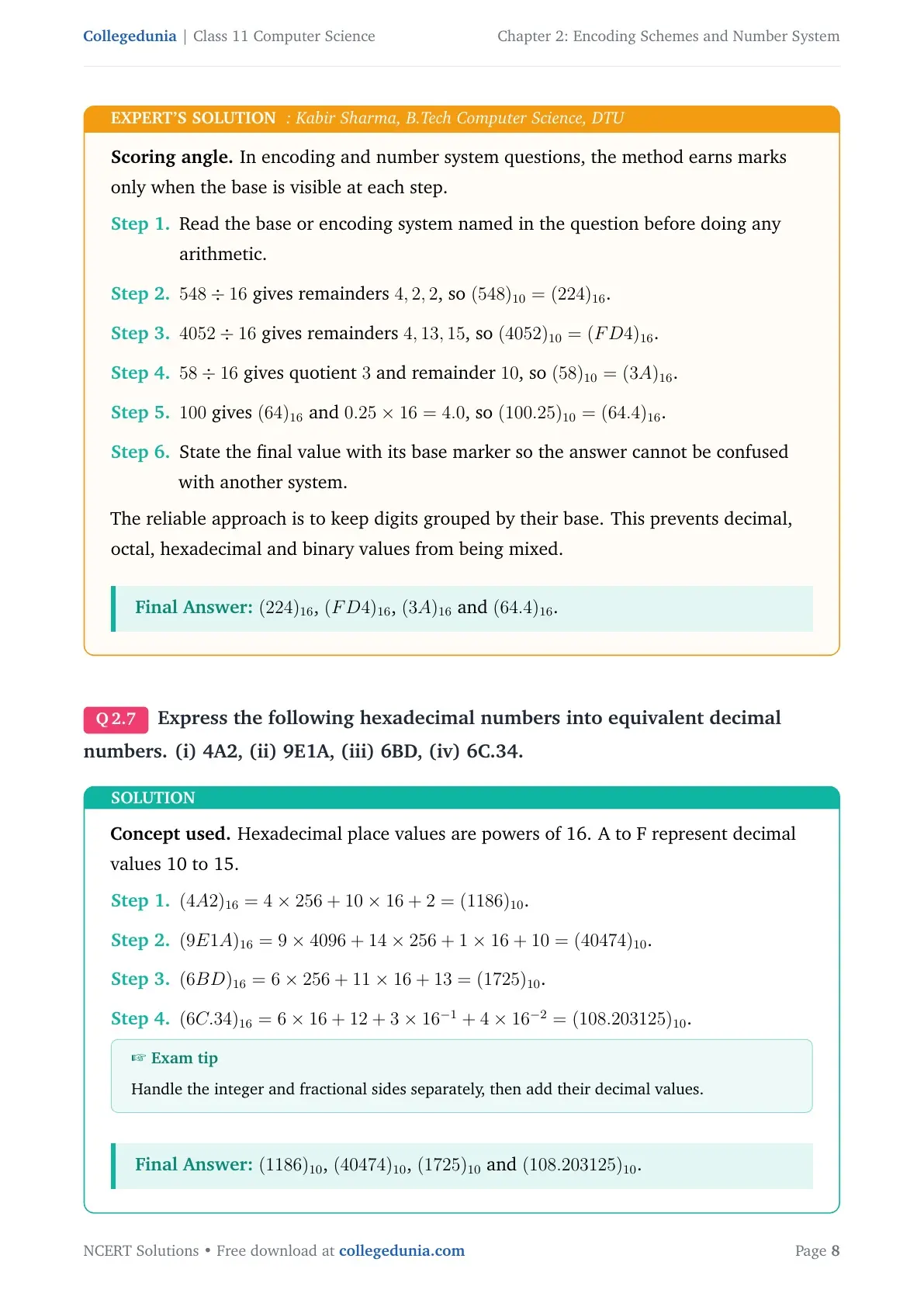
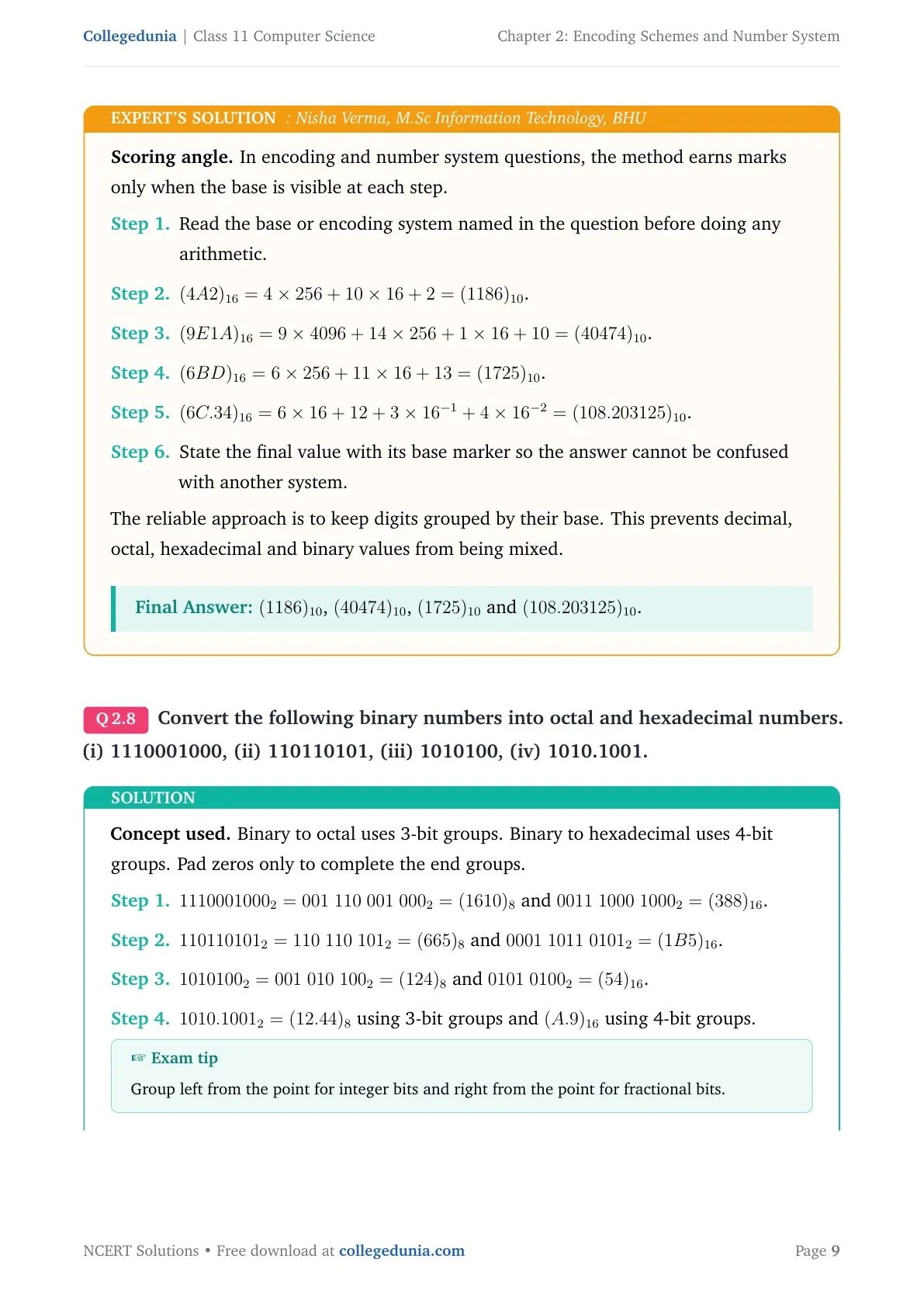
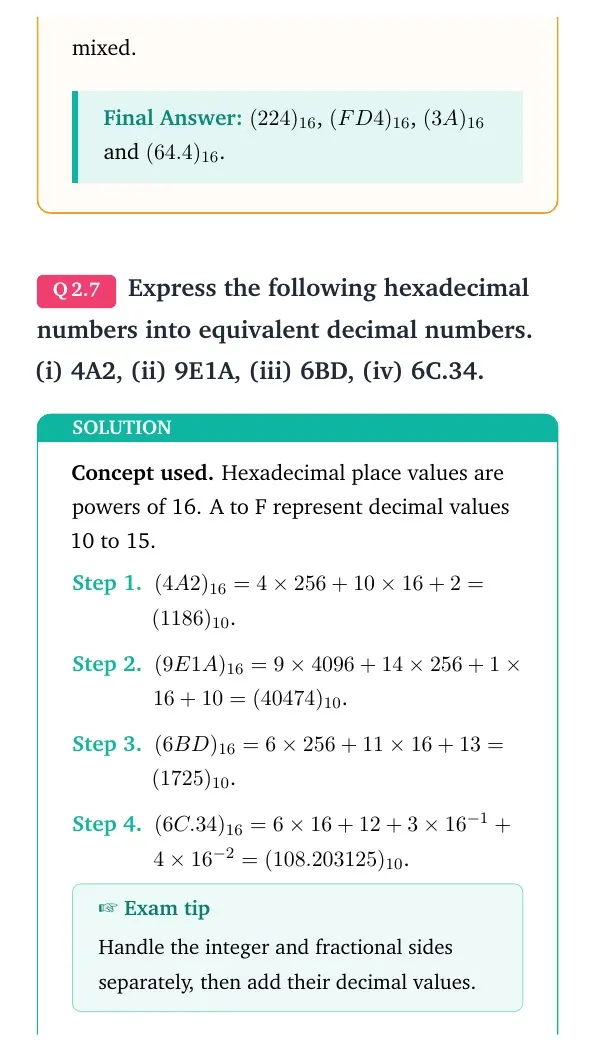
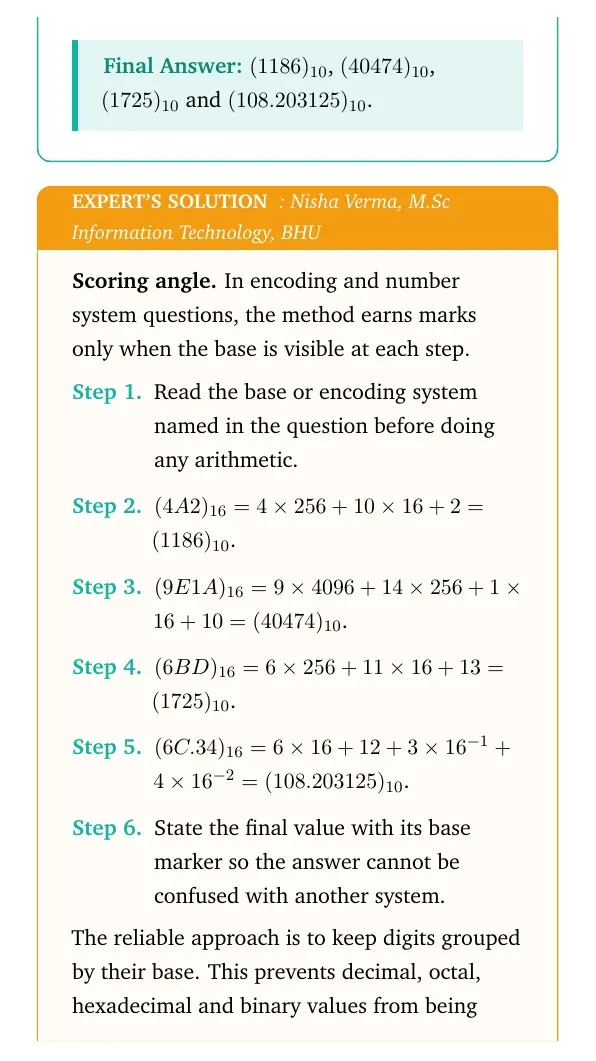
Express the following hexadecimal numbers into equivalent decimal numbers. (i) 4A2, (ii) 9E1A, (iii) 6BD, (iv) 6C.34.
- (4A2)_{16}=4\times256+10\times16+2=(1186)_{10}.
- (9E1A)_{16}=9\times4096+14\times256+1\times16+10=(40474)_{10}.
- (6BD)_{16}=6\times256+11\times16+13=(1725)_{10}.
- (6C.34)_{16}=6\times16+12+3\times16^{-1}+4\times16^{-2}=(108.203125)_{10}.
Answer: (1186)_{10}, (40474)_{10}, (1725)_{10} and (108.203125)_{10}.
Expert view: Keep the base marker visible in every conversion step.
- (4A2)_{16}=4\times256+10\times16+2=(1186)_{10}.
- (9E1A)_{16}=9\times4096+14\times256+1\times16+10=(40474)_{10}.
- (6BD)_{16}=6\times256+11\times16+13=(1725)_{10}.
- (6C.34)_{16}=6\times16+12+3\times16^{-1}+4\times16^{-2}=(108.203125)_{10}.
Final answer: (1186)_{10}, (40474)_{10}, (1725)_{10} and (108.203125)_{10}.
Question 8
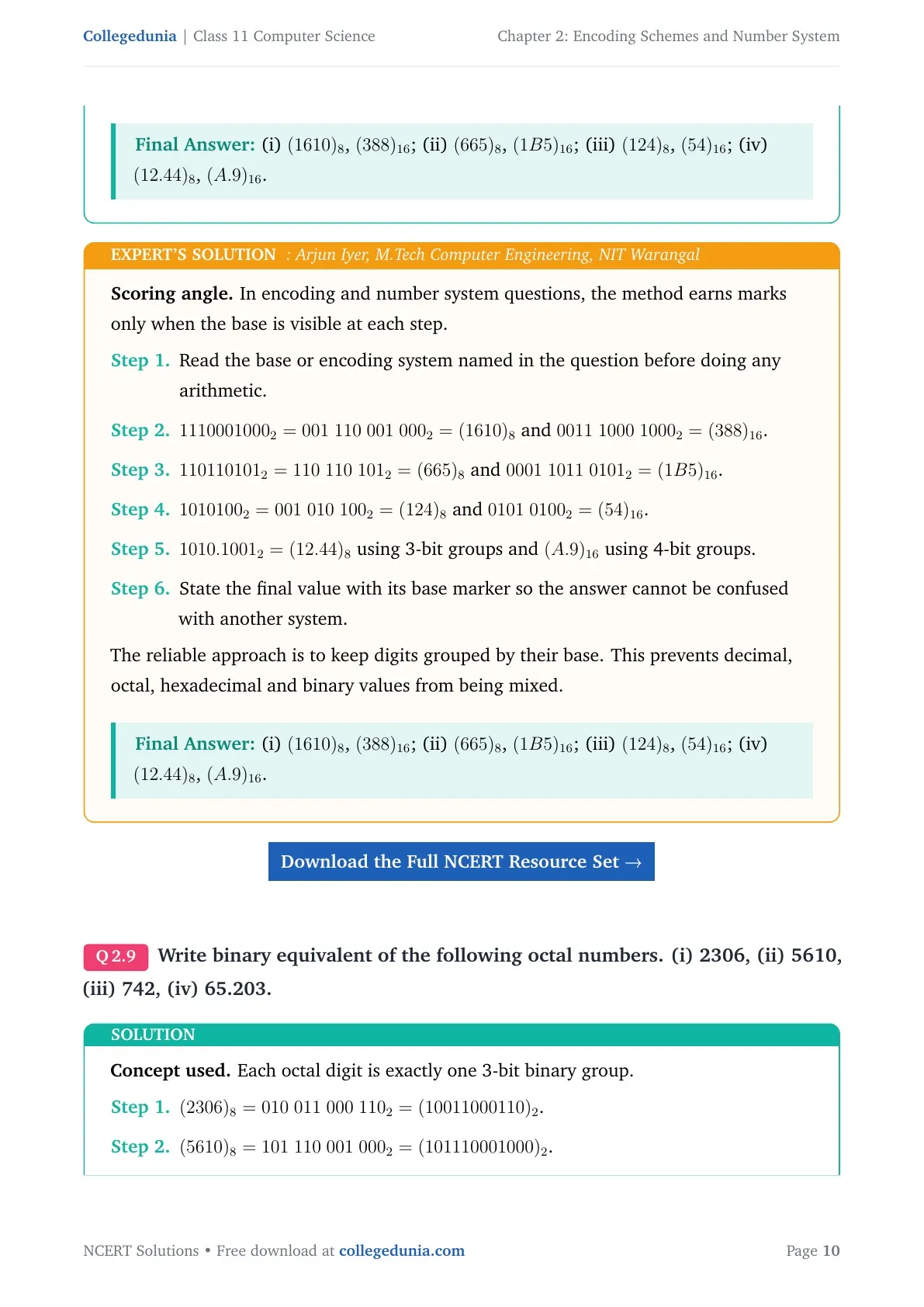
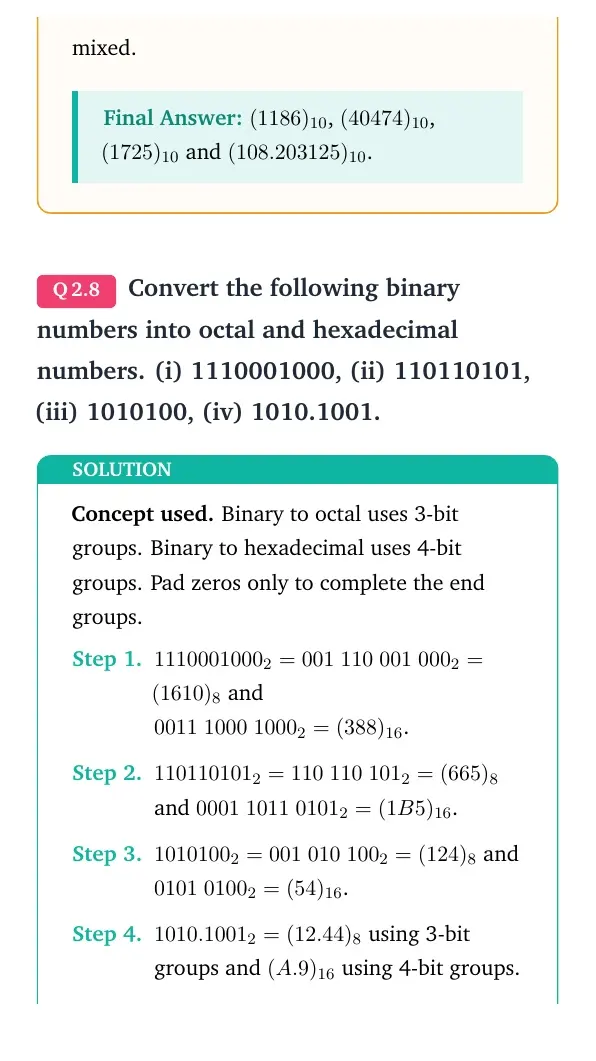
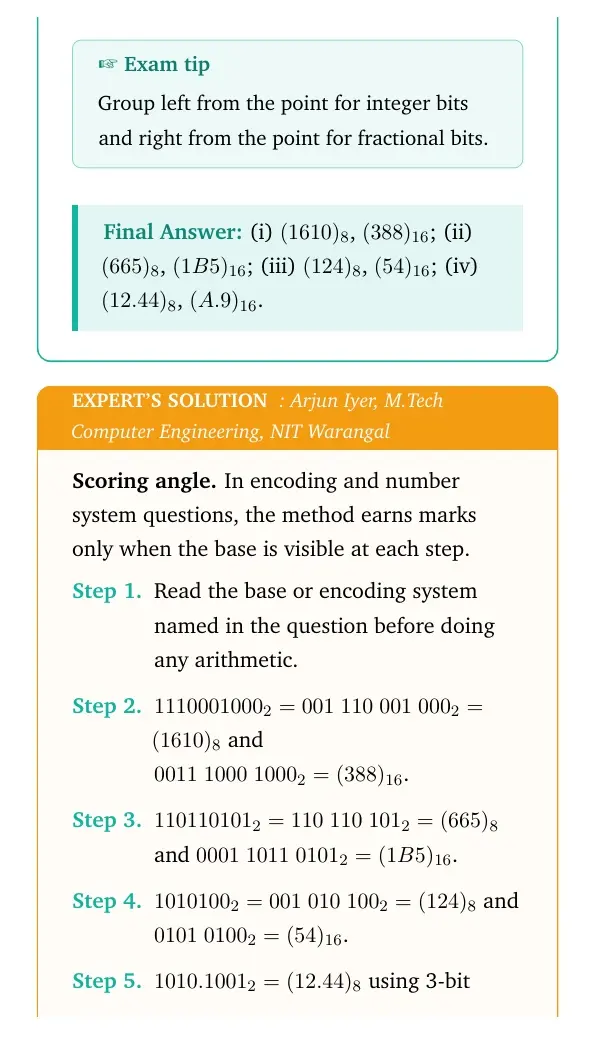
Convert the following binary numbers into octal and hexadecimal numbers. (i) 1110001000, (ii) 110110101, (iii) 1010100, (iv) 1010.1001.
- 1110001000_2 = 001\ 110\ 001\ 000_2=(1610)_8 and 0011\ 1000\ 1000_2=(388)_{16}.
- 110110101_2 = 110\ 110\ 101_2=(665)_8 and 0001\ 1011\ 0101_2=(1B5)_{16}.
- 1010100_2 = 001\ 010\ 100_2=(124)_8 and 0101\ 0100_2=(54)_{16}.
- 1010.1001_2=(12.44)_8 using 3-bit groups and (A.9)_{16} using 4-bit groups.
Answer: (i) (1610)_8, (388)_{16}; (ii) (665)_8, (1B5)_{16}; (iii) (124)_8, (54)_{16}; (iv) (12.44)_8, (A.9)_{16}.
Expert view: Keep the base marker visible in every conversion step.
- 1110001000_2 = 001\ 110\ 001\ 000_2=(1610)_8 and 0011\ 1000\ 1000_2=(388)_{16}.
- 110110101_2 = 110\ 110\ 101_2=(665)_8 and 0001\ 1011\ 0101_2=(1B5)_{16}.
- 1010100_2 = 001\ 010\ 100_2=(124)_8 and 0101\ 0100_2=(54)_{16}.
- 1010.1001_2=(12.44)_8 using 3-bit groups and (A.9)_{16} using 4-bit groups.
Final answer: (i) (1610)_8, (388)_{16}; (ii) (665)_8, (1B5)_{16}; (iii) (124)_8, (54)_{16}; (iv) (12.44)_8, (A.9)_{16}.
Question 9
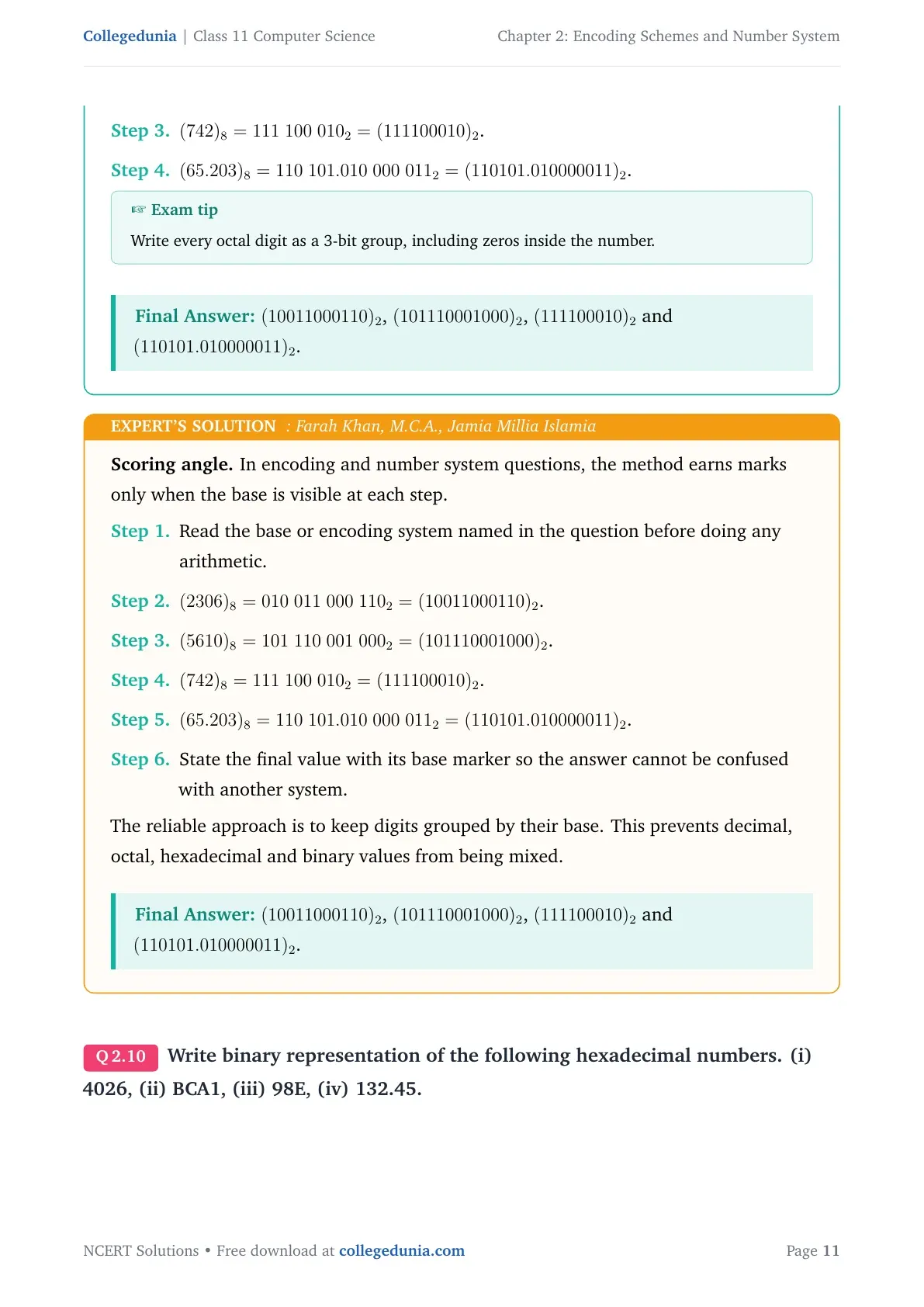
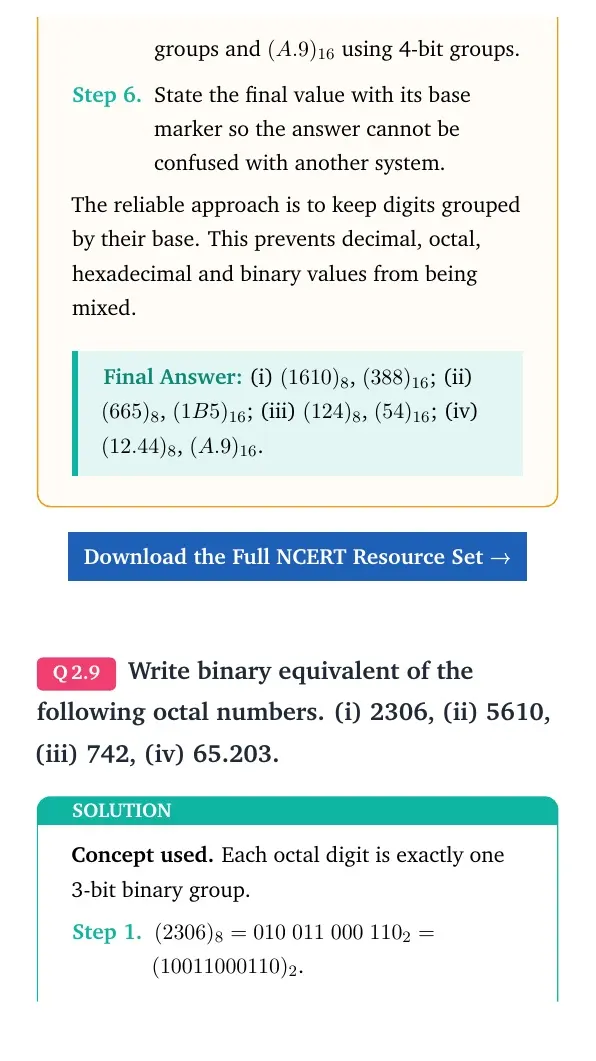
Write binary equivalent of the following octal numbers. (i) 2306, (ii) 5610, (iii) 742, (iv) 65.203.
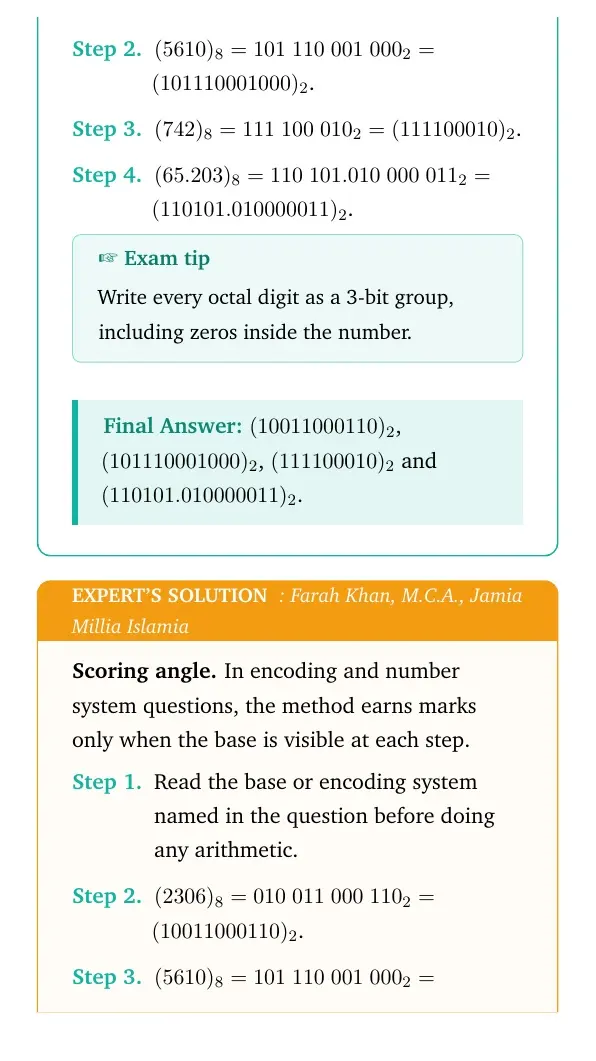
- (2306)_8 = 010\ 011\ 000\ 110_2 = (10011000110)_2.
- (5610)_8 = 101\ 110\ 001\ 000_2 = (101110001000)_2.
- (742)_8 = 111\ 100\ 010_2 = (111100010)_2.
- (65.203)_8 = 110\ 101 . 010\ 000\ 011_2 = (110101.010000011)_2.
Answer: (10011000110)_2, (101110001000)_2, (111100010)_2 and (110101.010000011)_2.
Expert view: Keep the base marker visible in every conversion step.
- (2306)_8 = 010\ 011\ 000\ 110_2 = (10011000110)_2.
- (5610)_8 = 101\ 110\ 001\ 000_2 = (101110001000)_2.
- (742)_8 = 111\ 100\ 010_2 = (111100010)_2.
- (65.203)_8 = 110\ 101 . 010\ 000\ 011_2 = (110101.010000011)_2.
Final answer: (10011000110)_2, (101110001000)_2, (111100010)_2 and (110101.010000011)_2.
Question 10
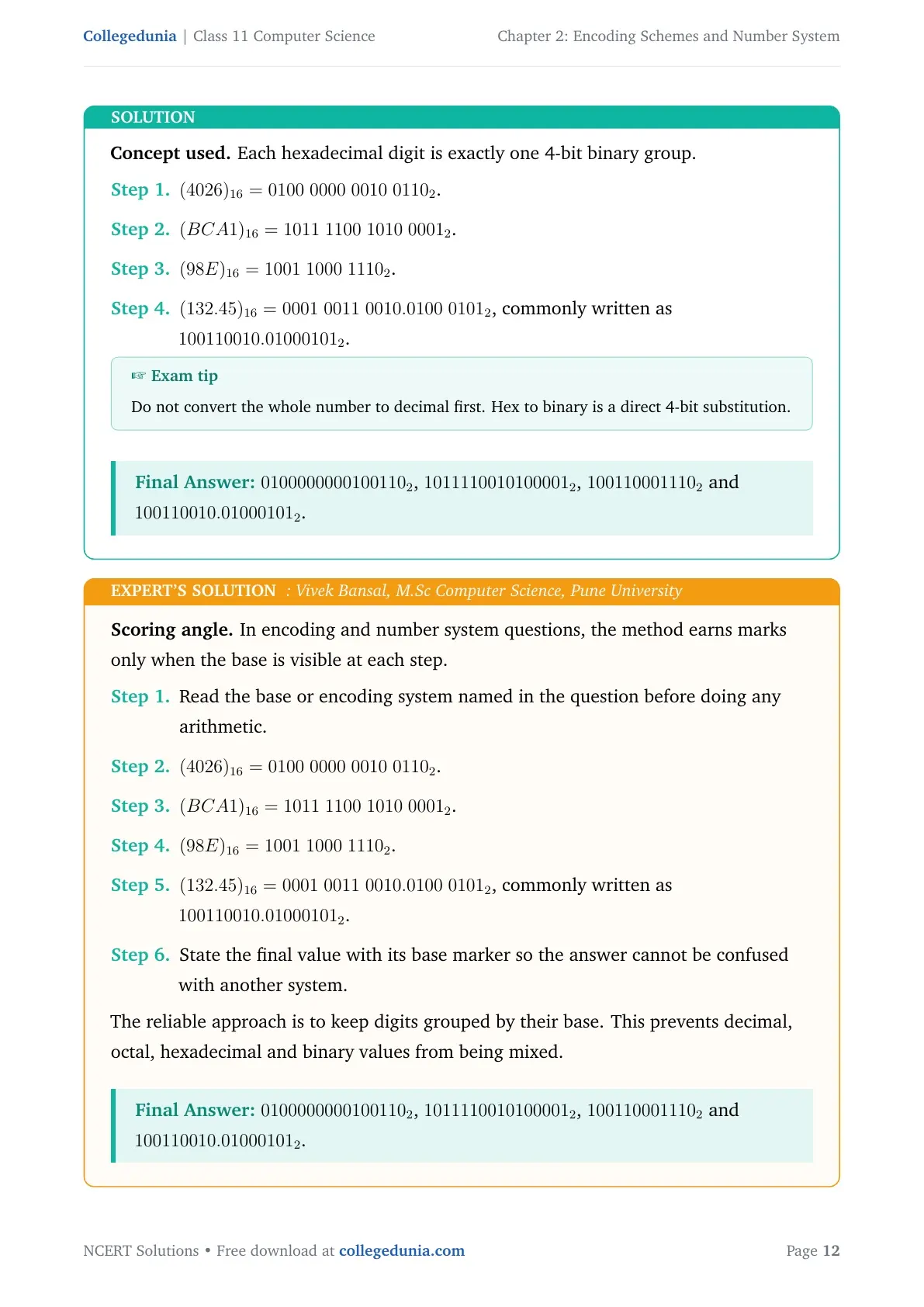
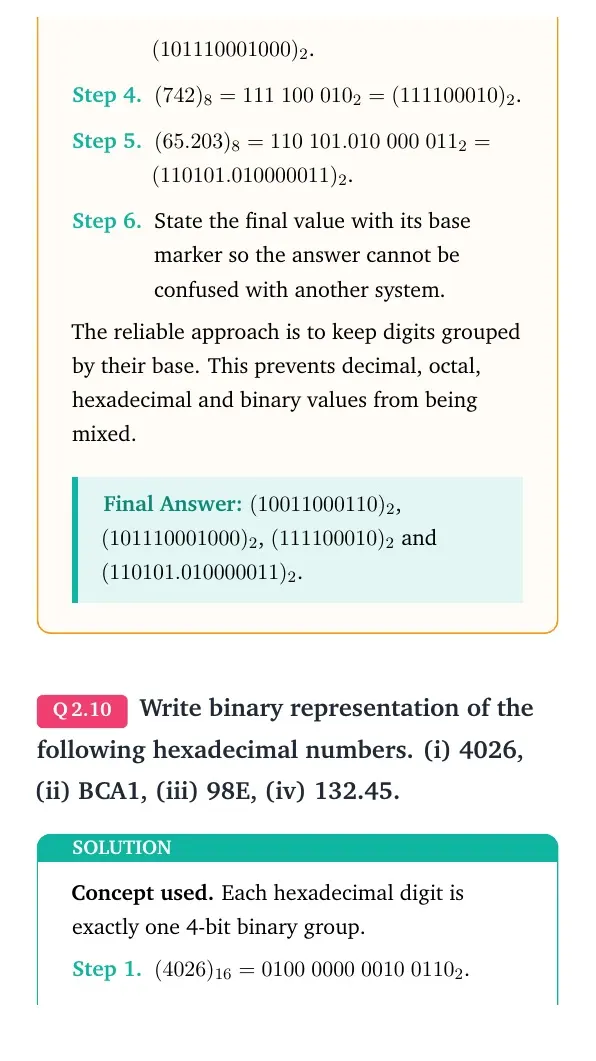
Write binary representation of the following hexadecimal numbers. (i) 4026, (ii) BCA1, (iii) 98E, (iv) 132.45.
- (4026)_{16}=0100\ 0000\ 0010\ 0110_2.
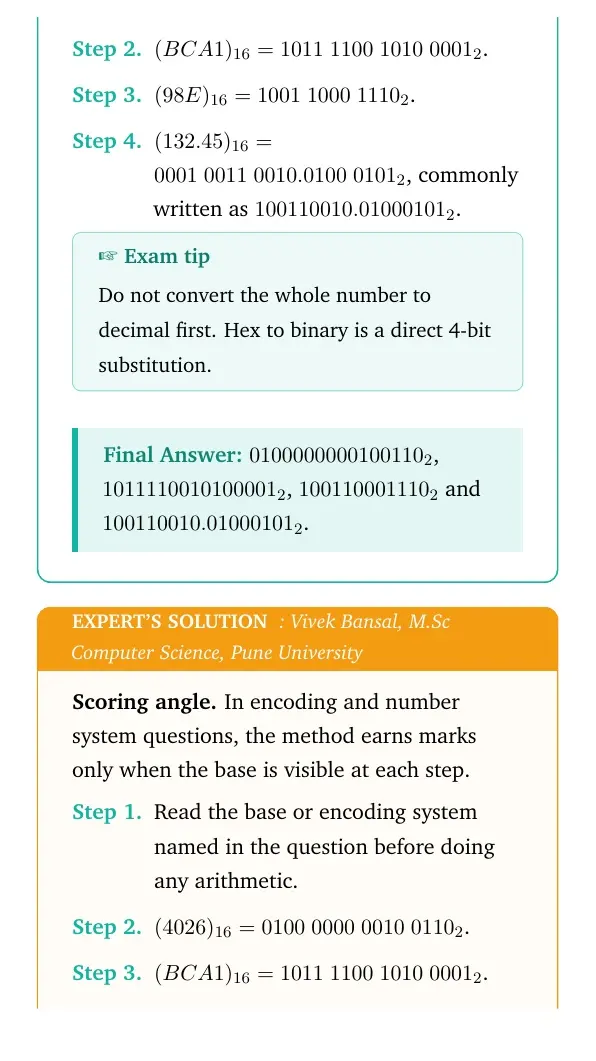
- (BCA1)_{16}=1011\ 1100\ 1010\ 0001_2.
- (98E)_{16}=1001\ 1000\ 1110_2.
- (132.45)_{16}=0001\ 0011\ 0010 . 0100\ 0101_2, commonly written as 100110010.01000101_2.
Answer: 0100000000100110_2, 1011110010100001_2, 100110001110_2 and 100110010.01000101_2.
Expert view: Keep the base marker visible in every conversion step.
- (4026)_{16}=0100\ 0000\ 0010\ 0110_2.
- (BCA1)_{16}=1011\ 1100\ 1010\ 0001_2.
- (98E)_{16}=1001\ 1000\ 1110_2.
- (132.45)_{16}=0001\ 0011\ 0010 . 0100\ 0101_2, commonly written as 100110010.01000101_2.
Final answer: 0100000000100110_2, 1011110010100001_2, 100110001110_2 and 100110010.01000101_2.
Question 11
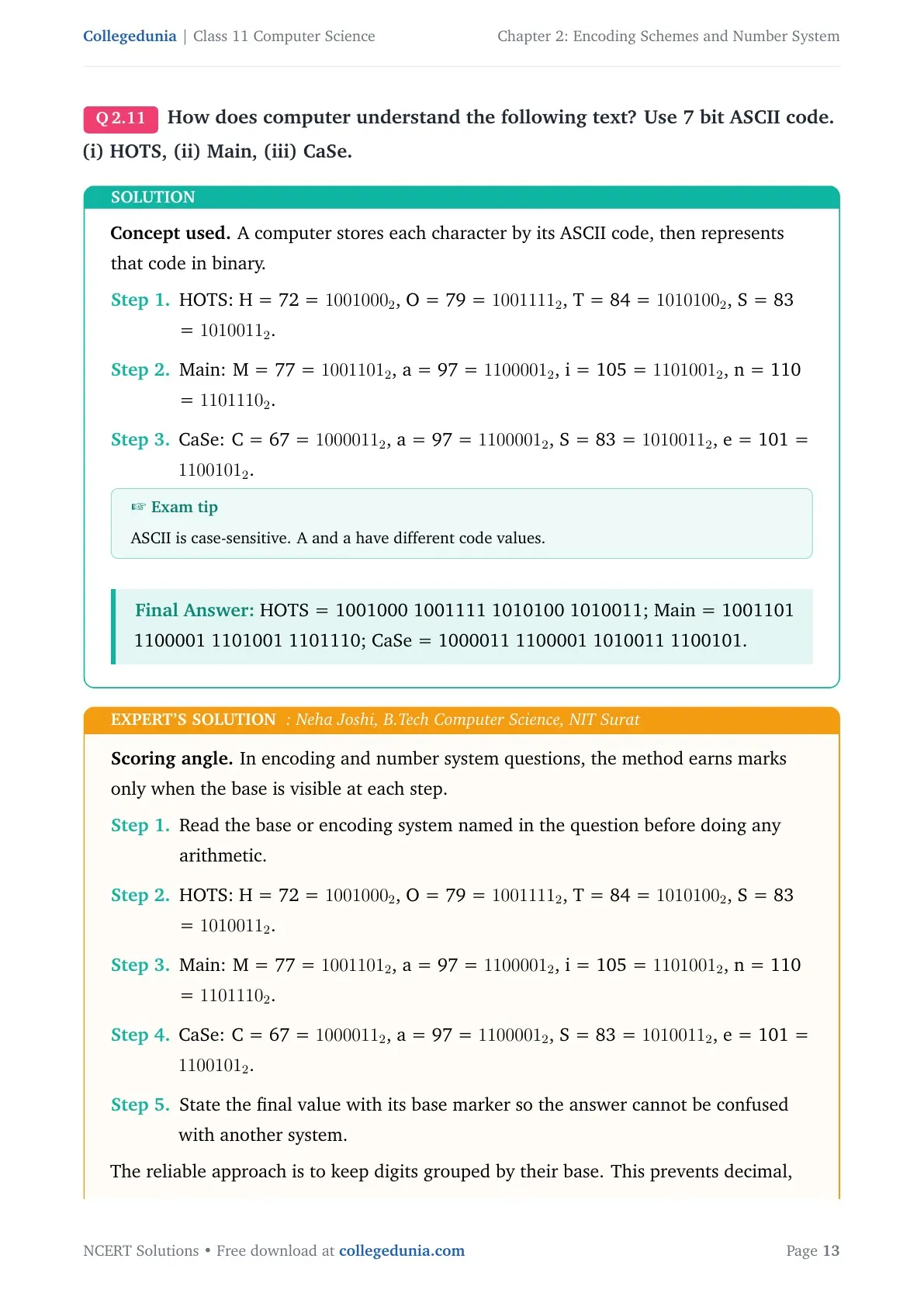
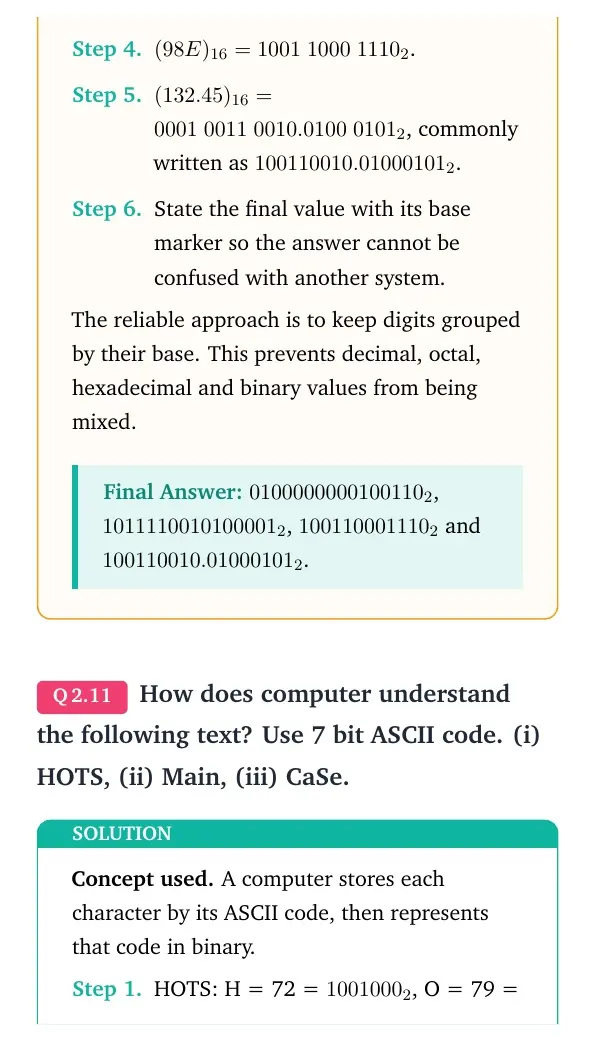
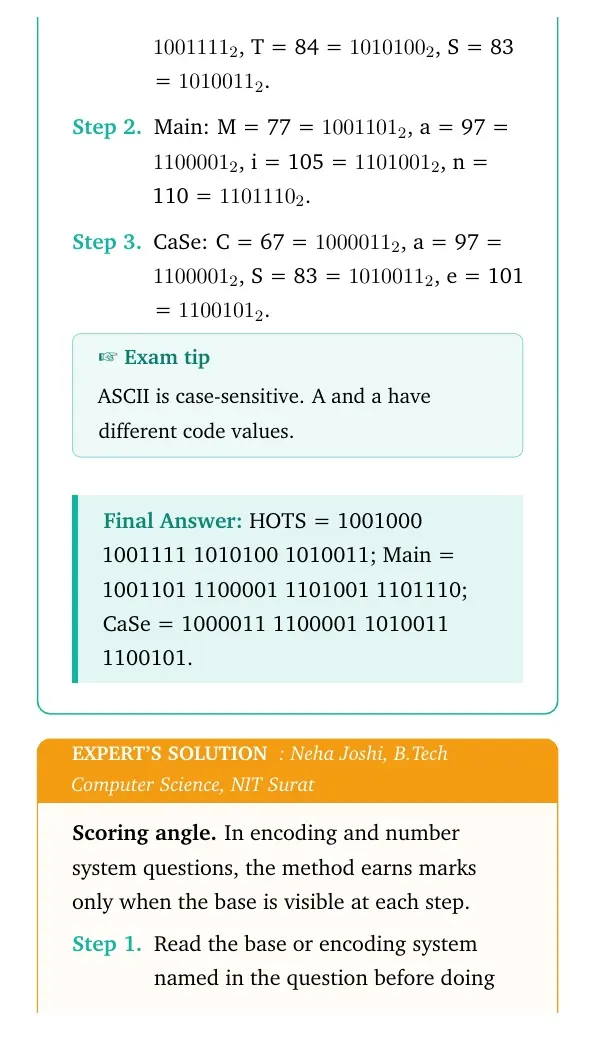
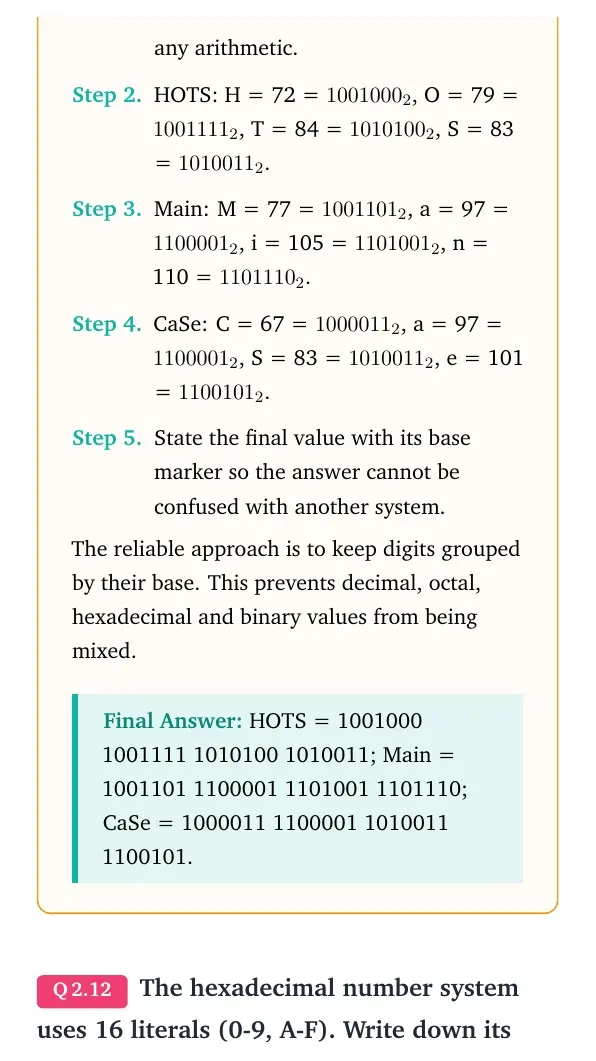
How does computer understand the following text? Use 7 bit ASCII code. (i) HOTS, (ii) Main, (iii) CaSe.
- HOTS: H = 72 = 1001000_2, O = 79 = 1001111_2, T = 84 = 1010100_2, S = 83 = 1010011_2.
- Main: M = 77 = 1001101_2, a = 97 = 1100001_2, i = 105 = 1101001_2, n = 110 = 1101110_2.
- CaSe: C = 67 = 1000011_2, a = 97 = 1100001_2, S = 83 = 1010011_2, e = 101 = 1100101_2.
Answer: HOTS = 1001000 1001111 1010100 1010011; Main = 1001101 1100001 1101001 1101110; CaSe = 1000011 1100001 1010011 1100101.
Expert view: Keep the base marker visible in every conversion step.
- HOTS: H = 72 = 1001000_2, O = 79 = 1001111_2, T = 84 = 1010100_2, S = 83 = 1010011_2.
- Main: M = 77 = 1001101_2, a = 97 = 1100001_2, i = 105 = 1101001_2, n = 110 = 1101110_2.
- CaSe: C = 67 = 1000011_2, a = 97 = 1100001_2, S = 83 = 1010011_2, e = 101 = 1100101_2.
Final answer: HOTS = 1001000 1001111 1010100 1010011; Main = 1001101 1100001 1101001 1101110; CaSe = 1000011 1100001 1010011 1100101.
Question 12
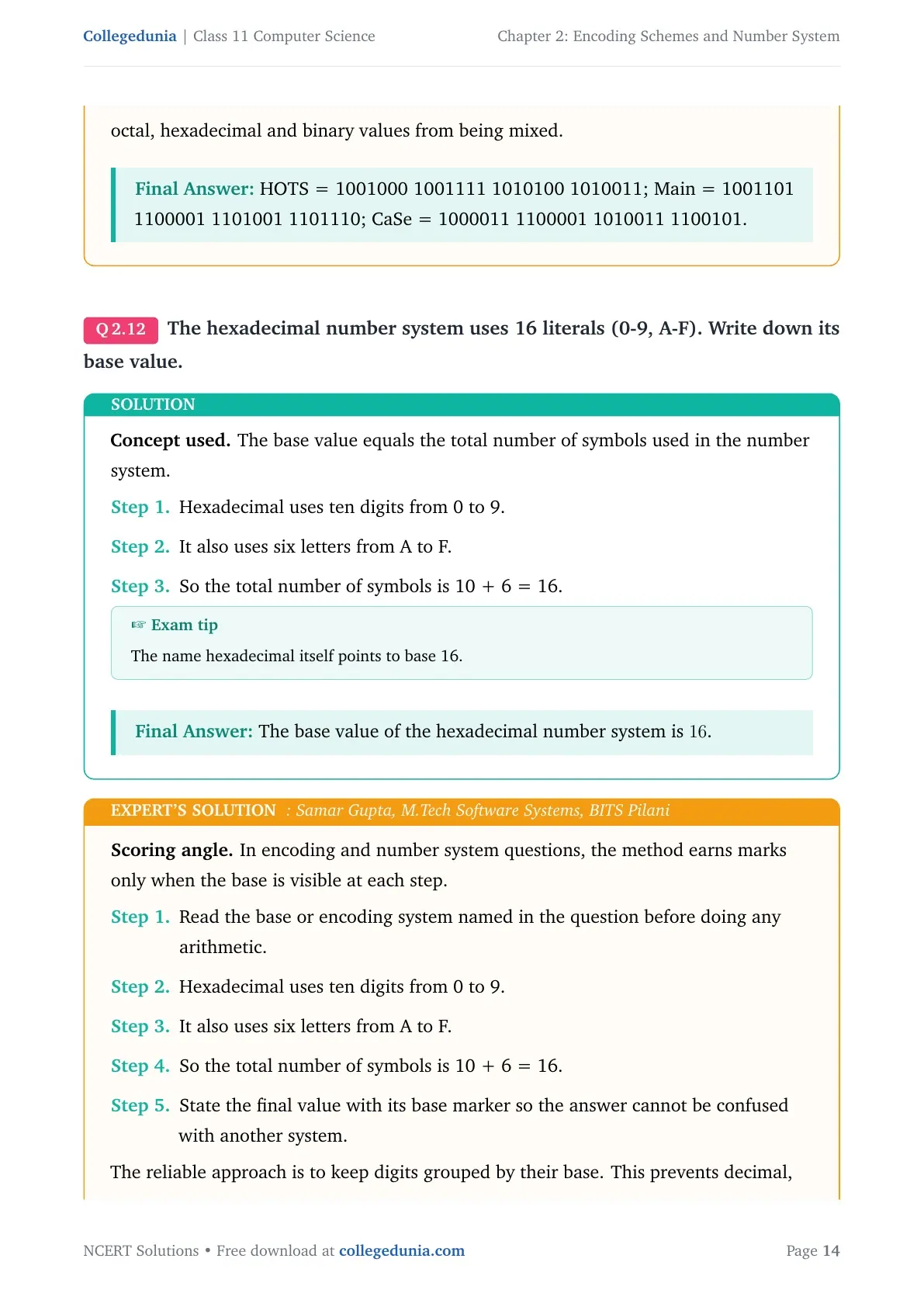
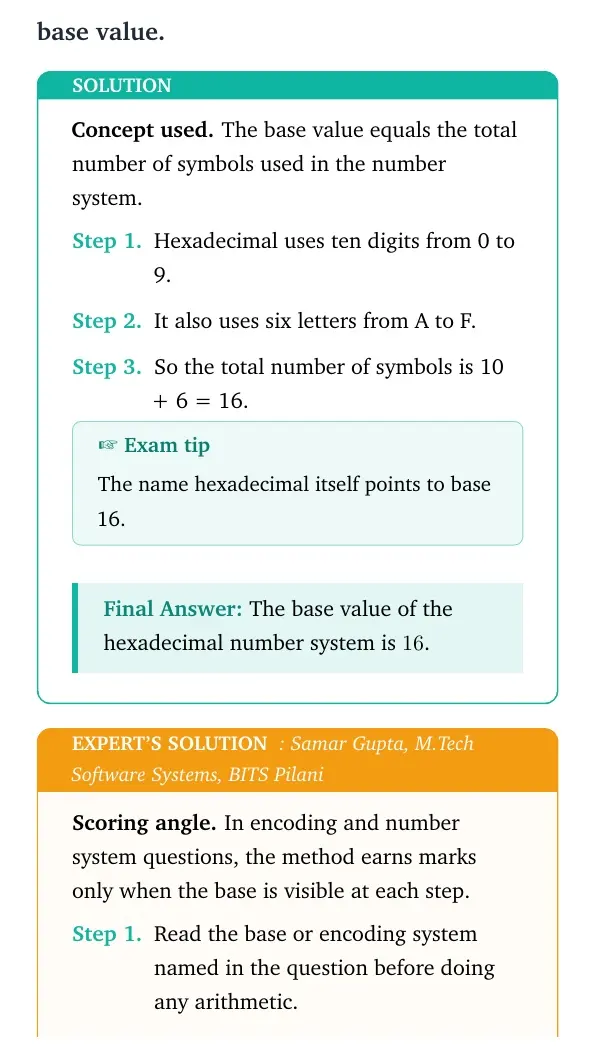
The hexadecimal number system uses 16 literals (0-9, A-F). Write down its base value.
- Hexadecimal uses ten digits from 0 to 9.
- It also uses six letters from A to F.
- So the total number of symbols is 10 + 6 = 16.
Answer: The base value of the hexadecimal number system is 16.
Expert view: Keep the base marker visible in every conversion step.
- Hexadecimal uses ten digits from 0 to 9.
- It also uses six letters from A to F.
- So the total number of symbols is 10 + 6 = 16.
Final answer: The base value of the hexadecimal number system is 16.
Question 13
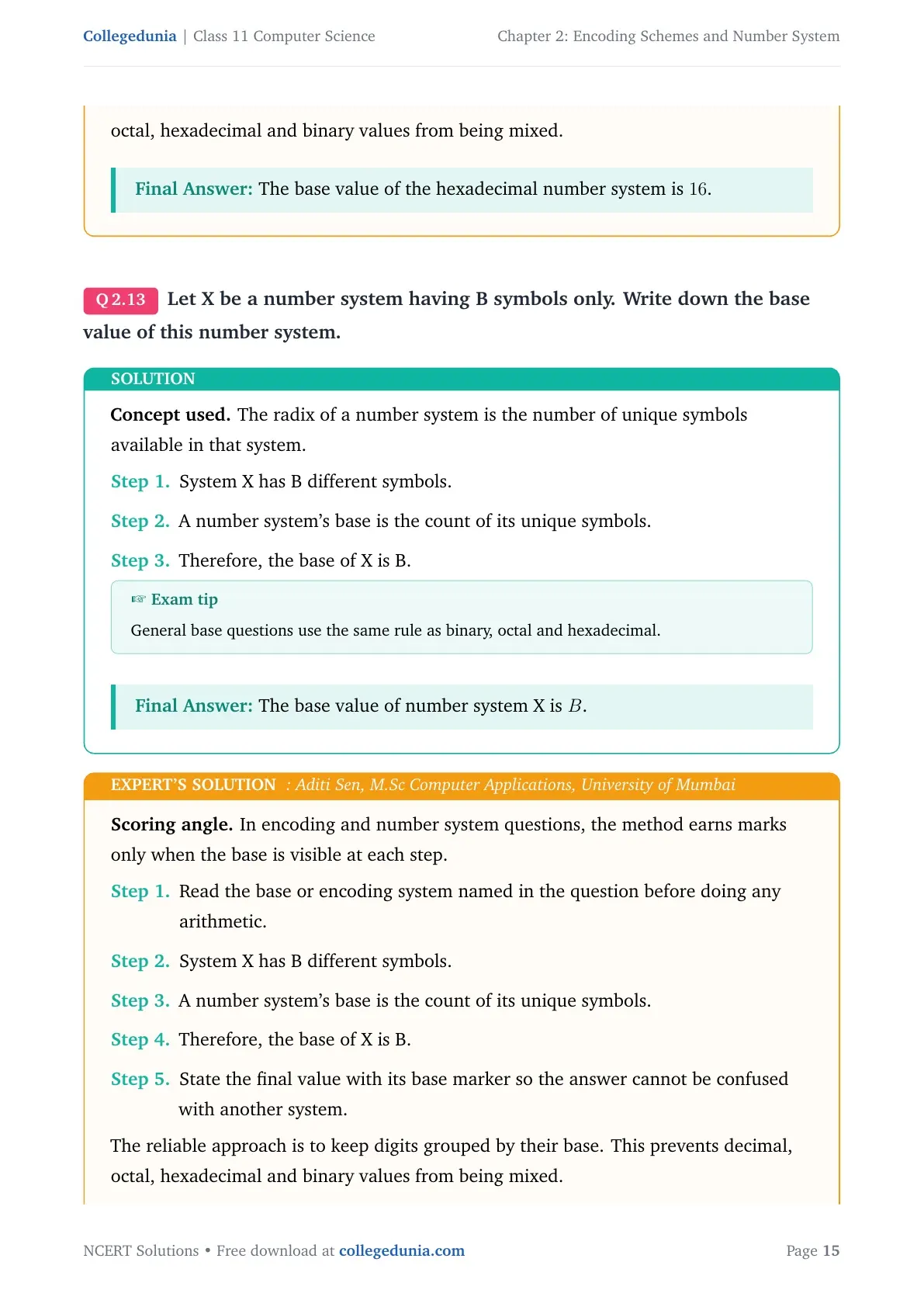
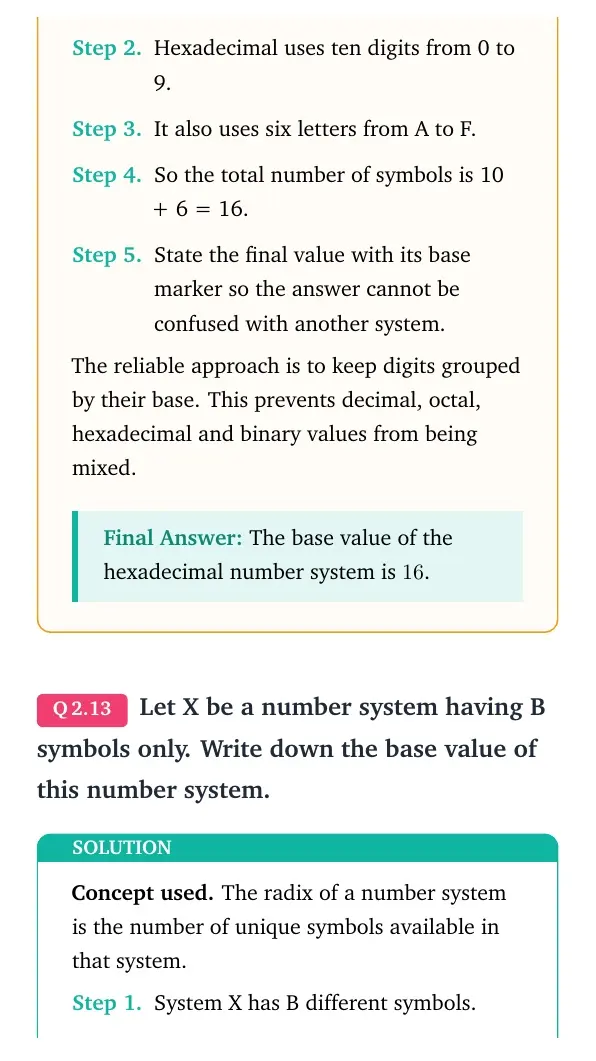
Let X be a number system having B symbols only. Write down the base value of this number system.
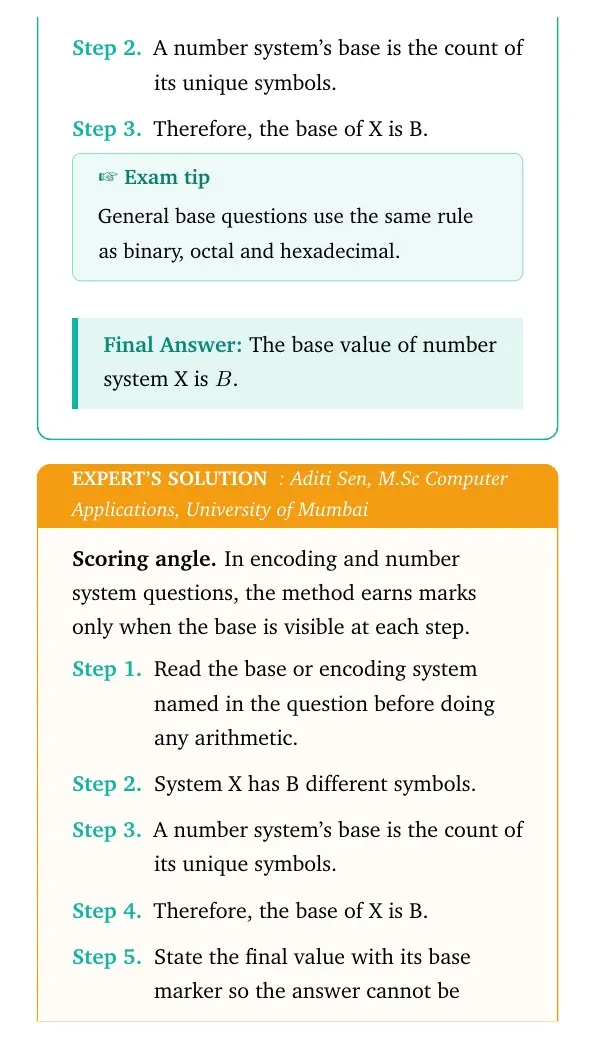
- System X has B different symbols.
- A number system's base is the count of its unique symbols.
- Therefore, the base of X is B.
Answer: The base value of number system X is B.
Expert view: Keep the base marker visible in every conversion step.
- System X has B different symbols.
- A number system's base is the count of its unique symbols.
- Therefore, the base of X is B.
Final answer: The base value of number system X is B.
Question 14
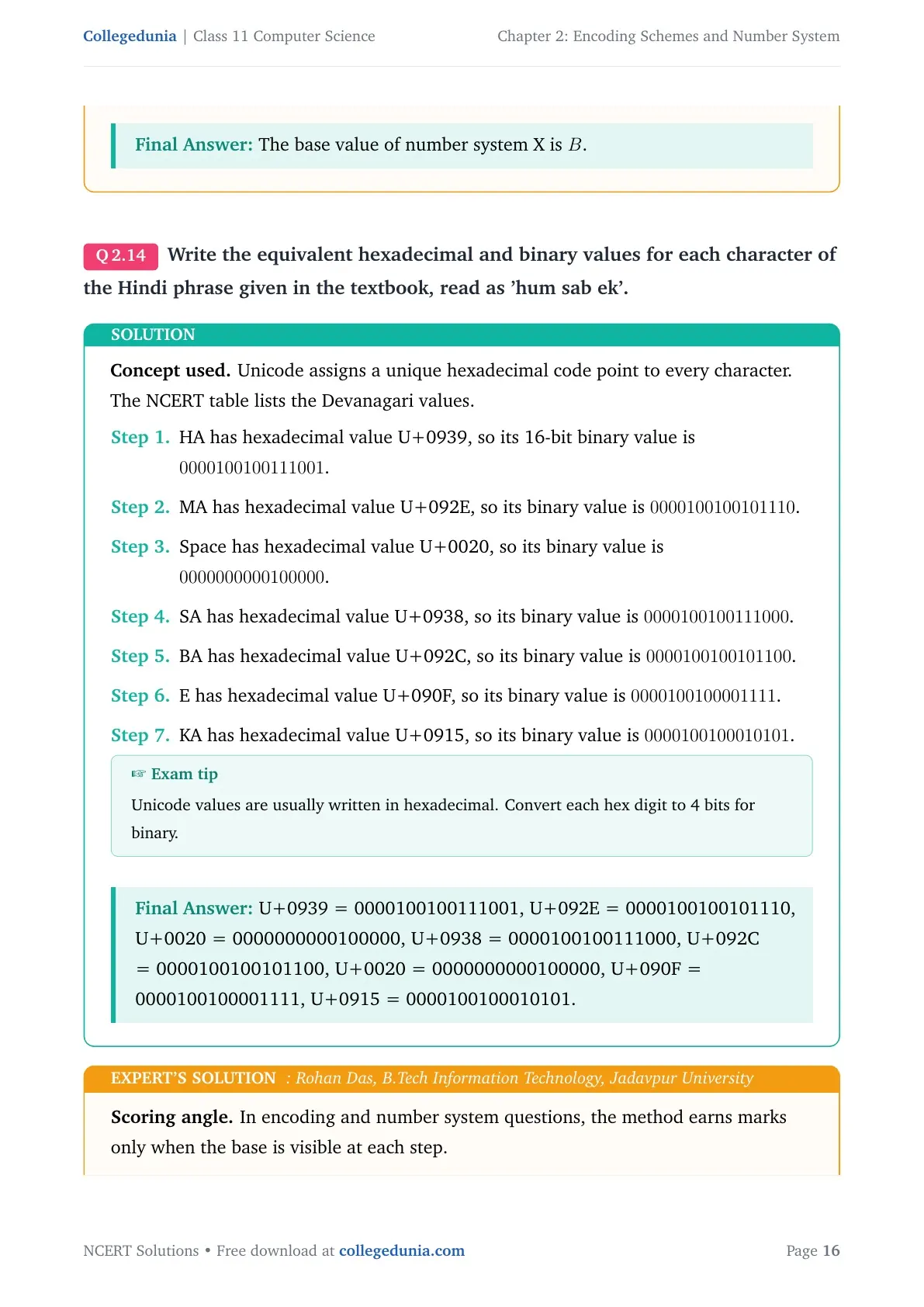
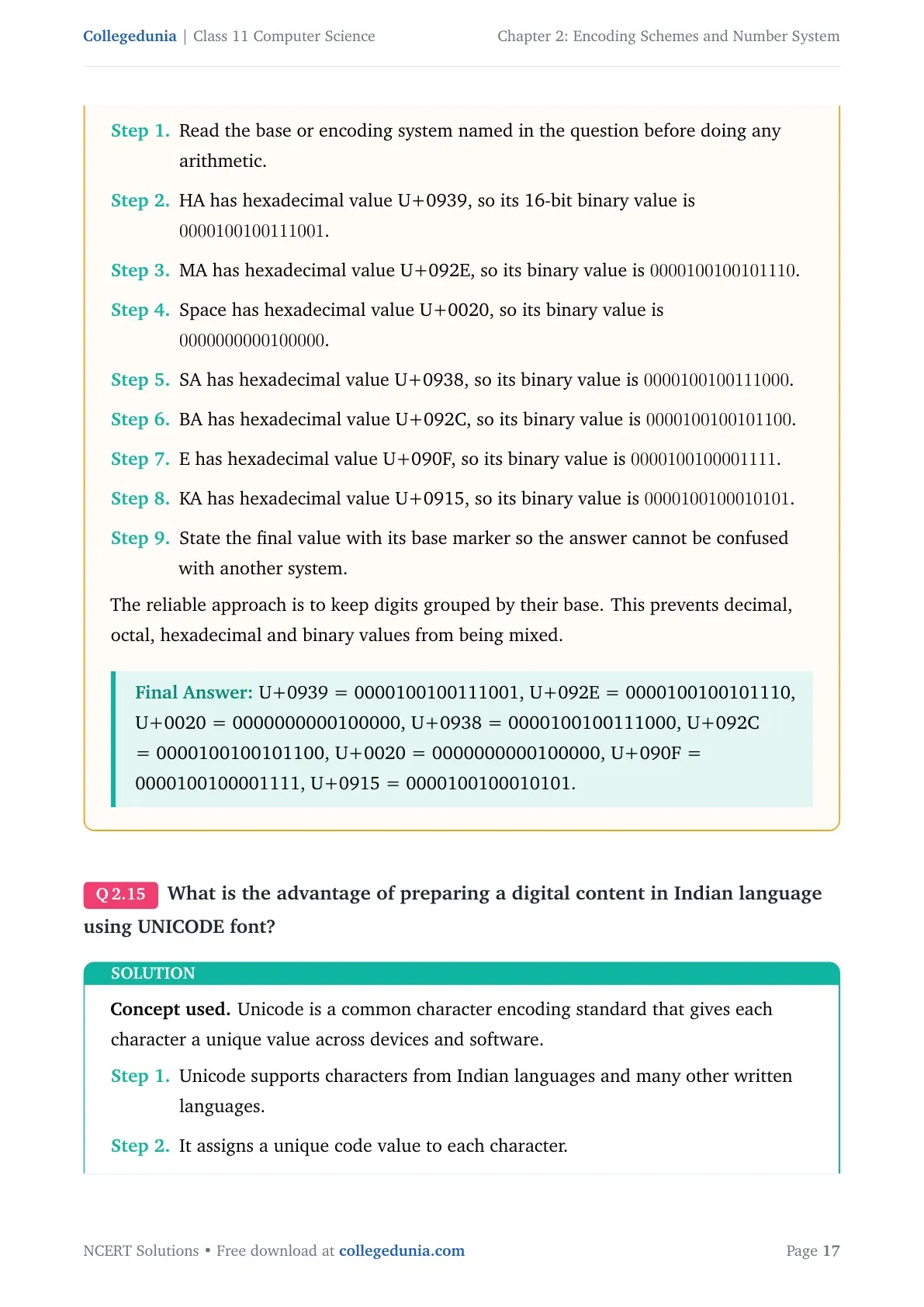
Write the equivalent hexadecimal and binary values for each character of the Hindi phrase given in the textbook, read as 'hum sab ek'.
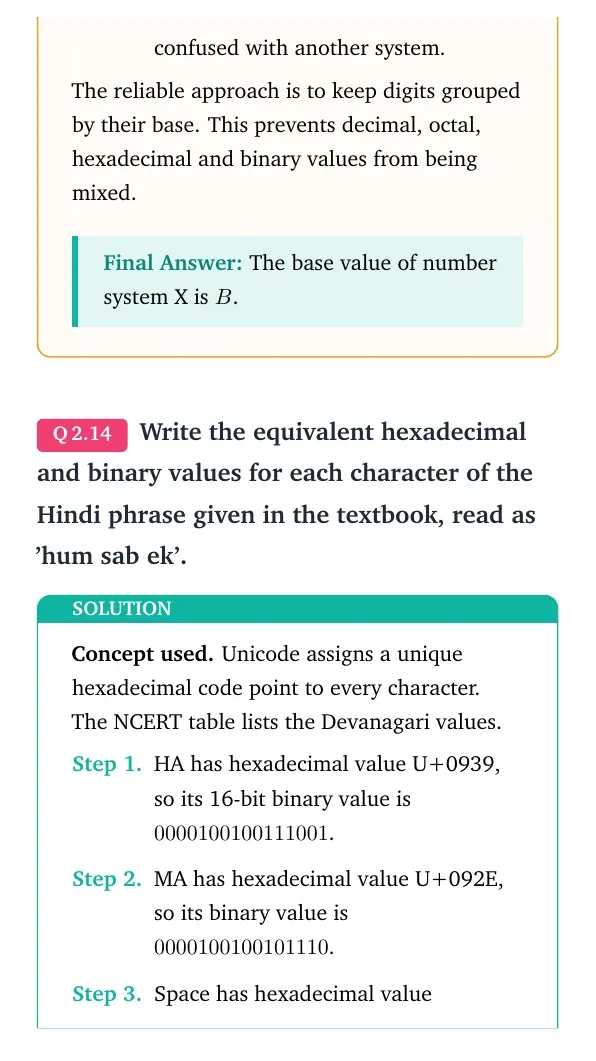
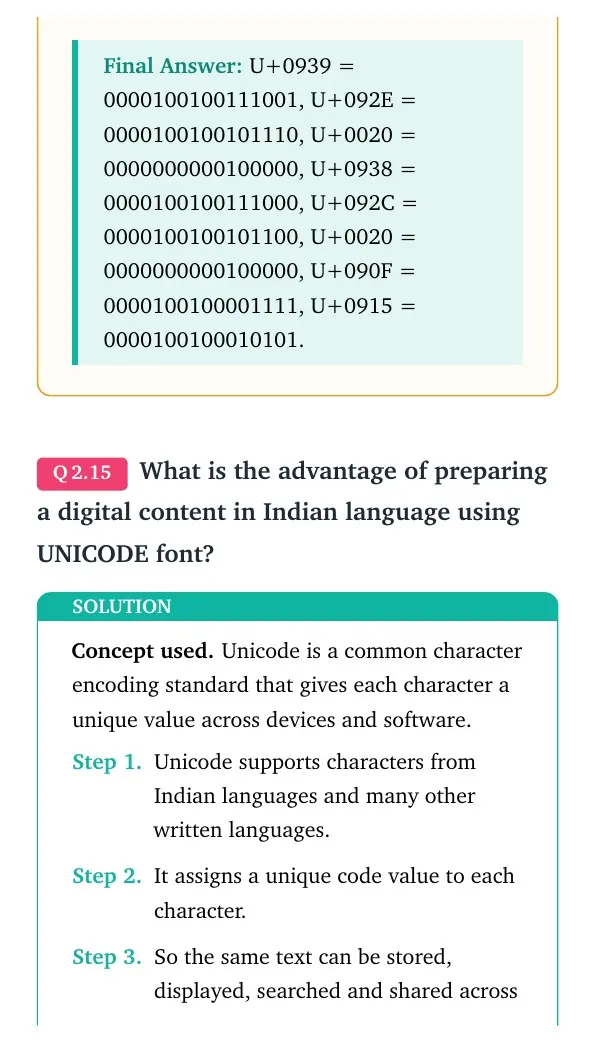
- HA has hexadecimal value U+0939, so its 16-bit binary value is 0000100100111001.
- MA has hexadecimal value U+092E, so its binary value is 0000100100101110.
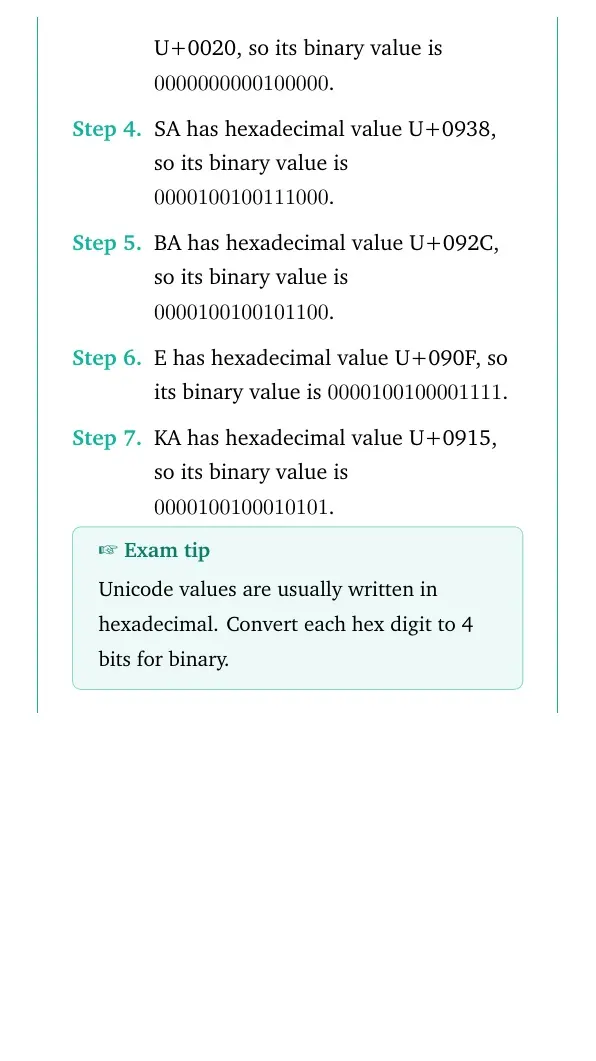
- Space has hexadecimal value U+0020, so its binary value is 0000000000100000.
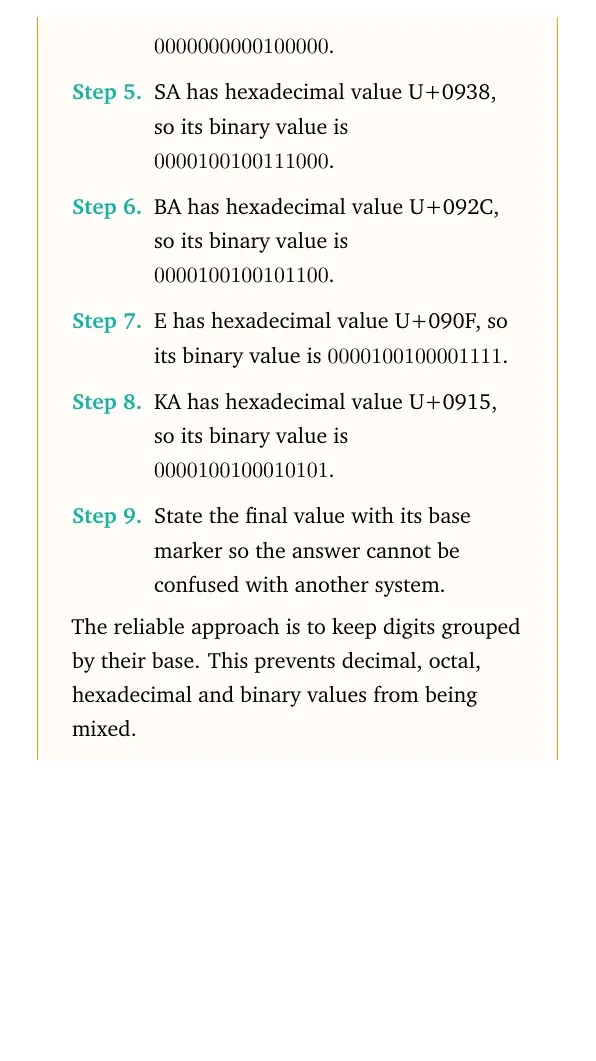
- SA has hexadecimal value U+0938, so its binary value is 0000100100111000.
- BA has hexadecimal value U+092C, so its binary value is 0000100100101100.
- E has hexadecimal value U+090F, so its binary value is 0000100100001111.
- KA has hexadecimal value U+0915, so its binary value is 0000100100010101.
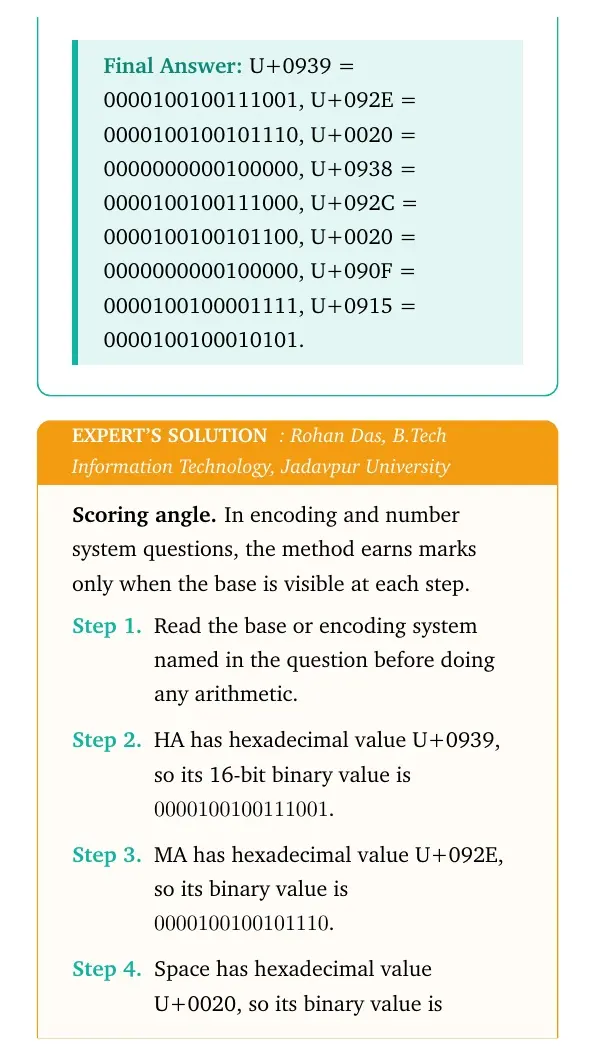
Answer: U+0939 = 0000100100111001, U+092E = 0000100100101110, U+0020 = 0000000000100000, U+0938 = 0000100100111000, U+092C = 0000100100101100, U+0020 = 0000000000100000, U+090F = 0000100100001111, U+0915 = 0000100100010101.
Expert view: Keep the base marker visible in every conversion step.
- HA has hexadecimal value U+0939, so its 16-bit binary value is 0000100100111001.
- MA has hexadecimal value U+092E, so its binary value is 0000100100101110.
- Space has hexadecimal value U+0020, so its binary value is 0000000000100000.
- SA has hexadecimal value U+0938, so its binary value is 0000100100111000.
- BA has hexadecimal value U+092C, so its binary value is 0000100100101100.
- E has hexadecimal value U+090F, so its binary value is 0000100100001111.
- KA has hexadecimal value U+0915, so its binary value is 0000100100010101.
Final answer: U+0939 = 0000100100111001, U+092E = 0000100100101110, U+0020 = 0000000000100000, U+0938 = 0000100100111000, U+092C = 0000100100101100, U+0020 = 0000000000100000, U+090F = 0000100100001111, U+0915 = 0000100100010101.
Question 15
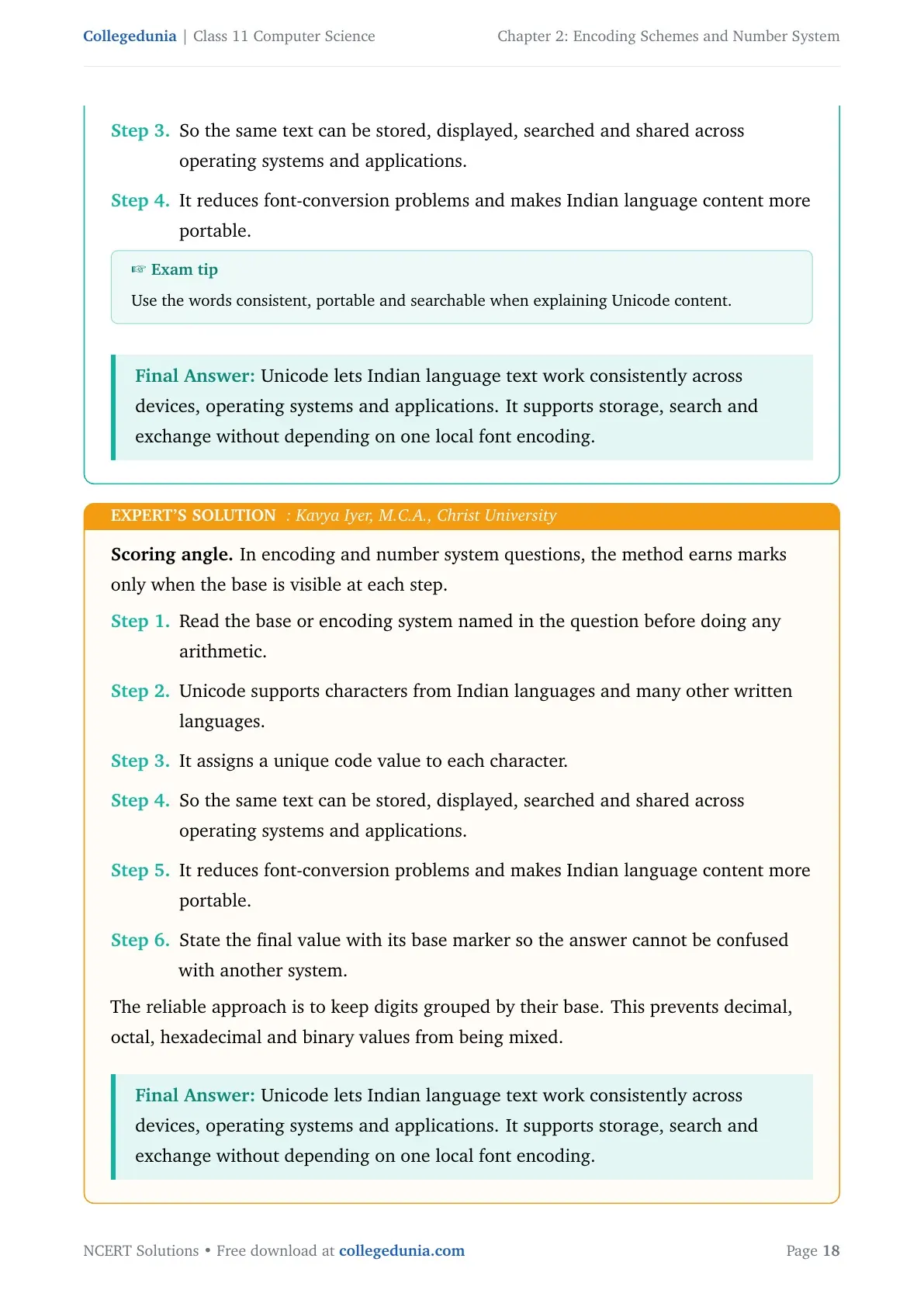
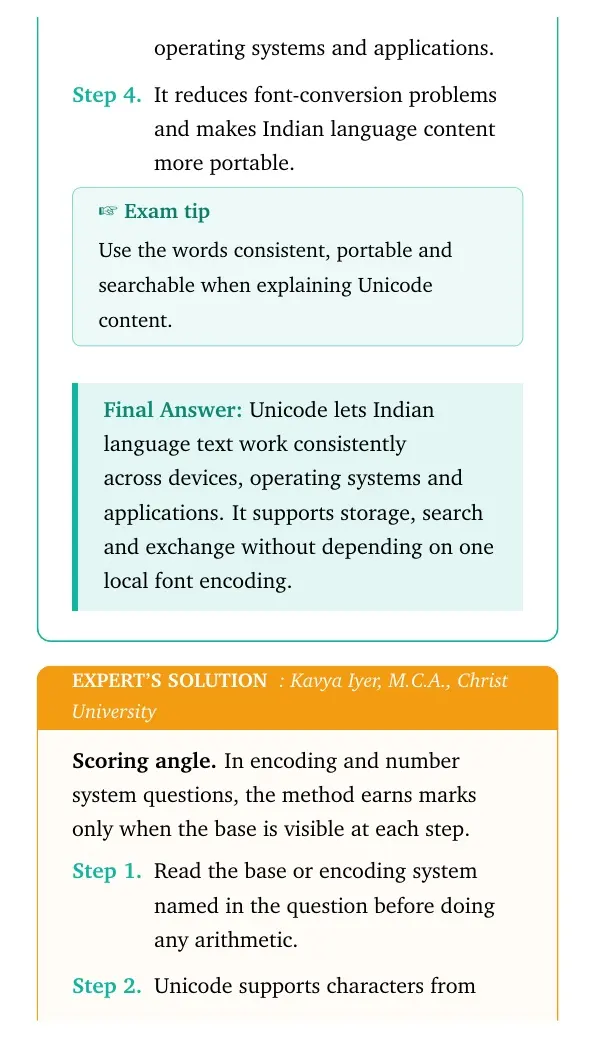
What is the advantage of preparing a digital content in Indian language using UNICODE font?
- Unicode supports characters from Indian languages and many other written languages.
- It assigns a unique code value to each character.
- So the same text can be stored, displayed, searched and shared across operating systems and applications.
- It reduces font-conversion problems and makes Indian language content more portable.
Answer: Unicode lets Indian language text work consistently across devices, operating systems and applications. It supports storage, search and exchange without depending on one local font encoding.
Expert view: Keep the base marker visible in every conversion step.
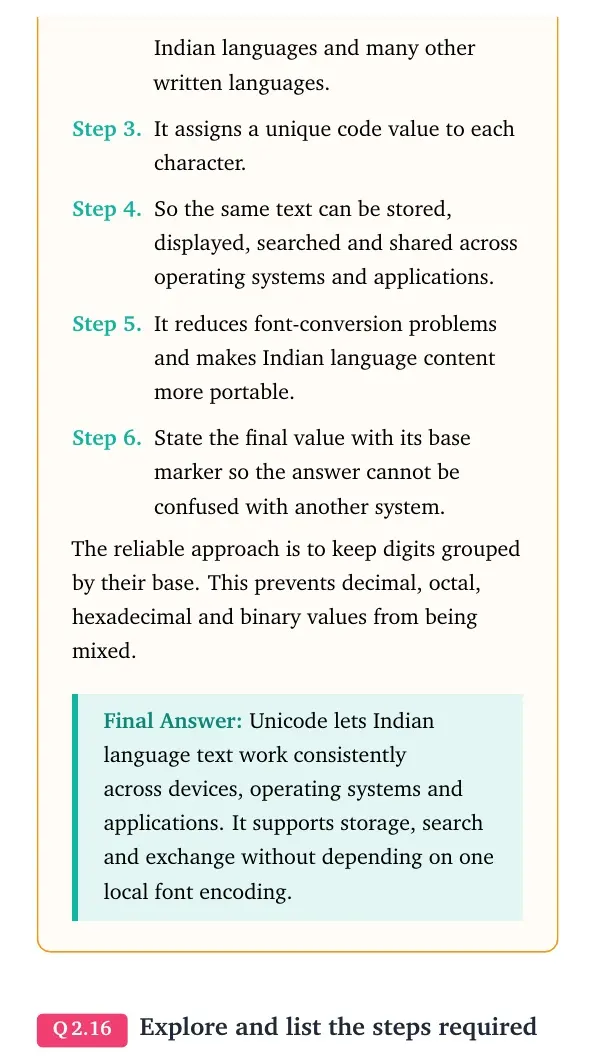
- Unicode supports characters from Indian languages and many other written languages.
- It assigns a unique code value to each character.
- So the same text can be stored, displayed, searched and shared across operating systems and applications.
- It reduces font-conversion problems and makes Indian language content more portable.
Final answer: Unicode lets Indian language text work consistently across devices, operating systems and applications. It supports storage, search and exchange without depending on one local font encoding.
Question 16
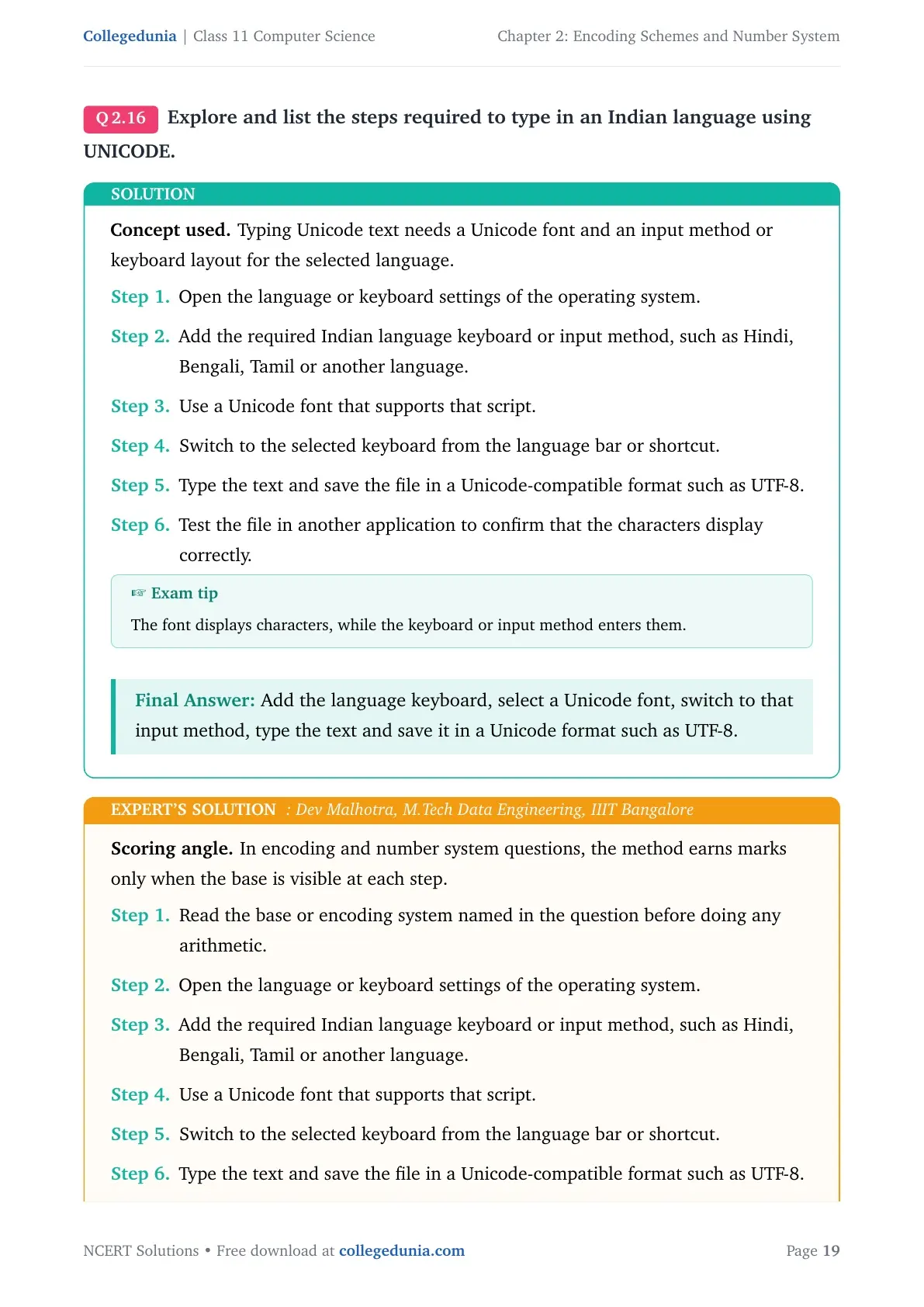
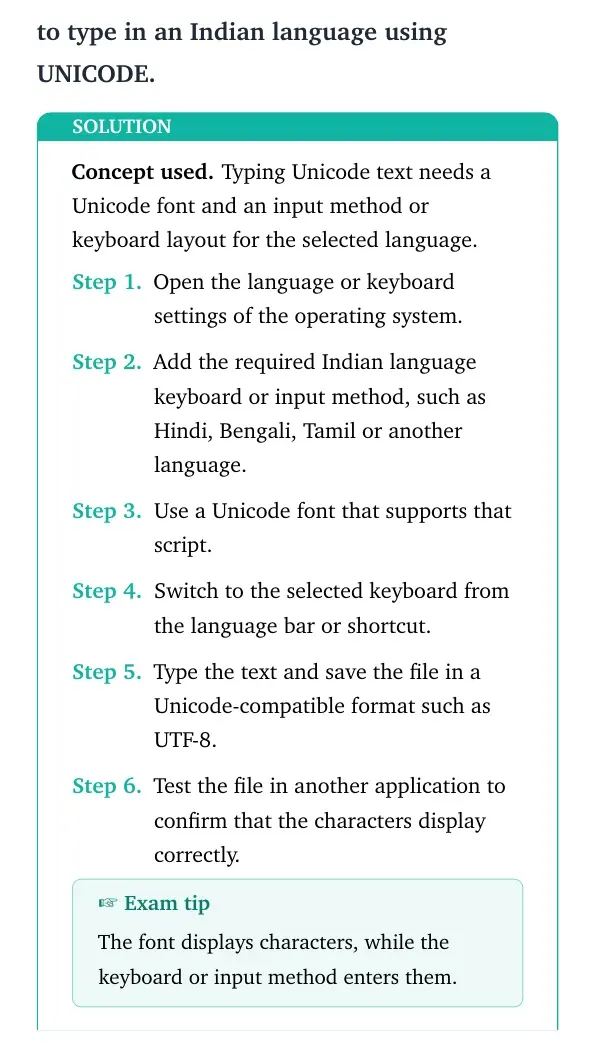
Explore and list the steps required to type in an Indian language using UNICODE.
- Open the language or keyboard settings of the operating system.
- Add the required Indian language keyboard or input method, such as Hindi, Bengali, Tamil or another language.
- Use a Unicode font that supports that script.
- Switch to the selected keyboard from the language bar or shortcut.
- Type the text and save the file in a Unicode-compatible format such as UTF-8.
- Test the file in another application to confirm that the characters display correctly.
Answer: Add the language keyboard, select a Unicode font, switch to that input method, type the text and save it in a Unicode format such as UTF-8.
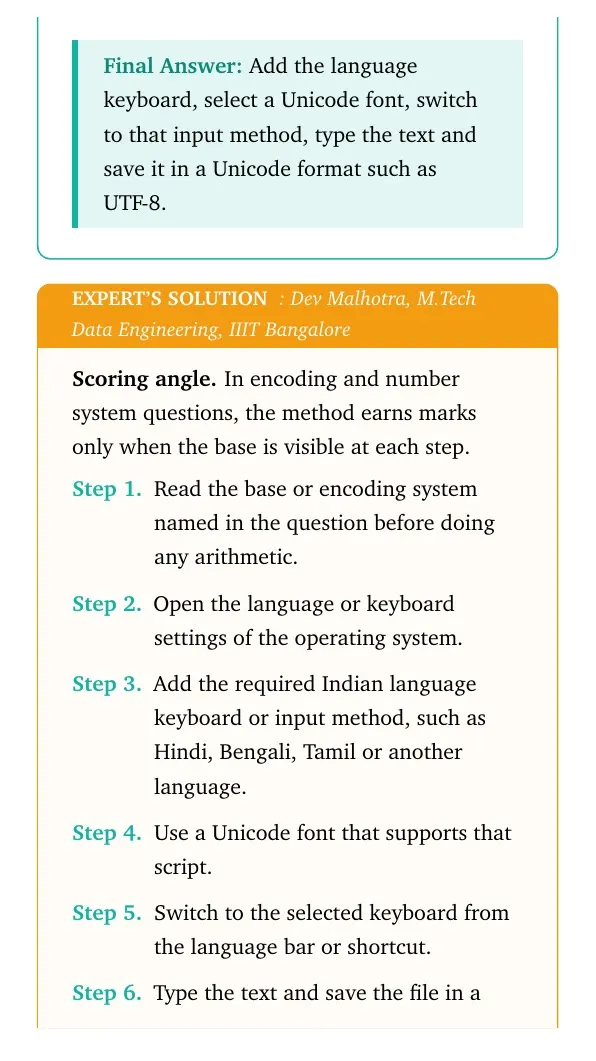
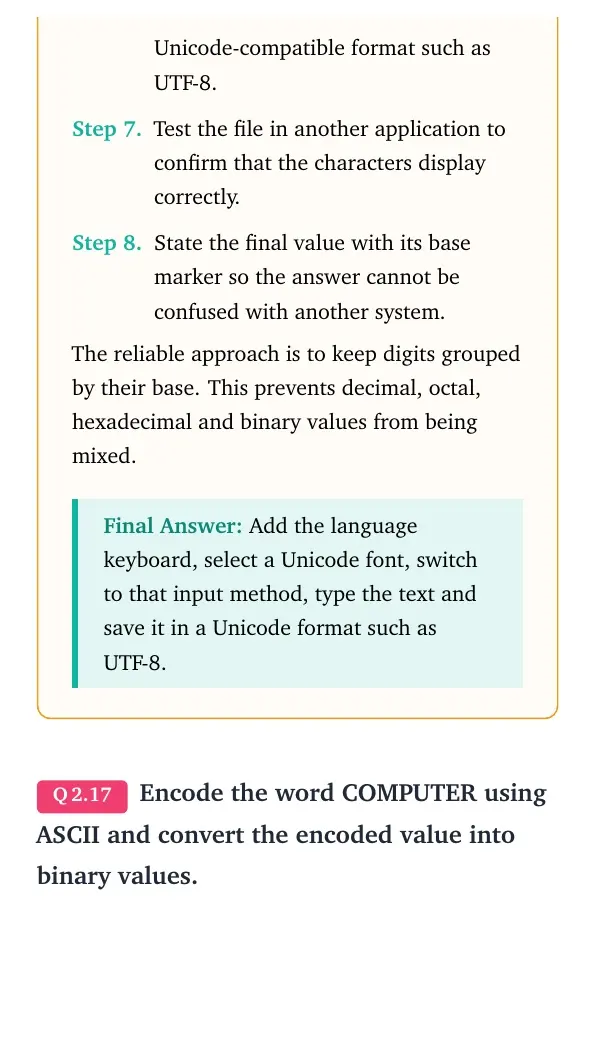
Expert view: Keep the base marker visible in every conversion step.
- Open the language or keyboard settings of the operating system.
- Add the required Indian language keyboard or input method, such as Hindi, Bengali, Tamil or another language.
- Use a Unicode font that supports that script.
- Switch to the selected keyboard from the language bar or shortcut.
- Type the text and save the file in a Unicode-compatible format such as UTF-8.
- Test the file in another application to confirm that the characters display correctly.
Final answer: Add the language keyboard, select a Unicode font, switch to that input method, type the text and save it in a Unicode format such as UTF-8.
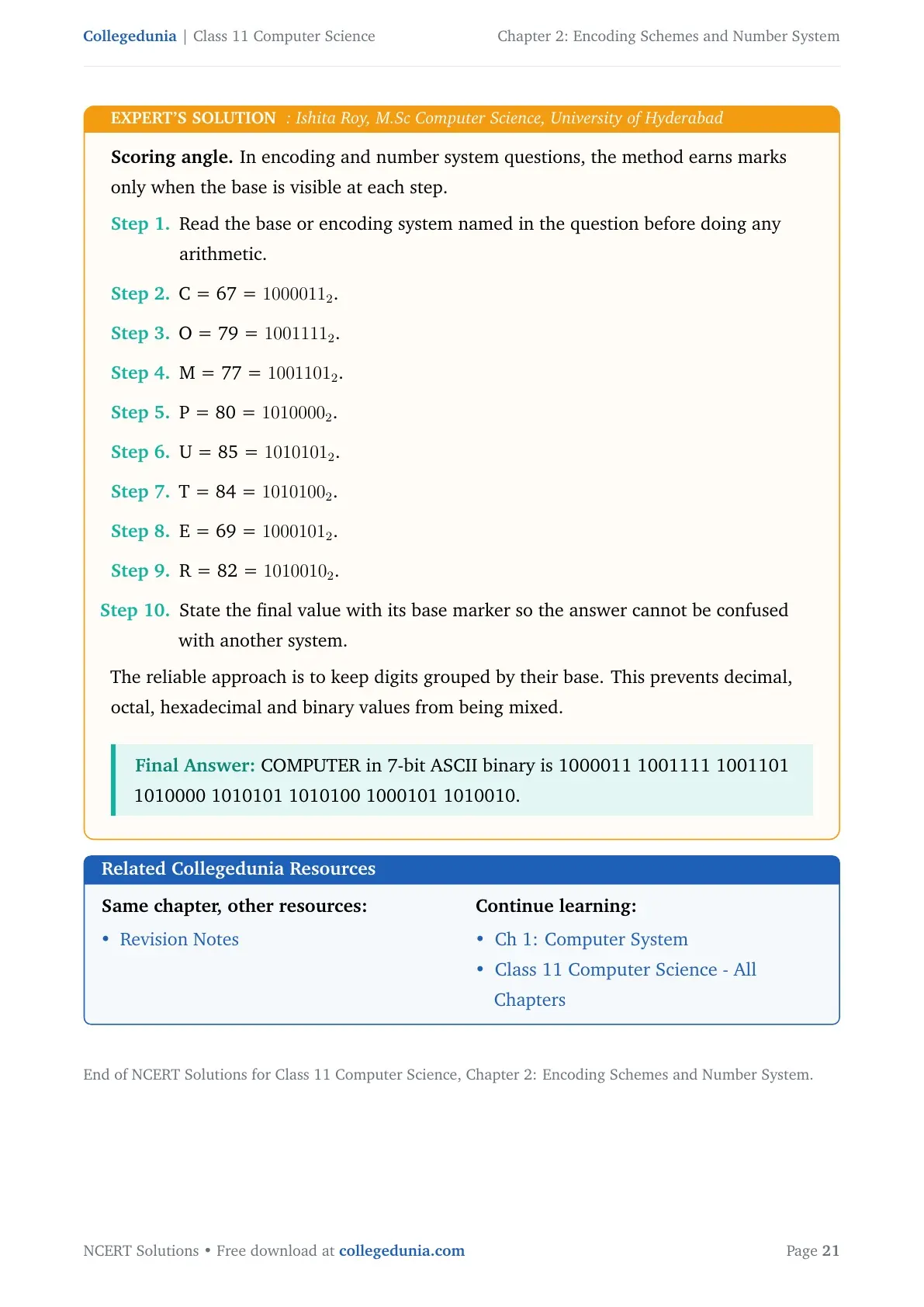
Question 17
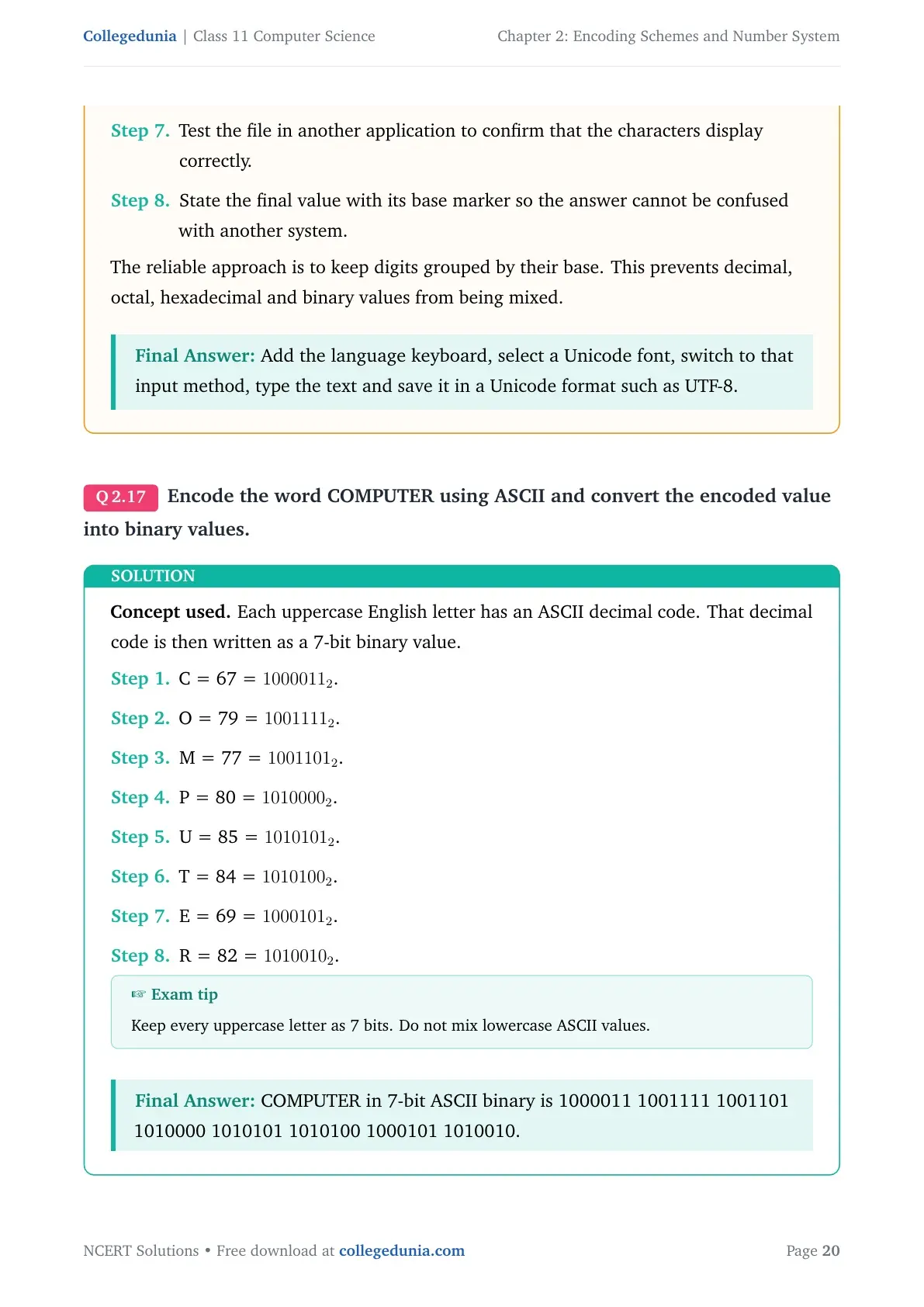
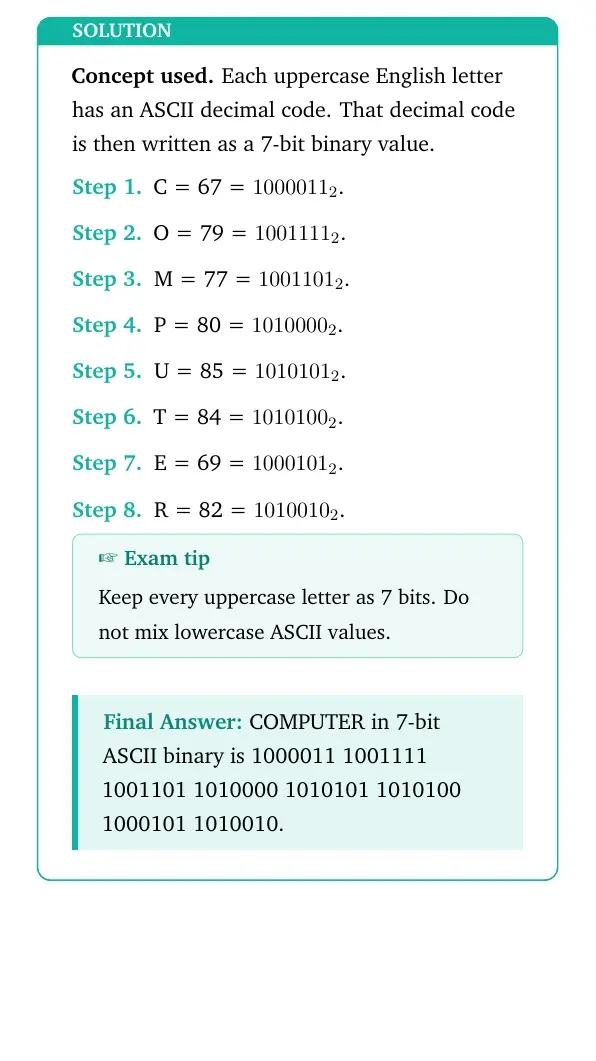
Encode the word COMPUTER using ASCII and convert the encoded value into binary values.
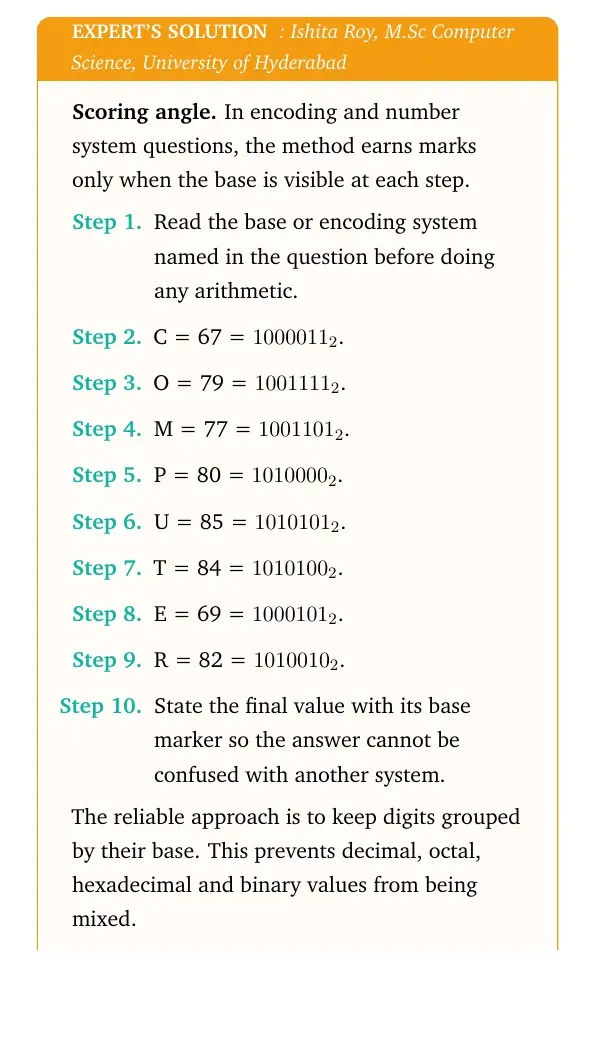
- C = 67 = 1000011_2.
- O = 79 = 1001111_2.
- M = 77 = 1001101_2.
- P = 80 = 1010000_2.
- U = 85 = 1010101_2.
- T = 84 = 1010100_2.
- E = 69 = 1000101_2.
- R = 82 = 1010010_2.
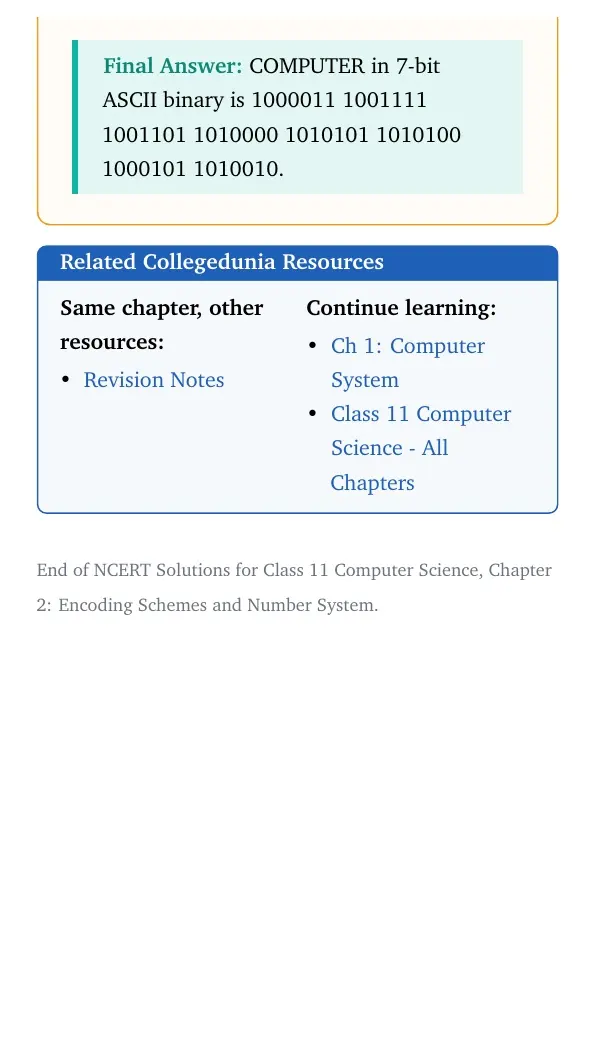
Answer: COMPUTER in 7-bit ASCII binary is 1000011 1001111 1001101 1010000 1010101 1010100 1000101 1010010.
Expert view: Keep the base marker visible in every conversion step.
- C = 67 = 1000011_2.
- O = 79 = 1001111_2.
- M = 77 = 1001101_2.
- P = 80 = 1010000_2.
- U = 85 = 1010101_2.
- T = 84 = 1010100_2.
- E = 69 = 1000101_2.
- R = 82 = 1010010_2.
Final answer: COMPUTER in 7-bit ASCII binary is 1000011 1001111 1001101 1010000 1010101 1010100 1000101 1010010.
Encoding Schemes and Number System Class 11 NCERT Solutions FAQs
Ques. How many questions are solved in Class 11 Computer Science Chapter 2?
Ans. The PDF solves all 17 NCERT exercise questions from Encoding Schemes and Number System.
Ques. What is the most important part of Encoding Schemes and Number System?
Ans. Number-system conversion is the most practice-heavy part. ASCII, ISCII and Unicode are important for short answers.
Ques. Does this page follow the 2026-27 NCERT Computer Science chapter?
Ans. Yes. The answers follow the 2026-27 NCERT Class 11 Computer Science Chapter 2 exercise.
Ques. Why should students write the base after every conversion answer?
Ans. A value can mean different numbers in different bases, so the base marker makes the final answer clear.



Comments