




Encoding Schemes and Number System is chapter 2 of the Class 11 Computer Science textbook published by NCERT. The ncert book class 11 computer science chapter 2 encoding schemes and number system file on this page is the official chapter for 2026-27. Download it to read the ASCII, ISCII and Unicode sections and every worked conversion example straight from the source.
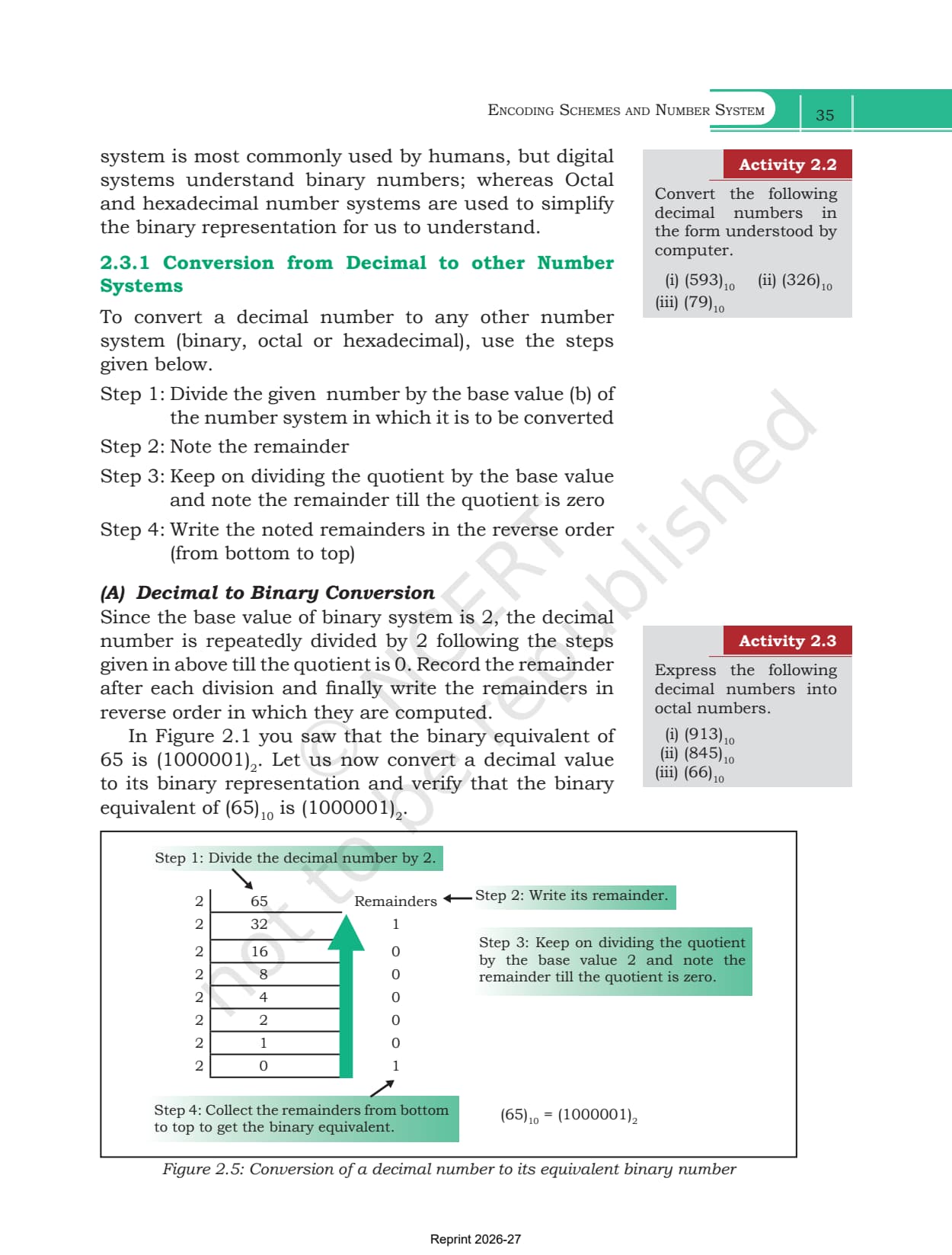
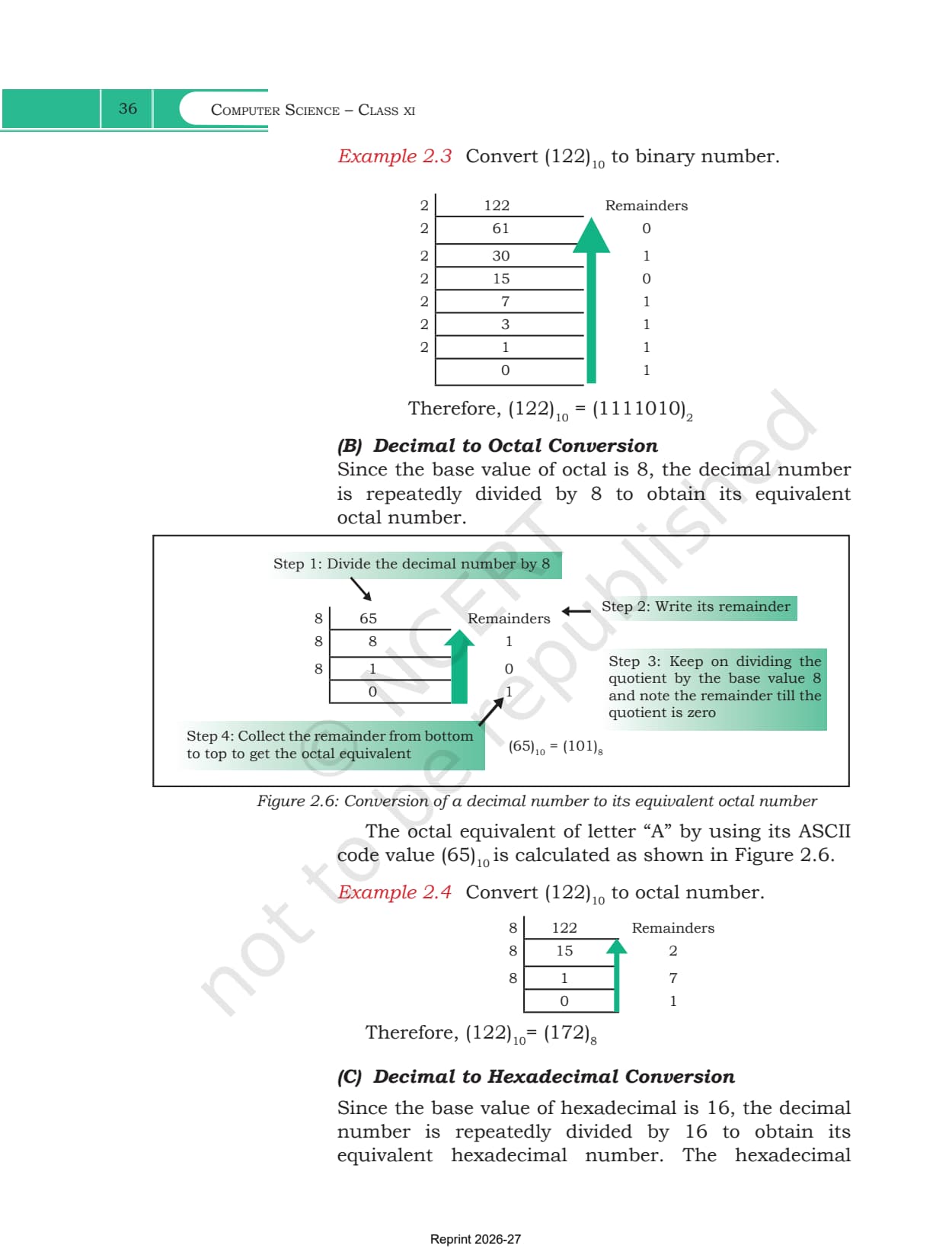
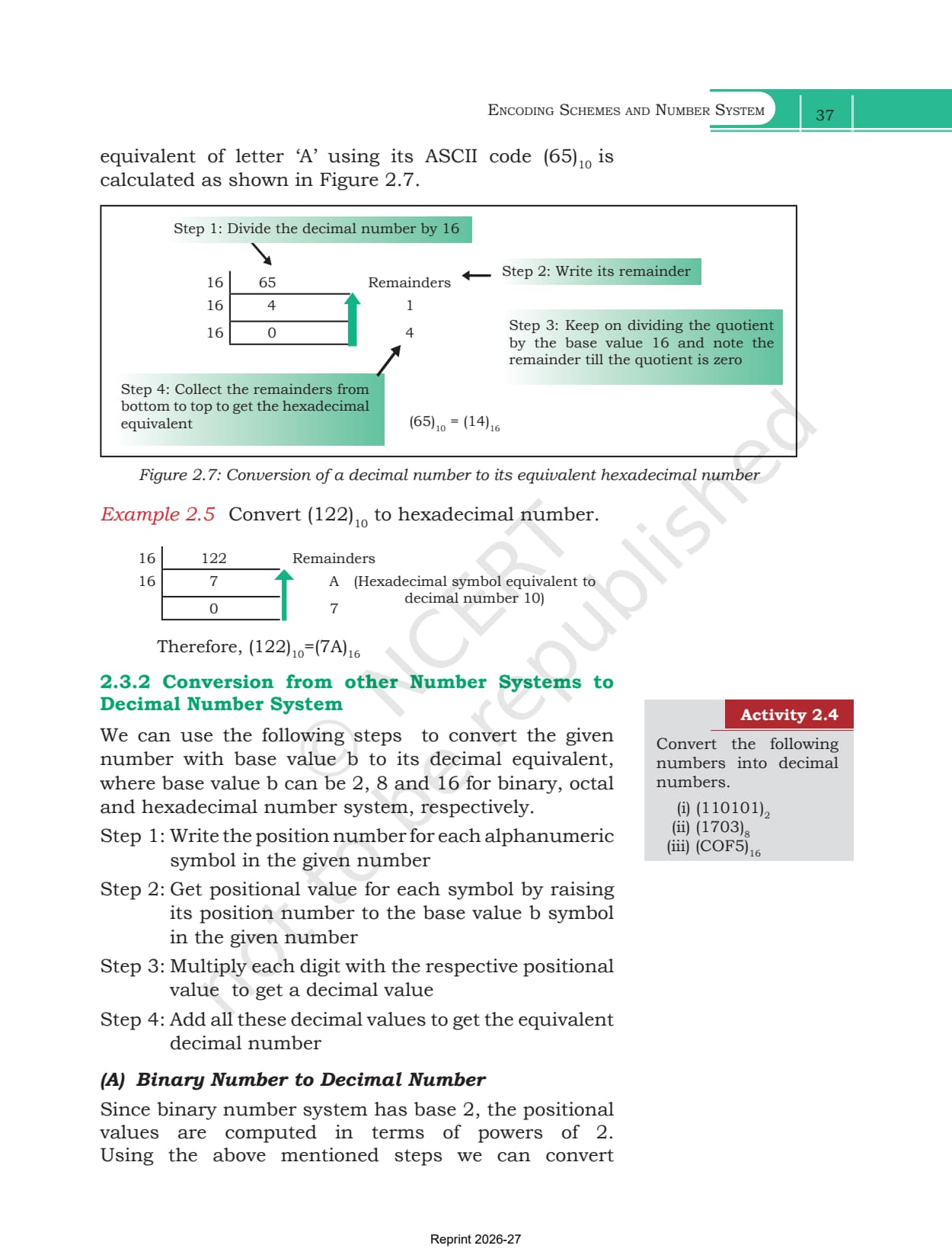
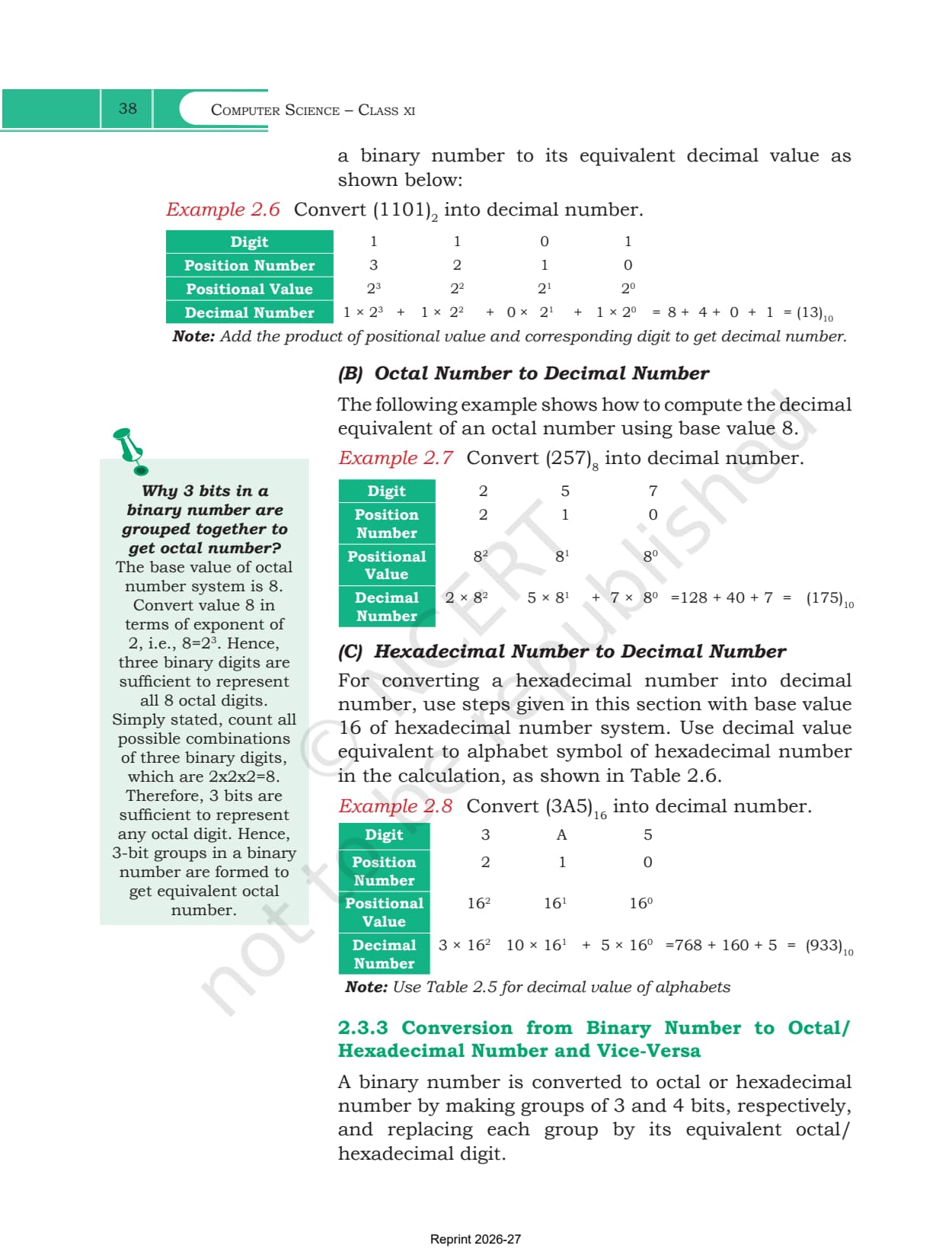
- Chapter: Chapter 2, Encoding Schemes and Number System, the chapter that follows Computer System
- Book: Computer Science is the Class 11 textbook for 2026-27, with 11 chapters
- File: 18 pages, printed as pages 27 to 44, the complete official chapter
You can page through the ASCII table, the Devanagari Unicode chart and all twenty solved examples in the reader above before downloading the file.
This is the official NCERT chapter file for the 2026-27 session, hosted by Collegedunia with no pages removed.
How the Encoding Schemes and Number System Chapter Is Laid Out
The chapter opens with an Albert Einstein quotation about counting, then runs in a straight line from keyboard input to number bases. Its parts appear in this order.
| Section | What it covers |
|---|---|
| 2.1 Introduction | why a keypress becomes a code value, and what encoding means |
| 2.1.1 ASCII | the 7-bit standard, with a printable-character table |
| 2.1.2 ISCII | the 8-bit Indian Script Code for Information Interchange |
| 2.1.3 UNICODE | UTF-8, UTF-16 and UTF-32, plus the Devanagari code chart |
| 2.2 Number System | positional value, then decimal, binary, octal and hexadecimal |
| 2.2.5 Applications | memory addresses and RGB colour codes in hexadecimal |
| 2.3 Conversion Between Number Systems | four sub-sections covering every direction, including fractions |
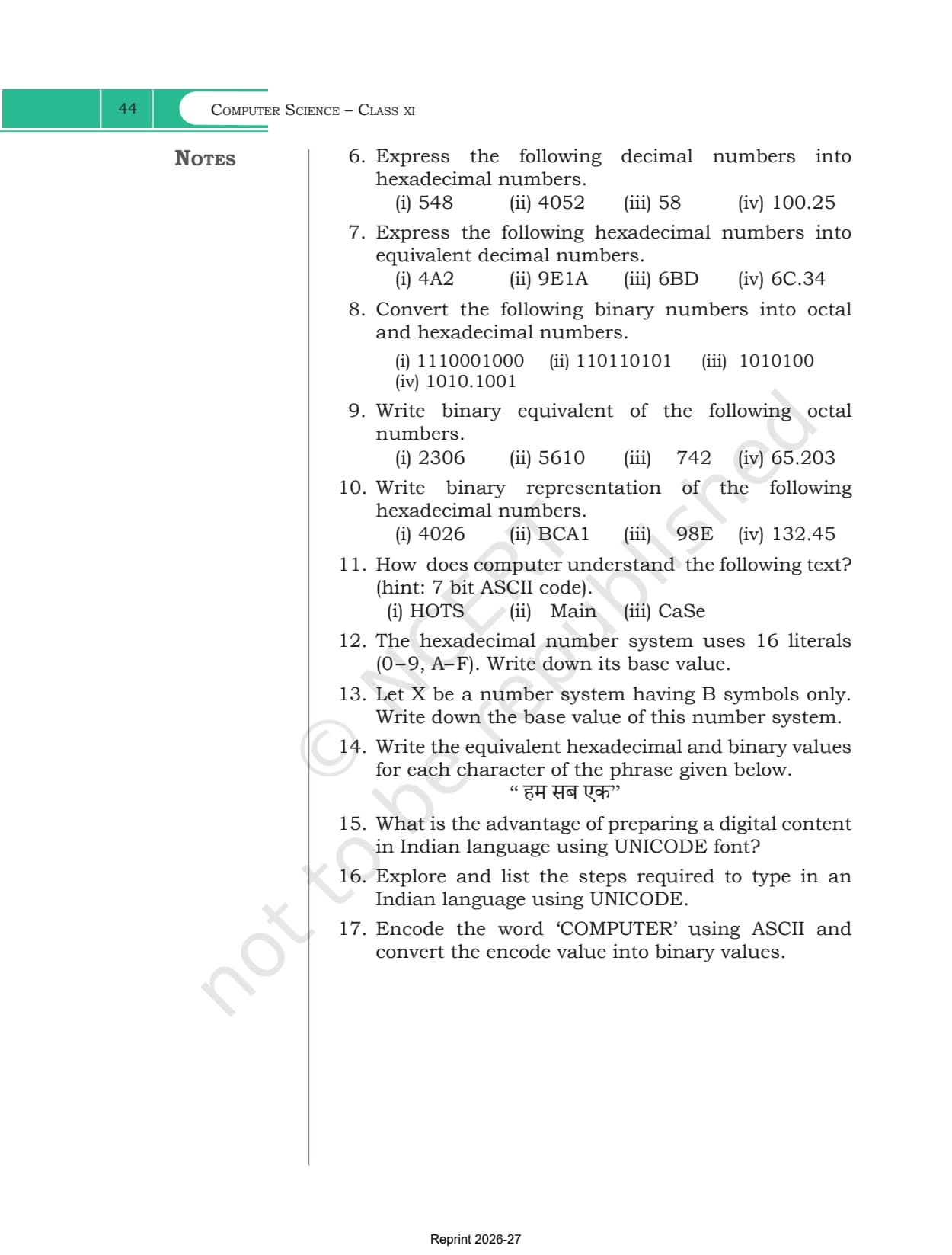
| Summary and Exercise | six summary points and 17 questions on the closing pages |
What the Class 11 Computer Science Chapter 2 PDF Contains
The PDF holds the whole chapter as NCERT printed it. Every table, figure, solved example and margin box is in place, with nothing trimmed.
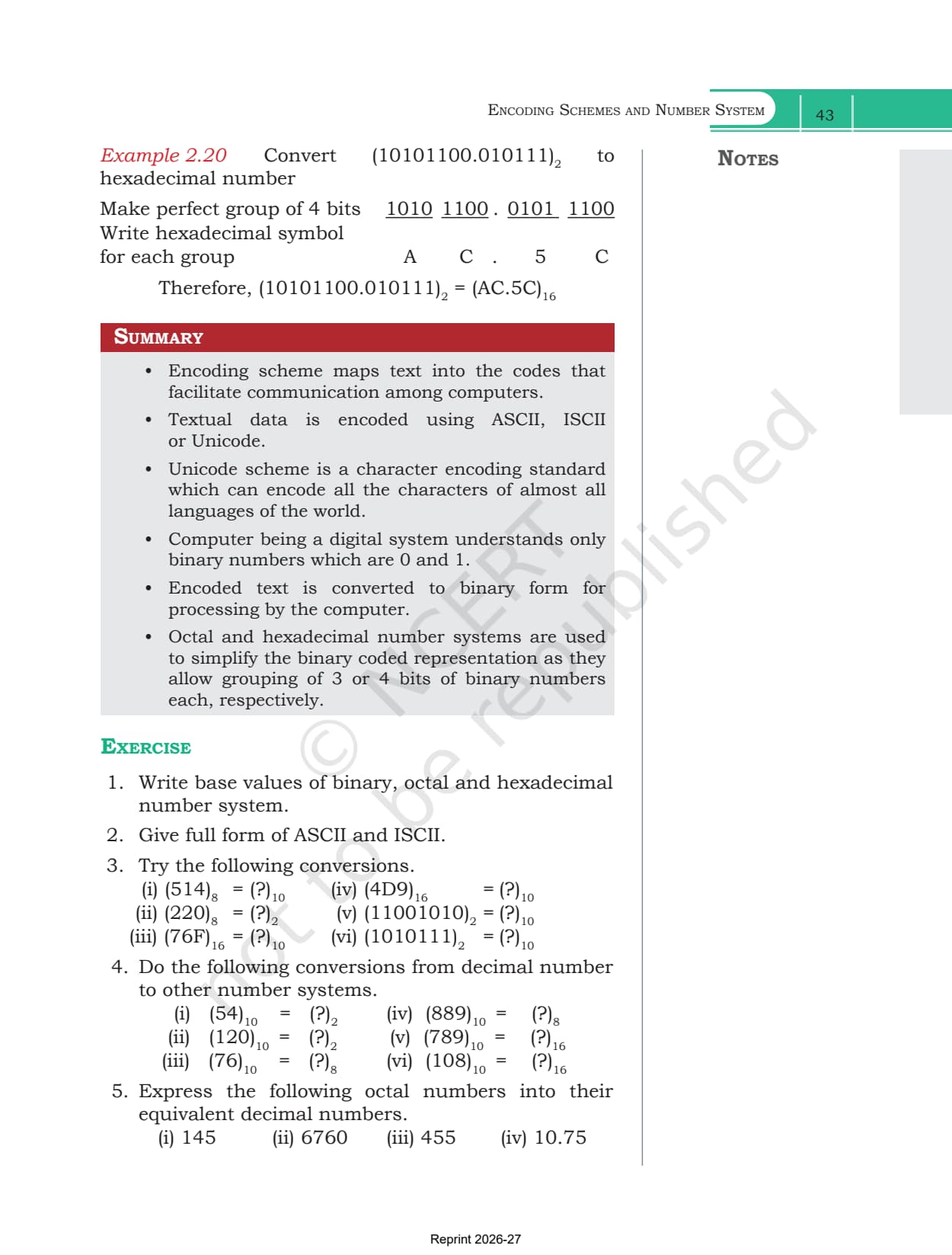
- Twenty solved examples, numbered 2.1 to 2.20, covering encoding and every conversion direction
- Seven tables, from the ASCII printable-character list to the colour codes for black, white, yellow and grey
- Seven figures, including the keyboard encoding diagram and the division-method charts
- Five Activity boxes and three Think and Reflect prompts set in the margins
- The complete Exercise, 17 questions long, ending with encoding the word COMPUTER in ASCII
Encoding Schemes and Number System Explained in One Video
Source: Magnet Brains on YouTube
ASCII, ISCII and Unicode in the Class 11 Chapter
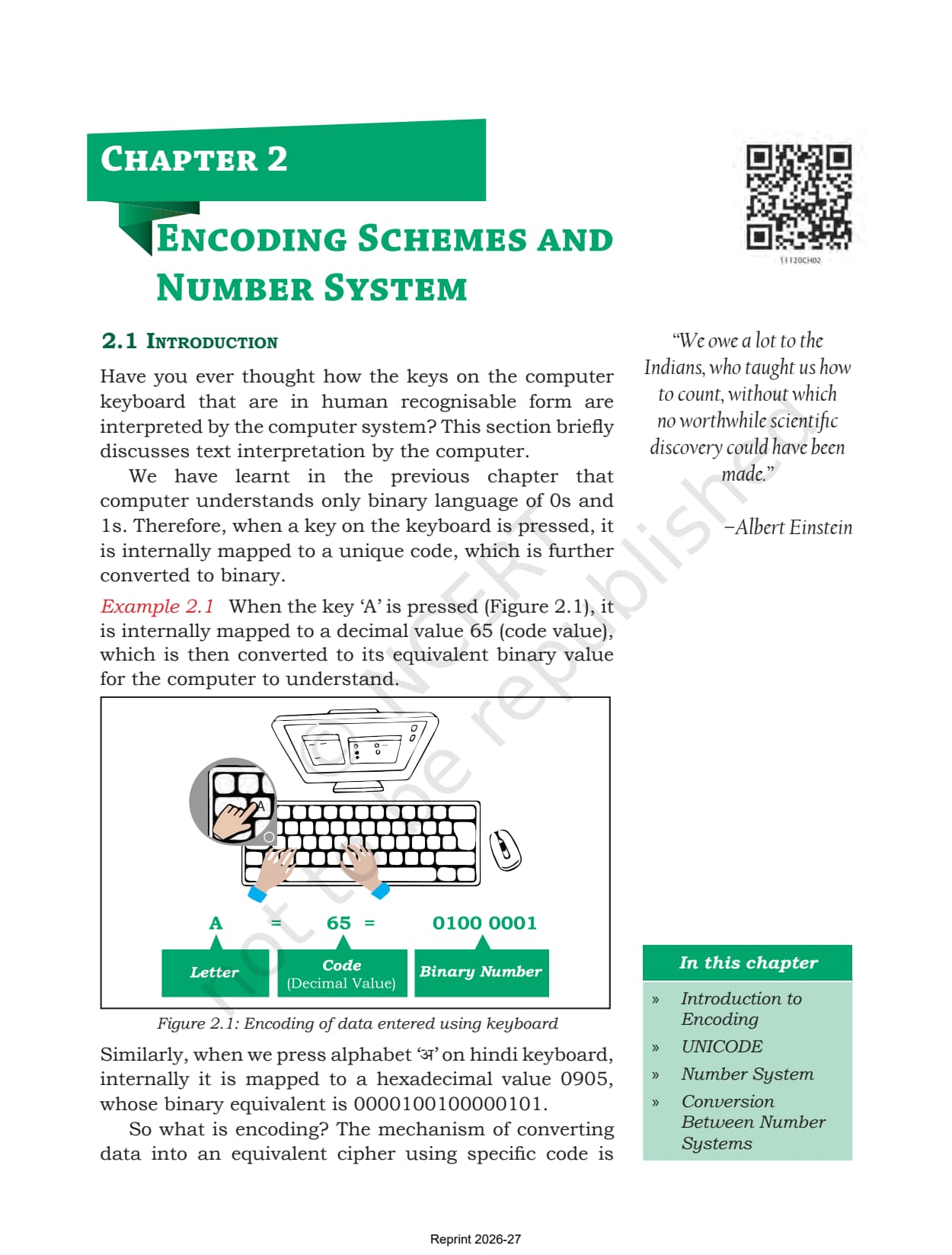
Section 2.1 answers a question most students ask once and never forget: why is the letter A stored as 65 and not some other value. Because every keyboard agrees on the same standard, and the chapter sets out the three that matter.
| Scheme | Bits | Characters | What the chapter says about it |
|---|---|---|---|
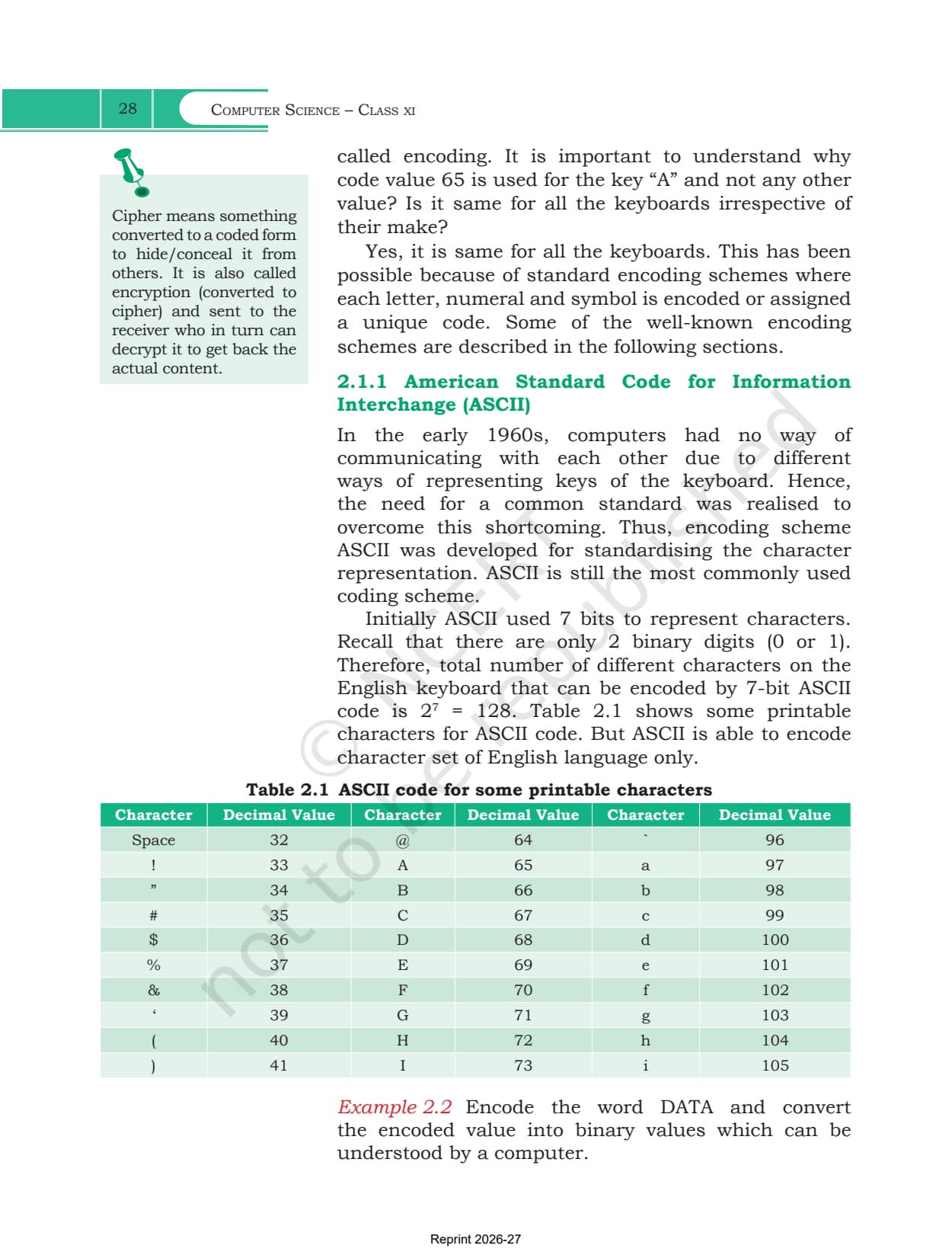
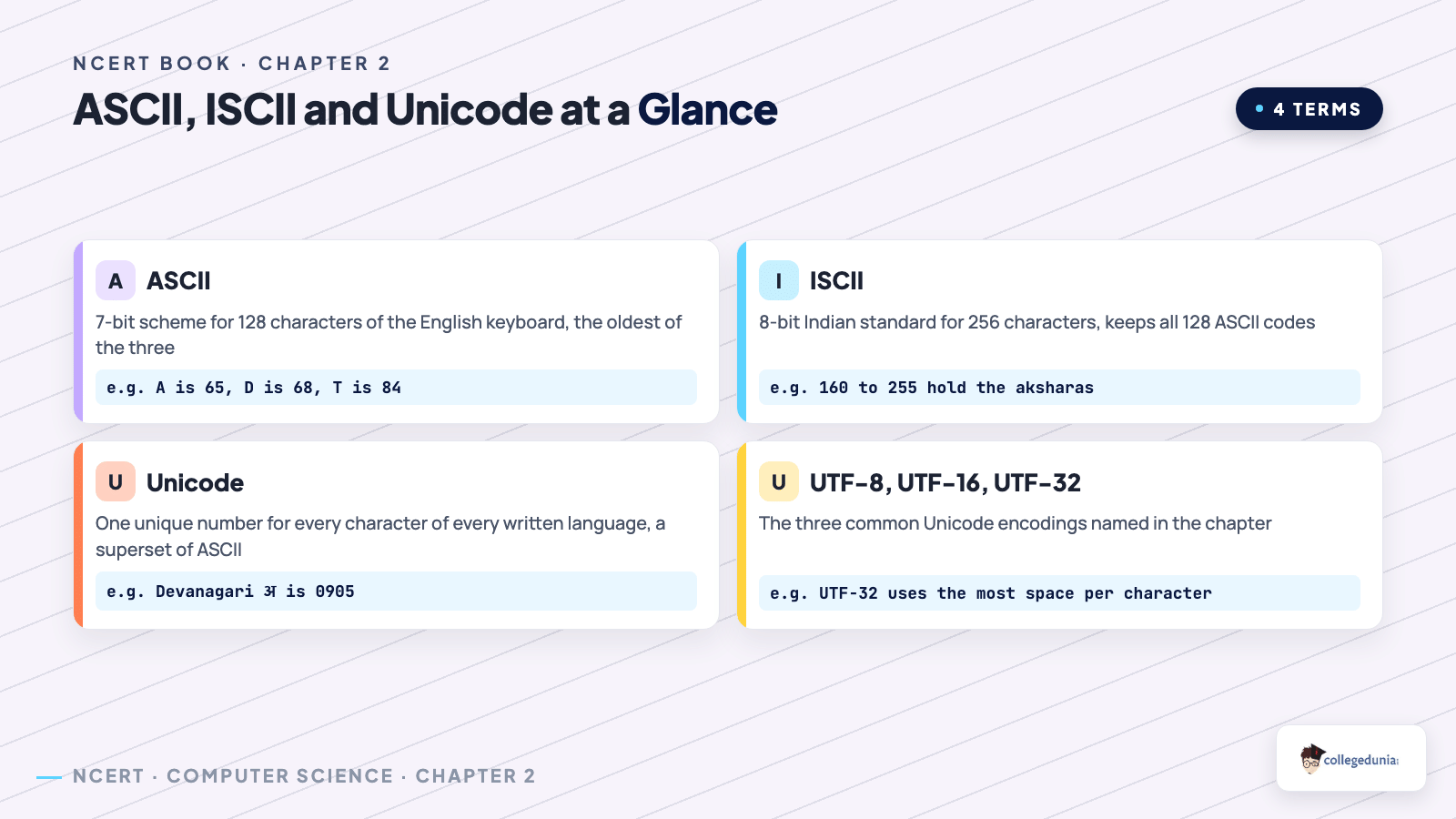
| ASCII | 7 | 128 | built in the early 1960s to standardise character representation, still the most used scheme, but English only |
| ISCII | 8 | 256 | built in India in the mid 1980s, keeps all 128 ASCII codes and uses 160 to 255 for the aksharas of Indian languages |
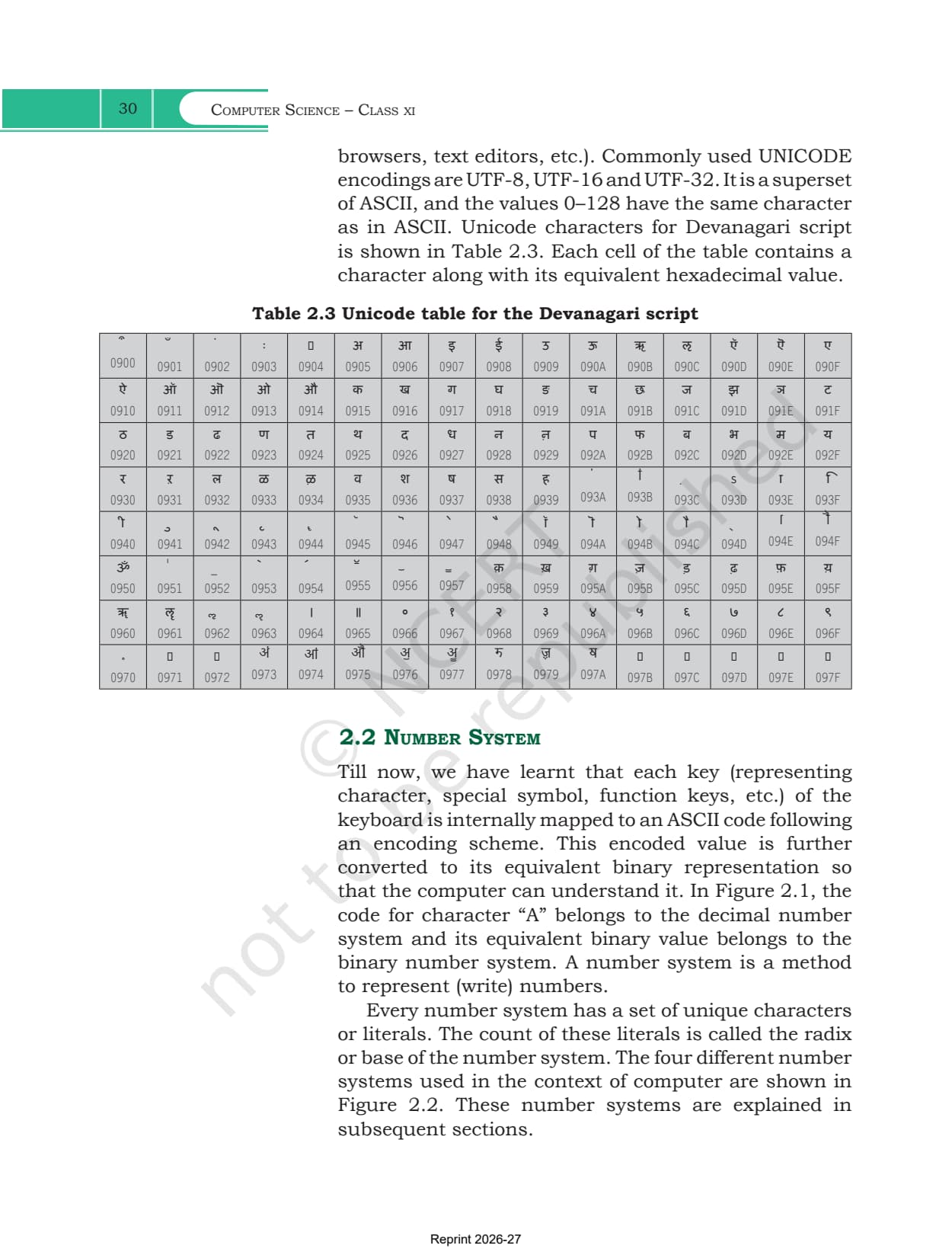
| Unicode | varies | every written language | a superset of ASCII whose values 0 to 128 carry the same characters, encoded as UTF-8, UTF-16 or UTF-32 |
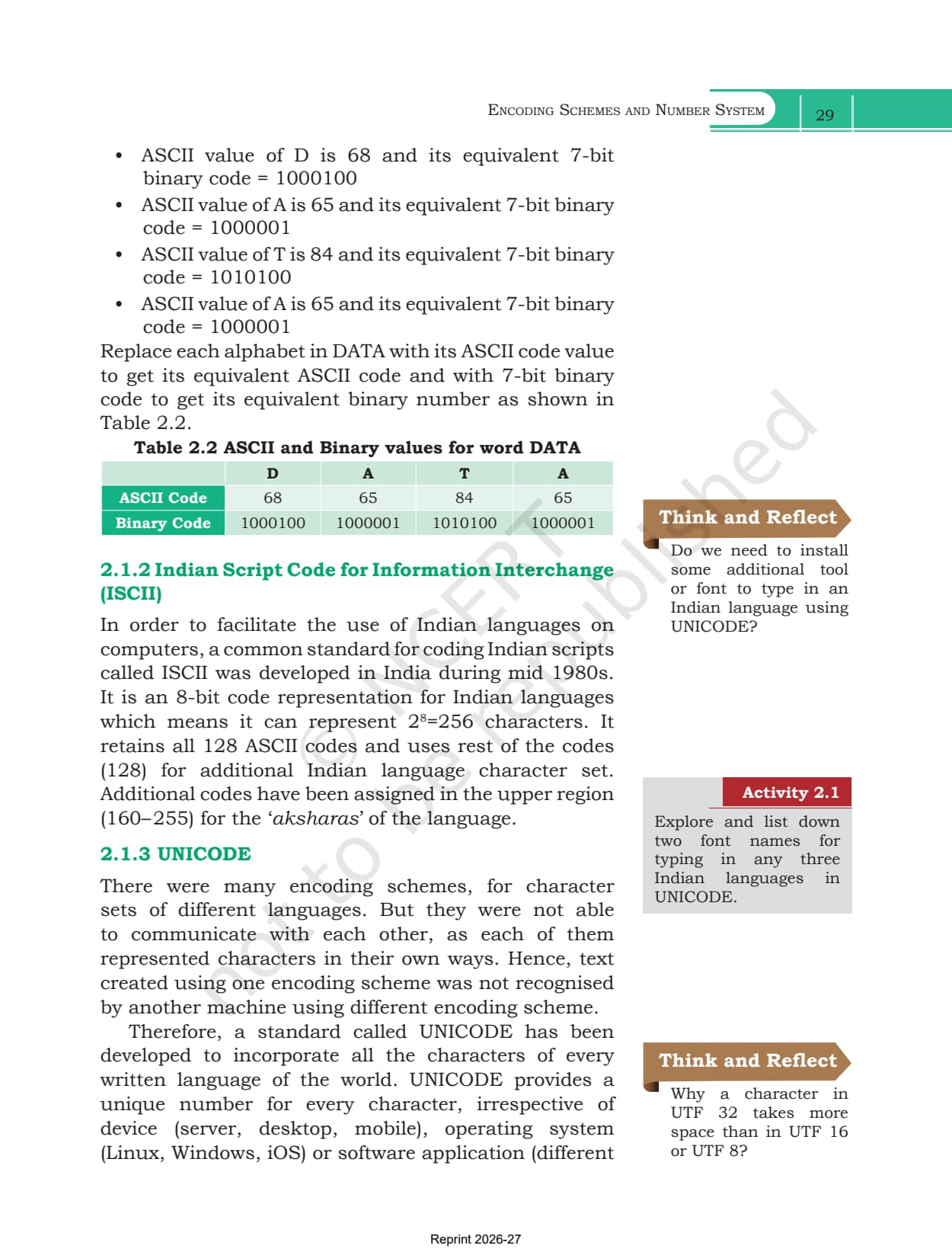
The worked example encodes the word DATA. D is 68, A is 65 and T is 84, so the binary form is 1000100 1000001 1010100 1000001. The Unicode section then prints the whole Devanagari chart, where the letter अ carries the hexadecimal value 0905, whose binary equivalent is 0000100100000101. A margin prompt asks why a character in UTF-32 takes more space than in UTF-16 or UTF-8.
The Four Number Systems Covered in Chapter 2
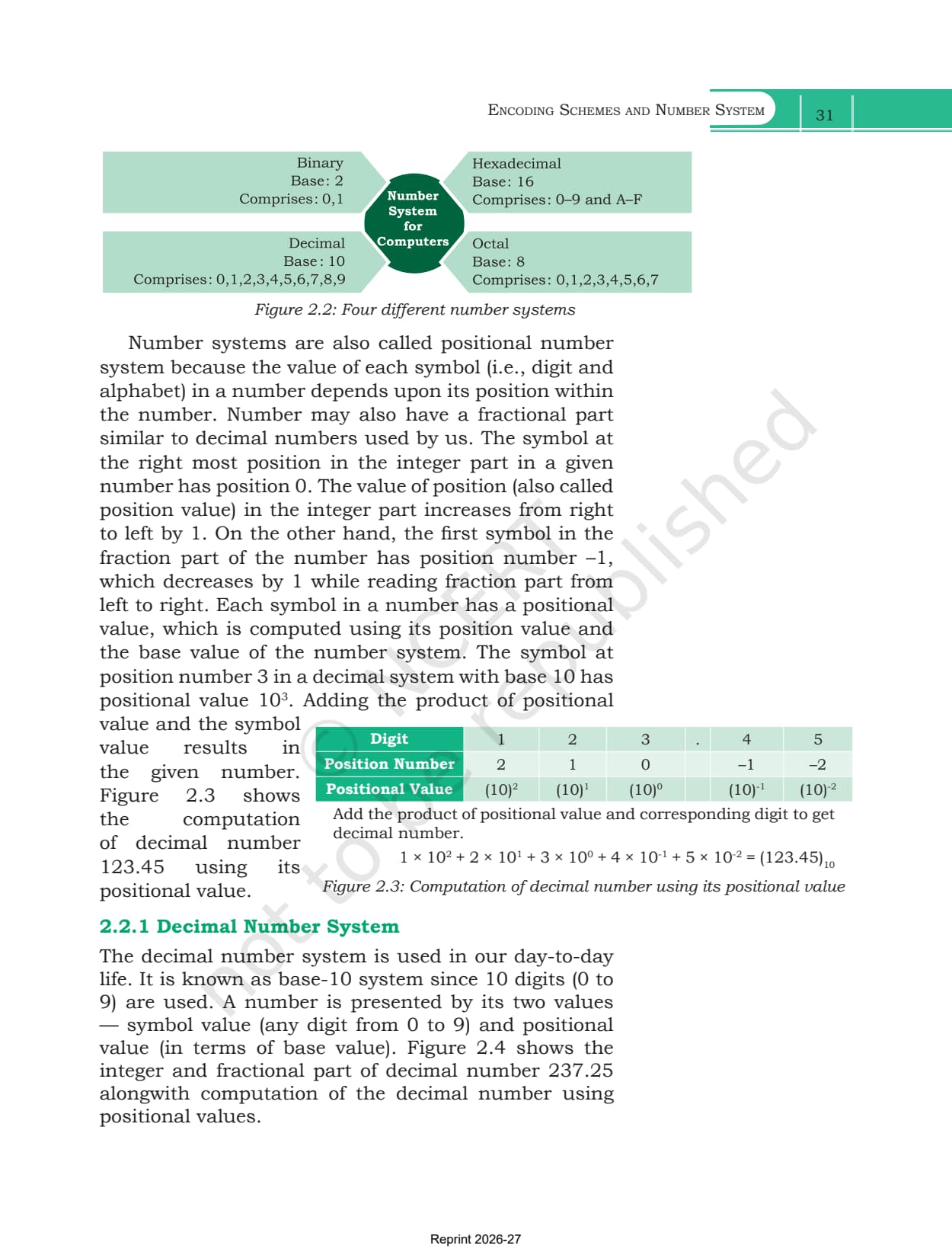
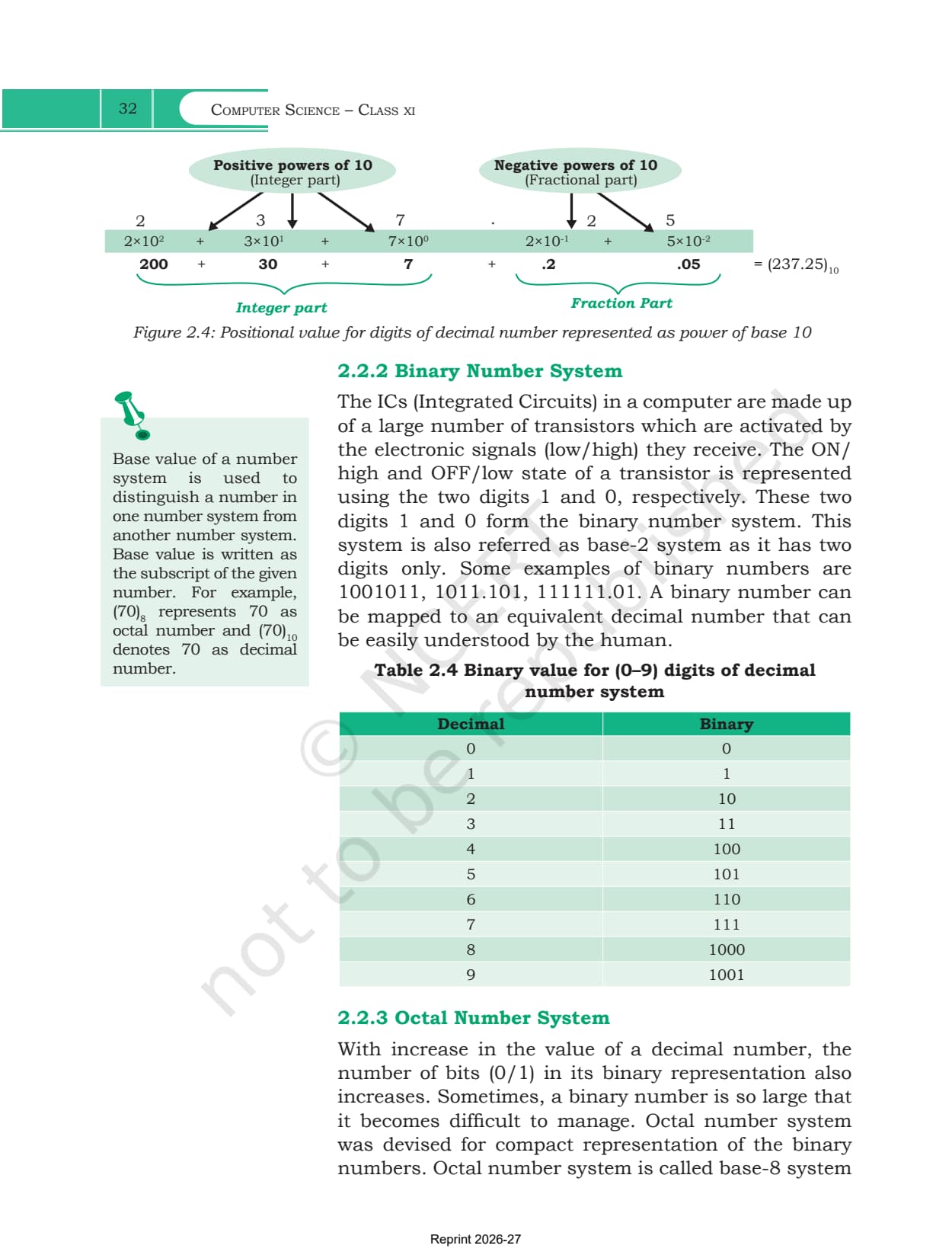
Section 2.2 explains that all four systems are positional. Every symbol carries a value of its own plus a value from where it sits, and the base is written as a subscript so (70)8 is never confused with (70)10.
| System | Base | Symbols | Why the chapter needs it |
|---|---|---|---|
| Decimal | 10 | 0 to 9 | the everyday system, used to demonstrate positional value with 123.45 and 237.25 |
| Binary | 2 | 0 and 1 | matches the on and off states of transistors inside an integrated circuit |
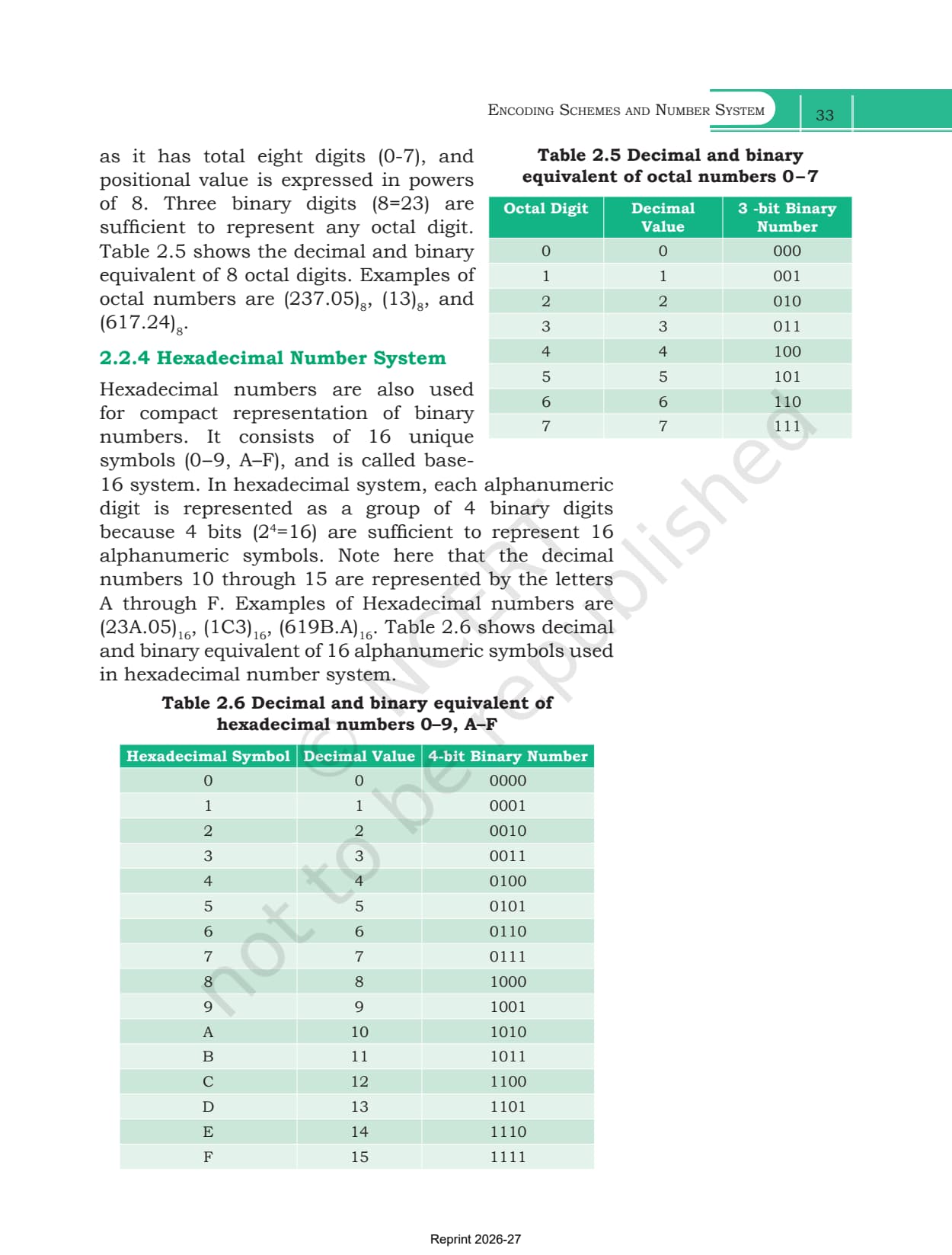
| Octal | 8 | 0 to 7 | compact binary, since 8 equals 23 so three bits cover one octal digit |
| Hexadecimal | 16 | 0 to 9 and A to F | compact binary, since 16 equals 24 so four bits cover one symbol |
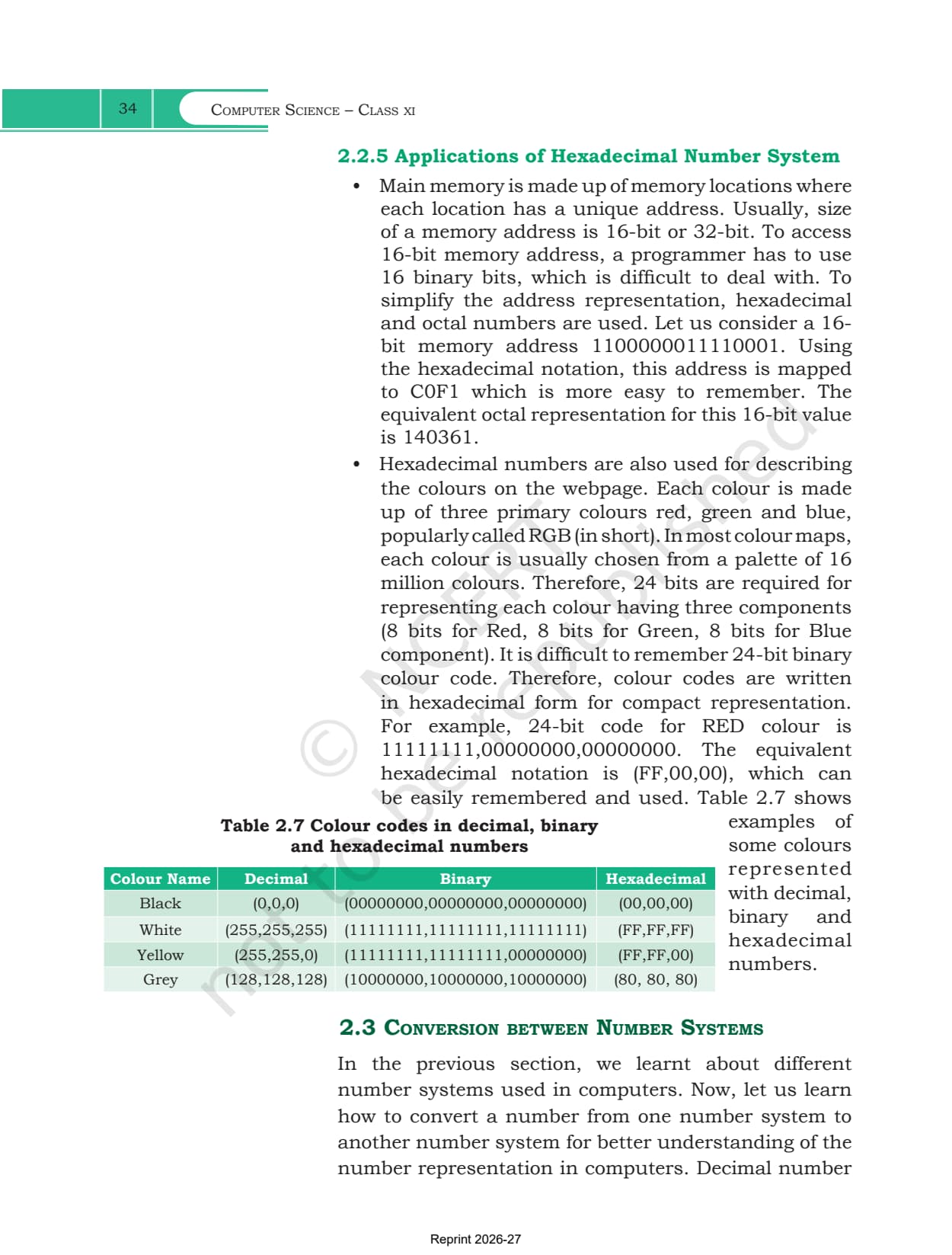
Section 2.2.5 shows where hexadecimal is actually used. A 16-bit memory address written as 1100000011110001 becomes C0F1, and 140361 in octal. Web colours work the same way: red is 11111111,00000000,00000000 in 24-bit binary and simply FF,00,00 in hexadecimal.
Worked Conversion Examples in the Chapter PDF
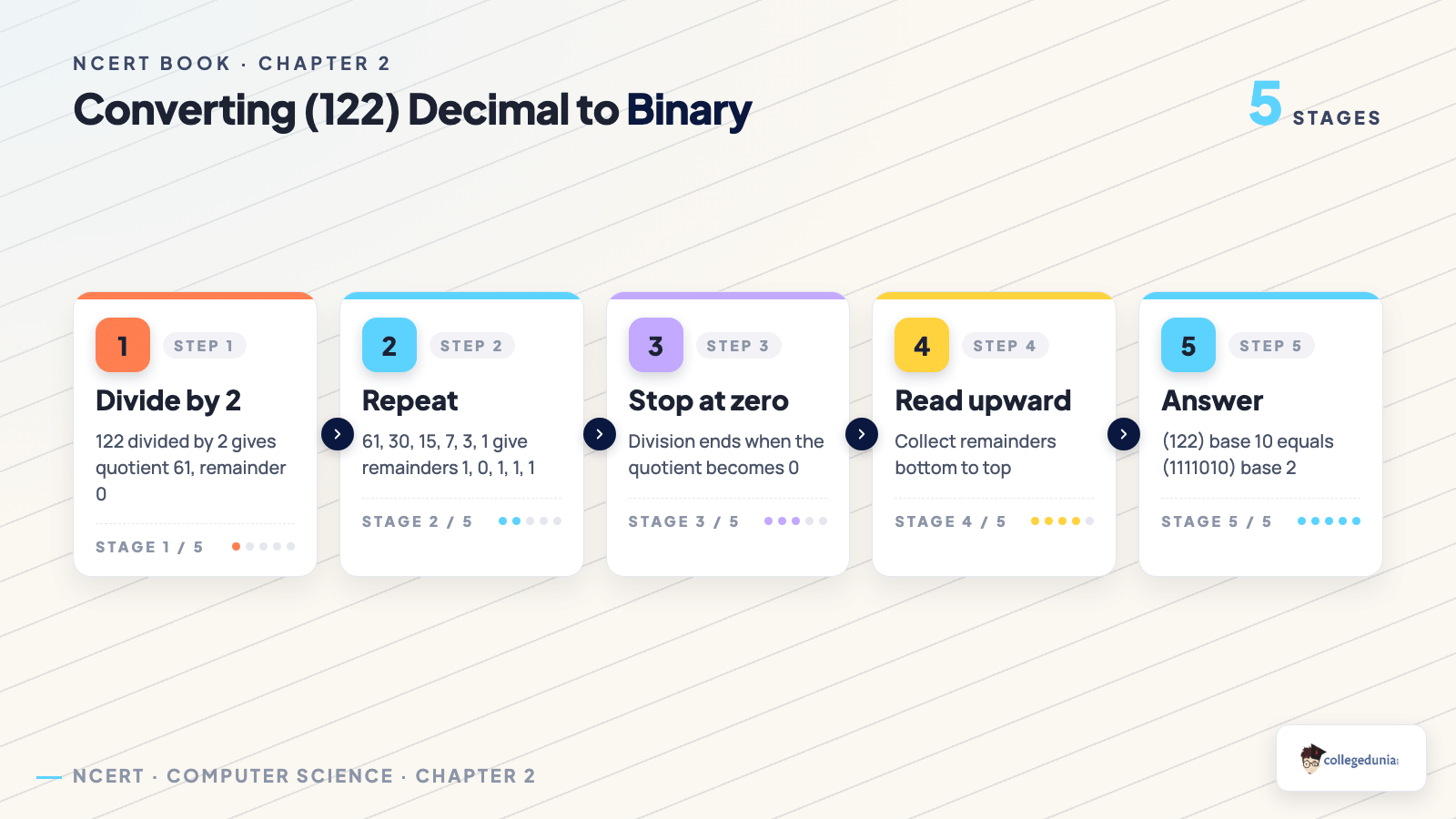
Section 2.3 is the longest part of the chapter and is built entirely around solved examples. Leaving decimal means repeated division by the target base, collecting remainders bottom to top. Reaching decimal means positional value, multiplying each digit by the base raised to its position number.
| Example | Conversion | Result in the book |
|---|---|---|
| 2.3 | decimal to binary | (122)10 = (1111010)2 |
| 2.4 | decimal to octal | (122)10 = (172)8 |
| 2.5 | decimal to hexadecimal | (122)10 = (7A)16 |
| 2.6 to 2.8 | binary, octal, hexadecimal to decimal | (1101)2 = 13, (257)8 = 175, (3A5)16 = 933 |
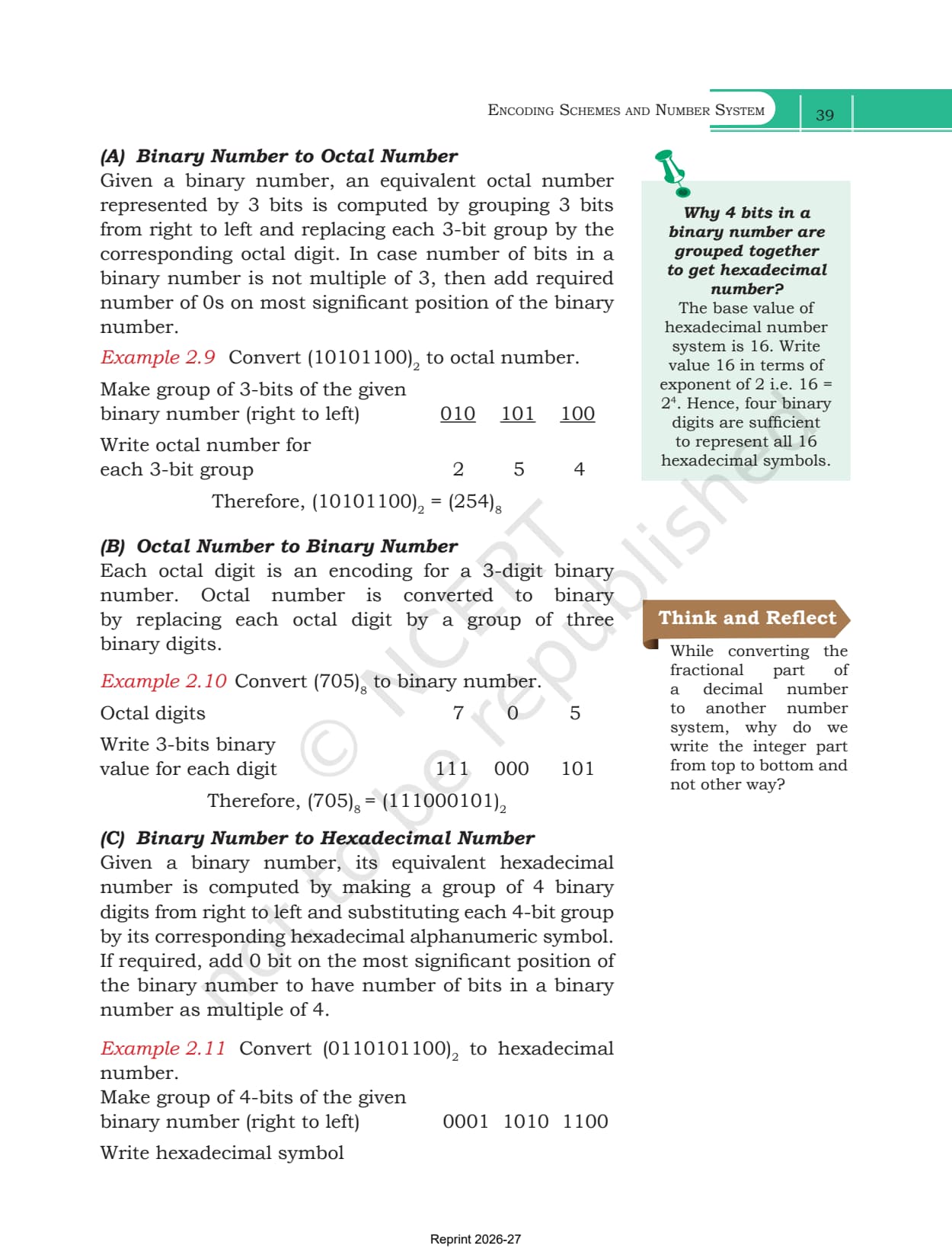
| 2.9, 2.10 | binary and octal both ways | (10101100)2 = (254)8, (705)8 = (111000101)2 |
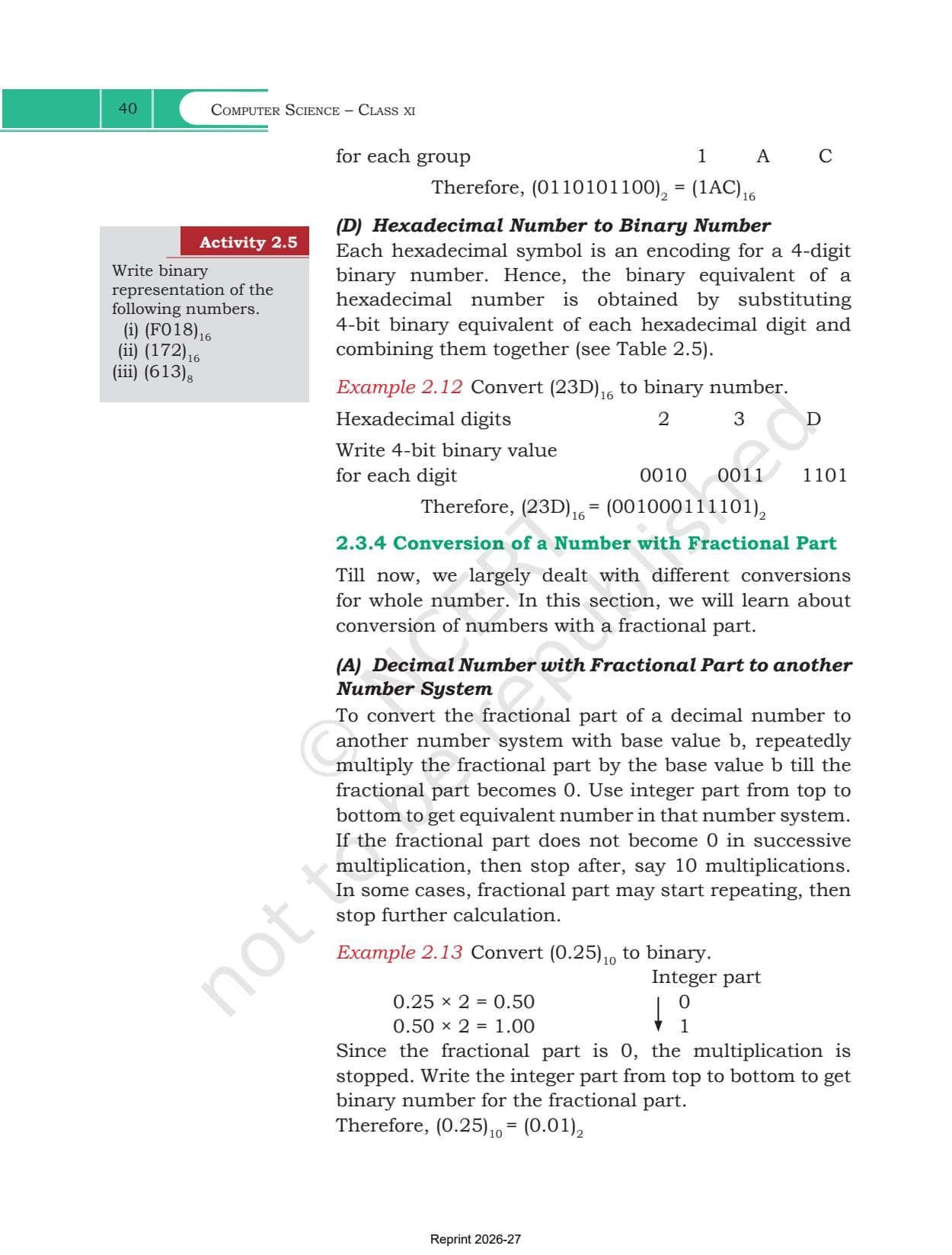
| 2.11, 2.12 | binary and hexadecimal both ways | (0110101100)2 = (1AC)16, (23D)16 = (001000111101)2 |
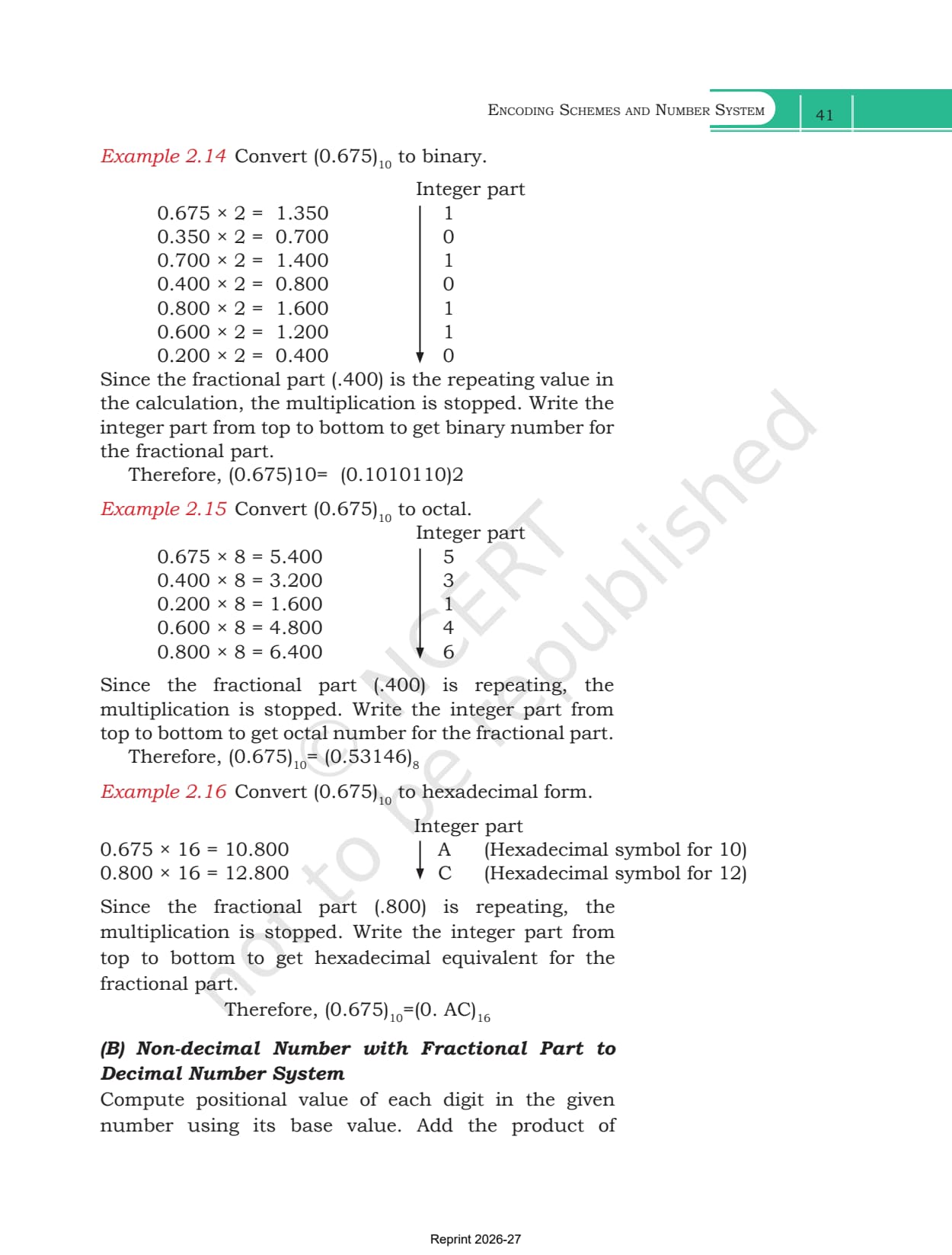
Section 2.3.4 handles numbers with a fractional part, and this is where the direction rule flips. You multiply the fraction by the base repeatedly and read the integer parts top to bottom, stopping when the fraction hits zero or starts repeating. That single reversal accounts for most of the marks lost on this chapter.
- (0.25)10 = (0.01)2, because the fraction reaches zero after two multiplications
- (0.675)10 = (0.1010110)2, stopped once 0.400 begins repeating
- The same 0.675 becomes (0.53146)8 in octal and (0.AC)16 in hexadecimal
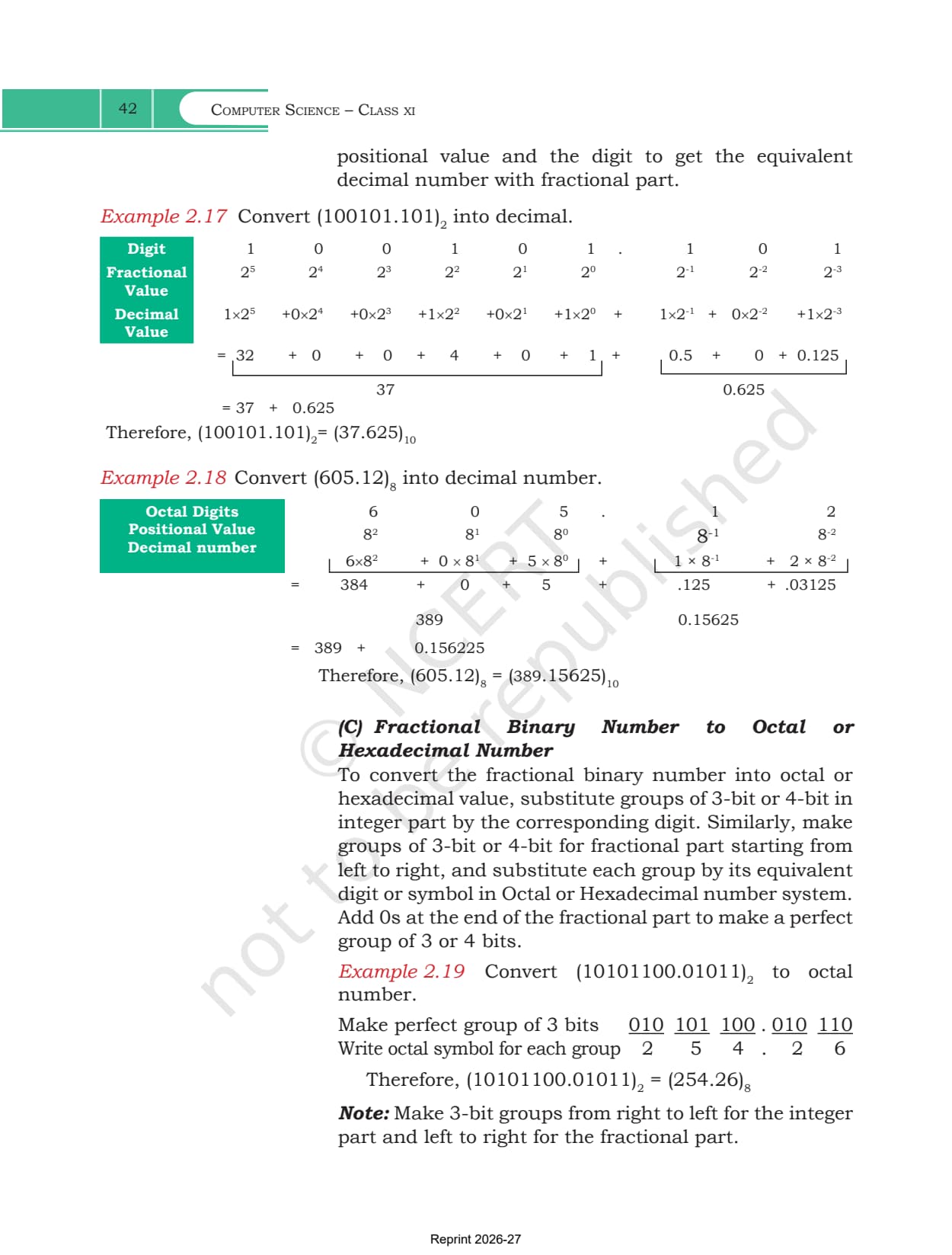
- Going the other way, (100101.101)2 = (37.625)10 and (605.12)8 = (389.15625)10
- For binary fractions, group bits outward from the point and pad with zeros, so (10101100.010111)2 = (AC.5C)16
What Collegedunia Adds to the Chapter 2 PDF
Collegedunia gives students the file plus a way into it. The chapter PDF itself is the official NCERT file, untouched.
- Official file: the exact NCERT chapter PDF, with no pages removed
- Read in the browser: page through all 18 pages before you download
- Chapter list: jump to any other chapter of the book from one table
- Study material: notes and solutions for the same chapter where available
Also Check: the other Class 11 Computer Science resources for this chapter and the chapters beside it.
| Resource | Link |
|---|---|
| Handwritten notes | Encoding Schemes and Number System Class 11 Handwritten Notes |
| Chapter notes | Encoding Schemes and Number System Class 11 Notes (coming soon) |
| Chapter solutions | Encoding Schemes and Number System Class 11 NCERT Solutions (coming soon) |
| Previous chapter book PDF | Computer System Class 11 NCERT Book PDF (coming soon) |
| Next chapter book PDF | Emerging Trends Class 11 NCERT Book PDF (coming soon) |
Class 11 Computer Science NCERT Book PDF: All Chapters
Every chapter of the Class 11 Computer Science book has its own page. The book runs to 11 chapters, moving from computer systems through problem solving into Python, linked below.
| Chapter | Download |
|---|---|
| Chapter 1 | Computer System NCERT Book PDF (coming soon) |
| Chapter 2 | Encoding Schemes and Number System NCERT Book PDF |
| Chapter 3 | Emerging Trends NCERT Book PDF (coming soon) |
| Chapter 4 | Introduction to Problem Solving NCERT Book PDF (coming soon) |
| Chapter 5 | Getting Started with Python NCERT Book PDF (coming soon) |
| Chapter 6 | Flow of Control NCERT Book PDF (coming soon) |
| Chapter 7 | Functions NCERT Book PDF (coming soon) |
| Chapter 8 | Strings NCERT Book PDF (coming soon) |
| Chapter 9 | Lists NCERT Book PDF (coming soon) |
| Chapter 10 | Tuples and Dictionaries NCERT Book PDF (coming soon) |
| Chapter 11 | Societal Impact NCERT Book PDF (coming soon) |
Encoding Schemes and Number System Class 11 NCERT Book PDF FAQs
Common Student Questions on the Encoding Schemes and Number System Chapter File
Ques. Where can I download the Class 11 Computer Science Encoding Schemes and Number System NCERT Book PDF?
Ans. The official 18-page chapter file from the Class 11 Computer Science textbook is on this page, free to download.
Ques. How many pages is Class 11 Computer Science Chapter 2?
Ans. 18 pages, printed as pages 27 to 44 of the 2026-27 textbook, and this PDF is the complete chapter.
Ques. What is the difference between ASCII and ISCII?
Ans. ASCII is a 7-bit scheme covering 128 characters of the English keyboard. ISCII is an 8-bit Indian standard covering 256, keeping all 128 ASCII codes and using 160 to 255 for the aksharas of Indian languages.
Ques. Why is Unicode needed if ASCII already exists?
Ans. Different languages once used different schemes, so text made on one machine was unreadable on another. Unicode gives every character of every written language a unique number, independent of device, operating system or application.
Ques. Which number systems are in Class 11 Computer Science Chapter 2?
Ans. Four. Decimal with base 10, binary with base 2, octal with base 8 and hexadecimal with base 16, plus conversion between every pair of them.
Ques. How do I convert a decimal number to binary?
Ans. Divide by 2 repeatedly, noting each remainder, until the quotient is zero, then read the remainders bottom to top. Example 2.3 shows that (122)10 becomes (1111010)2.
Ques. How many questions are in the chapter exercise?
Ans. 17, ranging from writing base values to converting the phrase हम सब एक into hexadecimal and binary using Unicode.
Ques. Is this the official NCERT file?
Ans. Yes. It is the NCERT chapter PDF hosted as published, with no pages removed or added.



Comments