NCERT Solutions for Class 11 KTPI Chapter 3 Performing Art Traditions in India cover all 14 exercise prompts from the 2026-27 syllabus. The chapter studies music, theatre and dance through Sāmagāna, Mārgi and Deśi music, Nāṭyaśāstra, instrument classes, classical dances, folk theatre and project work.
14 solved prompts cover definitions, short notes, descriptive answers, field reports and classroom activity tasks.
The solutions follow the NCERT order and use the 2026-27 Knowledge Traditions and Practices of India textbook as the source.
The embedded question cards include both a quick solution and a fuller expert explanation for every prompt.
Student Feedback on Class 11 KTPI Chapter 3
In a Collegedunia review poll for the 2026-27 session, 9,870 Class 11 students said Performing Art Traditions in India was easy to enjoy but harder to organise in written answers.
63% wanted a clear difference between music, dance and theatre questions.
58% mixed up Mārgi and Deśi music until the two streams were placed in a table.
7 out of 10 students found activity questions easier after using a report format with style, characters, costume and props.
Source: 2026-27 Class 11 KTPI student feedback sample of 9,870 students from CBSE schools across 11 states.
Every answer here is checked against the Performing Art Traditions in India chapter of the NCERT Knowledge Traditions and Practices of India textbook.
What the Class 11 KTPI Performing Art Traditions Solutions Cover
Performing Art Traditions in India is a wide chapter, so the exercise has several answer types. Some questions need definitions. Some ask for short notes on texts and scholars. The last few questions need activity reports, narration and project planning.
Question group
Prompt type
What the answer must show
Questions 1 to 7
Concept and short-note answers
Definitions, music streams, texts, instrument classes and modern scholars
Questions 8 and 9
Theatre activity work
Observation report, role division, costume, props and rehearsal plan
Questions 10 and 11
Dance explanation
Relation between dance and music plus tribal, folk, classical and modern forms
Questions 12 to 14
Research and reflection
Jammu and Kashmir folk forms, theatre narration and State-wise folder work
The downloadable PDF keeps the same order as the textbook. The question cards below are useful for quick revision because students can open the direct answer first, then compare it with the expert explanation.
Music Traditions in India: Sāmagāna, Mārgi and Deśi
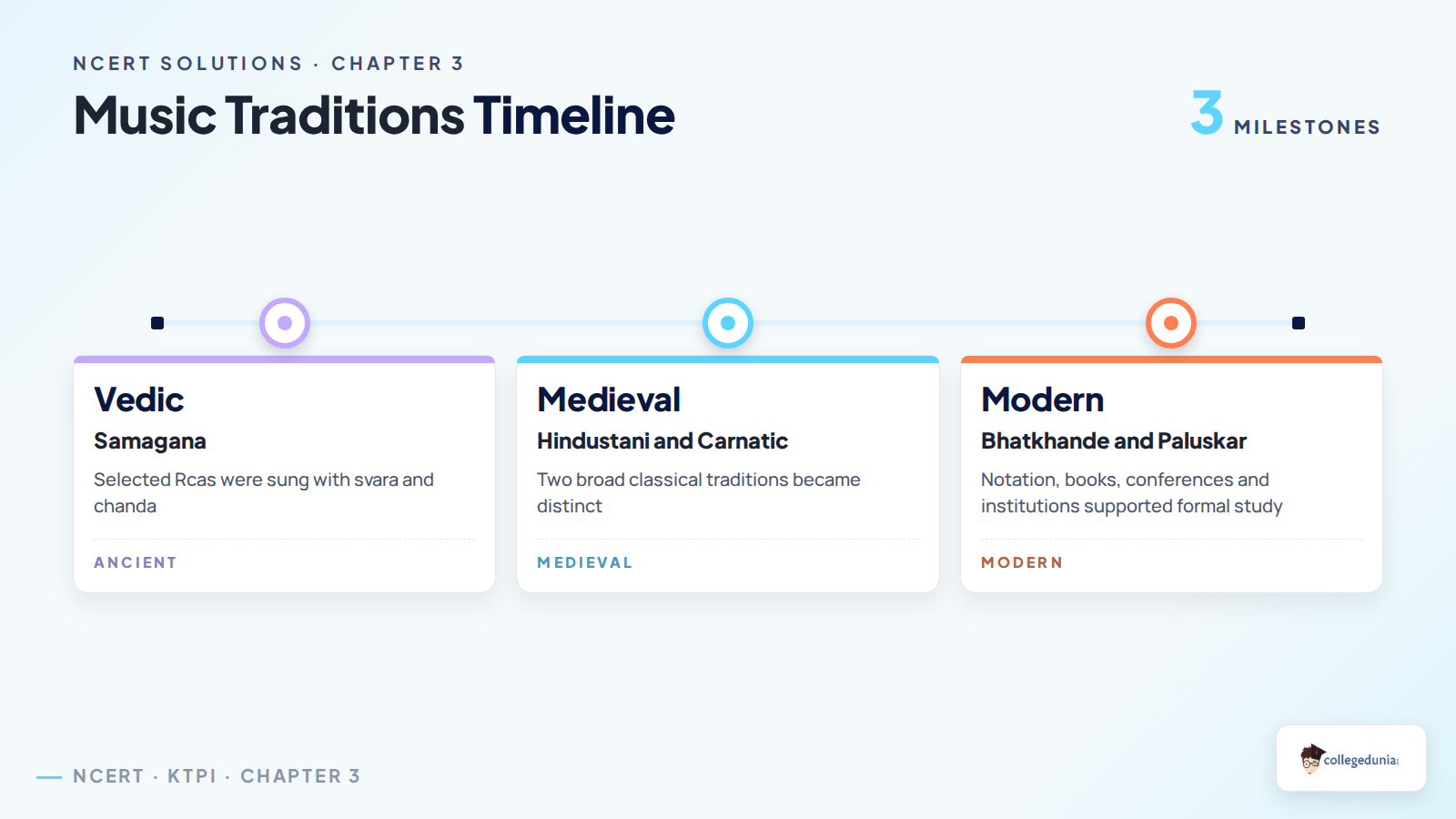
The chapter begins music history with Vedic chanting. Selected Ṛgvedic hymns were arranged in the Sāmaveda and sung with svara and chanda. This practice is called Sāmagāna.
Udātta, Anudātta and Svarita were the three Vedic svaras used in Sāmagāna.
Mārgi or Gāndharva Saṅgita was connected with a sacred aim and salvation.
Deśi Saṅgita became music for wider social use and later included classical, semi-classical and folk forms.
In the medieval period, Indian classical music developed as Hindustani music and Carnatic music. The modern period then brought documentation, notation, music conferences and institutions through scholars such as Pandit Vishnu Narayan Bhatkhande and Pandit Vishnu Digambar Paluskar.
Performing Arts Branches: Music, Theatre and Dance
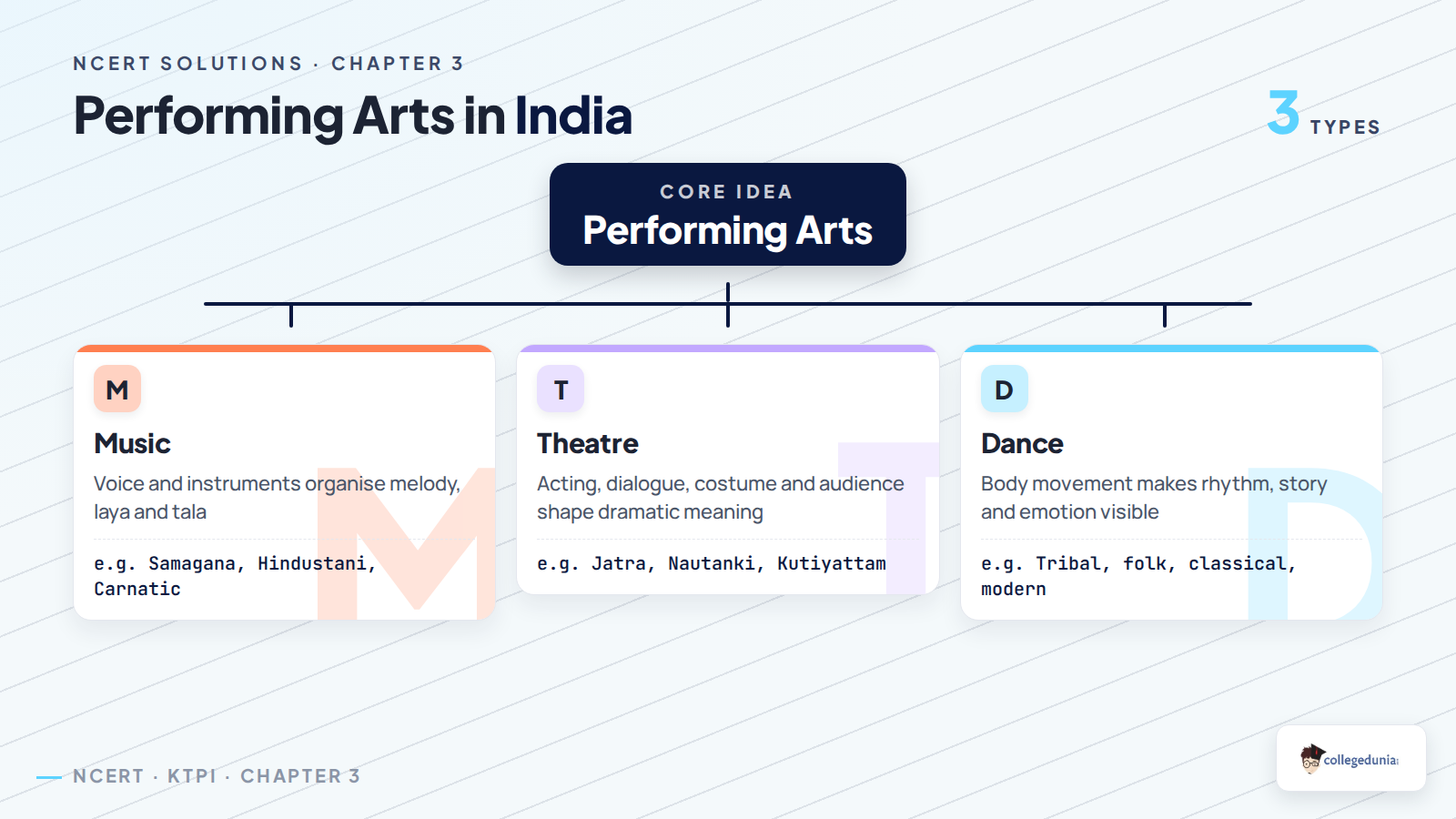
Performing arts are viewer-facing arts. They use the performer as the main medium. Voice, body movement, gesture, instruments, costume and stage action carry the meaning.
Music gives melody, rhythm, laya, tāla and emotional mood.
Theatre brings together acting, dialogue, narration, costume, make-up and viewer response.
Dance makes rhythm and emotion visible through movement, expression and posture.
For a scoring answer, connect every performing art with both expression and viewers. This prevents the definition from sounding like a list of hobbies.
Theatre and Dance Traditions in KTPI Chapter 3
The theatre section moves from dramatic instinct to Nāṭyaśāstra, Sanskrit drama, folk theatre and modern theatre institutions. It explains that theatre developed as an inclusive art form with mime, poetry, prose, dialogue, humour, song and dance.
Tradition
Region or link
Key feature
Jātrā
Bengal and Odisha
Travelling theatre with strong song and public performance
Kutiyattam
Kerala
Surviving Sanskrit theatre tradition with local elements
Bhand Pather
Kashmir
Dance, music and drama with satire, wit and parody
Nautanki
North India
Musical folk theatre led by a narrator called Ranga
The dance section explains that dance belongs to social, religious and cultural life. It also lists the living categories of dance: tribal, folk, classical and modern.
Classical and Folk Dance Forms Students Should Remember
The major classical or traditional dances listed in the chapter are Bharatanāṭyam, Kathak, Kathakali, Manipuri, Odissi, Kuchipudi, Mohiniattam and Sattriya. Folk and tribal forms are usually more participative and are tied to festivals, harvest, marriage and community life.
Tribal dance includes Santhal dance, Theyyam, Kalbelia and fire dance examples.
Folk dance includes Bihu, Dandiya Raas, Garba, Bhangra and Chari.
Classical dance uses refined technique, music, costume and trained expression.
Modern dance blends old forms with new themes through trained artists.
Rouf is a useful example for Jammu and Kashmir. The chapter says it is performed by groups of women facing each other on festive occasions such as Eid and Ramzan.
How to Write Activity Answers in KTPI Chapter 3
Questions 8, 9, 13 and 14 are not ordinary theory questions. They ask students to observe, recreate, narrate and compile. The answer should therefore look like a real task plan.
Activity
Best answer format
Must include
Theatre report
Field report
Style, character, customs, make-up, props and observation
Regional performance
Classroom plan
Chosen form, roles, script, music, costume, props and rehearsal
Folk play narration
Oral presentation notes
Region, plot, performers, stage features and personal response
State-wise folder
Project table and reflection
Dance, song, picture, caption, source and observation on India
Activity answers score well when they are specific. Use names of forms from the chapter, such as Bhavai, Tamasha, Bhand Pather, Jātrā, Nautanki, Swang, Rāslilā and Kutiyattam.
All NCERT Solutions for Class 11 KTPI Chapter 3 with Step-by-Step Solutions
The cards below reproduce the same 14 solved prompts as the downloadable PDF. Open Check Solution for the direct answer and Expert Solution for a second explanation with a verified expert byline.
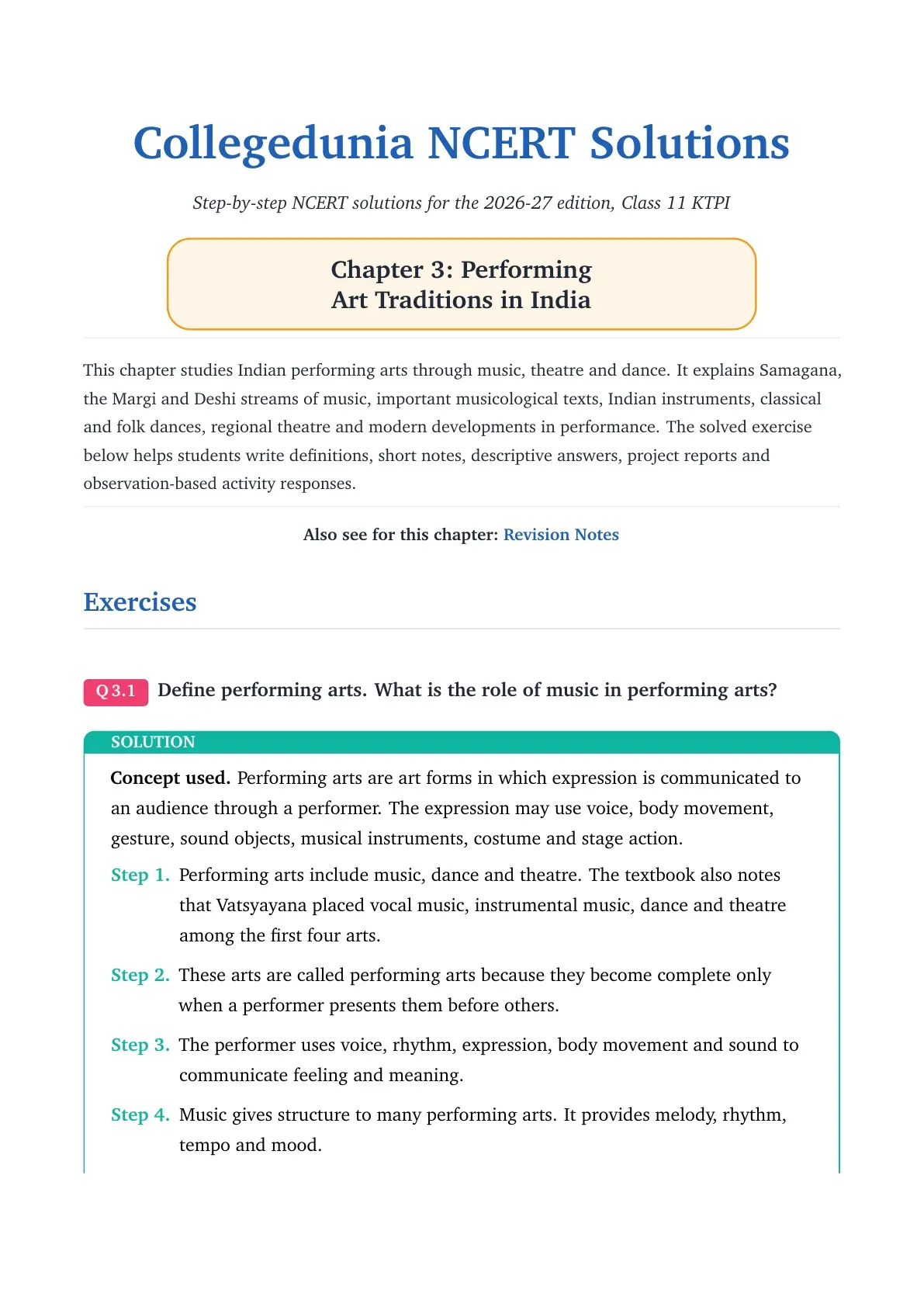
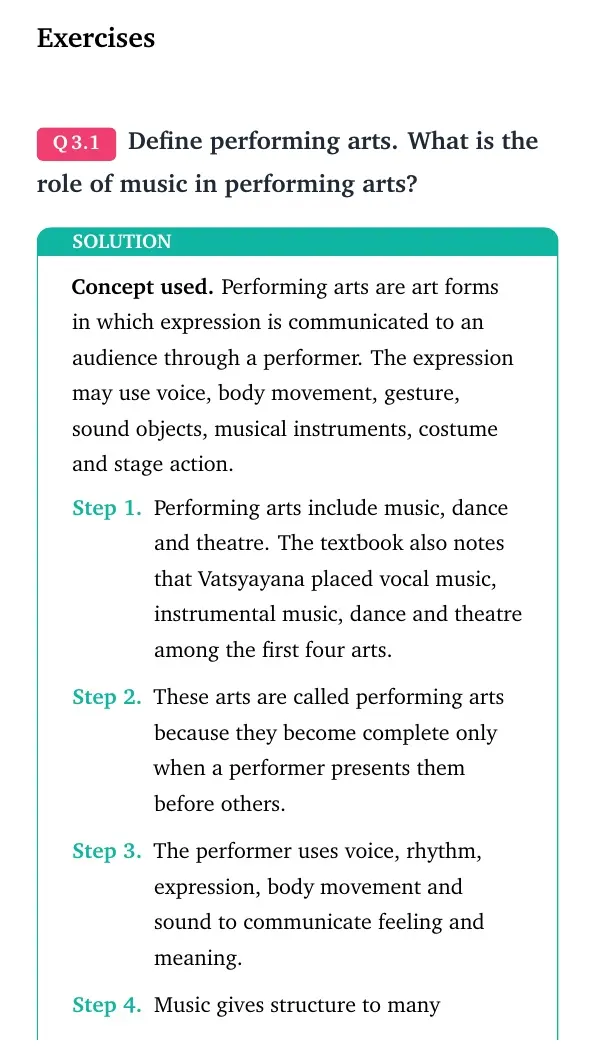
Q 3.1
Define performing arts. What is the role of music in performing arts?
Concept used. Performing arts are art forms in which expression is
communicated to an viewers through a performer. The expression may use voice,
body movement, gesture, sound objects, musical instruments, costume and stage
action.
Performing arts include music, dance and theatre. The textbook also
notes that Vatsyayana placed vocal music, instrumental music, dance and
theatre among the first four arts.
These arts are called performing arts because they become complete only
when a performer presents them before others.
The performer uses voice, rhythm, expression, body movement and sound
to communicate feeling and meaning.
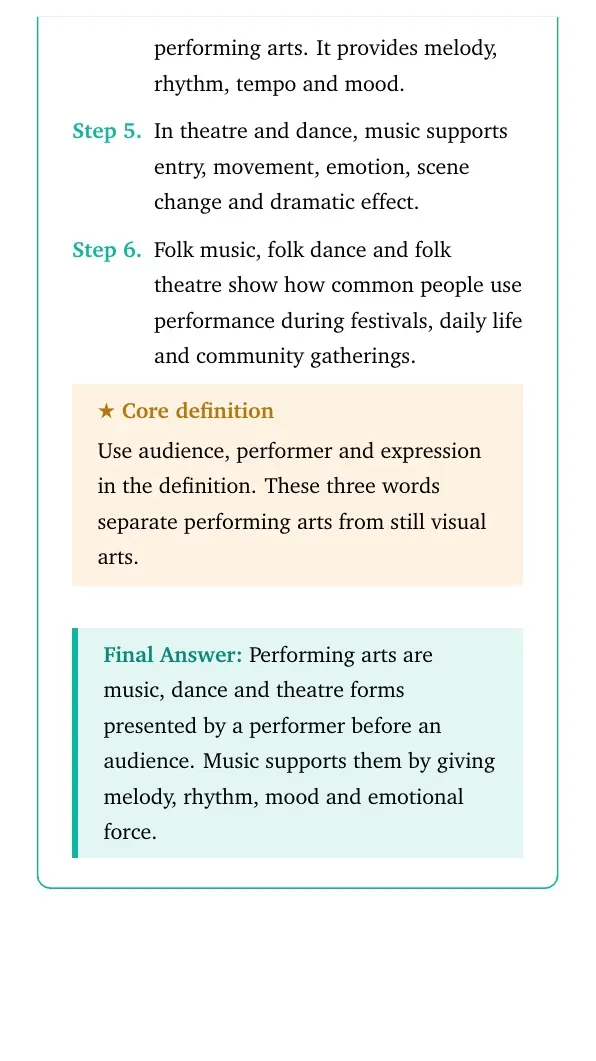
Music gives structure to many performing arts. It provides melody,
rhythm, tempo and mood.
In theatre and dance, music supports entry, movement, emotion, scene
change and dramatic effect.
Folk music, folk dance and folk theatre show how common people use
performance during festivals, daily life and community gatherings.
Core definition
Use viewers, performer and expression in the definition. These three words
separate performing arts from still visual arts.
Performing arts are music, dance and theatre forms presented by a
performer before an viewers. Music supports them by giving melody, rhythm,
mood and emotional force.
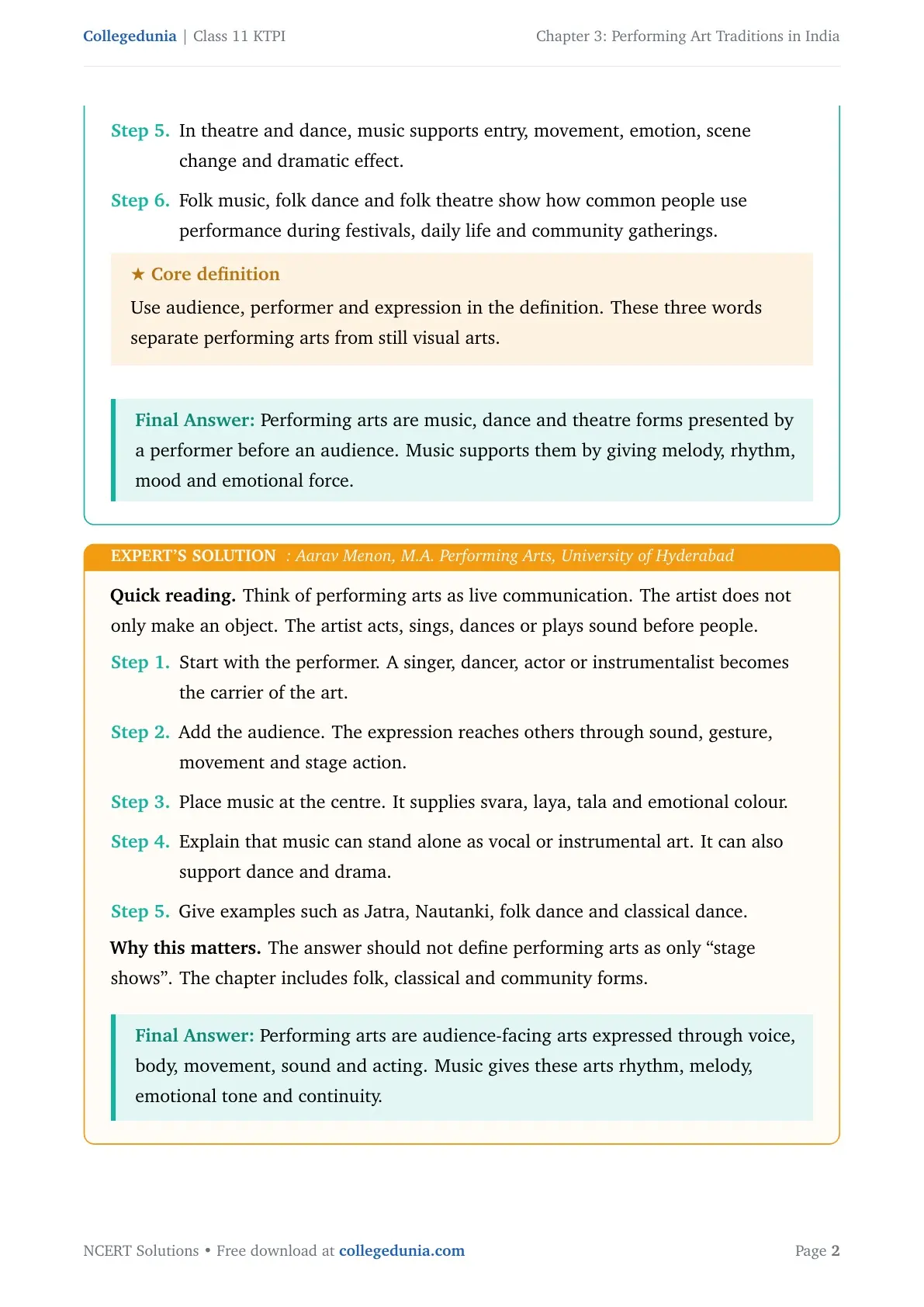
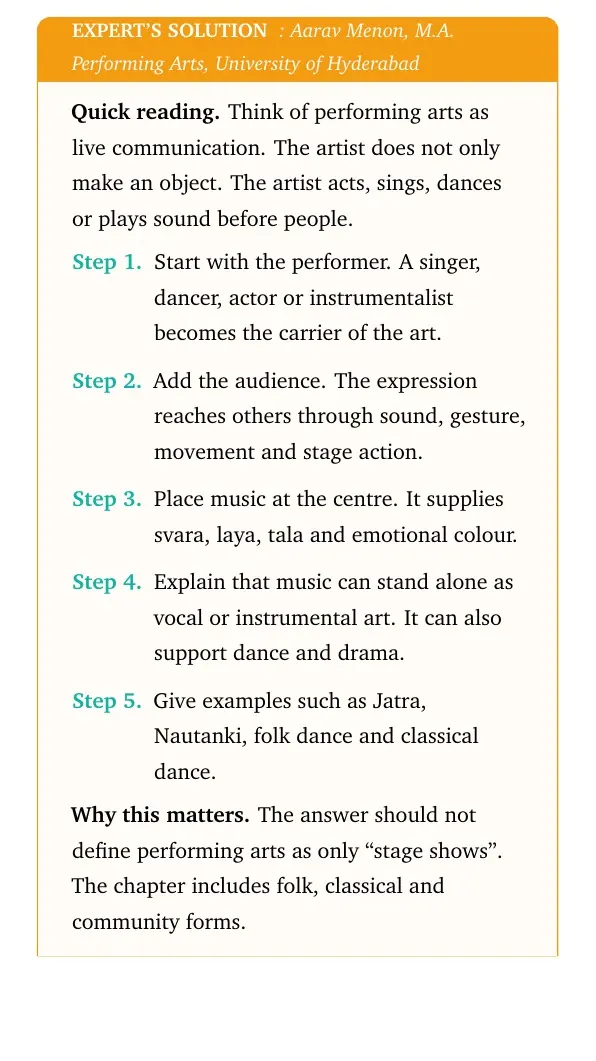
AM
Aarav Menon
M.A. Performing Arts, University of Hyderabad
Verified Expert
Quick reading. Think of performing arts as live communication. The
artist does not only make an object. The artist acts, sings, dances or plays
sound before people.
Start with the performer. A singer, dancer, actor or instrumentalist
becomes the carrier of the art.
Add the viewers. The expression reaches others through sound, gesture,
movement and stage action.
Place music at the centre. It supplies svara, laya, tala and emotional
colour.
Explain that music can stand alone as vocal or instrumental art. It can
also support dance and drama.
Give examples such as Jatra, Nautanki, folk dance and classical dance.
Why this matters. The answer should not define performing arts as only
``stage shows''. The chapter includes folk, classical and community forms.
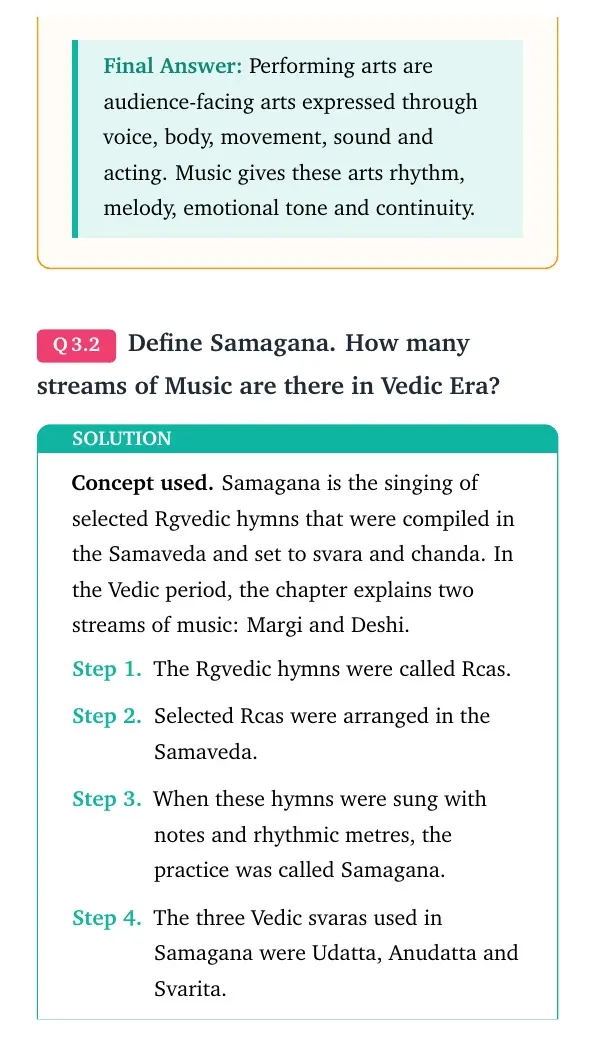
Performing arts are viewer-facing arts expressed through voice,
body, movement, sound and acting. Music gives these arts rhythm, melody,
emotional tone and continuity.
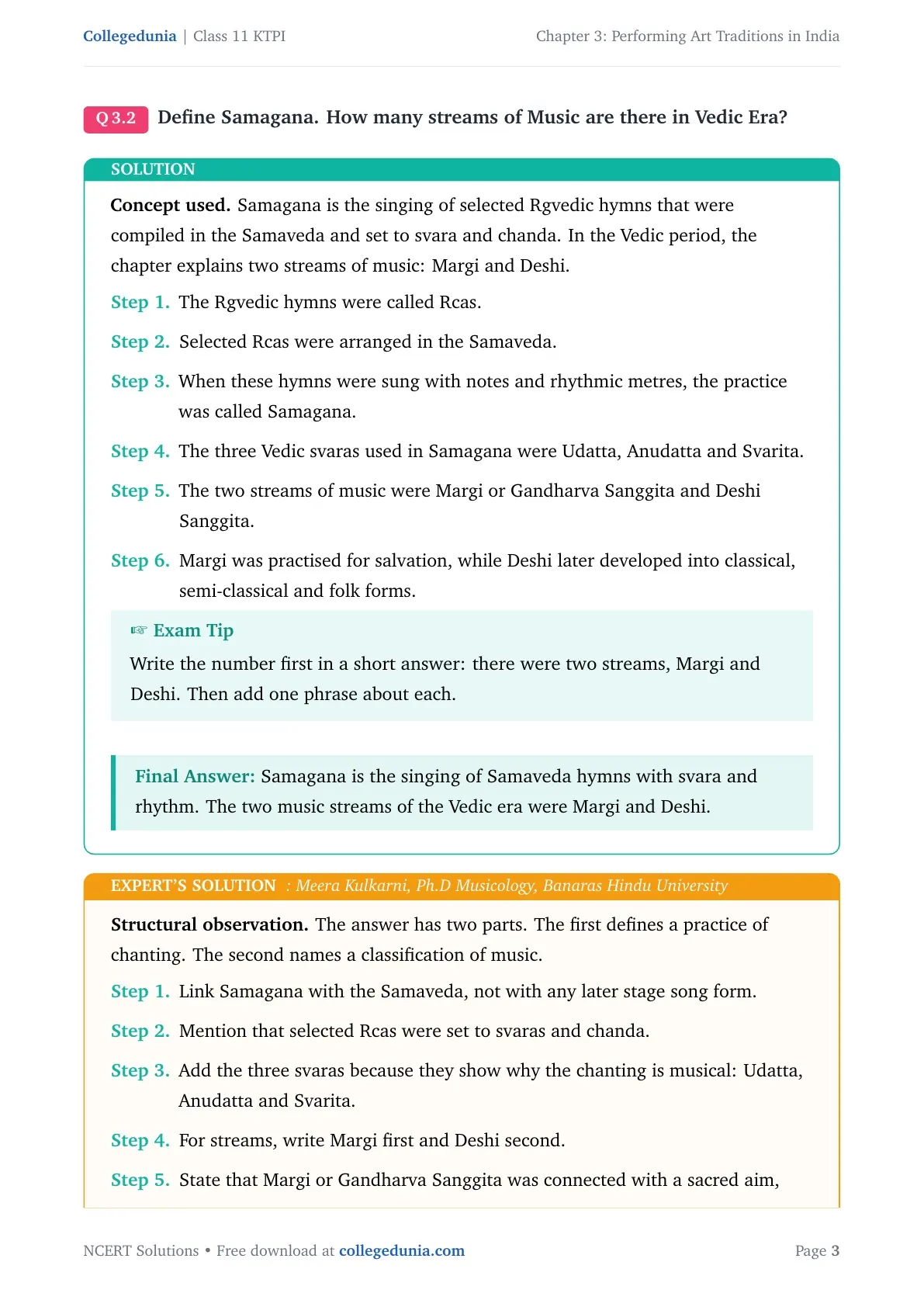
Q 3.2
Define Samagana. How many streams of Music are there in Vedic Era?
Concept used. Samagana is the singing of selected Rgvedic hymns that
were compiled in the Samaveda and set to svara and chanda. In the Vedic period,
the chapter explains two streams of music: Margi and Deshi.
The Rgvedic hymns were called Rcas.
Selected Rcas were arranged in the Samaveda.
When these hymns were sung with notes and rhythmic metres, the practice
was called Samagana.
The three Vedic svaras used in Samagana were Udatta, Anudatta and
Svarita.
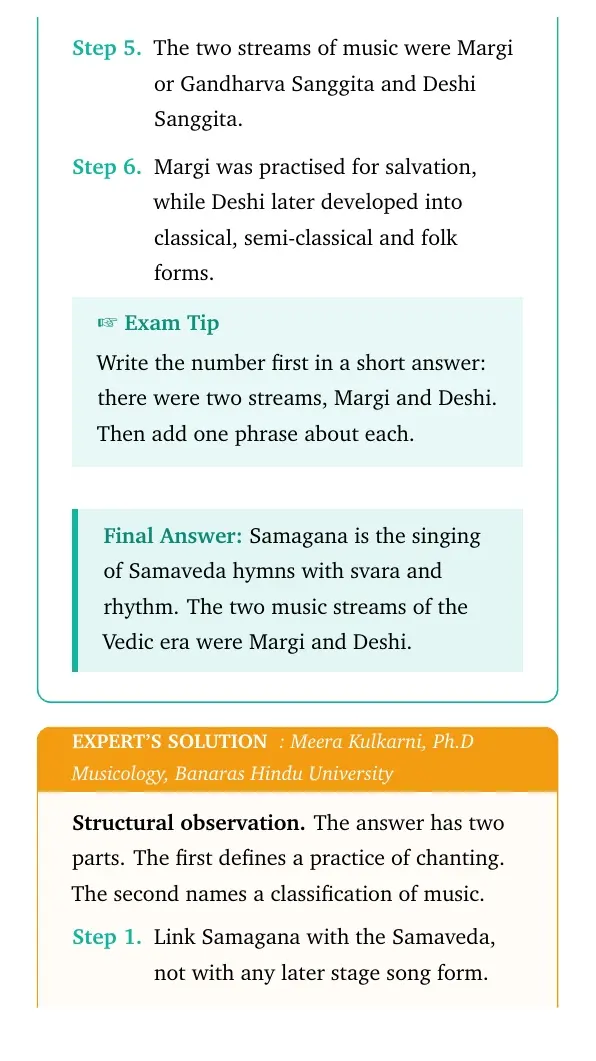
The two streams of music were Margi or Gandharva Sanggita and Deshi
Sanggita.
Margi was practised for salvation, while Deshi later developed into
classical, semi-classical and folk forms.
Write the number first in a short answer: there were two streams, Margi and
Deshi. Then add one phrase about each.
Samagana is the singing of Samaveda hymns with svara and rhythm. The
two music streams of the Vedic era were Margi and Deshi.
MK
Meera Kulkarni
Ph.D Musicology, Banaras Hindu University
Verified Expert
Structural observation. The answer has two parts. The first defines a
practice of chanting. The second names a classification of music.
Link Samagana with the Samaveda, not with any later stage song form.
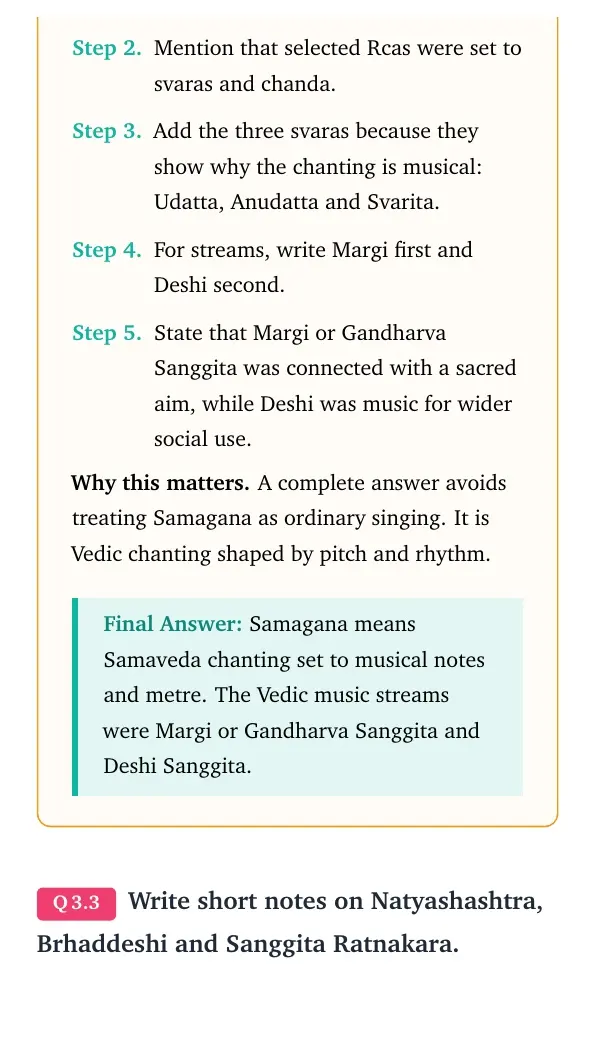
Mention that selected Rcas were set to svaras and chanda.
Add the three svaras because they show why the chanting is musical:
Udatta, Anudatta and Svarita.
For streams, write Margi first and Deshi second.
State that Margi or Gandharva Sanggita was connected with a sacred aim,
while Deshi was music for wider social use.
Why this matters. A complete answer avoids treating Samagana as
ordinary singing. It is Vedic chanting shaped by pitch and rhythm.
Samagana means Samaveda chanting set to musical notes and metre. The
Vedic music streams were Margi or Gandharva Sanggita and Deshi Sanggita.
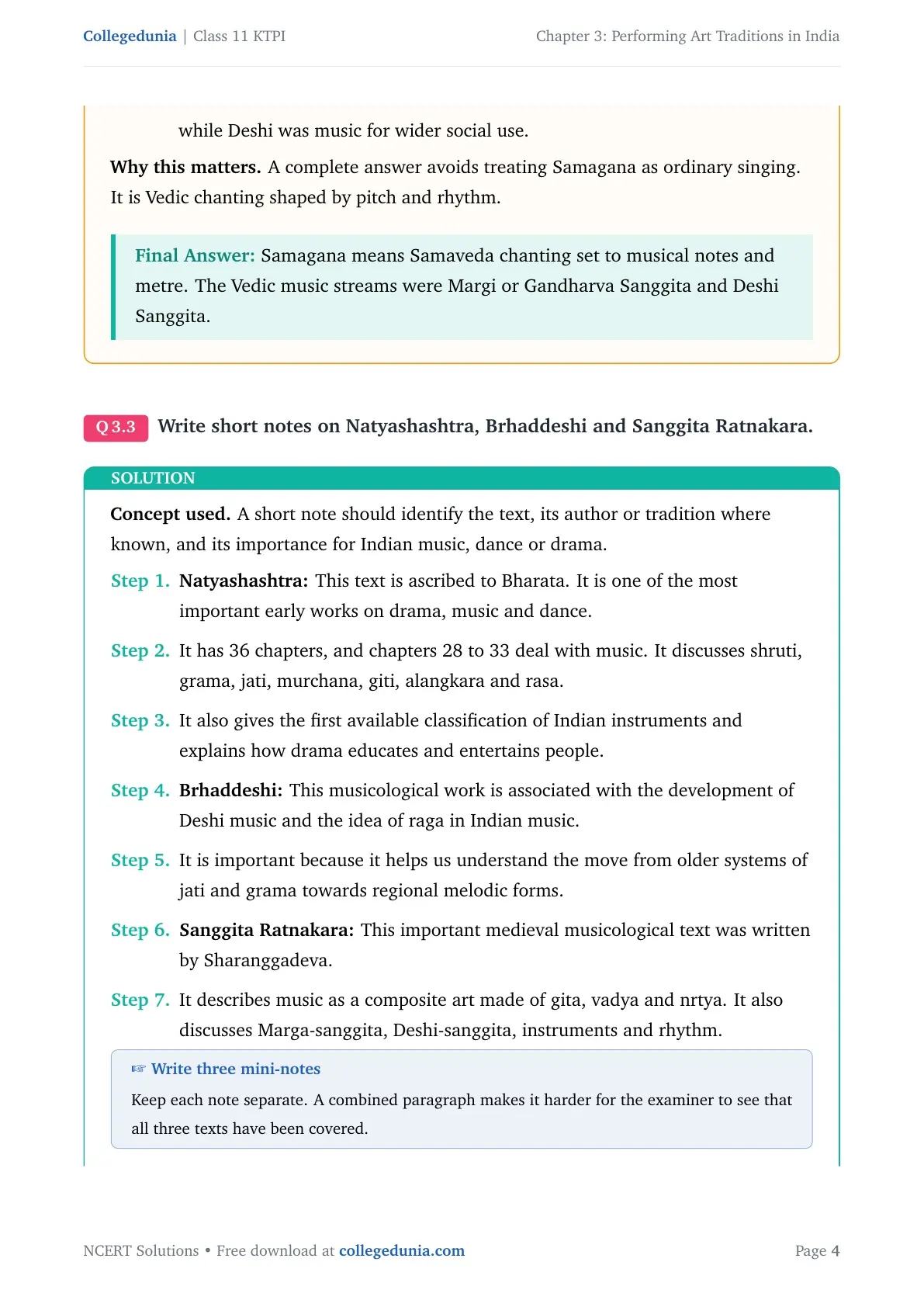
Q 3.3
Write short notes on Natyashashtra, Brhaddeshi and Sanggita Ratnakara.
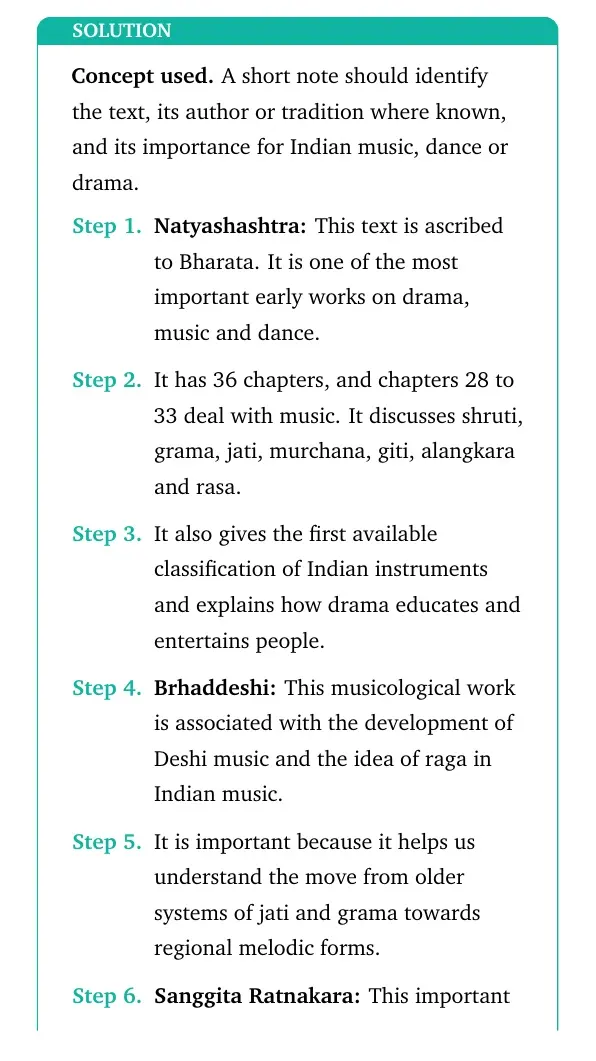
Concept used. A short note should identify the text, its author or
tradition where known, and its importance for Indian music, dance or drama.
Natyashashtra: This text is ascribed to Bharata. It is one of
the most important early works on drama, music and dance.
It has 36 chapters, and chapters 28 to 33 deal with music. It discusses
shruti, grama, jati, murchana, giti, alangkara and rasa.
It also gives the first available classification of Indian instruments
and explains how drama educates and entertains people.
Brhaddeshi: This musicological work is associated with the
development of Deshi music and the idea of raga in Indian music.
It is important because it helps us understand the move from older
systems of jati and grama towards regional melodic forms.
Sanggita Ratnakara: This important medieval musicological text
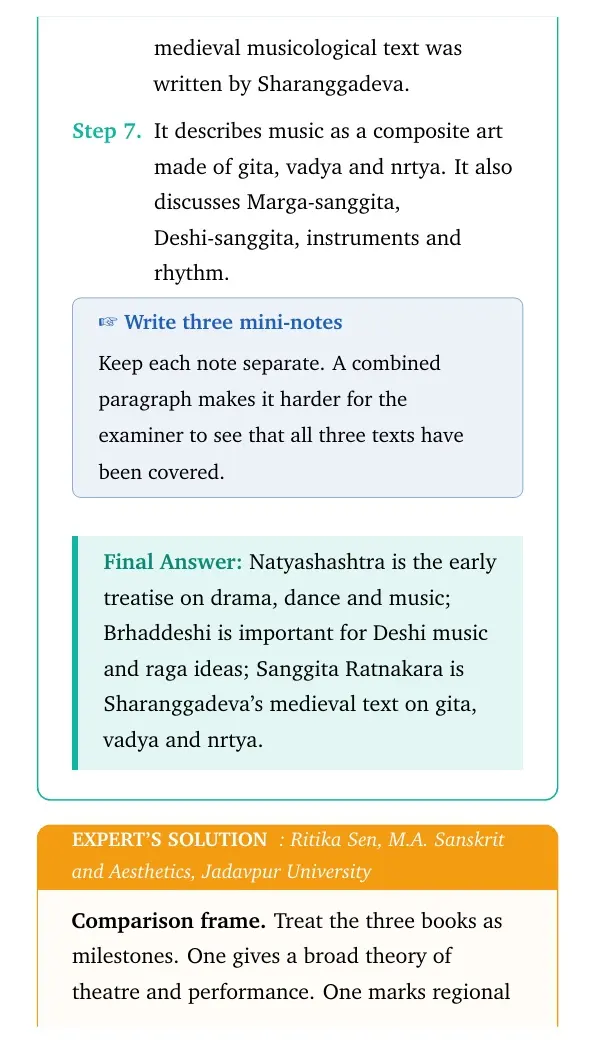
was written by Sharanggadeva.
It describes music as a composite art made of gita, vadya and nrtya.
It also discusses Marga-sanggita, Deshi-sanggita, instruments and rhythm.
Write three mini-notes
Keep each note separate. A combined paragraph makes it harder for the examiner
to see that all three texts have been covered.
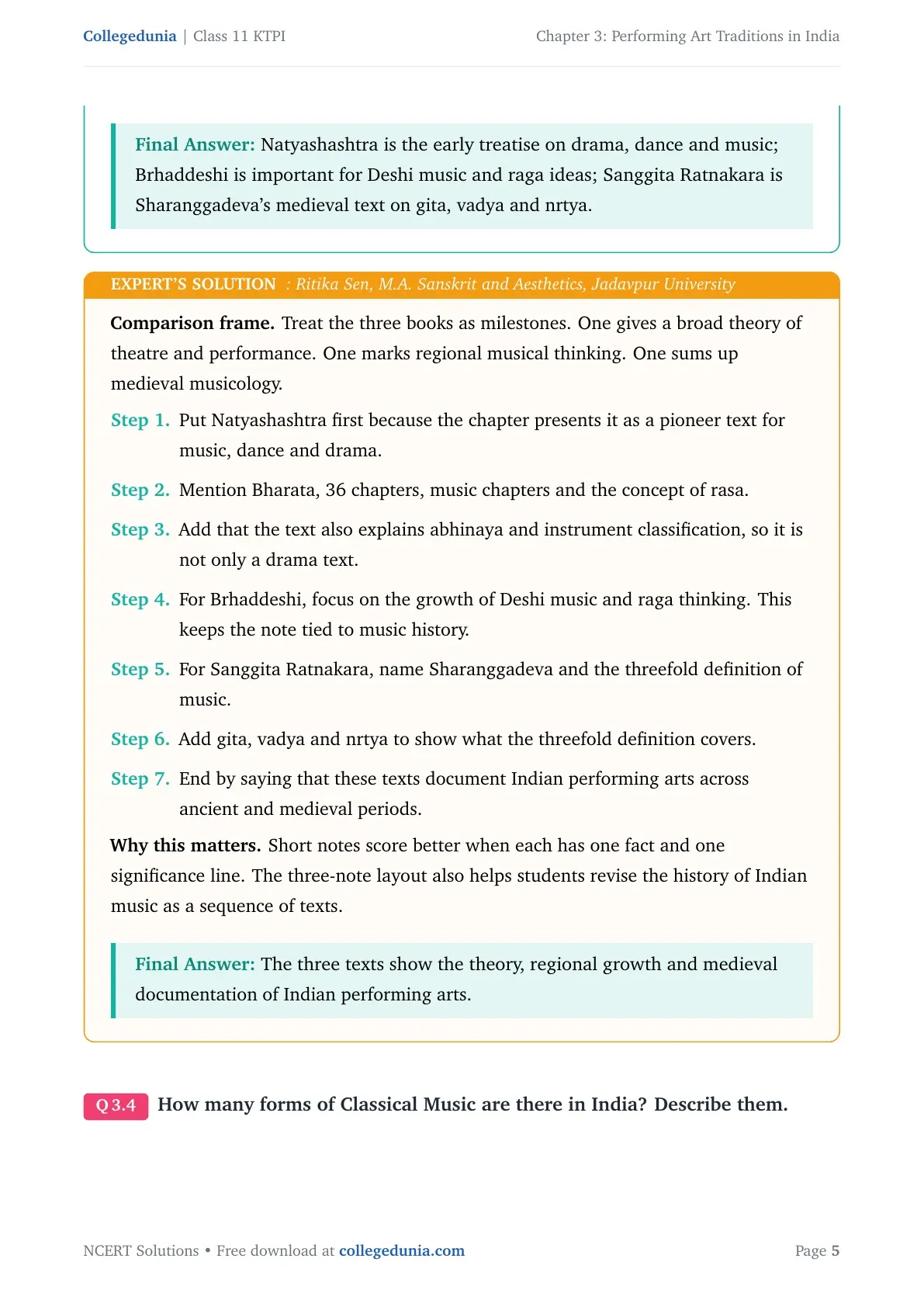
Natyashashtra is the early treatise on drama, dance and music;
Brhaddeshi is important for Deshi music and raga ideas; Sanggita Ratnakara is
Sharanggadeva's medieval text on gita, vadya and nrtya.
RS
Ritika Sen
M.A. Sanskrit and Aesthetics, Jadavpur University
Verified Expert
Comparison frame. Treat the three books as milestones. One gives a
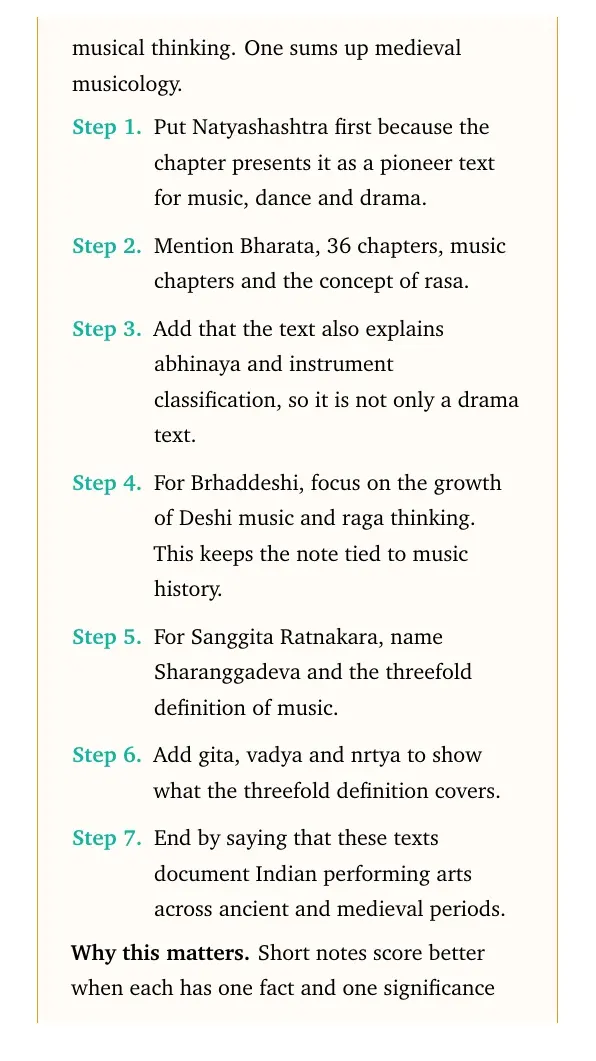
broad theory of theatre and performance. One marks regional musical thinking.
One sums up medieval musicology.
Put Natyashashtra first because the chapter presents it as a pioneer
text for music, dance and drama.
Mention Bharata, 36 chapters, music chapters and the concept of rasa.
Add that the text also explains abhinaya and instrument
classification, so it is not only a drama text.
For Brhaddeshi, focus on the growth of Deshi music and raga thinking.
This keeps the note tied to music history.
For Sanggita Ratnakara, name Sharanggadeva and the threefold definition of
music.
Add gita, vadya and nrtya to show what the threefold definition covers.
End by saying that these texts document Indian performing arts across
ancient and medieval periods.
Why this matters. Short notes score better when each has one fact and
one significance line. The three-note layout also helps students revise the
history of Indian music as a sequence of texts.
The three texts show the theory, regional growth and medieval
documentation of Indian performing arts.
Q 3.4
How many forms of Classical Music are there in India? Describe them.
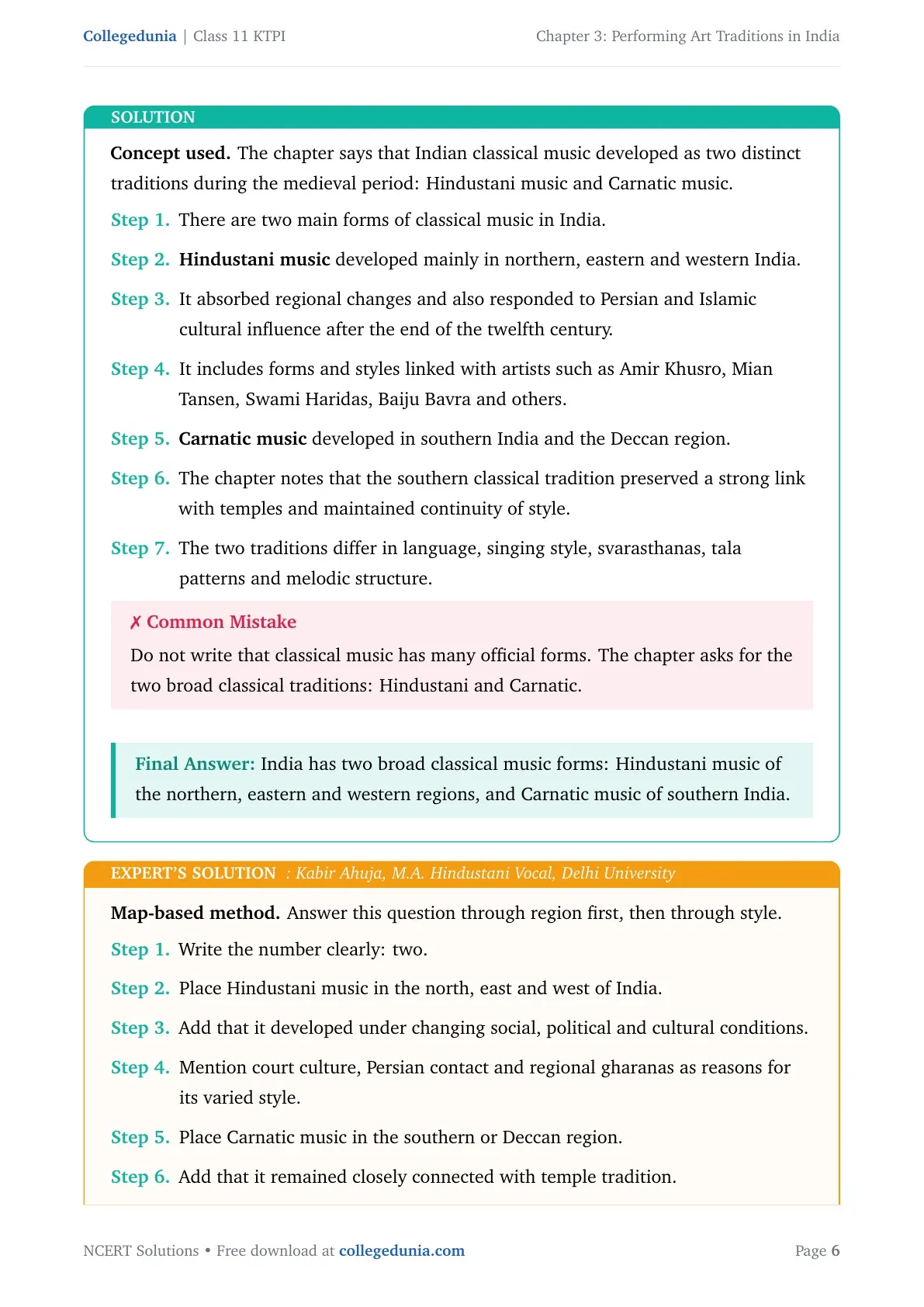
Concept used. The chapter says that Indian classical music developed
as two distinct traditions during the medieval period: Hindustani music and
Carnatic music.
There are two main forms of classical music in India.
Hindustani music developed mainly in northern, eastern and
western India.
It absorbed regional changes and also responded to Persian and Islamic
cultural influence after the end of the twelfth century.
It includes forms and styles linked with artists such as Amir Khusro,
Mian Tansen, Swami Haridas, Baiju Bavra and others.
Carnatic music developed in southern India and the Deccan
region.
The chapter notes that the southern classical tradition preserved a
strong link with temples and maintained continuity of style.
The two traditions differ in language, singing style, svarasthanas,
tala patterns and melodic structure.
Do not write that classical music has many official forms. The chapter asks for
the two broad classical traditions: Hindustani and Carnatic.
India has two broad classical music forms: Hindustani music of the
northern, eastern and western regions, and Carnatic music of southern India.
KA
Kabir Ahuja
M.A. Hindustani Vocal, Delhi University
Verified Expert
Map-based method. Answer this question through region first, then
through style.
Write the number clearly: two.
Place Hindustani music in the north, east and west of India.
Add that it developed under changing social, political and cultural
conditions.
Mention court culture, Persian contact and regional gharanas as reasons
for its varied style.
Place Carnatic music in the southern or Deccan region.
Add that it remained closely connected with temple tradition.
Close with two differences: language and rhythmic or melodic structure.
Why this matters. The answer needs classification, not a list of
ragas. Ragas belong inside both classical traditions. A short comparison of
region, history and style gives a fuller answer than names alone.
The two forms are Hindustani classical music and Carnatic classical
music, each with its own region, style, language use and rhythmic pattern.
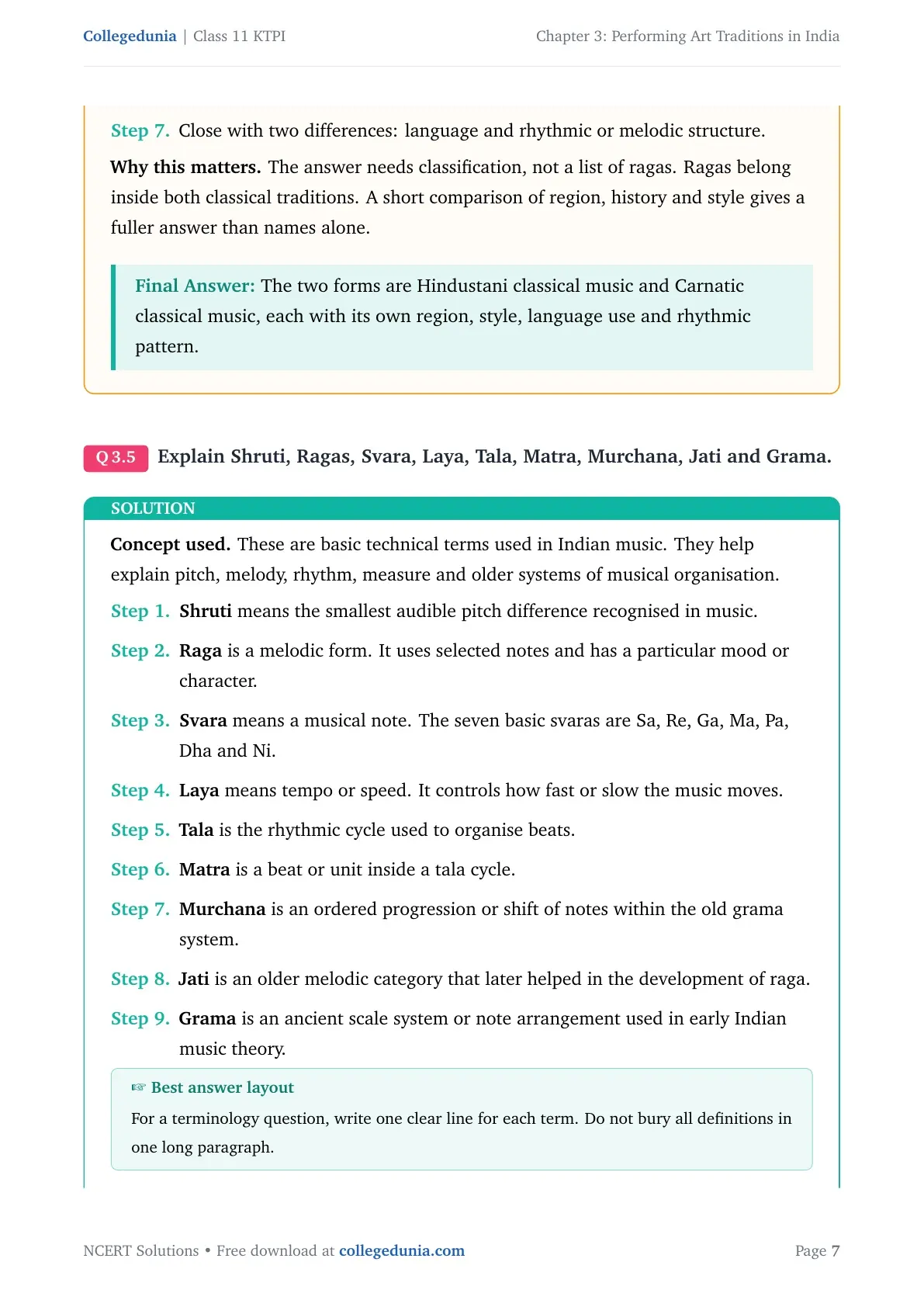
Concept used. These are basic technical terms used in Indian music.
They help explain pitch, melody, rhythm, measure and older systems of musical
organisation.
Shruti means the smallest audible pitch difference recognised
in music.
Raga is a melodic form. It uses selected notes and has a
particular mood or character.
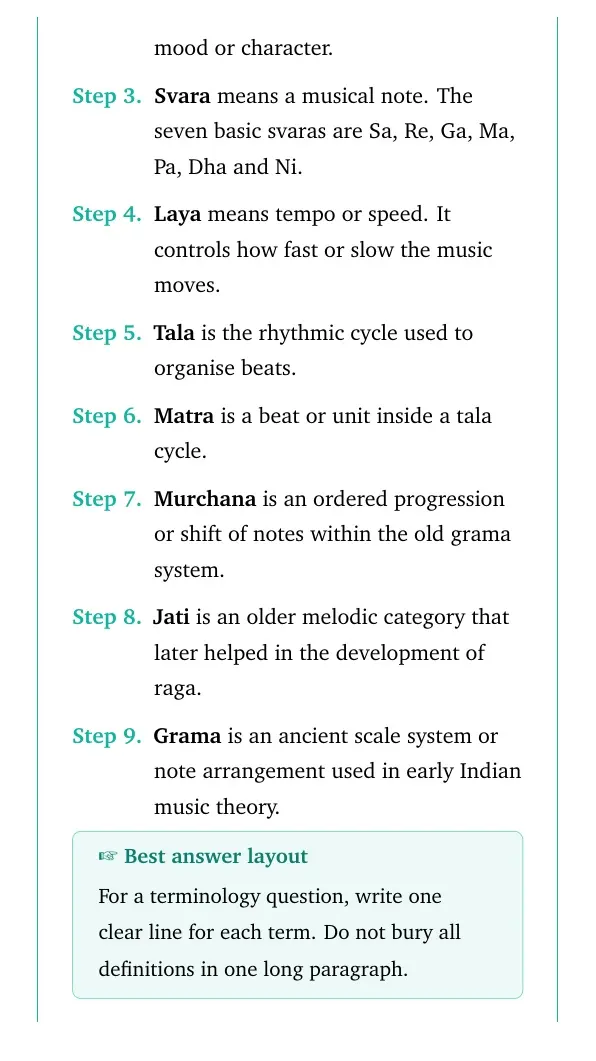
Svara means a musical note. The seven basic svaras are Sa, Re,
Ga, Ma, Pa, Dha and Ni.
Laya means tempo or speed. It controls how fast or slow the
music moves.
Tala is the rhythmic cycle used to organise beats.
Matra is a beat or unit inside a tala cycle.
Murchana is an ordered progression or shift of notes within
the old grama system.
Jati is an older melodic category that later helped in the
development of raga.
Grama is an ancient scale system or note arrangement used in
early Indian music theory.
Best answer layout
For a terminology question, write one clear line for each term. Do not bury all
definitions in one long paragraph.
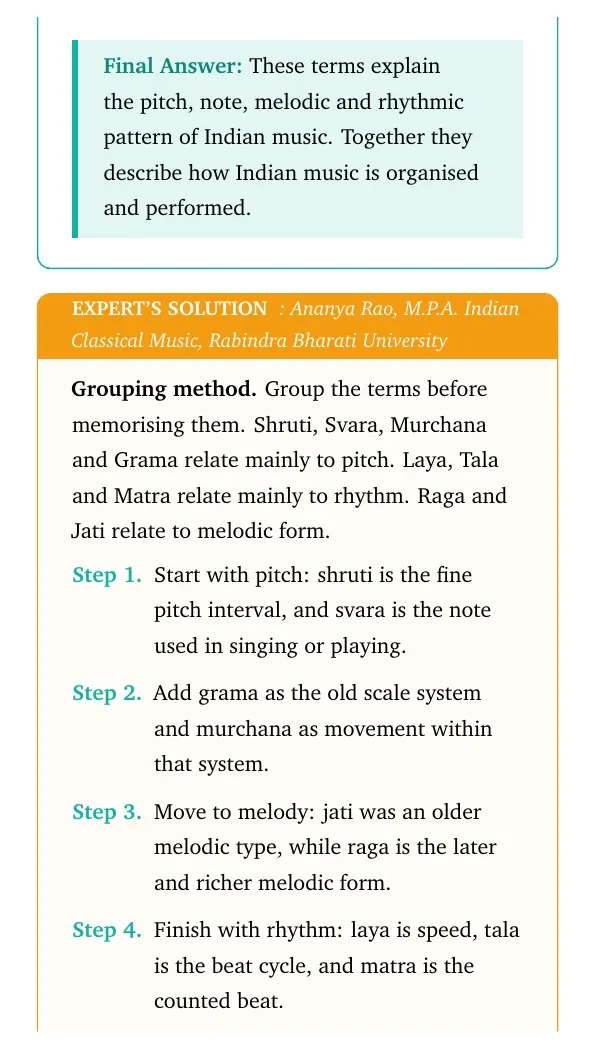
These terms explain the pitch, note, melodic and rhythmic pattern
of Indian music. Together they describe how Indian music is organised and
performed.
AR
Ananya Rao
M.P.A. Indian Classical Music, Rabindra Bharati University
Verified Expert
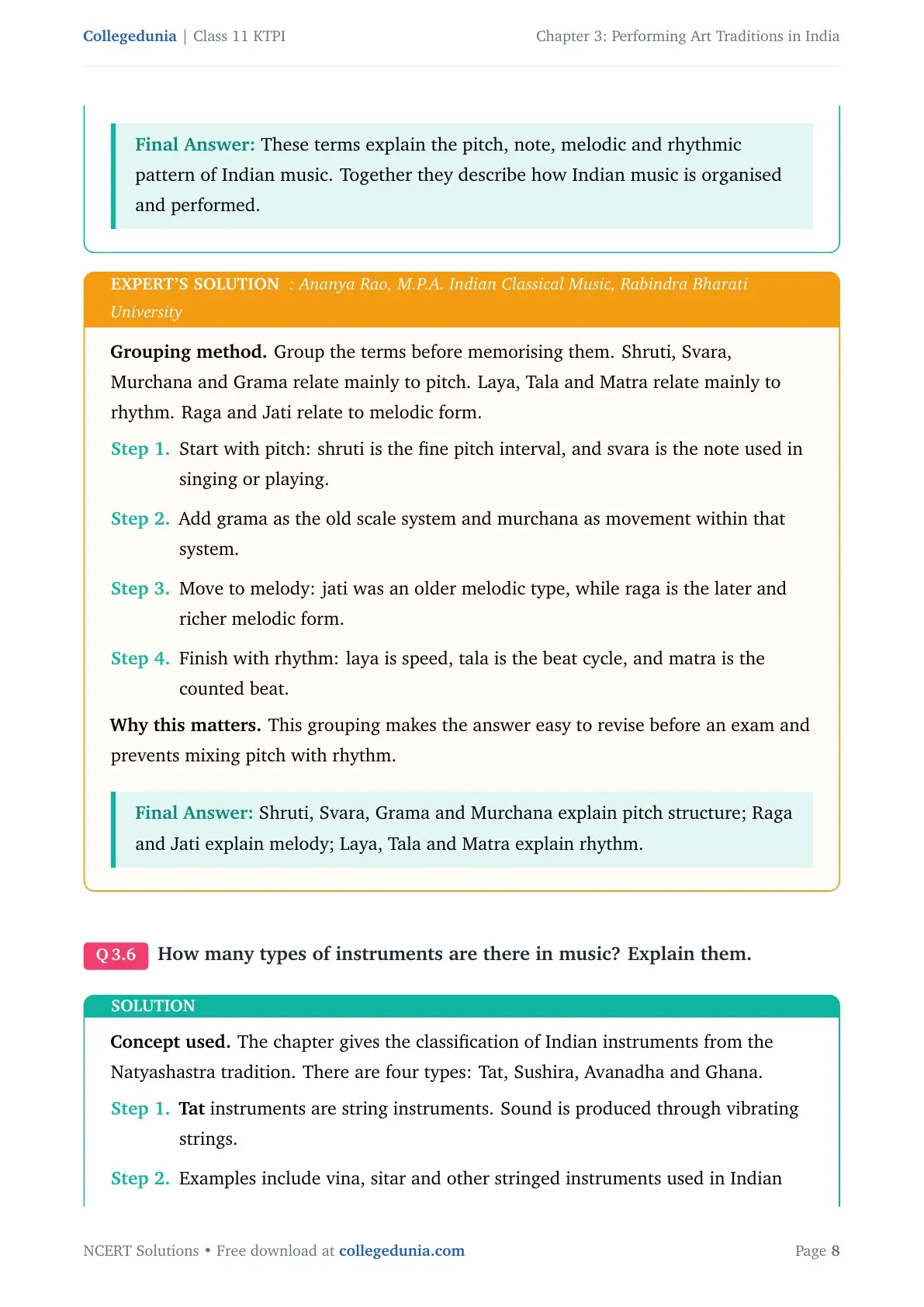
Grouping method. Group the terms before memorising them. Shruti, Svara,
Murchana and Grama relate mainly to pitch. Laya, Tala and Matra relate mainly
to rhythm. Raga and Jati relate to melodic form.
Start with pitch: shruti is the fine pitch interval, and svara is the
note used in singing or playing.
Add grama as the old scale system and murchana as movement within that
system.
Move to melody: jati was an older melodic type, while raga is the later
and richer melodic form.
Finish with rhythm: laya is speed, tala is the beat cycle, and matra is
the counted beat.
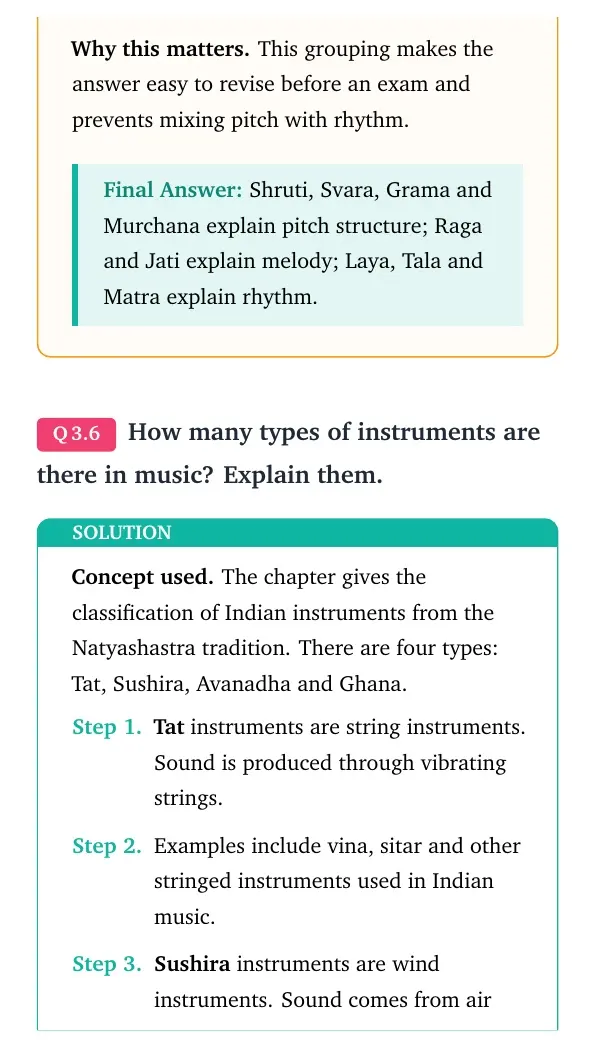
Why this matters. This grouping makes the answer easy to revise before
an exam and prevents mixing pitch with rhythm.
Shruti, Svara, Grama and Murchana explain pitch structure; Raga and
Jati explain melody; Laya, Tala and Matra explain rhythm.
Q 3.6
How many types of instruments are there in music? Explain them.
Concept used. The chapter gives the classification of Indian
instruments from the Natyashastra tradition. There are four types: Tat, Sushira,
Avanadha and Ghana.
Tat instruments are string instruments. Sound is produced
through vibrating strings.
Examples include vina, sitar and other stringed instruments used in
Indian music.
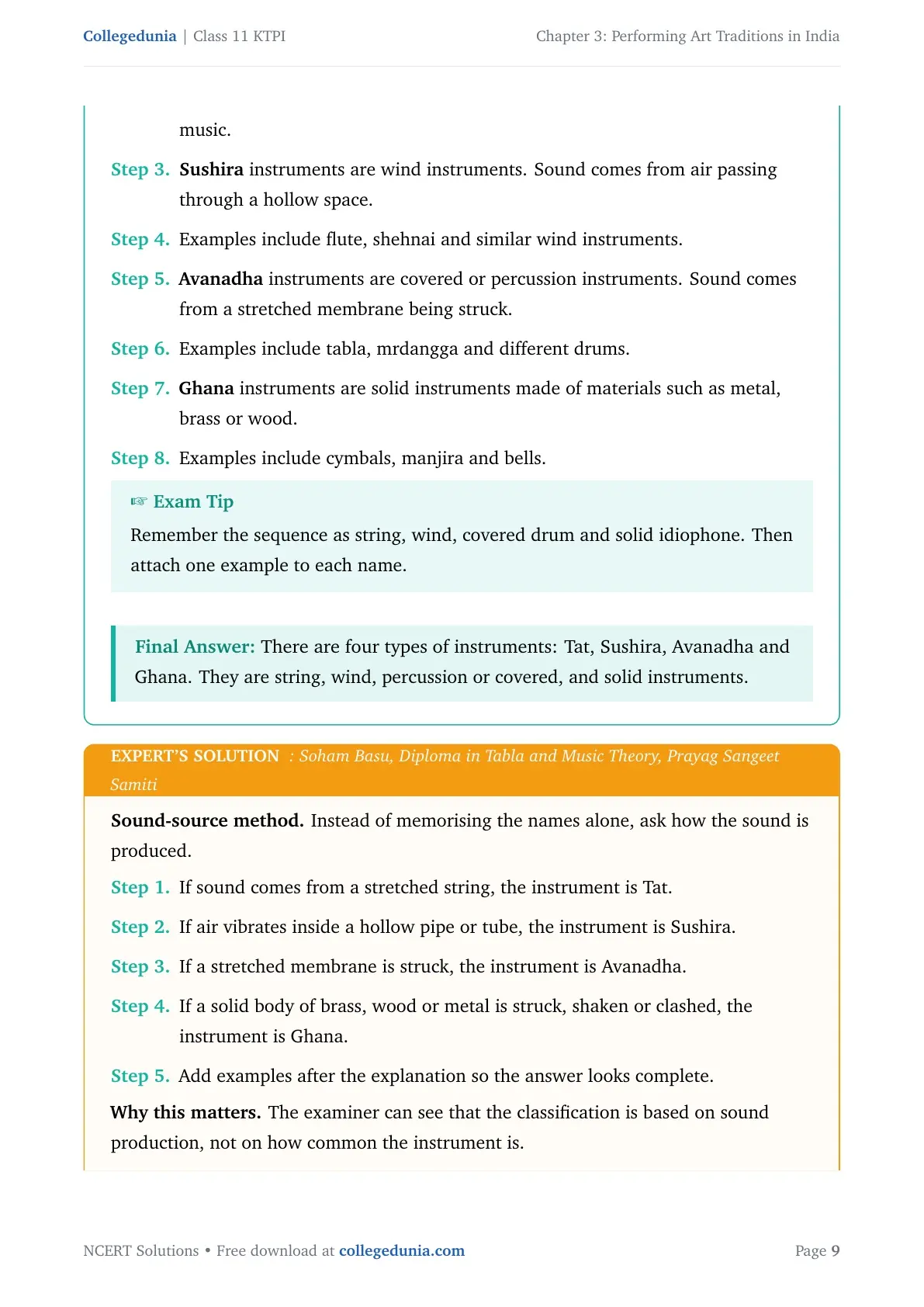
Sushira instruments are wind instruments. Sound comes from air
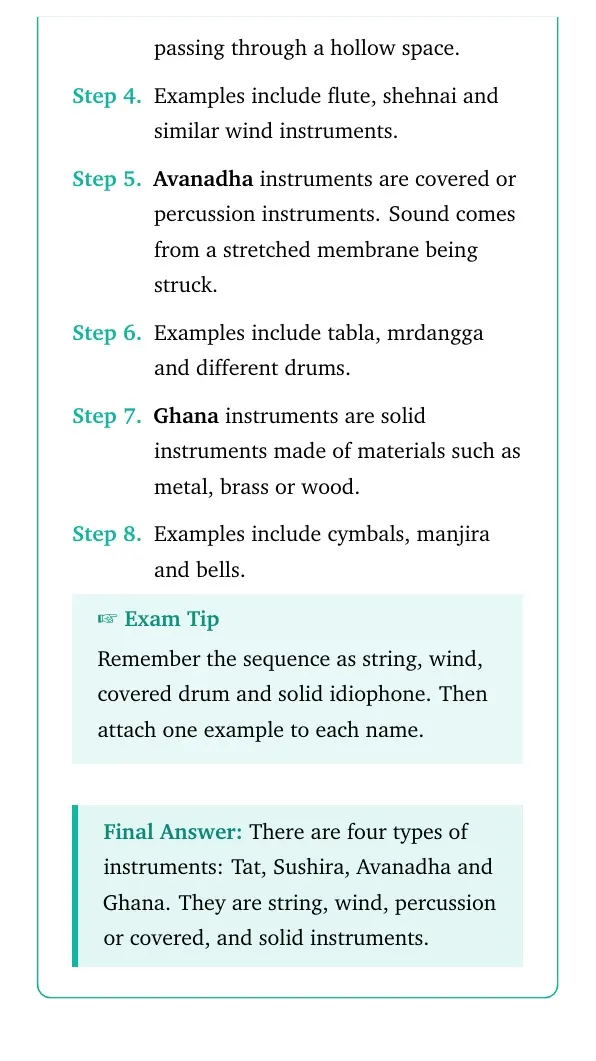
passing through a hollow space.
Examples include flute, shehnai and similar wind instruments.
Avanadha instruments are covered or percussion instruments.
Sound comes from a stretched membrane being struck.
Examples include tabla, mrdangga and different drums.
Ghana instruments are solid instruments made of materials such
as metal, brass or wood.
Examples include cymbals, manjira and bells.
Remember the sequence as string, wind, covered drum and solid idiophone. Then
attach one example to each name.
There are four types of instruments: Tat, Sushira, Avanadha and
Ghana. They are string, wind, percussion or covered, and solid instruments.
SB
Soham Basu
Diploma in Tabla and Music Theory, Prayag Sangeet Samiti
Verified Expert
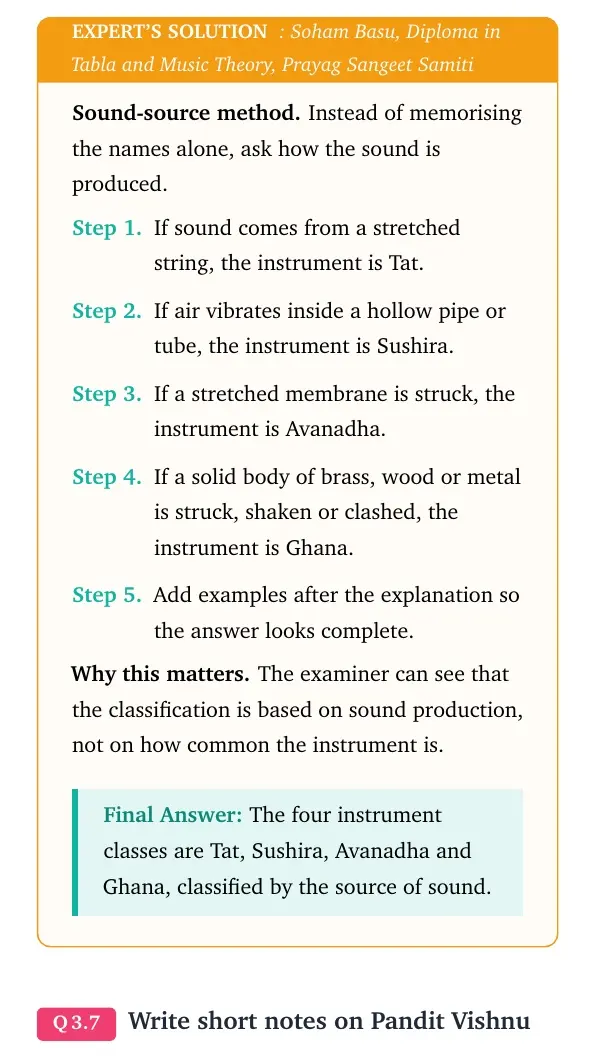
Sound-source method. Instead of memorising the names alone, ask how
the sound is produced.
If sound comes from a stretched string, the instrument is Tat.
If air vibrates inside a hollow pipe or tube, the instrument is Sushira.
If a stretched membrane is struck, the instrument is Avanadha.
If a solid body of brass, wood or metal is struck, shaken or clashed,
the instrument is Ghana.
Add examples after the explanation so the answer looks complete.
Why this matters. The examiner can see that the classification is
based on sound production, not on how common the instrument is.
The four instrument classes are Tat, Sushira, Avanadha and Ghana,
classified by the source of sound.
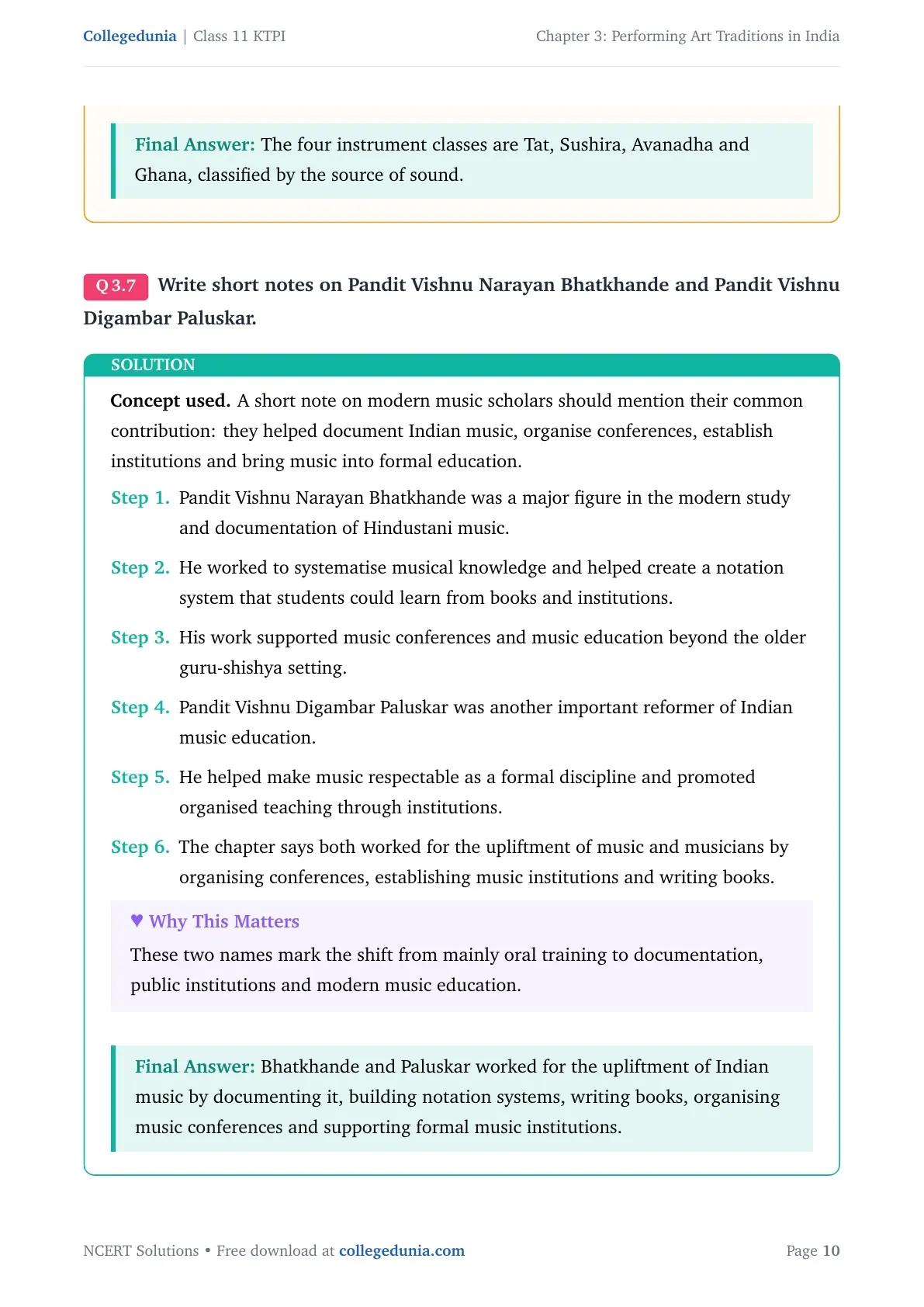
Q 3.7
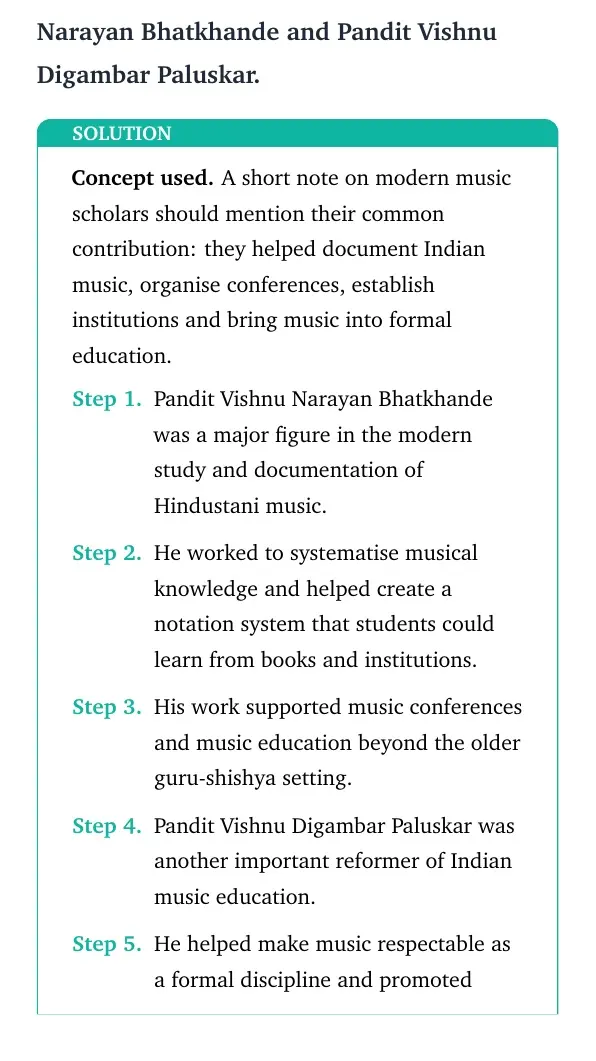
Write short notes on Pandit Vishnu Narayan Bhatkhande and Pandit Vishnu Digambar Paluskar.
Concept used. A short note on modern music scholars should mention
their common contribution: they helped document Indian music, organise
conferences, establish institutions and bring music into formal education.
Pandit Vishnu Narayan Bhatkhande was a major figure in the modern
study and documentation of Hindustani music.
He worked to systematise musical knowledge and helped create a notation
system that students could learn from books and institutions.
His work supported music conferences and music education beyond the
older guru-shishya setting.
Pandit Vishnu Digambar Paluskar was another important reformer of
Indian music education.
He helped make music respectable as a formal discipline and promoted
organised teaching through institutions.
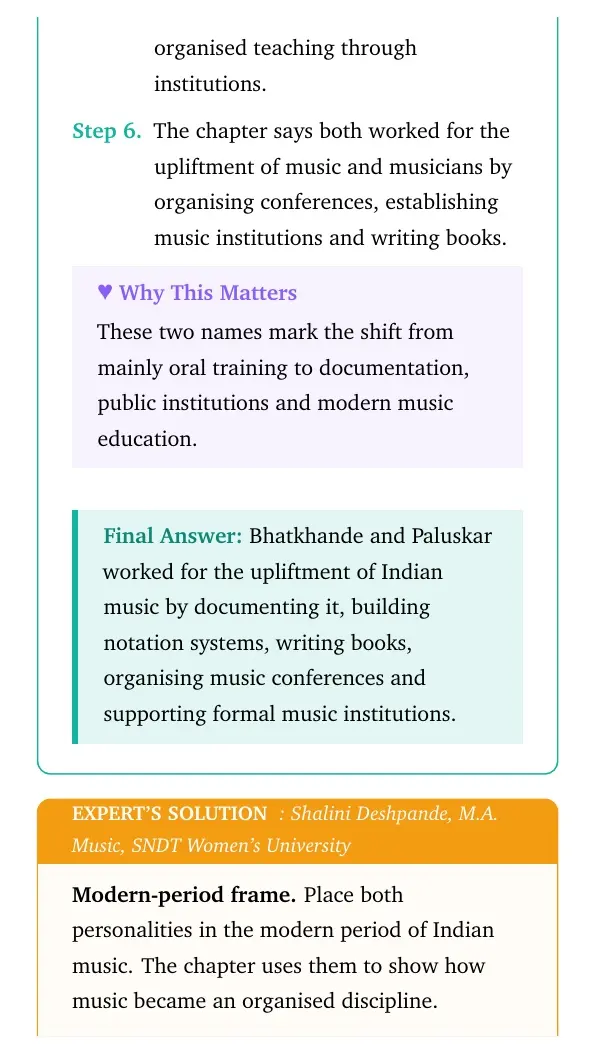
The chapter says both worked for the upliftment of music and musicians
by organising conferences, establishing music institutions and writing
books.
These two names mark the shift from mainly oral training to documentation,
public institutions and modern music education.
Bhatkhande and Paluskar worked for the upliftment of Indian music by
documenting it, building notation systems, writing books, organising music
conferences and supporting formal music institutions.
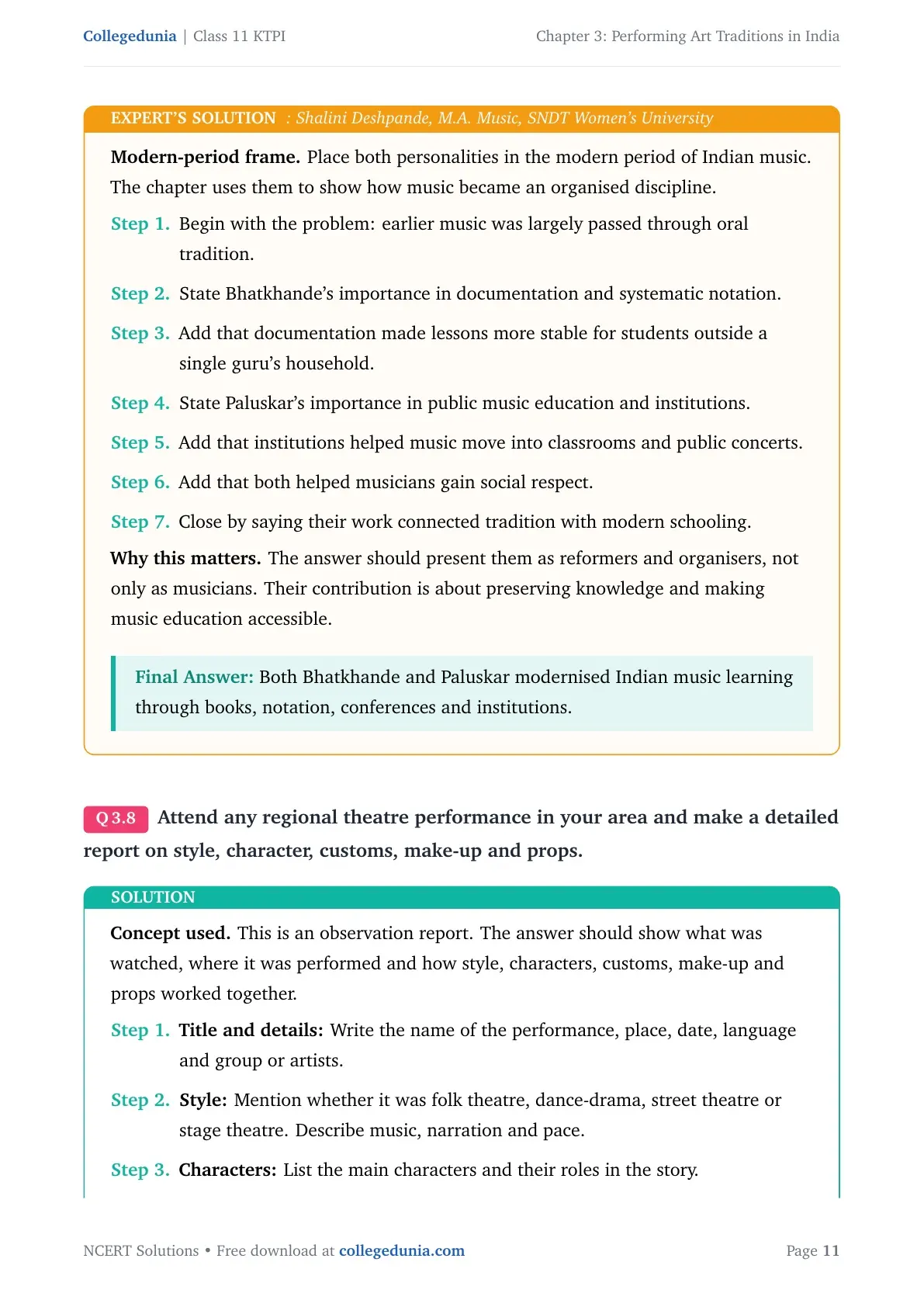
SD
Shalini Deshpande
M.A. Music, SNDT Women's University
Verified Expert
Modern-period frame. Place both personalities in the modern period of
Indian music. The chapter uses them to show how music became an organised
discipline.
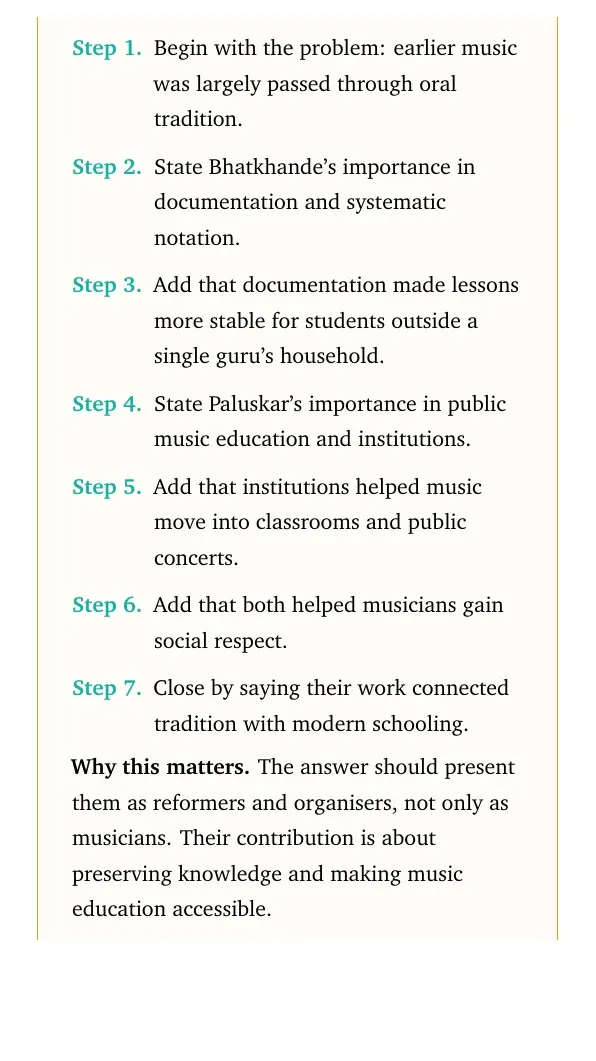
Begin with the problem: earlier music was largely passed through oral
tradition.
State Bhatkhande's importance in documentation and systematic notation.
Add that documentation made lessons more stable for students outside a
single guru's household.
State Paluskar's importance in public music education and institutions.
Add that institutions helped music move into classrooms and public
concerts.
Add that both helped musicians gain social respect.
Close by saying their work connected tradition with modern schooling.
Why this matters. The answer should present them as reformers and
organisers, not only as musicians. Their contribution is about preserving
knowledge and making music education accessible.
Both Bhatkhande and Paluskar modernised Indian music learning through
books, notation, conferences and institutions.
Q 3.8
Attend any regional theatre performance in your area and make a detailed report on style, character, customs, make-up and props.
Concept used. This is an observation report. The answer should show
what was watched, where it was performed and how style, characters, customs,
make-up and props worked together.
Title and details: Write the name of the performance, place,
date, language and group or artists.
Style: Mention whether it was folk theatre, dance-drama,
street theatre or stage theatre. Describe music, narration and pace.
Characters: List the main characters and their roles in the
story.
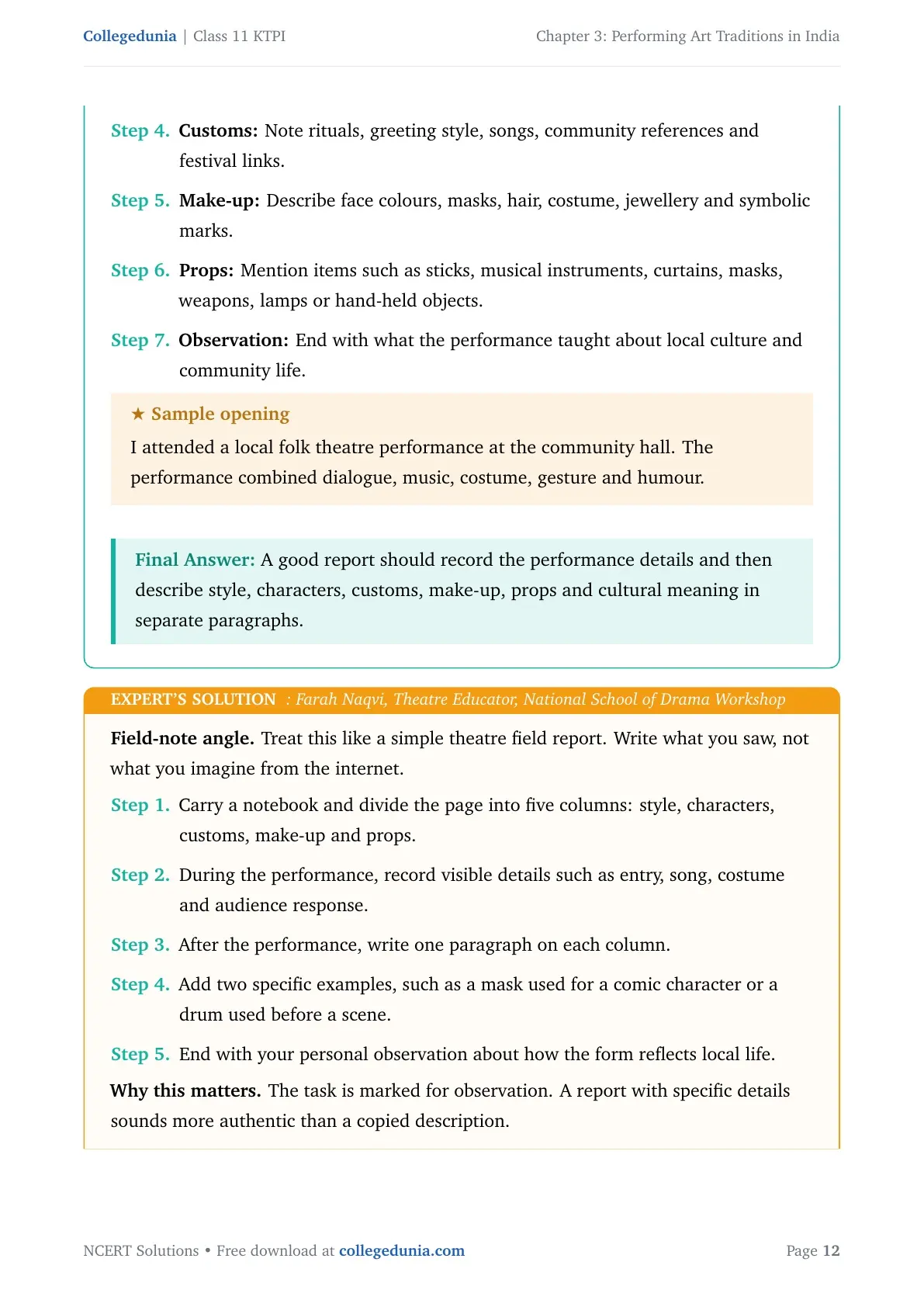
Customs: Note rituals, greeting style, songs, community
references and festival links.
Make-up: Describe face colours, masks, hair, costume, jewellery
and symbolic marks.
Props: Mention items such as sticks, musical instruments,
curtains, masks, weapons, lamps or hand-held objects.
Observation: End with what the performance taught about local
culture and community life.
Sample opening
I attended a local folk theatre performance at the community hall. The
performance combined dialogue, music, costume, gesture and humour.
A good report should record the performance details and then describe
style, characters, customs, make-up, props and cultural meaning in separate
paragraphs.
FN
Farah Naqvi
Theatre Educator, National School of Drama Workshop
Verified Expert
Field-note angle. Treat this like a simple theatre field report. Write
what you saw, not what you imagine from the internet.
Carry a notebook and divide the page into five columns: style,
characters, customs, make-up and props.
During the performance, record visible details such as entry, song,
costume and viewer response.
After the performance, write one paragraph on each column.
Add two specific examples, such as a mask used for a comic character or
a drum used before a scene.
End with your personal observation about how the form reflects local
life.
Why this matters. The task is marked for observation. A report with
specific details sounds more authentic than a copied description.
The report should be based on direct observation and should explain
how regional style, character, customs, make-up and props shape the theatre
experience.
Q 3.9
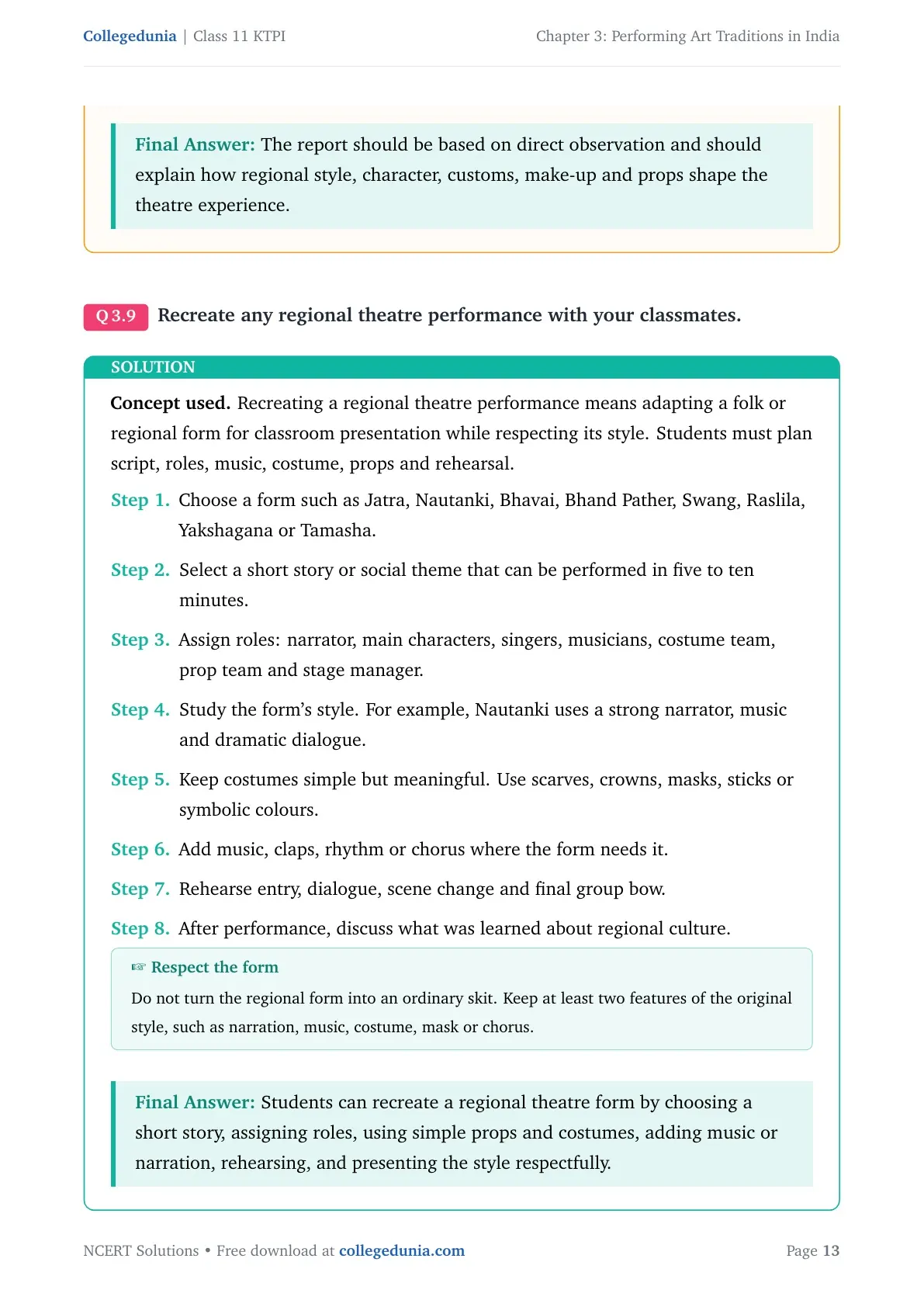
Recreate any regional theatre performance with your classmates.
Concept used. Recreating a regional theatre performance means adapting
a folk or regional form for classroom presentation while respecting its style.
Students must plan script, roles, music, costume, props and rehearsal.
Choose a form such as Jatra, Nautanki, Bhavai, Bhand Pather, Swang,
Raslila, Yakshagana or Tamasha.
Select a short story or social theme that can be performed in five to
ten minutes.
Assign roles: narrator, main characters, singers, musicians, costume
team, prop team and stage manager.
Study the form's style. For example, Nautanki uses a strong narrator,
music and dramatic dialogue.
Keep costumes simple but meaningful. Use scarves, crowns, masks, sticks
or symbolic colours.
Add music, claps, rhythm or chorus where the form needs it.
Rehearse entry, dialogue, scene change and final group bow.
After performance, discuss what was learned about regional culture.
Respect the form
Do not turn the regional form into an ordinary skit. Keep at least two features
of the original style, such as narration, music, costume, mask or chorus.
Students can recreate a regional theatre form by choosing a short
story, assigning roles, using simple props and costumes, adding music or
narration, rehearsing, and presenting the style respectfully.
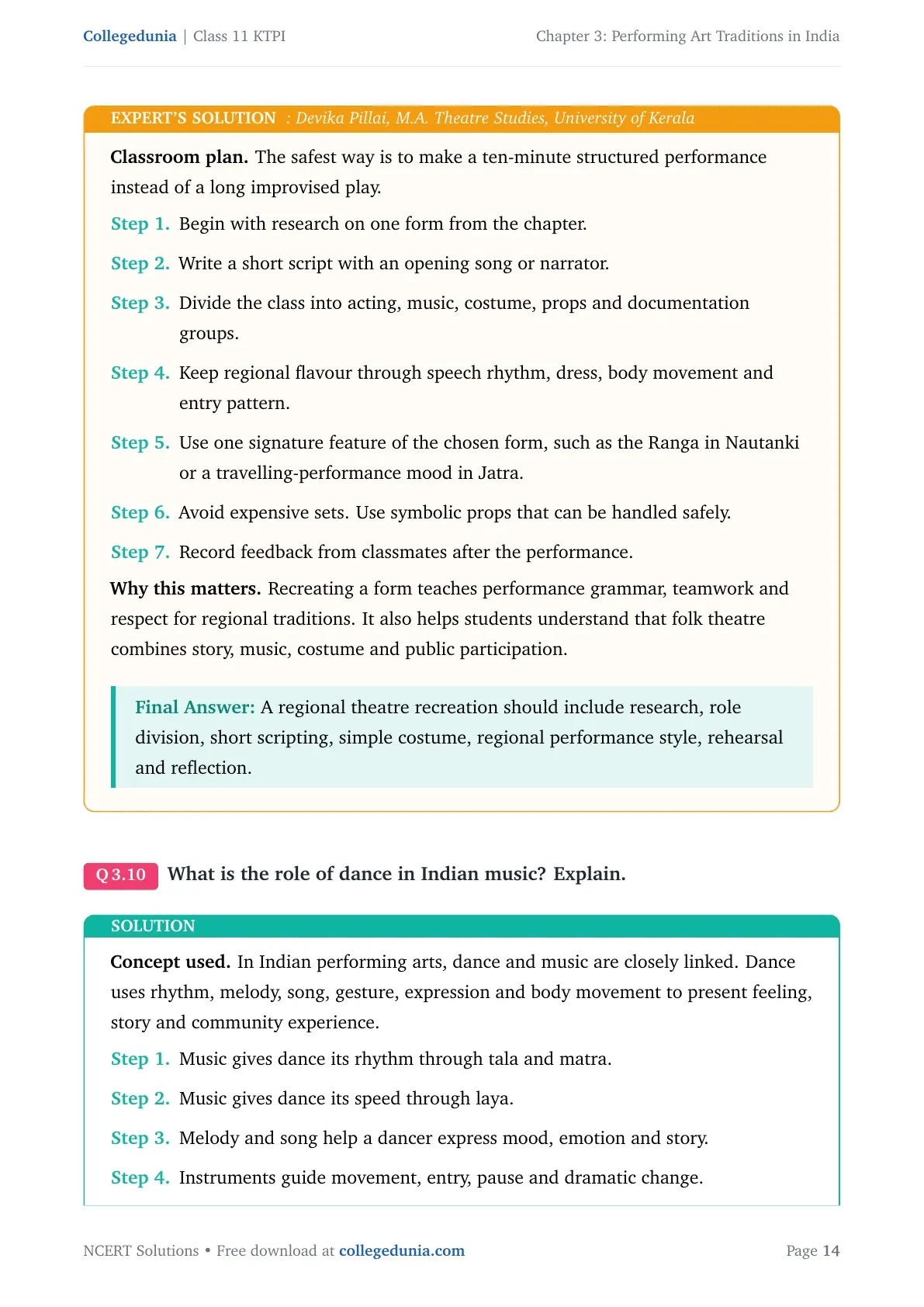
DP
Devika Pillai
M.A. Theatre Studies, University of Kerala
Verified Expert
Classroom plan. The safest way is to make a ten-minute structured
performance instead of a long improvised play.
Begin with research on one form from the chapter.
Write a short script with an opening song or narrator.
Divide the class into acting, music, costume, props and documentation
groups.
Keep regional flavour through speech rhythm, dress, body movement and
entry pattern.
Use one signature feature of the chosen form, such as the Ranga in
Nautanki or a travelling-performance mood in Jatra.
Avoid expensive sets. Use symbolic props that can be handled safely.
Record feedback from classmates after the performance.
Why this matters. Recreating a form teaches performance grammar,
teamwork and respect for regional traditions. It also helps students understand
that folk theatre combines story, music, costume and public participation.
A regional theatre recreation should include research, role
division, short scripting, simple costume, regional performance style,
rehearsal and reflection.
Q 3.10
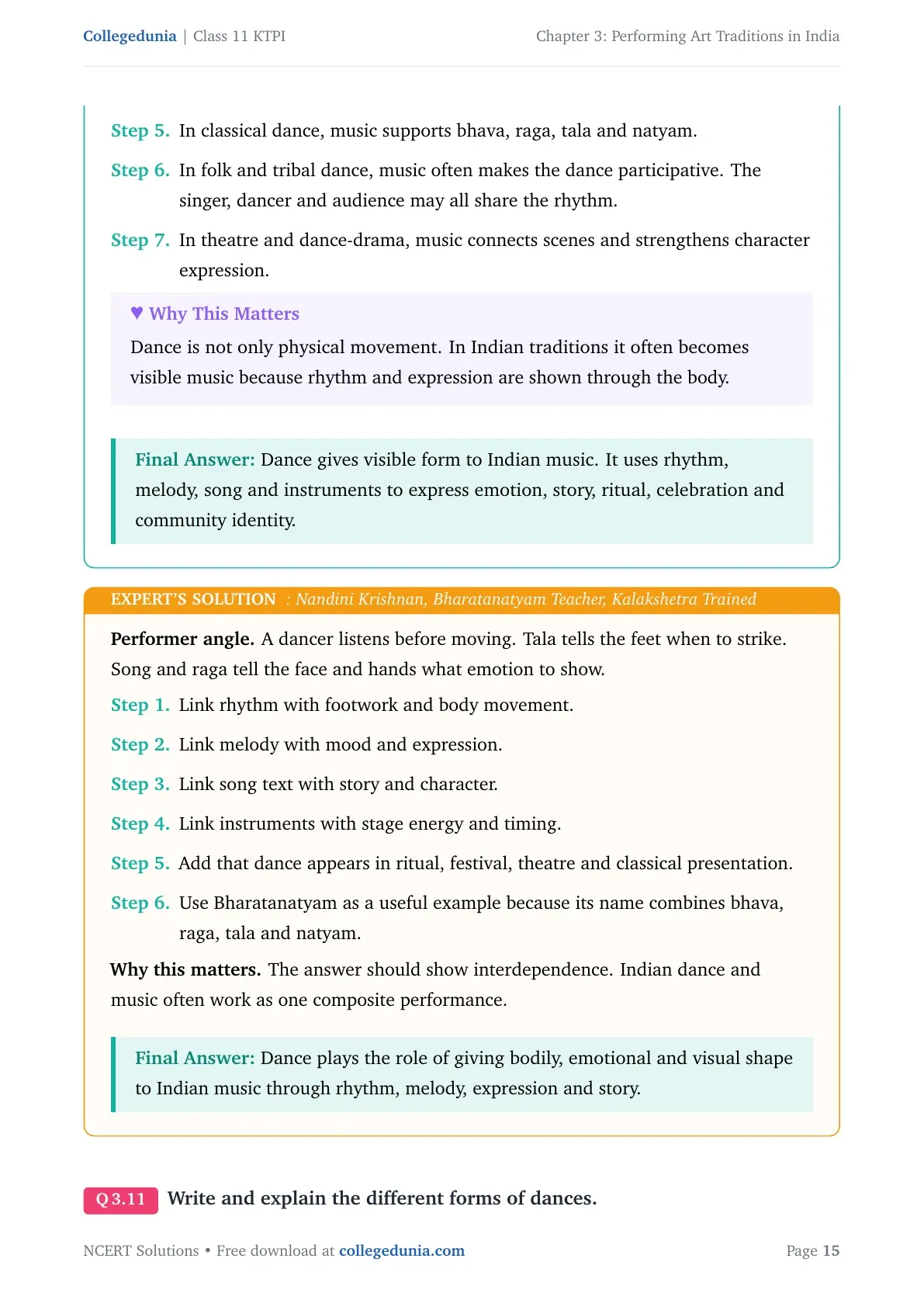
What is the role of dance in Indian music? Explain.
Concept used. In Indian performing arts, dance and music are closely
linked. Dance uses rhythm, melody, song, gesture, expression and body movement
to present feeling, story and community experience.
Music gives dance its rhythm through tala and matra.
Music gives dance its speed through laya.
Melody and song help a dancer express mood, emotion and story.
Instruments guide movement, entry, pause and dramatic change.
In classical dance, music supports bhava, raga, tala and natyam.
In folk and tribal dance, music often makes the dance participative.
The singer, dancer and viewers may all share the rhythm.
In theatre and dance-drama, music connects scenes and strengthens
character expression.
Dance is not only physical movement. In Indian traditions it often becomes
visible music because rhythm and expression are shown through the body.
Dance gives visible form to Indian music. It uses rhythm, melody,
song and instruments to express emotion, story, ritual, celebration and
community identity.
NK
Nandini Krishnan
Bharatanatyam Teacher, Kalakshetra Trained
Verified Expert
Performer angle. A dancer listens before moving. Tala tells the feet
when to strike. Song and raga tell the face and hands what emotion to show.
Link rhythm with footwork and body movement.
Link melody with mood and expression.
Link song text with story and character.
Link instruments with stage energy and timing.
Add that dance appears in ritual, festival, theatre and classical
presentation.
Use Bharatanatyam as a useful example because its name combines bhava,
raga, tala and natyam.
Why this matters. The answer should show interdependence. Indian
dance and music often work as one composite performance.
Dance plays the role of giving bodily, emotional and visual shape to
Indian music through rhythm, melody, expression and story.
Q 3.11
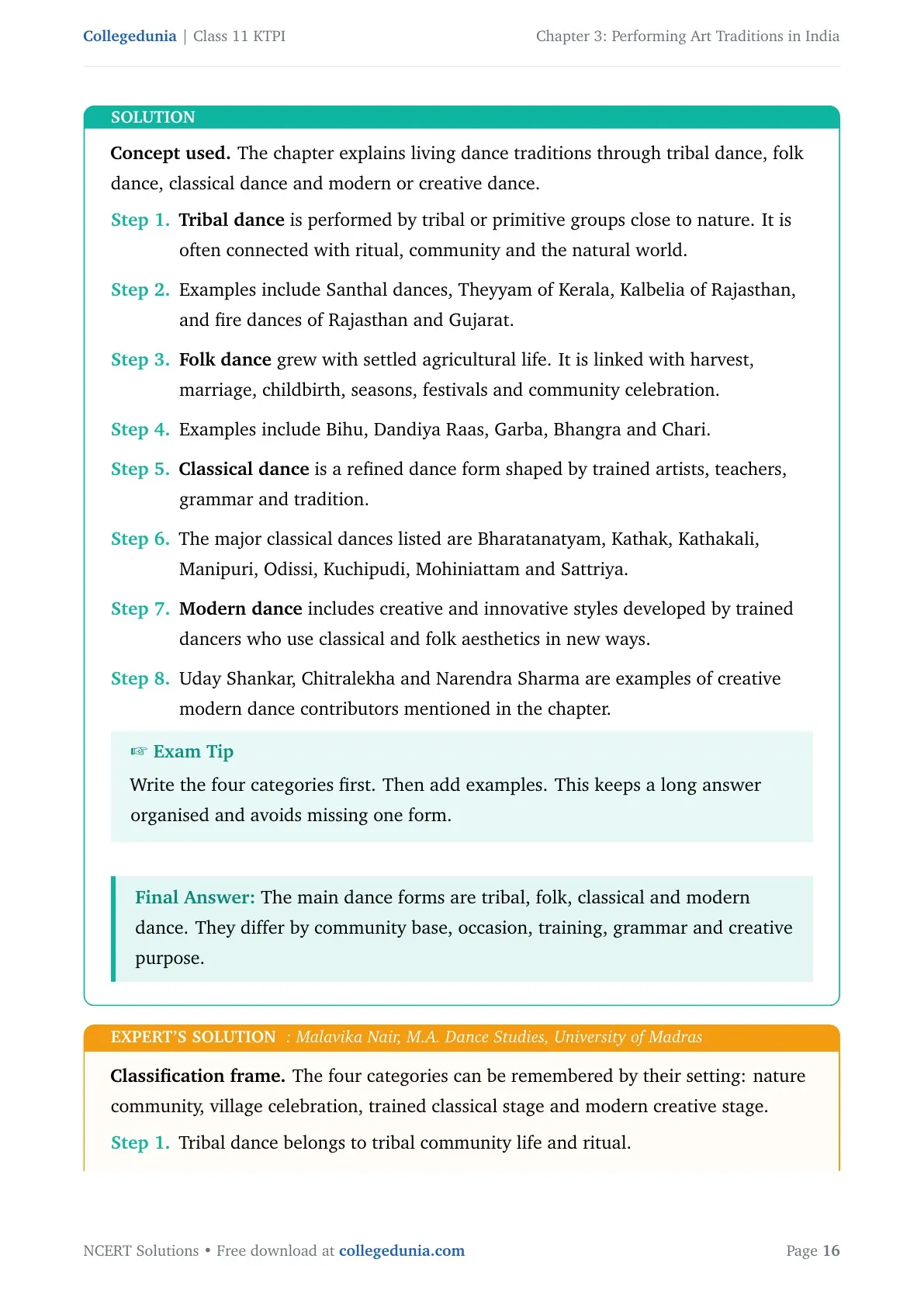
Write and explain the different forms of dances.
Concept used. The chapter explains living dance traditions through
tribal dance, folk dance, classical dance and modern or creative dance.
Tribal dance is performed by tribal or primitive groups close
to nature. It is often connected with ritual, community and the natural
world.
Examples include Santhal dances, Theyyam of Kerala, Kalbelia of
Rajasthan, and fire dances of Rajasthan and Gujarat.
Folk dance grew with settled agricultural life. It is linked
with harvest, marriage, childbirth, seasons, festivals and community
celebration.
Examples include Bihu, Dandiya Raas, Garba, Bhangra and Chari.
Classical dance is a refined dance form shaped by trained
artists, teachers, grammar and tradition.
The major classical dances listed are Bharatanatyam, Kathak, Kathakali,
Manipuri, Odissi, Kuchipudi, Mohiniattam and Sattriya.
Modern dance includes creative and innovative styles developed
by trained dancers who use classical and folk aesthetics in new ways.
Uday Shankar, Chitralekha and Narendra Sharma are examples of creative
modern dance contributors mentioned in the chapter.
Write the four categories first. Then add examples. This keeps a long answer
organised and avoids missing one form.
The main dance forms are tribal, folk, classical and modern dance.
They differ by community base, occasion, training, grammar and creative
purpose.
MN
Malavika Nair
M.A. Dance Studies, University of Madras
Verified Expert
Classification frame. The four categories can be remembered by their
setting: nature community, village celebration, trained classical stage and
modern creative stage.
Tribal dance belongs to tribal community life and ritual.
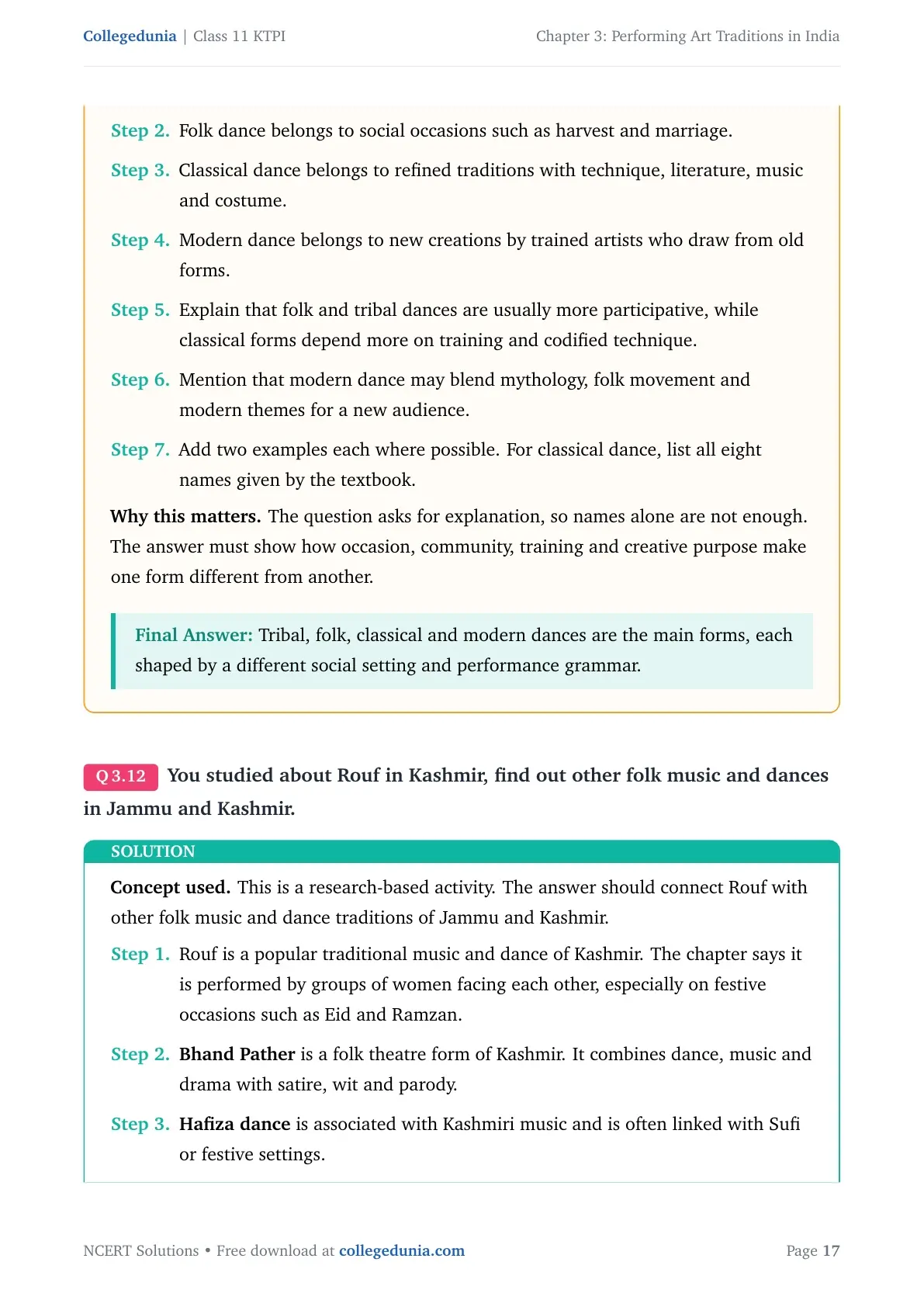
Folk dance belongs to social occasions such as harvest and marriage.
Classical dance belongs to refined traditions with technique,
literature, music and costume.
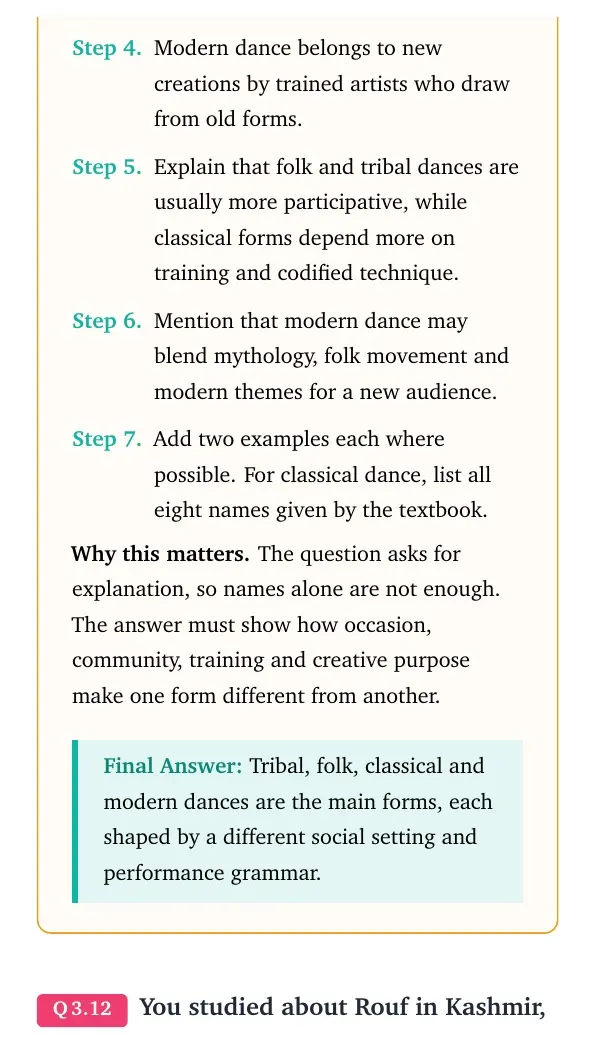
Modern dance belongs to new creations by trained artists who draw from
old forms.
Explain that folk and tribal dances are usually more participative,
while classical forms depend more on training and codified technique.
Mention that modern dance may blend mythology, folk movement and modern
themes for a new viewers.
Add two examples each where possible. For classical dance, list all
eight names given by the textbook.
Why this matters. The question asks for explanation, so names alone
are not enough. The answer must show how occasion, community, training and
creative purpose make one form different from another.
Tribal, folk, classical and modern dances are the main forms, each
shaped by a different social setting and performance grammar.
Q 3.12
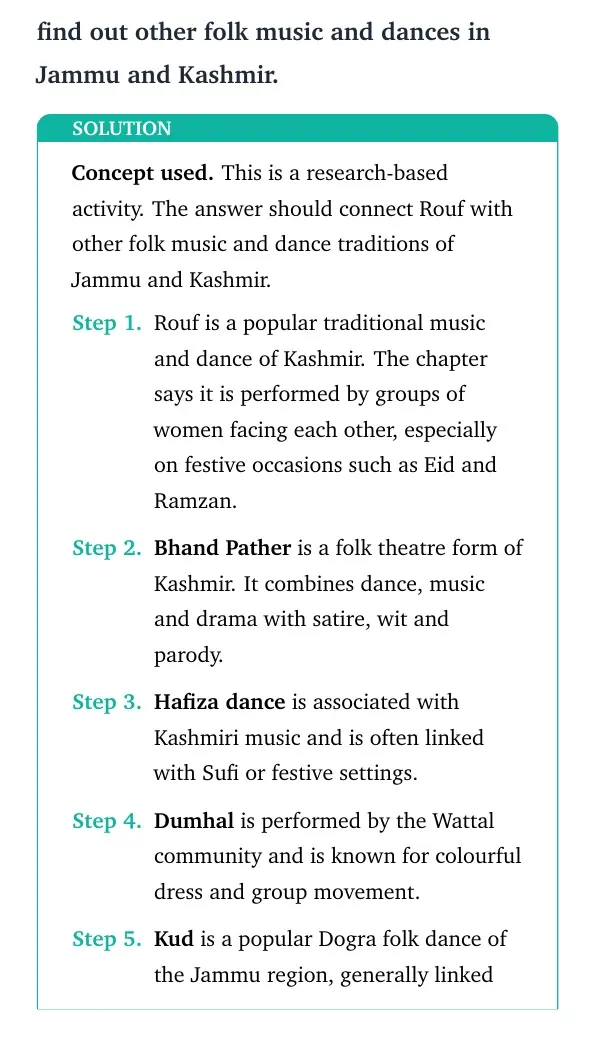
You studied about Rouf in Kashmir, find out other folk music and dances in Jammu and Kashmir.
Concept used. This is a research-based activity. The answer should
connect Rouf with other folk music and dance traditions of Jammu and Kashmir.
Rouf is a popular traditional music and dance of Kashmir. The chapter
says it is performed by groups of women facing each other, especially
on festive occasions such as Eid and Ramzan.
Bhand Pather is a folk theatre form of Kashmir. It combines
dance, music and drama with satire, wit and parody.
Hafiza dance is associated with Kashmiri music and is often
linked with Sufi or festive settings.
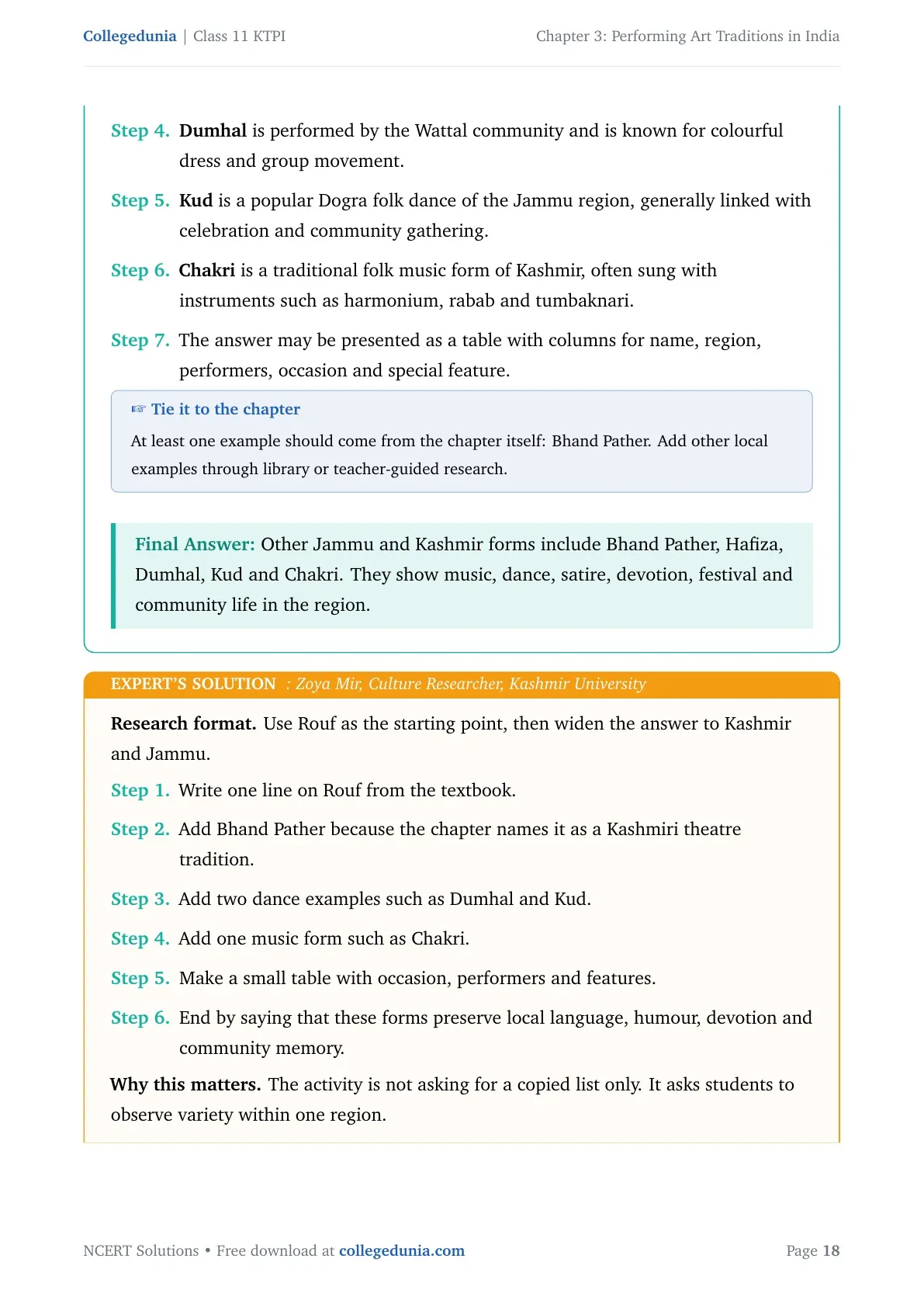
Dumhal is performed by the Wattal community and is known for
colourful dress and group movement.
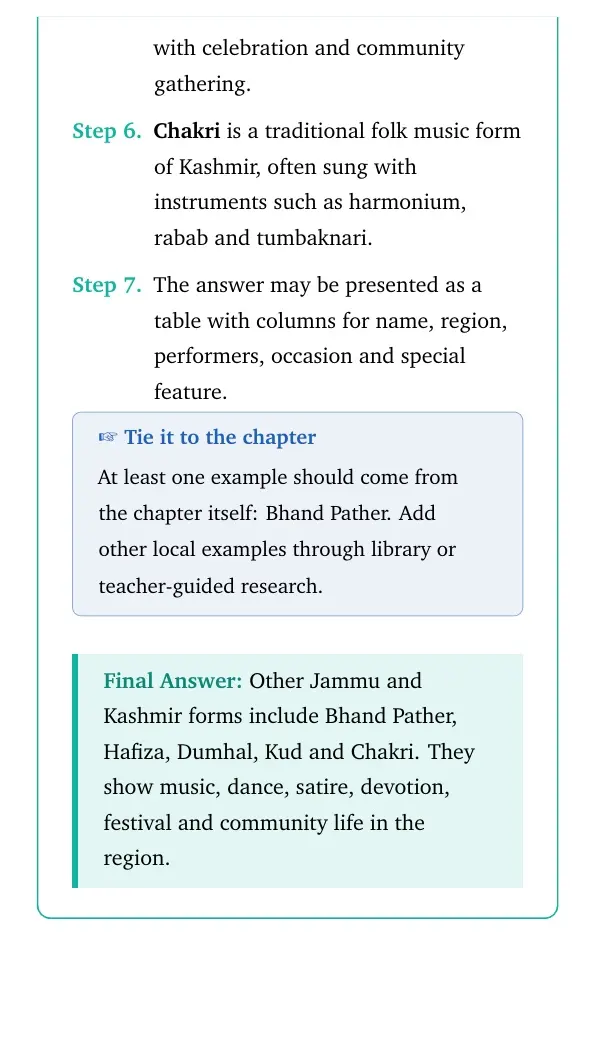
Kud is a popular Dogra folk dance of the Jammu region,
generally linked with celebration and community gathering.
Chakri is a traditional folk music form of Kashmir, often sung
with instruments such as harmonium, rabab and tumbaknari.
The answer may be presented as a table with columns for name, region,
performers, occasion and special feature.
Tie it to the chapter
At least one example should come from the chapter itself: Bhand Pather. Add
other local examples through library or teacher-guided research.
Other Jammu and Kashmir forms include Bhand Pather, Hafiza, Dumhal,
Kud and Chakri. They show music, dance, satire, devotion, festival and community
life in the region.
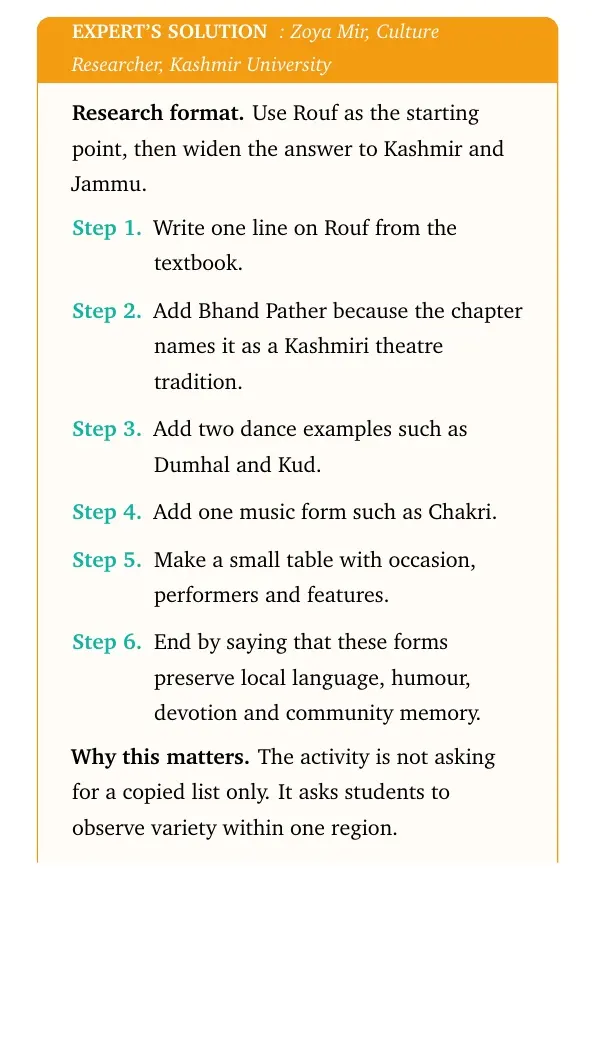
ZM
Zoya Mir
Culture Researcher, Kashmir University
Verified Expert
Research format. Use Rouf as the starting point, then widen the answer
to Kashmir and Jammu.
Write one line on Rouf from the textbook.
Add Bhand Pather because the chapter names it as a Kashmiri theatre
tradition.
Add two dance examples such as Dumhal and Kud.
Add one music form such as Chakri.
Make a small table with occasion, performers and features.
End by saying that these forms preserve local language, humour,
devotion and community memory.
Why this matters. The activity is not asking for a copied list only.
It asks students to observe variety within one region.
A strong answer names Rouf, Bhand Pather, Dumhal, Kud, Hafiza and
Chakri, then explains their occasions and community value.
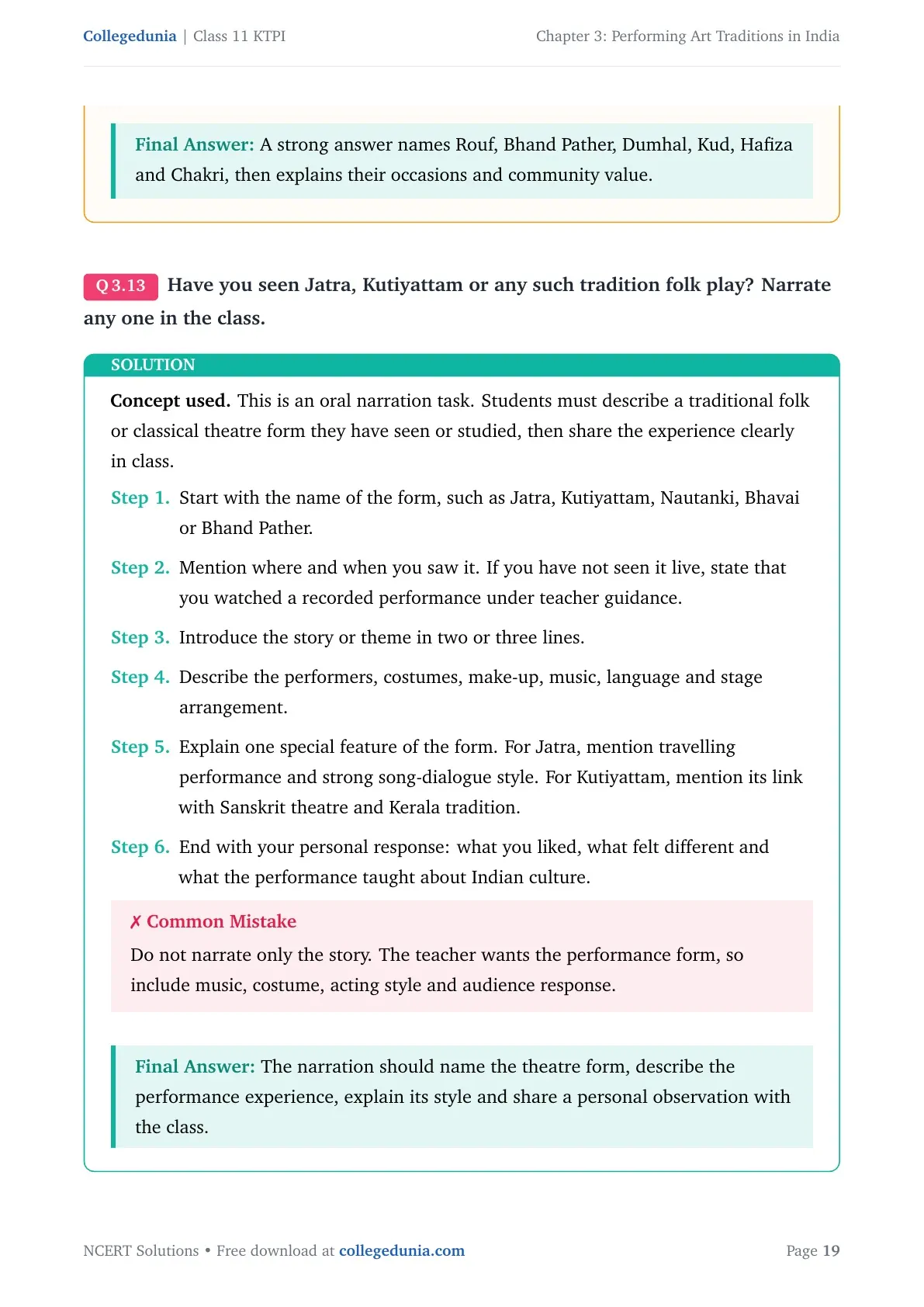
Q 3.13
Have you seen Jatra, Kutiyattam or any such tradition folk play? Narrate any one in the class.
Concept used. This is an oral narration task. Students must describe a
traditional folk or classical theatre form they have seen or studied, then
share the experience clearly in class.
Start with the name of the form, such as Jatra, Kutiyattam, Nautanki,
Bhavai or Bhand Pather.
Mention where and when you saw it. If you have not seen it live, state
that you watched a recorded performance under teacher guidance.
Introduce the story or theme in two or three lines.
Describe the performers, costumes, make-up, music, language and stage
arrangement.
Explain one special feature of the form. For Jatra, mention travelling
performance and strong song-dialogue style. For Kutiyattam, mention
its link with Sanskrit theatre and Kerala tradition.
End with your personal response: what you liked, what felt different
and what the performance taught about Indian culture.
Do not narrate only the story. The teacher wants the performance form, so include
music, costume, acting style and viewer response.
The narration should name the theatre form, describe the performance
experience, explain its style and share a personal observation with the class.
IR
Ishan Roy
Theatre Studies Scholar, Visva-Bharati
Verified Expert
Narration frame. A class narration needs order. Use experience,
features and reflection.
Give the name and region of the form.
Say whether it was live, recorded or observed during a school event.
Summarise the plot briefly.
Spend more time on performance features: music, movement, costume,
make-up and interaction with viewers.
Use one comparison with ordinary stage drama.
Finish with what you learned about local traditions.
Why this matters. The prompt asks students to speak in class, so the
answer should sound like a clear oral presentation.
A good narration covers the theatre form, region, plot, performers,
music, costume, special features and personal learning.
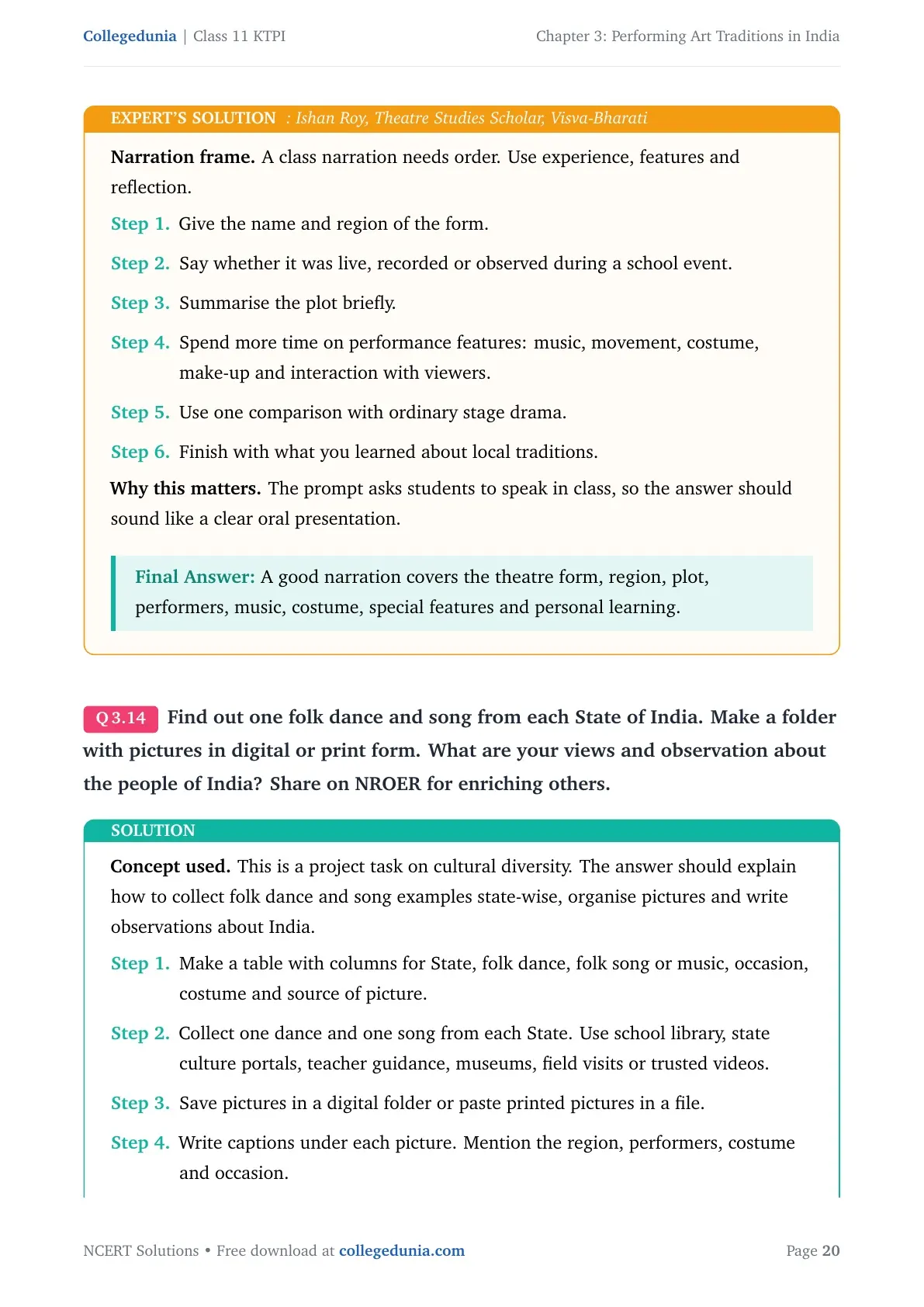
Q 3.14
Find out one folk dance and song from each State of India. Make a folder with pictures in digital or print form. What are your views and observation about the people of India? Share on NROER for enriching others.
Concept used. This is a project task on cultural diversity. The answer
should explain how to collect folk dance and song examples state-wise, organise
pictures and write observations about India.
Make a table with columns for State, folk dance, folk song or music,
occasion, costume and source of picture.
Collect one dance and one song from each State. Use school library,
state culture portals, teacher guidance, museums, field visits or
trusted videos.
Save pictures in a digital folder or paste printed pictures in a file.
Write captions under each picture. Mention the region, performers,
costume and occasion.
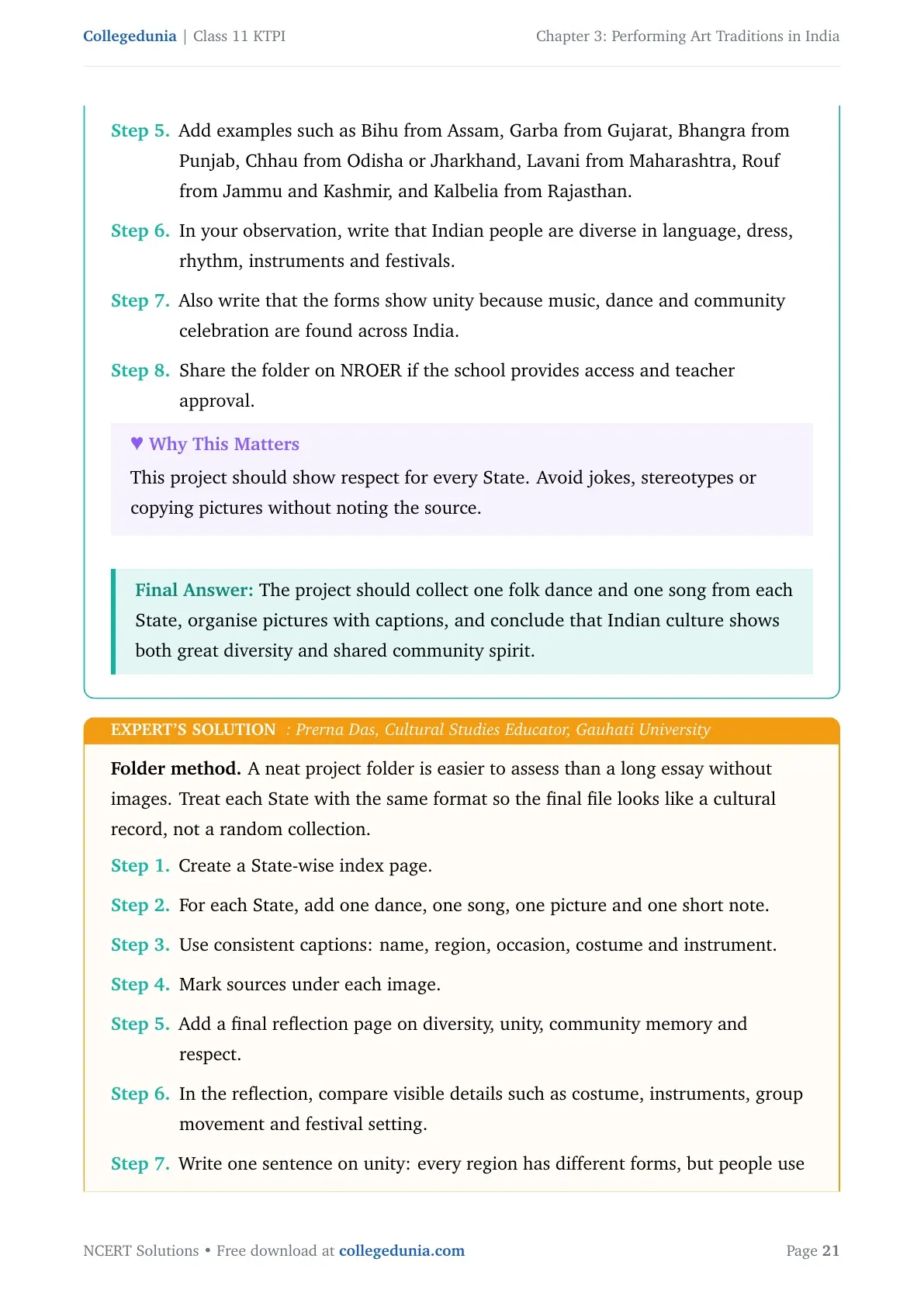
Add examples such as Bihu from Assam, Garba from Gujarat, Bhangra from
Punjab, Chhau from Odisha or Jharkhand, Lavani from Maharashtra, Rouf
from Jammu and Kashmir, and Kalbelia from Rajasthan.
In your observation, write that Indian people are diverse in language,
dress, rhythm, instruments and festivals.
Also write that the forms show unity because music, dance and community
celebration are found across India.
Share the folder on NROER if the school provides access and teacher
approval.
This project should show respect for every State. Avoid jokes, stereotypes or
copying pictures without noting the source.
The project should collect one folk dance and one song from each
State, organise pictures with captions, and conclude that Indian culture shows
both great diversity and shared community spirit.
PD
Prerna Das
Cultural Studies Educator, Gauhati University
Verified Expert
Folder method. A neat project folder is easier to assess than a long
essay without images. Treat each State with the same format so the final file
looks like a cultural record, not a random collection.
Create a State-wise index page.
For each State, add one dance, one song, one picture and one short note.
Use consistent captions: name, region, occasion, costume and
instrument.
Mark sources under each image.
Add a final reflection page on diversity, unity, community memory and
respect.
In the reflection, compare visible details such as costume, instruments,
group movement and festival setting.
Write one sentence on unity: every region has different forms, but
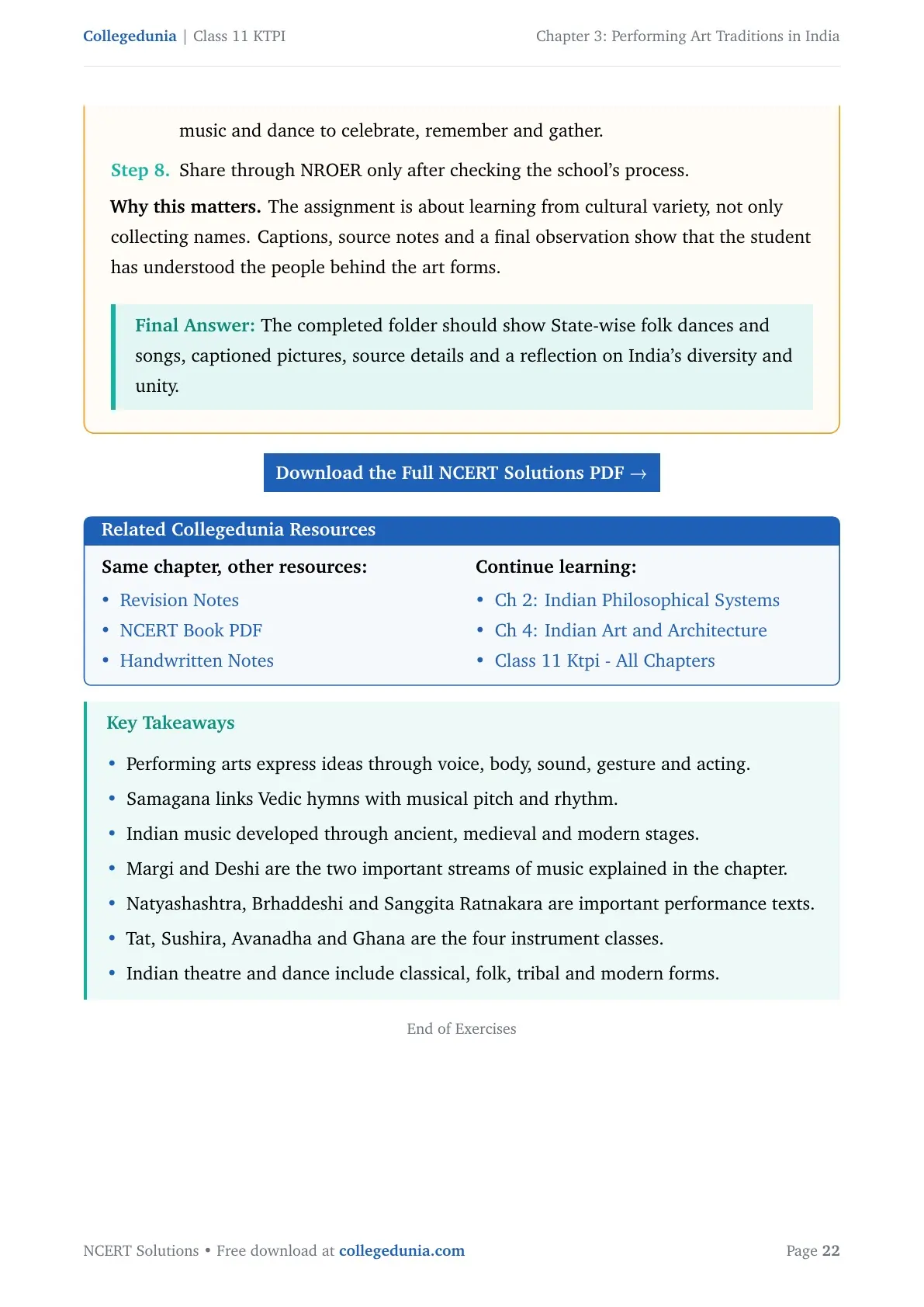
people use music and dance to celebrate, remember and gather.
Share through NROER only after checking the school's process.
Why this matters. The assignment is about learning from cultural
variety, not only collecting names. Captions, source notes and a final
observation show that the student has understood the people behind the art
forms.
The completed folder should show State-wise folk dances and songs,
captioned pictures, source details and a reflection on India's diversity and
unity.
Performing Art Traditions in India Class 11 KTPI NCERT Solutions FAQs
Questions Students Ask About KTPI Chapter 3
Ques. How many questions are solved in Class 11 KTPI Chapter 3 Performing Art Traditions in India?
Ans. There are 14 solved prompts in this resource. The questions cover performing arts, Sāmagāna, classical music, Indian instruments, theatre reports, dance forms, Rouf, folk plays and State-wise project work.
Ques. What are the two music streams mentioned in the chapter?
Ans. The two streams are Mārgi or Gāndharva Saṅgita and Deśi Saṅgita. Mārgi is linked with a sacred aim, while Deśi developed for wider social use and later included classical, semi-classical and folk forms.
Ques. Which four instrument classes should students remember?
Ans. Students should remember Tat, Suśirā, Avanādha and Ghana. These refer to string, wind, covered or percussion, and solid instruments.
Ques. Which classical dances are listed in Class 11 KTPI Chapter 3?
Ans. The chapter lists Bharatanāṭyam, Kathak, Kathakali, Manipuri, Odissi, Kuchipudi, Mohiniattam and Sattriya as major classical or traditional dance forms.
Ques. Is this resource based on the 2026-27 NCERT syllabus?
Ans. Yes. The article, PDF and embedded question cards are written for the 2026-27 Class 11 KTPI syllabus using the NCERT chapter Performing Art Traditions in India as the source.







Comments