



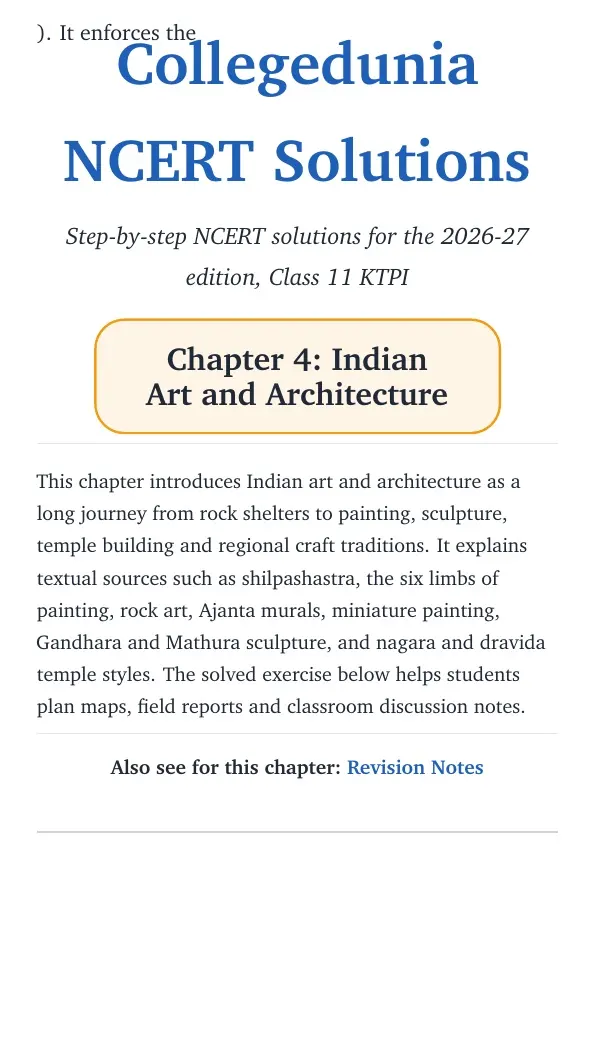
NCERT Solutions for Class 11 KTPI Chapter 4 Indian Art and Architecture cover all 3 project-based questions from the 2026-27 syllabus. The chapter studies Indian painting, sculpture, cave art, temple styles, monuments, museums and ancient texts on art and architecture.
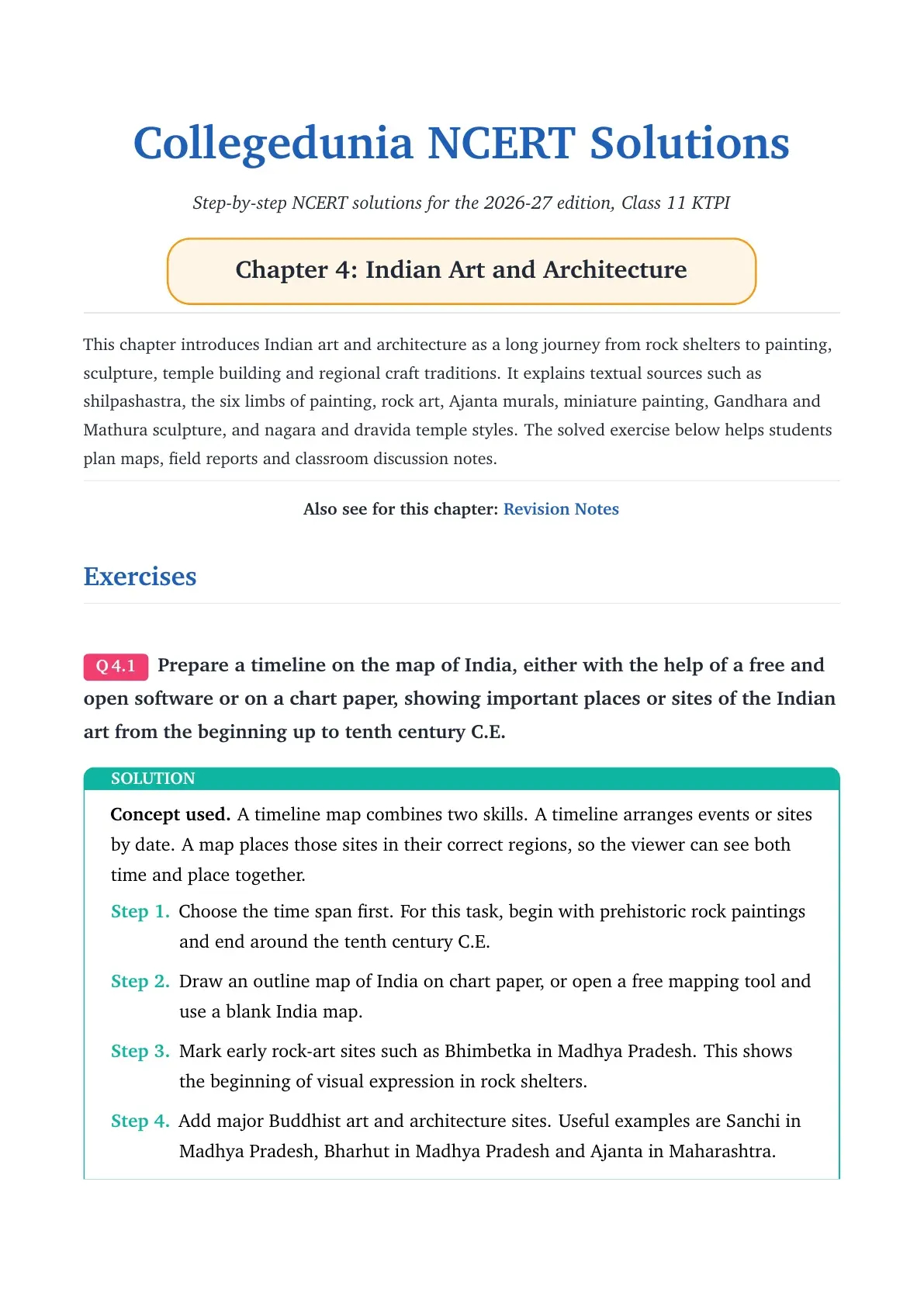
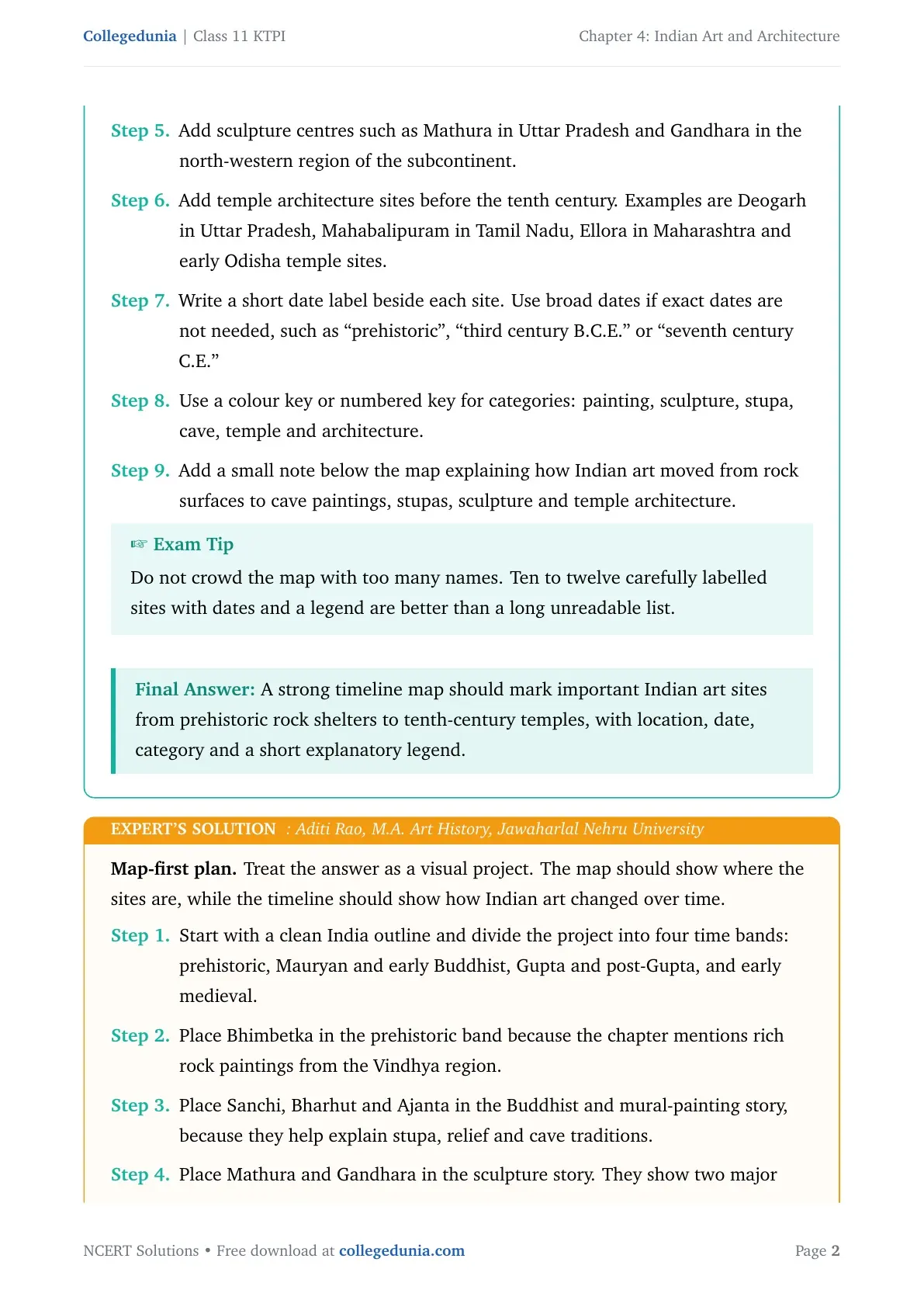
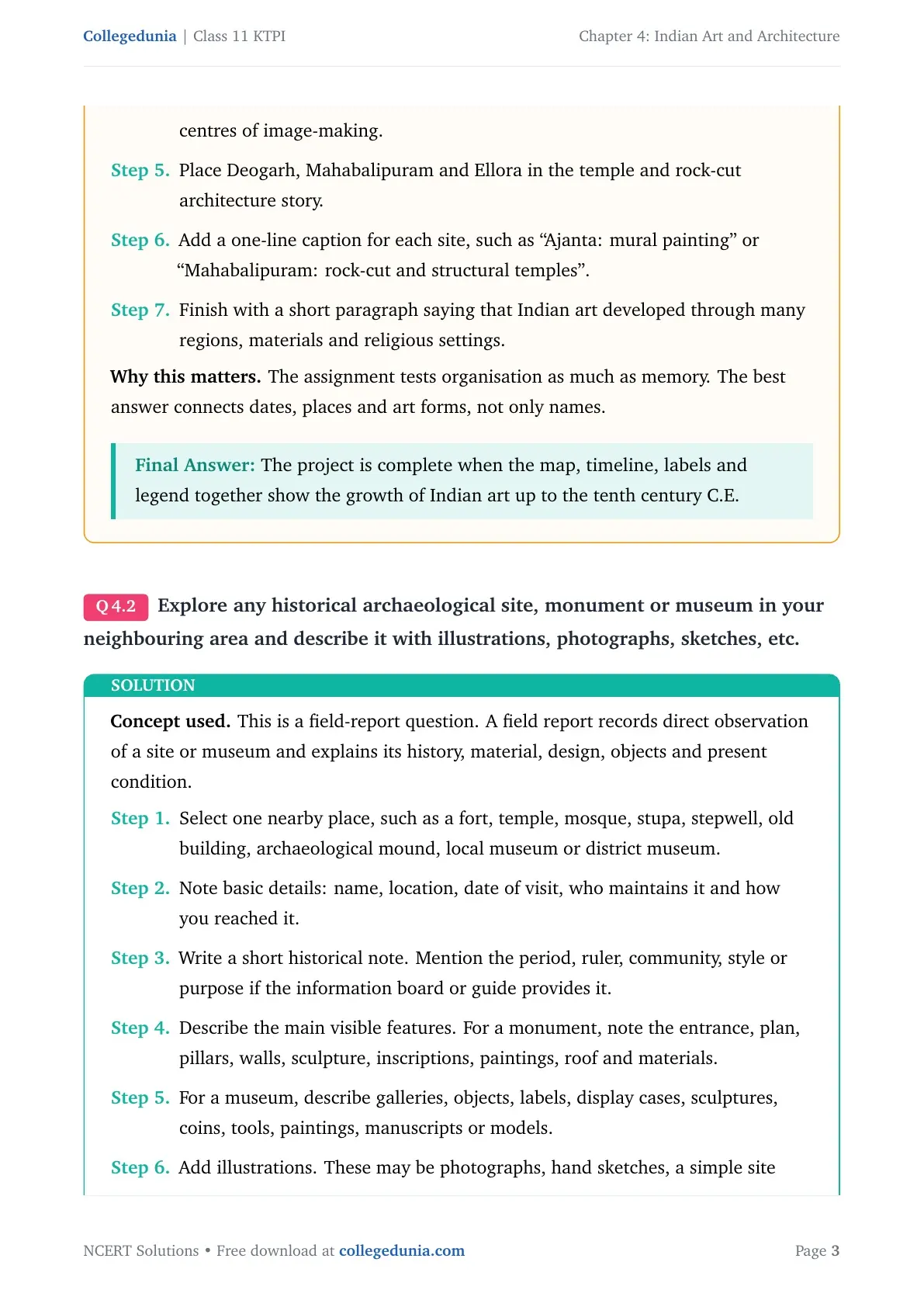
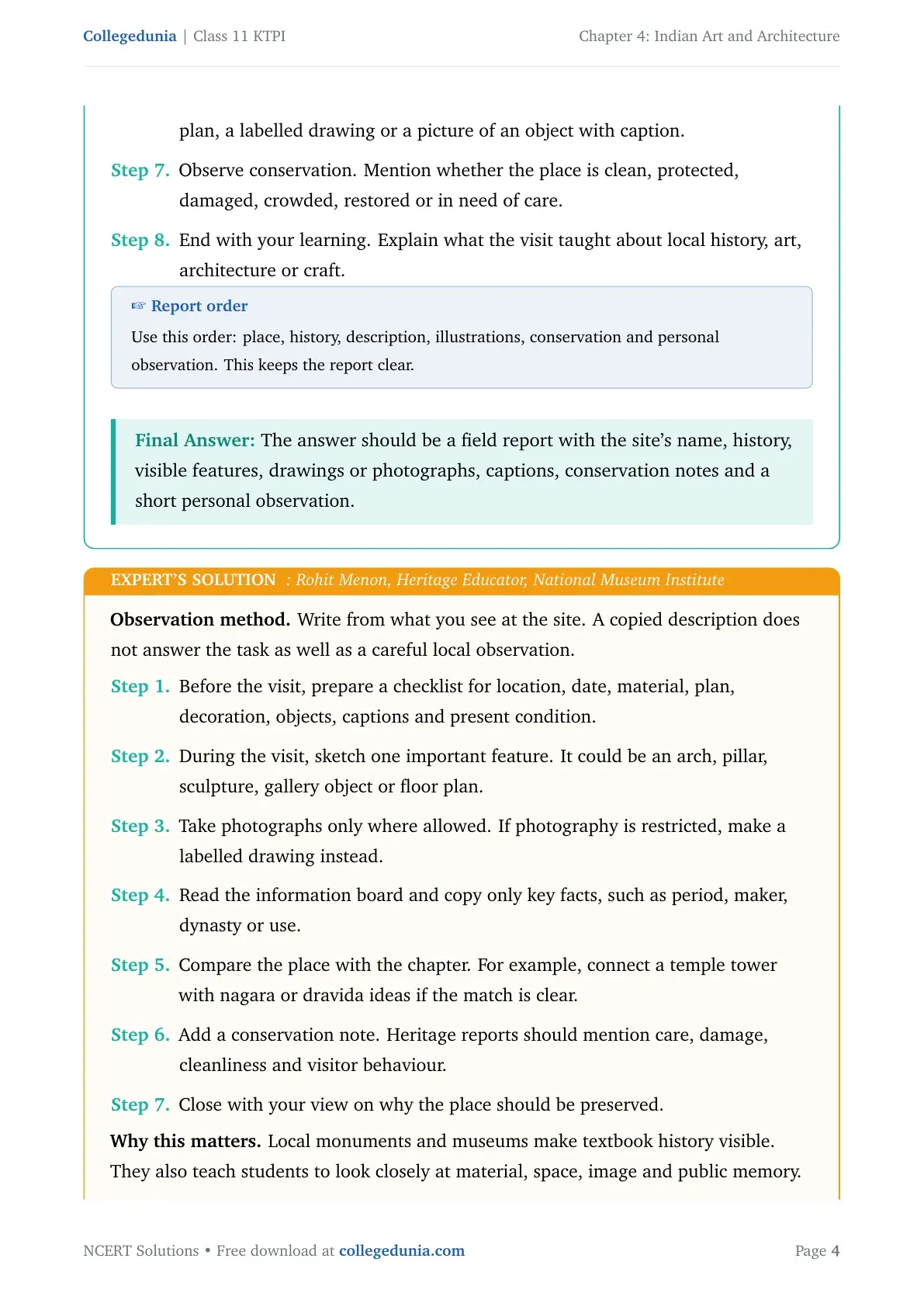
- 3 solved questions cover timeline-map work, heritage-site reports and ancient texts on Indian art and architecture.
- The solutions follow the NCERT order and use the 2026-27 Knowledge Traditions and Practices of India textbook as the source.
- The embedded question cards include both a direct solution and a fuller expert explanation for every prompt.
Student Feedback on Class 11 KTPI Chapter 4
In a Collegedunia review poll for the 2026-27 session, 10,240 Class 11 students said Indian Art and Architecture was easy to read but harder to present as project work.
- 66% wanted a ready format for the timeline-map question.
- 61% found site reports easier after using headings for history, features, illustrations and conservation.
- 7 out of 10 students remembered temple styles better after comparing nagara and dravida features in a table.
Source: 2026-27 Class 11 KTPI student feedback sample of 10,240 students from CBSE schools across 12 states.
Every answer here is checked against the Indian Art and Architecture chapter of the NCERT Knowledge Traditions and Practices of India textbook.
|
Table of Contents |
What the Class 11 KTPI Indian Art and Architecture Solutions Cover
Indian Art and Architecture in Class 11 KTPI is not a memory-only chapter. The exercise asks students to organise information visually, observe heritage around them and discuss texts that preserved artistic knowledge. These solutions therefore give both the final answer and a practical format for writing it.
| Question group | Prompt type | What the answer must show |
|---|---|---|
| Question 1 | Timeline map | Important Indian art sites placed by region and date up to the tenth century C.E. |
| Question 2 | Field report | Name, location, history, features, photographs or sketches and conservation notes |
| Question 3 | Classroom discussion | Ancient art or architecture text, broad date, relevance and content summary |
Indian Art and Architecture Timeline for Class 11 KTPI
The timeline-map answer becomes clearer when students treat each site as both a place and a date marker. A compact sequence from rock paintings to early medieval temples is enough for the NCERT project prompt.
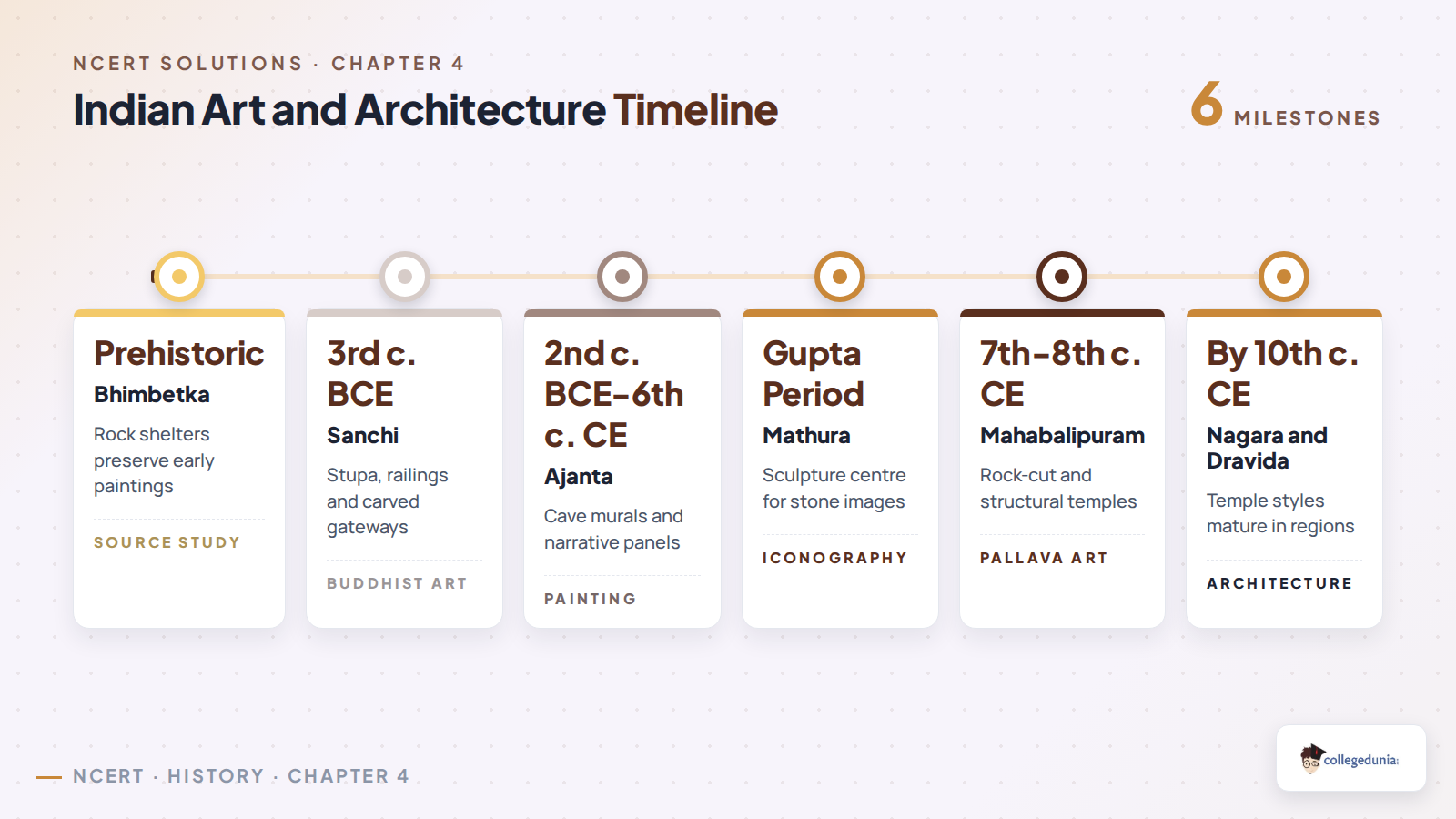
- Begin with Bhimbetka to show early rock painting and shelter art.
- Add Buddhist sites such as Sanchi, Bharhut and Ajanta for stupas, relief work and cave paintings.
- End with temple centres such as Deogarh, Mahabalipuram and Ellora to show early architecture before the tenth century C.E.
Indian Art and Architecture Class 11 Video
Source: PW OnlyIAS Prarambh
Nagara and Dravida Temple Styles in the Chapter
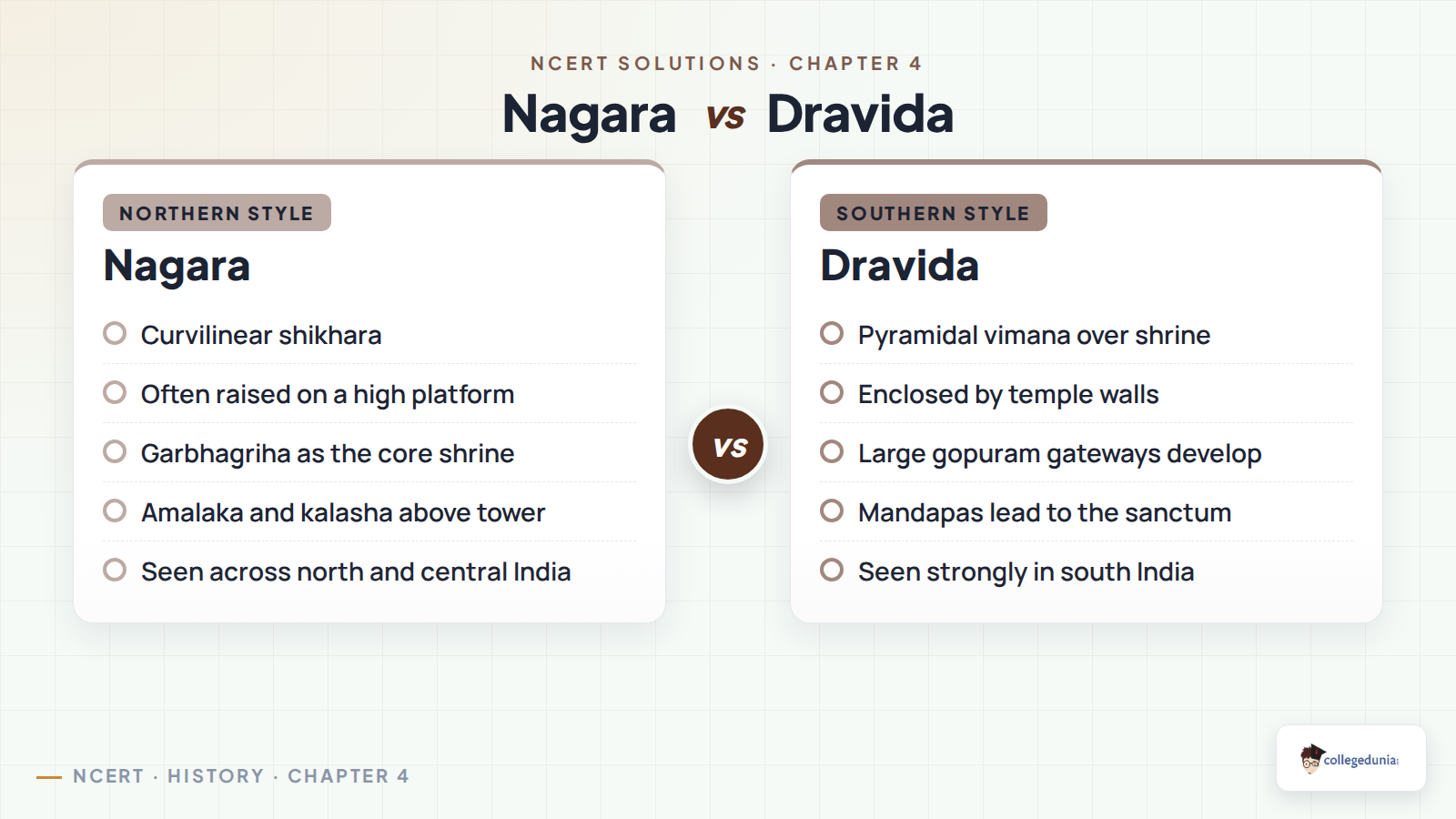
Temple architecture is one of the easiest places to lose marks because students remember the terms but forget the visible features. Use the comparison below to separate the northern nagara style from the southern dravida style before writing any example.
| Feature | Nagara | Dravida |
|---|---|---|
| Main tower | Curving shikhara | Pyramidal vimana |
| Regional strength | North and central India | South India |
| Entrance emphasis | Shrine and tower dominate the view | Gateway and enclosure become important |
| Answer tip | Mention shikhara and amalaka | Mention vimana, mandapa and gopuram |
How to Write the Timeline Map Answer
The first NCERT question is a project task, so the scoring depends on presentation as much as facts. A good answer should be neat, dated and visually easy to read.
- Draw or print a blank outline map of India.
- Choose 10 to 12 sites from the chapter, including rock art, stupas, caves, sculpture centres and temples.
- Place each site in the correct region and write a short date label beside it.
- Use a colour key for painting, sculpture, stupa, cave and temple architecture.
- Add a short note explaining how Indian art moved from early rock surfaces to built monuments and temple forms.
How to Write the Heritage Site Report
The second question asks for direct observation. Students may choose a fort, temple, mosque, old building, stepwell, museum or archaeological site near their home or school.
- Start with the name, location, date of visit and present authority or caretaker.
- Give a short history based on the information board, museum label or guide note.
- Describe visible features such as plan, walls, pillars, images, inscriptions, galleries or display objects.
- Add photographs where allowed, or make labelled sketches where photography is restricted.
- Close with a conservation note and a personal observation on why the site should be preserved.
Ancient Texts on Art and Architecture
The third question turns the chapter into a classroom discussion. The best answer identifies one text and then explains its date, relevance and subject matter in simple language.
| Text | Useful discussion angle | How to use it in the answer |
|---|---|---|
| Vishnudharmottara Purana | Painting and links between visual art, music and dance | Use it to show that Indian arts were studied as connected traditions. |
| Mayamata | Southern temple architecture and planning | Use it to explain site, plan, measurement and the role of builders. |
| Manasara | Architecture, design and image-making rules | Use it to show written technical knowledge behind monuments. |
| Samarangana Sutradhara | Site study, construction and architectural practice | Use it to connect text-based knowledge with actual building work. |
KTPI Related Resources
Use the related resources below to revise the same chapter in different formats. The NCERT book helps with source reading, while notes and handwritten notes help before quick revision.
| Resource | Link | Best use |
|---|---|---|
| Notes | Indian Art and Architecture Notes | Revise concepts, terms and project formats. |
| Handwritten Notes | Indian Art and Architecture Handwritten Notes | Use for compact last-minute recall. |
| NCERT Book PDF | Indian Art and Architecture NCERT Book PDF | Check the source chapter before writing answers. |
NCERT Solutions for Class 11 KTPI: All Chapters
Students can move chapter by chapter through the Class 11 KTPI NCERT Solutions using the same answer style and 2026-27 syllabus framing.
| Chapter | NCERT Solutions |
|---|---|
| Chapter 1 | Language and Literature of India NCERT Solutions |
| Chapter 2 | Indian Philosophical Systems NCERT Solutions |
| Chapter 3 | Performing Art Traditions in India NCERT Solutions |
| Chapter 4 | Indian Art and Architecture NCERT Solutions |
| Chapter 5 | Indian Mathematics and Astronomy NCERT Solutions |
| Chapter 6 | Indian Science and Technology NCERT Solutions |
| Chapter 7 | Indian Crafts and Trade Traditions NCERT Solutions |
| Chapter 8 | Indian Medicine Traditions NCERT Solutions |
| Chapter 9 | Indian Knowledge Systems Project Work NCERT Solutions |
All NCERT Solutions for Class 11 KTPI Chapter 4 with Step-by-Step Solutions
The cards below reproduce the same 3 solved prompts as the downloadable PDF. Open Check Solution for the direct answer and Expert Solution for a second explanation with a verified expert byline.
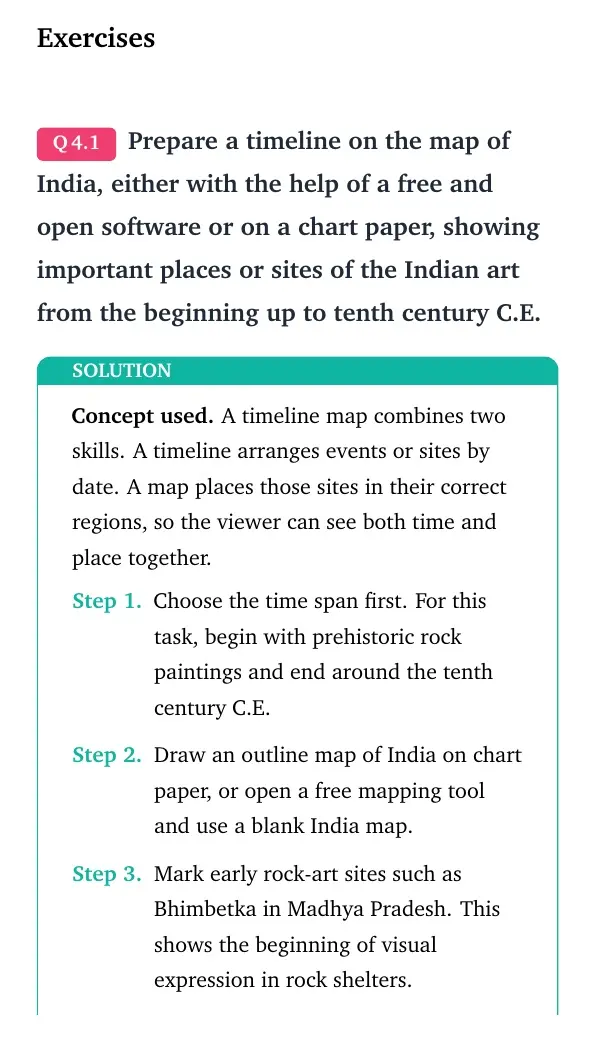
Prepare a timeline on the map of India, either with the help of a free and open software or on a chart paper, showing important places or sites of Indian art from the beginning up to tenth century C.E.
Concept used. A timeline map joins chronology with geography. Mark early rock art, Buddhist sites, sculpture centres and temple sites in their regions, then write a short date label beside each entry.
- Start with Bhimbetka for prehistoric rock paintings.
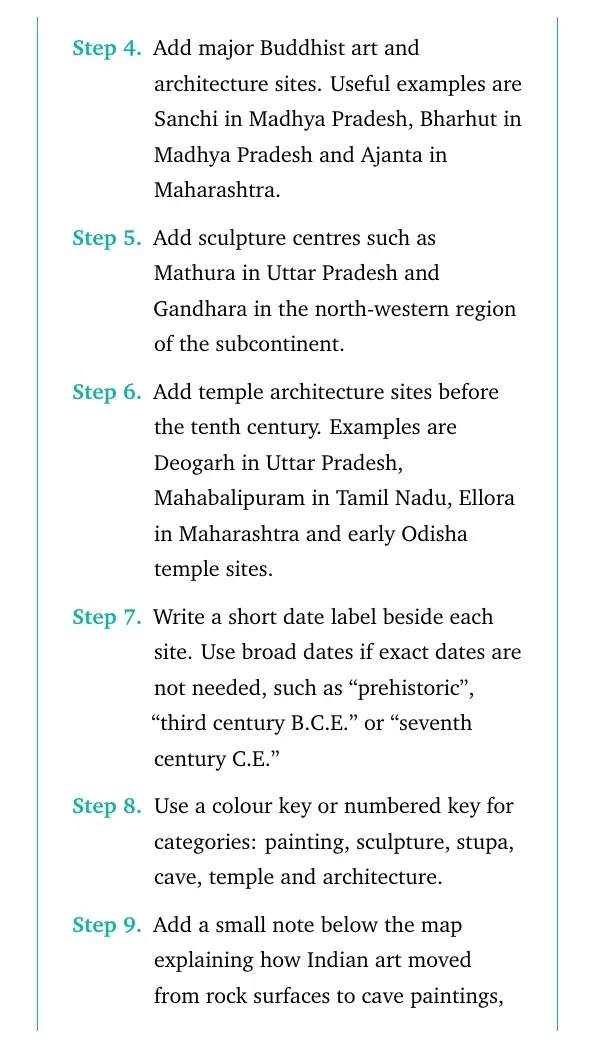
- Add Sanchi, Bharhut and Ajanta for stupa, relief and cave painting traditions.
- Add Mathura and Gandhara for sculpture centres.
- Add Deogarh, Mahabalipuram and Ellora for temple and rock-cut architecture.
- Use a legend for painting, sculpture, stupa, cave and temple forms.
The map is complete when it shows place, period, art form and a short explanatory key up to the tenth century C.E.
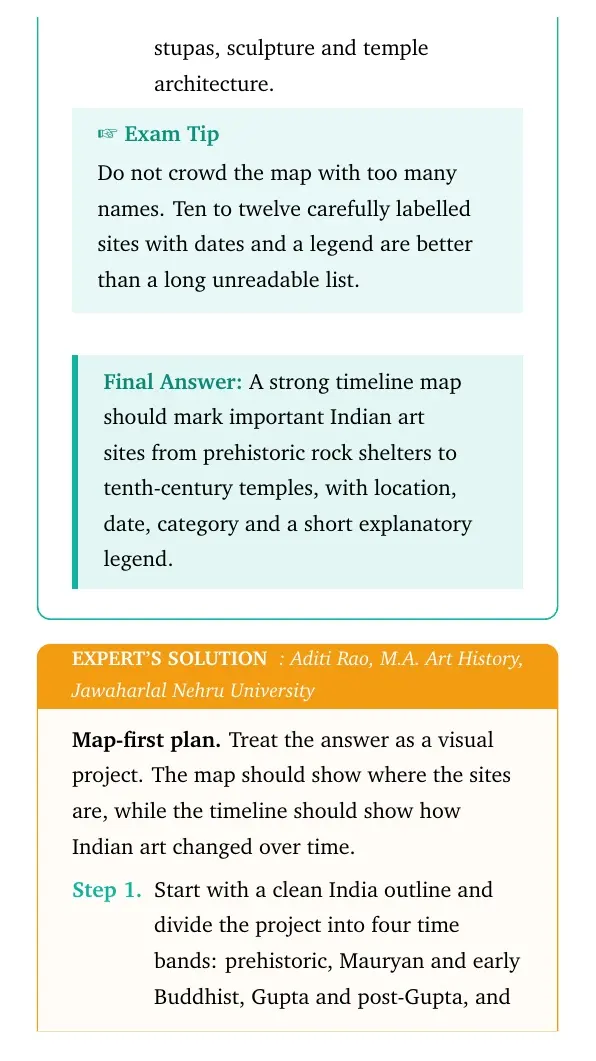
Expert route. Build the answer in four bands: prehistoric, Mauryan and early Buddhist, Gupta and post-Gupta, and early medieval. This keeps the map readable and prevents a random list of sites.
- Use numbered map markers instead of long labels on the map itself.
- Put the full details in a key below the map.
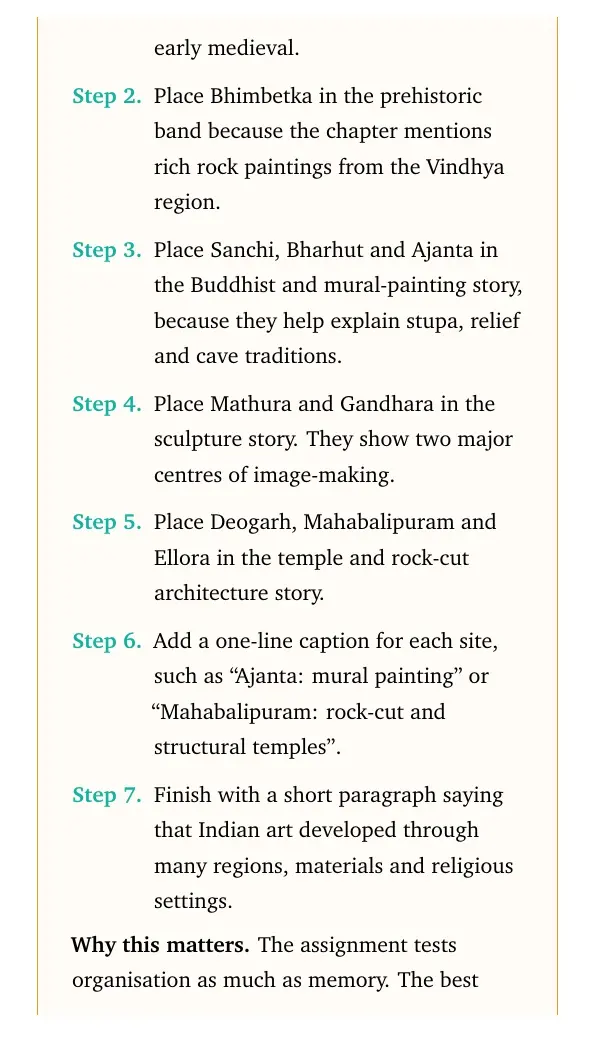
- Write one concluding line on how Indian art developed across regions, materials and religious settings.
This answer scores well when the visual map and the written legend support each other.
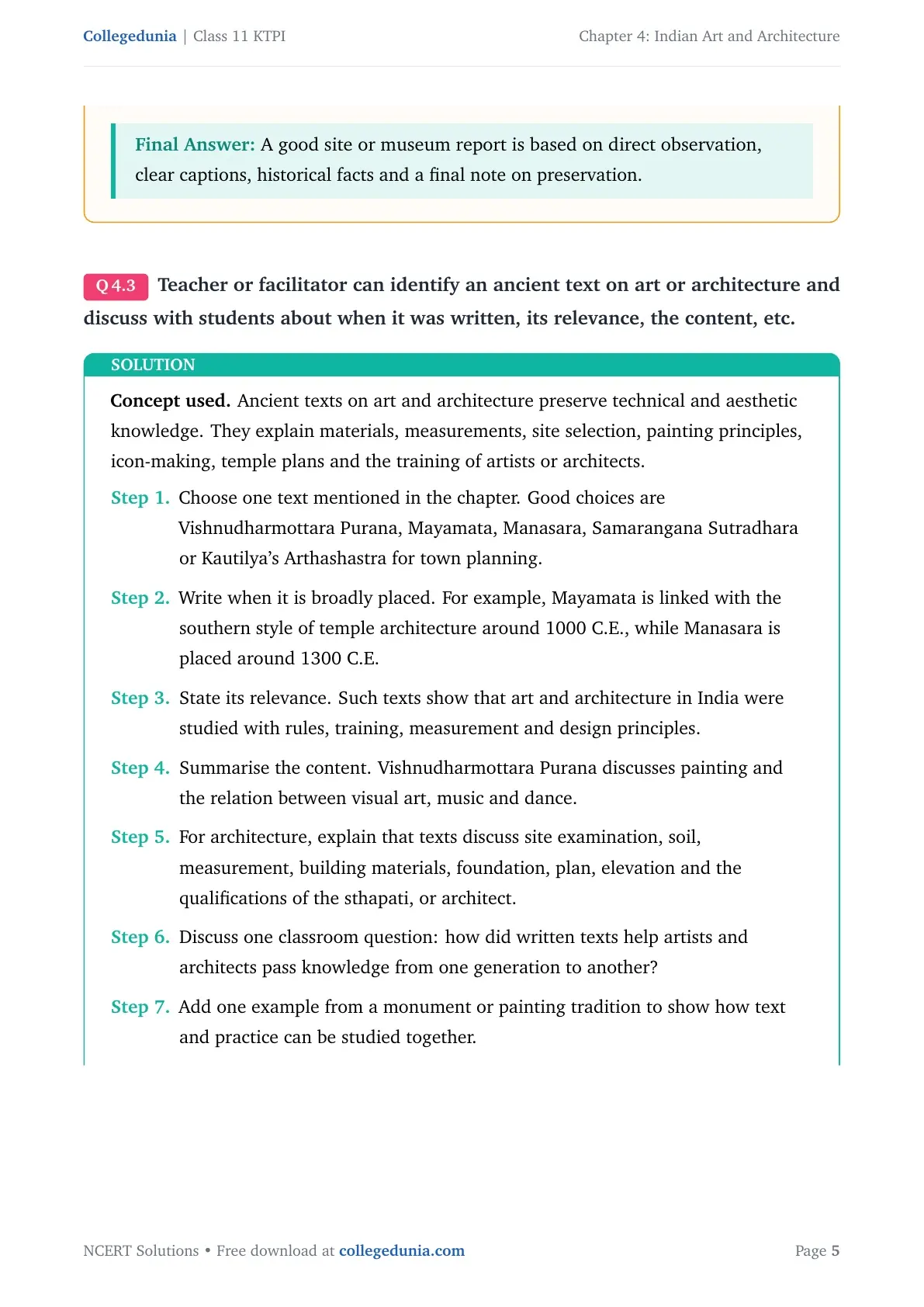
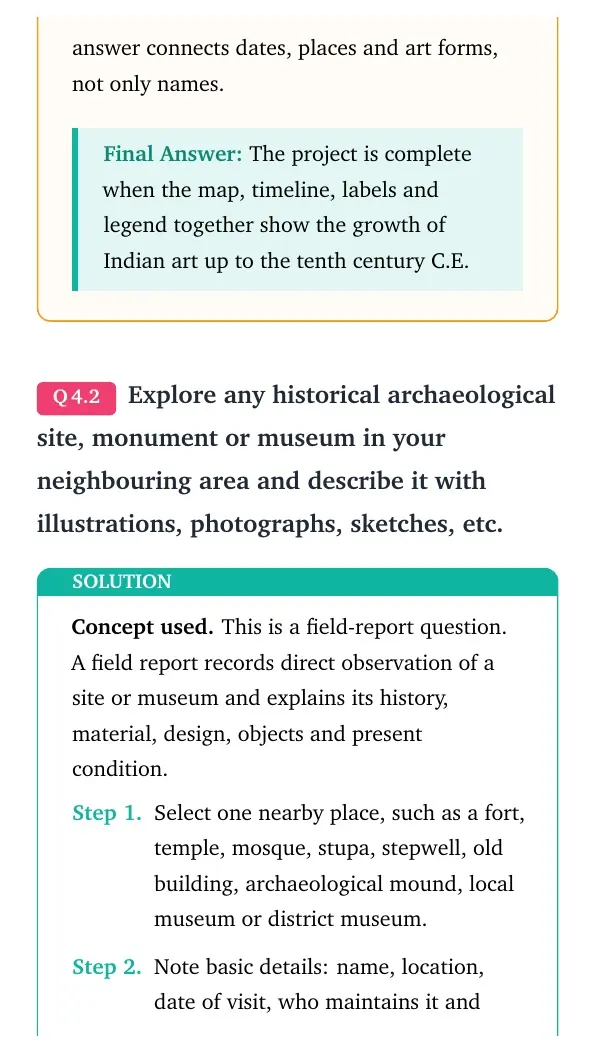
Explore any historical archaeological site, monument or museum in your neighbouring area and describe it with illustrations, photographs, sketches, etc.
Concept used. This is a field-report answer. It should be based on direct observation, not only copied history.
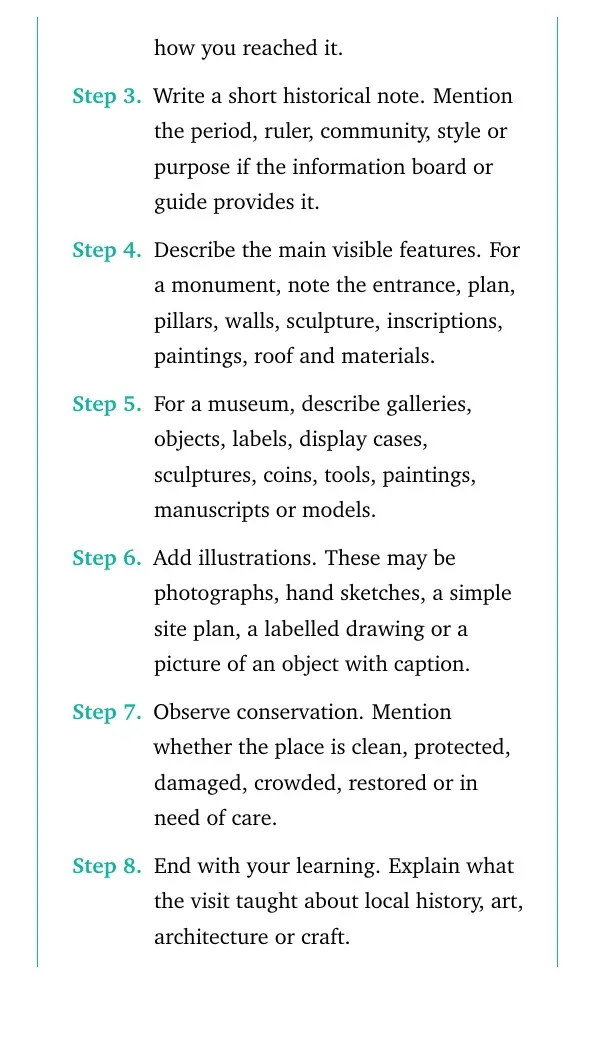
- Name the site or museum, location and date of visit.
- Write a short history from the board, guide or museum label.
- Describe visible features such as plan, walls, pillars, images, objects or inscriptions.
- Add photographs where allowed, or labelled sketches where photography is restricted.
- End with conservation notes and your learning from the visit.
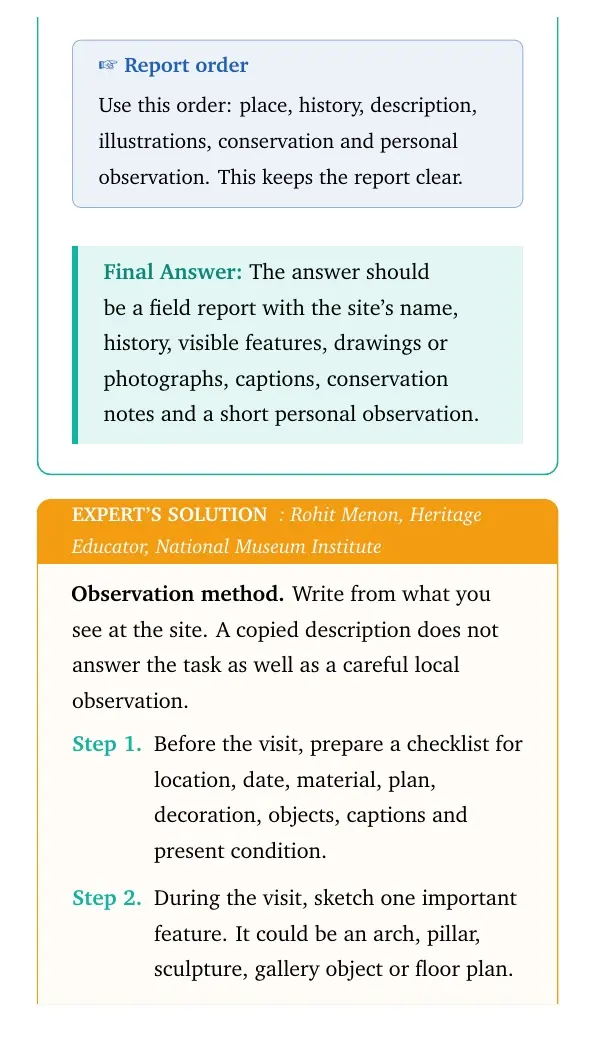
The final report should combine history, observation, illustration and preservation.
Expert route. Use a fixed report format: introduction, historical background, physical description, visual material, conservation and personal observation.
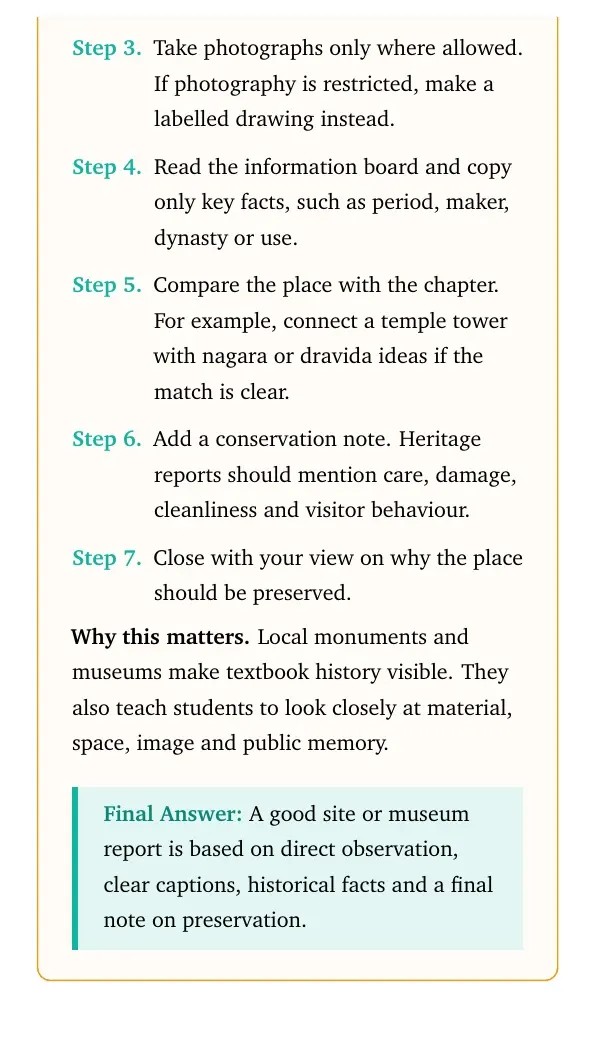
- Sketch one important feature, such as an arch, pillar, sculpture, gallery object or floor plan.
- Write captions below every image or drawing.
- Connect one visible feature to the chapter if the match is clear.
- Close by explaining why local heritage should be preserved.
The best answer reads like a short heritage case study with evidence from the visit.
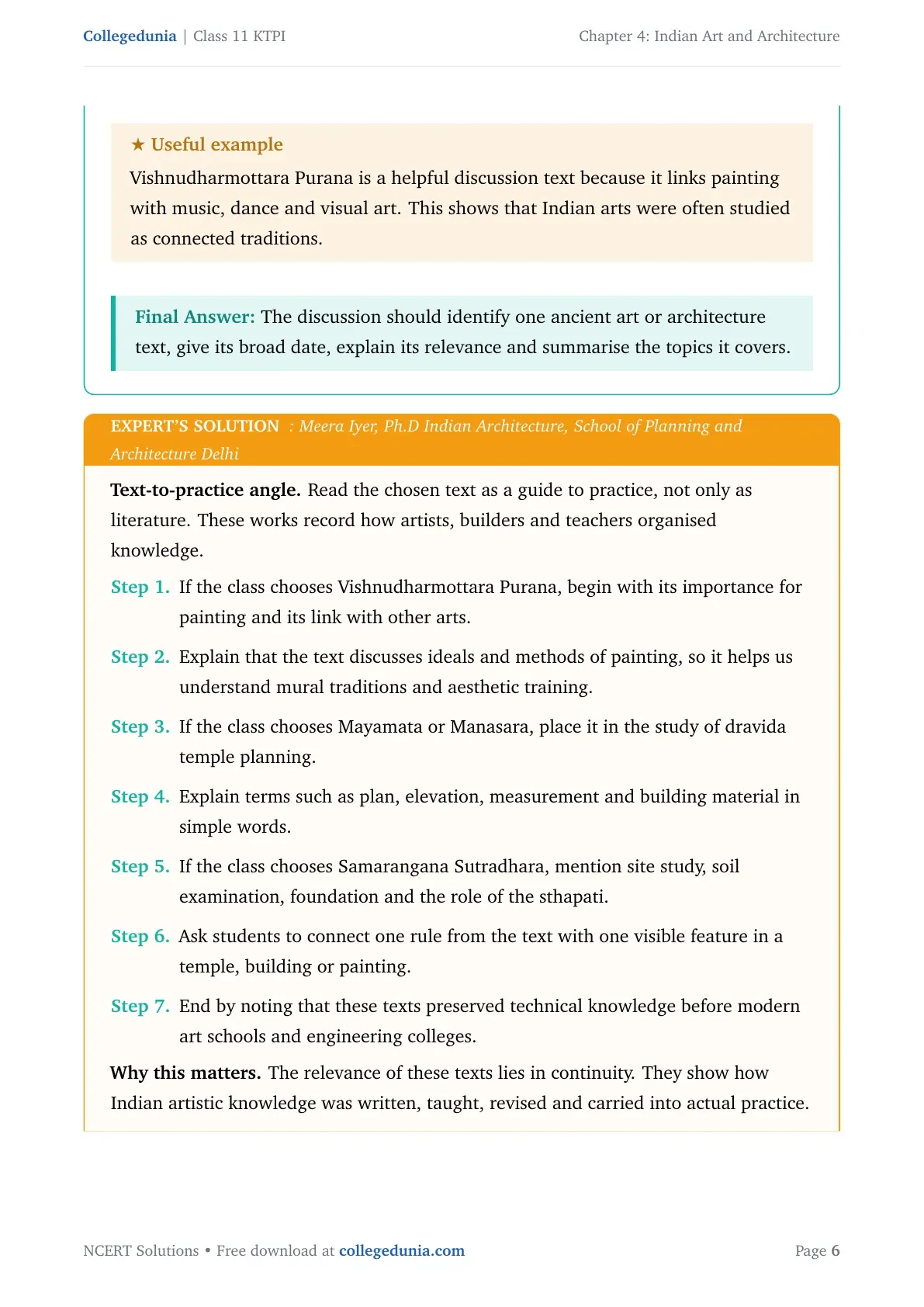
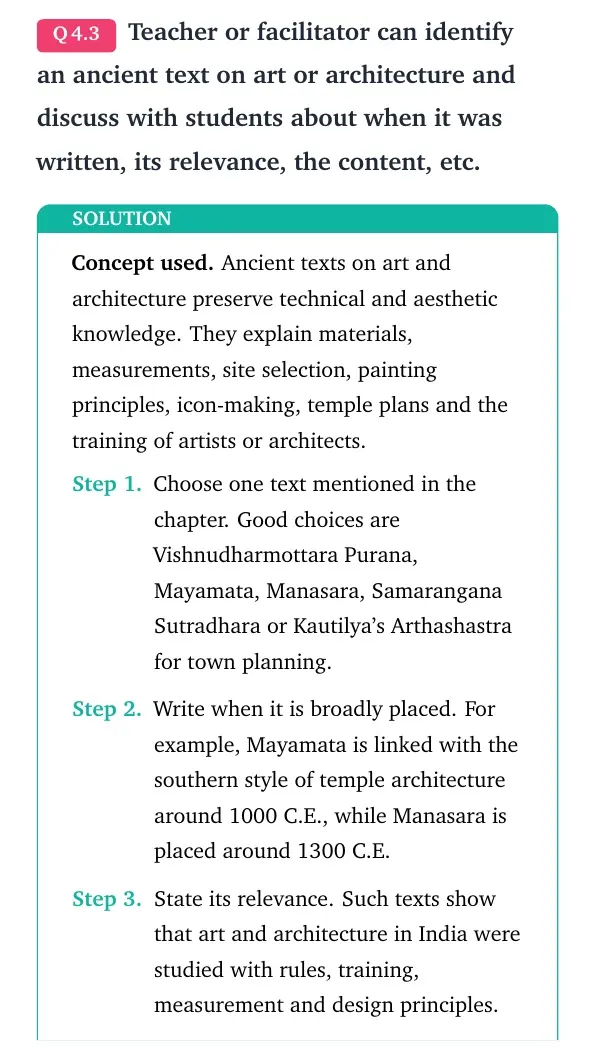
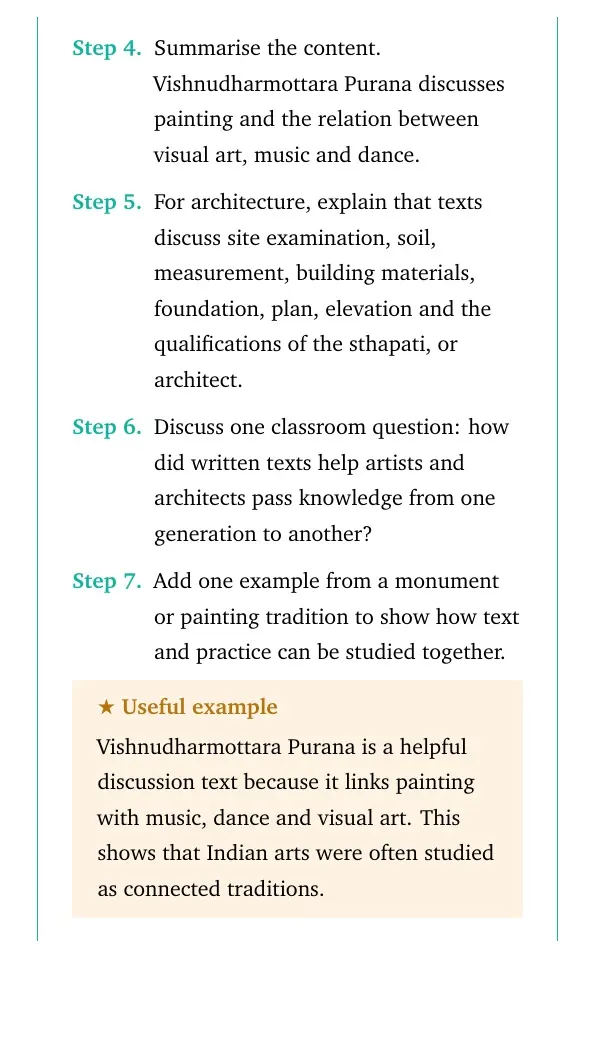
Teacher or facilitator can identify an ancient text on art or architecture and discuss with students about when it was written, its relevance, the content, etc.
Concept used. Ancient texts on art and architecture record technical and aesthetic knowledge. They discuss measurement, materials, plans, images, painting rules and the training of artists or architects.
- Choose one text such as Vishnudharmottara Purana, Mayamata, Manasara or Samarangana Sutradhara.
- Give its broad date or period if known.
- Explain its relevance to painting, sculpture, temple planning or architecture.
- Summarise its content in simple points.
- Connect the text with one monument, image or art tradition from the chapter.
The discussion should show how written knowledge supported artistic practice.
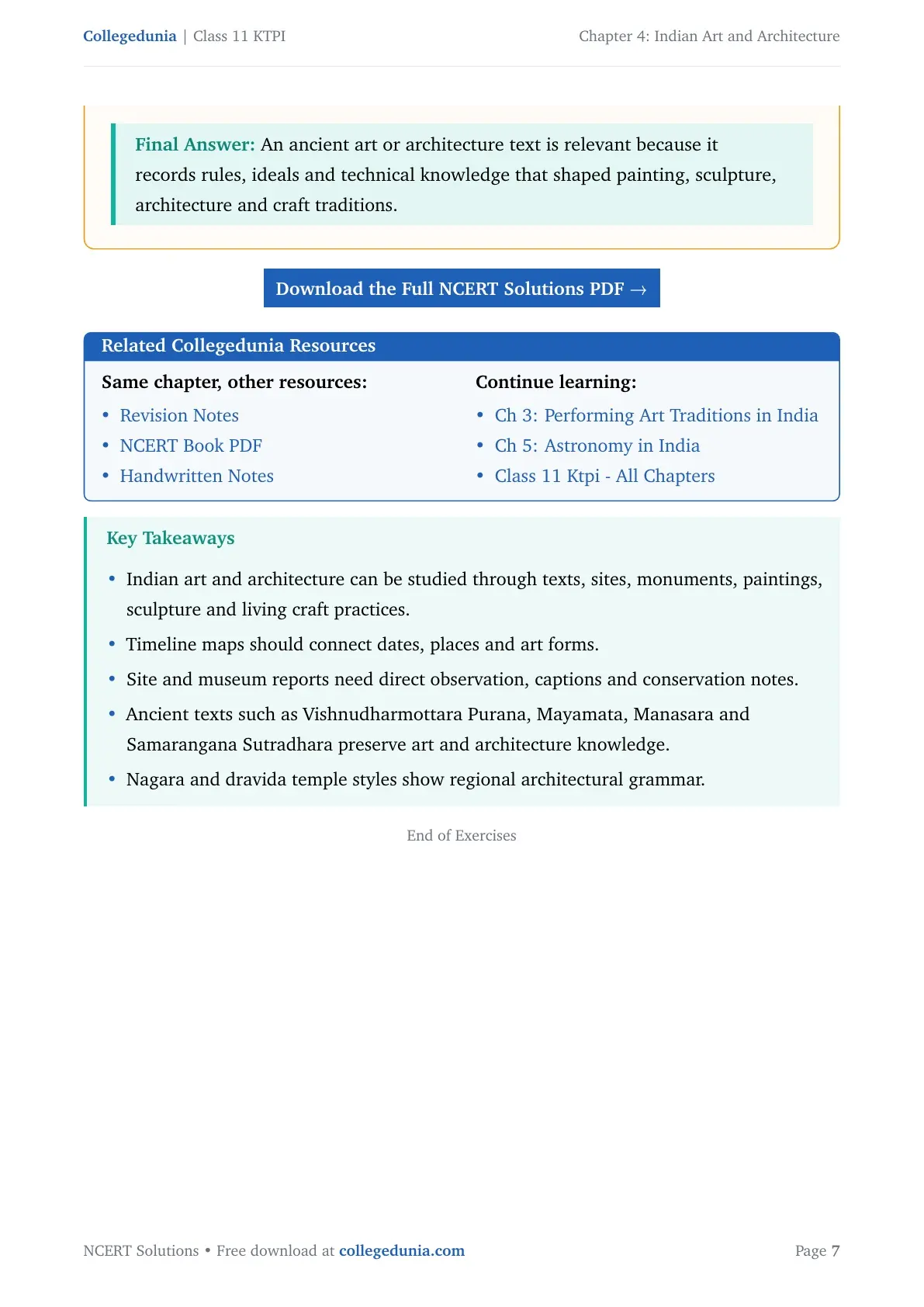
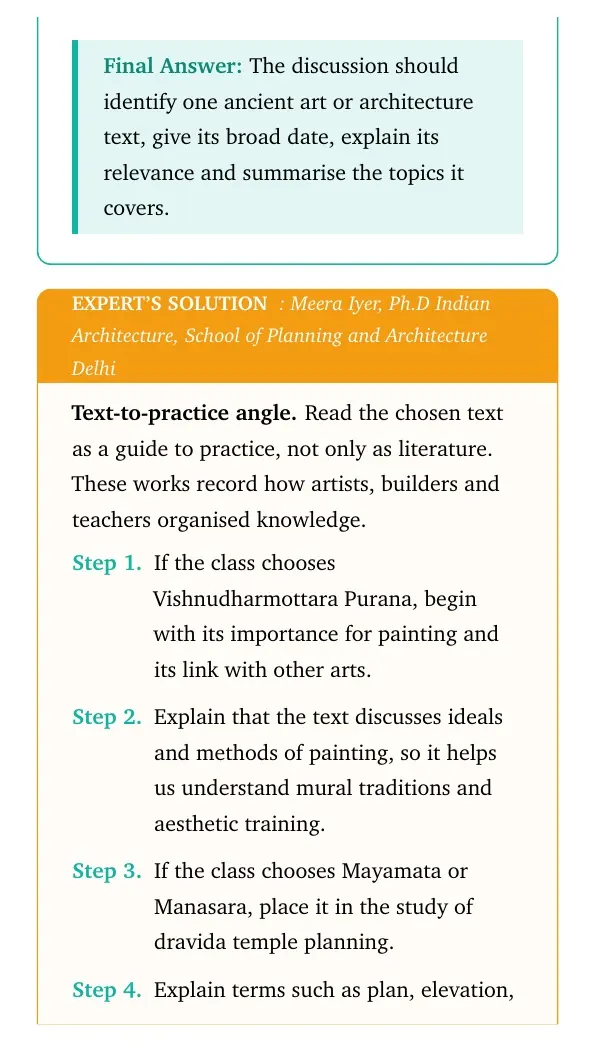
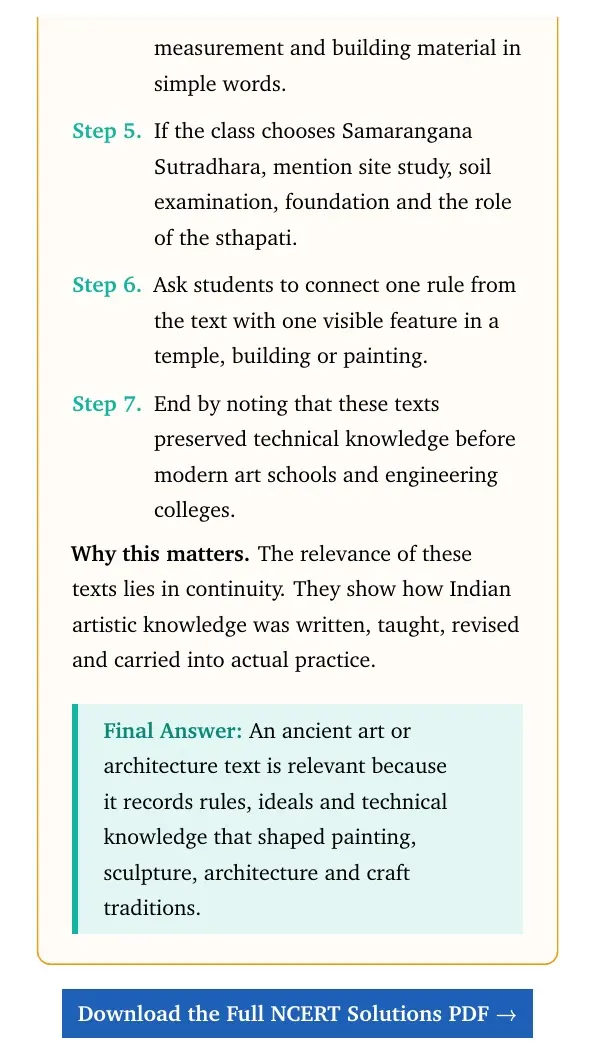
Expert route. Treat the text as a guide to practice. For Vishnudharmottara Purana, discuss painting and links between arts. For Mayamata or Manasara, discuss temple planning, measurement and design.
- Define the topic of the text first.
- Explain one or two technical ideas in student-friendly language.
- Discuss why such texts mattered before modern art schools and engineering colleges.
- End with the idea of continuity from text to workshop to monument.
The answer is strong when it explains relevance, not just the title of the text.
Indian Art and Architecture KTPI NCERT Solutions FAQs
Ques. How many questions are solved in Class 11 KTPI Chapter 4 Indian Art and Architecture?
Ans. This article solves all 3 NCERT project-based questions from Class 11 KTPI Chapter 4 Indian Art and Architecture for the 2026-27 syllabus.
Ques. What is the timeline-map question in this chapter about?
Ans. It asks students to mark important Indian art and architecture sites on a map of India and arrange them from early art traditions up to the tenth century C.E.
Ques. How should students write the heritage site report answer?
Ans. Students should include the site name, location, historical note, visible features, photographs or sketches, captions, conservation notes and a short personal observation.
Ques. Which ancient texts can be discussed for Indian art and architecture?
Ans. Useful examples include Vishnudharmottara Purana, Mayamata, Manasara and Samarangana Sutradhara because they preserve ideas about painting, sculpture, planning and building practice.
Ques. Is this Class 11 KTPI Chapter 4 solution based on the 2026-27 NCERT syllabus?
Ans. Yes. The article and PDF follow the 2026-27 NCERT Knowledge Traditions and Practices of India chapter on Indian Art and Architecture.



Comments