NCERT Solutions for Class 11 KTPI Chapter 6 Mathematics in India cover all 5 exercise questions from the 2026-27 syllabus. The chapter explains ancient Indian arithmetic, geometry, algebra, trigonometry and mathematical terminology through clear textbook-based answers.
5 solved questions are included with direct answers and fuller expert explanations.
The PDF follows the NCERT exercise order for operations, mathematicians, calculation methods and terminology.
Inline question cards below let students check the quick solution first and then read the expert route.
Student Feedback on Class 11 KTPI Chapter 6
In the 2026-27 Collegedunia KTPI review log, 10,240 Class 11 students marked Mathematics in India as a high-recall chapter because it asks for names, periods, operation terms and short comparisons in the same exercise.
71% wanted a single table for mathematicians, periods and contributions.
64% confused arithmetic operation terms before revising them by meaning.
7 out of 10 students found the present-day comparison answer easier after separating method, notation and place-value logic.
Source: 2026-27 Class 11 KTPI student feedback sample recorded for Collegedunia NCERT resource planning.
Every answer here is checked against the Mathematics in India chapter of the NCERT Knowledge Traditions and Practices of India textbook.
What the Class 11 KTPI Mathematics in India Solutions Cover
Mathematics in India is a short chapter, but its exercise moves across recall, comparison and explanation. A good answer should name the exact operation or scholar, then add the reason that connects it with the chapter idea.
Question group
Question numbers
What students need to show
Fundamental operations
Question 1
Eight operations and their place in ancient ganita
Geometry and trigonometry
Question 2
Names, periods and similarity with modern school mathematics
Calculation methods
Question 3
Difference between board-based older methods and present written methods
Operation terms
Question 4
Traditional terms for addition, subtraction, multiplication and division
Further concepts
Question 5
Examples from Indian mathematical literature beyond the chapter
The downloadable PDF keeps this sequence. The quick solution gives the classroom answer, while the expert solution adds the historical link that helps in long-answer writing.
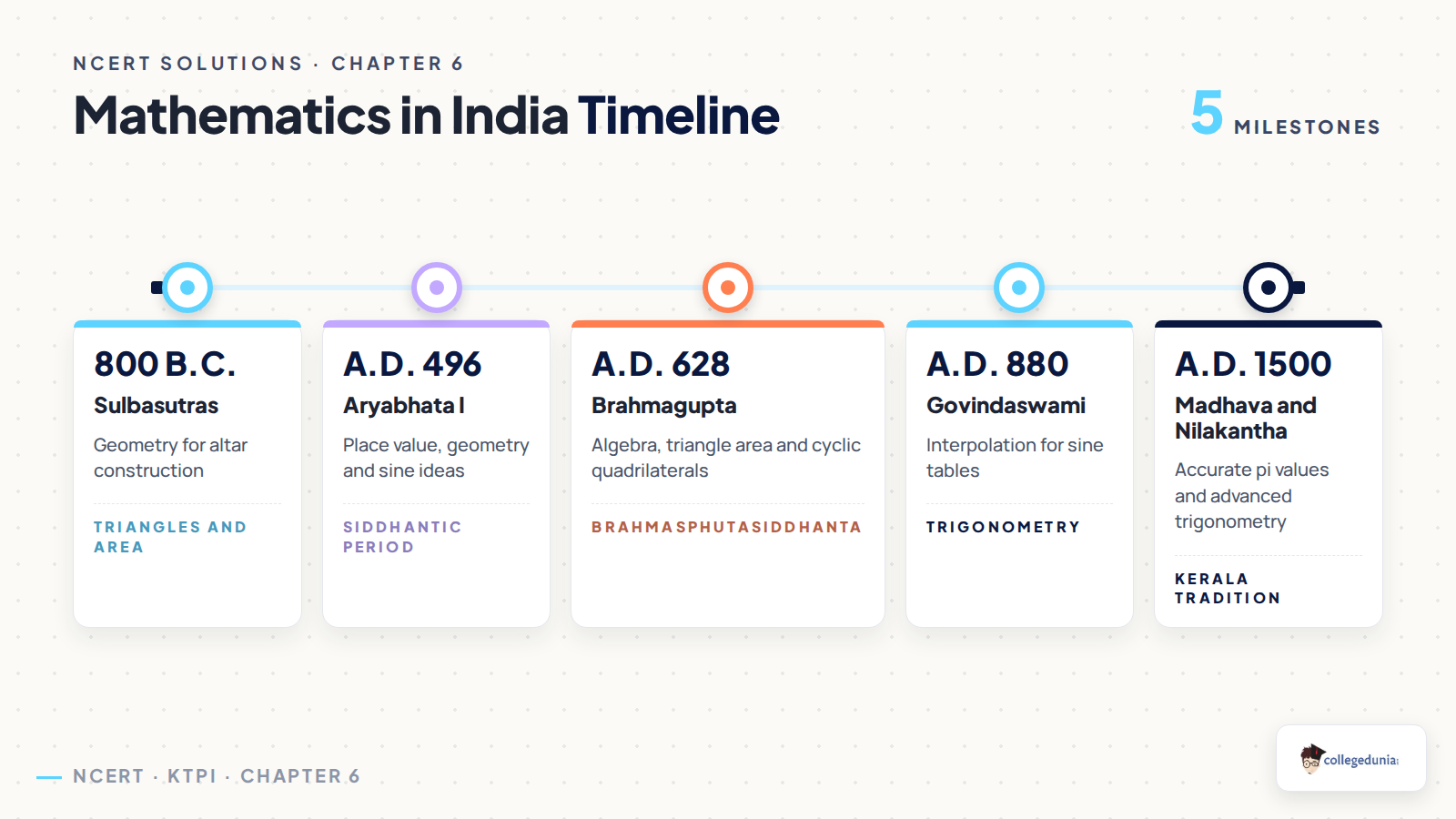
The chapter presents mathematics as a long tradition, not as isolated discoveries. It starts with altar geometry, moves through Aryabhata and Brahmagupta, and then reaches later work on sine tables, interpolation and accurate values of pi.
Sulbasutra authors such as Baudhayana, Apastamba and Katyayana are linked with geometry around 800 B.C.
Aryabhata I is important for geometrical formulae and sine-cosine ideas in A.D. 496.
Brahmagupta is linked with algebra, triangle area and cyclic quadrilaterals in A.D. 628.
Govindaswami, Madhava and Nilakantha show later progress in trigonometry and interpolation.
Arithmetic Operations and Traditional Terms
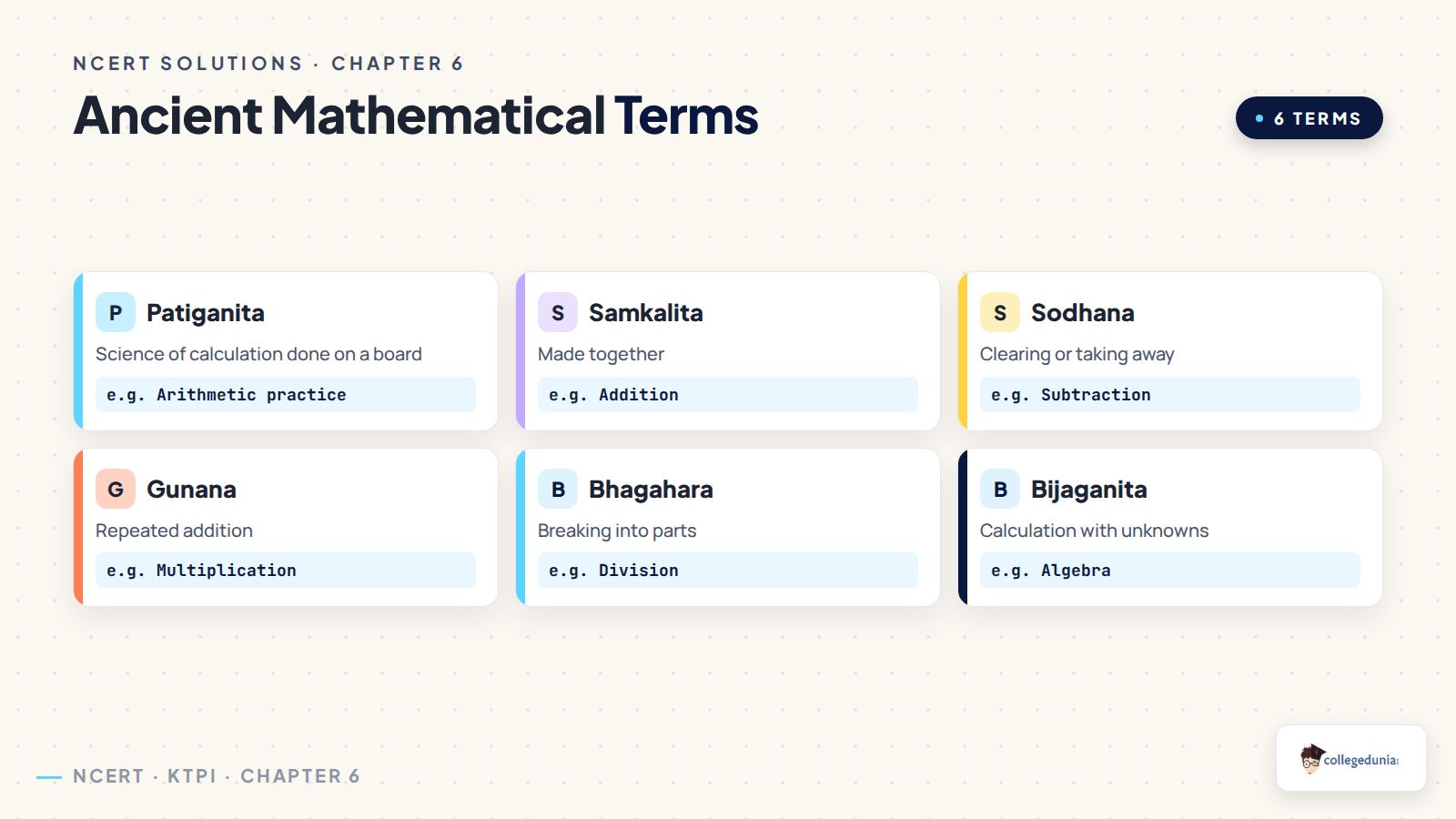
The first and fourth questions become easier when students learn operation terms by meaning. Ancient writers often named a process from the action being done, such as joining, clearing, repeated addition or breaking into parts.
Operation
Helpful terms
Meaning cue
Addition
samkalita, sankalana, yoga
Making together or joining
Subtraction
vyutkalita, sodhana, viyoga
Taking away, clearing or separating
Multiplication
gunana, hanana, vadha
Repeated addition and replacement during work
Division
bhagahara, bhajana, chedana
Breaking a number into parts
For Question 4, a table is better than a paragraph because it keeps each operation, term and meaning together.
How Ancient and Present Calculation Methods Compare
The comparison question should be balanced. Ancient methods were not weak methods. They used the tools of their time, such as a board or writing surface, while modern classroom methods preserve each step on paper.
Main difference: older work could involve rubbing out and replacing figures, while present methods show every intermediate line.
Main similarity: both depend on number sense, place value and organised steps.
Best answer frame: say the present system is easier to check, but the older system was efficient and mathematically sound.
This answer should not dismiss ancient calculation. It should explain why the modern format is more convenient for students while still respecting the older method.
KTPI Chapter 6 Related Resources
Use the chapter-wise resources below to revise the same NCERT chapter in different formats. The textbook PDF is useful for source reading, notes help with short revision, and handwritten notes help with quick recall.
All NCERT Solutions for Mathematics in India with Step-by-Step Solutions
The cards below embed every exercise answer from the chapter. Use Check Solution for the direct NCERT answer and Expert Solution for a fuller explanation.
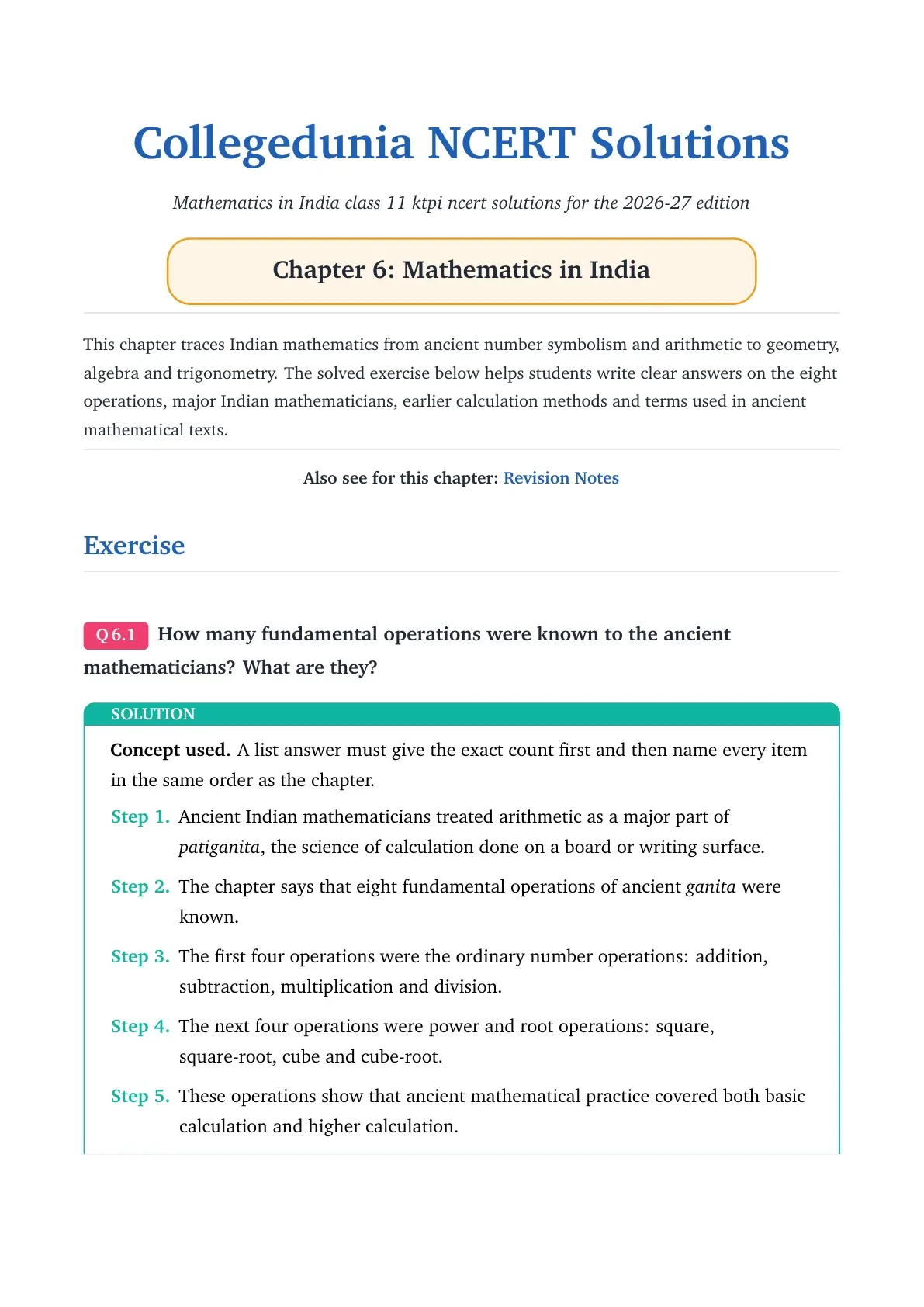
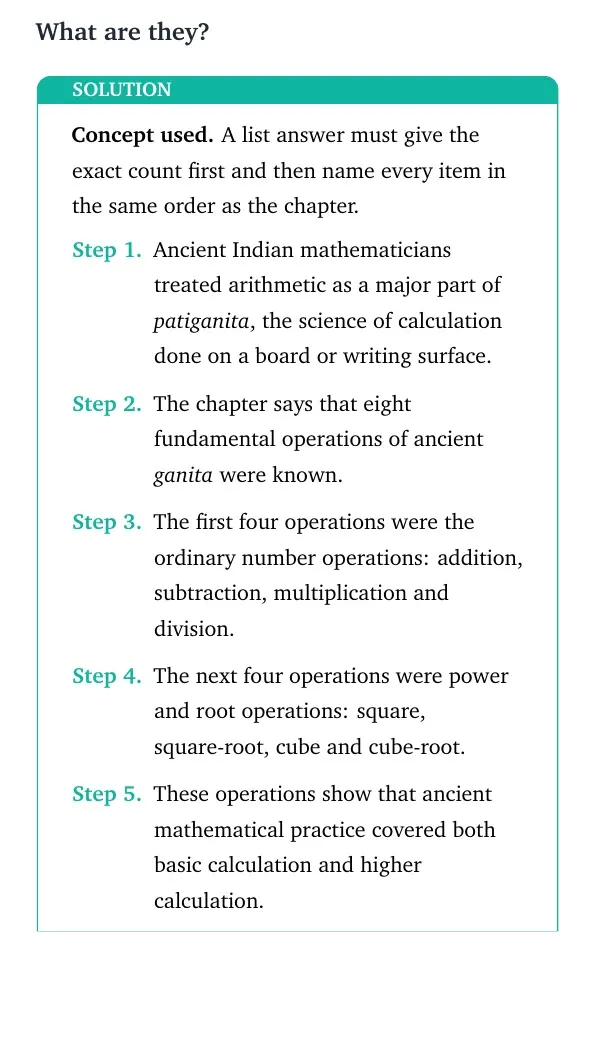
Q 6.1
How many fundamental operations were known to the ancient mathematicians? What are they?
Concept used. A list answer must give the exact count first and then
name every item in the same order as the chapter.
Ancient Indian mathematicians treated arithmetic as a major part of
patiganita, the science of calculation done on a board or
writing surface.
The chapter says that eight fundamental operations of ancient
ganita were known.
The first four operations were the ordinary number operations:
addition, subtraction, multiplication and division.
The next four operations were power and root operations: square,
square-root, cube and cube-root.
These operations show that ancient mathematical practice covered both
basic calculation and higher calculation.
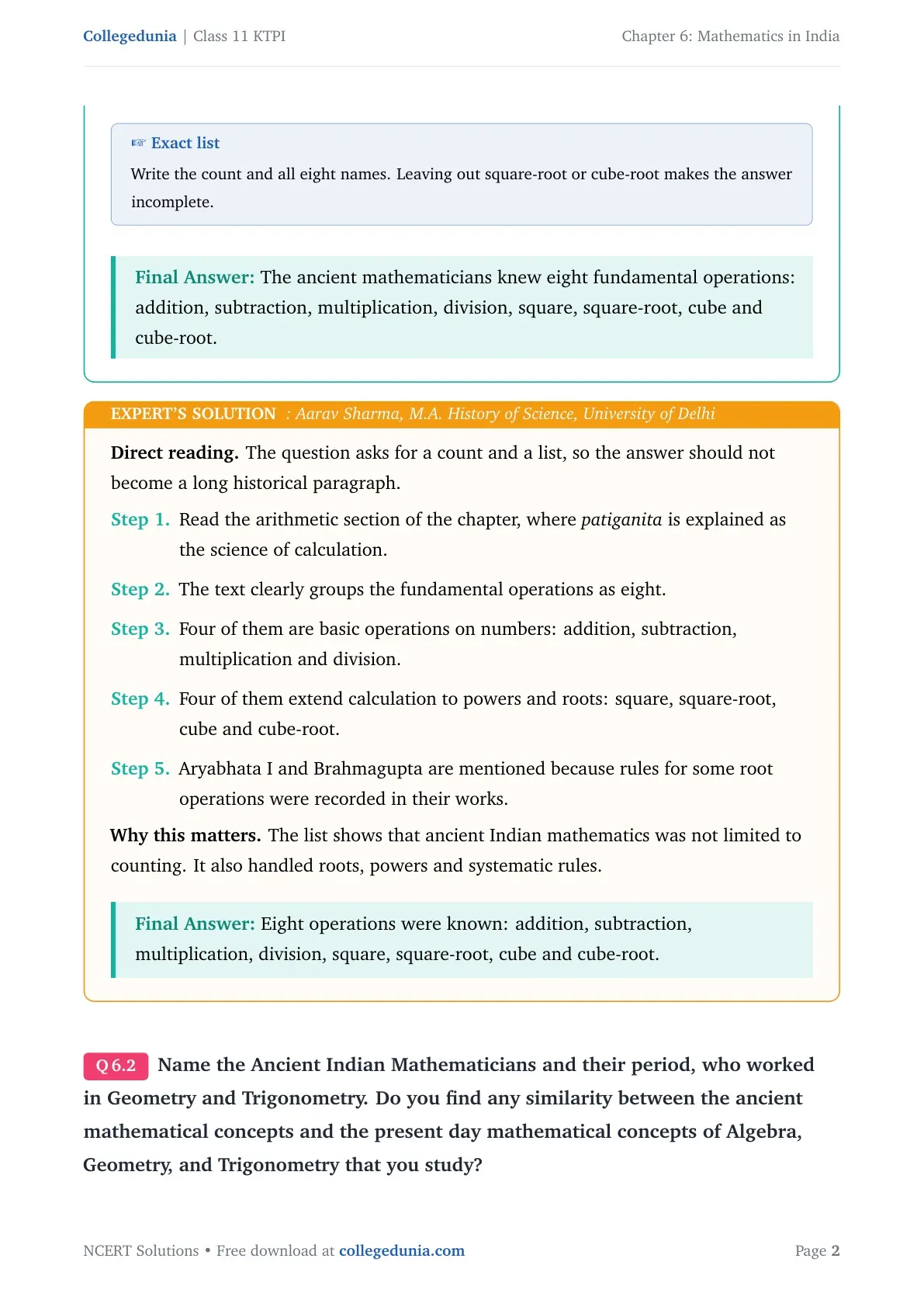
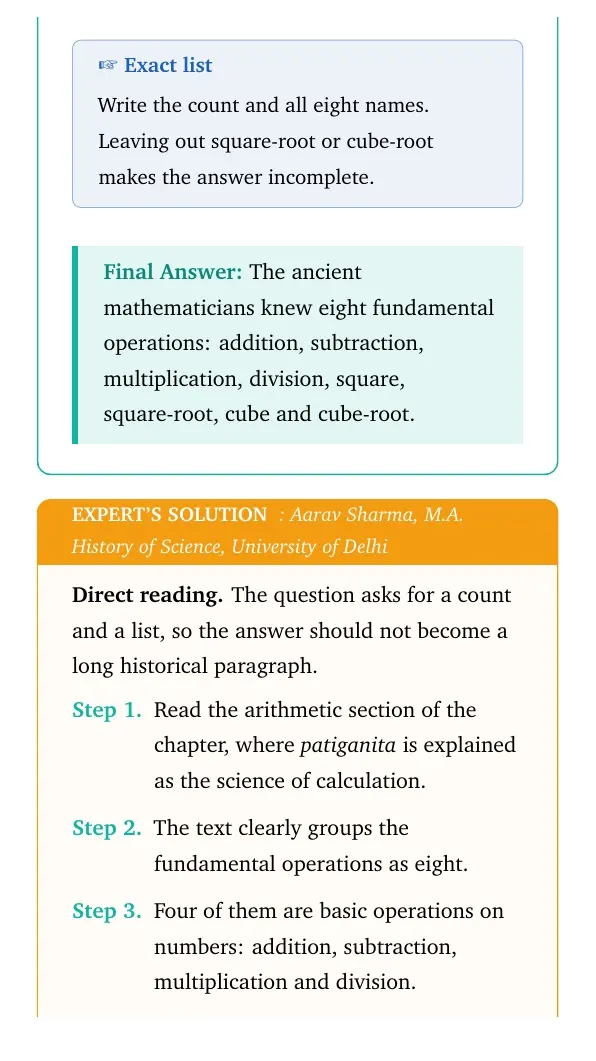
Exact list
Write the count and all eight names. Leaving out square-root or cube-root makes
the answer incomplete.
The ancient mathematicians knew eight fundamental operations:
addition, subtraction, multiplication, division, square, square-root, cube and
cube-root.
AS
Aarav Sharma
M.A. History of Science, University of Delhi
Verified Expert
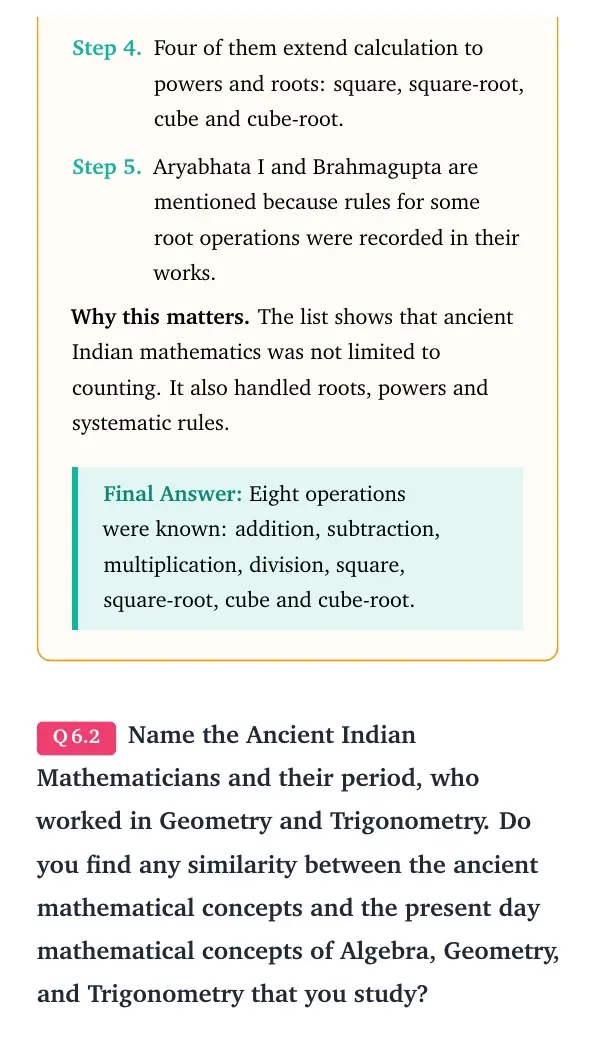
Direct reading. The question asks for a count and a list, so the
answer should not become a long historical paragraph.
Read the arithmetic section of the chapter, where patiganita
is explained as the science of calculation.
The text clearly groups the fundamental operations as eight.
Four of them are basic operations on numbers: addition, subtraction,
multiplication and division.
Four of them extend calculation to powers and roots: square,
square-root, cube and cube-root.
Aryabhata I and Brahmagupta are mentioned because rules for some root
operations were recorded in their works.
Why this matters. The list shows that ancient Indian mathematics was
not limited to counting. It also handled roots, powers and systematic rules.
Eight operations were known: addition, subtraction, multiplication,
division, square, square-root, cube and cube-root.
Q 6.2
Name the Ancient Indian Mathematicians and their period, who worked in Geometry and Trigonometry. Do you find any similarity between the ancient mathematical concepts and the present day mathematical concepts of Algebra, Geometry, and Trigonometry that you study?
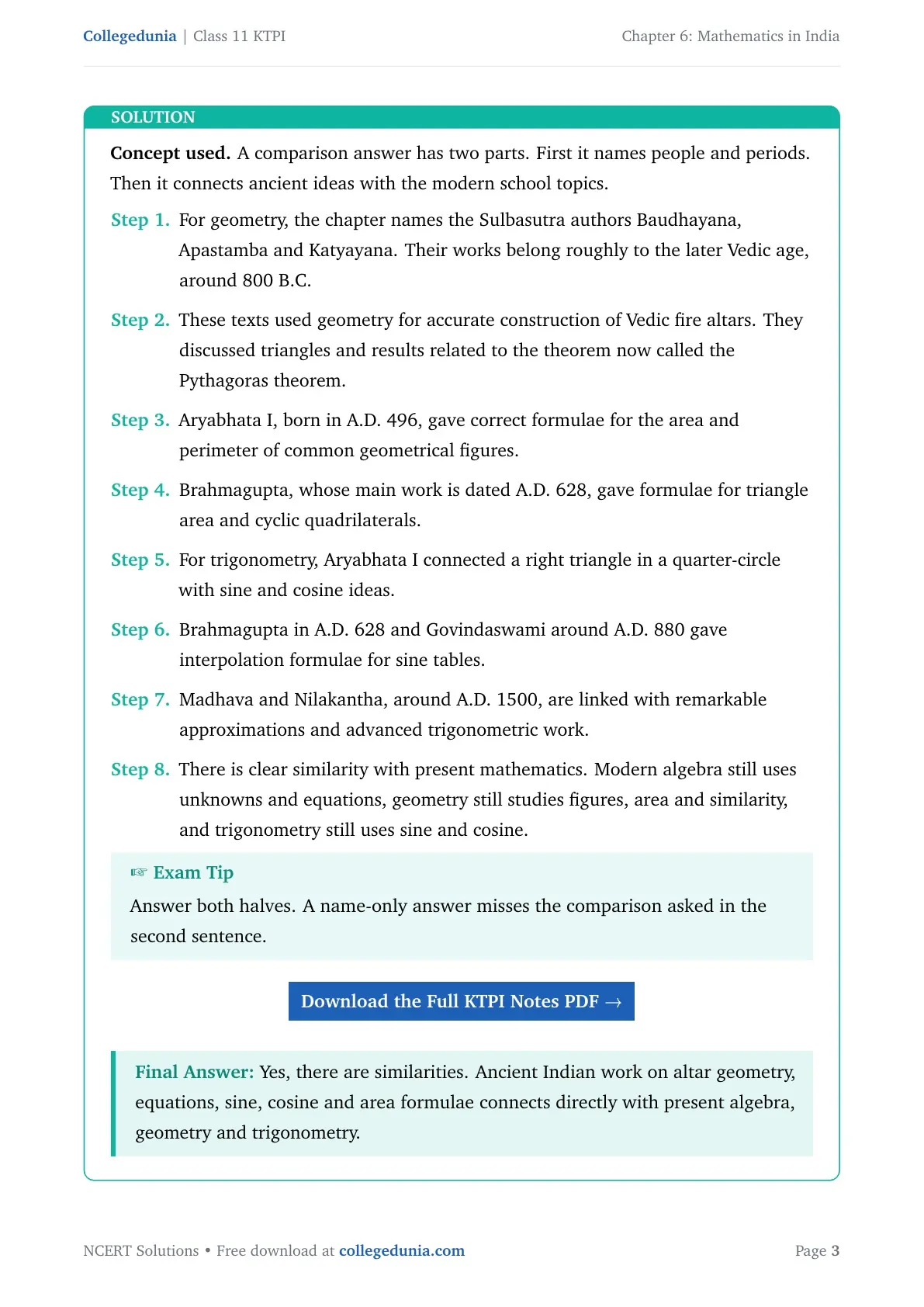
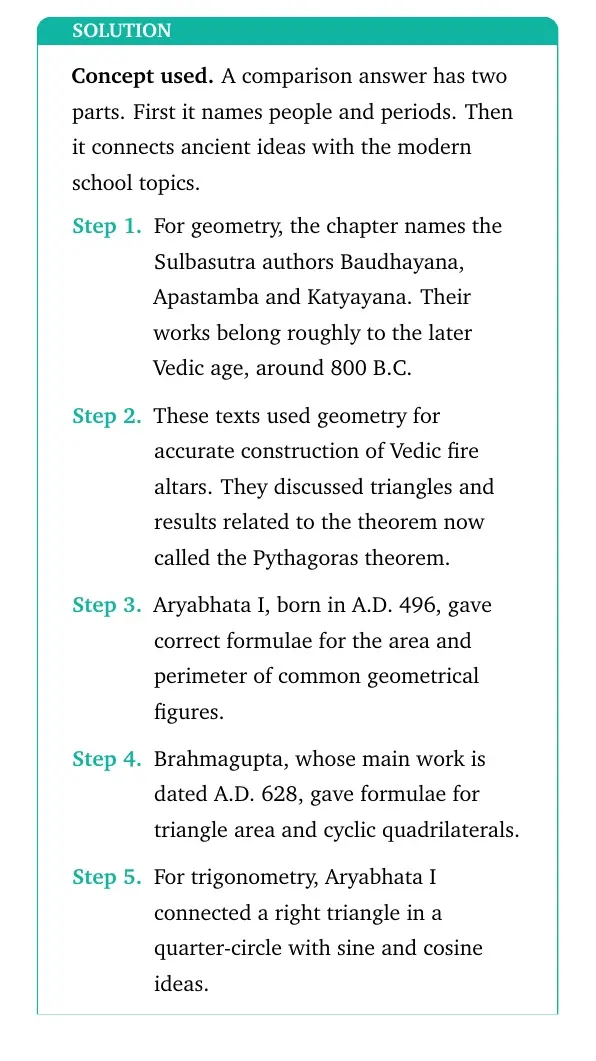
Concept used. A comparison answer has two parts. First it names
people and periods. Then it connects ancient ideas with the modern school
topics.
For geometry, the chapter names the Sulbasutra authors Baudhayana,
Apastamba and Katyayana. Their works belong roughly to the later Vedic
age, around 800 B.C.
These texts used geometry for accurate construction of Vedic fire
altars. They discussed triangles and results related to the theorem now
called the Pythagoras theorem.
Aryabhata I, born in A.D. 496, gave correct formulae for the area and
perimeter of common geometrical figures.
Brahmagupta, whose main work is dated A.D. 628, gave formulae for
triangle area and cyclic quadrilaterals.
For trigonometry, Aryabhata I connected a right triangle in a
quarter-circle with sine and cosine ideas.
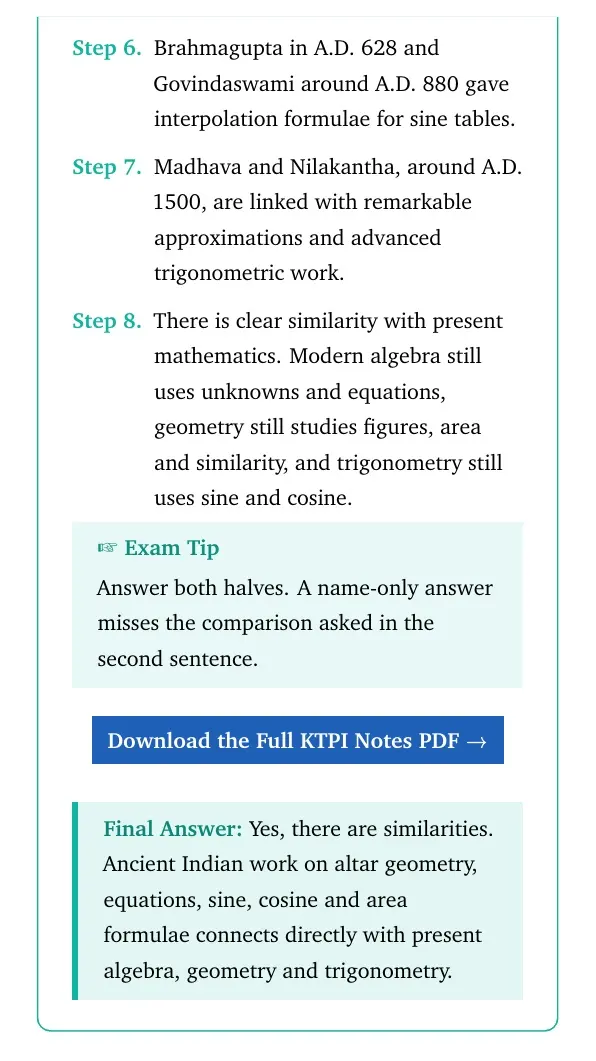
Brahmagupta in A.D. 628 and Govindaswami around A.D. 880 gave
interpolation formulae for sine tables.
Madhava and Nilakantha, around A.D. 1500, are linked with remarkable
approximations and advanced trigonometric work.
There is clear similarity with present mathematics. Modern algebra
still uses unknowns and equations, geometry still studies figures,
area and similarity, and trigonometry still uses sine and cosine.
Answer both halves. A name-only answer misses the comparison asked in the
second sentence.
Download the full Mathematics in India NCERT Solutions PDF
Yes, there are similarities. Ancient Indian work on altar geometry,
equations, sine, cosine and area formulae connects directly with present
algebra, geometry and trigonometry.
PI
Priya Iyer
M.A. Ancient Indian History, JNU
Verified Expert
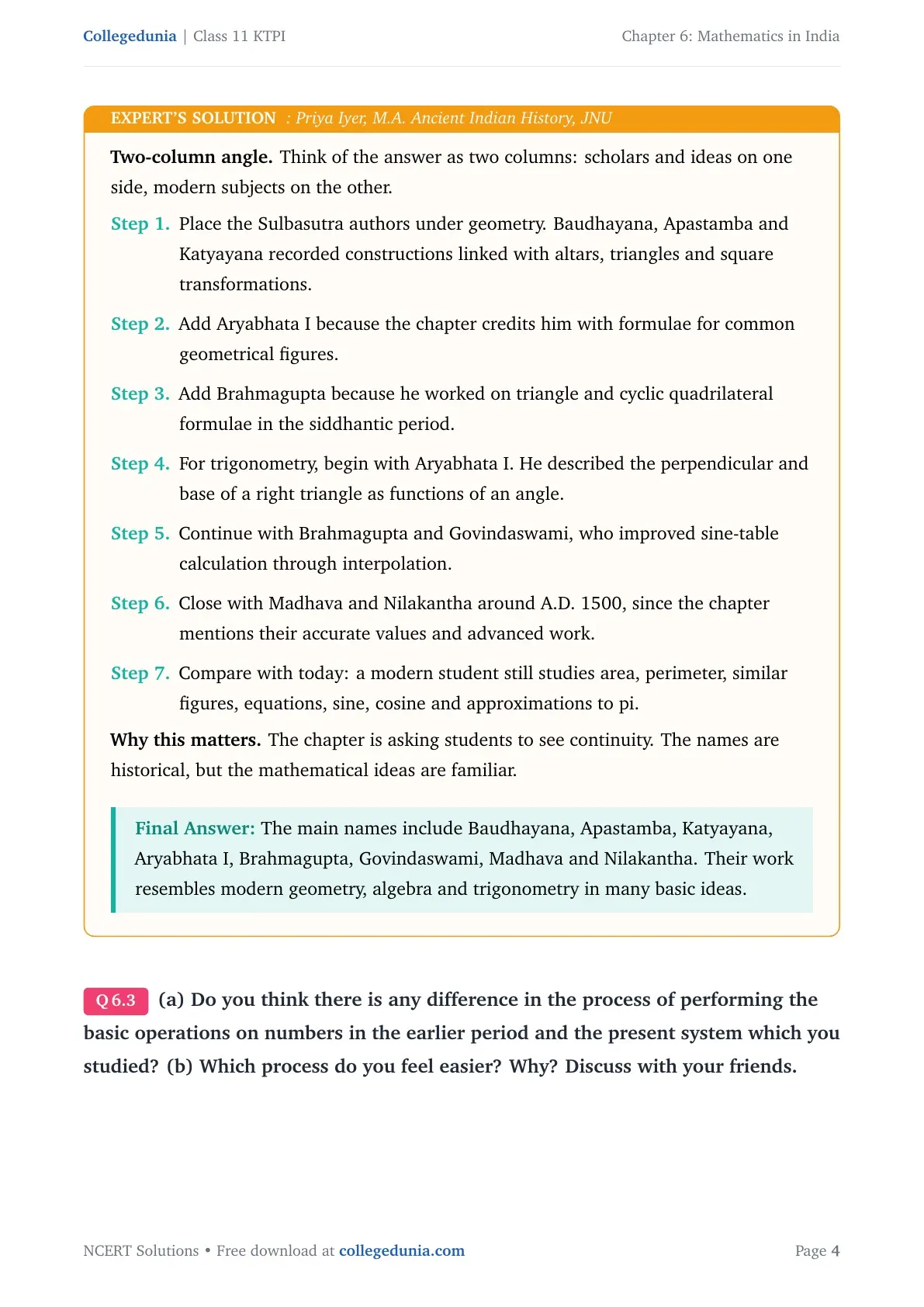
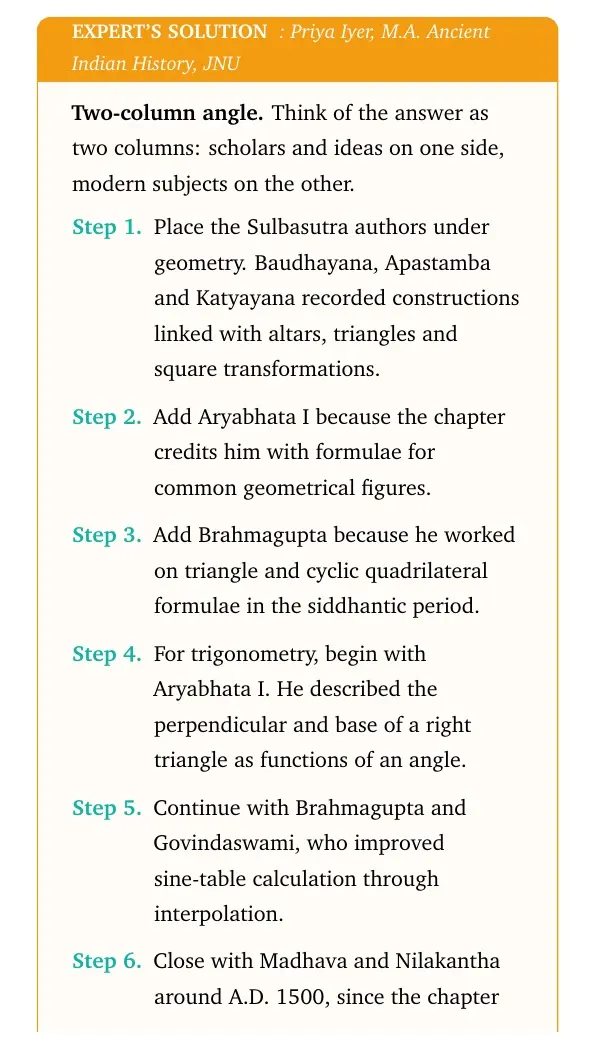
Two-column angle. Think of the answer as two columns: scholars and
ideas on one side, modern subjects on the other.
Place the Sulbasutra authors under geometry. Baudhayana, Apastamba and
Katyayana recorded constructions linked with altars, triangles and
square transformations.
Add Aryabhata I because the chapter credits him with formulae for
common geometrical figures.
Add Brahmagupta because he worked on triangle and cyclic quadrilateral
formulae in the siddhantic period.
For trigonometry, begin with Aryabhata I. He described the
perpendicular and base of a right triangle as functions of an angle.
Continue with Brahmagupta and Govindaswami, who improved sine-table
calculation through interpolation.
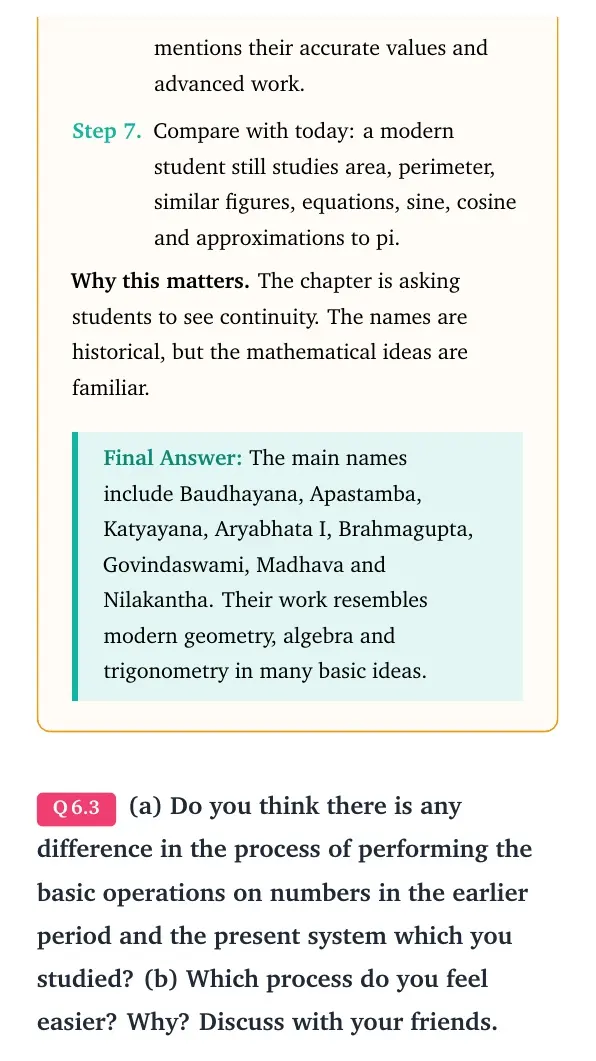
Close with Madhava and Nilakantha around A.D. 1500, since the chapter
mentions their accurate values and advanced work.
Compare with today: a modern student still studies area, perimeter,
similar figures, equations, sine, cosine and approximations to pi.
Why this matters. The chapter is asking students to see continuity.
The names are historical, but the mathematical ideas are familiar.
The main names include Baudhayana, Apastamba, Katyayana, Aryabhata I,
Brahmagupta, Govindaswami, Madhava and Nilakantha. Their work resembles modern
geometry, algebra and trigonometry in many basic ideas.
Q 6.3
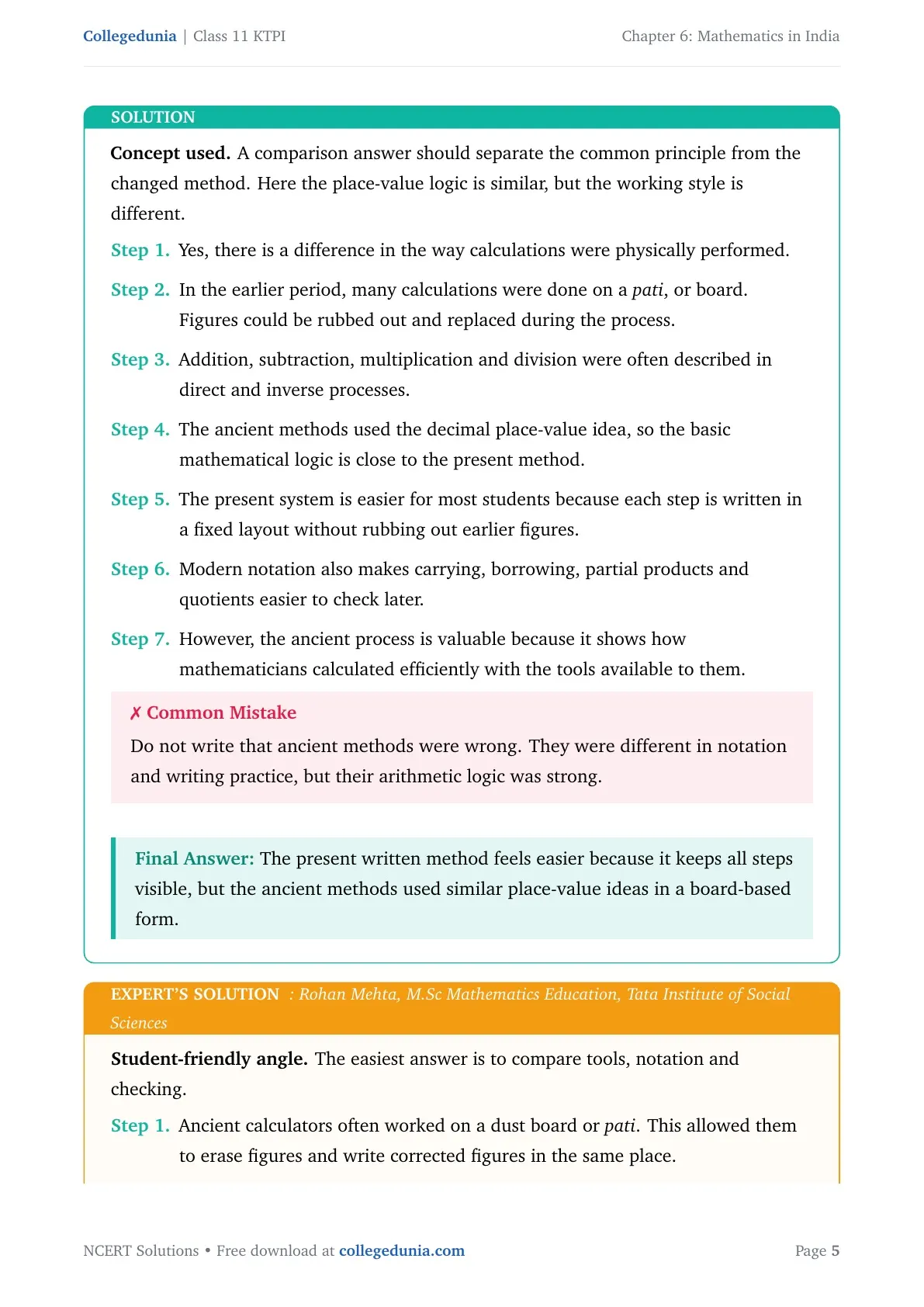
(a) Do you think there is any difference in the process of performing the basic operations on numbers in the earlier period and the present system which you studied? (b) Which process do you feel easier? Why? Discuss with your friends.
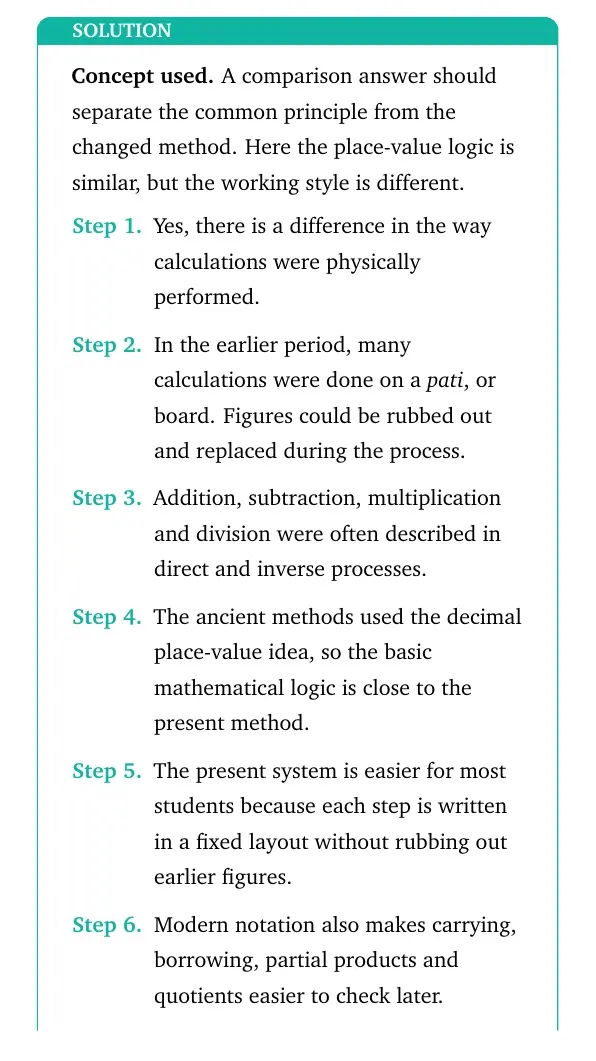
Concept used. A comparison answer should separate the common principle
from the changed method. Here the place-value logic is similar, but the
working style is different.
Yes, there is a difference in the way calculations were physically
performed.
In the earlier period, many calculations were done on a pati,
or board. Figures could be rubbed out and replaced during the process.
Addition, subtraction, multiplication and division were often described
in direct and inverse processes.
The ancient methods used the decimal place-value idea, so the basic
mathematical logic is close to the present method.
The present system is easier for most students because each step is
written in a fixed layout without rubbing out earlier figures.
Modern notation also makes carrying, borrowing, partial products and
quotients easier to check later.
However, the ancient process is valuable because it shows how
mathematicians calculated efficiently with the tools available to them.
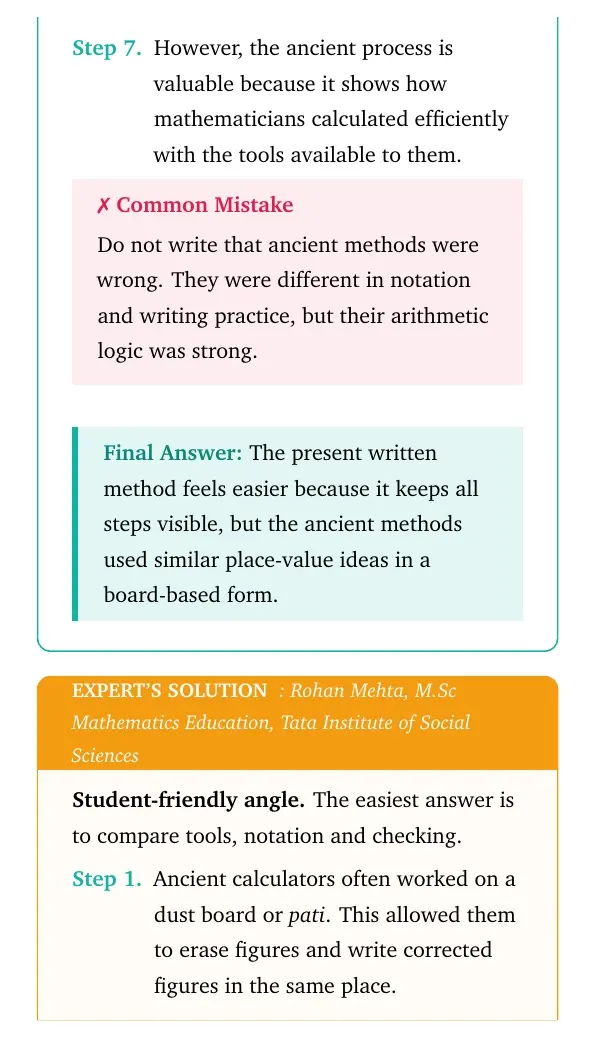
Do not write that ancient methods were wrong. They were different in notation
and writing practice, but their arithmetic logic was strong.
The present written method feels easier because it keeps all steps
visible, but the ancient methods used similar place-value ideas in a board-based
form.
RM
Rohan Mehta
M.Sc Mathematics Education, Tata Institute of Social Sciences
Verified Expert
Student-friendly angle. The easiest answer is to compare tools,
notation and checking.
Ancient calculators often worked on a dust board or pati. This
allowed them to erase figures and write corrected figures in the same
place.
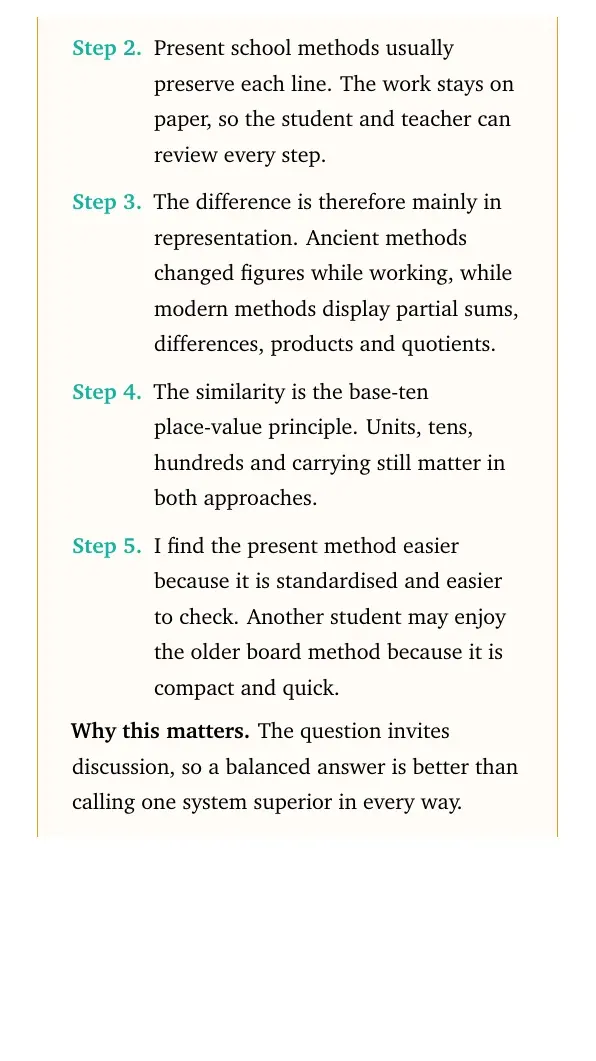
Present school methods usually preserve each line. The work stays on
paper, so the student and teacher can review every step.
The difference is therefore mainly in representation. Ancient methods
changed figures while working, while modern methods display partial
sums, differences, products and quotients.
The similarity is the base-ten place-value principle. Units, tens,
hundreds and carrying still matter in both approaches.
I find the present method easier because it is standardised and easier
to check. Another student may enjoy the older board method because it is
compact and quick.
Why this matters. The question invites discussion, so a balanced
answer is better than calling one system superior in every way.
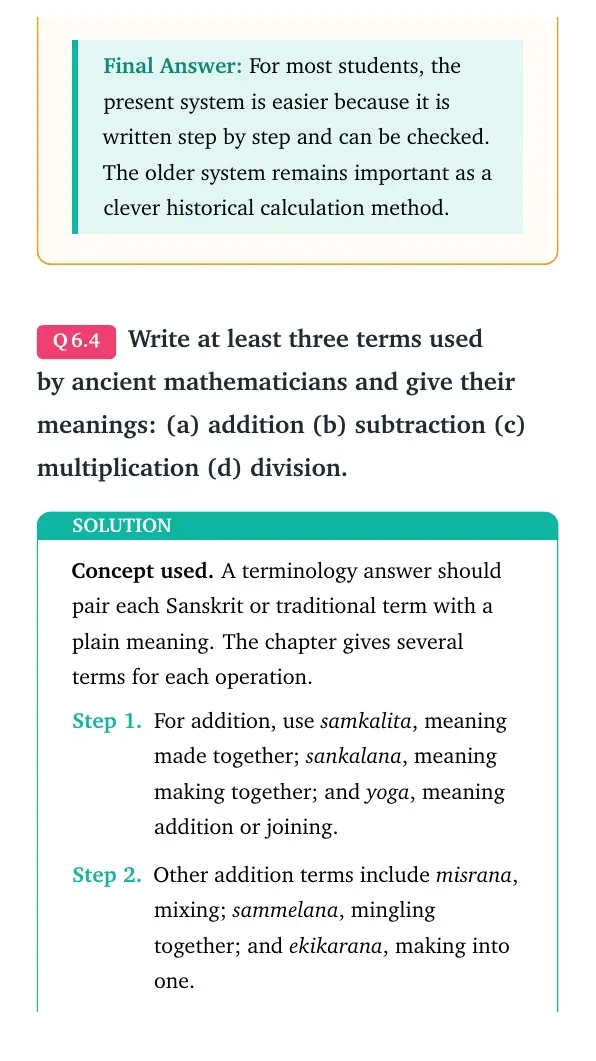
For most students, the present system is easier because it is written
step by step and can be checked. The older system remains important as a clever
historical calculation method.
Q 6.4
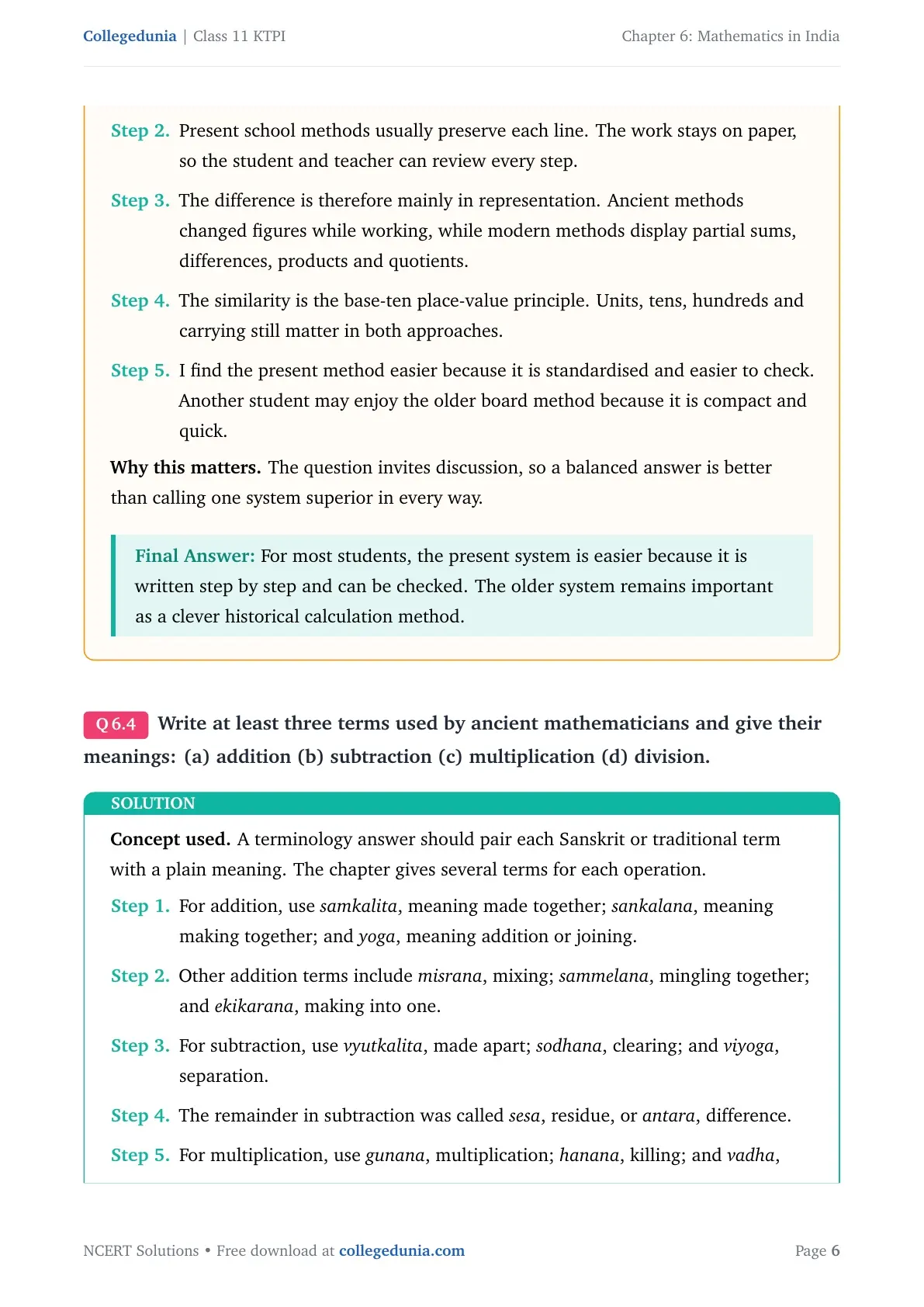
Write at least three terms used by ancient mathematicians and give their meanings: (a) addition (b) subtraction (c) multiplication (d) division.
Concept used. A terminology answer should pair each Sanskrit or
traditional term with a plain meaning. The chapter gives several terms for each
operation.
For addition, use samkalita, meaning made together;
sankalana, meaning making together; and yoga,
meaning addition or joining.
Other addition terms include misrana, mixing;
sammelana, mingling together; and ekikarana, making
into one.
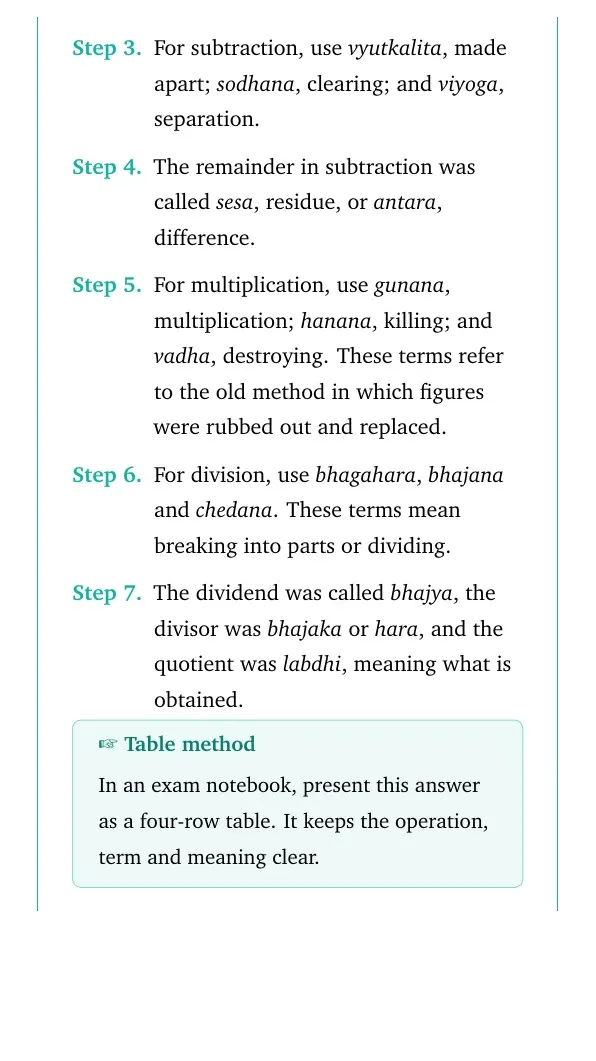
For subtraction, use vyutkalita, made apart;
sodhana, clearing; and viyoga, separation.
The remainder in subtraction was called sesa, residue, or
antara, difference.
For multiplication, use gunana, multiplication;
hanana, killing; and vadha, destroying. These terms
refer to the old method in which figures were rubbed out and replaced.
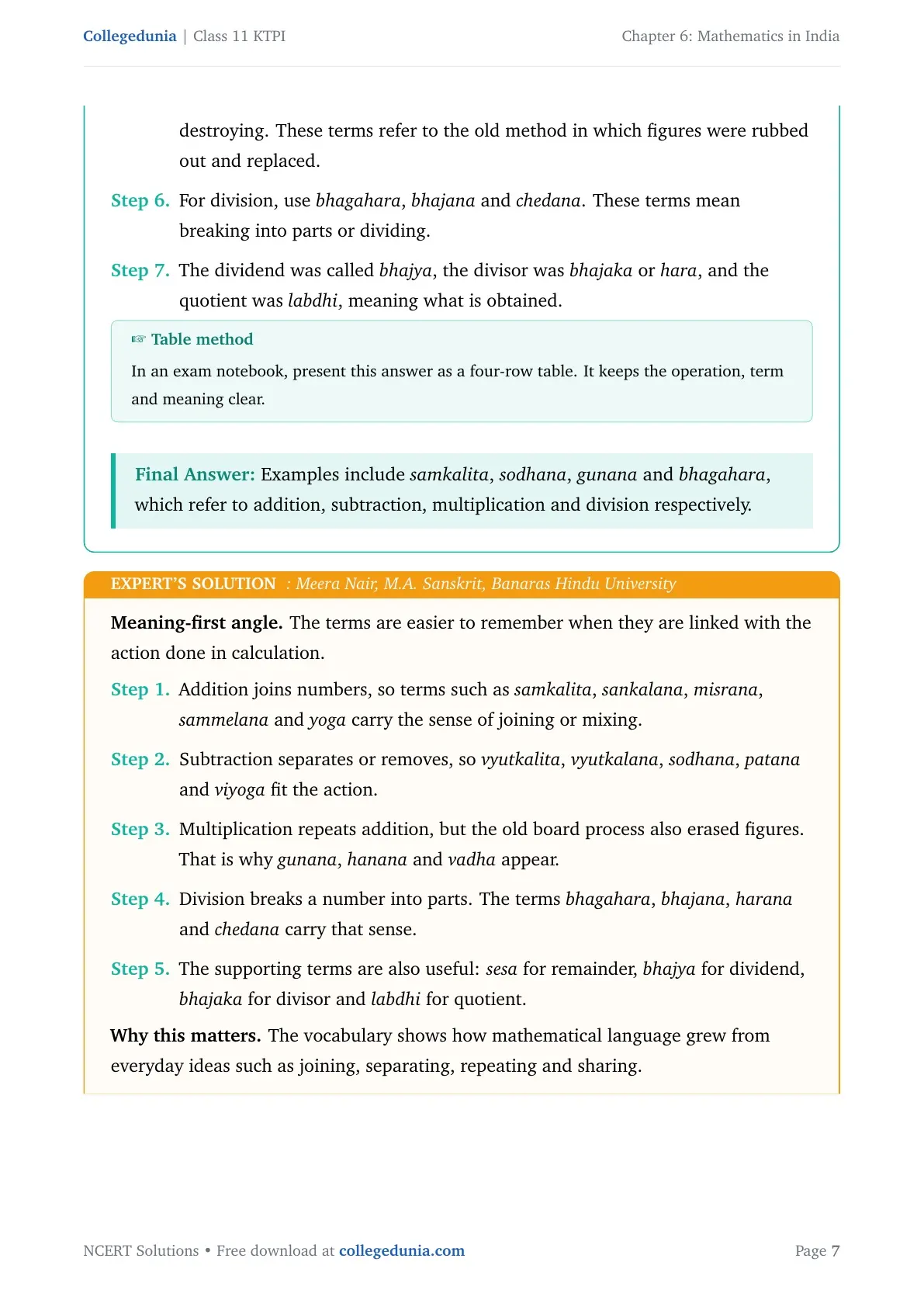
For division, use bhagahara, bhajana and
chedana. These terms mean breaking into parts or dividing.
The dividend was called bhajya, the divisor was
bhajaka or hara, and the quotient was
labdhi, meaning what is obtained.
Table method
In an exam notebook, present this answer as a four-row table. It keeps the
operation, term and meaning clear.
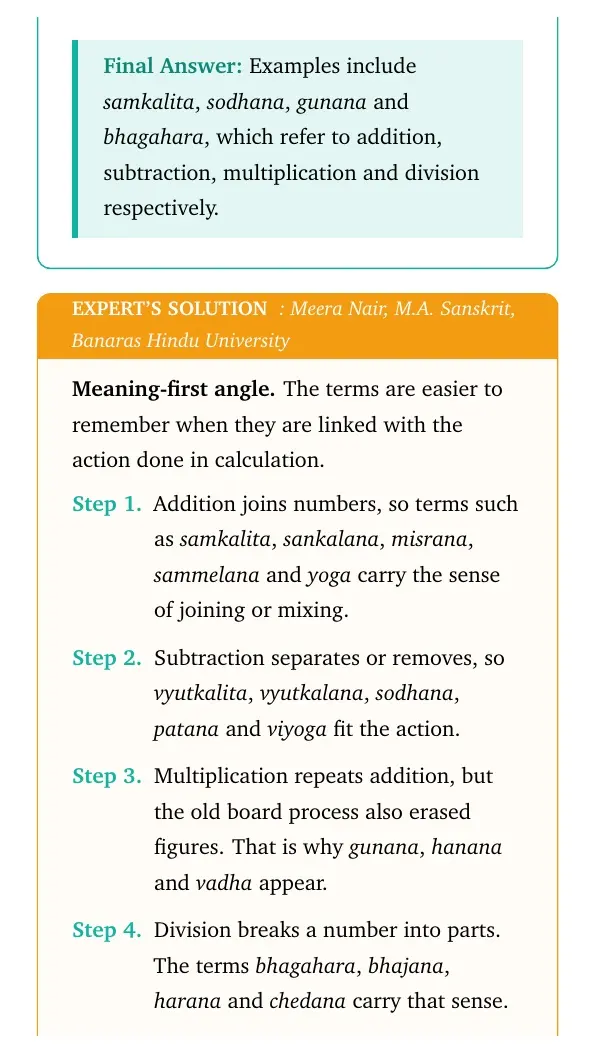
Examples include samkalita, sodhana,
gunana and bhagahara, which refer to addition, subtraction,
multiplication and division respectively.
MN
Meera Nair
M.A. Sanskrit, Banaras Hindu University
Verified Expert
Meaning-first angle. The terms are easier to remember when they are
linked with the action done in calculation.
Addition joins numbers, so terms such as samkalita,
sankalana, misrana, sammelana and
yoga carry the sense of joining or mixing.
Subtraction separates or removes, so vyutkalita,
vyutkalana, sodhana, patana and
viyoga fit the action.
Multiplication repeats addition, but the old board process also erased
figures. That is why gunana, hanana and
vadha appear.
Division breaks a number into parts. The terms bhagahara,
bhajana, harana and chedana carry that
sense.
The supporting terms are also useful: sesa for remainder,
bhajya for dividend, bhajaka for divisor and
labdhi for quotient.
Why this matters. The vocabulary shows how mathematical language grew
from everyday ideas such as joining, separating, repeating and sharing.
Ancient terms include samkalita for addition,
vyutkalita or sodhana for subtraction, gunana for
multiplication, and bhagahara or bhajana for division.
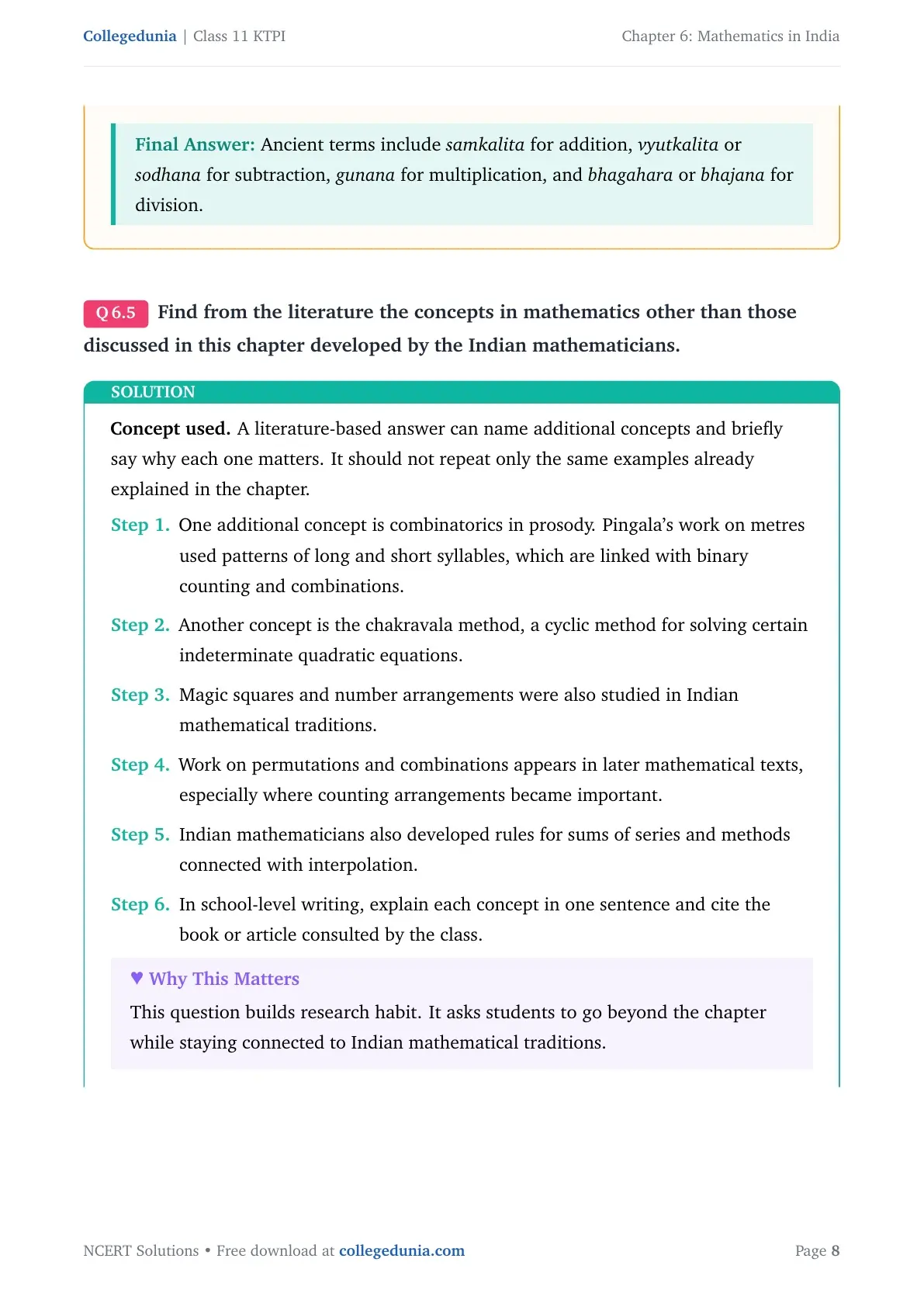
Q 6.5
Find from the literature the concepts in mathematics other than those discussed in this chapter developed by the Indian mathematicians.
Concept used. A literature-based answer can name additional concepts
and briefly say why each one matters. It should not repeat only the same
examples already explained in the chapter.
One additional concept is combinatorics in prosody. Pingala's work on
metres used patterns of long and short syllables, which are linked with
binary counting and combinations.
Another concept is the chakravala method, a cyclic method for solving
certain indeterminate quadratic equations.
Magic squares and number arrangements were also studied in Indian
mathematical traditions.
Work on permutations and combinations appears in later mathematical
texts, especially where counting arrangements became important.
Indian mathematicians also developed rules for sums of series and
methods connected with interpolation.
In school-level writing, explain each concept in one sentence and cite
the book or article consulted by the class.
This question builds research habit. It asks students to go beyond the chapter
while staying connected to Indian mathematical traditions.
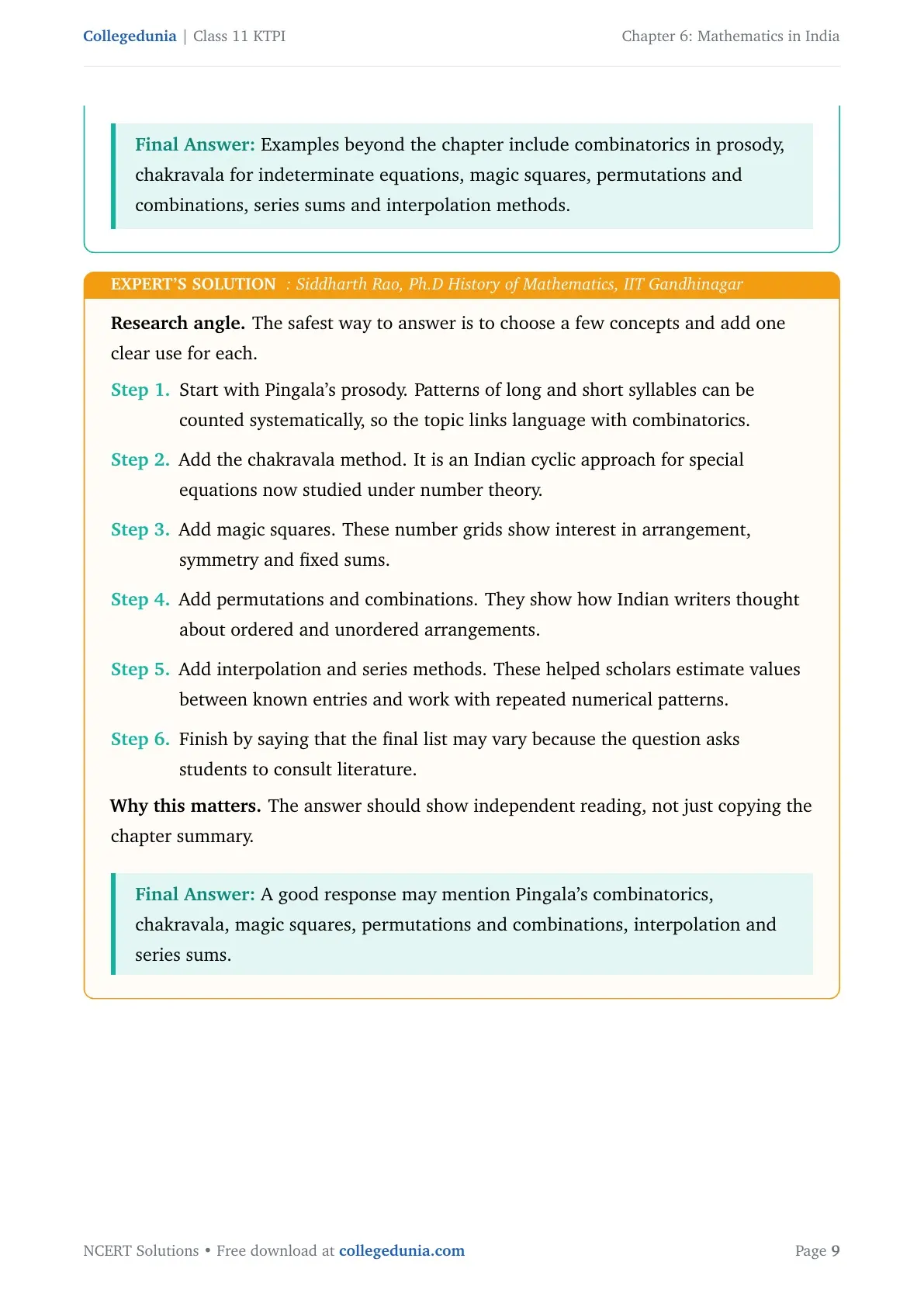
Examples beyond the chapter include combinatorics in prosody,
chakravala for indeterminate equations, magic squares, permutations and
combinations, series sums and interpolation methods.
SR
Siddharth Rao
Ph.D History of Mathematics, IIT Gandhinagar
Verified Expert
Research angle. The safest way to answer is to choose a few concepts
and add one clear use for each.
Start with Pingala's prosody. Patterns of long and short syllables can
be counted systematically, so the topic links language with
combinatorics.
Add the chakravala method. It is an Indian cyclic approach for special
equations now studied under number theory.
Add magic squares. These number grids show interest in arrangement,
symmetry and fixed sums.
Add permutations and combinations. They show how Indian writers thought
about ordered and unordered arrangements.
Add interpolation and series methods. These helped scholars estimate
values between known entries and work with repeated numerical patterns.
Finish by saying that the final list may vary because the question asks
students to consult literature.
Why this matters. The answer should show independent reading, not just
copying the chapter summary.
A good response may mention Pingala's combinatorics, chakravala,
magic squares, permutations and combinations, interpolation and series sums.
Class 11 KTPI Mathematics in India NCERT Solutions FAQs
Ques. How many questions are solved in Class 11 KTPI Chapter 6 Mathematics in India?
Ans. This article and PDF solve all 5 NCERT exercise questions from Mathematics in India for the 2026-27 Class 11 KTPI syllabus.
Ques. What are the most important topics in Mathematics in India Class 11 KTPI?
Ans. The key topics are eight fundamental operations, Sulbasutra geometry, Aryabhata I, Brahmagupta, sine tables, algebraic terms and traditional arithmetic vocabulary.
Ques. Which ancient mathematicians should I remember for KTPI Chapter 6?
Ans. Remember Baudhayana, Apastamba, Katyayana, Aryabhata I, Brahmagupta, Govindaswami, Madhava and Nilakantha with their broad periods and contributions.
Ques. Why is the present system of calculation usually easier for students?
Ans. The present system keeps every step visible on paper, so carrying, borrowing, partial products and quotients are easier to check than older board-based methods.
Ques. Which resources should I use with these NCERT Solutions?
Ans. Use the NCERT Book PDF for source reading, chapter notes for short revision and handwritten notes for last-minute recall before writing the exercise answers.







Comments