NCERT Solutions for Class 11 KTPI Chapter 8 Chemistry and Metallurgy in India cover all 7 exercise questions from the 2026-27 syllabus. The chapter connects ancient Indian chemical knowledge with ink making, atomic ideas, copper metallurgy, zinc smelting, Wootz steel, the Delhi Iron Pillar and the decline of metallurgical crafts. These answers keep the NCERT sequence intact and add expert explanations for students who need fuller reasoning before writing the exercise.
7 solved questions are included with direct NCERT answers and fuller expert explanations.
The PDF follows the exercise order for inks, atom theory, copper, zinc, iron and decline of metallurgical skills.
Question cards below let students open the direct solution first and then compare the expert route.
Student Feedback on Class 11 KTPI Chapter 8
In the 2026-27 Collegedunia KTPI review log, 10,420 Class 11 students marked Chemistry and Metallurgy in India as a chapter that needs careful sequencing because it combines history, chemistry terms, craft evidence and colonial policy in one exercise.
76% wanted the metallurgy examples grouped by material before answering the long questions.
69% confused zinc smelting with ordinary metal heating until the distillation step was explained.
6 out of 10 students asked for a clean reason behind the Delhi Iron Pillar corrosion answer.
Source: 2026-27 Class 11 KTPI student feedback sample recorded for Collegedunia NCERT resource planning.
Every answer here is checked against the Chemistry and Metallurgy in India chapter of the NCERT Knowledge Traditions and Practices of India textbook.
What the Class 11 KTPI Chemistry and Metallurgy Solutions Cover
Chapter 8 studies chemical and metallurgical knowledge as practical science. The exercise does not ask students to memorise only names. It expects them to connect substances, places, processes and historical causes in short but complete answers.
Question group
Question numbers
What students need to show
Materials and writing
Question 1
Name the mineral, plant and chemical materials used for coloured and black inks
Early atomic ideas
Question 2
Explain anu, paramanu and Kanada's description of indivisible particles
Copper and zinc metallurgy
Questions 3, 4 and 5
Use evidence from Chalcolithic copper, Ahar, Zawar, ore dressing, retorts and alloying
Decline and preservation
Questions 6 and 7
Connect invasions, colonial policy and the Delhi Iron Pillar's protective layer
The downloadable PDF uses the same structure. The direct solution gives the answer needed for school work, while the expert solution adds source evidence and a cleaner writing frame.
Materials, Atoms and Metallurgy Evidence at a Glance
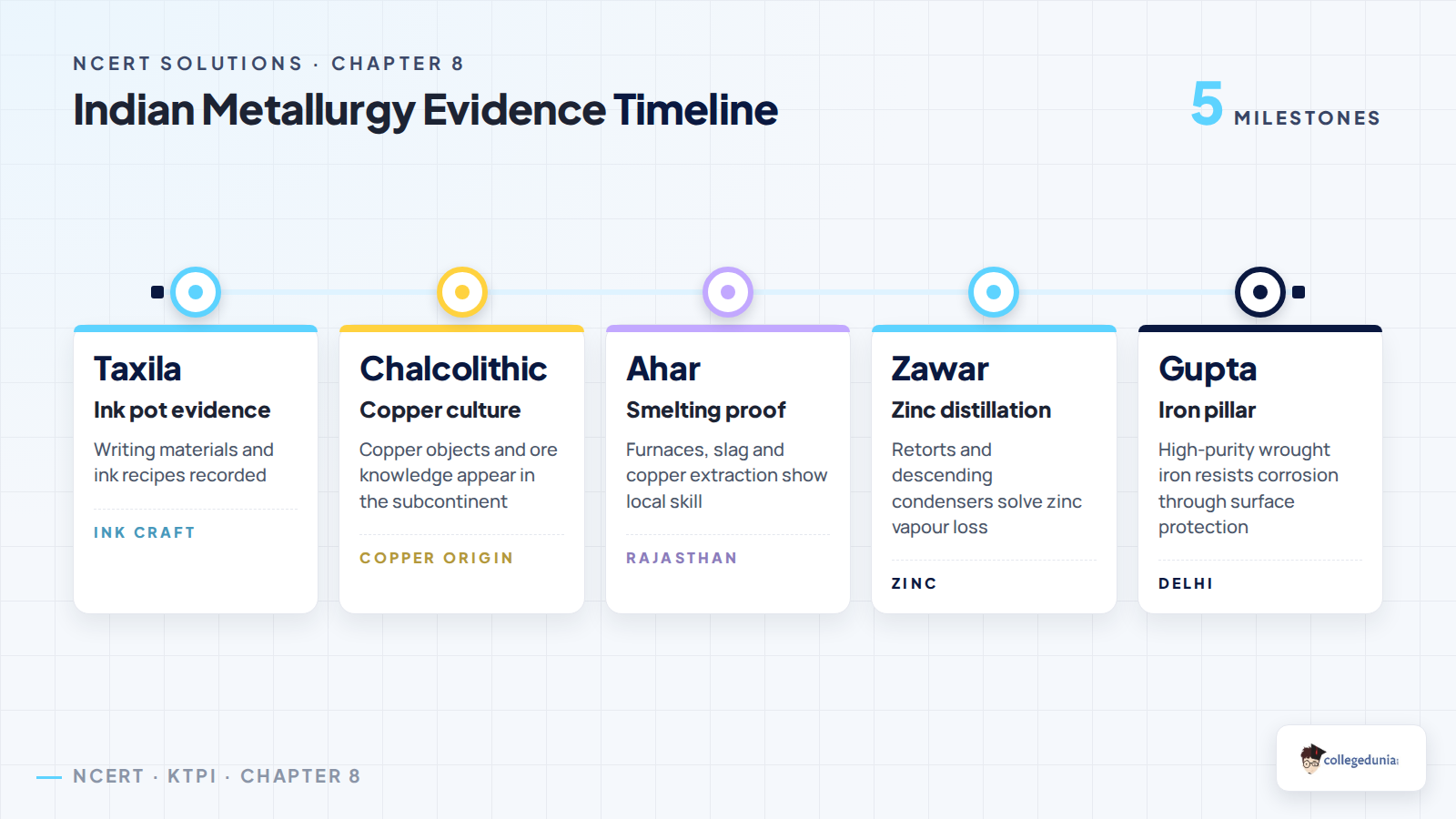
The chapter shows chemistry through evidence. Ink recipes use minerals and plant products, atomic ideas come from the Vaisheshika school, and metallurgy is proved through objects, slags, furnaces, ores and inscriptions.
Ink colour materials are chalk, red lead and minium, also called sindoor; broader ink recipes use other substances separately.
Atomic thought is linked with Acharya Kanada, anu, paramanu and combinations of very small particles.
Metallurgical evidence is strongest when the answer names sites, processes and materials, not only finished objects.
For Questions 1 to 5, this evidence-first method prevents vague answers. Students should name the process, the place and the material wherever the NCERT chapter provides them.
Zinc Smelting and Iron Pillar Concepts
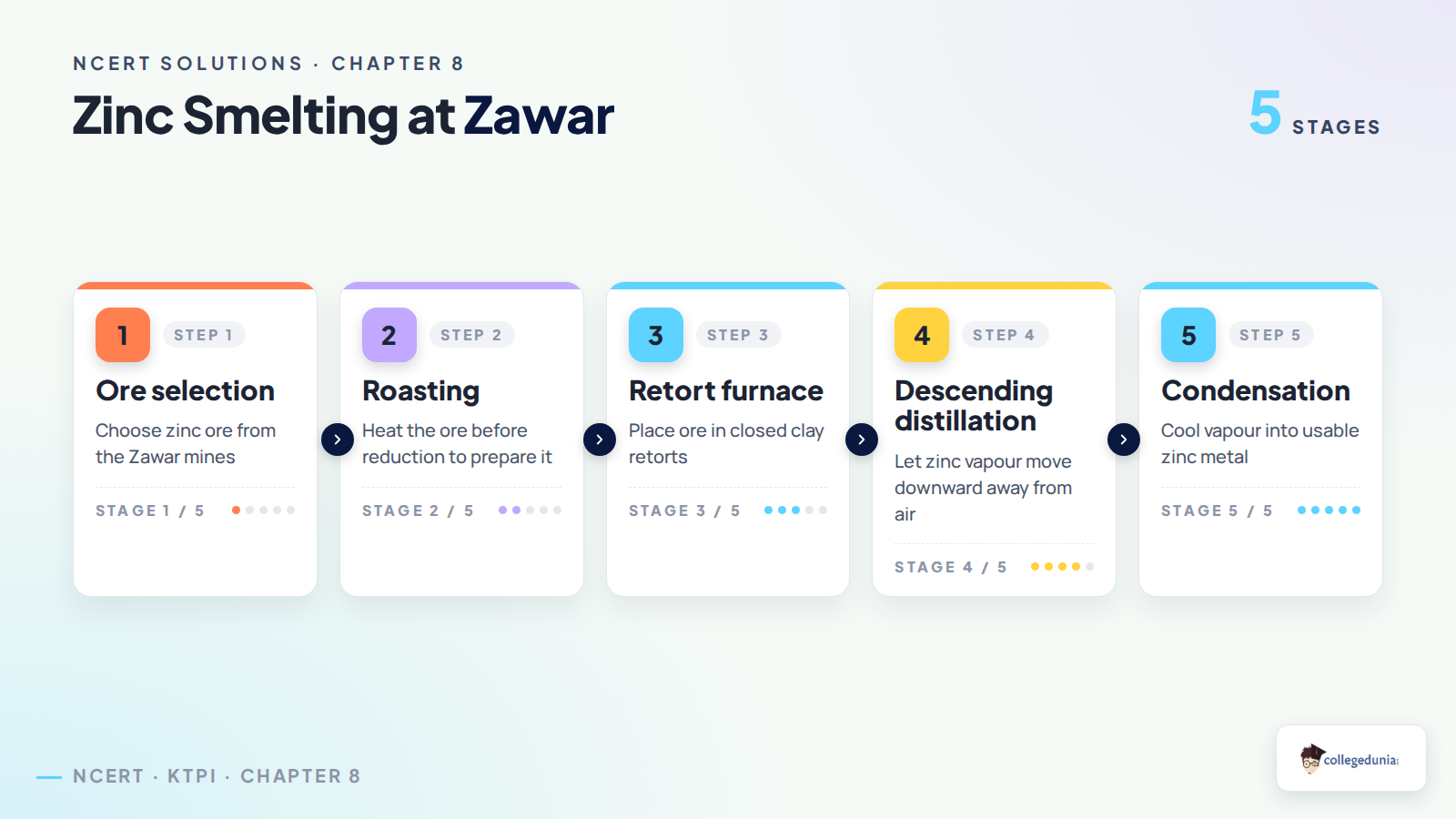
The zinc question is the most technical part of the exercise. Zinc extraction is difficult because zinc vaporises easily. Indian smelters solved this by using retorts and a descending distillation method at Zawar, so zinc vapour could be collected after cooling.
Zawar evidence points to mining, ore treatment, retorts, furnaces and controlled vapour collection.
Copper evidence includes ore dressing, roasting, fluxing, smelting, alloying and high-purity copper.
The Delhi Iron Pillar is explained through high-purity wrought iron, low harmful impurities and a protective iron hydrogen phosphate layer.
Question 7 should not be answered as a mystery. The textbook answer is a materials-science explanation: good metal, favourable surroundings for a long time and a protective surface layer slowed corrosion.
KTPI Chapter 8 Related Resources
Use the chapter-wise resources below to revise the same NCERT chapter in different formats. The textbook PDF is useful for source reading, notes help with short revision, and handwritten notes help with quick recall.
All NCERT Solutions for Chemistry and Metallurgy in India with Step-by-Step Solutions
The cards below embed every exercise answer from the chapter. Use Check Solution for the direct NCERT answer and Expert Solution for a fuller explanation.
Q 8.1
Which materials were used to make the colour of inks?
Concept used. A factual answer should name the materials and connect
them with the ink colours described in the chapter. Recipe materials belong
only as extra context when the question specifically asks about ink making.
The chapter says that an ink pot found at Taxila shows the use of ink
in India from the fourth century.
It names chalk, red lead and minium, or sindoor, as materials used for
making colours of ink.
These three names are the direct answer because the wording asks for
the materials used to make the colour of inks.
The same section also discusses ink recipes and chemical observations,
but those are broader ink-making details, not the answer to this
colour-material question.
Keep the answer narrow
For this question, write only the colour materials named by NCERT: chalk, red
lead and minium, also called sindoor.
The colour of inks was made from chalk, red lead and minium, also
called sindoor.
AS
Aarav Sharma
M.A. History, University of Delhi
Verified Expert
Source-first reading. The question asks for materials, so the answer
should not become a general history of writing. Read the paper and ink section
and separate colour agents from recipe ingredients.
Begin with the direct colour agents. NCERT names chalk, red lead and
minium for coloured inks.
Minium is identified with sindoor, so both names may be written
together.
Do not add nuts, myrobalans, roasted rice, lamp black, sugar, kesurte
juice, tannin or ferric salts in the final answer unless the question
asks for ink recipes.
This distinction matters because NCERT separately discusses colour
materials and broader ink-making practice.
Why this matters. A precise answer follows the wording of the
exercise and avoids turning a direct factual question into an overlong recipe
list.
NCERT names chalk, red lead and minium, or sindoor, as the materials
used to make the colour of inks.
Q 8.2
How was the concept of atom described in early Indian philosophical system?
Concept used. A concept answer should explain the thinker, the term
used for the smallest unit and the properties assigned to that unit.
The chapter links early Indian atomic thought with Acharya Kanada,
also known as Kashyapa.
Kanada is described as the first propounder of the atomic theory in
this tradition.
He wrote the Vaisheshika Sutras.
He said that substances are made of very small indivisible particles.
These were called anu.
He also described a still smaller basic unit called paramanu.
These particles were treated as eternal, indestructible, spherical,
too subtle for the senses and in motion at the primordial state.
Kanada added that different classes of substances have different kinds
of atoms.
These atoms could combine as pairs or triplets, and unseen forces
caused interactions among them.
Keep the comparison short
You may mention Dalton only as a time comparison. The main answer must stay on
Kanada and the Vaisheshika idea.
Early Indian philosophy described matter as made of indivisible
units called anu or paramanu. Kanada said these particles were eternal,
indestructible, spherical, beyond the senses and able to combine into larger
forms.
PI
Priya Iyer
M.A. Indology, JNU
Verified Expert
Meaning-first angle. The safest answer explains the atom as a
philosophical idea about the smallest structure of matter.
Start with the basic claim. Matter is not continuous forever. It is
made from tiny units.
Name the thinker. The chapter gives Acharya Kanada as the key figure.
Name the text. His atomic ideas are linked with the
Vaisheshika Sutras.
Explain the term. Anu means a very small unit, and
paramanu points to an even finer indivisible unit.
State the properties. These particles are eternal, indestructible,
spherical and beyond direct sense perception.
Add the combining idea. Atoms may form pairs and triplets, which then
create larger substances.
Close with the contrast. Dalton later gave a modern scientific atomic
theory, but Kanada's idea belongs to an earlier philosophical system.
Why this matters. The question tests whether you can connect a modern
science word with its older Indian intellectual setting.
The early Indian atom concept, linked with Kanada, held that matter
is built from indivisible anu or paramanu that combine to form substances.
Q 8.3
Justify that copper metallurgy in India has indigenous origin.
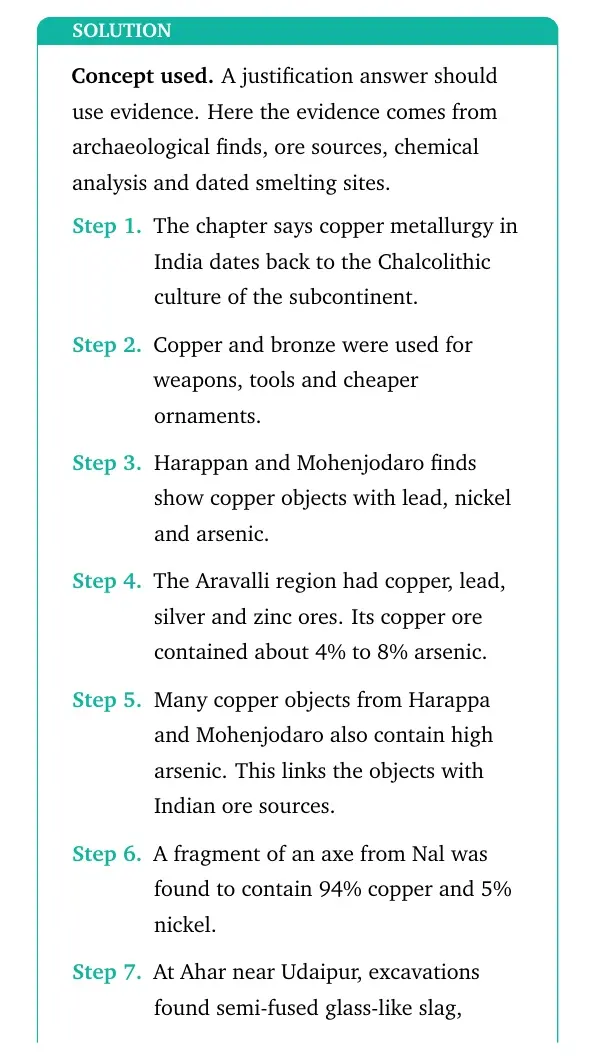
Concept used. A justification answer should use evidence. Here the
evidence comes from archaeological finds, ore sources, chemical analysis and
dated smelting sites.
The chapter says copper metallurgy in India dates back to the
Chalcolithic culture of the subcontinent.
Copper and bronze were used for weapons, tools and cheaper ornaments.
Harappan and Mohenjodaro finds show copper objects with lead, nickel
and arsenic.
The Aravalli region had copper, lead, silver and zinc ores. Its copper
ore contained about 4% to 8% arsenic.
Many copper objects from Harappa and Mohenjodaro also contain high
arsenic. This links the objects with Indian ore sources.
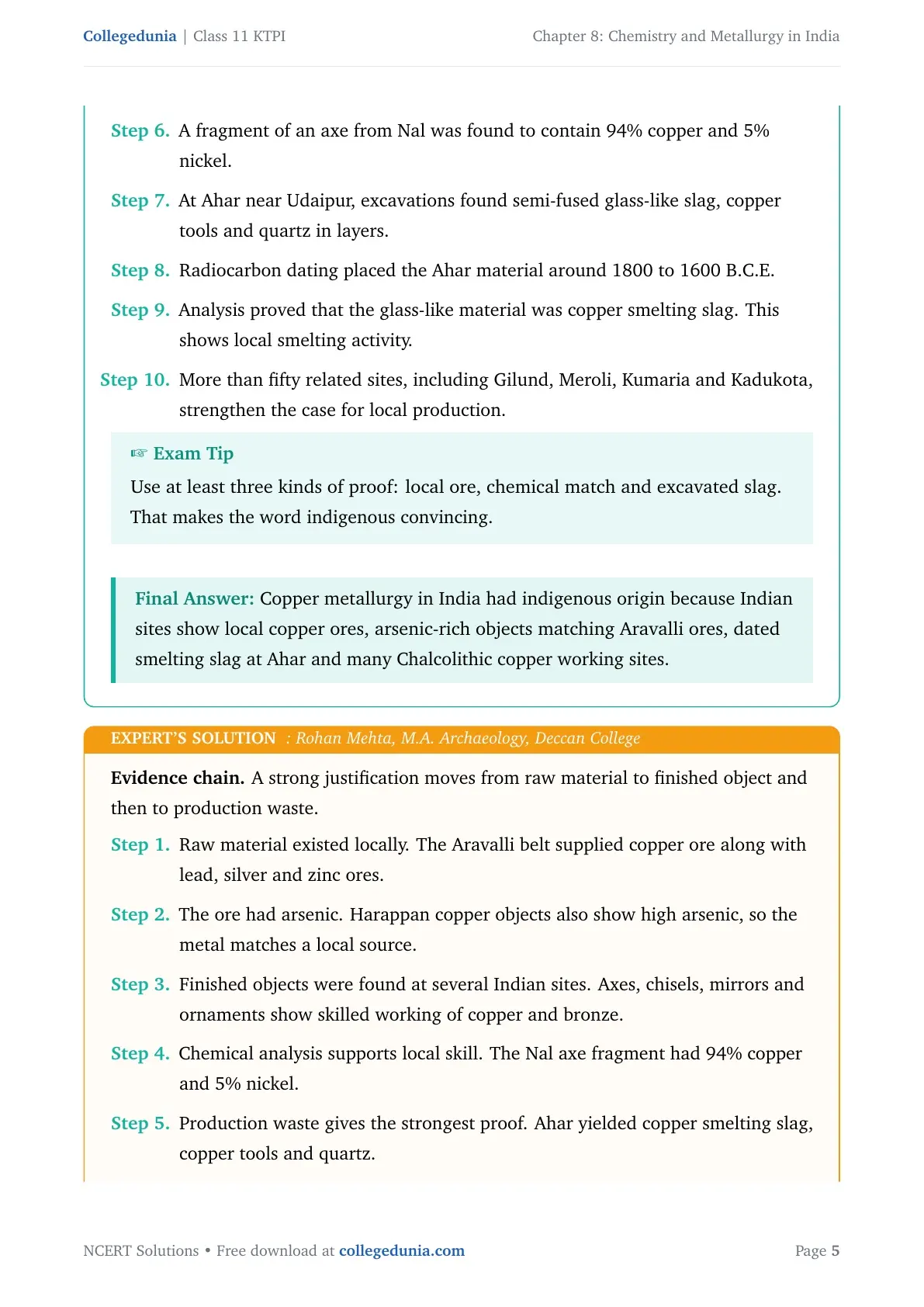
A fragment of an axe from Nal was found to contain 94% copper and
5% nickel.
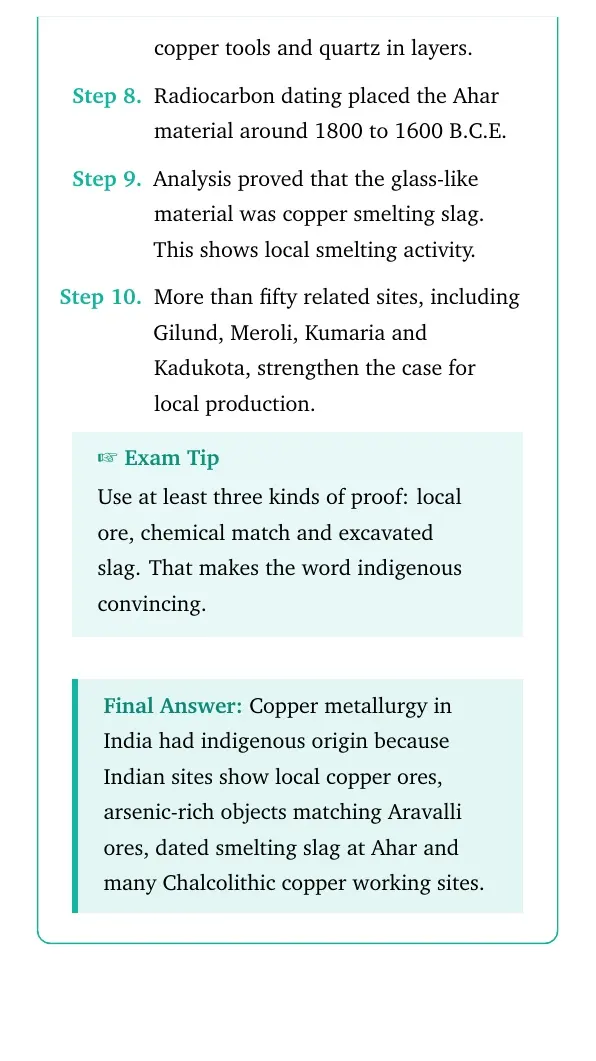
At Ahar near Udaipur, excavations found semi-fused glass-like slag,
copper tools and quartz in layers.
Radiocarbon dating placed the Ahar material around 1800 to 1600 B.C.E.
Analysis proved that the glass-like material was copper smelting slag.
This shows local smelting activity.
More than fifty related sites, including Gilund, Meroli, Kumaria and
Kadukota, strengthen the case for local production.
Use at least three kinds of proof: local ore, chemical match and excavated
slag. That makes the word indigenous convincing.
Copper metallurgy in India had indigenous origin because Indian
sites show local copper ores, arsenic-rich objects matching Aravalli ores,
dated smelting slag at Ahar and many Chalcolithic copper working sites.
RM
Rohan Mehta
M.A. Archaeology, Deccan College
Verified Expert
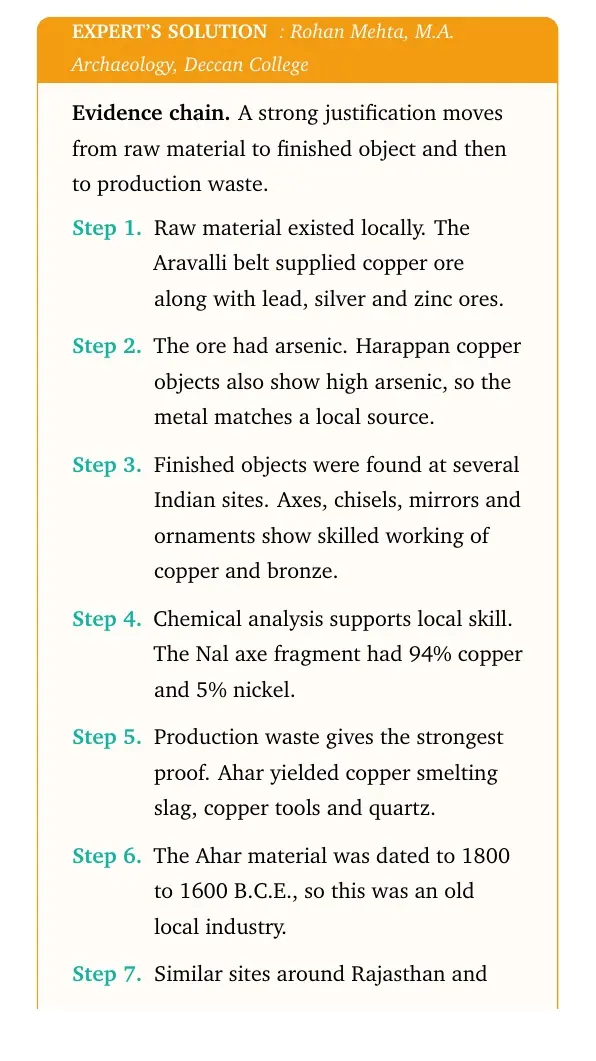
Evidence chain. A strong justification moves from raw material to
finished object and then to production waste.
Raw material existed locally. The Aravalli belt supplied copper ore
along with lead, silver and zinc ores.
The ore had arsenic. Harappan copper objects also show high arsenic,
so the metal matches a local source.
Finished objects were found at several Indian sites. Axes, chisels,
mirrors and ornaments show skilled working of copper and bronze.
Chemical analysis supports local skill. The Nal axe fragment had
94% copper and 5% nickel.
Production waste gives the strongest proof. Ahar yielded copper
smelting slag, copper tools and quartz.
The Ahar material was dated to 1800 to 1600 B.C.E., so this was an
old local industry.
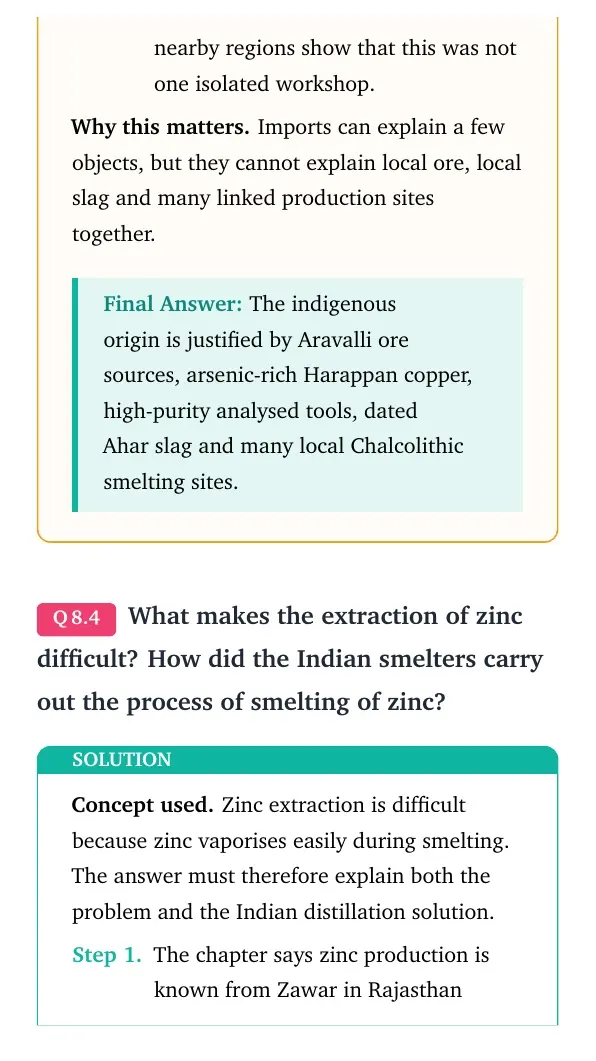
Similar sites around Rajasthan and nearby regions show that this was
not one isolated workshop.
Why this matters. Imports can explain a few objects, but they cannot
explain local ore, local slag and many linked production sites together.
The indigenous origin is justified by Aravalli ore sources,
arsenic-rich Harappan copper, high-purity analysed tools, dated Ahar slag and
many local Chalcolithic smelting sites.
Q 8.4
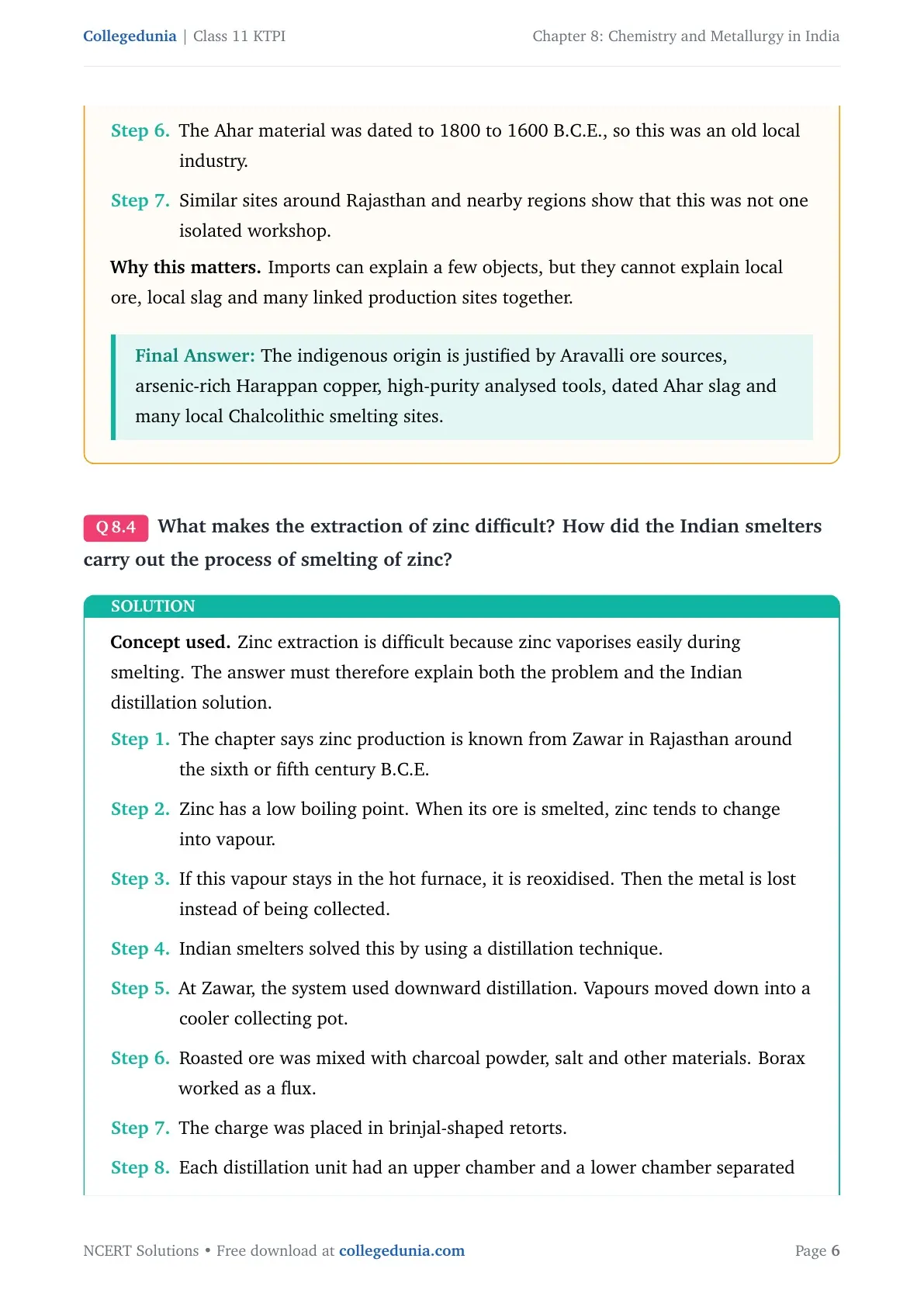
What makes the extraction of zinc difficult? How did the Indian smelters carry out the process of smelting of zinc?
Concept used. Zinc extraction is difficult because zinc vaporises
easily during smelting. The answer must therefore explain both the problem and
the Indian distillation solution.
The chapter says zinc production is known from Zawar in Rajasthan
around the sixth or fifth century B.C.E.
Zinc has a low boiling point. When its ore is smelted, zinc tends to
change into vapour.
If this vapour stays in the hot furnace, it is reoxidised. Then the
metal is lost instead of being collected.
Indian smelters solved this by using a distillation technique.
At Zawar, the system used downward distillation. Vapours moved down
into a cooler collecting pot.
Roasted ore was mixed with charcoal powder, salt and other materials.
Borax worked as a flux.
The charge was placed in brinjal-shaped retorts.
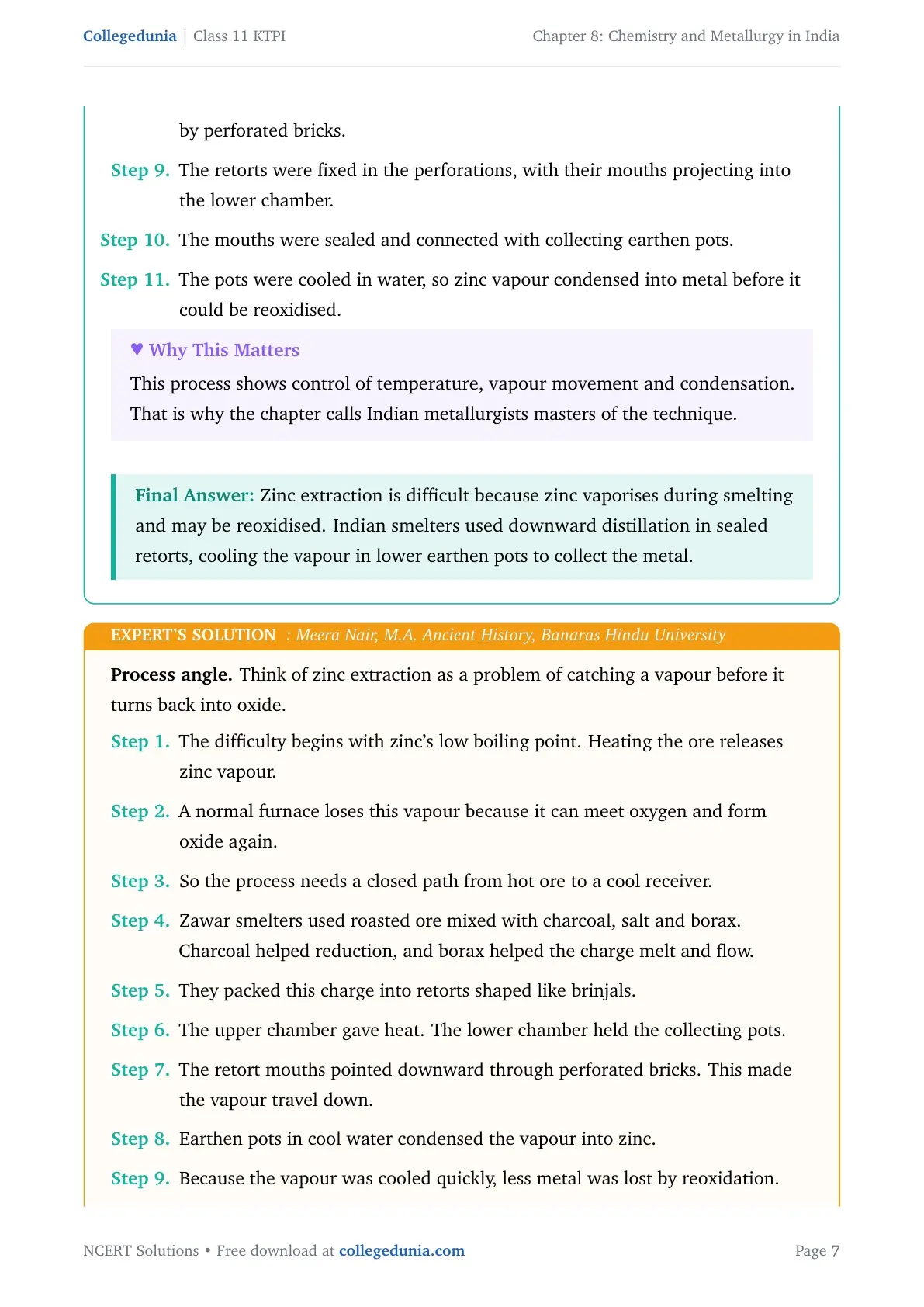
Each distillation unit had an upper chamber and a lower chamber
separated by perforated bricks.
The retorts were fixed in the perforations, with their mouths
projecting into the lower chamber.
The mouths were sealed and connected with collecting earthen pots.
The pots were cooled in water, so zinc vapour condensed into metal
before it could be reoxidised.
This process shows control of temperature, vapour movement and condensation.
That is why the chapter calls Indian metallurgists masters of the technique.
Zinc extraction is difficult because zinc vaporises during smelting
and may be reoxidised. Indian smelters used downward distillation in sealed
retorts, cooling the vapour in lower earthen pots to collect the metal.
MN
Meera Nair
M.A. Ancient History, Banaras Hindu University
Verified Expert
Process angle. Think of zinc extraction as a problem of catching a
vapour before it turns back into oxide.
The difficulty begins with zinc's low boiling point. Heating the ore
releases zinc vapour.
A normal furnace loses this vapour because it can meet oxygen and form
oxide again.
So the process needs a closed path from hot ore to a cool receiver.
Zawar smelters used roasted ore mixed with charcoal, salt and borax.
Charcoal helped reduction, and borax helped the charge melt and flow.
They packed this charge into retorts shaped like brinjals.
The upper chamber gave heat. The lower chamber held the collecting
pots.
The retort mouths pointed downward through perforated bricks. This
made the vapour travel down.
Earthen pots in cool water condensed the vapour into zinc.
Because the vapour was cooled quickly, less metal was lost by
reoxidation.
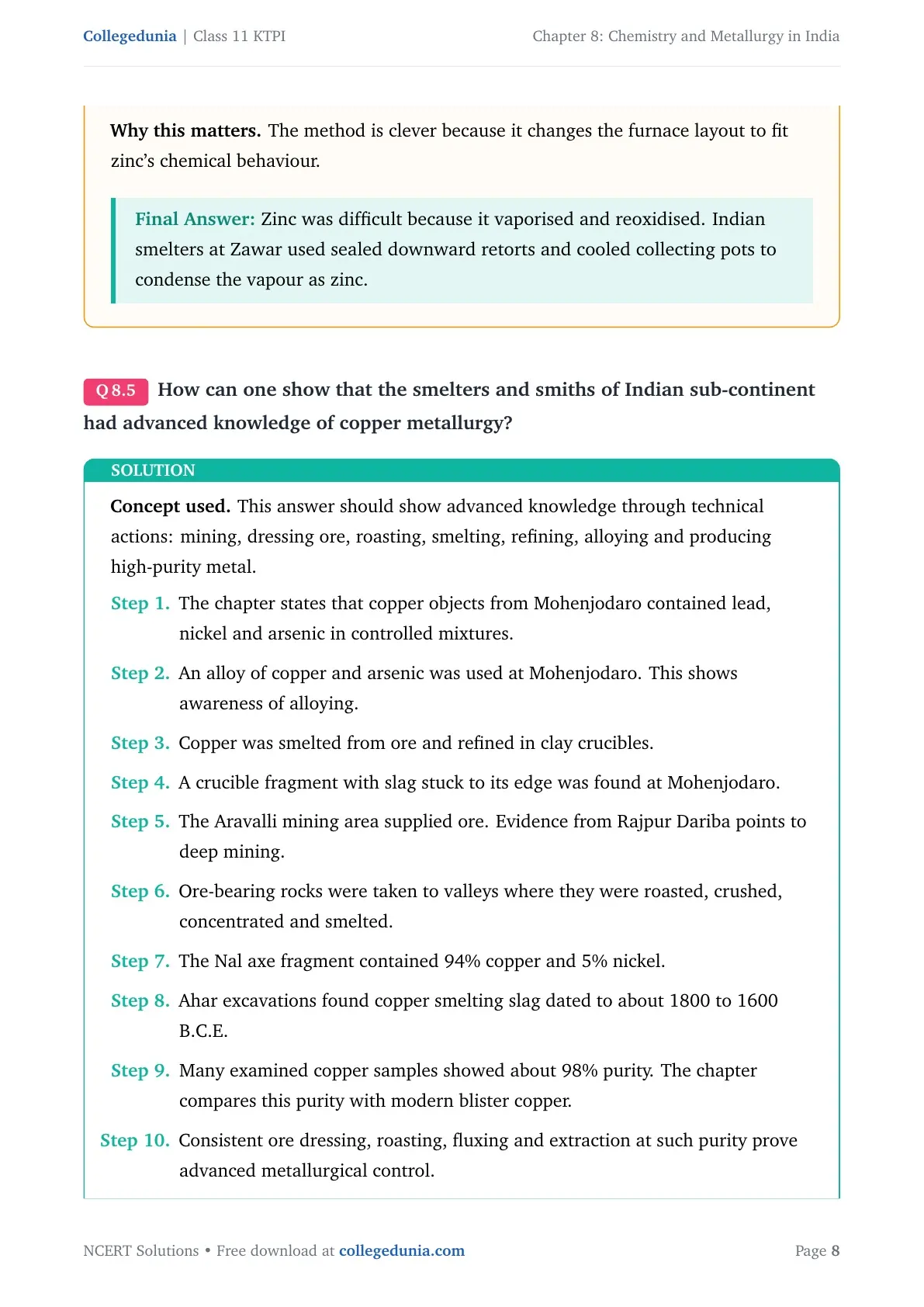
Why this matters. The method is clever because it changes the furnace
layout to fit zinc's chemical behaviour.
Zinc was difficult because it vaporised and reoxidised. Indian
smelters at Zawar used sealed downward retorts and cooled collecting pots to
condense the vapour as zinc.
Q 8.5
How can one show that the smelters and smiths of Indian sub-continent had advanced knowledge of copper metallurgy?
Concept used. This answer should show advanced knowledge through
technical actions: mining, dressing ore, roasting, smelting, refining,
alloying and producing high-purity metal.
The chapter states that copper objects from Mohenjodaro contained
lead, nickel and arsenic in controlled mixtures.
An alloy of copper and arsenic was used at Mohenjodaro. This shows
awareness of alloying.
Copper was smelted from ore and refined in clay crucibles.
A crucible fragment with slag stuck to its edge was found at
Mohenjodaro.
The Aravalli mining area supplied ore. Evidence from Rajpur Dariba
points to deep mining.
Ore-bearing rocks were taken to valleys where they were roasted,
crushed, concentrated and smelted.
The Nal axe fragment contained 94% copper and 5% nickel.
Ahar excavations found copper smelting slag dated to about 1800 to
1600 B.C.E.
Many examined copper samples showed about 98% purity. The chapter
compares this purity with modern blister copper.
Consistent ore dressing, roasting, fluxing and extraction at such
purity prove advanced metallurgical control.
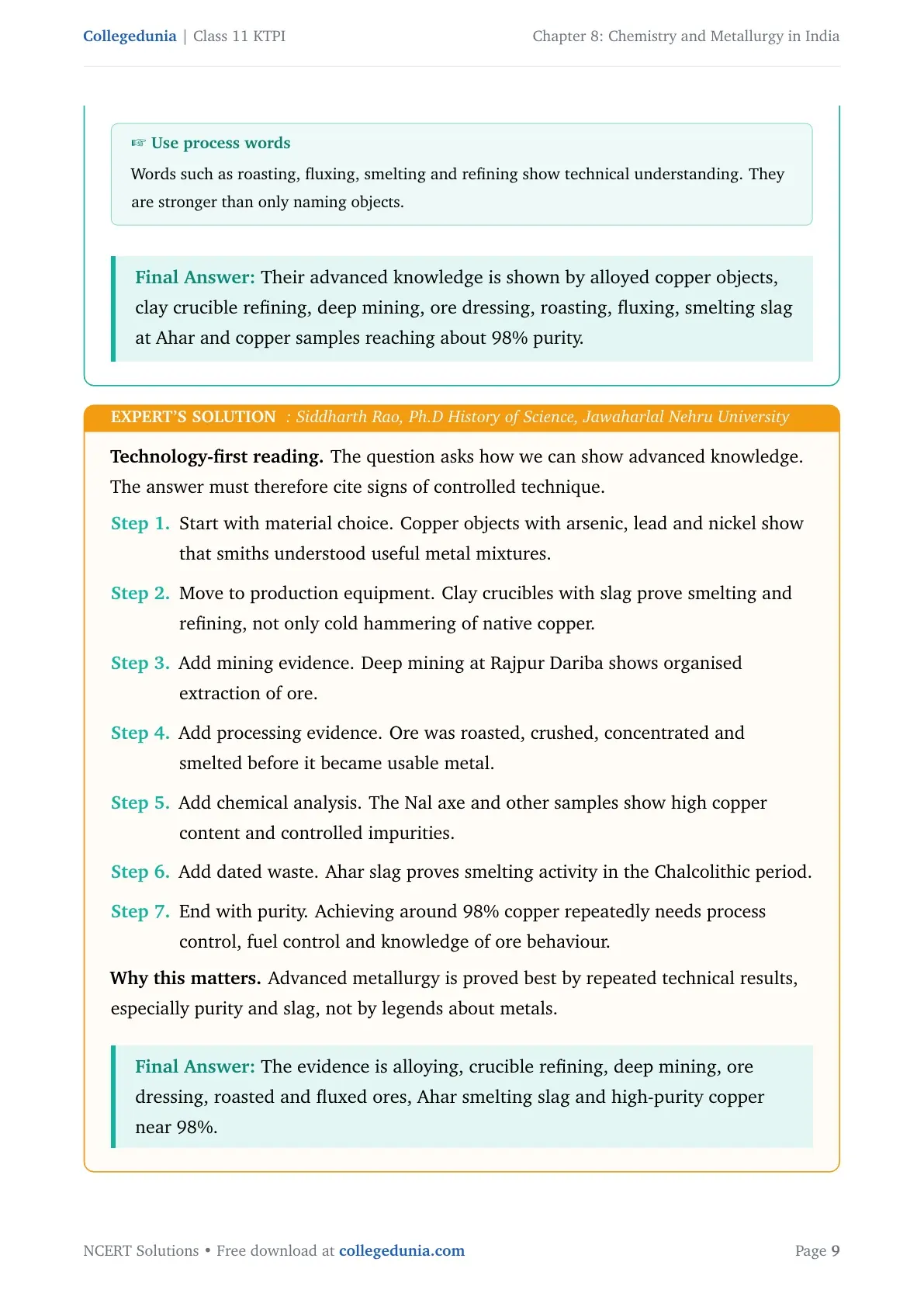
Use process words
Words such as roasting, fluxing, smelting and refining show technical
understanding. They are stronger than only naming objects.
Their advanced knowledge is shown by alloyed copper objects, clay
crucible refining, deep mining, ore dressing, roasting, fluxing, smelting slag
at Ahar and copper samples reaching about 98% purity.
SR
Siddharth Rao
Ph.D History of Science, Jawaharlal Nehru University
Verified Expert
Technology-first reading. The question asks how we can show advanced
knowledge. The answer must therefore cite signs of controlled technique.
Start with material choice. Copper objects with arsenic, lead and
nickel show that smiths understood useful metal mixtures.
Move to production equipment. Clay crucibles with slag prove smelting
and refining, not only cold hammering of native copper.
Add mining evidence. Deep mining at Rajpur Dariba shows organised
extraction of ore.
Add processing evidence. Ore was roasted, crushed, concentrated and
smelted before it became usable metal.
Add chemical analysis. The Nal axe and other samples show high copper
content and controlled impurities.
Add dated waste. Ahar slag proves smelting activity in the
Chalcolithic period.
End with purity. Achieving around 98% copper repeatedly needs process
control, fuel control and knowledge of ore behaviour.
Why this matters. Advanced metallurgy is proved best by repeated
technical results, especially purity and slag, not by legends about metals.
The evidence is alloying, crucible refining, deep mining, ore
dressing, roasted and fluxed ores, Ahar smelting slag and high-purity copper
near 98%.
Q 8.6
What caused the decline of knowledge of metallurgical skills in India?
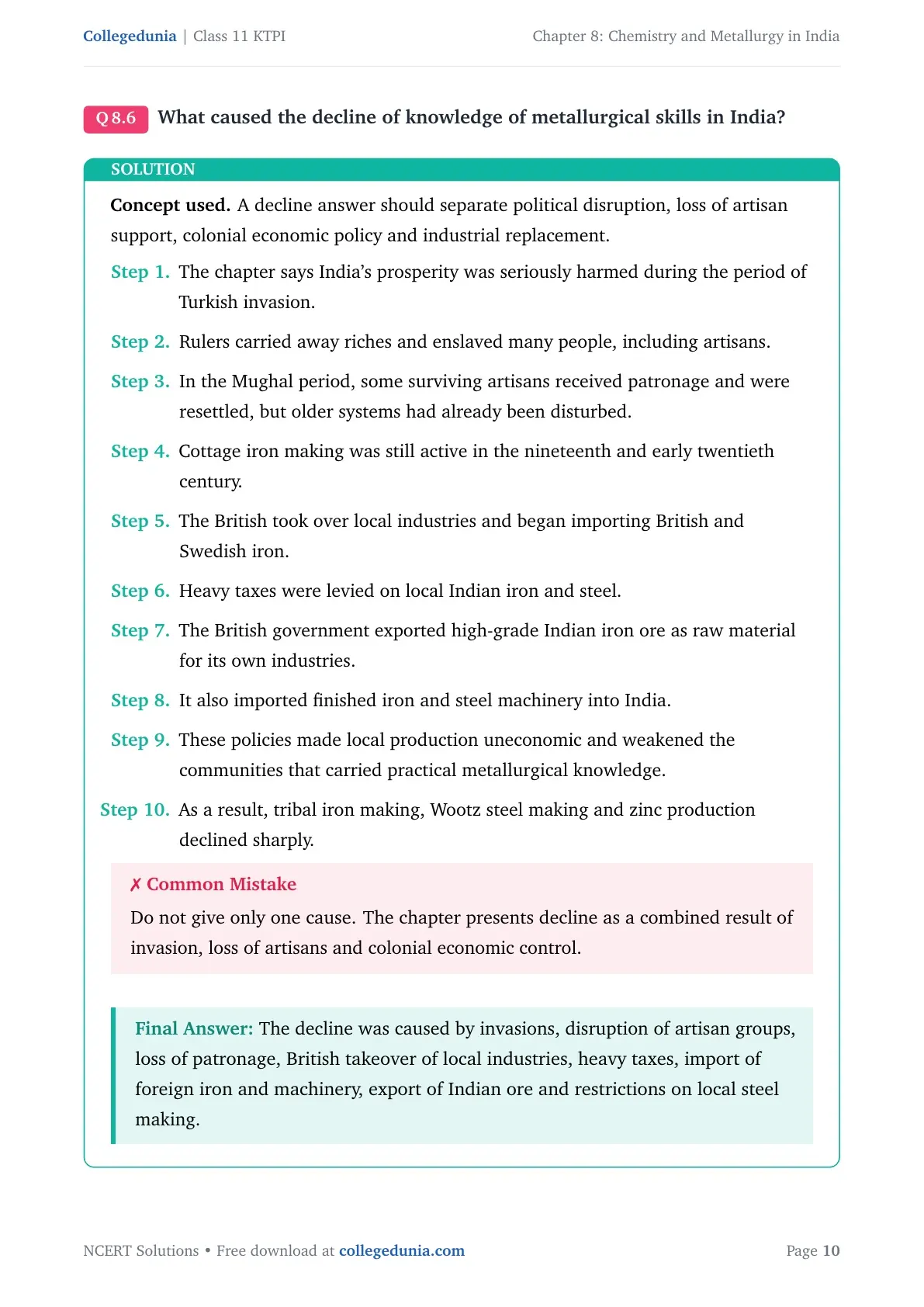
Concept used. A decline answer should separate political disruption,
loss of artisan support, colonial economic policy and industrial replacement.
The chapter says India's prosperity was seriously harmed during the
period of Turkish invasion.
Rulers carried away riches and enslaved many people, including
artisans.
In the Mughal period, some surviving artisans received patronage and
were resettled, but older systems had already been disturbed.
Cottage iron making was still active in the nineteenth and early
twentieth century.
The British took over local industries and began importing British
and Swedish iron.
Heavy taxes were levied on local Indian iron and steel.
The British government exported high-grade Indian iron ore as raw
material for its own industries.
It also imported finished iron and steel machinery into India.
These policies made local production uneconomic and weakened the
communities that carried practical metallurgical knowledge.
As a result, tribal iron making, Wootz steel making and zinc
production declined sharply.
Do not give only one cause. The chapter presents decline as a combined result
of invasion, loss of artisans and colonial economic control.
The decline was caused by invasions, disruption of artisan groups,
loss of patronage, British takeover of local industries, heavy taxes, import
of foreign iron and machinery, export of Indian ore and restrictions on local
steel making.
KB
Kavya Banerjee
M.A. History, University of Calcutta
Verified Expert
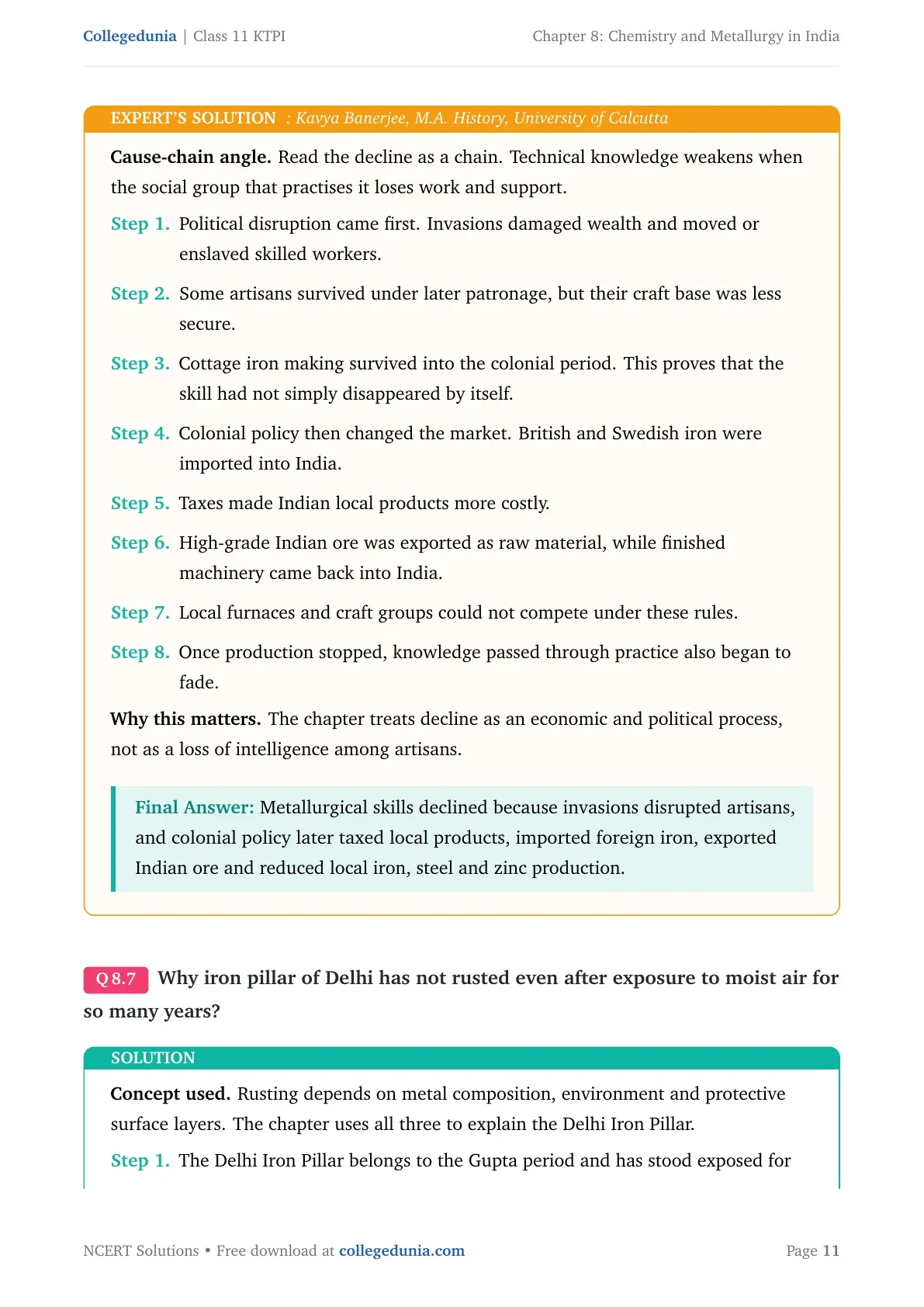
Cause-chain angle. Read the decline as a chain. Technical knowledge
weakens when the social group that practises it loses work and support.
Political disruption came first. Invasions damaged wealth and moved
or enslaved skilled workers.
Some artisans survived under later patronage, but their craft base was
less secure.
Cottage iron making survived into the colonial period. This proves
that the skill had not simply disappeared by itself.
Colonial policy then changed the market. British and Swedish iron were
imported into India.
Taxes made Indian local products more costly.
High-grade Indian ore was exported as raw material, while finished
machinery came back into India.
Local furnaces and craft groups could not compete under these rules.
Once production stopped, knowledge passed through practice also began
to fade.
Why this matters. The chapter treats decline as an economic and
political process, not as a loss of intelligence among artisans.
Metallurgical skills declined because invasions disrupted artisans,
and colonial policy later taxed local products, imported foreign iron,
exported Indian ore and reduced local iron, steel and zinc production.
Q 8.7
Why iron pillar of Delhi has not rusted even after exposure to moist air for so many years?
Concept used. Rusting depends on metal composition, environment and
protective surface layers. The chapter uses all three to explain the Delhi
Iron Pillar.
The Delhi Iron Pillar belongs to the Gupta period and has stood
exposed for about 1,600 years.
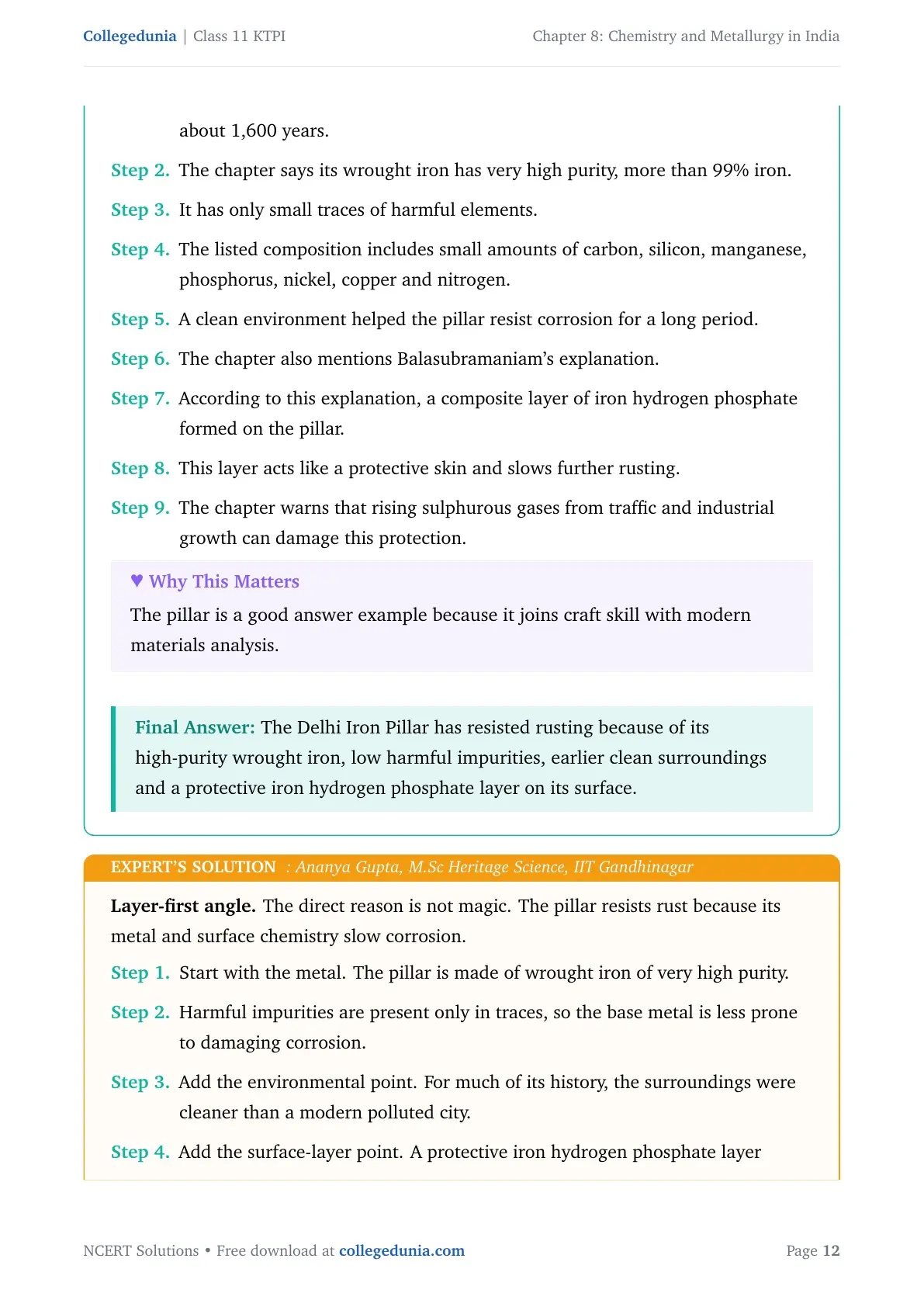
The chapter says its wrought iron has very high purity, more than
99% iron.
It has only small traces of harmful elements.
The listed composition includes small amounts of carbon, silicon,
manganese, phosphorus, nickel, copper and nitrogen.
A clean environment helped the pillar resist corrosion for a long
period.
The chapter also mentions Balasubramaniam's explanation.
According to this explanation, a composite layer of iron hydrogen
phosphate formed on the pillar.
This layer acts like a protective skin and slows further rusting.
The chapter warns that rising sulphurous gases from traffic and
industrial growth can damage this protection.
The pillar is a good answer example because it joins craft skill with modern
materials analysis.
The Delhi Iron Pillar has resisted rusting because of its high-purity
wrought iron, low harmful impurities, earlier clean surroundings and a
protective iron hydrogen phosphate layer on its surface.
AG
Ananya Gupta
M.Sc Heritage Science, IIT Gandhinagar
Verified Expert
Layer-first angle. The direct reason is not magic. The pillar resists
rust because its metal and surface chemistry slow corrosion.
Start with the metal. The pillar is made of wrought iron of very high
purity.
Harmful impurities are present only in traces, so the base metal is
less prone to damaging corrosion.
Add the environmental point. For much of its history, the surroundings
were cleaner than a modern polluted city.
Add the surface-layer point. A protective iron hydrogen phosphate
layer formed on the pillar.
This layer separates the inner iron from moisture and air.
Because air and moisture cannot attack the fresh iron easily, rusting
remains very slow.
The warning in the chapter is also relevant. More sulphurous gases may
disturb the protective condition.
Why this matters. The answer shows why ancient metal skill can be
studied with modern chemistry instead of only admired.
It has not rusted badly because high-purity wrought iron and a
protective iron hydrogen phosphate layer have limited corrosion despite long
exposure.
Class 11 KTPI Chemistry and Metallurgy NCERT Solutions FAQs
Ques. How many questions are solved in Class 11 KTPI Chapter 8 Chemistry and Metallurgy in India?
Ans. All 7 NCERT exercise questions are solved. The PDF and the question cards cover ink materials, atom theory, copper metallurgy, zinc smelting, decline of metallurgical skills and the Delhi Iron Pillar.
Ques. What are the most important topics in Chemistry and Metallurgy in India Class 11 KTPI?
Ans. Important topics are ink-making materials, Kanada's atomic theory, indigenous copper metallurgy, Zawar zinc distillation, Wootz steel, colonial decline of metallurgy and the corrosion resistance of the Delhi Iron Pillar.
Ques. Why is zinc extraction difficult in Class 11 KTPI Chapter 8?
Ans. Zinc extraction is difficult because zinc vaporises during heating. Indian smelters at Zawar used retorts and descending distillation so that zinc vapour could move away from air, cool down and collect as metal.
Ques. Why has the Delhi Iron Pillar not rusted heavily for many years?
Ans. The pillar has high-purity wrought iron with low harmful impurities. The chapter also explains that a protective iron hydrogen phosphate layer formed on the surface, which slowed corrosion in moist air.
Ques. Which resources should I use with these NCERT Solutions?
Ans. Use the NCERT Book PDF for source reading, chapter notes for compact revision, handwritten notes for last-minute recall and this Solutions PDF for answer-writing practice in the 2026-27 syllabus.







Comments