The NCERT Solutions for Class 11 Psychology Chapter 3 Human Development cover all 10 textbook review questions from the latest 2026-27 NCERT book. The chapter explains development across the life span, from prenatal growth and childhood attachment to adolescence, identity and entry into adulthood.
Covers every review question with a direct solution and an expert explanation.
Focuses on growth, maturation, life-span perspective, cognitive change, attachment and identity formation.
Useful for school exams because answers connect definitions with examples from everyday development.
Student Feedback: In a Collegedunia poll of 11,240 Class 11 Psychology students preparing for the 2026 school exams, 68% said they could define development but confused growth, maturation and adolescence in long answers.
Source: 2026-27 Class 11 Psychology student poll across CBSE schools.
Every answer in this chapter set is checked against the 2026-27 NCERT Psychology textbook and written so that students can revise the concept, example and exam framing together.
Human Development: What Class 11 Students Must Know
Human Development studies how a person changes from conception to old age. The chapter asks students to see development as a continuous process shaped by heredity, maturation, learning, family, culture and social roles. Development is wider than growth because it includes physical, cognitive, emotional and social changes.
Chapter area
What students must know
Where it helps
Meaning of development
Development includes ordered qualitative and quantitative change
Question 1
Life-span view
Development is lifelong, multidirectional, plastic and contextual
Question 2
Developmental tasks
Age-linked responsibilities students are expected to master
Question 3
Child development
Environment, cognition and attachment shape later adjustment
Questions 4 to 7
Adolescence and adulthood
Identity, egocentrism and adult roles become central
Questions 8 to 10
The safest exam strategy is to explain each stage with one keyword, one example and one effect on behaviour. This keeps answers clear when questions ask for environment, attachment or identity.
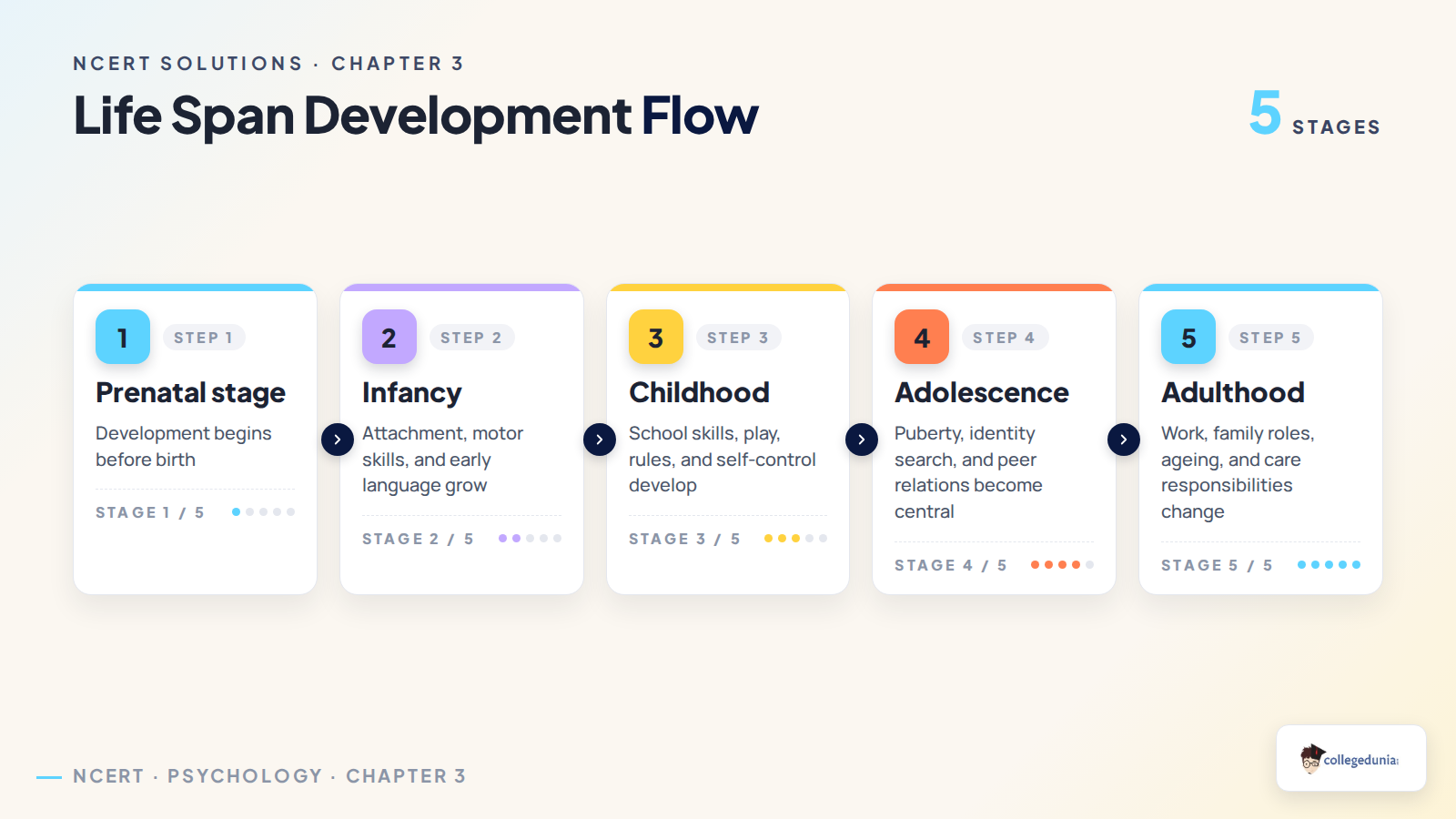
The life-span perspective says development does not stop after childhood. It continues through infancy, childhood, adolescence, adulthood and old age. Each period brings its own strengths, risks and responsibilities, so answers should avoid treating development as only physical growth.
Lifelong: change continues from prenatal life to old age.
Multidirectional: some abilities improve while others may slow down.
Plastic: experience, practice and support can change development.
Contextual: family, school, peers, culture and history shape behaviour.
This section is especially important for questions on developmental tasks. A strong answer names the task, places it in the age period and gives a daily-life example.
Growth, Maturation and Cognitive Changes in Human Development
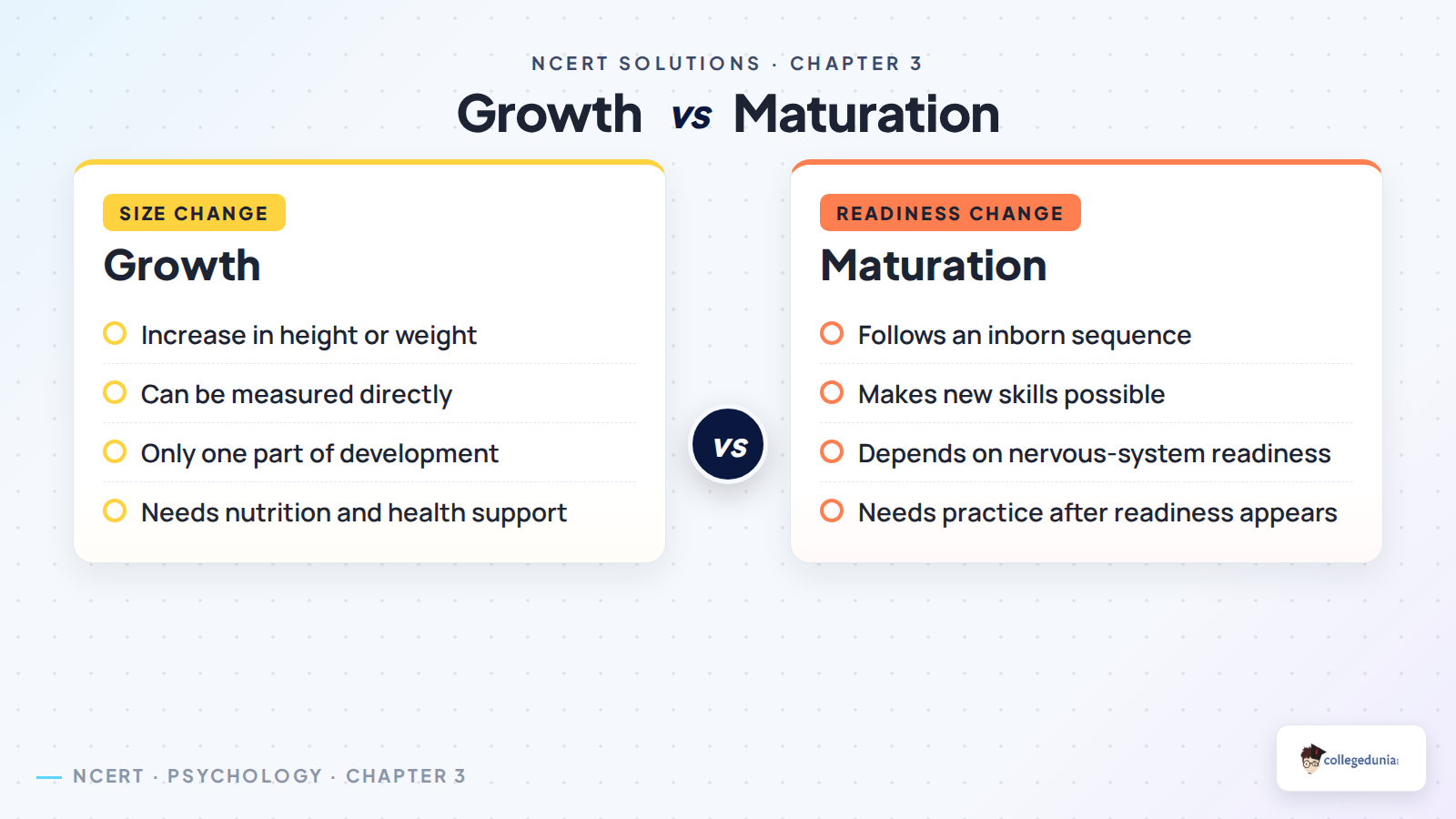
Growth means measurable physical increase, such as height or weight. Maturation means the biologically guided readiness that allows a child to perform new skills. Development includes both, but it also includes thinking, language, emotion and social understanding.
Term
Meaning
Example
Growth
Increase in size or body structure
A child becoming taller and heavier
Maturation
Natural readiness for a skill
Nervous-system readiness for walking
Cognitive development
Change in thinking, memory, attention and reasoning
Moving from concrete examples to abstract ideas
Attachment
Close emotional bond with caregivers
A child using the caregiver as a secure base
How to Write Better Human Development Answers
Most mistakes in this chapter happen when students write a definition but skip the developmental effect. The review questions expect both concept and application. For example, an answer on attachment should say what attachment is, then explain how secure care supports trust and later relationships.
Start with the exact term. Define development, growth, maturation, identity or egocentrism clearly.
Add the stage. Mention infancy, childhood, adolescence or adulthood when the question asks for a period.
Use one example. Connect the idea with school, family, peer group, media, work or daily responsibility.
Close with impact. Explain how the factor shapes behaviour, adjustment or self-understanding.
The solved PDF follows the same pattern. It gives the quick answer first, then the concept, steps and expert explanation for revision.
Related Psychology Resources for Human Development
Use the solutions PDF for answers, then move to notes and the NCERT book when you want to revise theory in a different format.
All NCERT Solutions for Class 11 Psychology Chapter 3 Human Development with Step-by-Step Solutions
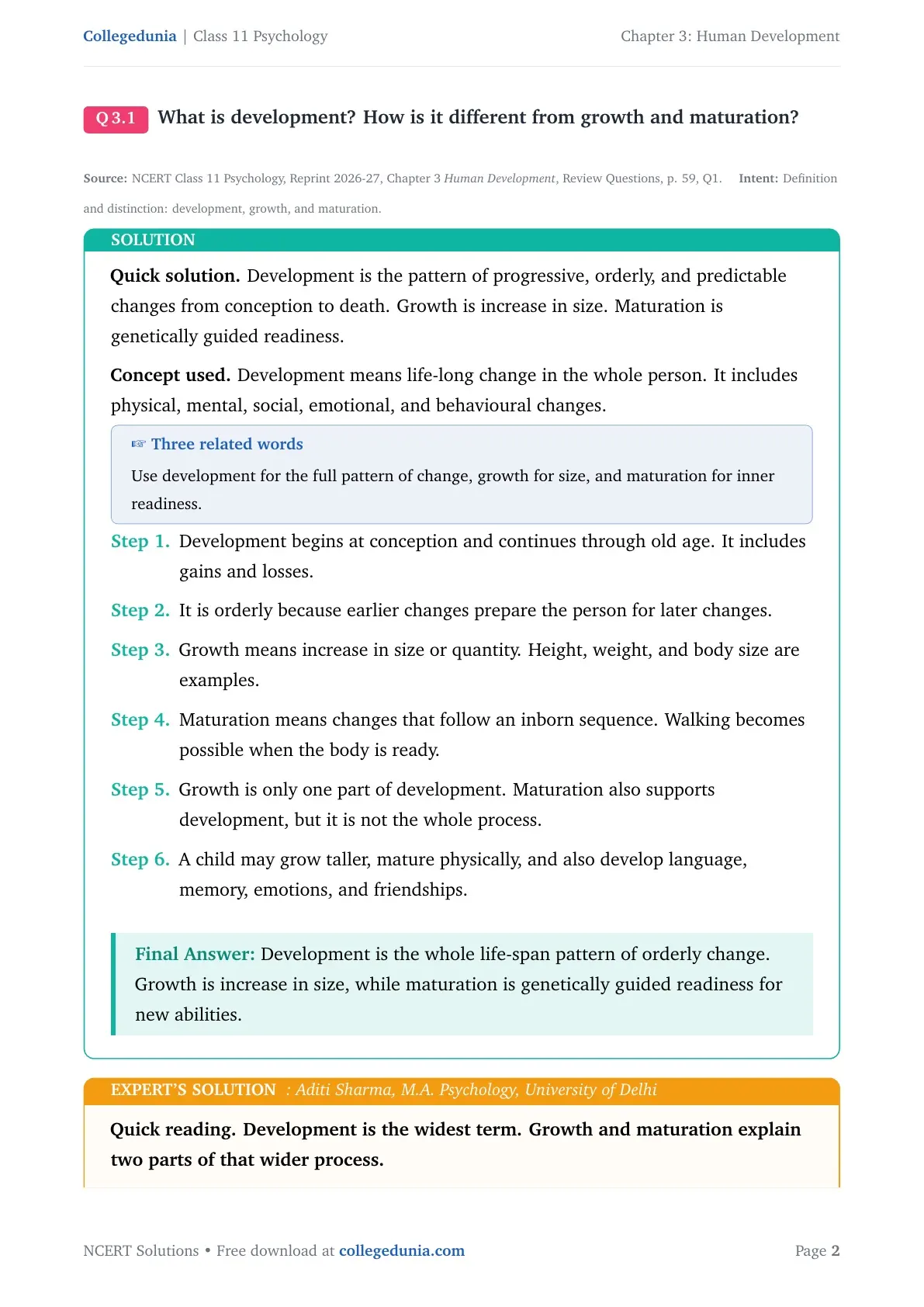
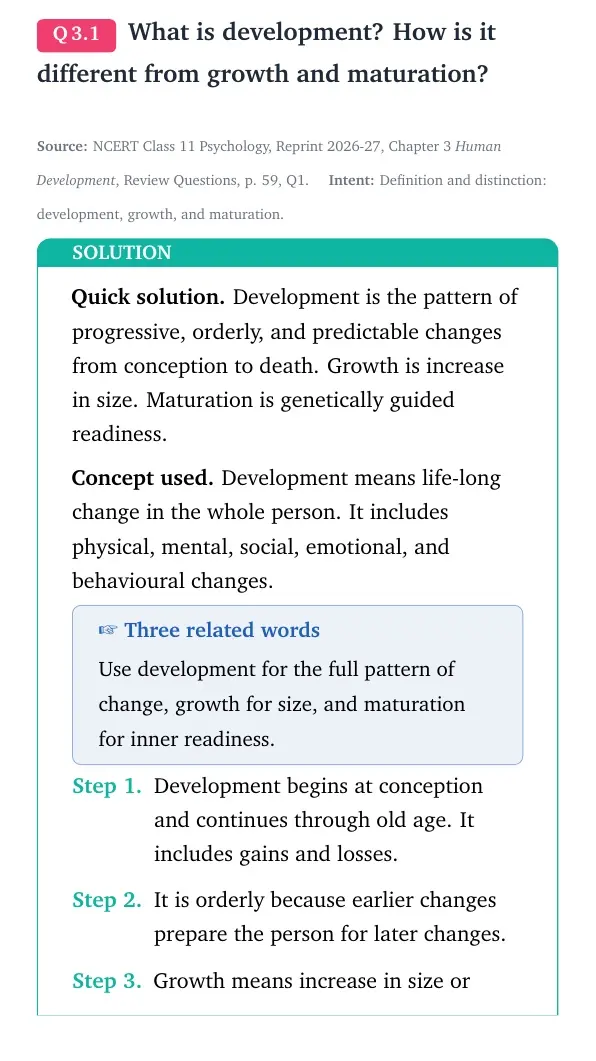
Q 3.1
What is development? How is it different from growth and maturation?
Development is the pattern of progressive, orderly, and predictable changes from conception to death. Growth is increase in size. Maturation is genetically guided readiness. Concept used. Development means life-long change in the whole person. It includes physical, mental, social, emotional, and behavioural changes.
Three related words
Use development for the full pattern of change, growth for size, and maturation for inner readiness.
Development begins at conception and continues through old age. It includes gains and losses.
It is orderly because earlier changes prepare the person for later changes.
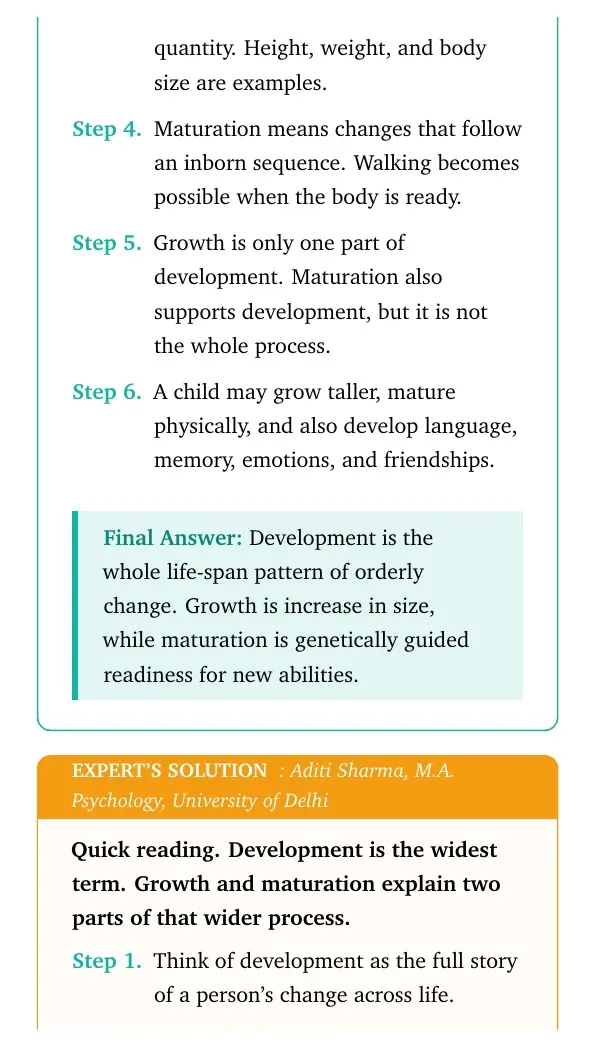
Growth means increase in size or quantity. Height, weight, and body size are examples.
Maturation means changes that follow an inborn sequence. Walking becomes possible when the body is ready.
Growth is only one part of development. Maturation also supports development, but it is not the whole process.
A child may grow taller, mature physically, and also develop language, memory, emotions, and friendships.
Development is the whole life-span pattern of orderly change. Growth is increase in size, while maturation is genetically guided readiness for new abilities.
AS
Aditi Sharma
M.A. Psychology, University of Delhi
Verified Expert
Quick reading. Development is the widest term. Growth and maturation explain two parts of that wider process.
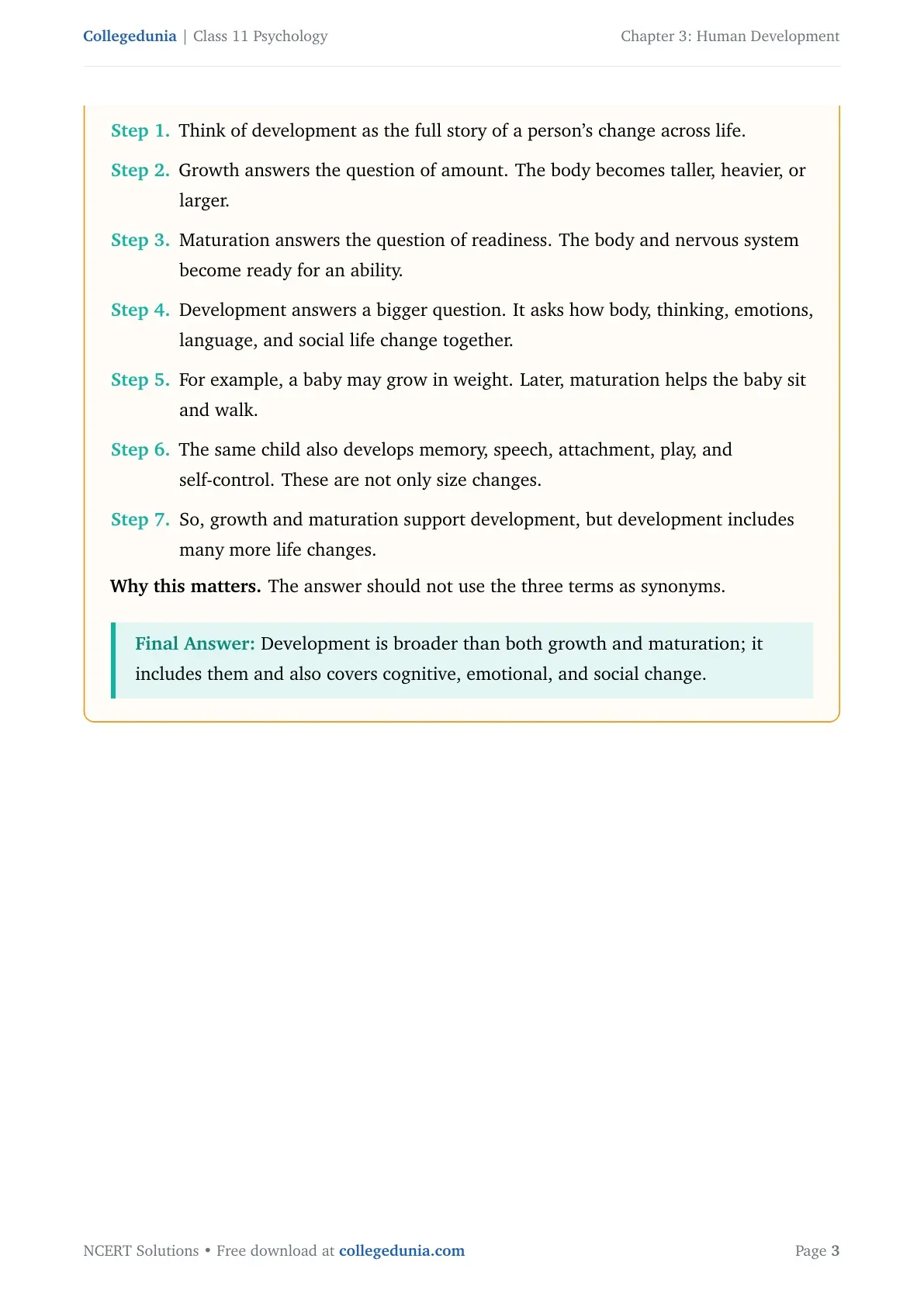
Think of development as the full story of a person's change across life.
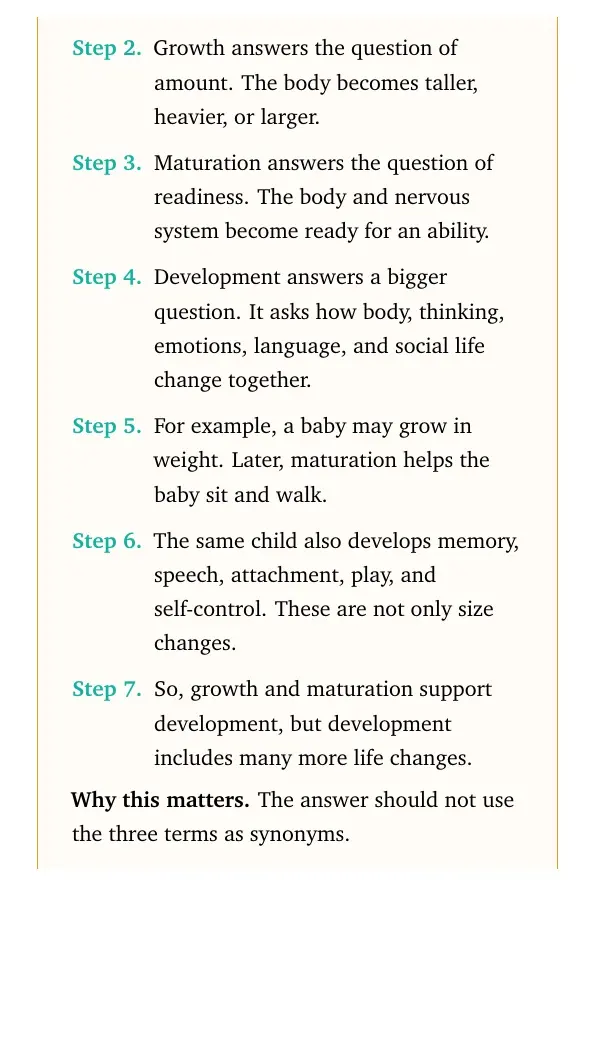
Growth answers the question of amount. The body becomes taller, heavier, or larger.
Maturation answers the question of readiness. The body and nervous system become ready for an ability.
Development answers a bigger question. It asks how body, thinking, emotions, language, and social life change together.
For example, a baby may grow in weight. Later, maturation helps the baby sit and walk.
The same child also develops memory, speech, attachment, play, and self-control. These are not only size changes.
So, growth and maturation support development, but development includes many more life changes.
Why this matters. The answer should not use the three terms as synonyms.
Development is broader than both growth and maturation; it includes them and also covers cognitive, emotional, and social change.
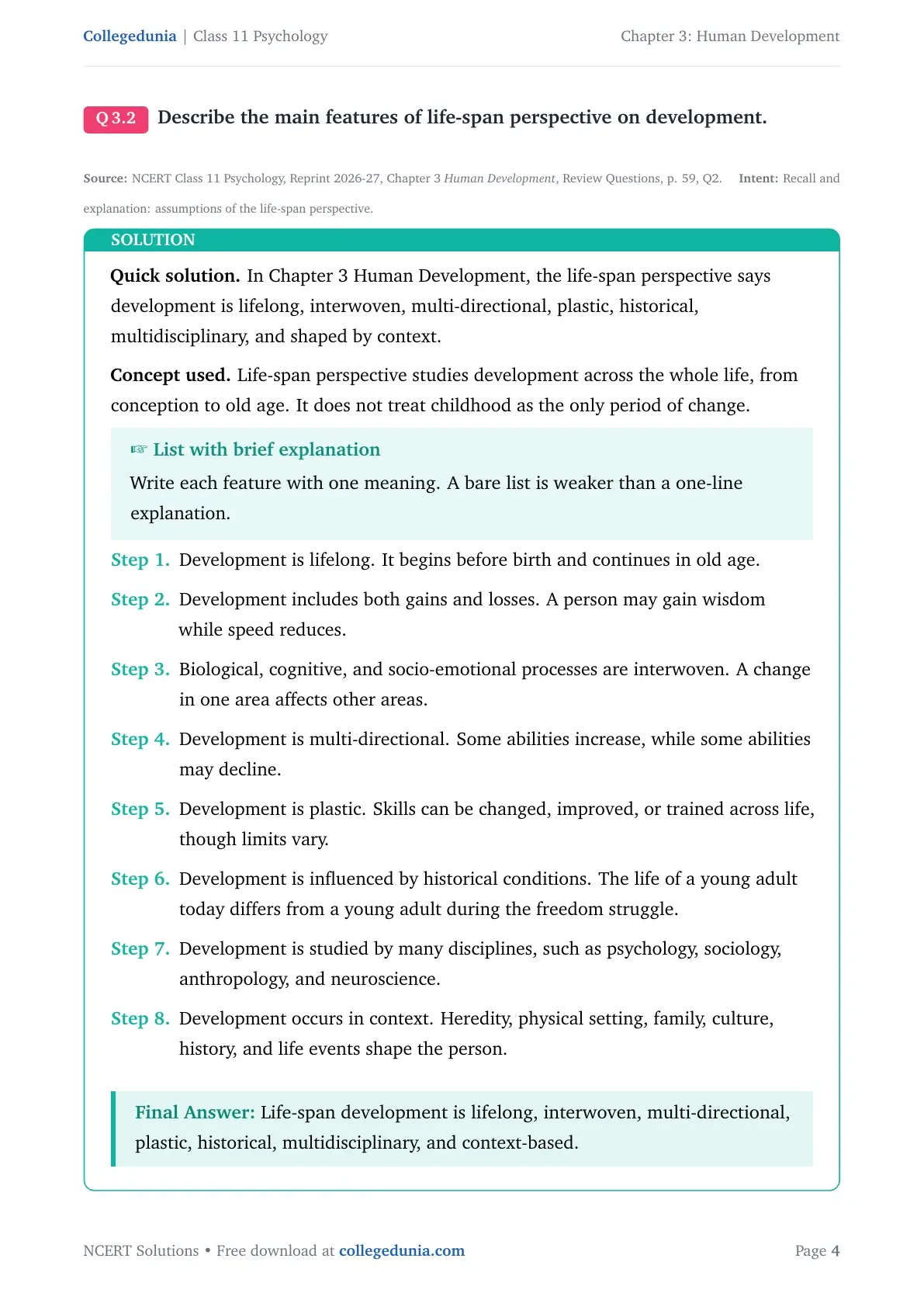
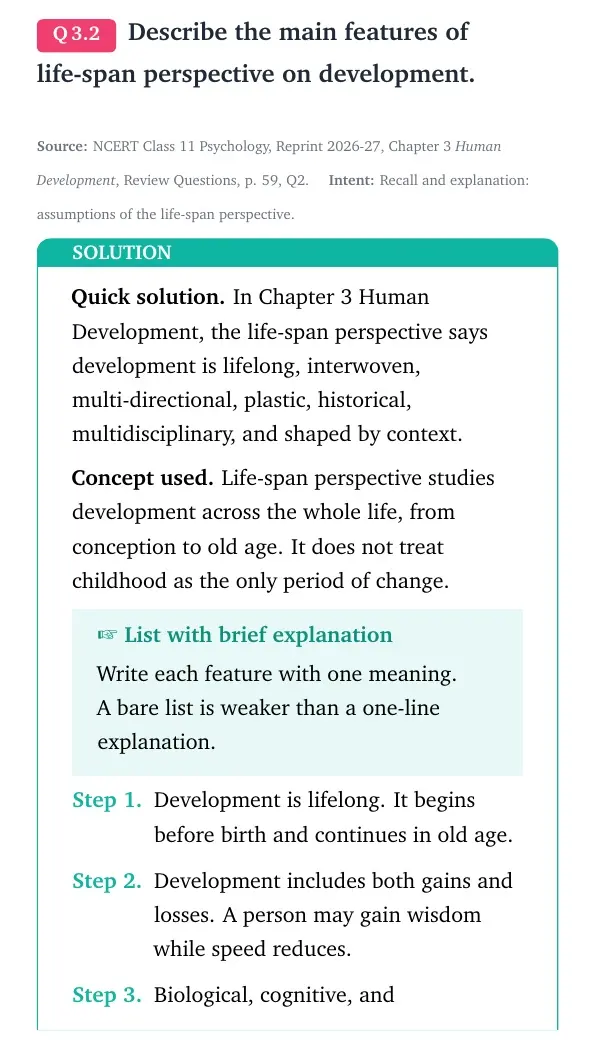
Q 3.2
Describe the main features of life-span perspective on development.
In Chapter 3 Human Development, the life-span perspective says development is lifelong, interwoven, multi-directional, plastic, historical, multidisciplinary, and shaped by context. Concept used. Life-span perspective studies development across the whole life, from conception to old age. It does not treat childhood as the only period of change.
List with brief explanation
Write each feature with one meaning. A bare list is weaker than a one-line explanation.
Development is lifelong. It begins before birth and continues in old age.
Development includes both gains and losses. A person may gain wisdom while speed reduces.
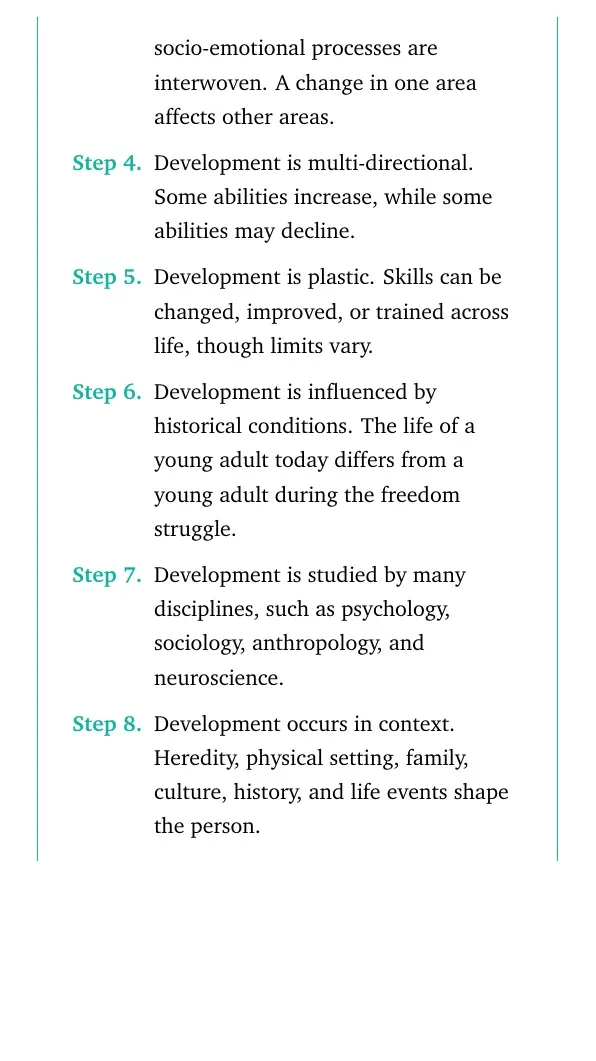
Biological, cognitive, and socio-emotional processes are interwoven. A change in one area affects other areas.
Development is multi-directional. Some abilities increase, while some abilities may decline.
Development is plastic. Skills can be changed, improved, or trained across life, though limits vary.
Development is influenced by historical conditions. The life of a young adult today differs from a young adult during the freedom struggle.
Development is studied by many disciplines, such as psychology, sociology, anthropology, and neuroscience.
Development occurs in context. Heredity, physical setting, family, culture, history, and life events shape the person.
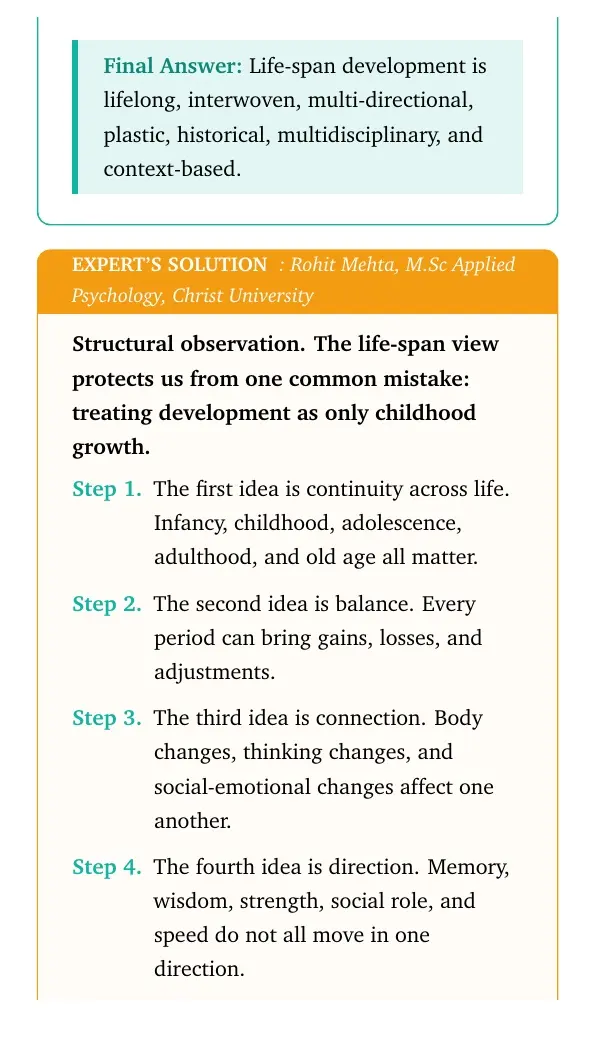
Life-span development is lifelong, interwoven, multi-directional, plastic, historical, multidisciplinary, and context-based.
RM
Rohit Mehta
M.Sc Applied Psychology, Christ University
Verified Expert
Structural observation. The life-span view protects us from one common mistake: treating development as only childhood growth.
The first idea is continuity across life. Infancy, childhood, adolescence, adulthood, and old age all matter.
The second idea is balance. Every period can bring gains, losses, and adjustments.
The third idea is connection. Body changes, thinking changes, and social-emotional changes affect one another.
The fourth idea is direction. Memory, wisdom, strength, social role, and speed do not all move in one direction.
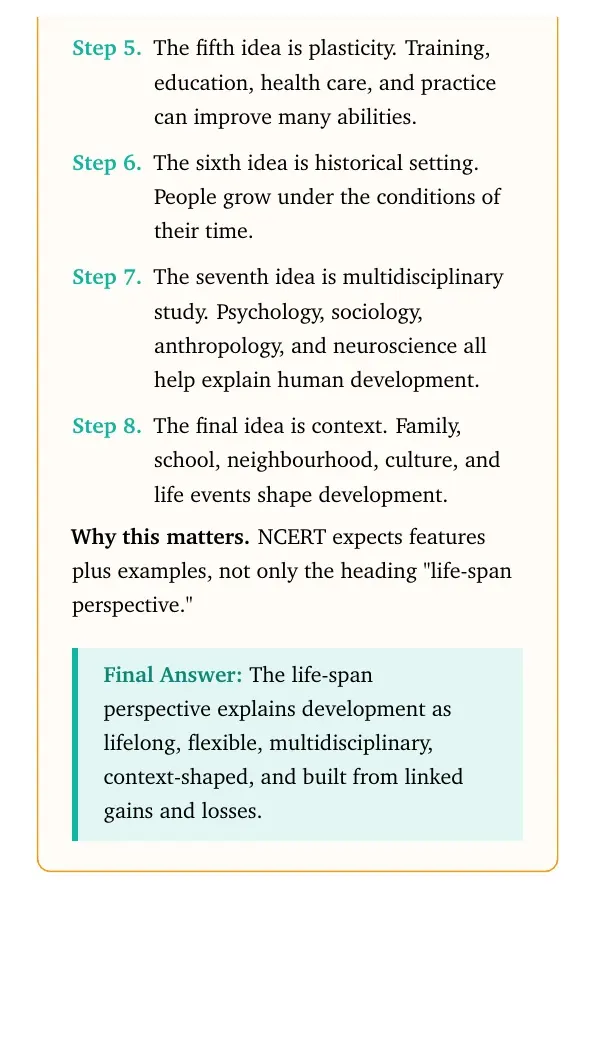
The fifth idea is plasticity. Training, education, health care, and practice can improve many abilities.
The sixth idea is historical setting. People grow under the conditions of their time.
The seventh idea is multidisciplinary study. Psychology, sociology, anthropology, and neuroscience all help explain human development.
The final idea is context. Family, school, neighbourhood, culture, and life events shape development.
Why this matters. NCERT expects features plus examples, not only the heading "life-span perspective."
The life-span perspective explains development as lifelong, flexible, multidisciplinary, context-shaped, and built from linked gains and losses.
Q 3.3
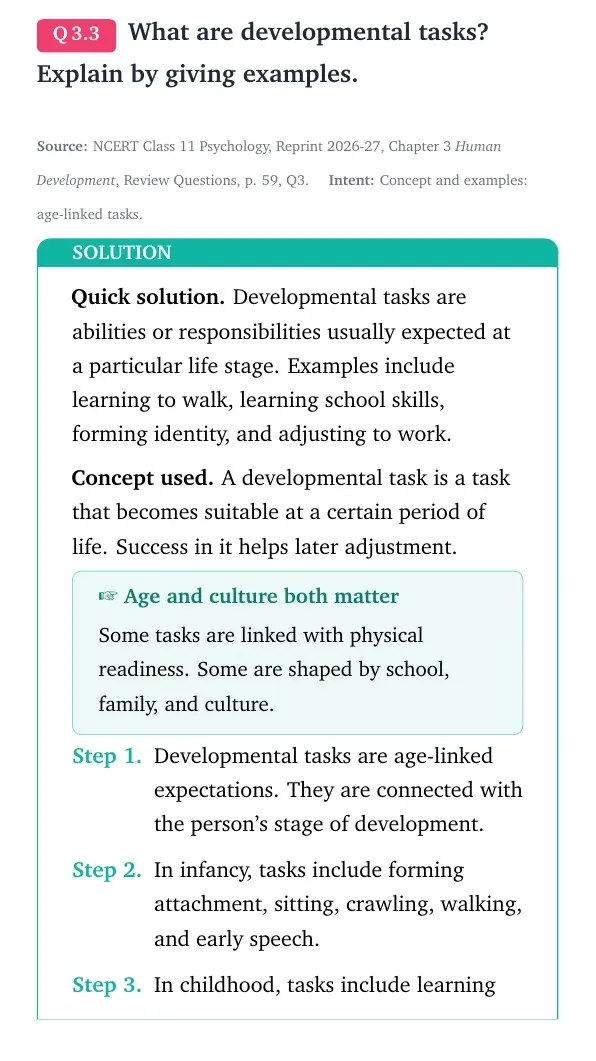
What are developmental tasks? Explain by giving examples.
Developmental tasks are abilities or responsibilities usually expected at a particular life stage. Examples include learning to walk, learning school skills, forming identity, and adjusting to work. Concept used. A developmental task is a task that becomes suitable at a certain period of life. Success in it helps later adjustment.
Age and culture both matter
Some tasks are linked with physical readiness. Some are shaped by school, family, and culture.
Developmental tasks are age-linked expectations. They are connected with the person's stage of development.
In infancy, tasks include forming attachment, sitting, crawling, walking, and early speech.
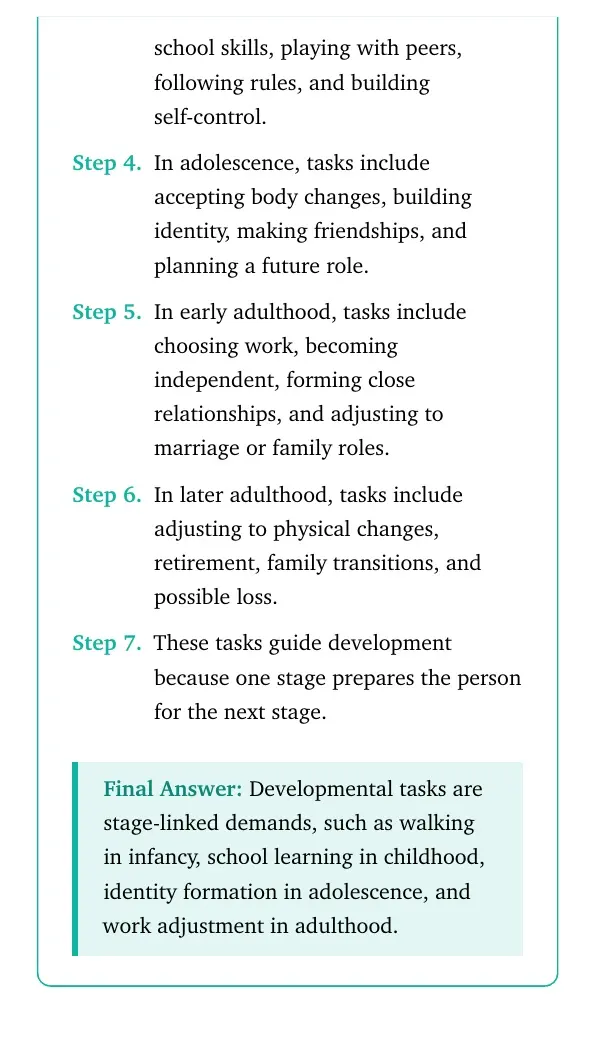
In childhood, tasks include learning school skills, playing with peers, following rules, and building self-control.
In adolescence, tasks include accepting body changes, building identity, making friendships, and planning a future role.
In early adulthood, tasks include choosing work, becoming independent, forming close relationships, and adjusting to marriage or family roles.
In later adulthood, tasks include adjusting to physical changes, retirement, family transitions, and possible loss.
These tasks guide development because one stage prepares the person for the next stage.
Developmental tasks are stage-linked demands, such as walking in infancy, school learning in childhood, identity formation in adolescence, and work adjustment in adulthood.
PN
Priya Nair
M.A. Clinical Psychology, Tata Institute of Social Sciences
Verified Expert
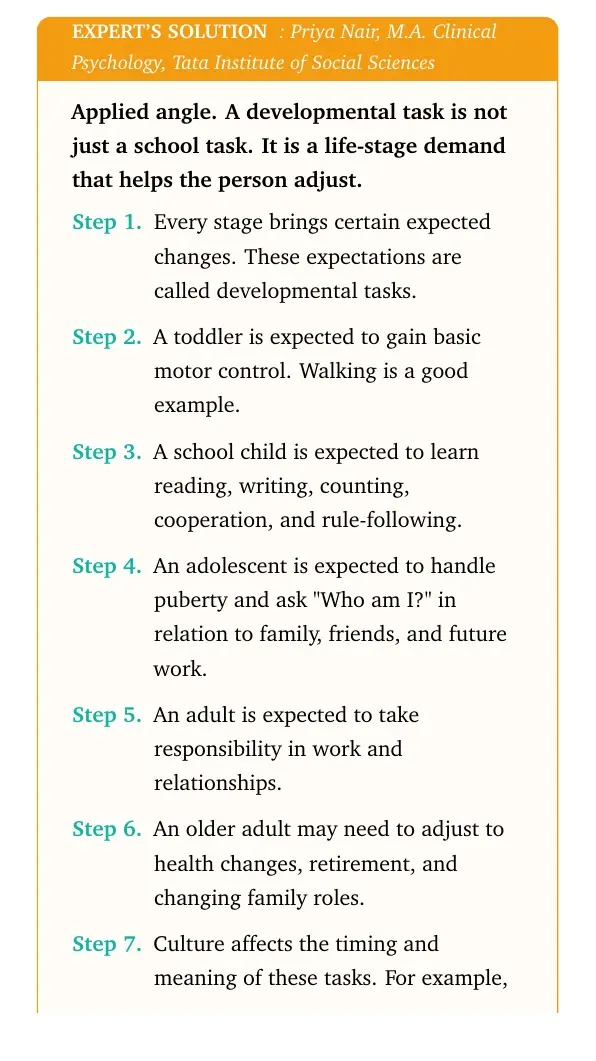
Applied angle. A developmental task is not just a school task. It is a life-stage demand that helps the person adjust.
Every stage brings certain expected changes. These expectations are called developmental tasks.
A toddler is expected to gain basic motor control. Walking is a good example.
A school child is expected to learn reading, writing, counting, cooperation, and rule-following.
An adolescent is expected to handle puberty and ask "Who am I?" in relation to family, friends, and future work.
An adult is expected to take responsibility in work and relationships.
An older adult may need to adjust to health changes, retirement, and changing family roles.
Culture affects the timing and meaning of these tasks. For example, family responsibility may begin earlier in some homes.
Why this matters. Good answers give examples from more than one stage of life.
Developmental tasks are age-linked responsibilities and abilities that support healthy adjustment at each stage of life.
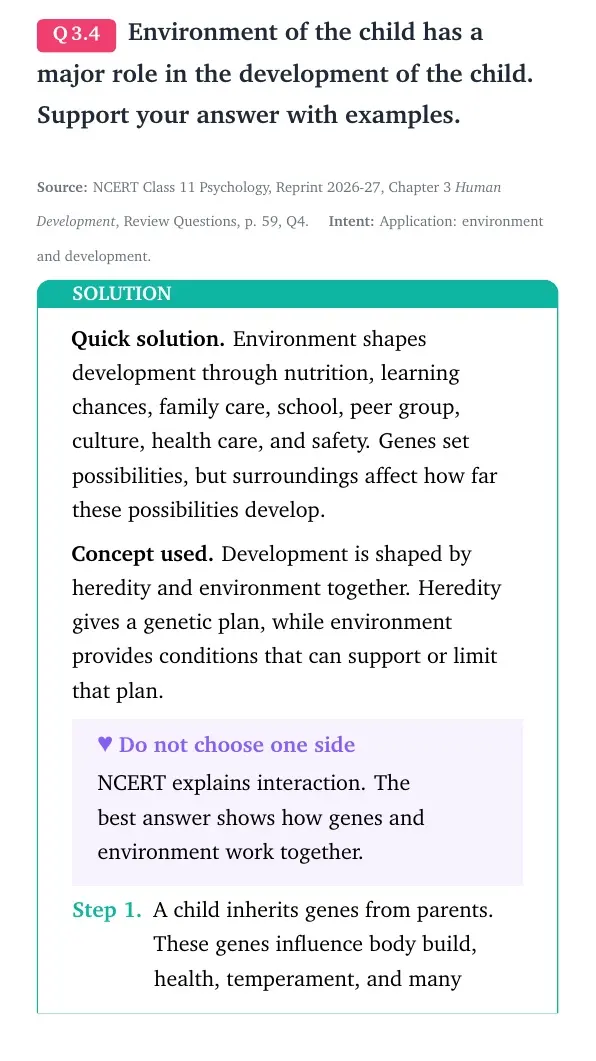
Q 3.4
Environment of the child has a major role in the development of the child. Support your answer with examples.
Environment shapes development through nutrition, learning chances, family care, school, peer group, culture, health care, and safety. Genes set possibilities, but surroundings affect how far these possibilities develop. Concept used. Development is shaped by heredity and environment together. Heredity gives a genetic plan, while environment provides conditions that can support or limit that plan.
Do not choose one side
NCERT explains interaction. The best answer shows how genes and environment work together.
A child inherits genes from parents. These genes influence body build, health, temperament, and many abilities.
The environment decides many chances the child receives. Food, care, books, school, language, play, and safety all matter.
Nutrition is a simple example. A child with a good growth potential may still remain weak if food is poor.
Learning environment also matters. Parents who read and provide books may support reading interest in the child.
Social environment shapes personality. A shy child may become more outgoing in a warm setting that encourages interaction.
Pollution, illness, stress, violence, and neglect can slow or disturb development.
A supportive environment cannot remove every genetic limit, but it can help the child reach a better level within that limit.
The child's environment has a major role because it supplies nutrition, care, stimulation, safety, and social models that shape development.
KI
Karan Iyer
M.Phil Psychology, Jamia Millia Islamia
Verified Expert
Quick reading. Genes are not a finished life story. The child's surroundings decide how many abilities are encouraged, practised, and supported.
Development starts with heredity, but genes do not act in empty space.
A child's home gives language, affection, discipline, food, sleep routine, and early stimulation.
School adds instruction, peer contact, rule learning, and chances to solve problems.
Culture tells the child what behaviour is valued. It shapes gender roles, respect, independence, and family duty.
Good health care protects the child from illness that may affect physical and mental growth.
Unsafe or poor settings can reduce opportunities. Lack of nutrition or books can limit performance.
The best example is height. Genes set a possible range, but food and health decide where the child may fall in that range.
Why this matters. The answer should show interaction, not a contest between nature and nurture.
Environment plays a major role by supporting or limiting the child's inherited potential through daily conditions and opportunities.
Q 3.5
How do socio-cultural factors influence development?
In Chapter 3 Human Development, socio-cultural factors influence development through family, school, peers, culture, indirect settings, historical events, resources, and deprivation. Concept used. Socio-cultural factors are the nested social and cultural conditions in which a child grows. Development does not take place in a vacuum; it is embedded in context.
Use concrete settings
Name family, school, peer group, neighbourhood, and culture. These examples make the answer specific.
The microsystem is the child's immediate setting: family, school, peers, teachers, and neighbourhood.
The mesosystem means relations between these settings. For example, how parents relate to teachers can affect school adjustment.
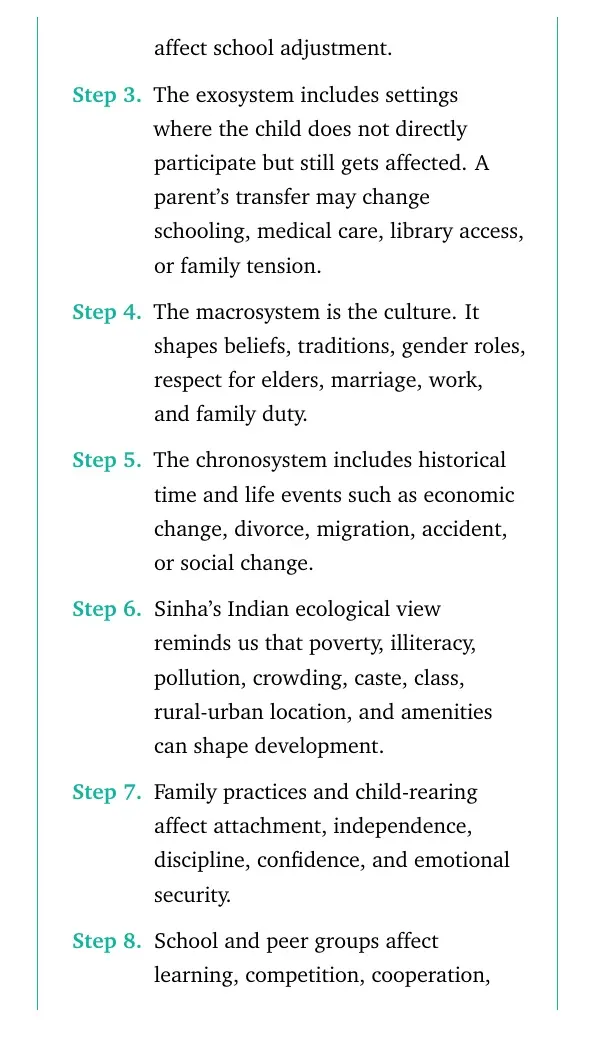
The exosystem includes settings where the child does not directly participate but still gets affected. A parent's transfer may change schooling, medical care, library access, or family tension.
The macrosystem is the culture. It shapes beliefs, traditions, gender roles, respect for elders, marriage, work, and family duty.
The chronosystem includes historical time and life events such as economic change, divorce, migration, accident, or social change.
Sinha's Indian ecological view reminds us that poverty, illiteracy, pollution, crowding, caste, class, rural-urban location, and amenities can shape development.
Family practices and child-rearing affect attachment, independence, discipline, confidence, and emotional security.
School and peer groups affect learning, competition, cooperation, social skills, identity, self-image, and risk-taking.
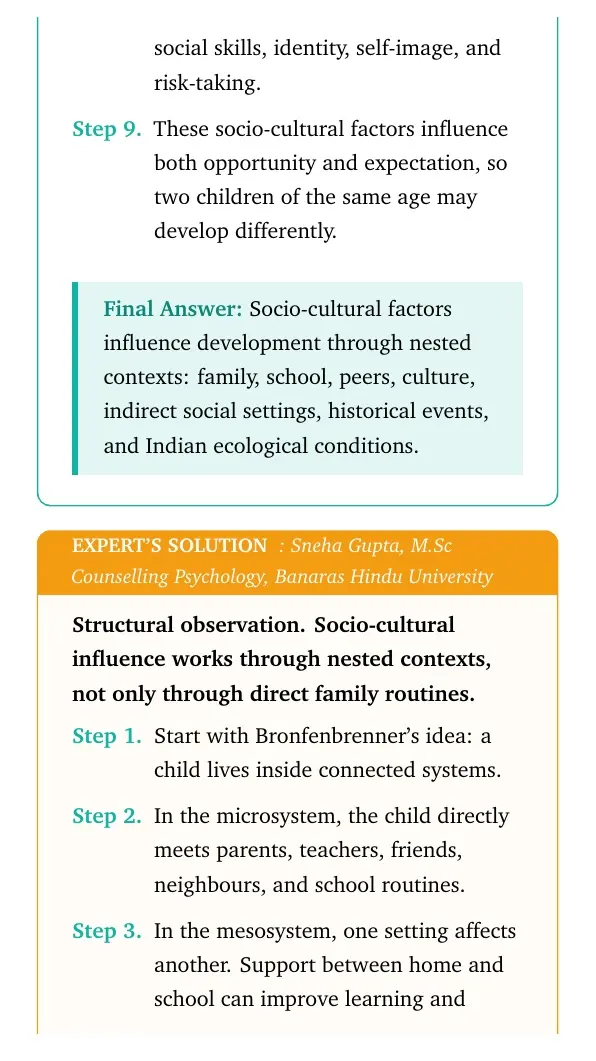
These socio-cultural factors influence both opportunity and expectation, so two children of the same age may develop differently.
Socio-cultural factors influence development through nested contexts: family, school, peers, culture, indirect social settings, historical events, and Indian ecological conditions.
SG
Sneha Gupta
M.Sc Counselling Psychology, Banaras Hindu University
Verified Expert
Structural observation. Socio-cultural influence works through nested contexts, not only through direct family routines.
Start with Bronfenbrenner's idea: a child lives inside connected systems.
In the microsystem, the child directly meets parents, teachers, friends, neighbours, and school routines.
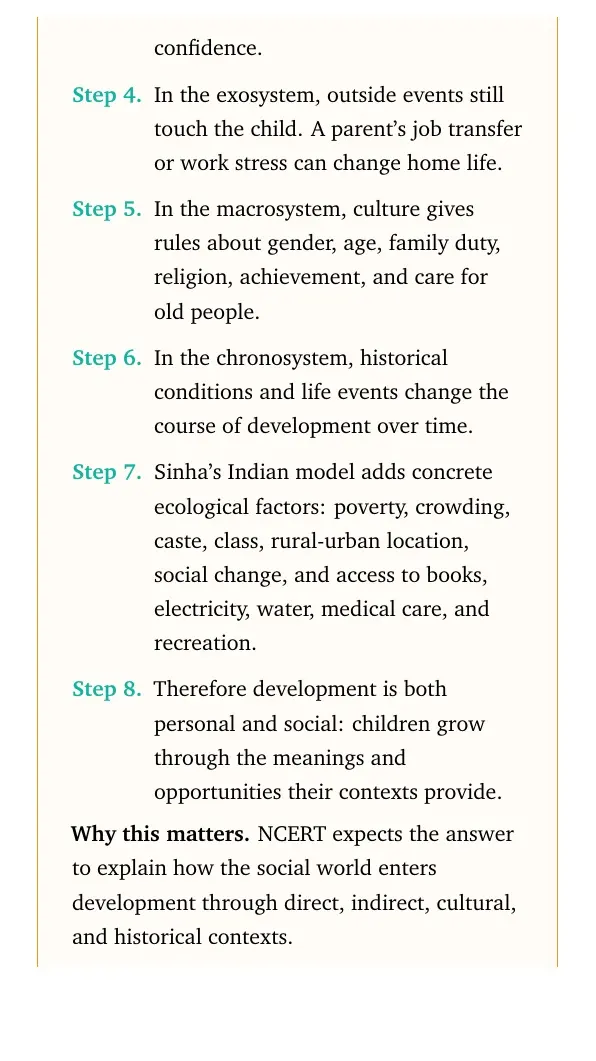
In the mesosystem, one setting affects another. Support between home and school can improve learning and confidence.
In the exosystem, outside events still touch the child. A parent's job transfer or work stress can change home life.
In the macrosystem, culture gives rules about gender, age, family duty, religion, achievement, and care for old people.
In the chronosystem, historical conditions and life events change the course of development over time.
Sinha's Indian model adds concrete ecological factors: poverty, crowding, caste, class, rural-urban location, social change, and access to books, electricity, water, medical care, and recreation.
Therefore development is both personal and social: children grow through the meanings and opportunities their contexts provide.
Why this matters. NCERT expects the answer to explain how the social world enters development through direct, indirect, cultural, and historical contexts.
Socio-cultural factors shape development through immediate relationships, links between settings, indirect conditions, culture, historical time, and Indian ecological realities.
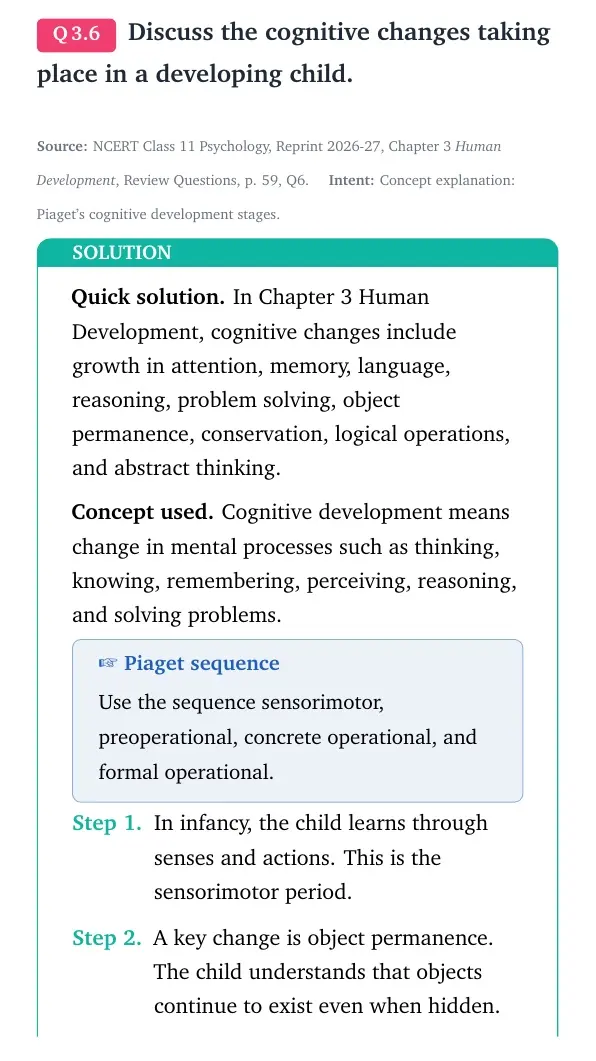
Q 3.6
Discuss the cognitive changes taking place in a developing child.
In Chapter 3 Human Development, cognitive changes include growth in attention, memory, language, reasoning, problem solving, object permanence, conservation, logical operations, and abstract thinking. Concept used. Cognitive development means change in mental processes such as thinking, knowing, remembering, perceiving, reasoning, and solving problems.
Piaget sequence
Use the sequence sensorimotor, preoperational, concrete operational, and formal operational.
In infancy, the child learns through senses and actions. This is the sensorimotor period.
A key change is object permanence. The child understands that objects continue to exist even when hidden.
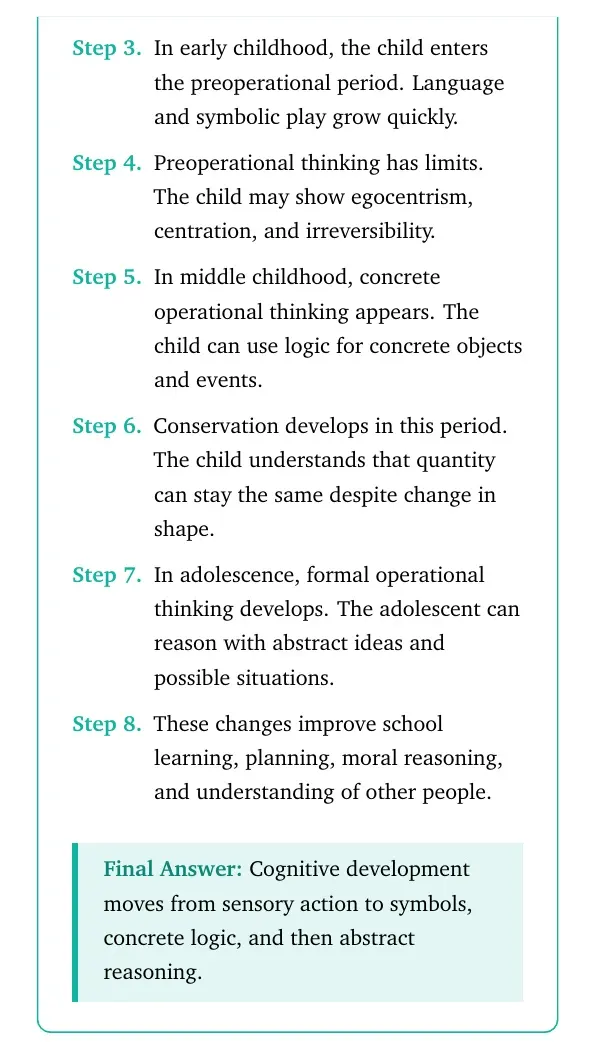
In early childhood, the child enters the preoperational period. Language and symbolic play grow quickly.
Preoperational thinking has limits. The child may show egocentrism, centration, and irreversibility.
In middle childhood, concrete operational thinking appears. The child can use logic for concrete objects and events.
Conservation develops in this period. The child understands that quantity can stay the same despite change in shape.
In adolescence, formal operational thinking develops. The adolescent can reason with abstract ideas and possible situations.
These changes improve school learning, planning, moral reasoning, and understanding of other people.
Cognitive development moves from sensory action to symbols, concrete logic, and then abstract reasoning.
AR
Arjun Rao
M.A. Psychology, University of Hyderabad
Verified Expert
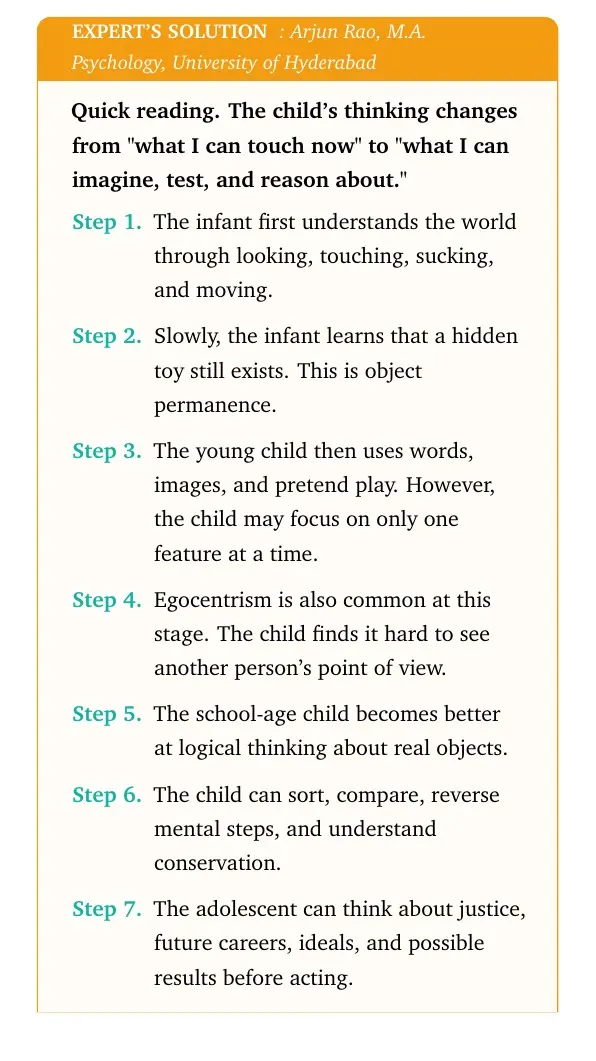
Quick reading. The child's thinking changes from "what I can touch now" to "what I can imagine, test, and reason about."
The infant first understands the world through looking, touching, sucking, and moving.
Slowly, the infant learns that a hidden toy still exists. This is object permanence.
The young child then uses words, images, and pretend play. However, the child may focus on only one feature at a time.
Egocentrism is also common at this stage. The child finds it hard to see another person's point of view.
The school-age child becomes better at logical thinking about real objects.
The child can sort, compare, reverse mental steps, and understand conservation.
The adolescent can think about justice, future careers, ideals, and possible results before acting.
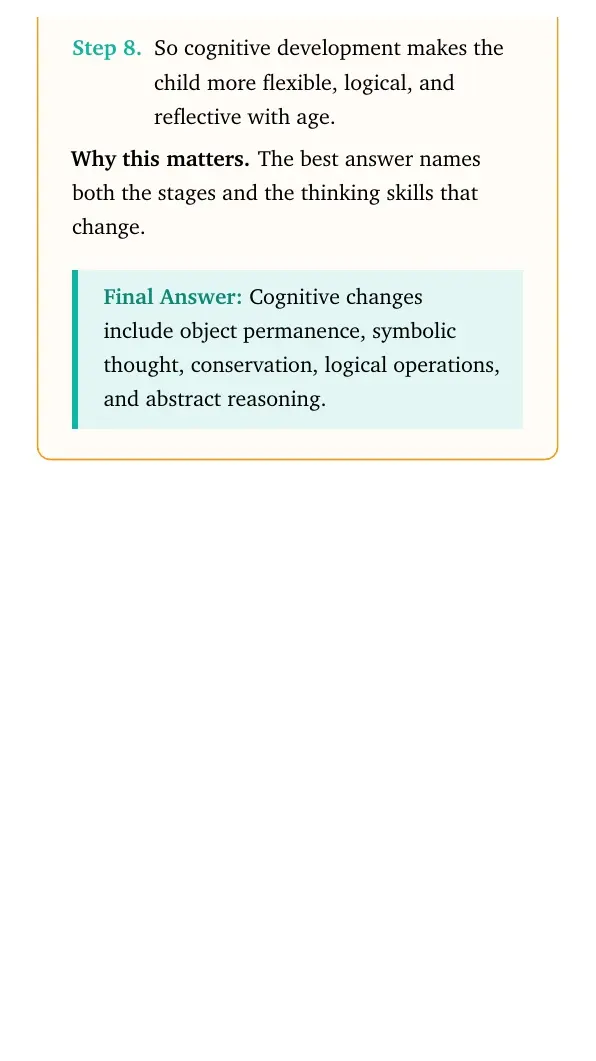
So cognitive development makes the child more flexible, logical, and reflective with age.
Why this matters. The best answer names both the stages and the thinking skills that change.
Cognitive changes include object permanence, symbolic thought, conservation, logical operations, and abstract reasoning.
Q 3.7
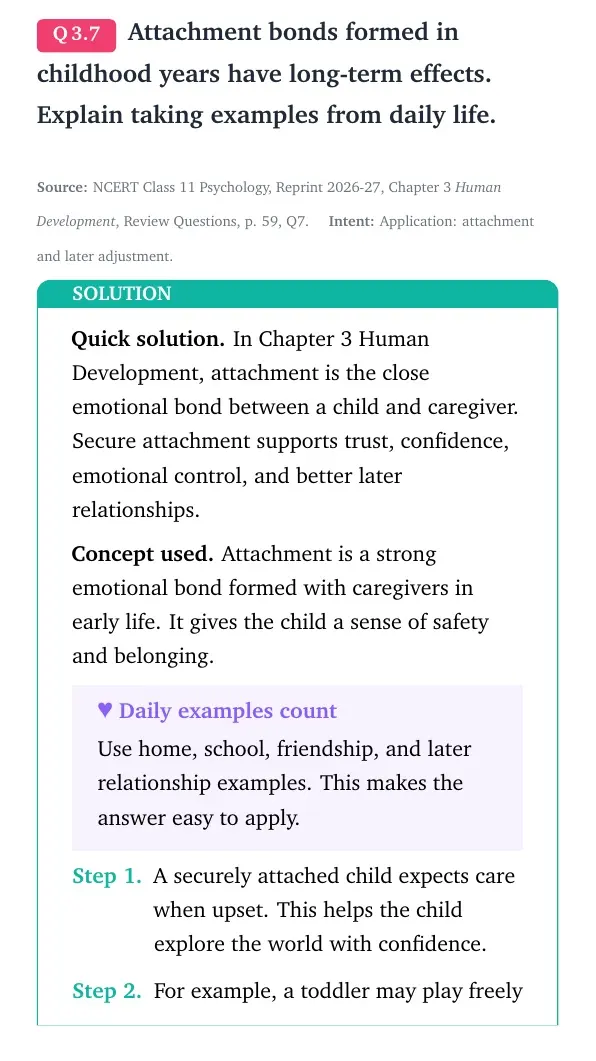
Attachment bonds formed in childhood years have long-term effects. Explain taking examples from daily life.
In Chapter 3 Human Development, attachment is the close emotional bond between a child and caregiver. Secure attachment supports trust, confidence, emotional control, and better later relationships. Concept used. Attachment is a strong emotional bond formed with caregivers in early life. It gives the child a sense of safety and belonging.
Daily examples count
Use home, school, friendship, and later relationship examples. This makes the answer easy to apply.
A securely attached child expects care when upset. This helps the child explore the world with confidence.
For example, a toddler may play freely in a park but return to the parent when frightened.
In school, secure attachment can help a child ask for help and handle separation from home better.
Such children often learn trust. They may form friendships with less fear of rejection.
Insecure attachment may lead to clinginess, withdrawal, anger, or fear in relationships.
For example, a child who receives unpredictable care may panic when a parent leaves or may avoid comfort.
Later in life, early attachment can influence self-worth, closeness, independence, and response to stress.
Long-term effects are not fixed forever. Warm later relationships can support healthier adjustment.
Childhood attachment affects later trust, confidence, emotional control, friendships, and close relationships.
NK
Neha Kapoor
M.Sc Developmental Psychology, Ambedkar University Delhi
Verified Expert
Applied angle. Attachment works like an early lesson in trust: "When I need care, someone responds."
A sensitive caregiver notices the child's signals and responds with warmth.
The child then feels secure enough to explore toys, people, and new places.
In daily life, this appears when a child starts school without extreme fear and returns calmly after class.
It also appears in friendship. A secure child is more likely to share, seek help, and forgive small conflicts.
When care is rejecting or inconsistent, the child may become anxious, avoidant, or unsure of support.
These patterns can show up later in close relationships, self-confidence, and stress handling.
However, development remains open to change. Supportive teachers, friends, and family members can repair many difficulties.
Why this matters. NCERT wants the link between early care and later socio-emotional development.
Attachment bonds have long-term effects because they shape trust, security, self-image, and later relationships.
Q 3.8
What is adolescence? Explain the concept of egocentrism.
In Chapter 3 Human Development, adolescence is the transition from childhood to adulthood. Egocentrism is the adolescent's strong focus on self, seen in imaginary onlookers and personal fable. Concept used. Adolescence is the developmental period marked by puberty, identity search, emotional change, peer influence, and movement toward adulthood.
Concept recall
Write imaginary onlookers and personal fable. These two terms make the answer complete.
Adolescence comes from the Latin word meaning "to grow into maturity."
It is commonly seen as the period between childhood and adulthood.
Puberty is a major biological change in adolescence. It brings reproductive maturity and secondary sex characteristics.
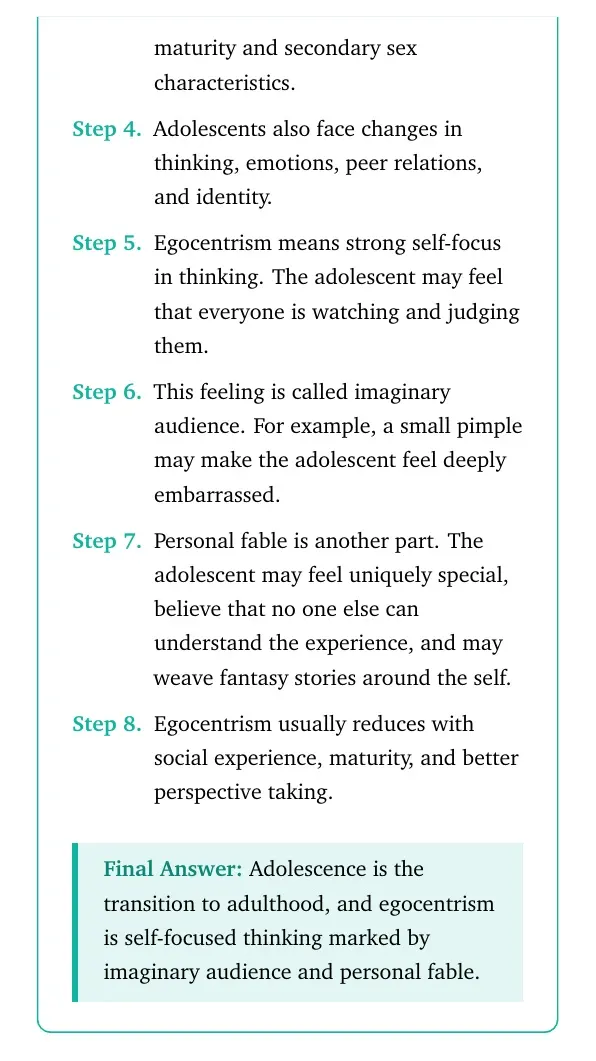
Adolescents also face changes in thinking, emotions, peer relations, and identity.
Egocentrism means strong self-focus in thinking. The adolescent may feel that everyone is watching and judging them.
This feeling is called imaginary onlookers. For example, a small pimple may make the adolescent feel deeply embarrassed.
Personal fable is another part. The adolescent may feel uniquely special, believe that no one else can understand the experience, and may weave fantasy stories around the self.
Egocentrism usually reduces with social experience, maturity, and better perspective taking.
Adolescence is the transition to adulthood, and egocentrism is self-focused thinking marked by imaginary onlookers and personal fable.
VB
Vivaan Bhat
M.A. Psychology, Gujarat Forensic Sciences University
Verified Expert
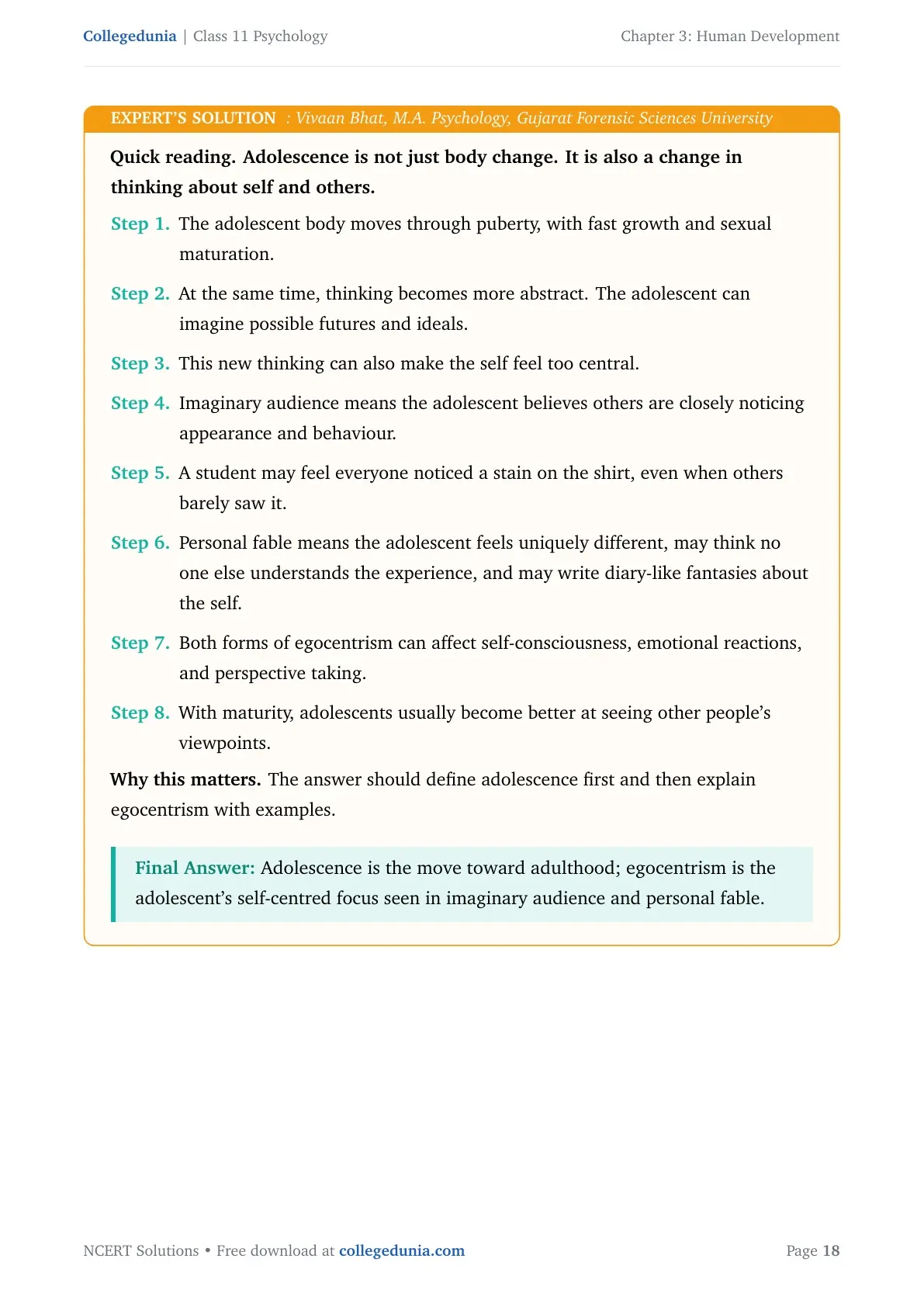
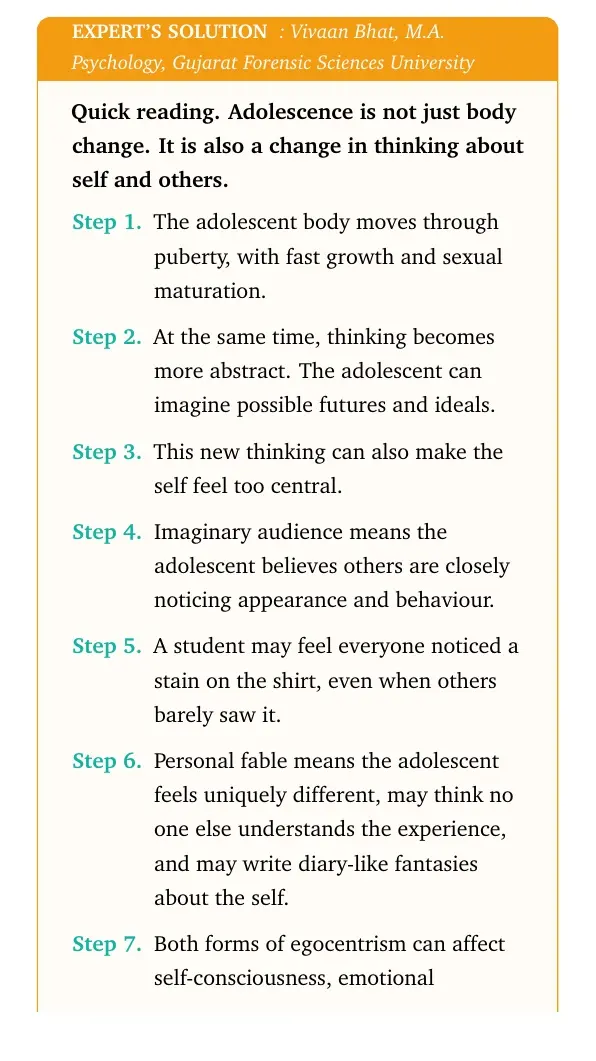
Quick reading. Adolescence is not just body change. It is also a change in thinking about self and others.
The adolescent body moves through puberty, with fast growth and sexual maturation.
At the same time, thinking becomes more abstract. The adolescent can imagine possible futures and ideals.
This new thinking can also make the self feel too central.
imaginary onlookers means the adolescent believes others are closely noticing appearance and behaviour.
A student may feel everyone noticed a stain on the shirt, even when others barely saw it.
Personal fable means the adolescent feels uniquely different, may think no one else understands the experience, and may write diary-like fantasies about the self.
Both forms of egocentrism can affect self-consciousness, emotional reactions, and perspective taking.
With maturity, adolescents usually become better at seeing other people's viewpoints.
Why this matters. The answer should define adolescence first and then explain egocentrism with examples.
Adolescence is the move toward adulthood; egocentrism is the adolescent's self-centred focus seen in imaginary onlookers and personal fable.
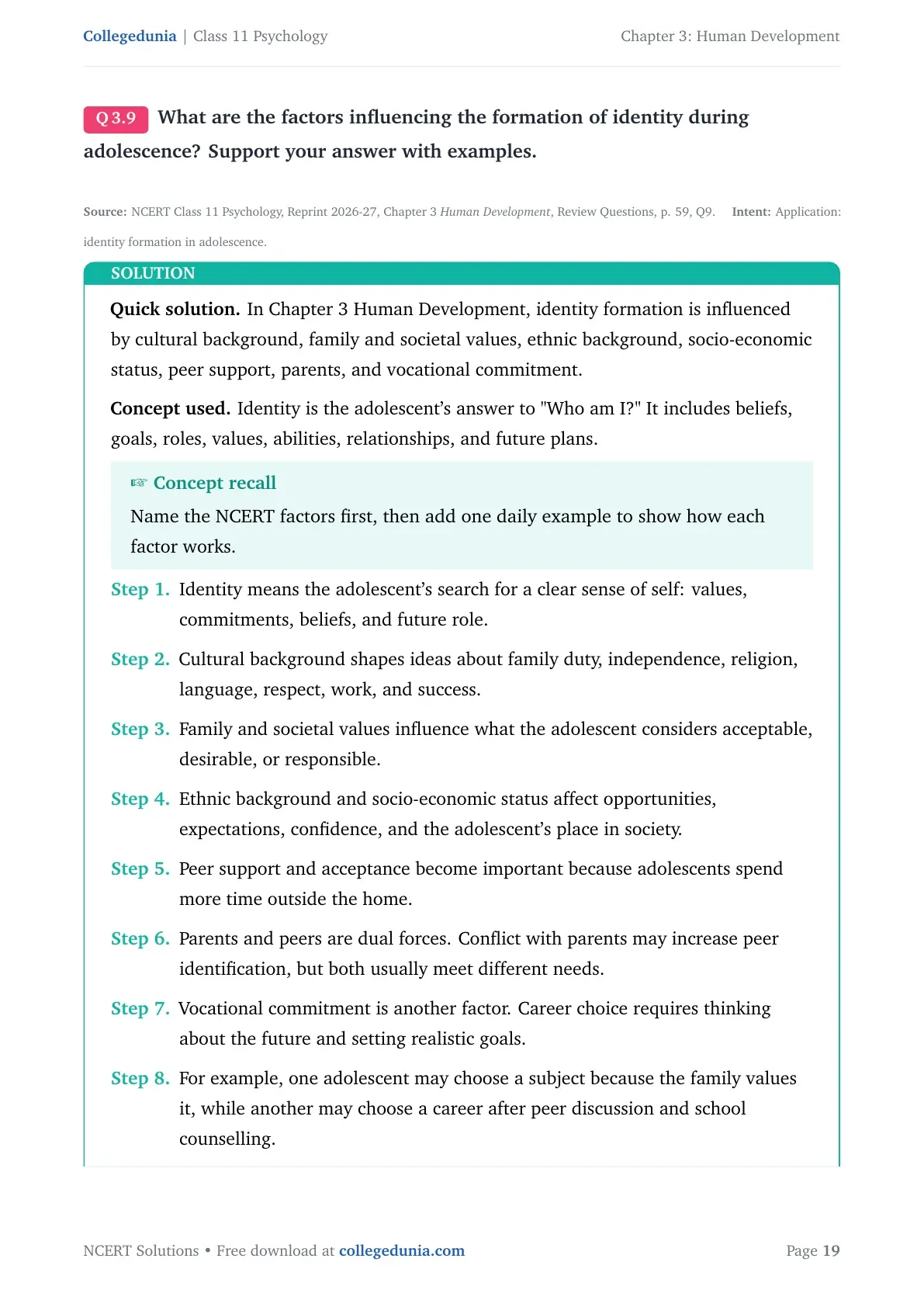
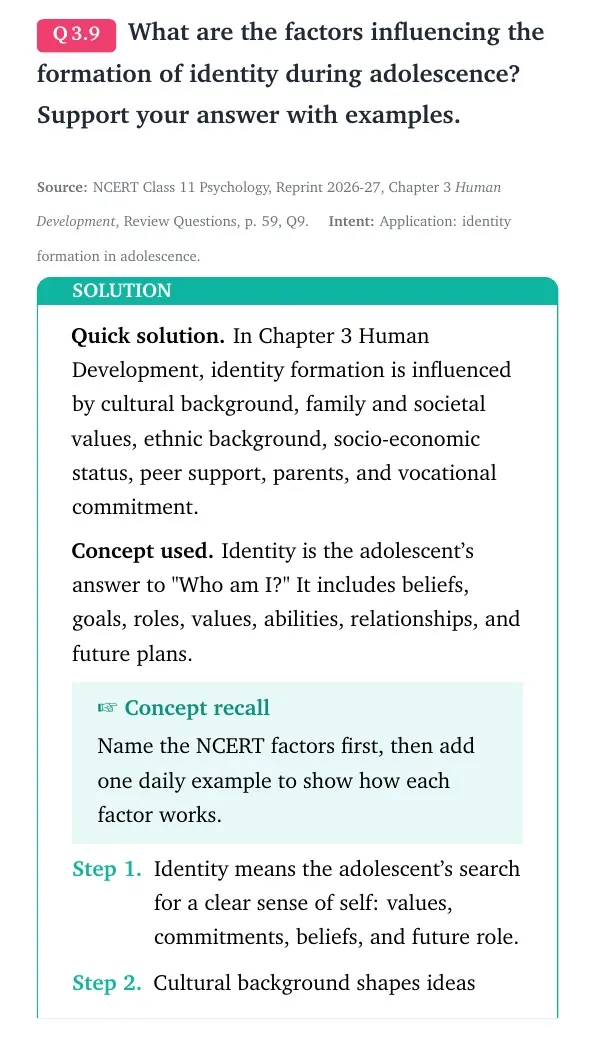
Q 3.9
What are the factors influencing the formation of identity during adolescence? Support your answer with examples.
In Chapter 3 Human Development, identity formation is influenced by cultural background, family and societal values, ethnic background, socio-economic status, peer support, parents, and vocational commitment. Concept used. Identity is the adolescent's answer to "Who am I?" It includes beliefs, goals, roles, values, abilities, relationships, and future plans.
Concept recall
Name the NCERT factors first, then add one daily example to show how each factor works.
Identity means the adolescent's search for a clear sense of self: values, commitments, beliefs, and future role.
Cultural background shapes ideas about family duty, independence, religion, language, respect, work, and success.
Family and societal values influence what the adolescent considers acceptable, desirable, or responsible.
Ethnic background and socio-economic status affect opportunities, expectations, confidence, and the adolescent's place in society.
Peer support and acceptance become important because adolescents spend more time outside the home.
Parents and peers are dual forces. Conflict with parents may increase peer identification, but both usually meet different needs.
Vocational commitment is another factor. Career choice requires thinking about the future and setting realistic goals.
For example, one adolescent may choose a subject because the family values it, while another may choose a career after peer discussion and school counselling.
Adolescent identity is shaped by cultural background, family and societal values, ethnic background, socio-economic status, peers, parents, and vocational commitment.
DR
Diya Reddy
M.A. Psychology, Osmania University
Verified Expert
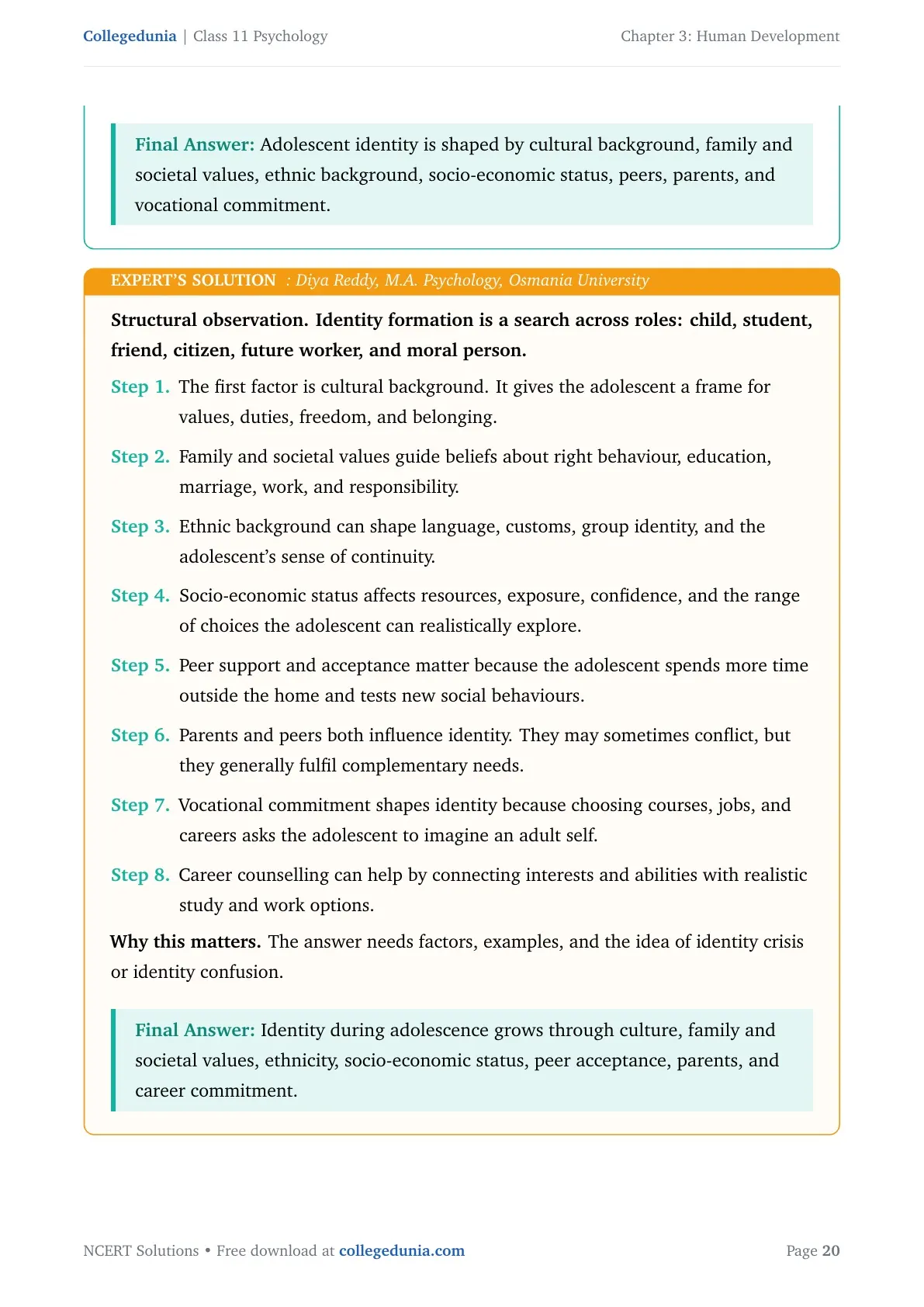
Structural observation. Identity formation is a search across roles: child, student, friend, citizen, future worker, and moral person.
The first factor is cultural background. It gives the adolescent a frame for values, duties, freedom, and belonging.
Family and societal values guide beliefs about right behaviour, education, marriage, work, and responsibility.
Ethnic background can shape language, customs, group identity, and the adolescent's sense of continuity.
Socio-economic status affects resources, exposure, confidence, and the range of choices the adolescent can realistically explore.
Peer support and acceptance matter because the adolescent spends more time outside the home and tests new social behaviours.
Parents and peers both influence identity. They may sometimes conflict, but they generally fulfil complementary needs.
Vocational commitment shapes identity because choosing courses, jobs, and careers asks the adolescent to imagine an adult self.
Career counselling can help by connecting interests and abilities with realistic study and work options.
Why this matters. The answer needs factors, examples, and the idea of identity crisis or identity confusion.
Identity during adolescence grows through culture, family and societal values, ethnicity, socio-economic status, peer acceptance, parents, and career commitment.
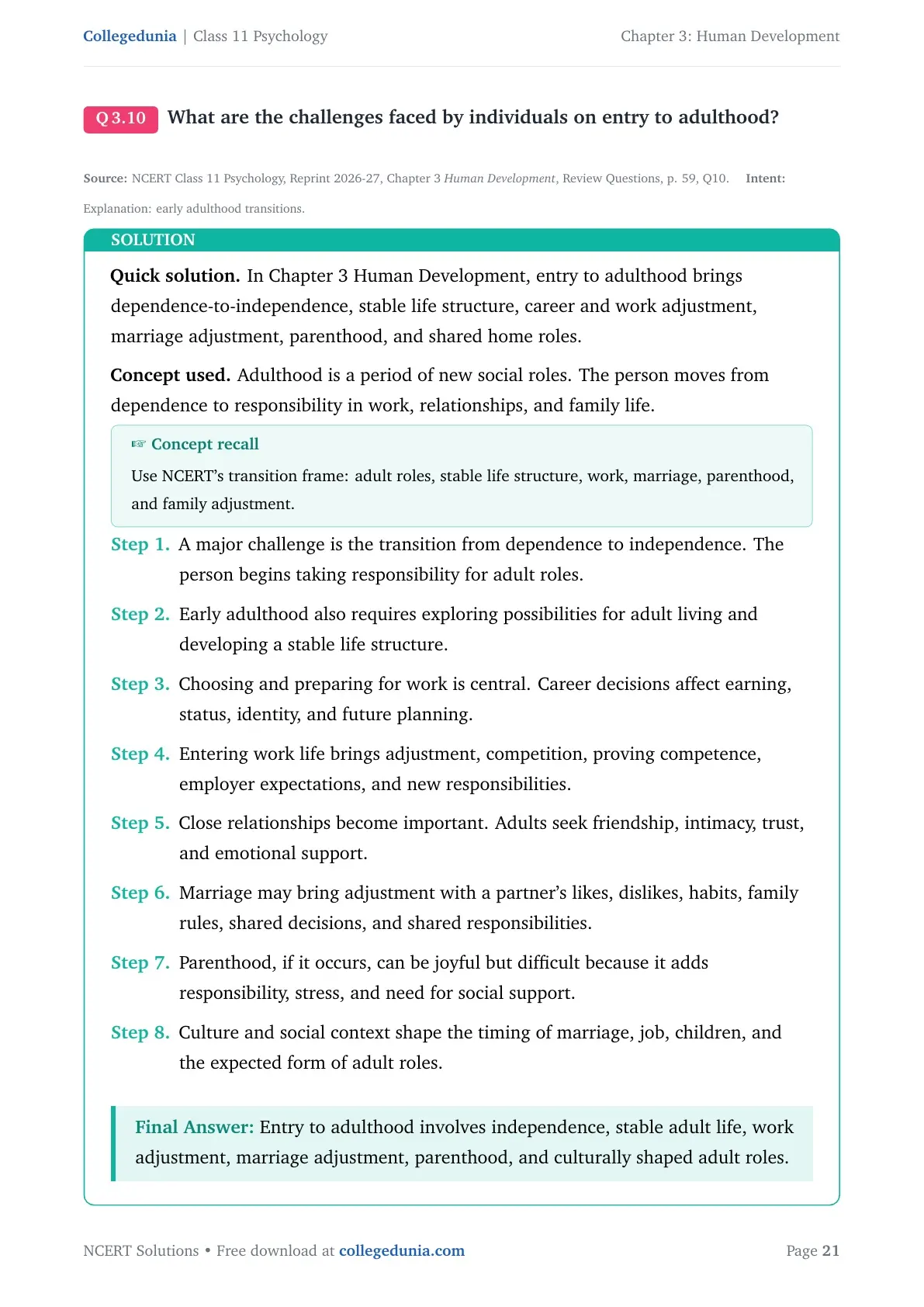
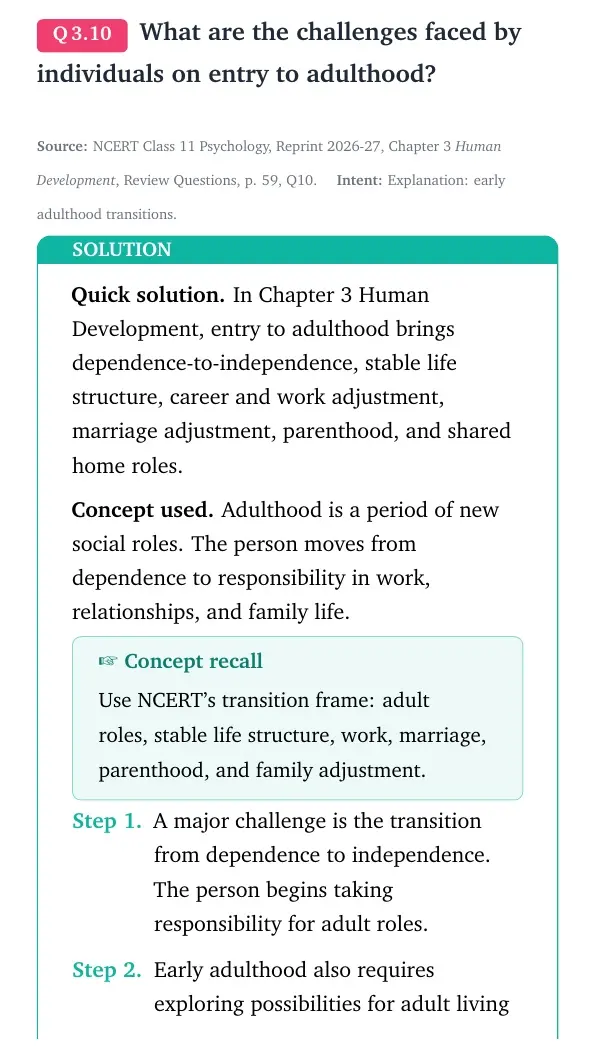
Q 3.10
What are the challenges faced by individuals on entry to adulthood?
In Chapter 3 Human Development, entry to adulthood brings dependence-to-independence, stable life structure, career and work adjustment, marriage adjustment, parenthood, and shared home roles. Concept used. Adulthood is a period of new social roles. The person moves from dependence to responsibility in work, relationships, and family life.
Concept recall
Use NCERT's transition frame: adult roles, stable life structure, work, marriage, parenthood, and family adjustment.
A major challenge is the transition from dependence to independence. The person begins taking responsibility for adult roles.
Early adulthood also requires exploring possibilities for adult living and developing a stable life structure.
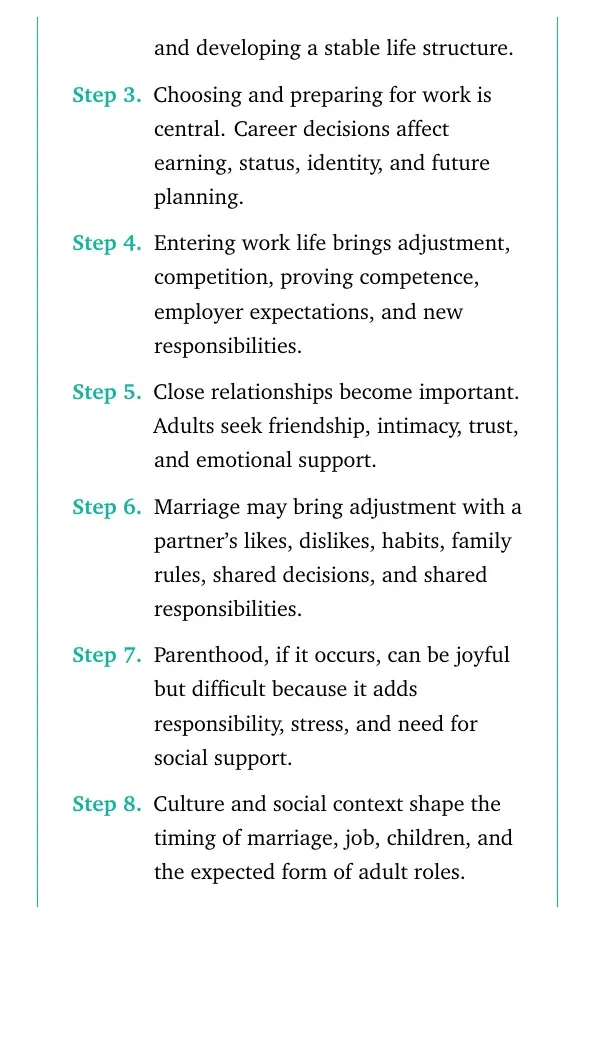
Choosing and preparing for work is central. Career decisions affect earning, status, identity, and future planning.
Entering work life brings adjustment, competition, proving competence, employer expectations, and new responsibilities.
Close relationships become important. Adults seek friendship, intimacy, trust, and emotional support.
Marriage may bring adjustment with a partner's likes, dislikes, habits, family rules, shared decisions, and shared responsibilities.
Parenthood, if it occurs, can be joyful but difficult because it adds responsibility, stress, and need for social support.
Culture and social context shape the timing of marriage, job, children, and the expected form of adult roles.
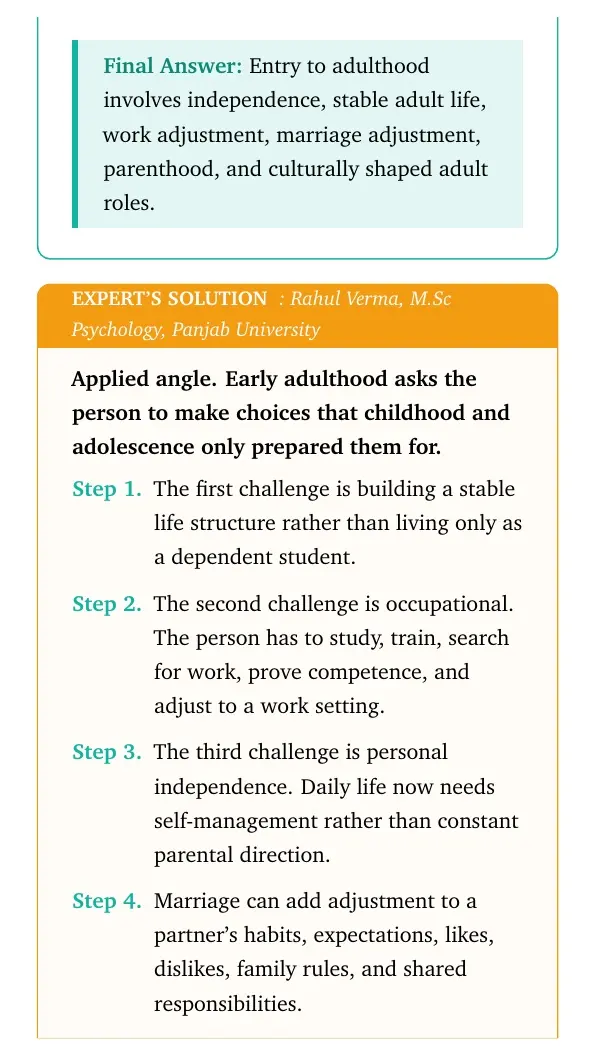
Entry to adulthood involves independence, stable adult life, work adjustment, marriage adjustment, parenthood, and culturally shaped adult roles.
RV
Rahul Verma
M.Sc Psychology, Panjab University
Verified Expert
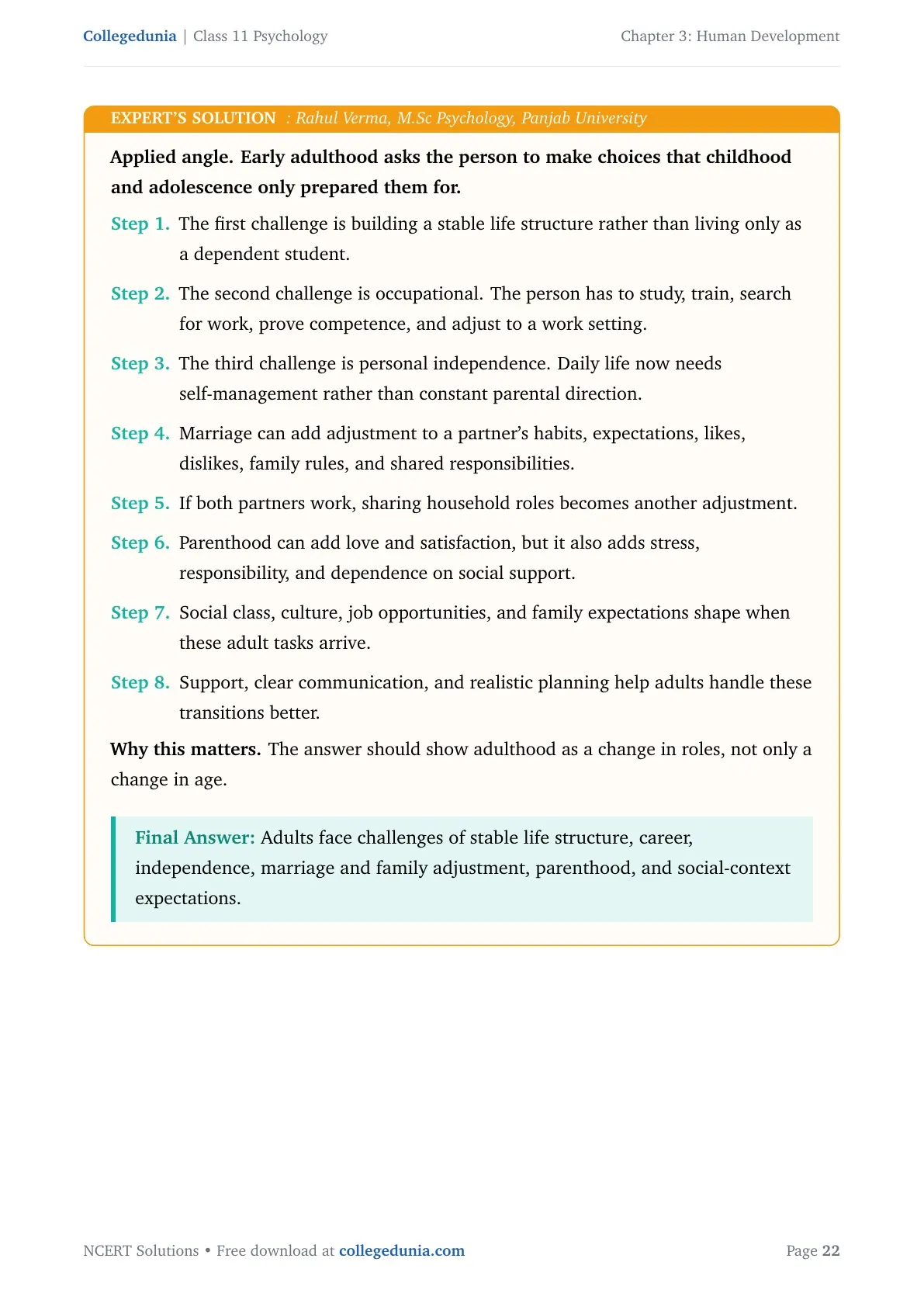
Applied angle. Early adulthood asks the person to make choices that childhood and adolescence only prepared them for.
The first challenge is building a stable life structure rather than living only as a dependent student.
The second challenge is occupational. The person has to study, train, search for work, prove competence, and adjust to a work setting.
The third challenge is personal independence. Daily life now needs self-management rather than constant parental direction.
Marriage can add adjustment to a partner's habits, expectations, likes, dislikes, family rules, and shared responsibilities.
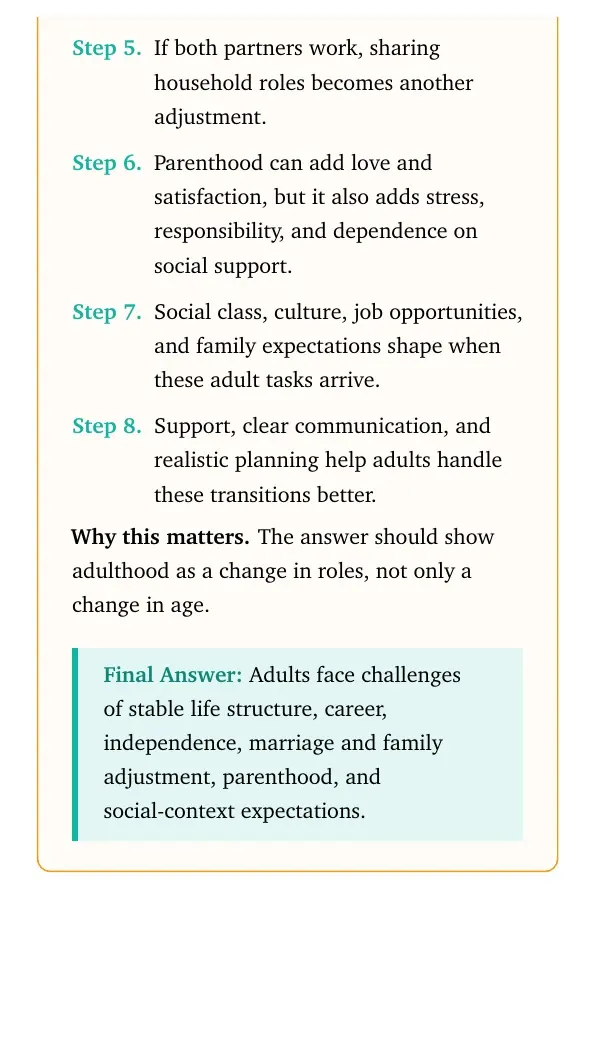
If both partners work, sharing household roles becomes another adjustment.
Parenthood can add love and satisfaction, but it also adds stress, responsibility, and dependence on social support.
Social class, culture, job opportunities, and family expectations shape when these adult tasks arrive.
Support, clear communication, and realistic planning help adults handle these transitions better.
Why this matters. The answer should show adulthood as a change in roles, not only a change in age.
Adults face challenges of stable life structure, career, independence, marriage and family adjustment, parenthood, and social-context expectations.
Human Development Psychology NCERT Solutions FAQs
Ques. How many review questions are solved in Class 11 Psychology Chapter 3 Human Development?
Ans. The PDF solves all 10 review questions from the 2026-27 NCERT Class 11 Psychology Chapter 3 Human Development textbook.
Ques. What is the main difference between growth and development?
Ans. Growth means measurable physical increase, while development includes physical, cognitive, emotional and social change across the life span.
Ques. Why is adolescence important in Human Development?
Ans. Adolescence is important because puberty, identity search, peer relations and egocentrism strongly shape self-understanding and adjustment.
Ques. Are these Human Development solutions useful for the 2026-27 school exam?
Ans. Yes. The answers follow the latest 2026-27 NCERT chapter sequence and explain each concept with examples suited to Class 11 Psychology exams.











Comments