The NCERT Solutions for Class 11 Psychology Chapter 7 Thinking cover all 9 textbook review questions from the latest 2026-27 NCERT book. The chapter explains how people form mental images, use concepts, solve problems, reason, judge, decide, create and acquire language.
Covers every review question with a direct answer and a detailed expert explanation.
Focuses on thinking, problem solving, reasoning, decision making, creativity and language.
Useful for school exams because each answer connects NCERT terms with clear examples.
Student Feedback: In a Collegedunia poll of 10,420 Class 11 Psychology students preparing for the 2026-27 school exams, 69% said they could define thinking but found it difficult to separate reasoning, judgment, decision making and creative thinking in long answers.
Source: 2026-27 Class 11 Psychology student poll across CBSE schools.
Every answer in this chapter set is checked against the 2026-27 NCERT Psychology textbook and written so that students can revise the concept, example and exam framing together.
Chapter 7 treats thinking as a higher mental process. It shows how the mind represents information, organises it through concepts, and uses that material for problem solving, reasoning and decision making. Students should not memorise the chapter as separate definitions only. The best answers show how one mental process leads to the next.
Chapter area
What students must know
Where it helps
Nature of thinking
Mental images, concepts, symbols and directed mental activity
Question 1
Concepts
Categories that reduce complexity and support thinking
Question 2
Problem solving
Obstacles such as mental set, lack of motivation and poor representation
Question 3
Reasoning
Drawing conclusions through rules, evidence and relations
Question 4
Judgment and decision making
Evaluating information and selecting one option
Question 5
Creativity and language
Divergent thinking, fluency, flexibility, originality and language acquisition
Questions 6 to 9
Use NCERT terms exactly: mental image, concept, prototype, mental set, reasoning, judgment, decision making, divergent thinking, creative thinking and language acquisition. These terms keep answers precise and close to the textbook.
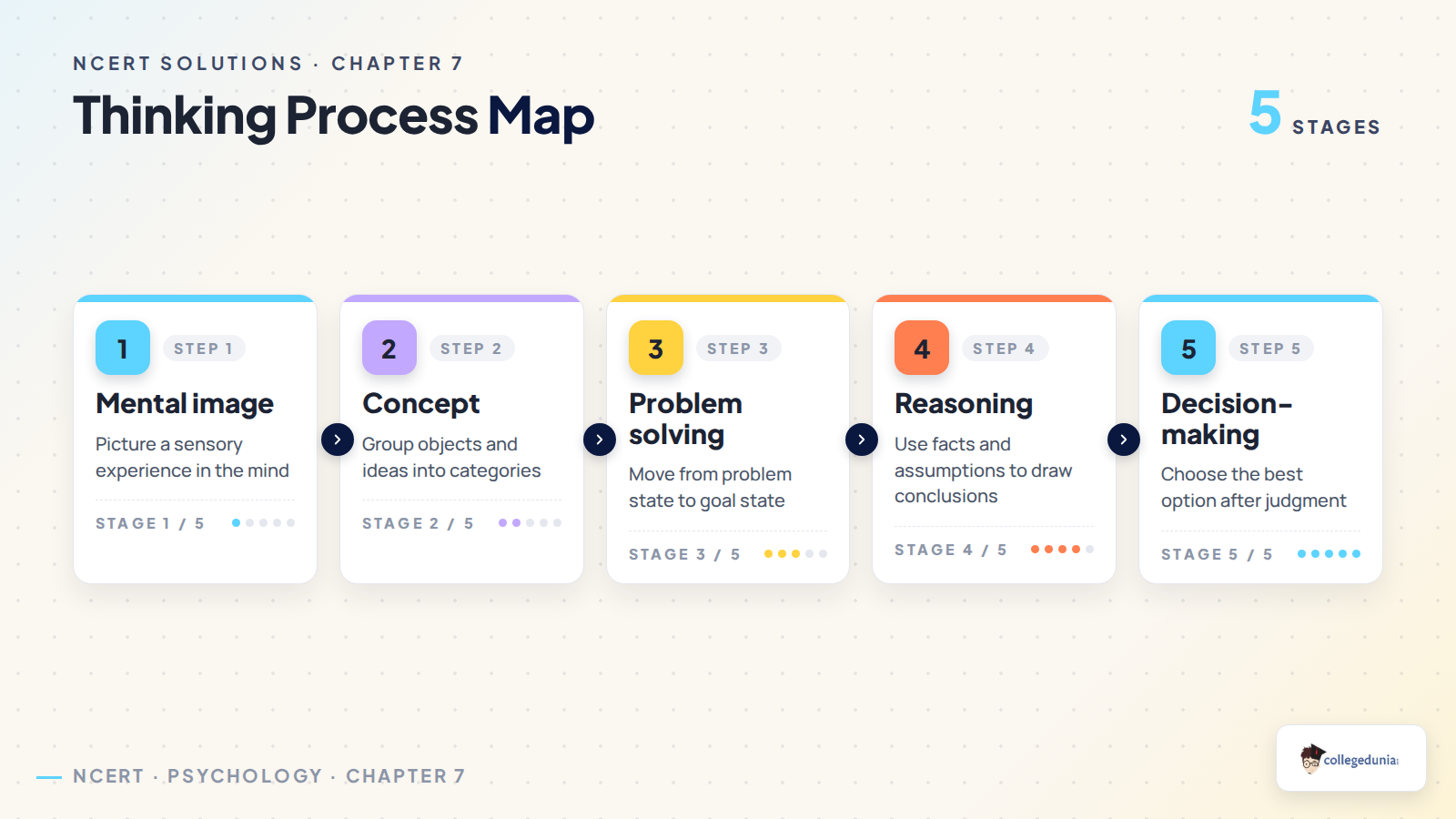
The first two questions build the base of the chapter. Thinking begins when a learner uses mental representations, such as images, words, symbols and concepts. A concept is especially important because it groups similar objects or events and reduces the amount of information the mind has to handle at one time.
Mental image: a picture-like representation of an object, event or experience in the mind.
Concept: a category used to organise objects, ideas or events with common features.
Problem solving: moving from an initial state to a goal when the path is not immediately clear.
Reasoning: using rules, facts and assumptions to reach a conclusion.
Decision making: selecting one option after judging possible choices.
This sequence also explains why concepts matter in exam answers. Once a student recognises the category of a problem, the mind can choose the right rule, compare alternatives and write a more organised answer.
Problem Solving Reasoning and Decision Making in Thinking
Problem solving starts when there is a gap between the present state and the desired goal. The learner must represent the problem, generate possible steps and test which path works. Obstacles appear when a student uses the wrong representation, stays fixed on an old method, lacks motivation, or cannot see a new use for familiar material.
Process
NCERT focus
Exam cue
Problem solving
Finding a path from problem state to goal state
Name obstacles and how they block progress
Reasoning
Drawing conclusions from given facts, rules or examples
Show the link between evidence and conclusion
Judgment
Evaluating information before forming an opinion
Explain why it comes before decision making
Decision making
Choosing one option from available alternatives
Connect it with judgment and consequences
For long answers, do not only define reasoning. Show its use. Reasoning helps by organising facts, excluding unsuitable options and making the solution less dependent on guessing.
Divergent Thinking and Creative Thinking in Chapter 7
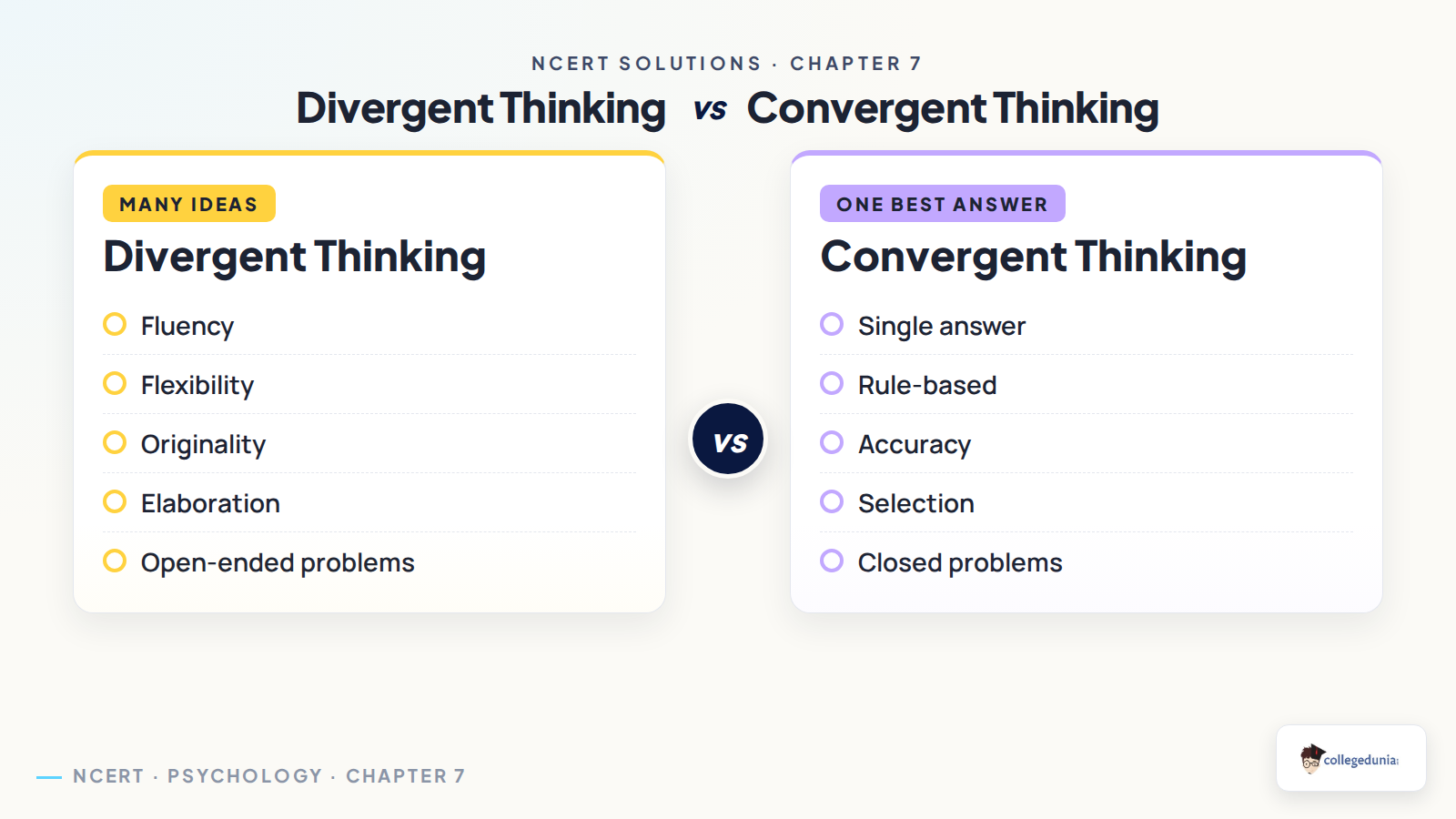
Creative thinking needs divergent thinking because a creative response rarely comes from the first familiar answer. Divergent thinking helps students produce many ideas, shift categories, combine distant ideas and improve the final response. Convergent thinking is also useful, but mainly when the task needs one correct answer.
Fluency: producing many ideas or responses.
Flexibility: shifting from one category or approach to another.
Originality: giving uncommon but useful responses.
Elaboration: adding details so an idea becomes clearer and workable.
To enhance creativity, NCERT asks students to avoid rigid habits, ask unusual questions, use brainstorming, take breaks, build knowledge and practise seeing a problem from more than one angle.
Thinking and Language in Class 11 Psychology Chapter 7
The chapter closes by asking whether thinking can occur without language. The safest answer is balanced. Some thinking happens through images, actions and sensory representations without words. At the same time, language greatly improves complex thinking because it helps people name categories, communicate ideas, plan, reason and remember instructions.
Language area
What to write
Example
Thinking without language
Images, actions and non-verbal representations can guide thought
Solving a puzzle visually
Thinking with language
Words make abstract thought, planning and communication easier
Explaining a rule or writing an answer
Language acquisition
Children learn language through biological readiness and social interaction
Imitation, reinforcement and meaningful conversation
The PDF separates these points so students do not write an extreme answer. NCERT expects students to recognise both non-verbal thought and the special role of language in higher mental processes.
Related Psychology Resources for Thinking
Use the solutions PDF for answers, then move to the NCERT book, notes and handwritten notes when you want to revise the same chapter in another format.
All NCERT Solutions for Class 11 Psychology Chapter 7 Thinking with Step-by-Step Solutions
Review Questions
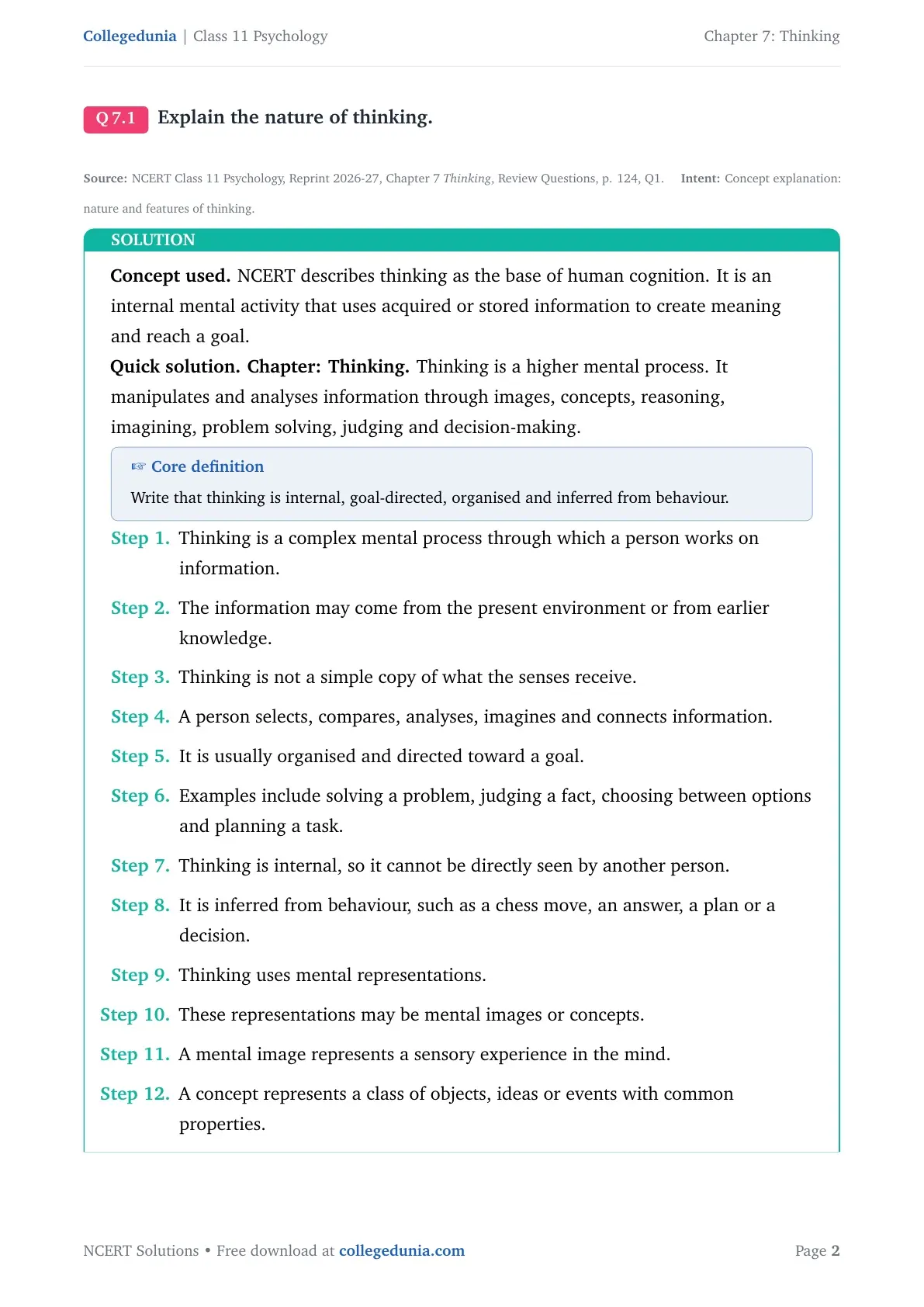
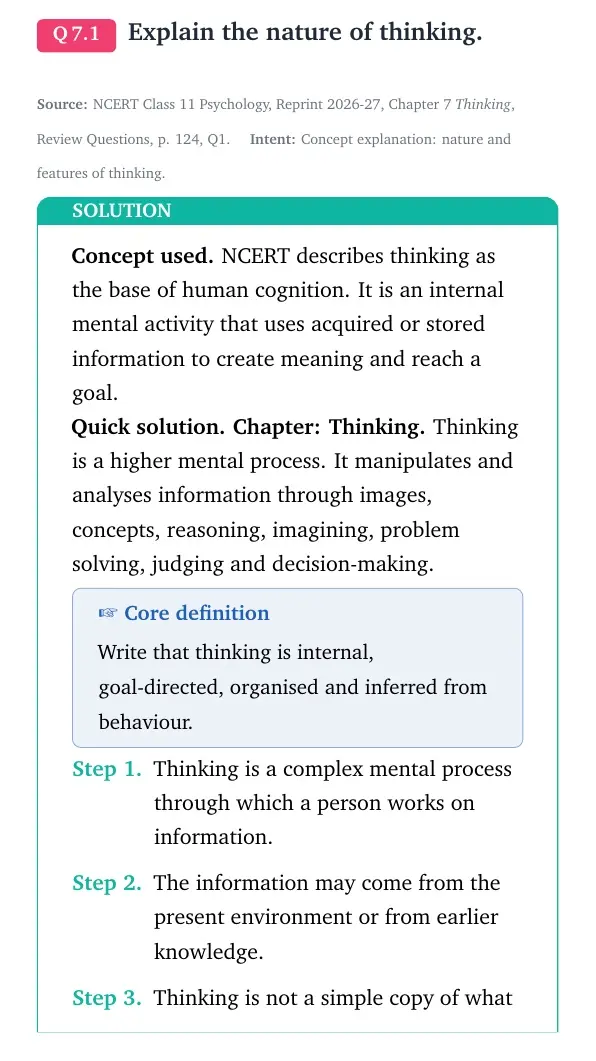
Q 7.1
Explain the nature of thinking.
Concept used. NCERT describes thinking as the base of human cognition. It is an internal mental activity that uses acquired or stored information to create meaning and reach a goal.
Thinking is a higher mental process. It manipulates and analyses information through images, concepts, reasoning, imagining, problem solving, judging and decision-making.
Core definition
Write that thinking is internal, goal-directed, organised and inferred from behaviour.
Thinking is a complex mental process through which a person works on information.
The information may come from the present environment or from earlier knowledge.
Thinking is not a simple copy of what the senses receive.
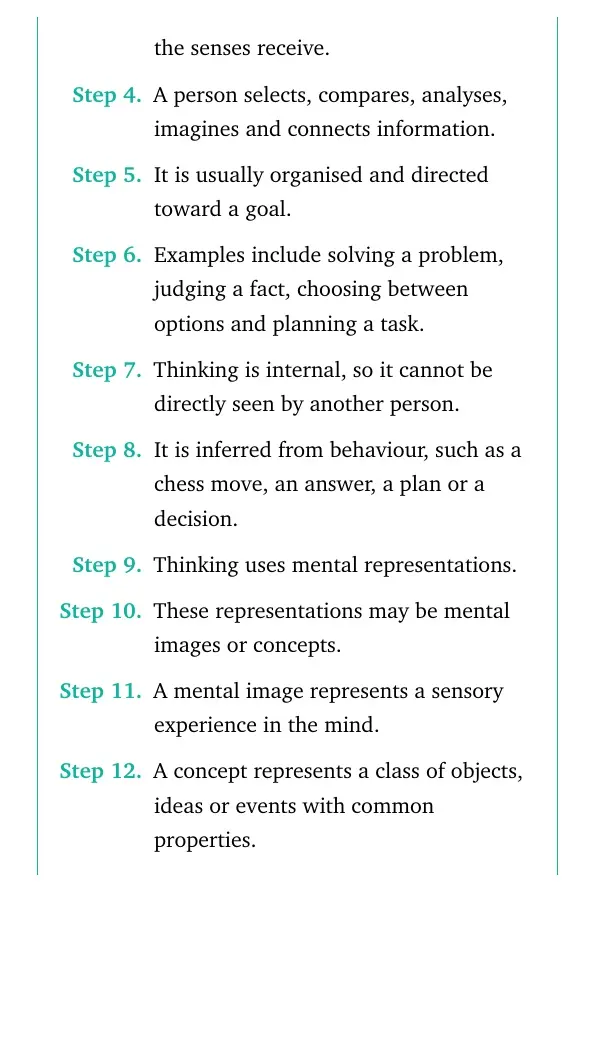
A person selects, compares, analyses, imagines and connects information.
It is usually organised and directed toward a goal.
Examples include solving a problem, judging a fact, choosing between options and planning a task.
Thinking is internal, so it cannot be directly seen by another person.
It is inferred from behaviour, such as a chess move, an answer, a plan or a decision.
Thinking uses mental representations.
These representations may be mental images or concepts.
A mental image represents a sensory experience in the mind.
A concept represents a class of objects, ideas or events with common properties.
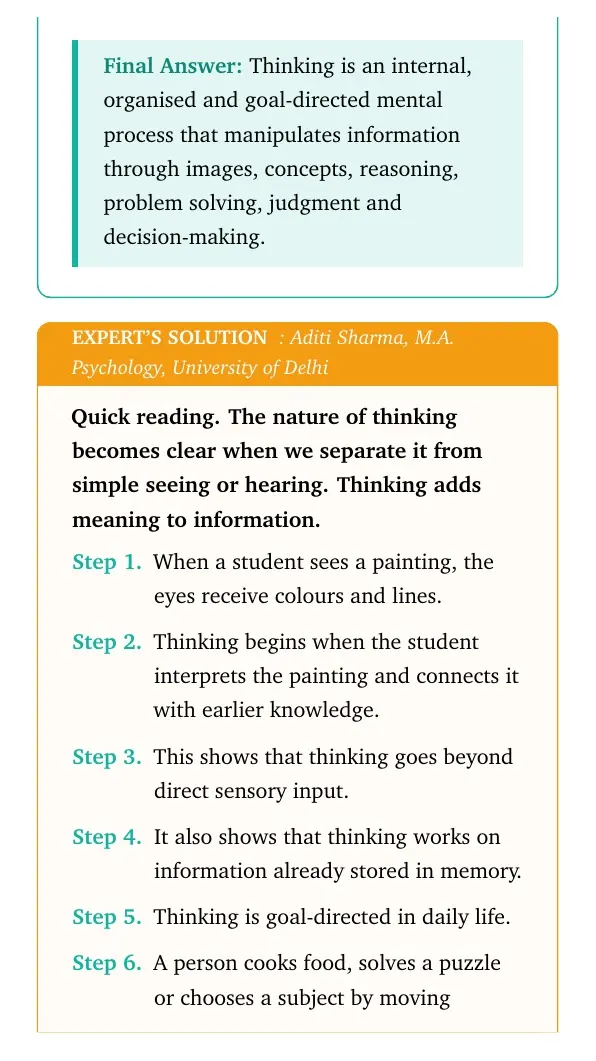
Thinking is an internal, organised and goal-directed mental process that manipulates information through images, concepts, reasoning, problem solving, judgment and decision-making.
AS
Aditi Sharma
M.A. Psychology, University of Delhi
Verified Expert
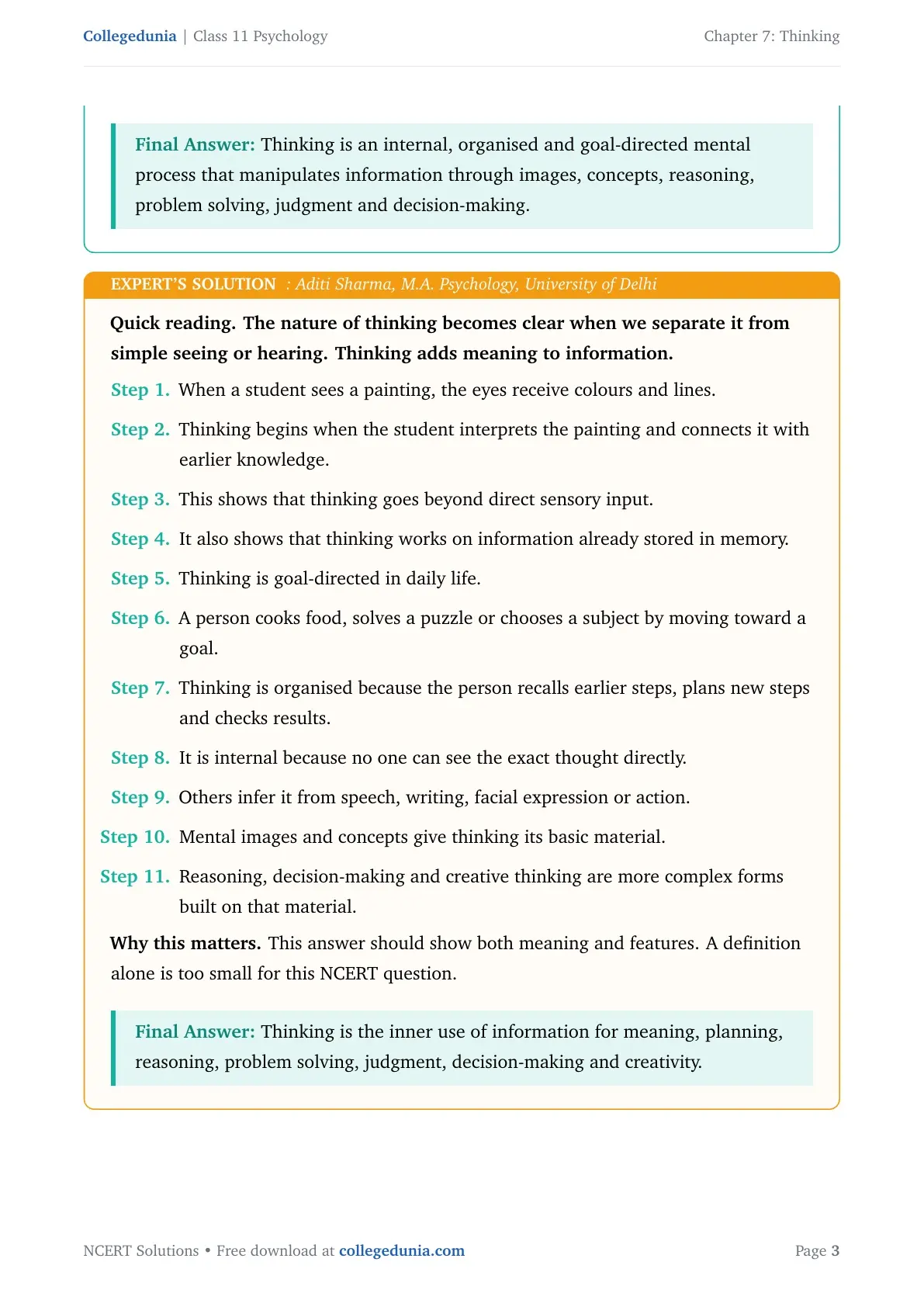
Quick reading. The nature of thinking becomes clear when we separate it from simple seeing or hearing. Thinking adds meaning to information.
When a student sees a painting, the eyes receive colours and lines.
Thinking begins when the student interprets the painting and connects it with earlier knowledge.
This shows that thinking goes beyond direct sensory input.
It also shows that thinking works on information already stored in memory.
Thinking is goal-directed in daily life.
A person cooks food, solves a puzzle or chooses a subject by moving toward a goal.
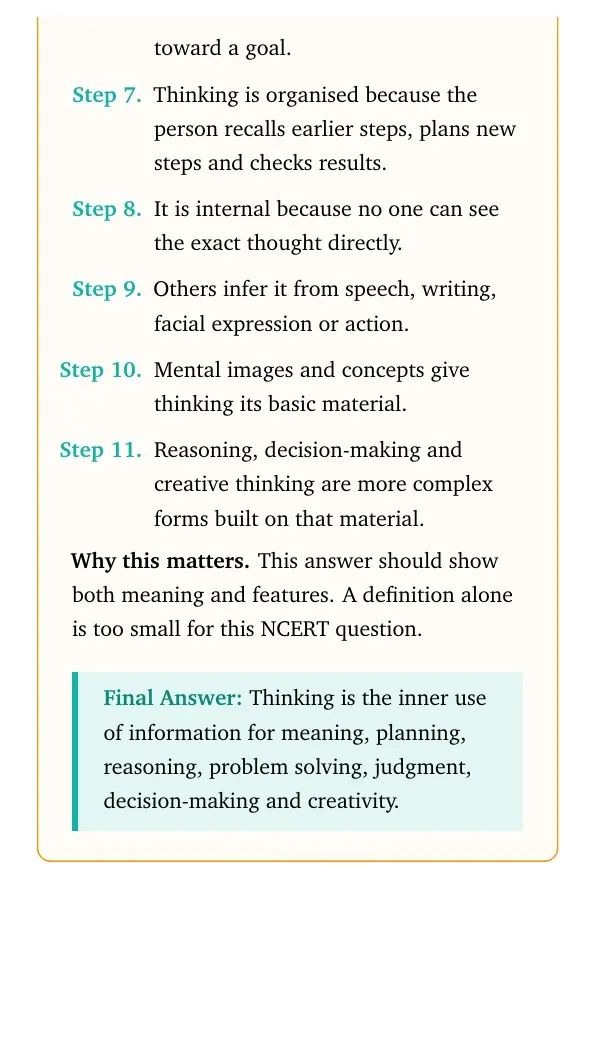
Thinking is organised because the person recalls earlier steps, plans new steps and checks results.
It is internal because no one can see the exact thought directly.
Others infer it from speech, writing, facial expression or action.
Mental images and concepts give thinking its basic material.
Reasoning, decision-making and creative thinking are more complex forms built on that material.
Why this matters. This answer should show both meaning and features. A definition alone is too small for this NCERT question.
Thinking is the inner use of information for meaning, planning, reasoning, problem solving, judgment, decision-making and creativity.
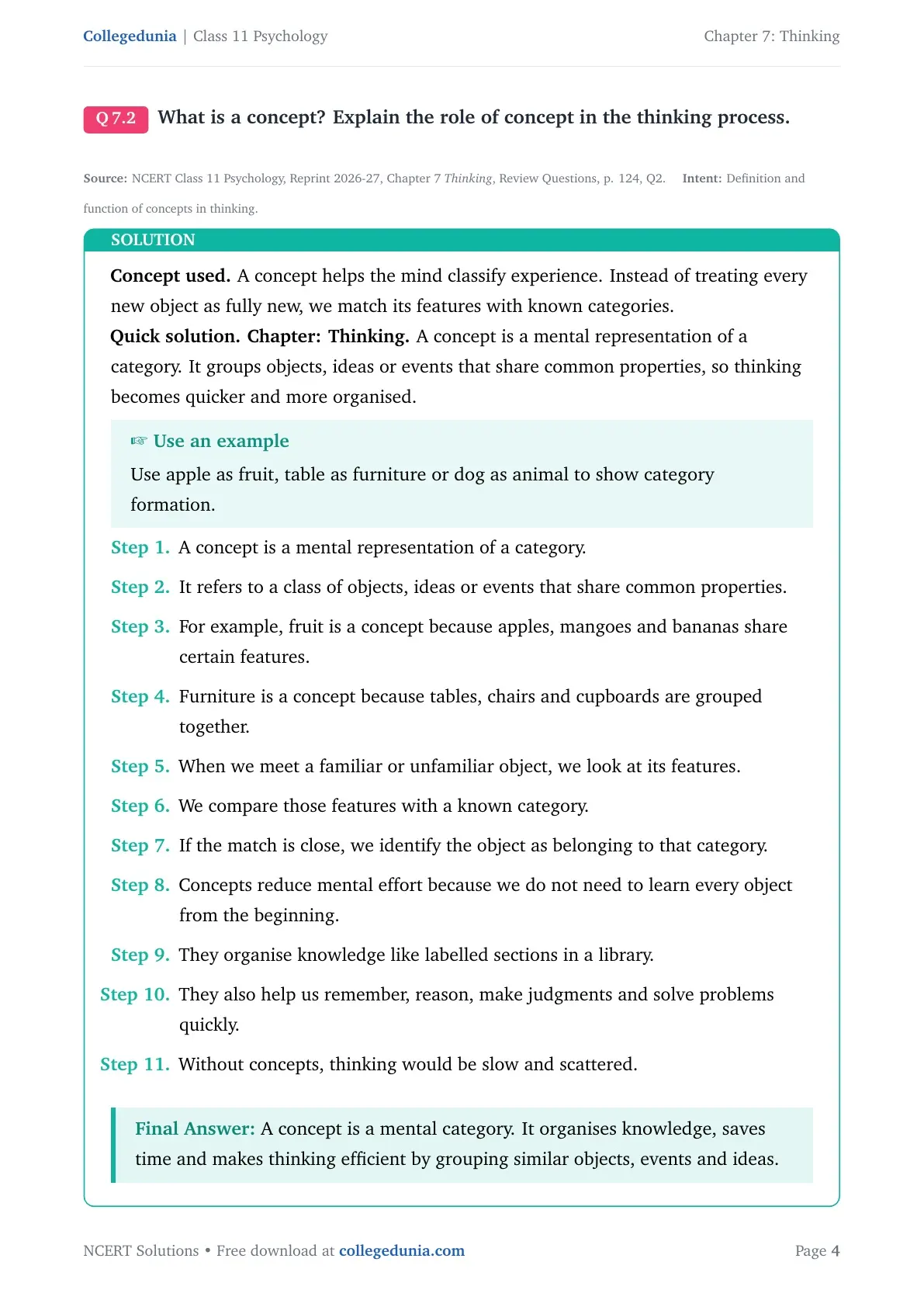
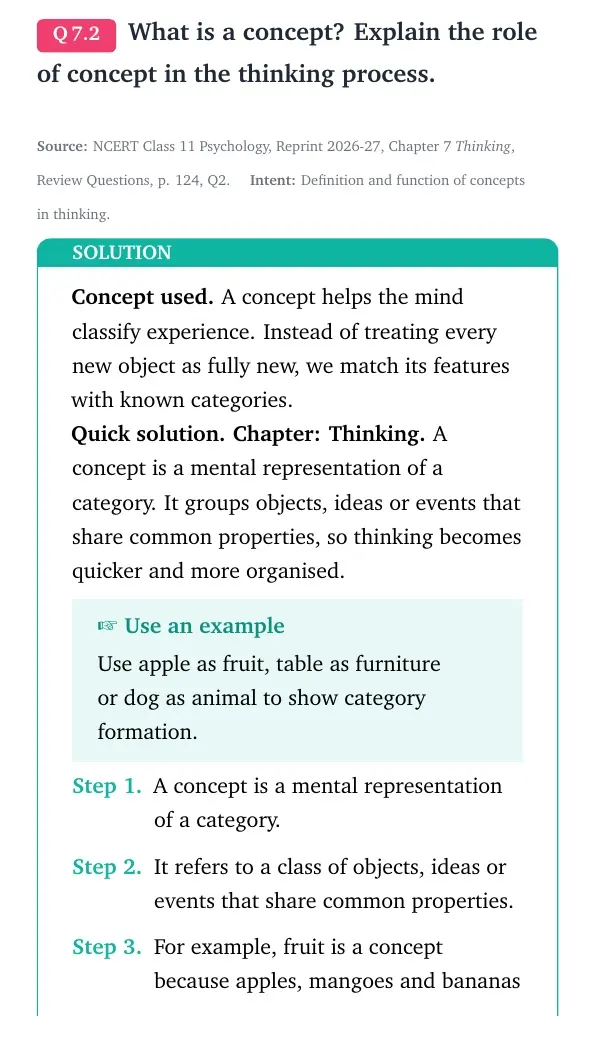
Q 7.2
What is a concept? Explain the role of concept in the thinking process.
Concept used. A concept helps the mind classify experience. Instead of treating every new object as fully new, we match its features with known categories.
A concept is a mental representation of a category. It groups objects, ideas or events that share common properties, so thinking becomes quicker and more organised.
Use an example
Use apple as fruit, table as furniture or dog as animal to show category formation.
A concept is a mental representation of a category.
It refers to a class of objects, ideas or events that share common properties.
For example, fruit is a concept because apples, mangoes and bananas share certain features.
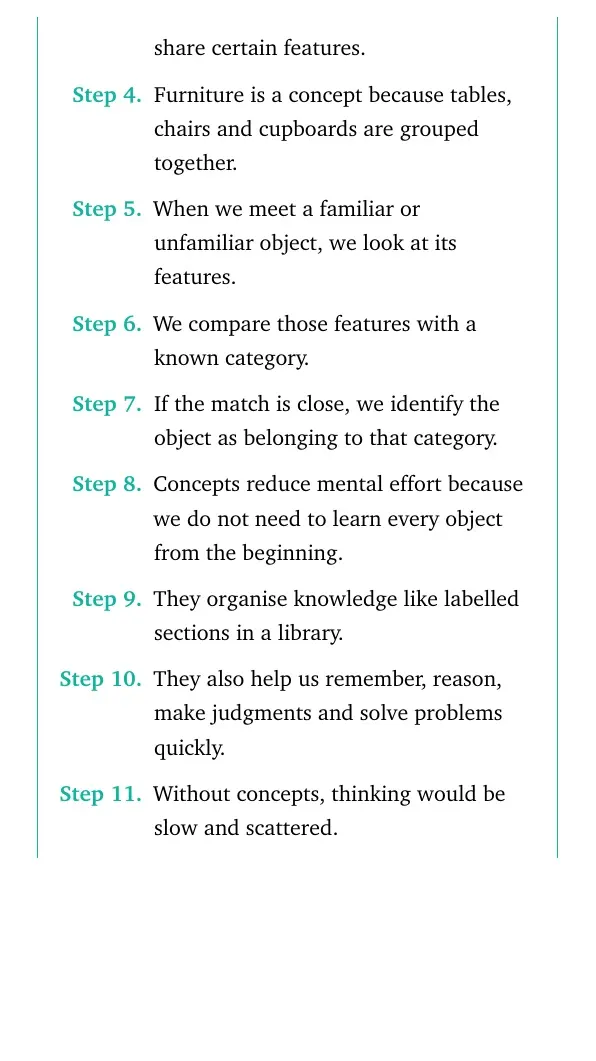
Furniture is a concept because tables, chairs and cupboards are grouped together.
When we meet a familiar or unfamiliar object, we look at its features.
We compare those features with a known category.
If the match is close, we identify the object as belonging to that category.
Concepts reduce mental effort because we do not need to learn every object from the beginning.
They organise knowledge like labelled sections in a library.
They also help us remember, reason, make judgments and solve problems quickly.
Without concepts, thinking would be slow and scattered.
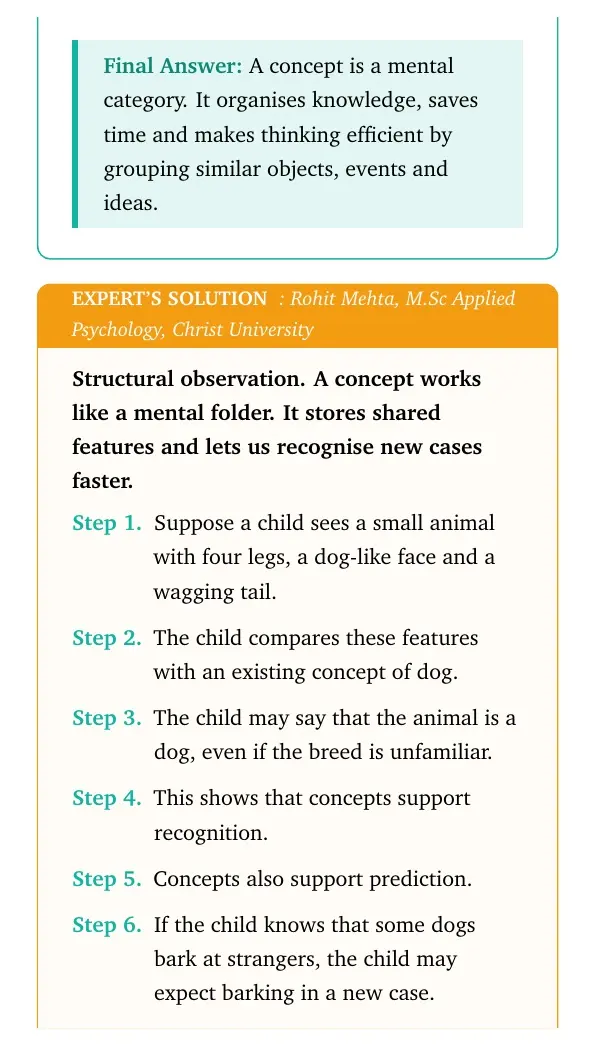
A concept is a mental category. It organises knowledge, saves time and makes thinking efficient by grouping similar objects, events and ideas.
RM
Rohit Mehta
M.Sc Applied Psychology, Christ University
Verified Expert
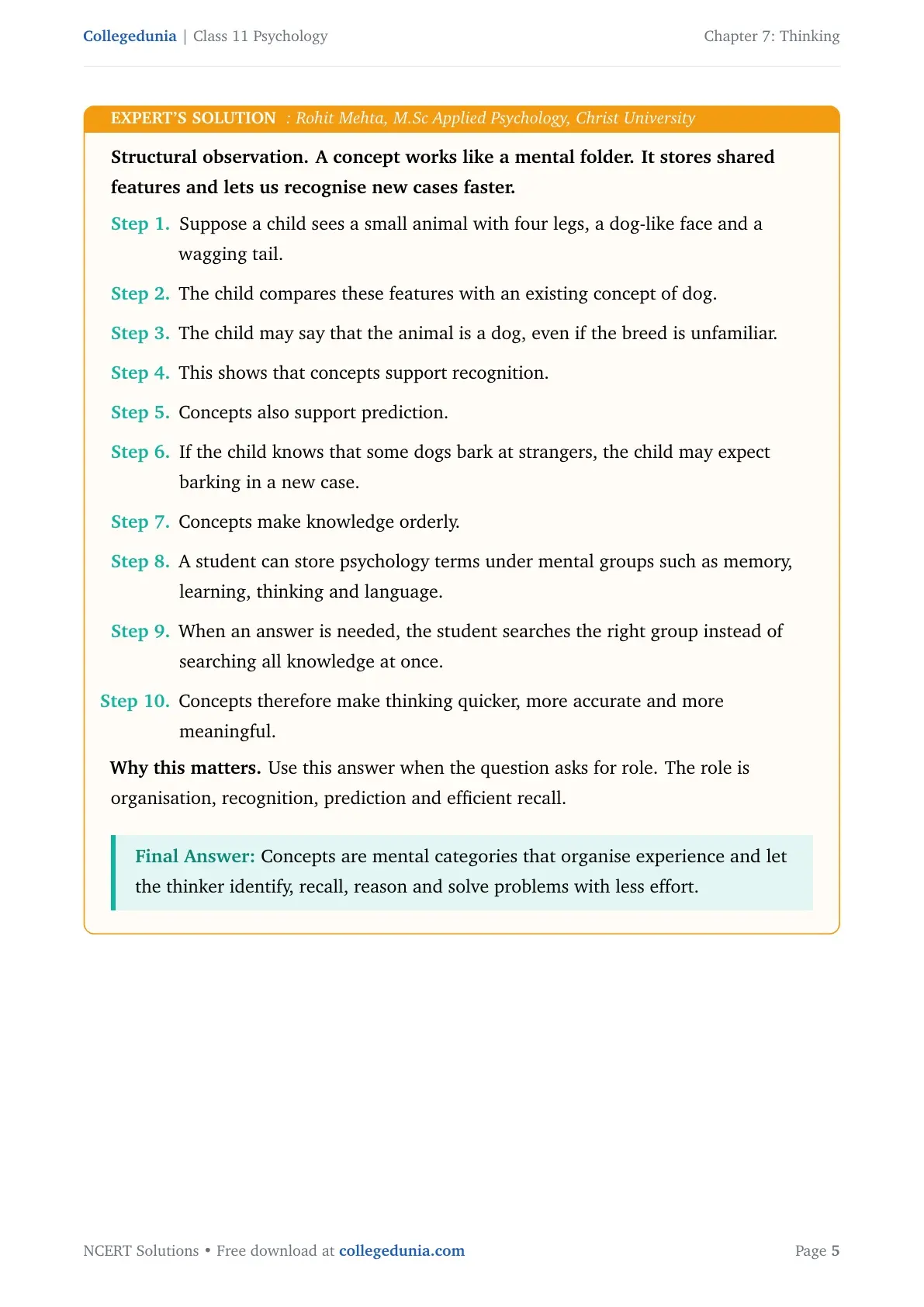
Structural observation. A concept works like a mental folder. It stores shared features and lets us recognise new cases faster.
Suppose a child sees a small animal with four legs, a dog-like face and a wagging tail.
The child compares these features with an existing concept of dog.
The child may say that the animal is a dog, even if the breed is unfamiliar.
This shows that concepts support recognition.
Concepts also support prediction.
If the child knows that some dogs bark at strangers, the child may expect barking in a new case.
Concepts make knowledge orderly.
A student can store psychology terms under mental groups such as memory, learning, thinking and language.
When an answer is needed, the student searches the right group instead of searching all knowledge at once.
Concepts therefore make thinking quicker, more accurate and more meaningful.
Why this matters. Use this answer when the question asks for role. The role is organisation, recognition, prediction and efficient recall.
Concepts are mental categories that organise experience and let the thinker identify, recall, reason and solve problems with less effort.
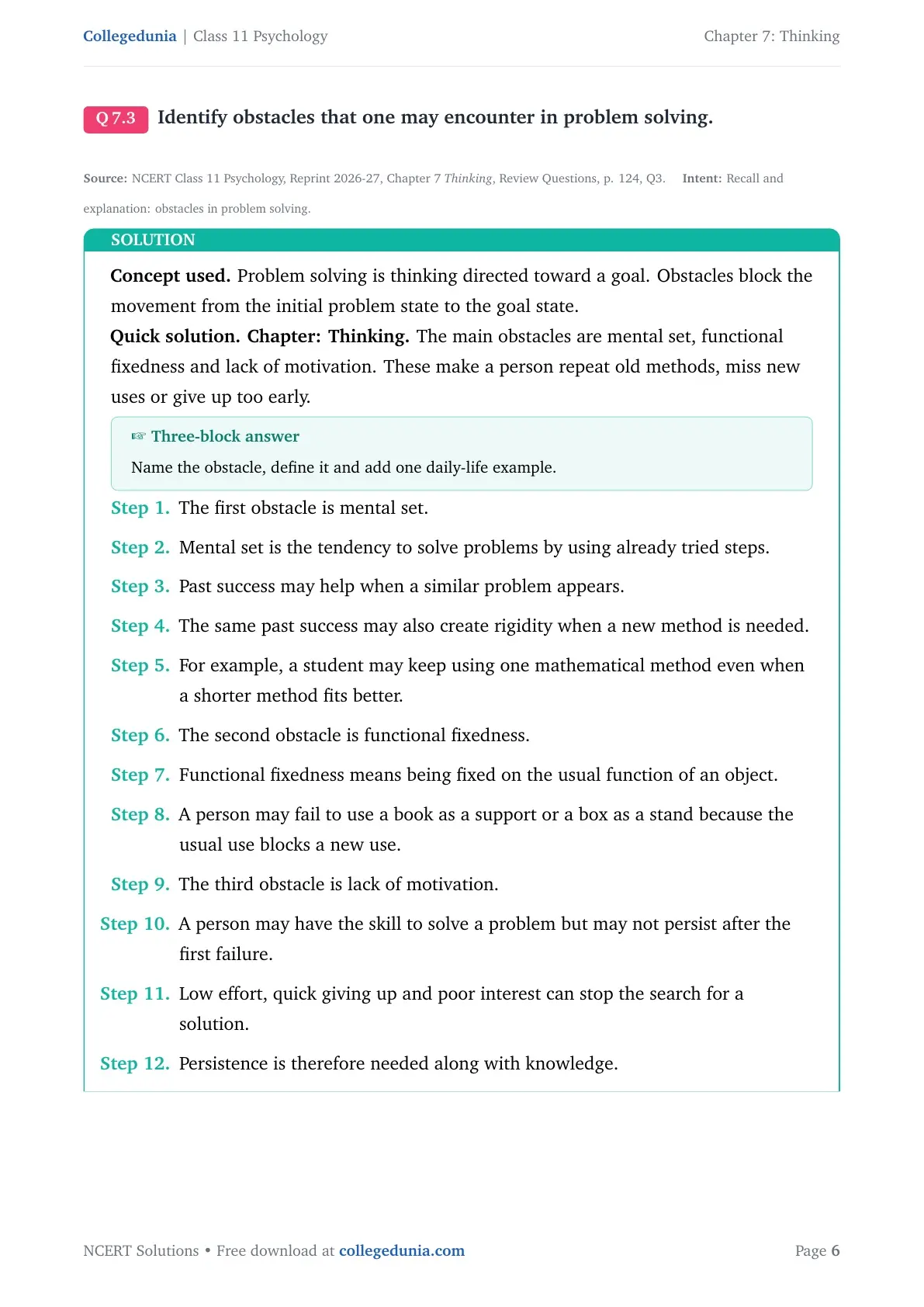
Q 7.3
Identify obstacles that one may encounter in problem solving.
Concept used. Problem solving is thinking directed toward a goal. Obstacles block the movement from the initial problem state to the goal state.
The main obstacles are mental set, functional fixedness and lack of motivation. These make a person repeat old methods, miss new uses or give up too early.
Three-block answer
Name the obstacle, define it and add one daily-life example.
The first obstacle is mental set.
Mental set is the tendency to solve problems by using already tried steps.
Past success may help when a similar problem appears.
The same past success may also create rigidity when a new method is needed.
For example, a student may keep using one mathematical method even when a shorter method fits better.
The second obstacle is functional fixedness.
Functional fixedness means being fixed on the usual function of an object.
A person may fail to use a book as a support or a box as a stand because the usual use blocks a new use.
The third obstacle is lack of motivation.
A person may have the skill to solve a problem but may not persist after the first failure.
Low effort, quick giving up and poor interest can stop the search for a solution.
Persistence is therefore needed along with knowledge.
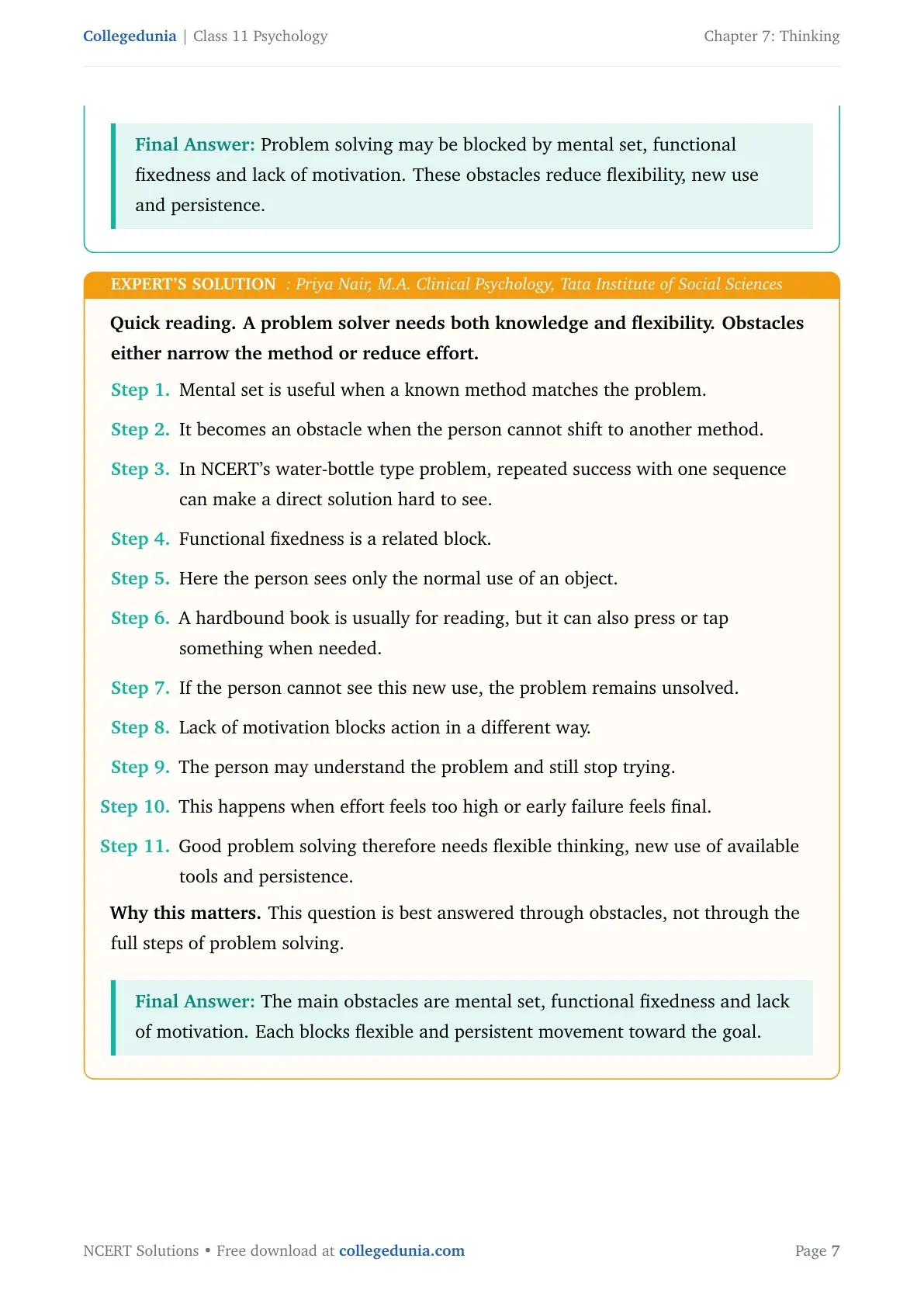
Problem solving may be blocked by mental set, functional fixedness and lack of motivation. These obstacles reduce flexibility, new use and persistence.
PN
Priya Nair
M.A. Clinical Psychology, Tata Institute of Social Sciences
Verified Expert
Quick reading. A problem solver needs both knowledge and flexibility. Obstacles either narrow the method or reduce effort.
Mental set is useful when a known method matches the problem.
It becomes an obstacle when the person cannot shift to another method.
In NCERT's water-bottle type problem, repeated success with one sequence can make a direct solution hard to see.
Functional fixedness is a related block.
Here the person sees only the normal use of an object.
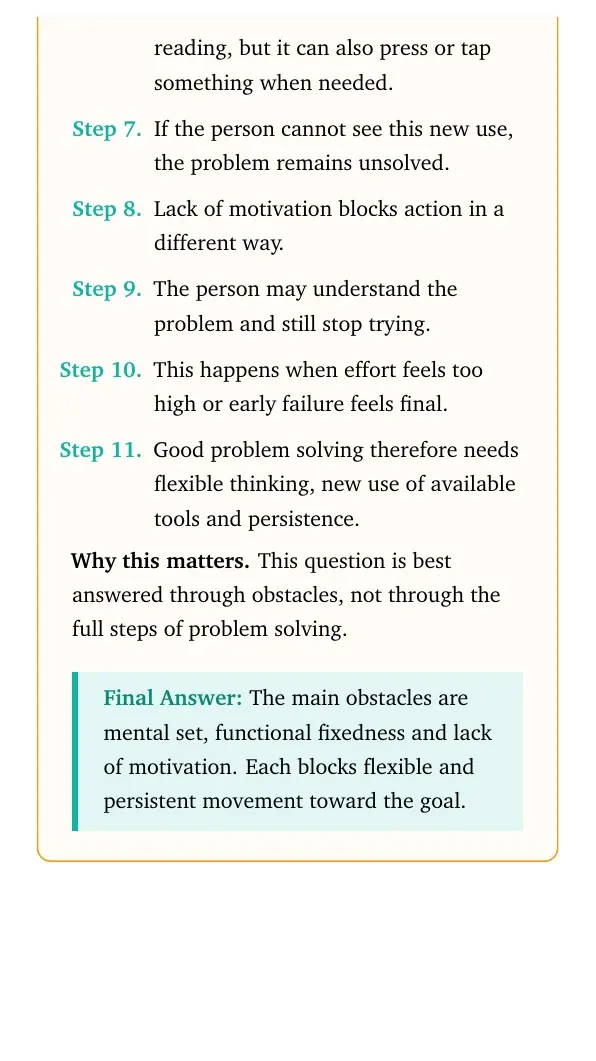
A hardbound book is usually for reading, but it can also press or tap something when needed.
If the person cannot see this new use, the problem remains unsolved.
Lack of motivation blocks action in a different way.
The person may understand the problem and still stop trying.
This happens when effort feels too high or early failure feels final.
Good problem solving therefore needs flexible thinking, new use of available tools and persistence.
Why this matters. This question is best answered through obstacles, not through the full steps of problem solving.
The main obstacles are mental set, functional fixedness and lack of motivation. Each blocks flexible and persistent movement toward the goal.
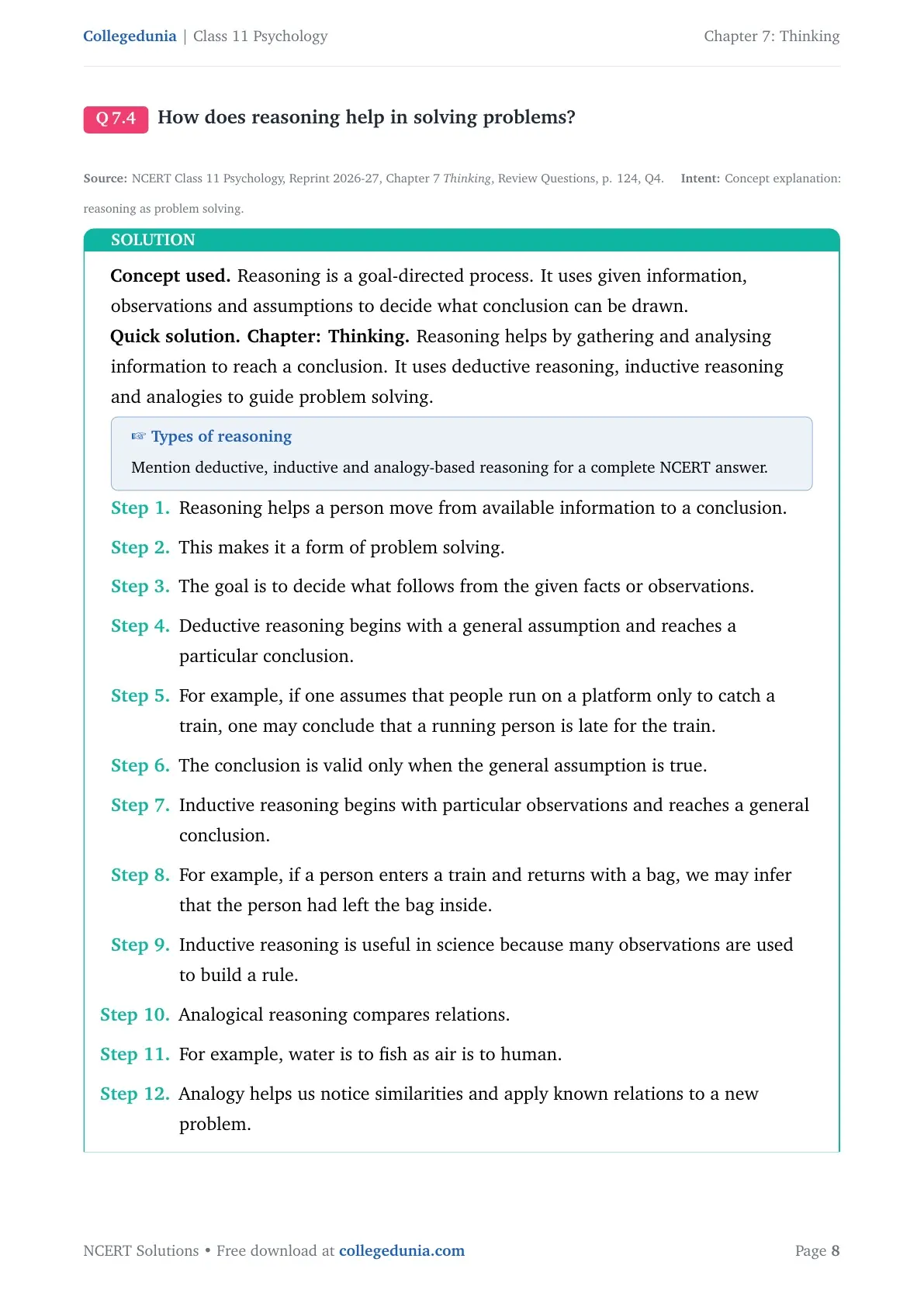
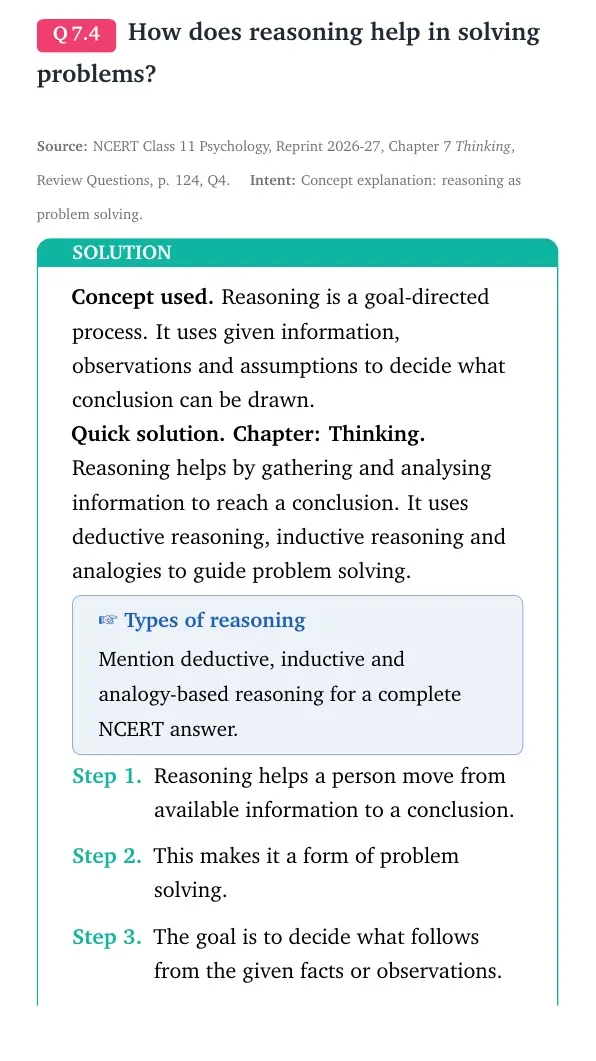
Q 7.4
How does reasoning help in solving problems?
Concept used. Reasoning is a goal-directed process. It uses given information, observations and assumptions to decide what conclusion can be drawn.
Reasoning helps by gathering and analysing information to reach a conclusion. It uses deductive reasoning, inductive reasoning and analogies to guide problem solving.
Types of reasoning
Mention deductive, inductive and analogy-based reasoning for a complete NCERT answer.
Reasoning helps a person move from available information to a conclusion.
This makes it a form of problem solving.
The goal is to decide what follows from the given facts or observations.
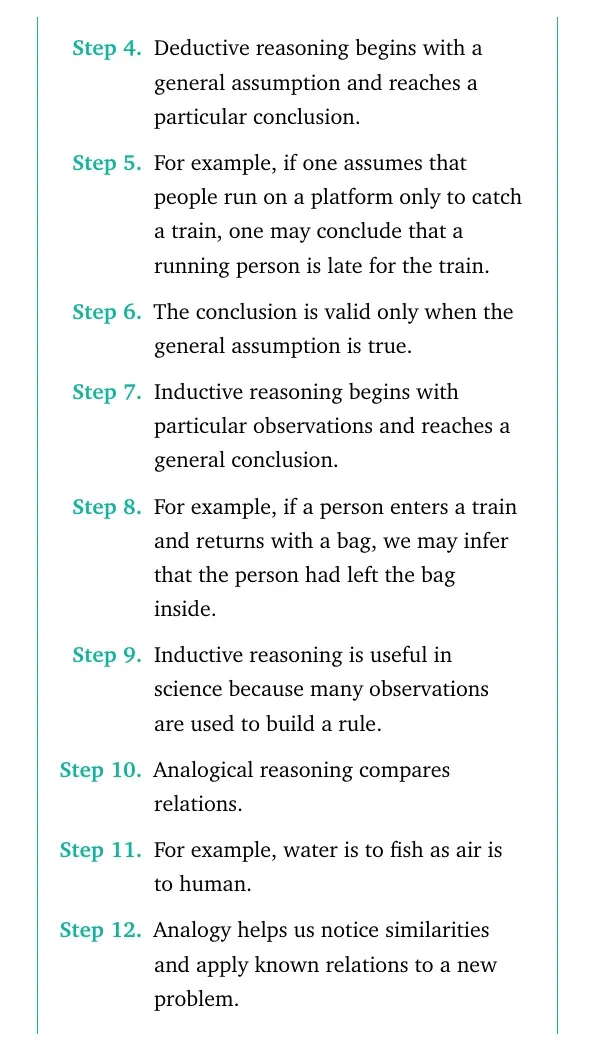
Deductive reasoning begins with a general assumption and reaches a particular conclusion.
For example, if one assumes that people run on a platform only to catch a train, one may conclude that a running person is late for the train.
The conclusion is valid only when the general assumption is true.
Inductive reasoning begins with particular observations and reaches a general conclusion.
For example, if a person enters a train and returns with a bag, we may infer that the person had left the bag inside.
Inductive reasoning is useful in science because many observations are used to build a rule.
Analogical reasoning compares relations.
For example, water is to fish as air is to human.
Analogy helps us notice similarities and apply known relations to a new problem.
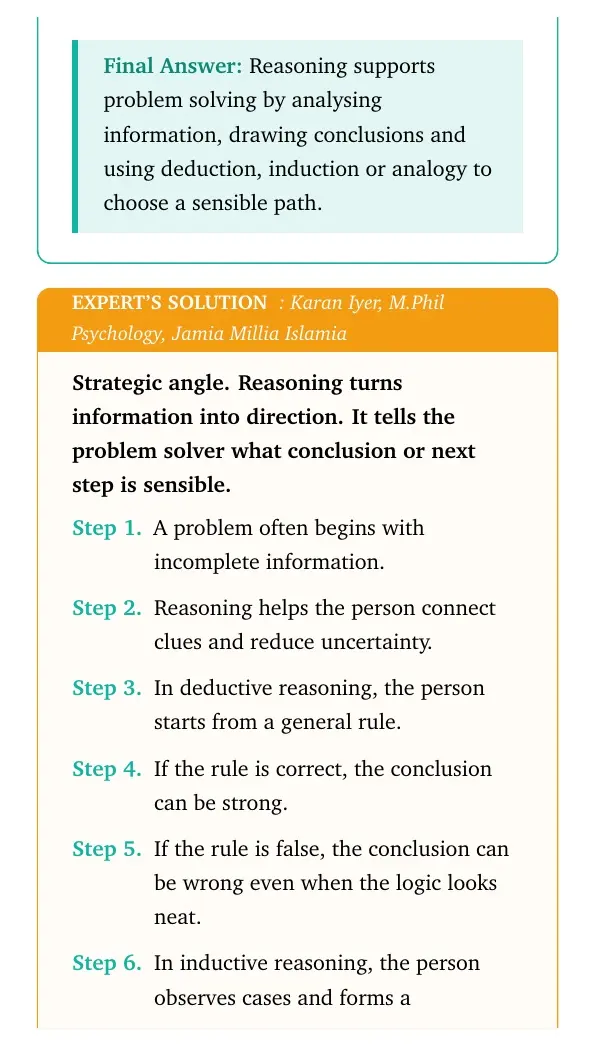
Reasoning supports problem solving by analysing information, drawing conclusions and using deduction, induction or analogy to choose a sensible path.
KI
Karan Iyer
M.Phil Psychology, Jamia Millia Islamia
Verified Expert
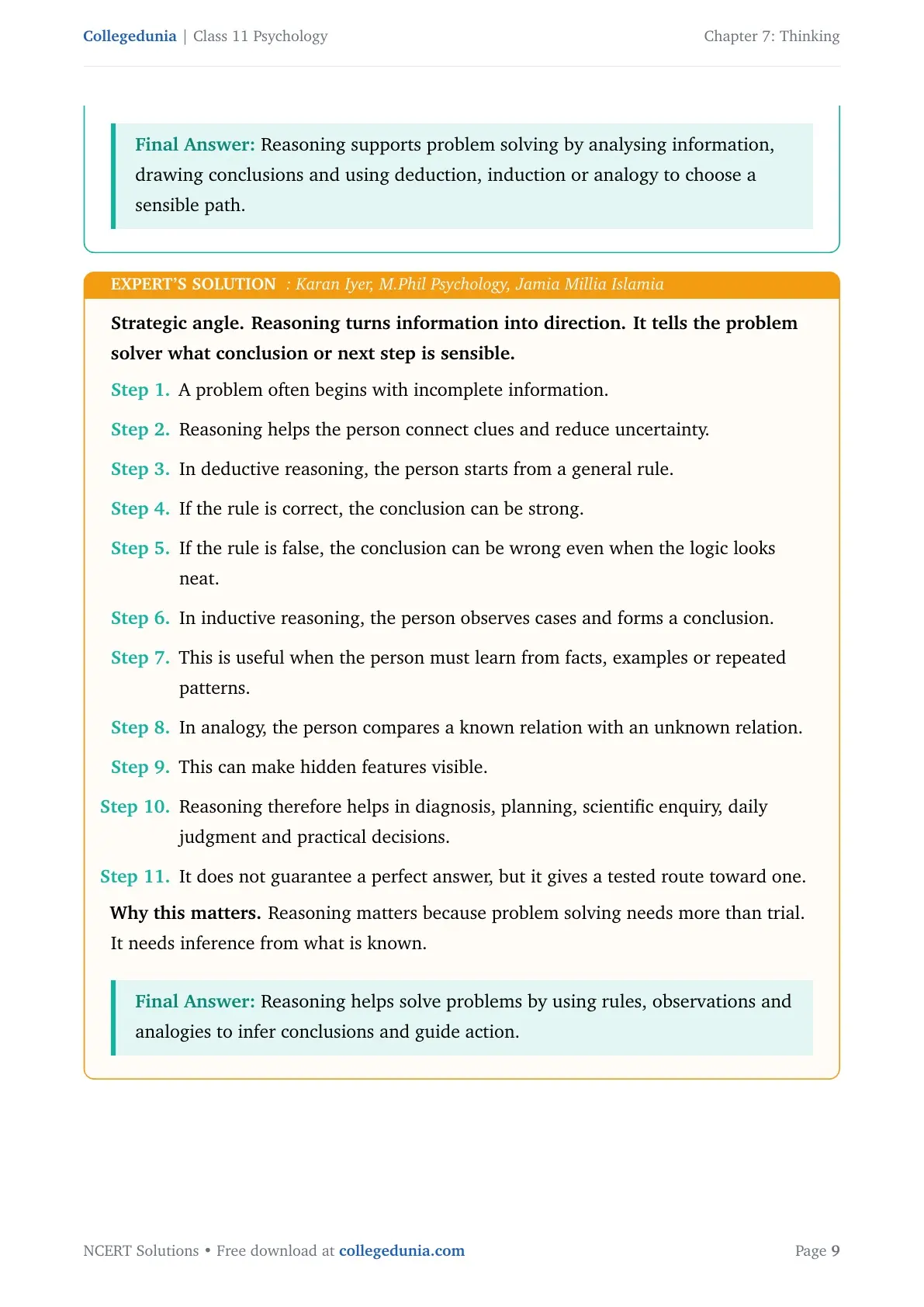
Strategic angle. Reasoning turns information into direction. It tells the problem solver what conclusion or next step is sensible.
A problem often begins with incomplete information.
Reasoning helps the person connect clues and reduce uncertainty.
In deductive reasoning, the person starts from a general rule.
If the rule is correct, the conclusion can be strong.
If the rule is false, the conclusion can be wrong even when the logic looks neat.
In inductive reasoning, the person observes cases and forms a conclusion.
This is useful when the person must learn from facts, examples or repeated patterns.
In analogy, the person compares a known relation with an unknown relation.
This can make hidden features visible.
Reasoning therefore helps in diagnosis, planning, scientific enquiry, daily judgment and practical decisions.
It does not guarantee a perfect answer, but it gives a tested route toward one.
Why this matters. Reasoning matters because problem solving needs more than trial. It needs inference from what is known.
Reasoning helps solve problems by using rules, observations and analogies to infer conclusions and guide action.
Q 7.5
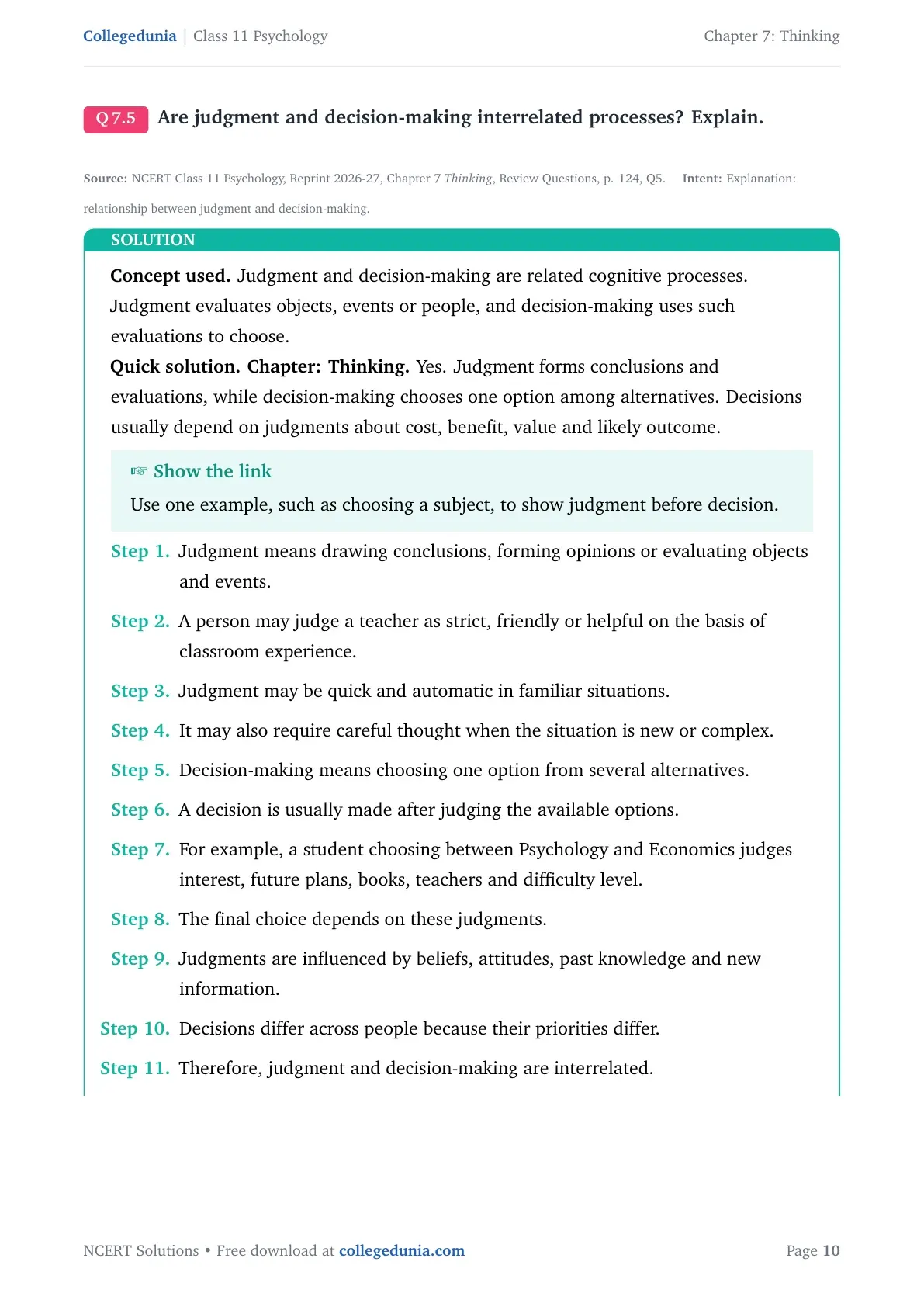
Are judgment and decision-making interrelated processes? Explain.
Concept used. Judgment and decision-making are related cognitive processes. Judgment evaluates objects, events or people, and decision-making uses such evaluations to choose.
Yes. Judgment forms conclusions and evaluations, while decision-making chooses one option among alternatives. Decisions usually depend on judgments about cost, benefit, value and likely outcome.
Show the link
Use one example, such as choosing a subject, to show judgment before decision.
Judgment means drawing conclusions, forming opinions or evaluating objects and events.
A person may judge a teacher as strict, friendly or helpful on the basis of classroom experience.
Judgment may be quick and automatic in familiar situations.
It may also require careful thought when the situation is new or complex.
Decision-making means choosing one option from several alternatives.
A decision is usually made after judging the available options.
For example, a student choosing between Psychology and Economics judges interest, future plans, books, teachers and difficulty level.
The final choice depends on these judgments.
Judgments are influenced by beliefs, attitudes, past knowledge and new information.
Decisions differ across people because their priorities differ.
Therefore, judgment and decision-making are interrelated.
Judgment and decision-making are interrelated because decisions are based on evaluations, opinions and conclusions about the available alternatives.
SG
Sneha Gupta
M.Sc Counselling Psychology, Banaras Hindu University
Verified Expert
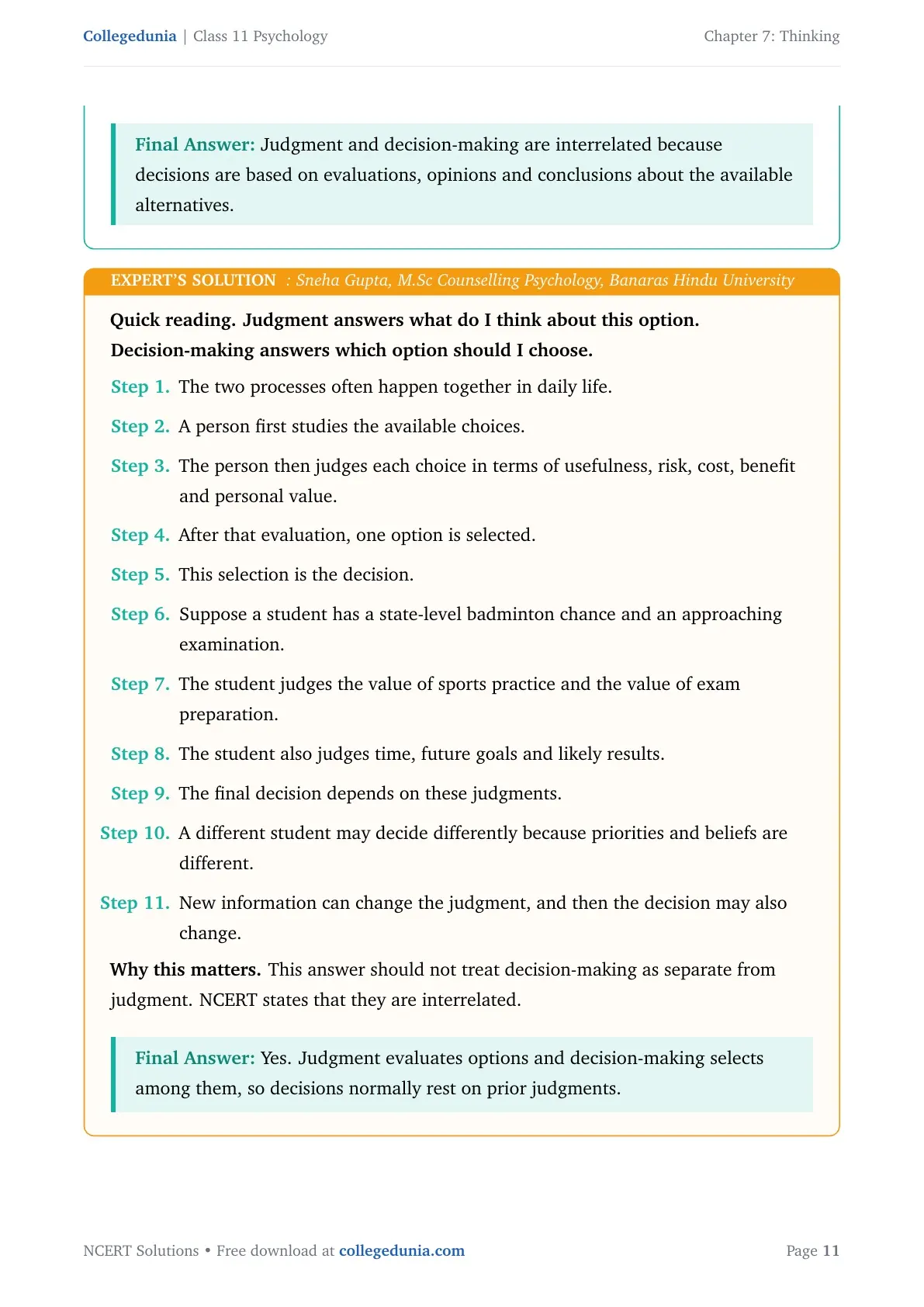
Quick reading. Judgment answers what do I think about this option. Decision-making answers which option should I choose.
The two processes often happen together in daily life.
A person first studies the available choices.
The person then judges each choice in terms of usefulness, risk, cost, benefit and personal value.
After that evaluation, one option is selected.
This selection is the decision.
Suppose a student has a state-level badminton chance and an approaching examination.
The student judges the value of sports practice and the value of exam preparation.
The student also judges time, future goals and likely results.
The final decision depends on these judgments.
A different student may decide differently because priorities and beliefs are different.
New information can change the judgment, and then the decision may also change.
Why this matters. This answer should not treat decision-making as separate from judgment. NCERT states that they are interrelated.
Yes. Judgment evaluates options and decision-making selects among them, so decisions normally rest on prior judgments.
Q 7.6
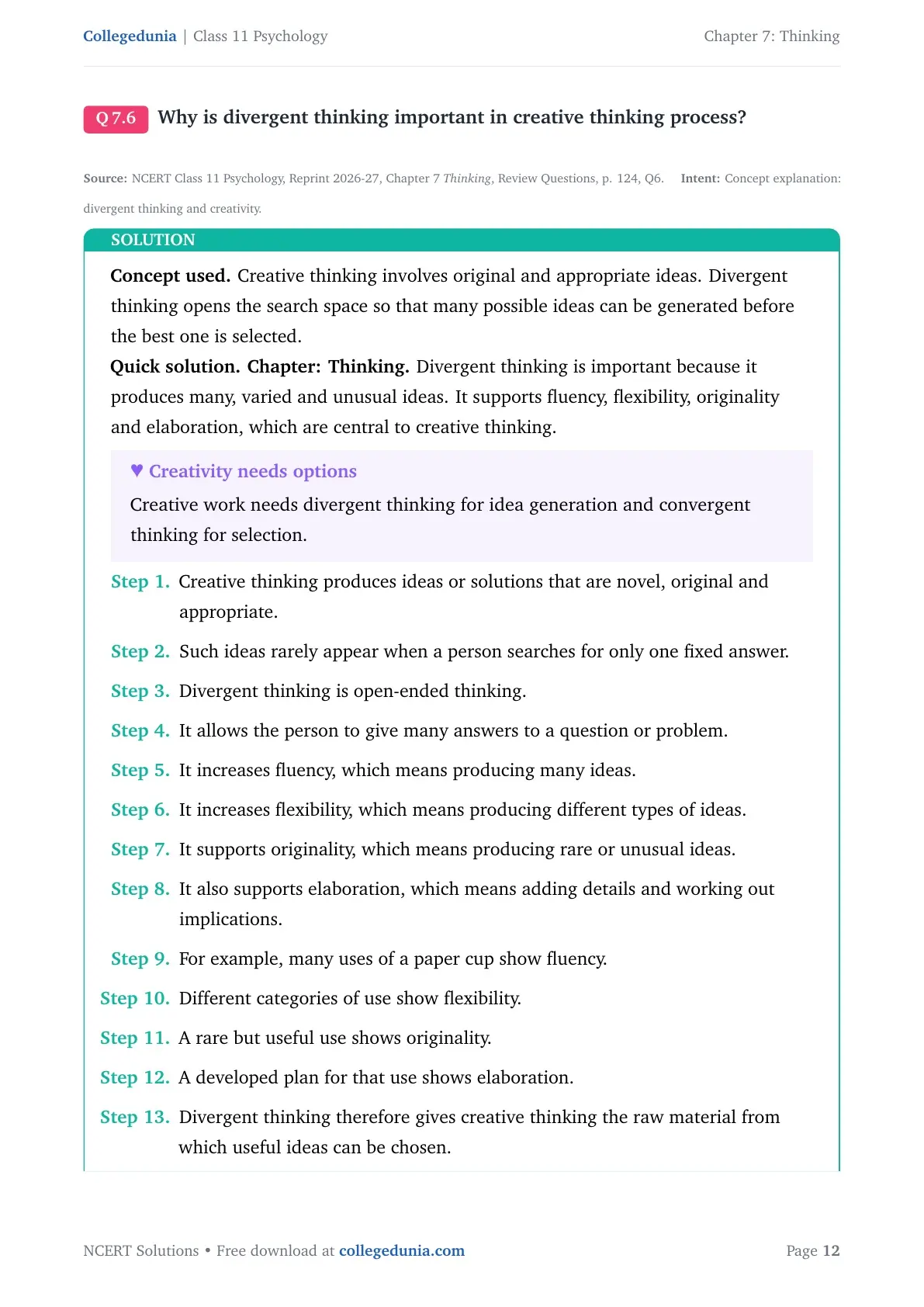
Why is divergent thinking important in creative thinking process?
Concept used. Creative thinking involves original and appropriate ideas. Divergent thinking opens the search space so that many possible ideas can be generated before the best one is selected.
Divergent thinking is important because it produces many, varied and unusual ideas. It supports fluency, flexibility, originality and elaboration, which are central to creative thinking.
Creativity needs options
Creative work needs divergent thinking for idea generation and convergent thinking for selection.
Creative thinking produces ideas or solutions that are novel, original and appropriate.
Such ideas rarely appear when a person searches for only one fixed answer.
Divergent thinking is open-ended thinking.
It allows the person to give many answers to a question or problem.
It increases fluency, which means producing many ideas.
It increases flexibility, which means producing different types of ideas.
It supports originality, which means producing rare or unusual ideas.
It also supports elaboration, which means adding details and working out implications.
For example, many uses of a paper cup show fluency.
Different categories of use show flexibility.
A rare but useful use shows originality.
A developed plan for that use shows elaboration.
Divergent thinking therefore gives creative thinking the raw material from which useful ideas can be chosen.
Divergent thinking is important because it generates many, varied, original and detailed ideas, which are needed before creative selection can occur.
AR
Arjun Rao
M.A. Psychology, University of Hyderabad
Verified Expert
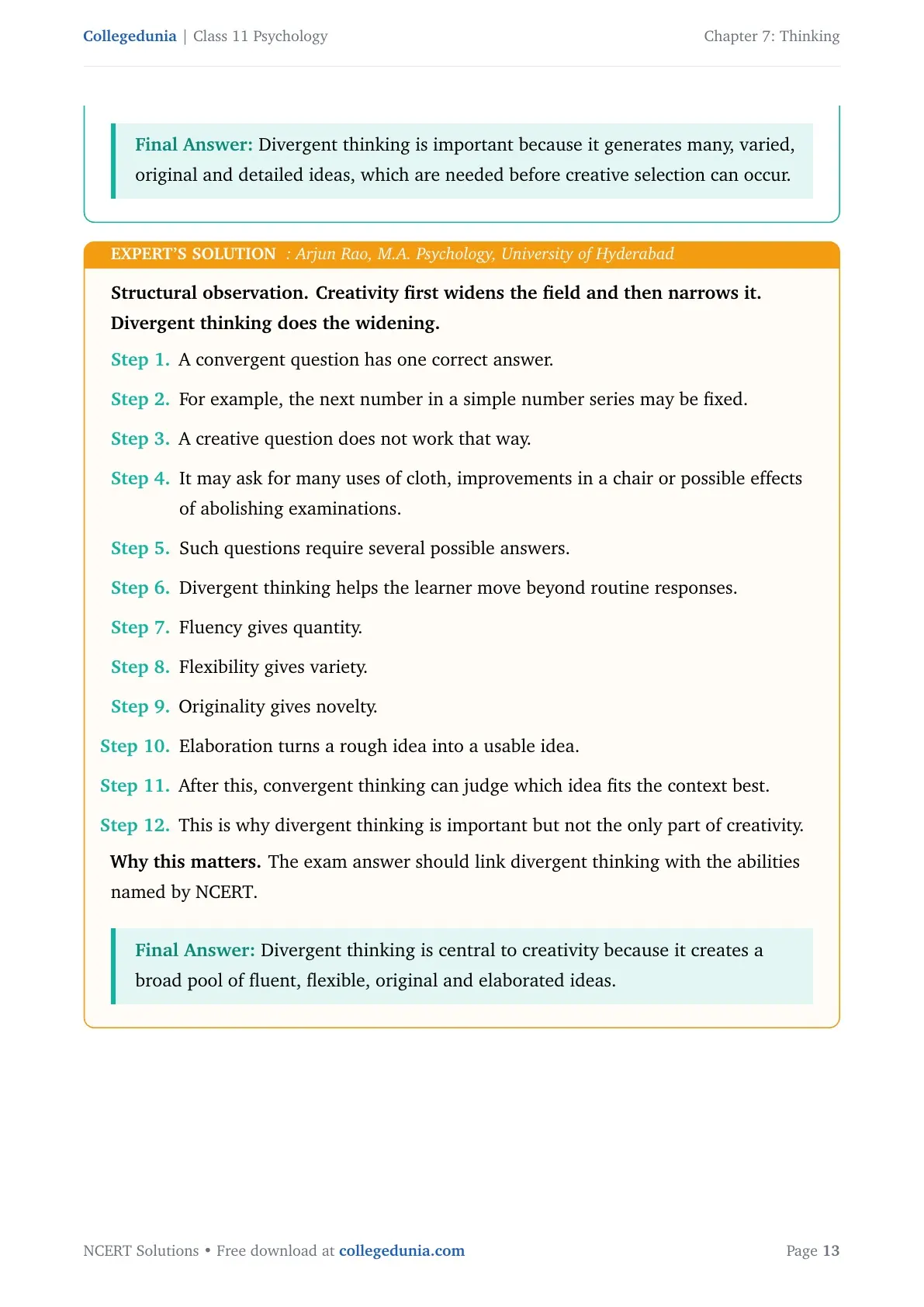
Structural observation. Creativity first widens the field and then narrows it. Divergent thinking does the widening.
A convergent question has one correct answer.
For example, the next number in a simple number series may be fixed.
A creative question does not work that way.
It may ask for many uses of cloth, improvements in a chair or possible effects of abolishing examinations.
Such questions require several possible answers.
Divergent thinking helps the learner move beyond routine responses.
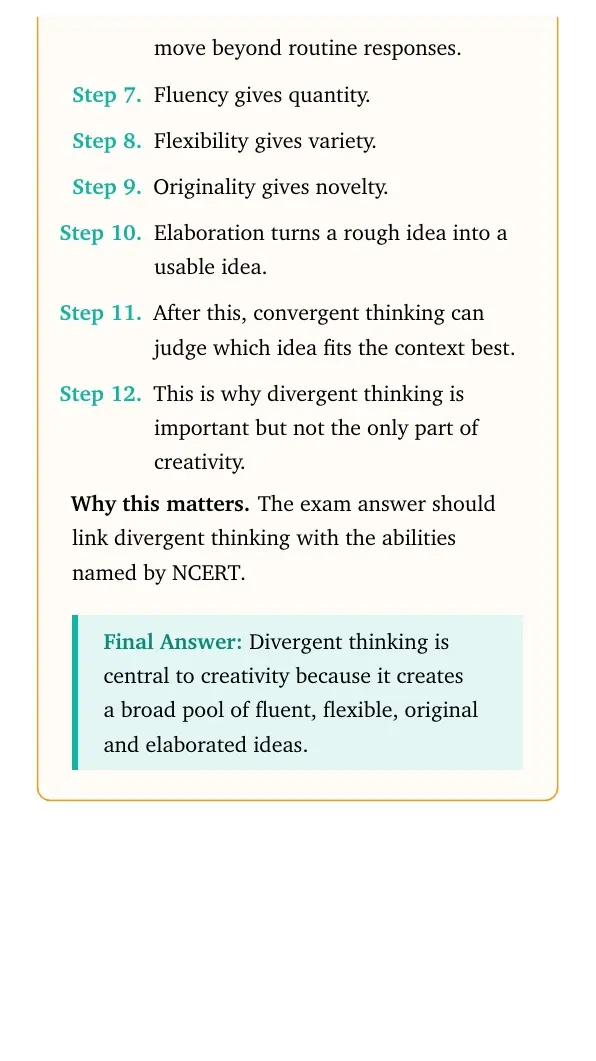
Fluency gives quantity.
Flexibility gives variety.
Originality gives novelty.
Elaboration turns a rough idea into a usable idea.
After this, convergent thinking can judge which idea fits the context best.
This is why divergent thinking is important but not the only part of creativity.
Why this matters. The exam answer should link divergent thinking with the abilities named by NCERT.
Divergent thinking is central to creativity because it creates a broad pool of fluent, flexible, original and elaborated ideas.
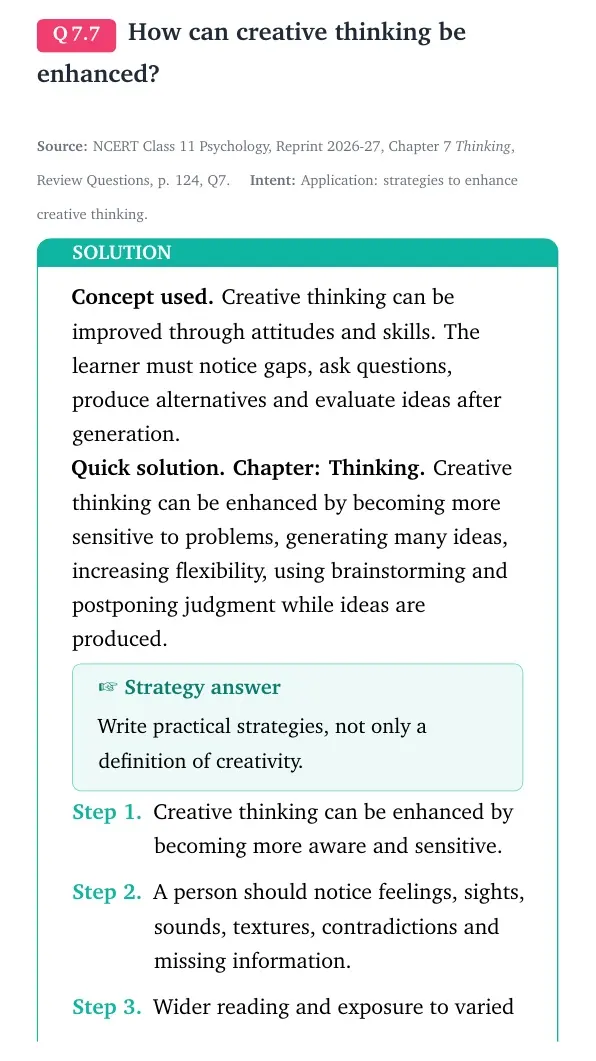
Q 7.7
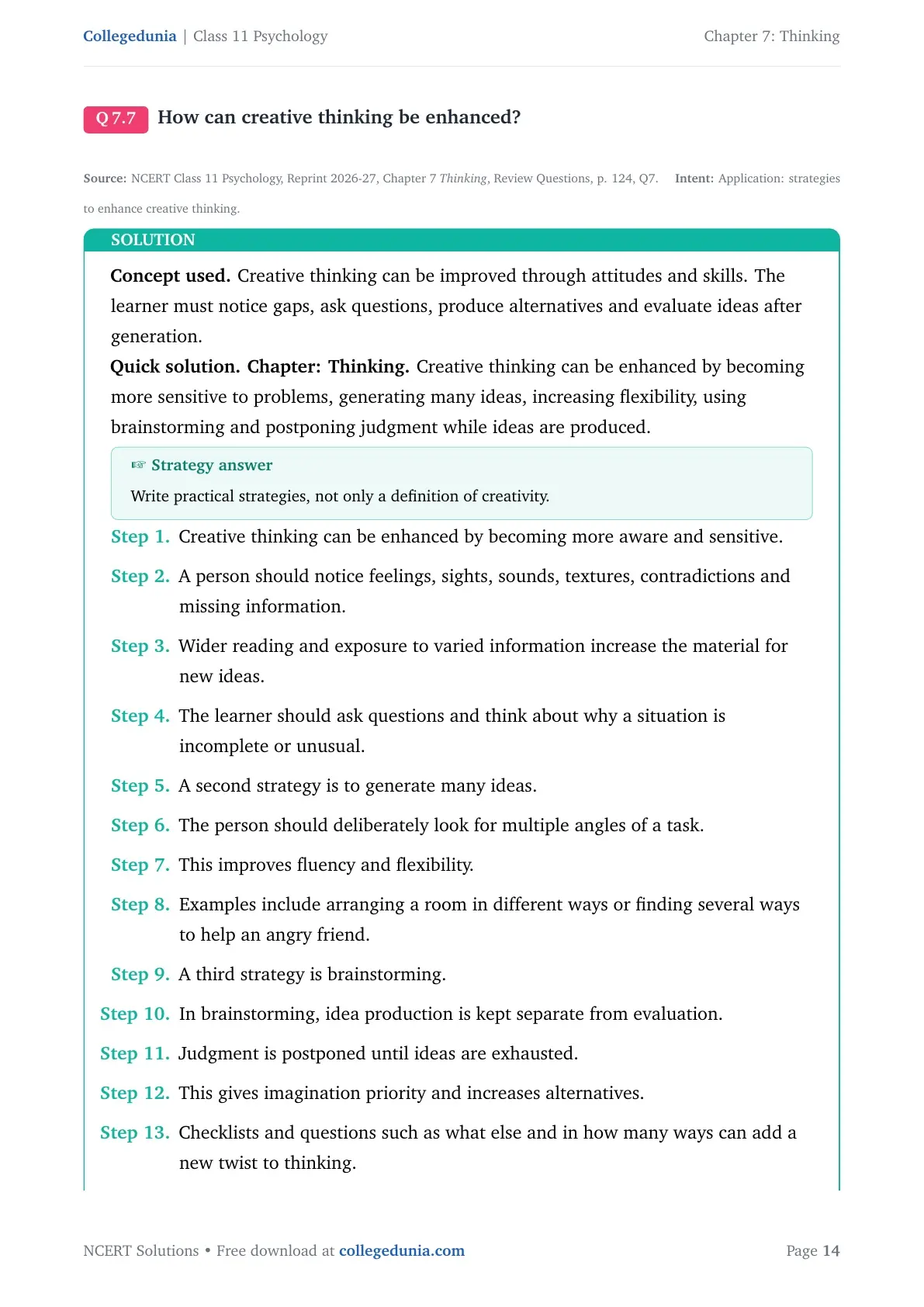
How can creative thinking be enhanced?
Concept used. Creative thinking can be improved through attitudes and skills. The learner must notice gaps, ask questions, produce alternatives and evaluate ideas after generation.
Creative thinking can be enhanced by becoming more sensitive to problems, generating many ideas, increasing flexibility, using brainstorming and postponing judgment while ideas are produced.
Strategy answer
Write practical strategies, not only a definition of creativity.
Creative thinking can be enhanced by becoming more aware and sensitive.
A person should notice feelings, sights, sounds, textures, contradictions and missing information.
Wider reading and exposure to varied information increase the material for new ideas.
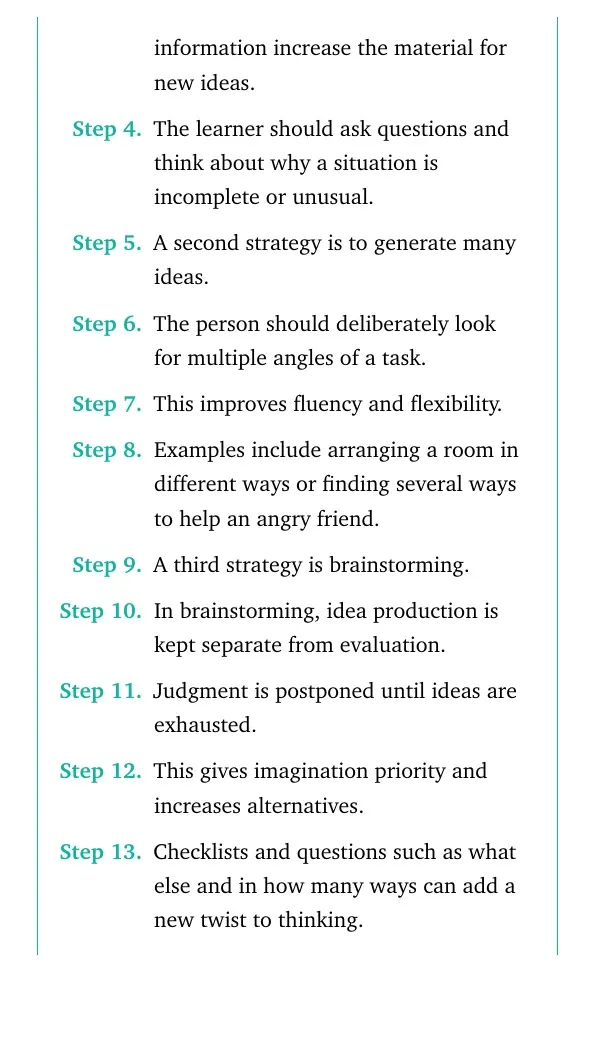
The learner should ask questions and think about why a situation is incomplete or unusual.
A second strategy is to generate many ideas.
The person should deliberately look for multiple angles of a task.
This improves fluency and flexibility.
Examples include arranging a room in different ways or finding several ways to help an angry friend.
A third strategy is brainstorming.
In brainstorming, idea production is kept separate from evaluation.
Judgment is postponed until ideas are exhausted.
This gives imagination priority and increases alternatives.
Checklists and questions such as what else and in how many ways can add a new twist to thinking.
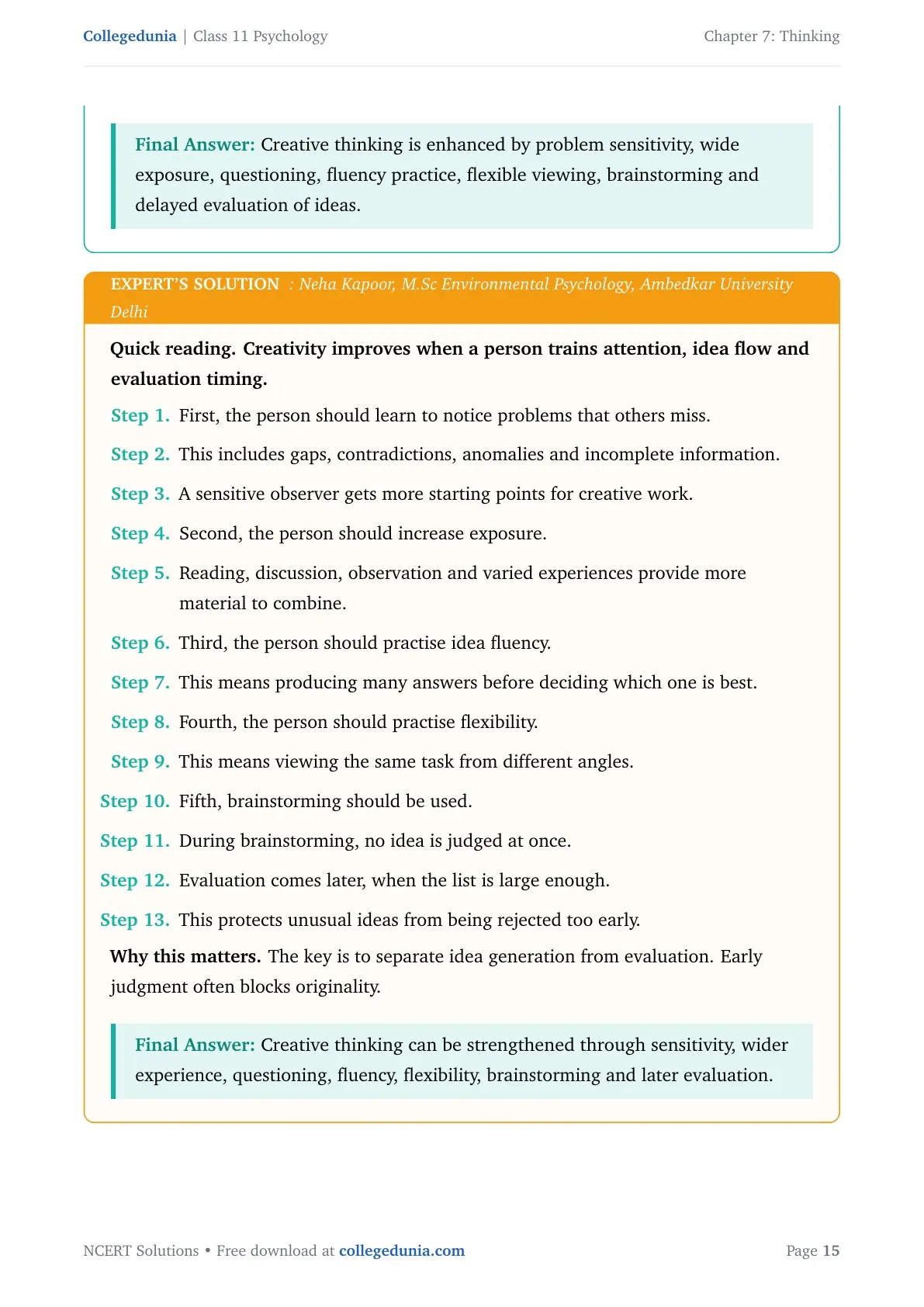
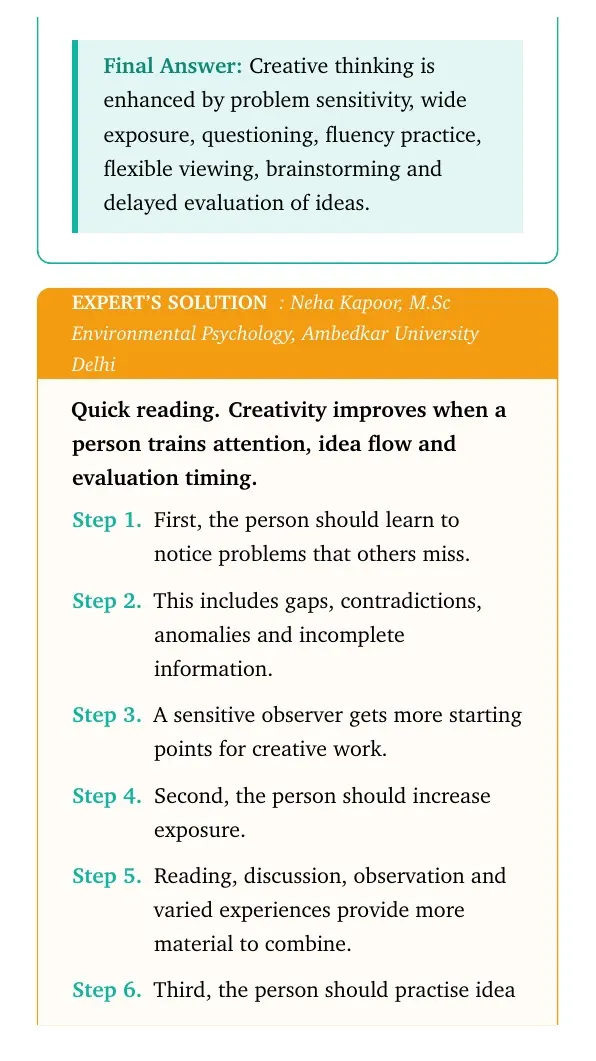
Creative thinking is enhanced by problem sensitivity, wide exposure, questioning, fluency practice, flexible viewing, brainstorming and delayed evaluation of ideas.
NK
Neha Kapoor
M.Sc Environmental Psychology, Ambedkar University Delhi
Verified Expert
Quick reading. Creativity improves when a person trains attention, idea flow and evaluation timing.
First, the person should learn to notice problems that others miss.
This includes gaps, contradictions, anomalies and incomplete information.
A sensitive observer gets more starting points for creative work.
Second, the person should increase exposure.
Reading, discussion, observation and varied experiences provide more material to combine.
Third, the person should practise idea fluency.
This means producing many answers before deciding which one is best.
Fourth, the person should practise flexibility.
This means viewing the same task from different angles.
Fifth, brainstorming should be used.
During brainstorming, no idea is judged at once.
Evaluation comes later, when the list is large enough.
This protects unusual ideas from being rejected too early.
Why this matters. The key is to separate idea generation from evaluation. Early judgment often blocks originality.
Creative thinking can be strengthened through sensitivity, wider experience, questioning, fluency, flexibility, brainstorming and later evaluation.
Q 7.8
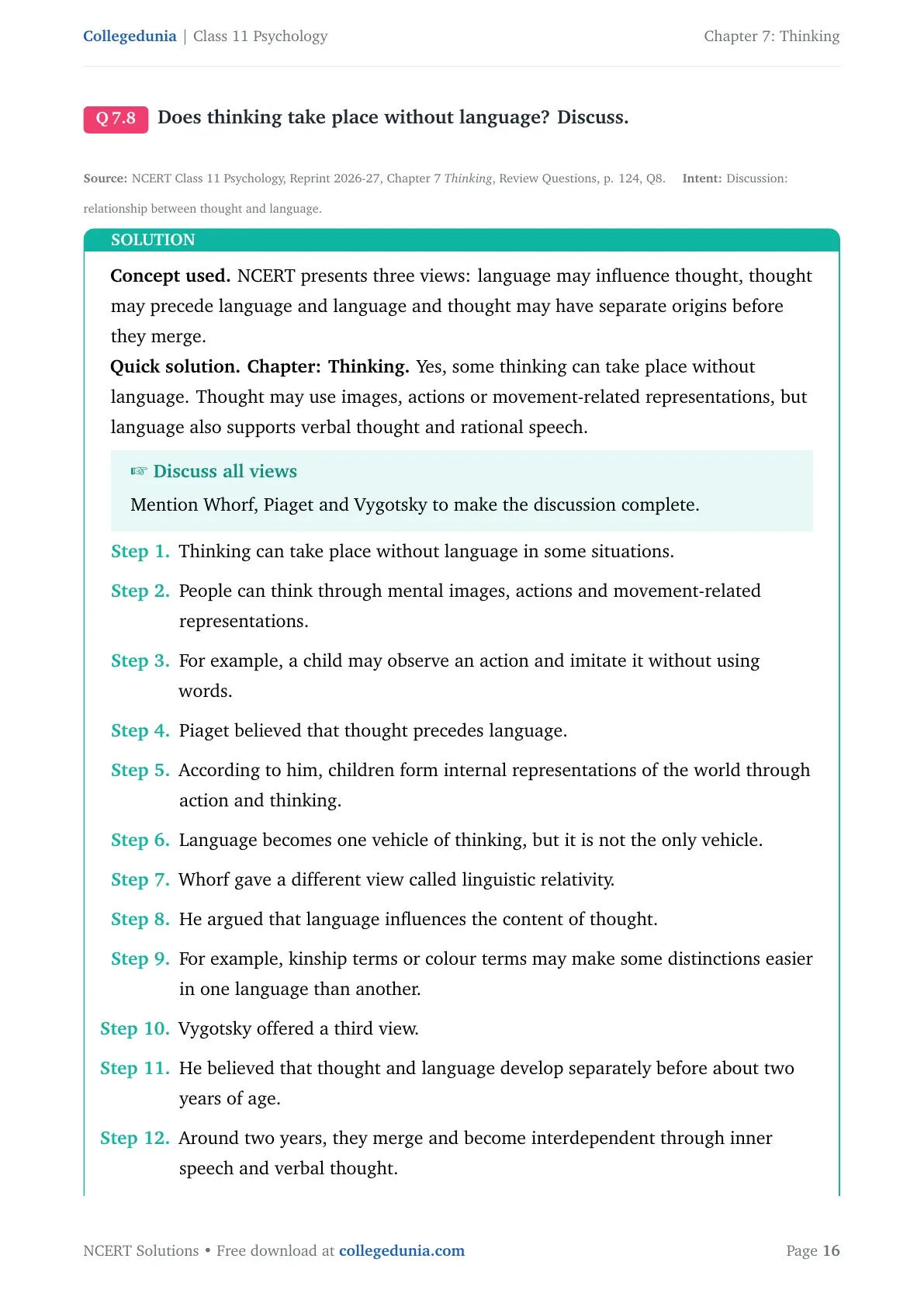
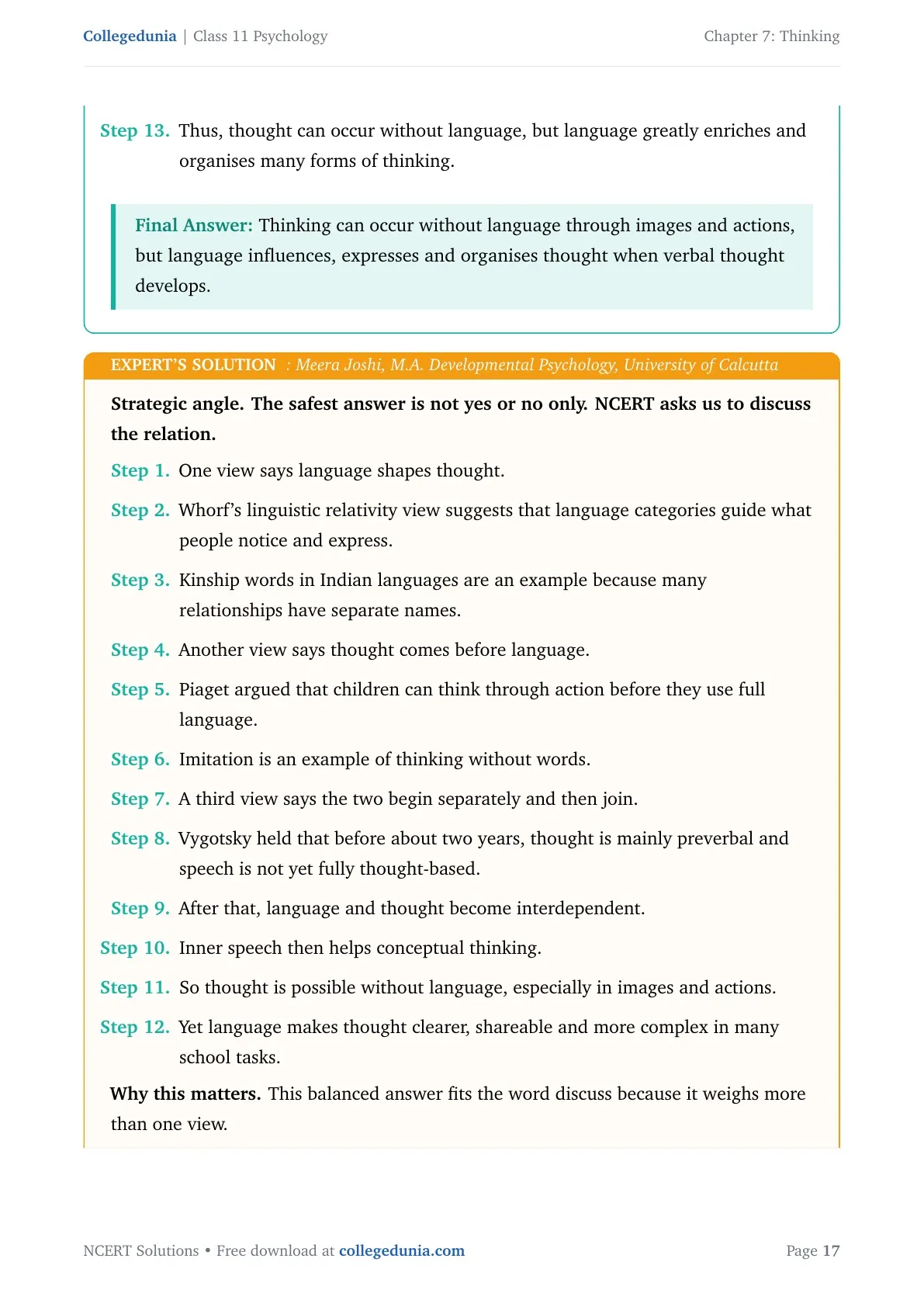
Does thinking take place without language? Discuss.
Concept used. NCERT presents three views: language may influence thought, thought may precede language and language and thought may have separate origins before they merge.
Yes, some thinking can take place without language. Thought may use images, actions or movement-related representations, but language also supports verbal thought and rational speech.
Discuss all views
Mention Whorf, Piaget and Vygotsky to make the discussion complete.
Thinking can take place without language in some situations.
People can think through mental images, actions and movement-related representations.
For example, a child may observe an action and imitate it without using words.
Piaget believed that thought precedes language.
According to him, children form internal representations of the world through action and thinking.
Language becomes one vehicle of thinking, but it is not the only vehicle.
Whorf gave a different view called linguistic relativity.
He argued that language influences the content of thought.
For example, kinship terms or colour terms may make some distinctions easier in one language than another.
Vygotsky offered a third view.
He believed that thought and language develop separately before about two years of age.
Around two years, they merge and become interdependent through inner speech and verbal thought.
Thus, thought can occur without language, but language greatly enriches and organises many forms of thinking.
Thinking can occur without language through images and actions, but language influences, expresses and organises thought when verbal thought develops.
MJ
Meera Joshi
M.A. Developmental Psychology, University of Calcutta
Verified Expert
Strategic angle. The safest answer is not yes or no only. NCERT asks us to discuss the relation.
One view says language shapes thought.
Whorf's linguistic relativity view suggests that language categories guide what people notice and express.
Kinship words in Indian languages are an example because many relationships have separate names.
Another view says thought comes before language.
Piaget argued that children can think through action before they use full language.
Imitation is an example of thinking without words.
A third view says the two begin separately and then join.
Vygotsky held that before about two years, thought is mainly preverbal and speech is not yet fully thought-based.
After that, language and thought become interdependent.
Inner speech then helps conceptual thinking.
So thought is possible without language, especially in images and actions.
Yet language makes thought clearer, shareable and more complex in many school tasks.
Why this matters. This balanced answer fits the word discuss because it weighs more than one view.
Yes, thinking can occur without language, but language influences and organises thought once verbal and conceptual development join.
Q 7.9
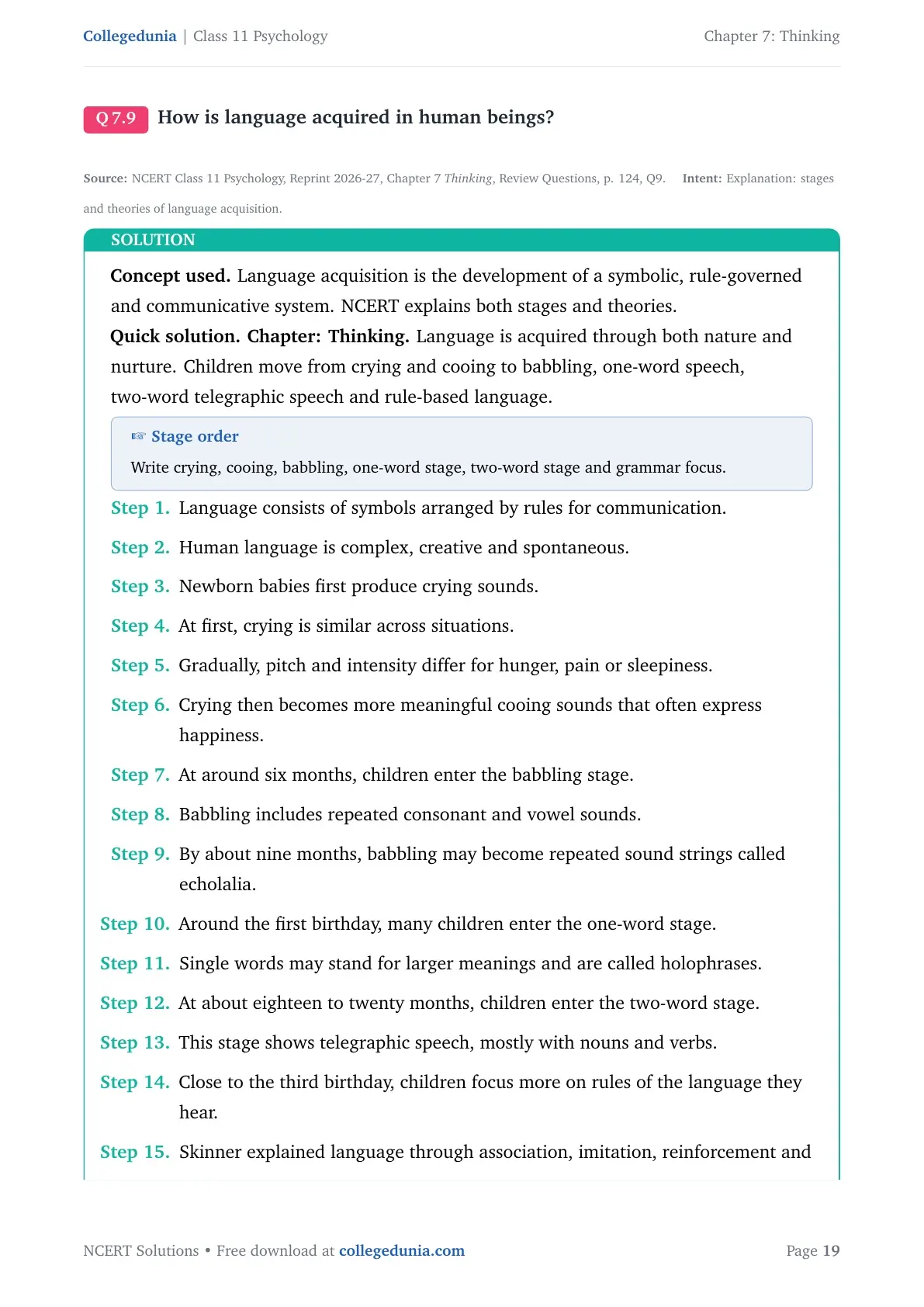
How is language acquired in human beings?
Concept used. Language acquisition is the development of a symbolic, rule-governed and communicative system. NCERT explains both stages and theories.
Language is acquired through both nature and nurture. Children move from crying and cooing to babbling, one-word speech, two-word telegraphic speech and rule-based language.
Language consists of symbols arranged by rules for communication.
Human language is complex, creative and spontaneous.
Newborn babies first produce crying sounds.
At first, crying is similar across situations.
Gradually, pitch and intensity differ for hunger, pain or sleepiness.
Crying then becomes more meaningful cooing sounds that often express happiness.
At around six months, children enter the babbling stage.
Babbling includes repeated consonant and vowel sounds.
By about nine months, babbling may become repeated sound strings called echolalia.
Around the first birthday, many children enter the one-word stage.
Single words may stand for larger meanings and are called holophrases.
At about eighteen to twenty months, children enter the two-word stage.
This stage shows telegraphic speech, mostly with nouns and verbs.
Close to the third birthday, children focus more on rules of the language they hear.
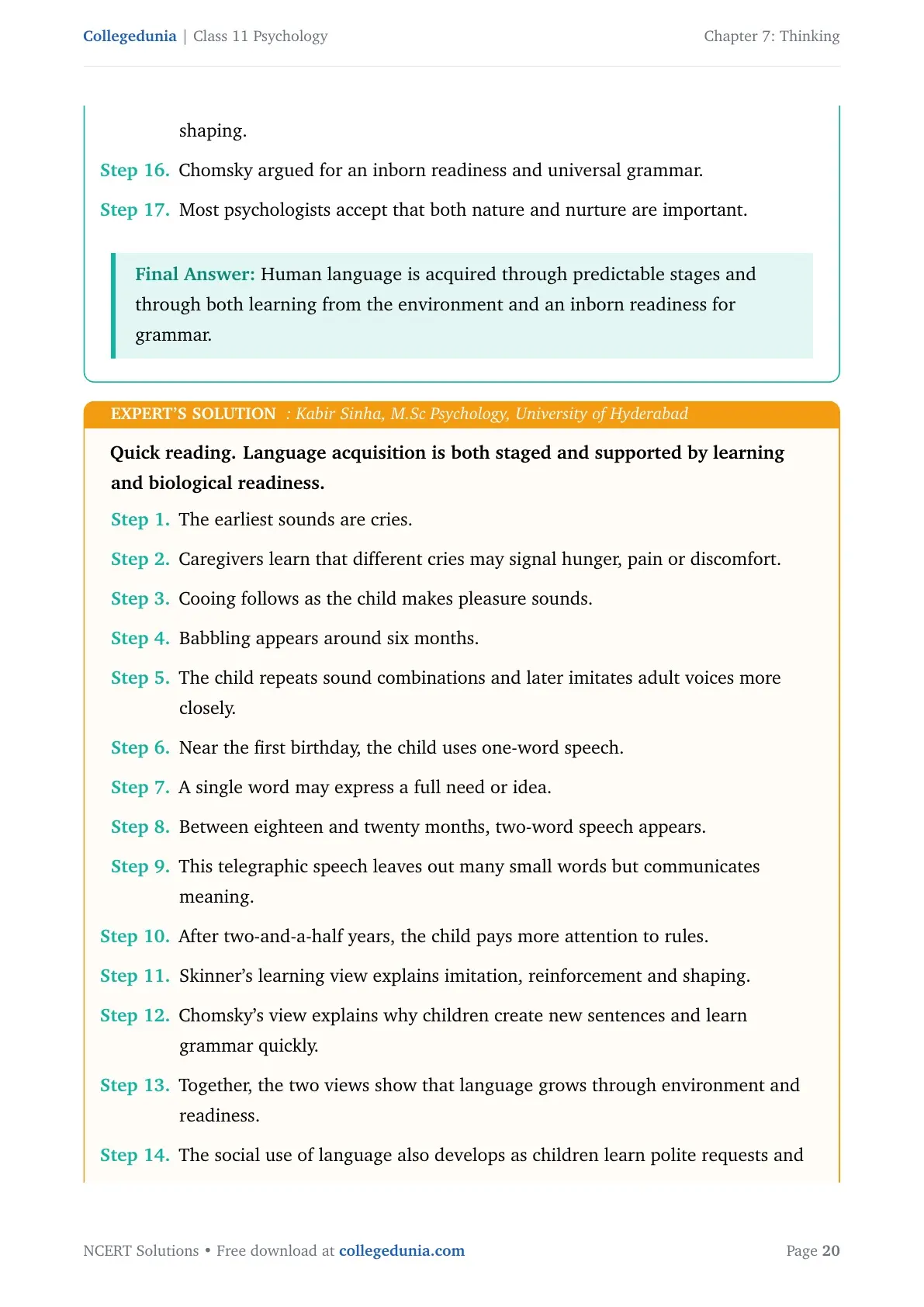
Skinner explained language through association, imitation, reinforcement and shaping.
Chomsky argued for an inborn readiness and universal grammar.
Most psychologists accept that both nature and nurture are important.
Human language is acquired through predictable stages and through both learning from the environment and an inborn readiness for grammar.
KS
Kabir Sinha
M.Sc Psychology, University of Hyderabad
Verified Expert
Quick reading. Language acquisition is both staged and supported by learning and biological readiness.
The earliest sounds are cries.
Caregivers learn that different cries may signal hunger, pain or discomfort.
Cooing follows as the child makes pleasure sounds.
Babbling appears around six months.
The child repeats sound combinations and later imitates adult voices more closely.
Near the first birthday, the child uses one-word speech.
A single word may express a full need or idea.
Between eighteen and twenty months, two-word speech appears.
This telegraphic speech leaves out many small words but communicates meaning.
After two-and-a-half years, the child pays more attention to rules.
Skinner's learning view explains imitation, reinforcement and shaping.
Chomsky's view explains why children create new sentences and learn grammar quickly.
Together, the two views show that language grows through environment and readiness.
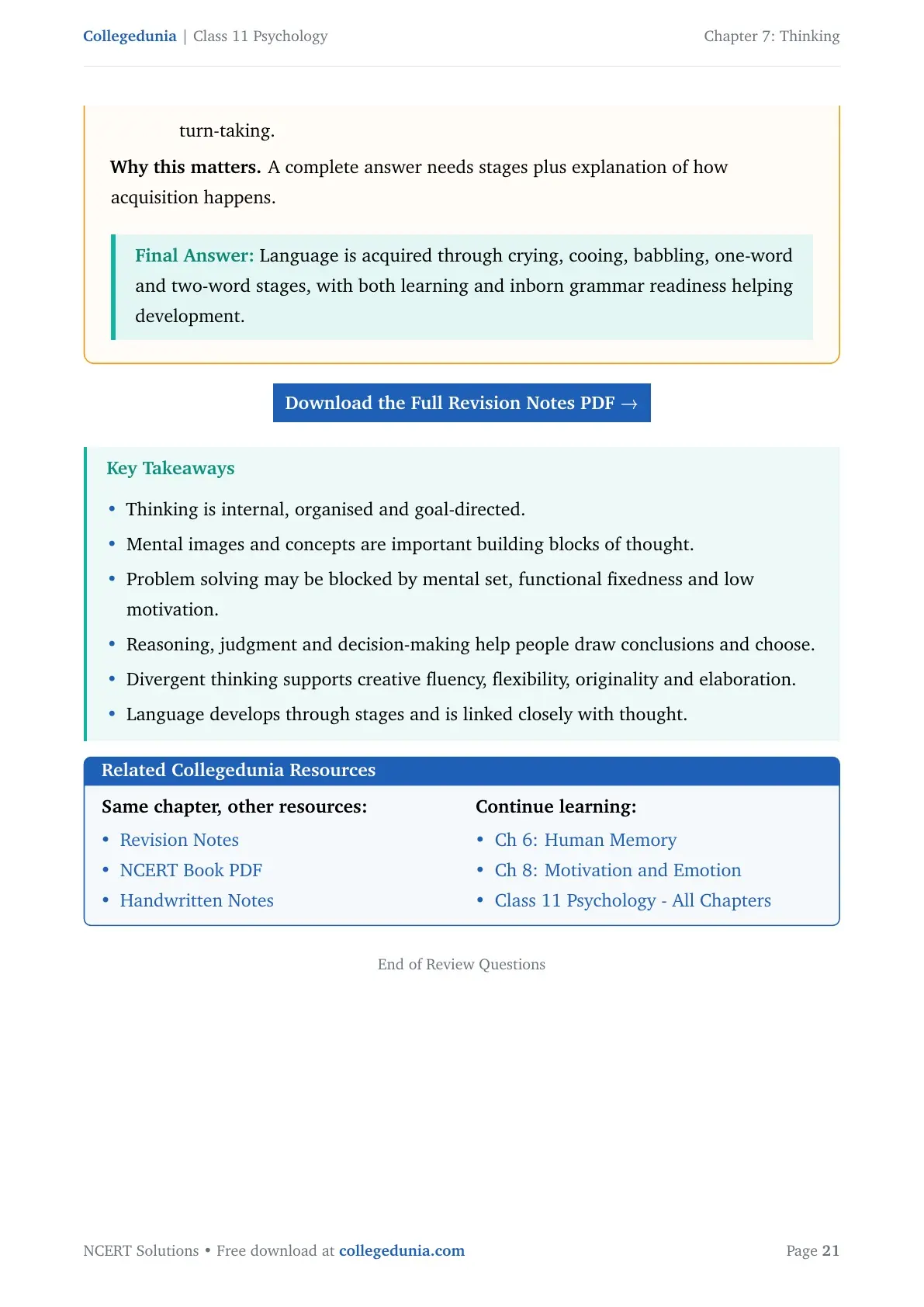
The social use of language also develops as children learn polite requests and turn-taking.
Why this matters. A complete answer needs stages plus explanation of how acquisition happens.
Language is acquired through crying, cooing, babbling, one-word and two-word stages, with both learning and inborn grammar readiness helping development.
Thinking Class 11 Psychology NCERT Solutions FAQs
Ques. How many questions are solved in Class 11 Psychology Chapter 7 Thinking?
Ans. The chapter has 9 NCERT review questions. This page and the downloadable PDF include a stepwise solution and an expert explanation for each one.
Ques. What is the main idea of Chapter 7 Thinking?
Ans. The main idea is that thinking uses mental images, concepts, reasoning and decision making to solve problems and support creative and language-based activity.
Ques. Why are concepts important in thinking?
Ans. Concepts group objects and ideas into categories. This reduces mental load and helps a learner recognise patterns, use rules and solve problems faster.
Ques. Why is divergent thinking important for creativity?
Ans. Divergent thinking helps a person produce many, flexible, original and detailed ideas. This makes creative solutions more likely than using one familiar answer only.









Comments