The NCERT Solutions for Class 11 Psychology Chapter 4 Sensory, Attentional and Perceptual Processes cover all 8 textbook review questions from the latest 2026-27 NCERT book. The chapter explains how sense organs receive information, how attention selects stimuli, and how perception organises depth, space, illusions and cultural experience.
Covers every review question with a direct solution and an expert explanation.
Focuses on attention, sensory thresholds, Gestalt perception, depth cues, illusions and socio-cultural influences.
Useful for school exams because answers connect NCERT terms with clear examples from daily perception.
Student Feedback: In a Collegedunia poll of 10,860 Class 11 Psychology students preparing for the 2026 school exams, 71% said they could define attention but confused selective attention, sustained attention and depth cues in long answers.
Source: 2026-27 Class 11 Psychology student poll across CBSE schools.
Every answer in this chapter set is checked against the 2026-27 NCERT Psychology textbook and written so that students can revise the concept, example and exam framing together.
Sensory, Attentional and Perceptual Processes: What Students Must Know
Chapter 4 joins three parts of psychology into one exam-ready chain. Sensation begins when sense organs receive stimulus energy. Attention selects a limited part of that information. Perception then interprets the selected information so that the person experiences objects, space, depth and meaningful patterns.
Chapter area
What students must know
Where it helps
Sensory processes
Sense organs, absolute threshold and difference threshold
Question 1
Attention
Alertness, concentration, search, focus, fringe and effort allocation
Questions 2 and 3
Gestalt perception
The visual field is organised into meaningful wholes
Question 4
Space and depth
Monocular and binocular cues change a flat retinal image into three-dimensional perception
Questions 5 and 6
Illusions and culture
Perception can misinterpret real stimuli and is shaped by experience
Questions 7 and 8
The safest exam strategy is to write the NCERT term first, then add the process and one daily-life example. This keeps answers precise when questions ask for properties, determinants, cues or influences.
Attention Process in Class 11 Psychology Chapter 4
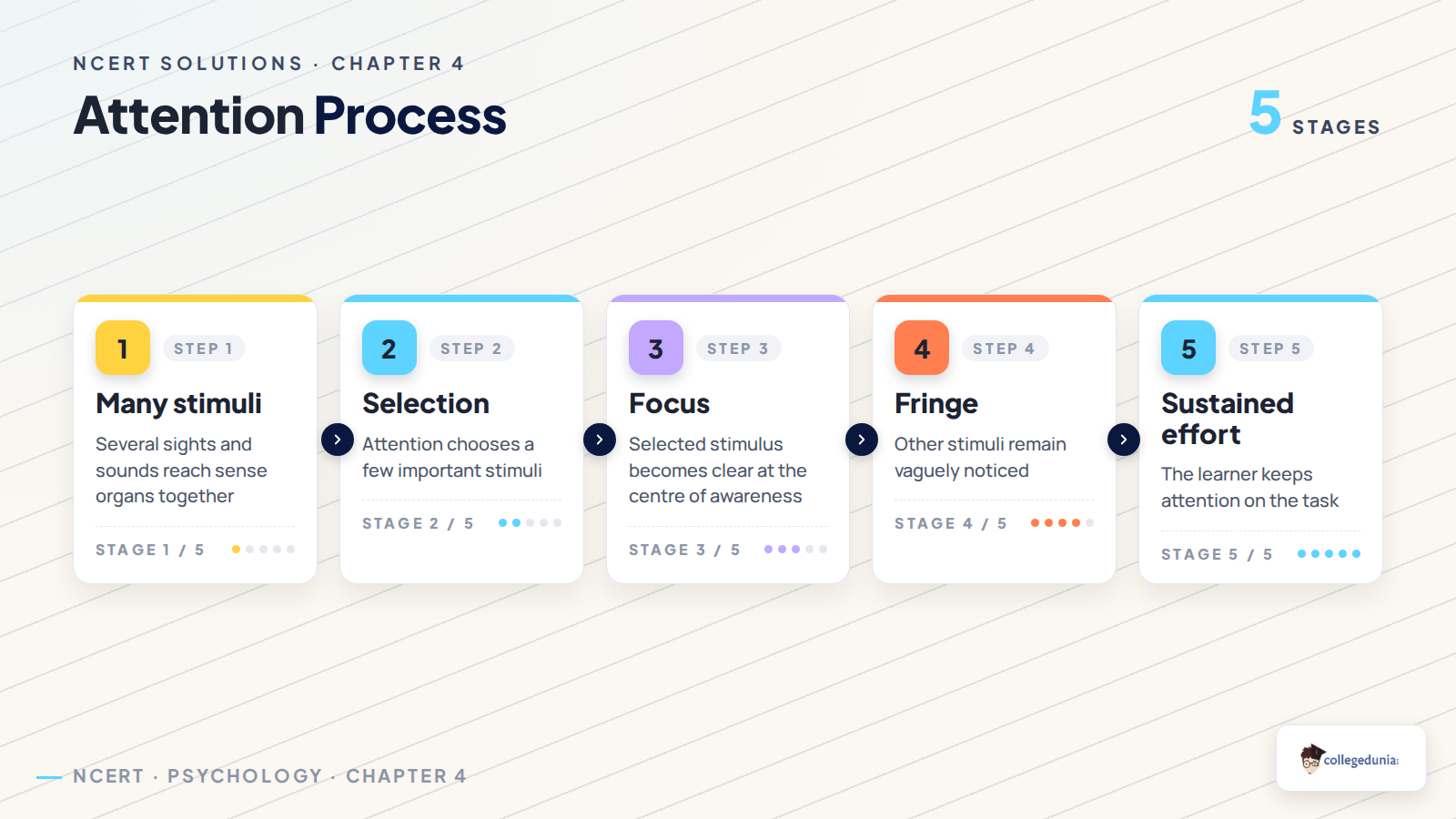
Attention is the process through which certain stimuli are selected from a larger field of stimulation. A student entering a classroom may see doors, windows, benches, classmates and notices together, but only a few become the focus of awareness at a time. NCERT explains attention through alertness, concentration, search, effort allocation, focus and fringe.
Alertness: readiness to respond when a stimulus appears.
Concentration: keeping awareness on a selected object while excluding others for the moment.
Search: looking for a specified object or person among many alternatives.
Focus and fringe: the clear centre of attention and the vague surrounding field.
Selective attention answers what is chosen from competing stimuli. Sustained attention answers how long attention can remain on a task. This difference is central for Question 3.
Space, Depth and Monocular Cues in Chapter 4
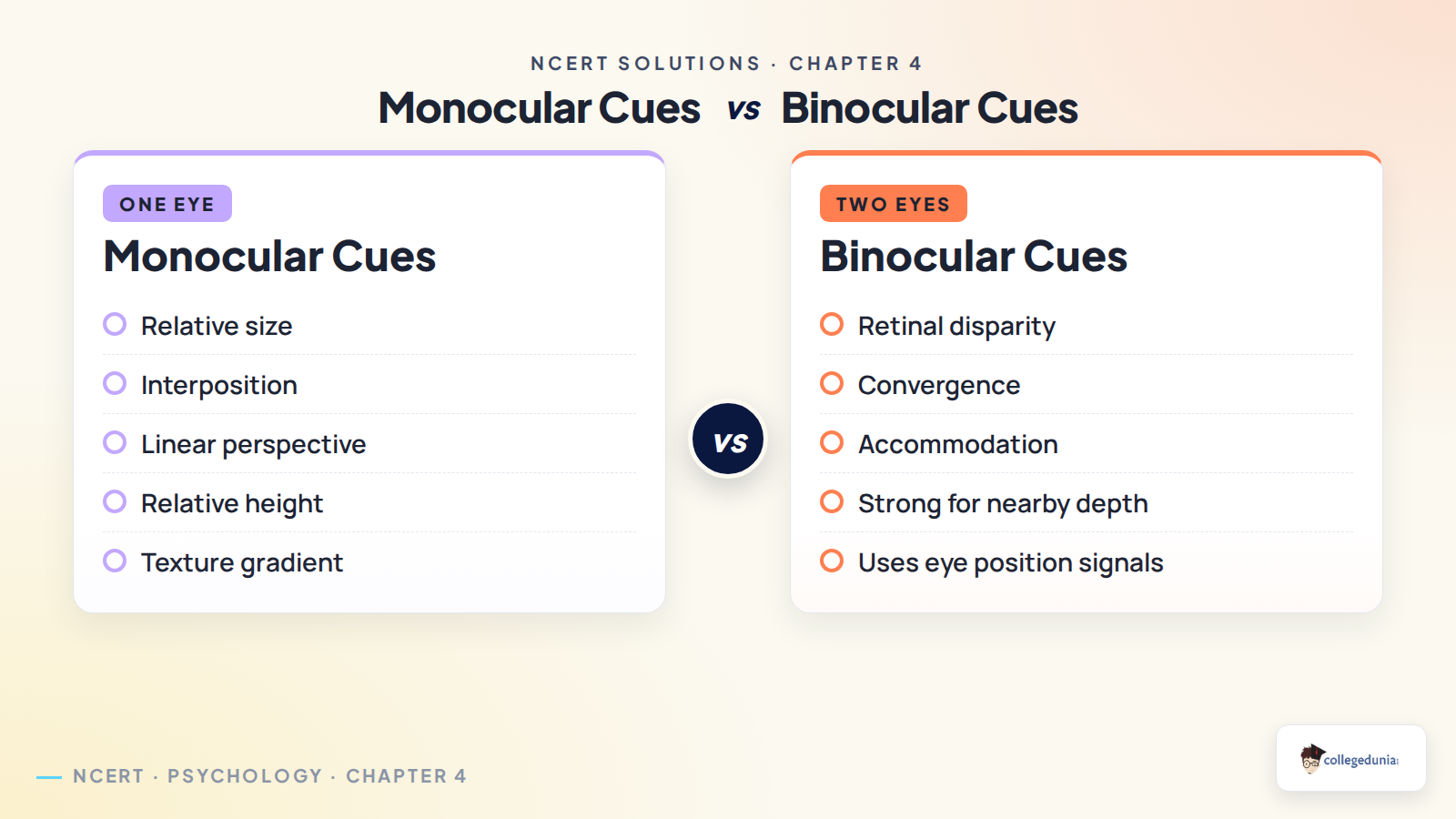
The retinal image is flat, but human beings experience the world in three dimensions. NCERT calls this distance or depth perception. The chapter explains that depth perception depends on two sources of information: monocular cues and binocular cues.
Cue type
Meaning
Examples from NCERT
Monocular cues
Cues that work with one eye
Relative size, interposition, linear perspective, aerial perspective, light and shade, relative height, texture gradient, motion parallax
Binocular cues
Cues that need both eyes
Retinal disparity, convergence and accommodation
Depth perception
Viewing the world in three dimensions
Judging the distance of a vehicle or a person on the street
The solved PDF gives special attention to this part because cue lists are easy to miss. The corrected solution includes relative height, which is one of NCERT's monocular cues.
Gestalt Principles, Illusions and Socio-Cultural Influence
Gestalt psychologists argued that perception is organised. The whole visual field is not experienced as disconnected sensations. Instead, the mind arranges stimuli into meaningful forms through principles such as figure-ground organisation, proximity, similarity, continuity and closure.
Illusions show why perception is not a direct copy of the physical world. In an illusion, an external stimulus is present, but the person misinterprets it. The Muller-Lyer illusion and apparent movement are NCERT examples that show how context, arrangement and timing can change what a person experiences.
Universal illusions: experienced by most people because of common perceptual organisation.
Personal or culture-linked illusions: influenced by experience and environment.
Socio-cultural influence: culture changes familiarity, salience and habits of perceptual inference.
How to Write Better Chapter 4 Psychology Answers
Most mistakes in this chapter happen when students write only a definition and skip the process. A strong answer should define the term, name the NCERT properties or cues, and then add an example that shows the idea in use.
Use the exact NCERT word. Write absolute threshold, difference threshold, selective attention, sustained attention, Gestalt, monocular cues or binocular cues as required.
Add the process. Explain how the stimulus is selected, organised or misinterpreted.
Give one example. Use classroom attention, rail tracks, picture depth, trees, road distance or an illusion example.
Close with impact. State how the process changes sensation, attention or perception.
The solved PDF follows the same pattern. It gives the quick answer first, then the concept, steps and expert explanation for revision.
Related Psychology Resources for Sensory, Attentional and Perceptual Processes
Use the solutions PDF for answers, then move to notes and the NCERT book when you want to revise theory in a different format.
All NCERT Solutions for Class 11 Psychology Chapter 4 Sensory, Attentional and Perceptual Processes with Step-by-Step Solutions
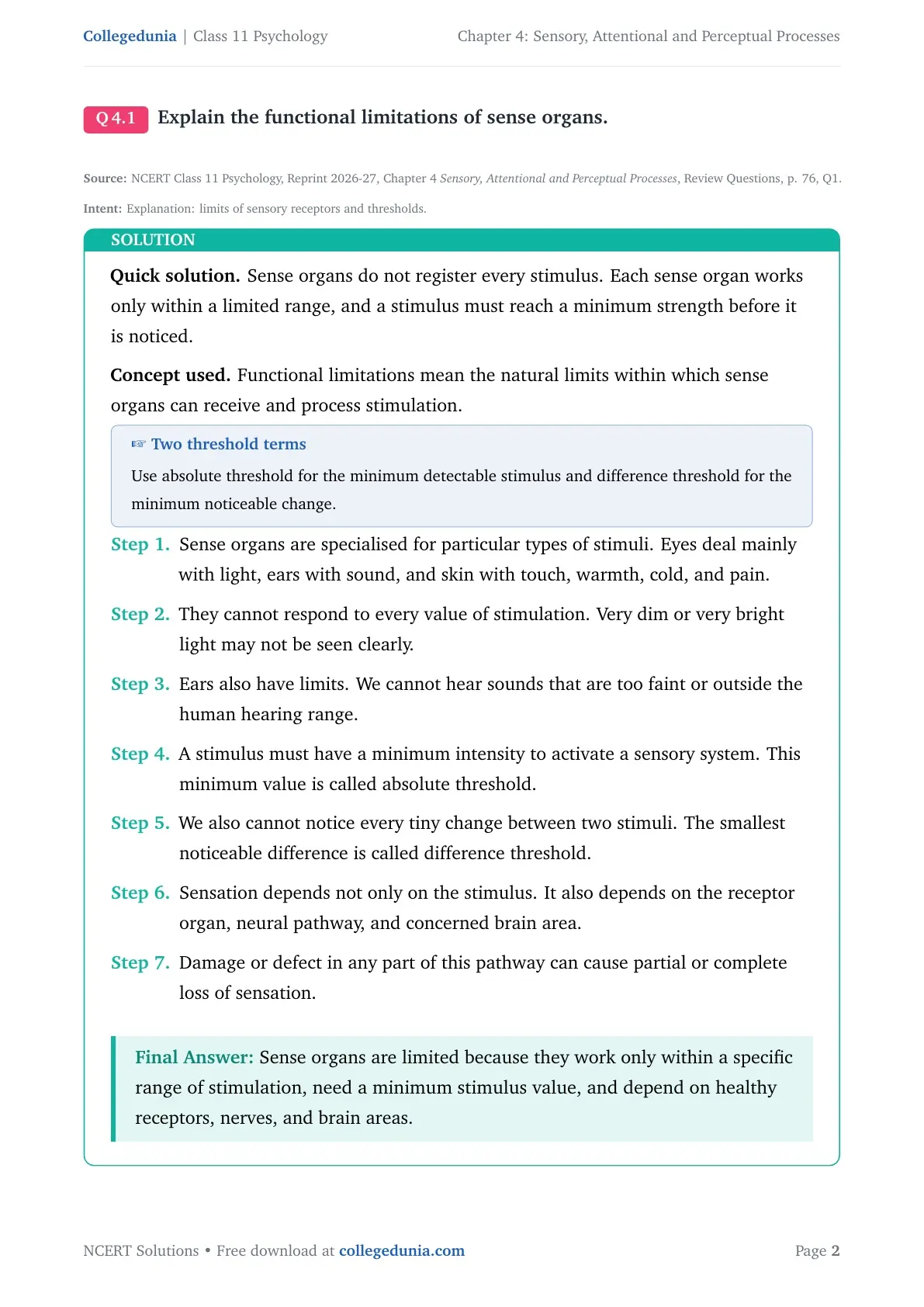
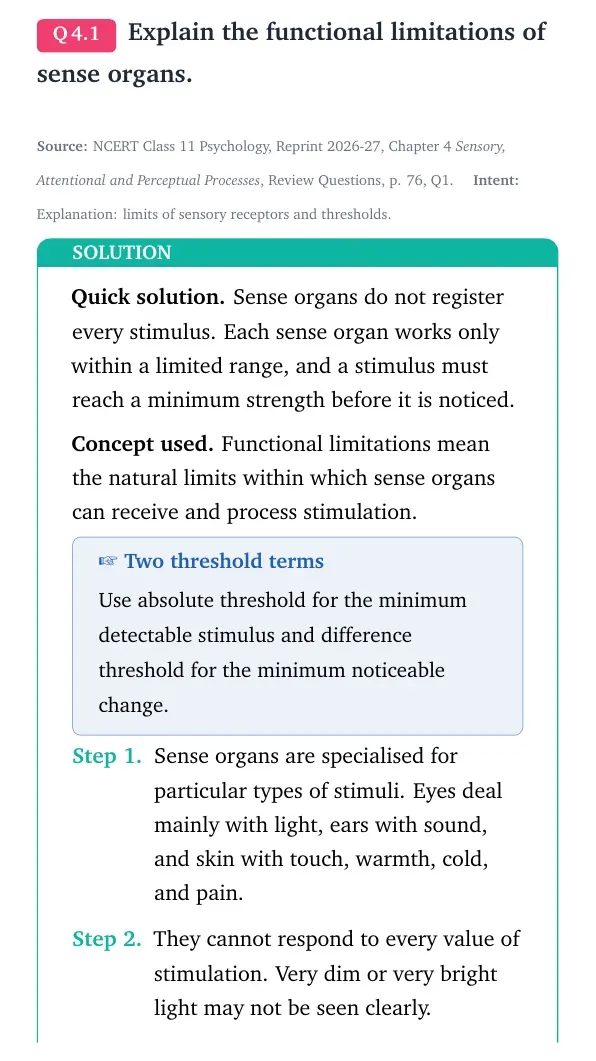
Q 4.1
Explain the functional limitations of sense organs.
Sense organs do not register every stimulus. Each sense organ works only within a limited range, and a stimulus must reach a minimum strength before it is noticed. Concept used. Functional limitations mean the natural limits within which sense organs can receive and process stimulation.
Two threshold terms
Use absolute threshold for the minimum detectable stimulus and difference threshold for the minimum noticeable change.
Sense organs are specialised for particular types of stimuli. Eyes deal mainly with light, ears with sound, and skin with touch, warmth, cold, and pain.
They cannot respond to every value of stimulation. Very dim or very bright light may not be seen clearly.
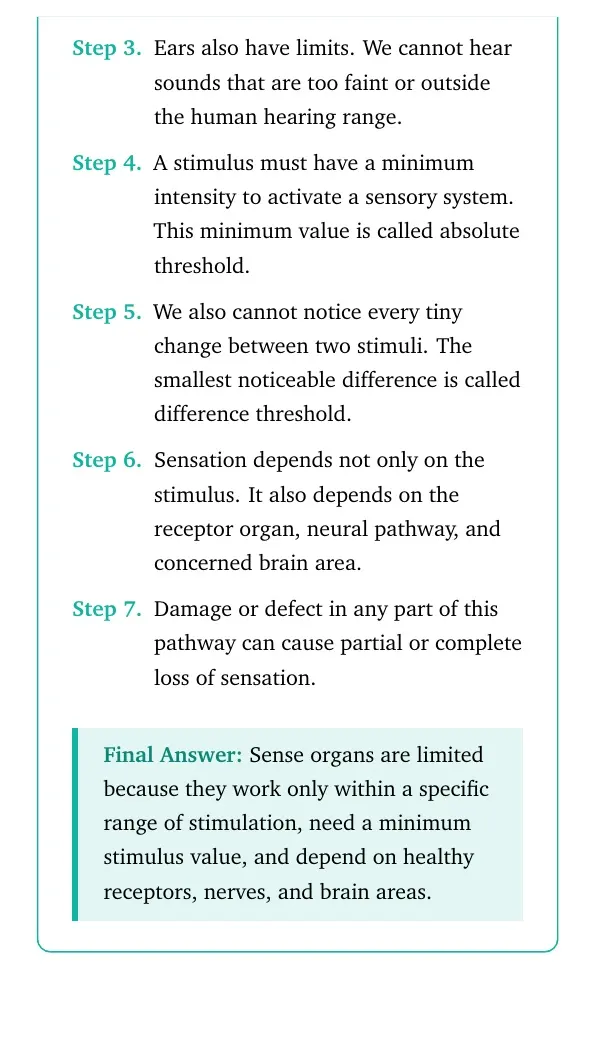
Ears also have limits. We cannot hear sounds that are too faint or outside the human hearing range.
A stimulus must have a minimum intensity to activate a sensory system. This minimum value is called absolute threshold.
We also cannot notice every tiny change between two stimuli. The smallest noticeable difference is called difference threshold.
Sensation depends not only on the stimulus. It also depends on the receptor organ, neural pathway, and concerned brain area.
Damage or defect in any part of this pathway can cause partial or complete loss of sensation.
Sense organs are limited because they work only within a specific range of stimulation, need a minimum stimulus value, and depend on healthy receptors, nerves, and brain areas.
AS
Aditi Sharma
M.A. Psychology, University of Delhi
Verified Expert
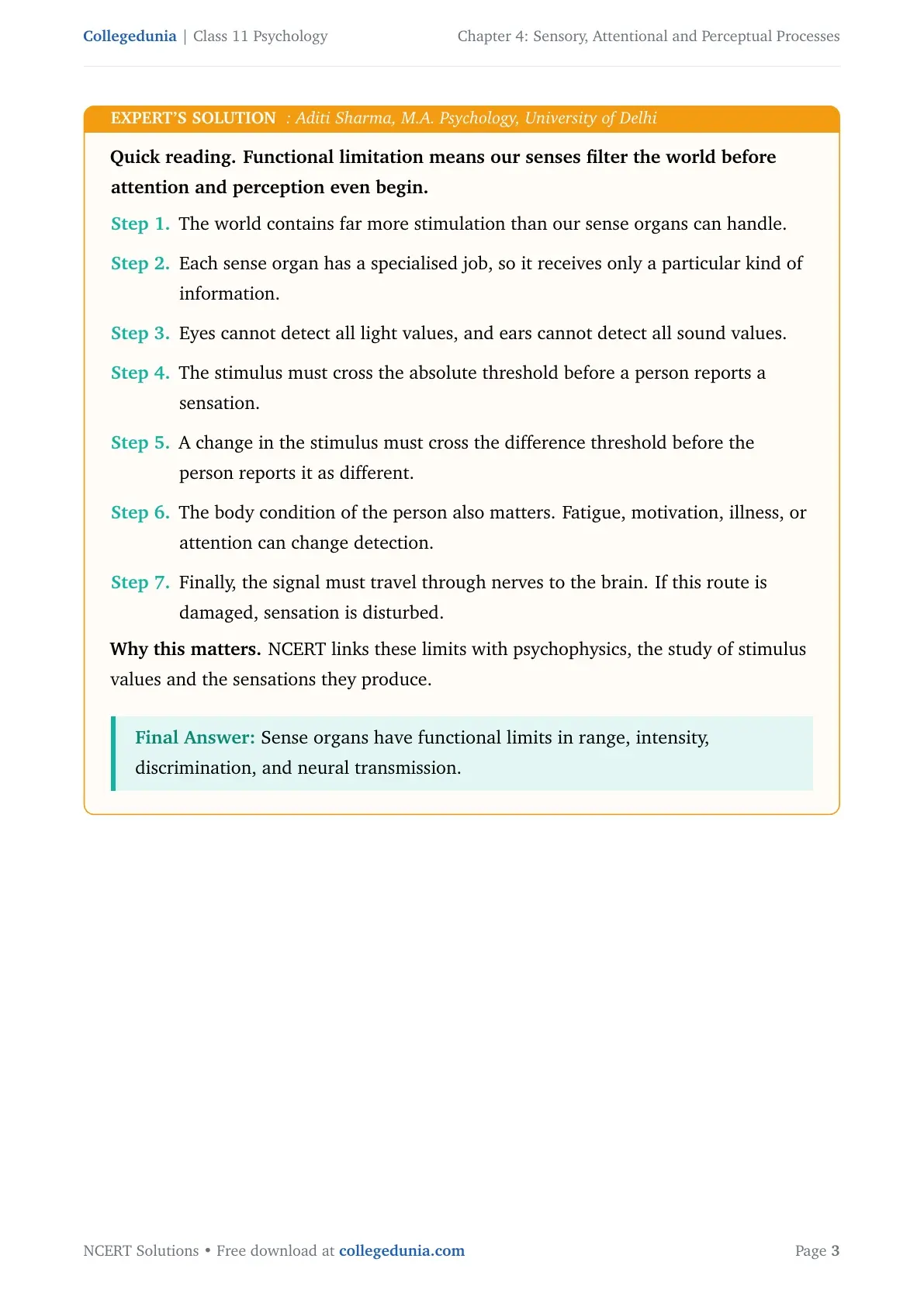
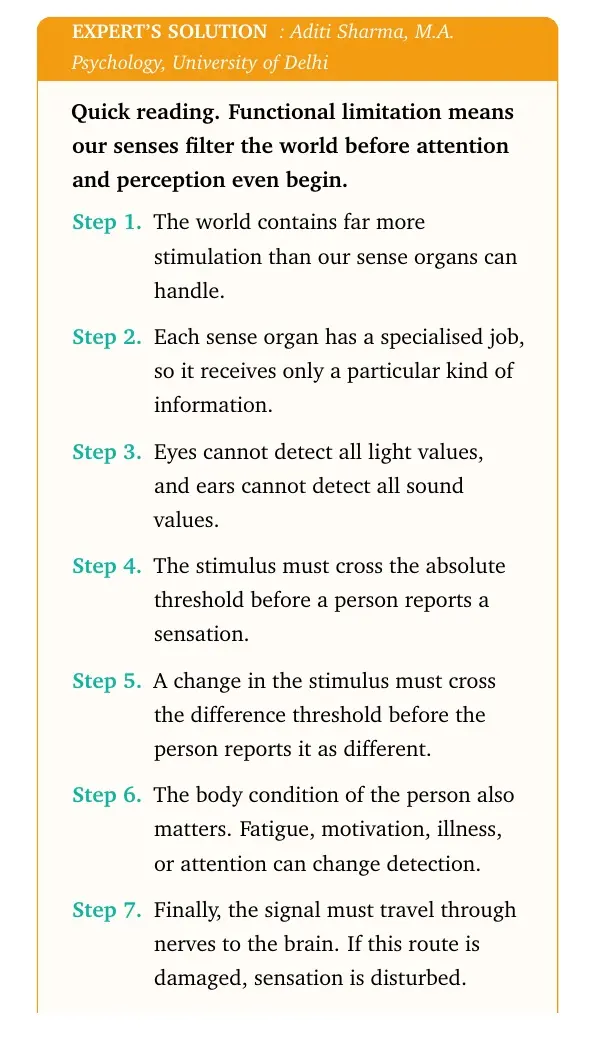
Quick reading. Functional limitation means our senses filter the world before attention and perception even begin.
The world contains far more stimulation than our sense organs can handle.
Each sense organ has a specialised job, so it receives only a particular kind of information.
Eyes cannot detect all light values, and ears cannot detect all sound values.
The stimulus must cross the absolute threshold before a person reports a sensation.
A change in the stimulus must cross the difference threshold before the person reports it as different.
The body condition of the person also matters. Fatigue, motivation, illness, or attention can change detection.
Finally, the signal must travel through nerves to the brain. If this route is damaged, sensation is disturbed.
Why this matters. NCERT links these limits with psychophysics, the study of stimulus values and the sensations they produce.
Sense organs have functional limits in range, intensity, discrimination, and neural transmission.
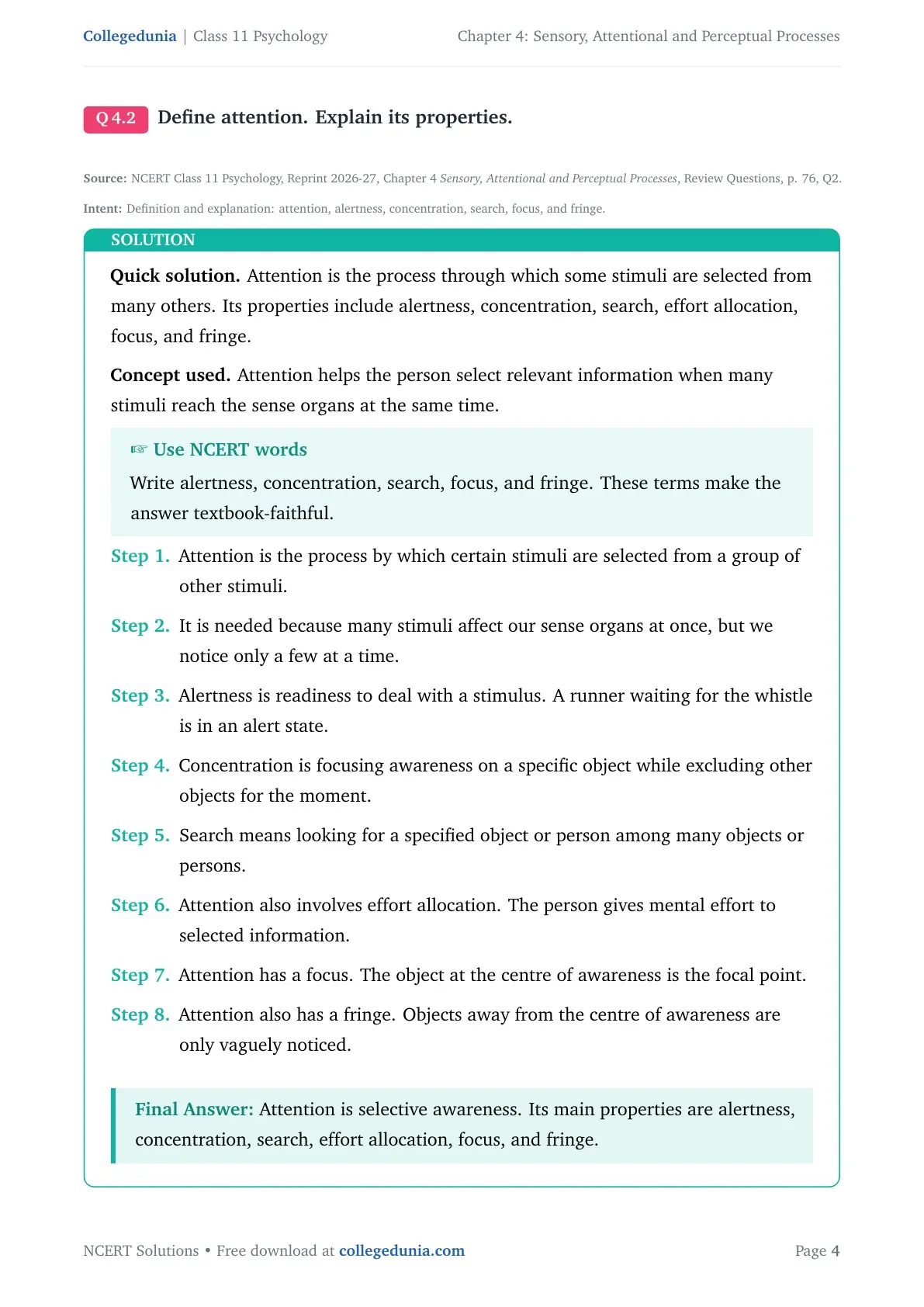
Q 4.2
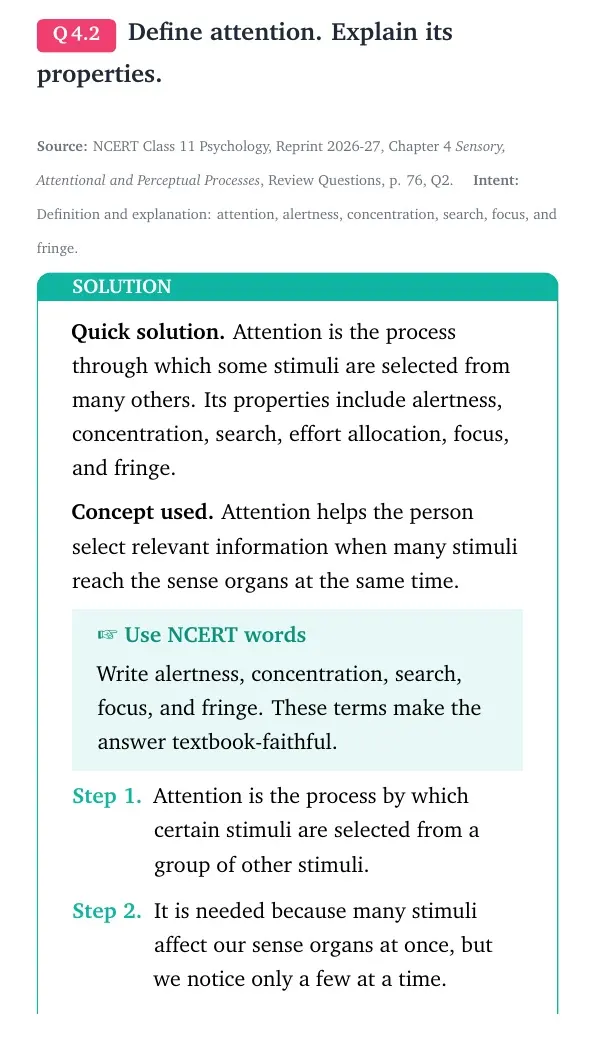
Define attention. Explain its properties.
Attention is the process through which some stimuli are selected from many others. Its properties include alertness, concentration, search, effort allocation, focus, and fringe. Concept used. Attention helps the person select relevant information when many stimuli reach the sense organs at the same time.
Use NCERT words
Write alertness, concentration, search, focus, and fringe. These terms make the answer textbook-faithful.
Attention is the process by which certain stimuli are selected from a group of other stimuli.
It is needed because many stimuli affect our sense organs at once, but we notice only a few at a time.
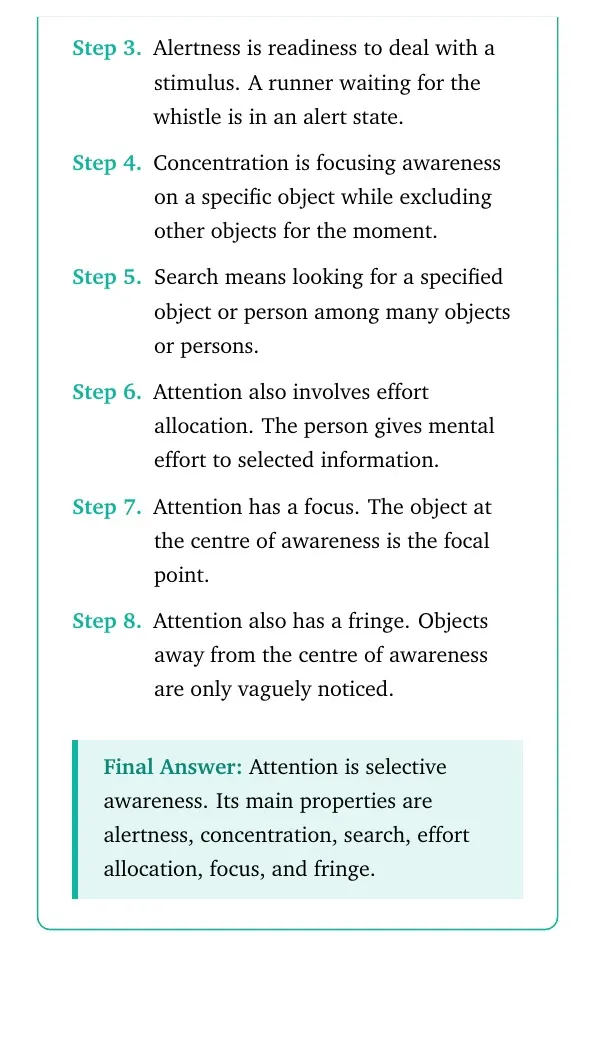
Alertness is readiness to deal with a stimulus. A runner waiting for the whistle is in an alert state.
Concentration is focusing awareness on a specific object while excluding other objects for the moment.
Search means looking for a specified object or person among many objects or persons.
Attention also involves effort allocation. The person gives mental effort to selected information.
Attention has a focus. The object at the centre of awareness is the focal point.
Attention also has a fringe. Objects away from the centre of awareness are only vaguely noticed.
Attention is selective awareness. Its main properties are alertness, concentration, search, effort allocation, focus, and fringe.
RM
Rohit Mehta
M.Sc Applied Psychology, Christ University
Verified Expert
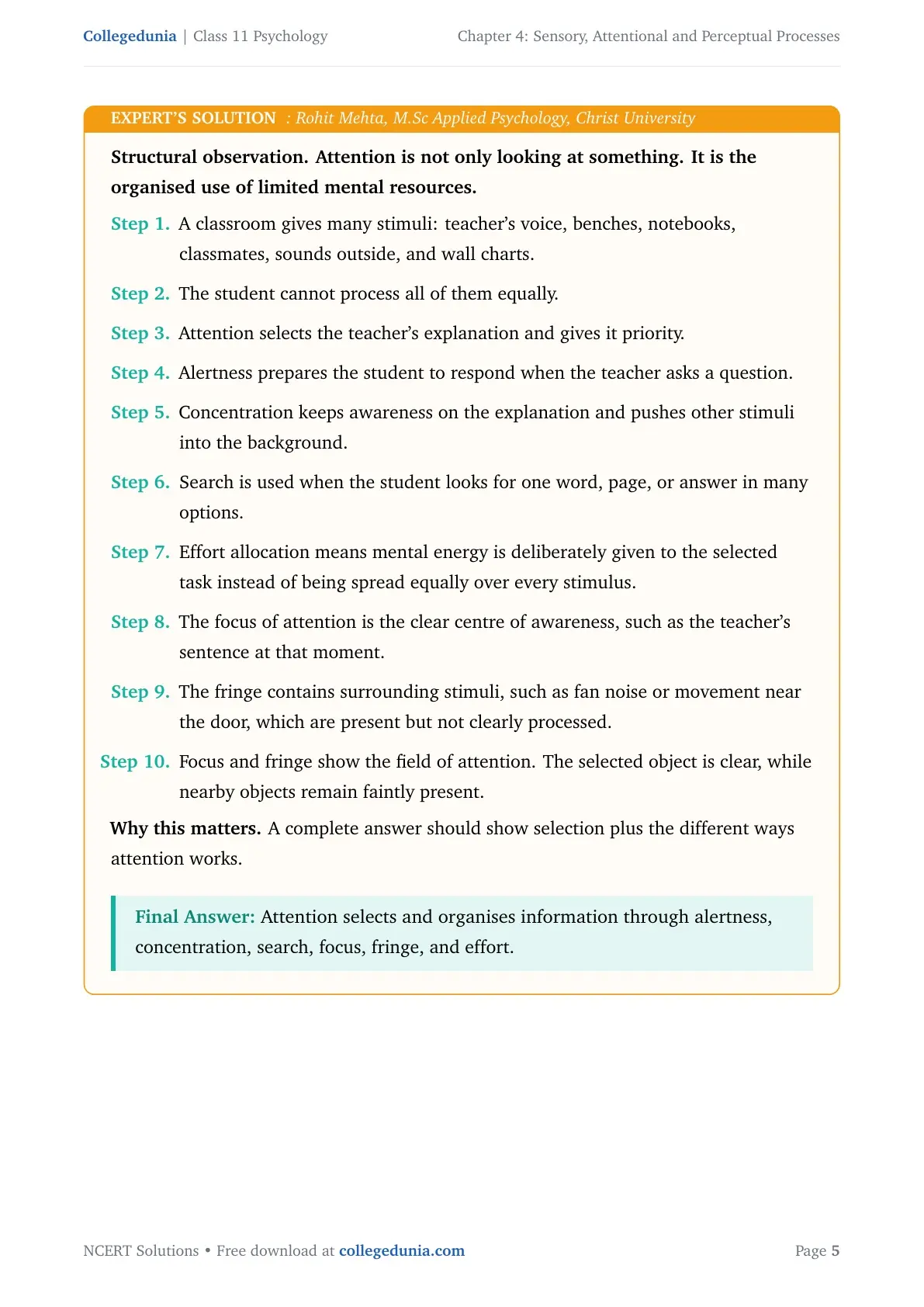
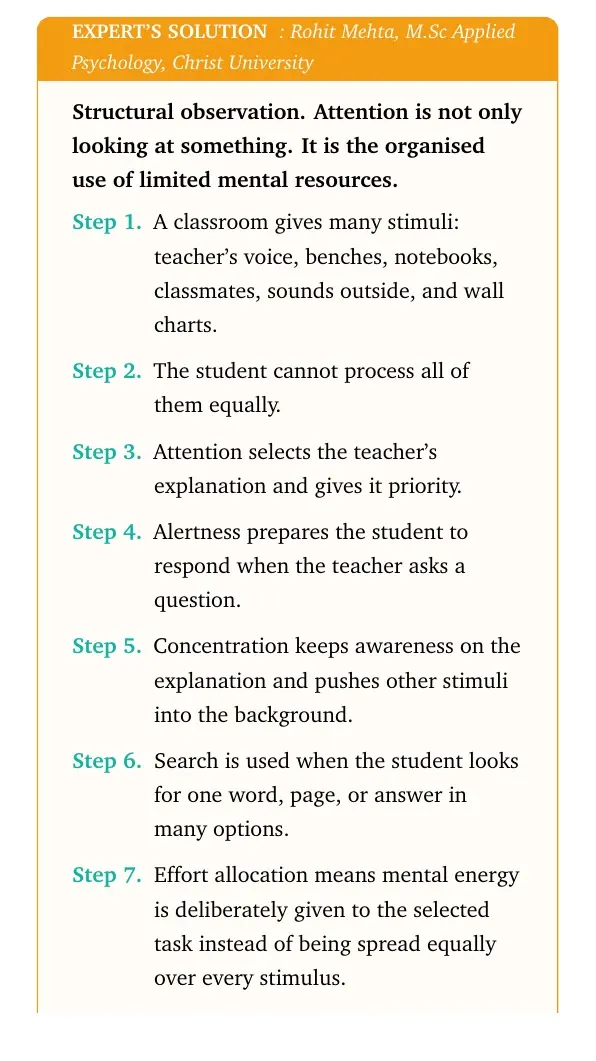
Structural observation. Attention is not only looking at something. It is the organised use of limited mental resources.
A classroom gives many stimuli: teacher's voice, benches, notebooks, classmates, sounds outside, and wall charts.
The student cannot process all of them equally.
Attention selects the teacher's explanation and gives it priority.
Alertness prepares the student to respond when the teacher asks a question.
Concentration keeps awareness on the explanation and pushes other stimuli into the background.
Search is used when the student looks for one word, page, or answer in many options.
Effort allocation means mental energy is deliberately given to the selected task instead of being spread equally over every stimulus.
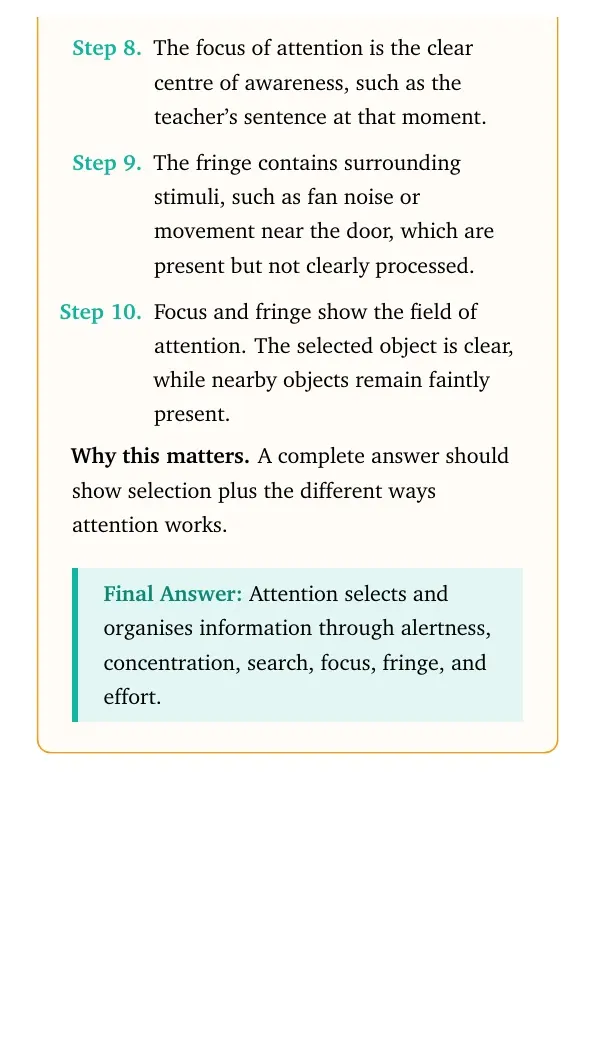
The focus of attention is the clear centre of awareness, such as the teacher's sentence at that moment.
The fringe contains surrounding stimuli, such as fan noise or movement near the door, which are present but not clearly processed.
Focus and fringe show the field of attention. The selected object is clear, while nearby objects remain faintly present.
Why this matters. A complete answer should show selection plus the different ways attention works.
Attention selects and organises information through alertness, concentration, search, focus, fringe, and effort.
Q 4.3
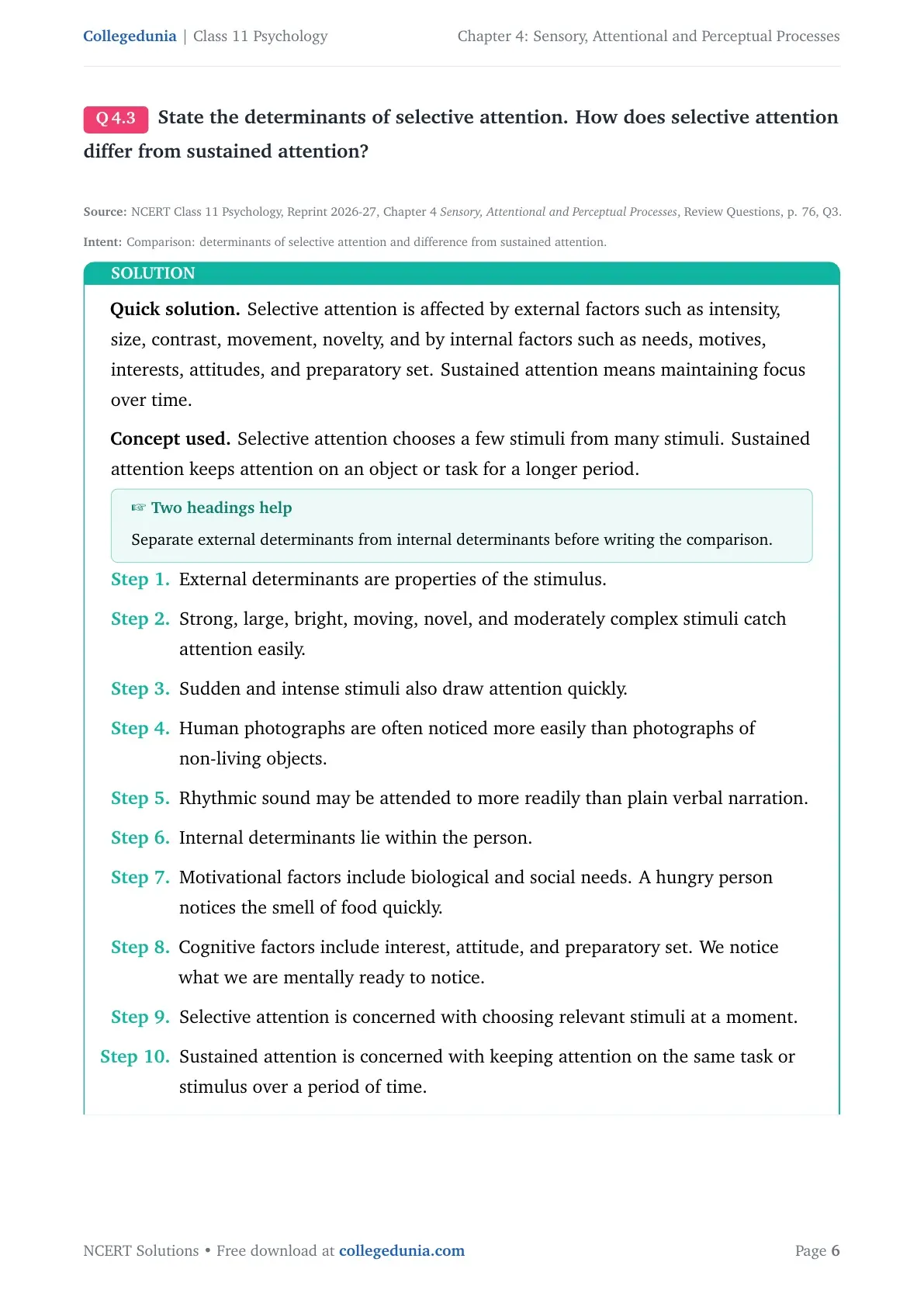
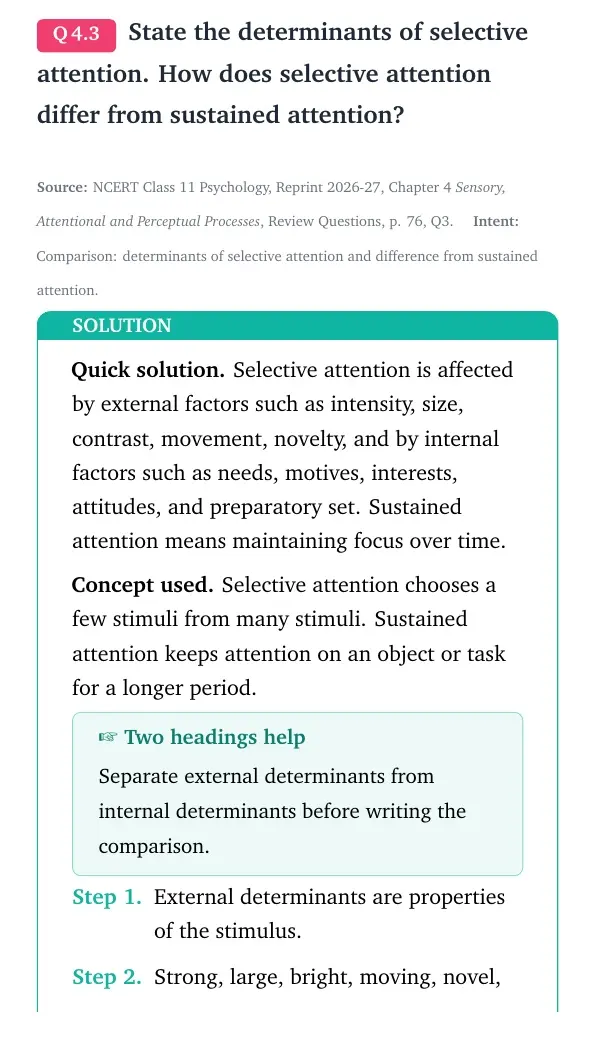
State the determinants of selective attention. How does selective attention differ from sustained attention?
Selective attention is affected by external factors such as intensity, size, contrast, movement, novelty, and by internal factors such as needs, motives, interests, attitudes, and preparatory set. Sustained attention means maintaining focus over time. Concept used. Selective attention chooses a few stimuli from many stimuli. Sustained attention keeps attention on an object or task for a longer period.
Two headings help
Separate external determinants from internal determinants before writing the comparison.
External determinants are properties of the stimulus.
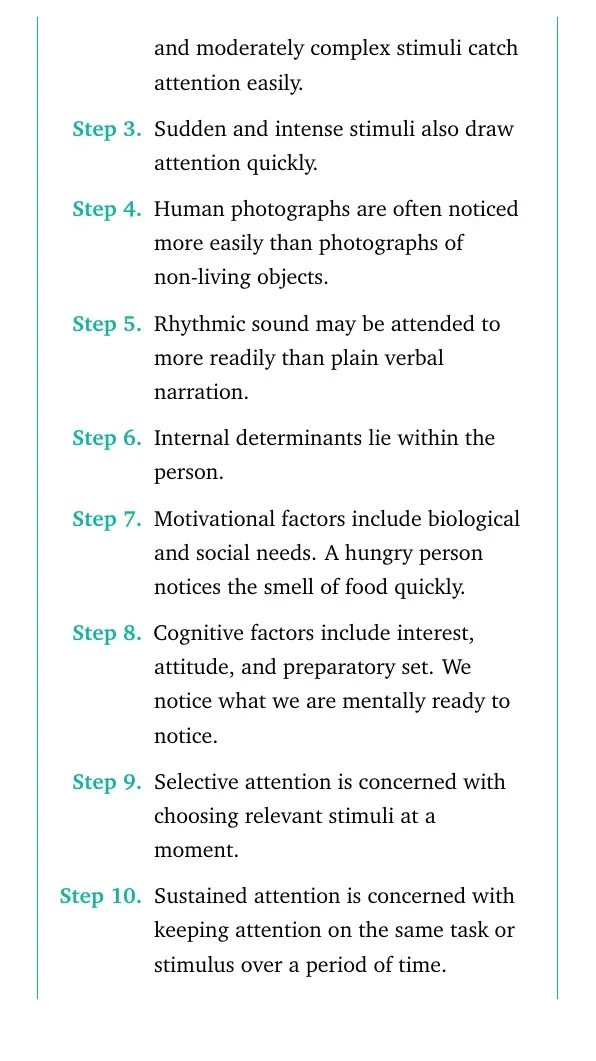
Sudden and intense stimuli also draw attention quickly.
Human photographs are often noticed more easily than photographs of non-living objects.
Rhythmic sound may be attended to more readily than plain verbal narration.
Internal determinants lie within the person.
Motivational factors include biological and social needs. A hungry person notices the smell of food quickly.
Cognitive factors include interest, attitude, and preparatory set. We notice what we are mentally ready to notice.
Selective attention is concerned with choosing relevant stimuli at a moment.
Sustained attention is concerned with keeping attention on the same task or stimulus over a period of time.
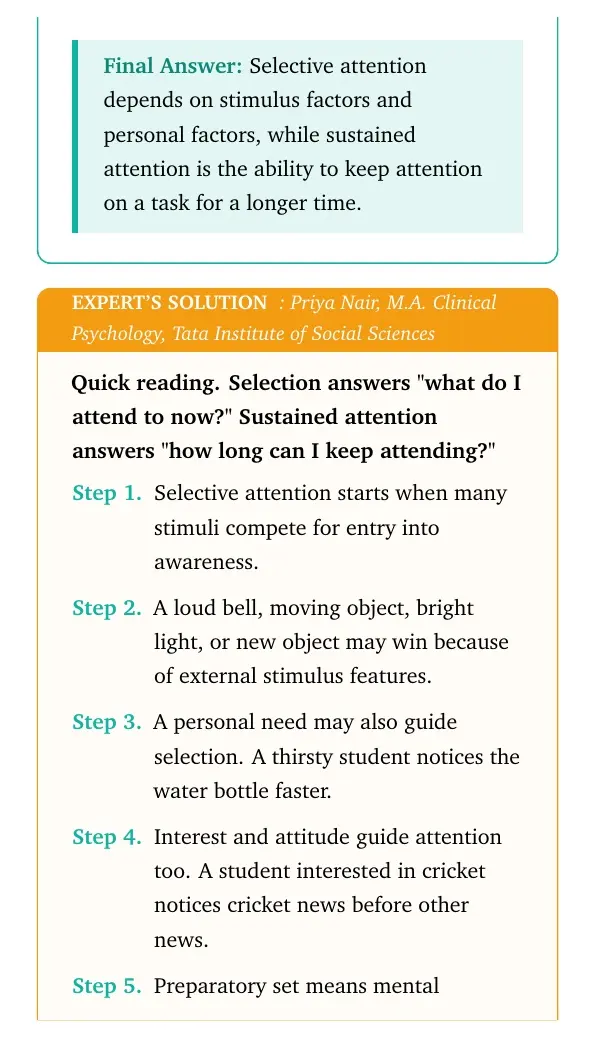
Selective attention depends on stimulus factors and personal factors, while sustained attention is the ability to keep attention on a task for a longer time.
PN
Priya Nair
M.A. Clinical Psychology, Tata Institute of Social Sciences
Verified Expert
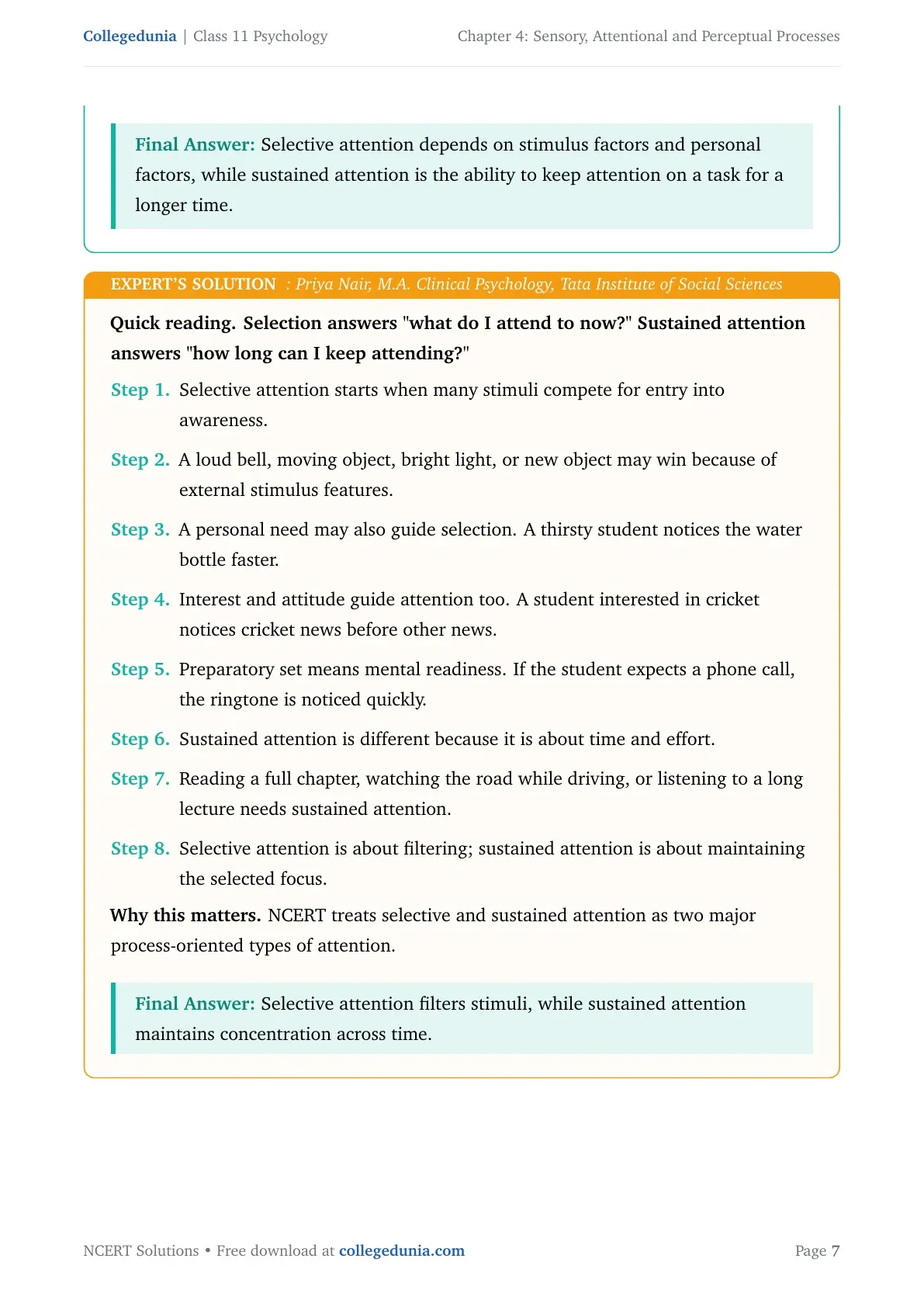
Quick reading. Selection answers "what do I attend to now?" Sustained attention answers "how long can I keep attending?"
Selective attention starts when many stimuli compete for entry into awareness.
A loud bell, moving object, bright light, or new object may win because of external stimulus features.
A personal need may also guide selection. A thirsty student notices the water bottle faster.
Interest and attitude guide attention too. A student interested in cricket notices cricket news before other news.
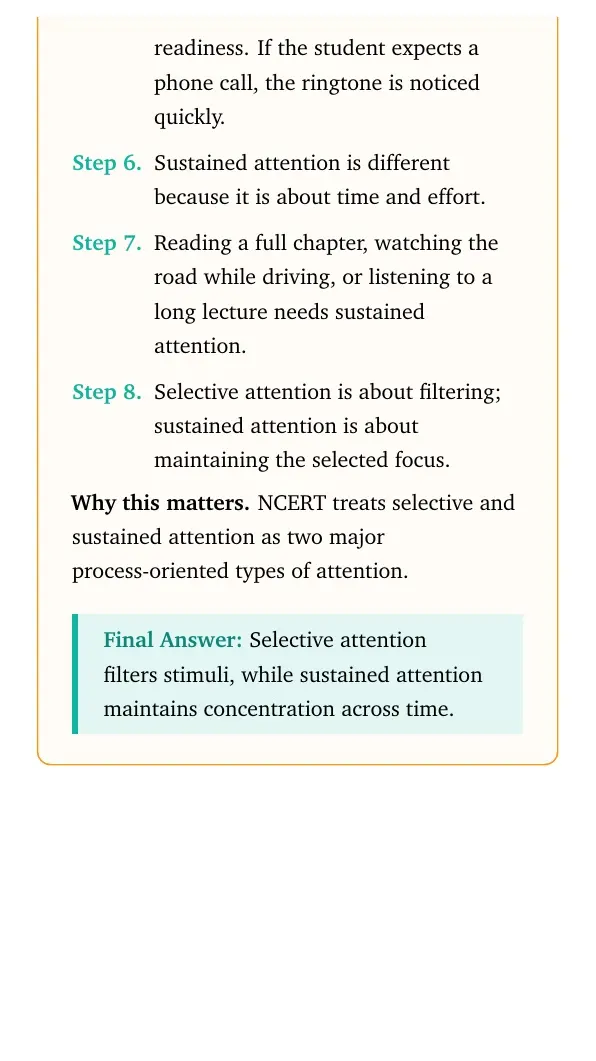
Preparatory set means mental readiness. If the student expects a phone call, the ringtone is noticed quickly.
Sustained attention is different because it is about time and effort.
Reading a full chapter, watching the road while driving, or listening to a long lecture needs sustained attention.
Selective attention is about filtering; sustained attention is about maintaining the selected focus.
Why this matters. NCERT treats selective and sustained attention as two major process-oriented types of attention.
Selective attention filters stimuli, while sustained attention maintains concentration across time.
Q 4.4
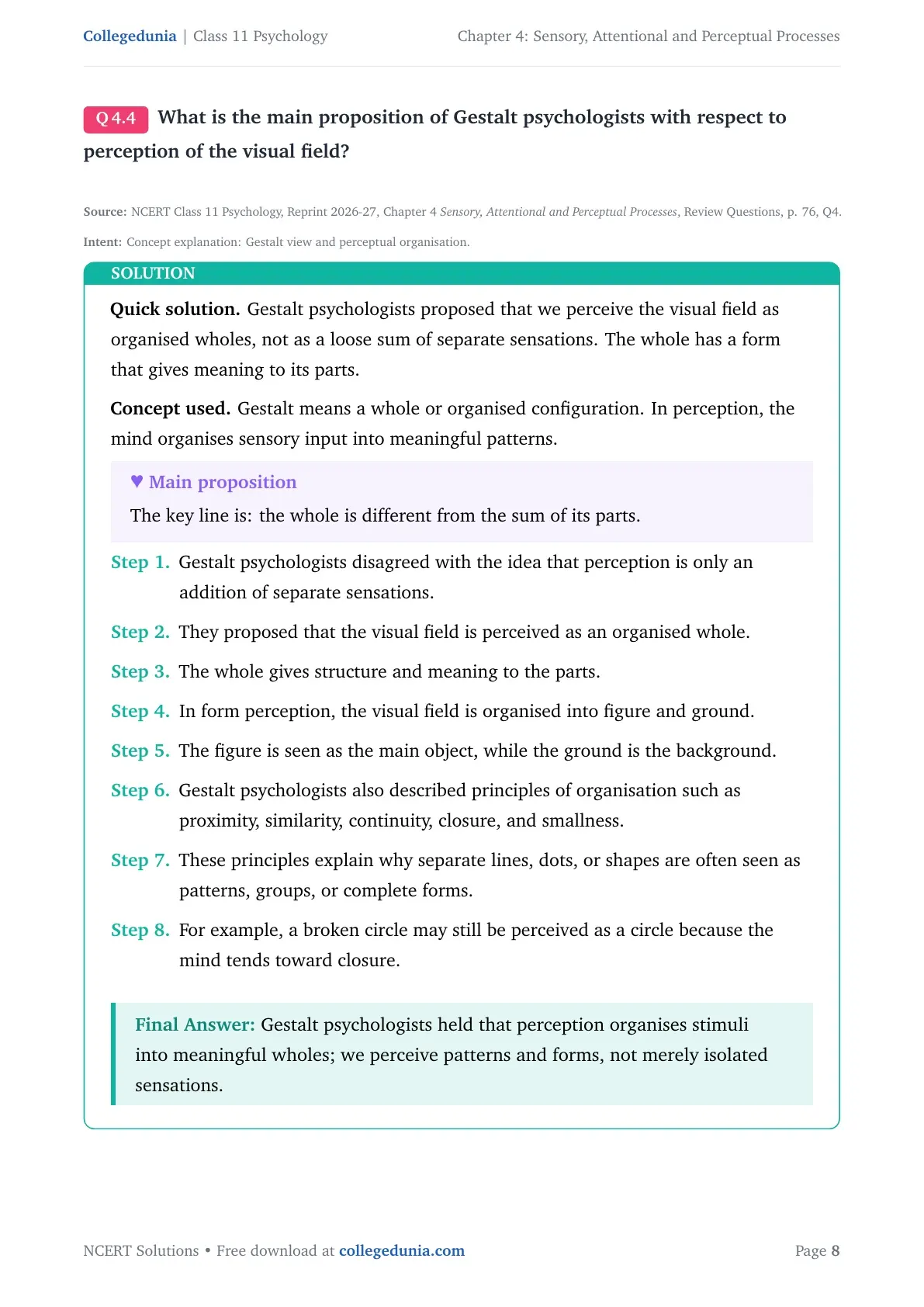
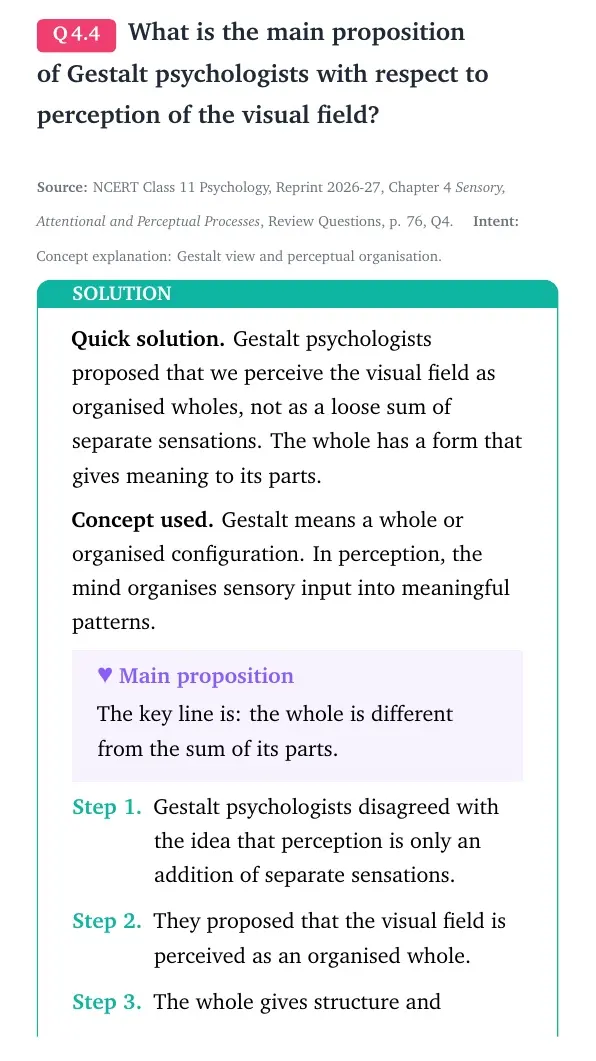
What is the main proposition of Gestalt psychologists with respect to perception of the visual field?
Gestalt psychologists proposed that we perceive the visual field as organised wholes, not as a loose sum of separate sensations. The whole has a form that gives meaning to its parts. Concept used. Gestalt means a whole or organised configuration. In perception, the mind organises sensory input into meaningful patterns.
Main proposition
The key line is: the whole is different from the sum of its parts.
Gestalt psychologists disagreed with the idea that perception is only an addition of separate sensations.
They proposed that the visual field is perceived as an organised whole.
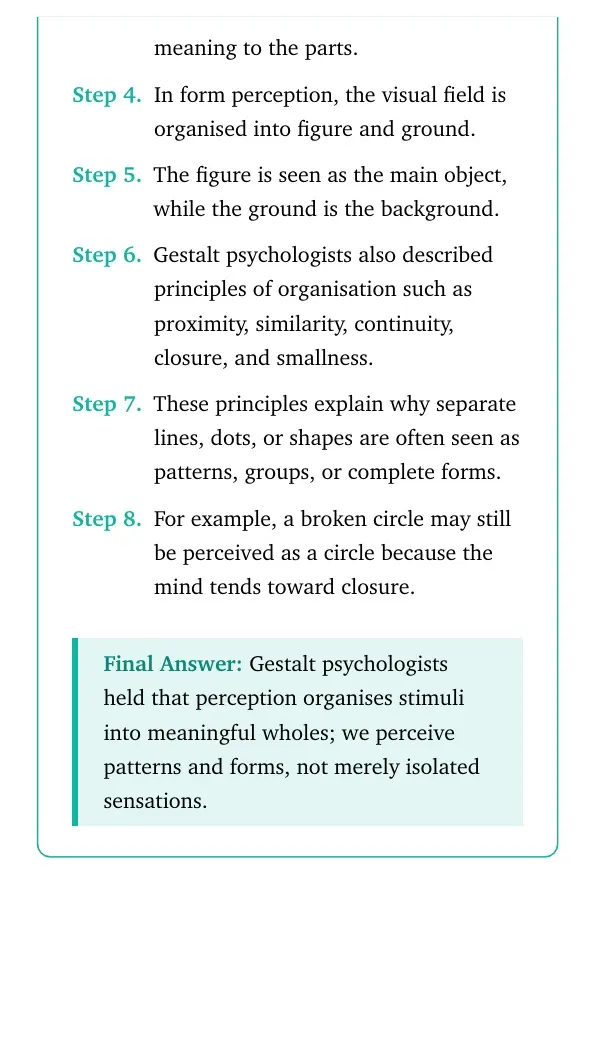
The whole gives structure and meaning to the parts.
In form perception, the visual field is organised into figure and ground.
The figure is seen as the main object, while the ground is the background.
Gestalt psychologists also described principles of organisation such as proximity, similarity, continuity, closure, and smallness.
These principles explain why separate lines, dots, or shapes are often seen as patterns, groups, or complete forms.
For example, a broken circle may still be perceived as a circle because the mind tends toward closure.
Gestalt psychologists held that perception organises stimuli into meaningful wholes; we perceive patterns and forms, not merely isolated sensations.
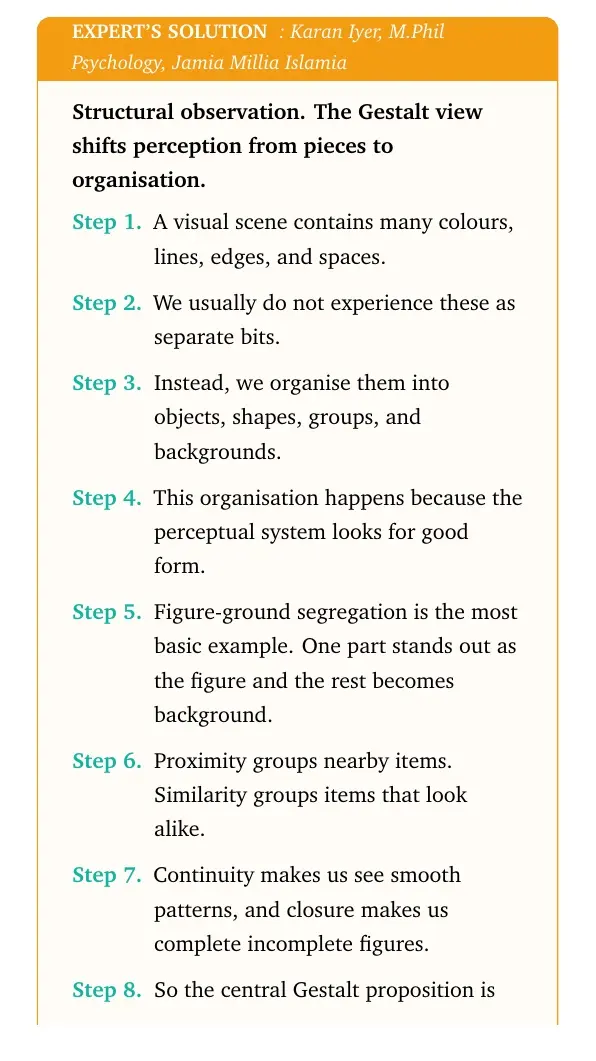
KI
Karan Iyer
M.Phil Psychology, Jamia Millia Islamia
Verified Expert
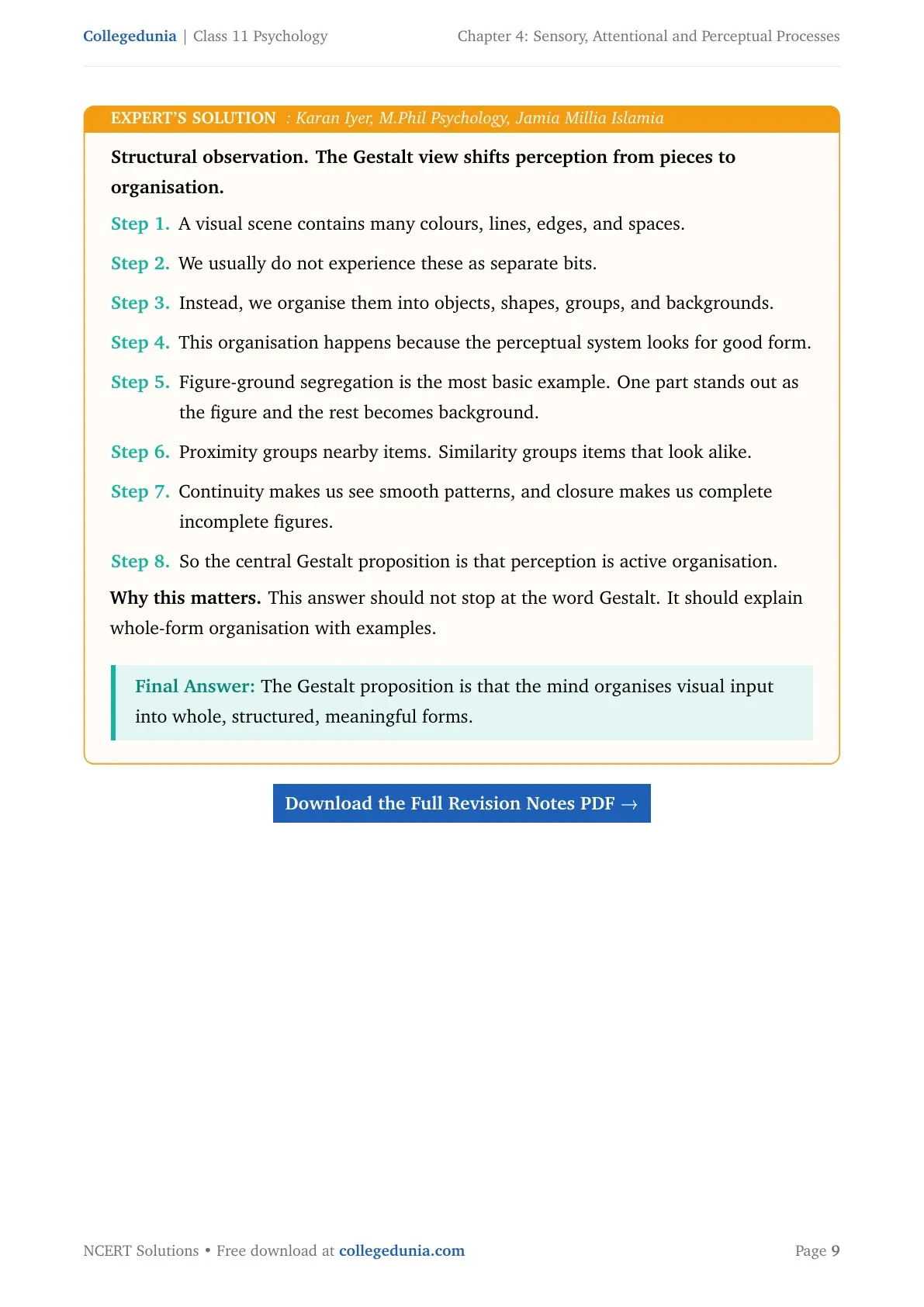
Structural observation. The Gestalt view shifts perception from pieces to organisation.
A visual scene contains many colours, lines, edges, and spaces.
We usually do not experience these as separate bits.
Instead, we organise them into objects, shapes, groups, and backgrounds.
This organisation happens because the perceptual system looks for good form.
Figure-ground segregation is the most basic example. One part stands out as the figure and the rest becomes background.
Proximity groups nearby items. Similarity groups items that look alike.
Continuity makes us see smooth patterns, and closure makes us complete incomplete figures.
So the central Gestalt proposition is that perception is active organisation.
Why this matters. This answer should not stop at the word Gestalt. It should explain whole-form organisation with examples.
The Gestalt proposition is that the mind organises visual input into whole, structured, meaningful forms.
Q 4.5
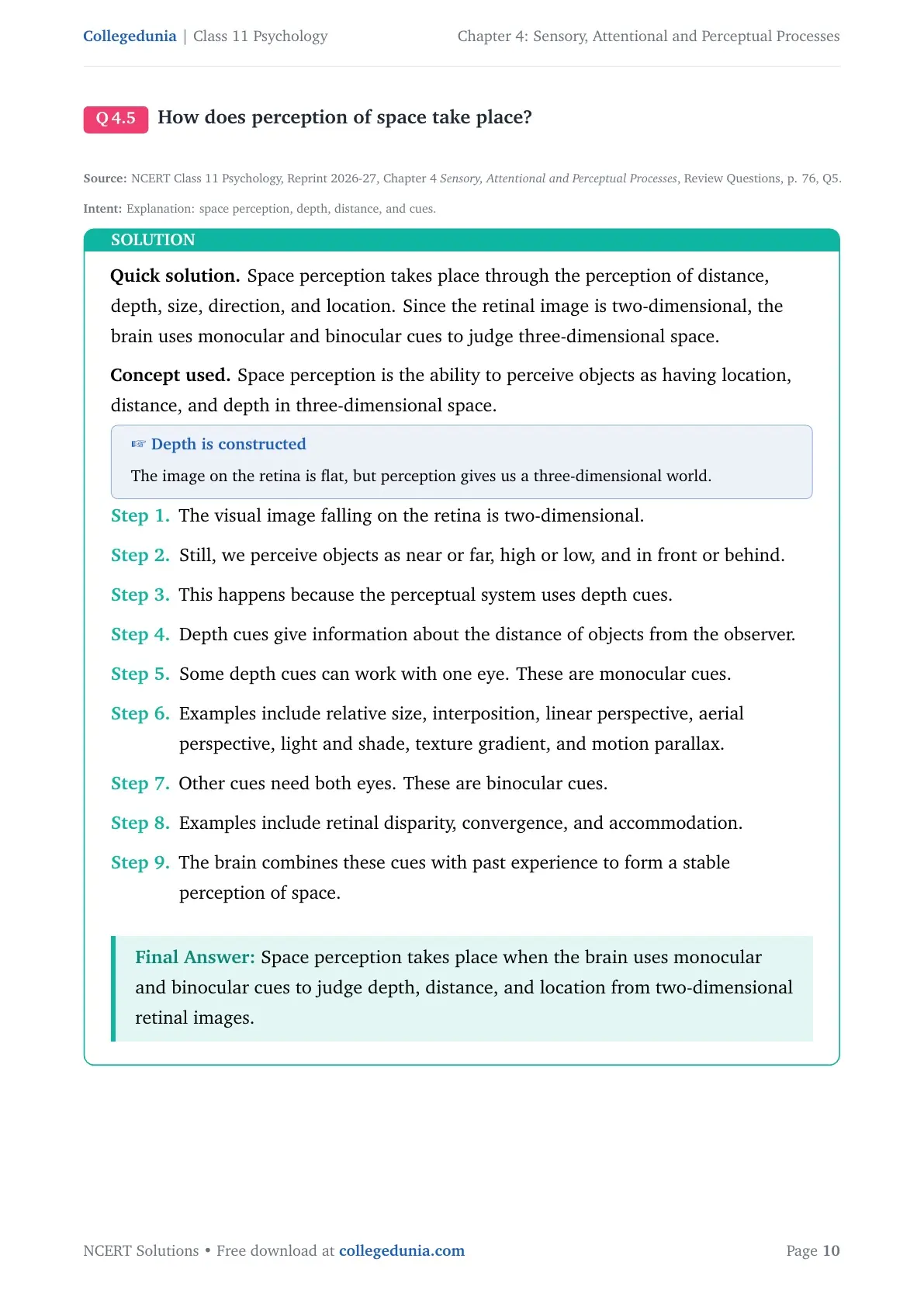
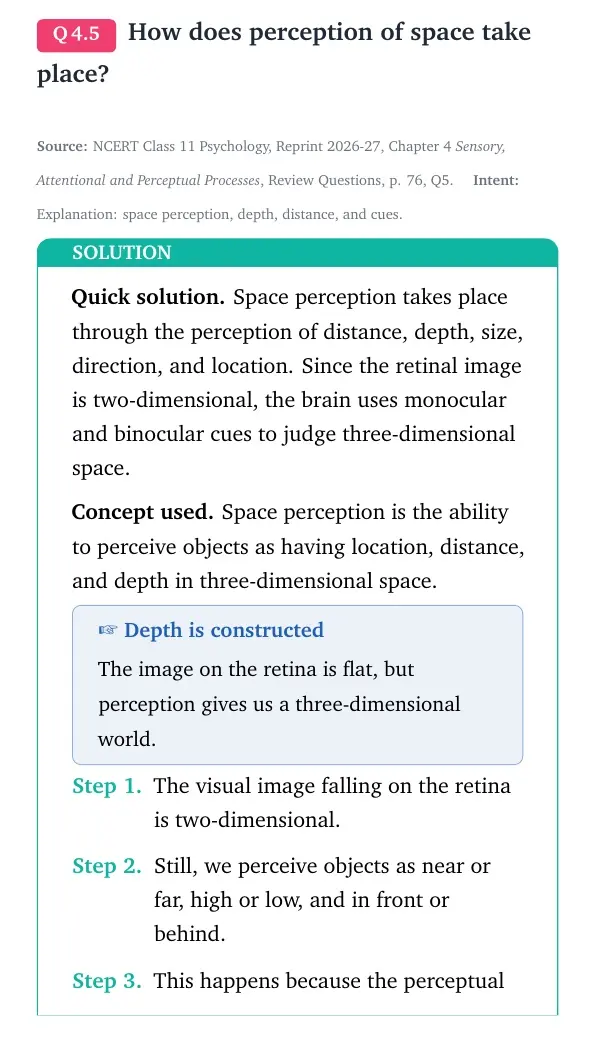
How does perception of space take place?
Space perception takes place through the perception of distance, depth, size, direction, and location. Since the retinal image is two-dimensional, the brain uses monocular and binocular cues to judge three-dimensional space. Concept used. Space perception is the ability to perceive objects as having location, distance, and depth in three-dimensional space.
Depth is constructed
The image on the retina is flat, but perception gives us a three-dimensional world.
The visual image falling on the retina is two-dimensional.
Still, we perceive objects as near or far, high or low, and in front or behind.
This happens because the perceptual system uses depth cues.
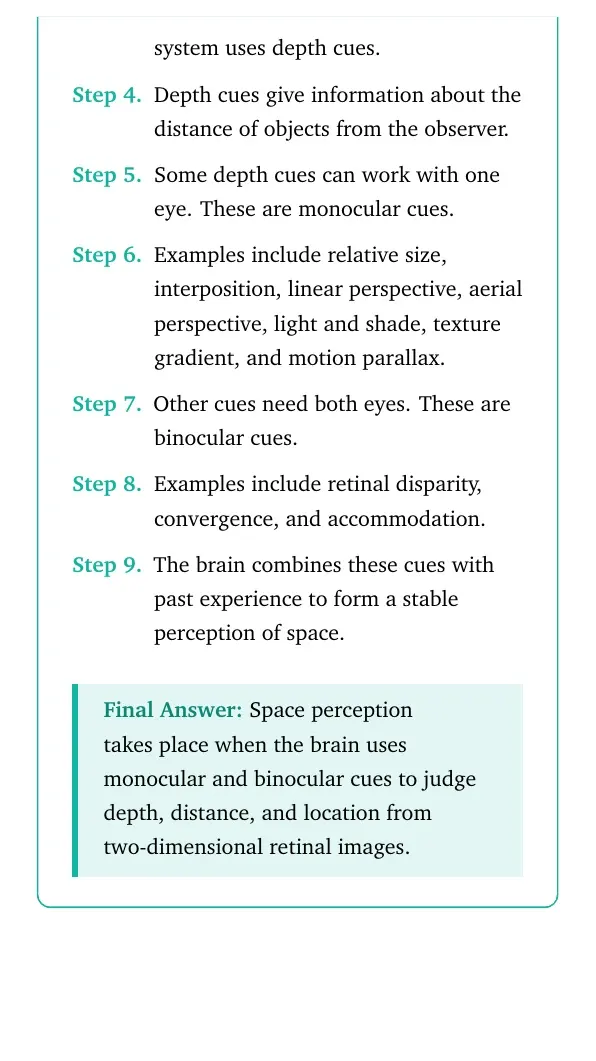
Depth cues give information about the distance of objects from the observer.
Some depth cues can work with one eye. These are monocular cues.
Examples include relative size, interposition, linear perspective, aerial perspective, light and shade, texture gradient, and motion parallax.
Other cues need both eyes. These are binocular cues.
Examples include retinal disparity, convergence, and accommodation.
The brain combines these cues with past experience to form a stable perception of space.
Space perception takes place when the brain uses monocular and binocular cues to judge depth, distance, and location from two-dimensional retinal images.
SG
Sneha Gupta
M.Sc Counselling Psychology, Banaras Hindu University
Verified Expert
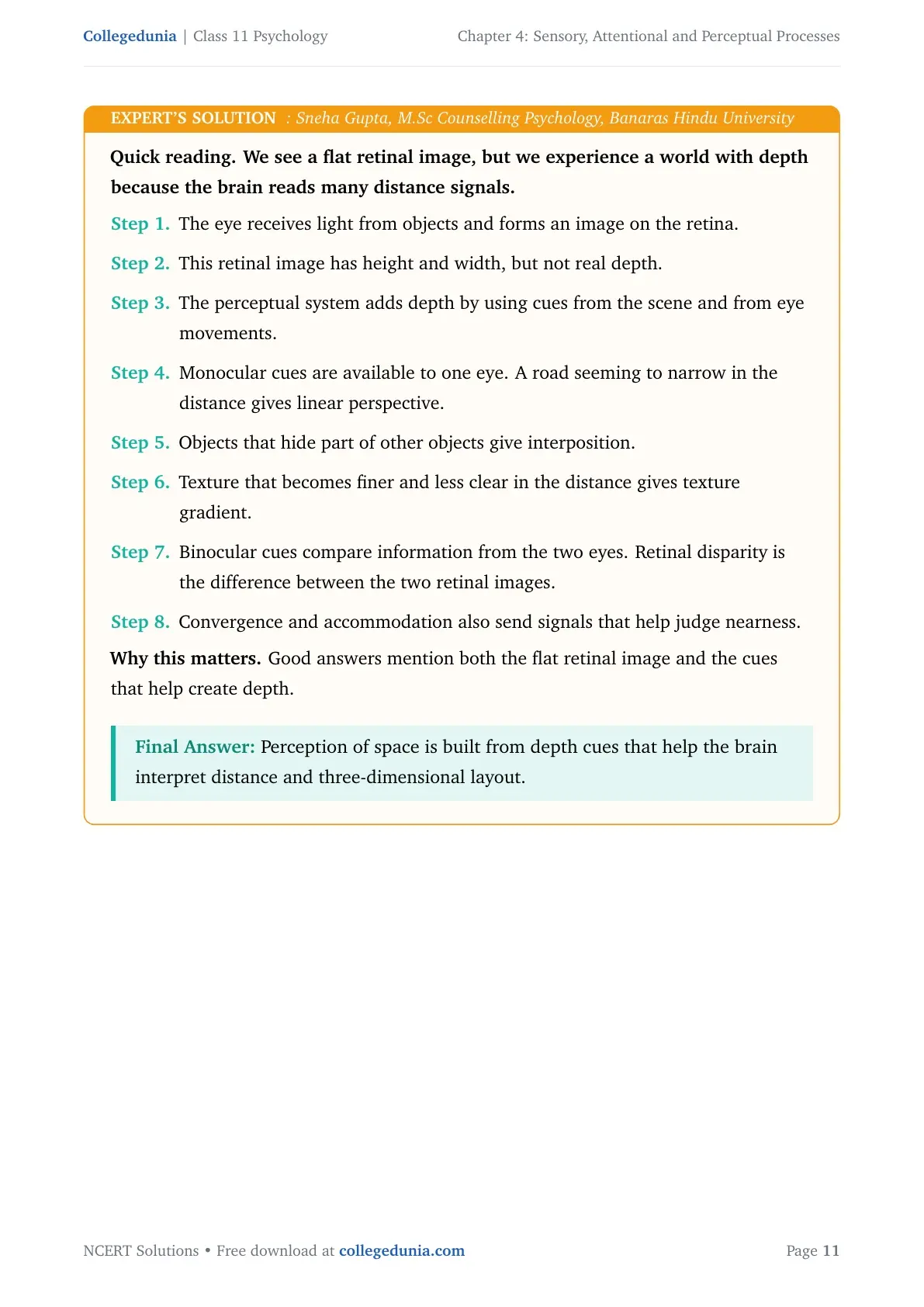
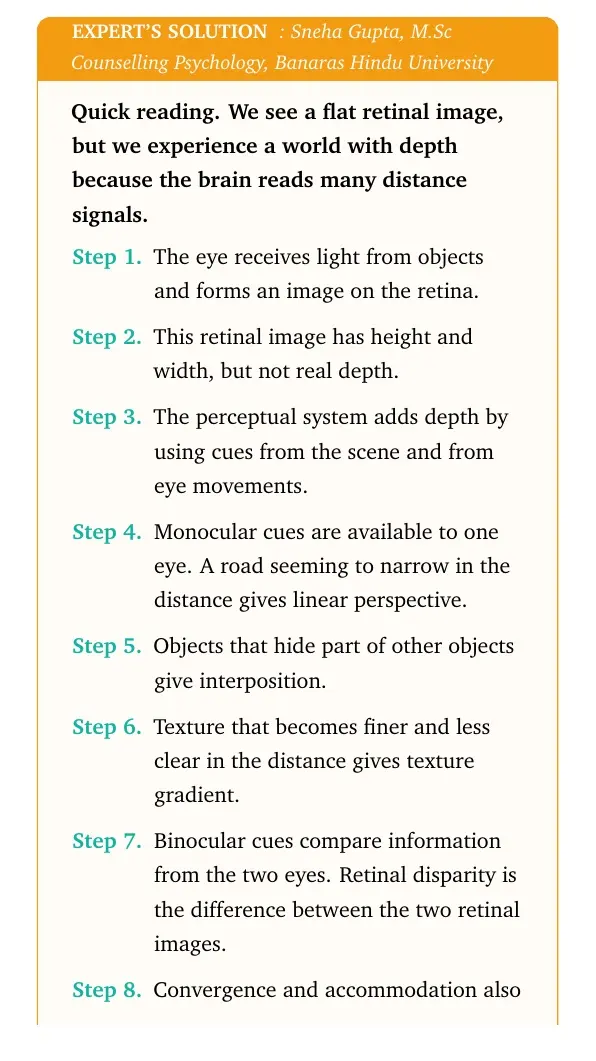
Quick reading. We see a flat retinal image, but we experience a world with depth because the brain reads many distance signals.
The eye receives light from objects and forms an image on the retina.
This retinal image has height and width, but not real depth.
The perceptual system adds depth by using cues from the scene and from eye movements.
Monocular cues are available to one eye. A road seeming to narrow in the distance gives linear perspective.
Objects that hide part of other objects give interposition.
Texture that becomes finer and less clear in the distance gives texture gradient.
Binocular cues compare information from the two eyes. Retinal disparity is the difference between the two retinal images.
Convergence and accommodation also send signals that help judge nearness.
Why this matters. Good answers mention both the flat retinal image and the cues that help create depth.
Perception of space is built from depth cues that help the brain interpret distance and three-dimensional layout.
Q 4.6
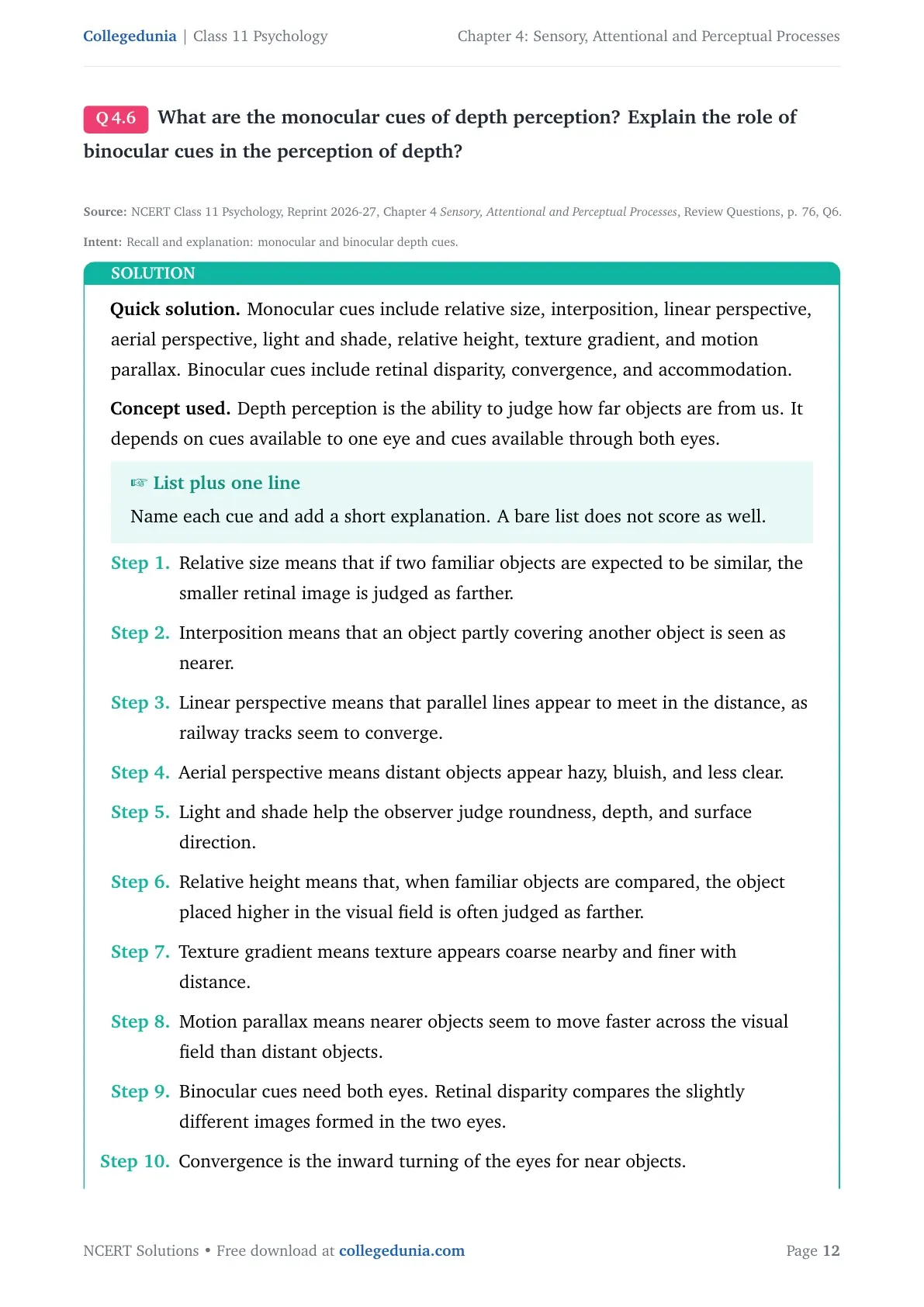
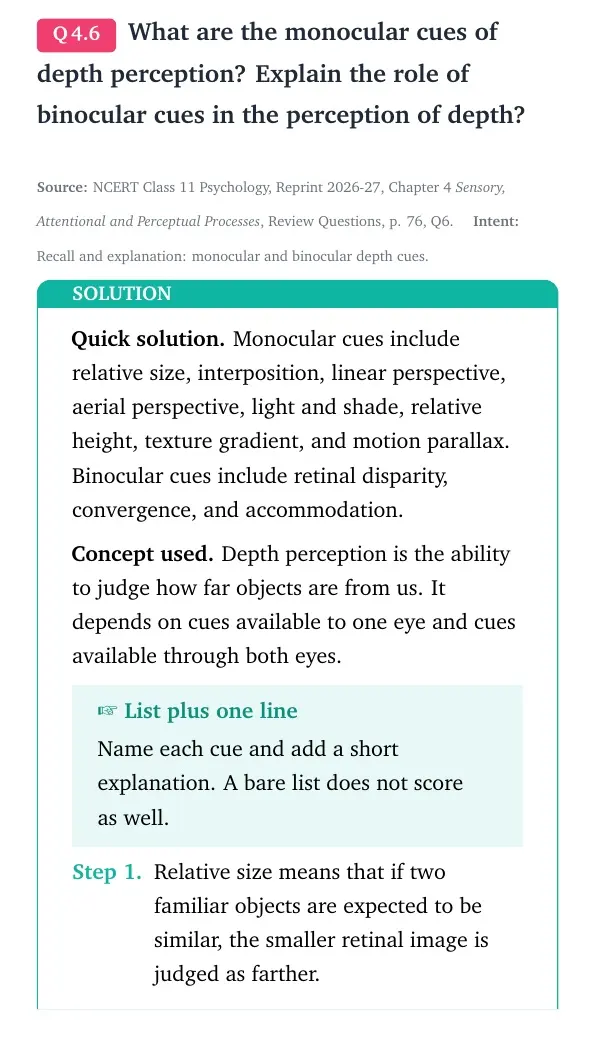
What are the monocular cues of depth perception? Explain the role of binocular cues in the perception of depth?
Monocular cues include relative size, interposition, linear perspective, aerial perspective, light and shade, relative height, texture gradient, and motion parallax. Binocular cues include retinal disparity, convergence, and accommodation. Concept used. Depth perception is the ability to judge how far objects are from us. It depends on cues available to one eye and cues available through both eyes.
List plus one line
Name each cue and add a short explanation. A bare list does not score as well.
Relative size means that if two familiar objects are expected to be similar, the smaller retinal image is judged as farther.
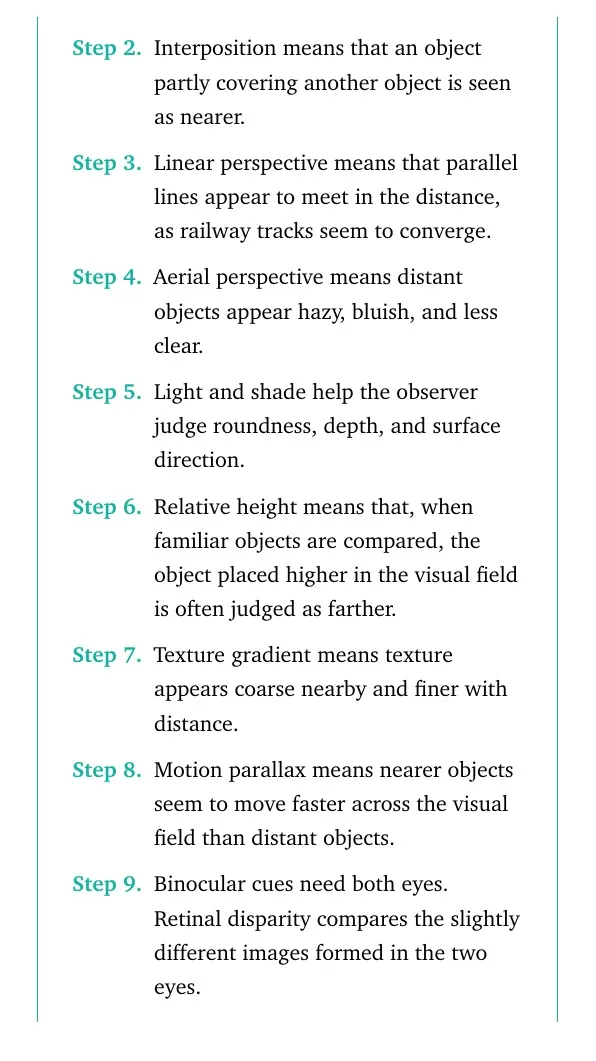
Interposition means that an object partly covering another object is seen as nearer.
Linear perspective means that parallel lines appear to meet in the distance, as railway tracks seem to converge.
Aerial perspective means distant objects appear hazy, bluish, and less clear.
Light and shade help the observer judge roundness, depth, and surface direction.
Relative height means that, when familiar objects are compared, the object placed higher in the visual field is often judged as farther.
Texture gradient means texture appears coarse nearby and finer with distance.
Motion parallax means nearer objects seem to move faster across the visual field than distant objects.
Binocular cues need both eyes. Retinal disparity compares the slightly different images formed in the two eyes.
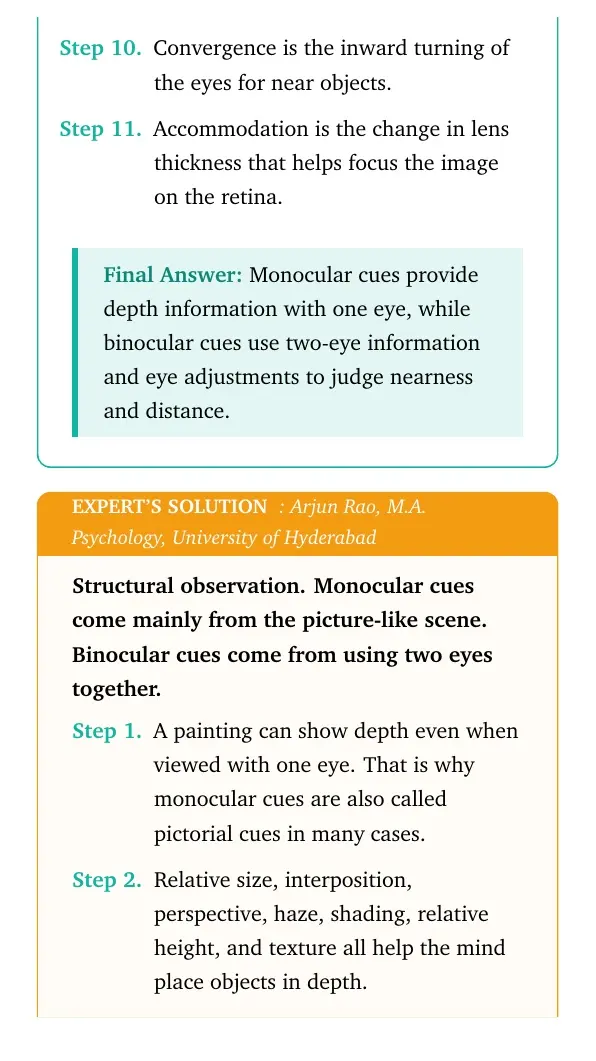
Convergence is the inward turning of the eyes for near objects.
Accommodation is the change in lens thickness that helps focus the image on the retina.
Monocular cues provide depth information with one eye, while binocular cues use two-eye information and eye adjustments to judge nearness and distance.
AR
Arjun Rao
M.A. Psychology, University of Hyderabad
Verified Expert
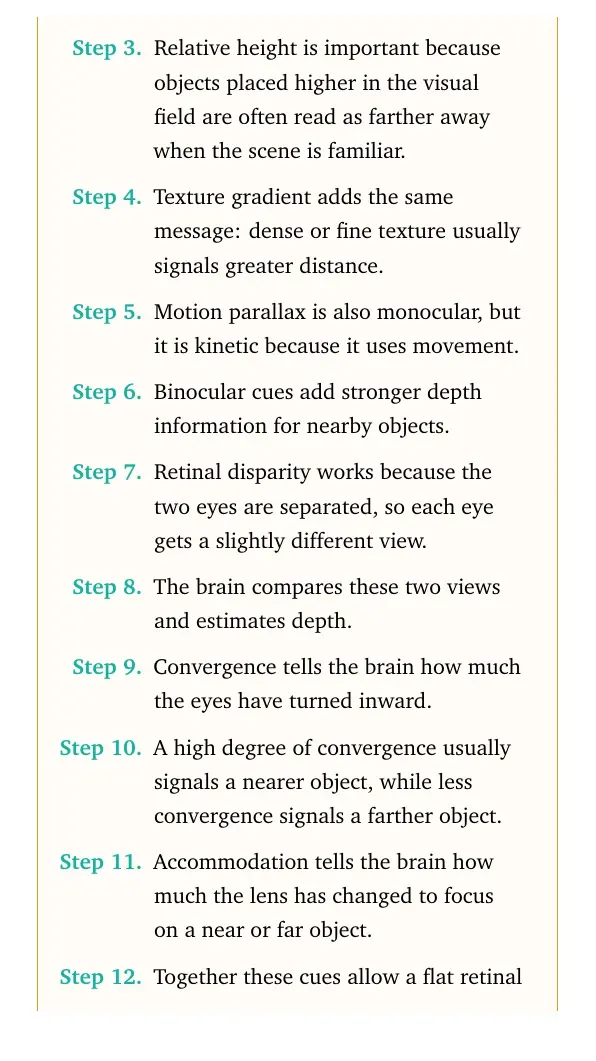
Structural observation. Monocular cues come mainly from the picture-like scene. Binocular cues come from using two eyes together.
A painting can show depth even when viewed with one eye. That is why monocular cues are also called pictorial cues in many cases.
Relative size, interposition, perspective, haze, shading, relative height, and texture all help the mind place objects in depth.
Relative height is important because objects placed higher in the visual field are often read as farther away when the scene is familiar.
Texture gradient adds the same message: dense or fine texture usually signals greater distance.
Motion parallax is also monocular, but it is kinetic because it uses movement.
Binocular cues add stronger depth information for nearby objects.
Retinal disparity works because the two eyes are separated, so each eye gets a slightly different view.
The brain compares these two views and estimates depth.
Convergence tells the brain how much the eyes have turned inward.
A high degree of convergence usually signals a nearer object, while less convergence signals a farther object.
Accommodation tells the brain how much the lens has changed to focus on a near or far object.
Together these cues allow a flat retinal image to be experienced as a three-dimensional scene.
Why this matters. NCERT expects the answer to separate one-eye cues from two-eye cues clearly.
Monocular cues use scene information, and binocular cues use two-eye difference and eye-muscle signals for depth.
Q 4.7
Why do illusions occur?
Illusions occur when sensory information is misinterpreted. The physical stimulus is present, but perception does not match the actual stimulus situation. Concept used. An illusion is a nonveridical perception, which means perception differs from the real physical properties of the stimulus.
Do not confuse
Illusion is not the same as hallucination. In illusion, an external stimulus is present.
Perception is not a direct copy of the stimulus.
The brain actively organises and interprets sensory information.
Sometimes this interpretation is wrong or misleading.
The mismatch between physical stimulus and perceived experience produces an illusion.
Illusions are often caused by the arrangement, context, size, brightness, angle, or movement of stimuli.
Geometrical illusions, such as Muller-Lyer illusion, occur because line endings or surrounding context change perceived length.
Apparent movement illusion occurs when still pictures or lights are presented one after another at the right speed.
Some illusions are universal and are experienced by most people. Others are more personal or culture-linked.
Illusions occur because the perceptual system misinterprets sensory information and constructs an experience that does not match the actual stimulus.
NK
Neha Kapoor
M.Sc Developmental Psychology, Ambedkar University Delhi
Verified Expert
Quick reading. Illusions show that perception is constructive, not camera-like.
In ordinary perception, the brain uses stimulus features, past experience, and context.
Usually this helps us understand the world quickly.
In some stimulus arrangements, the same organising rules mislead us.
For example, two equal lines may look unequal when arrowheads create a misleading context.
Two still lights may seem to move if they flash in a proper sequence.
A distant rail track may appear to converge because depth cues affect interpretation.
Such experiences occur even when the sense organs are working normally.
This is why NCERT describes illusions as misperceptions due to misinterpretation of sensory information.
Why this matters. Illusions prove that perception uses meaning and context, not only raw sensation.
Illusions occur when normal perceptual organisation gives an incorrect interpretation of a real stimulus.
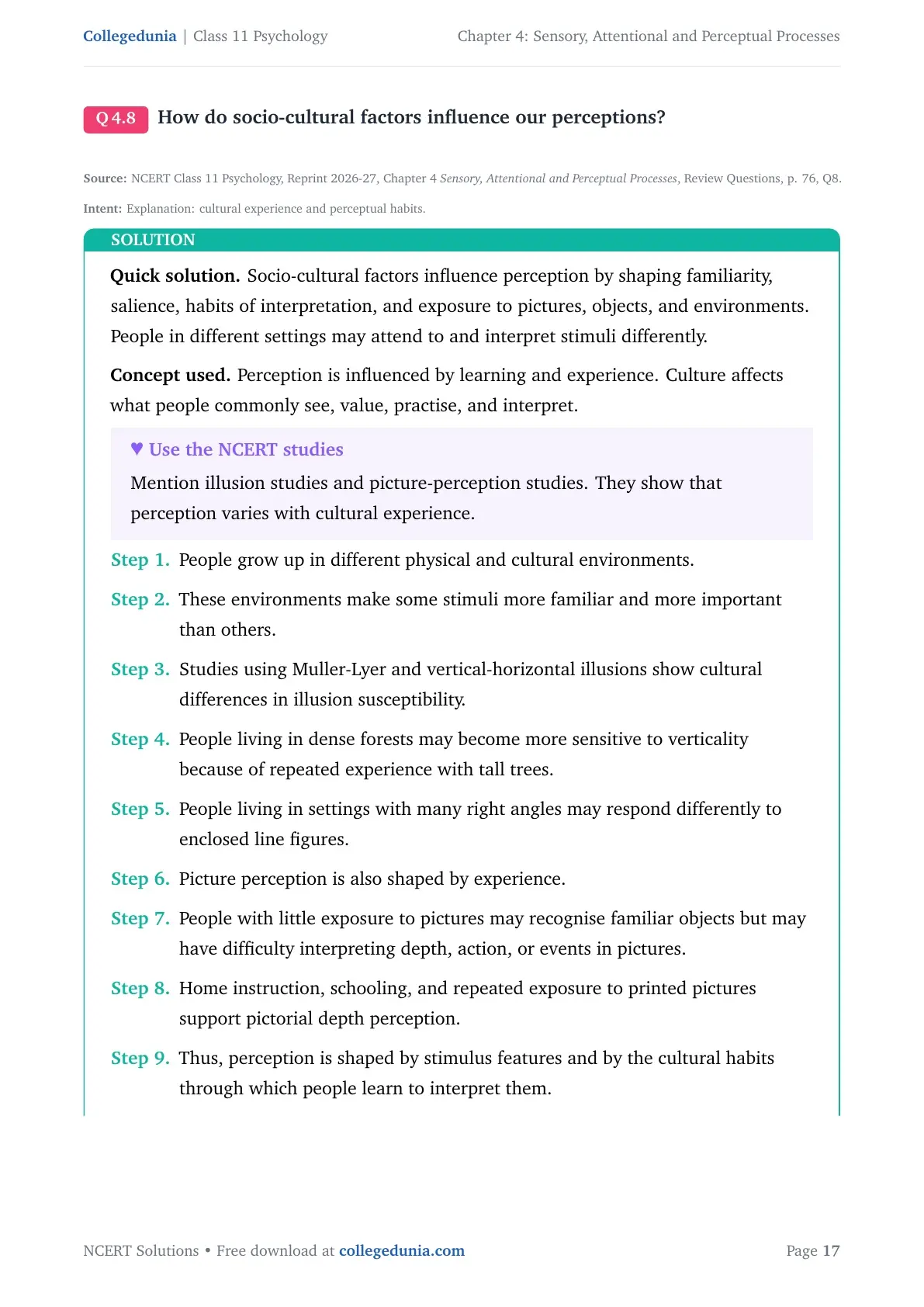
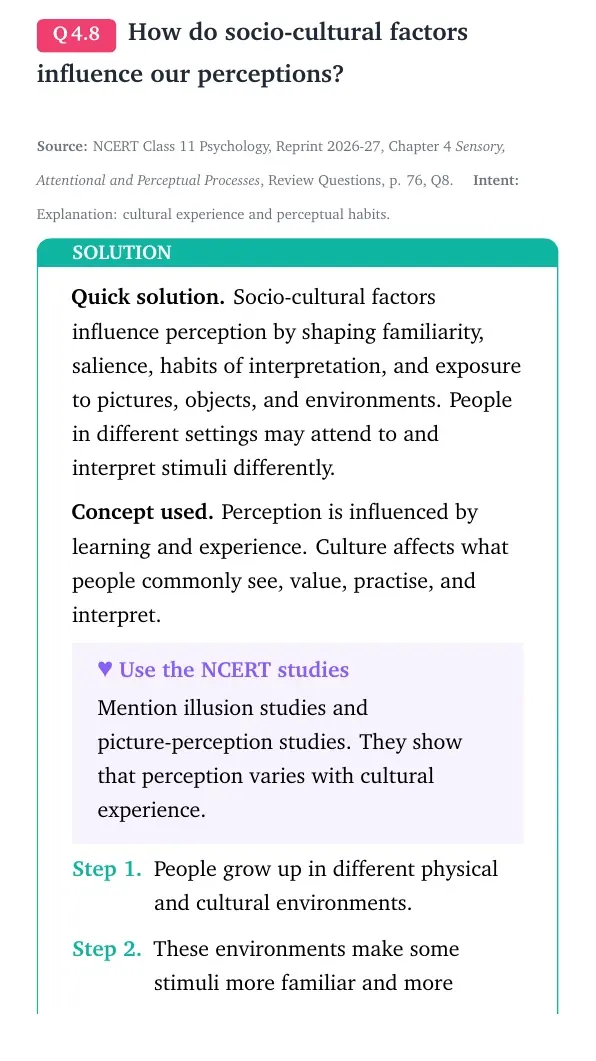
Q 4.8
How do socio-cultural factors influence our perceptions?
Socio-cultural factors influence perception by shaping familiarity, salience, habits of interpretation, and exposure to pictures, objects, and environments. People in different settings may attend to and interpret stimuli differently. Concept used. Perception is influenced by learning and experience. Culture affects what people commonly see, value, practise, and interpret.
Use the NCERT studies
Mention illusion studies and picture-perception studies. They show that perception varies with cultural experience.
People grow up in different physical and cultural environments.
These environments make some stimuli more familiar and more important than others.
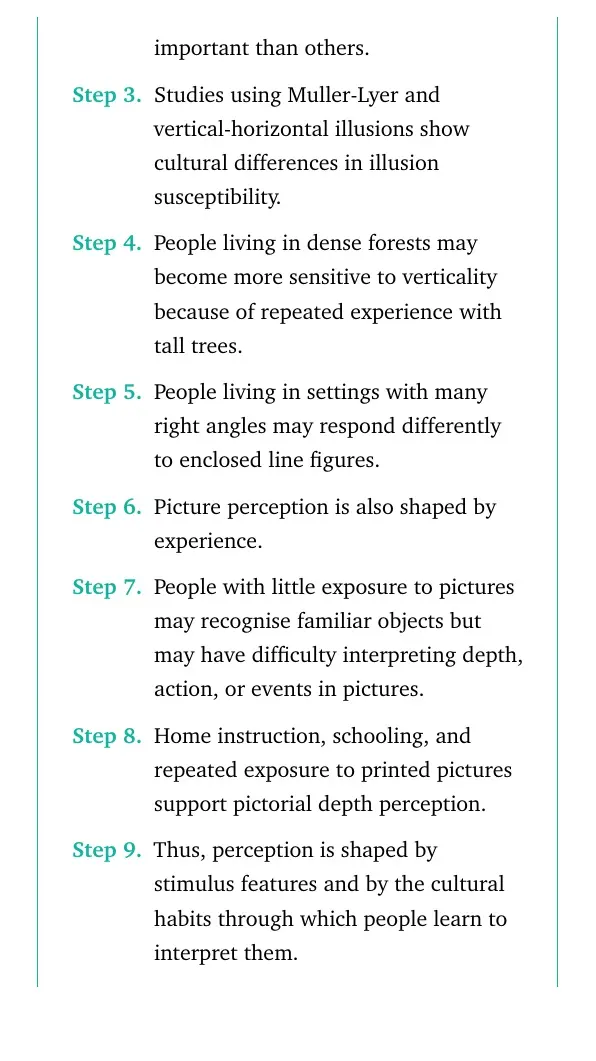
Studies using Muller-Lyer and vertical-horizontal illusions show cultural differences in illusion susceptibility.
People living in dense forests may become more sensitive to verticality because of repeated experience with tall trees.
People living in settings with many right angles may respond differently to enclosed line figures.
Picture perception is also shaped by experience.
People with little exposure to pictures may recognise familiar objects but may have difficulty interpreting depth, action, or events in pictures.
Home instruction, schooling, and repeated exposure to printed pictures support pictorial depth perception.
Thus, perception is shaped by stimulus features and by the cultural habits through which people learn to interpret them.
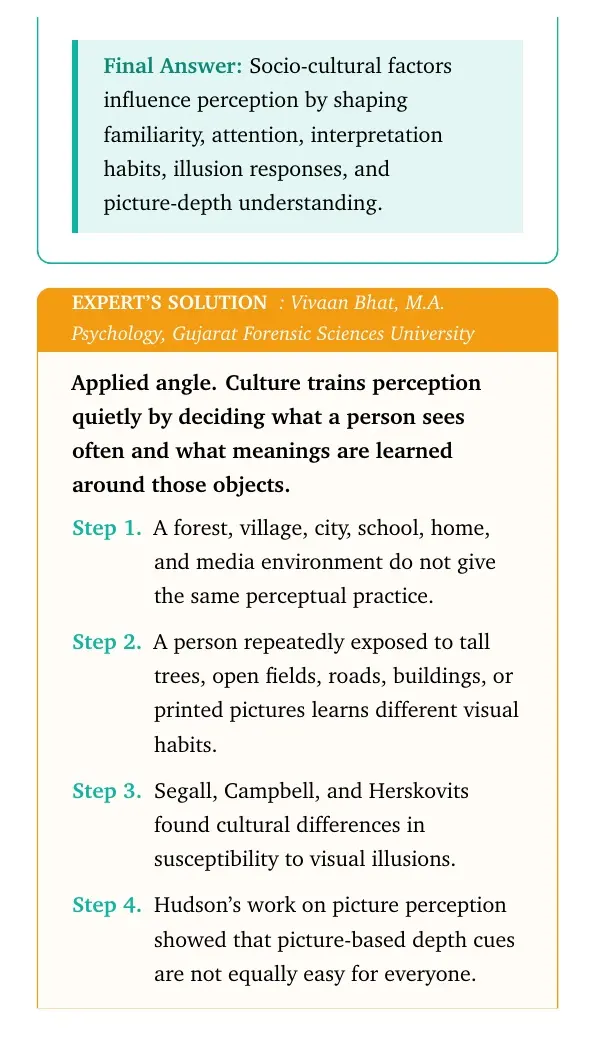
Socio-cultural factors influence perception by shaping familiarity, attention, interpretation habits, illusion responses, and picture-depth understanding.
VB
Vivaan Bhat
M.A. Psychology, Gujarat Forensic Sciences University
Verified Expert
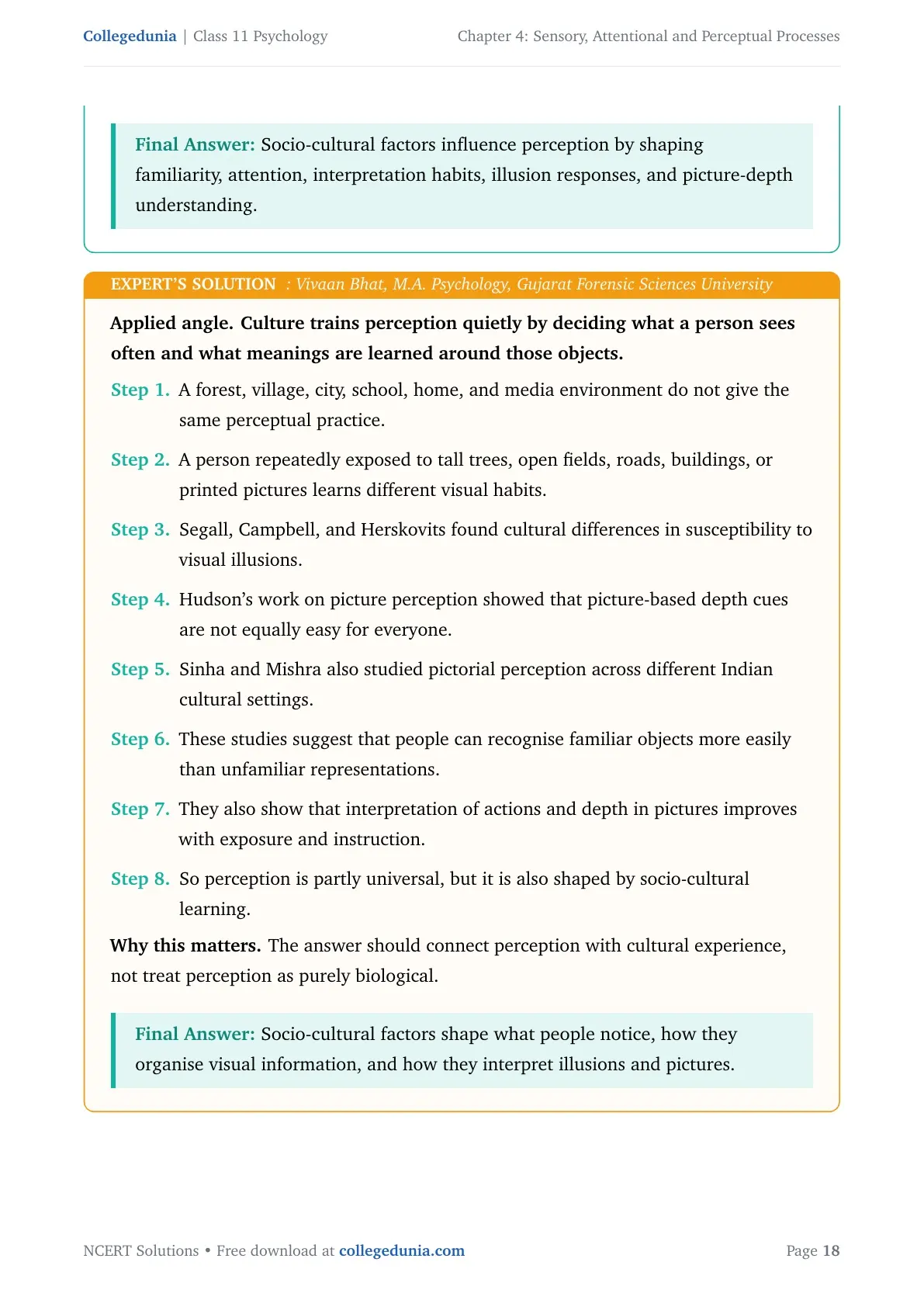
Applied angle. Culture trains perception quietly by deciding what a person sees often and what meanings are learned around those objects.
A forest, village, city, school, home, and media environment do not give the same perceptual practice.
A person repeatedly exposed to tall trees, open fields, roads, buildings, or printed pictures learns different visual habits.
Segall, Campbell, and Herskovits found cultural differences in susceptibility to visual illusions.
Hudson's work on picture perception showed that picture-based depth cues are not equally easy for everyone.
Sinha and Mishra also studied pictorial perception across different Indian cultural settings.
These studies suggest that people can recognise familiar objects more easily than unfamiliar representations.
They also show that interpretation of actions and depth in pictures improves with exposure and instruction.
So perception is partly universal, but it is also shaped by socio-cultural learning.
Why this matters. The answer should connect perception with cultural experience, not treat perception as purely biological.
Socio-cultural factors shape what people notice, how they organise visual information, and how they interpret illusions and pictures.
Sensory, Attentional and Perceptual Processes Psychology NCERT Solutions FAQs
Ques. How many review questions are solved in Class 11 Psychology Chapter 4 Sensory, Attentional and Perceptual Processes?
Ans. The PDF solves all 8 review questions from the 2026-27 NCERT Class 11 Psychology Chapter 4 textbook.
Ques. What is the main difference between selective attention and sustained attention?
Ans. Selective attention chooses a limited number of stimuli from many alternatives, while sustained attention keeps attention on an object or task for a longer time.
Ques. Which monocular cue was important in the Chapter 4 depth-perception answer?
Ans. The answer includes relative height along with relative size, interposition, linear perspective, aerial perspective, light and shade, texture gradient and motion parallax.
Ques. Are these solutions useful for the 2026-27 Class 11 Psychology school exam?
Ans. Yes. The answers follow the latest 2026-27 NCERT chapter sequence and explain each concept with examples suited to Class 11 Psychology exams.







Comments