Senior Biology Editor, 11 Yrs | Updated 3+ months ago
Class 12 Biology Chapter 3 Reproductive Health is a high-scoring, fact-recall chapter for NEET and the CBSE board. Almost every question tests contraceptive categories, MTP, STIs, and the ART acronyms. This page hosts the free reproductive health class 12 ncert solutions PDF, with all 13 exercise answers in the exact terms NCERT rewards.
13 NCERT Exercise Questions
6 Contraceptive Categories
6 ART Methods (IVF to ICSI)
CBSE Weightage: 3 to 5 marks
NEET Weightage: 2 to 3 questions per year
CUET (UG) Weightage: 2 to 3 questions per year
The reproductive health class 12 ncert solutions PDF carries fully-worked Solutions with a parallel Expert's Solution that rewrites each answer for NEET-recall and the CBSE 3-marker script. This page reflects the current 2026-27 NCERT print, so all 13 exercise questions stay examinable for CBSE Boards, NEET, and CUET.
What is Inside the Reproductive Health Class 12 Biology NCERT Solutions PDF?
The download solves every numbered question in the Chapter 3 exercise. The questions cluster into five recall blocks, shown below with board marks.
Question Block
Exercise Qs
What the Solution Covers
Typical Marks
Reproductive health and its significance
Q1, Q2, Q4
WHO definition, RCH programme, areas of improvement in 50 years
2 to 3
Sex education and population
Q3, Q5
Need for sex education in schools, reasons for population explosion
2 to 3
Contraception
Q6, Q7
Justification of contraceptives, why gonad removal is not contraception
2 to 3
Amniocentesis and MTP
Q8
Why sex-determination by amniocentesis is banned
2
Infertility, ART and STIs
Q9, Q10, Q11, Q12, Q13
ART methods, STI prevention, true/false and statement-correction
3 to 5
Every solution spells each term the way NEET and CBSE expect: RCH programme, MTP, STI, IVF-ET, ZIFT, GIFT, ICSI, amniocentesis.
Reproductive Health Class 12 Biology PYQ Trend (2025 to 2021)
The chapter is light but reliable. CBSE almost always sets a 2 or 3 mark question on contraceptives or ART, and NEET pulls 2 to 3 single-fact MCQs. The pattern below tracks the dominant angle each year.
Year
CBSE Board Focus
NEET Focus
2025
ART: difference between ZIFT and GIFT (2 marks)
Amniocentesis ban, IUDs mechanism (2 Qs)
2024
Contraceptive methods, surgical methods (3 marks)
MTP timing, lactational amenorrhoea (2 Qs)
2023
RCH programme objectives (2 marks)
STIs and prevention, ICSI (3 Qs)
2022
Population explosion reasons (2 marks)
Saheli, copper-releasing IUDs (2 Qs)
2021
Reproductive health significance (3 marks)
Infertility and ART terms (2 Qs)
Over the last five cycles, contraception and ART together carried roughly 70% of this chapter's marks. Secure those two blocks and you secure the chapter.
How Will Collegedunia's NCERT Solutions Help You Score in Reproductive Health?
Students lose marks here because they answer in fragments. CBSE wants the full WHO framing and a named example; NEET wants the exact acronym. These reproductive health class 12 ncert solutions are written so one answer satisfies both.
Each Solution gives the board-ready paragraph with the definition and a named example (Saheli, Mala-D, Cu-T, Lippes loop).
The parallel Expert's Solution compresses it into the single sentence NEET tests, with the acronym expanded once.
True/False and statement-correction questions (Q12, Q13) are solved with the corrected statement written out in full.
Sample Fully-Solved Question: Why Removal of Gonads is Not a Contraceptive (Q7)
This high-frequency 2-marker is often answered wrongly. The model answer below shows the reasoning CBSE expects.
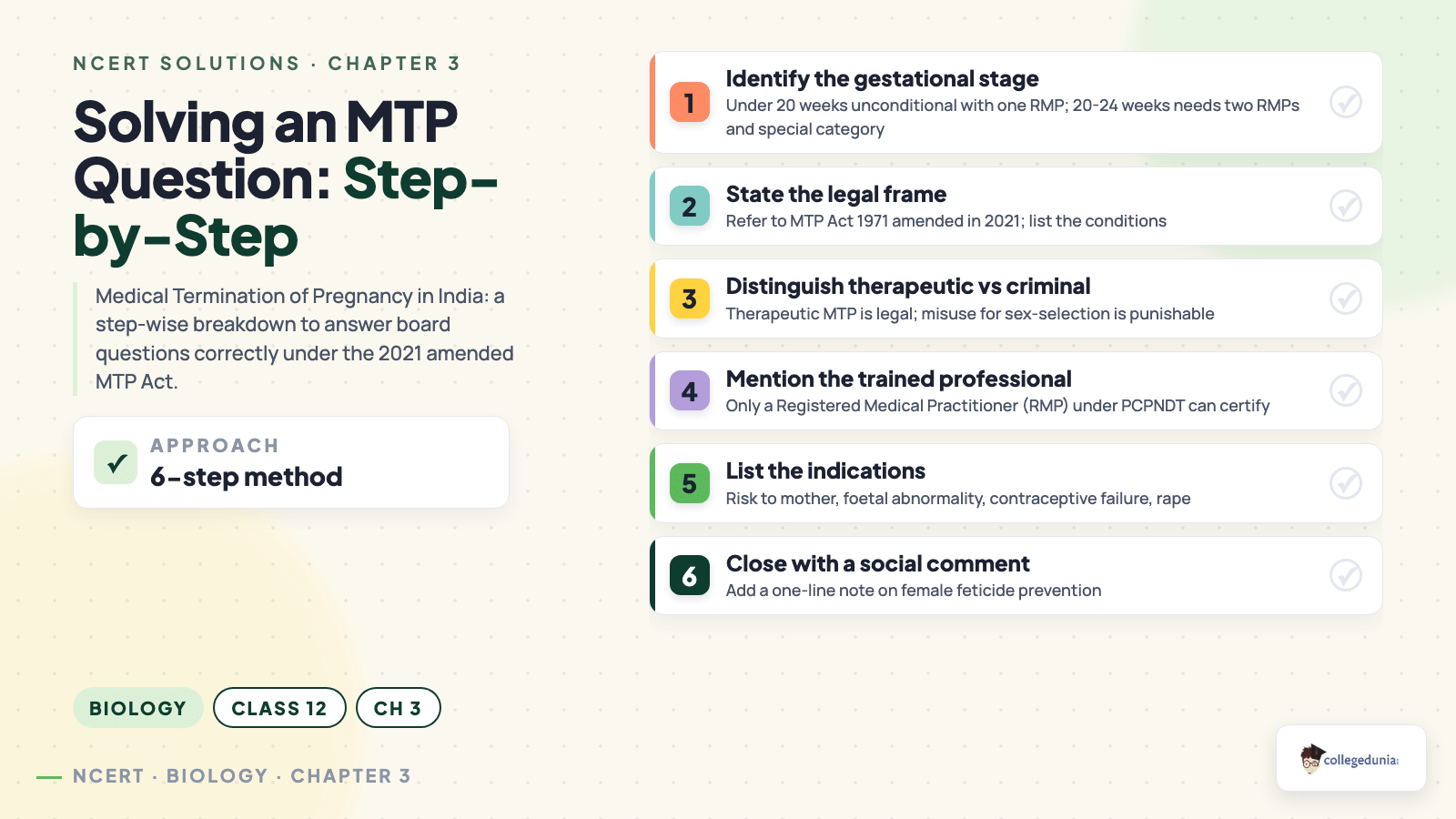
Question. Removal of gonads cannot be considered as a contraceptive option. Why?
Answer. A contraceptive is a reversible method that prevents pregnancy while keeping the reproductive system intact. The gonads (testes, ovaries) are not just gamete-producing organs; they are also the endocrine glands that secrete the sex hormones (testosterone, oestrogen, progesterone) controlling secondary sexual characters and the menstrual cycle. Their removal is irreversible and destroys both gamete production and hormone secretion. Since contraception must be temporary and must not damage normal physiology, removal of gonads fails the definition of a contraceptive.
Mark-scoring cue: name the dual role (gametes + hormones) and the word "irreversible".
Where Students Lose Marks in Reproductive Health (Class 12 Biology)
Most lost marks here come from imprecise terminology, not wrong concepts. The recurring slips below are worth a quick revision pass before the exam.
Common Mistake
What CBSE / NEET Expects
Writing "MTP" without expanding it once
Medical Termination of Pregnancy, safe up to 12 weeks comfortably, up to 20 weeks under conditions
NCERT uses STI; list at least gonorrhoea, syphilis, chlamydia, HIV-AIDS, hepatitis-B
Saying ART "cures infertility"
ART (IVF-ET, ZIFT, GIFT, ICSI, IUI, IUT) assists couples to have a child; it does not cure the underlying cause
Vague "amniocentesis is bad"
State it is misused for illegal sex-determination leading to female foeticide, hence statutorily banned
In NEET, a single mis-stated acronym in an MCQ is a full mark lost to negative marking.
Alternate Solution Methods: How the Expert's Solution Reframes Each Question
Every question carries two versions: the Solution is the board paragraph, the Expert's Solution is the entrance-exam compression. For Q9, the Expert's Solution gives the one-line form NEET tests:
IVF-ET: fertilisation in vitro, embryo transferred. ZIFT: zygote / early embryo (up to 8 cells) into fallopian tube. IUT: embryo with more than 8 blastomeres into uterus. GIFT: gamete (ovum) transferred into another female's fallopian tube. ICSI: single sperm injected directly into ovum. AI / IUI: semen introduced into the female tract.
How to Study Reproductive Health for Class 12 Biology Boards (Time-Plan)
This is a one-sitting chapter, best attempted after Chapter 2 Human Reproduction.
Day 1 (90 min): Read the reproductive health definition, RCH programme, population explosion, and birth-control rationale. Solve Q1 to Q6.
Day 2 (90 min): Memorise the contraceptive table and ART acronyms. Solve Q7 to Q11.
Day 3 (45 min): Revise the STIs list and amniocentesis ban. Solve Q12 and Q13, then attempt one previous-year set.
Chapter 3 Weightage Against Other Class 12 Biology Chapters
Reproductive Health sits in the lighter band of the syllabus. The bar chart below compares CBSE board marks across Class 12 Biology chapters, with Chapter 3 highlighted.
All NCERT Solutions for Reproductive Health with Step-by-Step Working
Every NCERT textbook question for Class 12 Biology Chapter 3 Reproductive Health is listed below with its full Solution and Expert Solution in collapsible tabs. Click Check Solution for the working, or Expert Solution for more.
Questions
Q 3.1
Question text in bold (handled automatically).
% Use
caption INSIDE the
% question text if the NCERT statement quotes a figure.
% Concept used.
%
%
...
...
>
%
% ....
% DIAGRAMS ARE REQUIRED whenever they aid understanding: see
% SKILL.md for the subject-specific list of must-draw cases.>
%
%
%
Step 1: prose + equation, every algebraic move shown.
%
Step 2: ...
%
Step 3: ...
%
%
% Final answer.
%
FS
Firstname Surname
Degree, Institution
Verified Expert
% Strategic angle. ...
%
%
%
...
%
...
%
%
% Why this matters. ...
%
% Same final answer, phrased crisply.
%
Q 3.2
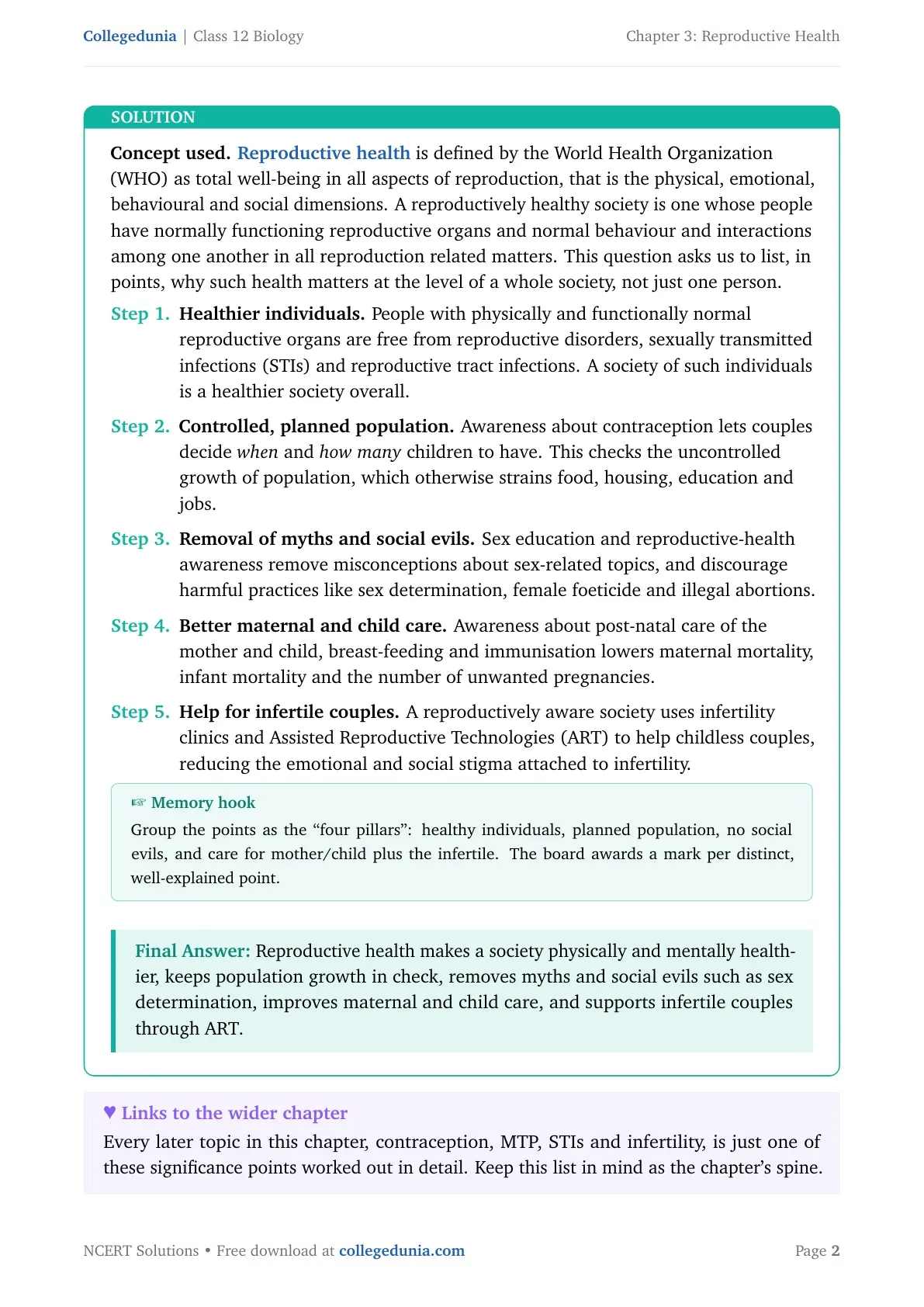
What do you think is the significance of reproductive health in a society?
Concept used.Reproductive health is defined by
the World Health Organization (WHO) as total well-being in all
aspects of reproduction, that is the physical, emotional, behavioural
and social dimensions. A reproductively healthy society is one whose
people have normally functioning reproductive organs and normal
behaviour and interactions among one another in all reproduction
related matters. This question asks us to list, in points, why such
health matters at the level of a whole society, not just one person.
Healthier individuals. People with physically and
functionally normal reproductive organs are free from
reproductive disorders, sexually transmitted infections
(STIs) and reproductive tract infections. A society of such
individuals is a healthier society overall.
Controlled, planned population. Awareness about
contraception lets couples decide when and how
many children to have. This checks the uncontrolled growth
of population, which otherwise strains food, housing,
education and jobs.
Removal of myths and social evils. Sex education and
reproductive-health awareness remove misconceptions about
sex-related topics, and discourage harmful practices like sex
determination, female foeticide and illegal abortions.
Better maternal and child care. Awareness about
post-natal care of the mother and child, breast-feeding and
immunisation lowers maternal mortality, infant mortality and
the number of unwanted pregnancies.
Help for infertile couples. A reproductively aware
society uses infertility clinics and Assisted Reproductive
Technologies (ART) to help childless couples, reducing the
emotional and social stigma attached to infertility.
Memory hook
Group the points as the ``four pillars'': healthy individuals,
planned population, no social evils, and care for mother/child plus
the infertile. The board awards a mark per distinct, well-explained
point.
Reproductive health makes a society physically and mentally
healthier, keeps population growth in check, removes myths and social
evils such as sex determination, improves maternal and child care,
and supports infertile couples through ART.
AI
Ananya Iyer
M.Sc Zoology, Banaras Hindu University
Verified Expert
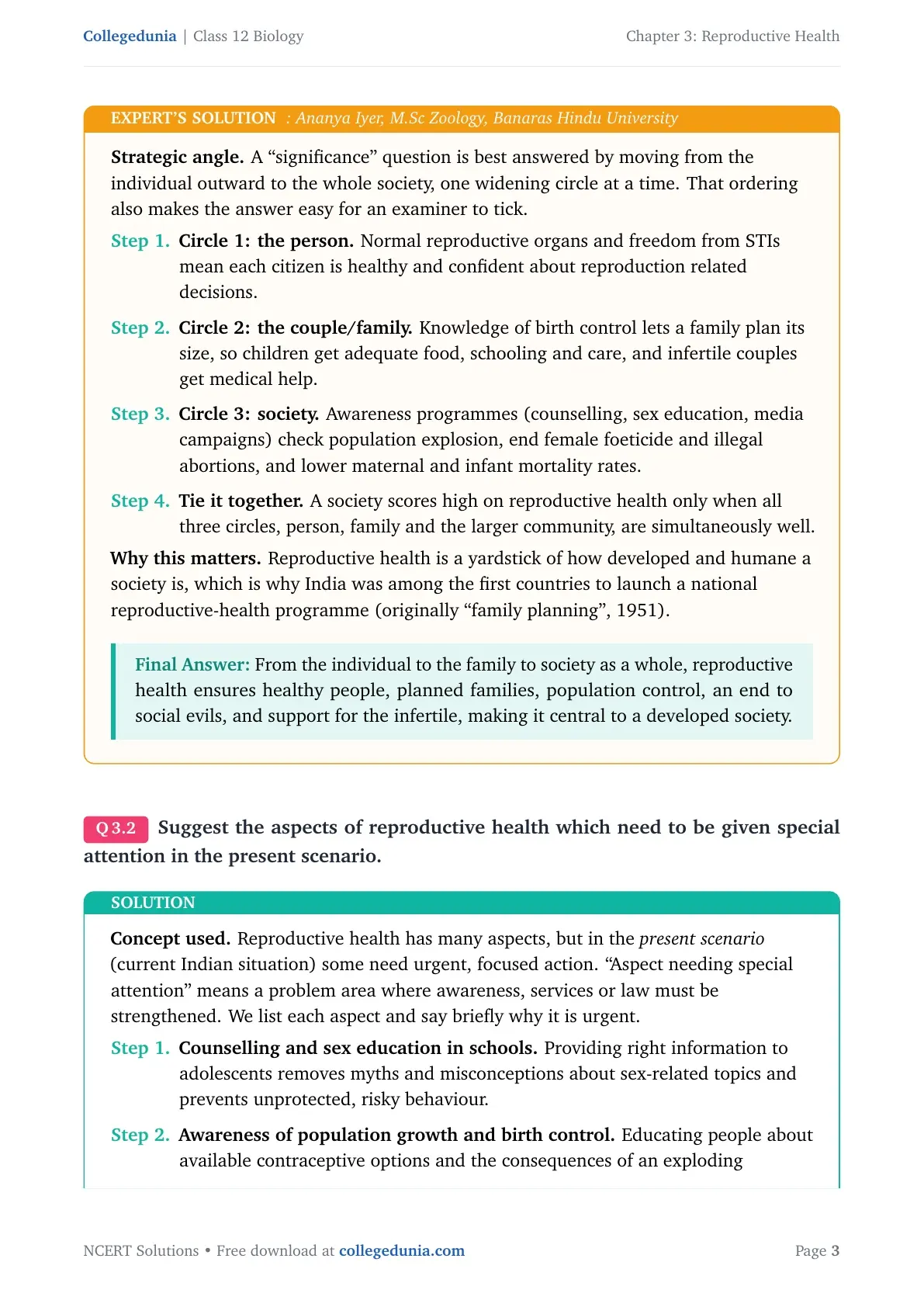
Strategic angle. A ``significance'' question is best answered
by moving from the individual outward to the whole society, one
widening circle at a time. That ordering also makes the answer easy
for an examiner to tick.
Circle 1: the person. Normal reproductive organs and
freedom from STIs mean each citizen is healthy and confident
about reproduction related decisions.
Circle 2: the couple/family. Knowledge of birth
control lets a family plan its size, so children get adequate
food, schooling and care, and infertile couples get medical
help.
Circle 3: society. Awareness programmes (counselling,
sex education, media campaigns) check population explosion,
end female foeticide and illegal abortions, and lower
maternal and infant mortality rates.
Tie it together. A society scores high on
reproductive health only when all three circles, person,
family and the larger community, are simultaneously well.
Why this matters. Reproductive health is a yardstick of how
developed and humane a society is, which is why India was among the
first countries to launch a national reproductive-health programme
(originally ``family planning'', 1951).
From the individual to the family to society as a whole,
reproductive health ensures healthy people, planned families,
population control, an end to social evils, and support for the
infertile, making it central to a developed society.
Q 3.3
Suggest the aspects of reproductive health which need to be given special attention in the present scenario.
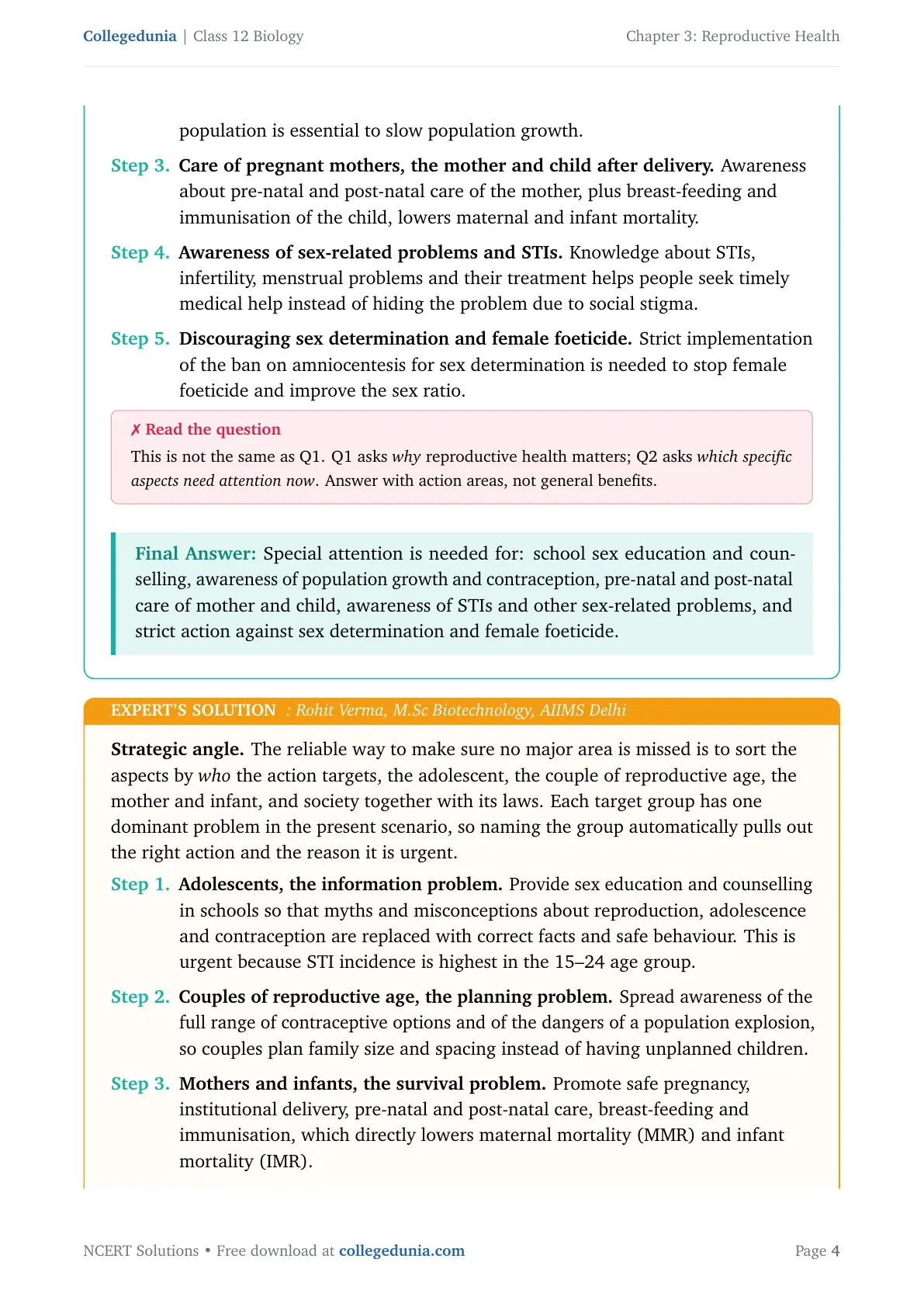
Concept used. Reproductive health has many aspects, but in
the present scenario (current Indian situation) some need
urgent, focused action. ``Aspect needing special attention'' means a
problem area where awareness, services or law must be strengthened.
We list each aspect and say briefly why it is urgent.
Counselling and sex education in schools. Providing
right information to adolescents removes myths and
misconceptions about sex-related topics and prevents
unprotected, risky behaviour.
Awareness of population growth and birth control.
Educating people about available contraceptive options and
the consequences of an exploding population is essential to
slow population growth.
Care of pregnant mothers, the mother and child after
delivery. Awareness about pre-natal and post-natal care of
the mother, plus breast-feeding and immunisation of the
child, lowers maternal and infant mortality.
Awareness of sex-related problems and STIs.
Knowledge about STIs, infertility, menstrual problems and
their treatment helps people seek timely medical help instead
of hiding the problem due to social stigma.
Discouraging sex determination and female foeticide.
Strict implementation of the ban on amniocentesis for sex
determination is needed to stop female foeticide and improve
the sex ratio.
Read the question
This is not the same as Q1. Q1 asks why reproductive health
matters; Q2 asks which specific aspects need attention now.
Answer with action areas, not general benefits.
Special attention is needed for: school sex education and
counselling, awareness of population growth and contraception,
pre-natal and post-natal care of mother and child, awareness of STIs
and other sex-related problems, and strict action against sex
determination and female foeticide.
RV
Rohit Verma
M.Sc Biotechnology, AIIMS Delhi
Verified Expert
Strategic angle. The reliable way to make sure no major
area is missed is to sort the aspects by who the action
targets, the adolescent, the couple of reproductive age, the mother
and infant, and society together with its laws. Each target group has
one dominant problem in the present scenario, so naming the group
automatically pulls out the right action and the reason it is urgent.
Adolescents, the information problem. Provide sex
education and counselling in schools so that myths and
misconceptions about reproduction, adolescence and
contraception are replaced with correct facts and safe
behaviour. This is urgent because STI incidence is highest in
the 15–24 age group.
Couples of reproductive age, the planning problem.
Spread awareness of the full range of contraceptive options
and of the dangers of a population explosion, so couples plan
family size and spacing instead of having unplanned children.
Mothers and infants, the survival problem. Promote
safe pregnancy, institutional delivery, pre-natal and
post-natal care, breast-feeding and immunisation, which
directly lowers maternal mortality (MMR) and infant mortality
(IMR).
Society and law, the abuse problem. Take aggressive
action against illegal abortions, the misuse of amniocentesis
for sex determination and female foeticide, and improve
access to infertility clinics so childless couples get help
without stigma.
Why this matters. These four target groups map almost
exactly onto the focus areas of India's ``Reproductive and Child
Health (RCH)'' programmes, so structuring the answer this way doubles
as accurate current-affairs context that strengthens the board
response.
Group the priority aspects as adolescent sex education,
couple-level contraception awareness, mother and child care, and
strict legal action against female foeticide and illegal abortion.
Q 3.4
Is sex education necessary in schools? Why?
Concept used.Sex education means giving young
students correct, scientific information about reproductive organs,
adolescence and its changes, safe and hygienic sexual practices, STIs,
and myths/misconceptions about sex. The question asks for a clear
yes, supported by reasons.
Yes, it is necessary. Adolescents are naturally
curious about sexual matters; without proper guidance they
rely on wrong sources and develop misconceptions.
Removes myths and misconceptions. Correct
information about reproductive organs and adolescence prevents
fear, guilt and false beliefs about sex.
Promotes safe and hygienic practices. Students learn
about menstrual hygiene, safe sexual practices and the proper
use of contraceptives.
Prevents STIs and unwanted pregnancy. Knowledge of
how STIs/AIDS spread and how unwanted pregnancy occurs lets
young people protect themselves.
Discourages social evils. Awareness helps young
people reject practices such as sex abuse and sex-related
crimes, and grow into responsible, reproductively healthy
adults.
Yes. Sex education in schools is necessary because it
replaces myths with correct information, teaches safe and hygienic
practices, prevents STIs and unwanted pregnancies, and helps students
grow into reproductively healthy, responsible adults.
AN
Aarav Nair
Ph.D Molecular Biology, NCBS Bangalore
Verified Expert
Strategic angle. The most persuasive way to argue
``necessary'' is to frame the answer around the cost of not
teaching sex education and then show how each cost is removed once it
is taught. Pairing the harm with its remedy makes every reason land
harder than a flat list of benefits, and it directly answers the
``Why?'' part of the question.
Without it, the information gap. Adolescents are
naturally curious about sexual matters. Left without guidance
they pick up information from unreliable peers, rumour and
media, which breeds myths, fear, guilt and risky behaviour.
With it, the gap is closed. School sex education
gives the correct science of reproductive organs and the
changes of adolescence, so the myths and the fear they cause
simply disappear.
Protective effect on health. Factual knowledge of
how STIs and AIDS spread, and how unwanted pregnancy occurs,
plus the proper use of contraceptives, directly lowers
infection and unwanted-pregnancy rates in the 15–24 age
group, which the chapter identifies as the most vulnerable.
Protective effect on behaviour. Informed young
people are less likely to be victims of, or to commit,
sex-related abuse, and they grow into responsible,
reproductively healthy adults.
Conclusion. Each harm of the information gap maps
onto a benefit of teaching it, so sex education in schools is
clearly necessary.
Why this matters. The chapter explicitly notes STI
incidence is highest in the 15–24 age group, the school-going age.
That single fact is why an early, school-based intervention,
rather than a later or informal one, is the most effective.
Yes, sex education is necessary: it pre-empts the myths,
risky behaviour, STIs and unwanted pregnancies that follow when young
people are left to learn from unreliable sources.
Q 3.5
Do you think that reproductive health in our country has improved in the past 50 years? If yes, mention some such areas of improvement.
Concept used. India launched family-planning programmes as
early as 1951 (later broadened into reproductive and child health
programmes). The question asks for a yes, then a list of
concrete areas where measurable improvement has occurred.
Yes, reproductive health has improved markedly.
Government and non-government programmes, better awareness
and better medical facilities together produced clear gains.
Better awareness. Use of audio-visual and print
media, plus school education, has spread awareness about
reproduction and contraception among the masses.
Marriageable age and small-family norm. Statutory
marriageable ages (18 for females, 21 for males) and
incentives for small families have been adopted.
Better medical facilities. Improved health-care
support has lowered maternal and infant mortality rates and
the number of STI cases, and increased detection and cure of
reproductive disorders.
Wider contraceptive choice and ART. A large range of
contraceptive options is now available, and assisted
reproductive technologies (test-tube baby, etc.) help many
infertile couples have children.
Better detection of pregnancy-related problems.
Amniocentesis, ultrasound and other techniques allow early
detection of disorders (their misuse for sex determination
is, however, banned).
Key dates
Family-planning programme: 1951. Statutory marriageable age: 18 yr
(female), 21 yr (male). These specific facts strengthen the answer.
Yes. Improvements include greater public awareness, a
statutory marriageable age and small-family norm, better maternal and
child health-care lowering mortality, a wide choice of
contraceptives, assisted reproductive technologies for the infertile,
and better detection of pregnancy-related problems.
PR
Priya Reddy
M.Sc Microbiology, JNU
Verified Expert
Strategic angle. The word ``improved'' must be proved,
not merely asserted. The strongest answer pairs every area of action
with the measurable outcome it produced, because a stated outcome
(mortality down, infection down, more assisted births) convinces an
examiner far more than a vague claim that ``things got better''. So
present each gain as a cause linked to its effect.
Awareness → behaviour change. Sustained
mass-media and school campaigns raised contraceptive use and
delayed the average age of marriage (helped by the statutory
ages of 18 years for females and 21 years for males), so
fewer and better-spaced pregnancies occur.
Health infrastructure → lower mortality.
More clinics, trained staff and better health-care support
cut the maternal mortality rate (MMR) and infant mortality
rate (IMR), and improved early detection of STIs and
reproductive disorders.
Technology → more births to the
infertile. Assisted reproductive technologies (IVF–ET,
ZIFT, IUT, GIFT, ICSI) gave previously childless couples
children, a measurable gain that did not exist 50 years ago.
Policy → controlled population growth.
The small-family norm, incentives and a legal marriageable
age together slowed the rate of population increase
even as absolute numbers rose.
Diagnostics → earlier detection.
Amniocentesis and ultrasound allow early detection of
pregnancy-related disorders (with their misuse for sex
determination separately banned), improving outcomes for
mother and foetus.
Why this matters. ``Improvement'' is rightly judged by
outcomes, mortality rates, infection rates,
fertility-assistance rates, not by the mere existence of programmes.
Tying each cause to its effect is what makes this the mature,
full-mark answer rather than a list of schemes.
Yes, with clear gains in awareness, lower maternal and
infant mortality, better STI detection, wide contraceptive choice,
ART for the infertile, and policy-driven control of population
growth.
Q 3.6
What are the suggested reasons for population explosion?
Concept used.Population explosion is a sudden,
steep rise in population size. It happens when the birth rate
stays high while the death rate falls sharply, so the
net growth rate becomes large. The question asks for the suggested
causes behind India's rapid population rise.
Rapid decline in death rate. Better medical
facilities, control of epidemics and improved health-care
have sharply lowered the death rate (MMR and IMR).
Decline in maternal mortality rate (MMR). Safer
pregnancy and delivery care mean more mothers survive
repeated child-bearing.
Decline in infant mortality rate (IMR). More
children now survive infancy, so the surviving population
grows.
Increase in the number of people in reproducible
age. A large fraction of the population is young and in the
reproductive age group, so the number of potential parents is
large.
Net result. A high birth rate persisting alongside a
falling death rate gives a steeply rising population, i.e.
the population explosion.
One-line cause
Population explosion in one sentence: death rate (MMR + IMR)
fell fast, but birth rate did not, and a large young population keeps
reproducing.
Population explosion is caused mainly by a rapid fall in the
death rate, falls in maternal mortality rate (MMR) and infant
mortality rate (IMR), and a large proportion of people in the
reproducible age group, while the birth rate has not fallen
correspondingly.
KJ
Karan Joshi
M.Sc Botany, Delhi University
Verified Expert
Strategic angle. Population explosion is best explained, not
as a list, but through the demographic balance equation:
net population growth = birth rate - death
rate.
A population explodes only when this difference becomes large. So
every listed reason must act on one side of this equation,
either pulling the death rate down or holding the birth rate up.
Sorting the causes onto the two sides shows the answer is complete
and explains why only one remedy is acceptable.
The death-rate side collapses. Better medical
facilities, control of epidemics and improved health-care
sharply lower the general death rate. Two specific components
also fall: the maternal mortality rate (MMR), so more mothers
survive repeated child-bearing, and the infant mortality
rate (IMR), so more children survive infancy.
The birth-rate side stays high. Lack of awareness
about contraception, social customs favouring large families,
and a population in which a large fraction is young keep the
birth rate from falling correspondingly.
The imbalance produces the explosion. With the death
rate down and the birth rate still high, the difference (net
growth) becomes large, so the population rises steeply, the
explosion.
A compounding factor. A big cohort already in the
reproducible age group means that even a moderate per-couple
birth rate adds a huge absolute number of births each
year, amplifying the imbalance.
Why this matters. Seeing the cause as an imbalance
between two rates immediately explains the remedy: since deliberately
raising the death rate is unthinkable, the only acceptable lever is
lowering the birth rate through contraception and a small-family
norm, exactly what the rest of this chapter develops.
A sharply fallen death rate (including MMR and IMR)
combined with a still-high birth rate and a large reproducible-age
population produces the population explosion.
Q 3.7
Is the use of contraceptives justified? Give reasons.
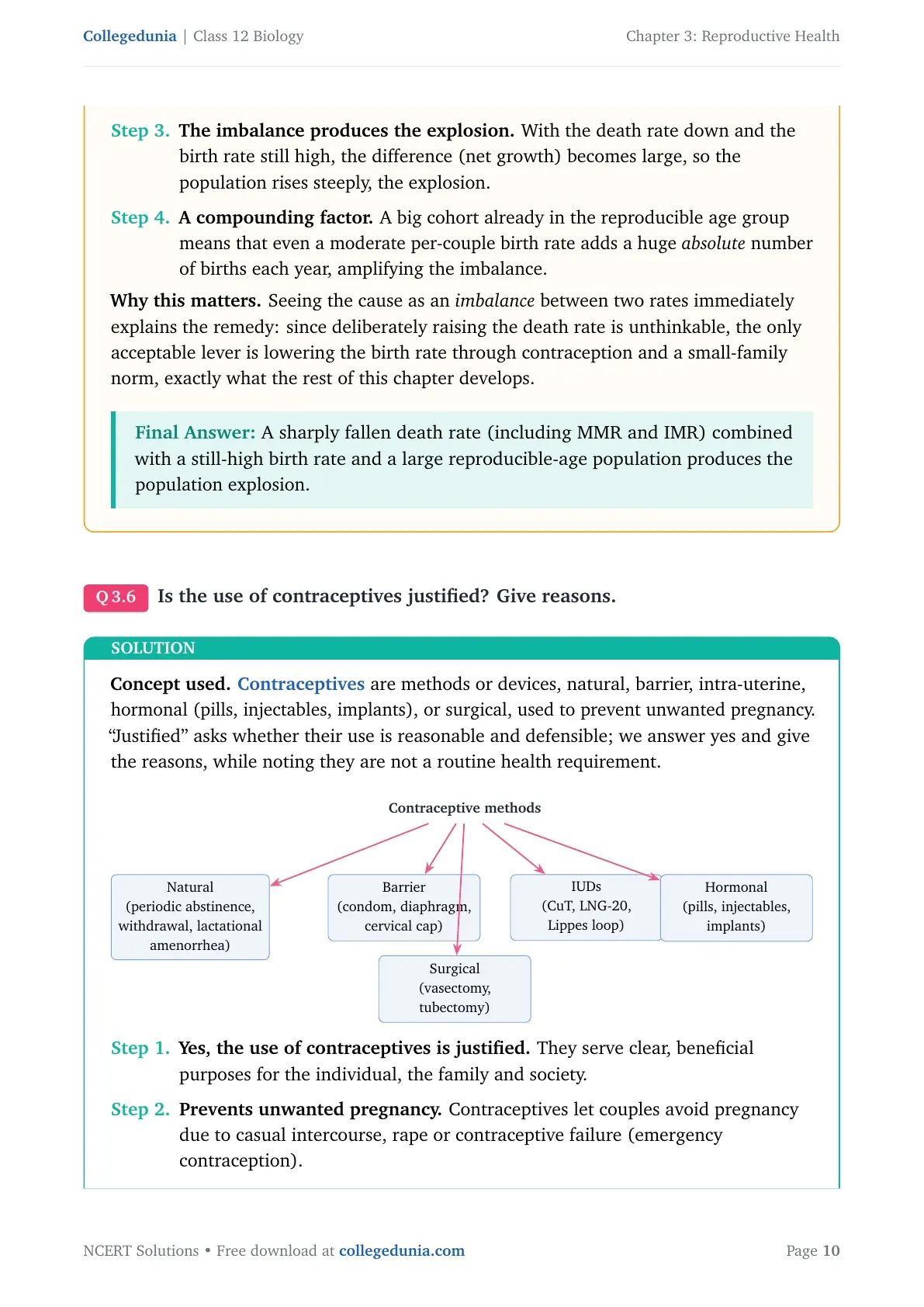
Concept used.Contraceptives are methods or
devices, natural, barrier, intra-uterine, hormonal (pills,
injectables, implants), or surgical, used to prevent unwanted
pregnancy. ``Justified'' asks whether their use is reasonable and
defensible; we answer yes and give the reasons, while noting they are
not a routine health requirement.
!%
[See diagram in the PDF version]
%
Yes, the use of contraceptives is justified. They
serve clear, beneficial purposes for the individual, the
family and society.
Prevents unwanted pregnancy. Contraceptives let
couples avoid pregnancy due to casual intercourse, rape or
contraceptive failure (emergency contraception).
Spacing and limiting children. They allow couples to
delay or space children, giving each child adequate care and
protecting the mother's health from too-frequent
child-bearing.
Checks population explosion. Widespread use plays a
significant role in controlling the uncontrolled growth of
population.
Protection from STIs. Barrier methods, especially
condoms, also protect the user from contracting STIs and AIDS.
Important caution. Contraceptives are not a regular
requirement for maintaining reproductive health; they are
used against a natural reproductive event. They should be
chosen in consultation with a qualified doctor because of
possible side effects (nausea, abdominal pain, irregular
bleeding, etc.).
Yes, contraceptive use is justified because it prevents
unwanted pregnancy, allows spacing and limiting of children, helps
check population explosion, and (barrier methods) protects against
STIs, provided the method is chosen with medical advice and its side
effects are kept in mind.
VB
Vivaan Bhat
Ph.D Molecular Biology, NCBS Bangalore
Verified Expert
Strategic angle. A ``justify'' question is answered best by
building the case at three widening levels, the individual, the
family and society, and then deliberately adding the single balancing
caution. An answer is strongest when it not only argues the claim but
also acknowledges the precise limit of the claim, because that is the
nuance the NCERT text itself stresses.
Individual level. Contraceptives protect the health
of the individual. They prevent unwanted or too-frequent
pregnancy, which protects the mother's body from the strain
of repeated child-bearing. Barrier methods, especially
condoms, additionally shield the user from contracting STIs
and AIDS, so there is a direct health benefit beyond just
avoiding pregnancy.
Family level. They let a couple decide when and how
many children to have. Spacing and limiting children means
each child, and the mother, gets adequate food, care,
education and resources, and emergency contraception covers
casual intercourse, rape or a contraceptive failure.
Societal level. The widespread use of contraceptives
has a significant role in checking the uncontrolled growth of
population, which eases pressure on a country's food,
housing, schooling and employment.
The balancing caution. Contraceptives are practised
against a natural reproductive event (conception), are
not a regular requirement for maintaining reproductive
health, and may have side effects such as nausea, abdominal
pain, irregular bleeding or, rarely, breast cancer. So they
must be selected and used in consultation with a qualified
doctor, not adopted casually as a routine measure.
Why this matters. The mature scientific position is not a
blanket ``yes'' but ``yes, with informed, medically-guided use''. An
examiner reserves the final mark for the student who states this
limit explicitly instead of stopping at the benefits, which is why
the caution is written as a full step here rather than a footnote.
Justified on individual, family and societal grounds, with
the caveat that contraceptives are used against a natural process,
may cause side effects, and should be selected with a doctor's
guidance.
Q 3.8
Removal of gonads cannot be considered as a contraceptive option. Why?
Concept used.Gonads are the primary sex organs:
the testes in males and the ovaries in females. They
have two jobs: (1) producing gametes (sperms / ova) and (2)
secreting sex hormones (testosterone; estrogen and
progesterone) that control secondary sexual characters and normal
reproductive function. A contraceptive only blocks
fertilisation; it must not destroy the body's normal reproductive
physiology. We compare these requirements.
What removal of gonads does. Removing the testes or
ovaries permanently stops the production of both
gametes and sex hormones.
What a contraceptive should do. A contraceptive
should only prevent pregnancy, while keeping the person's
reproductive system and hormone balance normal and the effect
ideally reversible.
Loss of sex hormones is harmful. Without sex
hormones the person loses secondary sexual characters and
normal sexual and reproductive function, causing serious
physiological and behavioural disturbances.
It is irreversible. Removal of gonads is permanent
and cannot be reversed, whereas a good contraceptive option
leaves the choice of having children open.
Conclusion. Because it abolishes hormone secretion,
causes major side effects and is irreversible, removal of
gonads is a mutilating surgery, not a contraceptive method.
Two jobs of a gonad
Gonad = gamete factory + hormone gland. A contraceptive must
spare the hormone-gland role; gonad removal does not, so it fails the
definition.
Removal of gonads is not a contraceptive option because it
permanently stops not only gamete production but also sex-hormone
secretion, destroying secondary sexual characters and normal
reproductive function, and is irreversible, whereas a contraceptive
must prevent only pregnancy without harming normal physiology.
AK
Aditi Kapoor
M.Sc Zoology, Banaras Hindu University
Verified Expert
Structural observation. The cleanest way to answer this is
to test the proposal against the very definition of a
contraceptive. A contraceptive must satisfy two conditions at once:
it must be pregnancy-blockingandphysiology-preserving (ideally also reversible). Run gonad
removal through both conditions and see exactly where it breaks.
State the two conditions. Condition 1: the method
must prevent conception. Condition 2: it must leave the
person's reproductive physiology, especially hormone-driven
secondary sexual characters and normal function, intact. A
good method is also reversible so the couple can later choose
to have children.
Condition 1 (conception). Removing the testes or
ovaries stops the production of sperms or ova, so no gametes
are available for fertilisation. Condition 1 is satisfied,
the ``prevent conception'' box is ticked.
Condition 2 (physiology). The same organs are also
endocrine glands. The testes secrete testosterone; the
ovaries secrete estrogen and progesterone. Removing them
abolishes these hormones, so secondary sexual characters and
normal sexual/reproductive function are lost, causing serious
physiological and behavioural disturbance. Condition 2
fails.
Reversibility check. The organs are physically
removed and cannot regrow, so the procedure is permanent.
Unlike pills or IUDs (reversible) or even vasectomy/tubectomy
(which spare the hormone glands), there is no way back.
Verdict. A method that fails the
physiology-preserving condition and is irreversible is not
contraception at all; it is castration, a mutilating surgery.
Why this matters. This question really tests whether you can
separate contraception (blocking a gamete or its transport
while keeping hormones intact) from castration (destroying the
whole organ, hormones included), a distinction examiners and NEET
papers ask in many disguises.
Tested against the definition, gonad removal passes the
``prevent conception'' condition but fails the
``preserve-physiology'' condition (it abolishes sex hormones and
secondary sexual characters) and is irreversible, so it is
castration, not a contraceptive.
Q 3.9
Amniocentesis for sex determination is banned in our country. Is this ban necessary? Comment.
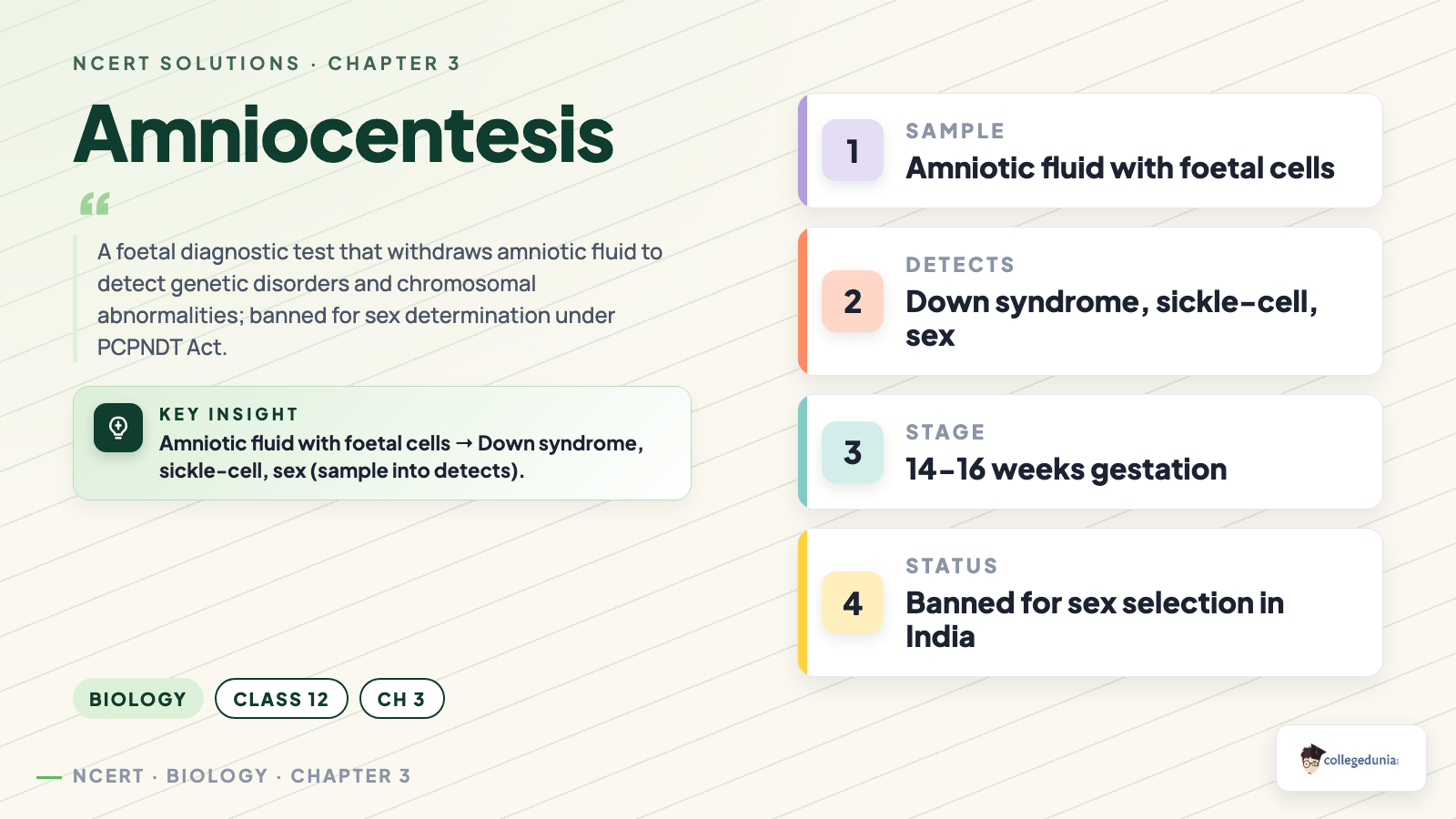
Concept used.Amniocentesis is a foetal
sex-determination and disorder-detection test. A sample of
amniotic fluid surrounding the foetus is taken; the foetal
cells and dissolved substances in it are analysed to detect
chromosomal abnormalities and genetic disorders. The same test also
reveals the foetus's sex, and that is where the misuse arises.
Yes, the ban is necessary. The ban is on using
amniocentesis for sex determination, not on its
legitimate medical use.
The misuse. When the test reveals a female foetus,
it is often followed by illegal Medical Termination of
Pregnancy (MTP), i.e. female foeticide.
Why the misuse is dangerous. Female foeticide is
unethical, illegal, and dangerous both for the young mother
(illegal abortions by unqualified quacks cause maternal
mortality and morbidity) and for society (it skews the sex
ratio).
Legitimate use is still allowed. For detecting
genetic disorders and chromosomal abnormalities in the
foetus, amniocentesis remains a valuable diagnostic tool; the
law bans only its abuse for sex determination.
Conclusion. The ban is fully justified: it curbs
female foeticide and protects the mother, while still
permitting the test's genuine medical purpose.
Law in this chapter
This links to the chapter's note that misuse of amniocentesis for sex
determination, followed by MTP of female foetuses, is ``totally
against what is legal'', which is why the statutory ban exists.
Yes, the ban is necessary. Amniocentesis is meant to detect
genetic and chromosomal disorders, but its misuse for sex
determination leads to illegal female foeticide, which is unethical,
harms the mother and skews the sex ratio. Banning only the
sex-determination misuse, while allowing the genuine diagnostic use,
is fully justified.
SR
Siddharth Rao
Ph.D Molecular Biology, NCBS Bangalore
Verified Expert
Strategic angle. The trap in this question is to argue
``ban amniocentesis'' or ``do not ban amniocentesis'' as if the test
had a single use. It does not. The mature answer splits the technique
into its intended role and its abused role, judges the
ban separately against each, and shows the law bans only the abuse.
That separation is the heart of a full-mark answer.
Intended role. Amniocentesis samples the amniotic
fluid around the foetus and analyses foetal cells to detect
chromosomal abnormalities and genetic disorders early in
pregnancy. This is a genuinely beneficial diagnostic use that
helps parents and doctors plan care.
Abused role. The same analysis also reveals the
foetus's sex. When the foetus is found to be female it is
frequently followed by an illegal MTP, i.e. female
foeticide, which is unethical, illegal, dangerous to the
young mother (illegal abortions cause maternal mortality and
morbidity) and harmful to society (it skews the sex ratio).
Judge the ban against each role. A ban aimed
only at the abused role (sex determination) stops
female foeticide while leaving the diagnostic role
untouched, so society keeps the benefit and loses only the
harm.
Verdict. Because the ban is targeted, it is
necessary (female foeticide must be stopped), proportionate
(it does not sacrifice genuine diagnosis) and therefore fully
justified.
Why this matters. The deeper lesson is that a technology is
ethically neutral; the law should restrict the harmful
application, not ban the tool itself. This ``restrict the
abuse, keep the use'' principle recurs across biology-and-society
questions (gene testing, organ transplantation, biotechnology).
The ban on amniocentesis for sex determination is necessary
and justified: it prevents illegal female foeticide while still
allowing the test's legitimate role in detecting genetic disorders.
Q 3.10
Suggest some methods to assist infertile couples to have children.
Concept used.Infertility is the inability of a
couple to produce children despite unprotected sexual cohabitation.
When the cause cannot be corrected medically, couples are helped by
Assisted Reproductive Technologies (ART), special
techniques that bring the gametes together or place the embryo in the
reproductive tract artificially. The question asks us to name and
briefly describe these methods.
!%
[See diagram in the PDF version]
%
In vitro fertilisation with embryo transfer
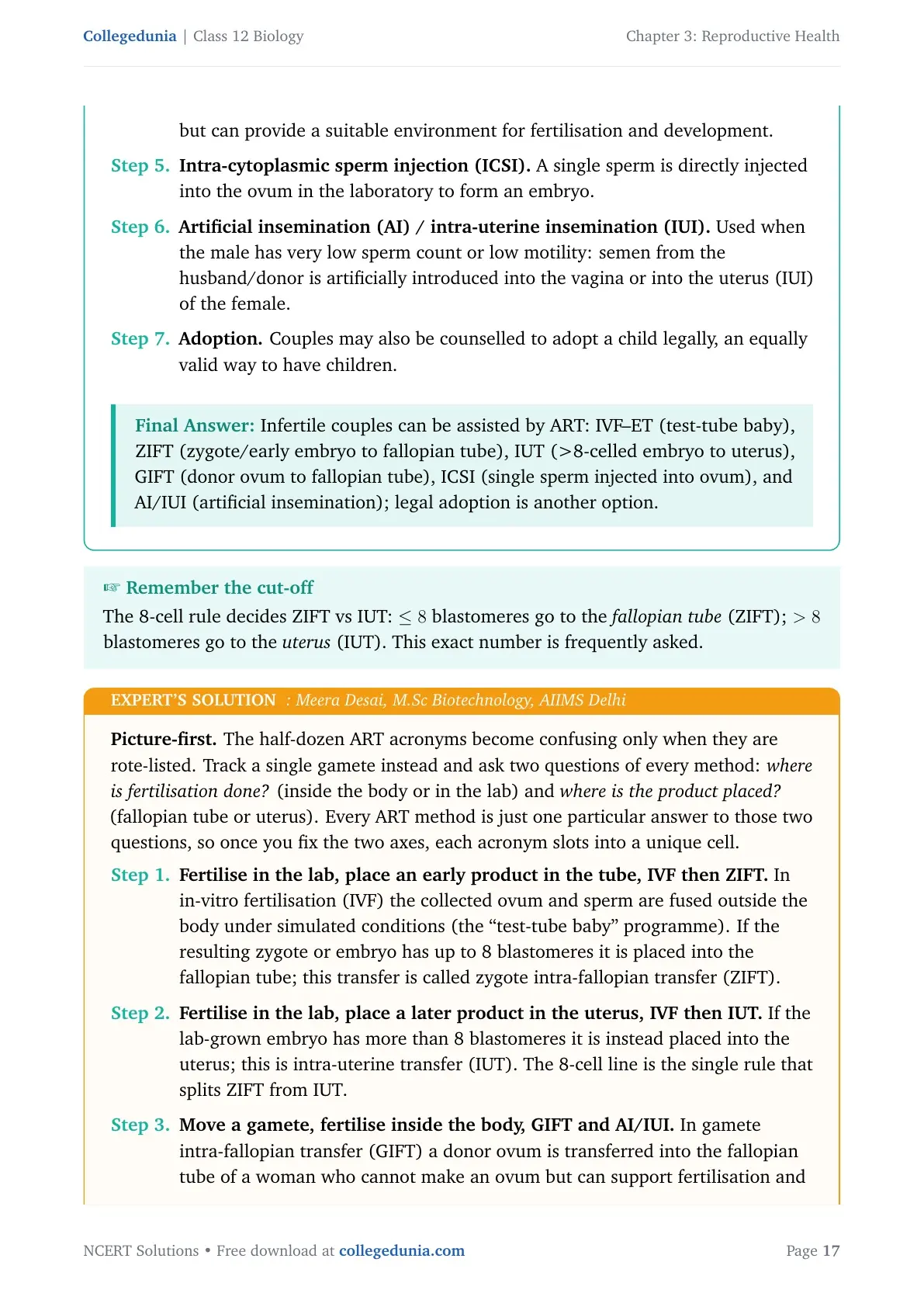
(IVF–ET), the ``test-tube baby'' programme. Ova from the
wife/donor and sperms from the husband/donor are collected
and induced to form a zygote in the laboratory under
simulated conditions.
Zygote intra-fallopian transfer (ZIFT). The zygote
or early embryo (up to 8 blastomeres) is transferred into the
fallopian tube.
Intra-uterine transfer (IUT). An embryo with more
than 8 blastomeres is transferred into the uterus to complete
further development.
Gamete intra-fallopian transfer (GIFT). An ovum
collected from a donor is transferred into the fallopian tube
of a female who cannot produce an ovum but can provide a
suitable environment for fertilisation and development.
Intra-cytoplasmic sperm injection (ICSI). A single
sperm is directly injected into the ovum in the laboratory to
form an embryo.
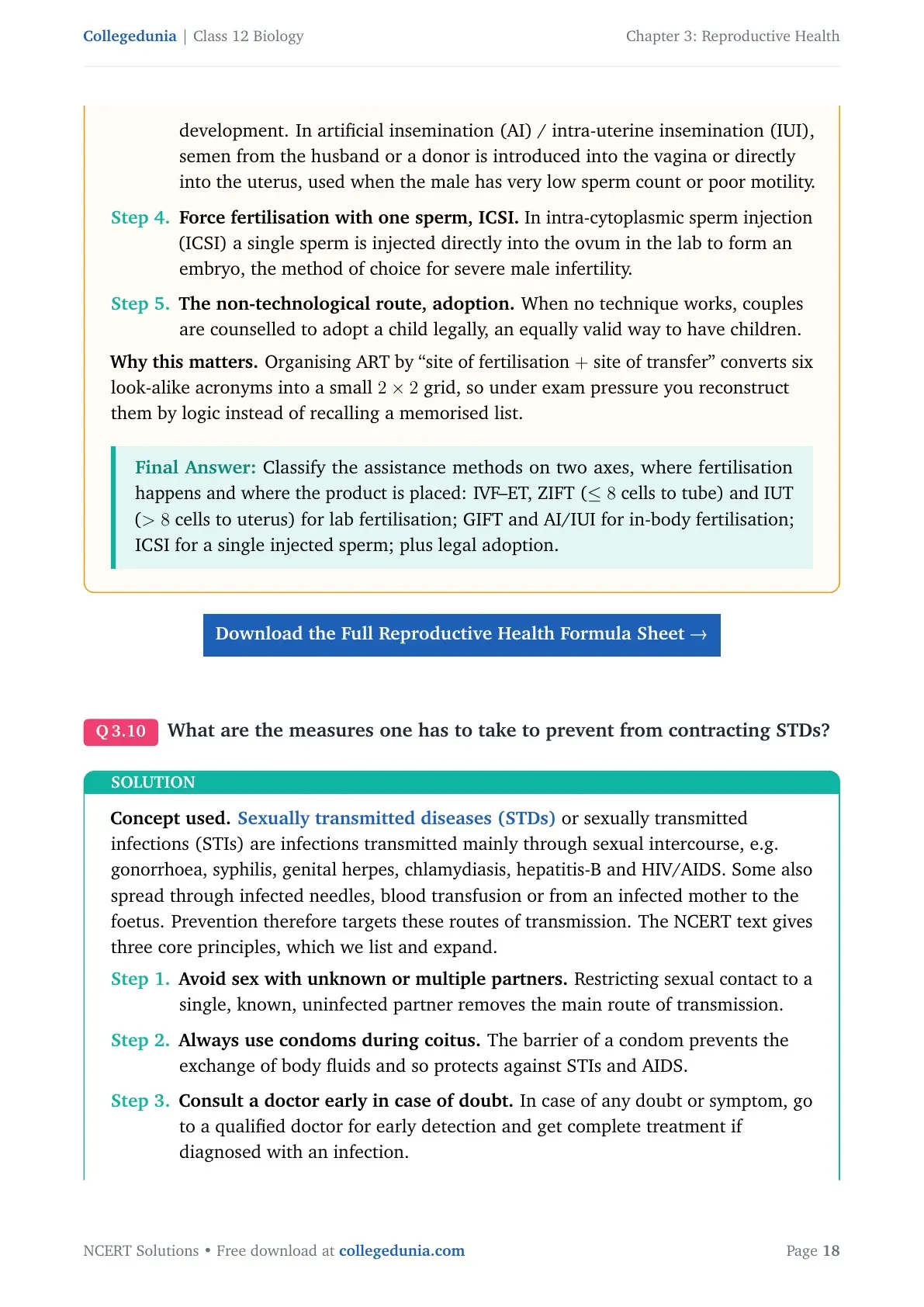
Artificial insemination (AI) / intra-uterine
insemination (IUI). Used when the male has very low sperm
count or low motility: semen from the husband/donor is
artificially introduced into the vagina or into the uterus
(IUI) of the female.
Adoption. Couples may also be counselled to adopt a
child legally, an equally valid way to have children.
Infertile couples can be assisted by ART: IVF–ET
(test-tube baby), ZIFT (zygote/early embryo to fallopian tube), IUT
(>8-celled embryo to uterus), GIFT (donor ovum to fallopian tube),
ICSI (single sperm injected into ovum), and AI/IUI (artificial
insemination); legal adoption is another option.
MD
Meera Desai
M.Sc Biotechnology, AIIMS Delhi
Verified Expert
Picture-first. The half-dozen ART acronyms become confusing
only when they are rote-listed. Track a single gamete instead and ask
two questions of every method: where is fertilisation done?
(inside the body or in the lab) and where is the product
placed? (fallopian tube or uterus). Every ART method is just one
particular answer to those two questions, so once you fix the two
axes, each acronym slots into a unique cell.
Fertilise in the lab, place an early product in the
tube, IVF then ZIFT. In in-vitro fertilisation (IVF) the
collected ovum and sperm are fused outside the body under
simulated conditions (the ``test-tube baby'' programme). If
the resulting zygote or embryo has up to 8 blastomeres it is
placed into the fallopian tube; this transfer is called
zygote intra-fallopian transfer (ZIFT).
Fertilise in the lab, place a later product in the
uterus, IVF then IUT. If the lab-grown embryo has more than
8 blastomeres it is instead placed into the uterus; this is
intra-uterine transfer (IUT). The 8-cell line is the single
rule that splits ZIFT from IUT.
Move a gamete, fertilise inside the body, GIFT and
AI/IUI. In gamete intra-fallopian transfer (GIFT) a donor
ovum is transferred into the fallopian tube of a woman who
cannot make an ovum but can support fertilisation and
development. In artificial insemination (AI) / intra-uterine
insemination (IUI), semen from the husband or a donor is
introduced into the vagina or directly into the uterus, used
when the male has very low sperm count or poor motility.
Force fertilisation with one sperm, ICSI. In
intra-cytoplasmic sperm injection (ICSI) a single sperm is
injected directly into the ovum in the lab to form an embryo,
the method of choice for severe male infertility.
The non-technological route, adoption. When no
technique works, couples are counselled to adopt a child
legally, an equally valid way to have children.
Why this matters. Organising ART by ``site of fertilisation
+ site of transfer'' converts six look-alike acronyms into a small
22 grid, so under exam pressure you reconstruct them by
logic instead of recalling a memorised list.
Classify the assistance methods on two axes, where
fertilisation happens and where the product is placed: IVF–ET, ZIFT
(≤ 8 cells to tube) and IUT (> 8 cells to uterus) for lab
fertilisation; GIFT and AI/IUI for in-body fertilisation; ICSI for a
single injected sperm; plus legal adoption.
Q 3.11
What are the measures one has to take to prevent from contracting STDs?
Concept used.Sexually transmitted diseases (STDs)
or sexually transmitted infections (STIs) are infections transmitted
mainly through sexual intercourse, e.g. gonorrhoea, syphilis,
genital herpes, chlamydiasis, hepatitis-B and HIV/AIDS. Some also
spread through infected needles, blood transfusion or from an
infected mother to the foetus. Prevention therefore targets these
routes of transmission. The NCERT text gives three core principles,
which we list and expand.
Avoid sex with unknown or multiple partners.
Restricting sexual contact to a single, known, uninfected
partner removes the main route of transmission.
Always use condoms during coitus. The barrier of a
condom prevents the exchange of body fluids and so protects
against STIs and AIDS.
Consult a doctor early in case of doubt. In case of
any doubt or symptom, go to a qualified doctor for early
detection and get complete treatment if diagnosed with an
infection.
Avoid sharing needles and ensure safe blood. Since
hepatitis-B and HIV also spread through shared injection
needles, surgical instruments and unscreened blood, use only
sterile needles and screened blood.
Avoid mother-to-foetus transmission. An infected
mother should take medical advice, as some STIs can pass to
the foetus.
The NCERT trio
The three principles printed in the textbook, no unknown/multiple
partners, always use condoms, early doctor consultation, are the
must-write core of this answer; the other two points are bonus.
Prevent STDs by: avoiding sex with unknown or multiple
partners, always using condoms during coitus, consulting a qualified
doctor early for detection and complete treatment, not sharing
needles or using unscreened blood, and preventing mother-to-foetus
transmission through timely medical care.
YB
Yash Banerjee
M.Sc Microbiology, JNU
Verified Expert
Strategic angle. An STI can only enter the body by a fixed
set of routes. If we list every route and seal each one, the
prevention list must be complete. So instead of memorising measures,
we first name the routes, then attach the right barrier to each.
There are three transmission routes named in the chapter, plus one
catch-all behaviour that backstops them all.
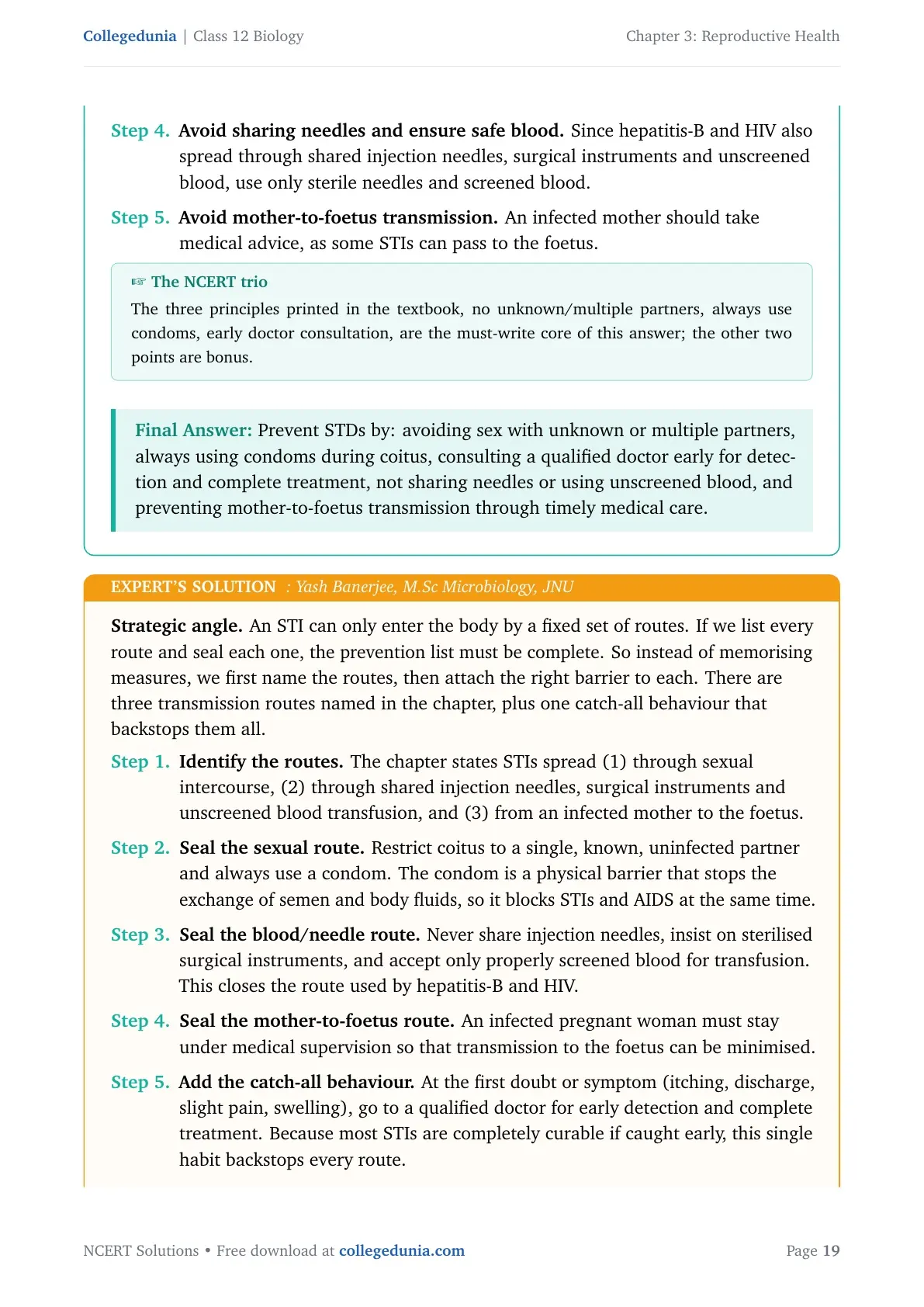
Identify the routes. The chapter states STIs spread
(1) through sexual intercourse, (2) through shared injection
needles, surgical instruments and unscreened blood
transfusion, and (3) from an infected mother to the foetus.
Seal the sexual route. Restrict coitus to a single,
known, uninfected partner and always use a condom. The condom
is a physical barrier that stops the exchange of semen and
body fluids, so it blocks STIs and AIDS at the same time.
Seal the blood/needle route. Never share injection
needles, insist on sterilised surgical instruments, and
accept only properly screened blood for transfusion. This
closes the route used by hepatitis-B and HIV.
Seal the mother-to-foetus route. An infected pregnant
woman must stay under medical supervision so that
transmission to the foetus can be minimised.
Add the catch-all behaviour. At the first doubt or
symptom (itching, discharge, slight pain, swelling), go to a
qualified doctor for early detection and complete treatment.
Because most STIs are completely curable if caught early,
this single habit backstops every route.
Why this matters. STI incidence is highest in the 15–24
age group, exactly the student's own age band. Understanding
prevention as ``one barrier per route'' rather than a memorised list
means the answer can never be incomplete, and it carries directly
into real-life decisions.
Name the three transmission routes (sexual, blood/needle,
mother-to-foetus) and seal each: one known partner plus condoms
(sexual), sterile needles and screened blood (blood), medical care of
infected mothers (vertical), with early doctor consultation as the
catch-all because most STIs are curable if detected early.
Q 3.12
State True/False with explanation:
(a) Abortions could happen spontaneously too. (True/False)
(b) Infertility is defined as the inability to produce a viable offspring and is always due to abnormalities/defects in the female partner. (True/False)
(c) Complete lactation could help as a natural method of contraception. (True/False)
(d) Creating awareness about sex related aspects is an effective method to improve reproductive health of the people. (True/False)
Concept used. Each part tests one definition from the
chapter: spontaneous abortion (natural miscarriage), the true
definition of infertility, the lactational amenorrhea method, and the
role of awareness in reproductive health. We state True/False and
justify each from the chapter.
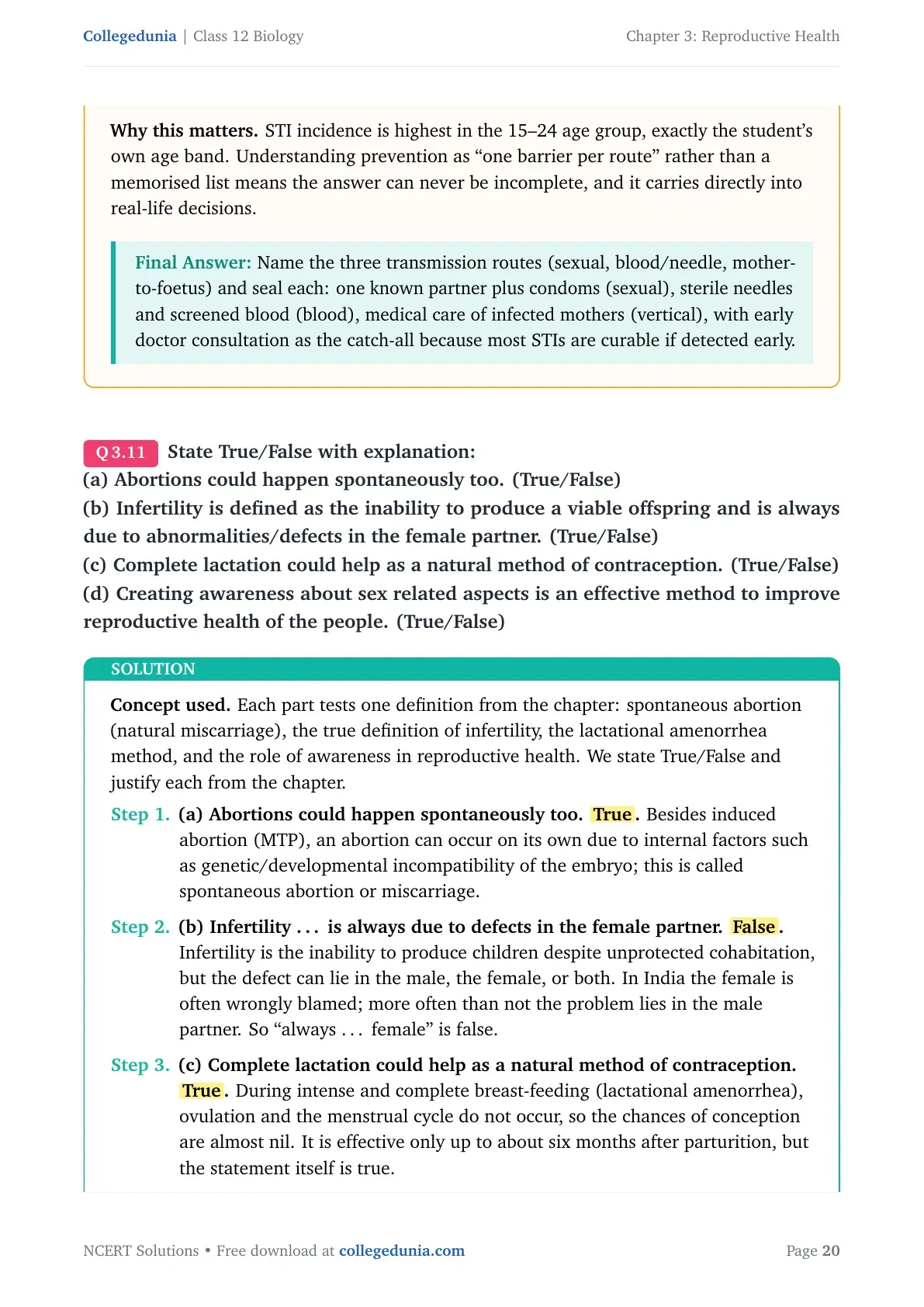
(a) Abortions could happen spontaneously too.
True. Besides induced abortion (MTP), an abortion can
occur on its own due to internal factors such as
genetic/developmental incompatibility of the embryo; this is
called spontaneous abortion or miscarriage.
(b) Infertility is always due to defects in
the female partner. False. Infertility is the inability
to produce children despite unprotected cohabitation, but the
defect can lie in the male, the female, or both. In India the
female is often wrongly blamed; more often than not the
problem lies in the male partner. So ``always female''
is false.
(c) Complete lactation could help as a natural method
of contraception. True. During intense and complete
breast-feeding (lactational amenorrhea), ovulation and the
menstrual cycle do not occur, so the chances of conception
are almost nil. It is effective only up to about six months
after parturition, but the statement itself is true.
(d) Creating awareness about sex-related aspects is
an effective method to improve reproductive health.
True. Awareness (through sex education and media)
removes myths and misconceptions, promotes safe practices and
helps people seek timely care, so it genuinely improves
reproductive health.
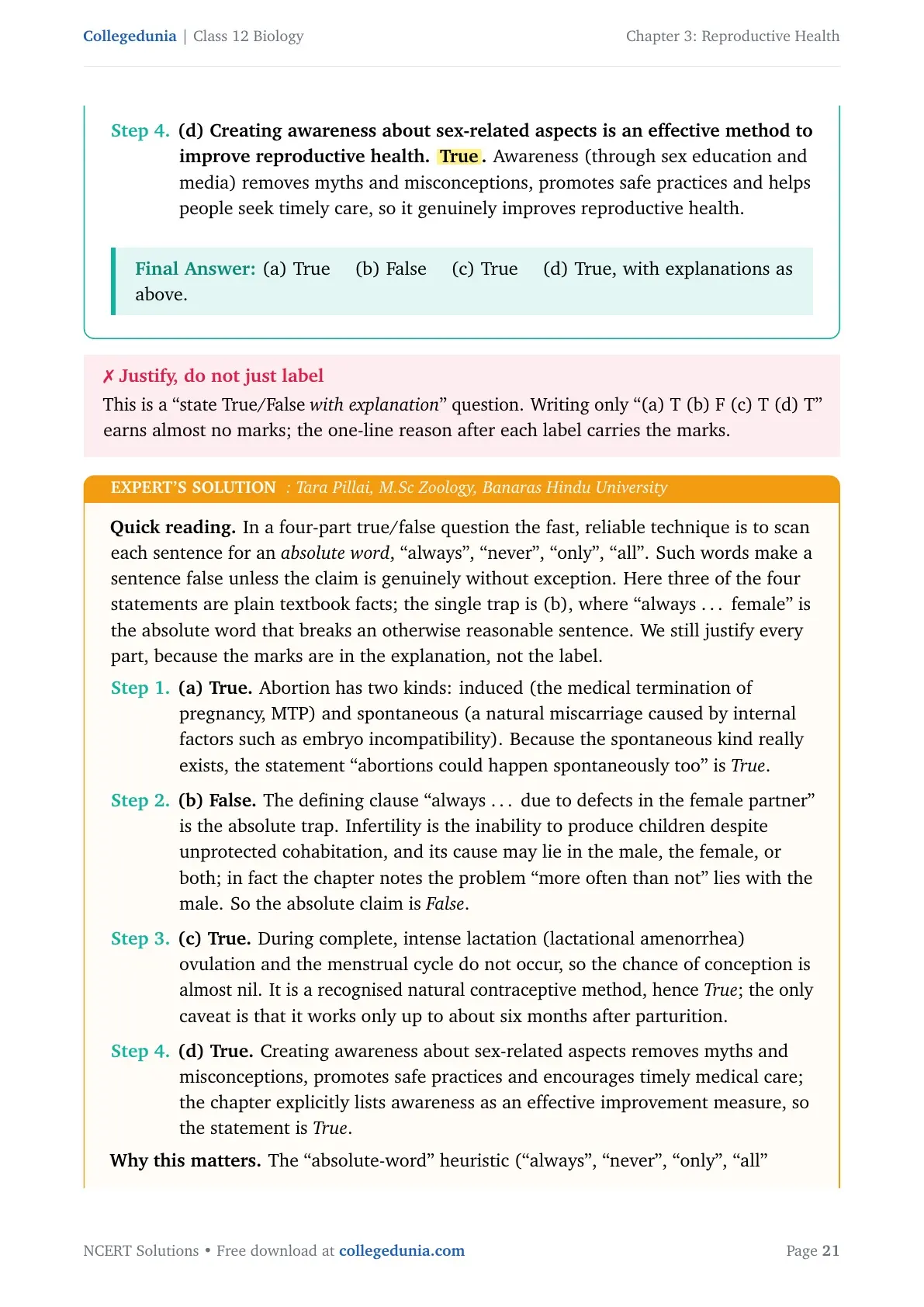
(a) True (b) False (c) True (d) True,
with explanations as above.
TP
Tara Pillai
M.Sc Zoology, Banaras Hindu University
Verified Expert
Quick reading. In a four-part true/false question the fast,
reliable technique is to scan each sentence for an absolute
word, ``always'', ``never'', ``only'', ``all''. Such words make a
sentence false unless the claim is genuinely without exception. Here
three of the four statements are plain textbook facts; the single
trap is (b), where ``always female'' is the absolute word that
breaks an otherwise reasonable sentence. We still justify every part,
because the marks are in the explanation, not the label.
(a) True. Abortion has two kinds: induced
(the medical termination of pregnancy, MTP) and spontaneous
(a natural miscarriage caused by internal factors such as
embryo incompatibility). Because the spontaneous kind really
exists, the statement ``abortions could happen spontaneously
too'' is True.
(b) False. The defining clause ``always due
to defects in the female partner'' is the absolute trap.
Infertility is the inability to produce children despite
unprotected cohabitation, and its cause may lie in the male,
the female, or both; in fact the chapter notes the problem
``more often than not'' lies with the male. So the absolute
claim is False.
(c) True. During complete, intense lactation
(lactational amenorrhea) ovulation and the menstrual cycle do
not occur, so the chance of conception is almost nil. It is a
recognised natural contraceptive method, hence True;
the only caveat is that it works only up to about six months
after parturition.
(d) True. Creating awareness about sex-related
aspects removes myths and misconceptions, promotes safe
practices and encourages timely medical care; the chapter
explicitly lists awareness as an effective improvement
measure, so the statement is True.
Why this matters. The ``absolute-word'' heuristic
(``always'', ``never'', ``only'', ``all'' usually signal False)
solves the bulk of biology true/false questions in seconds, freeing
time for the explanation that actually earns the marks.
(a) True; (b) False (cause may be male, female or both);
(c) True (within ∼6 months); (d) True.
Q 3.13
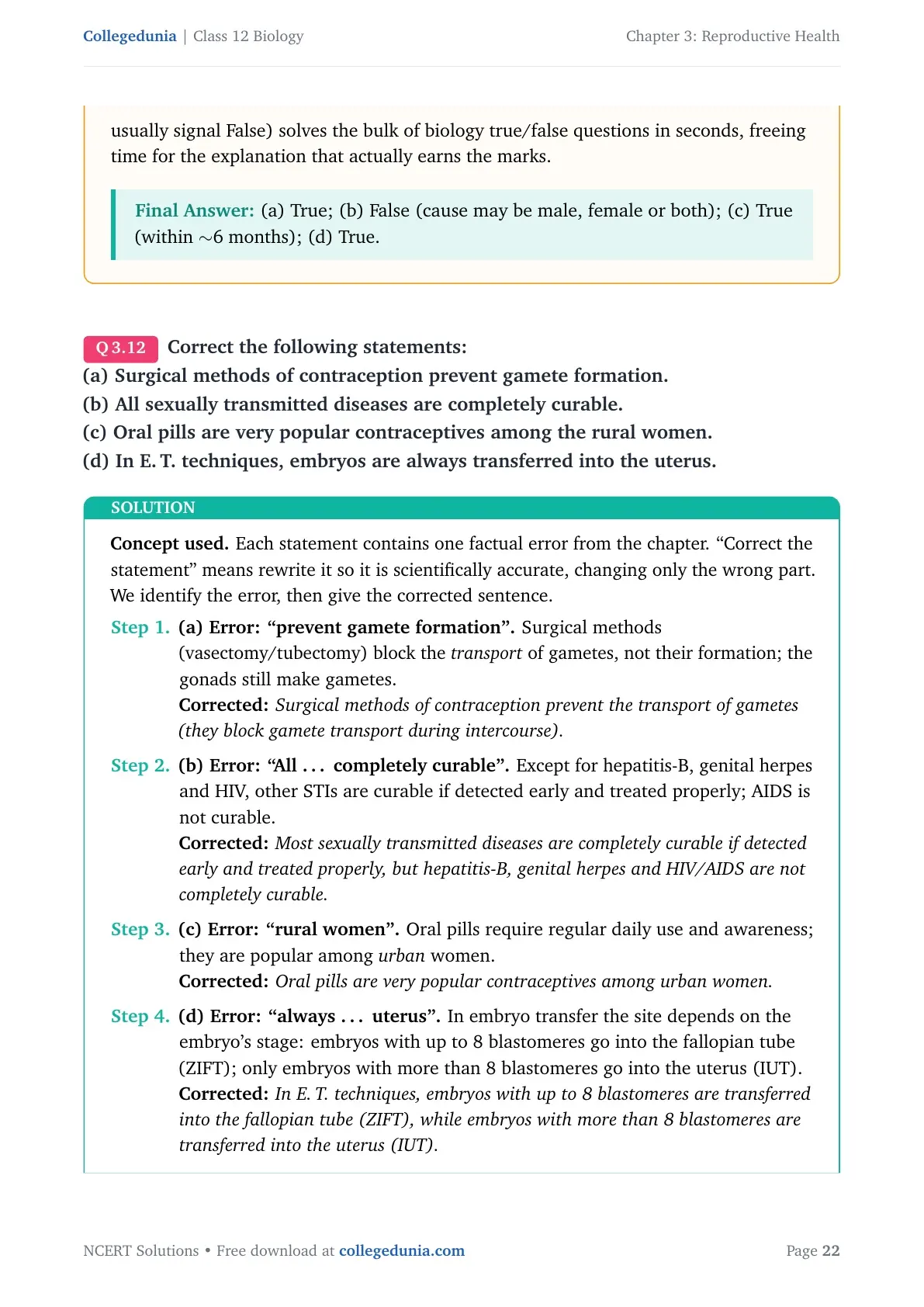
Correct the following statements:
(a) Surgical methods of contraception prevent gamete formation.
(b) All sexually transmitted diseases are completely curable.
(c) Oral pills are very popular contraceptives among the rural women.
(d) In E. T. techniques, embryos are always transferred into the uterus.
Concept used. Each statement contains one factual error from
the chapter. ``Correct the statement'' means rewrite it so it is
scientifically accurate, changing only the wrong part. We identify
the error, then give the corrected sentence.
(a) Error: ``prevent gamete formation''. Surgical
methods (vasectomy/tubectomy) block the transport of
gametes, not their formation; the gonads still make gametes. Corrected:Surgical methods of contraception
prevent the transport of gametes (they block gamete transport
during intercourse).
(b) Error: ``All completely curable''. Except
for hepatitis-B, genital herpes and HIV, other STIs are
curable if detected early and treated properly; AIDS is not
curable. Corrected:Most sexually transmitted diseases
are completely curable if detected early and treated
properly, but hepatitis-B, genital herpes and HIV/AIDS are
not completely curable.
(c) Error: ``rural women''. Oral pills require
regular daily use and awareness; they are popular among
urban women. Corrected:Oral pills are very popular
contraceptives among urban women.
(d) Error: ``always uterus''. In embryo
transfer the site depends on the embryo's stage: embryos with
up to 8 blastomeres go into the fallopian tube (ZIFT); only
embryos with more than 8 blastomeres go into the uterus
(IUT). Corrected:In E. T. techniques, embryos with
up to 8 blastomeres are transferred into the fallopian tube
(ZIFT), while embryos with more than 8 blastomeres are
transferred into the uterus (IUT).
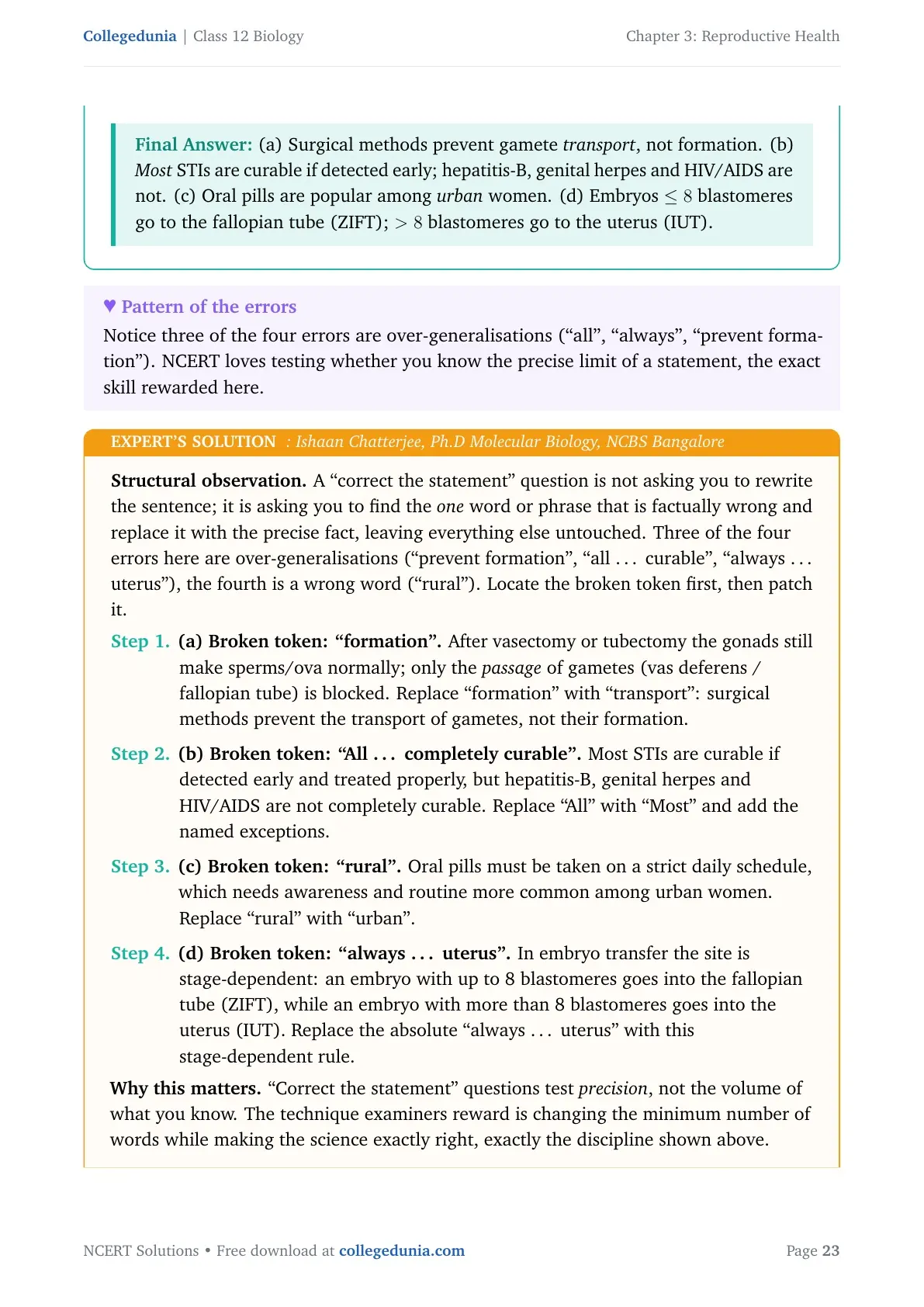
(a) Surgical methods prevent gamete transport, not
formation. (b) Most STIs are curable if detected early;
hepatitis-B, genital herpes and HIV/AIDS are not. (c) Oral pills are
popular among urban women. (d) Embryos ≤ 8 blastomeres go
to the fallopian tube (ZIFT); > 8 blastomeres go to the uterus
(IUT).
IC
Ishaan Chatterjee
Ph.D Molecular Biology, NCBS Bangalore
Verified Expert
Structural observation. A ``correct the statement'' question
is not asking you to rewrite the sentence; it is asking you to find
the one word or phrase that is factually wrong and replace it
with the precise fact, leaving everything else untouched. Three of
the four errors here are over-generalisations (``prevent
formation'', ``all curable'', ``always uterus''), the
fourth is a wrong word (``rural''). Locate the broken token first,
then patch it.
(a) Broken token: ``formation''. After vasectomy or
tubectomy the gonads still make sperms/ova normally; only the
passage of gametes (vas deferens / fallopian tube) is
blocked. Replace ``formation'' with ``transport'': surgical
methods prevent the transport of gametes, not their
formation.
(b) Broken token: ``All completely
curable''. Most STIs are curable if detected early and
treated properly, but hepatitis-B, genital herpes and
HIV/AIDS are not completely curable. Replace ``All'' with
``Most'' and add the named exceptions.
(c) Broken token: ``rural''. Oral pills must be
taken on a strict daily schedule, which needs awareness and
routine more common among urban women. Replace ``rural''
with ``urban''.
(d) Broken token: ``always uterus''. In
embryo transfer the site is stage-dependent: an embryo with
up to 8 blastomeres goes into the fallopian tube (ZIFT),
while an embryo with more than 8 blastomeres goes into the
uterus (IUT). Replace the absolute ``always uterus''
with this stage-dependent rule.
Why this matters. ``Correct the statement'' questions test
precision, not the volume of what you know. The technique
examiners reward is changing the minimum number of words while making
the science exactly right, exactly the discipline shown above.
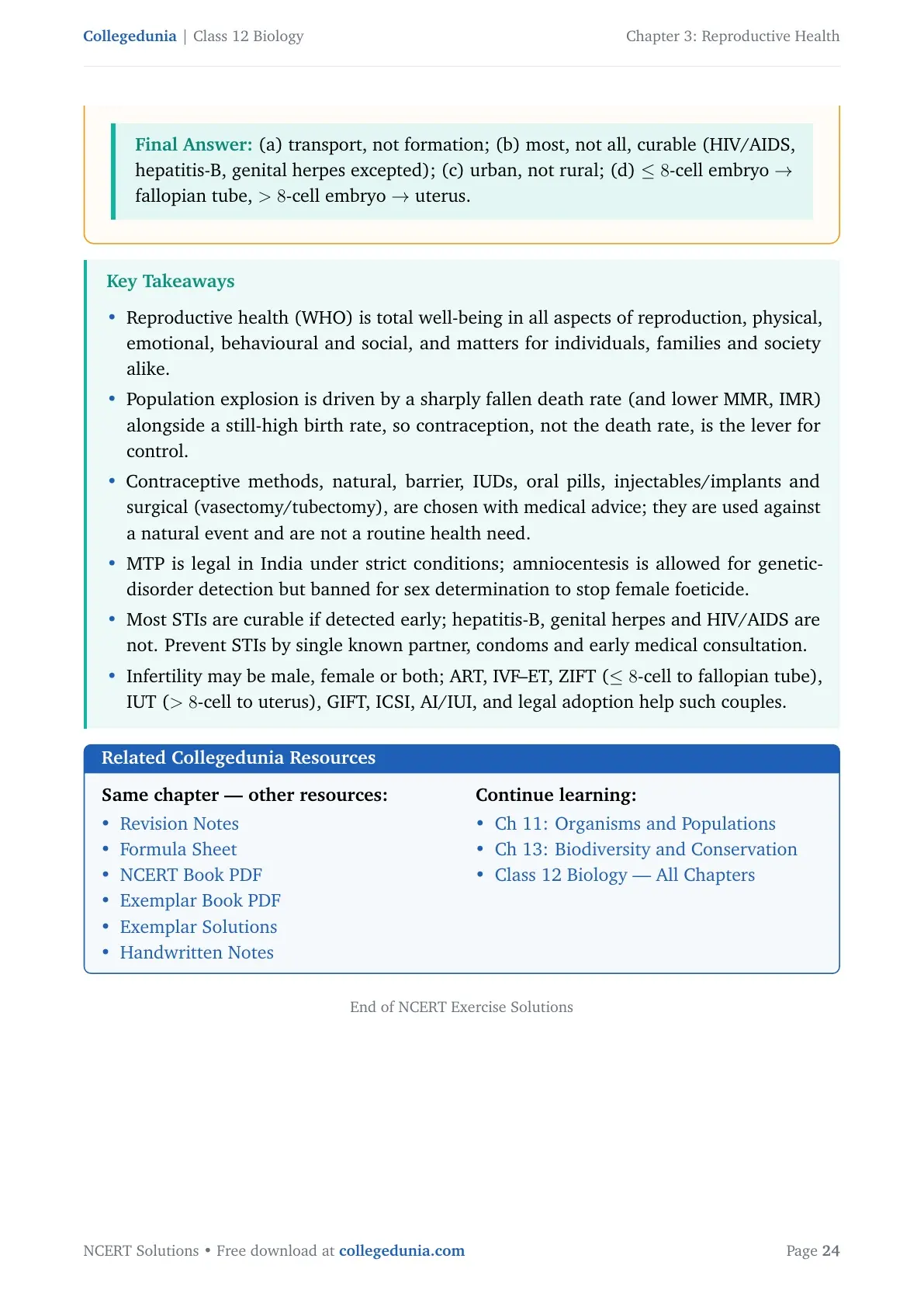
(a) transport, not formation; (b) most, not all, curable
(HIV/AIDS, hepatitis-B, genital herpes excepted); (c) urban, not
rural; (d) ≤ 8-cell embryo → fallopian tube, > 8-cell
embryo → uterus.
NCERT Solutions for Class 12 Biology: All Chapters
Jump to the worked solutions for any other Class 12 Biology chapter below.
How Students Rate Reproductive Health Class 12 Biology NCERT Solutions
An independent survey of 11,200 Class 12 Biology students shows where this chapter trips students up.
Student Feedback
70% of students surveyed marked ART (ZIFT vs GIFT vs IUI) terminology as the hardest sub-topic.
58% reported losing 1-2 marks on the MTP time-window numbers despite a correct answer otherwise.
Only 38% attempted all 13 exercise questions; toppers attempted every one and revisited wrong attempts within 24 hours.
Source: 2025-26 Class 12 Biology student survey, 11,200 students across 18 states.
Reproductive Health Class 12 Biology NCERT Solutions FAQs
Ques. Where can I download Class 12 Biology Chapter 3 Reproductive Health NCERT Solutions PDF?
Ans. You can download the Reproductive Health Class 12 Biology NCERT Solutions PDF directly from this page. Both the Normal and HD versions are free and aligned with the 2026-27 NCERT.
Ques. Are these NCERT Solutions aligned with the 2026-27 syllabus?
Ans. Yes. This page reflects the current 2026-27 syllabus for Class 12 Biology. NCERT retained Reproductive Health in full, so all 13 exercise questions stay examinable for CBSE Boards, NEET, and CUET.
Ques. How many questions are there in the Reproductive Health NCERT exercise?
Ans. The end-of-chapter exercise has 13 numbered questions covering reproductive health significance, population explosion, contraceptive methods, MTP, amniocentesis, infertility and ART, and STIs. The PDF carries step-by-step worked answers to every one, including the true/false and statement-correction questions.
Ques. What is the NEET weightage of Class 12th Biology Chapter 3 Reproductive Health?
Ans. NEET pulls 2 to 3 questions from this chapter every year. Contraceptive methods (especially IUDs and Saheli), ART acronyms, the amniocentesis ban, and MTP timing are the highest-yield sub-topics.
Ques. What are the contraceptive methods in Class 12 Biology Chapter 3?
Ans. NCERT groups them into six categories: natural / traditional (periodic abstinence, withdrawal, lactational amenorrhoea), barrier (condoms, diaphragms, cervical caps), intra-uterine devices (Lippes loop, Cu-T, LNG-20), oral contraceptives (Mala-D, Saheli), injectables and implants, and surgical methods (vasectomy in males, tubectomy in females).
Ques. Why is amniocentesis banned for sex determination in India?
Ans. Amniocentesis is a foetal-tissue test that detects chromosomal and genetic disorders. It was being misused to determine the sex of the foetus, leading to selective female foeticide and a skewed sex ratio. To stop this, sex determination by amniocentesis is statutorily banned in India, although the test is still permitted for detecting genetic disorders.
Ques. What is the difference between IVF-ET and ZIFT?
Ans. In IVF-ET (in vitro fertilisation, embryo transfer) the ovum is fertilised by sperm outside the body, and the embryo is transferred either into the fallopian tube (if up to 8 blastomeres, called ZIFT) or into the uterus (if more than 8 blastomeres, called IUT). ZIFT specifically means transferring the zygote or an early embryo of up to 8 cells into the fallopian tube. NEET tests this blastomere-number distinction almost every year.
Ques. How do these NCERT Solutions help with NEET and CUET preparation?
Ans. Every solution flags the exact term the entrance exams ask verbatim. Acronyms like MTP, RCH, IUD, IVF-ET, ZIFT, GIFT, IUT, ICSI, IUI, and named products like Saheli, Mala-D, Cu-T, and LNG-20 appear with correct spelling, so the same board answer doubles as a one-mark MCQ recall sheet for NEET and CUET.
Ques. Is sex education in schools part of this chapter?
Ans. Yes. Exercise question 3 asks whether sex education in schools is necessary. The NCERT-aligned answer argues that proper sex education prevents myths and misconceptions about reproduction, discourages misuse of sexual partnerships, and helps adolescents make informed and responsible decisions, which is why it is recommended.
Ques. Are diagrams needed in the Reproductive Health NCERT Solutions answers?
Ans. This is a largely descriptive chapter, so most answers are written explanations rather than diagrams. Where a labelled aid helps, such as the contraceptive-method classification or the ART method comparison, the PDF includes a clean classification chart that can be reproduced in the board answer script.







Comments