Ecology starts with the individual organism and builds up to populations of one species in a habitat. Class 12 Biology Chapter 11 Organisms and Populations opens NCERT Unit 10 and keeps all 14 exercise questions in the 2026-27 NCERT. This page hosts the step-by-step Solutions PDF.
CBSE Weightage: 5 to 7 marks
NEET Weightage: 3 to 5 questions per year
Exam relevance: CBSE Boards, NEET, AIIMS-pattern and CUET Biology
Why Organisms and Populations is a NEET Anchor Chapter
NEET treats Unit 10 as a 14 to 16 question block, and about a third comes from this chapter. It has three NEET hotspots: population growth equations, the six interspecific interactions, and adaptations to abiotic stress.
NEET pulled 4 questions from this chapter in 2025 and 5 in 2024, including one logistic-equation numerical.
High-yield recall items: the logistic equation and sigmoid curve; the six interactions matrix (+/+, +/-, -/-, +/0, -/0, 0/0); Allen's rule; Gause's exclusion (Paramecium aurelia vs P. caudatum); density, natality, mortality and age pyramids.
How Will Collegedunia's NCERT Solutions Help You Crack Organisms and Populations?
Every answer follows the phrasing CBSE rewards, and a separate Expert's Solution reframes it for NEET.
Worked answers for all 14 questions in the CBSE four-step pattern: define, name the example, state the mechanism, draw the labelled curve or pyramid.
NEET value baked in: every solution flags the verbatim term (commensalism, amensalism, carrying capacity).
NCERT Q5 asks students to derive the logistic growth equation, the most NEET-quotable derivation in the chapter, shown below in the four-step CBSE pattern.
Step 1 (1 mark) - State the assumption. Resources are finite. As N nears the carrying capacity K, the growth rate r declines.
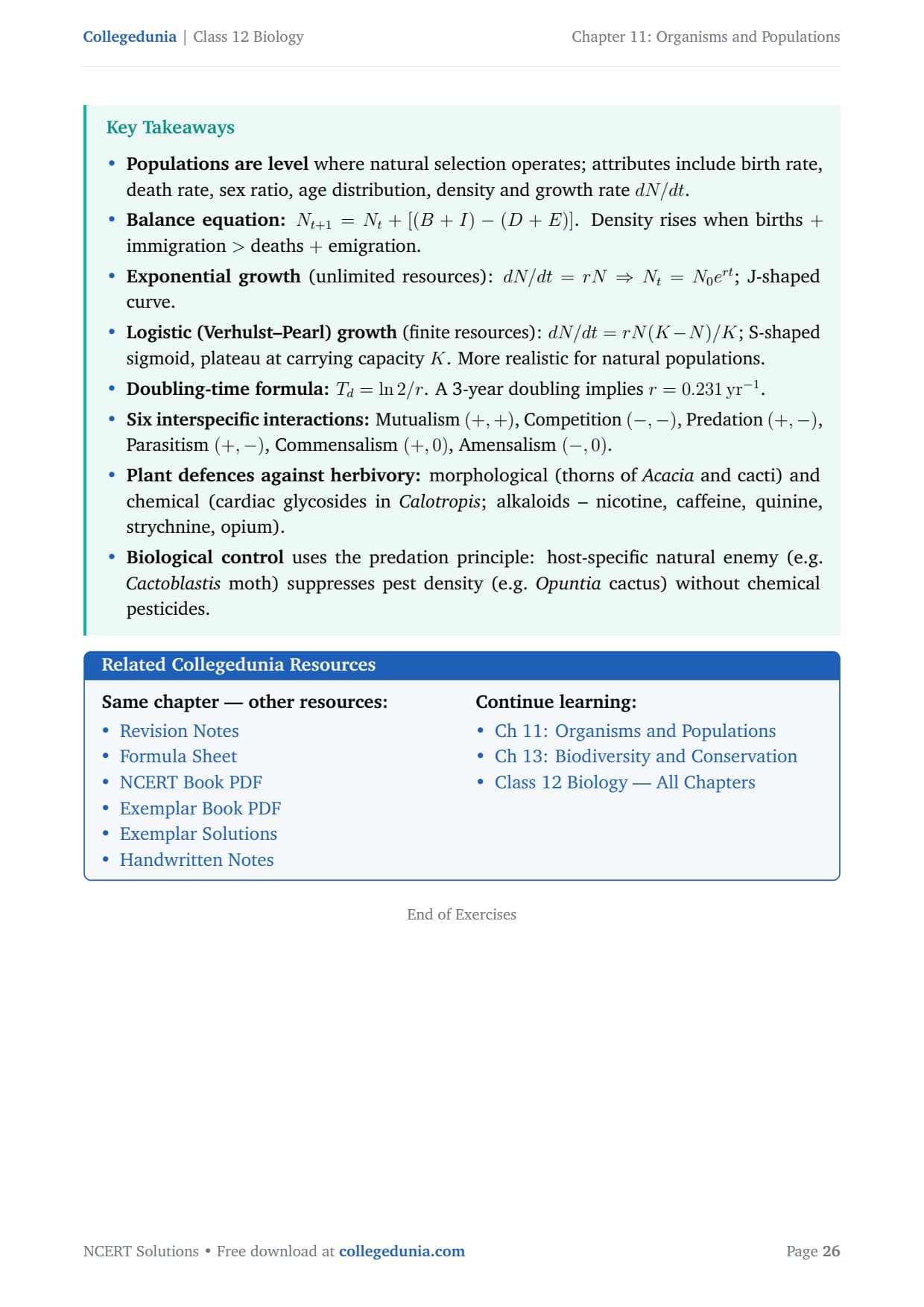
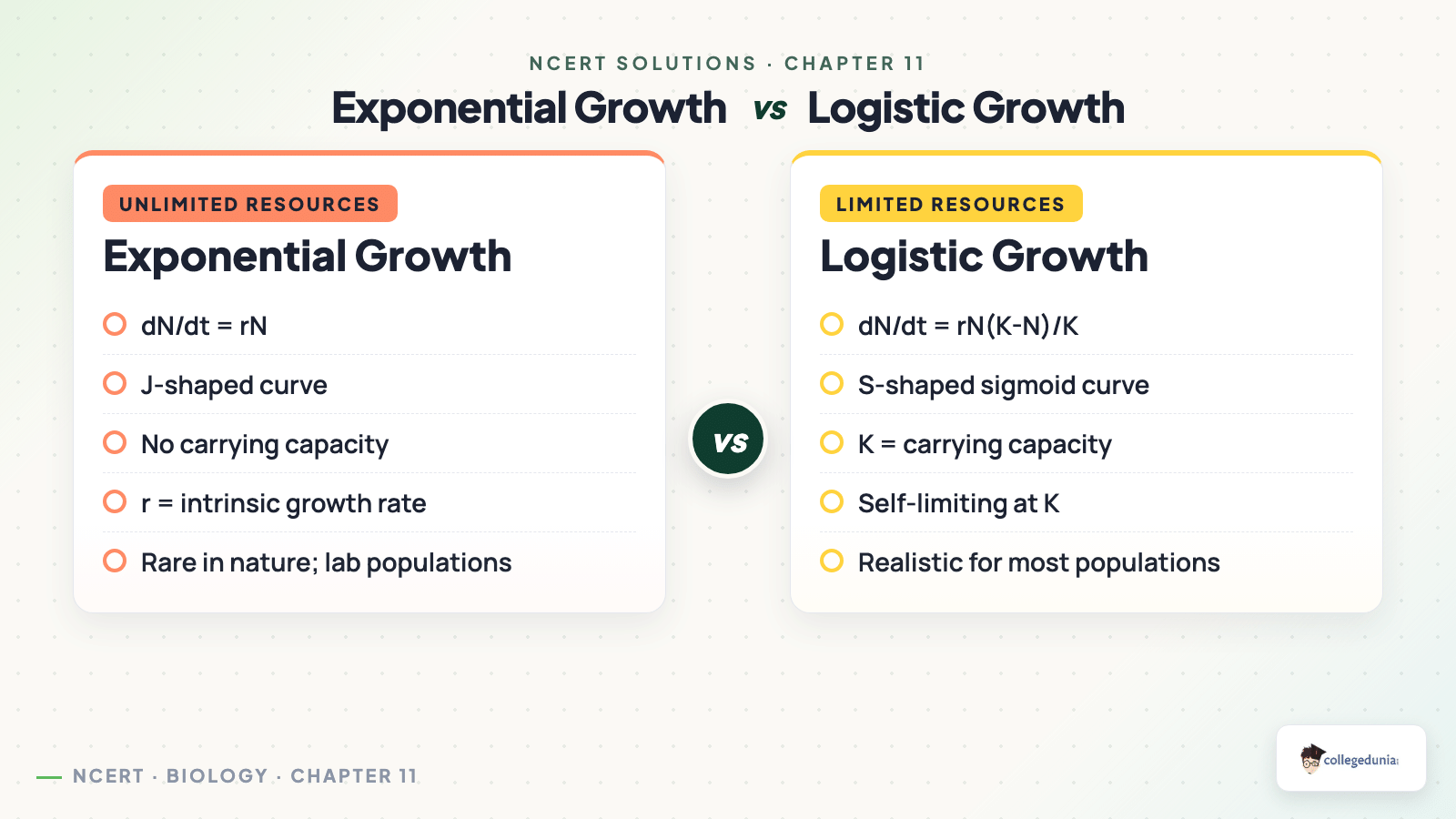
Step 2 (1 mark) - Write the differential. The logistic (Verhulst-Pearl) equation is $$\dfrac{dN}{dt} = rN\left(\dfrac{K-N}{K}\right)$$ the bracket is the unutilised resource fraction.
Step 3 (1 mark) - Sketch the sigmoid. Plot N against time: an S-shaped curve from lag → log → deceleration → asymptote at N = K, with the inflexion at N = K/2 .
Step 4 (2 marks) - Interpret. When N ≪ K the bracket → 1 and growth is near-exponential. When N = K the bracket → 0 , so dN/dt = 0 and growth halts. This is the realistic model.
CBSE 2025 gave zero marks to scripts that skipped the (K-N)/K bracket or did not label K as carrying capacity. The bracket is mandatory.
Where Students Lose Marks in Organisms and Populations (Class 12 Biology)
Students rote-learn "commensalism" and "mutualism" but invert the +/0 and +/+ signs, or mix up the two growth equations. The mistakes below cost the most marks.
Mistake 1. Writing dN/dt = rN for logistic growth. That is exponential; logistic carries the (K-N)/K bracket.
Mistake 2. Calling commensalism +/+. It is +/0 (one benefits, one unaffected). Mutualism is +/+.
Mistake 3. Confusing predation with parasitism. Predation kills the prey; parasitism rarely kills the host.
Mistake 4. Drawing an exponential J-curve when the question asks for logistic (S-shaped, asymptote at K).
Mistake 5. Spelling "Calatropis" for Calotropis, or "Pisater" for Pisaster. A direct NEET trap.
Interspecific Interactions Recall Matrix for Class 12 Biology Chapter 11
This is the most reused recall table in the chapter. Every entry has appeared in CBSE or NEET. The sign pair is what the marking scheme awards.
How to Study Organisms and Populations for Class 12 Biology Boards
Students often under-prepare population growth and interactions, yet NEET tests both yearly. The three-day plan below splits the 14 questions by exam frequency.
All NCERT Solutions for Organisms and Populations with Step-by-Step Working
Every NCERT textbook question for Class 12 Biology Chapter 11 Organisms and Populations is listed below with its full Solution and Expert Solution hidden inside collapsible tabs. Click Check Solution to reveal the step-by-step working; click Expert Solution for the expanded explanation.
Questions
Q 11.1
List the attributes that populations possess but not individuals.
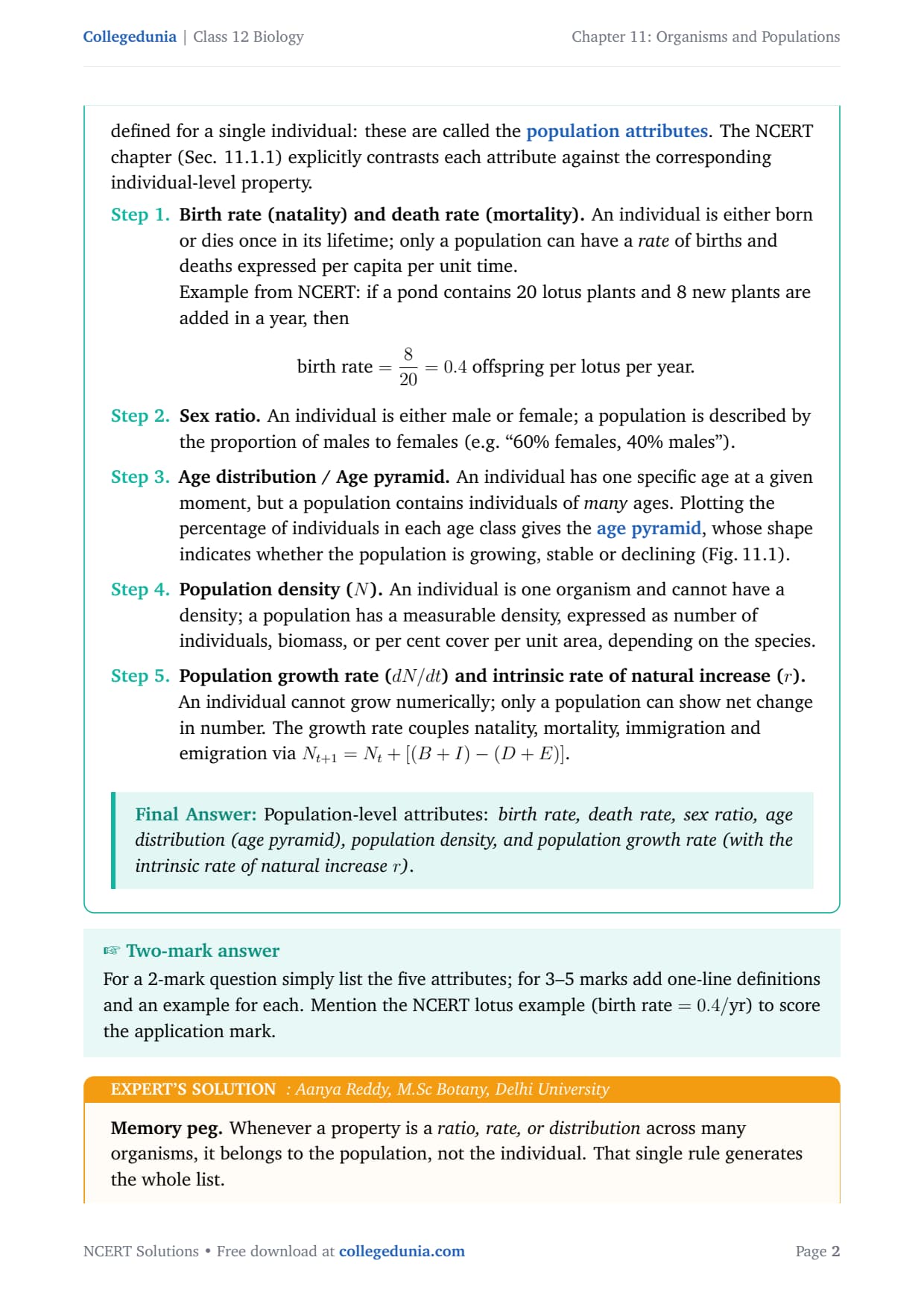
Concept used. A population is a group of individuals of the
same species occupying a defined geographical area, sharing or competing for
similar resources, and capable of interbreeding (sexual or asexual). An
individual is a single organism. Several measurable properties exist for the
population as a whole that cannot logically be defined for a single
individual: these are called the population attributes. The NCERT
chapter (Sec. 11.1.1) explicitly contrasts each attribute against the
corresponding individual-level property.
Birth rate (natality) and death rate (mortality). An
individual is either born or dies once in its lifetime; only a
population can have a rate of births and deaths expressed
per capita per unit time.
Example from NCERT: if a pond contains 20 lotus plants and 8 new
plants are added in a year, then
birth rate = 820 = 0.4 offspring per lotus per year.
Sex ratio. An individual is either male or female; a
population is described by the proportion of males to females
(e.g. ``60% females, 40% males'').
Age distribution / Age pyramid. An individual has one
specific age at a given moment, but a population contains
individuals of many ages. Plotting the percentage of
individuals in each age class gives the age pyramid, whose
shape indicates whether the population is growing, stable or
declining (Fig. 11.1).
Population density (N). An individual is one organism
and cannot have a density; a population has a measurable density,
expressed as number of individuals, biomass, or per cent cover per
unit area, depending on the species.
Population growth rate (dN/dt) and intrinsic rate of
natural increase (r). An individual cannot grow numerically;
only a population can show net change in number. The growth rate
couples natality, mortality, immigration and emigration via
Nt+1 = Nt + [(B + I) - (D + E)].
Population-level attributes: birth rate, death rate, sex
ratio, age distribution (age pyramid), population density, and population
growth rate (with the intrinsic rate of natural increase r).
AR
Aanya Reddy
M.Sc Botany, Delhi University
Verified Expert
Memory peg. Whenever a property is a ratio, rate, or
distribution across many organisms, it belongs to the population, not the
individual. That single rule generates the whole list.
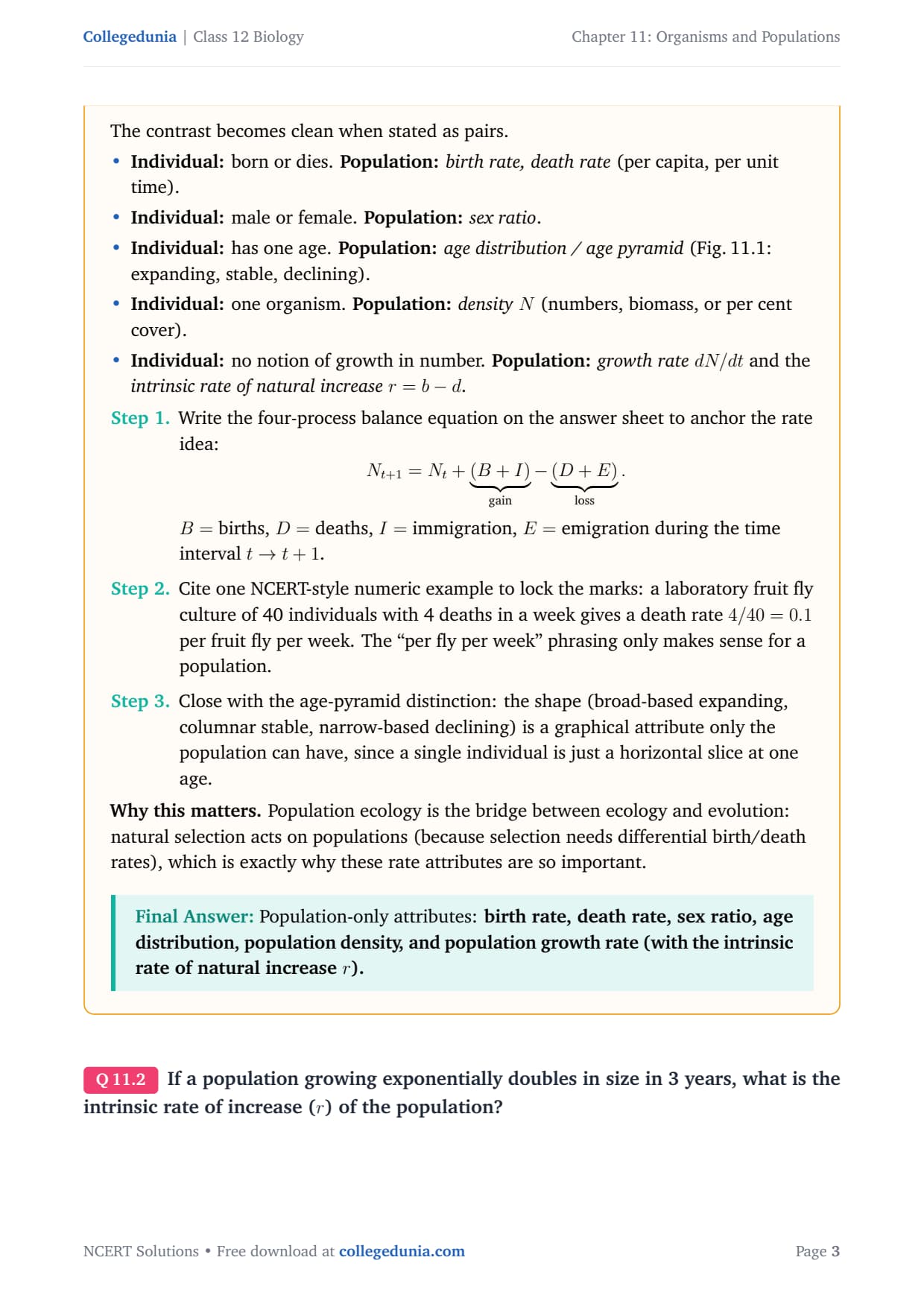
The contrast becomes clean when stated as pairs.
Individual: born or dies. Population:birth
rate, death rate (per capita, per unit time).
Individual: male or female. Population:sex
ratio.
Individual: has one age. Population:age
distribution / age pyramid (Fig. 11.1: expanding, stable,
declining).
Individual: one organism. Population:density N (numbers, biomass, or per cent cover).
Individual: no notion of growth in number.
Population:growth ratedN/dt and the
intrinsic rate of natural increaser = b - d.
Write the four-process balance equation on the answer sheet to
anchor the rate idea:
Nt+1 = Nt + (B + I)gain - (D + E)loss. B = births, D = deaths, I = immigration, E = emigration
during the time interval t → t+1.
Cite one NCERT-style numeric example to lock the marks: a
laboratory fruit fly culture of 40 individuals with 4 deaths in a
week gives a death rate 4/40 = 0.1 per fruit fly per week. The
``per fly per week'' phrasing only makes sense for a population.
Close with the age-pyramid distinction: the shape (broad-based
expanding, columnar stable, narrow-based declining) is a graphical
attribute only the population can have, since a single individual
is just a horizontal slice at one age.
Why this matters. Population ecology is the bridge between
ecology and evolution: natural selection acts on populations (because
selection needs differential birth/death rates), which is exactly why these
rate attributes are so important.
Population-only attributes: birth rate, death rate, sex
ratio, age distribution, population density, and population growth rate
(with the intrinsic rate of natural increase r).
Q 11.2
If a population growing exponentially doubles in size in 3 years,
what is the intrinsic rate of increase (r) of the population?
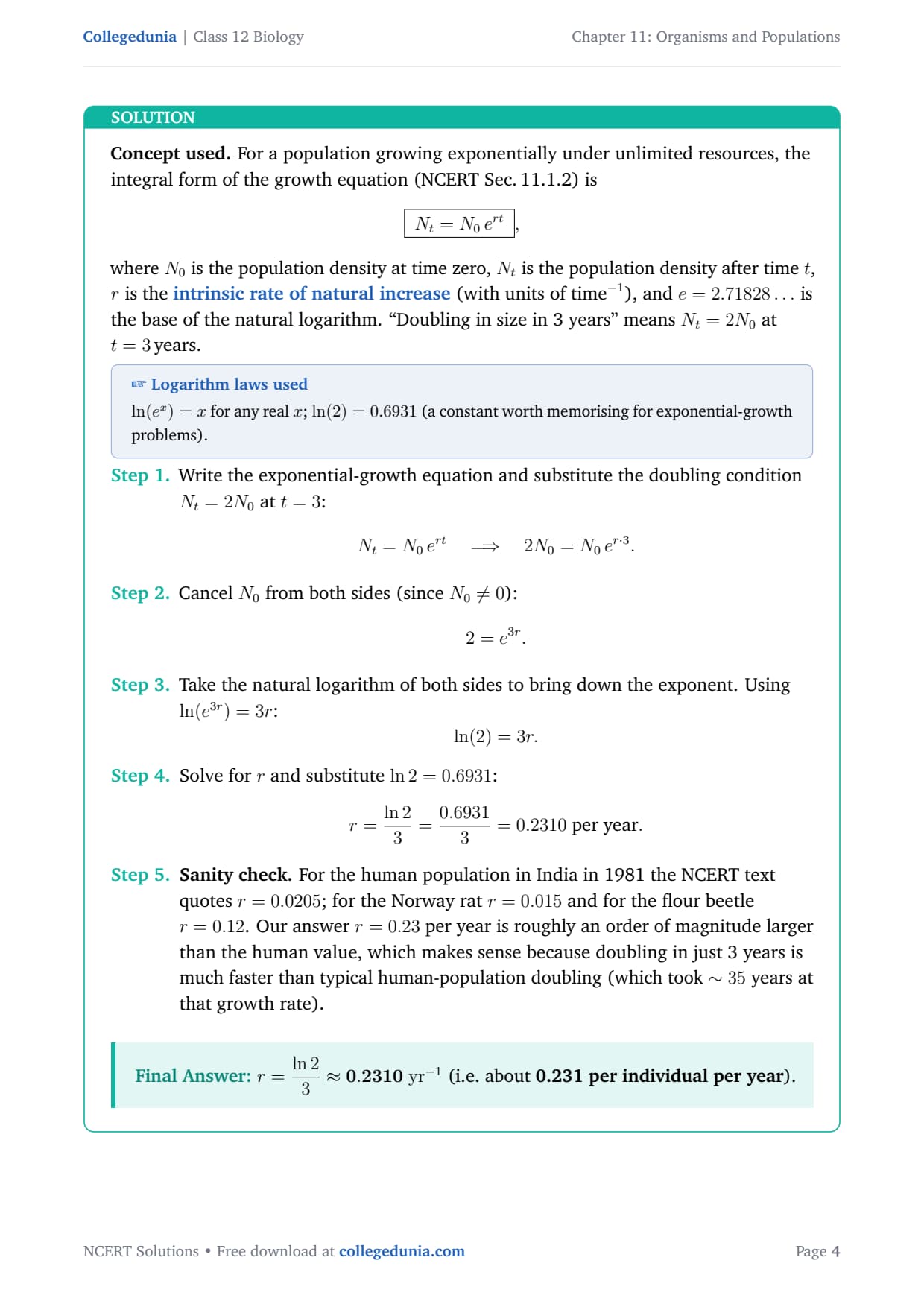
Concept used. For a population growing exponentially under
unlimited resources, the integral form of the growth equation (NCERT
Sec. 11.1.2) is
Nt = N0 ert ,
where N0 is the population density at time zero, Nt is the population
density after time t, r is the intrinsic rate of natural
increase (with units of time-1), and e = 2.71828… is the
base of the natural logarithm. ``Doubling in size in 3 years'' means
Nt = 2 N0 at t = 3 years.
Logarithm laws used
ln(ex) = x for any real x; ln(2) = 0.6931 (a constant worth
memorising for exponential-growth problems).
Write the exponential-growth equation and substitute the doubling
condition Nt = 2N0 at t = 3:
Nt = N0 ert 2N0 = N0 er · 3.
Cancel N0 from both sides (since N0 ≠ 0):
2 = e3r.
Take the natural logarithm of both sides to bring down the
exponent. Using ln(e3r) = 3r:
ln(2) = 3r.
Solve for r and substitute ln 2 = 0.6931:
r = ln 23 = 0.69313 = 0.2310 per year.
Sanity check. For the human population in India in 1981
the NCERT text quotes r = 0.0205; for the Norway rat r = 0.015
and for the flour beetle r = 0.12. Our answer r = 0.23 per
year is roughly an order of magnitude larger than the human value,
which makes sense because doubling in just 3 years is much faster
than typical human-population doubling (which took ∼ 35 years
at that growth rate).
r = ln 23 ≈ 0.2310 yr-1
(i.e. about 0.231 per individual per year).
PS
Pranav Sharma
M.Sc Biotechnology, AIIMS Delhi
Verified Expert
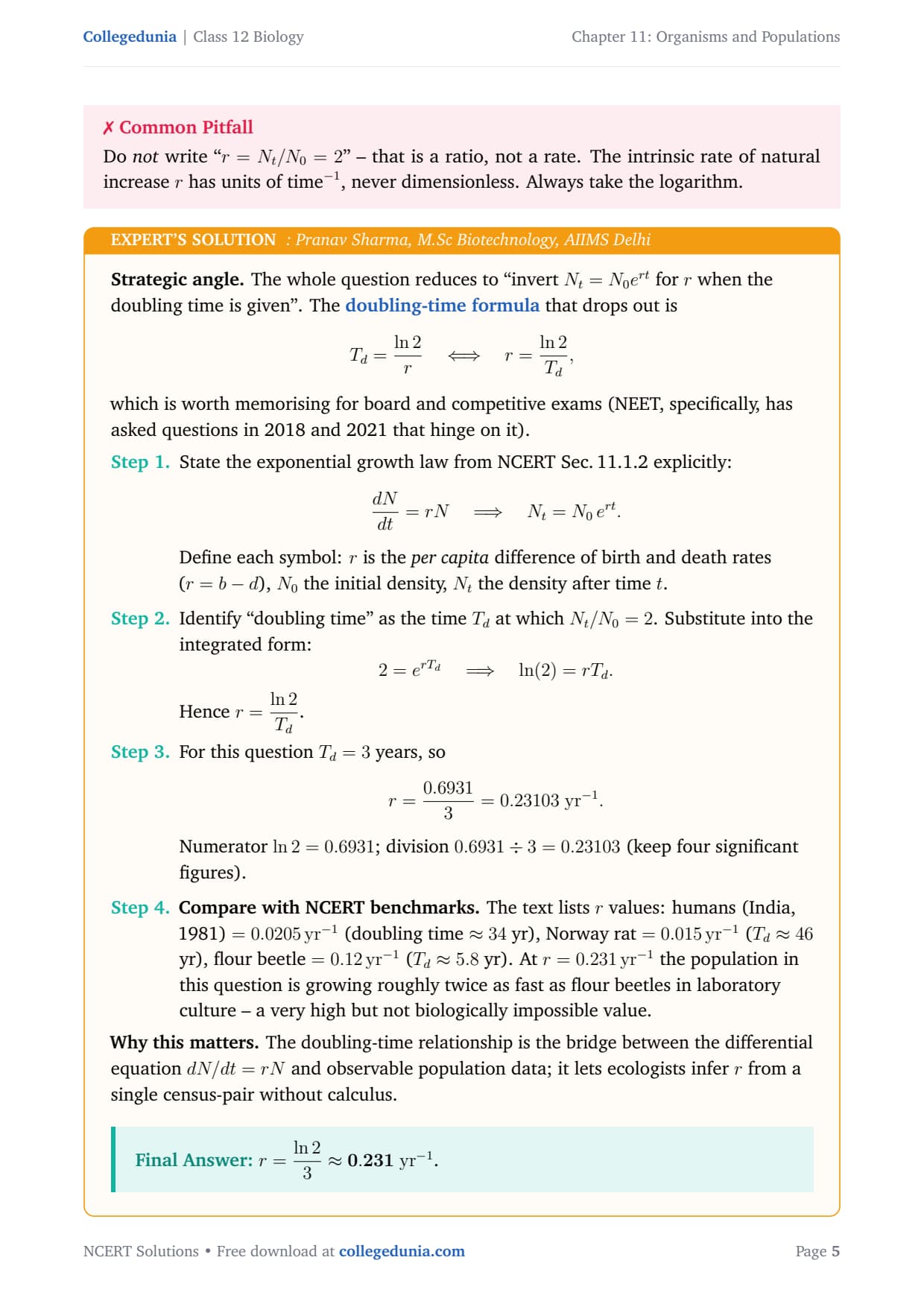
Strategic angle. The whole question reduces to ``invert
Nt = N0 ert for r when the doubling time is given''. The
doubling-time formula that drops out is
Td = ln 2rr = ln 2Td,
which is worth memorising for board and competitive exams (NEET,
specifically, has asked questions in 2018 and 2021 that hinge on it).
State the exponential growth law from NCERT Sec. 11.1.2 explicitly:
dNdt = rN Nt = N0 ert.
Define each symbol: r is the per capita difference of
birth and death rates (r = b - d), N0 the initial density,
Nt the density after time t.
Identify ``doubling time'' as the time Td at which
Nt / N0 = 2. Substitute into the integrated form:
2 = er Td ln(2) = r Td.
Hence r = ln 2Td.
For this question Td = 3 years, so
r = 0.69313 = 0.23103 yr-1.
Numerator ln 2 = 0.6931; division 0.6931 ÷ 3 = 0.23103
(keep four significant figures).
Compare with NCERT benchmarks. The text lists r
values: humans (India, 1981) = 0.0205 yr-1 (doubling
time ≈ 34 yr), Norway rat = 0.015 yr-1
(Td ≈ 46 yr), flour beetle = 0.12 yr-1
(Td ≈ 5.8 yr). At r = 0.231 yr-1 the
population in this question is growing roughly twice as fast as
flour beetles in laboratory culture – a very high but not
biologically impossible value.
Why this matters. The doubling-time relationship is the bridge
between the differential equation dN/dt = rN and observable population
data; it lets ecologists infer r from a single census-pair without
calculus.
r = ln 23 ≈ 0.231 yr-1.
Q 11.3
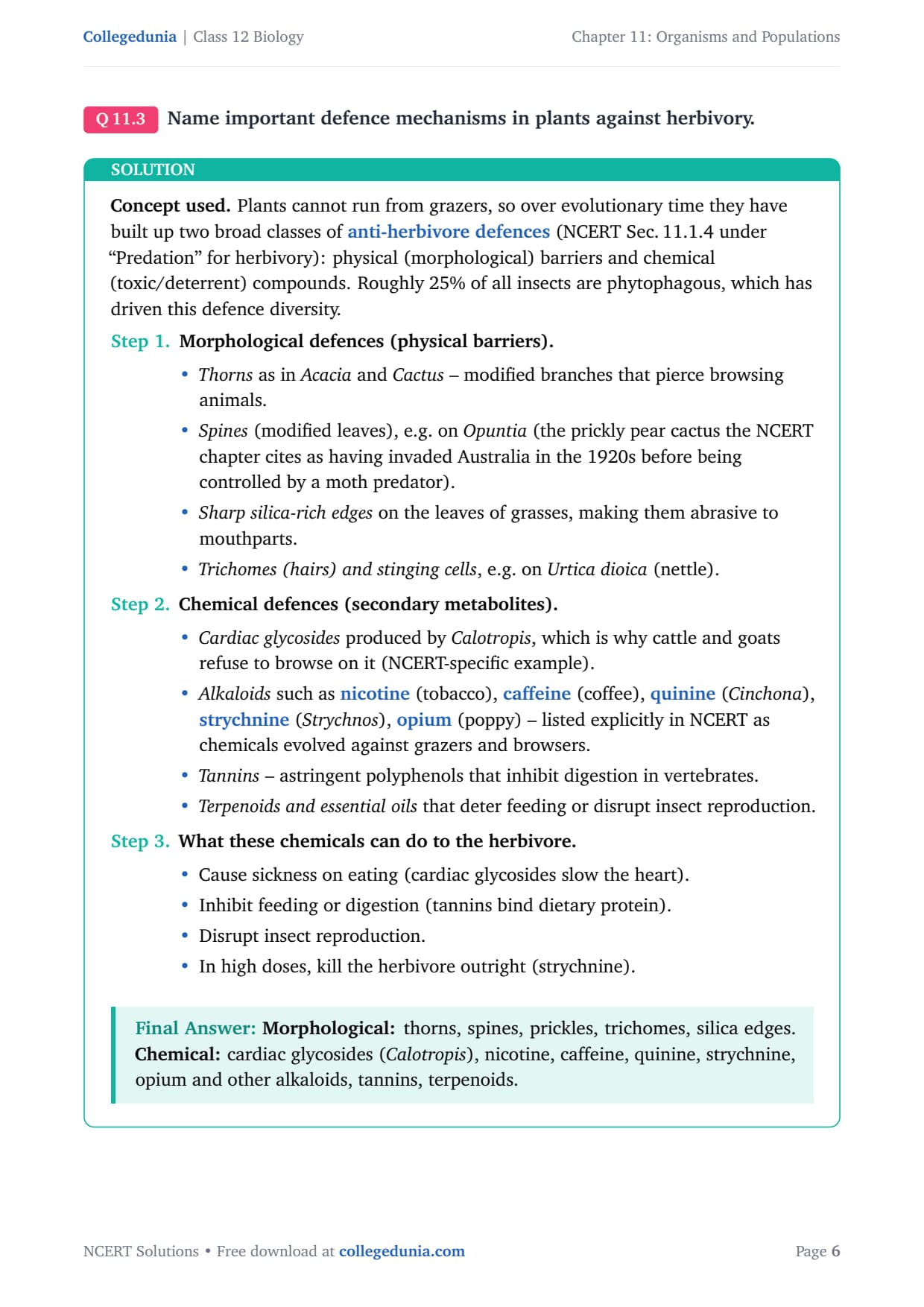
Name important defence mechanisms in plants against herbivory.
Concept used. Plants cannot run from grazers, so over evolutionary
time they have built up two broad classes of anti-herbivore
defences (NCERT Sec. 11.1.4 under ``Predation'' for herbivory): physical
(morphological) barriers and chemical (toxic/deterrent) compounds. Roughly
25% of all insects are phytophagous, which has driven this defence
diversity.
Morphological defences (physical barriers).
Thorns as in Acacia and Cactus –
modified branches that pierce browsing animals.
Spines (modified leaves), e.g. on Opuntia
(the prickly pear cactus the NCERT chapter cites as having
invaded Australia in the 1920s before being controlled by
a moth predator).
Sharp silica-rich edges on the leaves of grasses,
making them abrasive to mouthparts.
Trichomes (hairs) and stinging cells, e.g. on
Urtica dioica (nettle).
Chemical defences (secondary metabolites).
Cardiac glycosides produced by Calotropis,
which is why cattle and goats refuse to browse on it
(NCERT-specific example).
Alkaloids such as nicotine (tobacco),
caffeine (coffee), quinine
(Cinchona), strychnine
(Strychnos), opium (poppy) – listed
explicitly in NCERT as chemicals evolved against grazers
and browsers.
Tannins – astringent polyphenols that inhibit
digestion in vertebrates.
Terpenoids and essential oils that deter feeding or
disrupt insect reproduction.
What these chemicals can do to the herbivore.
Cause sickness on eating (cardiac glycosides slow the
heart).
Inhibit feeding or digestion (tannins bind dietary
protein).
Disrupt insect reproduction.
In high doses, kill the herbivore outright (strychnine).
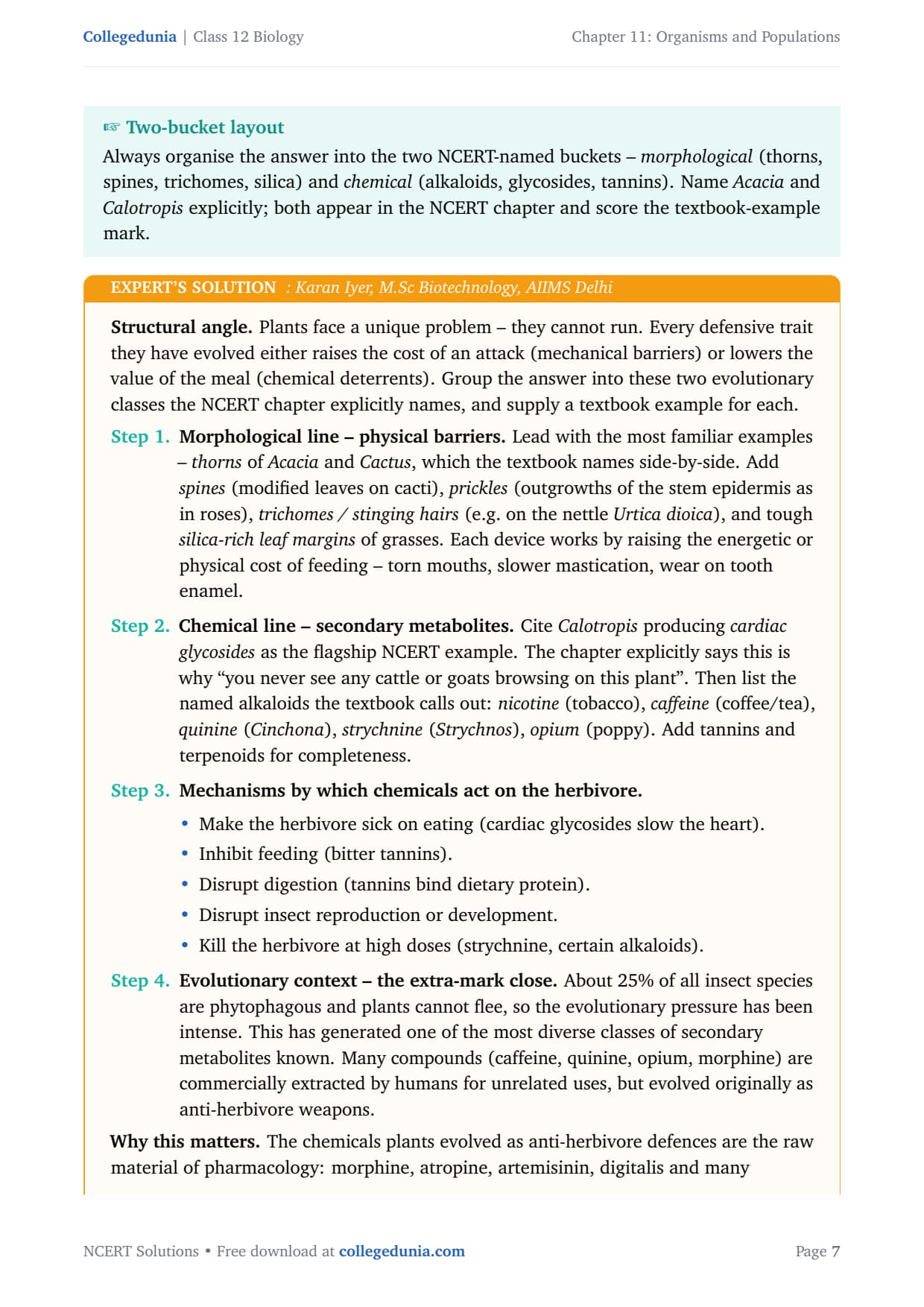
Structural angle. Plants face a unique problem – they cannot run.
Every defensive trait they have evolved either raises the cost of an
attack (mechanical barriers) or lowers the value of the meal (chemical
deterrents). Group the answer into these two evolutionary classes the
NCERT chapter explicitly names, and supply a textbook example for each.
Morphological line – physical barriers.
Lead with the most familiar examples – thorns of
Acacia and Cactus, which the textbook names
side-by-side. Add spines (modified leaves on cacti),
prickles (outgrowths of the stem epidermis as in roses),
trichomes / stinging hairs (e.g. on the nettle
Urtica dioica), and tough silica-rich leaf
margins of grasses. Each device works by raising the energetic
or physical cost of feeding – torn mouths, slower mastication,
wear on tooth enamel.
Chemical line – secondary metabolites.
Cite Calotropis producing cardiac glycosides as
the flagship NCERT example. The chapter explicitly says this is
why ``you never see any cattle or goats browsing on this
plant''. Then list the named alkaloids the textbook calls out:
nicotine (tobacco), caffeine (coffee/tea),
quinine (Cinchona), strychnine
(Strychnos), opium (poppy). Add tannins and
terpenoids for completeness.
Mechanisms by which chemicals act on the herbivore.
Make the herbivore sick on eating (cardiac glycosides
slow the heart).
Inhibit feeding (bitter tannins).
Disrupt digestion (tannins bind dietary protein).
Disrupt insect reproduction or development.
Kill the herbivore at high doses (strychnine, certain
alkaloids).
Evolutionary context – the extra-mark close. About
25% of all insect species are phytophagous and plants cannot
flee, so the evolutionary pressure has been intense. This has
generated one of the most diverse classes of secondary
metabolites known. Many compounds (caffeine, quinine, opium,
morphine) are commercially extracted by humans for unrelated
uses, but evolved originally as anti-herbivore weapons.
Why this matters. The chemicals plants evolved as anti-herbivore
defences are the raw material of pharmacology: morphine, atropine,
artemisinin, digitalis and many anti-cancer agents all began life as
plant defences. Crop breeders also actively select against such
chemicals (to make the crop edible) and for morphological
defences (silica leaf-edges in rice, glands in cotton).
An orchid plant is growing on the branch of mango tree. How do you
describe this interaction between the orchid and the mango tree?
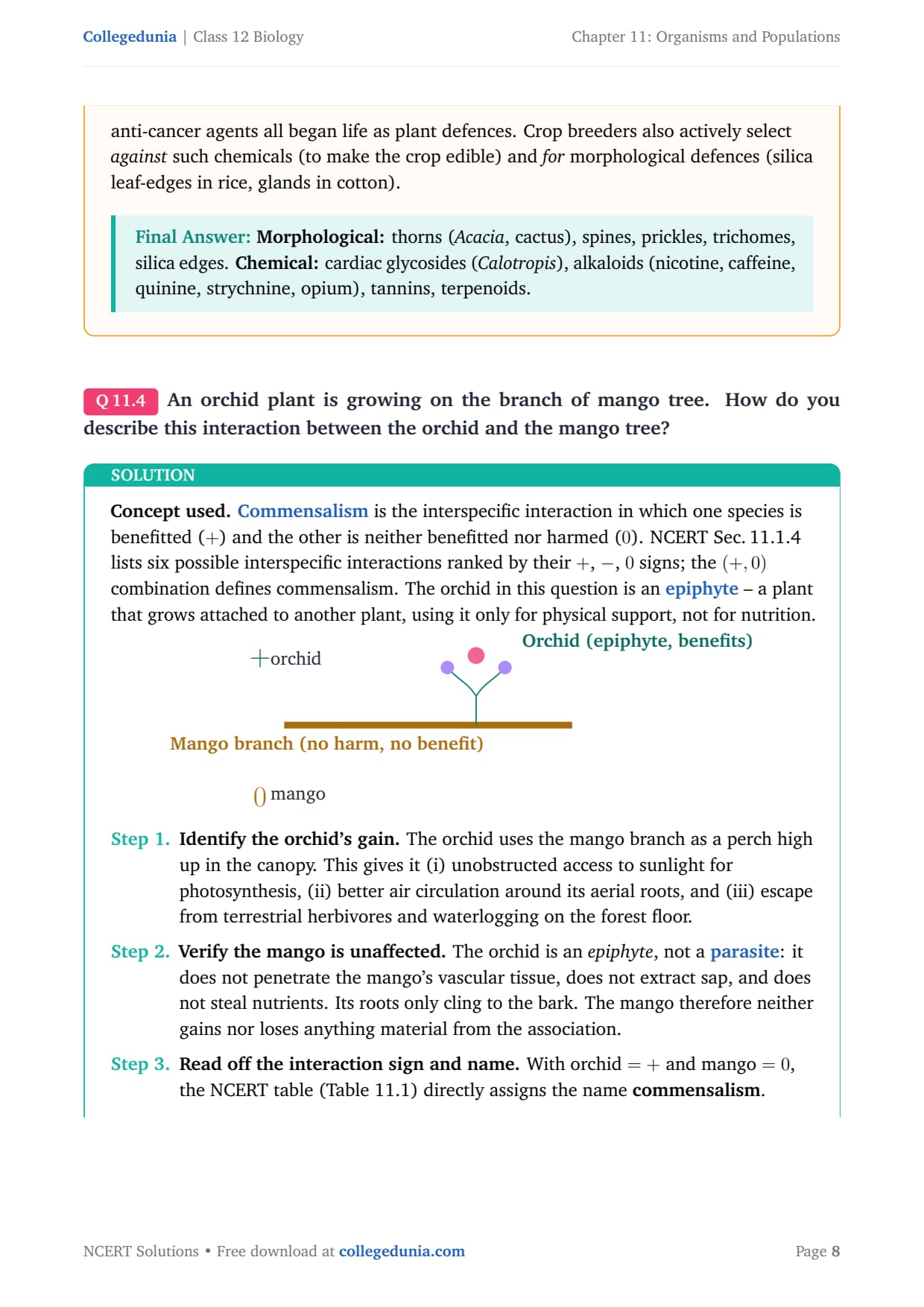
Concept used.Commensalism is the interspecific
interaction in which one species is benefitted (+) and the other is
neither benefitted nor harmed (0). NCERT Sec. 11.1.4 lists six possible
interspecific interactions ranked by their +, -, 0 signs; the
(+, 0) combination defines commensalism. The orchid in this question is
an epiphyte – a plant that grows attached to another plant,
using it only for physical support, not for nutrition.
0.85!%
[See diagram in the PDF version]
Identify the orchid's gain. The orchid uses the mango
branch as a perch high up in the canopy. This gives it (i)
unobstructed access to sunlight for photosynthesis, (ii) better
air circulation around its aerial roots, and (iii) escape from
terrestrial herbivores and waterlogging on the forest floor.
Verify the mango is unaffected. The orchid is an
epiphyte, not a parasite: it does not penetrate
the mango's vascular tissue, does not extract sap, and does not
steal nutrients. Its roots only cling to the bark. The mango
therefore neither gains nor loses anything material from the
association.
Read off the interaction sign and name. With orchid = +
and mango = 0, the NCERT table (Table 11.1) directly assigns
the name commensalism.
The orchid–mango interaction is commensalism: the
orchid (epiphyte) is benefitted while the mango tree is neither benefitted
nor harmed.
SK
Sneha Kapoor
Ph.D Molecular Biology, NCBS Bangalore
Verified Expert
Sign-table angle. Treat every species-interaction question as a
two-step process: (1) assign a +, -, or 0 to each partner, then
(2) look up the row in the interaction matrix (NCERT Table 11.1). The
algorithm cannot go wrong if you do these two steps in order.
Partner A – the orchid. An orchid is an
epiphyte: a plant that grows attached to another plant,
purely for support, with no nutritional dependency. Perched on
the mango branch, it gains (i) canopy-level sunlight (vital for
photosynthesis), (ii) good air circulation around its aerial
roots (orchids absorb atmospheric moisture through specialised
velamen tissue), and (iii) refuge from terrestrial herbivores,
ground floods and leaf-litter rot. Without the mango it would
have to grow at ground level with much less light. Hence the
orchid is benefitted: assign orchid = +.
Partner B – the mango. The orchid's roots cling to the
bark but do not penetrate the cambium, xylem or phloem.
It does not extract sap, nutrients or water from the mango.
Therefore the mango neither gains (no service rendered) nor
loses (no resource stolen). Assign mango = 0.
Look up the interaction matrix. The pair (+, 0)
appears in NCERT Table 11.1 against exactly one row:
commensalism. No ambiguity.
Cite parallels from the NCERT chapter to lock the
application mark. Two other (+, 0) pairs the textbook lists:
(i) the cattle egret foraging beside grazing cattle
(egret = +, cattle = 0 – the cattle stir up insects the
egret eats, but lose nothing), and (ii) barnacles on the
back of a whale (barnacles = +, whale = 0 – barnacles get a
free ride through nutrient-rich waters, the whale is
unaffected). Naming any one parallel is a reliable way to earn
the application mark.
Contrast with parasitism. If the orchid were a
parasite (e.g. Cuscuta, the dodder, which the NCERT
chapter explicitly cites), it would pierce the host's vascular
tissue with haustoria to extract sap; the host would
weaken; the sign pair would be (+, -) and the name would be
parasitism. The fact that an orchid does not have
haustoria is the diagnostic distinction.
Why this matters. Distinguishing commensalism from parasitism
hinges on asking one focused question: is the host losing
anything? If yes, it is parasitism. If no, it is commensalism. The
orchid–mango case is the standard textbook benchmark for the ``no, the
host loses nothing'' branch of this decision.
Commensalism – the orchid (epiphyte) is benefitted,
the mango tree is unaffected. Sign pair (+, 0), NCERT Table 11.1.
Q 11.5
What is the ecological principle behind the biological control
method of managing with pest insects?
Concept used.Biological control (or biocontrol) is the
use of one species (the natural enemy) to regulate the population of
another (the pest). The underlying ecological principle, stated in NCERT
Sec. 11.1.4 under ``Predation'', is that predators keep prey
populations under control: in the absence of natural enemies, prey species
can attain very high densities and cause ecosystem instability, but the
prudent predator keeps prey numbers around a sustainable
equilibrium.
The principle. A predator, parasitoid or pathogen that
feeds on a target pest species, when introduced into a habitat
where the pest has no natural enemies, reduces the pest's
population density through density-dependent mortality. As the
pest density falls, the predator's reproduction also falls
(because food is scarcer), so the system tends to settle into a
low-density equilibrium rather than driving the pest extinct.
The flagship NCERT example. The prickly pear cactus
Opuntia was introduced into Australia in the early 1920s
and spread into millions of hectares of rangeland because its
natural predators were absent. The invasion was finally controlled
only after a cactus-feeding moth (Cactoblastis cactorum)
was imported from Opuntia's native habitat – a textbook
demonstration that predator pressure can hold a runaway pest at
manageable levels.
Why biocontrol is preferred over chemical control.
It is species-specific – the natural enemy targets the
pest, sparing non-target species.
It is self-sustaining – once established, the predator
reproduces and disperses on its own.
It avoids chemical residues in food and water.
It cannot generate ``resistance'' the way insecticides do.
Caveat the NCERT chapter implies. A predator that is too
efficient (over-exploits the prey) drives the prey extinct, and
then itself dies of starvation. Biocontrol species must therefore
be screened to be specialist (won't attack non-pest
natives) and prudent (regulating, not eradicating, the
pest).
The ecological principle is that predators (or
parasitoids/pathogens) regulate prey populations; releasing a host-specific
natural enemy of a pest holds its density below the damage threshold
without chemical pesticides. NCERT example: Cactoblastis moth
controlling Opuntia cactus in Australia.
AB
Aditya Bhat
M.Sc Zoology, Banaras Hindu University
Verified Expert
Quick reading. Biocontrol = the predation principle
applied to agriculture. The pest is the prey, the released agent is the
predator (or parasitoid or pathogen), and the goal is to keep the pest
below the economic injury threshold – not zero, but low enough
that crop loss is acceptable.
State the principle. In nature, predators control prey
densities through density-dependent feeding: more prey ⇒
more predation, fewer prey ⇒ less predation. This
negative-feedback loop is what stabilises prey numbers. Biocontrol
deliberately reproduces this loop in a crop field by importing or
releasing a host-specific natural enemy of the pest.
Anchor with the NCERT example.Opuntia
(prickly pear cactus) was introduced into Australia in the early
1920s. With no natural predator present, it spread across
millions of hectares of rangeland – an exponential, J-shaped
invasion. The moth Cactoblastis cactorum, imported from
Opuntia's native habitat in Argentina, lays eggs on the
cactus pads; the caterpillars bore into and consume the cactus
tissue. Within a few years cactus density was driven back to
manageable levels. This is the canonical illustration of
predation-based control.
Add a second, modern example to widen the answer. The
soil bacterium Bacillus thuringiensis (Bt) is sprayed
on cotton and brinjal to kill lepidopteran larvae through its
crystal toxin (Cry protein). The same predation principle
applies, with the ``predator'' replaced by a pathogenic
bacterium. Modern transgenic Bt cotton has the Cry gene
engineered directly into the plant.
Caveat the chapter explicitly teaches. A predator that
is too efficient drives the prey extinct and then
collapses for lack of food. NCERT states ``predators in nature
are prudent''. Biocontrol agents are therefore screened
in advance for two properties: (a) host-specificity
(they will not attack non-pest native species), and (b)
prudence (they regulate, not eradicate). This is why
exotic biocontrol introductions are preceded by years of
host-range testing in quarantine.
Add the diversity-protecting role for the extra mark.
NCERT mentions Paine's classic Pacific intertidal experiment:
removing the starfish Pisaster caused more than 10
invertebrate species to go extinct within a year due to
interspecific competition. Predators thus also protect
biodiversity, not just suppress one prey species.
Why this matters. Biocontrol is the foundation of modern
integrated pest management (IPM), which combines biological,
cultural and minimal-chemical methods to keep pests below the economic
injury threshold while protecting non-target organisms, pollinators and
soil microbiota.
Predators regulate prey populations. Biological pest
control releases a host-specific natural enemy (predator, parasitoid or
pathogen) of the pest, exploiting this regulatory predation pressure to
suppress the pest below the damage threshold. NCERT example: the
Cactoblastis moth controlling Opuntia in Australia.
Q 11.6
Define population and community.
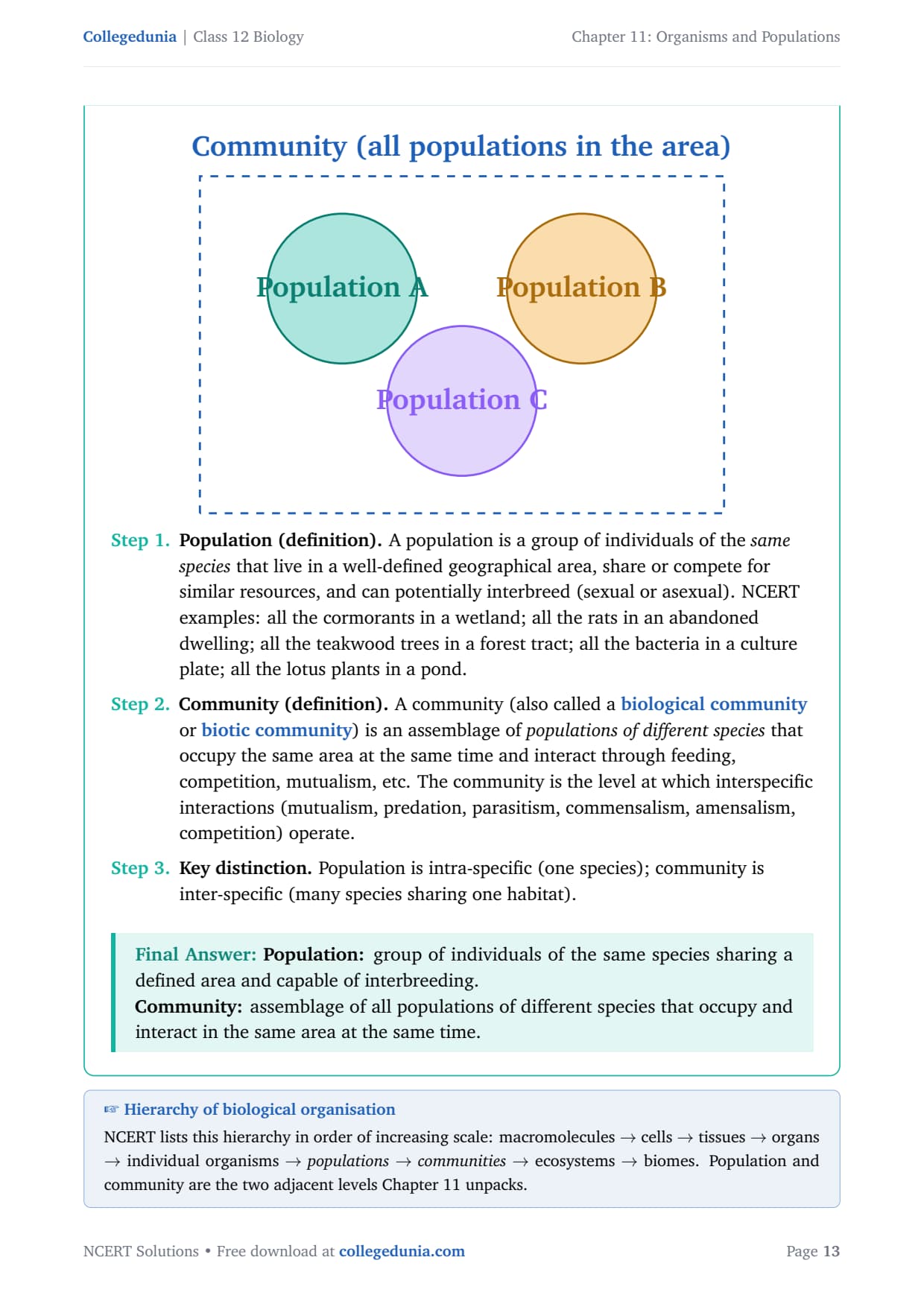
Concept used. The NCERT chapter opens with the hierarchy of
biological organisation: macromolecules → cells → tissues →
organs → organisms →populations→communities→ ecosystems → biomes. ``Population'' and
``community'' are the two levels Chapter 11 deals with; their definitions
follow directly from Sec. 11.1.1 (population) and the introduction to
Sec. 11.1.4 (community).
0.80!%
[See diagram in the PDF version]
Population (definition). A population is a group of
individuals of the same species that live in a well-defined
geographical area, share or compete for similar resources, and
can potentially interbreed (sexual or asexual). NCERT examples:
all the cormorants in a wetland; all the rats in an abandoned
dwelling; all the teakwood trees in a forest tract; all the
bacteria in a culture plate; all the lotus plants in a pond.
Community (definition). A community (also called a
biological community or biotic community) is
an assemblage of populations of different species that
occupy the same area at the same time and interact through
feeding, competition, mutualism, etc. The community is the level
at which interspecific interactions (mutualism, predation,
parasitism, commensalism, amensalism, competition) operate.
Key distinction. Population is intra-specific (one
species); community is inter-specific (many species sharing one
habitat).
Population: group of individuals of the same species
sharing a defined area and capable of interbreeding. Community: assemblage of all populations of different species
that occupy and interact in the same area at the same time.
RV
Rohit Verma
M.Sc Botany, Delhi University
Verified Expert
Definition-pair angle. Write the two definitions as a deliberate
contrast: emphasise ``same species, one area'' for population and
``many species, one area'' for community. Examiners explicitly
look for both phrases.
Population – full definition. A population is a group
of individuals of one species living together in a
well-defined geographical area, sharing or competing for similar
resources, and capable of interbreeding (sexual or, by extension
in ecological usage, asexual). It is the basic unit of
intraspecific (within-species) ecology and the unit on
which natural selection acts (different birth/death rates among
sub-groups within the population).
NCERT-listed population examples. Cormorants in a
wetland; rats in an abandoned dwelling; teakwood trees in a
forest tract; bacteria in a culture plate; lotus plants in a
pond. Pick any one for the example mark.
Community – full definition. A community (or
biological/biotic community) is the assemblage of all
populations of different species that occupy the same area at
the same time and interact through feeding, competition,
mutualism, parasitism, etc. It is the unit of interspecific
(between-species) ecology.
Community-level example. A pond community contains
lotus plants (Population A), fishes (Population B), algae,
zooplankton, frogs and aquatic insects (further populations) –
all interacting through predation (fish eat zooplankton),
competition (algae compete with lotus for light) and other
relationships.
Key distinction – one-line memory peg. Population is
intraspecific (one species, many individuals); community
is interspecific (many species sharing one habitat).
Where each fits in Chapter 11. The population-level
section (11.1.1–11.1.3) covers attributes, growth and life
history. The community-level section (11.1.4 onwards) covers
the six interspecific interactions. Together they set up
Chapter 12 (Ecosystem), which adds the abiotic compartment.
Why this matters. Diagnosing the level (population vs community)
is a recurring exam skill: ``the orchid–mango interaction'' is a
population-pair question (commensalism), while ``the forest floor
biodiversity of the Western Ghats'' is a community-level question
(interspecific interaction web). Read the question once and identify the
level before writing.
Population: group of individuals of one species in a
defined geographical area, sharing resources and capable of
interbreeding. Community: assemblage of all populations of different species
in the same area, interacting through ecological processes.
Q 11.7
Define the following terms and give one example for each:
(a) Commensalism
(b) Parasitism
(c) Camouflage
(d) Mutualism
(e) Interspecific competition
Concept used. All five terms come from NCERT Sec. 11.1.4
(Population Interactions). Four of them ((a), (b), (d), (e)) appear in
Table 11.1 with assigned +/-/0 signs; (c) camouflage is a prey-defence
trait that arises out of predation pressure and is discussed in the
``Predation'' subsection. Treat each part as a one-line definition + one
NCERT example.
(a) Commensalism. An interaction in which one species is
benefitted (+) and the other is neither benefitted nor harmed
(0). Example: an orchid growing as an
epiphyte on a mango tree branch – the orchid gets a perch in the
canopy; the mango is unaffected. (Other NCERT examples: cattle
egret beside grazing cattle; barnacles on the back of a whale;
clownfish among the tentacles of a sea anemone.)
(b) Parasitism. An interaction in which one species (the
parasite) is benefitted (+) by deriving nourishment and shelter
from another species (the host), which is harmed (-). Parasites
often reduce host survival, growth and reproduction and make the
host more vulnerable to predation. Example: the
human liver fluke (a trematode) parasitises the human
liver and uses a snail and a fish as intermediate hosts. (Other
NCERT examples: lice on humans, ticks on dogs, Cuscuta
on hedge plants, malarial parasite in human RBCs, cuckoo brood
parasitism on the crow.)
(c) Camouflage. A morphological prey-defence strategy in
which the body colour, pattern or shape blends with the
background, making the animal cryptically coloured and hard for a
predator to detect. Example: the NCERT chapter cites
``some species of insects and frogs are
cryptically-coloured (camouflaged) to avoid being detected easily
by the predator''. The leaf insect (Phyllium) and the
stick insect (Phasmida) are classic illustrations.
(d) Mutualism. An interaction in which both
species benefit (+, +). Example: the lichen
– an intimate mutualism between a fungus (provides anchorage,
moisture, mineral salts) and a photosynthesising alga or
cyanobacterium (provides organic carbon from photosynthesis). The
NCERT chapter also highlights the fig–wasp one-to-one
mutualism (Fig. 11.4) and mycorrhizae (fungus-root
associations) as flagship examples.
(e) Interspecific competition. A (-,-) interaction in
which two species compete for the same limited resource (food,
space, mates, light), with the fitness of each species reduced
in the presence of the other. Example: the visiting
flamingoes and resident fishes in shallow
South American lakes compete for their common food, the
zooplankton. (Other NCERT examples: the barnacles Balanus
and Chathamalus on rocky Scottish coasts where
Balanus excludes Chathamalus from the intertidal
zone; the Abingdon tortoise vs introduced goats in Gal'apagos.)
(a) Commensalism – orchid on mango branch. (b) Parasitism –
liver fluke in human liver. (c) Camouflage – cryptically coloured frogs
and insects. (d) Mutualism – lichens (fungus + alga). (e) Interspecific
competition – flamingoes vs fishes for zooplankton.
DJ
Diya Joshi
M.Sc Microbiology, JNU
Verified Expert
Sign-table angle. For each interaction-type part, the marker
expects two things: (i) a one-line definition that names the +/-/0
sign pair, and (ii) one named NCERT example. Stick to the textbook
examples – they are the safest under board marking schemes.
(a) Commensalism (+, 0). One species benefits, the
other is neither benefitted nor harmed. Orchid on a mango
branch – the orchid (epiphyte) gains a canopy perch and
sunlight; the mango is unaffected because the orchid does not
pierce its vascular tissue. Backup textbook examples: cattle
egret beside grazing cattle, barnacles on a whale, clownfish
among sea-anemone tentacles.
(b) Parasitism (+, -). The parasite gains
nourishment and shelter; the host is harmed (reduced survival,
growth, reproduction; may become more vulnerable to predation).
The human liver fluke, a trematode that depends on two
intermediate hosts (a snail and a fish) to complete its life
cycle, is the cleanest NCERT example. Backup examples: lice on
humans, ticks on dogs, Cuscuta on hedge plants,
Plasmodium (malarial parasite) in human RBCs, and
brood parasitism by the cuckoo on the crow.
(c) Camouflage. Note: camouflage is a prey-defence
trait, not a sign-pair interaction; it does not appear in
Table 11.1. It is the cryptic colouration, pattern or shape
that hides prey from predators. Use NCERT's phrase: ``some
species of insects and frogs are cryptically-coloured
(camouflaged) to avoid being detected easily by the predator''.
Backup examples: leaf insect (Phyllium), stick insect
(Phasmida), the polar bear's white coat.
(d) Mutualism (+, +). Both species benefit. Three
flagship NCERT examples, any one of which suffices: lichens
(fungus provides anchorage and water; alga or cyanobacterium
provides organic carbon from photosynthesis); mycorrhizae
(fungi help plant roots absorb nutrients; plant supplies sugars);
fig–wasp (one-to-one species-specific relationship,
Fig. 11.4 – wasp pollinates fig; fig provides developing seeds
as food for wasp larvae).
(e) Interspecific competition (-, -). Two species
compete for the same limited resource (food, space, mates,
light); each species' fitness, measured by its intrinsic rate
of increase r, is reduced in the presence of the other. The
flamingo–fish case in shallow South American lakes –
both compete for the zooplankton – is short, neat and directly
NCERT-quoted. Backup examples: Balanus excluding
Chathamalus (Connell's barnacle experiment on rocky
Scottish coasts), and the Abingdon tortoise vs introduced goats
in Gal'apagos.
Score-maximising format. Lay out the answer as a
labelled list – (a), (b), (c), (d),
(e) – with the definition and example on separate lines.
This gives the examiner discrete bullet points to tick off and
is the safest way to lock 5 of 5 marks.
Why this matters. The five terms cover four of the six rows of
Table 11.1 (commensalism, parasitism, mutualism, competition) plus one
prey-defence trait (camouflage). They commonly appear together in 5-mark
``define and give example'' questions on board papers.
With the help of suitable diagram describe the logistic
population growth curve.
Concept used. In nature no habitat has truly unlimited resources,
so exponential growth cannot continue indefinitely. As density rises,
intraspecific competition for finite food and space slows down
the per-capita growth rate. The Verhulst–Pearl logistic growth
equation (NCERT Sec. 11.1.2 (ii)) captures this:
dNdt = rN(K - NK) ,
where N is the population density at time t, r is the intrinsic rate
of natural increase, and K is the carrying capacity of the
habitat (the maximum population the environment can sustain).
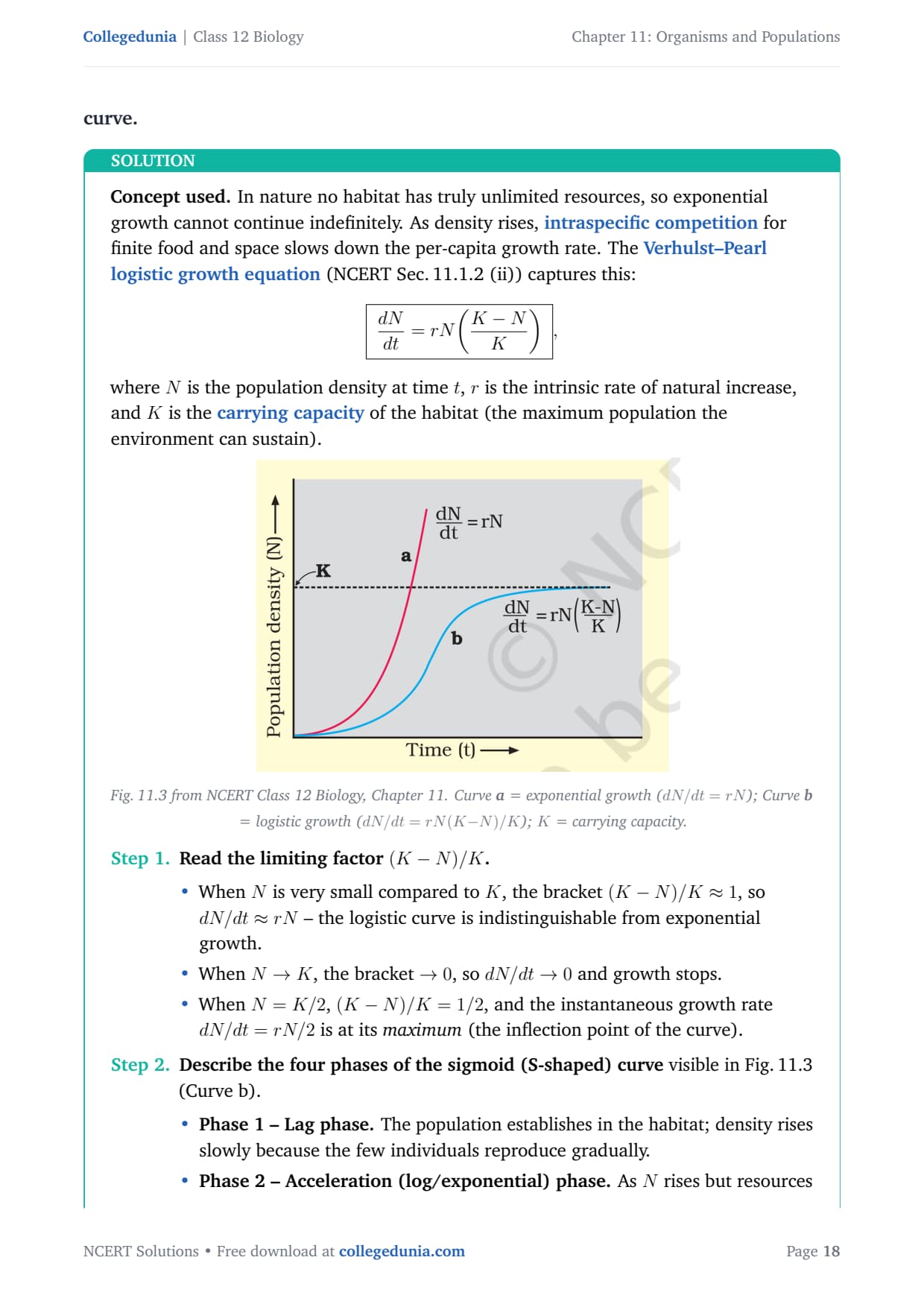
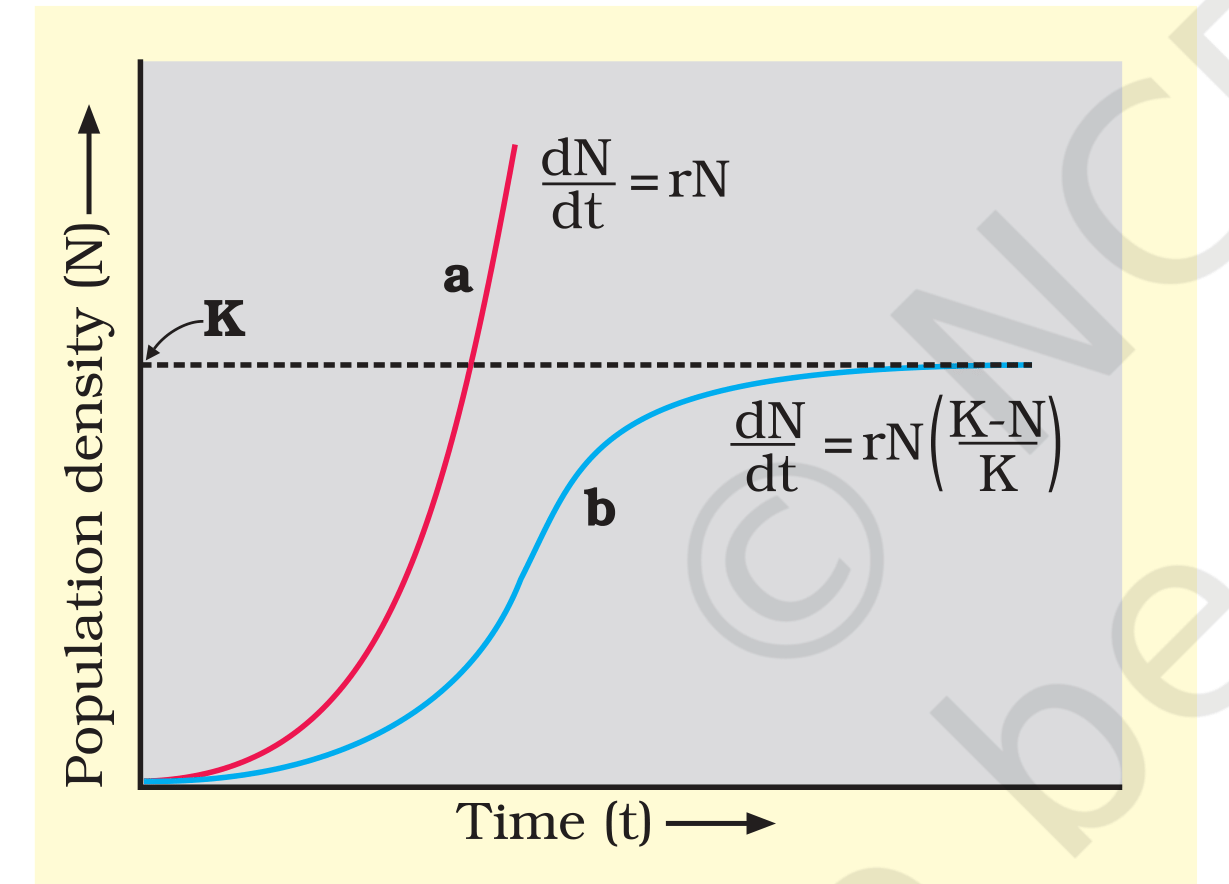
Fig. 11.3 from NCERT Class 12 Biology,
Chapter 11. Curve a = exponential growth (dN/dt = rN);
Curve b = logistic growth (dN/dt = rN(K-N)/K);
K = carrying capacity.
Read the limiting factor (K - N)/K.
When N is very small compared to K, the bracket
(K - N)/K ≈ 1, so dN/dt ≈ rN – the
logistic curve is indistinguishable from exponential
growth.
When N → K, the bracket → 0, so dN/dt → 0
and growth stops.
When N = K/2, (K - N)/K = 1/2, and the
instantaneous growth rate dN/dt = rN/2 is at its
maximum (the inflection point of the curve).
Describe the four phases of the sigmoid (S-shaped)
curve visible in Fig. 11.3 (Curve b).
Phase 1 – Lag phase. The population establishes
in the habitat; density rises slowly because the few
individuals reproduce gradually.
Phase 2 – Acceleration (log/exponential) phase.
As N rises but resources are still abundant
(K - N ≈ K), growth accelerates rapidly and
approximates exponential growth.
Phase 3 – Deceleration phase. As N approaches
K, resources become limiting; competition, disease and
emigration rise; per-capita growth rate falls.
Phase 4 – Stationary (asymptote) phase. The
population fluctuates around K; births and deaths
balance, so dN/dt ≈ 0.
Sketch result. Plotting N against time t produces a
sigmoid (S-shaped) curve that flattens at N = K.
Compare with Curve a in Fig. 11.3, where unlimited resources
produce a J-shaped exponential rise that never plateaus.
Sanity check. For all real animal populations, resources
are finite – NCERT explicitly states ``the logistic growth model
is considered a more realistic one'' for natural populations,
whereas exponential growth describes only initial colonisation or
laboratory conditions.
The logistic population growth curve is described by
dNdt = rN(K-NK). A plot of N vs t
gives a sigmoid (S-shaped) curve with four phases – lag,
acceleration, deceleration and stationary (asymptote at N = K) –
because finite resources limit growth to the carrying capacity K.
AN
Ananya Nair
Ph.D Molecular Biology, NCBS Bangalore
Verified Expert
Picture-first. The simplest way to remember the logistic curve
is to draw the J-curve first (exponential), then bend it over horizontal
when it hits the dashed K line. The result is the S-curve (sigmoid).
This visual trick makes the description impossible to forget.
Build the equation by inspection. Start from the
exponential law dN/dt = rN. Multiply the right-hand side by a
bracket chosen to satisfy two boundary conditions: it must equal
1 at N = 0 (so logistic matches exponential at low density)
and equal 0 at N = K (so growth stops at the carrying
capacity). The simplest bracket satisfying both is
(K - N)/K. Substituting,
dNdt = rN(K-NK).
That is the Verhulst–Pearl logistic equation. This
construction explains why it has exactly the right asymptote.
Identify the four phases on the S-curve visible in
Fig. 11.3 (Curve b). Lag → Acceleration → Deceleration
→ Stationary. Mark each on your hand-drawn S-curve before
writing the description. Each phase scores 0.5 mark in board
marking schemes, so all four must appear.
Find the inflection point. Differentiate dN/dt with
respect to t and set the result to zero; this yields the
inflection condition N = K/2. At that density the
instantaneous growth rate is maximum:
(dNdt)max = r · K2 · K - K/2K = rK4.
This N = K/2 point is the famous maximum sustainable
yield of fisheries science – the best harvesting density a
manager can target without driving the stock toward collapse.
Contrast with exponential (Curve a in Fig. 11.3).
Exponential growth assumes unlimited resources: dN/dt = rN,
Nt = N0 ert, J-shaped curve, indefinite rise. Logistic
assumes finite resources: dN/dt = rN(K-N)/K, N asymptotes
at K, S-shaped sigmoid. NCERT calls logistic ``more realistic''
for natural populations because every real habitat eventually
runs out of food, space or both.
NCERT-cited applications. The chapter encourages
students to plot India's census data over the last 100 years
and check the growth pattern – early decades approximate
exponential growth, recent decades show deceleration as
India's effective K becomes limiting (resources, agriculture,
urban land).
Why this matters. The shape of a population's growth curve
(J vs S) tells an ecologist whether the species is in early colonisation
(J) or near its carrying capacity (S). The bend is what makes the
logistic curve diagnostic, and the maximum-yield point at N = K/2
is the bridge from ecology to fisheries management, harvesting
regulations and recovery targets in conservation biology.
Logistic (Verhulst–Pearl) growth: dNdt =
rN(K-N)/K. S-shaped sigmoid curve with four phases – lag, acceleration,
deceleration, stationary – plateauing at the carrying capacity K;
maximum growth rate rK/4 at N = K/2.
Q 11.9
Select the statement which explains best parasitism.
(a) One organism is benefited.
(b) Both the organisms are benefited.
(c) One organism is benefited, other is not affected.
(d) One organism is benefited, other is affected.
Concept used. The six interspecific interactions in NCERT Table
11.1 are distinguished by the (+/-/0) sign for each partner.
Parasitism is defined as the interaction in which the parasite
is benefitted (+) by deriving nourishment and shelter, while the host
is harmed (-). The textbook explicitly notes that ``majority of the
parasites harm the host; they may reduce the survival, growth and
reproduction of the host''. Hence option (d), ``one organism is benefited,
other is affected (harmed)'', is the correct match.
Decode each option against the sign table.
(a) ``one organism is benefited'' – incomplete; matches
multiple categories (commensalism, predation, parasitism)
because it doesn't say what happens to the other.
Reject.
(b) ``both are benefited'' → (+, +)=
mutualism, not parasitism. Reject.
(c) ``one benefited, other unaffected'' → (+, 0)= commensalism, not parasitism. Reject.
Reconfirm with a textbook example. The human
liver fluke (trematode) benefits by deriving nourishment from
the human host's liver; the host suffers reduced liver function
and weakened health. The interaction is therefore (+, -),
matching only option (d).
Correct answer: (d) One organism is benefited, other is
affected.
ID
Ishaan Desai
M.Sc Biotechnology, AIIMS Delhi
Verified Expert
Elimination angle. The fastest MCQ strategy for species-interaction
questions is to convert each option into a (+/-/0) sign-pair and match
it against NCERT Table 11.1. Among the six interactions in the table,
exactly one row has the pair (+, -) that is offered here as an option
and is named parasitism (predation also has (+, -), but predation is
not among the choices).
Decode option (a). ``One organism is benefited.''
This sentence is incomplete – it does not say what happens to
the other partner. The pair could be (+, +), (+, 0), or
(+, -) – i.e. mutualism, commensalism, or
parasitism/predation. Reject (a) for being
underspecified.
Decode option (b). ``Both are benefited.'' This is
the sign pair (+, +), which Table 11.1 names mutualism
(lichens, mycorrhizae, fig–wasp). Wrong category for
parasitism. Reject (b).
Decode option (c). ``One benefited, other unaffected.''
Sign pair (+, 0), which Table 11.1 names commensalism
(orchid on mango, cattle egret with cattle). Wrong category for
parasitism. Reject (c).
Decode option (d). ``One benefited, other affected
(harmed).'' Sign pair (+, -). In Table 11.1 this matches two
rows – parasitism and predation. Since predation is not offered
and parasitism is, option (d) is the unique correct match.
Accept (d).
Reality check with a textbook example.Plasmodium (the malarial parasite) in human RBCs:
the parasite gains nutrition and a site for reproduction; the
host suffers fever, anaemia and, in severe cases, organ
failure. The sign pair (+, -) is unambiguous, confirming
option (d). Other NCERT examples that fit the same pair: the
human liver fluke; Cuscuta on hedge plants; lice on
humans; ticks on dogs.
Common trap to avoid. Some students pick option (a)
because it ``sounds parasitic''. Option (a) is not wrong, it
is just insufficiently specific; a multiple-choice
question rewards the option that contains the full diagnostic
information, which is (d).
Why this matters. Sign-pair thinking turns every
species-interaction MCQ into a one-step lookup; you do not need to
memorise the names if you can read the +/-/0 pair off the option text.
This is a particularly useful tactic in NEET, where the same
distractor pattern (one correct option + one underspecified-but-tempting
option) recurs.
(d) One organism is benefited, other is affected. The
sign pair is (+, -), matching parasitism in NCERT Table 11.1.
Q 11.10
List any three important characteristics of a population and
explain.
Concept used. A population has measurable attributes
(NCERT Sec. 11.1.1) that an individual does not. Three of the most
important are population density, natality and
mortality (birth and death rates) and age distribution (the
age pyramid). Each is defined and then explained with an NCERT example.
1. Population density (N).Definition. The size of the population per unit area or
volume at a given time. NCERT denotes it N. Measurement. It may be expressed as (i) total number of
individuals, (ii) per cent cover, (iii) biomass, or (iv) an
indirect index such as pug marks or fecal pellets (used in tiger
census). The choice depends on the species – a single banyan tree
with a vast canopy is functionally more important than 200 carrot
grass plants, so per-cent cover or biomass is a better measure
for trees. Why it matters. Density is the single number against
which all ecological processes – competition, predation, pesticide
impact – are evaluated.
2. Natality and mortality (birth and death rates).Definition. Natality is the number of births per
individual per unit time; mortality is the number of deaths per
individual per unit time. Both are per capita quantities. Example (NCERT). If a pond had 20 lotus plants last year
and 8 new plants are added this year through reproduction, the
birth rate is
birth rate = 820 = 0.4 offspring per lotus per year.
Similarly, 4 deaths out of 40 lab fruit flies in one week gives
death rate = 440 = 0.1 deaths per fly per week. Why it matters. The difference b - d is the intrinsic
rate of natural increase r, which drives dN/dt = rN.
3. Age distribution (age pyramid).Definition. The percentage of individuals in each age
class (pre-reproductive, reproductive, post-reproductive).
Plotting these percentages gives the age pyramid
(Fig. 11.1). Interpretation of pyramid shape.
Broad base, tapering top →expanding
(growing) population.
Columnar (roughly equal age classes) →stable
population.
Narrow base, broad top →declining
population.
Why it matters. Demographers use age pyramids to project
future population trends and set policy (housing, schools,
pensions).
Three population characteristics: (1) Population density
N (size per unit area/volume; multiple metrics); (2) Natality
and mortality (per-capita birth and death rates, e.g. NCERT lotus
example = 0.4/yr); (3) Age distribution / age pyramid
(expanding, stable or declining).
TP
Tara Pillai
M.Sc Botany, Delhi University
Verified Expert
Pick-and-explain angle. The exercise says ``list any three'',
so pick the three with the cleanest one-line definitions, a memorable
NCERT example, and a strong evolutionary or applied interpretation:
density, natality + mortality, and age distribution. These three
together also generate the rest of population ecology – the growth-rate
equation dN/dt comes out of natality minus mortality applied to a
density.
Population density N – the central quantity.
Population size per unit area or volume at a given moment.
Multiple metrics are available, with the choice depending on
the species: total count (small mammals), biomass
(microbes), per-cent cover (vegetation), or indirect indices
(tiger census via pug marks and fecal pellets). NCERT example:
stating banyan density by number underestimates its ecological
role compared with 200 carrot grass plants, so per-cent cover
or biomass is the better measure for trees. Density is the
variable against which every ecological process is evaluated.
Natality and mortality – the rate engine. Per capita
birth rate (b) and death rate (d) drive the change in
density. NCERT lotus example: 8 new offspring among 20 plants
in a year gives
b = 820 = 0.4 offspring per lotus per year.
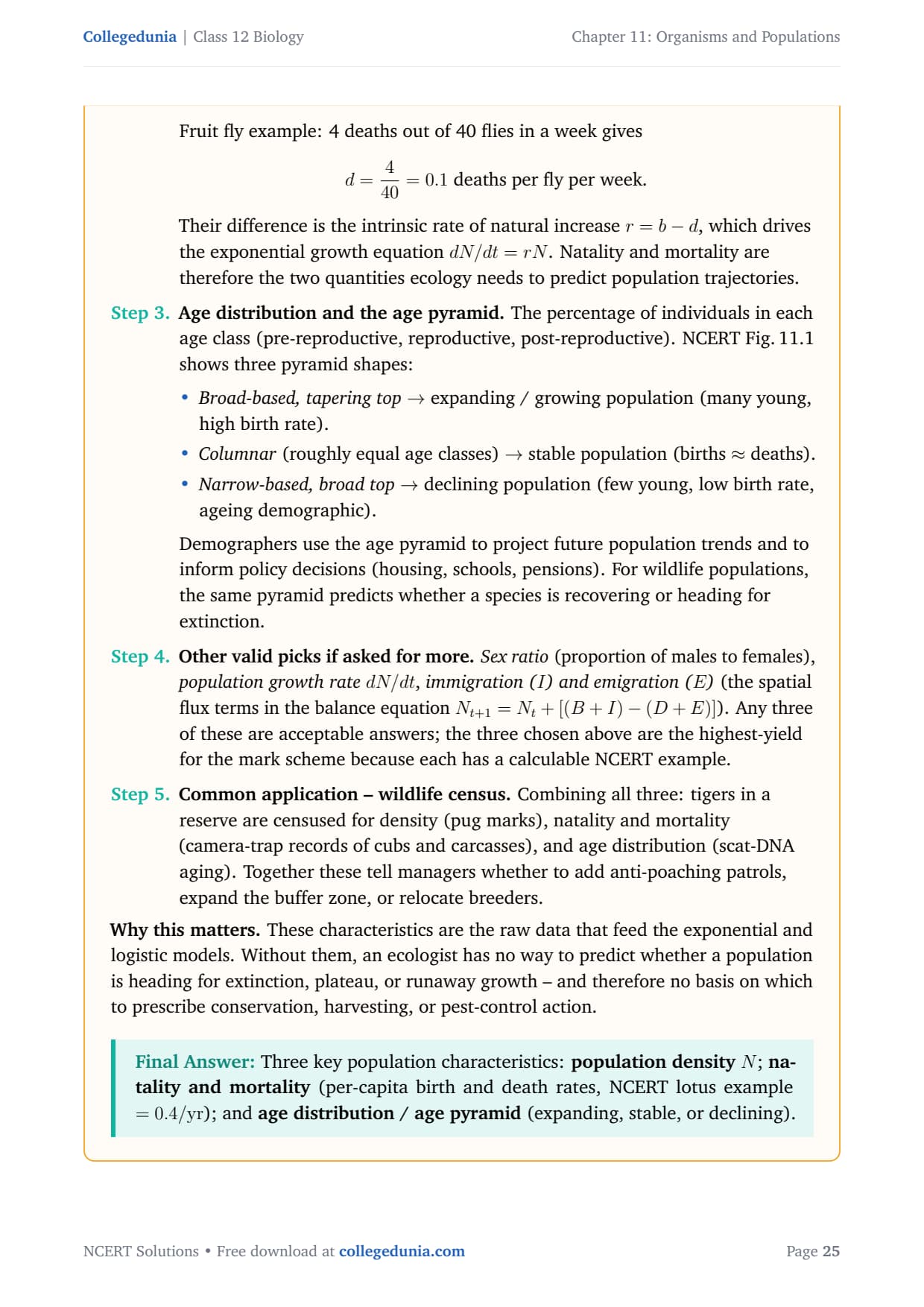
Fruit fly example: 4 deaths out of 40 flies in a week gives
d = 440 = 0.1 deaths per fly per week.
Their difference is the intrinsic rate of natural increase
r = b - d, which drives the exponential growth equation
dN/dt = rN. Natality and mortality are therefore the two
quantities ecology needs to predict population trajectories.
Age distribution and the age pyramid. The percentage
of individuals in each age class (pre-reproductive,
reproductive, post-reproductive). NCERT Fig. 11.1 shows three
pyramid shapes:
Broad-based, tapering top→ expanding /
growing population (many young, high birth rate).
Columnar (roughly equal age classes) →
stable population (births ≈ deaths).
Demographers use the age pyramid to project future population
trends and to inform policy decisions (housing, schools,
pensions). For wildlife populations, the same pyramid predicts
whether a species is recovering or heading for extinction.
Other valid picks if asked for more.Sex ratio
(proportion of males to females), population growth
ratedN/dt, immigration (I) and emigration (E)
(the spatial flux terms in the balance equation
Nt+1 = Nt + [(B + I) - (D + E)]). Any three of these are
acceptable answers; the three chosen above are the highest-yield
for the mark scheme because each has a calculable NCERT example.
Common application – wildlife census. Combining all
three: tigers in a reserve are censused for density (pug marks),
natality and mortality (camera-trap records of cubs and
carcasses), and age distribution (scat-DNA aging). Together
these tell managers whether to add anti-poaching patrols, expand
the buffer zone, or relocate breeders.
Why this matters. These characteristics are the raw data that
feed the exponential and logistic models. Without them, an ecologist has
no way to predict whether a population is heading for extinction,
plateau, or runaway growth – and therefore no basis on which to
prescribe conservation, harvesting, or pest-control action.
Three key population characteristics: population
density N; natality and mortality (per-capita birth and
death rates, NCERT lotus example = 0.4/yr); and age
distribution / age pyramid (expanding, stable, or declining).
NCERT Solutions for Class 12 Biology: All Chapters
Browse all Class 12 Biology NCERT Solutions for 2026-27.
We asked 11,300 Class 12 Biology students about this chapter:
70% rated the logistic-growth derivation the hardest sub-topic, though it carries the highest single-question marks.
59% lost 1-2 marks classifying mutualism, commensalism, predation and parasitism.
4 out of 5 students skipped the age-pyramid figure.
Only 39% attempted all 14 questions. Toppers solved every one and revisited wrong attempts within 24 hours.
Organisms and Populations Class 12 Biology NCERT Solutions FAQs
Ques. Where can I download Class 12 Biology Chapter 11 Organisms and Populations NCERT Solutions PDF?
Ans. You can download the Organisms and Populations Class 12 Biology NCERT Solutions PDF directly from this page. Both Normal and HD versions are free and aligned with the 2026-27 NCERT.
Ques. Are these NCERT Solutions aligned with the 2026-27 syllabus?
Ans. Yes. This page reflects the current 2026-27 syllabus for Class 12 Biology. NCERT did not trim Organisms and Populations, so all 14 exercise questions are still examinable for CBSE Boards and NEET.
Ques. How many questions are there in the Organisms and Populations NCERT exercise?
Ans. The end-of-chapter exercise has 14 numbered questions covering abiotic factors, adaptations, population attributes, growth models and interspecific interactions. The PDF carries step-by-step worked answers to every one.
Ques. What is the NEET weightage of Class 12th Biology Chapter 11 Organisms and Populations?
Ans. NEET pulls 3 to 5 questions from this chapter every year. Population growth (logistic equation) and the six interspecific interactions are the two highest-yield sub-topics.
Ques. What is the logistic growth equation in Class 12 Biology Chapter 11?
Ans. The Verhulst-Pearl logistic equation is dNdt = rN(K-NK) , where N is population size, r is intrinsic rate of natural increase, and K is the carrying capacity. The curve is sigmoid (S-shaped) with an asymptote at N = K.
Ques. What is the difference between commensalism and mutualism?
Ans.Commensalism is a +/0 interaction: one species benefits while the other is unaffected (cattle egret + cattle, orchid on a mango tree). Mutualism is +/+: both species benefit (lichen, Ficus-fig wasp, mycorrhiza). The sign-pair is what CBSE awards.
Ques. What is carrying capacity in Class 12 Biology population ecology?
Ans. Carrying capacity (K) is the maximum population size that a habitat can sustain indefinitely with the available resources. In the logistic equation, growth slows as N approaches K and stops when N = K, giving the upper asymptote of the sigmoid curve.
Ques. How do NCERT Solutions for Organisms and Populations help with NEET preparation?
Ans. Every solution flags the exact term NEET asks verbatim, such as commensalism, amensalism, Verhulst-Pearl, Gause's principle and Allen's rule. The interaction-matrix recall table on this page covers the top six NEET-tested pairings with NCERT examples.
Ques. Are diagrams included in the Class 12 Biology Chapter 11 NCERT Solutions PDF?
Ans. Yes. The sigmoid logistic growth curve (Q5), age pyramids for expanding / stable / declining populations (Q4), the three survivorship curves (Q8) and the six-cell interspecific interactions matrix (Q9) are all included with examiner-grade labels ready to copy into the board answer script.








Comments