Business Studies Editor, MBA | Updated on - Jul 21, 2026
Principles of Management is one of the most reliably tested chapters in the Class 12 Business Studies paper. These NCERT Solutions answer every textbook question on Fayol's 14 principles and Taylor's scientific management, written in the CBSE marking-scheme style for the 2026-27 session.
CBSE Weightage: 6 to 12 marks (Unit 1, Principles and Functions of Management)
Question Count: 6 Very Short Answer + 6 Short Answer + 8 Long Answer (20 in total)
These solutions cover Fayol's 14 principles, Taylor's 4 principles and 7 techniques of scientific management, Functional Foremanship, Mental Revolution, Scalar Chain and Gang Plank, and the full Fayol vs Taylor comparison. Each answer follows the CBSE marking scheme.
Principles of Management NCERT Solutions: Section-wise Question Map
The Chapter 2 exercises split into three sub-sections by mark weightage. The table groups the 20 questions so you can target what CBSE tests most.
Sub-section
Question Count
Focus Area
Difficulty
Very Short Answer Type
6
Meaning of principles, Gang Plank, naming Fayol principles and Taylor techniques
Easy
Short Answer Type
6
Nature and significance of principles, Fatigue Study, Mental Revolution, Differential Piece Rate
Medium
Long Answer Type
8
Fayol's 14 principles, Taylor's 4 principles and 7 techniques, 8 functional foremen, Fayol vs Taylor, and the Bhasin, Mukti and Mr. Rathore cases
Hard
The 6-mark Long Answer usually comes from the Fayol 14 principles, Taylor 7 techniques or Fayol vs Taylor clusters, while the 3-mark Short Answer is drawn from the case-based set.
Concept Anchor: Fayol's 14 principles cover the whole organisation (general management, top-down view); Taylor's 4 principles plus 7 techniques target the shop floor (scientific management, bottom-up view). They are complementary, not contradictory. Unity of Command is Fayol's principle; Taylor diluted it through his 8 specialised foremen.
What the Class 12 Business Studies Chapter 2 NCERT Solutions PDF Contains
The PDF contains solved answers to every question in the chapter, in a CBSE marker-friendly format that follows the official 1-mark, 3-4-mark and 5-6-mark answer-length brackets.
Concept opener that names and defines the principle, technique or foreman role before the analysis.
Textbook-mapped definitions in exact NCERT wording, like Taylor's "Science not Rule of Thumb".
Step-by-step structure so the marker can tick each named principle or technique in turn.
Expert Solution that adds an alternate angle and shows what the examiner is checking.
Common-mistake call-outs, like Unity of Command vs Unity of Direction, with the correct answer.
How Will Collegedunia's NCERT Solutions Help You with Principles of Management?
Three question patterns drive over 75% of marks in this chapter. These solutions help you learn the patterns while you practise.
2026-27 NCERT Alignment: Every answer matches the current textbook, including the Bhasin, Mukti and Mr. Rathore cases.
Marker-Style Structure: Concept line first, named points next, one-line takeaway last, the shape a Board examiner expects.
Case-Study Verification: Each case is mapped to the correct principle, so you never write "Discipline" instead of "Subordination".
Common-Mistake Notes: Unity of Command vs Unity of Direction, 5 techniques instead of 7, 6 foremen instead of 8, all flagged in place.
Solved Example: Principles of Management Case-Based Long Answer
The solved example below shows the answer shape a CBSE marker expects for a typical 6-mark case-based long answer. The same structure transfers to every principle-violation question in the chapter.
Question (6 marks). Mr. Rathore, owner of a textile factory, places a raw-material order with his cousin's firm at a price 15% higher than the regular supplier's quote. Identify and explain the principle of management violated, with reference to Fayol's 14 principles.
Step 1 (1M), Concept used. Fayol's principle of Subordination of Individual Interest to General Interest says the organisation's interest must override any individual's personal interest.
Step 2 (1M), Diagnosis. By favouring his cousin at a 15% premium, Mr. Rathore put personal interest above the firm's interest. The firm pays more and profit shrinks.
Step 3 (2M), Why not Discipline or Equity. Discipline is about obeying rules and Equity is about fairness to subordinates, neither of which is in question. The match is Subordination because personal gain is placed above organisational gain.
Step 4 (1M), Remedy. Set a clear vendor-selection policy, require competitive quotes above a threshold, and prohibit related-party purchases without board approval.
Step 5 (1M), Takeaway. The violated principle is Subordination of Individual Interest to General Interest; the remedy is a transparent procurement policy.
Principles of Management NCERT Solutions: Important Topics
The Chapter 2 exercises cover the topics below, grouped so you can target the clusters CBSE tests most heavily.
Topic
What CBSE Tests
Mark Weightage
Nature and Significance of Principles
Seven nature features plus six significance points
3-6
Fayol's 14 principles
Definitions, examples, application to cases
5-6
Taylor's 4 principles of scientific management
Science not Rule of Thumb, Harmony not Discord, Cooperation not Individualism, Development of each person
Complete attitude shift on both sides; mutual cooperation
3-4
Differential Piece Wage System
Two-tier rate per unit; efficient vs inefficient workers
1-3
Scalar Chain and Gang Plank
Vertical authority line plus lateral emergency exception
3-4
Fayol vs Taylor
Seven-row comparison of perspective, focus, unity, applicability and results
5-6
Case-based questions
Bhasin Limited, Mukti Consultants and Mr. Rathore
5-6
Fayol vs Taylor: The Seven-Row Comparison Every CBSE Marker Checks
This is the single most repeated long-answer question from Chapter 2. Memorise the seven rows in order, and write all seven points to secure full marks.
Basis
Fayol
Taylor
Perspective
Top-level (general management)
Shop-floor (scientific management)
Focus
Improving overall administration
Increasing worker productivity
Unity Emphasis
Unity of Command (one boss per worker)
Diluted - 8 specialised foremen, each issues orders in their domain
Higher productivity through mental revolution and standardisation
Common Mistakes Students Make in Chapter 2
Confusing Unity of Command with Unity of Direction. One boss per worker versus one head and one plan per objective.
Listing only 5 or 6 techniques. There are exactly 7; drop one and you forfeit a mark.
Forgetting Functional Foremanship has 8 foremen. Name all eight: 4 planning and 4 production.
Treating Taylor and Fayol as opposed. They are complementary, one bottom-up and one top-down.
Mislabelling the Mr. Rathore case as Equity or Discipline. The answer is Subordination of Individual Interest.
Calling principles "absolute" or "rigid". They are general guidelines, indicative not absolute.
Previous Year Question Analysis: Class 12 Business Studies Chapter 2
Across the last five CBSE Class 12 Business Studies board papers, Principles of Management has been tested through the following dominant question patterns:
Fayol vs Taylor seven-row comparison (Long Answer). Appeared in 2020, 2022 and 2024 papers.
Explain any five Fayol principles with examples (Long Answer). Appeared in 2019, 2021 and 2023 papers.
7 techniques of scientific management (Long Answer). Appeared in 2020 and 2022; Differential Piece Wage often carries a numerical.
Case-based principle identification (Short Answer). Appeared in 2021, 2023 and 2024; the Bhasin and Mr. Rathore patterns map to specific Fayol principles.
Functional Foremanship (Short or Long Answer). Appeared in 2022 and 2024; name all eight foremen and explain the specialisation.
All NCERT Solutions for Principles of Management with Step-by-Step Working
Every NCERT textbook question for Class 12 Business Studies Chapter 2 Principles of Management is listed below with its full Solution and Expert Solution hidden inside collapsible tabs. Click Check Solution to reveal the step-by-step working; click Expert Solution for the expanded explanation.
Very Short Answer Type Questions
Q 2.1
What makes principles of management flexible?
Concept used.Flexibility is a defining feature of management principles.
Unlike the laws of physics, management principles are not rigid; they can be modified by the
manager to suit the situation, the people, the size of the organisation and the environment.
Principles are general guidelines, not strict rules. They tell the manager what to do but
leave the how to the manager's judgement.
Principles are tested in different contexts and adapted; for example, ``unity of
command'' is enforced strictly in a small firm but moderated in a matrix structure.
Principles of management are flexible because they are general guidelines that can be
modified by the manager to suit the situation, organisation and environment.
AS
Aditya Sharma
MBA, IIM Bangalore
Verified Expert
Quick reading. The keyword the marker wants is ``general guidelines'', not laws. Use
that phrase verbatim.
Define: principles are general guidelines, not rigid rules.
Imply flexibility: the manager applies judgement based on context.
Contrast with physical sciences: physics laws are fixed; management principles are
fluid, modifiable, situational.
Flexibility comes from the principles being general guidelines, applied with the
manager's judgement based on the situation.
Q 2.2
State the main objective of time study.
Concept used.Time study is a technique developed by F.W. Taylor that
determines the standard time taken by an average worker to do a defined task using standard
methods. Its main objective is to fix a fair day's work and set a benchmark for evaluating worker
performance.
Define time study: scientific measurement of the time required to perform a task using
a stopwatch.
State the objective: to fix a fair day's work (the standard time) and use it as a
benchmark for wages and performance.
The main objective of time study is to determine the standard time required by an
average worker to complete a task, which is then used to fix a fair day's work.
VJ
Vikram Joshi
B.Com (H), Shri Ram College of Commerce
Verified Expert
Strategic angle. The examiner wants the phrase ``fair day's work''. Drop it into the
answer.
State the technique: time study uses a stopwatch to measure task duration.
State the objective: to fix the standard time, i.e. fair day's work.
State the use: as a basis for the differential piece-rate wage system.
To determine the standard time (fair day's work) for performing a task.
Q 2.3
Name the principle that is an extension of the `harmony, not discord'.
Concept used. Taylor's principle of Harmony, not Discord requires that
management and workers should be in complete harmony, with mutual cooperation and a shared
understanding of organisational goals. The principle that extends this idea is
Cooperation, not Individualism: it builds on harmony by demanding active cooperation
between management and workers rather than each party pursuing its own interest.
Identify the original principle: Harmony, not Discord.
Identify the extension: Cooperation, not Individualism, which goes one step further by
requiring active, joint effort rather than just absence of conflict.
The principle of ``Cooperation, not Individualism'' is the extension of ``Harmony, not
Discord''.
RB
Ravi Bansal
M.Com, Delhi School of Economics
Verified Expert
Quick reading. The two principles work as a pair: harmony first (no conflict), then
cooperation (active joint effort).
Harmony, not Discord: management and labour are not in conflict.
Cooperation, not Individualism: they actively work together, sharing profits and risks.
Hence cooperation extends harmony from ``no conflict'' to ``joint effort''.
Cooperation, not Individualism.
Q 2.4
State any two causes of fatigue that may create hindrance in the employee's performance.
Concept used. Taylor's Fatigue Study identifies the causes of physical and
mental tiredness that reduce worker efficiency. Common causes include long working hours,
unsuitable working conditions, repetitive monotonous work, excessive workload and inadequate rest
periods.
Long working hours without adequate rest reduce a worker's concentration and
productivity.
Excessive workload: doing too many tasks in too little time fatigues both body
and mind, raising the error rate.
(i) Long working hours without rest; (ii) excessive workload.
MK
Megha Kapoor
MBA, FMS Delhi
Verified Expert
Quick reading. ``Any two'' means pick the two with the cleanest one-line definitions.
Long working hours without rest periods: reduce mental concentration.
Poor working conditions (lighting, ventilation, noise): increase physical tiredness.
Memorise a third (excessive workload, monotony) as insurance.
Why this matters. Fatigue Study is one of Taylor's lesser-known techniques but a
regular 1-mark VSA question. Memorise three causes.
(i) Long working hours; (ii) poor working conditions.
Q 2.5
SanakLal and Gagan started their career in Wales Limited (a printing press) after going
through a rigorous recruitment process. Since they had no prior work experience, the firm decided
to give them one year to prove themselves. Name the principle of management followed by Wales
Limited.
Concept used. Fayol's principle of Stability of Personnel states that employees
should be retained in the organisation long enough to learn the job and contribute their best.
Frequent turnover is costly. Giving new joiners one year to prove themselves is the textbook
application of this principle.
Identify the cue: ``one year to prove themselves'' implies job security for new joiners.
Map to principle: Stability of Personnel (also called Stability of Tenure of Personnel).
Explain briefly: it reduces turnover cost, builds loyalty, and lets workers reach their
peak productivity.
Wales Limited is following the principle of Stability of Personnel (Stability of Tenure
of Personnel).
KM
Karan Mehta
MBA, IIM Calcutta
Verified Expert
Strategic angle. Whenever the case shows job security or a probation period that
promises retention, the answer is Stability of Personnel.
Identify the cue: probation/job-security clause.
Map: Stability of Personnel.
Defend: turnover is costly; stable employees are more efficient.
Stability of Personnel.
Q 2.6
Which technique is used by Taylor for distinguishing efficient and inefficient workers?
Concept used. Taylor's Differential Piece Rate System rewards efficient
workers at a higher rate per unit and pays inefficient workers at a lower rate per unit. It is
the wage incentive system that distinguishes between the two groups financially.
Define: under the differential piece rate, workers who meet or exceed the standard are
paid at a higher rate per unit; workers who fall short are paid at a lower rate.
Explain how it distinguishes: efficient workers earn substantially more, creating a
clear financial gap that flags inefficient performance.
The Differential Piece Rate System.
AS
Anjali Sinha
FCA, ICAI
Verified Expert
Quick reading. ``Distinguish efficient from inefficient'' is the standard cue for the
differential piece rate system.
Name: Differential Piece Rate System.
Definition: two-tier wage rate; higher for those who meet the standard, lower for those
below.
Purpose: financial incentive + clear identification of inefficient workers.
Differential Piece Rate System.
Short Answer Type Questions
Q 2.7
How is the Principle of `Unity of Command' useful to management? Explain briefly.
Concept used. Fayol's principle of Unity of Command states that each
subordinate should receive orders from one and only one superior. The purpose is to avoid
confusion, conflict of orders and divided loyalty.
Define: one boss for one subordinate at any given time.
Usefulness 1, avoids confusion: a worker who receives orders from only one
superior knows exactly what to do and how.
Usefulness 2, clear accountability: the single boss is accountable for the
worker's performance.
Usefulness 3, no overlapping authority: prevents two managers issuing
contradictory instructions for the same task.
Usefulness 4, better discipline and morale: workers are not torn between
competing superiors; loyalty is unified.
Unity of Command means one subordinate, one boss. It avoids confusion, ensures clear
accountability, prevents overlapping authority and improves discipline and morale.
PI
Pranav Iyer
MBA, IIM Lucknow
Verified Expert
Strategic angle. List four uses with one line each; the marker counts named benefits.
Avoids confusion among workers.
Establishes clear accountability up the chain.
Prevents overlapping orders and contradictory authority.
Improves discipline and worker morale via unified loyalty.
One boss per subordinate, avoiding confusion, fixing accountability, preventing overlap,
and improving morale.
Q 2.8
Define scientific management. State any three of its principles.
Concept used.Scientific Management, developed by F.W. Taylor, is the
application of scientific methods (observation, measurement, analysis, experimentation) to the
management of work to maximise efficiency. Taylor proposed four core principles.
Definition. Scientific management is ``the substitution of scientific methods of
analysis and observation for the rule of thumb at every step of business operations''.
Principle 1: Science, not Rule of Thumb. Replace traditional/intuitive methods
with a scientifically tested ``one best way''.
Principle 2: Harmony, not Discord. Management and workers should share goals,
with mutual respect, not conflict.
Principle 3: Cooperation, not Individualism. Management and workers must
actively cooperate, sharing the gains of higher productivity.
Scientific management is the application of scientific methods to management. Three
principles: Science not Rule of Thumb, Harmony not Discord, Cooperation not Individualism.
SV
Suhana Verma
MBA, XLRI Jamshedpur
Verified Expert
Quick reading. Mark the definition, then three named principles with a one-line
explanation each.
Definition: scientific methods replace rule of thumb in management.
Science not Rule of Thumb: one best way, scientifically determined.
Harmony not Discord: management and labour share goals.
Cooperation not Individualism: active joint effort, profit sharing.
Scientific management = science-based methods in management. Three principles: Science
not Rule of Thumb, Harmony not Discord, Cooperation not Individualism.
Q 2.9
If an organisation does not provide the right place for physical and human resources in
an organisation, which principle is violated? What are the consequences of it?
Concept used. Fayol's principle of Order states that there should be a place
for everything and everyone, and everything and everyone should be in its allotted place.
Physical resources need material order; human resources need social order. Violation produces
inefficiency and confusion.
Name the principle: Order.
Define: ``A place for everything and everything in its place''; for people, ``a place for
everyone and everyone in his place''.
Consequences of violation:
Wastage of time and effort hunting for misplaced materials.
Confusion among workers as no one knows who reports where.
Higher costs due to lost or damaged materials.
Reduced efficiency and slower production.
Low morale because workers feel they are working in chaos.
The principle of Order is violated. Consequences: wastage, confusion, higher costs,
lower efficiency and poor morale.
AP
Aakash Pillai
MBA, NMIMS Mumbai
Verified Expert
Picture-first. Imagine a warehouse where boxes are scattered and workers wander looking
for tools. That is what violation of Order looks like.
Principle: Order (both material and social).
Definition: ``A place for everything and everything in its place''.
Consequences: wastage of time, materials, money; rising errors; falling morale.
Principle of Order is violated; consequences are wastage of resources, confusion and
inefficiency.
Q 2.10
Explain any four points regarding significance of principles of management.
Concept used. The significance of management principles refers to the practical
benefits managers and organisations gain by following them. NCERT lists six benefits; any four are
acceptable.
Provides useful insights to managers. Principles explain why and how to manage;
they save time by codifying experience.
Optimum utilisation of resources and effective administration. Principles guide
the use of men, money, machines and methods so that waste is minimised.
Scientific decisions. Principles encourage decisions based on logic and analysis
rather than guesswork or personal bias.
Meeting changing environment requirements. Principles are flexible; managers can
adapt them to deal with technology change, globalisation and competition.
Four points: (i) provides useful insights, (ii) optimum resource utilisation, (iii)
scientific decisions, (iv) meeting changing environment.
DR
Devansh Roy
MBA, MDI Gurgaon
Verified Expert
Strategic angle. List four benefits, named, one line each. NCERT's full list also
includes ``fulfilling social responsibility'' and ``management training, education and research''.
Useful insights to managers (codified experience).
Optimum utilisation of resources, efficient administration.
Scientific decisions over rule of thumb.
Adaptation to changing environment via flexibility.
Insights to managers, optimum utilisation, scientific decisions, flexibility for
change.
Q 2.11
Explain the principle of `Scalar Chain' and gang plank.
Concept used. Fayol's principle of Scalar Chain requires that there should be
a clear line of authority from the topmost manager to the lowest worker. Communication should
flow along this chain. The gang plank is an exception that allows two employees at the
same level in different departments to communicate directly with each other in an emergency,
bypassing the chain to save time.
Scalar Chain. Authority and communication flow from top to bottom in a defined
chain. For example, if a junior in Department A needs information from a senior in
Department C, the request travels up Department A's chain, across to Department C's top,
and down to the senior in C.
Gang Plank. In an emergency, two employees at the same level in different
departments may communicate directly, bypassing the chain (with their superiors'
knowledge). For example, in a fire drill, the head of section A talks directly to the
head of section B to coordinate evacuation, without sending the message up and down the
chain.
Scalar Chain: authority flows top-to-bottom in a clear line. Gang Plank: exception
allowing same-level employees in different departments to communicate directly in an emergency.
TN
Tarun Nair
MBA, ISB Hyderabad
Verified Expert
Strategic angle. Define both terms clearly, describe the chain in words, then justify
the exception.
Scalar Chain: vertical chain of command from top to bottom.
Gang Plank: horizontal shortcut between same-level officers across departments.
Justification: emergencies need quick decisions; the chain's slowness would cause harm.
Scalar Chain is the formal top-to-bottom authority line; Gang Plank is the emergency
shortcut for same-level lateral communication.
Q 2.12
A production manager at top level in a reputed corporate, Mr. Rathore holds the
responsibility for ordering raw material for the firm. While deciding on the supplier for the
financial year 2017–18, he gave the order to his cousin at a higher price per unit instead of
the firm's usual supplier who was willing to lower the rates for the order. Which principle of
management was violated by Mr. Rathore? What are the positive impacts of following the above
identified principle?
Concept used. Fayol's principle of Subordination of Individual Interest to
General Interest states that the interest of the organisation must take precedence over the
personal interest of any employee. Mr. Rathore's preference for his cousin's higher price puts
personal interest above the firm's interest, a clear violation.
Identify the violation: Subordination of Individual Interest to General Interest.
Explain the violation: the manager favoured a relative (individual interest) at a higher
cost, harming the organisation (general interest).
Positive impacts of following the principle:
Optimum use of resources: the firm gets the lowest price and best
quality.
Higher profit: cost savings flow to the bottom line.
Fairness and ethical culture: no nepotism, building trust among
employees.
Sustainable growth: ethical decisions support long-term reputation and
survival.
Violated: Subordination of Individual Interest to General Interest. Positive impacts:
optimum resource use, higher profit, fair culture, sustainable growth.
HB
Harshit Bose
M.Com, St. Xavier's College Kolkata
Verified Expert
Quick reading. ``Gave order to his cousin at higher price'' = personal interest over
general interest.
Principle: Subordination of Individual Interest to General Interest.
Why: cousin = personal; higher price = harm to firm.
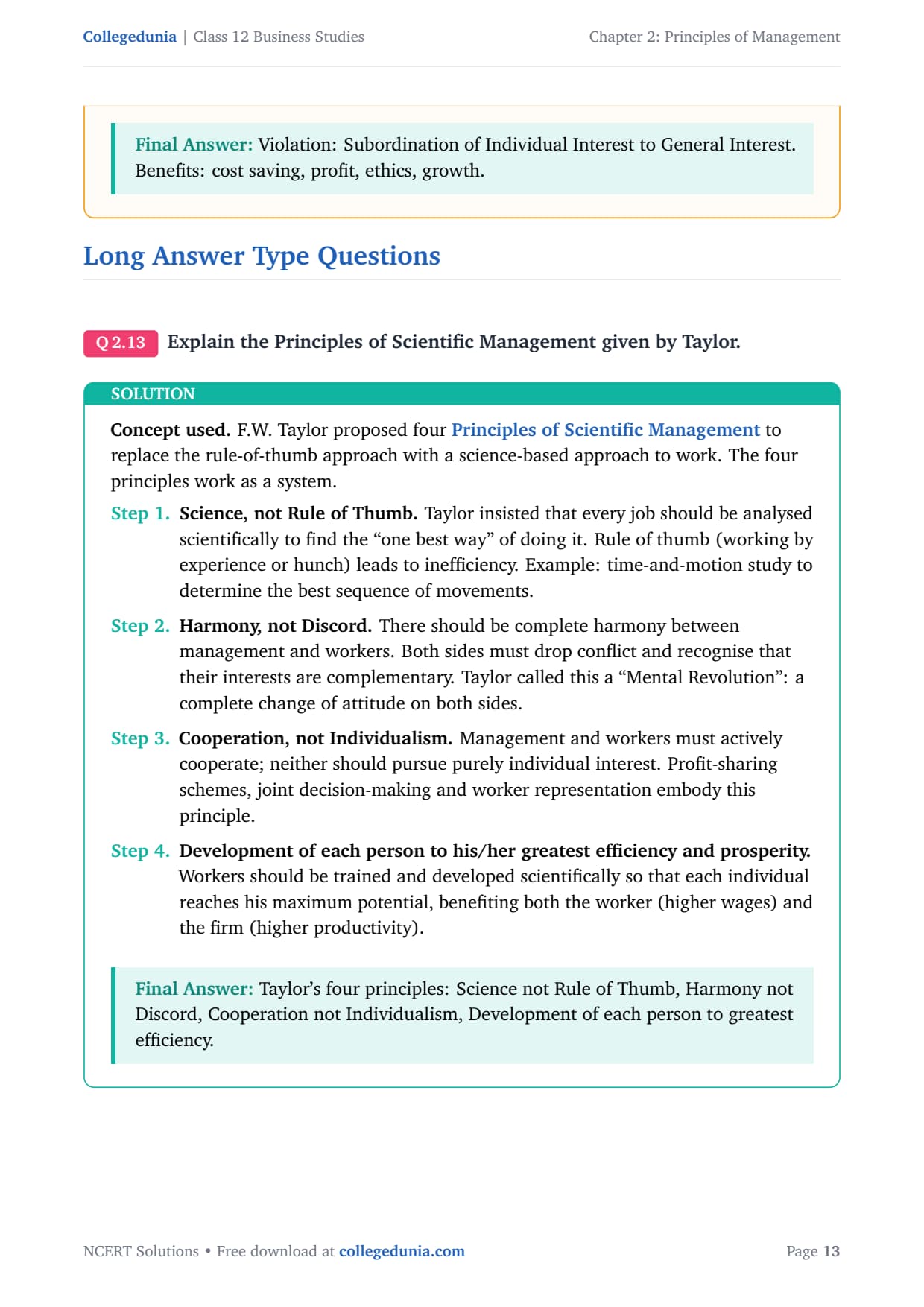
Violation: Subordination of Individual Interest to General Interest. Benefits: cost
saving, profit, ethics, growth.
Long Answer Type Questions
Q 2.13
Explain the Principles of Scientific Management given by Taylor.
Concept used. F.W. Taylor proposed four Principles of Scientific Management
to replace the rule-of-thumb approach with a science-based approach to work. The four principles
work as a system.
Science, not Rule of Thumb. Taylor insisted that every job should be analysed
scientifically to find the ``one best way'' of doing it. Rule of thumb (working by
experience or hunch) leads to inefficiency. Example: time-and-motion study to determine
the best sequence of movements.
Harmony, not Discord. There should be complete harmony between management and
workers. Both sides must drop conflict and recognise that their interests are
complementary. Taylor called this a ``Mental Revolution'': a complete change of attitude
on both sides.
Cooperation, not Individualism. Management and workers must actively cooperate;
neither should pursue purely individual interest. Profit-sharing schemes, joint
decision-making and worker representation embody this principle.
Development of each person to his/her greatest efficiency and prosperity.
Workers should be trained and developed scientifically so that each individual reaches
his maximum potential, benefiting both the worker (higher wages) and the firm (higher
productivity).
Taylor's four principles: Science not Rule of Thumb, Harmony not Discord, Cooperation
not Individualism, Development of each person to greatest efficiency.
MK
Meera Kapoor
MBA, IIM Ahmedabad
Verified Expert
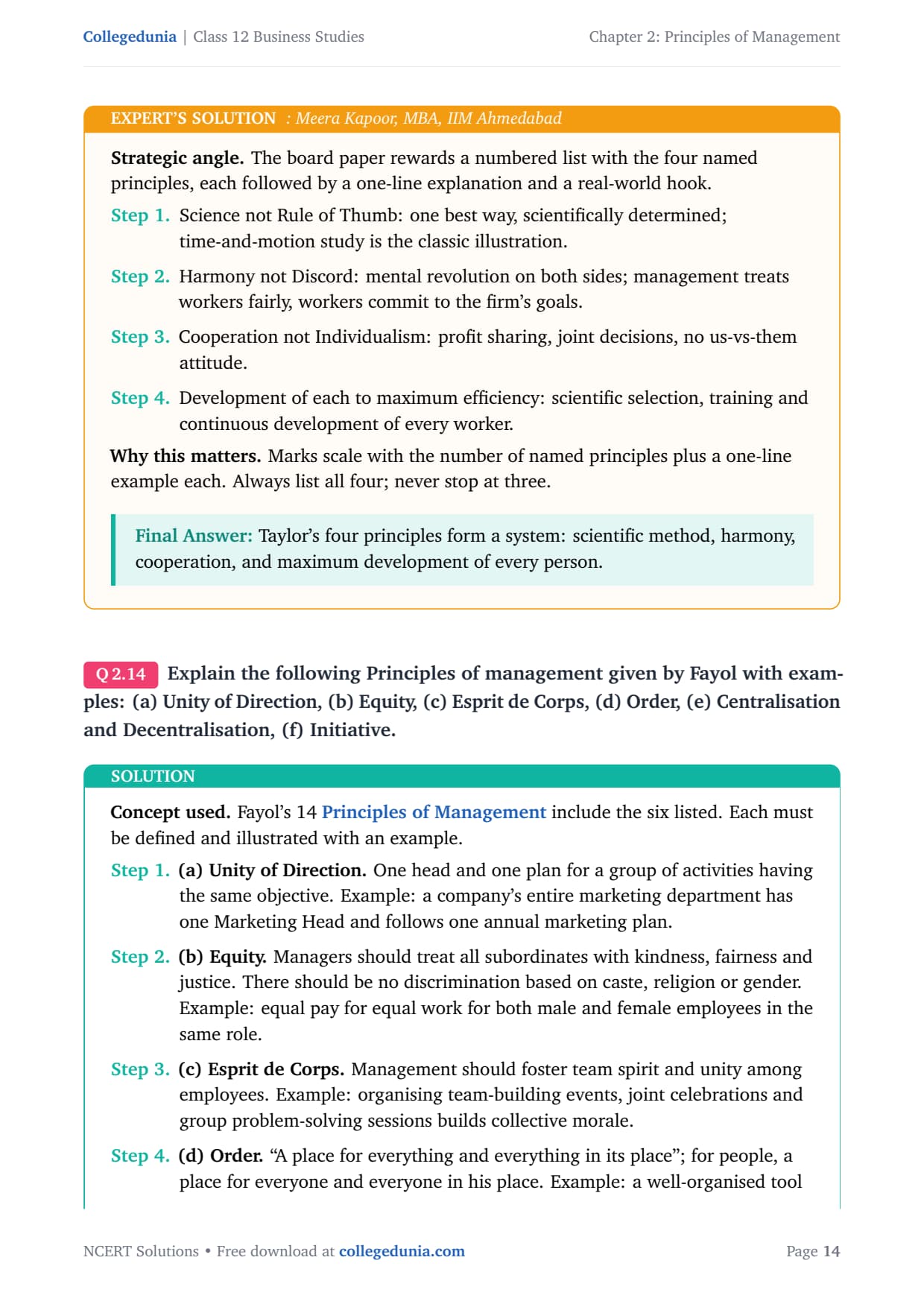
Strategic angle. The board paper rewards a numbered list with the four named principles,
each followed by a one-line explanation and a real-world hook.
Science not Rule of Thumb: one best way, scientifically determined; time-and-motion study
is the classic illustration.
Harmony not Discord: mental revolution on both sides; management treats workers fairly,
workers commit to the firm's goals.
Cooperation not Individualism: profit sharing, joint decisions, no us-vs-them attitude.
Development of each to maximum efficiency: scientific selection, training and continuous
development of every worker.
Why this matters. Marks scale with the number of named principles plus a one-line
example each. Always list all four; never stop at three.
Taylor's four principles form a system: scientific method, harmony, cooperation, and
maximum development of every person.
Q 2.14
Explain the following Principles of management given by Fayol with examples:
(a) Unity of Direction, (b) Equity, (c) Esprit de Corps, (d) Order, (e) Centralisation and
Decentralisation, (f) Initiative.
Concept used. Fayol's 14 Principles of Management include the six listed.
Each must be defined and illustrated with an example.
(a) Unity of Direction. One head and one plan for a group of activities having
the same objective. Example: a company's entire ncert-notes-class-12-business-studies-chapter-10-marketing department has one Marketing
Head and follows one annual ncert-notes-class-12-business-studies-chapter-10-marketing plan.
(b) Equity. Managers should treat all subordinates with kindness, fairness and
justice. There should be no discrimination based on caste, religion or gender. Example:
equal pay for equal work for both male and female employees in the same role.
(c) Esprit de Corps. Management should foster team spirit and unity among
employees. Example: organising team-building events, joint celebrations and group
problem-solving sessions builds collective morale.
(d) Order. ``A place for everything and everything in its place''; for people, a
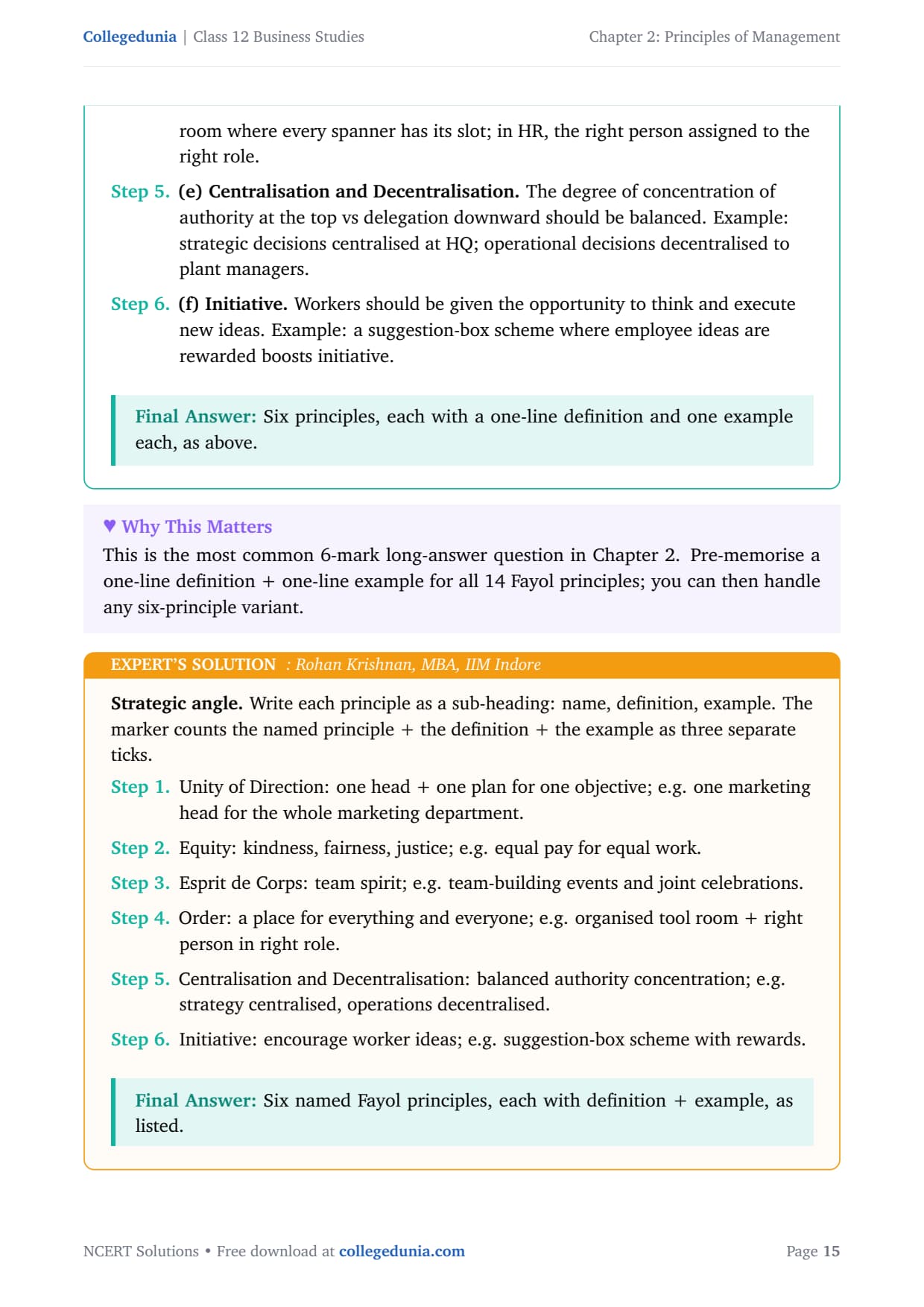
place for everyone and everyone in his place. Example: a well-organised tool room where
every spanner has its slot; in HR, the right person assigned to the right role.
(e) Centralisation and Decentralisation. The degree of concentration of
authority at the top vs delegation downward should be balanced. Example: strategic
decisions centralised at HQ; operational decisions decentralised to plant managers.
(f) Initiative. Workers should be given the opportunity to think and execute
new ideas. Example: a suggestion-box scheme where employee ideas are rewarded boosts
initiative.
Six principles, each with a one-line definition and one example each, as above.
RK
Rohan Krishnan
MBA, IIM Indore
Verified Expert
Strategic angle. Write each principle as a sub-heading: name, definition, example. The
marker counts the named principle + the definition + the example as three separate ticks.
Unity of Direction: one head + one plan for one objective; e.g. one ncert-notes-class-12-business-studies-chapter-10-marketing head for
the whole ncert-notes-class-12-business-studies-chapter-10-marketing department.
Equity: kindness, fairness, justice; e.g. equal pay for equal work.
Esprit de Corps: team spirit; e.g. team-building events and joint celebrations.
Order: a place for everything and everyone; e.g. organised tool room + right person in
right role.
Centralisation and Decentralisation: balanced authority concentration; e.g. strategy
centralised, operations decentralised.
Initiative: encourage worker ideas; e.g. suggestion-box scheme with rewards.
Six named Fayol principles, each with definition + example, as listed.
Q 2.15
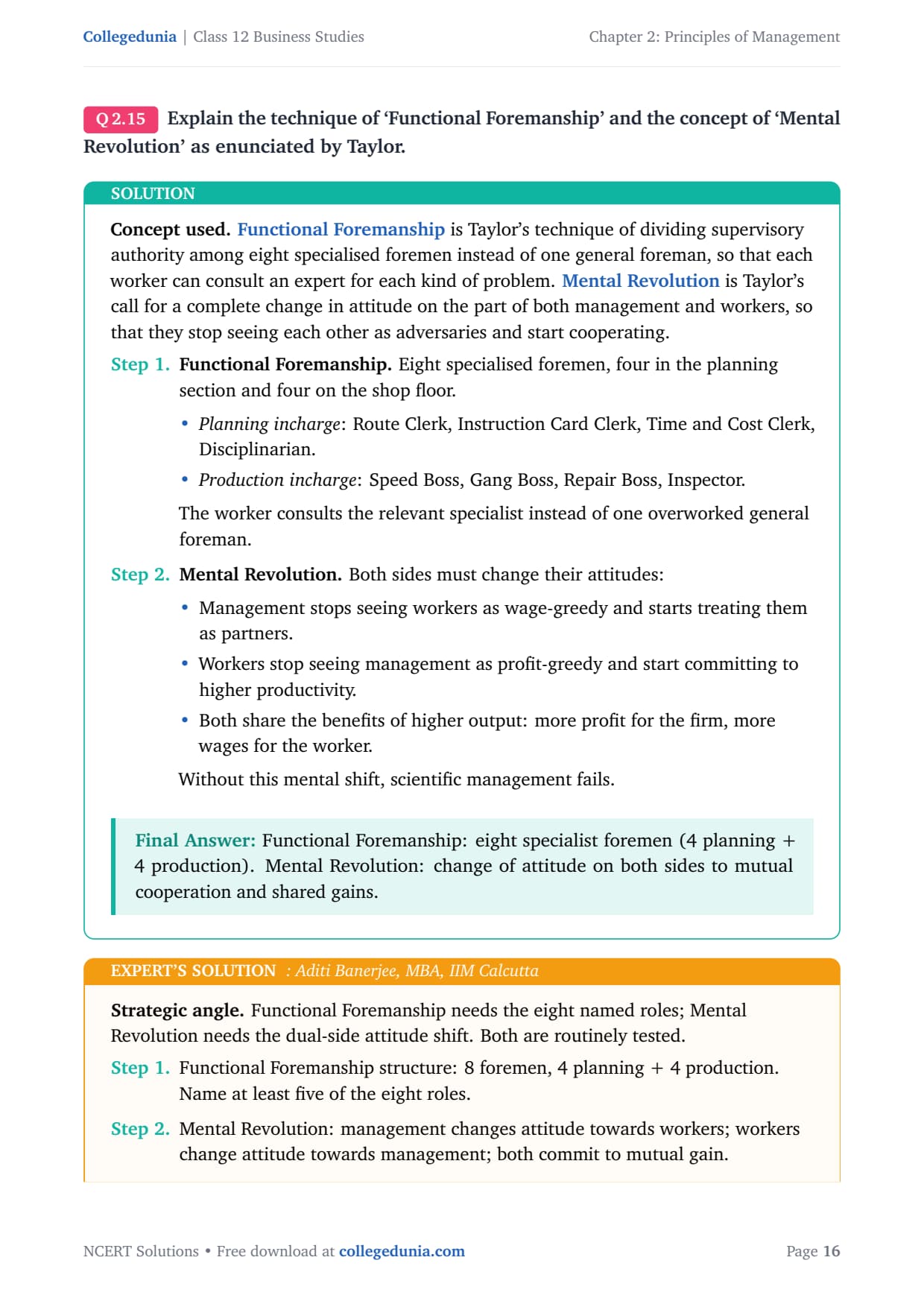
Explain the technique of `Functional Foremanship' and the concept of `Mental
Revolution' as enunciated by Taylor.
Concept used.Functional Foremanship is Taylor's technique of dividing
supervisory authority among eight specialised foremen instead of one general foreman, so that
each worker can consult an expert for each kind of problem. Mental Revolution is
Taylor's call for a complete change in attitude on the part of both management and workers, so
that they stop seeing each other as adversaries and start cooperating.
Functional Foremanship. Eight specialised foremen, four in the planning section
and four on the shop floor.
Planning incharge: Route Clerk, Instruction Card Clerk, Time and Cost
Clerk, Disciplinarian.
Production incharge: Speed Boss, Gang Boss, Repair Boss, Inspector.
The worker consults the relevant specialist instead of one overworked general foreman.
Mental Revolution. Both sides must change their attitudes:
Management stops seeing workers as wage-greedy and starts treating them as
partners.
Workers stop seeing management as profit-greedy and start committing to higher
productivity.
Both share the benefits of higher output: more profit for the firm, more wages
for the worker.
Without this mental shift, scientific management fails.
Functional Foremanship: eight specialist foremen (4 planning + 4 production). Mental
Revolution: change of attitude on both sides to mutual cooperation and shared gains.
AB
Aditi Banerjee
MBA, IIM Calcutta
Verified Expert
Strategic angle. Functional Foremanship needs the eight named roles; Mental Revolution
needs the dual-side attitude shift. Both are routinely tested.
Functional Foremanship structure: 8 foremen, 4 planning + 4 production. Name at least
five of the eight roles.
Mental Revolution: management changes attitude towards workers; workers change attitude
towards management; both commit to mutual gain.
Tie together: without mental revolution, functional foremanship is just an organogram;
with it, scientific management becomes a culture.
Functional Foremanship = 8 specialist foremen. Mental Revolution = complete attitude
shift on both management and worker sides.
Q 2.16
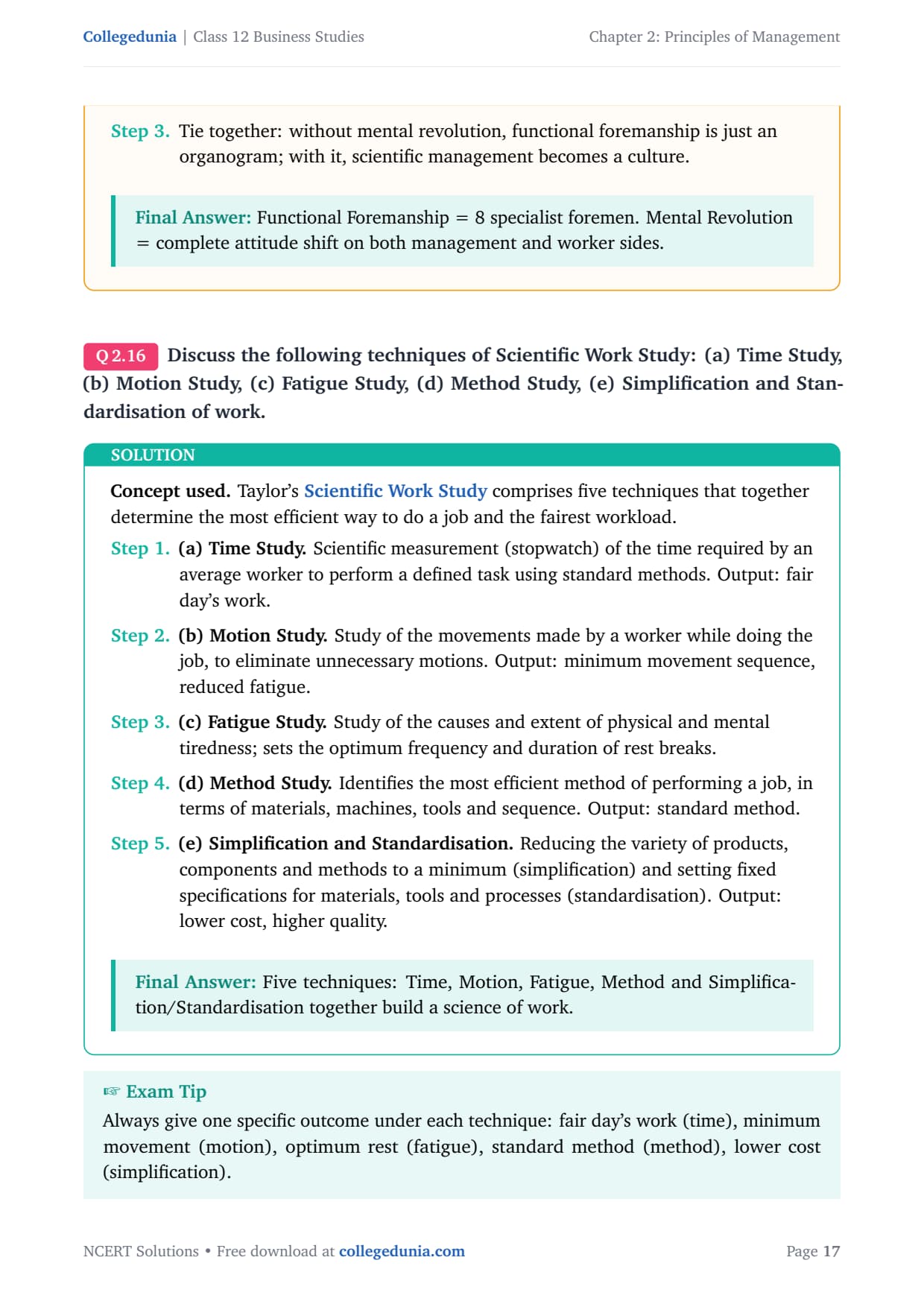
Discuss the following techniques of Scientific Work Study: (a) Time Study, (b) Motion
Study, (c) Fatigue Study, (d) Method Study, (e) Simplification and Standardisation of work.
Concept used. Taylor's Scientific Work Study comprises five techniques that
together determine the most efficient way to do a job and the fairest workload.
(a) Time Study. Scientific measurement (stopwatch) of the time required by an
average worker to perform a defined task using standard methods. Output: fair day's work.
(b) Motion Study. Study of the movements made by a worker while doing the job,
to eliminate unnecessary motions. Output: minimum movement sequence, reduced fatigue.
(c) Fatigue Study. Study of the causes and extent of physical and mental
tiredness; sets the optimum frequency and duration of rest breaks.
(d) Method Study. Identifies the most efficient method of performing a job, in
terms of materials, machines, tools and sequence. Output: standard method.
(e) Simplification and Standardisation. Reducing the variety of products,
components and methods to a minimum (simplification) and setting fixed specifications
for materials, tools and processes (standardisation). Output: lower cost, higher
quality.
Five techniques: Time, Motion, Fatigue, Method and Simplification/Standardisation
together build a science of work.
NI
Neha Iyengar
MBA, SP Jain
Verified Expert
Strategic angle. List five techniques, each with a one-line definition and a one-line
output.
Five named techniques, each delivering a measurable improvement in efficiency.
Q 2.17
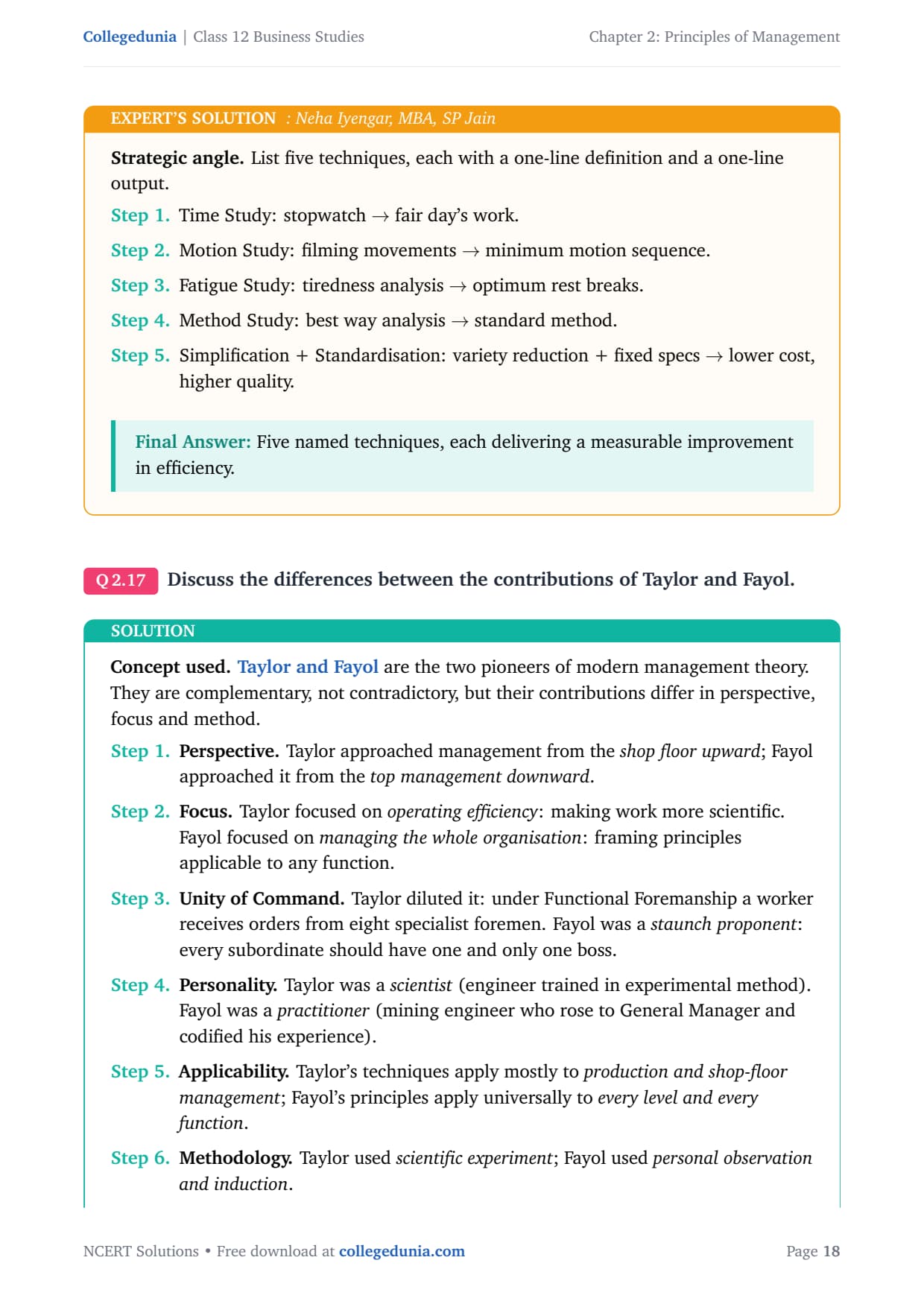
Discuss the differences between the contributions of Taylor and Fayol.
Concept used.Taylor and Fayol are the two pioneers of modern management
theory. They are complementary, not contradictory, but their contributions differ in perspective,
focus and method.
Perspective. Taylor approached management from the shop floor upward;
Fayol approached it from the top management downward.
Focus. Taylor focused on operating efficiency: making work more
scientific. Fayol focused on managing the whole organisation: framing principles
applicable to any function.
Unity of Command. Taylor diluted it: under Functional Foremanship a worker
receives orders from eight specialist foremen. Fayol was a staunch proponent: every
subordinate should have one and only one boss.
Personality. Taylor was a scientist (engineer trained in experimental
method). Fayol was a practitioner (mining engineer who rose to General Manager
and codified his experience).
Applicability. Taylor's techniques apply mostly to production and
shop-floor management; Fayol's principles apply universally to every level and
every function.
Methodology. Taylor used scientific experiment; Fayol used
personal observation and induction.
Taylor (shop floor up, scientist, production focus, experiment) vs Fayol (top down,
practitioner, whole organisation focus, observation). Complementary, not opposed.
KS
Karthik Sharma
MBA, MDI Gurgaon
Verified Expert
Strategic angle. Write a six-row comparison table: perspective, focus, unity emphasis,
personality, applicability, methodology. Six rows = six clean ticks for the marker.
Perspective: bottom-up (Taylor) vs top-down (Fayol).
Focus: operating efficiency vs whole-organisation management.
Unity of Command: Taylor diluted (8 foremen per worker) vs Fayol staunch proponent (one boss).
Personality: scientist (Taylor) vs practitioner (Fayol).
Applicability: production-floor focus (Taylor) vs universal (Fayol).
Methodology: experiment (Taylor) vs observation (Fayol).
Six-point comparison; both complementary, not in conflict.
Q 2.18
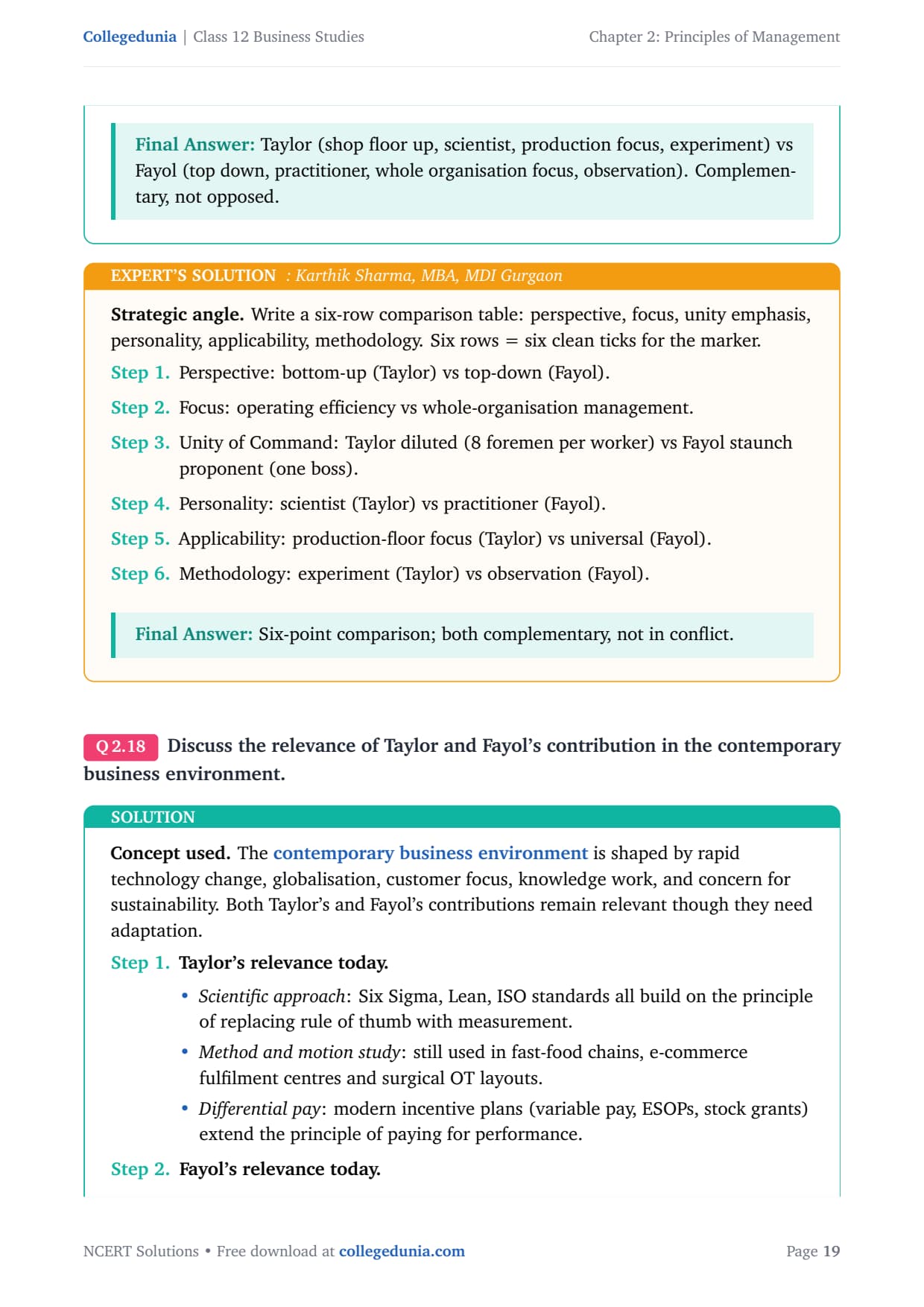
Discuss the relevance of Taylor and Fayol's contribution in the contemporary business
environment.
Concept used. The contemporary business environment is shaped by rapid
technology change, globalisation, customer focus, knowledge work, and concern for sustainability.
Both Taylor's and Fayol's contributions remain relevant though they need adaptation.
Taylor's relevance today.
Scientific approach: Six Sigma, Lean, ISO standards all build on the
principle of replacing rule of thumb with measurement.
Method and motion study: still used in fast-food chains, e-commerce
fulfilment centres and surgical OT layouts.
Differential pay: modern incentive plans (variable pay, ESOPs, stock
grants) extend the principle of paying for performance.
Fayol's relevance today.
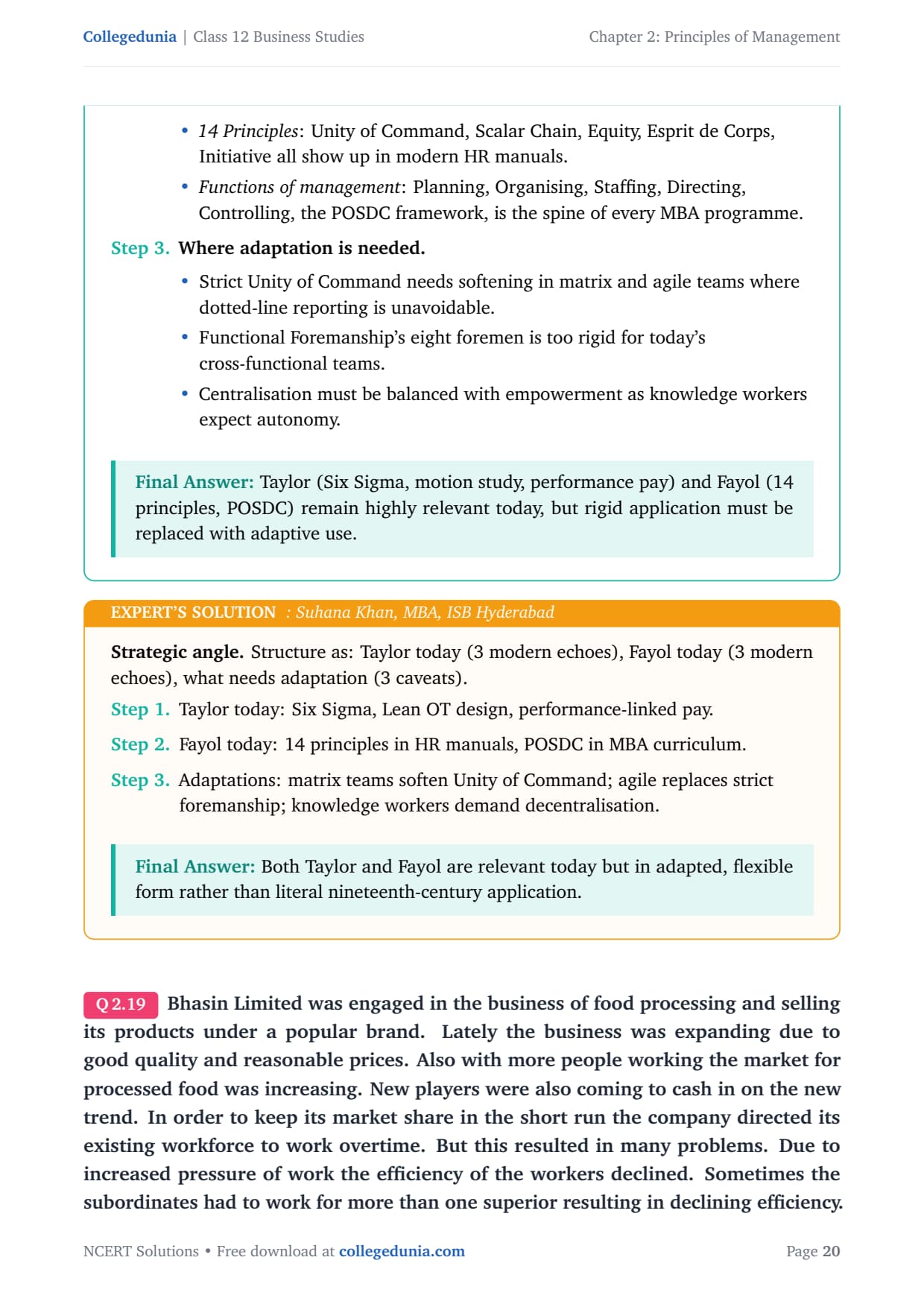
14 Principles: Unity of Command, Scalar Chain, Equity, Esprit de Corps,
Initiative all show up in modern HR manuals.
Functions of management: Planning, Organising, Staffing, Directing,
Controlling, the POSDC framework, is the spine of every MBA programme.
Where adaptation is needed.
Strict Unity of Command needs softening in matrix and agile teams where
dotted-line reporting is unavoidable.
Functional Foremanship's eight foremen is too rigid for today's cross-functional
teams.
Centralisation must be balanced with empowerment as knowledge workers expect
autonomy.
Taylor (Six Sigma, motion study, performance pay) and Fayol (14 principles, POSDC)
remain highly relevant today, but rigid application must be replaced with adaptive use.
SK
Suhana Khan
MBA, ISB Hyderabad
Verified Expert
Strategic angle. Structure as: Taylor today (3 modern echoes), Fayol today (3 modern
echoes), what needs adaptation (3 caveats).
Taylor today: Six Sigma, Lean OT design, performance-linked pay.
Fayol today: 14 principles in HR manuals, POSDC in MBA curriculum.
Adaptations: matrix teams soften Unity of Command; agile replaces strict foremanship;
knowledge workers demand decentralisation.
Both Taylor and Fayol are relevant today but in adapted, flexible form rather than
literal nineteenth-century application.
Q 2.19
Bhasin Limited was engaged in the business of food processing and selling its products
under a popular brand. Lately the business was expanding due to good quality and reasonable
prices. Also with more people working the market for processed food was increasing. New players
were also coming to cash in on the new trend. In order to keep its market share in the short run
the company directed its existing workforce to work overtime. But this resulted in many problems.
Due to increased pressure of work the efficiency of the workers declined. Sometimes the
subordinates had to work for more than one superior resulting in declining efficiency. The
divisions that were previously working on one product were also made to work on two or more
products. This resulted in a lot of overlapping and wastage. The workers were becoming
indisciplined. The spirit of teamwork, which had characterized the company, previously was
beginning to wane. Workers were feeling cheated and initiative was declining. The quality of the
products was beginning to decline and market share was on the verge of decrease. Actually the
company had implemented changes without creating the required infrastructure.
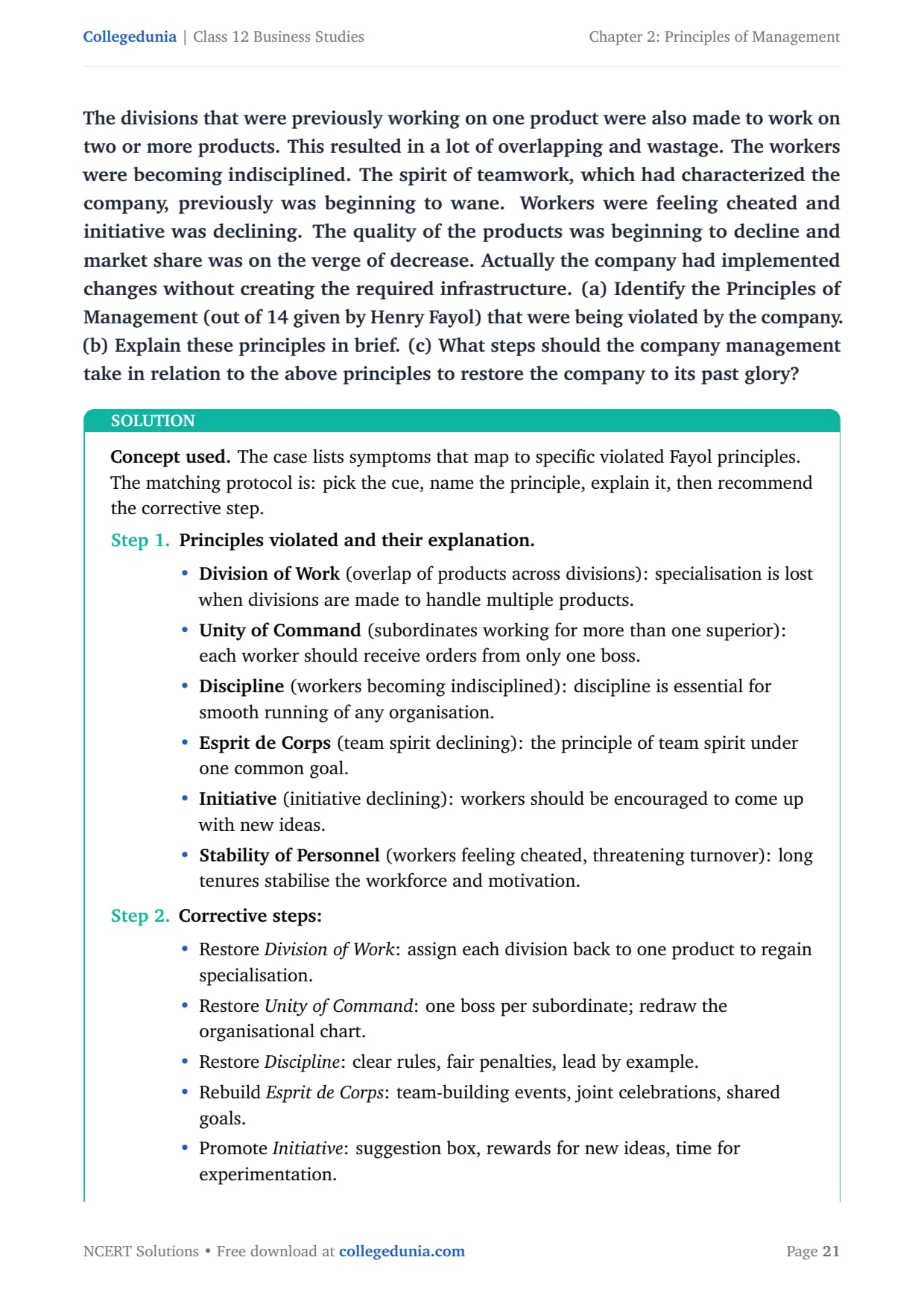
(a) Identify the Principles of Management (out of 14 given by Henry Fayol) that were being
violated by the company. (b) Explain these principles in brief. (c) What steps should the
company management take in relation to the above principles to restore the company to its past
glory?
Concept used. The case lists symptoms that map to specific violated Fayol principles.
The matching protocol is: pick the cue, name the principle, explain it, then recommend the
corrective step.
Principles violated and their explanation.
Division of Work (overlap of products across divisions): specialisation
is lost when divisions are made to handle multiple products.
Unity of Command (subordinates working for more than one superior):
each worker should receive orders from only one boss.
Discipline (workers becoming indisciplined): discipline is essential
for smooth running of any organisation.
Esprit de Corps (team spirit declining): the principle of team spirit
under one common goal.
Initiative (initiative declining): workers should be encouraged to come
up with new ideas.
Stability of Personnel (workers feeling cheated, threatening turnover):
long tenures stabilise the workforce and motivation.
Corrective steps:
Restore Division of Work: assign each division back to one product to
regain specialisation.
Restore Unity of Command: one boss per subordinate; redraw the
organisational chart.
Restore Discipline: clear rules, fair penalties, lead by example.
Rebuild Esprit de Corps: team-building events, joint celebrations, shared
goals.
Promote Initiative: suggestion box, rewards for new ideas, time for
experimentation.
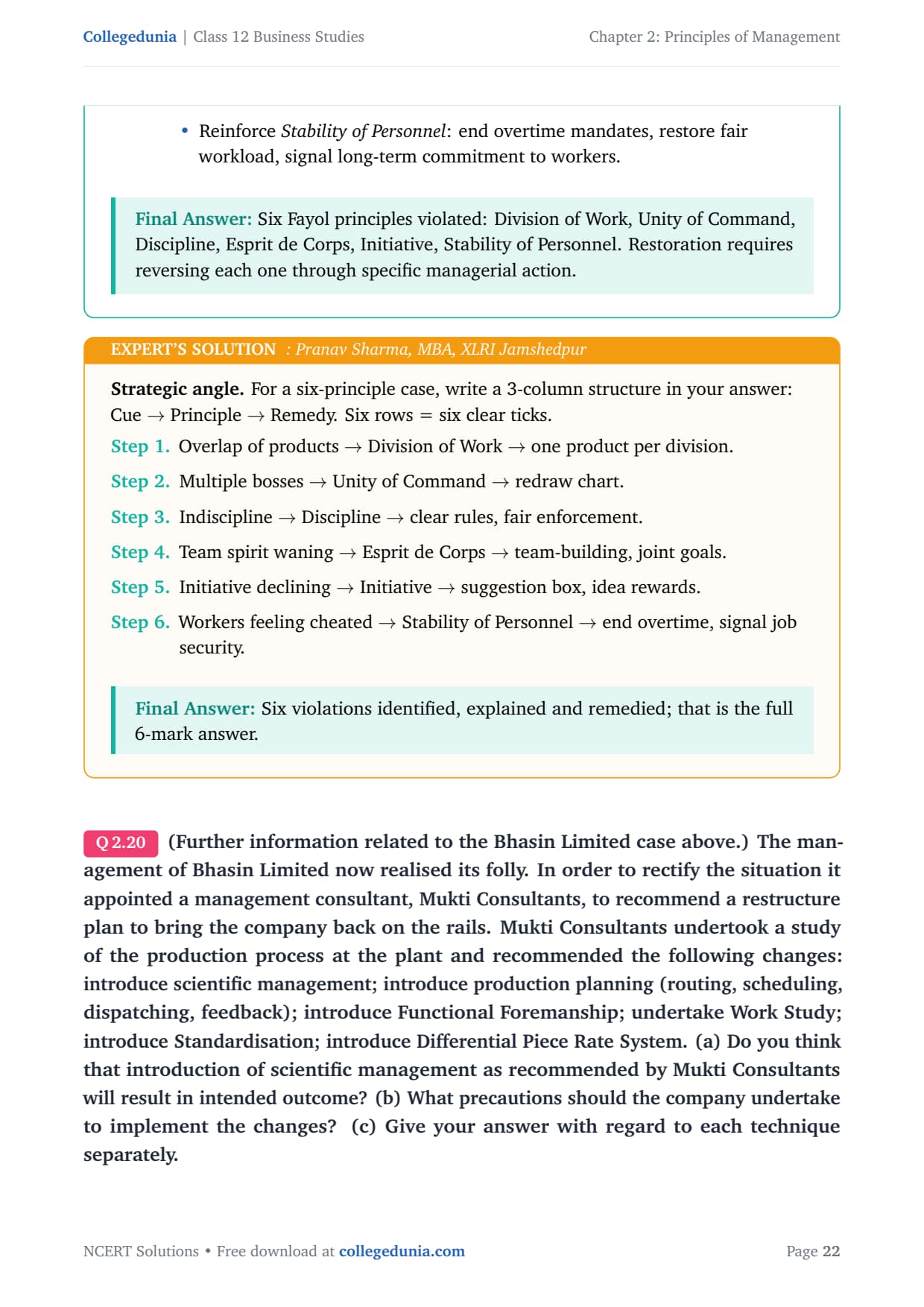
Reinforce Stability of Personnel: end overtime mandates, restore fair
workload, signal long-term commitment to workers.
Six Fayol principles violated: Division of Work, Unity of Command, Discipline, Esprit
de Corps, Initiative, Stability of Personnel. Restoration requires reversing each one through
specific managerial action.
PS
Pranav Sharma
MBA, XLRI Jamshedpur
Verified Expert
Strategic angle. For a six-principle case, write a 3-column structure in your answer:
Cue \(\to\) Principle \(\to\) Remedy. Six rows = six clear ticks.
Overlap of products \(\to\) Division of Work \(\to\) one product per division.
Multiple bosses \(\to\) Unity of Command \(\to\) redraw chart.
Team spirit waning \(\to\) Esprit de Corps \(\to\) team-building, joint goals.
Initiative declining \(\to\) Initiative \(\to\) suggestion box, idea rewards.
Workers feeling cheated \(\to\) Stability of Personnel \(\to\) end overtime, signal job
security.
Six violations identified, explained and remedied; that is the full 6-mark answer.
Q 2.20
(Further information related to the Bhasin Limited case above.) The management of
Bhasin Limited now realised its folly. In order to rectify the situation it appointed a
management consultant, Mukti Consultants, to recommend a restructure plan to bring the company
back on the rails. Mukti Consultants undertook a study of the production process at the plant and
recommended the following changes: introduce scientific management; introduce production planning
(routing, scheduling, dispatching, feedback); introduce Functional Foremanship; undertake Work
Study; introduce Standardisation; introduce Differential Piece Rate System. (a) Do you think that
introduction of scientific management as recommended by Mukti Consultants will result in intended
outcome? (b) What precautions should the company undertake to implement the changes? (c) Give
your answer with regard to each technique separately.
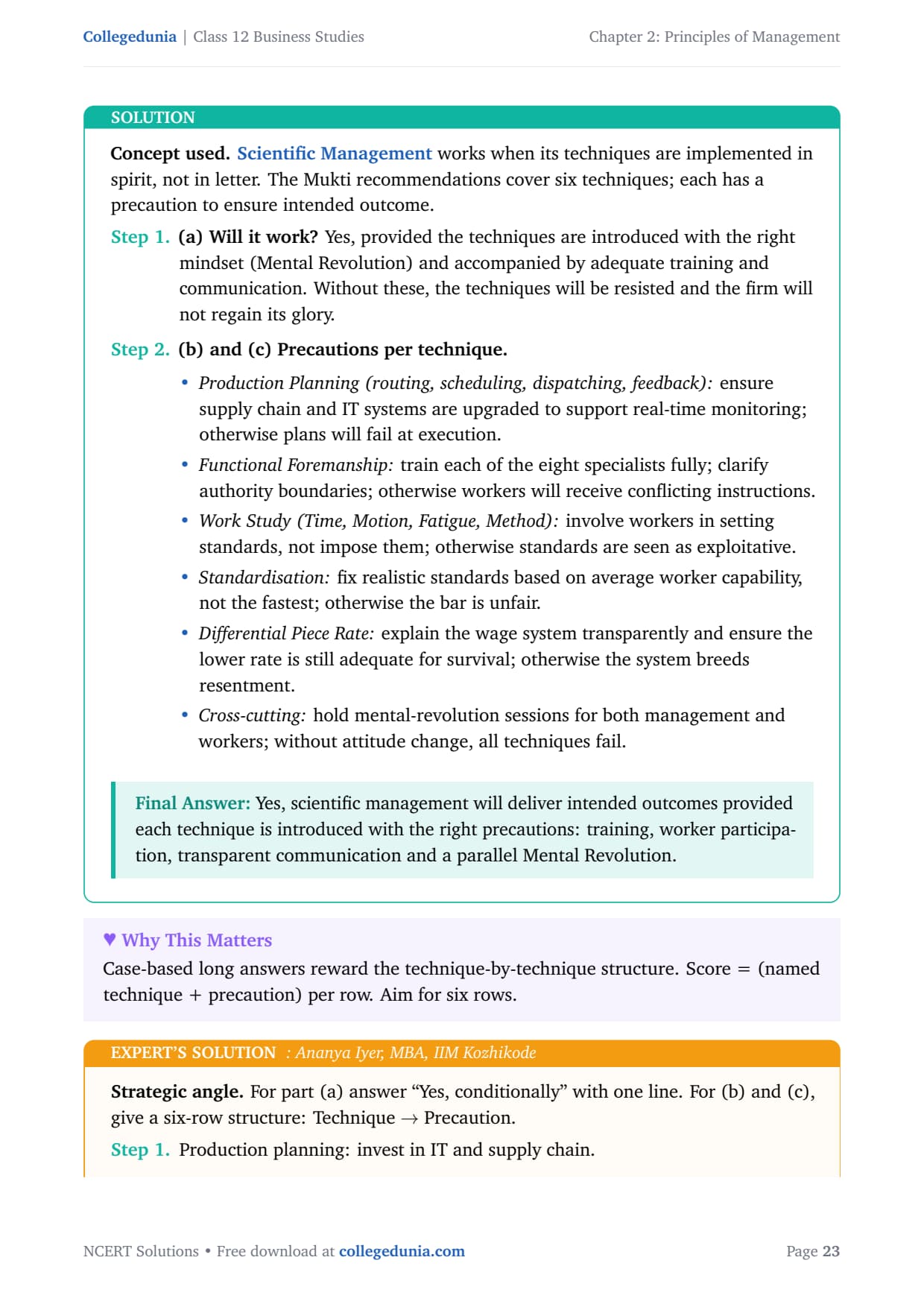
Concept used.Scientific Management works when its techniques are implemented
in spirit, not in letter. The Mukti recommendations cover six techniques; each has a precaution
to ensure intended outcome.
(a) Will it work? Yes, provided the techniques are introduced with the right
mindset (Mental Revolution) and accompanied by adequate training and communication.
Without these, the techniques will be resisted and the firm will not regain its glory.
(b) and (c) Precautions per technique.
Production Planning (routing, scheduling, dispatching, feedback): ensure
supply chain and IT systems are upgraded to support real-time monitoring;
otherwise plans will fail at execution.
Functional Foremanship: train each of the eight specialists fully;
clarify authority boundaries; otherwise workers will receive conflicting
instructions.
Work Study (Time, Motion, Fatigue, Method): involve workers in setting
standards, not impose them; otherwise standards are seen as exploitative.
Standardisation: fix realistic standards based on average worker
capability, not the fastest; otherwise the bar is unfair.
Differential Piece Rate: explain the wage system transparently and ensure
the lower rate is still adequate for survival; otherwise the system breeds
resentment.
Cross-cutting: hold mental-revolution sessions for both management and
workers; without attitude change, all techniques fail.
Yes, scientific management will deliver intended outcomes provided each technique is
introduced with the right precautions: training, worker participation, transparent communication
and a parallel Mental Revolution.
AI
Ananya Iyer
MBA, IIM Kozhikode
Verified Expert
Strategic angle. For part (a) answer ``Yes, conditionally'' with one line. For (b) and
(c), give a six-row structure: Technique \(\to\) Precaution.
Production planning: invest in IT and supply chain.
Cross-cutting: drive Mental Revolution for both sides.
Scientific management will work conditionally; six precautions, one per technique, must
accompany implementation.
Student Feedback
In a Collegedunia poll of 940 Class 12 Commerce students, 82% said the Fayol vs Taylor comparison and the case-based questions were the hardest part of this chapter to score in. 3 in 4 said practising the Bhasin and Mr. Rathore cases with these step-by-step solutions raised their confidence for the 6-mark Long Answer.
Other Resources for Class 12 Business Studies Chapter 2 Principles of Management
What are the 14 principles of management by Fayol?
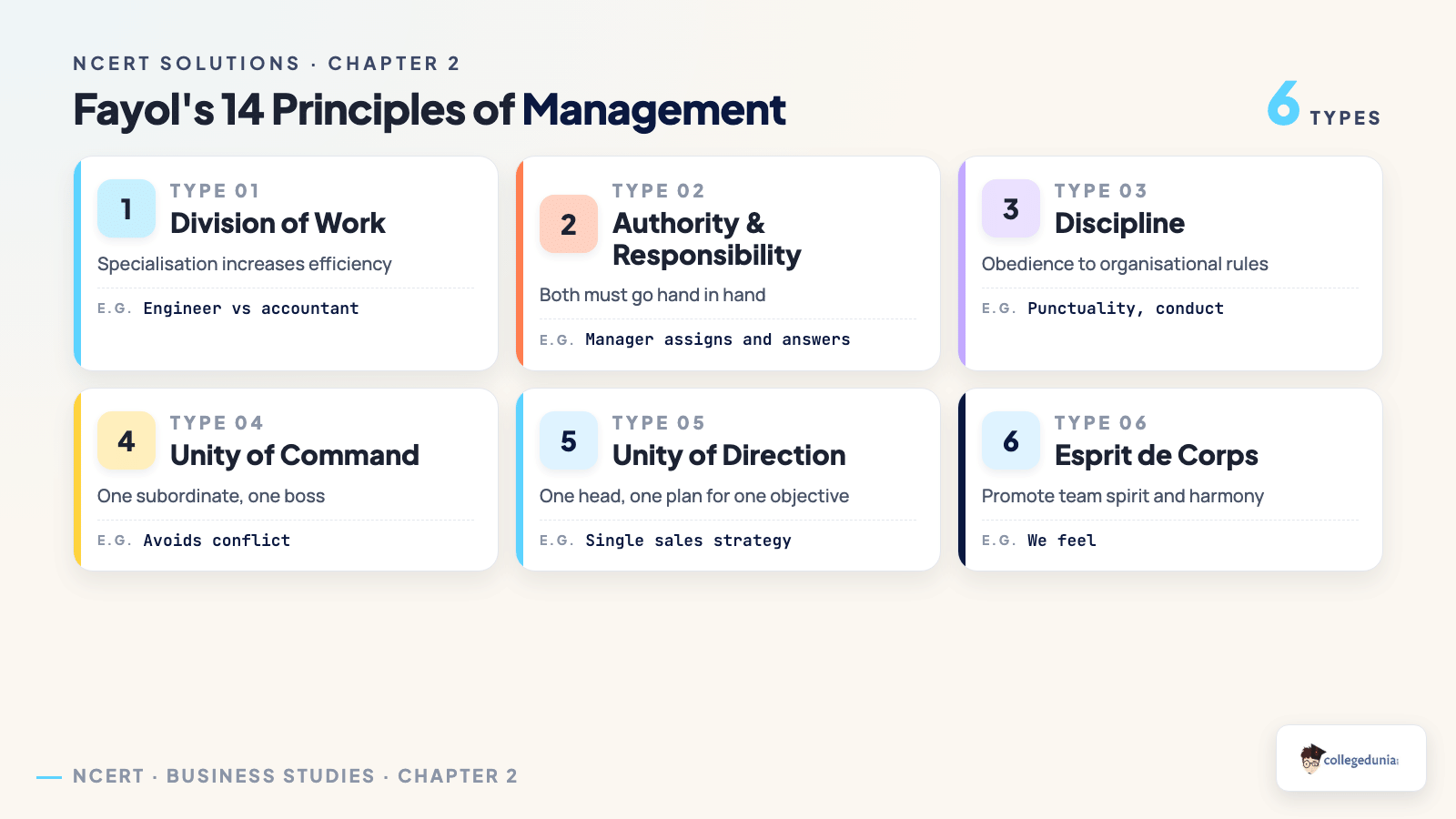
Fayol's 14 principles are: (1) Division of Work, (2) Authority and Responsibility, (3) Discipline, (4) Unity of Command, (5) Unity of Direction, (6) Subordination of Individual Interest to General Interest, (7) Remuneration of Personnel, (8) Centralisation and Decentralisation, (9) Scalar Chain, (10) Order, (11) Equity, (12) Stability of Personnel, (13) Initiative, (14) Esprit de Corps.
What are Taylor's four principles of scientific management?
Taylor's four principles are: (1) Science, not Rule of Thumb, (2) Harmony, not Discord, (3) Cooperation, not Individualism, (4) Development of each person to his/her greatest efficiency and prosperity.
What are the 7 techniques of scientific management?
Taylor proposed 7 techniques: (1) Functional Foremanship, (2) Standardisation and Simplification of Work, (3) Method Study, (4) Motion Study, (5) Time Study, (6) Fatigue Study and (7) Differential Piece Wage System. NCERT Class 12 lists all seven; students sometimes mistakenly write five or six.
What is Functional Foremanship and who are the eight foremen?
Functional Foremanship is Taylor's technique of dividing supervisory authority among eight specialised foremen instead of one general foreman. Four are in the planning section (Route Clerk, Instruction Card Clerk, Time and Cost Clerk, Disciplinarian) and four are on the production floor (Speed Boss, Gang Boss, Repair Boss, Inspector).
What is Mental Revolution in Taylor's scientific management?
Mental Revolution is Taylor's call for a complete change of attitude on the part of both management and workers. Management must stop treating workers as wage-greedy and workers must stop treating management as profit-greedy. Both must commit to mutual cooperation and shared gains.
What is the difference between Scalar Chain and Gang Plank?
Scalar Chain is the formal vertical line of authority from the top to the bottom of the organisation. Gang Plank is an exception that allows two employees at the same level in different departments to communicate directly with each other in an emergency, bypassing the chain to save time, with their superiors' knowledge.
What is the difference between Unity of Command and Unity of Direction?
Unity of Command means each employee should receive orders from only one superior, to avoid conflicting instructions. Unity of Direction means each group of activities with the same objective should have one head and one plan, to ensure unified effort. Unity of Command relates to one boss per worker; Unity of Direction relates to one plan per objective.
Which principle did Mr. Rathore violate by ordering raw material from his cousin at a higher price?
Mr. Rathore violated Fayol's principle of Subordination of Individual Interest to General Interest. He put personal interest (favouring his cousin) above the firm's interest (lower price from the usual supplier).
What is the Differential Piece Rate System?
Taylor's Differential Piece Rate System is a wage incentive that pays efficient workers (those who meet or exceed the standard) at a higher rate per unit and inefficient workers (those who fall short) at a lower rate per unit. It financially distinguishes between the two groups and motivates higher productivity.
How is Fayol's approach different from Taylor's?
Fayol approached management from the top down (general administration of the whole organisation) and gave 14 principles applicable to every level and every type of organisation. Taylor approached management from the bottom up (shop-floor productivity) and gave 4 principles plus 7 techniques mainly for specialised production work. They are complementary, not contradictory.








Comments