NCERT Solutions for Class 12 English (Suppl.) Chapter 9 Kaleidoscope: Kubla Khan give students clear answers for the 2026-27 poem questions. The PDF below explains the river Alph, Xanadu, water imagery, magical details, poetic ecstasy, the fragment form and the research task in simple exam-ready steps.
Includes all 9 solved tasks from Understanding the Poem, Language Study and Try this out.
Matches the full NCERT 2026-27 Kaleidoscope question order for Class 12 English Elective revision.
Focuses on real and dream details, the sacred river, prophecy, music and Coleridge's creative power.
The downloadable PDF keeps the NCERT sequence intact and adds expert solution tabs for deeper poetry interpretation.
Student Feedback: Students often mix up the historical details of Xanadu with the dream images in the poem. This page separates the factual layer, the imagined layer and the exam answer structure so revision stays quick.
Scope note: This page is for the complete NCERT Kaleidoscope poem Kubla Khan. If your school uses an internal chapter list, check whether this poetry unit is included before treating it as test-only revision.
Kubla Khan is built as a dream vision. It begins with Kubla Khan ordering a pleasure dome in Xanadu, then moves through the sacred river Alph, measureless caverns, a violent chasm, ancestral voices, a damsel's song and the figure of the poet himself.
The main skill is to show how history becomes dream. Xanadu and Kubla Khan give the poem a factual base, but the river, caverns, prophecy and music turn that base into a supernatural vision. The poem should be answered as a fusion of fact and imagination.
NCERT area
What students answer
Best answer cue
Understanding the Poem
Alph, imagery, discord, magic and poetic ecstasy
Quote the image, then explain its effect.
Language Study
Rare musical instruments from folk cultures
Name the instrument and mention its region or sound.
Try this out
Factual and imaginary details after research
Separate historical references from dream invention.
Kubla Khan Poem Explanation for Class 12 English
Source: Magnet Brains
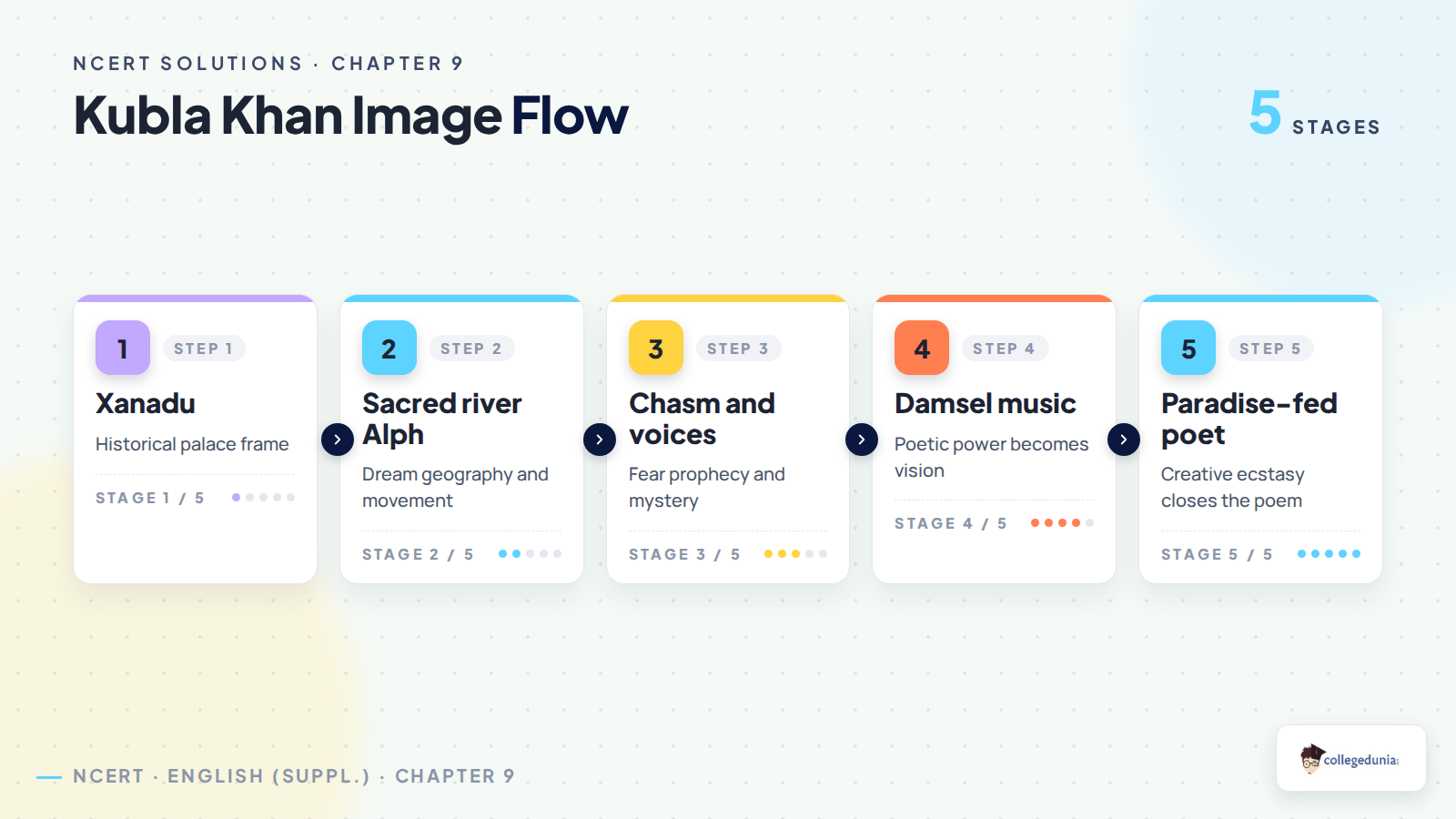
Kubla Khan Image Flow for NCERT Answers
The poem moves like a chain of images. A strong answer does not list the images randomly. It shows how each image deepens the atmosphere from imperial command to sacred mystery and then to poetic trance.
Xanadu gives the poem a royal and historical opening.
Alph and the caverns create sacred and mysterious movement.
The damsel's music shifts the focus to poetic creation.
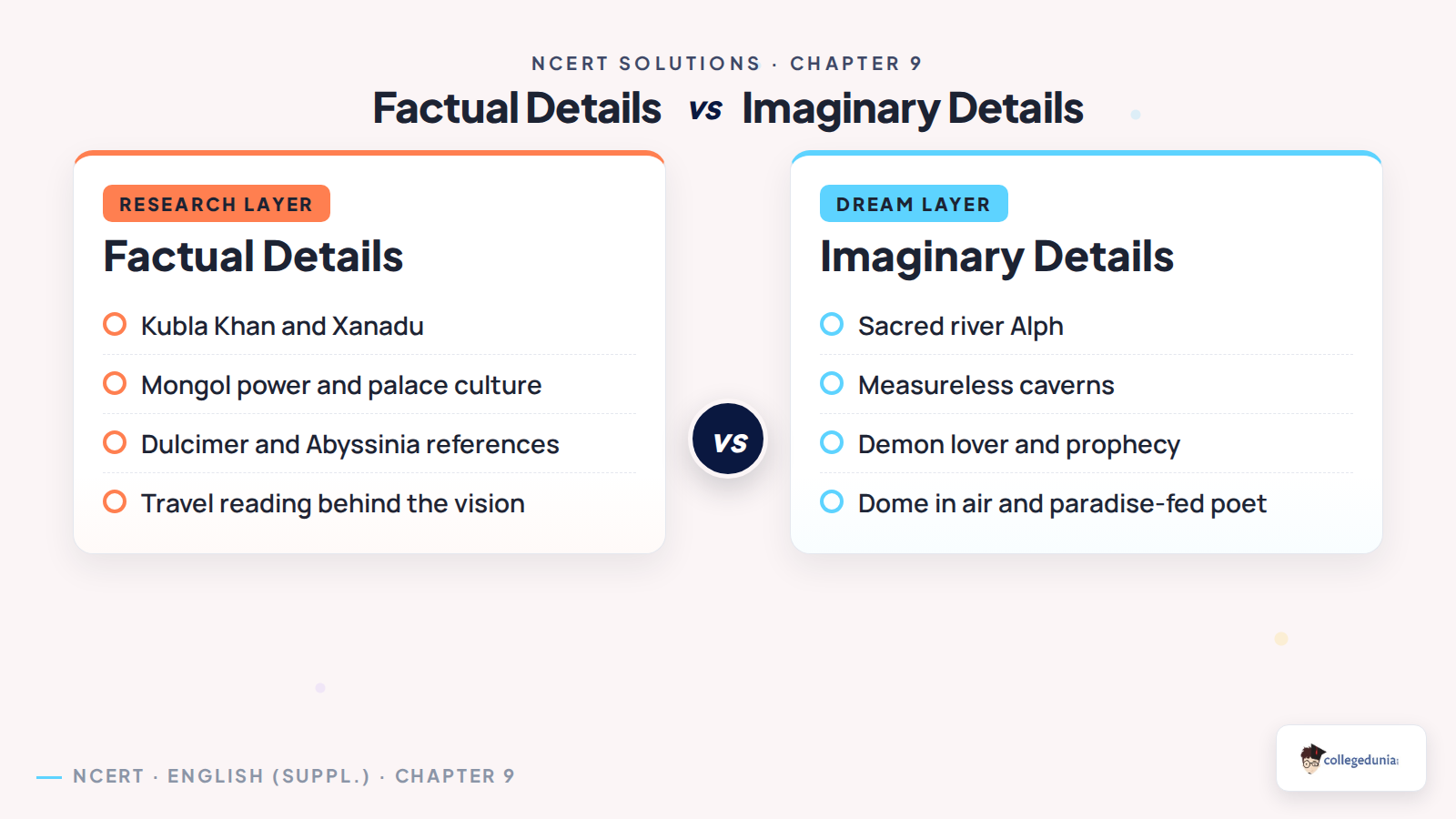
Factual and Imaginary Details in Kubla Khan
The final research task becomes easier when students separate facts from dream material. Kubla Khan, Xanadu, Mongol power, the dulcimer and Abyssinia can be researched. Alph, the measureless caverns, the demon-lover and the paradise-fed poet belong mainly to the poem's imagined world.
A balanced answer should not say that the factual side is more important than the dream side. Coleridge's achievement is that both layers work together. Research gives the dream texture, and imagination gives the facts symbolic force.
How to Write Better Kubla Khan Answers
Begin each answer with the exact NCERT demand. If the question asks for water movement, track the river, fountain and caves. If it asks for magic, include the chasm, voices, damsel, music and the transformed poet. If it asks about the fragment, explain why incompleteness adds mystery.
Use short quotations only when they support the point directly.
Do not treat Alph as a normal map river inside the poem.
Do not reduce the poem to history; its power lies in dream vision.
Close interpretive answers with the effect on the poem's atmosphere.
Class 12 English Supplementary Chapter 9 Resource Links
Use these related resources when you want the same chapter in another format. The table is placed above the FAQ so students can move from solutions to notes, book PDF and handwritten revision without losing the chapter context.
All NCERT Solutions for Class 12 English Supplementary Chapters
The table below keeps the same resource type together, so students can move chapter by chapter through the Class 12 English supplementary Kaleidoscope question set.
All NCERT Solutions for Class 12 English (Suppl.) Chapter 9 Kaleidoscope: Kubla Khan with Step-by-Step Solutions
The expandable cards below reproduce the full solution set from the PDF. Use the Solution tab for a direct exam-ready answer and the Expert Solution tab for a deeper reading of Coleridge's images, music and dream logic.
Questions
Q 9.1
Find out where the river Alph is.
Concept used. The river Alph is part of Coleridge's imagined Xanadu. The poem presents it as a sacred river running through measureless caverns, but it does not name a fixed real-world river that students can mark on a map.
Alph and Alpheus
Many students connect Alph with Alpheus, a river from Greek myth. That link adds mystery, but the poem's Alph remains mainly dream geography.
In the poem, Alph flows through Xanadu, the place where Kubla Khan orders a pleasure dome.
Xanadu has a historical base. It refers to Shangdu, Kubla Khan's summer capital in Inner Mongolia.
The river itself is not described like a surveyed river with a country, source, and mouth.
Coleridge calls it sacred and makes it run through caverns measureless to man.
This wording shifts the river from geography into dream and myth.
The name may echo the Alpheus river of classical tradition, but the poem transforms it.
Students should therefore answer with both parts: real Xanadu, imagined Alph.
The river Alph is the sacred river of Coleridge's dream-world Xanadu. Xanadu has a real historical base in Kubla Khan's Shangdu, but Alph is mainly an imagined, myth-like river rather than a fixed modern river.
AS
Aditi Sharma
M.A English, University of Delhi
Verified Expert
Quick reading. Treat Alph as a clue to the poem's method. Coleridge starts with a historical ruler and a real place, then makes the river pass into dream, myth, and sacred mystery.
The poem does not invite a simple atlas answer.
Kubla Khan and Xanadu point to real history.
Alph, however, is described through sacredness, caverns, and a sunless sea.
Those details belong to visionary landscape, not ordinary geography.
The possible echo of Alpheus strengthens the mythic sound of the name.
It does not turn Alph into a normal physical river inside the poem.
So the best answer keeps the real and imaginary layers together.
This answer also protects the student from a common mistake. If we call Alph a normal river, we flatten the poem's dream-world. If we call everything imaginary, we miss Coleridge's historical anchor.
Alph belongs to Coleridge's imagined Xanadu. Its name may recall classical river lore, but in Kubla Khan it functions as a sacred dream-river.
Q 9.2
Does the poem have a real geographical location? How does the poet mix up the real and the imaginary to give a sense of the surreal?
Concept used. Surreal writing joins recognisable reality with dream-like details. Kubla Khan has a historical ruler and a real place-name, but the landscape grows strange through sacred rivers, measureless caves, enchanted spaces, and prophetic voices.
Real plus imagined
Write the answer in two halves: what is real, and what Coleridge makes dream-like.
The poem begins with Xanadu and Kubla Khan.
Kubla Khan was a real Mongol ruler, and Xanadu refers to his summer capital.
This gives the poem a real historical starting point.
Coleridge then changes that starting point into a visionary landscape.
Alph runs through caverns measureless to man and sinks into a sunless sea.
The gardens are bright and fertile, but they stand near a deep romantic chasm.
The chasm is holy, enchanted, and linked with a woman wailing for her demon-lover.
The pleasure dome has a sunny surface and caves of ice.
Ancestral voices prophesy war, while music from a damsel seems able to rebuild the dome in air.
These details make the place feel half-real and half-dream.
The poem has a real historical base in Kubla Khan and Xanadu, but Coleridge fills it with sacred rivers, measureless caverns, enchanted chasms, war voices, and magical music. This mixture creates the poem's surreal effect.
RM
Rahul Menon
M.A English, EFLU Hyderabad
Verified Expert
Structural observation. The poem never abandons reality at once. It begins with a recognisable emperor, then keeps adding details that a normal map cannot hold.
Kubla Khan and Xanadu anchor the opening in history.
The phrase stately pleasure-dome also suits an emperor's command.
But the river Alph quickly takes us away from a normal palace scene.
Its course through measureless caverns creates vastness and mystery.
The sacred river, sunless sea, romantic chasm, and demon-lover create supernatural pressure.
The dome itself becomes impossible: sunny and icy at the same time.
The final vision of the poet fed on honeydew pushes the poem fully into imaginative power.
The surreal effect therefore comes from overlap. The student recognises an emperor and a palace, but each detail immediately exceeds ordinary reality. That is why the poem feels like remembered reading transformed by dream.
The poem uses real names as a base, then overlays them with dream images. The result is a surreal world where imperial power, nature, magic, and poetry exist together.
Q 9.3
Pick out (i) contrasting images that are juxtaposed throughout the poem, (ii) images that strike the eye and images that strike the ear, both positive and negative, and (iii) the words used to describe the movement of water.
Concept used. Imagery is language that appeals to the senses. Coleridge builds Kubla Khan through visual images, sound images, and movement words, so the student feels the dream as a moving scene.
Table method
For this question, a table is safer than a paragraph. It keeps the three sub-parts clear.
Contrasting images: sunny pleasure dome and caves of ice; fertile ground and savage chasm; gardens bright and caverns measureless; sacred river and lifeless ocean; poetic music and voices prophesying war.
Positive visual images: gardens bright with sinuous rills, incense-bearing trees, sunny spots of greenery, the stately pleasure dome, and the damsel with a dulcimer.
Negative visual images: deep romantic chasm, waning moon, demon-lover, lifeless ocean, and flashing eyes that inspire holy dread.
Positive sound images: the damsel's dulcimer, her symphony and song, music loud and long, and the mingled measure from fountain and caves.
Negative sound images: woman wailing, ceaseless turmoil, ancestral voices prophesying war, and the cry Beware! Beware!
Water movement words: ran, down, slanted, seething, forced, burst, vaulted, flung up, meandering, reached, sank, and floated.
The poem juxtaposes brightness with darkness, order with wildness, pleasure with fear, and music with war. Its visual, sound, and water-motion images make Xanadu feel alive, beautiful, and dangerous at the same time.
MK
Meera Krishnan
Ph.D English, University of Hyderabad
Verified Expert
Strategic angle. The poem's images are not decorative only. They make the student feel the dream's unstable balance between beauty and threat.
The pleasure dome shows human design and imperial order.
The chasm shows wild nature and supernatural fear.
Gardens and incense-bearing trees create brightness, scent, and luxury.
Caverns and the lifeless ocean create depth, darkness, and dread.
The ear also receives two opposite worlds.
Song and dulcimer suggest creativity and delight.
Wailing, tumult, and war voices suggest danger under the surface.
Water verbs keep the scene restless: Alph runs, bursts, meanders, sinks, and floats.
These shifting images give the poem its dream pressure.
This classification also shows Coleridge's control. He does not present a still painting. He gives the eye colour and shape, gives the ear music and warning, and gives water a continuous motion.
Coleridge creates a pattern of opposites: bright gardens and dark caves, song and war, sacred movement and destructive tumult. The water verbs make that pattern active.
Q 9.4
What is the discordant note heard at the end of the third stanza? Can we relate this to the grandeur and turmoil that are a part of an emperor's life?
Concept used. A discordant note is a sound or idea that breaks harmony. In the third stanza, the grandeur of the dome is disturbed by ancestral voices prophesying war.
War inside splendour
The poem does not let imperial beauty stay peaceful. Power brings building, but it also brings fear, memory, and conflict.
The stanza first describes the sacred river and the great pleasure dome.
The images suggest magnificence, design, and rare beauty.
Suddenly Kubla hears ancestral voices from far away.
These voices prophesy war.
This sound does not match the pleasure dome's beauty.
It is discordant because it brings anxiety into a scene of splendour.
The detail suits an emperor's life.
An emperor may build palaces, gardens, and cities.
Yet he also lives with conquest, rebellion, dynastic memory, and fear of attack.
The grandeur of power and the turmoil of power are therefore joined.
The discordant note is the sound of ancestral voices prophesying war. It connects with an emperor's life because imperial splendour is always shadowed by conflict, fear, conquest, and political unrest.
NR
Nandini Rao
M.A English, Jadavpur University
Verified Expert
Quick reading. The war prophecy is the crack in the dream-palace. It reminds us that rulers cannot separate beauty from violence.
Kubla's dome is a miracle of rare device.
It seems at first to prove command over land, water, and architecture.
But the ancestral voices arrive from far away.
Their message is not music or praise; it is war.
The word ancestral links the sound with dynasty and inherited power.
It suggests that empire carries old memories and old threats.
An emperor's public grandeur may hide private fear.
Coleridge captures that tension in a single sound-image.
So the question is not only about one line. It asks students to see how political power works in the poem. A palace may display control, but prophecy reminds the ruler of violence and instability.
The prophecy of war breaks the poem's harmony. It shows that Kubla's grandeur is inseparable from the danger and unrest of empire.
Q 9.5
Which are the lines that refer to magical elements?
Concept used. Magical elements in poetry appear through supernatural places, impossible combinations, visionary music, prophetic voices, and sacred fear. Kubla Khan uses all these signals.
Quote short phrases
You do not need to copy the whole poem. Short quoted phrases with explanation are enough.
The line about caverns measureless to man suggests an impossible underground world.
The deep romantic chasm is called holy and enchanted.
The phrase woman wailing for her demon-lover is openly supernatural.
The mighty fountain that is forced from the earth gives the landscape a living power.
Ancestral voices prophesying war add prophecy to the poem.
A sunny pleasure dome with caves of ice is an impossible and magical combination.
The damsel with a dulcimer appears in a vision.
The speaker says he could build that dome in air if he revived her song.
The closing lines, Beware! Beware!, flashing eyes, floating hair, holy dread, honeydew, and milk of Paradise make the poet seem like a magical figure.
The magical lines include references to measureless caverns, the holy and enchanted chasm, the demon-lover, ancestral voices, the sunny dome with caves of ice, the visionary damsel, the dome built in air, and the poet fed on honeydew and the milk of Paradise.
AS
Arjun Sen
M.A English, University of Calcutta
Verified Expert
Structural observation. The magic grows in stages. It begins in the landscape, then enters prophecy, music, and finally the figure of the poet.
At first, the magical feeling lies in the geography.
Caverns are measureless, and the chasm is holy and enchanted.
The demon-lover phrase turns the scene into legend.
The fountain and sacred river make nature seem alive.
The ancestral voices give the place a prophetic atmosphere.
The dome's sunny top and icy caves make normal logic fail.
In the last movement, the damsel's music gives poetry creative power.
The speaker becomes a feared visionary who has tasted Paradise.
The answer should therefore include lines from more than one part of the poem. The magic is not limited to the demon-lover. It moves through setting, sound, prophecy, music, and the poet's own transformed presence.
The magical elements are found in the enchanted chasm, demon-lover, prophetic voices, impossible dome, visionary music, and the final image of the inspired poet.
Q 9.6
What is poetic ecstasy likened to?
Concept used. Poetic ecstasy means a state of intense imaginative inspiration. In Kubla Khan, this state is likened to visionary music, magical creation, holy fear, and a paradisal nourishment.
Ecstasy in the poem
Ecstasy is not calm thinking here. It is a heightened state where the poet seems more than ordinary.
The speaker remembers a damsel with a dulcimer.
Her music belongs to a vision.
He says that if he could revive her symphony and song, he would gain deep delight.
That delight would let him build Kubla's dome in air.
This means poetic ecstasy is compared to magical creative power.
The people who hear him would cry Beware! Beware!
They would see flashing eyes and floating hair.
They would weave a circle round him in holy dread.
The poet is then described as one who has fed on honeydew and drunk the milk of Paradise.
So ecstasy is linked with music, sacred fear, and a supernatural taste of Paradise.
Poetic ecstasy is likened to a visionary, almost magical state. The inspired poet can build a dome in air through music and appears like a sacred figure fed on honeydew and the milk of Paradise.
IM
Ira Mukherjee
M.A English, Presidency University
Verified Expert
Strategic angle. The last stanza turns from Kubla's creation to the poet's creation. Ecstasy becomes the power to recreate the dream through song.
Kubla builds with command, walls, and towers.
The poet would build with remembered music.
That makes poetic ecstasy a stronger form of creation.
It does not need stone or labour.
It can raise the dome in air through imagination.
But this power also frightens ordinary people.
They respond with warning, circles, closed eyes, and holy dread.
The honeydew and milk of Paradise make the poet seem nourished by a divine source.
This is why the ending feels both attractive and frightening. The poet's ecstasy promises beauty, but it also separates him from ordinary society. Inspiration becomes a gift that others approach with reverence.
Poetic ecstasy is compared to inspired music, magical making, sacred fear, and divine nourishment. It makes the poet a visionary creator.
Q 9.7
The poem is a fragment. What do you think has made it a lasting literary piece?
Concept used. A fragment can still become complete as an experience. Kubla Khan lasts because its images, music, mystery, and imaginative energy are stronger than a normal plot.
Do not apologise for the fragment
Explain why the fragment works. Do not merely say that the poem is unfinished.
The poem has a memorable origin in a dream-like vision.
Its images are sharp and unusual: Xanadu, Alph, caverns, chasm, fountain, dome, caves of ice, and the damsel.
Its contrasts are powerful: sun and ice, pleasure and war, music and fear, beauty and terror.
Its sound pattern is rich, with repeated stresses, internal music, and flowing movement.
The fragment form leaves gaps.
Those gaps make the poem more mysterious rather than weaker.
The poem also speaks about poetic creation itself.
The final image of the poet makes imagination seem sacred and dangerous.
Because of this, students remember the poem as a vision, not just as an unfinished story.
Kubla Khan has lasted because its fragmentary form adds mystery to vivid images, musical language, supernatural atmosphere, and a powerful idea of poetic creation. Its incompleteness makes the dream more suggestive.
DN
Devika Nair
Ph.D English, JNU
Verified Expert
Quick reading. The poem's power lies in suggestion. A fully explained narrative might have made the dream smaller.
Coleridge gives the student enough detail to enter the vision.
He does not explain every connection.
That lack of closure suits the dream-origin of the poem.
The images remain in the mind because they are exact and strange.
The poem also moves from empire to nature, then from nature to poetry.
This gives it more range than a palace description.
The final portrait of the poet makes the fragment self-aware.
It asks what imagination can create and why that power frightens people.
A complete narrative would have explained too much. The fragment lets students feel the broken edge of a dream. That broken edge is part of the poem's force, because imagination seems larger than the surviving lines.
The poem lasts because it turns an unfinished dream into a concentrated vision of beauty, fear, power, and imagination.
Q 9.8
Dulcimer is a string instrument struck with two light hammers, used both in China and in Europe in different forms. Write short descriptions of five other rare musical instruments that are used by folk cultures.
Concept used. A short description should name the instrument, its region or folk setting, how it is played, and the kind of sound or cultural use linked with it.
Four-part description
Use this order for each instrument: name, place, playing method, and sound or use.
Ravanahatha: This bowed string instrument is linked with folk performers in Rajasthan and parts of Gujarat. It has a resonator, a neck, strings, and a bow, and it produces a raw, singing tone.
Ektara: This one-string drone instrument is used by Baul singers and wandering folk artists. The performer plucks the string while singing devotional or folk songs.
Algoza: This pair of wooden flutes is played in Punjab, Rajasthan, and Sindh folk traditions. One flute gives the drone, while the other plays the tune.
Morsing: This small jaw harp is placed near the mouth and plucked with the fingers. It creates a twanging rhythm used in many folk and classical-folk settings.
Sarangi: This bowed instrument is common in North Indian folk and semi-classical music. Its tone is close to the human voice, so it often supports emotional singing.
Five rare folk instruments are ravanahatha, ektara, algoza, morsing, and sarangi. Each has a distinct folk setting, playing method, and sound quality.
KR
Kavya Rao
M.A English, University of Mumbai
Verified Expert
Structural observation. The task checks descriptive writing, not just memory. A good answer gives enough detail for a student to imagine the instrument.
Ravanahatha can be described as a bowed desert instrument with an intense voice-like sound.
Ektara can be described as a one-string instrument used by singers who keep rhythm while singing.
Algoza can be described as twin flutes, one for drone and one for melody.
Morsing can be described as a mouth-resonated metal instrument that adds pulse and twang.
Sarangi can be described as a bowed instrument known for its emotional, human-like tone.
These descriptions work because they mention form, use, and sound.
Students can choose other folk instruments too, but each description should stay concrete. Mentioning the region, material, playing action, and sound makes the answer richer than a bare list of names.
The five descriptions should be compact but specific: ravanahatha, ektara, algoza, morsing, and sarangi are all suitable folk-culture examples.
Q 9.9
The poem is a product of subconscious fusion of dream images and ideas from Coleridge's wide reading. Which of the details in the poem do you think are factual, and which imaginary? Surf the internet to get interesting details.
Concept used. A factual detail can be checked against history, geography, or cultural information. An imaginary detail belongs mainly to dream, myth, supernatural vision, or the poet's creative reshaping.
Two-column answer
Classify details into factual and imaginary. Then add one sentence explaining why the mixture matters.
Factual details: Kubla Khan was a historical Mongol ruler.
Xanadu, or Shangdu, was connected with his imperial world.
The Mongol dynasty in China is also historically real.
A pleasure palace or imperial summer residence fits what we know of royal architecture.
The dulcimer is a real stringed musical instrument.
Abyssinia is an old name linked with Ethiopia in East Africa.
Imaginary details: Alph as a sacred river in Xanadu is dream geography.
Caverns measureless to man and a sunless sea belong to visionary exaggeration.
The woman wailing for her demon-lover is supernatural.
Ancestral voices prophesying war add prophecy and dream-sound.
A sunny pleasure dome with caves of ice is an impossible combination.
The poet who has fed on honeydew and drunk the milk of Paradise is a symbolic visionary figure.
The power of the poem comes from this fusion of reading and dream.
Factual details include Kubla Khan, Xanadu or Shangdu, the Mongol dynasty, imperial palace culture, the dulcimer, and Abyssinia. Imaginary details include Alph, the measureless caverns, demon-lover, prophetic voices, impossible dome, and the paradise-fed poet.
PS
Pranav Sharma
M.A English, Banaras Hindu University
Verified Expert
Strategic angle. Do not separate fact and imagination as if one is useful and the other is false. Coleridge's poem depends on their fusion.
The historical layer gives the poem weight.
Kubla Khan and Xanadu make the dream sound attached to a real empire.
The reading layer gives the poem its names, places, and travel-book flavour.
The dream layer changes those details into symbols.
Alph becomes sacred and mysterious.
The chasm becomes holy and enchanted.
The dome becomes sunny and icy together.
The poet becomes a figure of holy dread.
This is why the poem feels both researched and dream-born.
The final answer should not treat the internet task as a list hunt only. The research matters because it shows how Coleridge's reading became poetic material. Facts enter the poem, but dream changes their function.
Kubla Khan fuses factual reading with dream invention. Its historical details make the vision believable, while its imaginary details make the poem memorable and surreal.
Kubla Khan Class 12 English NCERT Solutions FAQs
Ques. How many questions are solved in the Class 12 English Kubla Khan PDF?
Ans. The PDF solves 9 NCERT tasks from Understanding the Poem, Language Study and Try this out for the 2026-27 Kaleidoscope chapter.
Ques. What is the river Alph in Kubla Khan?
Ans. In the poem, Alph is a sacred dream river that runs through Xanadu and measureless caverns. It is not treated as a fixed map river in the poem.
Ques. What is the main contrast in Kubla Khan?
Ans. The poem contrasts factual details such as Kubla Khan and Xanadu with imagined details such as Alph, the chasm, prophecy and the paradise-fed poet.
Ques. Why is Kubla Khan called a fragment?
Ans. It is called a fragment because it feels incomplete, but that incompleteness adds to its dream quality and leaves the vision mysterious.





Chapter9Kaleidoscope:KublaKhanSolutions.pdf?page=1&dpi=150)
Chapter9Kaleidoscope:KublaKhanSolutions.pdf?page=2&dpi=150)
Chapter9Kaleidoscope:KublaKhanSolutions.pdf?page=3&dpi=150)
Chapter9Kaleidoscope:KublaKhanSolutions.pdf?page=4&dpi=150)
Chapter9Kaleidoscope:KublaKhanSolutions.pdf?page=5&dpi=150)
Chapter9Kaleidoscope:KublaKhanSolutions.pdf?page=6&dpi=150)
Chapter9Kaleidoscope:KublaKhanSolutions.pdf?page=7&dpi=150)
Chapter9Kaleidoscope:KublaKhanSolutions.pdf?page=8&dpi=150)
Chapter9Kaleidoscope:KublaKhanSolutions.pdf?page=9&dpi=150)
Chapter9Kaleidoscope:KublaKhanSolutions.pdf?page=10&dpi=150)
Chapter9Kaleidoscope:KublaKhanSolutions.pdf?page=11&dpi=150)
Chapter9Kaleidoscope:KublaKhanSolutions.pdf?page=12&dpi=150)
Chapter9Kaleidoscope:KublaKhanSolutions.pdf?page=13&dpi=150)
Chapter9Kaleidoscope:KublaKhanSolutions.pdf?page=14&dpi=150)
Chapter9Kaleidoscope:KublaKhanSolutions.pdf?page=15&dpi=150)
Chapter9Kaleidoscope:KublaKhanSolutions.pdf?page=16&dpi=150)
Chapter9Kaleidoscope:KublaKhanSolutions.pdf?page=17&dpi=150)
Chapter9Kaleidoscope:KublaKhanSolutions.pdf?page=18&dpi=150)
Chapter9Kaleidoscope:KublaKhanSolutions_flat_MobileCard.pdf?page=1&dpi=150)
Chapter9Kaleidoscope:KublaKhanSolutions_flat_MobileCard.pdf?page=2&dpi=150)
Chapter9Kaleidoscope:KublaKhanSolutions_flat_MobileCard.pdf?page=3&dpi=150)
Chapter9Kaleidoscope:KublaKhanSolutions_flat_MobileCard.pdf?page=4&dpi=150)
Chapter9Kaleidoscope:KublaKhanSolutions_flat_MobileCard.pdf?page=5&dpi=150)
Chapter9Kaleidoscope:KublaKhanSolutions_flat_MobileCard.pdf?page=6&dpi=150)
Chapter9Kaleidoscope:KublaKhanSolutions_flat_MobileCard.pdf?page=7&dpi=150)
Chapter9Kaleidoscope:KublaKhanSolutions_flat_MobileCard.pdf?page=8&dpi=150)
Chapter9Kaleidoscope:KublaKhanSolutions_flat_MobileCard.pdf?page=9&dpi=150)
Chapter9Kaleidoscope:KublaKhanSolutions_flat_MobileCard.pdf?page=10&dpi=150)
Chapter9Kaleidoscope:KublaKhanSolutions_flat_MobileCard.pdf?page=11&dpi=150)
Chapter9Kaleidoscope:KublaKhanSolutions_flat_MobileCard.pdf?page=12&dpi=150)
Chapter9Kaleidoscope:KublaKhanSolutions_flat_MobileCard.pdf?page=13&dpi=150)
Chapter9Kaleidoscope:KublaKhanSolutions_flat_MobileCard.pdf?page=14&dpi=150)
Chapter9Kaleidoscope:KublaKhanSolutions_flat_MobileCard.pdf?page=15&dpi=150)
Chapter9Kaleidoscope:KublaKhanSolutions_flat_MobileCard.pdf?page=16&dpi=150)
Chapter9Kaleidoscope:KublaKhanSolutions_flat_MobileCard.pdf?page=17&dpi=150)
Chapter9Kaleidoscope:KublaKhanSolutions_flat_MobileCard.pdf?page=18&dpi=150)
Chapter9Kaleidoscope:KublaKhanSolutions_flat_MobileCard.pdf?page=19&dpi=150)
Chapter9Kaleidoscope:KublaKhanSolutions_flat_MobileCard.pdf?page=20&dpi=150)
Chapter9Kaleidoscope:KublaKhanSolutions_flat_MobileCard.pdf?page=21&dpi=150)
Chapter9Kaleidoscope:KublaKhanSolutions_flat_MobileCard.pdf?page=22&dpi=150)
Chapter9Kaleidoscope:KublaKhanSolutions_flat_MobileCard.pdf?page=23&dpi=150)
Chapter9Kaleidoscope:KublaKhanSolutions_flat_MobileCard.pdf?page=24&dpi=150)
Chapter9Kaleidoscope:KublaKhanSolutions_flat_MobileCard.pdf?page=25&dpi=150)
Chapter9Kaleidoscope:KublaKhanSolutions_flat_MobileCard.pdf?page=26&dpi=150)
Chapter9Kaleidoscope:KublaKhanSolutions_flat_MobileCard.pdf?page=27&dpi=150)
Chapter9Kaleidoscope:KublaKhanSolutions_flat_MobileCard.pdf?page=28&dpi=150)
Chapter9Kaleidoscope:KublaKhanSolutions_flat_MobileCard.pdf?page=29&dpi=150)
Chapter9Kaleidoscope:KublaKhanSolutions_flat_MobileCard.pdf?page=30&dpi=150)
Chapter9Kaleidoscope:KublaKhanSolutions_flat_MobileCard.pdf?page=31&dpi=150)
Chapter9Kaleidoscope:KublaKhanSolutions_flat_MobileCard.pdf?page=32&dpi=150)
Chapter9Kaleidoscope:KublaKhanSolutions_flat_MobileCard.pdf?page=33&dpi=150)



Comments