



Inside the NCERT Solutions for Class 12 KTPI Chapter 2 Chemistry in India you will find all 7 Exercise questions and all 4 Extended Activities solved, according to the latest 2026-27 syllabus. The answers rest on four ideas the chapter keeps returning to. Alchemy turning into chemistry through Rasayana Shastra. Kanada's atom. The indigenous copper trail from Mehrgarh to Khetri. And the iron story that runs from Wootz steel to the Delhi iron pillar.
- Chemistry in India is Chapter 2 of the Class 12 Knowledge Traditions and Practices of India course.
- 11 questions in total: 7 in the Exercise and 4 Extended Activities at the end.
- Names, places and numbers you must quote: Kanada, Nagarjuna, Cakrapani, Mehrgarh, Ahar, Khetri, Zawar, Wootz and the Delhi iron pillar.
Every answer on this page is written by subject experts and checked line by line against the Chemistry and Metallurgy in India chapter of the NCERT Knowledge Traditions and Practices of India textbook.
What the Class 12 KTPI Chemistry in India Solutions Cover, Question by Question
The chapter does not use exercise numbers like a Chemistry chapter does. It puts one Exercise block at the end, followed by an Extended Activities block. Students often finish the Exercise and stop, and then lose the activity marks. The table below shows both blocks in the order the book prints them.
| Block | Questions | What it tests |
|---|---|---|
| Exercise, Questions 1 to 2 | 2 recall and concept answers | Ink colours and recipes, the atom in early Indian philosophy |
| Exercise, Questions 3 and 5 | 2 evidence based answers | Indigenous origin of copper metallurgy, proof of advanced copper skill |
| Exercise, Question 4 | 1 two part process answer | Why zinc is hard to extract, and the Zawar distillation method |
| Exercise, Questions 6 and 7 | 2 reasoning answers | Decline of metallurgical skills, why the Delhi iron pillar has not rusted |
| Extended Activities 1 to 4 | 4 project tasks | Zinc purification then and now, rust resistant monuments, cosmetics, drugs |
Questions 1 and 2 are the easiest marks in the chapter because both answers are named lists. Questions 3 and 5 look similar but are not the same question, and mixing them up is the most common way students lose marks here.
Open the full solved question set
All 11 questions written out as complete answers, each with a short Solution and a longer Expert Solution, sit on the companion page.
Ancient Indian Chemistry and Metallurgy Explained
Source: Sangam Talks on YouTube
From Alchemy to Chemistry: Rasayana Shastra, Iatrochemistry and the Two Alchemical Goals
The chapter opens with a history question that no Exercise question asks directly, but every answer draws on it. Modern chemistry grew out of Alchemy and Iatrochemistry between 1300 and 1600 C.E. Learn the stages, and the rest of the chapter falls into a clean order.
| Stage | Period | What it was after | Names to quote |
|---|---|---|---|
| Egyptian roots | Ancient Egypt onward | Mummification, born from a belief in life after death | al-Khemia, the Greek word Khumos |
| Indian alchemy | Vedic texts onward | Metals, medicines, cosmetics, glass, dyes and inks under one name | Rasayana Shastra, Rasatantra, Rasakriya, Rasavidya |
| The two searches | Through the alchemical centuries | The Philosopher's stone or Paras, and the Elixir of life | Base metal into gold, immortality |
| The split | By the sixteenth century | One group chased new compounds, the other chased the spiritual side | Chemistry as a branch of science |
| Iatrochemistry | Sixteenth and seventeenth centuries | Chemicals used in the treatment of disease | Caraka Samhita, Sushruta Samhita, mercury and bhasma |
- Alchemy paid off anyway. The search failed, but it gave the world amalgams, many chemical processes and the apparatus those processes needed.
- The Indian name is wider than ours. Rasayana Shastra covered metallurgy, medicine, cosmetics, glass, dyes and inks in one subject.
- Mercury sits at the centre. It was passed through 18 processes before it could be used in treatment.
- The end of the line. Iatrochemistry steadied, then declined once western medicine spread in the twentieth century.
Materials Used to Make the Colour of Inks and How Indian Ink Was Prepared
Question 1 is a one line question with a four line answer, so most students underwrite it. The book names the colouring materials first, then the recipes, then the chemistry behind the black ink. Give all three and the answer is complete.
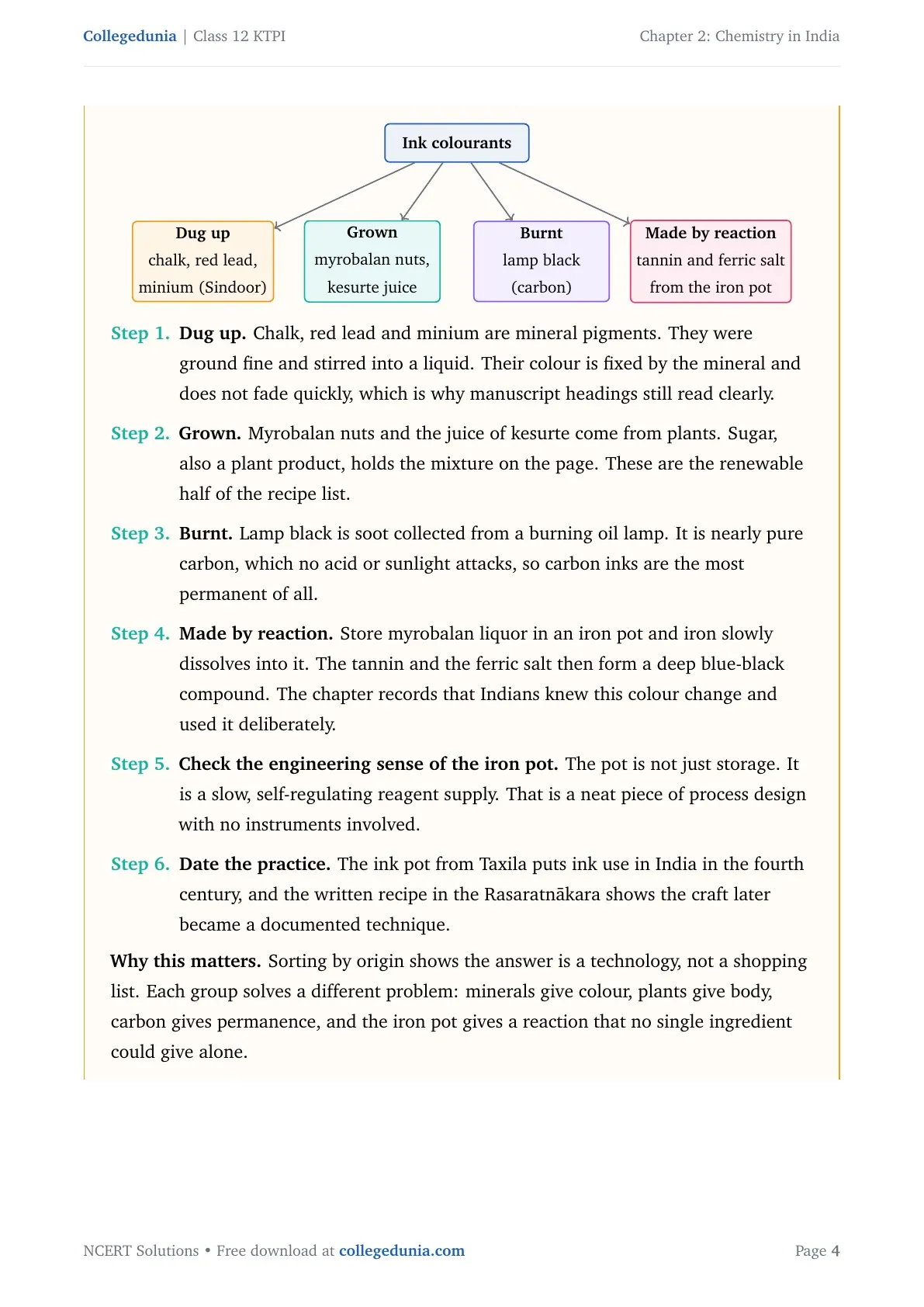
- The colouring materials. Colours of ink were made from chalk, red lead and minium, which is sindoor.
- The durable black ink. Made from nuts and myrobalans, it was kept in water in iron pots and used in Malabar and other parts of the country.
- The Jain manuscript ink. A special ink of roasted rice, lamp black, sugar and the juice of the plant kesurte.
- The written recipe. The method for making ink is given in the Rasaratnakara of Nityanatha.
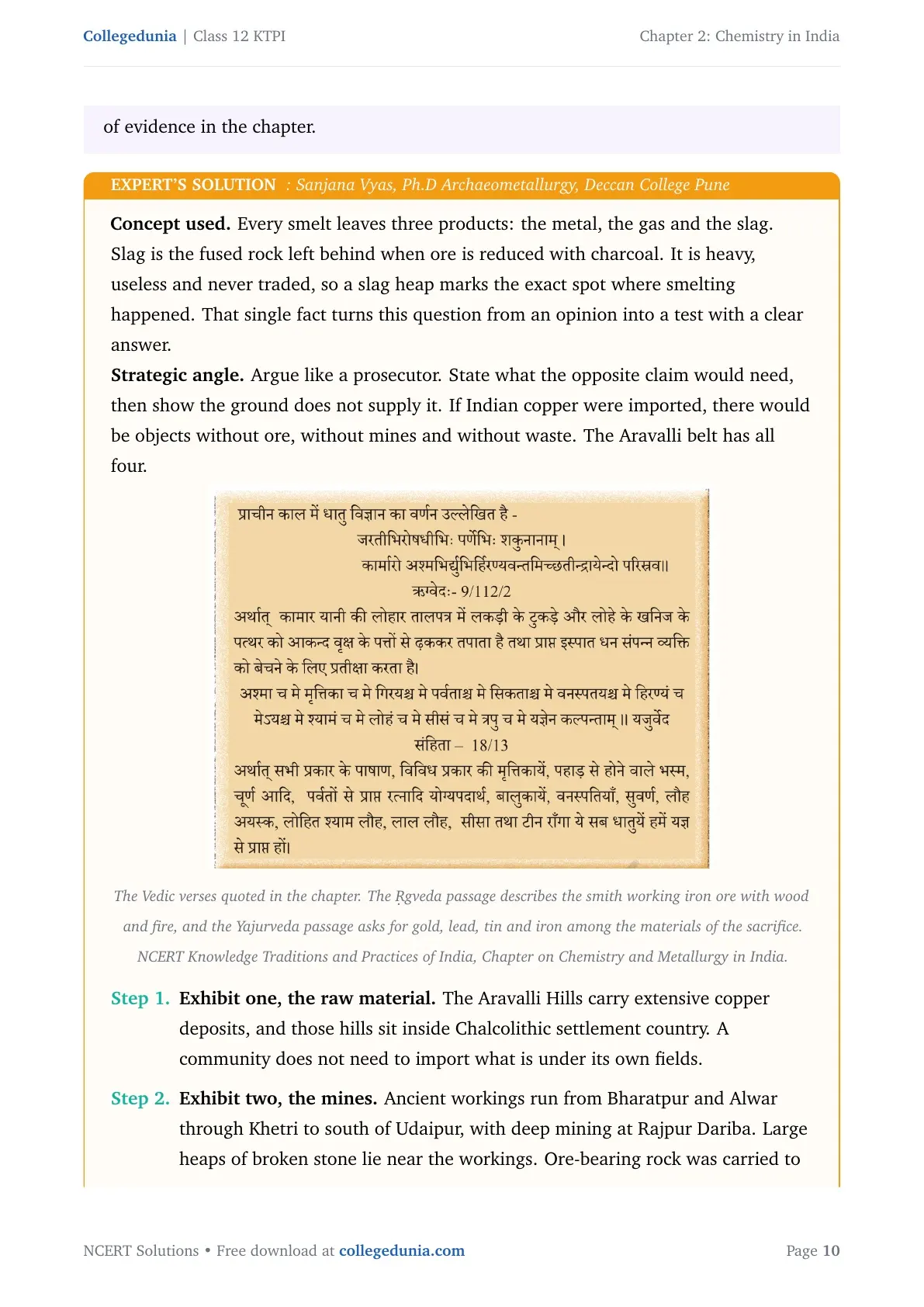
- The chemistry behind it. Indians knew that a tannin solution turns dark blue-black or greenish when ferric salts are added, and used that reaction to make ink.
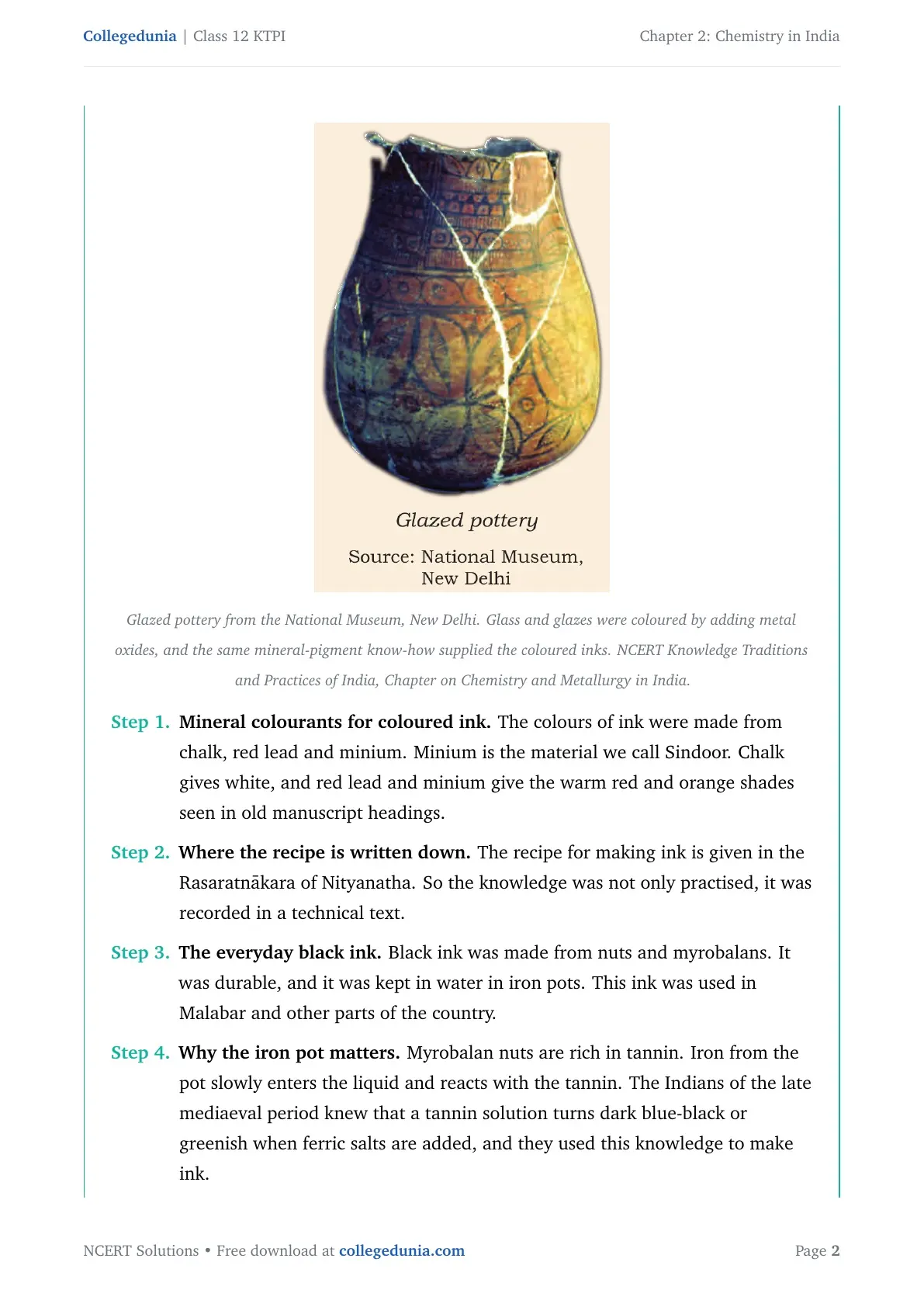
One extra line lifts the answer. An ink pot found at Taxila shows ink was in use in India from the fourth century, so the recipes were not written for a new craft.
The Concept of Atom in Early Indian Philosophical Systems: Kanada, Anu and Paramanu
Question 2 is the highest scoring theory answer in the chapter. The idea that matter is finally made of indivisible building blocks came to India as part of philosophical thinking, not laboratory work. Acharya Kanada, born in 600 B.C.E. and originally known as Kashyapa, was the first to propound the atomic theory.
- The text. He authored the Vaisheshika Sutras, and named his very small indivisible particles Anu, which are comparable to molecules.
- What paramanu is like. All substances are the aggregated form of smaller units called paramanu, which are eternal, indestructible, spherical, suprasensible and in motion at the primordial state.
- Why nobody could see them. He said the individual entity cannot be sensed through any human organ.
- Variety and combination. There are as many varieties of atoms as there are classes of substances, and they form pairs or triplets, called anu, among other combinations.
- What holds them together. Unseen forces caused the interaction between them.
- The timing. He set this out about 2500 years before John Dalton, who lived from 1766 to 1844.
The chapter adds a modern echo worth one closing sentence. The Caraka Samhita discusses reducing the particle size of metals, and the bhasma made that way have been shown to hold nano particles, which sit in the 1 to 100 nanometre range.
Why Copper Metallurgy in India Has an Indigenous Origin
Question 3 asks you to justify a claim, so a list of sites is not enough. Each site has to be tied to a piece of evidence that rules out import. Answer with the chain below and the justification writes itself.
| Evidence | Site | What it proves |
|---|---|---|
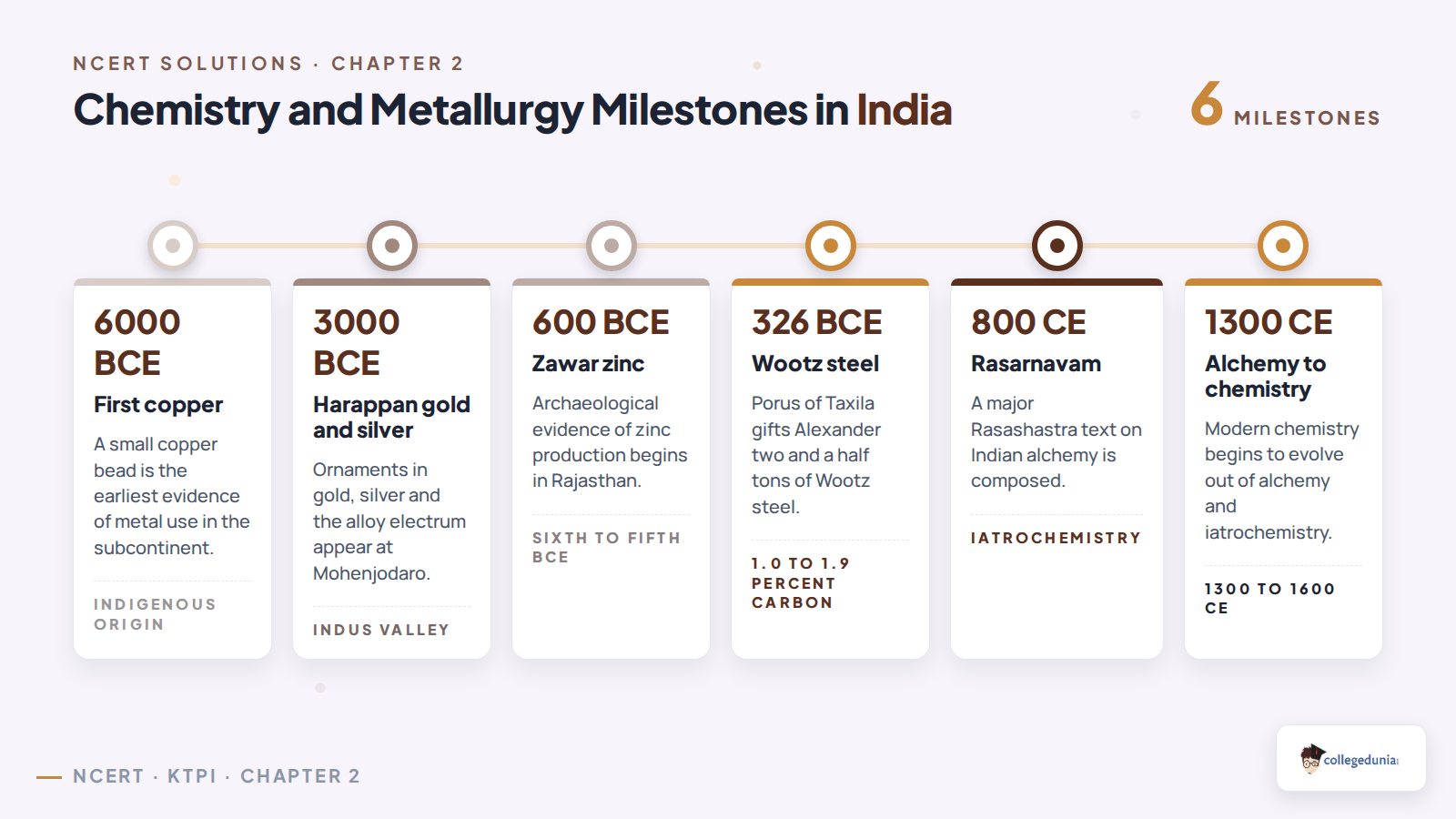
| A small copper bead dated to about 6000 B.C.E. | Mehrgarh, Baluchistan | The first evidence of metal in the subcontinent, though it is thought to be native copper |
| Copper ore carrying 4 to 8 per cent arsenic | Aravalli hills | Harappan copper objects carry high arsenic, so the ore came from this region |
| Copper metallurgical slag with tools and quartz, dated 1800 to 1600 B.C.E. | Ahar, near Udaipur, excavated in 1962 | Copper was smelted on Indian soil, not merely worked here |
| More than fifty similar sites | Gilund, Meroli, Kumaria, Kadukota | The activity was widespread, not a single accident |
| Deep mining of the last quarter of the second millennium B.C.E. | Rajpur Dariba, Udaipur district | Organised mining, with ore roasted, crushed, concentrated and smelted in the valley |
| Extensive ancient mining of about the third to second millennium B.C. | Khetri region, Rajasthan | A second large indigenous ore zone in the north west |
Close the answer with the ore point. Chalcopyrite is abundant in the Aravalli hills but poor in copper, and the Chalcolithic communities lived right on top of those deposits. Local ore, local slag, local mines and local metal objects together make the case for indigenous origin.
How Smelters and Smiths Showed Advanced Knowledge of Copper Metallurgy
Question 5 is not a repeat of Question 3. Question 3 asks where the copper came from. Question 5 asks how good the metalwork was. The answer is a list of measured results, so quote the numbers.
- The Nal axe. A chemical analysis of an axe fragment from Nal shows 94 per cent pure copper with 5 per cent nickel, from a pre-Harappan settlement site.
- The purity record. Many examined samples reached 98 per cent copper, equal to the purity of present day blister copper.
- The full process chain. Ore dressing, roasting, fluxing and extraction were carried out consistently, not occasionally.
- Refining in a crucible. Copper was smelted from ore and then refined in a clay crucible, and a crucible fragment with slag stuck at the edges was found at Mohenjodaro.
- Deliberate alloying. Harappans improved the hardness of copper for artefacts by using tin and arsenic, and also alloyed with lead and antimony.
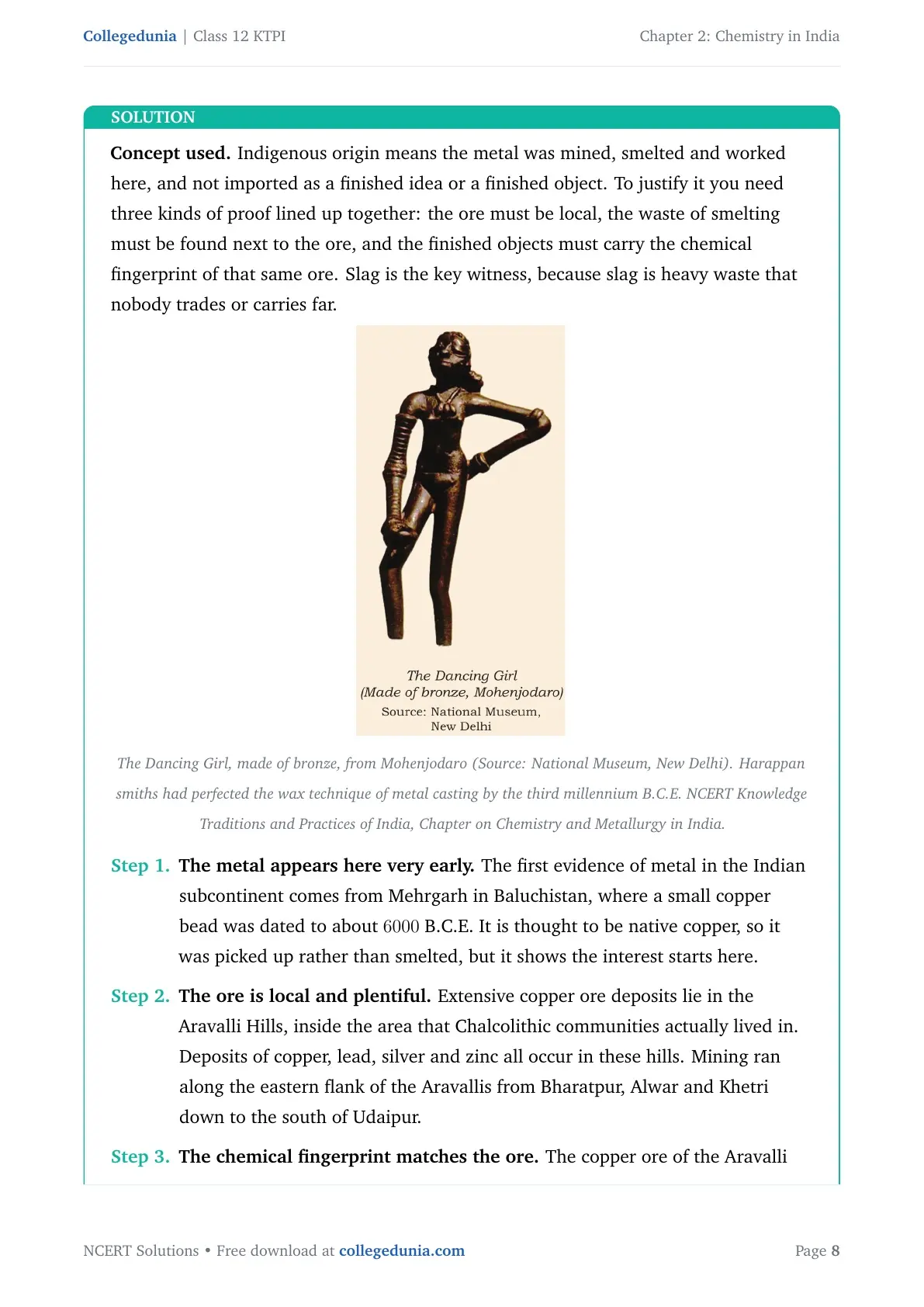
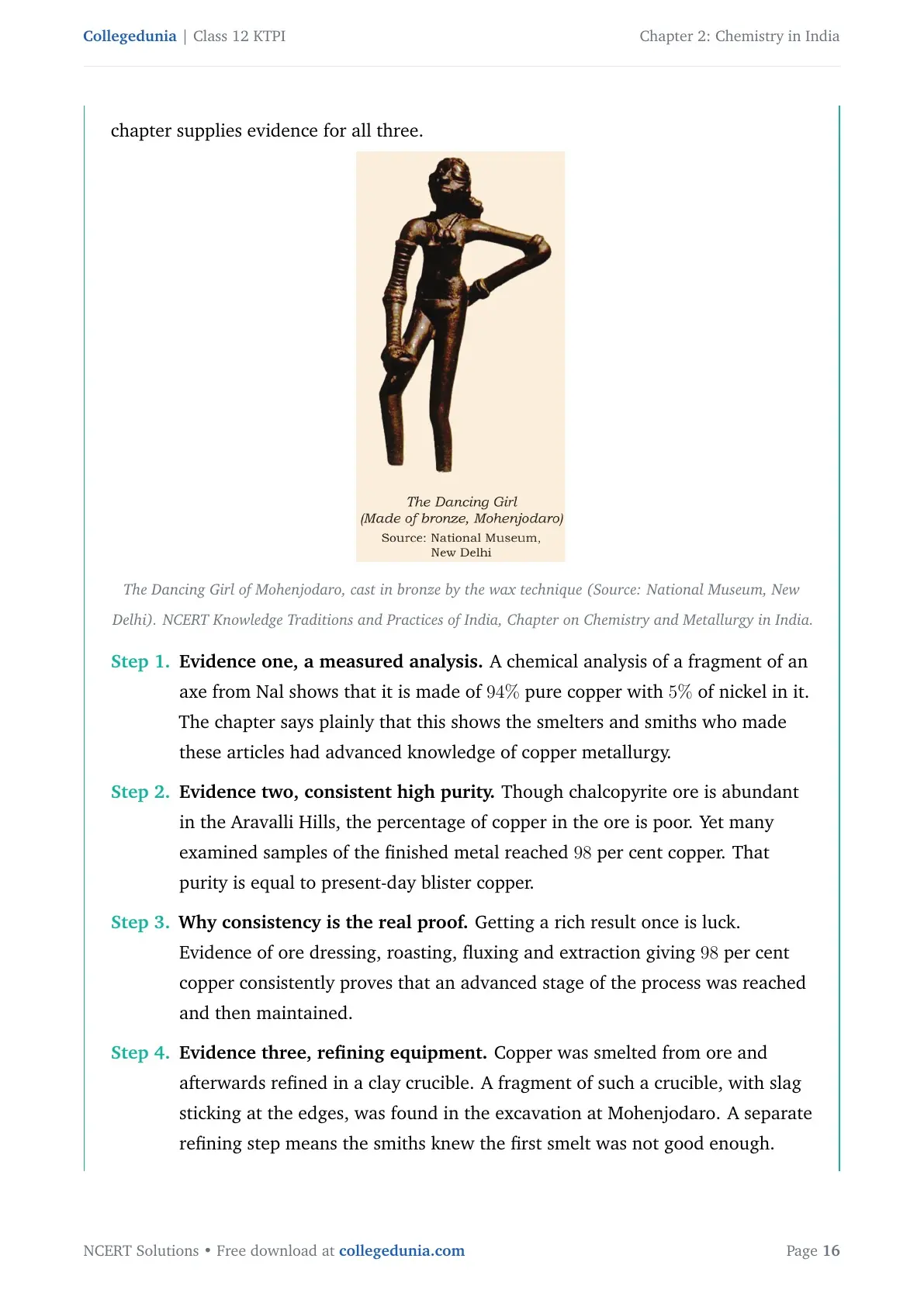
- The casting skill. They perfected the lost wax technique of metal casting as early as the third millennium B.C.E., which is how the bronze figurines were made.
Other pre-Harappan sites named alongside Nal are Mehi and Kot Diji, where axes, chisels and mirrors were unearthed. Naming all three sites turns a 2 mark answer into a 4 mark answer.
What Makes the Extraction of Zinc Difficult and How the Zawar Smelters Solved It
Question 4 has two parts and most students answer only the second. Start with the problem, because the whole Zawar design exists to fix that one problem. Zinc has a low boiling point, so it turns to vapour while its ore is being smelted.
- Why the metal is lost. The zinc vapours sitting in the furnace are reoxidised, so the metal never collects as a solid.
- The fix. Zinc has to be produced by distillation instead of ordinary smelting. India was the first country in the world to master zinc distillation.
- The site and the date. Archaeological evidence for zinc production comes from Zawar in Rajasthan, around the sixth or fifth century B.C.E.
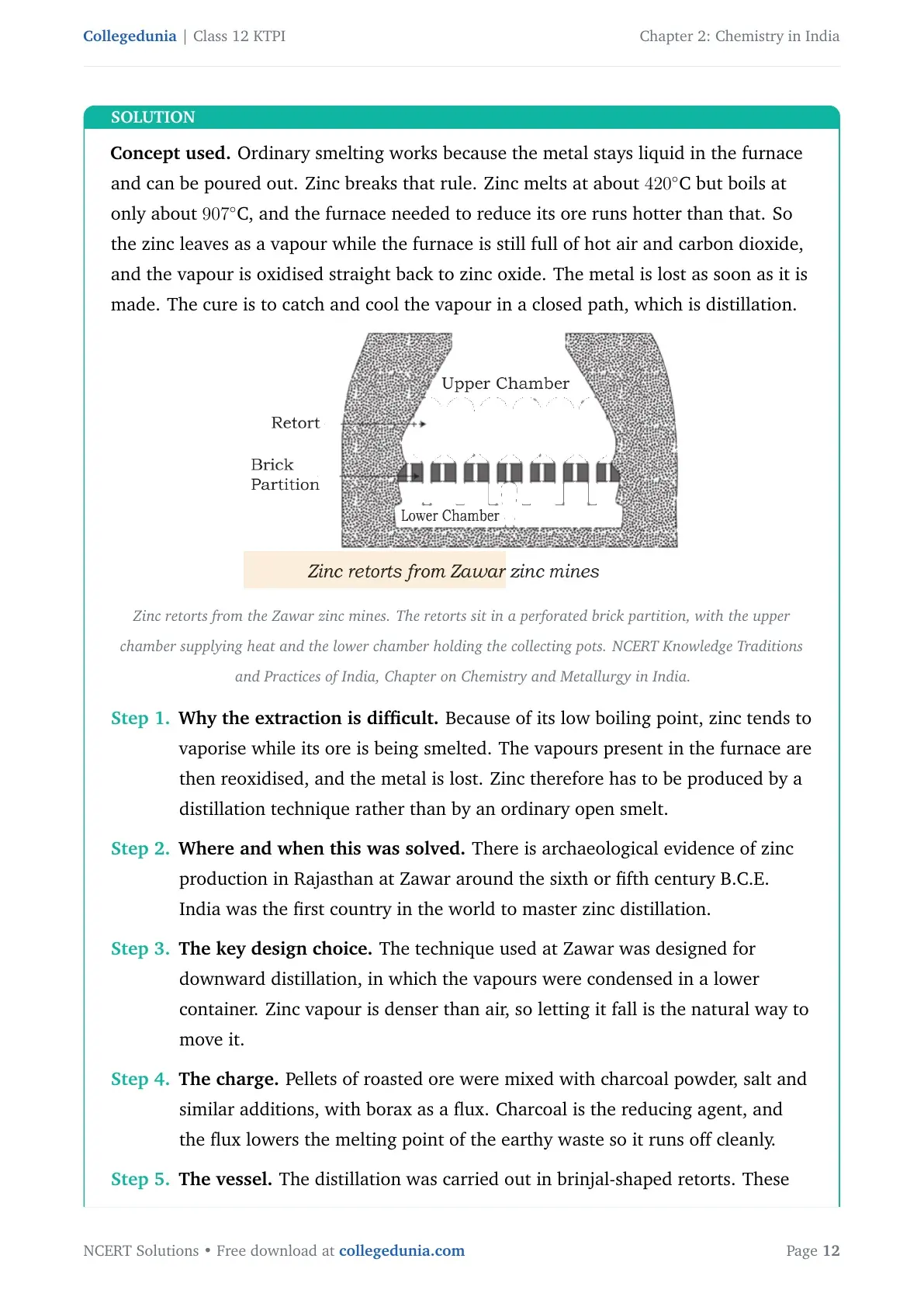
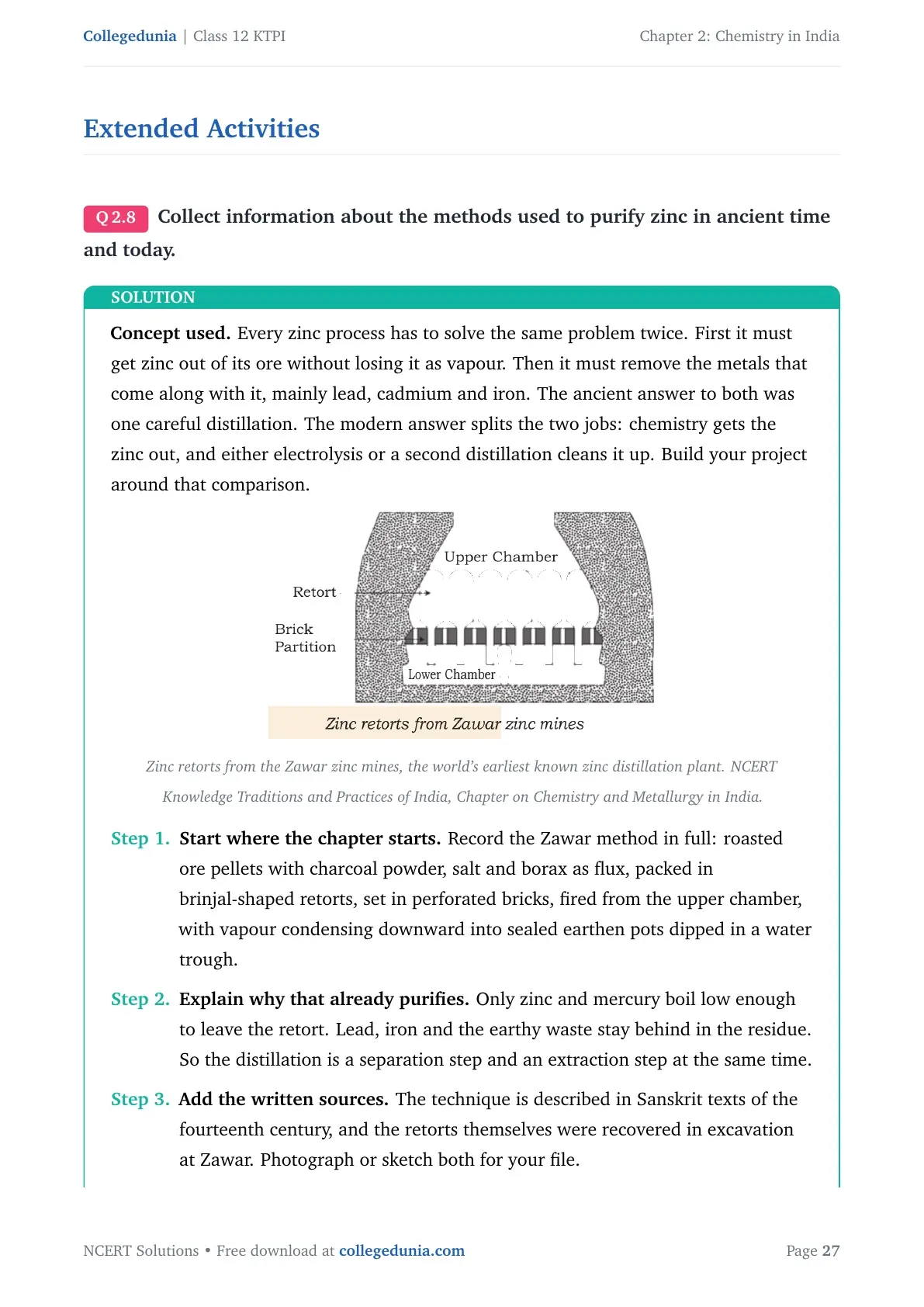
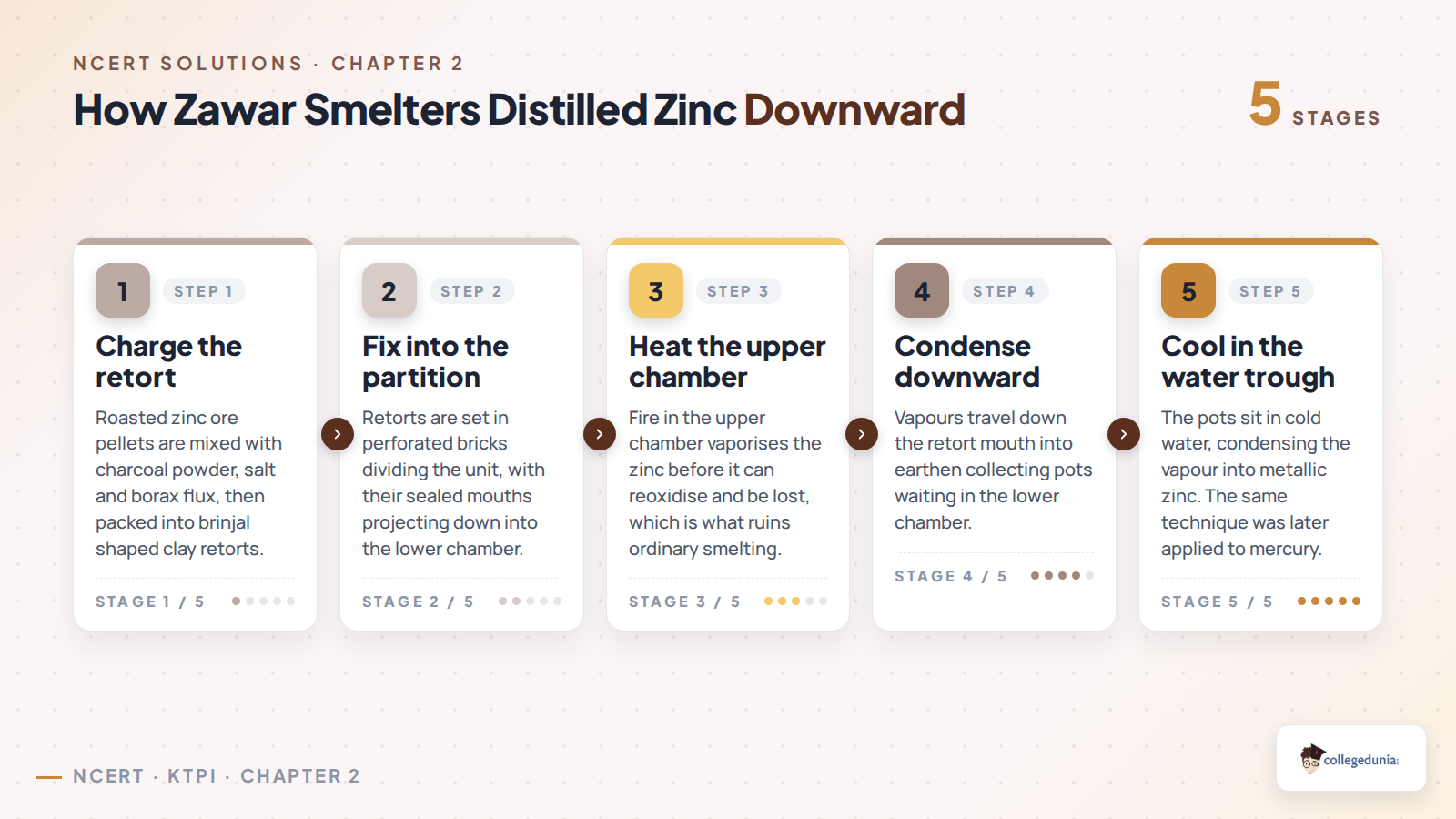
- The charge. Pellets of roasted ore were mixed with charcoal powder and salt, with borax as the flux, and distilled in brinjal shaped retorts.
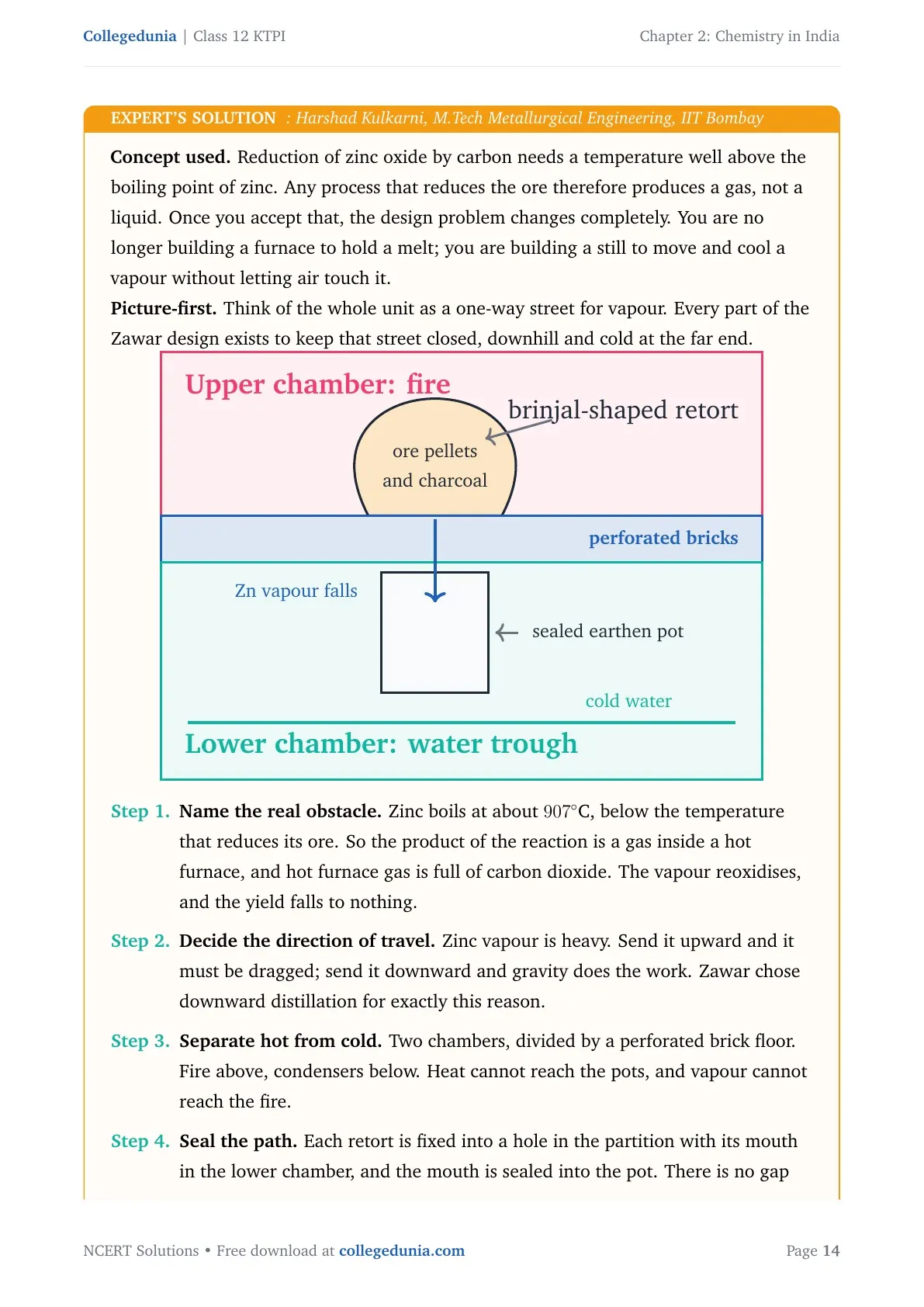
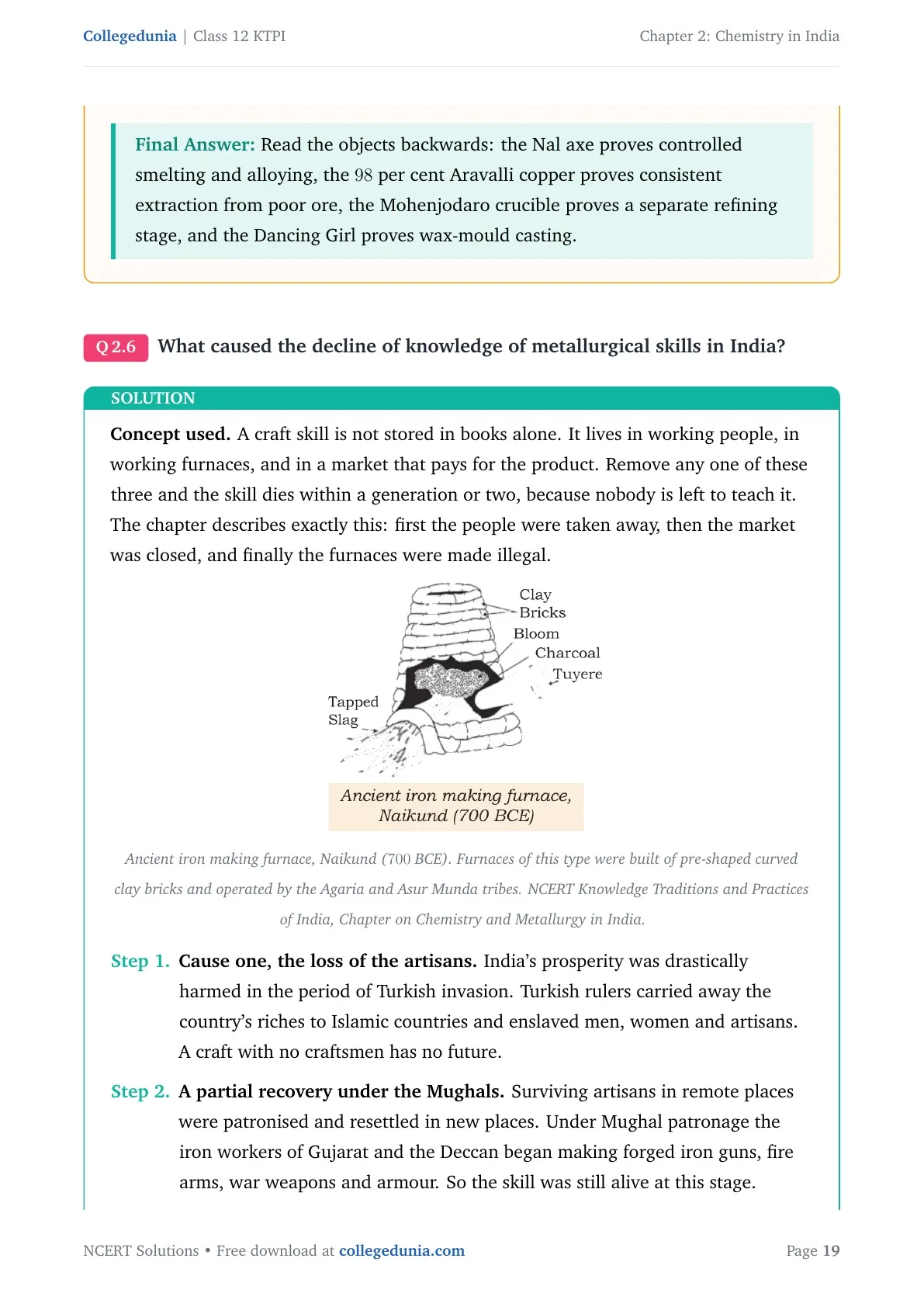
- The two chamber unit. A lower chamber was separated from an upper chamber by perforated bricks. Charged retorts were fixed into the perforations with their mouths projecting into the lower chamber.
- The condensing step. Each retort mouth was sealed into a collecting earthen pot, and those pots were dipped in a water trough. Fire was made in the upper chamber, and the vapours cooled downward into the pots.
Two closing facts are worth a mark each. The method is downward distillation, because the vapours condense in a lower container. The same technique was also applied to mercury, and it is described in Sanskrit texts of the fourteenth century.
Why the Iron Pillar of Delhi Has Not Rusted After 1,600 Years in Moist Air
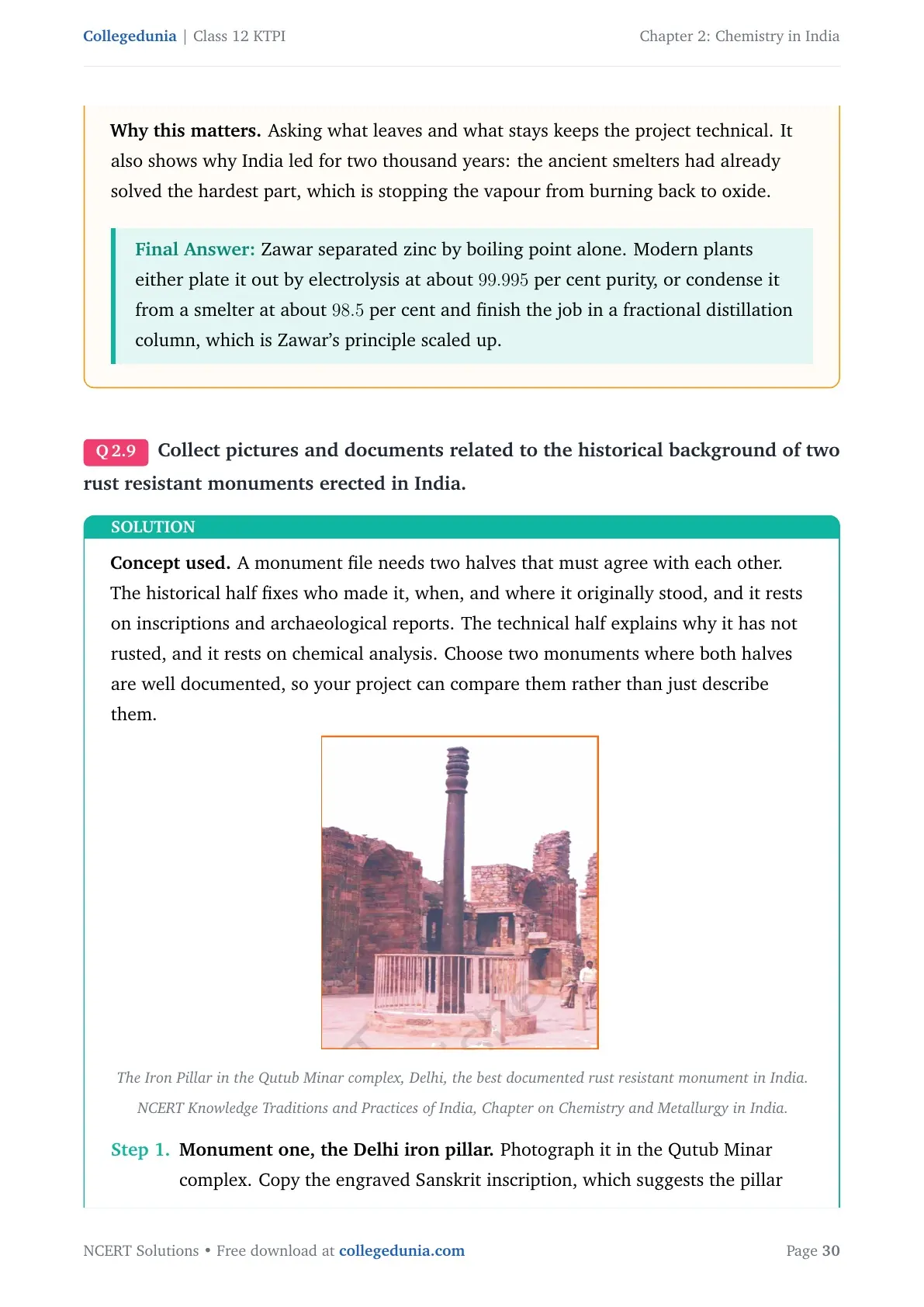
Question 7 wants a chemical reason, not a story. The pillar carries an engraved Sanskrit inscription suggesting it was brought to its present site from elsewhere during the Gupta period. It has stood in the open for about 1,600 years with no sign of corrosion.
| Reason | The detail to quote |
|---|---|
| High purity of the metal | The wrought iron is over 99 per cent iron |
| Only traces of injurious elements | 0.15% C, 0.05% Si, 0.05% Mn, 0.25% P, 0.005% Ni, 0.03% Cu and 0.02% N |
| A clean environment | For most of its life the air around it carried few corrosive gases |
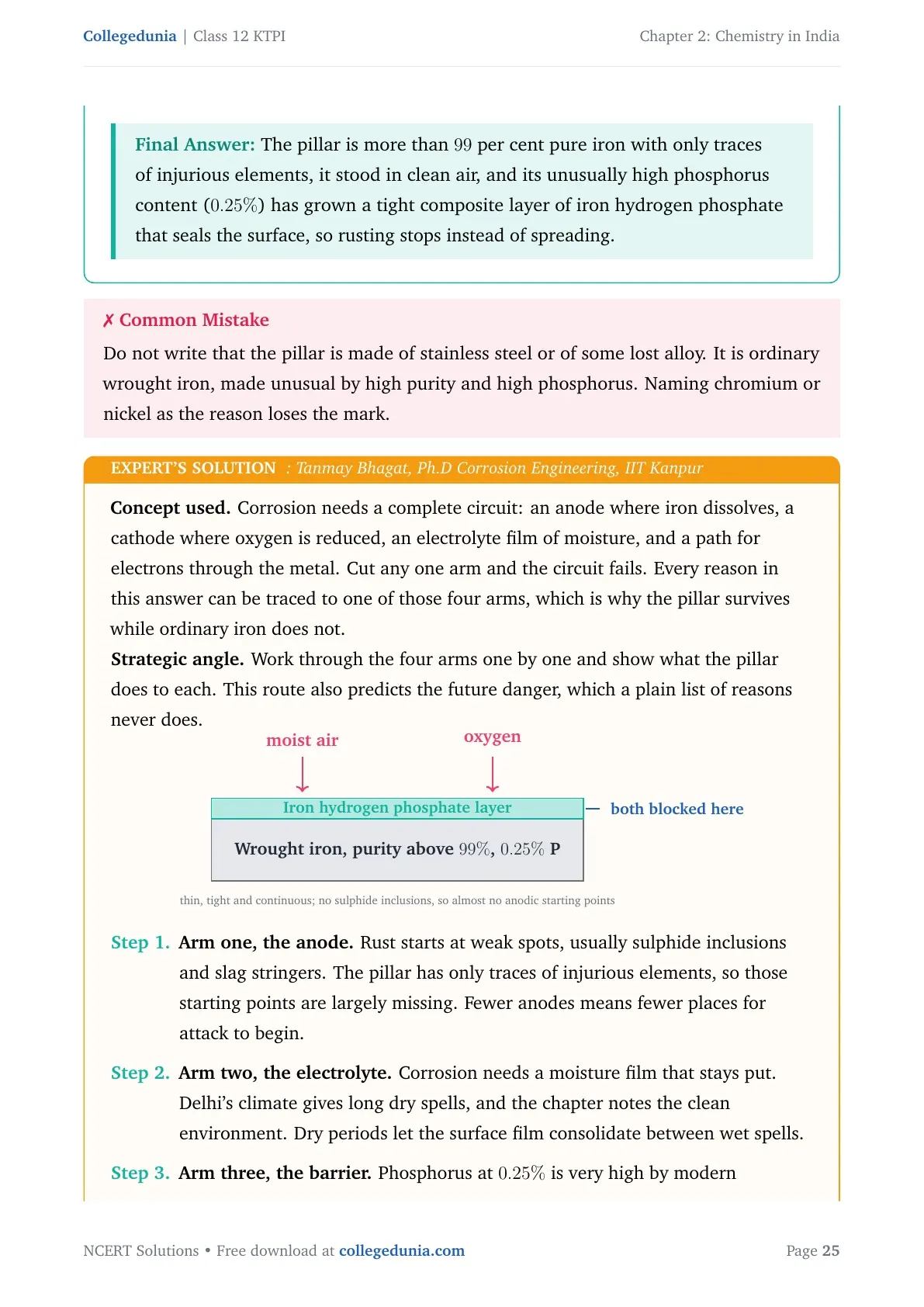
| A protective film | Balasubramaniam explained that a composite layer of iron hydrogen phosphate forms on the pillar and prevents rusting |
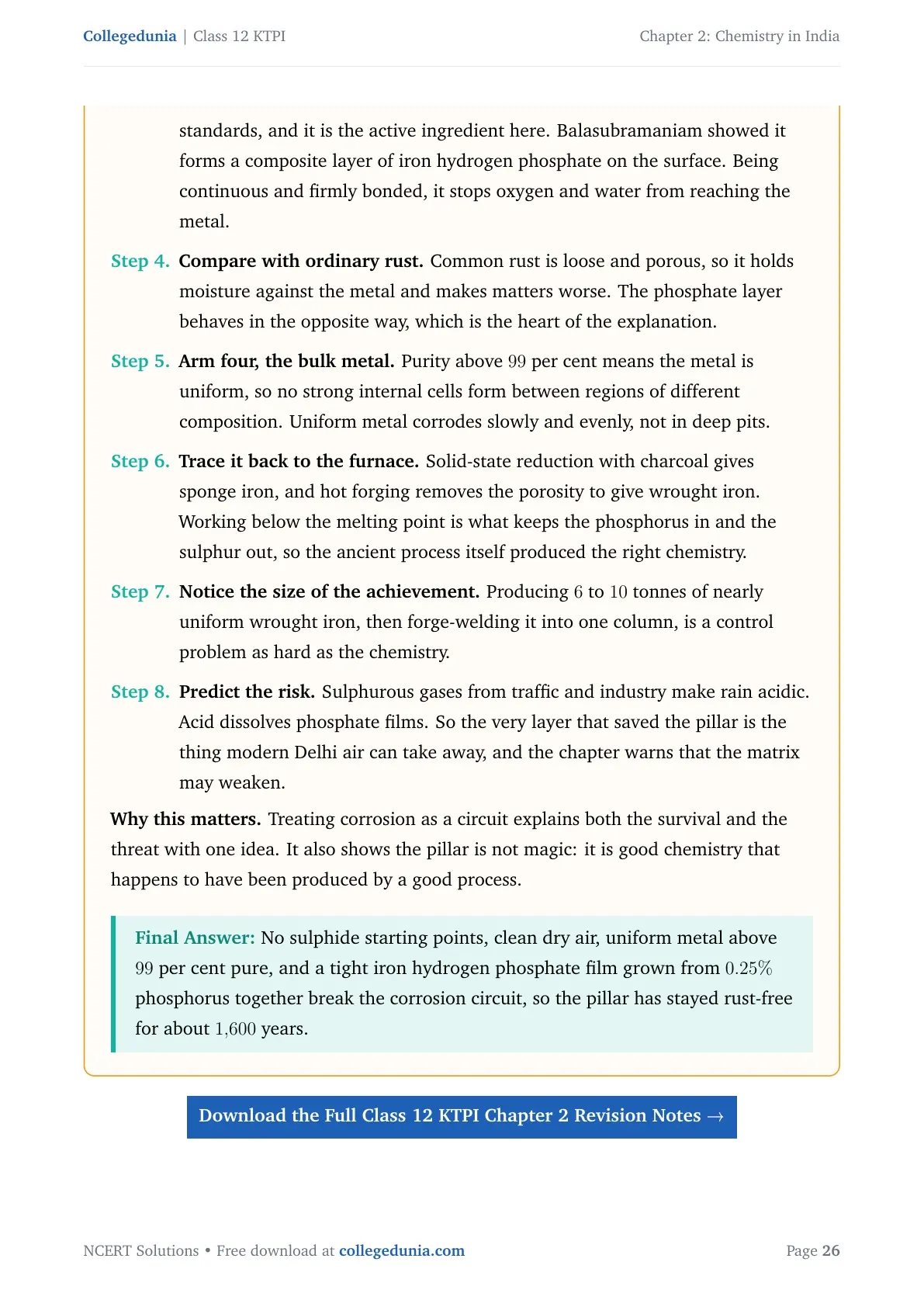
Add the warning line at the end, because it is the part examiners like. Rapid industrialisation and heavier traffic around Delhi are raising sulphurous gases in the air. If that is left uncontrolled, corrosion may begin and weaken the matrix of the pillar.
What Caused the Decline of Metallurgical Skills in India Under Colonial Policy
Question 6 needs a sequence, not a single villain. The chapter names three phases, and the marks sit in the third one. Write them in order and the answer stays tight.
- The Turkish invasion. India's prosperity was drastically harmed. Rulers carried the country's riches away and enslaved men, women and artisans.
- The Mughal period, a partial recovery. Surviving artisans in remote places were patronised and resettled. Iron workers of Gujarat and the Deccan began making forged iron guns, fire arms, war weapons and armour.
- The colonial phase, the real break. Cottage iron making was still flourishing at the end of the nineteenth century, and iron production was becoming an organised industry.
- The scale that was lost. In 1852 Oldham reported 70 iron making furnaces working in Birbhum district, each able to produce 2 tonnes of iron at a cost of 17 rupees.
- Takeover. British representatives took over the local industries.
- Import and tax. Despite the better quality of Indian iron and steel, they imported British and Swedish iron and levied heavy tax on local produce.
- Raw material drain. High grade iron ore was exported out of India while iron and steel making inside India was banned.
- The finished goods trap. Finished iron and steel machinery was imported and Indian produce was taxed high again.
End with the result the question is really asking about. The tribal art of iron making and of Wootz steel was almost stopped, and zinc production met the same fate.
Wootz Steel, Sponge Iron and the Crucible Process That Made Indian Steel Famous
No Exercise question asks about Wootz steel on its own, but it feeds Questions 6 and 7 and it is the most quotable material in the chapter. Indian steel was called the wonder material of the Orient.
- The crucible process. Greek accounts report that iron, charcoal and glass were mixed in a crucible and heated until the iron melted and absorbed the carbon.
- The carbon figure. Wootz steel is iron with a high proportion of carbon, 1.0 to 1.9 per cent.
- The name. Wootz is the English form of ukku, the word for steel in Karnataka and Andhra Pradesh.
- The famous gift. The Roman historian Quintus Curtius records that Porus of Taxila gave Alexander about two and a half tons of Wootz steel in 326 B.C.E.
- The export trail. It went to Europe, China and the Arab world, and became known in the Middle East as Damascus steel. Michael Faraday tried to duplicate it by alloying iron with many metals, including noble metals, and failed.
- Sponge iron and wrought iron. Charcoal reduces iron ore in the solid state to porous blocks called sponge iron. Hot forging removes the porosity and gives wrought iron.
That process control is the link to the pillar. Ancient smelters could produce 6 to 10 tons of wrought iron of almost uniform quality, which is what the Delhi iron pillar needed. The Asur Munda and Agaria tribes carried the iron smelting tradition, and it was thought extinct until 1963, when Ghose of TISCO found tribesmen at Kamarjoda, Chiglabecha and Jiragora who could still build and run the traditional furnace.
Chemical Arts and Crafts of Ancient India: Glass, Faience, Dyes, Perfumes and Paper
This half of the chapter has no direct Exercise question, but it supplies two of the four Extended Activities and most of the short quotes examiners like. Group the crafts as the book does and learn one date for each.
| Craft | Key evidence | Facts worth quoting |
|---|---|---|
| Glass making | Sushruta Samhita, Kautilya's Arthashastra, Pliny | Antiquity traced to 800 to 500 B.C.E. An advance licence fee was charged to start a glass industry in the Mauryan period. Pliny called Indian glass superior to that of other countries. |
| Glass archaeology | Maski, Hastinapur, Taxila, Rupar, Alamgirpur | Maski dates to 1000 to 900 B.C.E. Kenoyer places the first glass beads at Harappa around 1700 B.C.E., which is 200 years before glass was made in Egypt. |
| Faience and glazing | Harappan ornaments, Kenoyer's trials | Indus faience was stronger because it was made from partially melted quartz. Powdered rock quartz was melted with plant ash flux, reground and fired again at about 940 degree celsius. |
| Northern black polished ware | North Indian sites | Its golden gloss has never been replicated and is still a technological mystery. |
| Paints and dyes | Varahamihira's Brihatsamhita, Atharvaveda | A glutinous wall coating made from plant extracts, resins, fruits, seeds and barks. Dye stuffs included turmeric, madder, orpiment, cochineal, lac and kermes. The Ajanta and Ellora paintings still look fresh. |
| Perfumes and cosmetics | Gandhayukti, Ashtanga Hridaya, Raja Serfoji | Gandhayukti gives recipes for scents, mouth perfumes, bath powders, incense and talcum powder. Ashtanga Hridaya gives six formulations for the six seasons. |
| Paper and ink | I-tsing, Gilgit and Kuchar stupas, Taxila ink pot | Paper was known in India in the seventh century. A paper manuscript of 1105 C.E. is at the Ashutosh Museum, Calcutta. |
| Alcoholic liquors | Vedas, Arthashastra, Caraka Samhita | Fermentation was well known. Asavas were made from barks, stems, flowers, leaves, wood, cereals, fruits and sugarcane. |
Two named chemists belong in this section as well. Nagarjuna, a chemist, alchemist and metallurgist, wrote the Rasaratnakara on mercury compounds and discussed extracting gold, silver, tin and copper. Cakrapani discovered mercury sulphide and is credited with inventing soap, which he made from mustard oil and alkalies.
How to Plan the Four Extended Activities for the Chemistry in India Chapter
Each Extended Activity is a collection task, so the marks go to structure rather than length. Fix the shape first, then fill it. All four can be planned in about ten minutes.
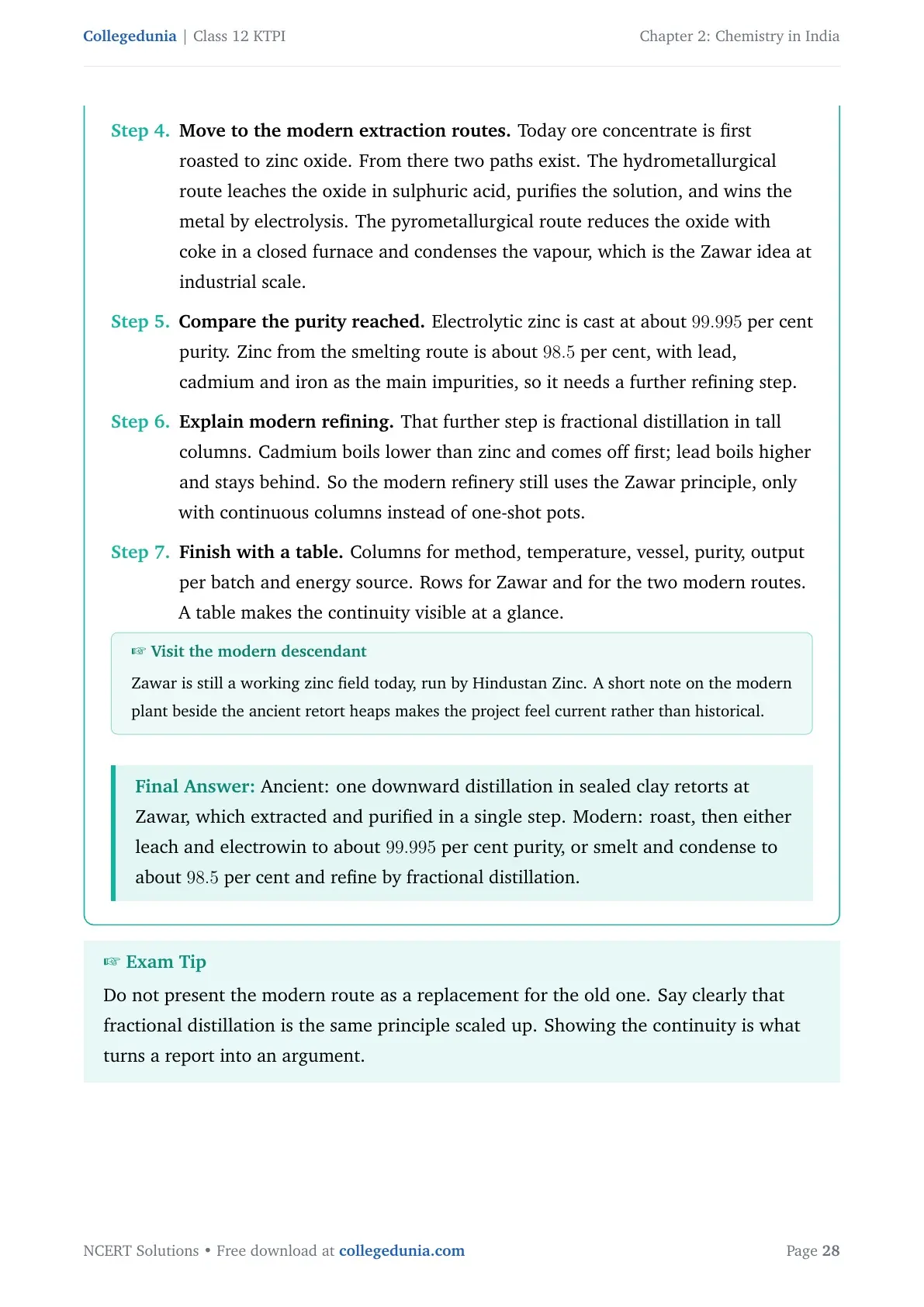
- Activity 1, zinc purification then and now. Two columns. The Zawar column carries downward distillation, brinjal shaped retorts, the two chamber unit and the water trough. The modern column carries roasting followed by either electrolytic refining or a modern distillation furnace. End with the one line the book gives you: India mastered zinc distillation first.
- Activity 2, two rust resistant monuments. The safe pair is the Delhi iron pillar in the Qutub Minar complex and the iron pillar at the Mookambika temple on Kodachari Hill, near Mangalore, which belongs to the same period. Mention the iron beams in the Surya temple at Konark, which are bigger still.
- Activity 3, ancient cosmetics. Build it around three sources: Brihatsamhita for hair dyes from indigo, iron powder and sour rice gruel, Gandhayukti for scents and bath powders, and Ashtanga Hridaya for the six seasonal formulations. Close with Raja Serfoji, who ruled Thanjavur from 1788 C.E. to 1832 C.E. and set up the Dhanvantari Mahal.
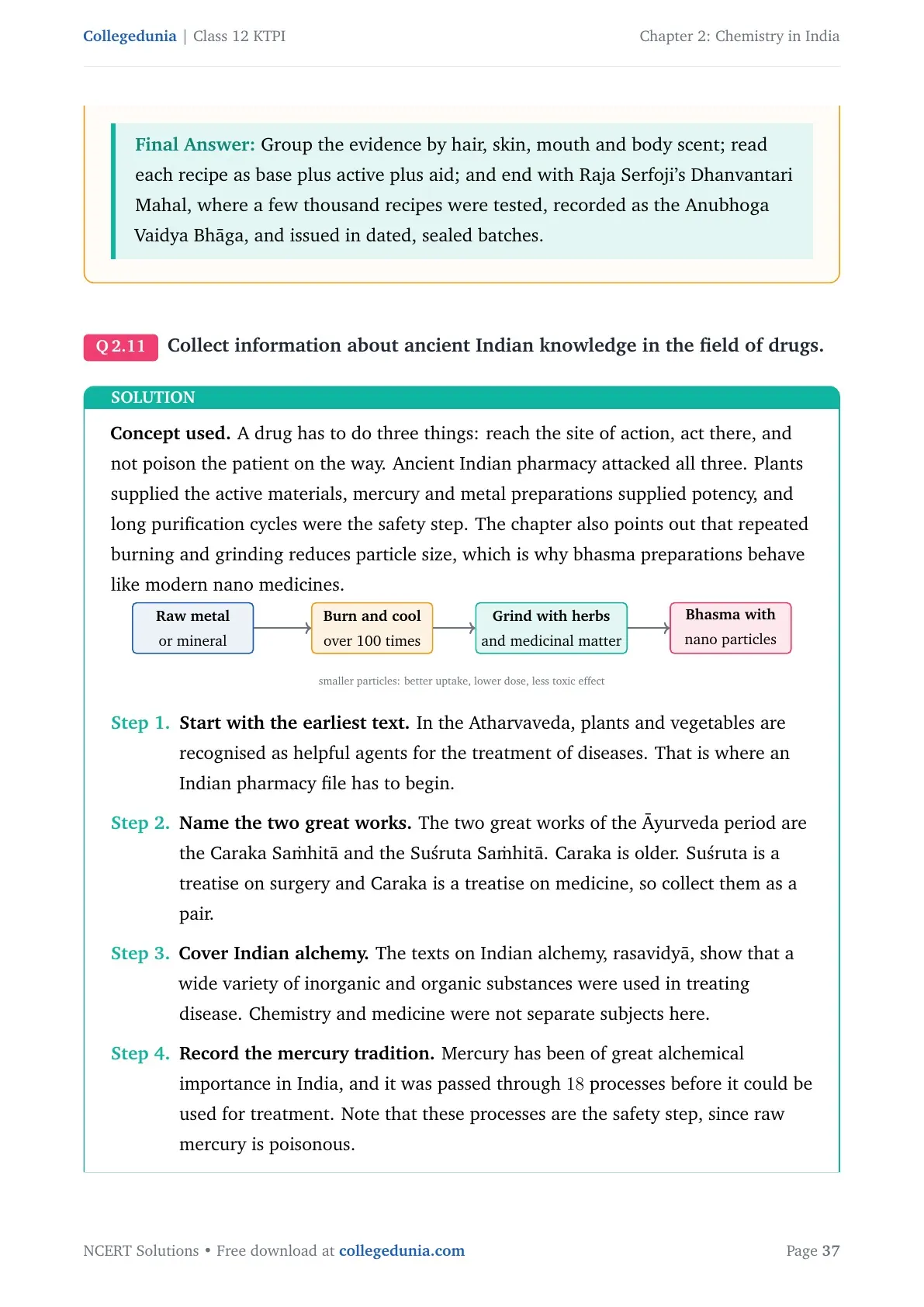
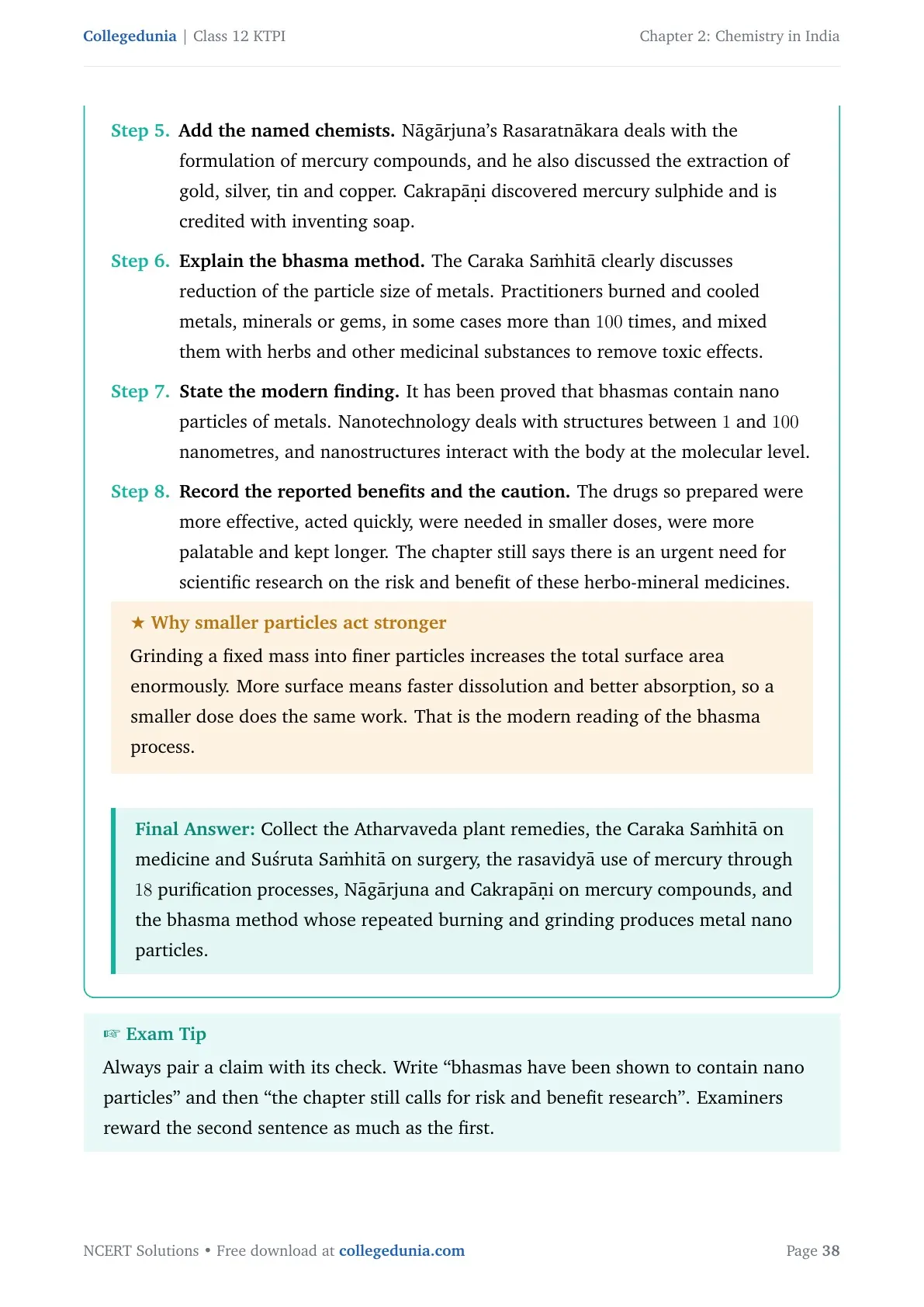
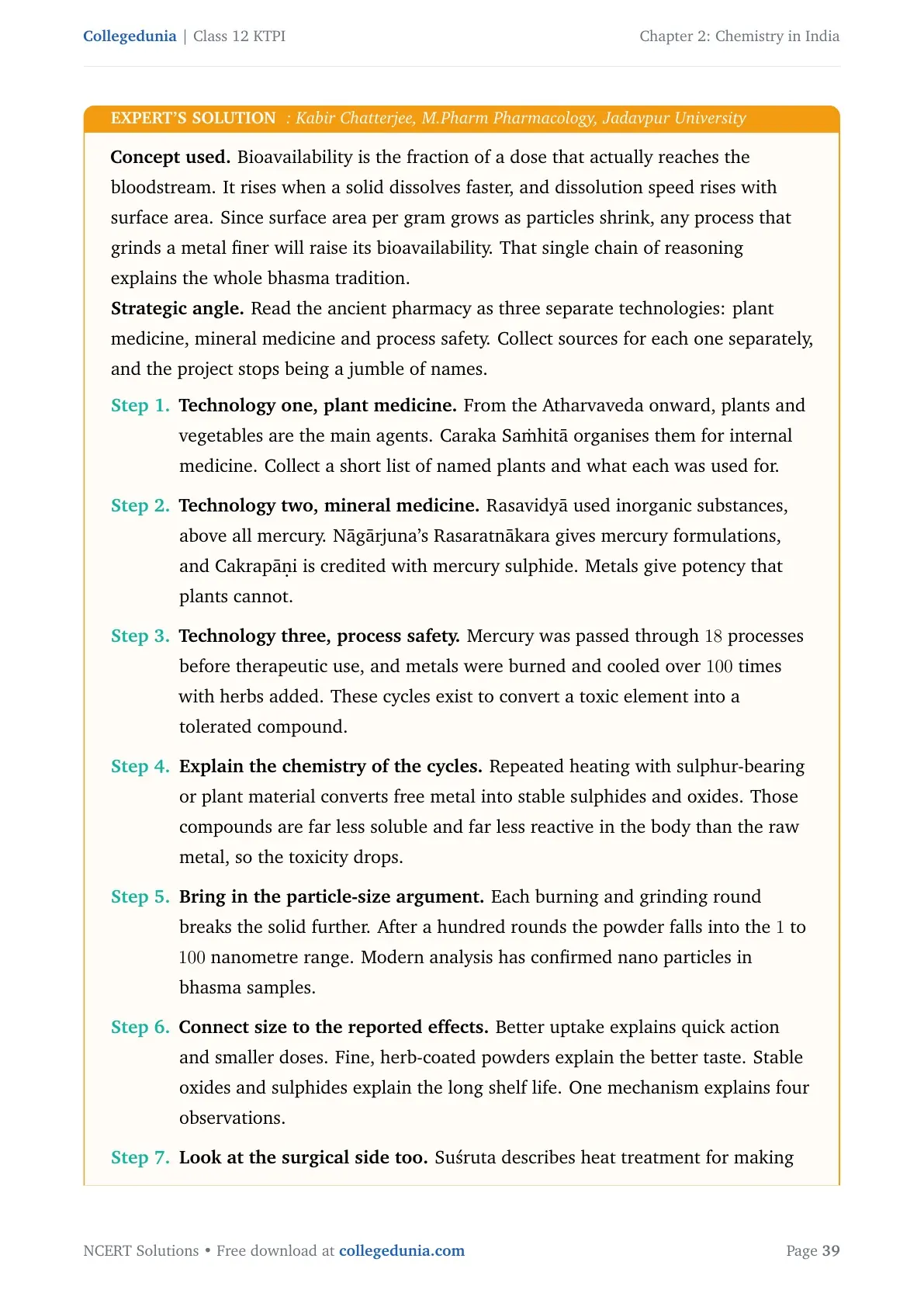
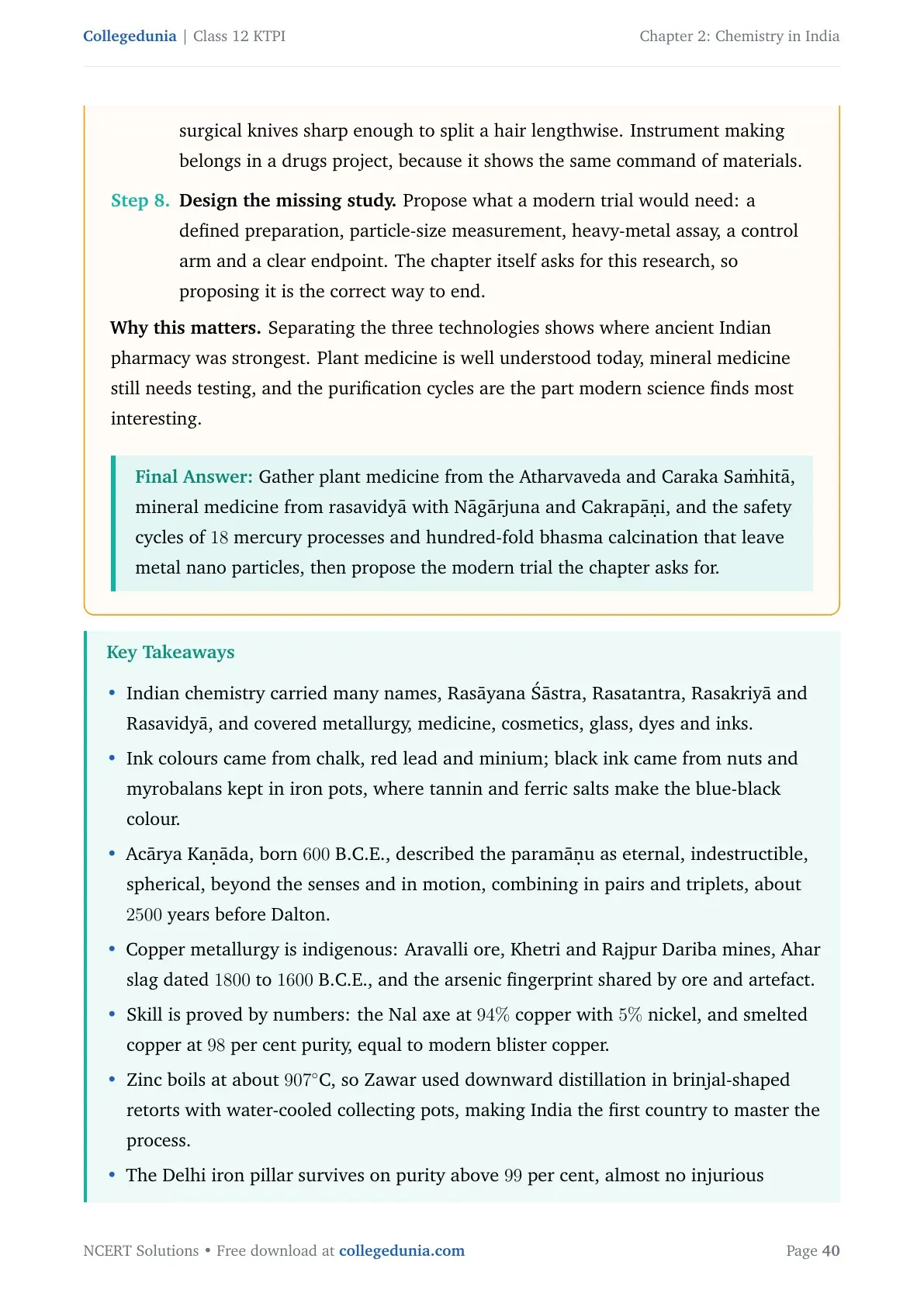
- Activity 4, ancient drugs. Caraka Samhita is a treatise on medicine and Sushruta Samhita is a treatise on surgery, and Caraka is the older of the two. Add the mercury line, the bhasma line and the nano particle link, then the closing point that the risk and benefit of herbo-mineral medicines still needs modern research.
Activity 3 has a ready made ending most students miss. Serfoji's tested recipes were turned into verse in colloquial Marathi and are called Anubhoga Vaidya Bhaga, which means a recipe tested by experience.
Common Mistakes Students Make in the Chemistry in India Chapter
Avoid these six in the answer sheet:
- Answering Question 4 with only the Zawar method. The low boiling point of zinc and the reoxidation of its vapour are half the answer.
- Treating Questions 3 and 5 as the same question. Question 3 is about indigenous origin, Question 5 is about advanced skill.
- Saying the Delhi iron pillar does not rust because it is made of a special alloy. It is the opposite. It is over 99 per cent pure iron with only traces of other elements.
- Forgetting the iron hydrogen phosphate layer in Question 7. That is the modern explanation the chapter credits to Balasubramaniam.
- Blaming only the British in Question 6. The decline starts with the Turkish invasion and passes through the Mughal period first.
- Writing that Kanada invented the atom in a laboratory. His paramanu came from philosophical thinking, and he called the particles Anu.
A quick fix for the numbers: put 6000 B.C.E., 1800 to 1600 B.C.E., 600 B.C.E., 94 per cent, 98 per cent, 99 per cent, 1.0 to 1.9 per cent, 940 degree celsius, 70 furnaces and 1,600 years on one card and recite it before the paper.
Student Feedback on the Class 12 KTPI Chemistry in India Chapter
What 12,380 Class 12 students told us about the Chemistry in India chapter
Collected in a Collegedunia poll run ahead of the 2026-27 board session:
- 61% named the zinc distillation question as the hardest part of the chapter, mostly because they skipped the boiling point reason.
- 7 out of 10 students said the ink question and the atom question were the easiest marks in the whole module.
- 44% lost marks by answering Question 5 with the same content they had written for Question 3.
- Students who drew a small two chamber sketch beside the zinc answer scored about a mark more than those who wrote prose alone.
Source: 2026-27 Class 12 KTPI student poll. Sample of 12,380 students from CBSE schools across 14 states.
Where Chemistry in India Sits in the Class 12 KTPI Course and Paper
Chemistry in India is the second chapter of the Class 12 Knowledge Traditions and Practices of India course. It shares its metallurgy half with a later chapter, so the two are best revised together. Treat the spread below as a planning guide, not as an official blueprint.
| Chapter | Topic | Indicative weight |
|---|---|---|
| Chapter 1 | Astronomy in India | High |
| Chapter 2 | Chemistry in India | Medium to High |
| Chapter 3 | Mathematics in India | High |
| Chapter 5 | Medicine in India | High |
| Chapter 7 | Metallurgy in India | Medium |
| Chapter 10 | Indian Philosophical Systems | Medium |
Inside this chapter, the heaviest sub-topics are the two copper questions, zinc distillation and the iron pillar. All four attract long answers. The ink question and the atom question usually appear as short answers of 2 to 3 marks.
How to Revise Chemistry in India in a Three Block Plan
The chapter is fact heavy but short. About three hours of focused work makes it exam ready, and the order the book prints gives you the sequence for free.
- Block 1, 60 minutes. Read the alchemy section, the chemical arts section and the ink section. Then write the Question 1 answer and the Question 2 answer from memory.
- Block 2, 60 minutes. Cover copper. Learn the Mehrgarh, Aravalli, Ahar, Rajpur Dariba and Khetri chain for Question 3, then the purity numbers for Question 5. Write both answers side by side so the difference stays fixed.
- Block 3, 60 minutes. Cover iron and zinc. Write the zinc distillation answer with a small sketch, then the iron pillar answer with its four reasons, then the three phase decline answer.
Repeat Block 2 a week before the paper. Students who wrote the Question 3 and Question 5 answers as a pair reported the fewest mix-ups in the copper questions.
How the Chemistry in India Solutions Work with the Rest of the Class 12 KTPI Pages
The solutions give you model answers. They do not give you the full chapter text or the figures the book prints. Those sit on the other Collegedunia pages for this course, and using them together is faster than reading any one of them alone.
| Resource | What it adds beyond these solutions | Link |
|---|---|---|
| Chapter PDF | The full chapter text as NCERT prints it, with the source figures, the site and date tables and the Sanskrit extracts this page only summarises | Chemistry in India Class 12 Chapter PDF |
| Solved question set | All 7 Exercise questions and all 4 Extended Activities written out as complete answers, each with a Solution and an Expert Solution | Chemistry in India Class 12 Solved Questions |
| Metallurgy chapter | Carries the iron, steel and zinc story further than this chapter does, with the same site names | Metallurgy in India Class 12 NCERT Solutions |
| Medicine chapter | Picks up Caraka, Sushruta, mercury and bhasma from the Iatrochemistry half of this chapter | Medicine in India Class 12 NCERT Solutions |
| Previous chapter | The chapter before this one, built on the same period wise structure you use here | Astronomy in India Class 12 NCERT Solutions |
Also Check: the Indian Philosophical Systems Class 12 NCERT Solutions, which explains the Vaisheshika school that Kanada's atom answer comes from.
All 10 Chapters of Class 12 KTPI with NCERT Solutions
The Class 12 Knowledge Traditions and Practices of India course runs across ten chapters. Every link below opens the solved question set for that chapter, written for the 2026-27 session.
| Chapter | NCERT Solutions |
|---|---|
| Chapter 1 | Astronomy in India Class 12 NCERT Solutions |
| Chapter 2 | Chemistry in India Class 12 NCERT Solutions |
| Chapter 3 | Mathematics in India Class 12 NCERT Solutions |
| Chapter 4 | Life Sciences Class 12 NCERT Solutions |
| Chapter 5 | Medicine in India Class 12 NCERT Solutions |
| Chapter 6 | Agriculture Class 12 NCERT Solutions |
| Chapter 7 | Metallurgy in India Class 12 NCERT Solutions |
| Chapter 8 | Architecture, Engineering and Technology Class 12 NCERT Solutions |
| Chapter 9 | Indian Languages and Grammar Class 12 NCERT Solutions |
| Chapter 10 | Indian Philosophical Systems Class 12 NCERT Solutions |
Chemistry in India Class 12 KTPI Chapter 2 NCERT Solutions FAQs
Questions Class 12 Students Ask Most About the Chemistry in India Chapter
Ques. How many questions are there in Class 12 KTPI Chapter 2 Chemistry in India?
Ans. There are 11 in total. The Exercise block has 7 questions and the Extended Activities block at the end has 4. All 11 are solved on this page for the 2026-27 session, and the downloadable PDF carries the same answers with the chapter figures.
Ques. Which materials were used to make the colour of inks?
Ans. Colours of ink were made from chalk, red lead and minium, which is sindoor. A durable black ink was made from nuts and myrobalans and kept in water in iron pots. Jain manuscripts used a special ink of roasted rice, lamp black, sugar and the juice of the plant kesurte. The recipe is given in the Rasaratnakara of Nityanatha, and Indians also knew that a tannin solution turns dark blue-black or greenish when ferric salts are added.
Ques. How was the concept of atom described in early Indian philosophical systems?
Ans. Acharya Kanada, born in 600 B.C.E. and originally called Kashyapa, was the first to propound an atomic theory. In his Vaisheshika Sutras he said all substances are aggregates of tiny units called paramanu, which are eternal, indestructible, spherical, suprasensible and in motion at the primordial state. They cannot be sensed by any human organ, there are as many varieties as there are classes of substances, and they combine as pairs or triplets called anu under unseen forces. He set this out about 2500 years before John Dalton.
Ques. Why does copper metallurgy in India have an indigenous origin?
Ans. The first metal in the subcontinent is a copper bead from Mehrgarh dated to about 6000 B.C.E. Aravalli copper ore carries 4 to 8 per cent arsenic and Harappan copper objects carry high arsenic, so the ore was local. Copper smelting slag dated 1800 to 1600 B.C.E. was found at Ahar near Udaipur, and more than fifty similar sites are known, including Gilund, Meroli, Kumaria and Kadukota. Deep mining is recorded at Rajpur Dariba and extensive ancient mining at Khetri in Rajasthan.
Ques. What makes the extraction of zinc difficult?
Ans. Zinc has a low boiling point, so it turns to vapour while its ore is being smelted. Those vapours sit in the furnace, get reoxidised, and the metal is lost. That is why zinc cannot be produced by ordinary smelting and has to be made by distillation instead.
Ques. How did Indian smelters carry out the smelting of zinc at Zawar?
Ans. India was the first country to master zinc distillation, at Zawar in Rajasthan around the sixth or fifth century B.C.E. The method was downward distillation. Pellets of roasted ore were mixed with charcoal powder and salt, with borax as flux, and charged into brinjal shaped retorts. Each unit had two chambers separated by perforated bricks. The retorts were fixed into the perforations with their mouths sealed into earthen pots in the lower chamber, and those pots were dipped in a water trough. Fire in the upper chamber drove the vapour down into the cooled pots.
Ques. How do we know that Indian smelters and smiths had advanced knowledge of copper metallurgy?
Ans. An axe fragment from Nal is 94 per cent pure copper with 5 per cent nickel. Many examined samples reached 98 per cent copper, which equals the purity of present day blister copper. Ore dressing, roasting, fluxing and extraction were carried out consistently. Copper was refined in clay crucibles, and a crucible fragment with slag was found at Mohenjodaro. Hardness was improved by alloying with tin and arsenic, and the lost wax casting technique was perfected as early as the third millennium B.C.E.
Ques. What caused the decline of metallurgical skills in India?
Ans. It happened in three phases. The Turkish invasion carried the country's riches away and enslaved artisans. The Mughal period brought partial recovery, with iron workers of Gujarat and the Deccan making forged iron guns and armour. The break came under colonial policy. British representatives took over local industries, imported British and Swedish iron, taxed local produce heavily, exported high grade Indian iron ore, banned iron and steel making in India and imported finished machinery. The tribal art of iron making and Wootz steel making almost stopped, and zinc production met the same fate.
Ques. Why has the iron pillar of Delhi not rusted?
Ans. Four reasons together. The wrought iron is over 99 per cent pure. Only traces of injurious elements are present, at 0.15 per cent carbon, 0.05 per cent silicon, 0.05 per cent manganese, 0.25 per cent phosphorus and smaller amounts of nickel, copper and nitrogen. The air around it stayed clean for most of its life. Balasubramaniam has also shown that a composite layer of iron hydrogen phosphate forms on the surface and prevents rusting. The pillar has stood for about 1,600 years, but rising sulphurous gases around Delhi are now a risk.
Ques. What is Wootz steel?
Ans. Wootz steel is iron with a high carbon content of 1.0 to 1.9 per cent, made by the crucible process in which iron, charcoal and glass were heated together until the iron melted and absorbed carbon. Wootz is the English form of ukku, the word for steel in Karnataka and Andhra Pradesh. Porus of Taxila gave Alexander about two and a half tons of it in 326 B.C.E. It was exported to Europe, China and the Arab world and became known as Damascus steel. Michael Faraday tried to reproduce it and failed.
Ques. What is faience and how did Harappans make it?
Ans. Faience is an attractive glazed ceramic or stone with a lustrous sheen, used by Harappans in ornaments. Indus faience was stronger than the Egyptian or Mesopotamian kind because it was made from partially melted quartz. Jonathan Mark Kenoyer showed that artisans partly melted powdered rock quartz in high temperature kilns using plant ash as flux, reground the glassy frit into a fine paste and fired it again at about 940 degree celsius. That control over kiln temperature is the point the chapter makes.
Ques. What was chemistry called in ancient India?
Ans. It had several names, Rasayana Shastra, Rasatantra, Rasakriya and Rasavidya. The subject was much wider than modern chemistry. It included metallurgy, medicine, and the manufacture of cosmetics, glass, dyes and inks. Modern chemistry itself grew out of Alchemy and Iatrochemistry between 1300 and 1600 C.E., driven by the search for the Philosopher's stone, or Paras, and the Elixir of life.
Ques. Is Chemistry in India part of the 2026-27 Class 12 KTPI syllabus?
Ans. Yes. Chemistry in India is Chapter 2 of the Class 12 Knowledge Traditions and Practices of India course for the 2026-27 session. It covers alchemy and Iatrochemistry, the atom in early Indian thought, the chemical arts of glass, faience, dyes, perfumes, paper and ink, fermentation, and then metallurgy from copper at Mehrgarh and Khetri to iron, Wootz steel, the Delhi iron pillar and zinc distillation at Zawar.



Comments