



The NCERT Solutions for Class 12 KTPI Chapter 3 Mathematics in India bring together every name, date and Sanskrit term the chapter actually asks you to quote. All 5 Exercise questions are solved here for the 2026-27 session. The chapter travels from the Sulbasutra fire altars to Madhava's value of pi, so the answers are built on four anchors: the decimal place value system, the eight operations of ganita, Sulbasutra geometry, and the sine tables that Aryabhata I began.
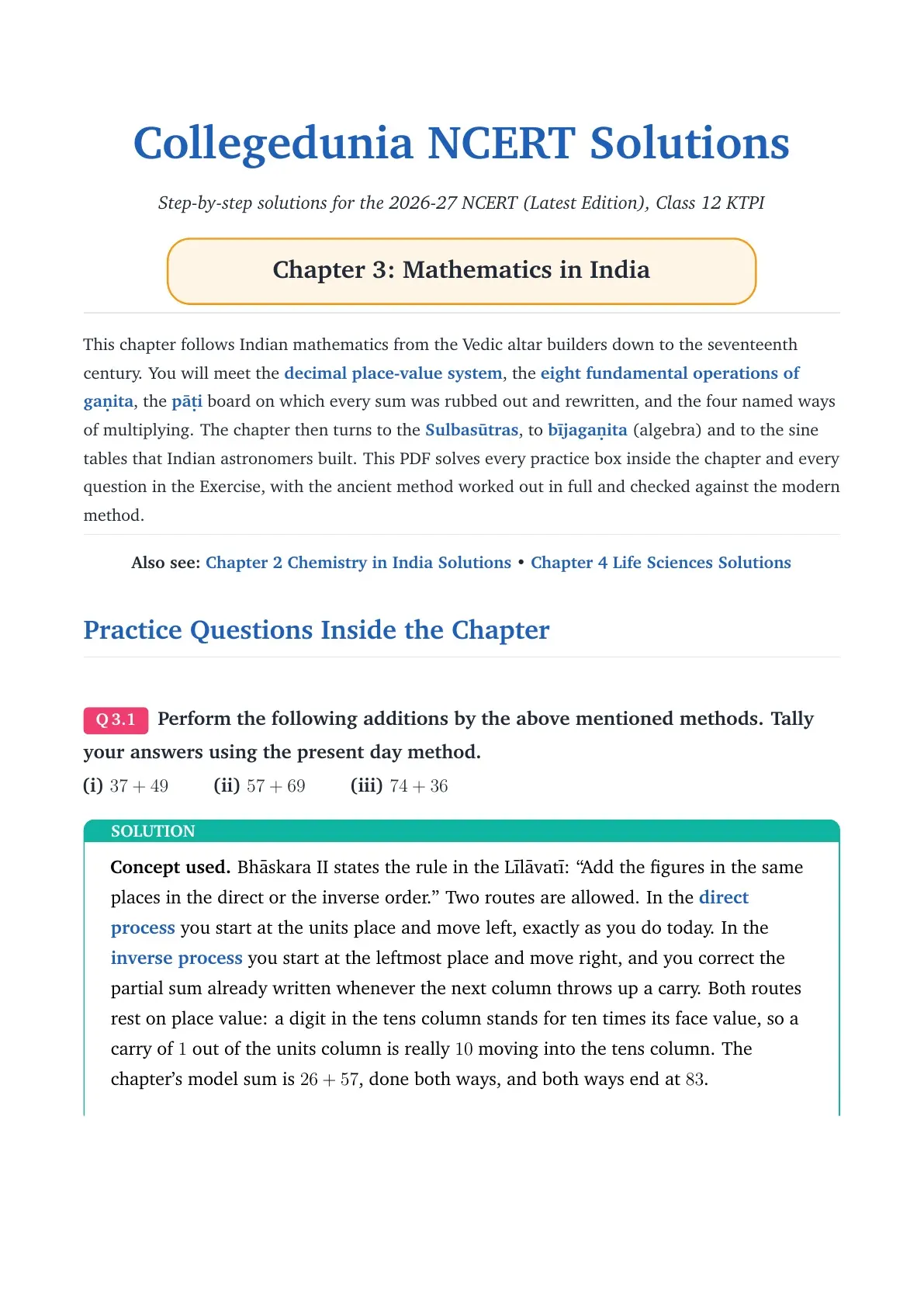
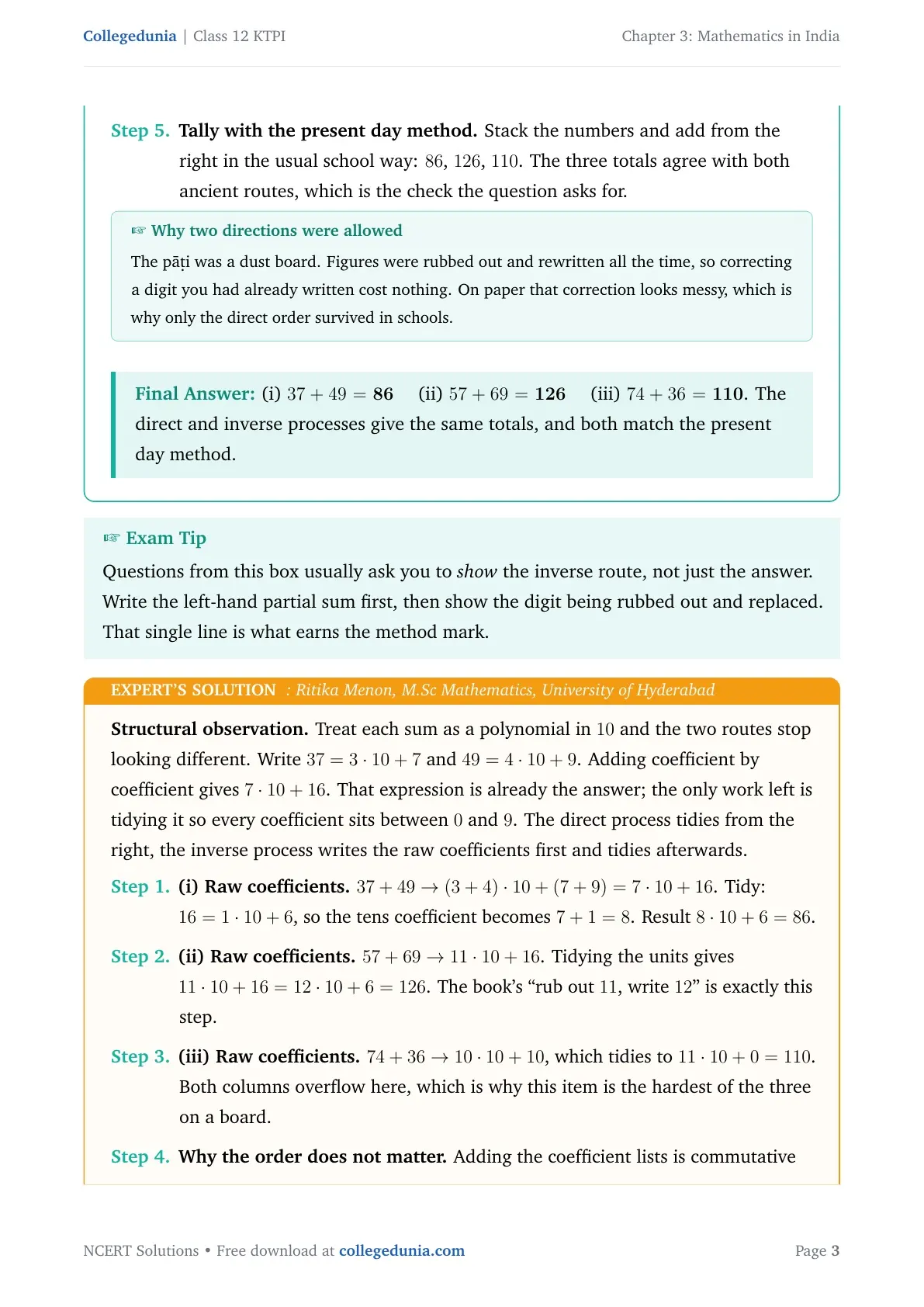
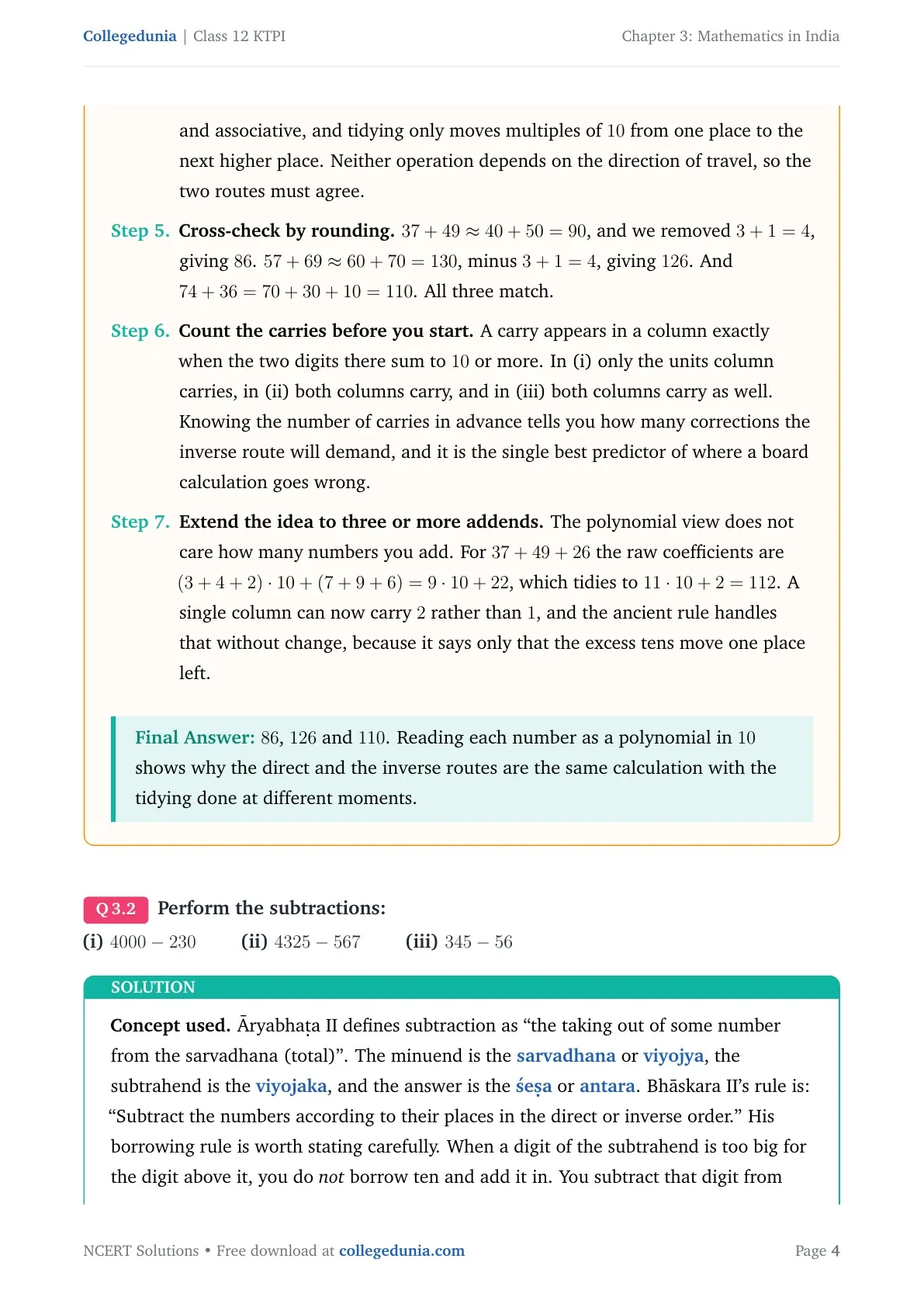
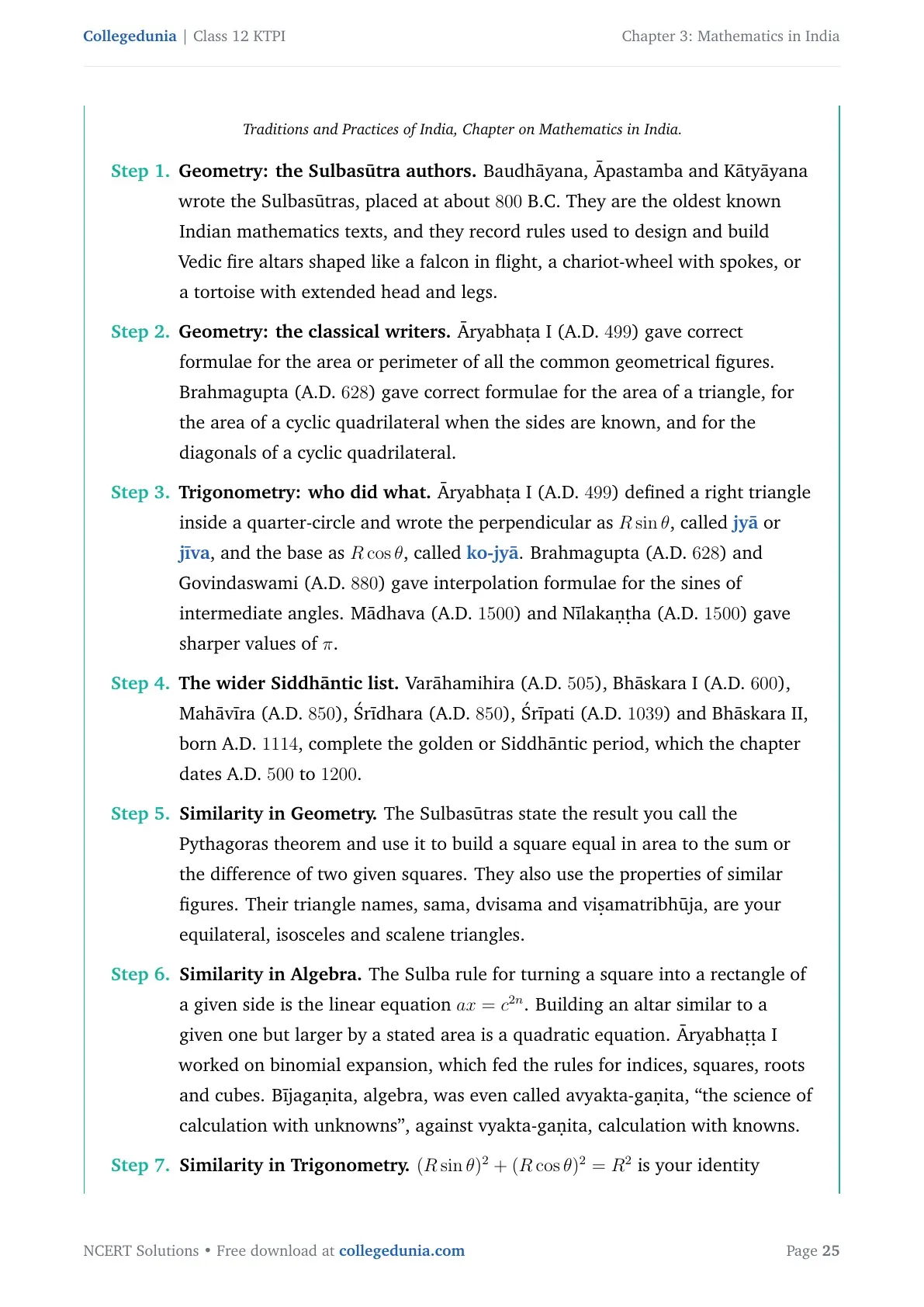
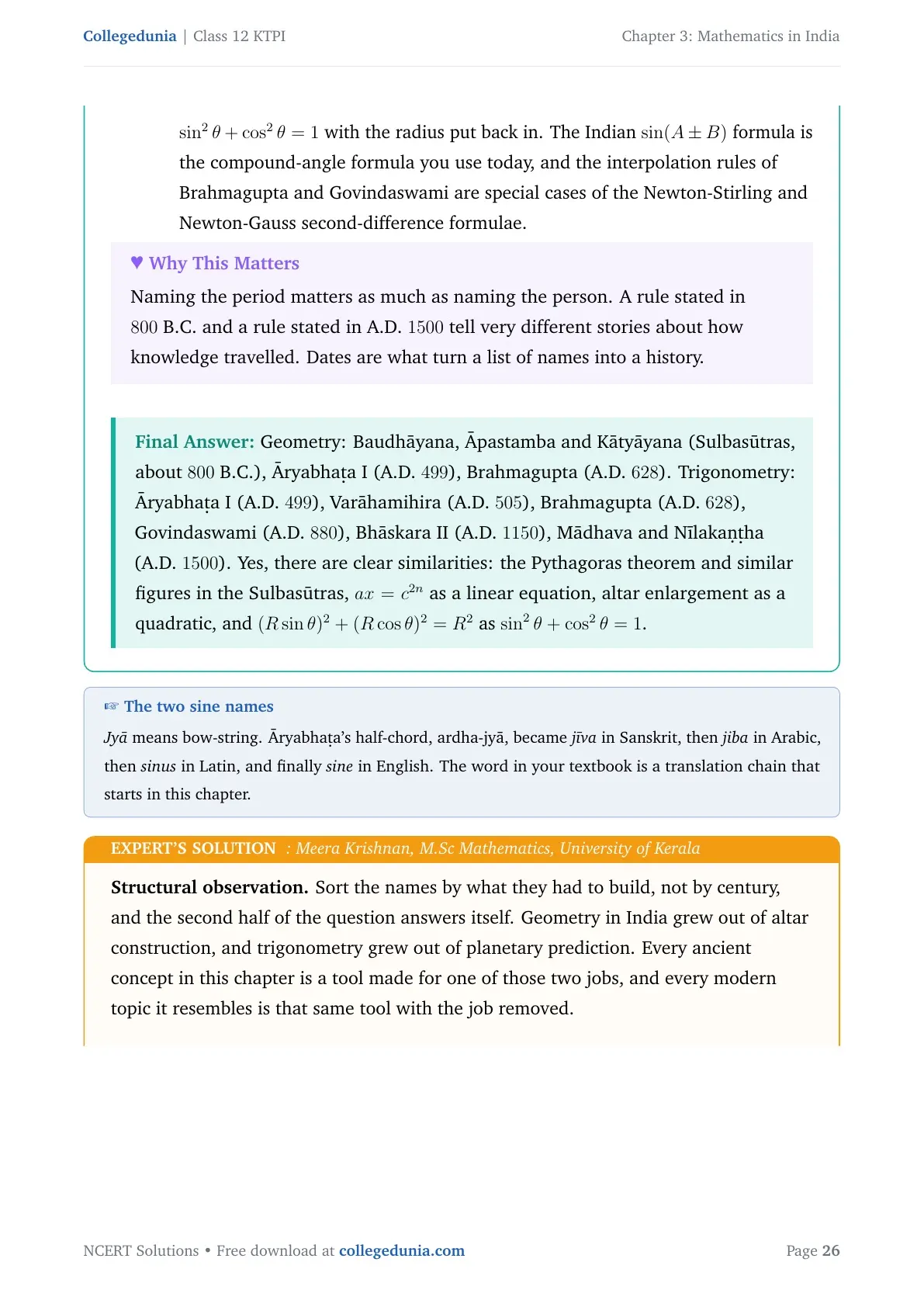
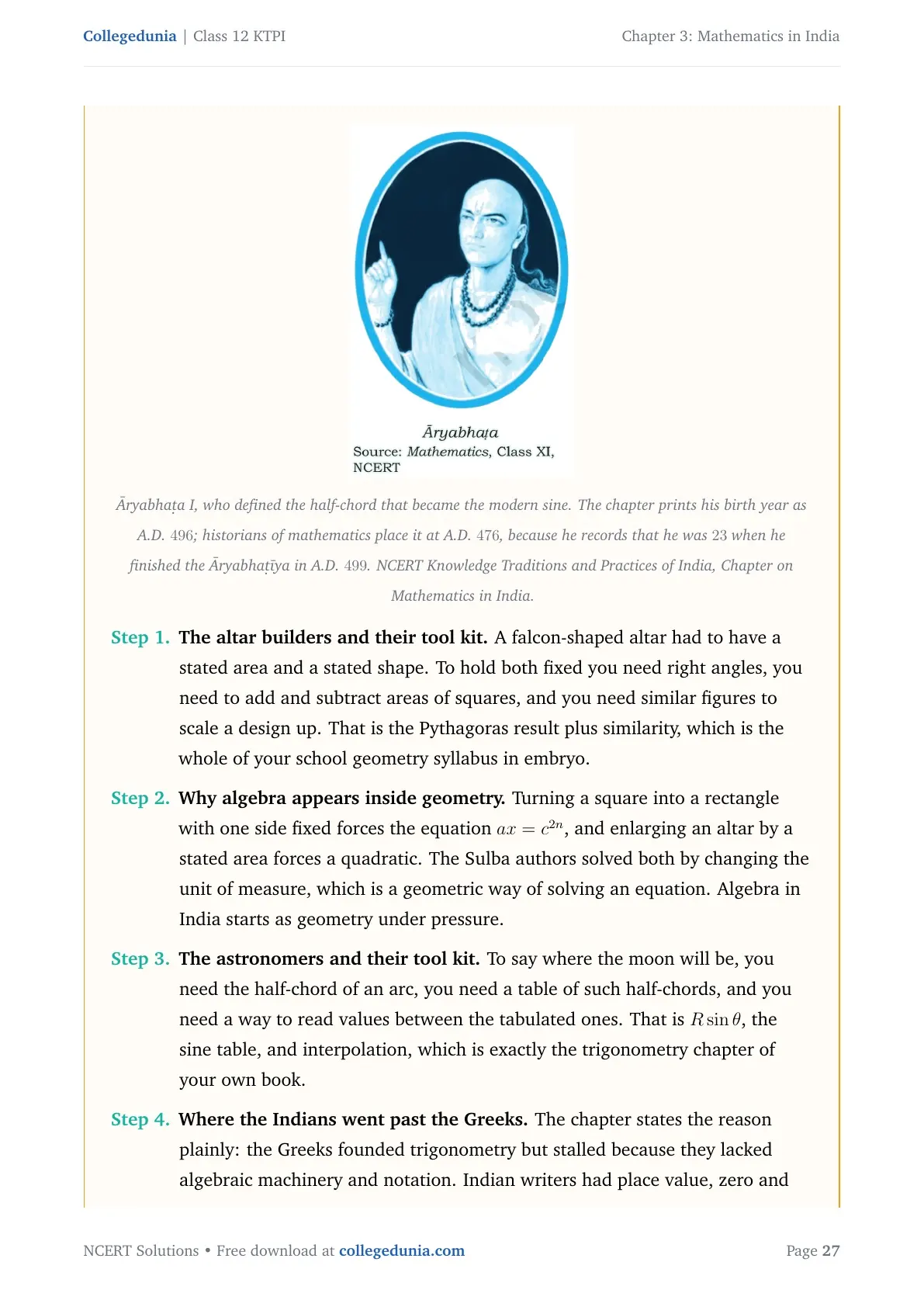
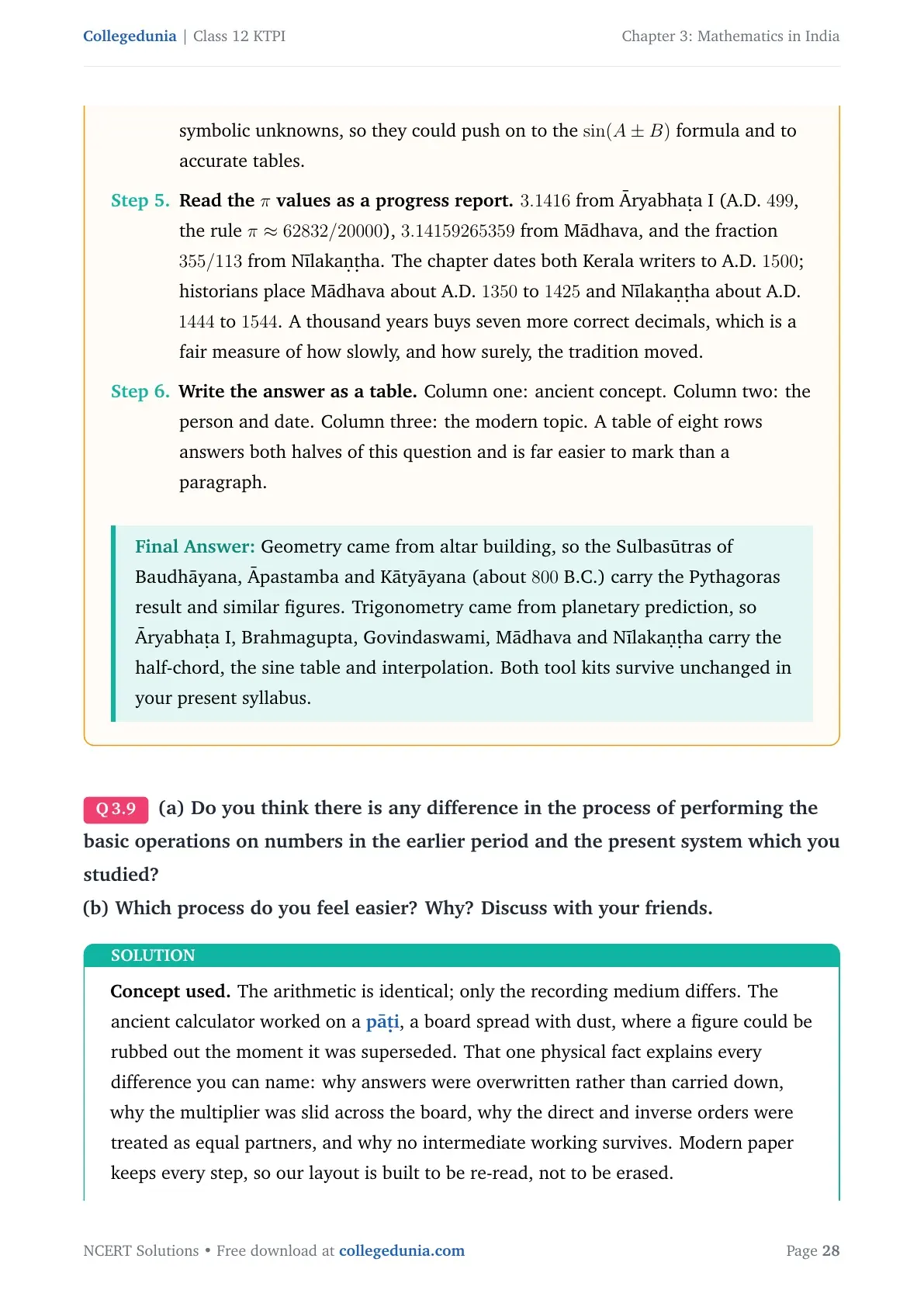
- Mathematics in India is Chapter 3 of the Class 12 Knowledge Traditions and Practices of India course.
- 5 Exercise questions in total, every one of them a written answer with no numerical marking.
- Names and years you must quote: Baudhayana, Aryabhata I, Brahmagupta, Bhaskara I, Bhaskara II, Mahavira, Sridhara, Sripati, Govindaswami, Madhava and Nilakantha.
Every answer on this page is written by subject experts and checked line by line against the Mathematics in India chapter of the NCERT Knowledge Traditions and Practices of India textbook.
What the Class 12 KTPI Mathematics in India Solutions Cover, Question by Question
This chapter does not number its exercises the way a Mathematics textbook does. It prints one Exercise block of five questions at the end, and nothing else. Two of those five ask you to go beyond the chapter text, which is where most students stop writing. The table below shows what each question really wants.
| Question | Type | What it tests |
|---|---|---|
| Exercise, Question 1 | Recall list | The eight fundamental operations of ancient ganita, named in order |
| Exercise, Question 2 | Long answer | Mathematicians of geometry and trigonometry with periods, plus the link to what you study today |
| Exercise, Question 3 | Compare and judge | Old board method against the modern written method, and which one is easier |
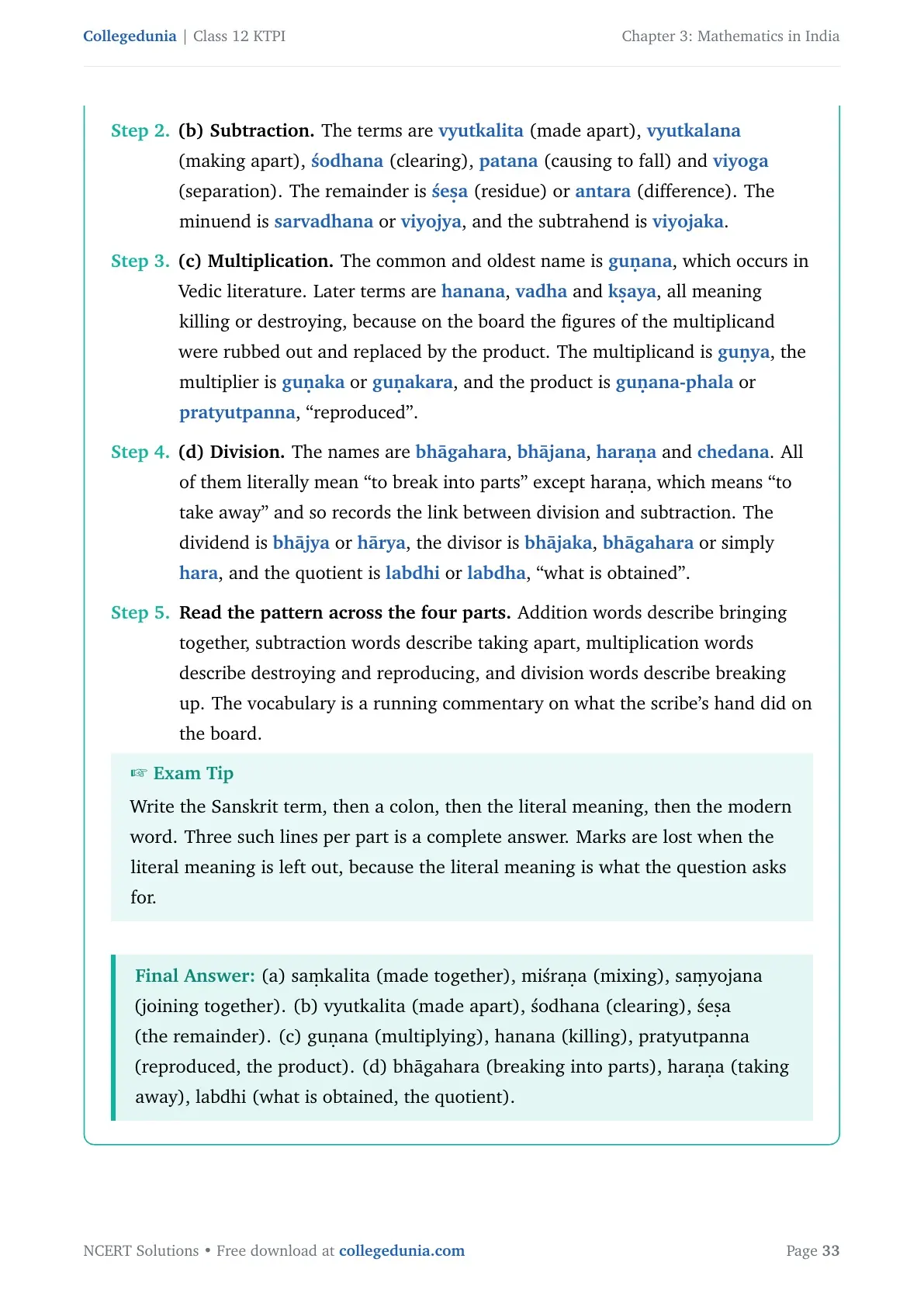
| Exercise, Question 4 | Vocabulary | Three Sanskrit terms each for addition, subtraction, multiplication and division, with meanings |
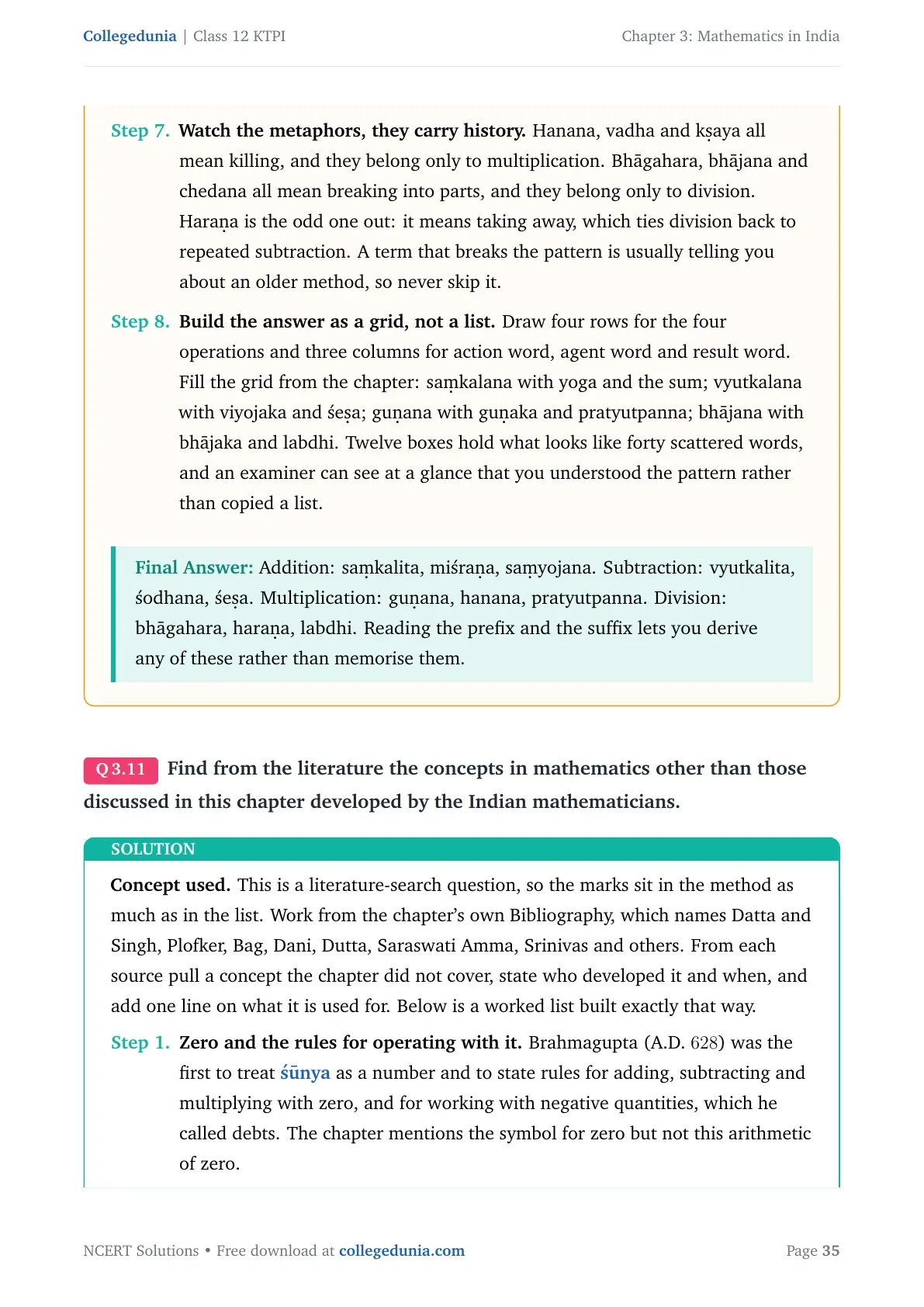
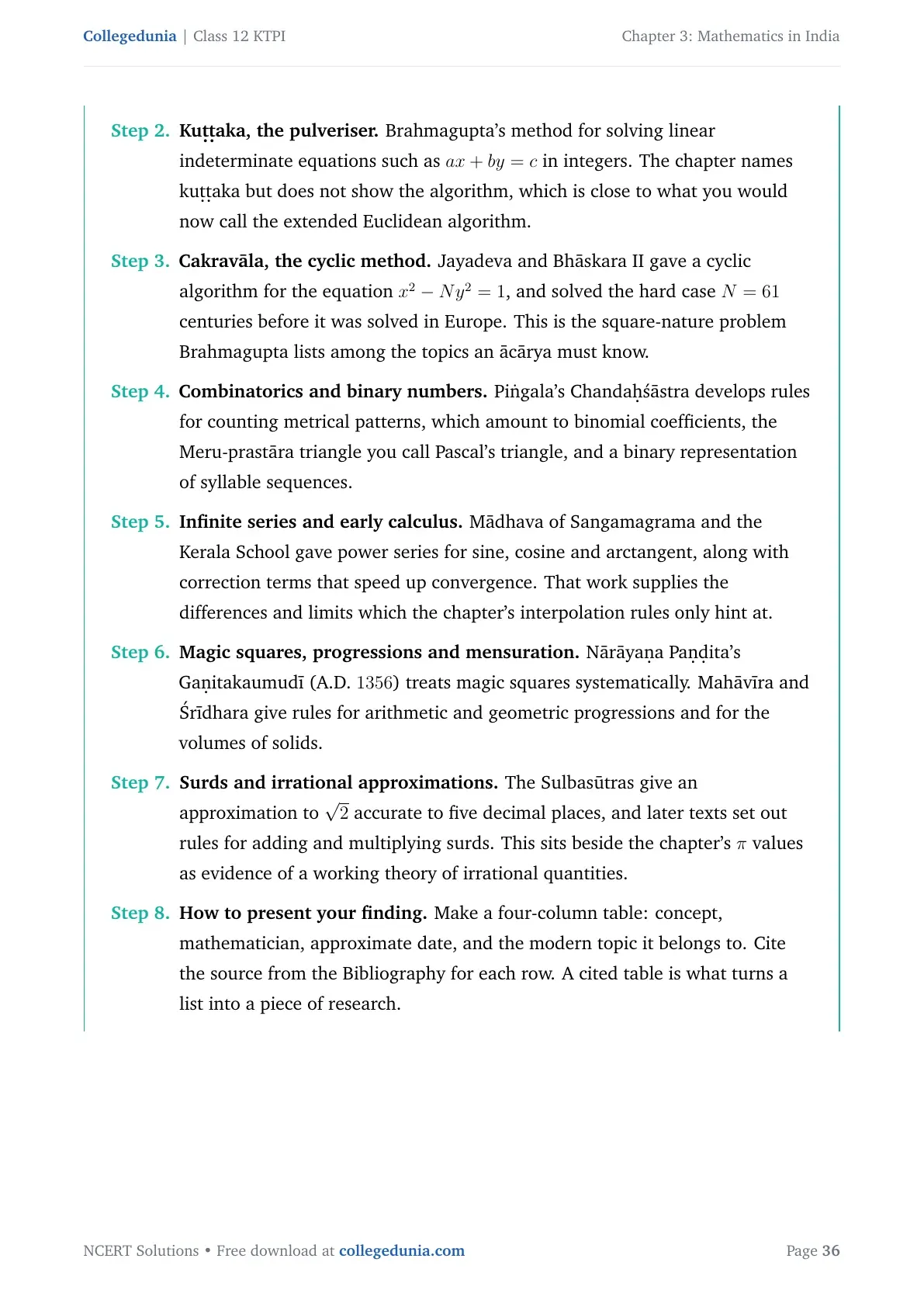
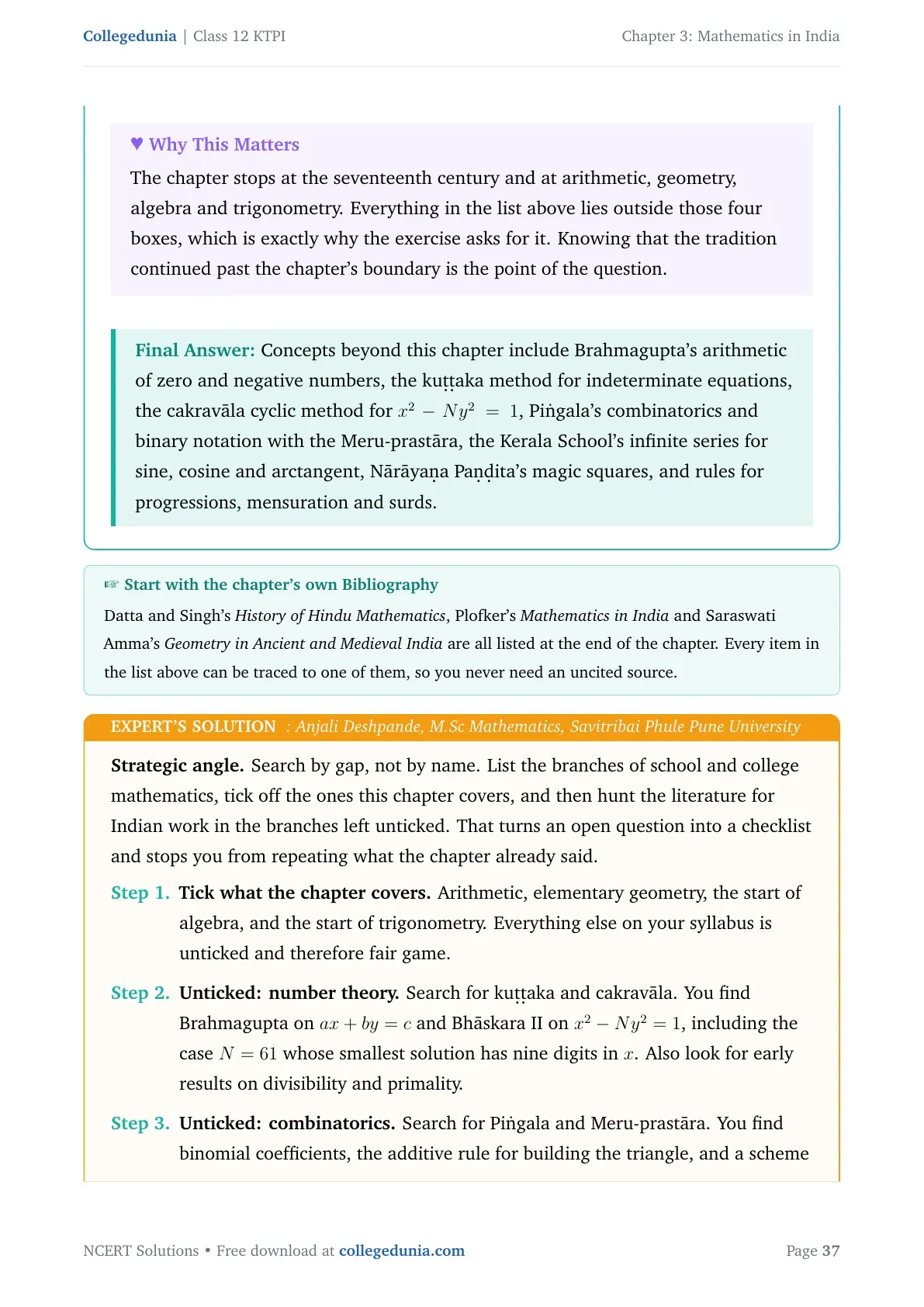
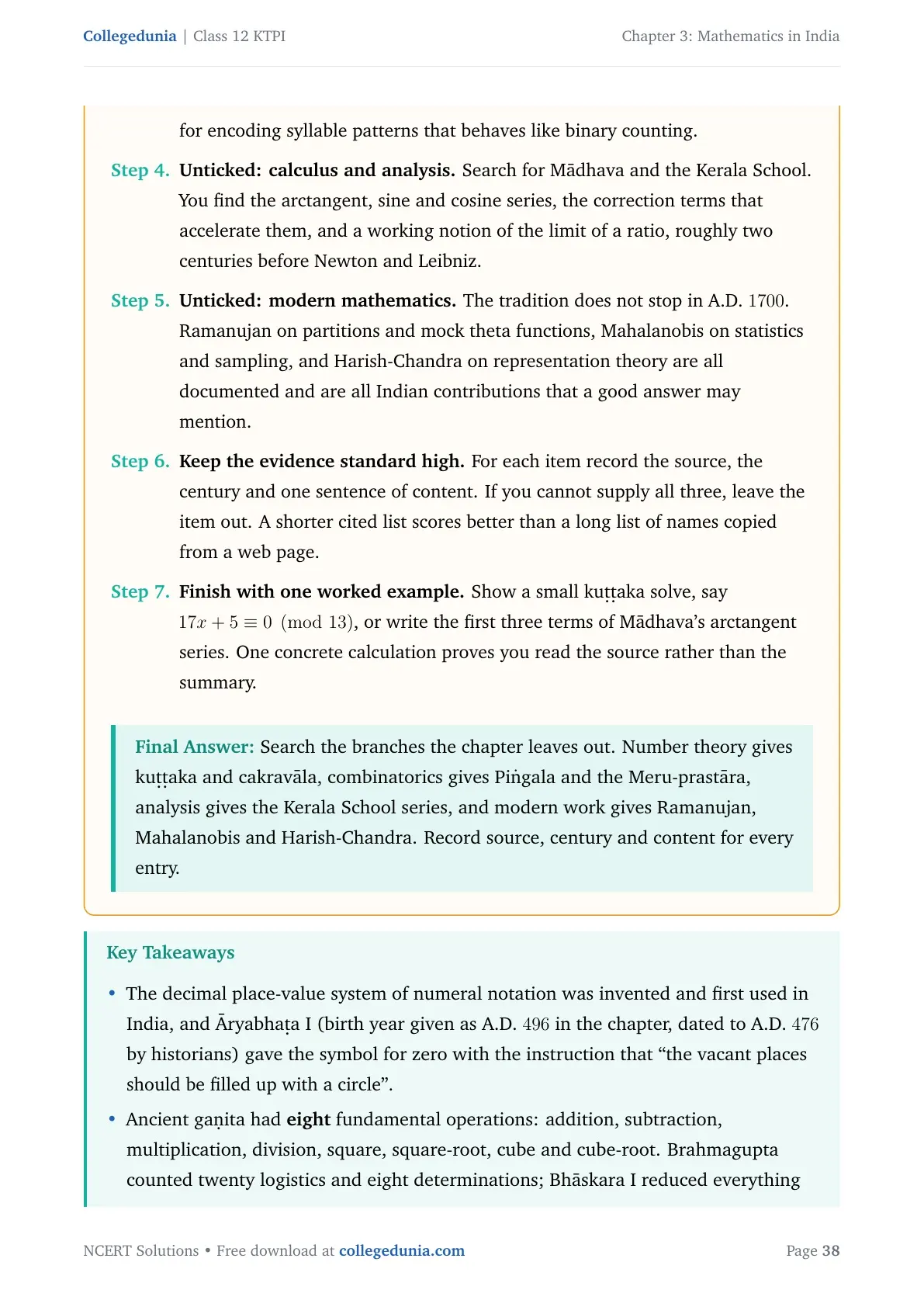
| Exercise, Question 5 | Open research | Indian contributions the chapter itself leaves out, found from the bibliography |
Questions 1 and 4 are the safest marks because both are fixed lists. Question 3 is the one that separates a full answer from a half answer, since part (b) asks for an opinion with a reason attached.
Open the full solved question set
All 5 Exercise questions written out as complete answers, each with a short Solution and a longer Expert Solution, sit on the companion page.
Decimal Place Value and Zero in Indian Mathematics
Source: Khan Academy India - English on YouTube
The Eight Fundamental Operations of Ancient Ganita and How Bhaskara I Reduced Them to Two
Question 1 is the shortest question in the chapter and the easiest to lose a mark on. The answer is a number followed by a list. Eight fundamental operations were known, and they must be named in the order the chapter prints them.
- Addition and subtraction, the two the rest are built from.
- Multiplication and division.
- Square and square root.
- Cube and cube root.
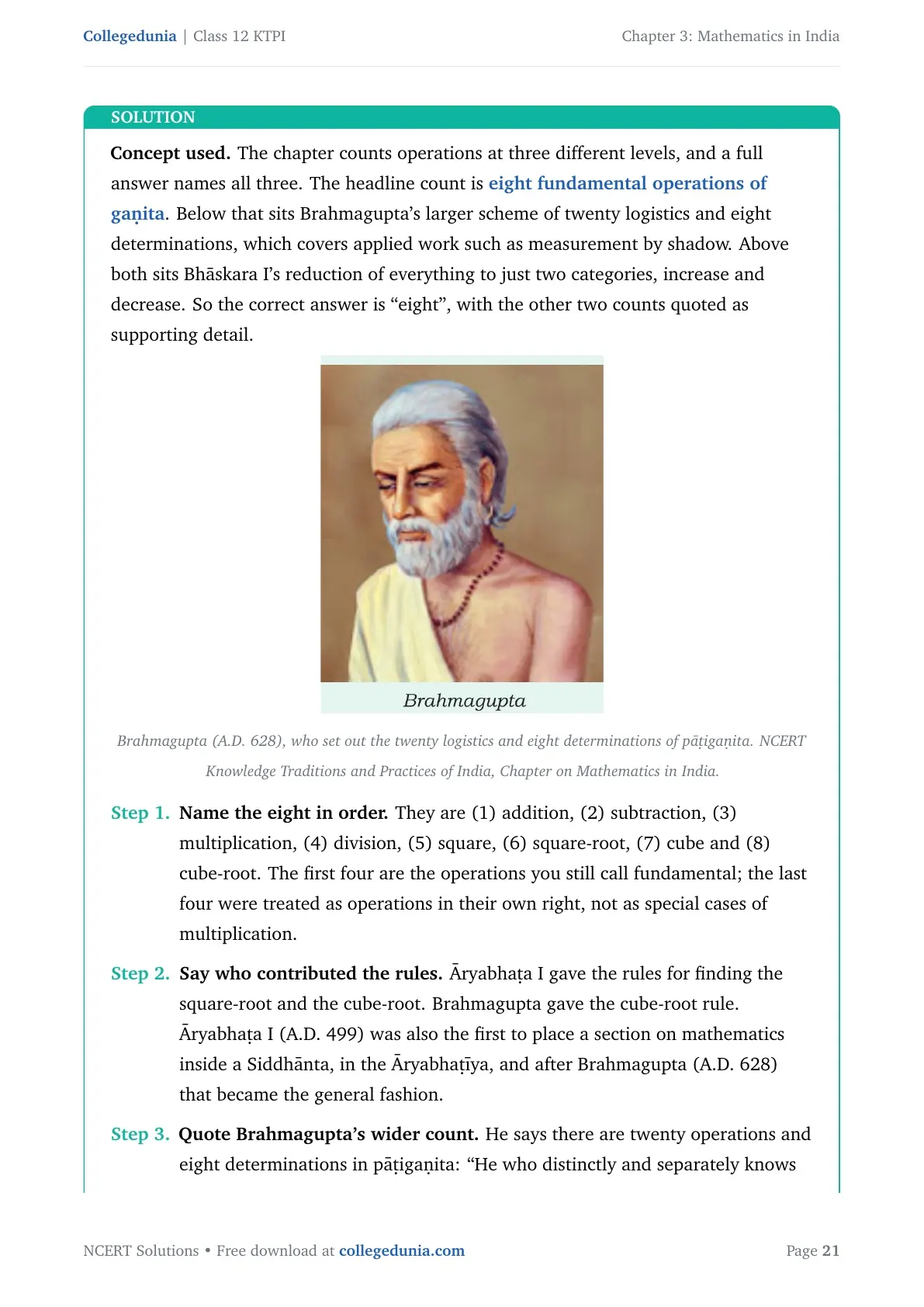
Add two supporting facts and a 2 mark answer becomes a 4 mark answer. Aryabhata I gave the rules for finding the square root and the cube root only, while Brahmagupta gave the cube root rule only. Brahmagupta also said a mathematician is one who knows the twenty logistics and the eight determinations of patiganita.
The second supporting fact is the neat one. Bhaskara I held that every operation is really one of two. Addition is increase and subtraction is decrease, and every other operation is a special kind of one of those two. Multiplication and evolution are kinds of addition. Division and involution are kinds of subtraction.
Ancient Indian Mathematicians of Geometry and Trigonometry with Their Periods
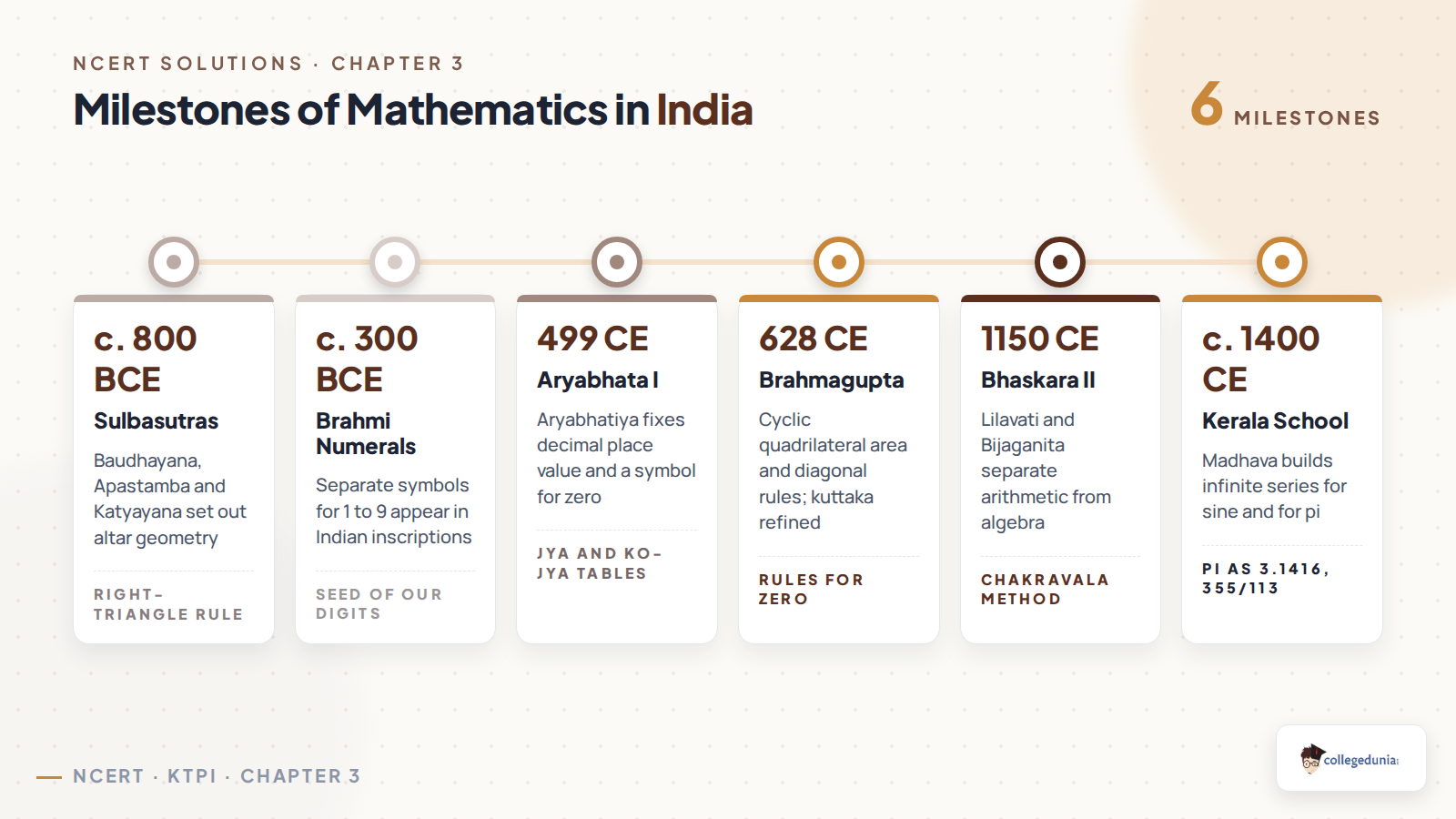
Question 2 has two halves and students answer only the first. The first half wants names with periods. The second half wants you to link those old ideas to what you study now. Write both halves under separate sub-headings in the answer sheet.
| Mathematician | Period | Area | What to quote |
|---|---|---|---|
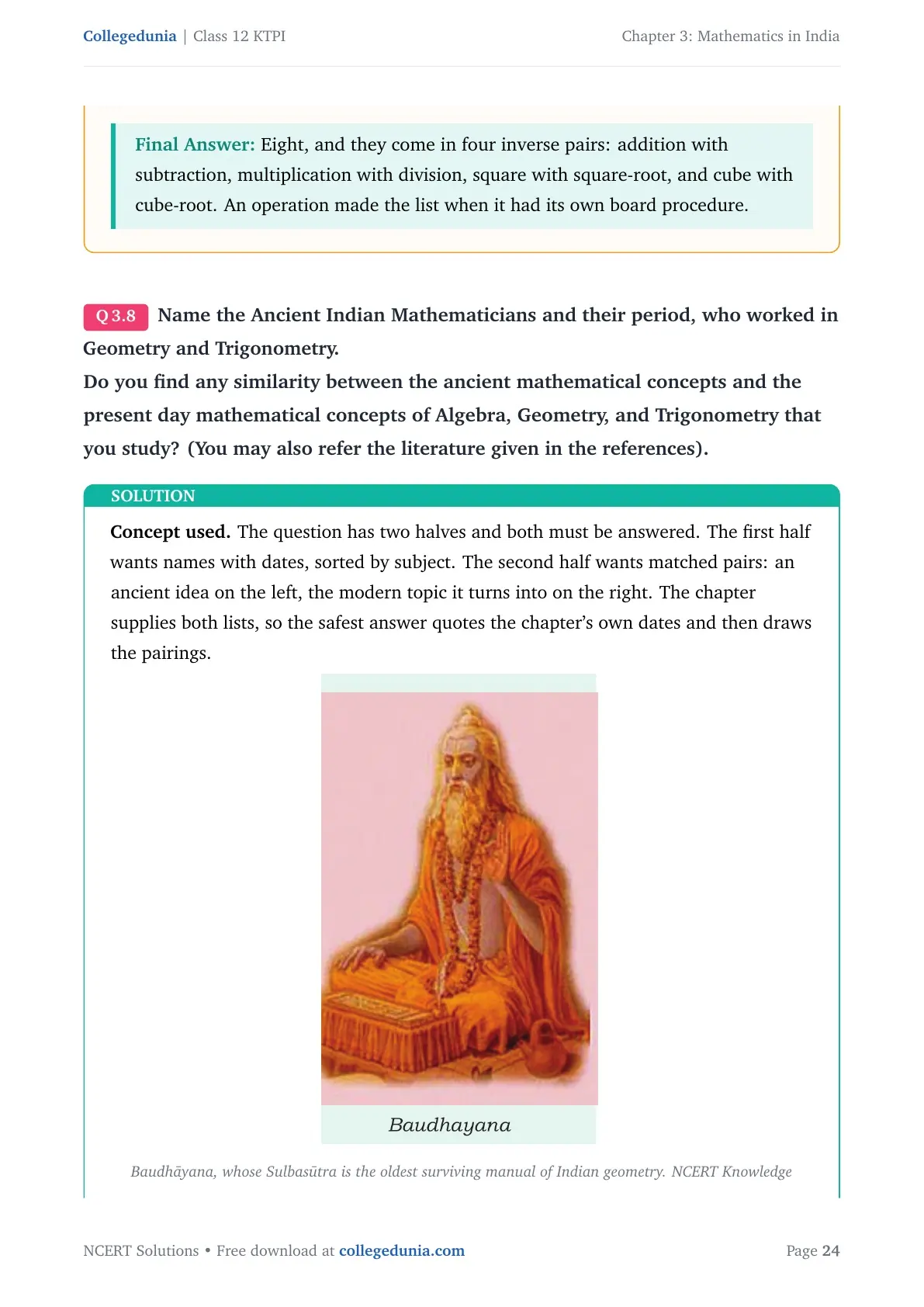
| Baudhayana, Apastamba, Katyayana | Around 800 B.C. | Geometry | Authors of the Sulbasutras, the oldest known mathematics texts |
| Aryabhata I | Born A.D. 496, Aryabhatiya A.D. 499 | Geometry and trigonometry | Correct area and perimeter formulae for all common figures; jya and ko-jya; pi as 3.1416 |
| Varahamihira | A.D. 505 | Siddhantic period | One of the famous names between Aryabhata I and Bhaskara II |
| Bhaskara I | A.D. 600 | Commentary | Explained Aryabhata I on zero and on multiplication as repeated addition |
| Brahmagupta | A.D. 628 | Geometry and trigonometry | Area of a triangle, area and diagonals of a cyclic quadrilateral, sine interpolation |
| Govindaswami | A.D. 880 | Trigonometry | Interpolation formula for sines of intermediate angles |
| Bhaskara II | Born A.D. 1114 | Geometry and algebra | Lilavati on mathematics and Bijaganita on algebra |
| Madhava and Nilakantha | A.D. 1500 | Trigonometry | Pi as 3.14159265359 and as 355/113 |
For the second half, name the similarity instead of describing it. The Sulbasutra statement of the Pythagoras theorem is the same result you use in a right triangle today. Aryabhata's R Sin theta and R Cos theta are the modern sine and cosine, only scaled by the radius. The interpolation formulae of Brahmagupta and Govindaswami are special cases of the Newton-Stirling and Newton-Gauss formulae for second order differences.
What the Sulbasutras Say About the Pythagoras Theorem and the Vedic Fire Altars
The Sulbasutras of Baudhayana, Apastamba and Katyayana are the oldest known mathematics texts in existence. They belong to the Sutra period of the later Vedic age and are placed at about 800 B.C. The mathematics inside them is older still, because the authors say they are only writing down facts the Brahmana and Samhita composers already knew.
- Why they were written. They collect the results needed to design and build Vedic fire altars, which had to be built accurately because the shape carried meaning.
- The altar shapes. A falcon in flight with curved wings, a chariot wheel complete with spokes, and a tortoise with extended head and legs.
- The two pillars of plane geometry. The result now called the Pythagoras theorem, and the properties of similar figures. Both appear in the Sulbasutras.
- The constructions. Building a square equal in area to the sum of two given squares, to the difference of two squares, or to a given rectangle.
- The triangles. Sama, dvisama and visama tribhuja, which are the equilateral, isosceles and scalene triangles you name today.
Two later names finish the geometry answer. Aryabhata I gave the correct formulae for the area or the perimeter of all the common geometrical figures. Brahmagupta gave correct formulae for the area of a triangle, for the area of a cyclic quadrilateral when the sides are known, and for the diagonals of a cyclic quadrilateral.
Aryabhata I, R Sin Theta and the Indian Route into Trigonometry
The chapter is direct about who did what. The Greeks founded trigonometry, but their progress stopped because they had no proper algebra or notation. Indian mathematicians had both, so they carried the subject forward.
- The functions. Indians invented the sine and cosine functions and found most of the standard formulae and identities, including the basic formula for sin(A plus or minus B).
- The tables. They built fairly accurate sine tables, and Brahmagupta and Govindaswami added interpolation rules for angles that fell between table entries.
- The geometry behind it. Aryabhata I was the first to define a right triangle inside a quarter circle, then write the perpendicular and the base as functions of the angle.
- The names. The perpendicular is jya or jiva, written as R Sin theta. The base is ko-jya, written as R Cos theta. Here R is the radius of the circle.
- The identity. (R Sin theta) squared plus (R Cos theta) squared equals R squared, which is the modern Pythagorean identity scaled by the radius.
The chapter also prints a short table of values, and it is worth learning as printed: R Sin 0 degrees = 0, R Sin 30 degrees = R/√3, R Sin 45 degrees = R/√2, R Sin 60 degrees = R√3/2 and R Sin 90 degrees = R. Sine values rise across the quadrant while cosine values fall, with R Cos 0 degrees = R and Cos 90 degrees = 0.
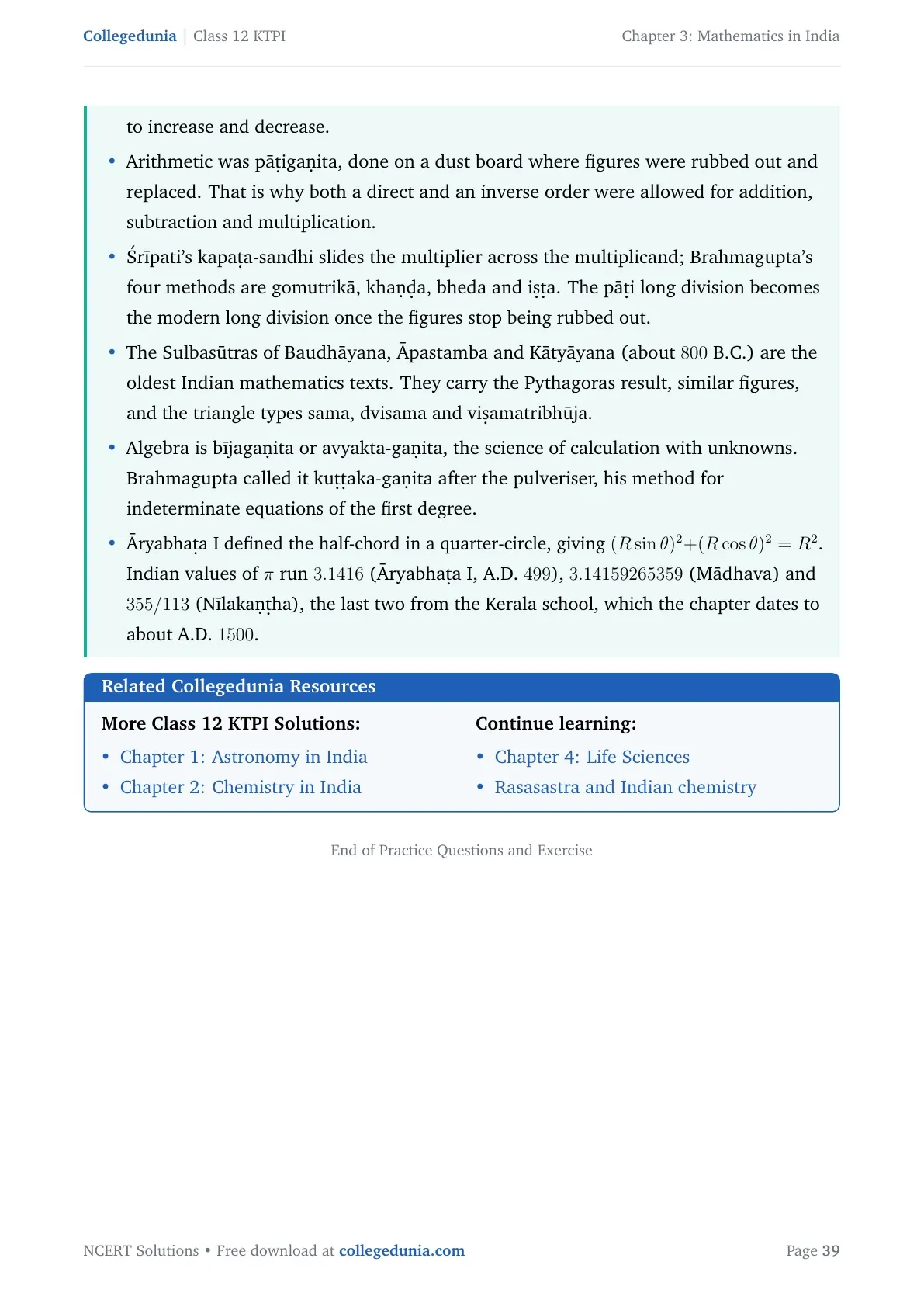
Three values of pi appear in the chapter and all three are quotable: 3.1416 from Aryabhata I in A.D. 499, 3.14159265359 from Madhava around A.D. 1500, and 355/113 from Nilakantha in the same period.
Decimal Place Value, the Brahmi Numerals and Aryabhata's Symbol for Zero
This section is not a printed question, but it supplies the opening line of almost every answer in the chapter. The decimal place value system of numeral notation was invented and first used by Indians. Ten has been the base of counting in India from the earliest times.
| Evidence | Period | What it shows |
|---|---|---|
| Mohenjodaro discoveries | As early as 3,000 B.C. | A highly organised life in the land of the Sindhu, ahead of any other people of the period |
| Yajurveda Samhita number names | Vedic | Denominations as large as ten raised to the power twelve, so a developed system of symbols already existed |
| Brahmi numerals | From King Asoka, 300 B.C. | A purely Indian invention; 1, 2 and 3 were one, two and three horizontal lines placed one below the other |
| Nasik cave inscriptions | A.D. first or second century | Numerals in everyday inscriptional use |
| Golden or Siddhantic period | A.D. 500 to 1200 | Opens with Aryabhata I, born A.D. 496, and closes with Bhaskara II, born A.D. 1114 |
The zero answer has one quotable line. Aryabhata I discovered the symbol for zero while writing numbers in decimal form, and said that "the vacant places should be filled up with a circle", which is what sunya looks like. His commentator Bhaskara I illustrated it in A.D. 600.
Learn the three great books alongside it. The Aryabhatiya has two sections, Dasagitika and Ganita. Brahmagupta's Brahmasphutasiddhanta also has two, Ganita and Kuttaka. Bhaskara II wrote two separate works instead, Lilavati on mathematics and Bijaganita on algebra.
How Ancient Indians Did Addition, Subtraction, Multiplication and Division on a Pati Board
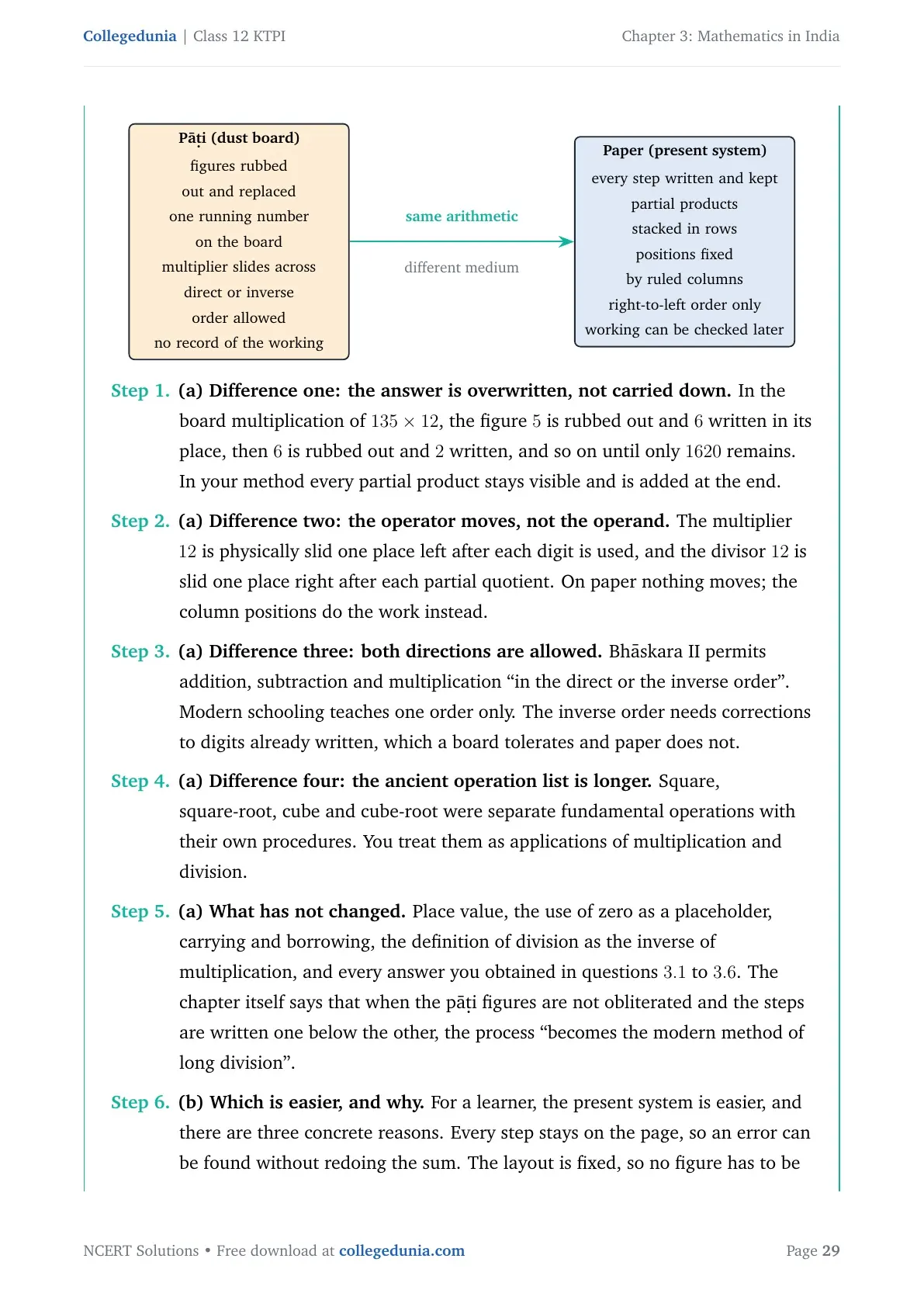
Question 3 asks whether the old process differs from the one you use, and which is easier. You cannot answer it without the word pati. Patiganita joins pati, meaning board, with ganita, meaning the science of calculation. Calculation was sometimes called dhuli-karma, or dust work, because figures were written on dust spread over a board.
| Point | Ancient board method | Method you use today |
|---|---|---|
| Surface | Dust on a board or on the ground, so figures were rubbed out and rewritten | Paper, so every figure stays |
| Direction of work | Direct order from the units place, or inverse order from the extreme left | Almost always from the units place |
| Record of steps | Only the final line survives; partial results are erased | Every step is written one below the other |
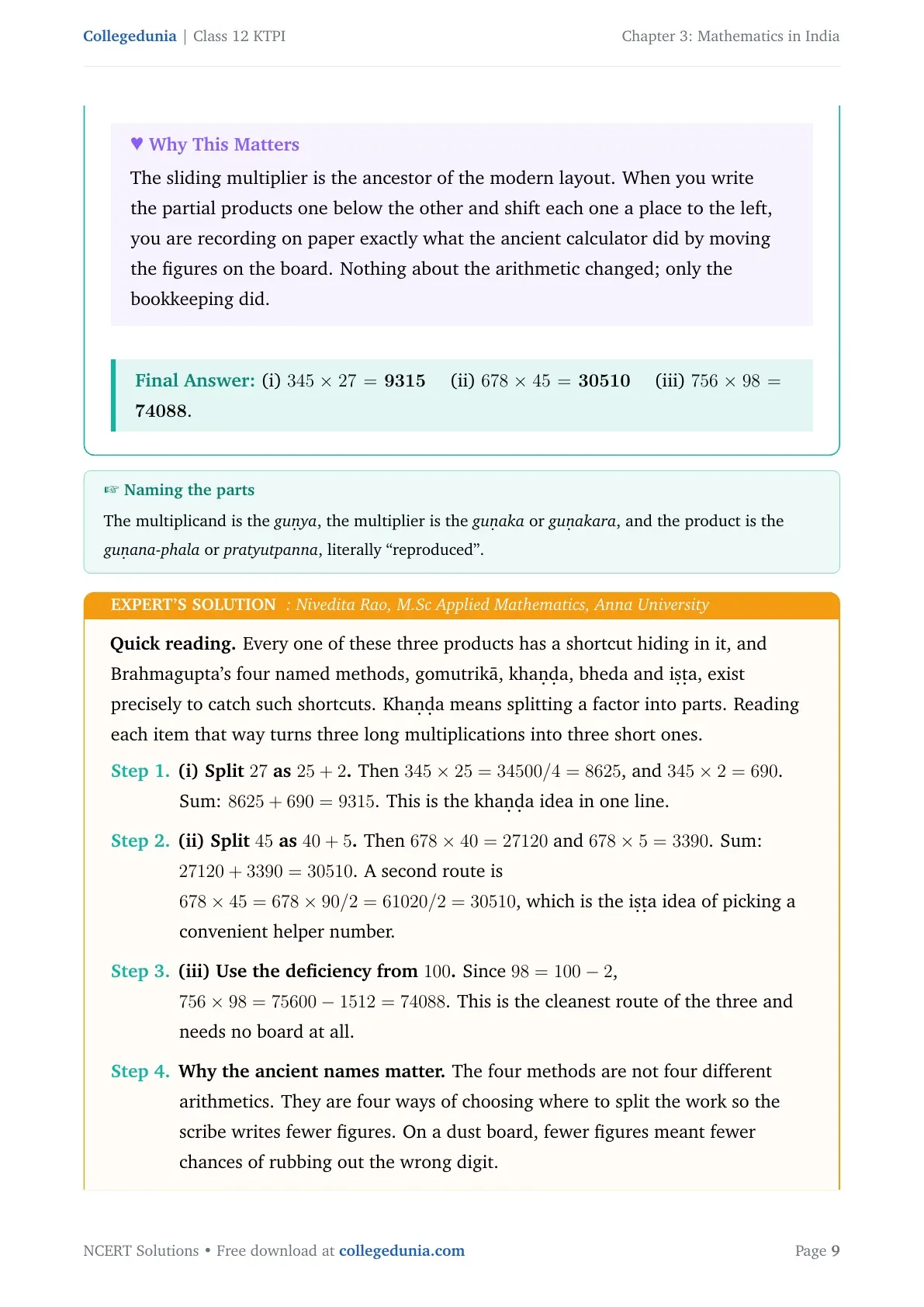
| Multiplication | Kapata-sandhi, the junction of two doors, with the multiplier moved one place at a time | Partial products written in rows and then added |
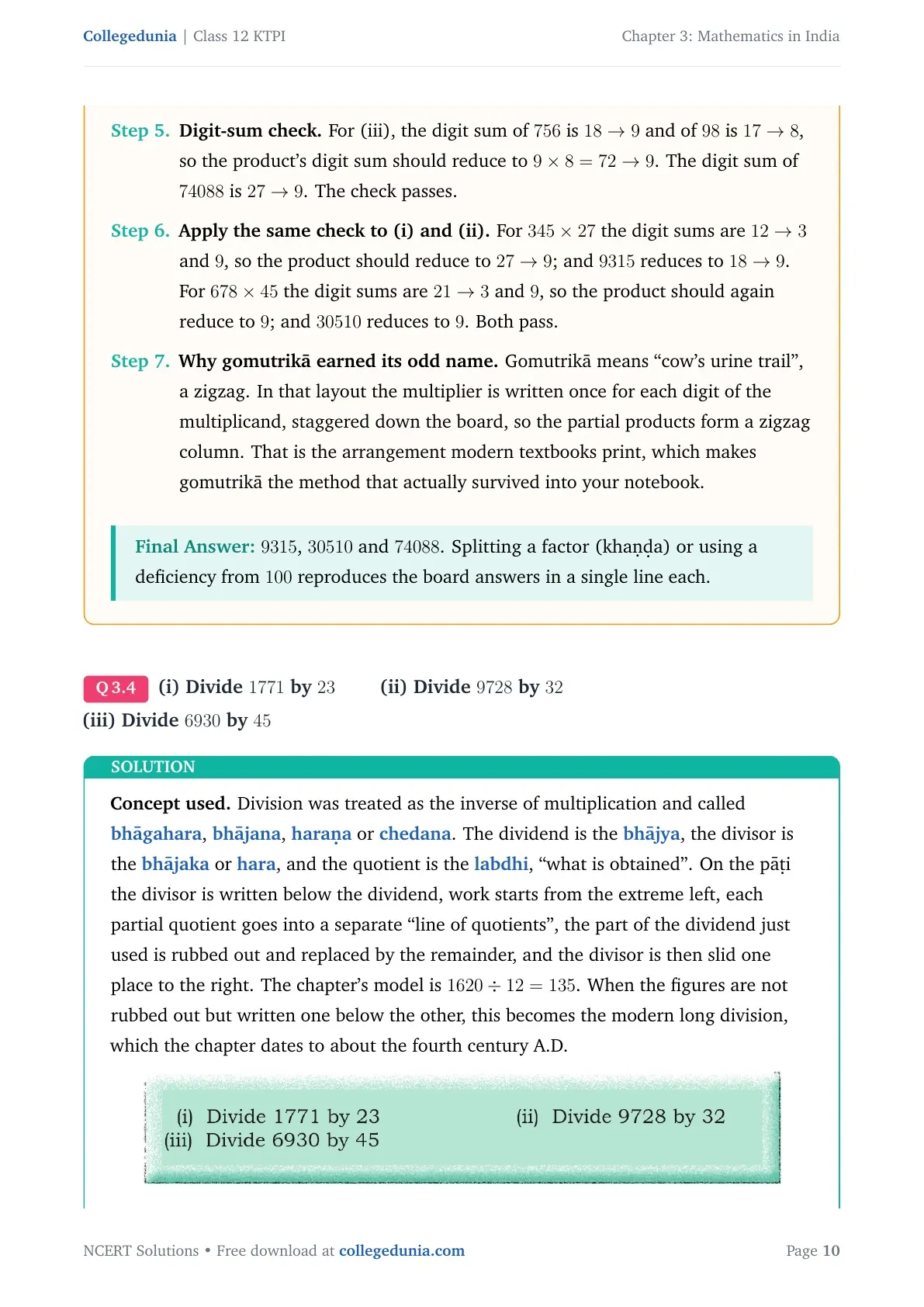
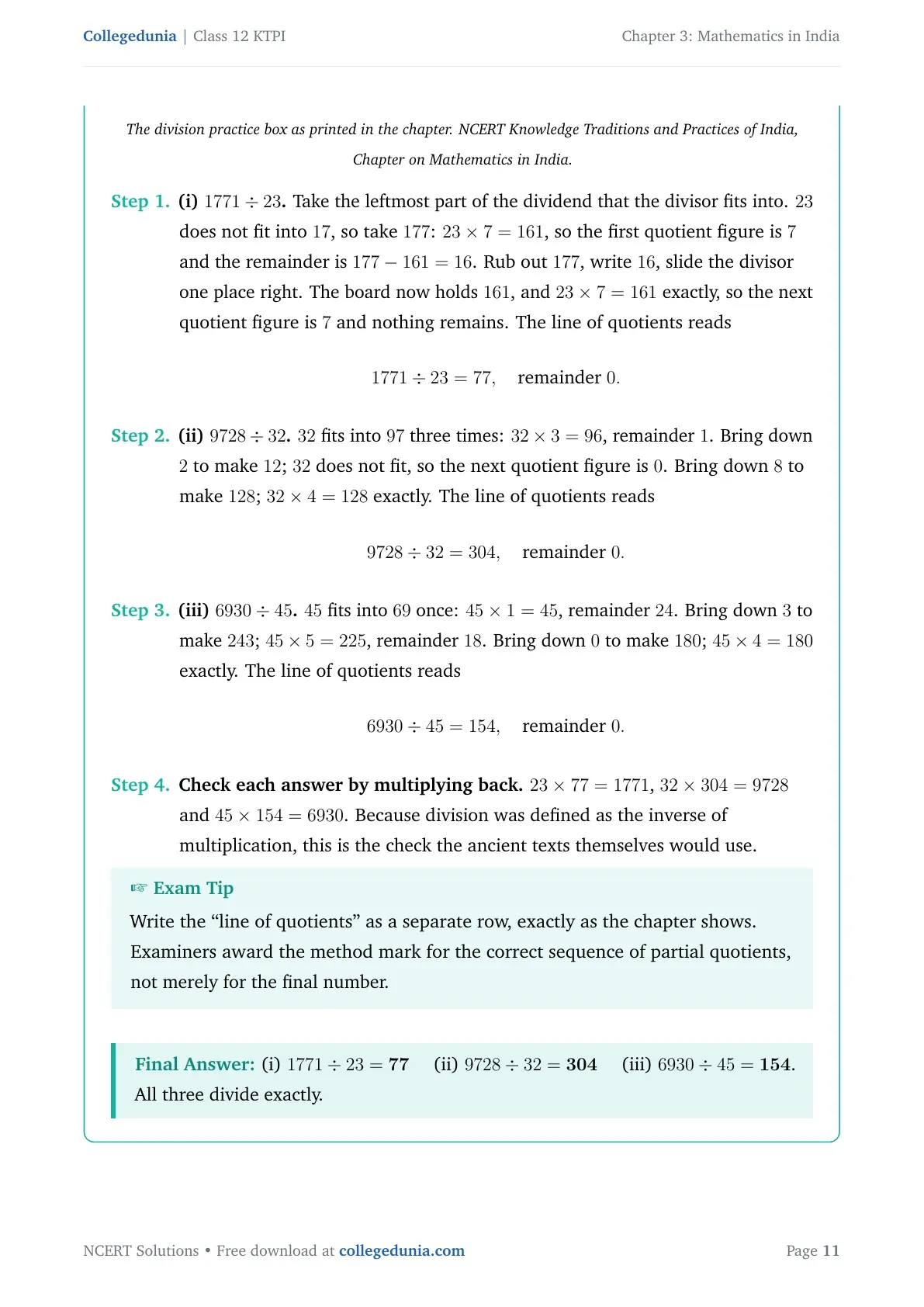
| Division | The divisor is moved right and remainders replace the dividend on the board | The same steps, written down instead of erased |
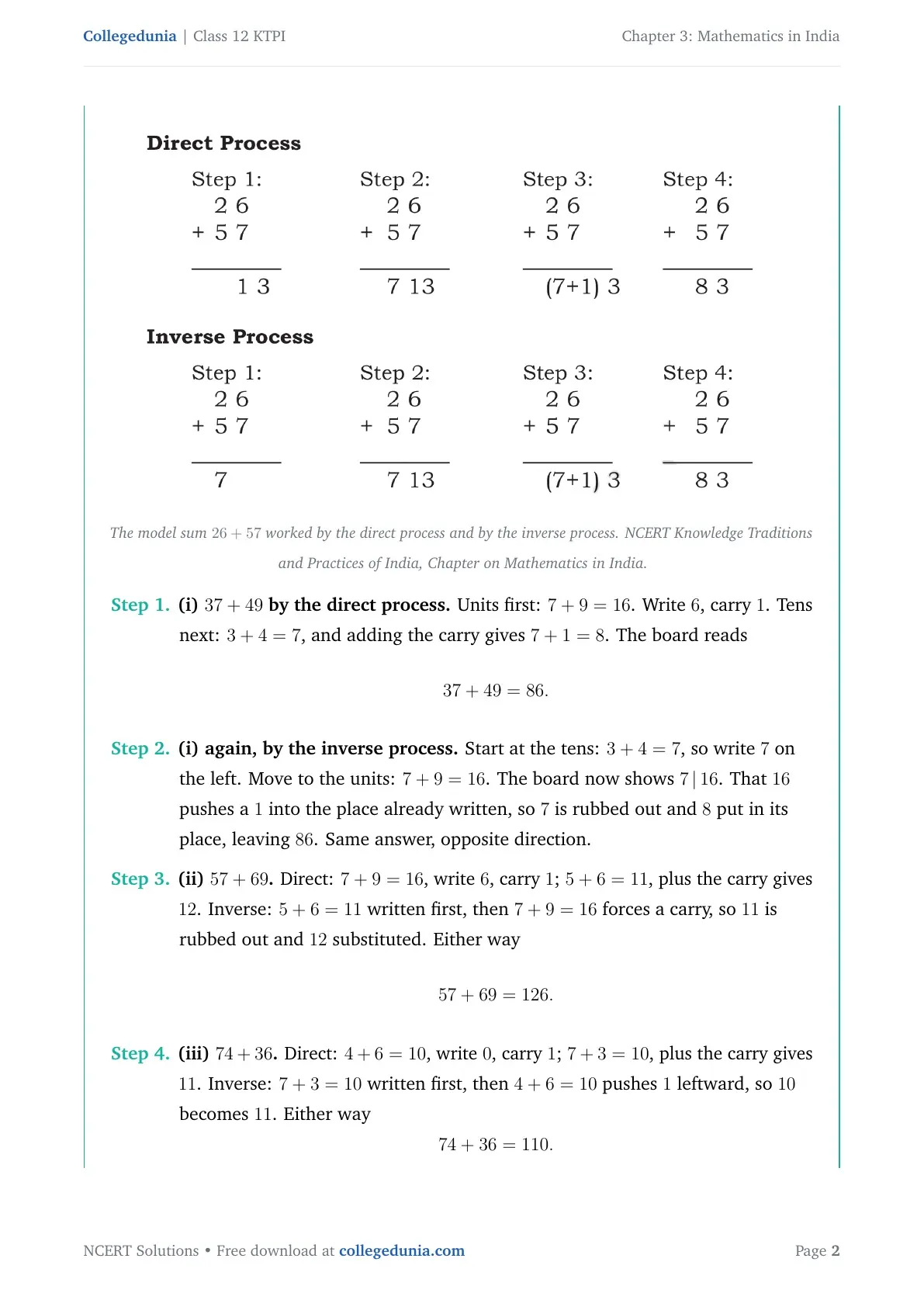
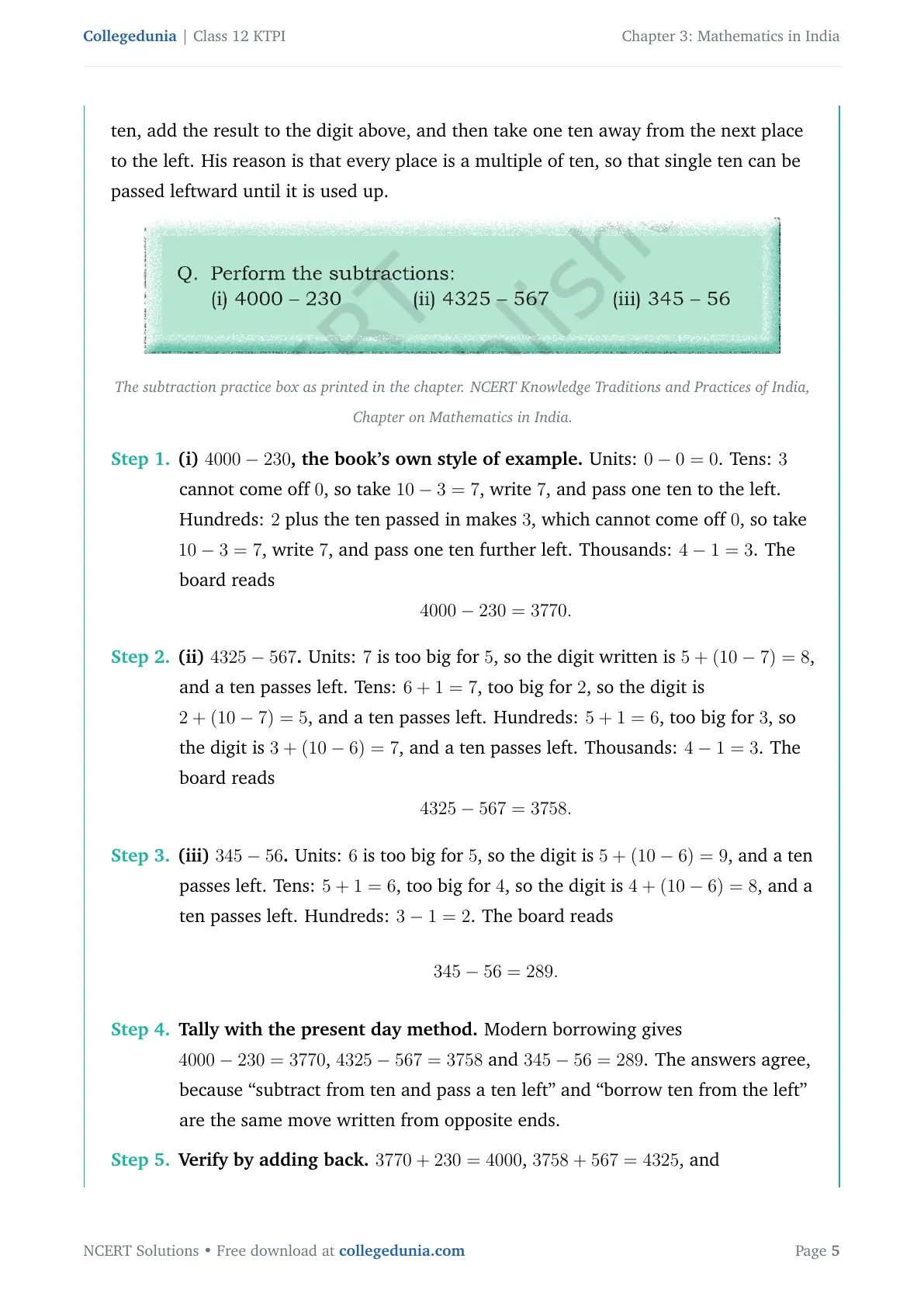
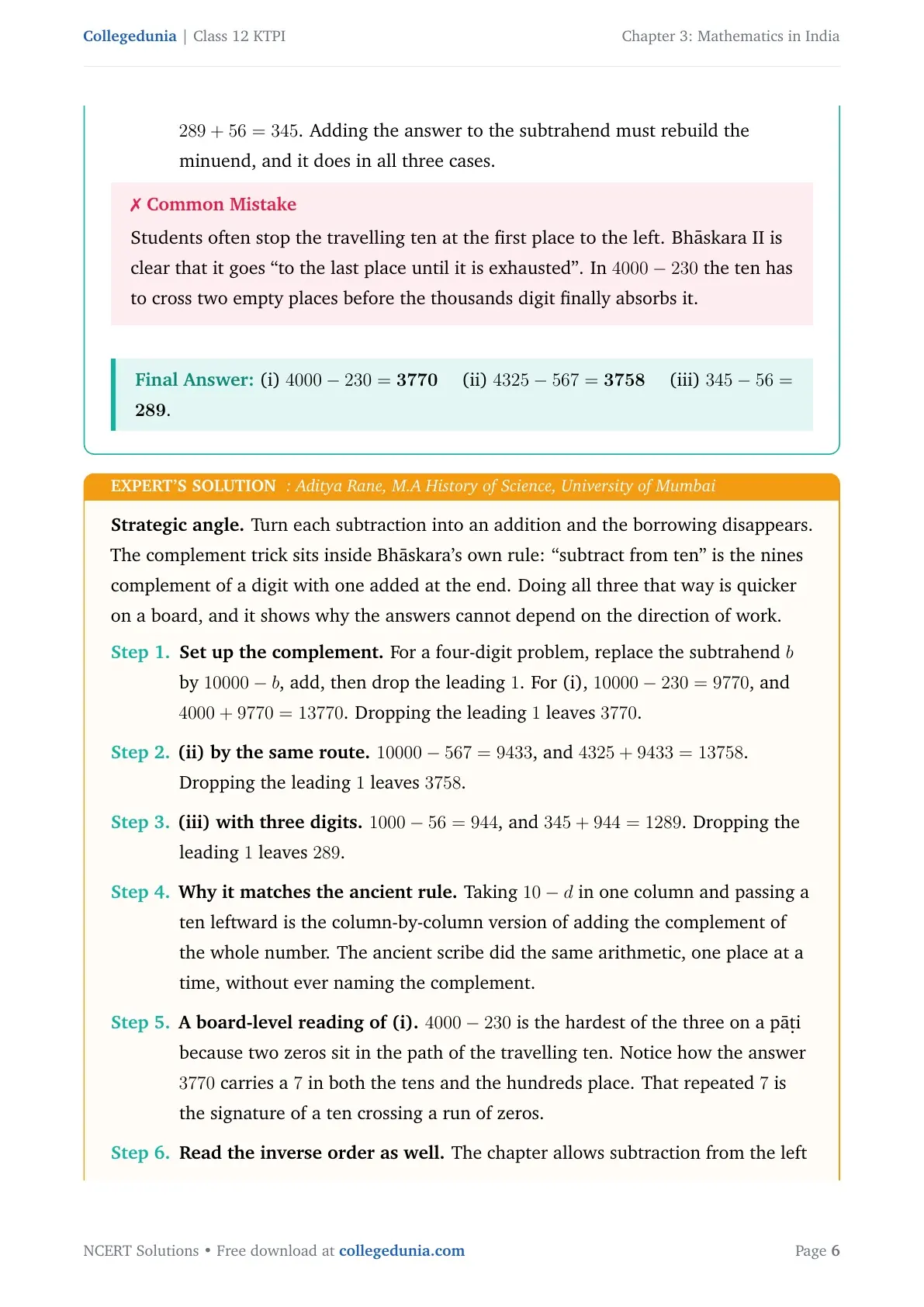
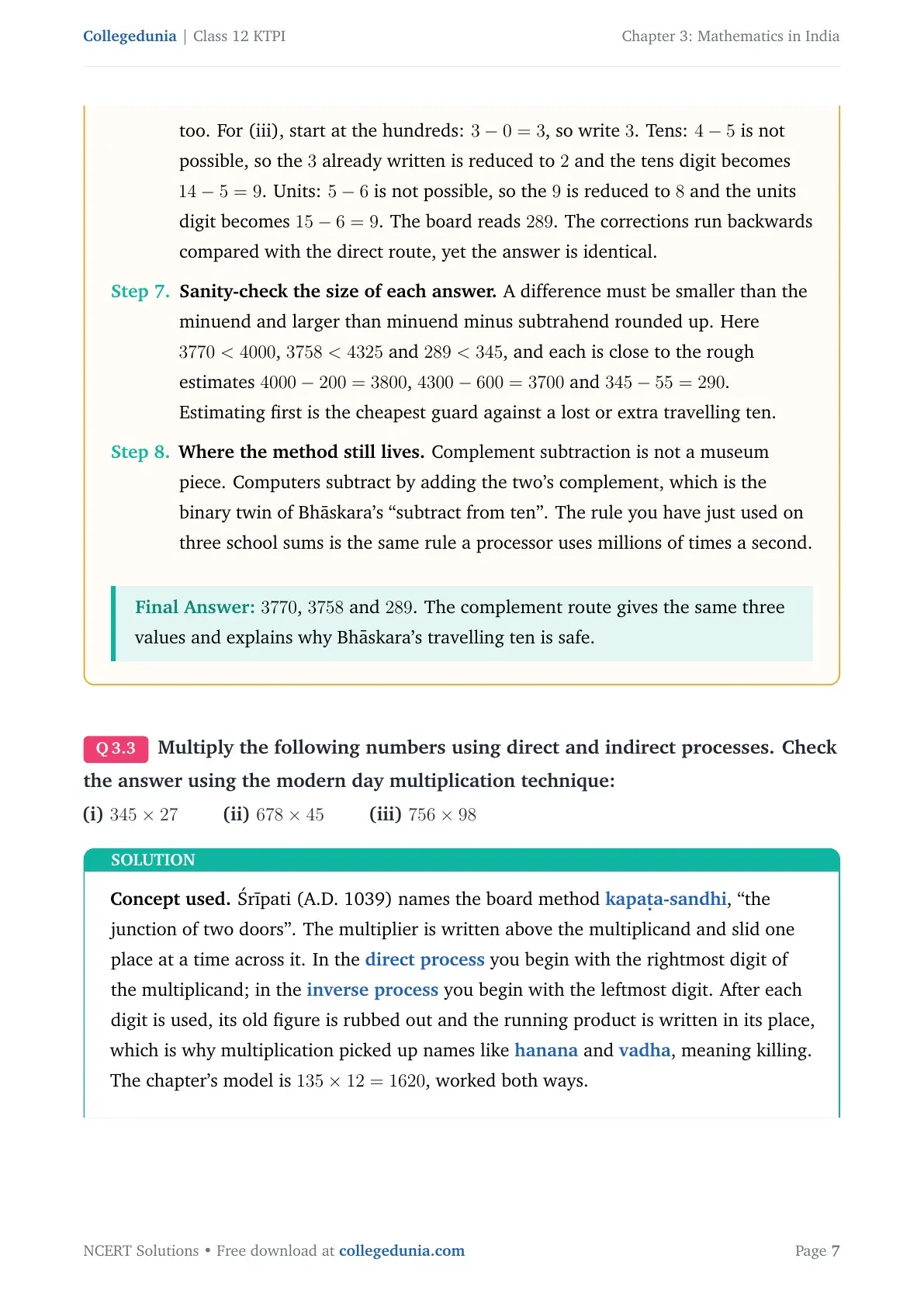
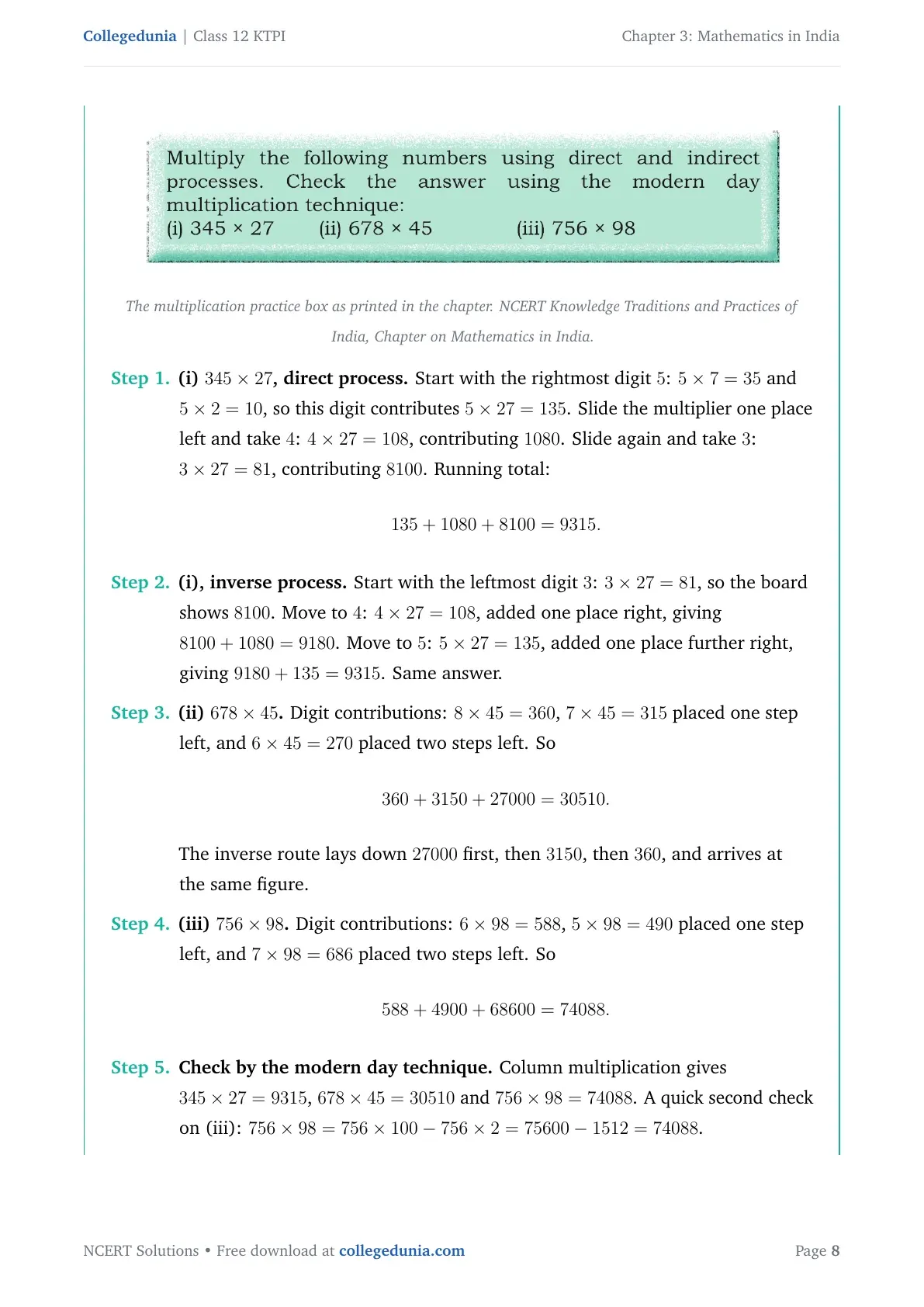
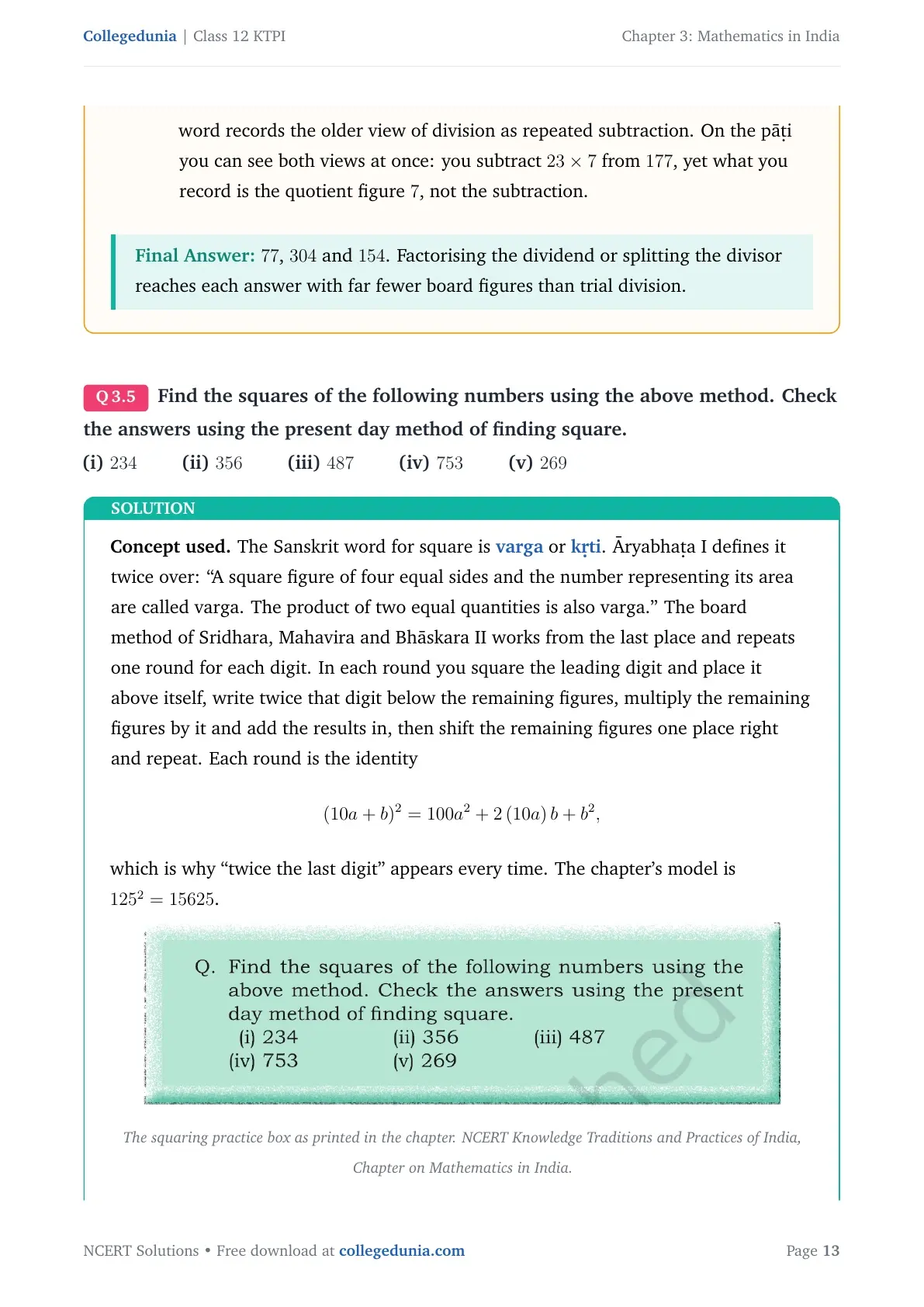
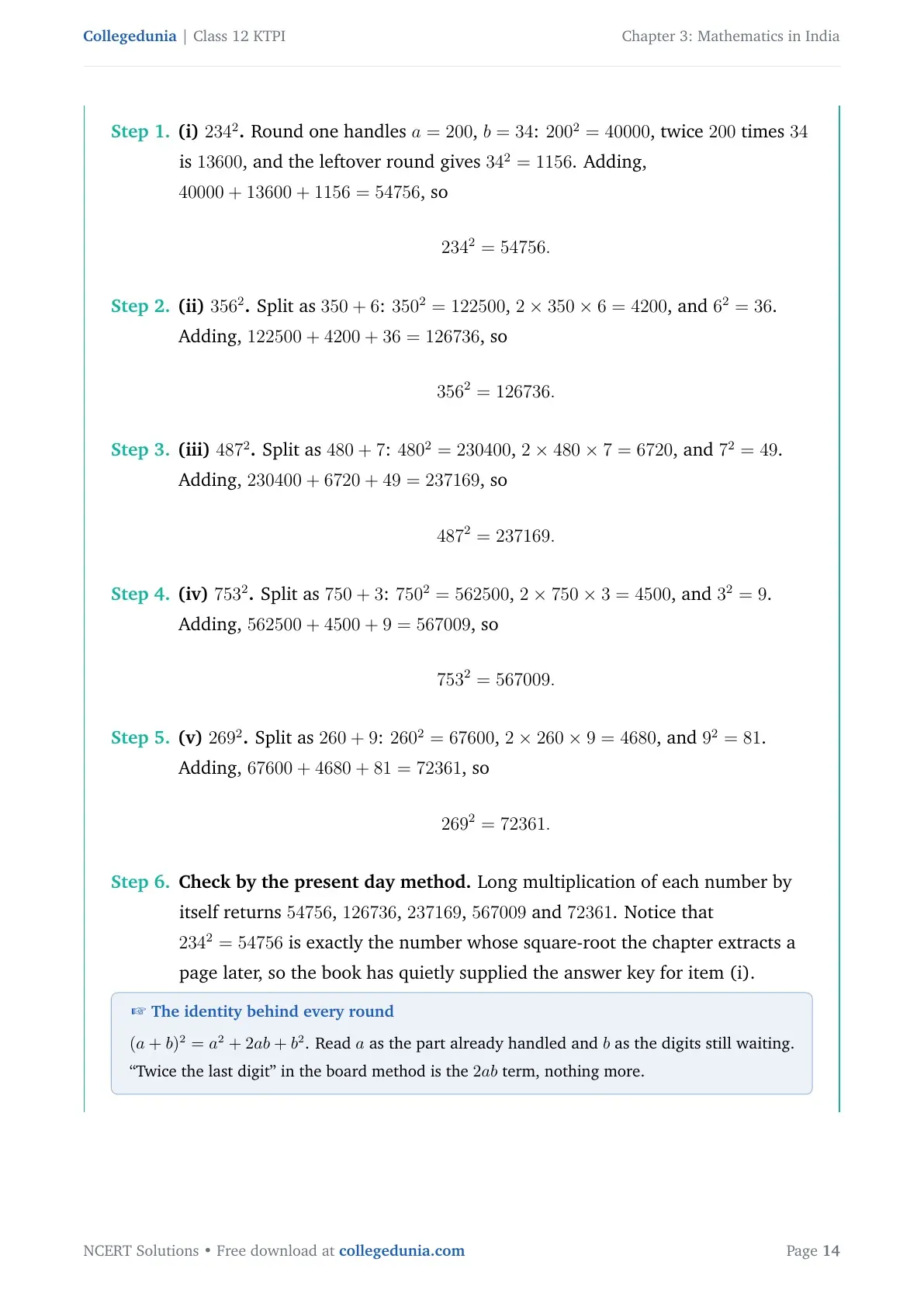
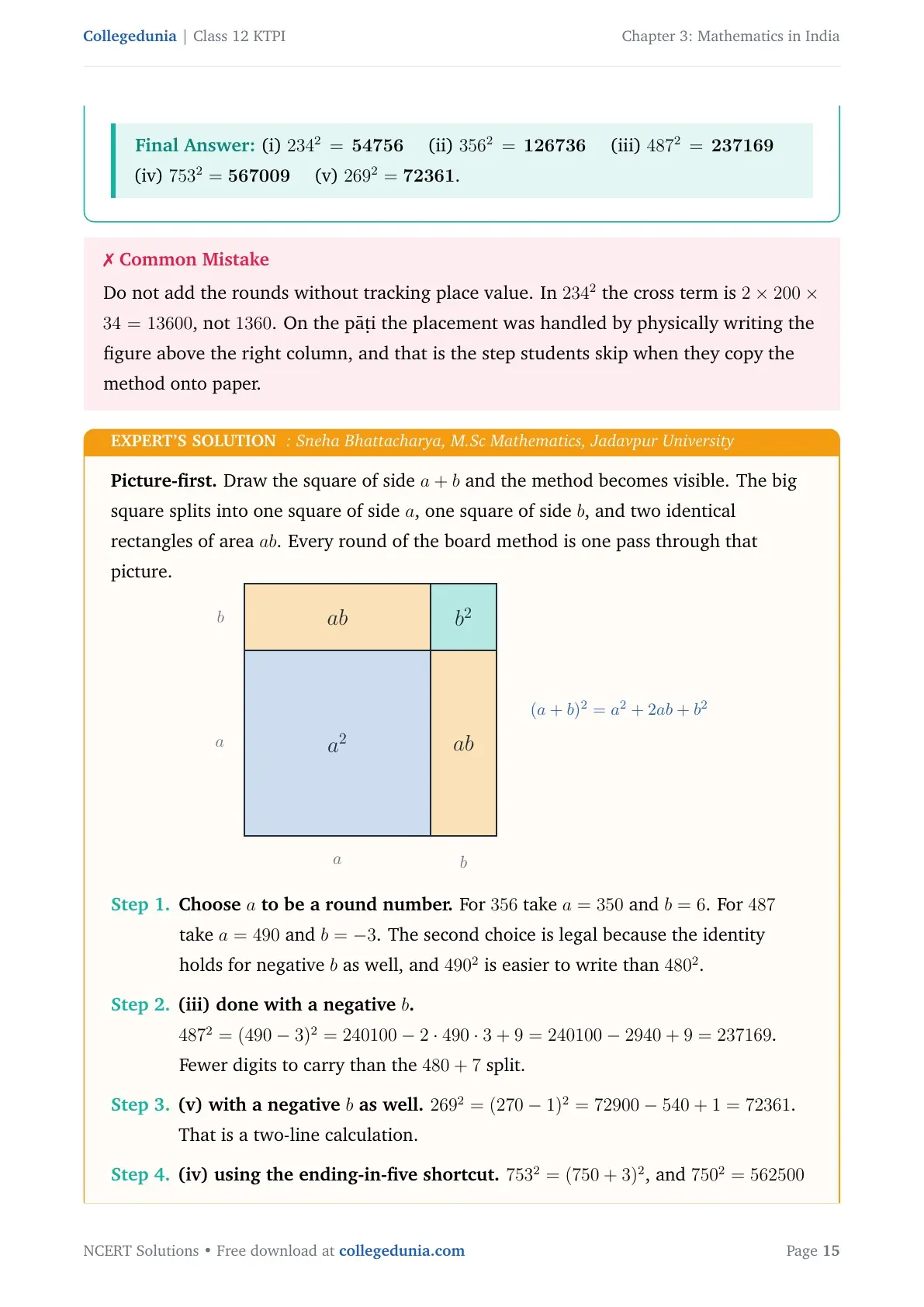
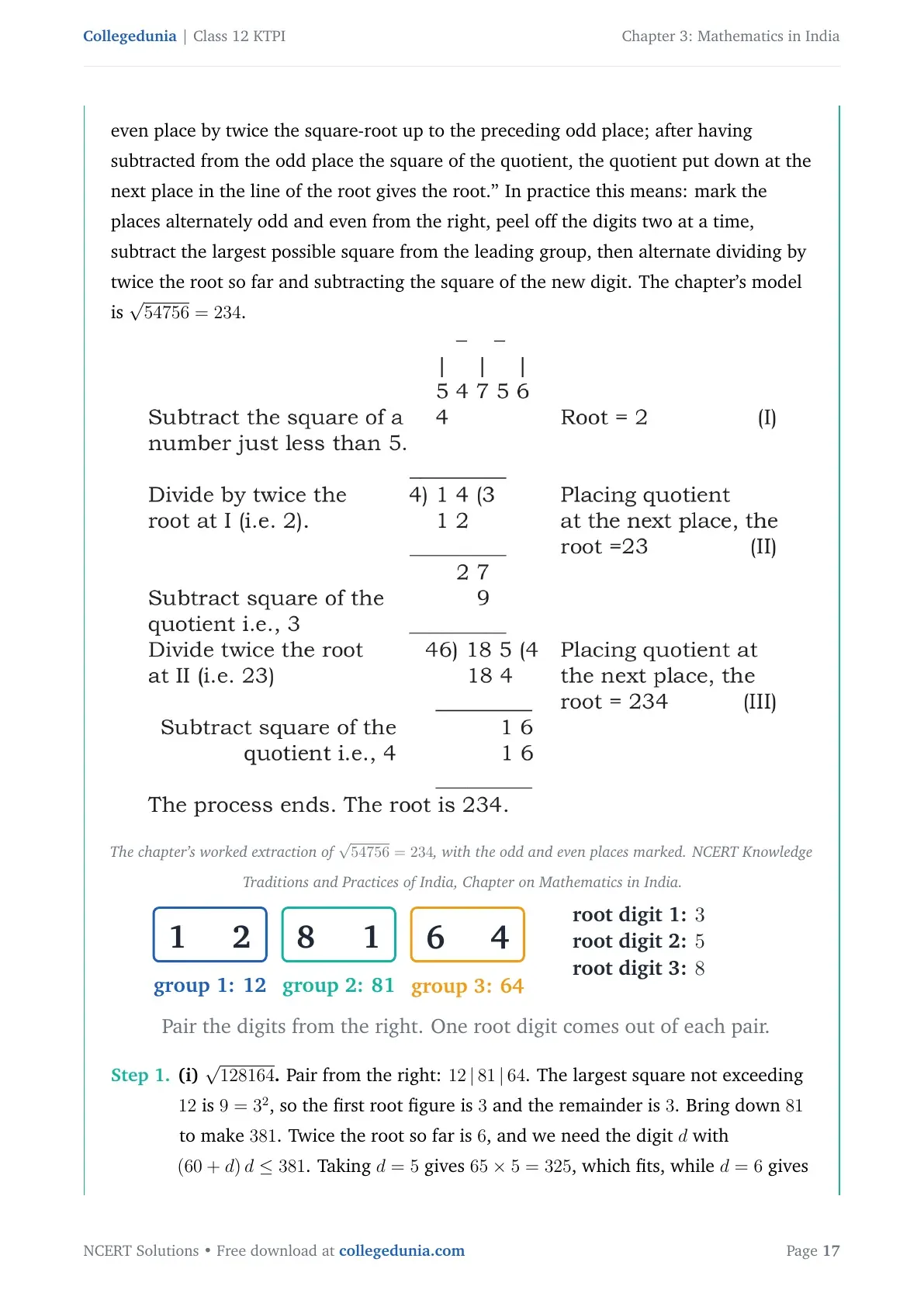
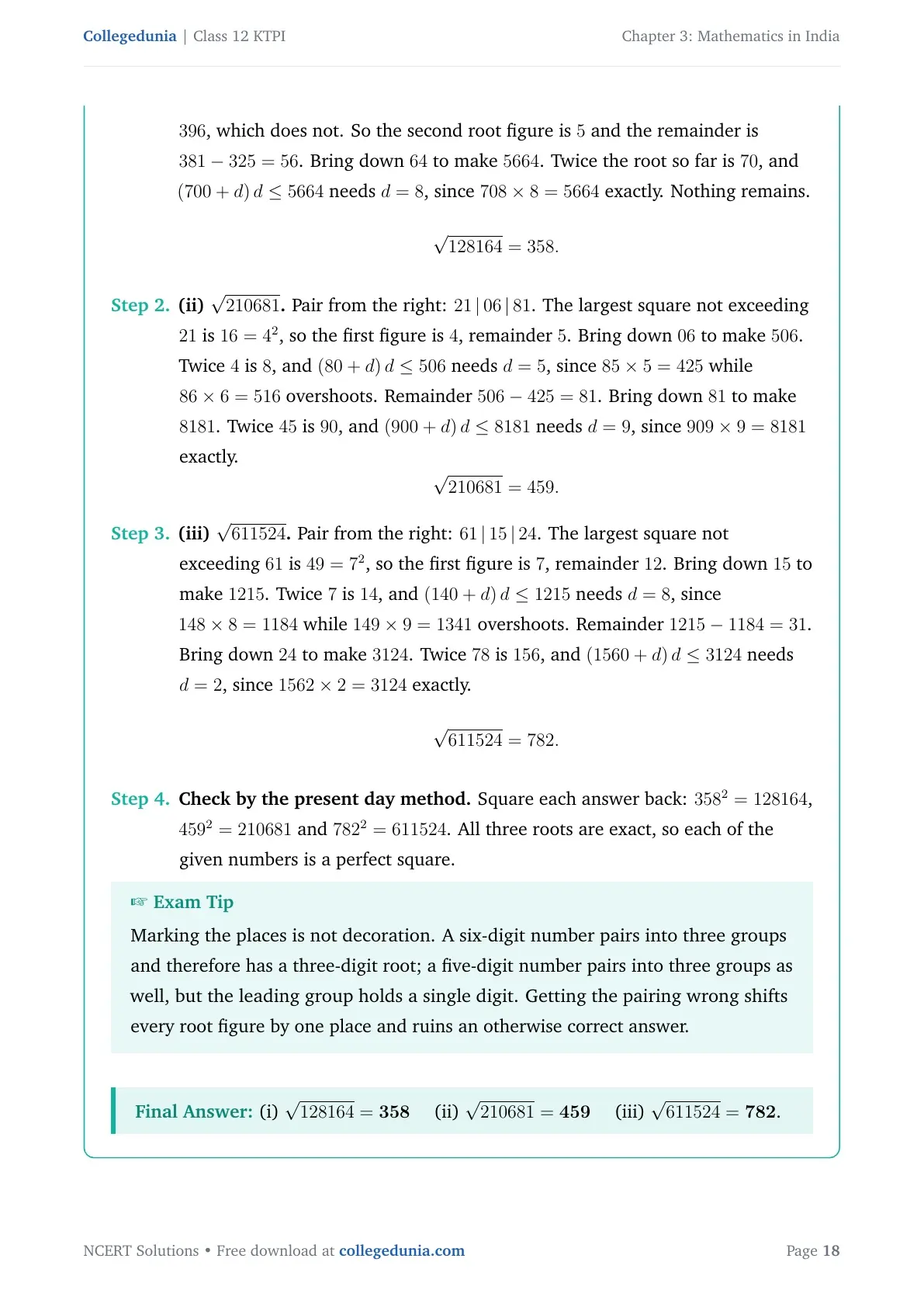
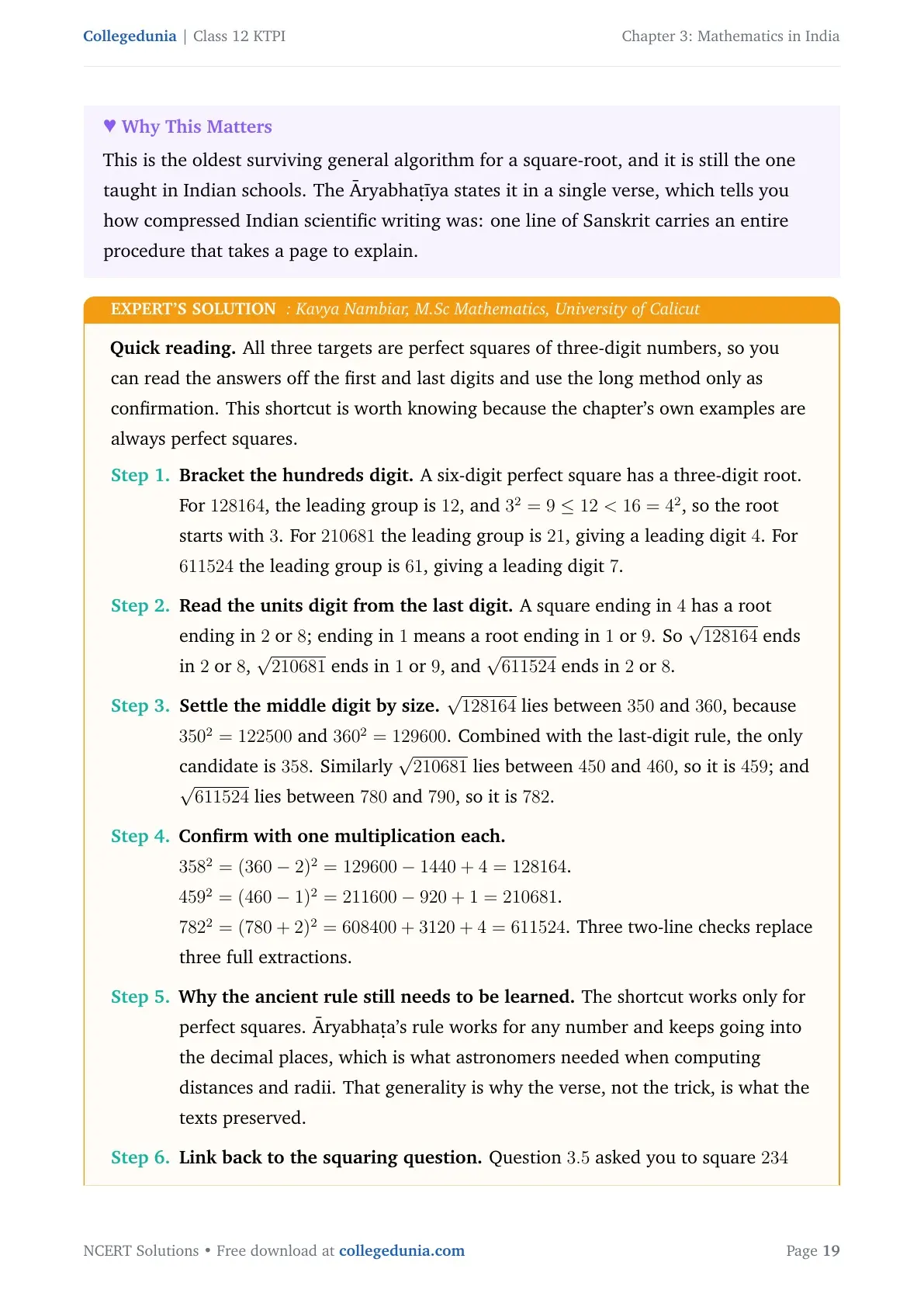
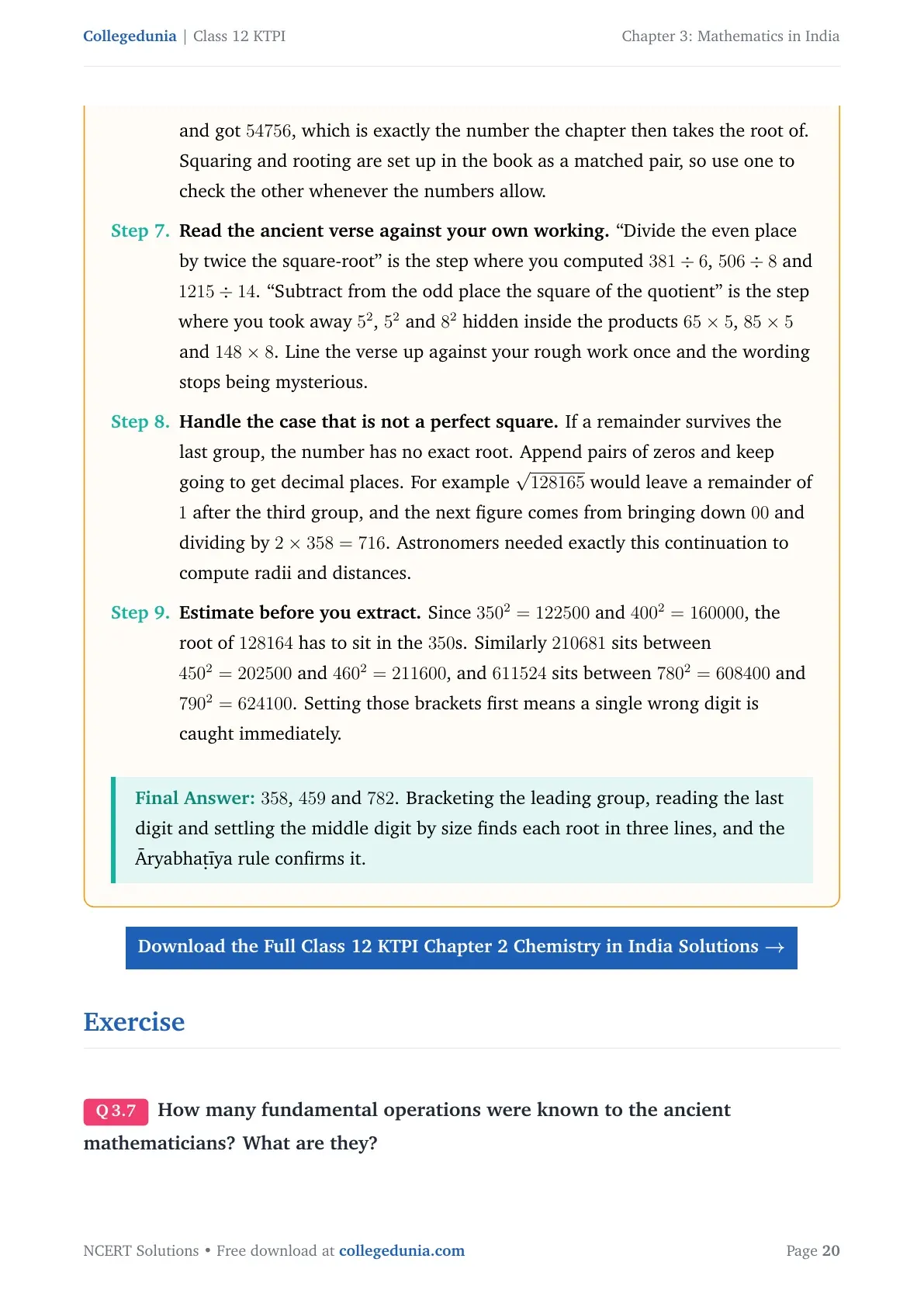
The examples in the chapter are the ones to reproduce. Addition uses 26 plus 57, giving 83. Subtraction uses 1000 minus 360. Multiplication uses 135 times 12, giving 1620, and division reverses it as 1620 divided by 12, giving 135. Squaring uses 125, giving 15625, and the square root example is 54756, giving 234.
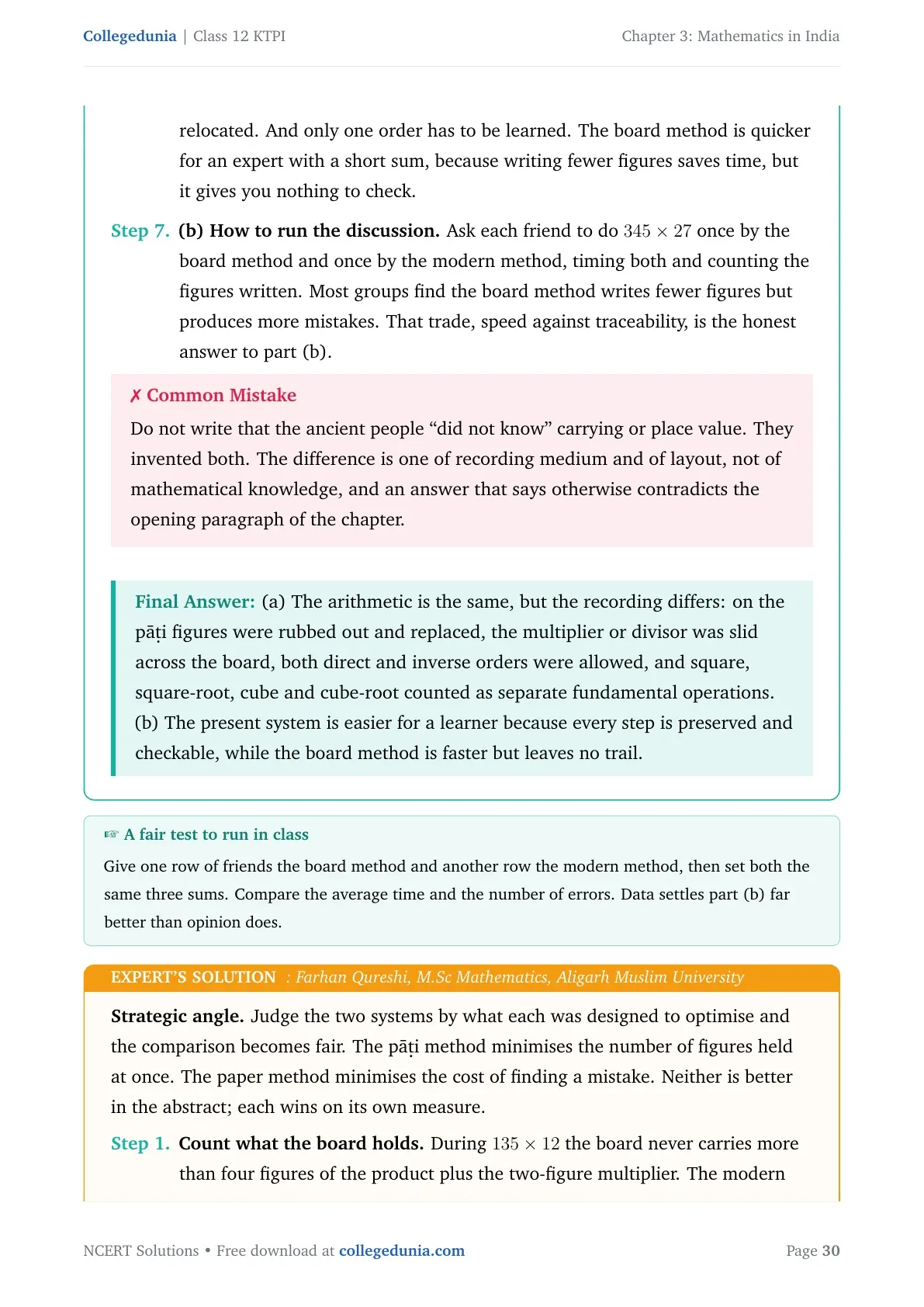
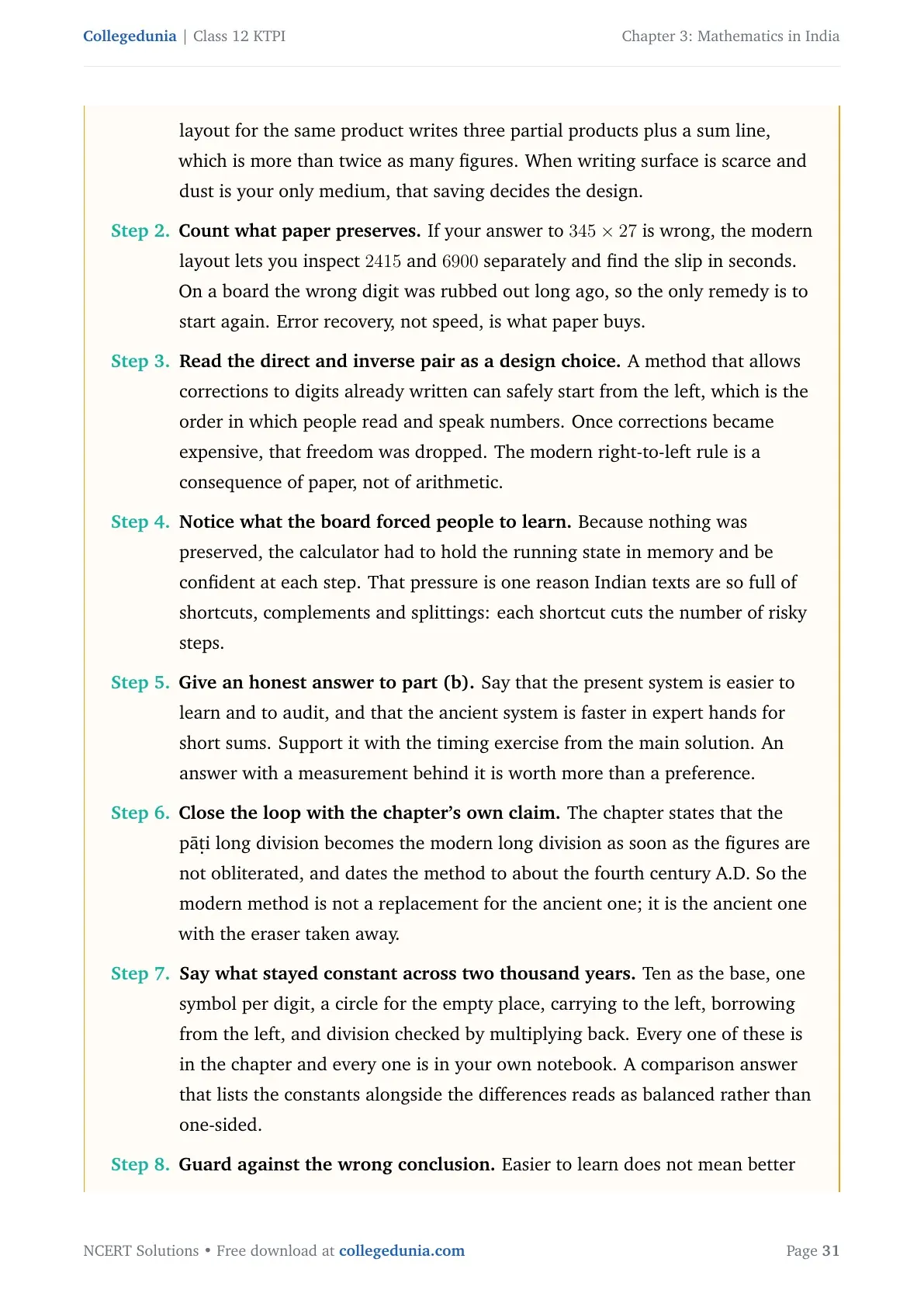
For part (b), give an opinion and then a reason. The modern written method is easier because no step is erased, so an error can be traced and corrected. The board method was faster and saved writing material.
Then add the line that ties both halves together. The chapter says that once the erased steps are written down one below the other, the old long division becomes exactly the modern one. That method appears to have been invented in India by about the fourth century A.D.
Three Terms Each for the Four Operations with Their Sanskrit Meanings
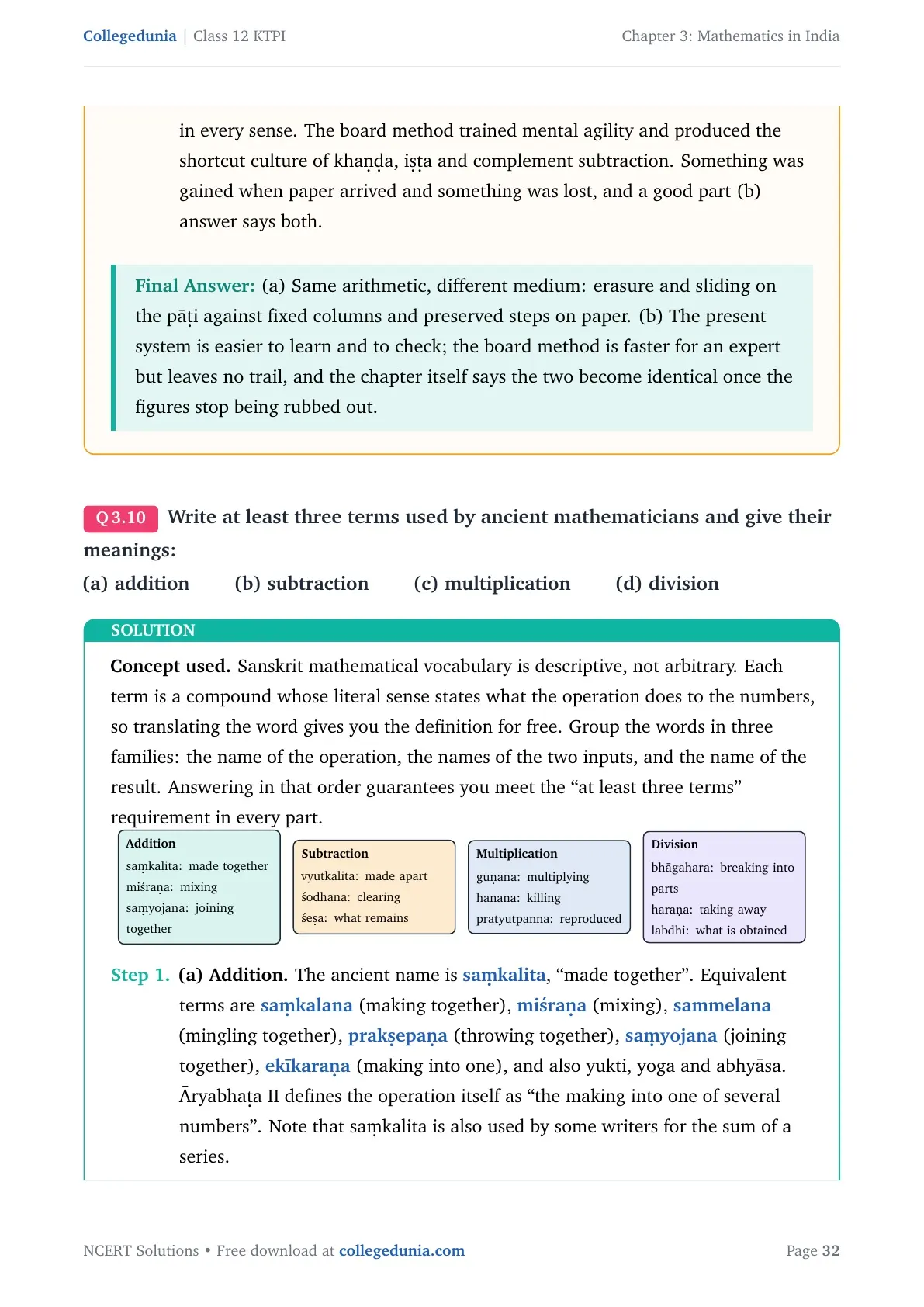
Question 4 is a pure vocabulary question and the fastest full mark in the chapter. It asks for at least three terms per operation with meanings. Write the meaning in brackets right after each term, because a term without its meaning scores half.
| Operation | Terms and meanings | Extra term worth adding |
|---|---|---|
| Addition | Samkalita (made together), misrana (mixing), samyojana (joining together), ekikarana (making into one) | Yoga, sammelana (mingling together), praksepana (throwing together) |
| Subtraction | Vyutkalita (made apart), sodhana (clearing), viyoga (separation), patana (causing to fall) | Sesa (residue) and antara (difference) for the remainder |
| Multiplication | Gunana (the oldest term, from Vedic literature), hanana (killing), vadha (killing), ksaya (destroying) | Gunya for the multiplicand, gunakara for the multiplier, pratyutpanna for the product |
| Division | Bhagahara (breaking into parts), bhajana (breaking into parts), chedana (cutting into parts), harana (taking away) | Bhajya for the dividend, hara for the divisor, labdhi for the quotient |
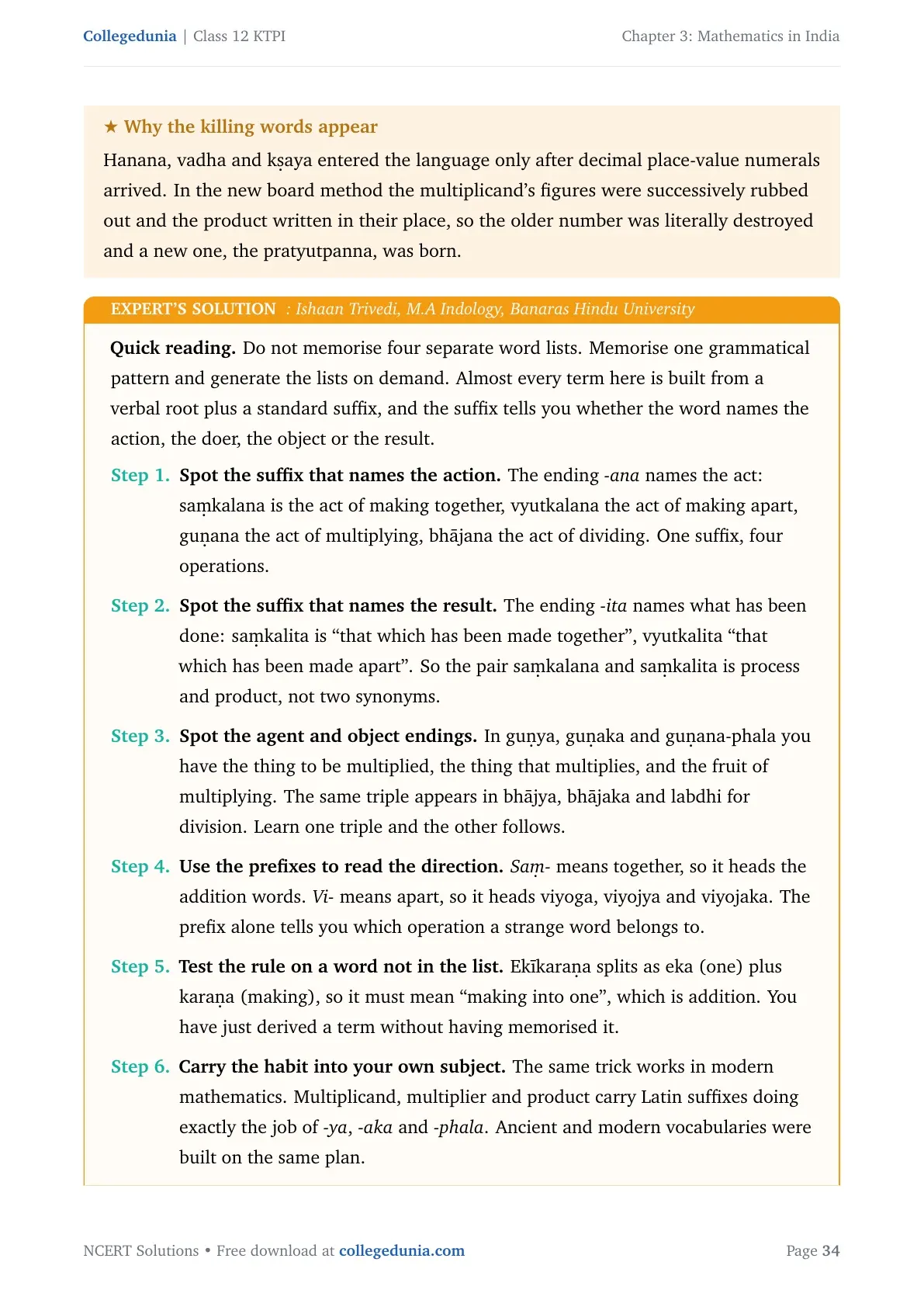
One line of explanation lifts this answer above a bare list. The killing words entered the language only after the decimal place value method arrived, because the figures of the multiplicand were rubbed out and replaced by the figures of the product. The old numbers were killed and a new one, the pratyutpanna, was born.
Two definitions are worth quoting exactly. Aryabhata II defined addition as "the making into one of several numbers", and defined subtraction as the taking out of some number from the sarvadhana, or total, with what remains called the sesa.
Bijaganita, Kuttaka and the Algebra Vocabulary Every Answer Needs
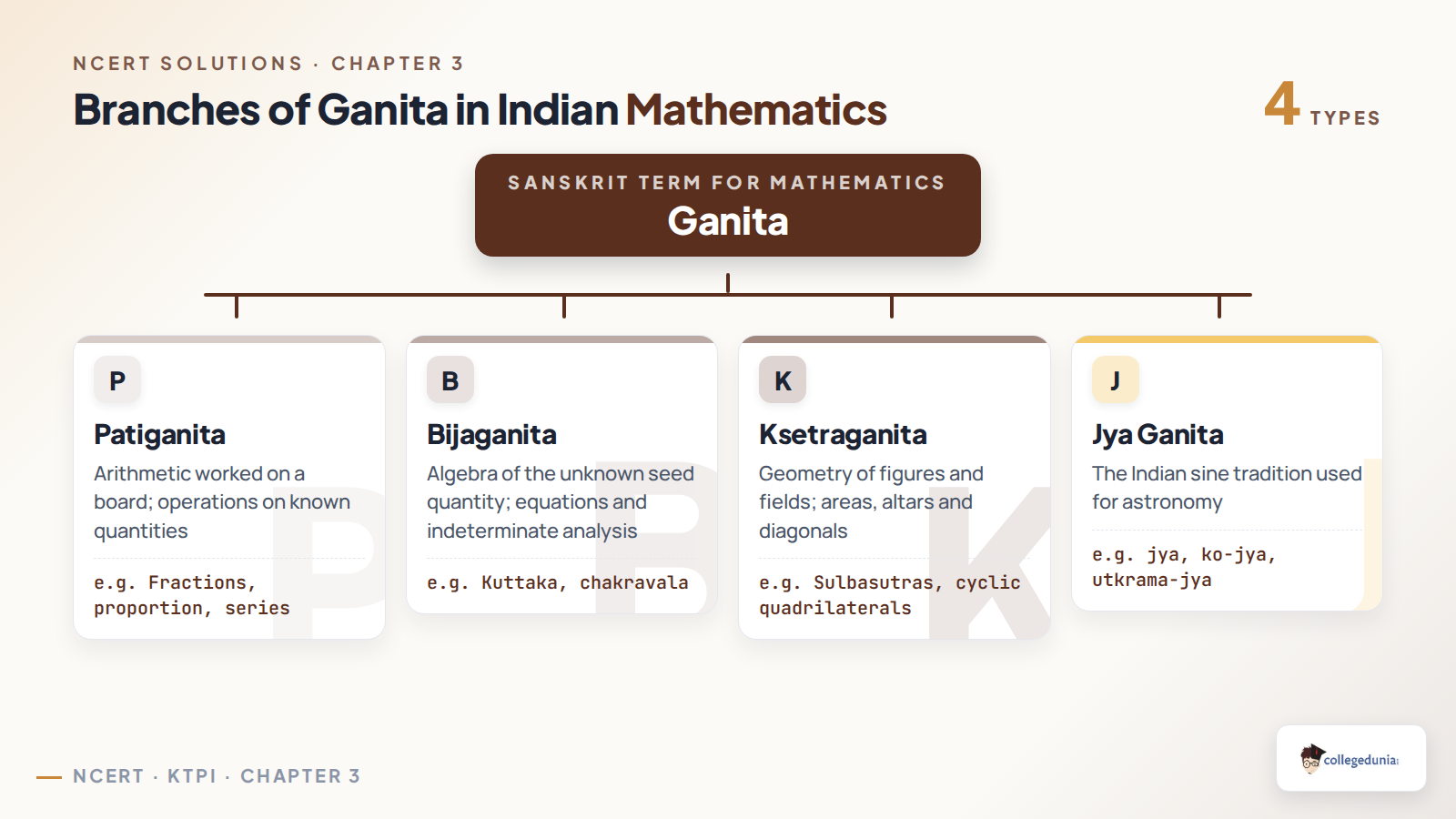
The Indian name for algebra is bijaganita. Bija means element or analysis, and ganita means the science of calculation, so the compound means the science of calculation with elements. Brahmagupta called it kuttaka-ganita, or simply kuttaka.
- Kuttaka means pulveriser. It is the branch that handles indeterminate equations of the first degree, and it mattered so much that the whole of algebra was named after it in the seventh century.
- Avyakta-ganita. Calculation with unknowns, where avyakta means unknown. Its opposite is vyakta-ganita, calculation with knowns, which covers arithmetic, geometry and mensuration.
- Where it began. The origin traces to the Sulba period, 800 to 500 B.C., and the Brahmana period at about 2000 B.C., but at that stage it was geometrical rather than symbolic.
- The linear equation. Turning a square into a rectangle with a given side, a standard Sulba construction, is the same task as solving a linear equation in one unknown.
- The quadratic equation. Building an altar similar to a given one but differing in area by a stated amount is the geometric form of a quadratic, solved by changing the unit of linear measure.
Brahmagupta's own reason for teaching algebra makes a strong closing line. He wrote that questions can scarcely be solved without algebra, and that whoever knows the pulveriser, zero, negative and positive quantities, unknowns, elimination of the middle term, equations with one unknown, factum and the square nature becomes an acarya among the learned. Bhaskara II repeated the point in A.D. 1150.
Concepts Indian Mathematicians Developed Beyond the Mathematics in India Chapter
Question 5 is open research, so there is no single fixed answer. Marks come from naming a concept, naming the mathematician, and naming a source. The chapter's own bibliography is the source list the question points you to.
| Concept beyond the chapter | Who is linked to it | Where to read it |
|---|---|---|
| Rules for zero, negative and positive quantities | Brahmagupta, A.D. 628 | Bag and Sarma, The Concept of Sunya |
| Prosody, binary counting and combinatorics | Pingala, Chandah sastra | Srinivas, Mathematics in India from the Vedic Period to Modern Times |
| Infinite series for pi, sine and cosine | Madhava and the Kerala School | Subramanian and Srinivas, Development of Calculus in India |
| Geometry of the Vedic ritual altars | Baudhayana and the Sulba authors | Dani, Geometry in Sulvasutras; Seidenberg, The Geometry of Vedic Rituals |
| Sine table construction and interpolation | Aryabhata I onward | Mallayya, Trigonometric Tables in India |
| Indeterminate equations and the pulveriser | Brahmagupta and Bhaskara II | Datta and Singh, Mathematics: A Source Book |
Pick any three rows and write two sentences on each. Do not invent a mathematician or a date, because the examiner checks this answer against the printed bibliography rather than against a fixed key. Adding the glossary words gaṇita anuyoga, kapata-sandhi, samkhyana and Sulbasutra shows that you read the chapter to the last page.
Common Mistakes Students Make in the Mathematics in India Chapter
Avoid these six in the answer sheet:
- Answering Question 1 with four operations. The chapter names eight, and square, square root, cube and cube root are half of them.
- Mixing up who gave which root rule. Aryabhata I gave the square root and cube root rules, Brahmagupta gave only the cube root rule.
- Writing Sanskrit terms in Question 4 without their meanings. Half the mark sits in the bracket after the word.
- Calling the Sulbasutras astronomy texts. They are geometry texts for building fire altars, dated at about 800 B.C.
- Answering Question 3 part (b) with a preference and no reason. Say which is easier and why.
- Crediting Aryabhata I with 3.14159265359. That longer value is Madhava's; Aryabhata I gave 3.1416.
A quick fix for the numbers: put 3,000 B.C., 800 B.C., 300 B.C., A.D. 496, A.D. 499, A.D. 628, A.D. 1114, A.D. 500 to 1200, 3.1416 and 355/113 on one card and recite it before the paper.
Student Feedback on the Class 12 KTPI Mathematics in India Chapter
What 12,310 Class 12 students told us about the Mathematics in India chapter
Collected in a Collegedunia poll run ahead of the 2026-27 board session:
- 61% named the Sanskrit vocabulary question as the hardest part, mostly because they learnt the terms without the meanings.
- 9 out of 10 students said the eight operations question was the easiest single mark in the whole module.
- 44% lost marks in Question 3 by giving a preference without a reason.
- Students who wrote the four worked examples once by hand reported the fastest recall of the board method.
Source: 2026-27 Class 12 KTPI student poll. Sample of 12,310 students from CBSE schools across 15 states.
Where Mathematics in India Sits in the Class 12 KTPI Course and Paper
Mathematics in India is the third chapter of the Class 12 Knowledge Traditions and Practices of India course. It is one of the most quotable chapters in the book because it is built from names, years and fixed lists. Treat the spread below as a planning guide, not as an official blueprint.
| Chapter | Topic | Indicative weight |
|---|---|---|
| Chapter 1 | Astronomy in India | High |
| Chapter 2 | Chemistry in India | Medium |
| Chapter 3 | Mathematics in India | High |
| Chapter 5 | Medicine in India | High |
| Chapter 7 | Metallurgy in India | Medium |
| Chapter 10 | Indian Philosophical Systems | Medium |
Inside the chapter, the heaviest topics are the eight operations, the Sulbasutra geometry and the trigonometry of Aryabhata I. All three attract long answers. The vocabulary question and the old-versus-new comparison usually appear as 3 to 4 mark reasoning questions, and both reward exact wording. The same names also feed CBSE school assessments and the CUET general test section on Indian knowledge traditions.
How to Revise Mathematics in India in a Three Block Plan
The chapter is fact heavy but short. About three hours of focused work makes it exam ready, and the order printed in the book gives you the sequence for free.
- Block 1, 60 minutes. Read the numerals and arithmetic sections. Then write the eight operations list and the four vocabulary groups from memory.
- Block 2, 60 minutes. Work the six printed examples by hand: 26 plus 57, 1000 minus 360, 135 times 12, 1620 divided by 12, the square of 125 and the square root of 54756.
- Block 3, 60 minutes. Cover geometry, algebra and trigonometry. Write the Sulbasutra answer, the bijaganita and kuttaka definitions, and the R Sin theta table without looking.
Repeat Block 1 a week before the paper. Students who wrote the Sanskrit terms with their meanings twice by hand reported the strongest recall in Question 4.
How the Mathematics in India Solutions Work with the Chapter PDF, Notes and Handwritten Notes
The solutions give you model answers. They do not give you the full chapter text, the board diagrams, or a one-page revision sheet. Those sit on the other Collegedunia pages for the same chapter, and using them together is faster than reading any one of them alone.
| Resource | What it adds beyond these solutions | Link |
|---|---|---|
| Chapter PDF | The full chapter text with the pati board working for every example, the Aryabhata and Brahmagupta portraits and the glossary | Mathematics in India Class 12 Chapter PDF |
| Chapter notes | The whole chapter compressed into topic notes, with the mathematician and period table already built for you | Mathematics in India Class 12 Notes |
| Handwritten notes | A short revision set in clear handwriting, with the Sanskrit terms colour coded for the night before the paper | Mathematics in India Class 12 Handwritten Notes |
| Solved question set | All 5 Exercise questions written out as complete answers, each with a Solution and an Expert Solution | Mathematics in India Class 12 Solved Questions |
Also Check: the Astronomy in India Class 12 NCERT Solutions, which begins the sine table and Kerala School story that this chapter carries forward.
All 10 Chapters of Class 12 KTPI with NCERT Solutions
The Class 12 Knowledge Traditions and Practices of India course runs across ten chapters. Every link below opens the solved question set for that chapter, written for the 2026-27 session.
| Chapter | NCERT Solutions |
|---|---|
| Chapter 1 | Astronomy in India Class 12 NCERT Solutions |
| Chapter 2 | Chemistry in India Class 12 NCERT Solutions |
| Chapter 3 | Mathematics in India Class 12 NCERT Solutions |
| Chapter 4 | Life Sciences Class 12 NCERT Solutions |
| Chapter 5 | Medicine in India Class 12 NCERT Solutions |
| Chapter 6 | Agriculture Class 12 NCERT Solutions |
| Chapter 7 | Metallurgy in India Class 12 NCERT Solutions |
| Chapter 8 | Architecture, Engineering and Technology Class 12 NCERT Solutions |
| Chapter 9 | Indian Languages and Grammar Class 12 NCERT Solutions |
| Chapter 10 | Indian Philosophical Systems Class 12 NCERT Solutions |
Mathematics in India Class 12 KTPI Chapter 3 NCERT Solutions FAQs
Questions Class 12 Students Ask Most About the Mathematics in India Chapter
Ques. How many questions are there in Class 12 KTPI Chapter 3 Mathematics in India?
Ans. There are 5. The chapter prints a single Exercise block at the end with five questions and no Project Ideas section. All 5 are solved on this page for the 2026-27 session, and the downloadable PDF carries the same answers with the worked board examples.
Ques. How many fundamental operations were known to ancient Indian mathematicians?
Ans. Eight. They are addition, subtraction, multiplication, division, square, square root, cube and cube root. Aryabhata I gave the rules for the square root and the cube root, while Brahmagupta gave only the cube root rule. Bhaskara I added that every operation is really a form of increase or decrease, so all eight reduce to addition and subtraction.
Ques. Which ancient Indian mathematicians worked on geometry?
Ans. Baudhayana, Apastamba and Katyayana wrote the Sulbasutras at about 800 B.C., and these are the oldest known mathematics texts in existence. Aryabhata I gave correct formulae for the area and perimeter of all common figures. Brahmagupta gave correct formulae for the area of a triangle, the area of a cyclic quadrilateral from its sides, and the diagonals of a cyclic quadrilateral.
Ques. Which Indian mathematicians worked on trigonometry?
Ans. Aryabhata I in A.D. 499 defined a right triangle inside a quarter circle and named the perpendicular jya and the base ko-jya. Brahmagupta in A.D. 628 and Govindaswami in A.D. 880 gave interpolation formulae for the sines of intermediate angles. Madhava and Nilakantha, both around A.D. 1500, gave sharper values of pi.
Ques. Who discovered the symbol for zero?
Ans. Aryabhata I, who was born in A.D. 496, discovered the symbol for zero while writing numbers in decimal form. He said that the vacant places should be filled up with a circle, which is what sunya looks like, and his commentator Bhaskara I illustrated the idea in A.D. 600. This is what let every number be written with nine symbols and zero.
Ques. What did Brahmagupta contribute to mathematics?
Ans. Brahmagupta wrote the Brahmasphutasiddhanta in A.D. 628, with sections named Ganita and Kuttaka. He named four methods of multiplication, gomutrika, khanda, bheda and ista, gave the cube root rule, and set correct formulae for the area of a triangle and for the area and diagonals of a cyclic quadrilateral. He also said patiganita has twenty operations and eight determinations.
Ques. Which values of pi are given in the Mathematics in India chapter?
Ans. Three. Aryabhata I gave 3.1416 in A.D. 499, Madhava gave 3.14159265359 around A.D. 1500, and Nilakantha gave 355/113 in the same period. A common error is to credit Aryabhata I with the longer decimal value, which belongs to Madhava.
Ques. What are three ancient terms for multiplication and what do they mean?
Ans. Gunana is the oldest term and appears in Vedic literature. Hanana and vadha both mean killing, and ksaya means destroying. Those killing words came in only after the decimal place value method arrived, because the figures of the multiplicand were rubbed out and replaced by the figures of the product. The product itself was called pratyutpanna, meaning reproduced.
Ques. Is the ancient Indian method of long division the same as the modern one?
Ans. Almost. The steps are identical, but on a pati board each partial result was rubbed out and replaced instead of being kept. The chapter says that once those steps are written down one below the other rather than erased, the process becomes the modern method of long division. It appears to have been invented in India by about the fourth century A.D.
Ques. What is patiganita?
Ans. Patiganita is the ancient Indian name for arithmetic. It joins pati, meaning board, with ganita, meaning the science of calculation, so it is the calculation that needs a writing surface. The work was sometimes called dhuli-karma, or dust work, because figures were written on dust spread over a board or the ground and then rubbed out as the working moved on.
Ques. What is bijaganita?
Ans. Bijaganita is the Indian name for algebra. Bija means element or analysis and ganita means the science of calculation, so the word means calculation with elements. Brahmagupta called it kuttaka-ganita after the pulveriser method for indeterminate equations of the first degree. It is also called avyakta-ganita, calculation with unknowns, against vyakta-ganita for calculation with knowns.
Ques. What are the Sulbasutras?
Ans. The Sulbasutras of Baudhayana, Apastamba and Katyayana are the oldest known mathematics texts in existence, composed at about 800 B.C. in the Sutra period of the later Vedic age. They collect the geometry needed to design and build Vedic fire altars shaped as a falcon in flight, a chariot wheel with spokes or a tortoise. They state the result now called the Pythagoras theorem and name the sama, dvisama and visama triangles.
Ques. Is Mathematics in India part of the 2026-27 Class 12 KTPI syllabus?
Ans. Yes. Mathematics in India is Chapter 3 of the Class 12 Knowledge Traditions and Practices of India course for the 2026-27 session. It covers the decimal place value system and the Brahmi numerals, the eight operations of patiganita, fractions, square and square root methods, Sulbasutra geometry, bijaganita and kuttaka, and the trigonometry of Aryabhata I through to Madhava and Nilakantha.



Comments