



If you are preparing for the Class 12 Knowledge Traditions and Practices of India paper, Agriculture is one chapter you cannot afford to skip. The questions are spread across three separate blocks, and most students only notice the first one. These NCERT Solutions answer all 22 tasks for the 2026-27 session, from the Mehrgarh granary to the water advice in the Kasyapiyakrsisukti.
- Agriculture is Chapter 6 of the Class 12 Knowledge Traditions and Practices of India course.
- 22 tasks in total: 12 Comprehension questions, 4 Project Ideas and 6 questions on the primary text extracts.
- Terms you must be able to spell: kunapajala, panchagavya, arbori-horticulture, nadimatrka, sarvatobhadra and pisciculture.


Every answer on this page is written by subject experts and checked line by line against the Agriculture module of the NCERT Knowledge Traditions and Practices of India textbook.
What the Class 12 KTPI Agriculture Solutions Cover, Question by Question
The chapter prints its questions in three places. Twelve Comprehension questions close the survey essay. Four Project Ideas follow the two class activities. Six more Comprehension questions sit at the end of the second part, after the primary text extracts. A student who answers only the first twelve loses a third of the chapter.
| Block | Tasks | What it tests |
|---|---|---|
| Comprehension, after the survey | 12 questions | Crop damage, implements, weather prediction, land types, the superintendent of cattle, pisciculture, kunapajala, manures, pests, arbori-horticulture, grafting and garden layouts |
| Project Ideas | 4 tasks | A village field study, recycling in farming, a career presentation, and an Indus Civilization display |
| Comprehension, after the extracts | 6 questions | Naming the texts, uniform seeds, seed treatment herbs, the four aims of life, water advice to kings, and the cow verse of the Rigveda |
The quick marks are the list questions: land types, manures, kunapajala ingredients and the duties of the superintendent of cattle. The slower marks are the two opinion questions in the second part, where you have to take a position and defend it in five or six lines.
Open the full solved question set
All 22 tasks written out as complete answers, each with a short Solution and a longer Expert Solution, sit on the companion page.
Agriculture in Prehistory: Mehrgarh, Kalibangan and India's First Crops
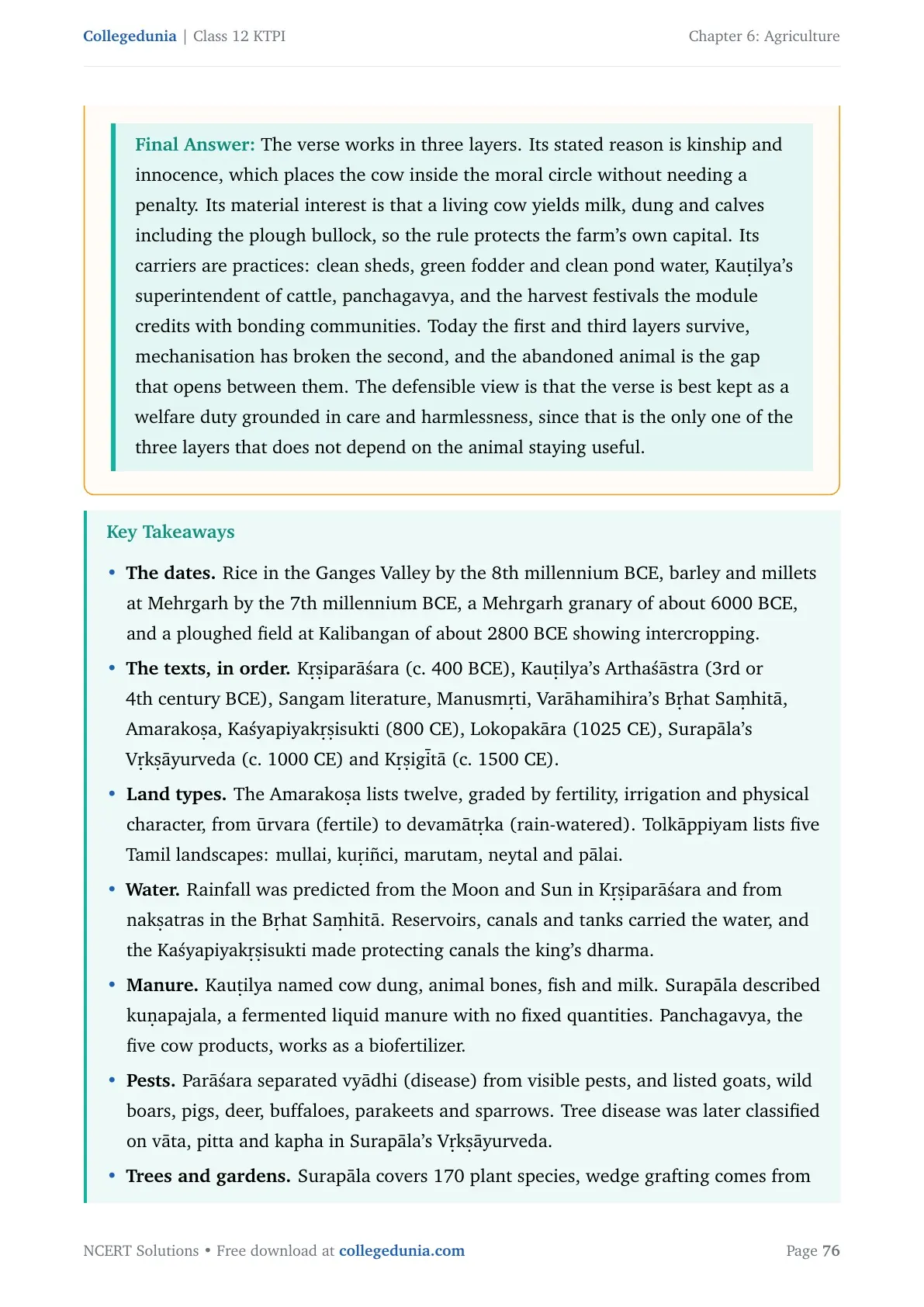
The survey opens with archaeology, and the dates are the marks. Learn them as a short ladder rather than as a paragraph. Every date below is printed in the chapter, so you can quote it without hedging.
| Date | Site or crop | What it shows |
|---|---|---|
| 8th millennium BCE | Rice, parts of the Ganges Valley | The earliest cultivation named in the chapter |
| 7th millennium BCE | Barley and millets, Mehrgarh in Baluchistan | Cereal farming outside the Ganges belt |
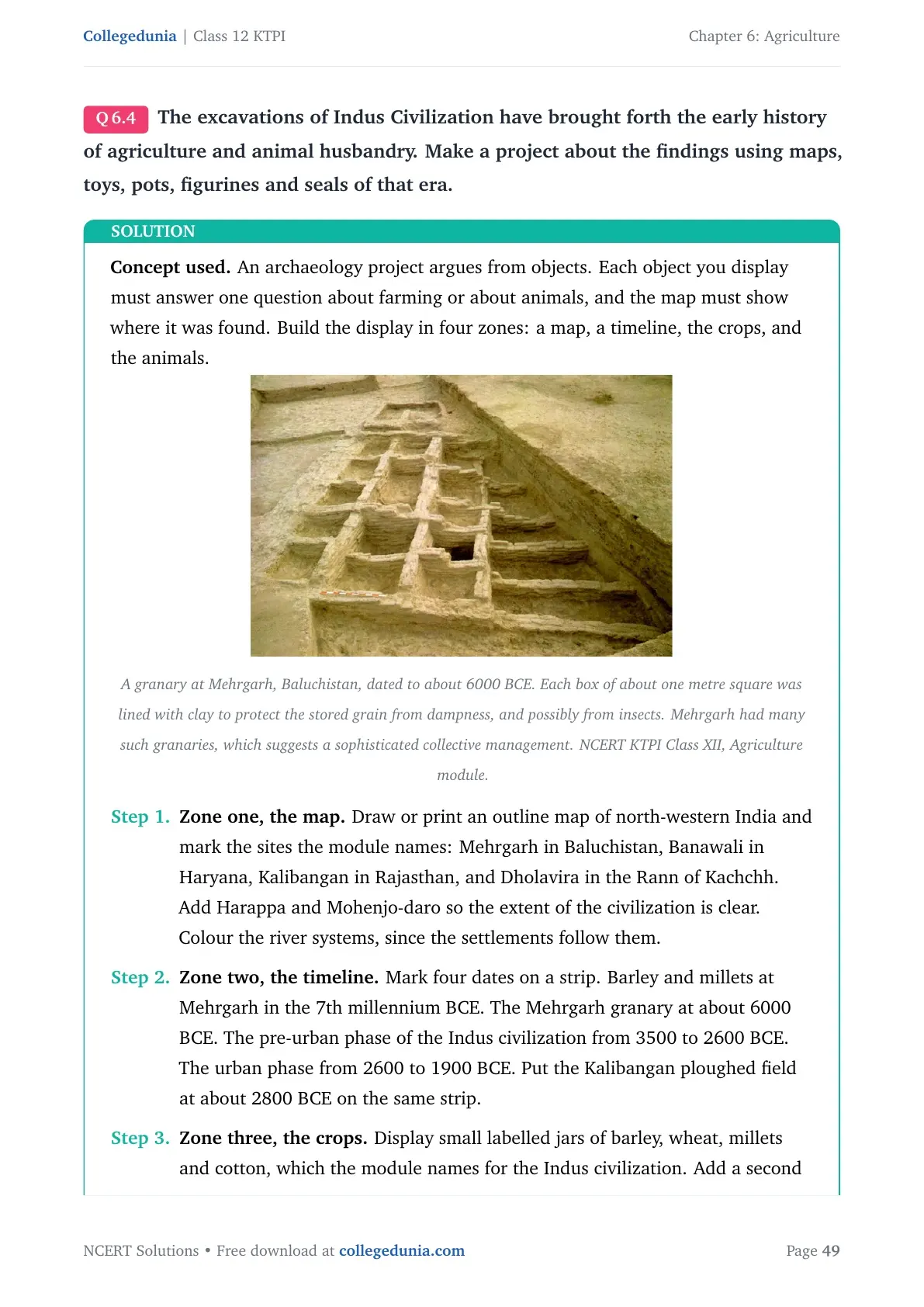
| About 6000 BCE | The Mehrgarh granary | Boxes of about 1 metre by 1 metre lined with clay, with walls up to 3 metres |
| 3500 to 1900 BCE | Indus civilization, pre-urban then urban phase | Barley, wheat, millets and cotton, plus domesticated cattle, sheep, goats, pigs and fowl |
| About 2800 BCE | Kalibangan field, Rajasthan | Two perpendicular sets of furrows, which point to intercropping |
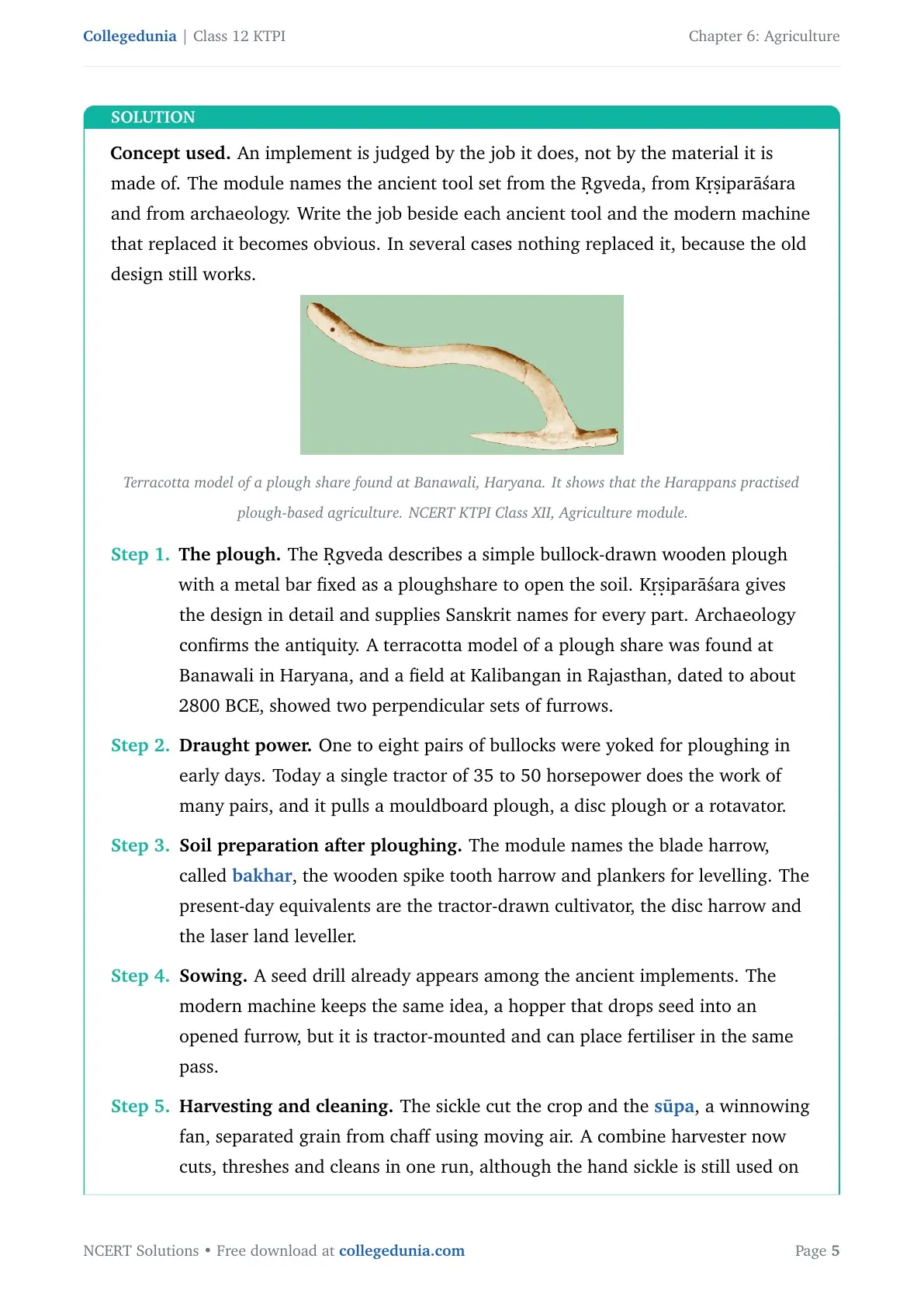
Two objects are worth naming. A terracotta model of a plough share was found at Banawali in Haryana, which shows plough based farming among the Harappans. And the clay lining of the Mehrgarh granary boxes protected stored grain from dampness and probably from insects. Many such granaries stood at Mehrgarh, which points to collective grain management, not household storage.
For the crops that spread in the following thousands of years, group them so you do not lose one: cereals such as wheat, oil seeds such as sesame, safflower, linseed, mustard and castor, legumes such as green gram, black gram and fenugreek, cotton as the fibre crop, and fruits such as grapes, dates, jujube, jackfruit, mango, mulberry and black plum.
Traditional Farming in India Explained
Source: Indian Knowledge Systems Division of MoE on YouTube
Textual Sources on Indian Agriculture and What Each Text Contributes
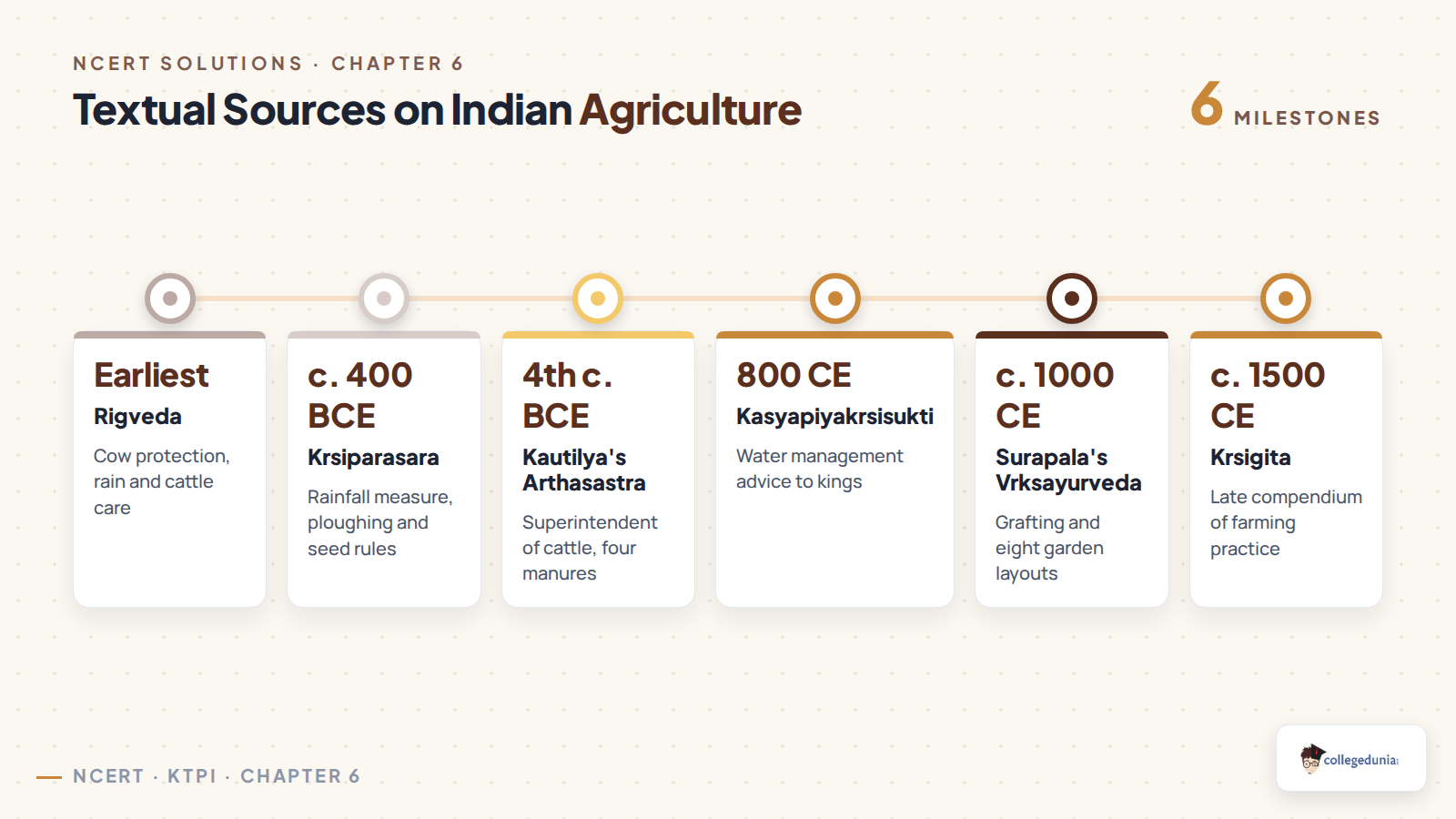
The first Comprehension question of the second part asks you to name a few texts that describe Indian agriculture. Do not stop at three names. Name the text, add its date, and add one line on what it holds. That turns a two mark answer into a full mark answer.
| Text | Date given in the chapter | What it contributes |
|---|---|---|
| Rigveda | Earliest Indian text | The bullock drawn wooden plough, cow protection, cattle management and verses asking for rain |
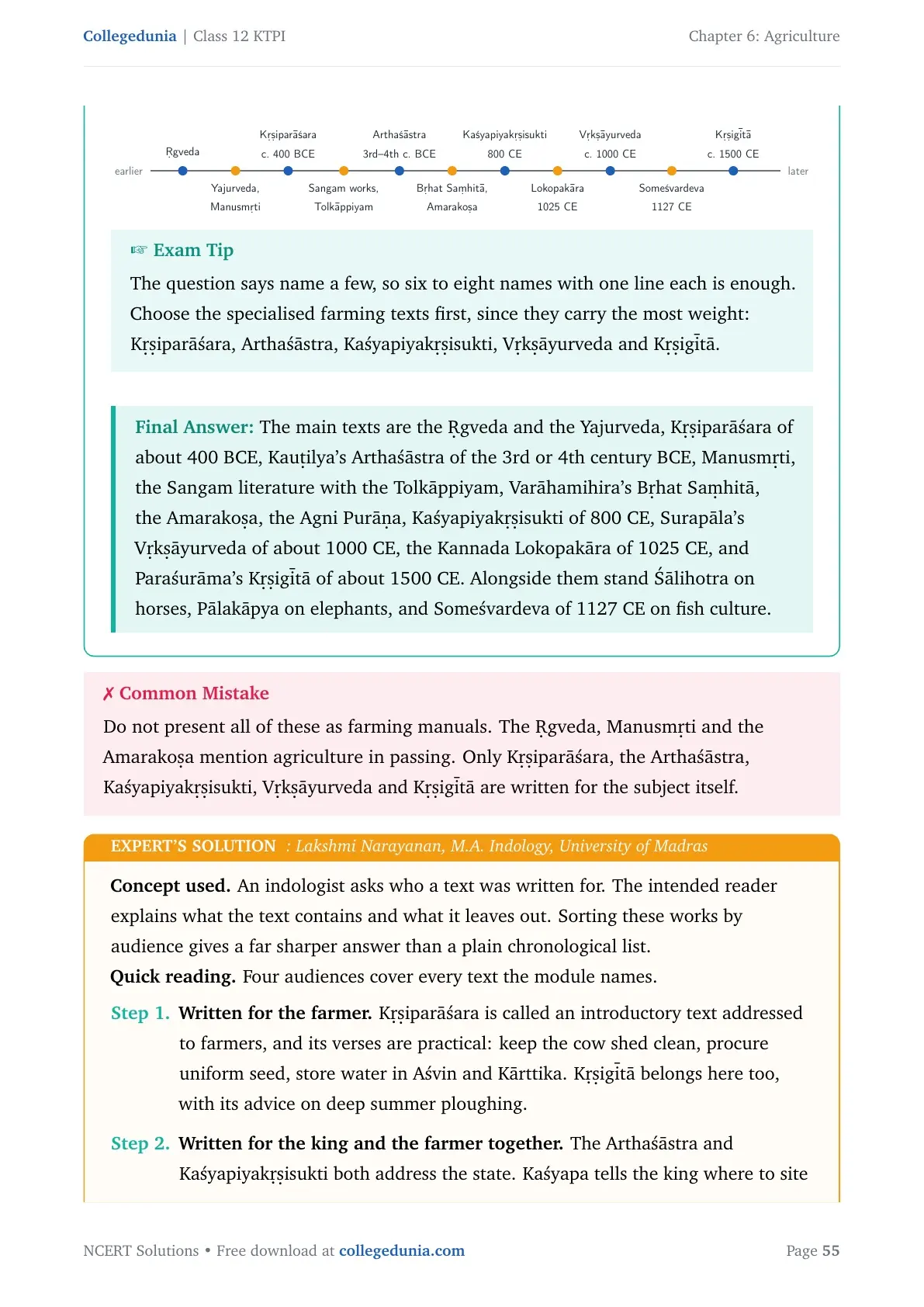
| Krsiparasara | About 400 BCE | Soil management, seed health, plough design with Sanskrit names for each part, rainfall prediction |
| Kautilya's Arthasastra | 3rd or 4th century BCE | Manures, water structures, the superintendent of cattle, intercropping of medicinal plants |
| Sangam literature and Tolkappiyam | 200 BCE to 200 CE | Five land types of the Tamil country and a list of fruits |
| Varahamihira's Brhat Samhita | 6th century CE | Rainfall prediction by nakshatras, tree disease, and wedge grafting |
| Kasyapiyakrsisukti | 800 CE | Farm advice to farmers and to kings, with detailed rules on reservoirs and canals |
| Surapala's Vrksayurveda | About 1000 CE | Arbori-horticulture, 170 plant species, garden layouts and plant protection recipes |
| Lokopakara | 1025 CE | A Kannada text on treatments for livestock and human diseases |
| Krsigita | About 1500 | Deep summer ploughing and green manuring for rice, still followed in Kerala |
Tip: add Manusmrti, Amarakosa and the Agni Purana to the list, and finish with the two specialist treatises the chapter names, Salihotra on horses and Palakapya on elephants. Those two are the details that separate a good answer from an average one.
How Many Land Types There Are and What They Are Based On
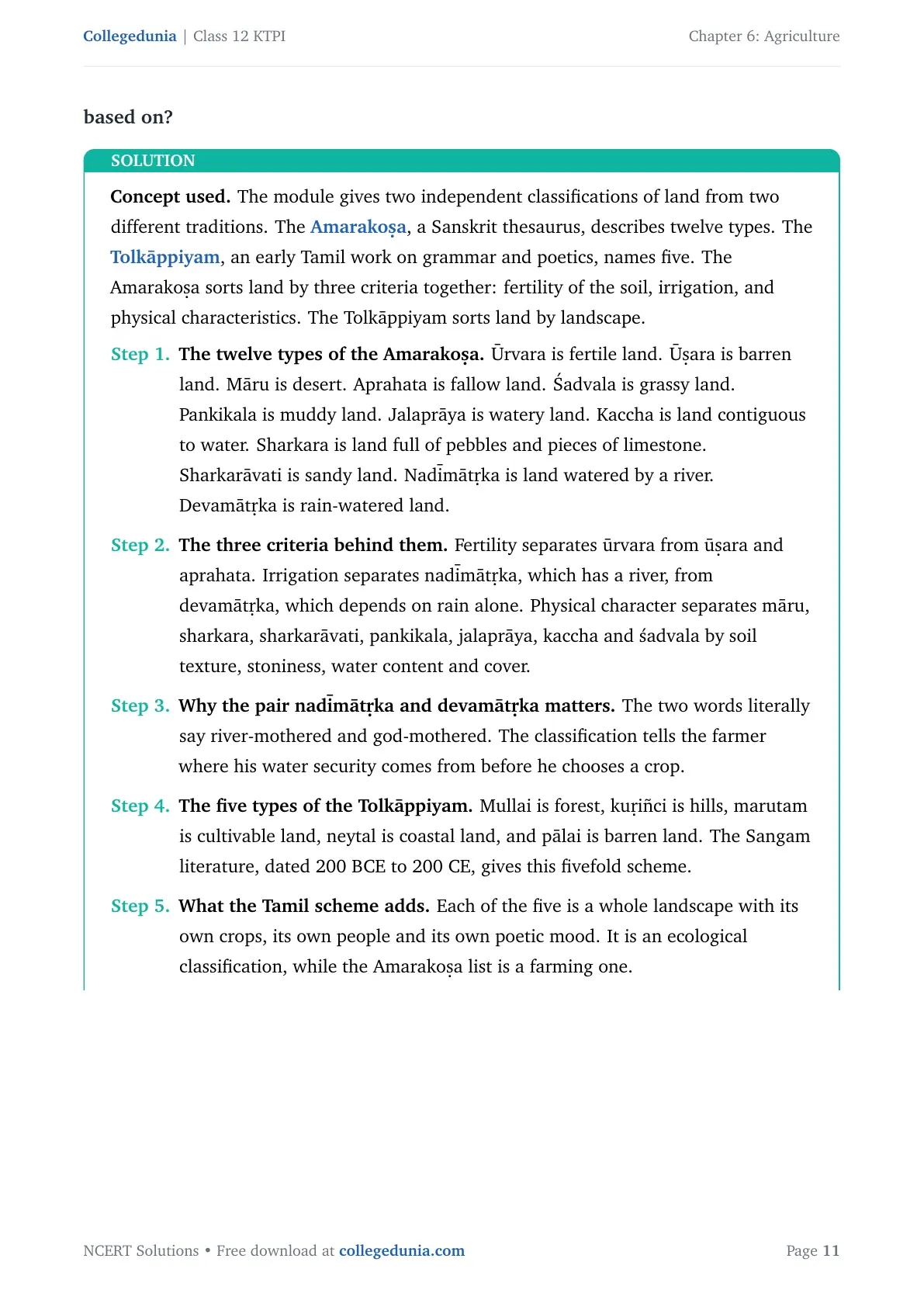
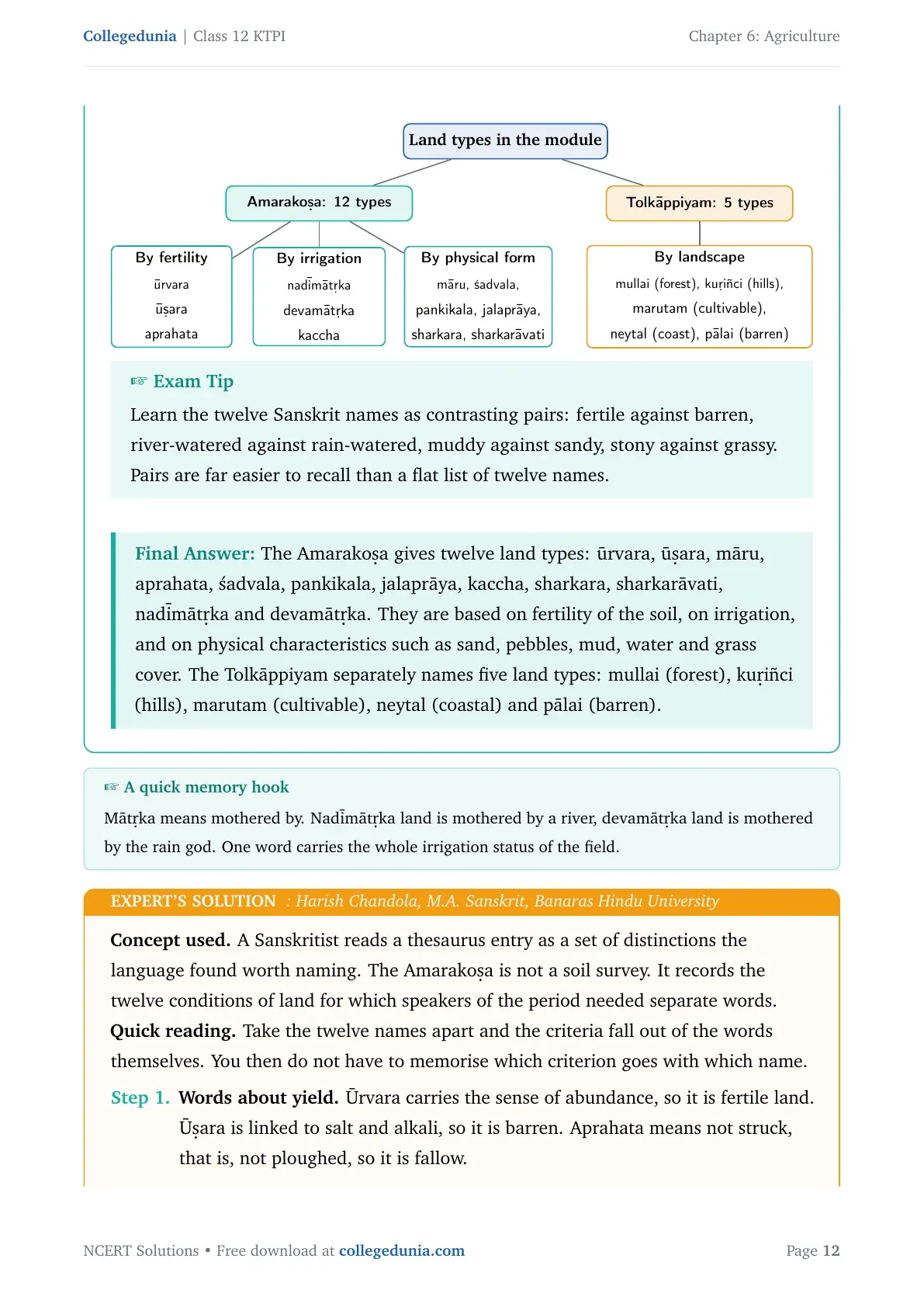
This question has two halves and students usually answer only the first. The Amarakosa, a Sanskrit thesaurus, describes twelve types of land. The classification is based on the fertility of the soil, irrigation and physical characteristics. Say that sentence before you list anything.
| Sanskrit name | Meaning | Sanskrit name | Meaning |
|---|---|---|---|
| urvara | Fertile | jalapraya | Watery |
| usara | Barren | kaccha | Land next to water |
| maru | Desert | sharkara | Full of pebbles and limestone pieces |
| aprahata | Fallow | sharkaravati | Sandy |
| sadvala | Grassy | nadimatrka | Watered by a river |
| pankikala | Muddy | devamatrka | Rain watered |
Close the answer with the Tamil classification, because it earns a separate mark. The Tolkappiyam, an early work on Tamil grammar and poetics, names five types of land: mullai for forest, kurinci for hills, marutam for cultivable land, neytal for coastal land and palai for barren land. The pair of examiners' favourites here are nadimatrka and devamatrka, since one is river fed and the other is rain fed.
Weather Prediction Then and Now, and the Irrigation That Followed
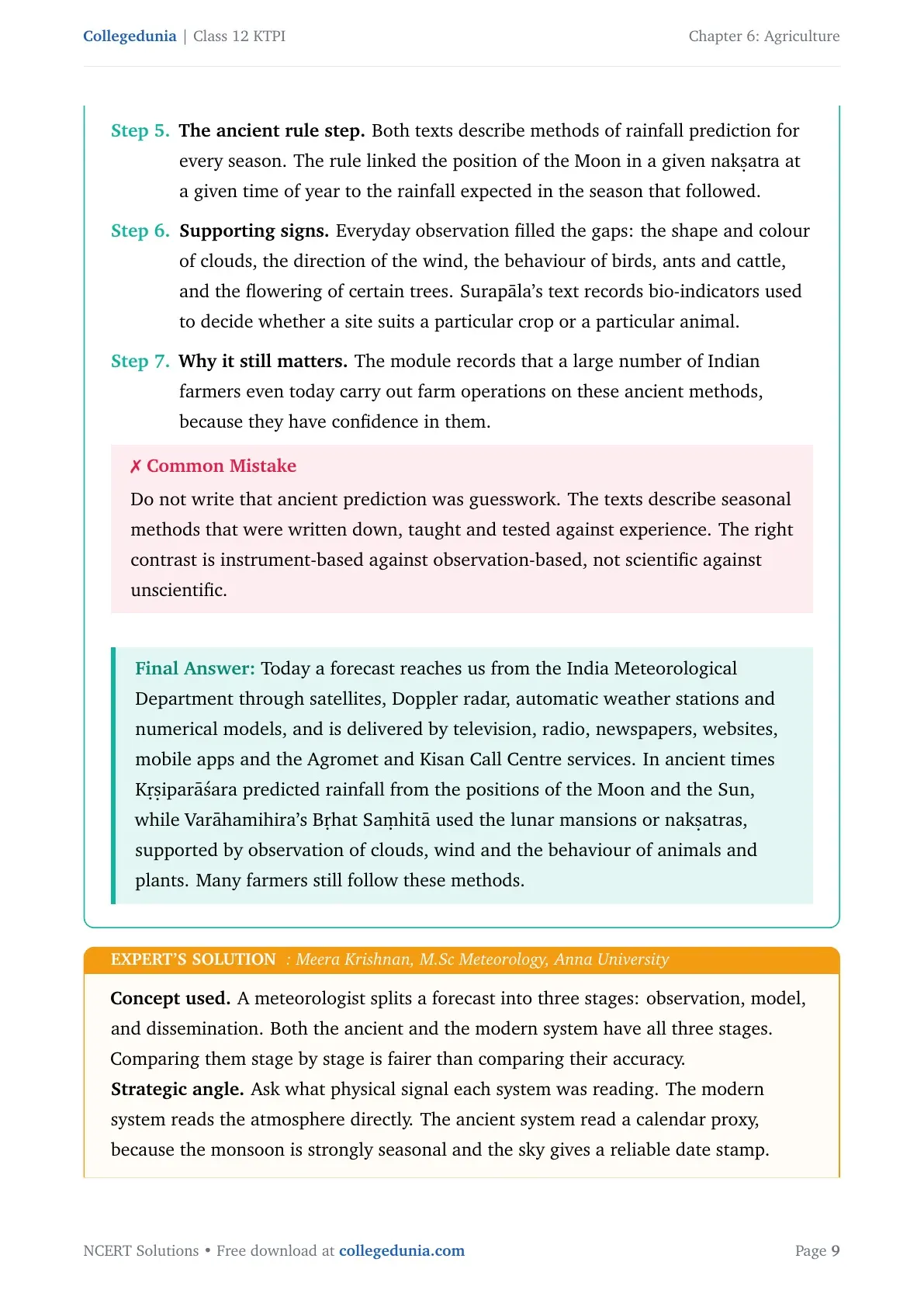
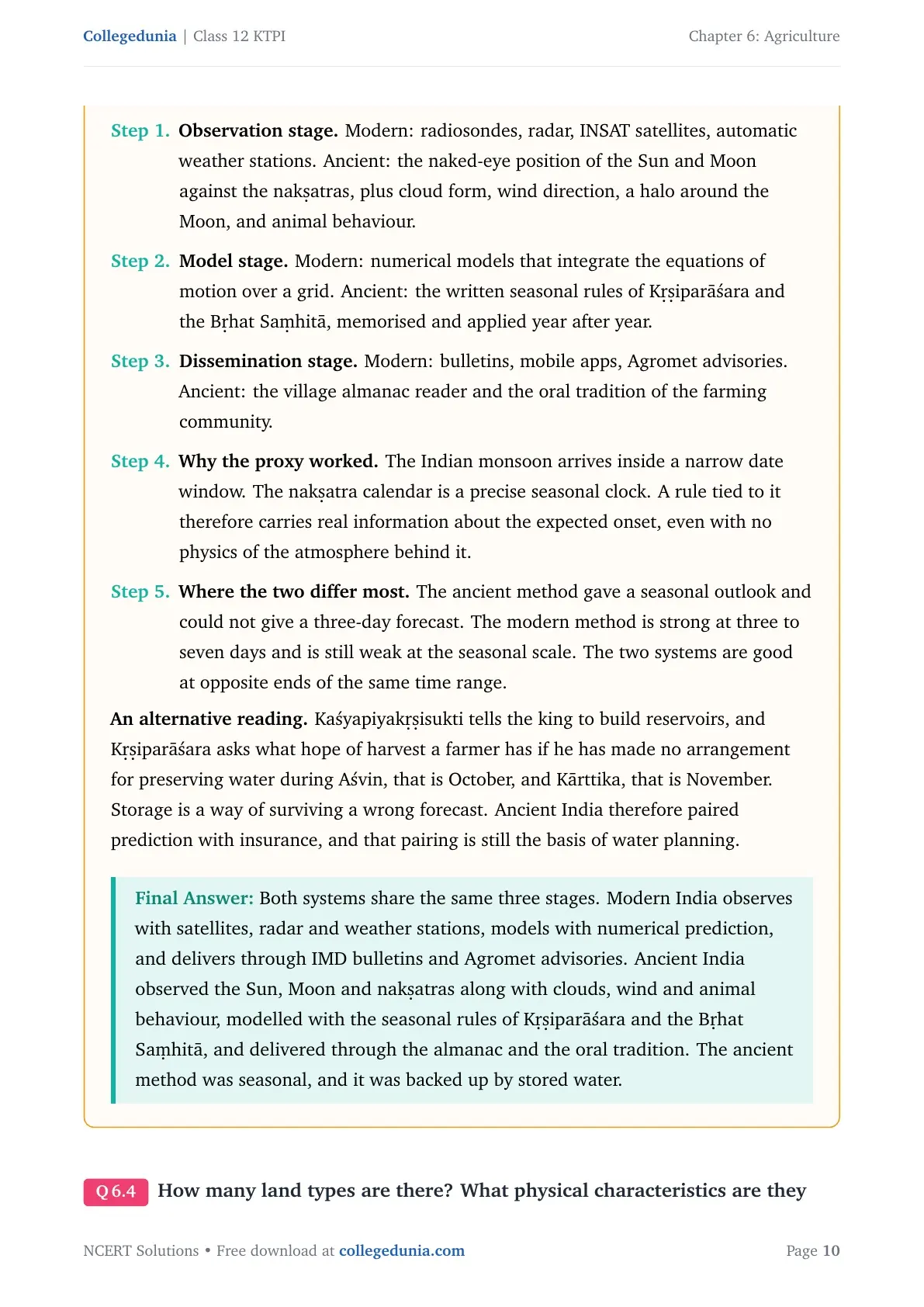
The weather question wants a comparison, so write it in two halves. Today you get a forecast from the India Meteorological Department, from satellite and radar images, from television bulletins, newspapers and phone applications. In ancient India the method was astronomical and seasonal.
- Krsiparasara and the Brhat Samhita both describe rainfall prediction methods for every season.
- Parasara's technique was based on the positions of the Moon and the Sun in the sky.
- Varahamihira used the lunar mansions, the nakshatras, to predict seasonal rainfall.
- A large number of farmers in India still time farm operations by these older methods.
Irrigation is the natural follow up, and the chapter gives you a strong set of examples. Canals, smaller channels and village tanks watered the crops, and reservoirs stored water for dry seasons and long droughts. The simplest method was a pair of bullocks pulling a leather bag out of a well, which tilted at the edge and emptied into a small channel.
| Structure or site | Detail to quote |
|---|---|
| Dholavira, Rann of Kachchh | Survived an arid climate in the 3rd millennium BCE only through vast reservoirs and large scale water harvesting |
| Ganges plains | Embankments, reservoirs, sluices, channels, interconnected tanks and wells became common in the 1st millennium BCE |
| Kautilya's Arthasastra | Refers to many of these structures and lays down strict rules for managing them |
| Grand Anicut, or Kallanai | A 329 metre dam across the Kaveri, credited to the Chola king Karikala about 1,800 years ago, splitting the river into four streams |
| Regional vocabulary | kulls, kunds, ahars, pokhars, khadins, arakere, kolas, surangam, tadagams and eris |
Ancient Indian Farm Implements Compared with the Machines Used Today
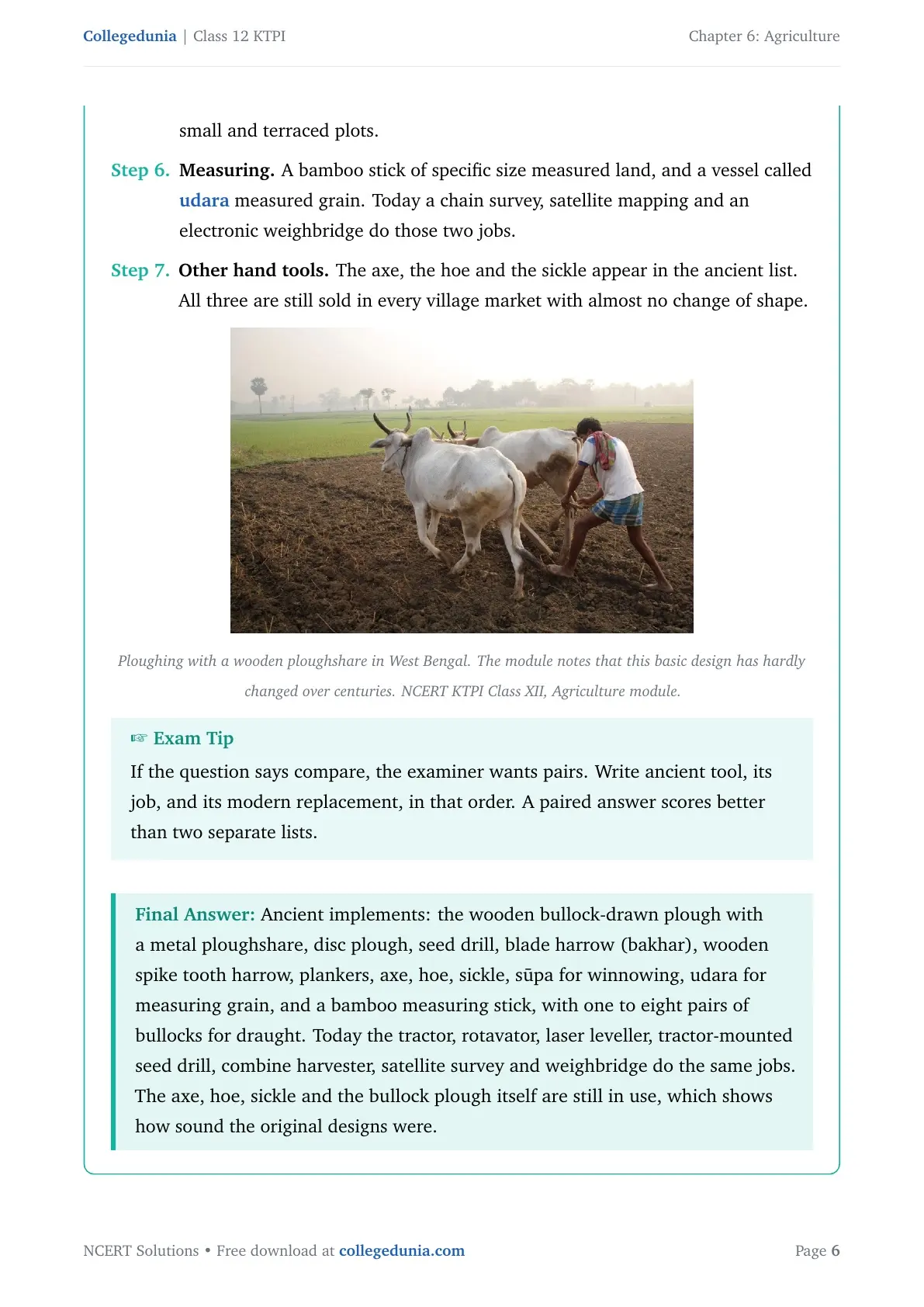
This is a compare question, so a two column answer scores better than prose. Start with the source. The Rigveda describes a simple bullock drawn wooden plough with a metal bar fitted as a ploughshare to open the soil. Krsiparasara gives the design in detail, with a Sanskrit name for every part.
| Ancient implement | Job it did | Modern equivalent |
|---|---|---|
| Bullock drawn wooden plough | Opening the soil before sowing | Tractor drawn mouldboard or disc plough |
| Seed drill | Placing seed in rows at an even depth | Tractor mounted seed cum fertilizer drill |
| Blade harrow, called bakhar | Breaking clods and weeding | Rotavator and cultivator |
| Wooden spike tooth harrow and plankers | Levelling the field | Laser land leveller |
| Sickle | Harvesting the standing crop | Combine harvester |
| Supa for winnowing | Separating grain from chaff | Thresher with a winnowing fan |
| Bamboo stick and the udara vessel | Measuring land and measuring grain | Measuring tape, survey instruments and weighing scales |
Two closing lines carry marks. One to eight pairs of bullocks were used for ploughing in the early period, depending on the soil and the size of the field. And the basic plough design has hardly changed over the centuries, since many farmers still work with a similar bullock drawn plough today. That continuity is the point the question is looking for.
Seed Selection, Seed Treatment Herbs and the Value of Uniform Seeds
Three questions across the two parts come from this short section, so read it twice. Farmers knew how to pick healthy seed from a ripening crop, and the law giver Manu recommended severe punishment for adulterating seed. That single line tells you how serious seed quality was.
- Seed treatment. Seeds were coated with flours of rice, black gram and sesame to get good germination. Surapala listed several herbs as seed treatment materials for shrubs and trees.
- Cow dung. Long used, and still used by many farmers, for treating cotton seed and some other seeds.
- Antimicrobial plants. For plant disorders Surapala suggested species we now know have antimicrobial properties, including mustard paste and milk.
- Nursery and transplanting. Sowing rice in small nursery beds and transplanting the seedlings is not modern. It was first perfected in the deltas of the Godavari and Krishna rivers in the 1st century CE.
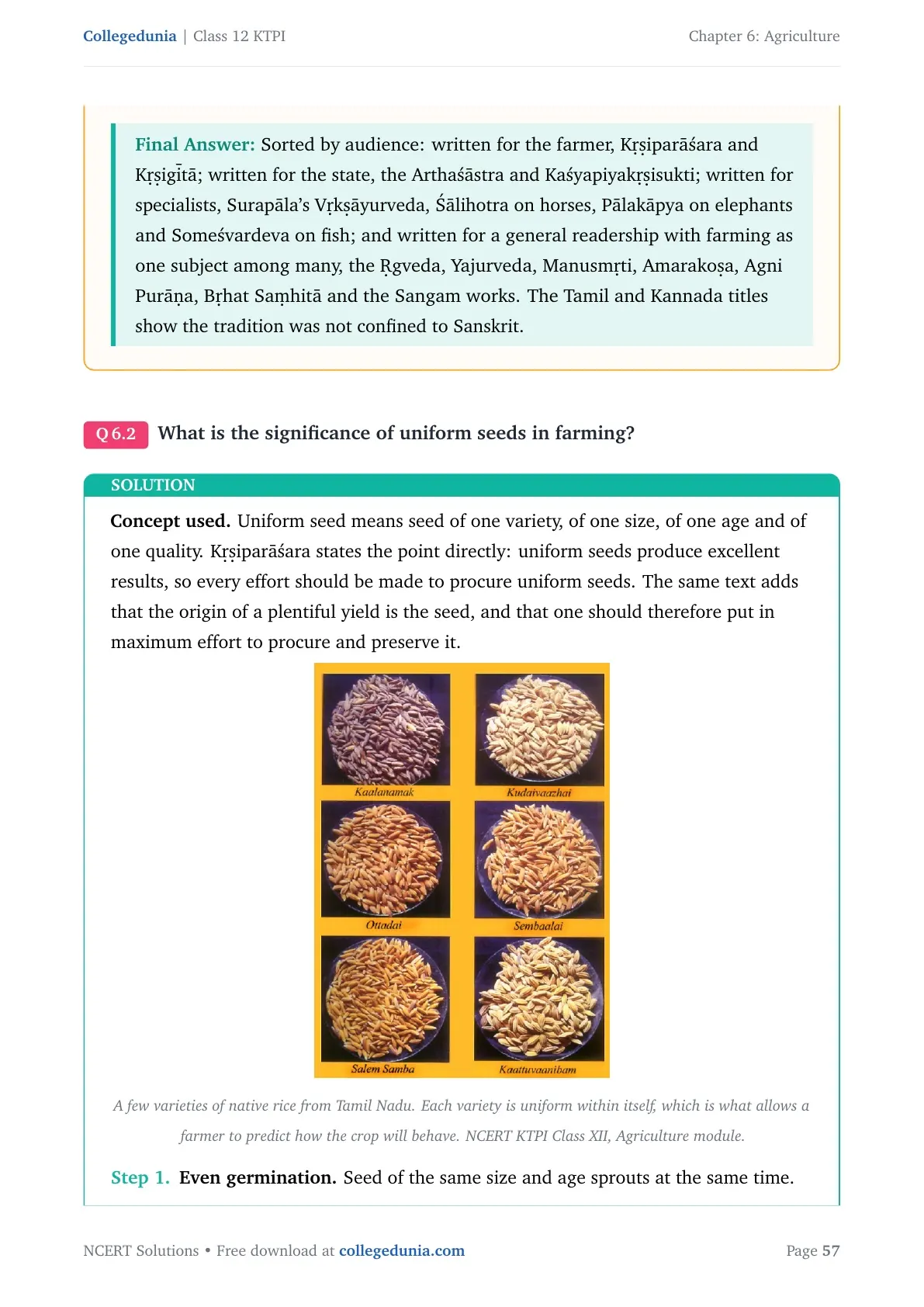
For the uniform seeds question, quote Parasara and then explain. He wrote that uniform seeds produce excellent results, and that the origin of a plentiful yield is the seed. Uniform seed germinates together, grows to a similar height, ripens at the same time and can be harvested in one operation. Mixed seed gives an uneven crop and an uncertain yield.
Kunapajala, Panchagavya and the Manures Kautilya Names
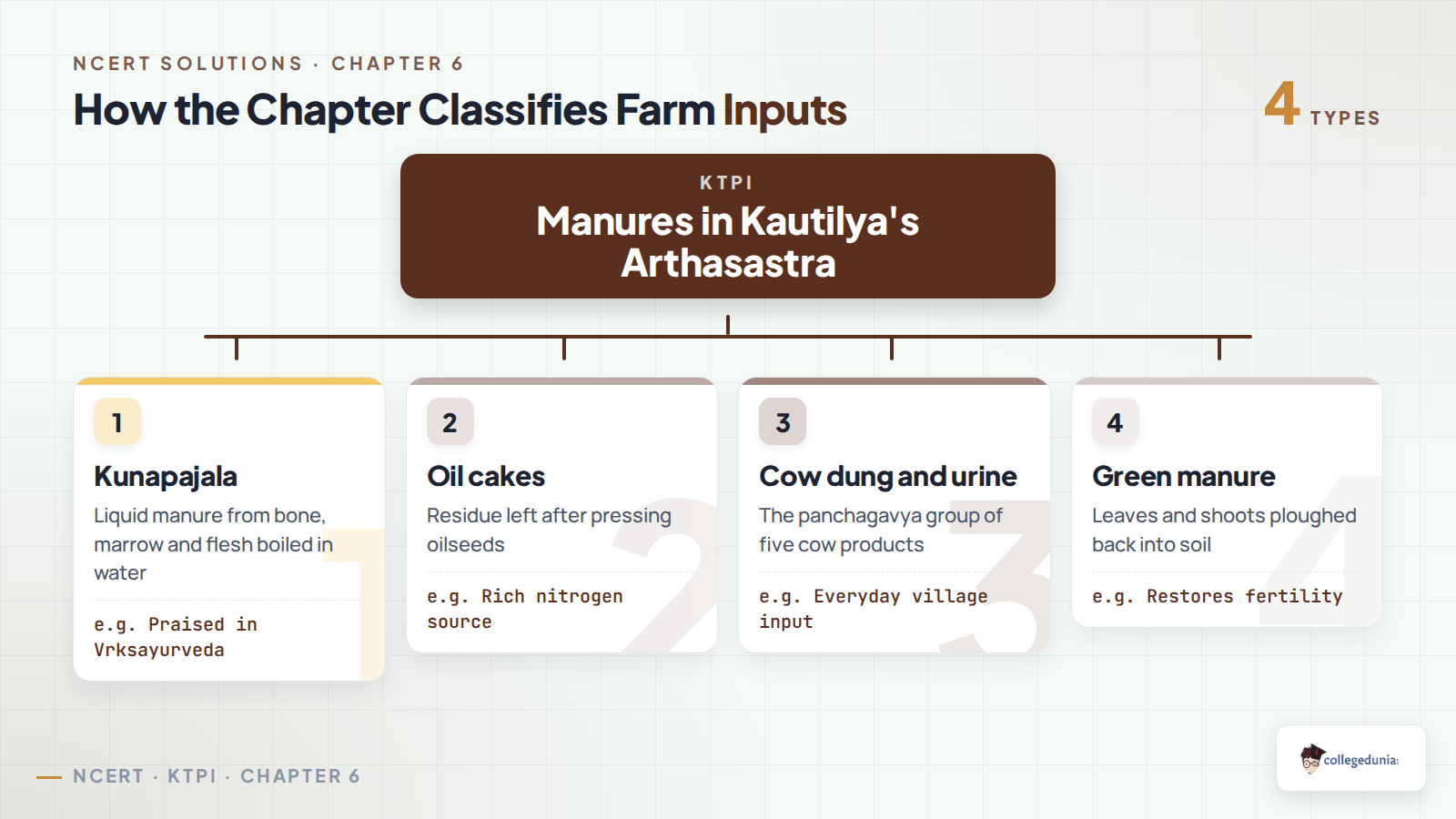
Two questions here are pure recall, so lose nothing. Parasara's rule comes first: crops grown without manure will not give a good yield. Kautilya mentions four manures: cow dung, animal bones, fish and milk. Write all four, in that order, and you have the full mark.
| Manure | What goes into it | Why it matters |
|---|---|---|
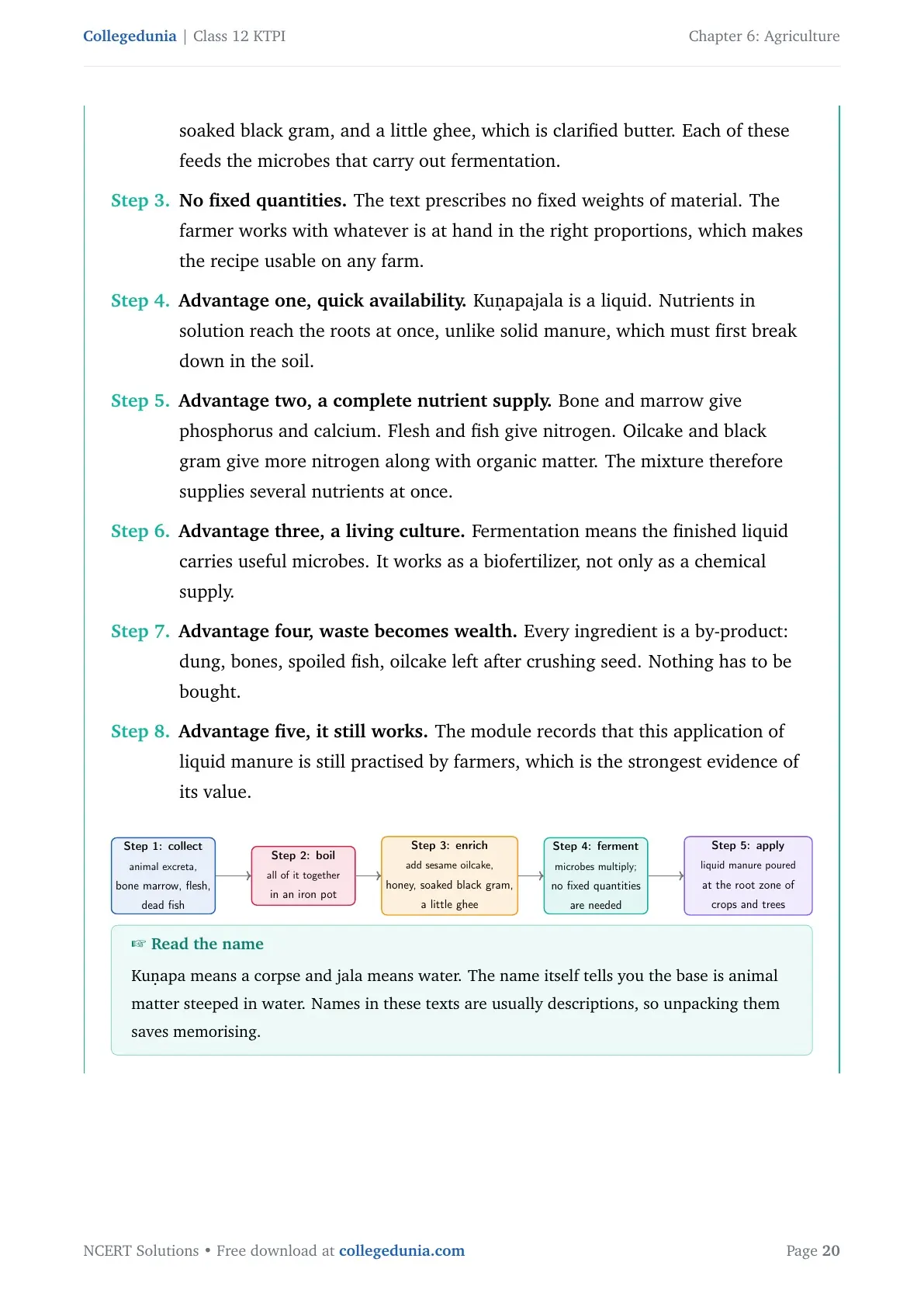
| Kunapajala | Animal excreta, bone marrow, flesh and dead fish boiled in an iron pot, then sesame oilcake, honey, soaked black gram and a little ghee added | A fermented liquid manure described by Surapala as an ancient practice, still used by farmers |
| Panchagavya | Cow dung, cow urine, milk, curd and ghee, sometimes with extra ingredients to speed fermentation | Studies show it works as a biofertilizer, raising growth and productivity and improving resistance to disease |
| Agni Purana recipe | Excreta of sheep and goat with pulverized barley and sesame, soaked in meat and water for seven nights | Recommended to increase flowering and fruiting in trees |
The advantages half of the kunapajala question is where students go vague. Give four concrete points. It is a liquid, so nutrients reach the roots quickly. No fixed quantities are needed, so any farm can prepare it from what is at hand. It uses animal waste and dead fish that would otherwise be thrown away. And it costs almost nothing, which is why the practice survives.
Elements That Damage Crops: Pests, Disease and Plant Protection
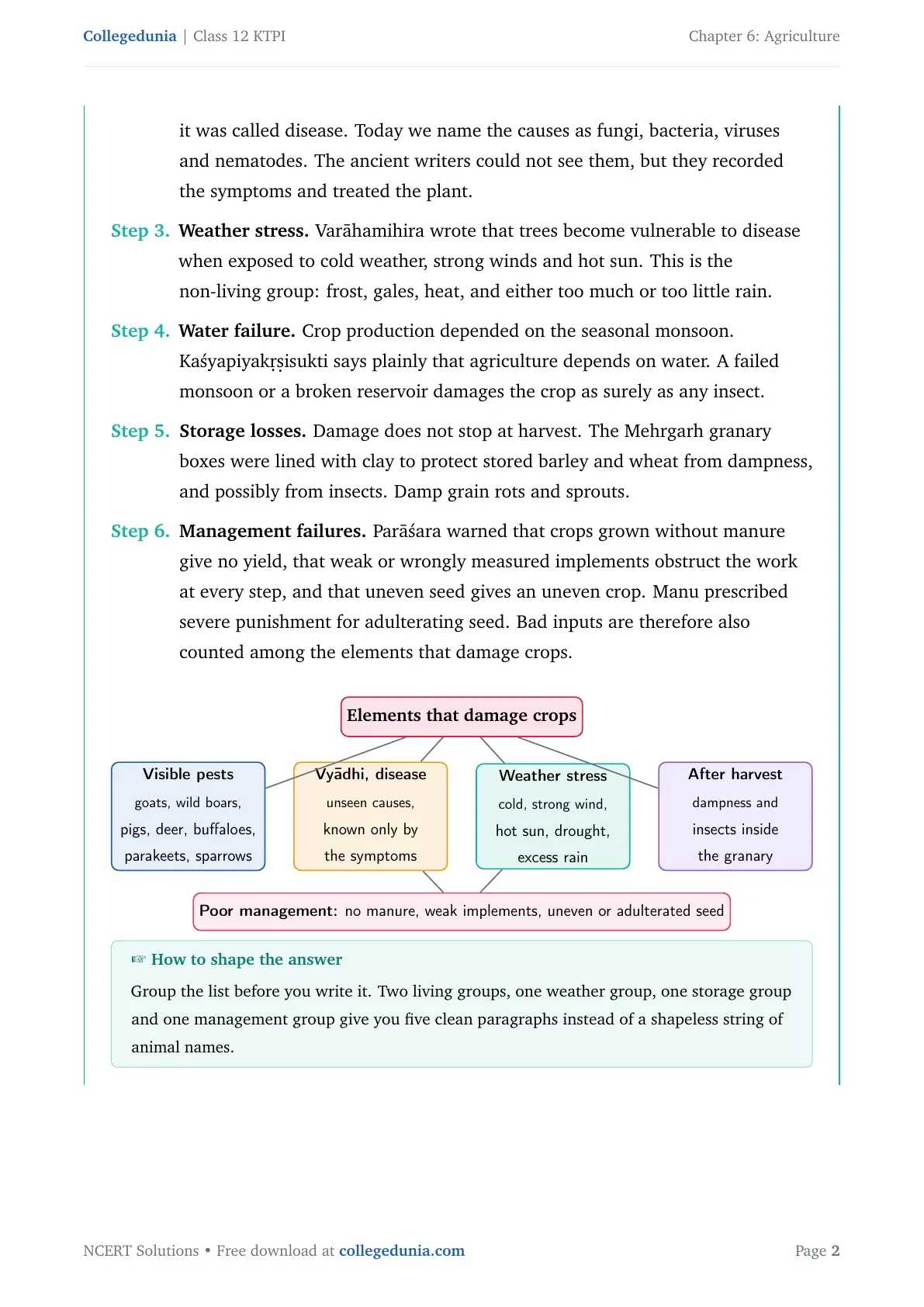
Question one of the chapter looks broad but has a tight answer. Parasara used the Sanskrit word vyadhi, meaning disease, to separate invisible damage from visible pests. So the answer splits into three groups, and naming the split is itself worth a mark.
- Visible pests. Parasara listed goats, wild boars, pigs, deer, buffaloes, parakeets and sparrows. Grazing animals eat and trample the standing crop, while birds strip the grain from ripening ears.
- Disease. The word vyadhi covers the damage you cannot see happening, which shows an early separation of pest damage from plant disease.
- Weather. Varahamihira wrote that trees become vulnerable when exposed to cold weather, strong winds and hot sun.
The weather point leads somewhere useful. It probably laid the base for classifying tree diseases by the humours vata, pitta and kapha, the tridosa of Ayurveda, a classification later formalised in Surapala's Vrksayurveda. Add that Surapala's plant protection recipes used species with antimicrobial properties, and the answer is complete.
Duties of the Superintendent of Cattle and How Livestock Was Classified
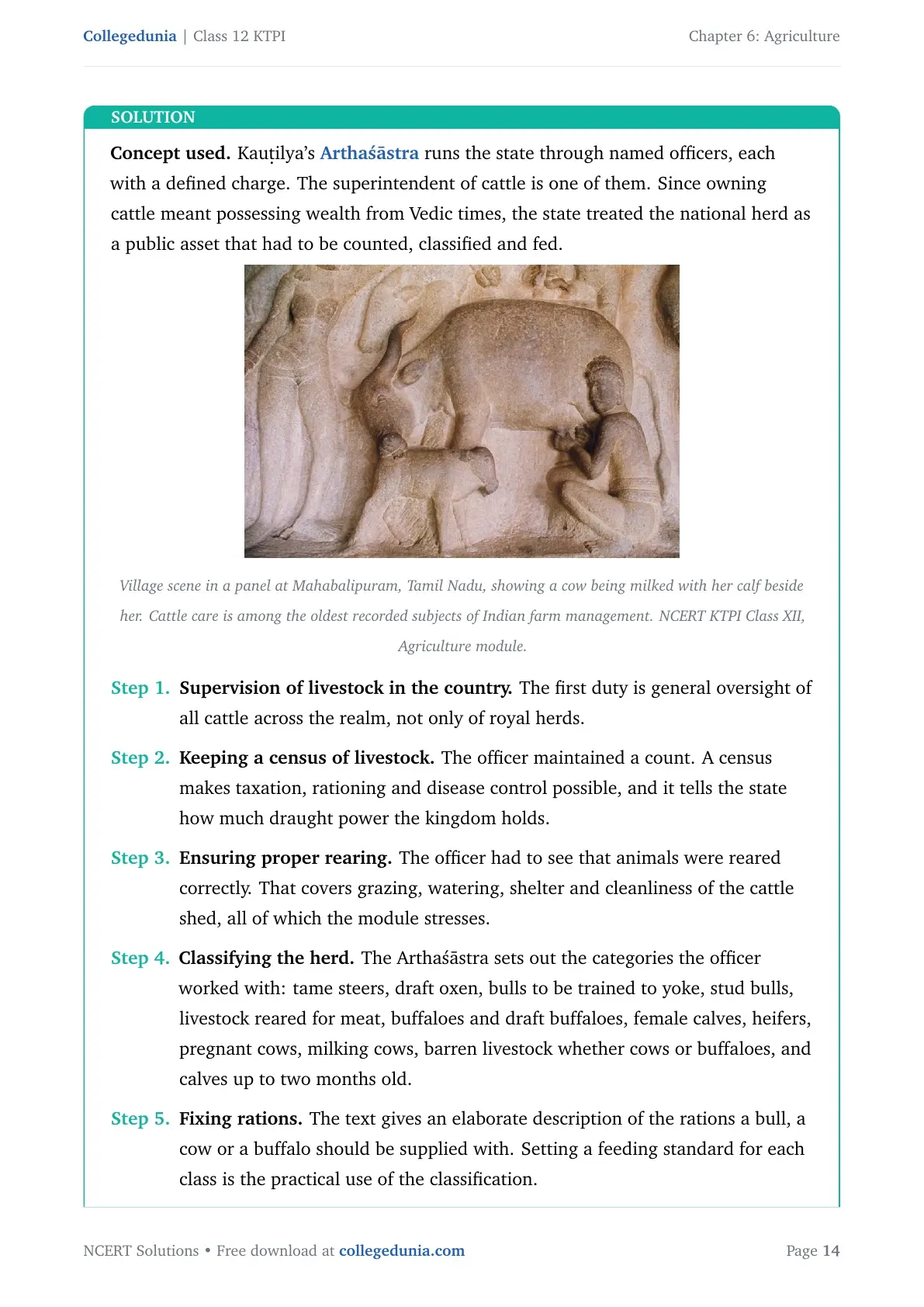
The Arthasastra question is a list question with a short introduction. Since Vedic times, owning cattle meant owning wealth, and the Rigveda is full of references to grazing, clean pond water, green fodder and livestock barns. Cattle sheds came later, with cleanliness stressed.
- Supervision. The superintendent supervised livestock across the country.
- Census. He kept a census of livestock, which means the state counted its animals.
- Proper rearing. He made sure animals were reared properly, with rations set out in detail for a bull, a cow and a buffalo.
- Pastures. Maintaining pastures around villages was encouraged under his charge.
If the question asks how livestock was classified, the Arthasastra list is long but the pattern is simple. It runs through tame steers, draft oxen, bulls being trained to yoke, stud bulls, animals reared for meat, buffaloes and draft buffaloes, female calves, heifers, pregnant cows, milking cows, barren cows or buffaloes, and calves up to two months old. Sort them by age, sex and work and the list becomes easy to recall.
One more text belongs here. The Kannada work Lokopakara of 1025 CE gives treatments for livestock diseases of the horns, teeth and mouth, and for human complaints such as sore throat, carditis, lumbago, rheumatism, muscle atrophy and acute dysentery. Plasters were used to set broken bones.
Arbori-horticulture, Wedge Grafting and Surapala's Garden Layouts
Three of the twelve Comprehension questions come from this one section. Define the term first. Arbori-horticulture is the combined science of growing trees and of raising fruit, vegetable and garden crops, and Surapala's Vrksayurveda is described in the chapter as a complete treatise on it.
| Question | What the answer must contain |
|---|---|
| What is arbori-horticulture? | Growing trees together with garden and fruit crops. Surapala's text covers the importance of trees, soil types, plant classification, seed, sowing, planting, plant protection recipes, nourishment, types of gardens, locating groundwater and bio-indicators |
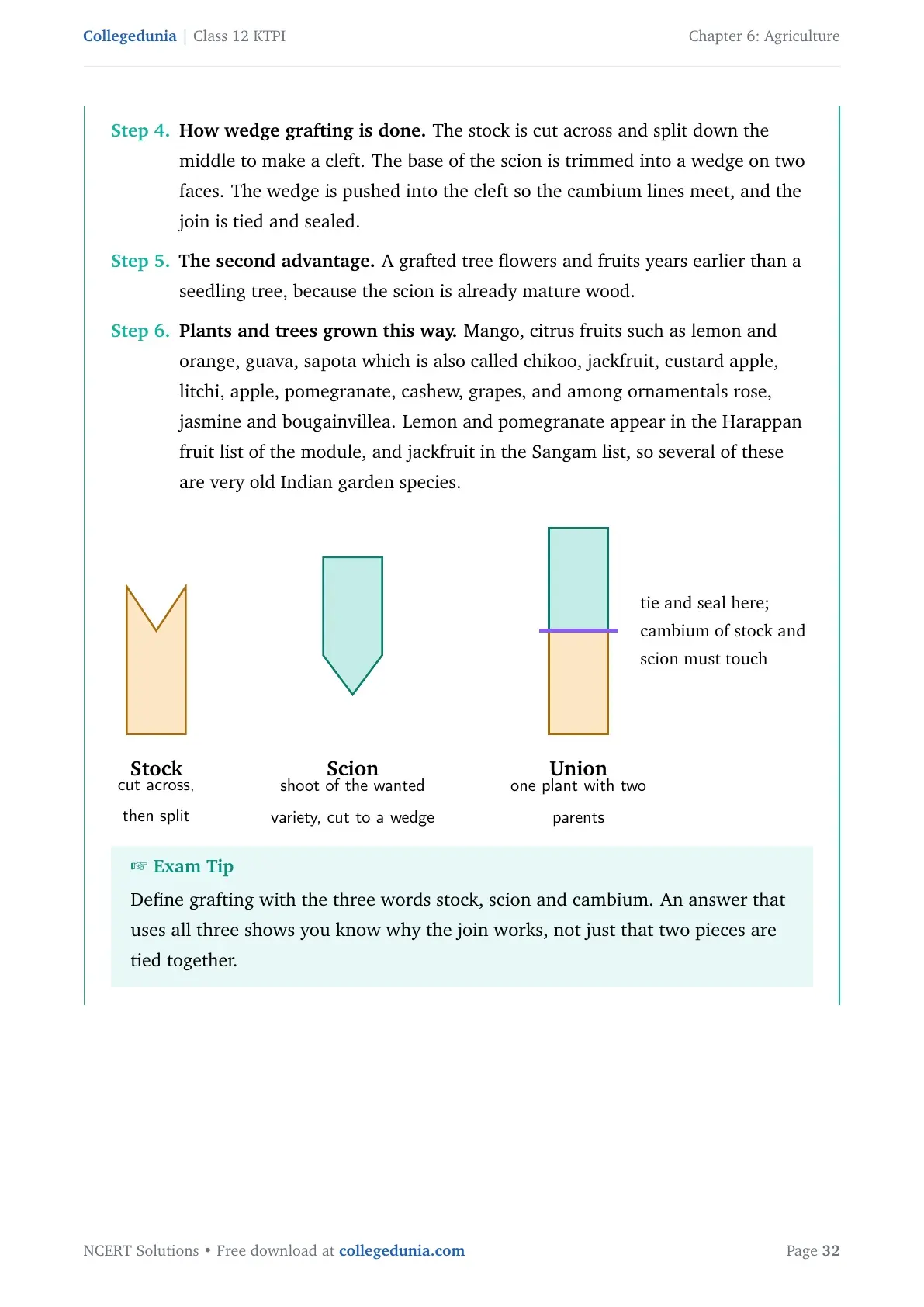
| What is grafting? | Joining a shoot of one plant to the rooted stem of another so they grow as one plant. The Brhat Samhita describes the method known today as wedge grafting |
| Plants grown by grafting | Mango, guava, lemon and other citrus, sapota, jackfruit, apple, grape and rose are the usual examples. The chapter itself names date palm, pomegranate, lemon and melon among Harappan fruits |
| Designing a garden layout | Soil type, water source and groundwater, spacing, choice of species, the purpose of the garden, and the eight named layouts |
The eight layouts are the recall item, so learn them as pairs. Mandapa is a canopy, nandyavarta a quadrangle with an opening to the west, swastika a design of religious meaning, chaturasra a square, sarvatobhadra a square enclosing a circle, vithi a line, nikunja an arbour and punjaka a cluster. Surapala's text mentions 170 species of plants and recommends layouts for pleasure gardens.
The last part of the garden question asks which modern professionals do this work. Name landscape architects, horticulturists, garden designers, urban planners and botanists, and add that a landscape architect today handles the same three concerns Surapala did: soil, water and the arrangement of species.
Pisciculture Explained and How Fish Culture Reached Bengal
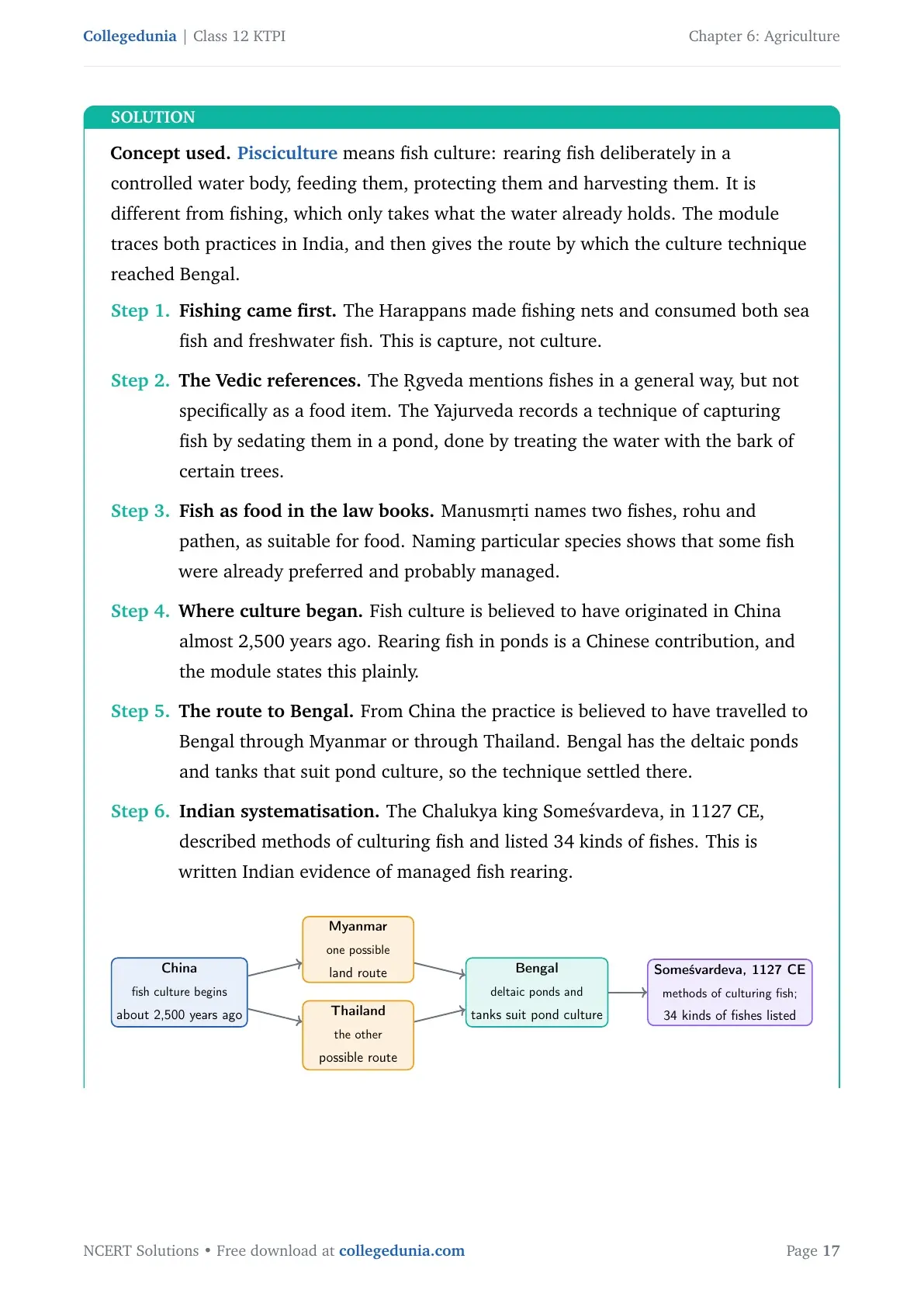
The pisciculture question is two lines of definition and one line of route, but students often miss the route. Pisciculture is fish culture, the planned breeding and rearing of fish in ponds and tanks for food. The chapter gives a clear path for how it arrived.
- Origin. Fish culture is believed to have come from China, where it began almost 2,500 years ago.
- Route. It reached Bengal through Myanmar or Thailand.
- Earlier evidence. The Harappans made fishing nets and ate both sea and freshwater fish.
- Textual mentions. The Rigveda mentions fish in general but not as food. The Yajurveda describes catching fish by sedating them in a pond with tree bark. Manusmrti names rohu and pathen as fit for food.
- The specialist text. The Chalukya king Somesvardeva in 1127 CE described methods of culturing fish and listed 34 kinds of fishes.
How to Plan the Four Project Ideas and the Extended Activities
Project work carries internal marks and takes less time than students expect, because the chapter hands you the headings. Three of the four projects need one field visit between them, so plan the visit once and collect material for all three.
- Project 1, the village study. Interview farmers and compare their work with that of their ancestors. The chapter gives the questionnaire headings: preparing the fields, seeds, manures and fertilizers, irrigation, varieties of crops, harvesting, storage, transport to market, and innovations in farming.
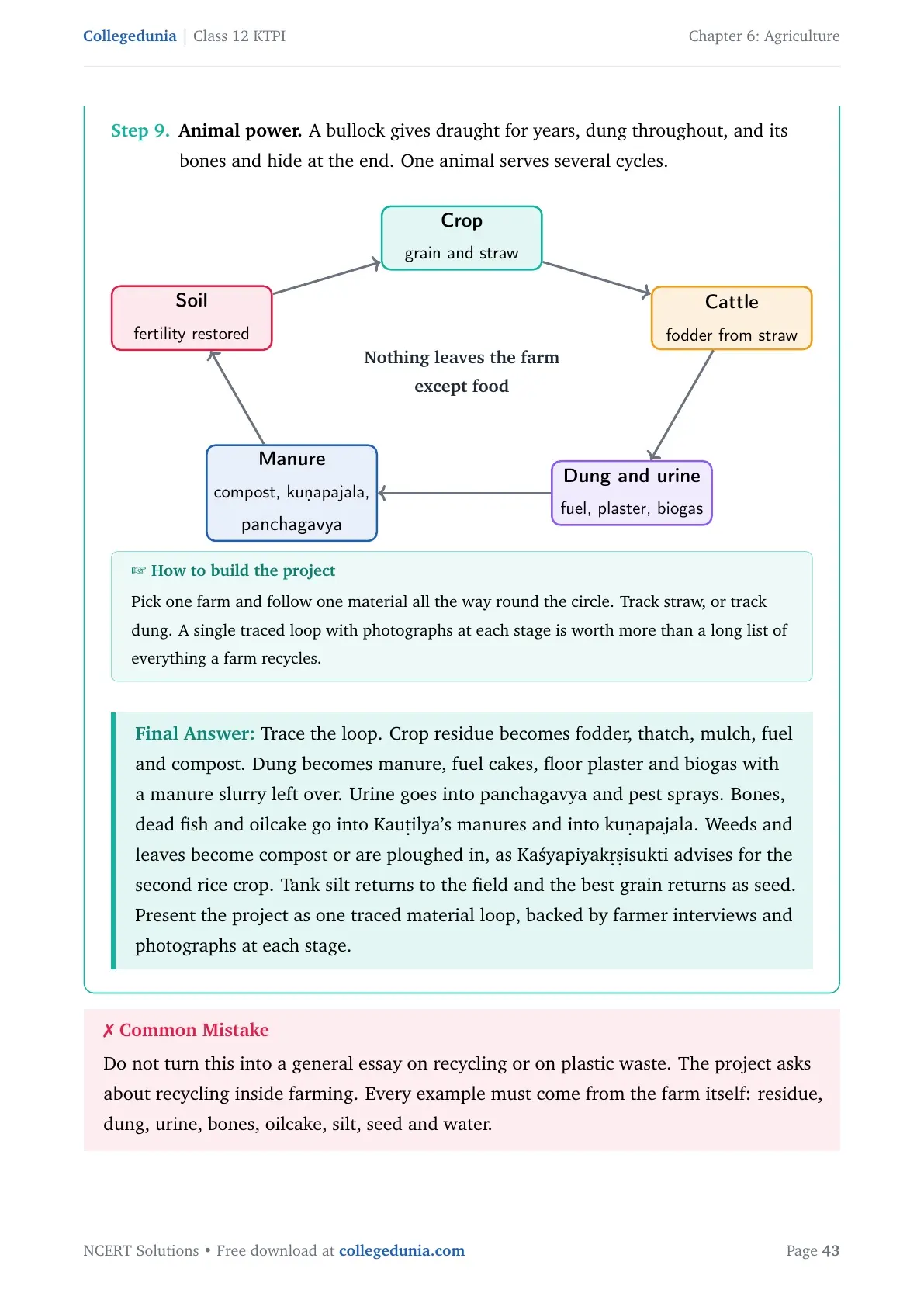
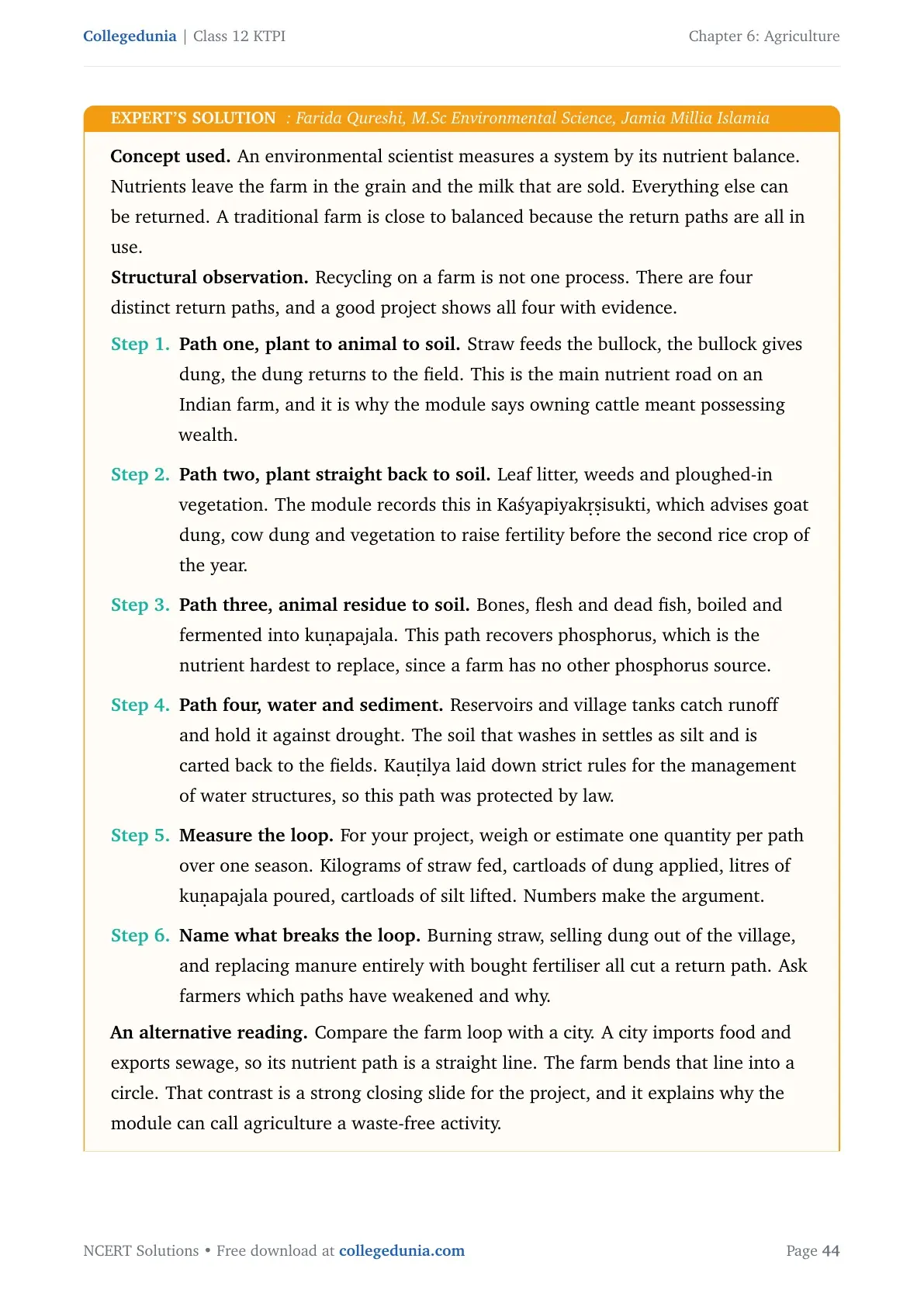
- Project 2, farming as a waste free activity. Record how reuse and recycling happen on a farm. Cover crop residue as fodder and as green manure, dung as manure and fuel, kunapajala from animal waste, and pond silt returned to the field. Include findings, a farmer interview and pictures.
- Project 3, Agriculture as a Promising Career Option. Build the presentation around people who left other professions for conventional farming as a way of living sustainably. Add organic certification, farm produce marketing and agri-tourism as career lines.
- Project 4, the Indus Civilization display. Use maps, toys, pots, figurines and seals. Anchor it on the Banawali plough share model, the Kalibangan furrows of about 2800 BCE and the Mehrgarh granary of about 6000 BCE.
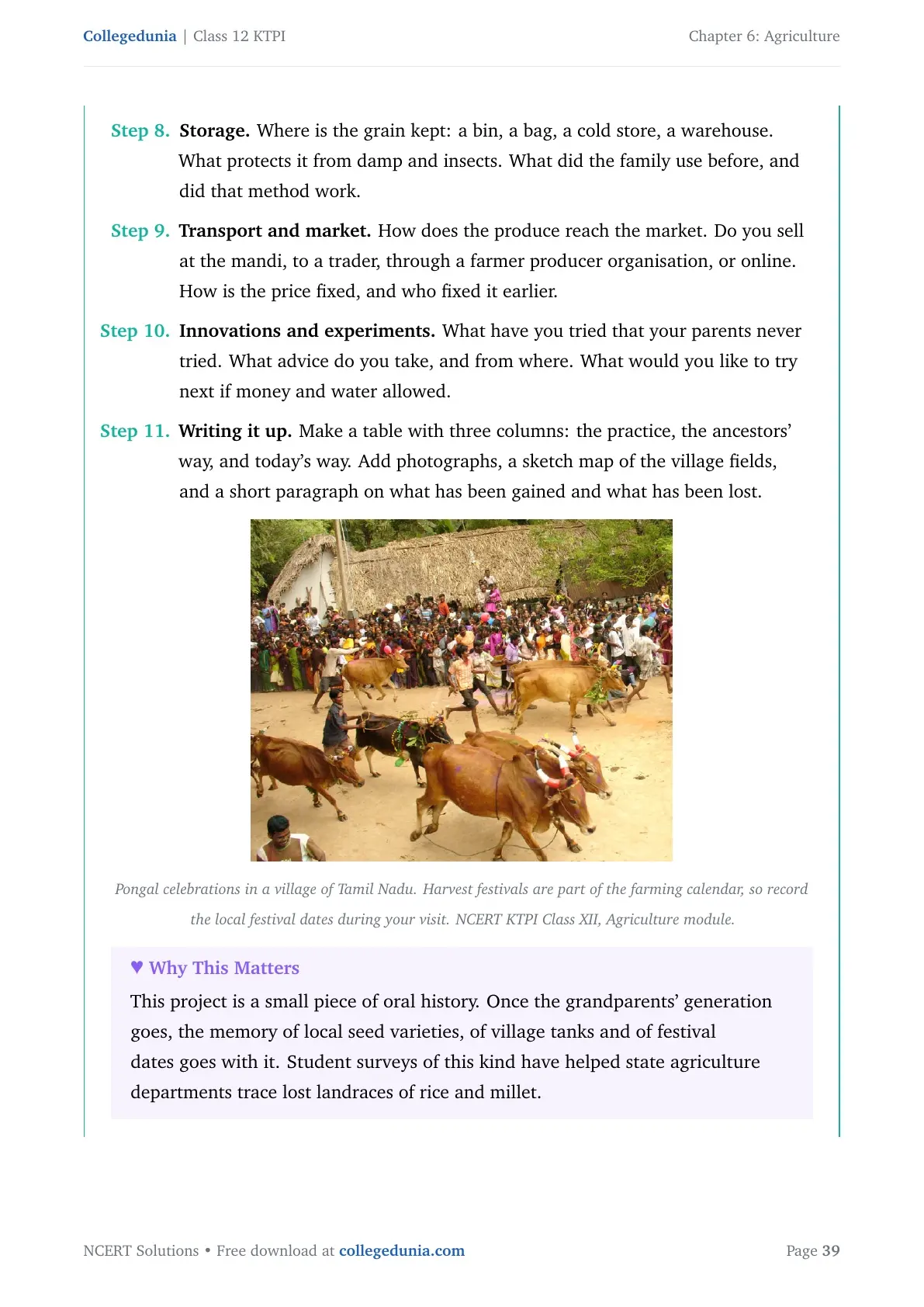
Also Check: the Extended Activities are short and often carry a viva question. Two are worth preparing properly. The barley planted in an earthen pot during Navaratra is a seed germination test, so it links directly to seed quality. And the list of farmer fairs and festivals connects to the Agriculture and Society section, where Akshaya Tritiya, Holi, Lohri, Magh Bihu, Nabanna, Onam and Pongal are all named as harvest festivals.
Answering the Six Questions on the Agricultural Heritage Extracts
The second part of the module prints verses from six sources. Its six questions are shorter than they look, but two of them ask for your own view, and a vague opinion scores nothing. Give a position, then two supporting reasons drawn from the extract.
| Question | The line to build the answer on |
|---|---|
| Name a few texts on ancient Indian agriculture | Rigveda, Krsiparasara, Arthasastra, Kasyapiyakrsisukti, Vrksayurveda and Krsigita, with dates attached |
| Significance of uniform seeds | Uniform seeds produce excellent results, and the origin of a plentiful yield is the seed |
| Herbs used to treat seeds | Flours of rice, black gram and sesame, cow dung for cotton seed, and Surapala's herbs including mustard paste and milk |
| Views on trees and the four aims of life | Trees yield the means of attaining dharma, artha, kama and moksha |
| Water advice to kings in Kasyapiyakrsisukti | Build reservoirs on any side of the village at convenient places, and protect canals as a duty |
| Views on the Rigveda cow verse | Do not kill a cow who is mother of Rudras, daughter of Vasus, sister of Aditya, milk bearing and innocent |
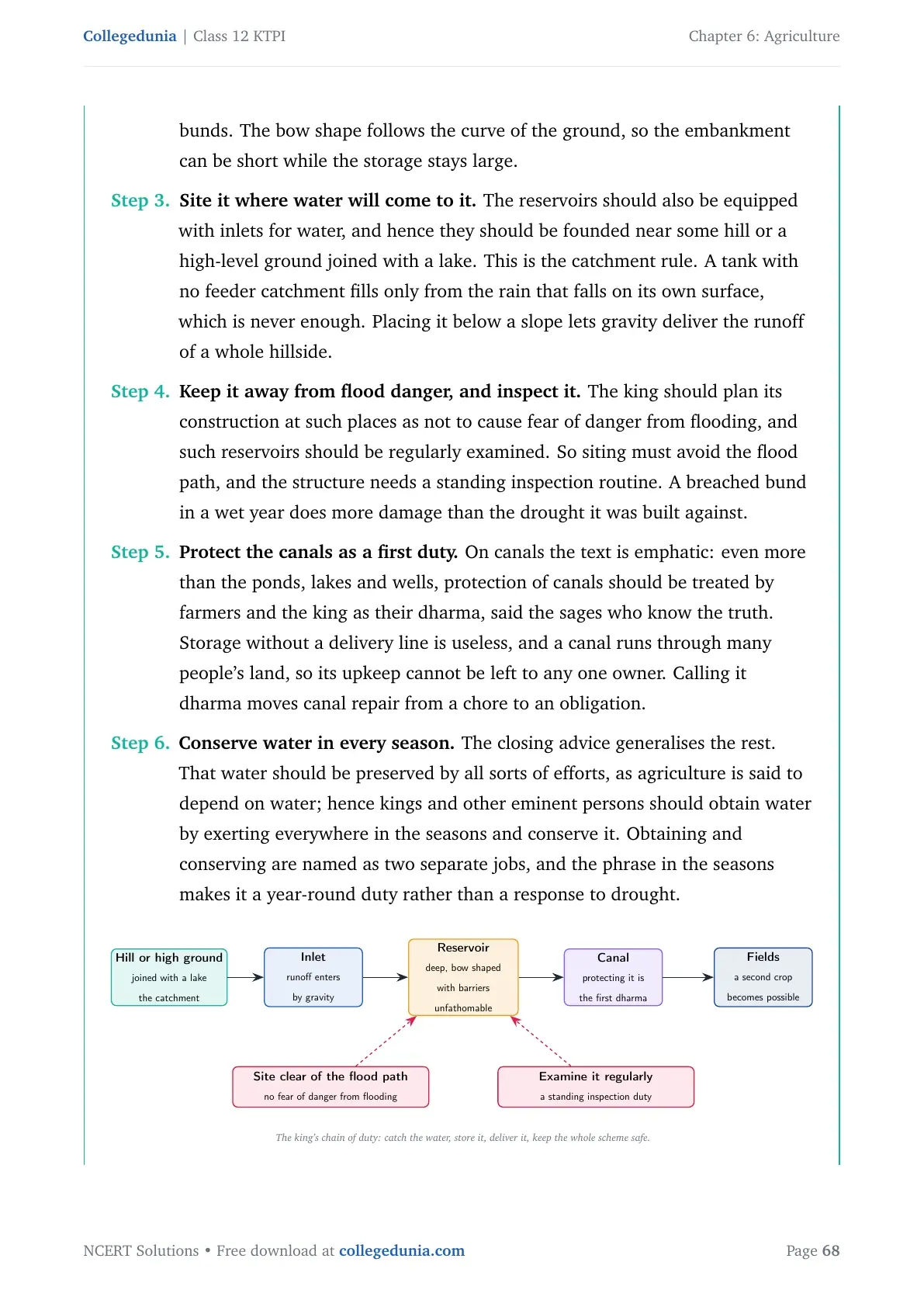
The water question is the one with the most printed detail, so use it. The Kasyapiyakrsisukti tells the king to build reservoirs to the west, north, east or south of villages and cities, according to the condition of the land.
- A reservoir should be deep, fitted with barriers, bow shaped or long or round, and essentially unfathomable.
- It should have inlets for water, and stand near a hill or high ground joined to a lake.
- It must not be sited where flooding is a danger, and it must be examined regularly.
Two further lines finish that answer. The text says protection of canals should be treated as dharma by farmers and the king alike. And it says water must be preserved by every effort, because agriculture depends on water.
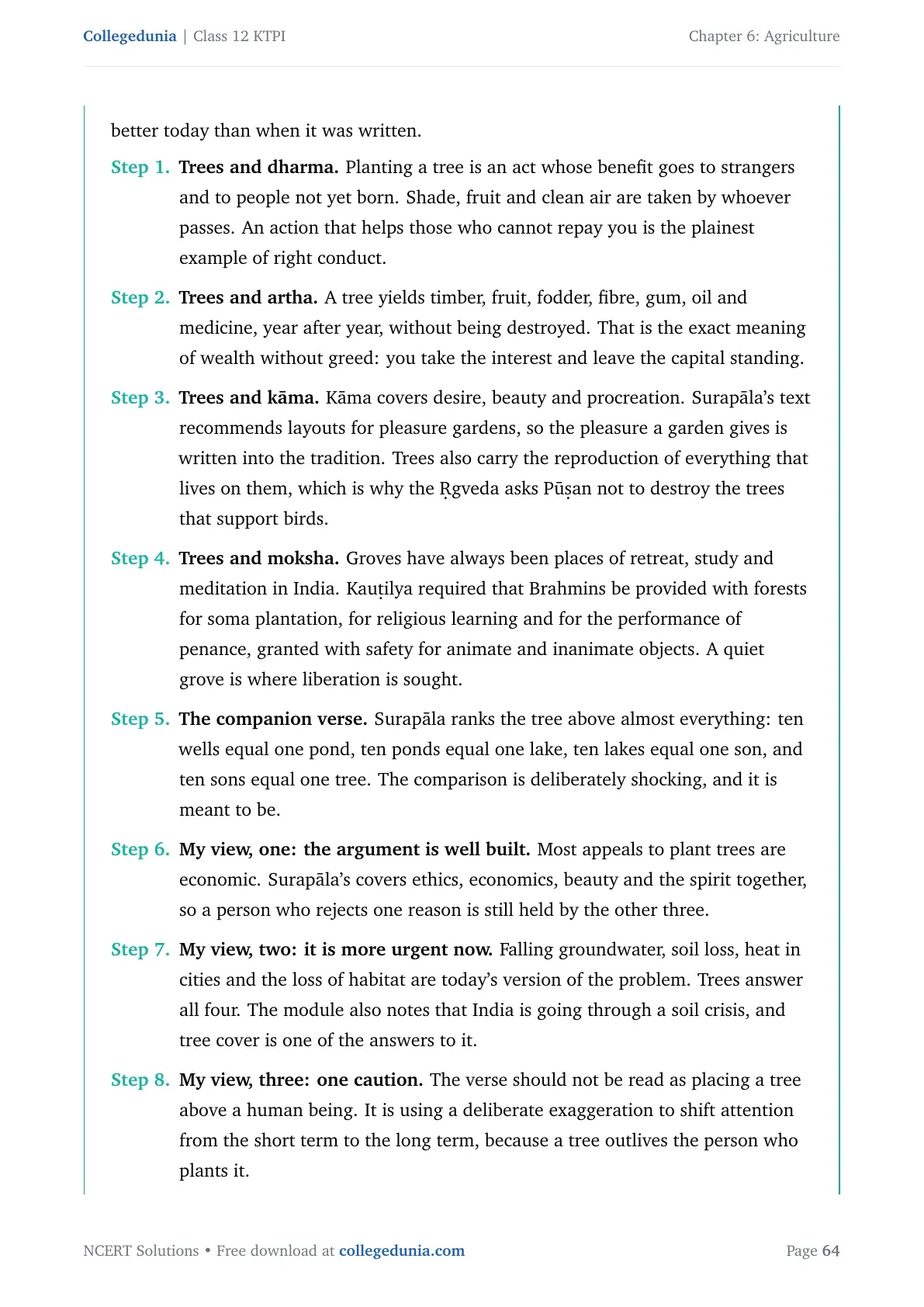
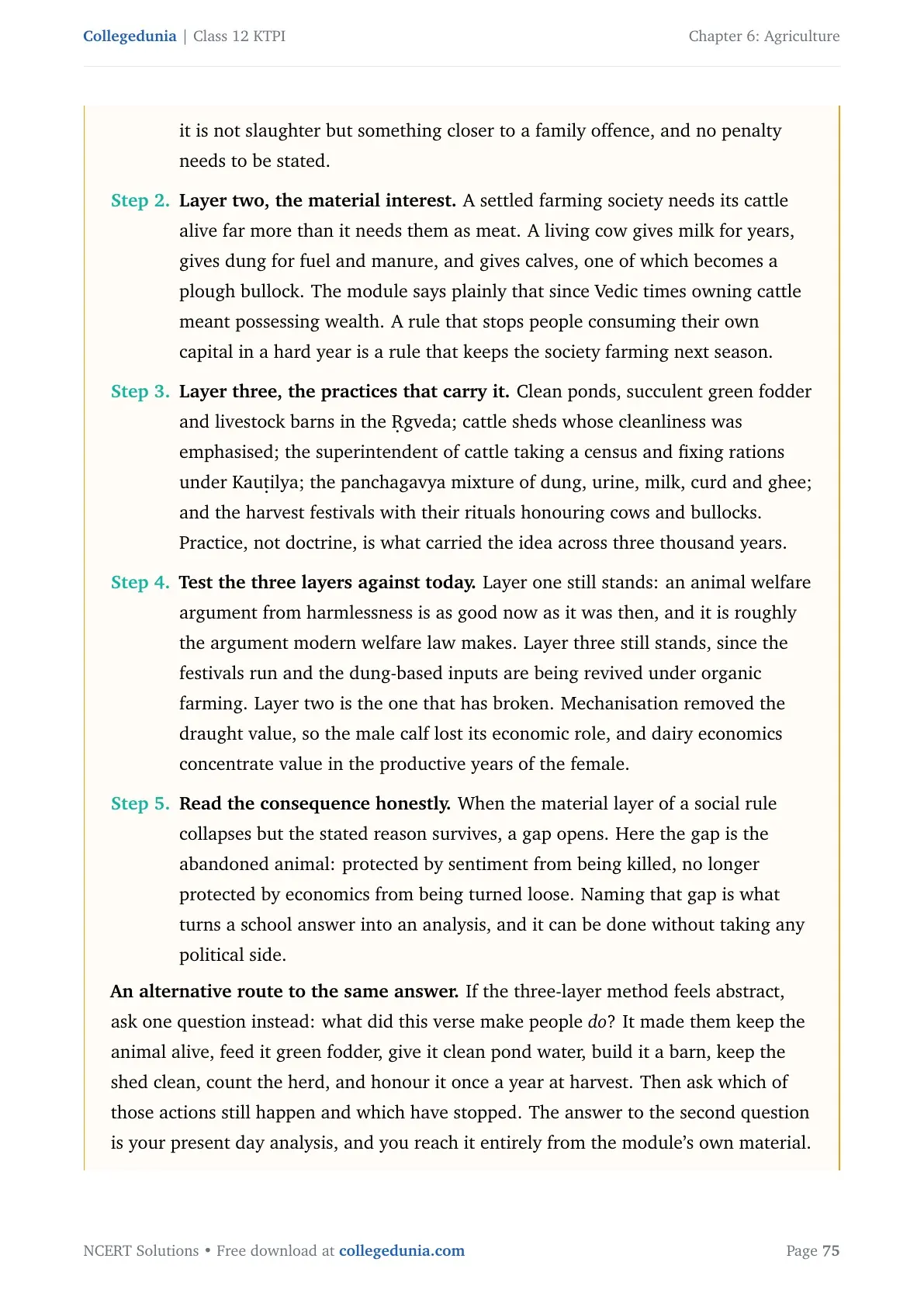
For the trees question, argue from use rather than sentiment. Surapala's ladder makes the case in four lines: ten wells equal one pond, ten ponds equal one lake, ten lakes equal one son, and ten sons equal one tree. Trees give food, fuel, timber, medicine, shade and clean air, so they serve wealth and duty at once.
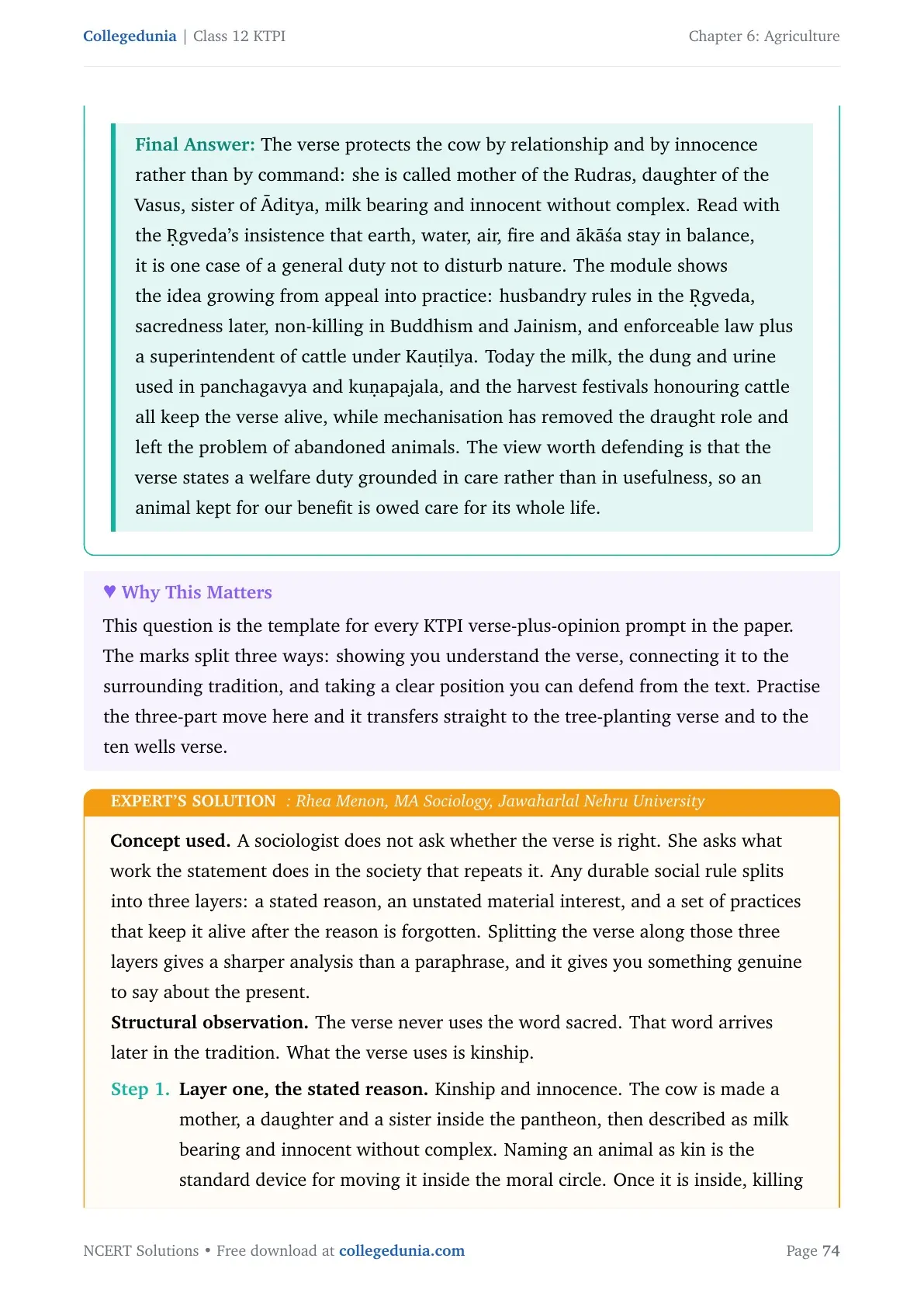
For the cow verse, set it against modern livestock economics, milk supply and animal welfare. Note that the Rigveda argument rests on the animal being productive and harmless, not on ritual alone.
Common Mistakes Students Make in the Agriculture Chapter
Avoid these six in the answer sheet:
- Answering only the twelve Comprehension questions after the survey. Six more sit at the end of the second part and carry the same weight.
- Listing the twelve land types without saying what the classification is based on. The question asks for fertility, irrigation and physical characteristics.
- Writing kunapajala and panchagavya as the same thing. Kunapajala is a boiled and fermented liquid from animal waste. Panchagavya is a fermented mixture of five cow products.
- Naming only cow dung for Kautilya. He names four: cow dung, animal bones, fish and milk.
- Saying pisciculture began in India. The chapter says it is believed to have come from China to Bengal through Myanmar or Thailand.
- Treating the two opinion questions in the second part as one line answers. Each needs a stated view plus two reasons from the extract.
A quick fix for the numbers: put 12 land types, 5 Tamil land types, 8 garden layouts, 170 plant species, 34 kinds of fishes, 329 metres for the Grand Anicut and one-sixth as the usual tax ceiling on one card and recite it before the paper.
Student Feedback on the Class 12 KTPI Agriculture Chapter
What 13,180 Class 12 students told us about the Agriculture chapter
Collected in a Collegedunia poll run ahead of the 2026-27 board session:
- 61% said spelling the Sanskrit terms correctly was the hardest part, with kasyapiyakrsisukti and sarvatobhadra named most often.
- 7 out of 10 students called the land types question and the manures question the easiest marks in the module.
- 44% did not know the chapter has a second Comprehension block after the primary text extracts, and left those six questions blank.
- Students who answered the implements question as a two column comparison scored higher than those who wrote it as a paragraph.
Source: 2026-27 Class 12 KTPI student poll. Sample of 13,180 students from CBSE schools across 15 states.
Where Agriculture Sits in the KTPI Course and How to Revise It
Agriculture is the sixth chapter of the Class 12 Knowledge Traditions and Practices of India course, and it follows Medicine in India. It is a list heavy chapter rather than a concept heavy one, which makes it one of the safest scoring modules if you revise the names. Treat the table below as a planning guide, not as an official blueprint.
| Chapter | Topic | Indicative weight |
|---|---|---|
| Chapter 3 | Mathematics in India | High |
| Chapter 4 | Life Sciences | High |
| Chapter 5 | Medicine in India | High |
| Chapter 6 | Agriculture | Medium |
| Chapter 7 | Metallurgy in India | Medium |
| Chapter 10 | Indian Philosophical Systems | Medium |
Three focused hours make the chapter exam ready, and the order the book prints gives you the sequence for free.
- Block 1, 60 minutes. Read from the prehistory section to the implements section. Then write the date ladder, the twelve land types and the implements comparison from memory.
- Block 2, 60 minutes. Cover seed, manures, pests, cattle, horticulture and fishing. Write the kunapajala recipe, Kautilya's four manures and the duties of the superintendent of cattle without looking.
- Block 3, 60 minutes. Read the six primary text extracts with their verses. Write the water advice from the Kasyapiyakrsisukti and draft both opinion answers in full.
Repeat Block 3 a week before the paper. The extract questions are where most students lose marks, and they improve fastest because the source verses are printed right above them.
How the Agriculture Solutions Work with the Solved Question Set
These solutions give you model answers. They do not reprint the full survey essay, the six extracts or the photographs the book carries. Those sit on the other Collegedunia pages for the same course, and using them together is faster than reading any one of them alone.
| Resource | What it adds beyond these solutions | Link |
|---|---|---|
| Solved question set | All 22 tasks written out as complete answers, each with a Solution and a longer Expert Solution | Agriculture Class 12 Solved Questions |
| Chapter book PDF | The full survey essay, the six primary text extracts and the photographs the solutions refer to but do not reprint | Agriculture Class 12 KTPI Book PDF |
| Previous chapter | Susruta, Caraka and the eight branches of Ayurveda, which explain the tridosa idea this chapter borrows for tree disease | Medicine in India Class 12 NCERT Solutions |
| Next chapter | Iron, zinc and wootz steel, the other craft tradition that grew out of the same village economy | Metallurgy in India Class 12 NCERT Solutions |
Also Check: the Life Sciences Class 12 NCERT Solutions, which carries the plant and animal science background that Surapala's Vrksayurveda builds on.
All 10 Chapters of Class 12 KTPI with NCERT Solutions
The Class 12 Knowledge Traditions and Practices of India course runs across ten chapters. Every link below opens the NCERT Solutions for that chapter, written for the 2026-27 session.
| Chapter | NCERT Solutions |
|---|---|
| Chapter 1 | Astronomy in India Class 12 NCERT Solutions |
| Chapter 2 | Chemistry in India Class 12 NCERT Solutions |
| Chapter 3 | Mathematics in India Class 12 NCERT Solutions |
| Chapter 4 | Life Sciences Class 12 NCERT Solutions |
| Chapter 5 | Medicine in India Class 12 NCERT Solutions |
| Chapter 6 | Agriculture Class 12 NCERT Solutions |
| Chapter 7 | Metallurgy in India Class 12 NCERT Solutions |
| Chapter 8 | Architecture, Engineering and Technology Class 12 NCERT Solutions |
| Chapter 9 | Indian Languages and Grammar Class 12 NCERT Solutions |
| Chapter 10 | Indian Philosophical Systems Class 12 NCERT Solutions |
Agriculture Class 12 KTPI Chapter 6 NCERT Solutions FAQs
Questions Class 12 Students Ask Most About the Agriculture Chapter
Ques. How many questions are there in Class 12 KTPI Chapter 6 Agriculture?
Ans. There are 22 tasks in total. Twelve Comprehension questions follow the survey essay, four Project Ideas follow the class activities, and six more Comprehension questions follow the primary text extracts in the Agricultural Heritage part. All 22 are solved on this page for the 2026-27 session, and the downloadable PDF carries the same answers.
Ques. What are the elements that damage crops according to the chapter?
Ans. Parasara separated disease, which he called vyadhi, from visible pests. Among visible pests he listed goats, wild boars, pigs, deer, buffaloes, parakeets and sparrows. Varahamihira added weather, writing that trees become vulnerable to disease when exposed to cold weather, strong winds and hot sun. That weather link probably led to classifying tree diseases by vata, pitta and kapha.
Ques. How many types of land does the Amarakosa describe?
Ans. Twelve, classified by the fertility of the soil, irrigation and physical characteristics. They are urvara or fertile, usara or barren, maru or desert, aprahata or fallow, sadvala or grassy, pankikala or muddy, jalapraya or watery, kaccha or land next to water, sharkara full of pebbles and limestone, sharkaravati or sandy, nadimatrka watered by a river, and devamatrka watered by rain.
Ques. What are the ingredients of kunapajala?
Ans. Animal excreta, bone marrow, flesh and dead fish are boiled together in an iron pot. Sesame oilcake, honey, soaked black gram and a little ghee are then added. No fixed quantities are required. Surapala describes it as an ancient practice, and this fermented liquid manure is still prepared by farmers today.
Ques. What manures does Kautilya mention in the Arthasastra?
Ans. Four: cow dung, animal bones, fish and milk. Parasara adds the governing rule that crops grown without manure will not give a good yield. The Agni Purana recommends excreta of sheep and goat with pulverized barley and sesame, soaked in meat and water for seven nights, to increase flowering and fruiting in trees.
Ques. What are the duties of the superintendent of cattle in the Arthasastra?
Ans. He supervised livestock across the country, kept a census of livestock, and made sure the animals were reared properly. The Arthasastra sets out in detail the rations a bull, a cow or a buffalo should receive, and encourages the upkeep of pastures around villages. It also classifies livestock by age, sex and work, from stud bulls and draft oxen down to calves up to two months old.
Ques. What is pisciculture and how did it reach Bengal?
Ans. Pisciculture is fish culture, the planned breeding and rearing of fish in ponds and tanks for food. It is believed to have come from China, where it originated almost 2,500 years ago, and to have reached Bengal through Myanmar or Thailand. The Chalukya king Somesvardeva described methods of culturing fish in 1127 CE and listed 34 kinds of fishes.
Ques. What is arbori-horticulture?
Ans. It is the combined science of growing trees and of raising fruit and garden crops. Surapala's Vrksayurveda, written around 1000 CE, is called a complete treatise on it. The text covers the importance of trees, soil types, classification of plants, seed, sowing, planting, plant protection recipes, nourishment, types of gardens, locating groundwater, and bio-indicators for choosing crops or breeding animals.
Ques. What is grafting and which plants are grown by this method?
Ans. Grafting joins a shoot of one plant to the rooted stem of another so that the two grow as a single plant. The Brhat Samhita describes a method that is known today as wedge grafting. Mango, guava, lemon and other citrus, sapota, jackfruit, apple, grape and rose are commonly raised this way, which is how orchards keep a chosen variety unchanged.
Ques. How was rainfall predicted in ancient India?
Ans. Krsiparasara and the Brhat Samhita both describe prediction methods for every season. Parasara worked from the positions of the Moon and the Sun in the sky. Varahamihira used the lunar mansions, the nakshatras, to forecast seasonal rainfall. A large number of Indian farmers still plan farm operations by these methods, alongside the modern forecast.
Ques. What garden layouts does Surapala's text describe?
Ans. Eight are named: mandapa or canopy, nandyavarta or a quadrangle with an opening to the west, swastika as a design of religious significance, chaturasra or square, sarvatobhadra which is a square enclosing a circle, vithi or line, nikunja or arbour, and punjaka or cluster. The text recommends layouts for pleasure gardens and mentions 170 species of plants.
Ques. What advice does the Kasyapiyakrsisukti give kings about water?
Ans. Build reservoirs to the west, north, east or south of villages and cities, according to the condition of the land. A reservoir should be deep, fitted with barriers, bow shaped or long or round, and essentially unfathomable. It should have inlets and stand near a hill or high ground joined to a lake. It must avoid flood prone sites and be examined regularly. Protecting canals is a duty for farmers and kings alike.
Ques. What is the Grand Anicut and why does the chapter mention it?
Ans. The Grand Anicut, called Kallanai in Tamil, is a 329 metre long water diverting structure across the Kaveri river. It is thought to have been built by the Chola king Karikala about 1,800 years ago and has been restored several times. It splits the river into four streams and irrigates thousands of hectares in the Kaveri delta, which is why the chapter uses it as the example of large scale ancient irrigation.
Ques. Is Agriculture part of the 2026-27 Class 12 KTPI syllabus?
Ans. Yes. Agriculture is Chapter 6 of the Class 12 Knowledge Traditions and Practices of India course for the 2026-27 session. It covers prehistoric and protohistoric farming, the textual sources, types of lands, rain fed and irrigated crops, implements, seed and sowing, manures, pests, cattle management, horticulture and arboriculture, fishing, and agriculture in society, followed by excerpts from the primary texts.



Comments