Maths Mentor, Thapar Institute | Updated on - Jul 21, 2026
NCERT Solutions for Class 12 Maths Chapter 13 Probability Exercise 13.3 cover all 14 questions on the theorem of total probability and Bayes' theorem. Each answer is mapped one question per page to the 2026-27 NCERT textbook. The free solutions PDF for Exercise 13.3 is available to download on this page.
CBSE Weightage: Bayes' theorem and the theorem of total probability together carry 5 to 6 marks, almost always one long-answer item.
Skill split: total-probability set-up (Q1, Q9), classical Bayes' inversion (Q2 to Q8, Q11), tree-with-branching priors (Q10, Q12), and short MCQs (Q13, Q14).
Probability Class 12 NCERT Solutions Exercise 13.3: Question-Wise Answer Map
The exercise threads two ideas across 14 problems: compute the total probability of an event using a partition, then invert that to find the posterior probability of a "cause". The table records the final answer for each question.
Q No.
What it asks
Answer
1
Urn with replacement and 2 extra balls, second draw red
1/2
2
Two bags, red drawn: posterior on first bag
2/3
3
Hosteller vs day scholar given A grade
9/13
4
Knows vs guesses, given the answer is correct
12/13
5
Blood-test base-rate fallacy: P(disease | +)
22/133 ≈ 0.165
6
Three coins, head observed: P(two-headed)
4/9
7
Insurance: posterior on scooter driver
1/52
8
Two machines, defective: P(B | defective)
1/4
9
Two competing groups, new product introduced
3/11
10
Die then coins, exactly one head: posterior on 1-4
8/11
11
Three operators, defective: posterior on A
5/34
12
Lost card diamond given two diamonds drawn
11/50
13
MCQ: A speaks truth, head reported
(A) 4/5
14
MCQ: A⊂B, conditional inequality
(C) P(A|B) ≥ P(A)
Q5 (blood-test) and Q12 (lost-card) are the most-asked items. A Bayes' theorem item has appeared in five of the last six CBSE board papers, usually as a 4 or 5-mark long answer.
Total Probability and Bayes' Definitions Used in Exercise 13.3
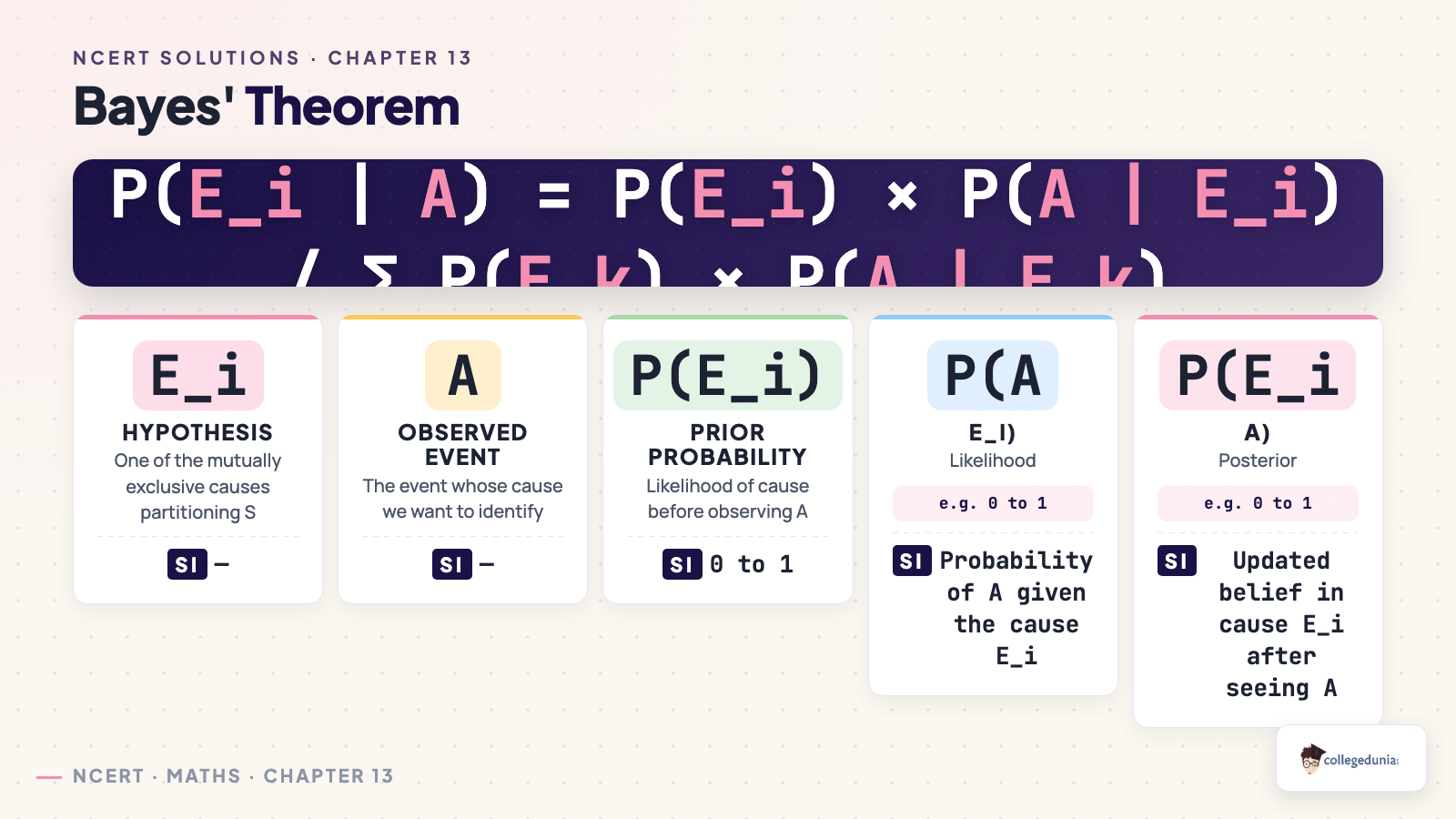
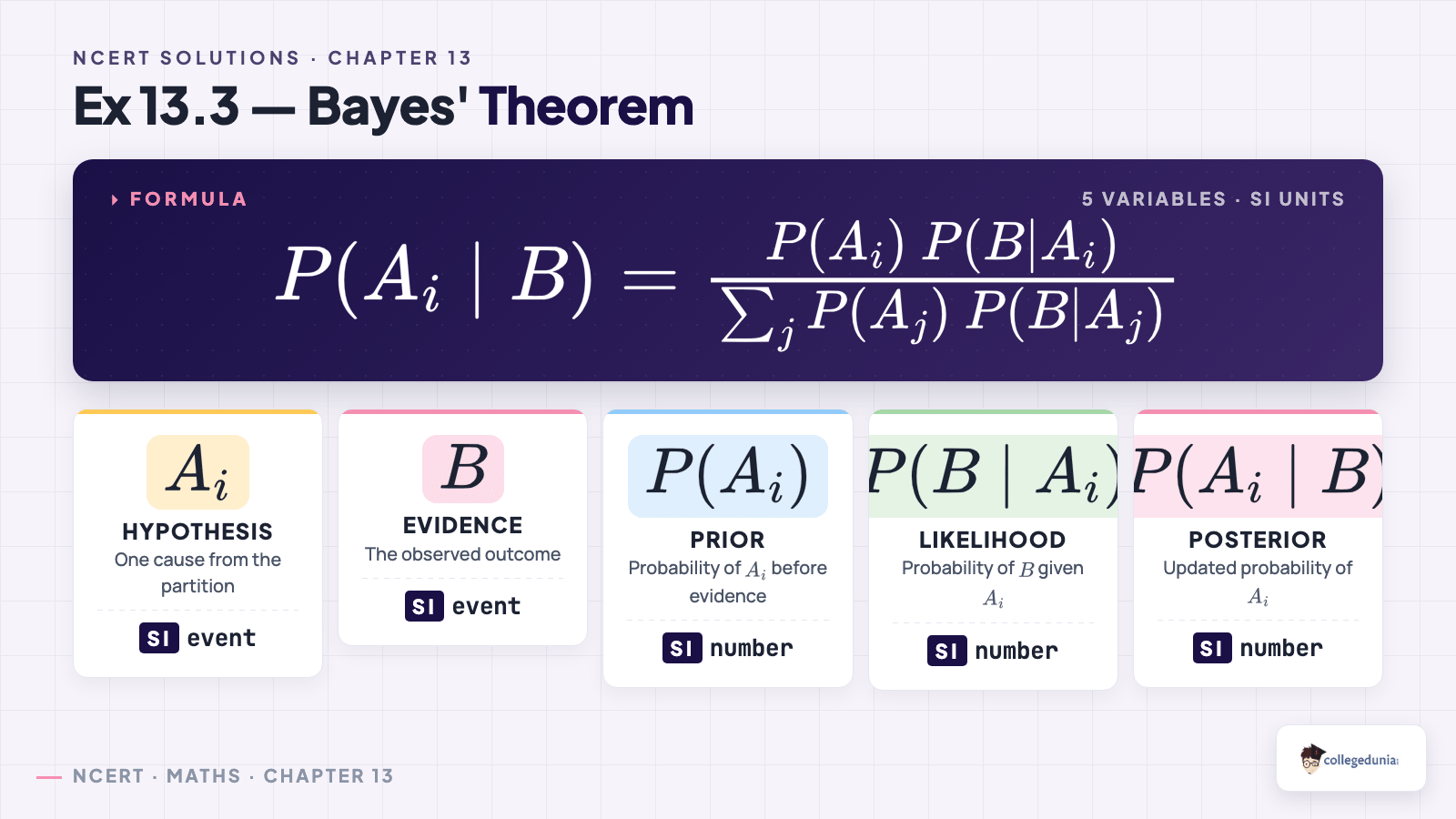
Total probability is the forward step: priors times likelihoods, summed across a partition. Bayes' theorem is the inverse step: one branch divided by that sum.
Partition: events E1, E2, ..., En partition S iff they are pairwise disjoint and their union is S. Theorem of total probability: P(A) = sum of P(Ei) · P(A|Ei). Bayes' theorem: P(Ei|A) = [P(Ei) P(A|Ei)] / [sum of P(Ej) P(A|Ej)]. Prior and likelihood: P(Ei) is the prior; P(A|Ei) is the likelihood; P(Ei|A) is the posterior.
Every Bayes' problem follows the same template: identify the partition, list priors and likelihoods, compute the total probability, then divide one branch by that total. A probability tree is the fastest visual aid.
How These NCERT Solutions Help You Clear Exercise 13.3
The single most common error is confusing the prior P(Ei) with the likelihood P(A|Ei), or stopping at the total probability without the Bayes' inversion.
Prior and likelihood listed separately before each Bayes' computation.
Tree diagram used in Q4, Q5, Q6 and Q10, where the partition has three or more branches.
Sanity check on the posterior shown after Q5 and Q12, where the result is counter-intuitive.
Common Mistakes Students Make in Exercise 13.3
Common Mistake: Treating P(Ei|A) as equal to P(A|Ei). In Q5, the test sensitivity P(+|disease)=0.99 does not equal P(disease|+), which is only about 0.165 once the small prior P(disease)=0.001 is folded in.
Swapping priors and likelihoods in the Bayes' denominator. In Q3 the prior is 0.6 and the likelihood is 0.3; reversing them drops 2 marks.
Stopping at the total probability and forgetting to divide. Q1 needs only the total probability; Q2 onwards needs the Bayes' division.
Computing P(A) for the wrong event. In Q12 the conditioning event is "two diamonds drawn from the remaining 51 cards", not from 52.
Forgetting the priors must sum to 1. In Q11 the operators contribute 0.5+0.3+0.2=1; a missing branch fails the partition check.
Other Resources for Class 12 Maths Chapter 13 Probability
Pair the Exercise 13.3 solutions with the rest of the Chapter 13 resource library.
All NCERT Solutions for Probability Exercise 13.3 with Step-by-Step Working
Every NCERT textbook question for Class 12 Mathematics Chapter 13 Probability Exercise 13.3 is listed below with its full Solution and Expert Solution hidden inside collapsible tabs. Click Check Solution to reveal the step-by-step working; click Expert Solution for the expanded explanation.
Questions
Q 13.1
An urn contains \(5\) red and \(5\) black balls. A ball is drawn at random, its colour is noted and is returned to the urn. Moreover, \(2\) additional balls of the colour drawn are put in the urn and then a ball is drawn at random. What is the probability that the second ball is red?
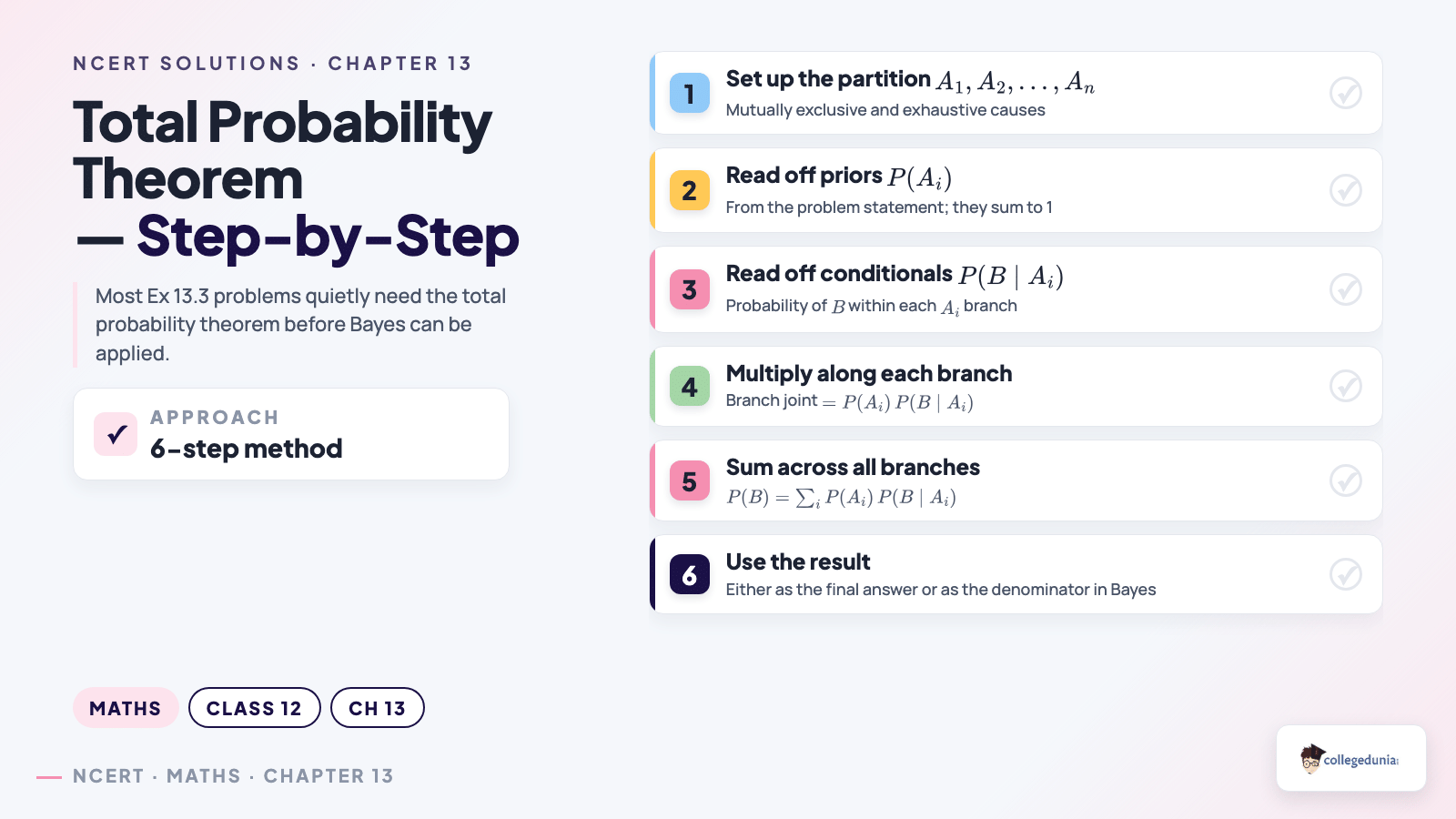
Concept used. The theorem of total probability states that for a partition \(\{E_1,E_2\}\) of the sample space,
\[ P(A)=P(E_1)\,P(A\mid E_1)+P(E_2)\,P(A\mid E_2). \]
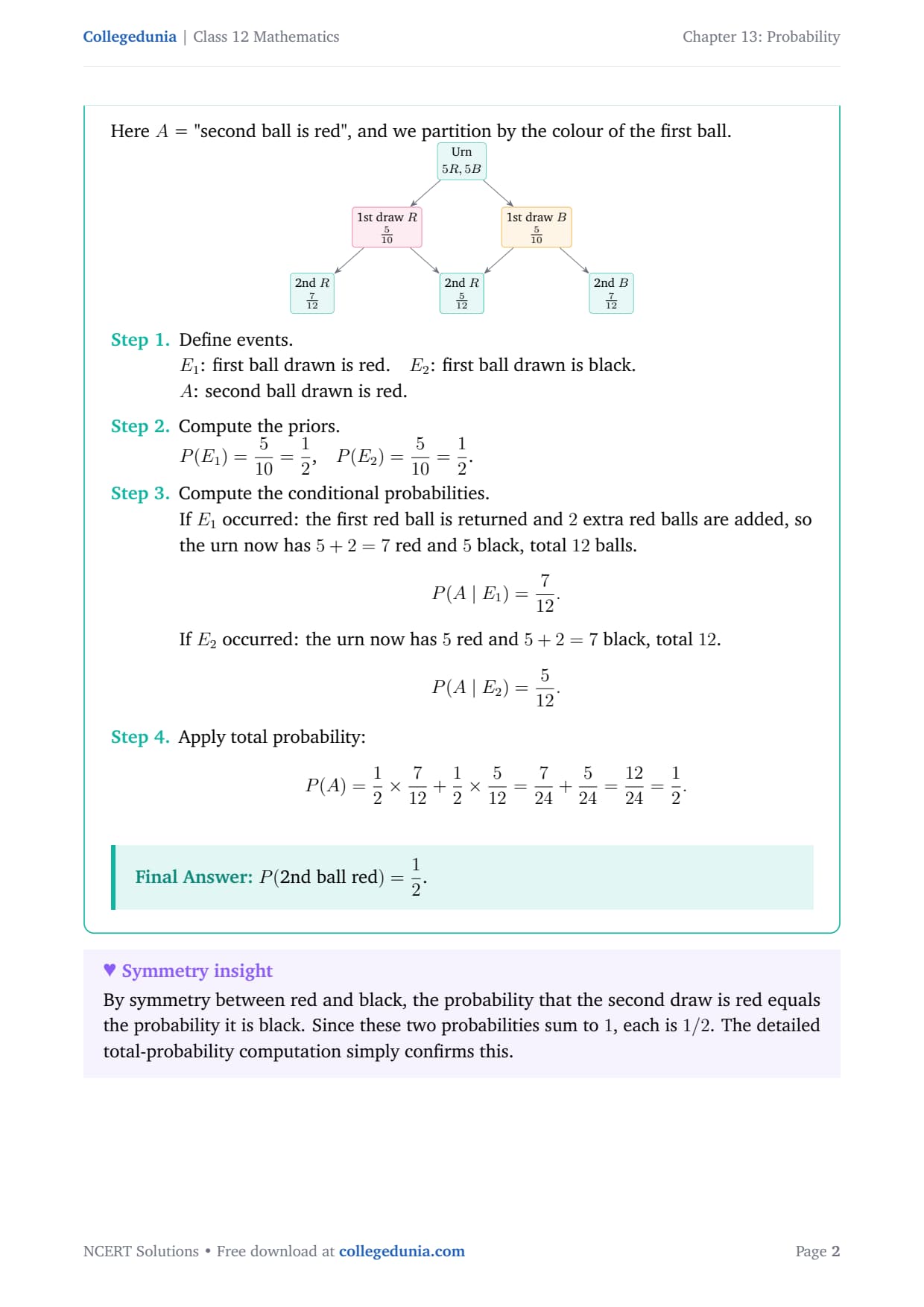
Here \(A\) = "second ball is red", and we partition by the colour of the first ball.
[See diagram in the PDF version]
Define events.
\(E_1\): first ball drawn is red. \(E_2\): first ball drawn is black.
\(A\): second ball drawn is red.
Compute the priors.
\(P(E_1)=\dfrac{5}{10}=\dfrac{1}{2}\), \(P(E_2)=\dfrac{5}{10}=\dfrac{1}{2}\).
Compute the conditional probabilities.
If \(E_1\) occurred: the first red ball is returned and \(2\) extra red balls are added, so the urn now has \(5+2=7\) red and \(5\) black, total \(12\) balls.
\[ P(A\mid E_1)=\dfrac{7}{12}. \]
If \(E_2\) occurred: the urn now has \(5\) red and \(5+2=7\) black, total \(12\).
\[ P(A\mid E_2)=\dfrac{5}{12}. \]
Apply total probability:
\[ P(A)=\dfrac{1}{2}\times \dfrac{7}{12}+\dfrac{1}{2}\times \dfrac{5}{12}=\dfrac{7}{24}+\dfrac{5}{24}=\dfrac{12}{24}=\dfrac{1}{2}. \]
\(P(\text{2nd ball red})=\dfrac{1}{2}\).
AS
Aarav Sharma
M.Sc Mathematics, IIT Bombay
Verified Expert
Strategic angle. Set up the tree, multiply along each "second ball red" branch, add.
Branch \(E_1\to A\): \((1/2)(7/12)=7/24\).
Branch \(E_2\to A\): \((1/2)(5/12)=5/24\).
Sum: \(12/24=1/2\).
Why this matters. A two-row tree is the cleanest sketch for two-stage problems. Each path probability is the product of edge probabilities along it.
\(\dfrac{1}{2}\).
Q 13.2
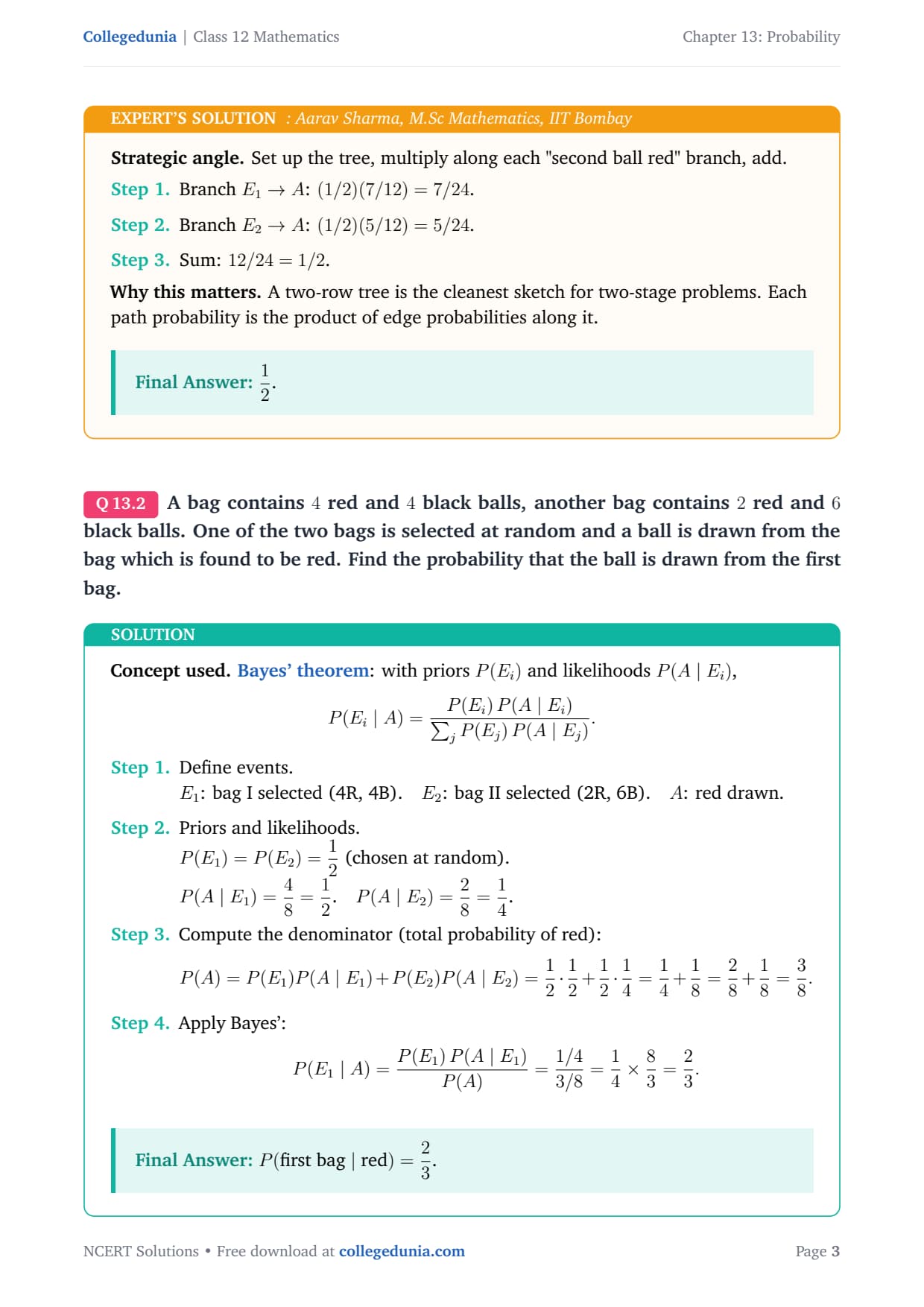
A bag contains \(4\) red and \(4\) black balls, another bag contains \(2\) red and \(6\) black balls. One of the two bags is selected at random and a ball is drawn from the bag which is found to be red. Find the probability that the ball is drawn from the first bag.
Concept used.Bayes' theorem: with priors \(P(E_i)\) and likelihoods \(P(A\mid E_i)\),
\[ P(E_i\mid A)=\dfrac{P(E_i)\,P(A\mid E_i)}{\sum_j P(E_j)\,P(A\mid E_j)}. \]
Define events.
\(E_1\): bag I selected (4R, 4B). \(E_2\): bag II selected (2R, 6B). \(A\): red drawn.
Priors and likelihoods.
\(P(E_1)=P(E_2)=\dfrac{1}{2}\) (chosen at random).
\(P(A\mid E_1)=\dfrac{4}{8}=\dfrac{1}{2}\). \(P(A\mid E_2)=\dfrac{2}{8}=\dfrac{1}{4}\).
Compute the denominator (total probability of red):
\[ P(A)=P(E_1)P(A\mid E_1)+P(E_2)P(A\mid E_2)=\dfrac{1}{2}\cdot \dfrac{1}{2}+\dfrac{1}{2}\cdot \dfrac{1}{4}=\dfrac{1}{4}+\dfrac{1}{8}=\dfrac{2}{8}+\dfrac{1}{8}=\dfrac{3}{8}. \]
Why this matters. On a tree, Bayes' theorem is the simple recipe "favourable path probability \(\div\) all-paths-to-this-effect probability."
\(\dfrac{2}{3}\).
Q 13.3
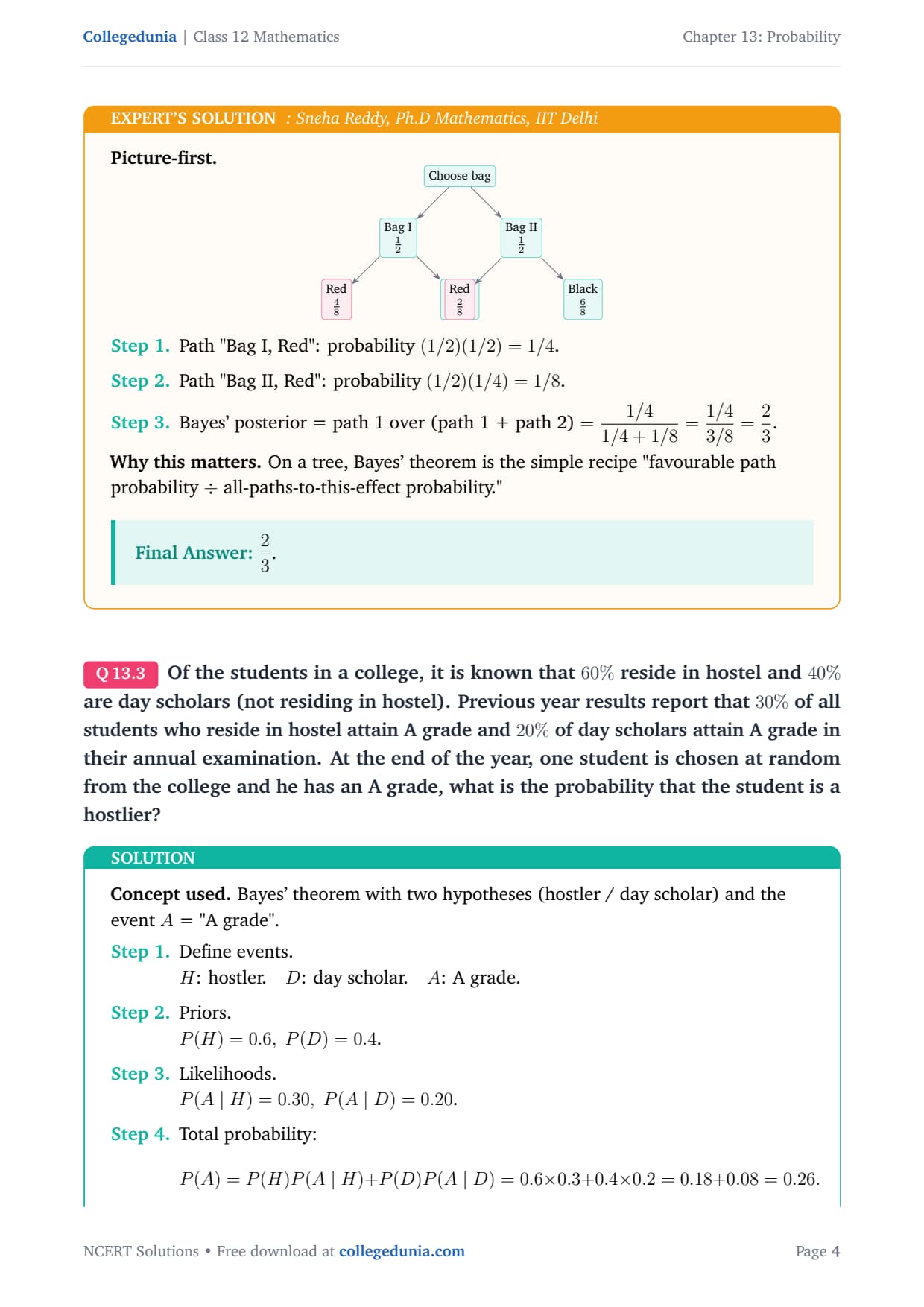
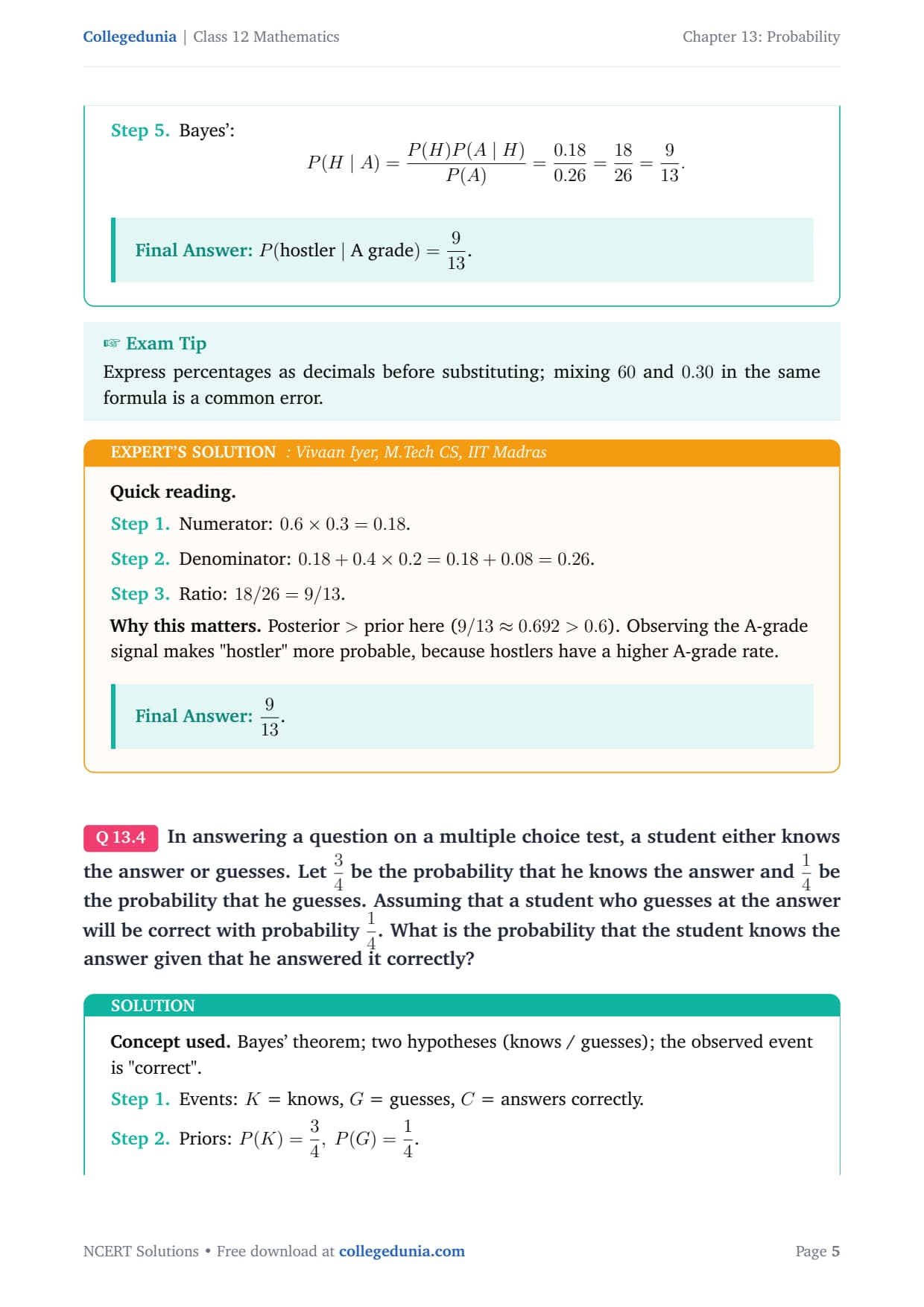
Of the students in a college, it is known that \(60\%\) reside in hostel and \(40\%\) are day scholars (not residing in hostel). Previous year results report that \(30\%\) of all students who reside in hostel attain A grade and \(20\%\) of day scholars attain A grade in their annual examination. At the end of the year, one student is chosen at random from the college and he has an A grade, what is the probability that the student is a hostlier?
Concept used. Bayes' theorem with two hypotheses (hostler / day scholar) and the event \(A\) = "A grade".
Define events.
\(H\): hostler. \(D\): day scholar. \(A\): A grade.
Why this matters. Posterior \(>\) prior here (\(9/13\approx 0.692>0.6\)). Observing the A-grade signal makes "hostler" more probable, because hostlers have a higher A-grade rate.
\(\dfrac{9}{13}\).
Q 13.4
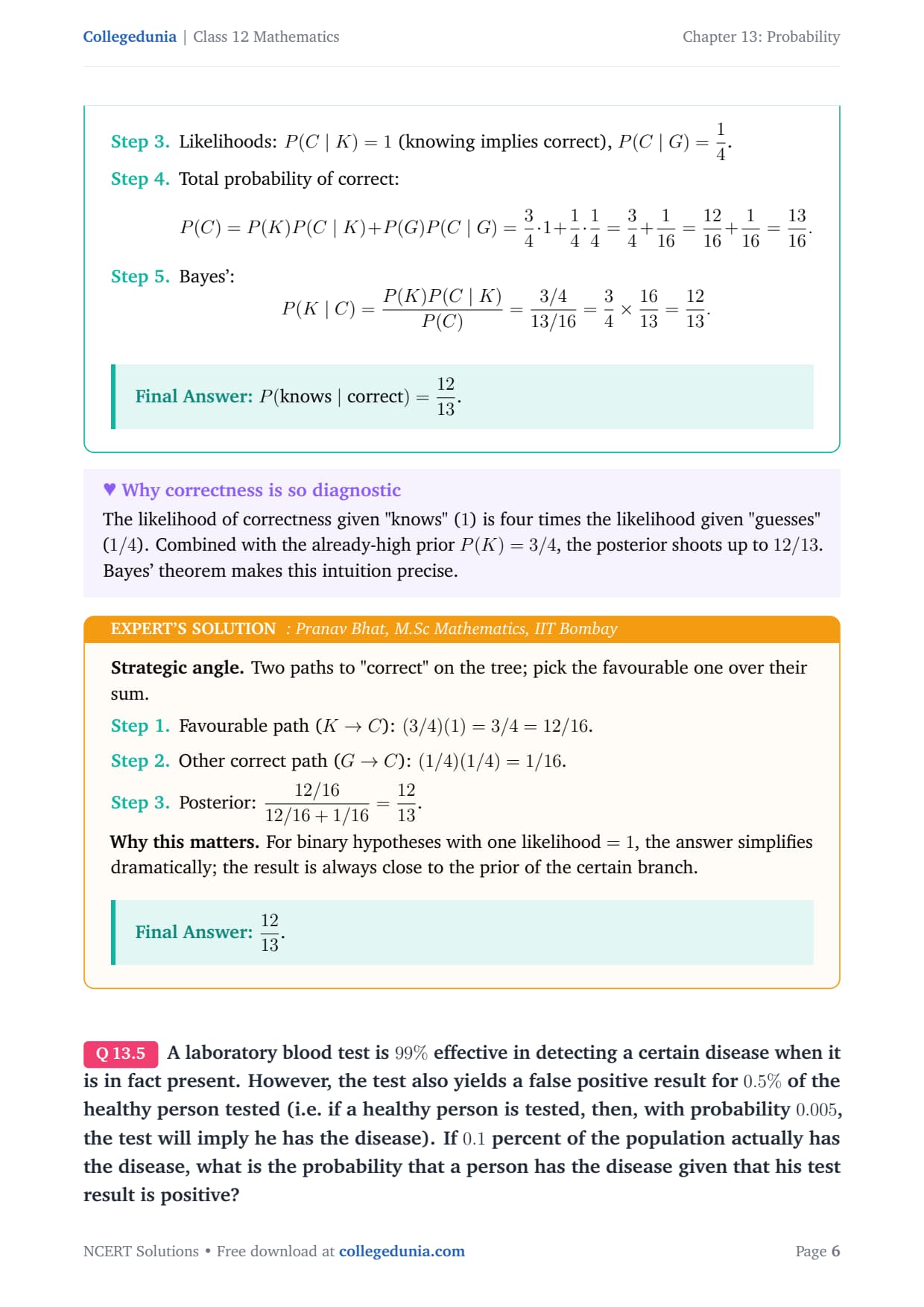
In answering a question on a multiple choice test, a student either knows the answer or guesses. Let \(\dfrac{3}{4}\) be the probability that he knows the answer and \(\dfrac{1}{4}\) be the probability that he guesses. Assuming that a student who guesses at the answer will be correct with probability \(\dfrac{1}{4}\). What is the probability that the student knows the answer given that he answered it correctly?
Concept used. Bayes' theorem; two hypotheses (knows / guesses); the observed event is "correct".
Total probability of correct:
\[ P(C)=P(K)P(C\mid K)+P(G)P(C\mid G)=\dfrac{3}{4}\cdot 1+\dfrac{1}{4}\cdot \dfrac{1}{4}=\dfrac{3}{4}+\dfrac{1}{16}=\dfrac{12}{16}+\dfrac{1}{16}=\dfrac{13}{16}. \]
Why this matters. For binary hypotheses with one likelihood \(=1\), the answer simplifies dramatically; the result is always close to the prior of the certain branch.
\(\dfrac{12}{13}\).
Q 13.5
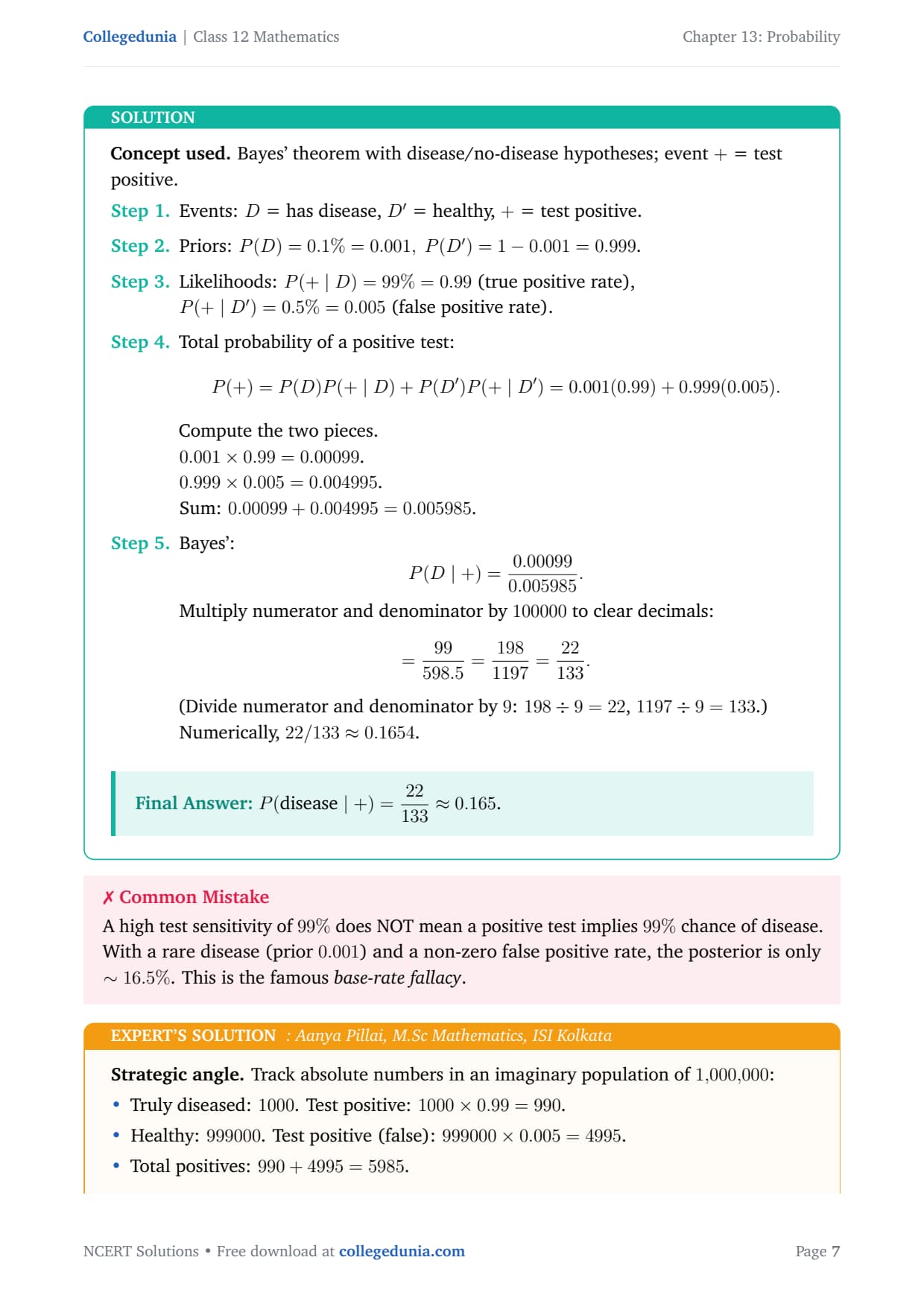
A laboratory blood test is \(99\%\) effective in detecting a certain disease when it is in fact present. However, the test also yields a false positive result for \(0.5\%\) of the healthy person tested (i.e. if a healthy person is tested, then, with probability \(0.005\), the test will imply he has the disease). If \(0.1\) percent of the population actually has the disease, what is the probability that a person has the disease given that his test result is positive?
Concept used. Bayes' theorem with disease/no-disease hypotheses; event \(+\) = test positive.
Events: \(D\) = has disease, \(D'\) = healthy, \(+\) = test positive.
Total probability of a positive test:
\[ P(+)=P(D)P(+\mid D)+P(D')P(+\mid D')=0.001(0.99)+0.999(0.005). \]
Compute the two pieces.
\(0.001\times 0.99=0.00099\).
\(0.999\times 0.005=0.004995\).
Sum: \(0.00099+0.004995=0.005985\).
Bayes':
\[ P(D\mid +)=\dfrac{0.00099}{0.005985}. \]
Multiply numerator and denominator by \(100000\) to clear decimals:
\[ =\dfrac{99}{598.5}=\dfrac{198}{1197}=\dfrac{22}{133}. \]
(Divide numerator and denominator by \(9\): \(198\div 9=22\), \(1197\div 9=133\).)
Numerically, \(22/133\approx 0.1654\).
Strategic angle. Track absolute numbers in an imaginary population of \(1{,}000{,}000\):
Truly diseased: \(1000\). Test positive: \(1000\times 0.99=990\).
Healthy: \(999000\). Test positive (false): \(999000\times 0.005=4995\).
Total positives: \(990+4995=5985\).
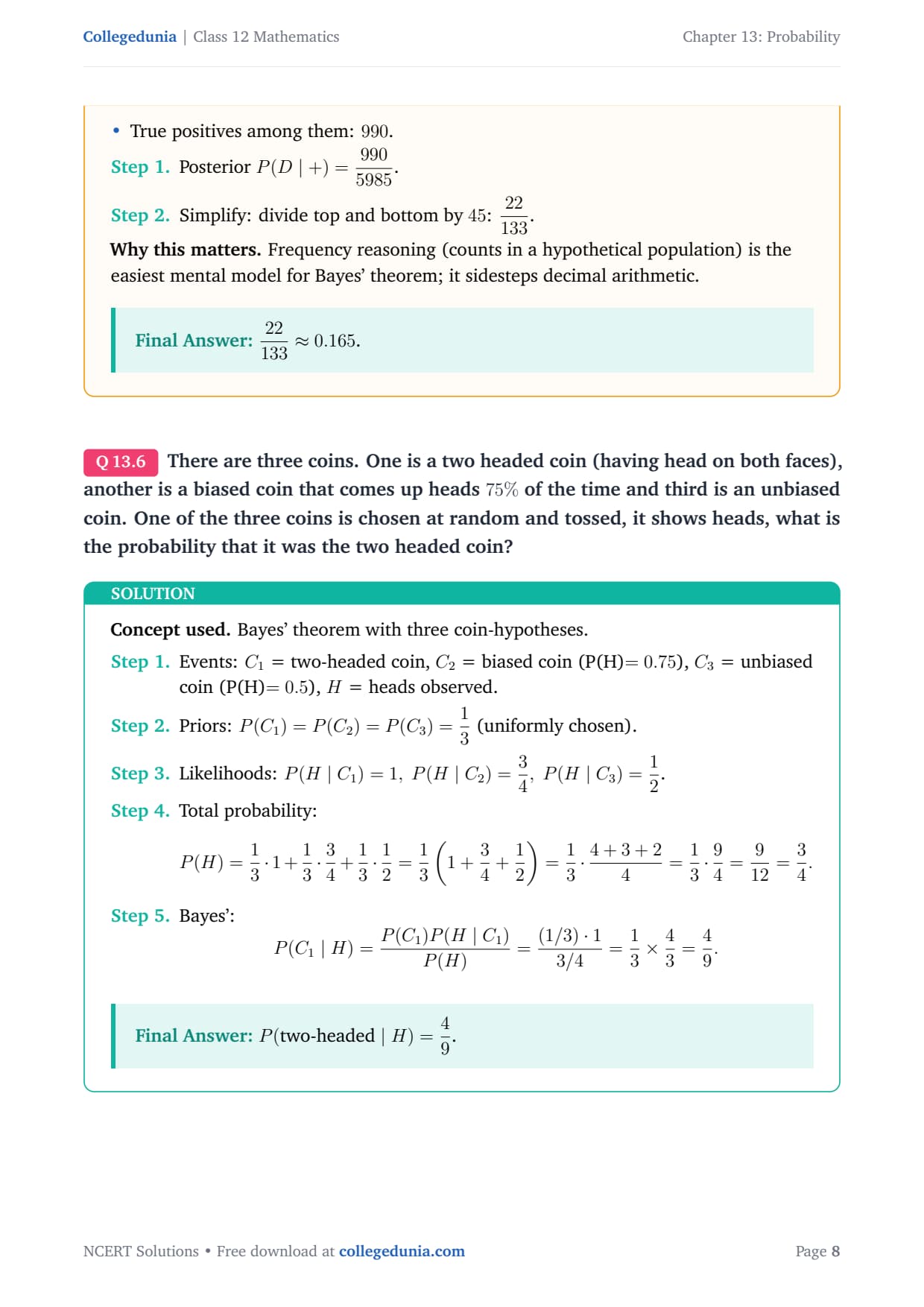
True positives among them: \(990\).
Posterior \(P(D\mid +)=\dfrac{990}{5985}\).
Simplify: divide top and bottom by \(45\): \(\dfrac{22}{133}\).
Why this matters. Frequency reasoning (counts in a hypothetical population) is the easiest mental model for Bayes' theorem; it sidesteps decimal arithmetic.
\(\dfrac{22}{133}\approx 0.165\).
Q 13.6
There are three coins. One is a two headed coin (having head on both faces), another is a biased coin that comes up heads \(75\%\) of the time and third is an unbiased coin. One of the three coins is chosen at random and tossed, it shows heads, what is the probability that it was the two headed coin?
Concept used. Bayes' theorem with three coin-hypotheses.
Why this matters. Equal priors \(\Rightarrow\) posterior simplifies to likelihood\(_i\,/\,\sum\) likelihoods.
\(\dfrac{4}{9}\).
Q 13.7
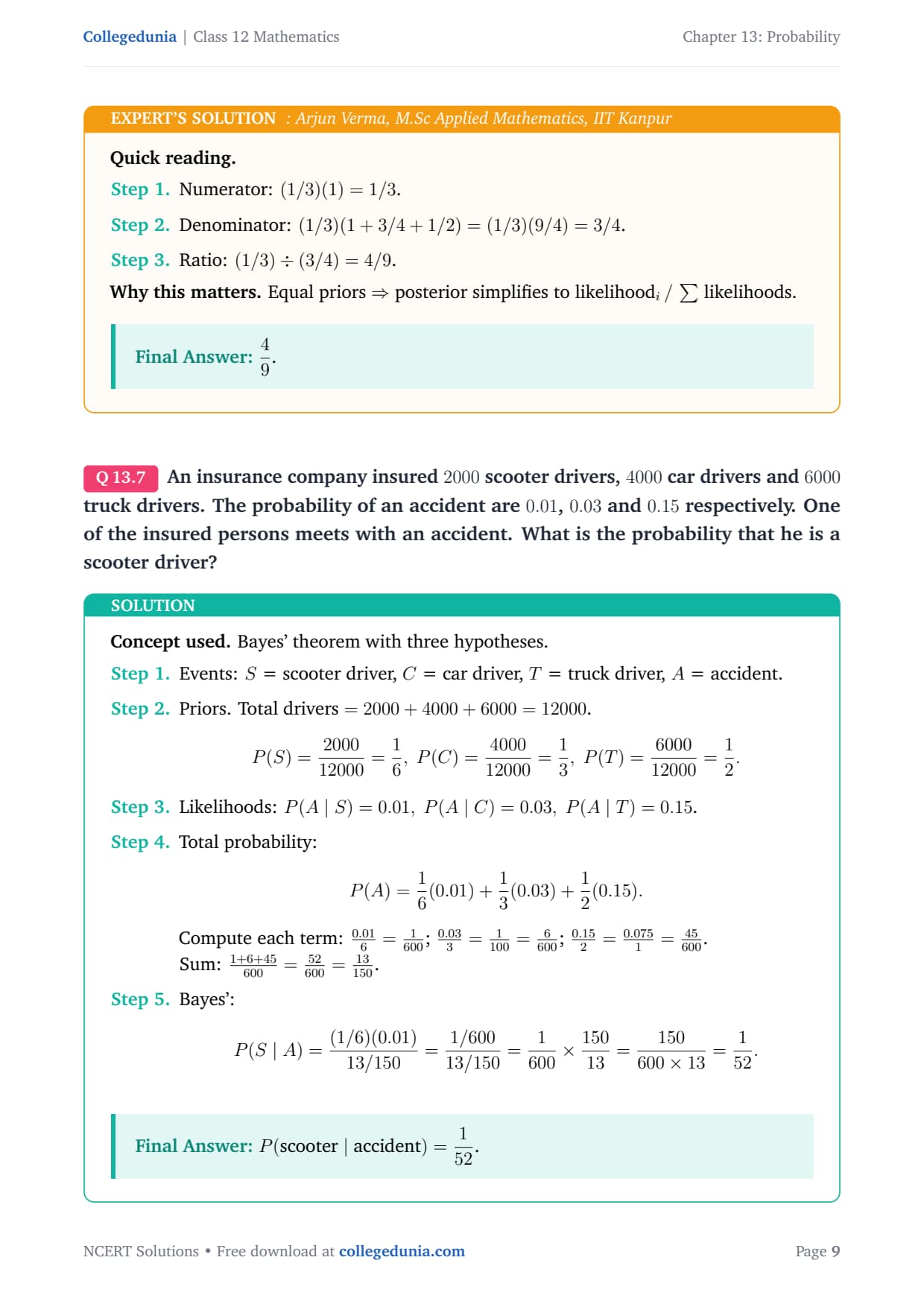
An insurance company insured \(2000\) scooter drivers, \(4000\) car drivers and \(6000\) truck drivers. The probability of an accident are \(0.01\), \(0.03\) and \(0.15\) respectively. One of the insured persons meets with an accident. What is the probability that he is a scooter driver?
Concept used. Bayes' theorem with three hypotheses.
Frequency angle. Among the \(12000\) drivers, expected accidents are
Scooter: \(2000\times 0.01=20\).
Car: \(4000\times 0.03=120\).
Truck: \(6000\times 0.15=900\).
Total expected accidents \(=20+120+900=1040\).
\(P(S\mid A)=20/1040=1/52\).
Why this matters. Frequencies bypass fraction arithmetic entirely. For Bayes' problems with given counts, this is almost always the fastest route.
\(\dfrac{1}{52}\).
Q 13.8
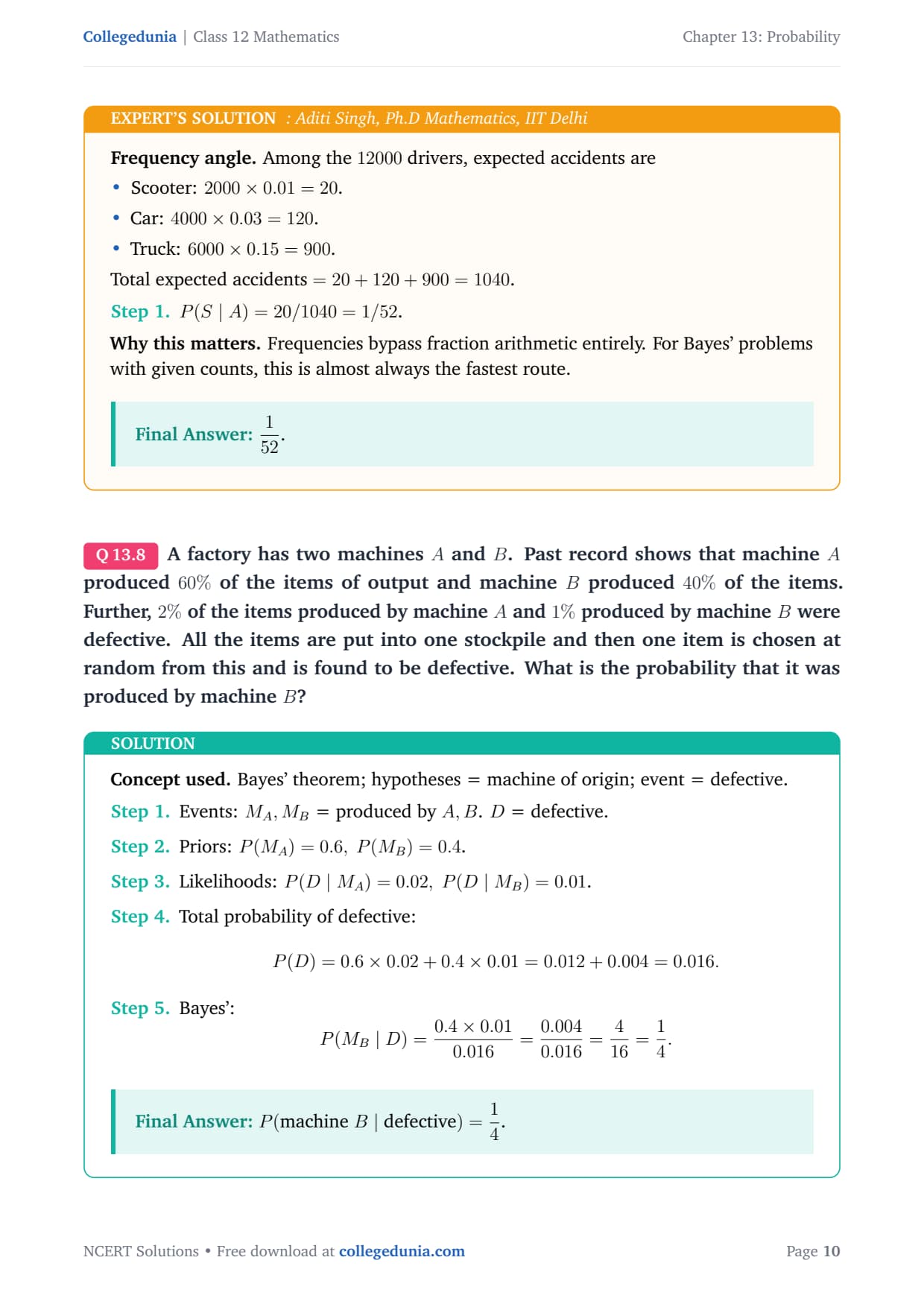
A factory has two machines \(A\) and \(B\). Past record shows that machine \(A\) produced \(60\%\) of the items of output and machine \(B\) produced \(40\%\) of the items. Further, \(2\%\) of the items produced by machine \(A\) and \(1\%\) produced by machine \(B\) were defective. All the items are put into one stockpile and then one item is chosen at random from this and is found to be defective. What is the probability that it was produced by machine \(B\)?
Why this matters. Machine \(B\) has a smaller market share and a lower defect rate, so its contribution to the defective pile is small; the posterior \(1/4\) confirms this.
\(\dfrac{1}{4}\).
Q 13.9
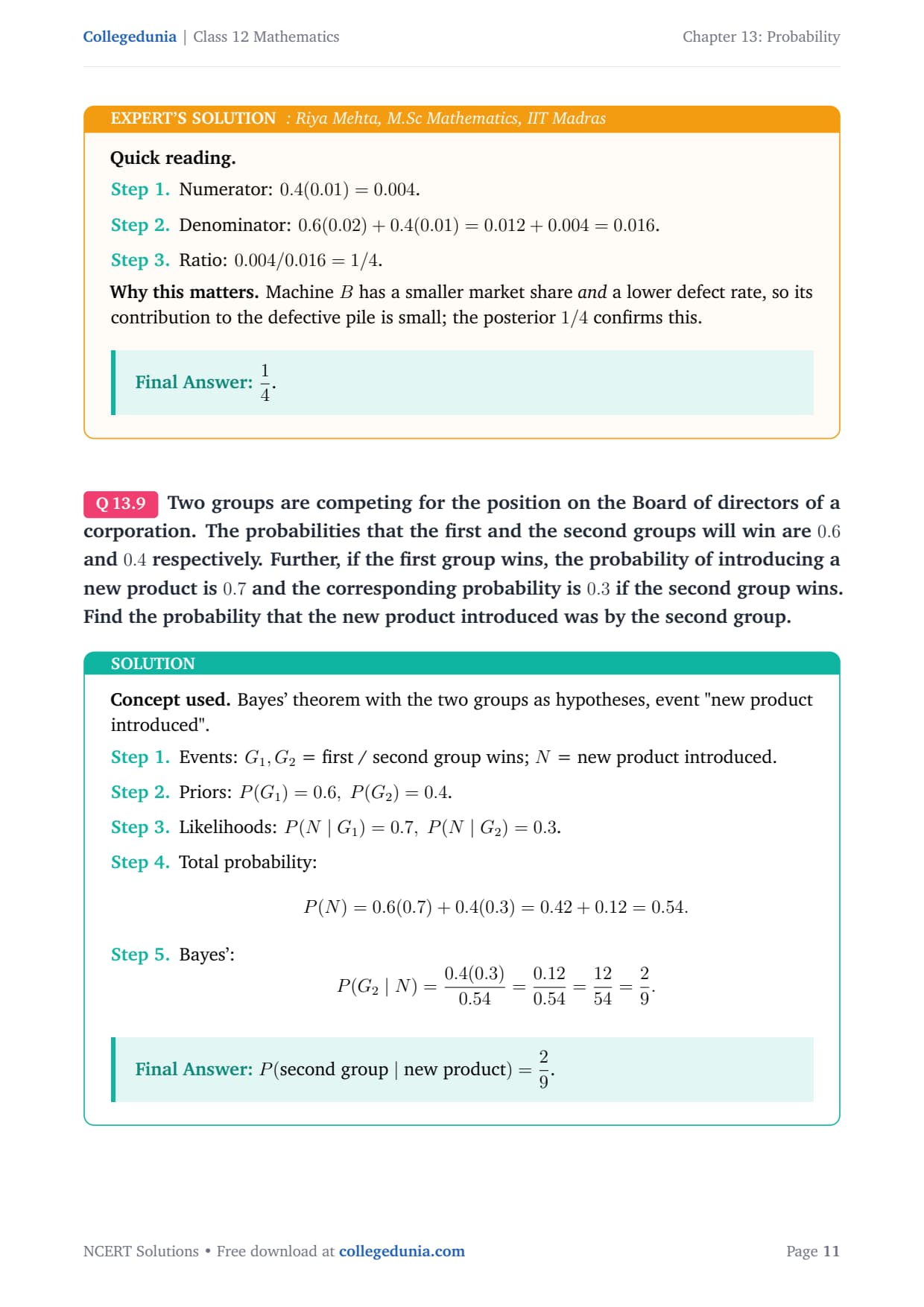
Two groups are competing for the position on the Board of directors of a corporation. The probabilities that the first and the second groups will win are \(0.6\) and \(0.4\) respectively. Further, if the first group wins, the probability of introducing a new product is \(0.7\) and the corresponding probability is \(0.3\) if the second group wins. Find the probability that the new product introduced was by the second group.
Concept used. Bayes' theorem with the two groups as hypotheses, event "new product introduced".
Events: \(G_1,G_2\) = first / second group wins; \(N\) = new product introduced.
Strategic angle. \(G_2\) has both lower prior and lower likelihood; expect a small posterior.
Numerator \(0.12\), denominator \(0.54\), ratio \(2/9\approx 0.22\).
Why this matters. When both prior and likelihood drop, the posterior drops twice; here, \(0.4\to 2/9\approx 0.22\).
\(\dfrac{2}{9}\).
Q 13.10
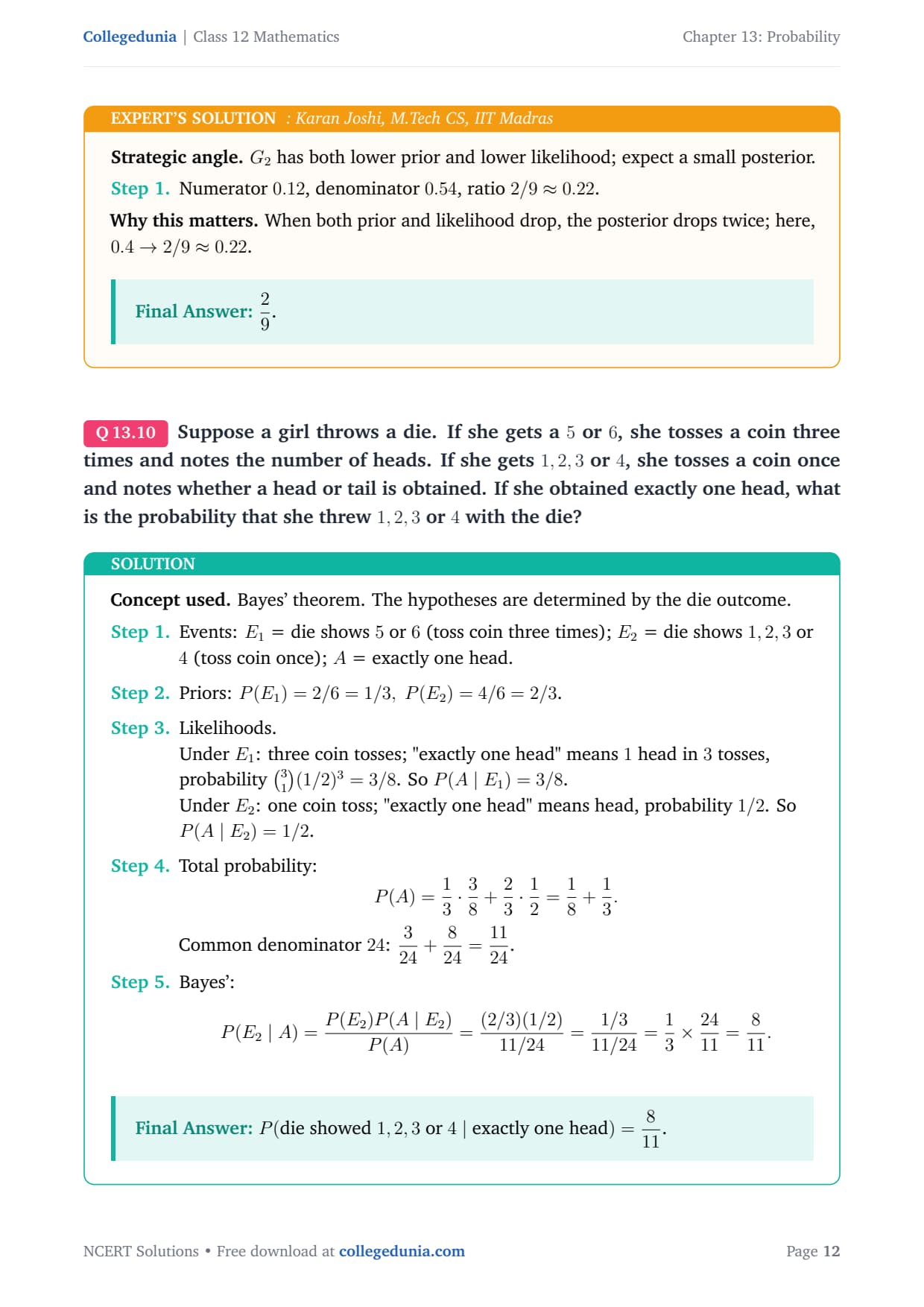
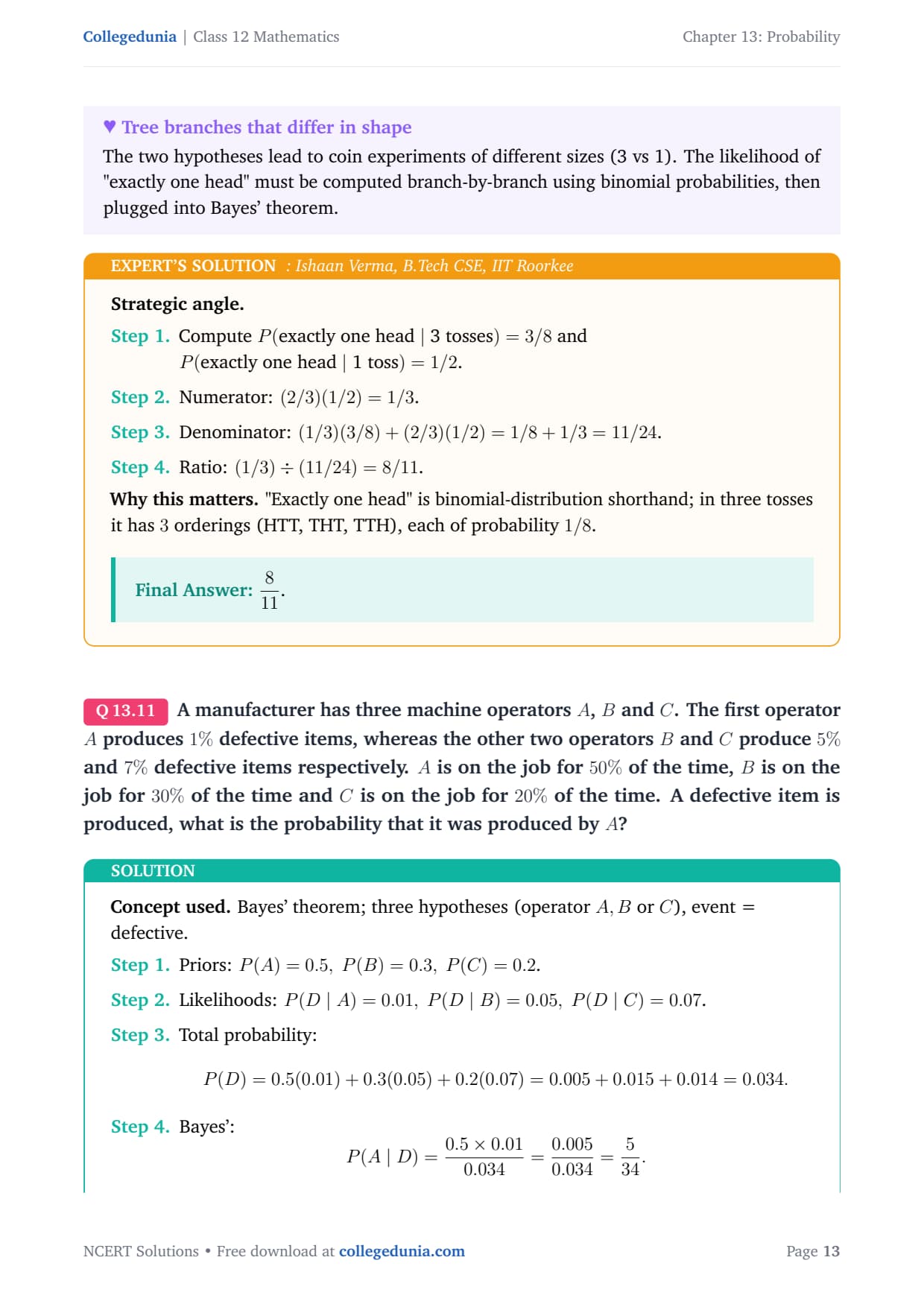
Suppose a girl throws a die. If she gets a \(5\) or \(6\), she tosses a coin three times and notes the number of heads. If she gets \(1,2,3\) or \(4\), she tosses a coin once and notes whether a head or tail is obtained. If she obtained exactly one head, what is the probability that she threw \(1,2,3\) or \(4\) with the die?
Concept used. Bayes' theorem. The hypotheses are determined by the die outcome.
Events: \(E_1\) = die shows \(5\) or \(6\) (toss coin three times); \(E_2\) = die shows \(1,2,3\) or \(4\) (toss coin once); \(A\) = exactly one head.
Priors: \(P(E_1)=2/6=1/3,\ P(E_2)=4/6=2/3\).
Likelihoods.
Under \(E_1\): three coin tosses; "exactly one head" means \(1\) head in \(3\) tosses, probability \(\binom{3}{1}(1/2)^3=3/8\). So \(P(A\mid E_1)=3/8\).
Under \(E_2\): one coin toss; "exactly one head" means head, probability \(1/2\). So \(P(A\mid E_2)=1/2\).
Total probability:
\[ P(A)=\dfrac{1}{3}\cdot \dfrac{3}{8}+\dfrac{2}{3}\cdot \dfrac{1}{2}=\dfrac{1}{8}+\dfrac{1}{3}. \]
Common denominator \(24\): \(\dfrac{3}{24}+\dfrac{8}{24}=\dfrac{11}{24}\).
Why this matters. "Exactly one head" is binomial-distribution shorthand; in three tosses it has \(3\) orderings (HTT, THT, TTH), each of probability \(1/8\).
\(\dfrac{8}{11}\).
Q 13.11
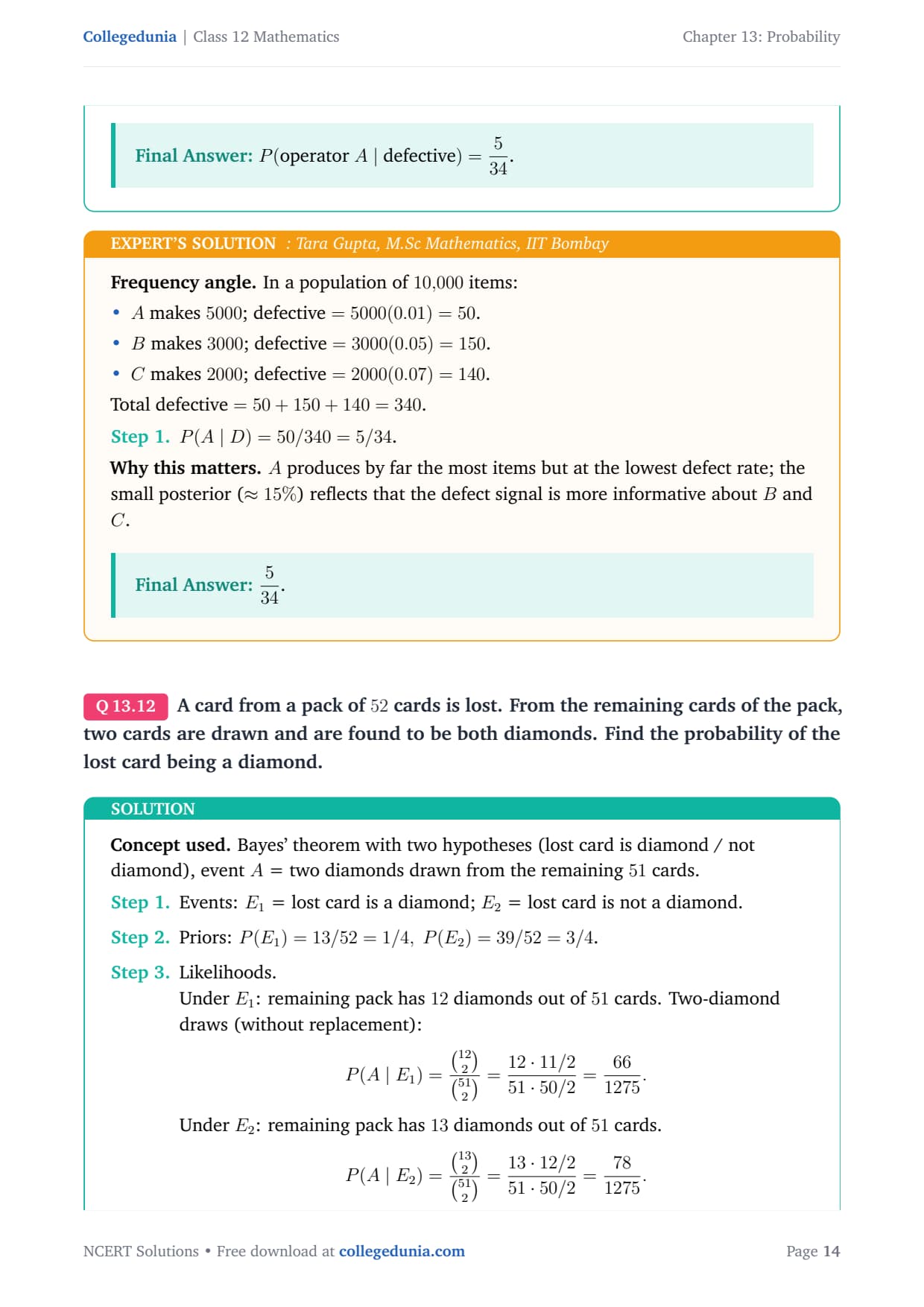
A manufacturer has three machine operators \(A\), \(B\) and \(C\). The first operator \(A\) produces \(1\%\) defective items, whereas the other two operators \(B\) and \(C\) produce \(5\%\) and \(7\%\) defective items respectively. \(A\) is on the job for \(50\%\) of the time, \(B\) is on the job for \(30\%\) of the time and \(C\) is on the job for \(20\%\) of the time. A defective item is produced, what is the probability that it was produced by \(A\)?
Concept used. Bayes' theorem; three hypotheses (operator \(A,B\) or \(C\)), event = defective.
Frequency angle. In a population of \(10{,}000\) items:
\(A\) makes \(5000\); defective \(=5000(0.01)=50\).
\(B\) makes \(3000\); defective \(=3000(0.05)=150\).
\(C\) makes \(2000\); defective \(=2000(0.07)=140\).
Total defective \(=50+150+140=340\).
\(P(A\mid D)=50/340=5/34\).
Why this matters. \(A\) produces by far the most items but at the lowest defect rate; the small posterior (\(\approx 15\%\)) reflects that the defect signal is more informative about \(B\) and \(C\).
\(\dfrac{5}{34}\).
Q 13.12
A card from a pack of \(52\) cards is lost. From the remaining cards of the pack, two cards are drawn and are found to be both diamonds. Find the probability of the lost card being a diamond.
Concept used. Bayes' theorem with two hypotheses (lost card is diamond / not diamond), event \(A\) = two diamonds drawn from the remaining \(51\) cards.
Events: \(E_1\) = lost card is a diamond; \(E_2\) = lost card is not a diamond.
Priors: \(P(E_1)=13/52=1/4,\ P(E_2)=39/52=3/4\).
Likelihoods.
Under \(E_1\): remaining pack has \(12\) diamonds out of \(51\) cards. Two-diamond draws (without replacement):
\[ P(A\mid E_1)=\dfrac{\binom{12}{2}}{\binom{51}{2}}=\dfrac{12\cdot 11/2}{51\cdot 50/2}=\dfrac{66}{1275}. \]
Under \(E_2\): remaining pack has \(13\) diamonds out of \(51\) cards.
\[ P(A\mid E_2)=\dfrac{\binom{13}{2}}{\binom{51}{2}}=\dfrac{13\cdot 12/2}{51\cdot 50/2}=\dfrac{78}{1275}. \]
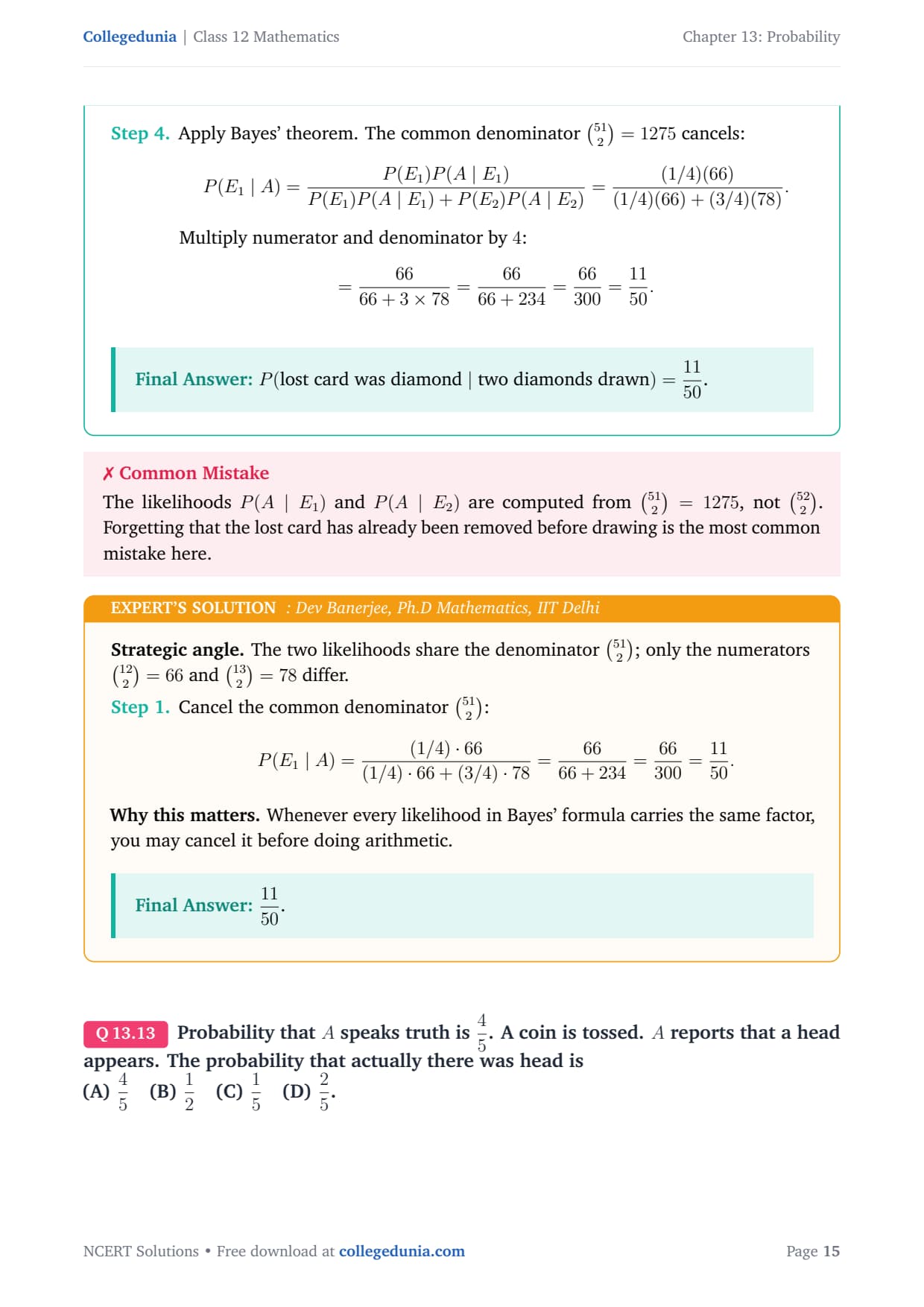
Apply Bayes' theorem. The common denominator \(\binom{51}{2}=1275\) cancels:
\[ P(E_1\mid A)=\dfrac{P(E_1)P(A\mid E_1)}{P(E_1)P(A\mid E_1)+P(E_2)P(A\mid E_2)}=\dfrac{(1/4)(66)}{(1/4)(66)+(3/4)(78)}. \]
Multiply numerator and denominator by \(4\):
\[ =\dfrac{66}{66+3\times 78}=\dfrac{66}{66+234}=\dfrac{66}{300}=\dfrac{11}{50}. \]
\(P(\text{lost card was diamond}\mid \text{two diamonds drawn})=\dfrac{11}{50}\).
DB
Dev Banerjee
Ph.D Mathematics, IIT Delhi
Verified Expert
Strategic angle. The two likelihoods share the denominator \(\binom{51}{2}\); only the numerators \(\binom{12}{2}=66\) and \(\binom{13}{2}=78\) differ.
Cancel the common denominator \(\binom{51}{2}\):
\[ P(E_1\mid A)=\dfrac{(1/4)\cdot 66}{(1/4)\cdot 66+(3/4)\cdot 78}=\dfrac{66}{66+234}=\dfrac{66}{300}=\dfrac{11}{50}. \]
Why this matters. Whenever every likelihood in Bayes' formula carries the same factor, you may cancel it before doing arithmetic.
\(\dfrac{11}{50}\).
Q 13.13
Probability that \(A\) speaks truth is \(\dfrac{4}{5}\). A coin is tossed. \(A\) reports that a head appears. The probability that actually there was head is
(A) \(\dfrac{4}{5}\) (B) \(\dfrac{1}{2}\) (C) \(\dfrac{1}{5}\) (D) \(\dfrac{2}{5}\).
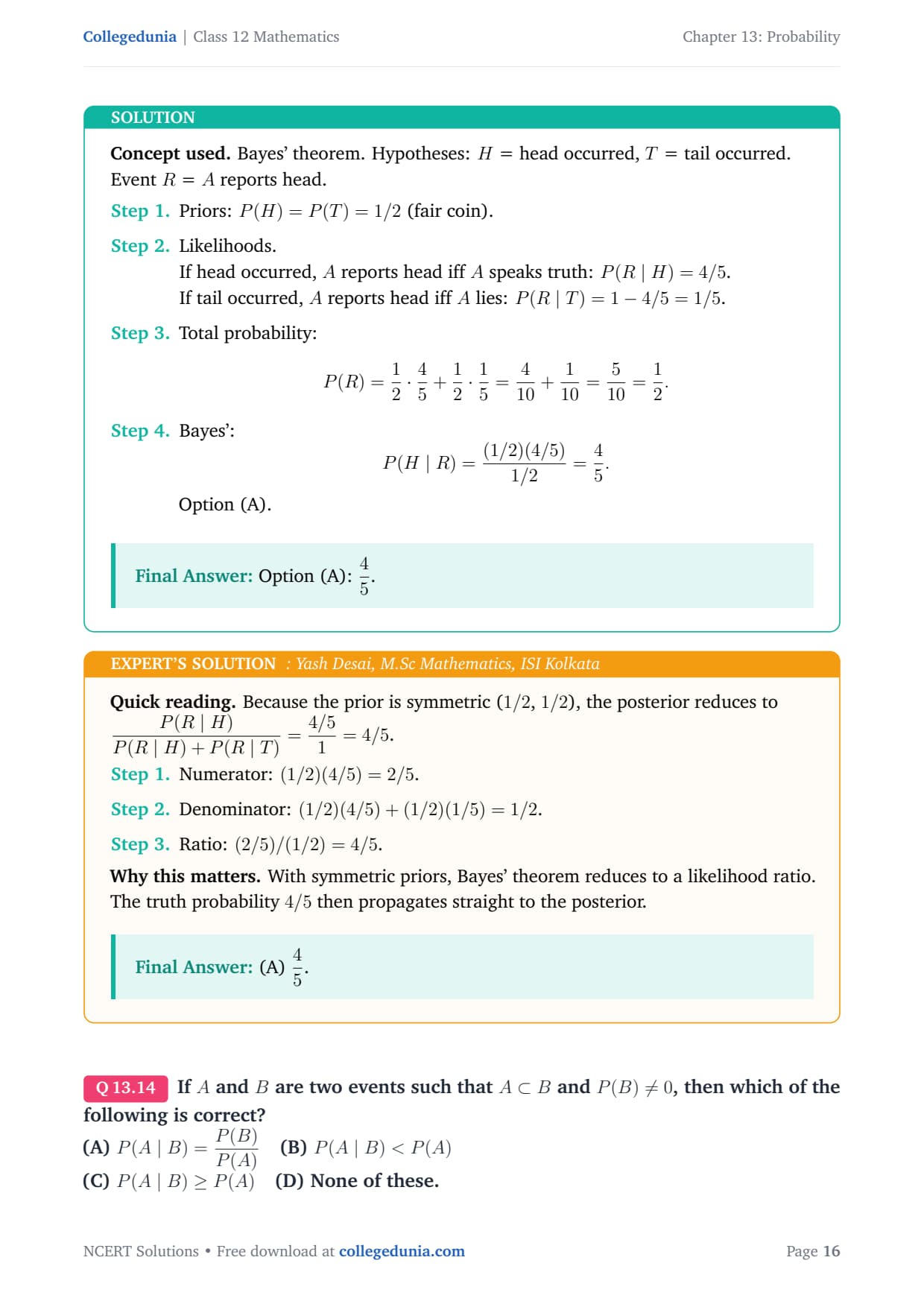
Likelihoods.
If head occurred, \(A\) reports head iff \(A\) speaks truth: \(P(R\mid H)=4/5\).
If tail occurred, \(A\) reports head iff \(A\) lies: \(P(R\mid T)=1-4/5=1/5\).
Total probability:
\[ P(R)=\dfrac{1}{2}\cdot \dfrac{4}{5}+\dfrac{1}{2}\cdot \dfrac{1}{5}=\dfrac{4}{10}+\dfrac{1}{10}=\dfrac{5}{10}=\dfrac{1}{2}. \]
Quick reading. Because the prior is symmetric (\(1/2\), \(1/2\)), the posterior reduces to \(\dfrac{P(R\mid H)}{P(R\mid H)+P(R\mid T)}=\dfrac{4/5}{1}=4/5\).
Numerator: \((1/2)(4/5)=2/5\).
Denominator: \((1/2)(4/5)+(1/2)(1/5)=1/2\).
Ratio: \((2/5)/(1/2)=4/5\).
Why this matters. With symmetric priors, Bayes' theorem reduces to a likelihood ratio. The truth probability \(4/5\) then propagates straight to the posterior.
(A) \(\dfrac{4}{5}\).
Q 13.14
If \(A\) and \(B\) are two events such that \(A\subset B\) and \(P(B)\ne 0\), then which of the following is correct?
(A) \(P(A\mid B)=\dfrac{P(B)}{P(A)}\) (B) \(P(A\mid B)
(C) \(P(A\mid B)\ge P(A)\) (D) None of these.
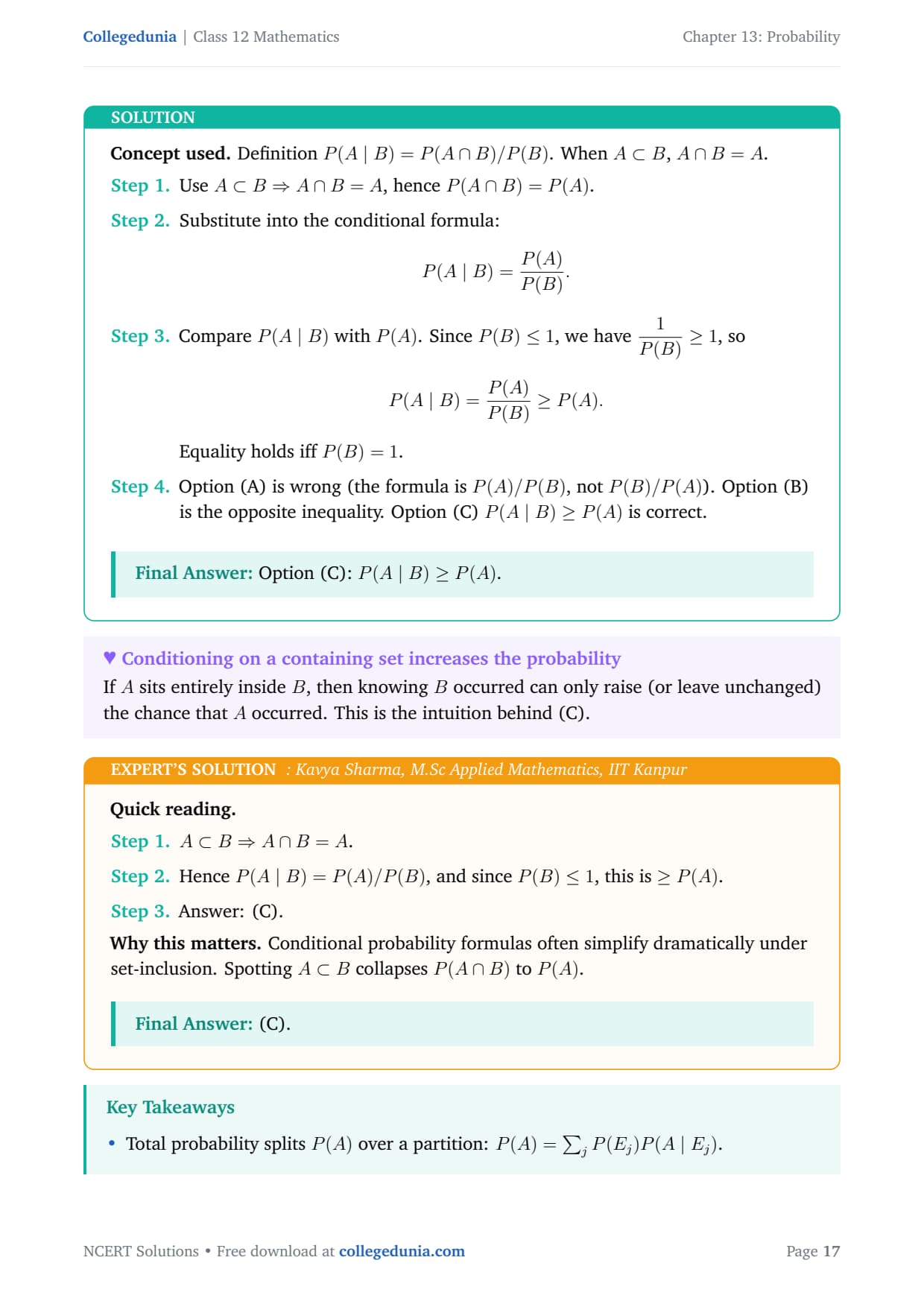
Use \(A\subset B\Rightarrow A\cap B=A\), hence \(P(A\cap B)=P(A)\).
Substitute into the conditional formula:
\[ P(A\mid B)=\dfrac{P(A)}{P(B)}. \]
Compare \(P(A\mid B)\) with \(P(A)\). Since \(P(B)\le 1\), we have \(\dfrac{1}{P(B)}\ge 1\), so
\[ P(A\mid B)=\dfrac{P(A)}{P(B)}\ge P(A). \]
Equality holds iff \(P(B)=1\).
Option (A) is wrong (the formula is \(P(A)/P(B)\), not \(P(B)/P(A)\)). Option (B) is the opposite inequality. Option (C) \(P(A\mid B)\ge P(A)\) is correct.
Option (C): \(P(A\mid B)\ge P(A)\).
KS
Kavya Sharma
M.Sc Applied Mathematics, IIT Kanpur
Verified Expert
Quick reading.
\(A\subset B\) \(\Rightarrow\) \(A\cap B=A\).
Hence \(P(A\mid B)=P(A)/P(B)\), and since \(P(B)\le 1\), this is \(\ge P(A)\).
Answer: (C).
Why this matters. Conditional probability formulas often simplify dramatically under set-inclusion. Spotting \(A\subset B\) collapses \(P(A\cap B)\) to \(P(A)\).
(C).
Student Feedback - Class 12 Probability Exercise 13.3 (Collegedunia Survey, 2026):
73% of 12,840 students surveyed rated Bayes' theorem as one of the higher-weightage units in board preparation.
The average student lost 1.5 marks from confusing the prior with the likelihood in a Bayes' problem.
Toppers reported that drawing the probability tree before any algebra added 1 to 2 marks on the long-answer question.
Probability Class 12 NCERT Solutions Exercise 13.3 - Frequently Asked Questions
Ques. How many questions are in Class 12 Maths Chapter 13 Exercise 13.3?
Ans. Exercise 13.3 has 14 questions. Q1 to Q12 are word problems on total probability and Bayes' theorem, and Q13-Q14 are MCQs.
Ques. What does Bayes' theorem state?
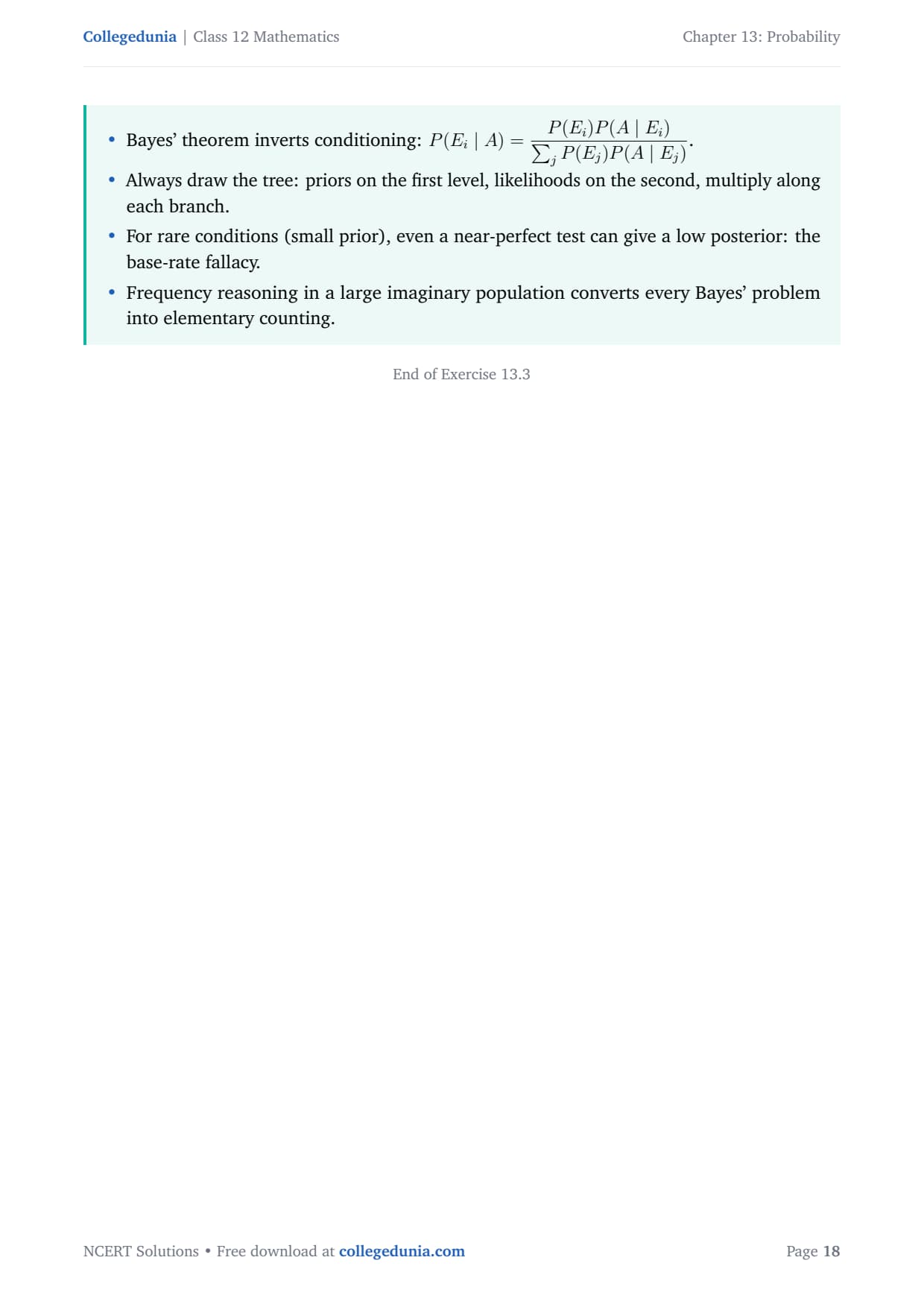
Ans. For a partition E1, E2, ..., En of the sample space and an event A with P(A) ≠ 0, P(Ei|A) equals P(Ei)P(A|Ei) divided by the sum of P(Ej)P(A|Ej) over all j.
Ques. What is the theorem of total probability?
Ans. If E1, E2, ..., En partitions the sample space, then P(A) equals the sum of P(Ei)P(A|Ei) over all i. This is the forward computation that the Bayes' denominator uses.
Ques. How do I solve Question 5, the blood-test problem?
Ans. Use Bayes' theorem with prior P(disease)=0.001 and likelihood P(+|disease)=0.99. The total probability of a positive test works out to 0.005985, so P(disease|+) = 22/133, about 0.165. The small prior controls the answer.
Ques. Which questions are most likely to appear in the CBSE board?
Ans. Q2, Q4, Q6, Q8 and Q11, the two-source and three-source Bayes' problems, have appeared every year between 2020 and 2025 in some form.
Ques. What is the difference between Exercise 13.2 and Exercise 13.3?
Ans. Exercise 13.2 covers the multiplication theorem and independence of events. Exercise 13.3 covers the theorem of total probability and Bayes' theorem, the inverse-conditional setting.








Comments