NCERT Solutions for Class 12 Maths Chapter 13 Probability Miscellaneous Exercise cover all 13 mixed-method problems, written one per page in the notation of the 2026-27 NCERT. The set revisits conditional probability, independent events and Bayes' theorem together. The free solutions PDF for the Miscellaneous Exercise is available to download on this page.
CBSE Weightage: The full Probability chapter carries 8 marks, of which the Miscellaneous Exercise style is worth a steady 3 to 5 marks.
Question count: 13 problems mixing conditional probability (Q1 to Q4), independent events (Q5 to Q8), Bayes' theorem (Q9, Q10), and three MCQs (Q11 to Q13).
Probability Class 12 NCERT Solutions Miscellaneous Exercise: Question-Wise Answer Map
The Miscellaneous Exercise revisits every tool from Exercises 13.1 to 13.3 and forces students to pick the right one per question. The table lists each question with its technique and final answer.
Q No.
Technique Tested
Final Answer
1
Two events from P(A), P(B), P(A∩B): direct conditional and union
2/5, 2/3, 17/20
2
Couple with three children; conditional on at least one boy
1/7, 1/4
3
Two-stage bag transfer; conditional probability of ball colour
11/50
4
If A and B are independent, prove A' and B' are independent
Proof
5
Couple aim at target; independent events; P(at least one hits)
11/12
6
Three independent events; product and union
1/2, 1/3, 1/4
7
Probability tree for repeated independent trials
31/32
8
Independent events with given conditional and product
2/3
9
Bayes' theorem on three urns (machine output reliability)
8/11
10
Bayes' theorem on diagnostic test (false positive)
22/133
11
MCQ on independence test P(A∩B)=P(A)P(B)
(D)
12
MCQ on conditional from given probabilities
(B)
13
MCQ: when is P(B|A)=1
(A) A⊂B
Q4 is the only proof-style item. A Bayes-style or independent-events question has appeared in every CBSE board paper since 2019, and this exercise covers both.
Probability Miscellaneous Exercise Solved Step by Step (Video)
How These NCERT Solutions Help You Clear the Miscellaneous Exercise
Every solution opens with a one-line tool tag, conditional, independent, or Bayes, so the routing decision is made before substitution. This habit accounts for the 1 to 2 marks most students lose in this section.
Sample spaces written out for the children, urn, and machine problems so the intersection set is unambiguous.
Trap callouts on Q2 (the "at least one boy" trap), Q3 (the transferred ball changes the distribution), and Q10 (confusing "test positive" with "actually positive").
Expert solutions add a faster tree-diagram or symmetry route alongside the textbook method.
Step-by-Step Method Used in the Miscellaneous Exercise
Every problem follows the same four-step routine.
Identify the tool. Is it conditional probability, independent events, or Bayes' theorem? Independence triggers the multiplication shortcut; Bayes is the trigger when you are given the effect and asked for the cause.
Write the relevant formula for that tool.
List the data, including the sample space if the question describes an experiment.
Substitute and simplify, then sanity check the answer lies in [0,1].
Students who write the tool tag before any computation score on average 1.5 marks higher on this exercise.
Probability Formulas Used in the Miscellaneous Exercise
Every question in the set uses one or two of these six identities and nothing else.
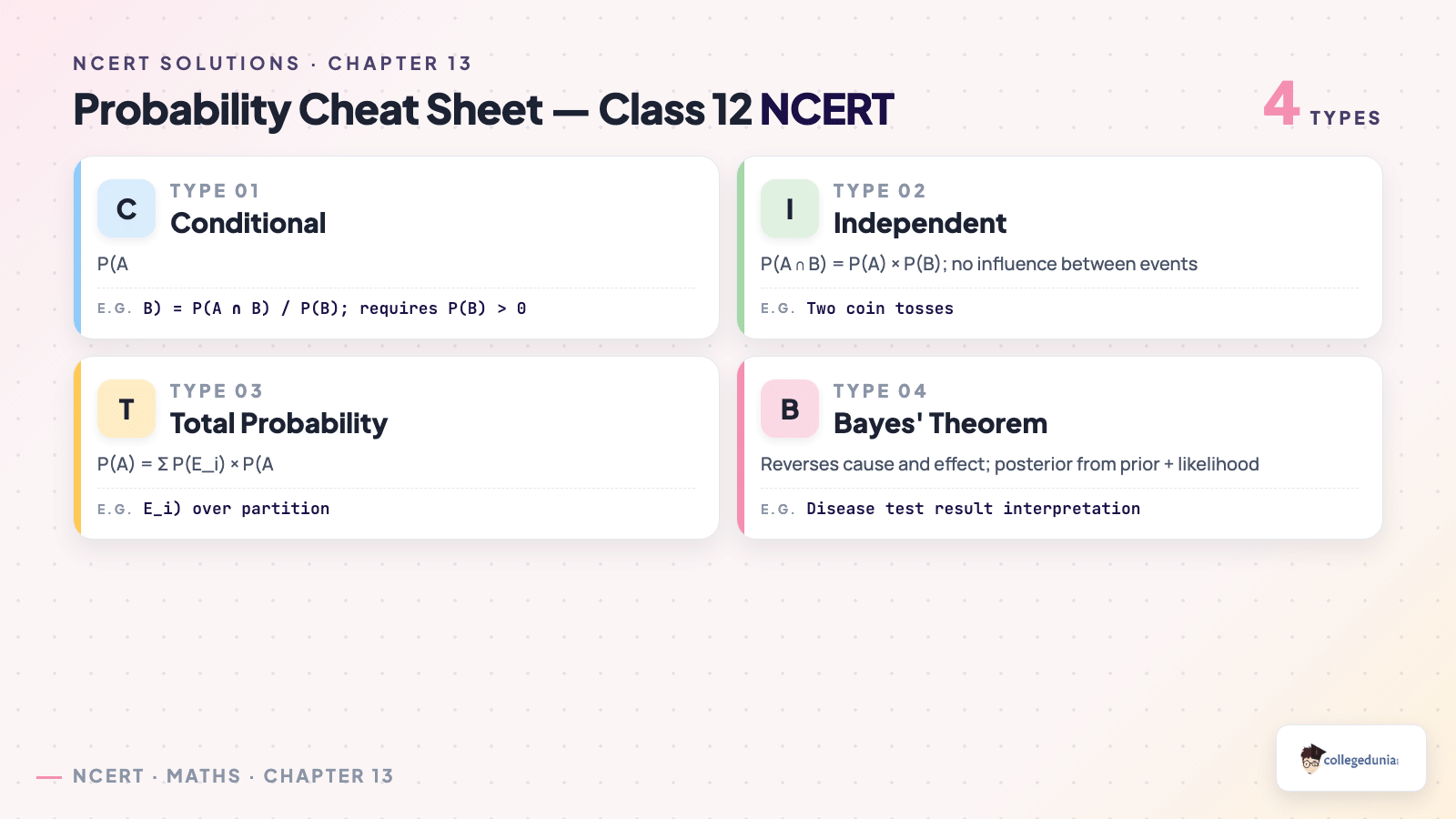
Conditional probability: P(E|F) = P(E∩F)/P(F), P(F)≠0 Multiplication theorem: P(A∩B) = P(A)P(B|A) = P(B)P(A|B) Independent events: A, B independent iff P(A∩B) = P(A)P(B) Independence of complements: if A, B independent, so are A', B and A', B' (Q4) Total probability: P(B) = sum of P(Ai)P(B|Ai), where Ai partitions the sample space Bayes' theorem: P(Ai|B) = [P(Ai)P(B|Ai)] / [sum of P(Aj)P(B|Aj)]
The first three formulas cover Q1 through Q8; the last two cover Q9 and Q10. All 13 questions can be solved using only these six identities. Probability distribution is not part of this exercise; it was removed from the syllabus in the 2023-24 revision and stays out in 2026-27.
CBSE Board Exam Relevance of the Miscellaneous Exercise
These patterns are the closest match to actual CBSE board questions, because the board paper mixes methods rather than testing them in isolation. Miscellaneous Exercise style content has carried a steady 3 to 5 marks every year, around half of the chapter's 8 marks.
Common Mistakes Students Make in the Miscellaneous Exercise
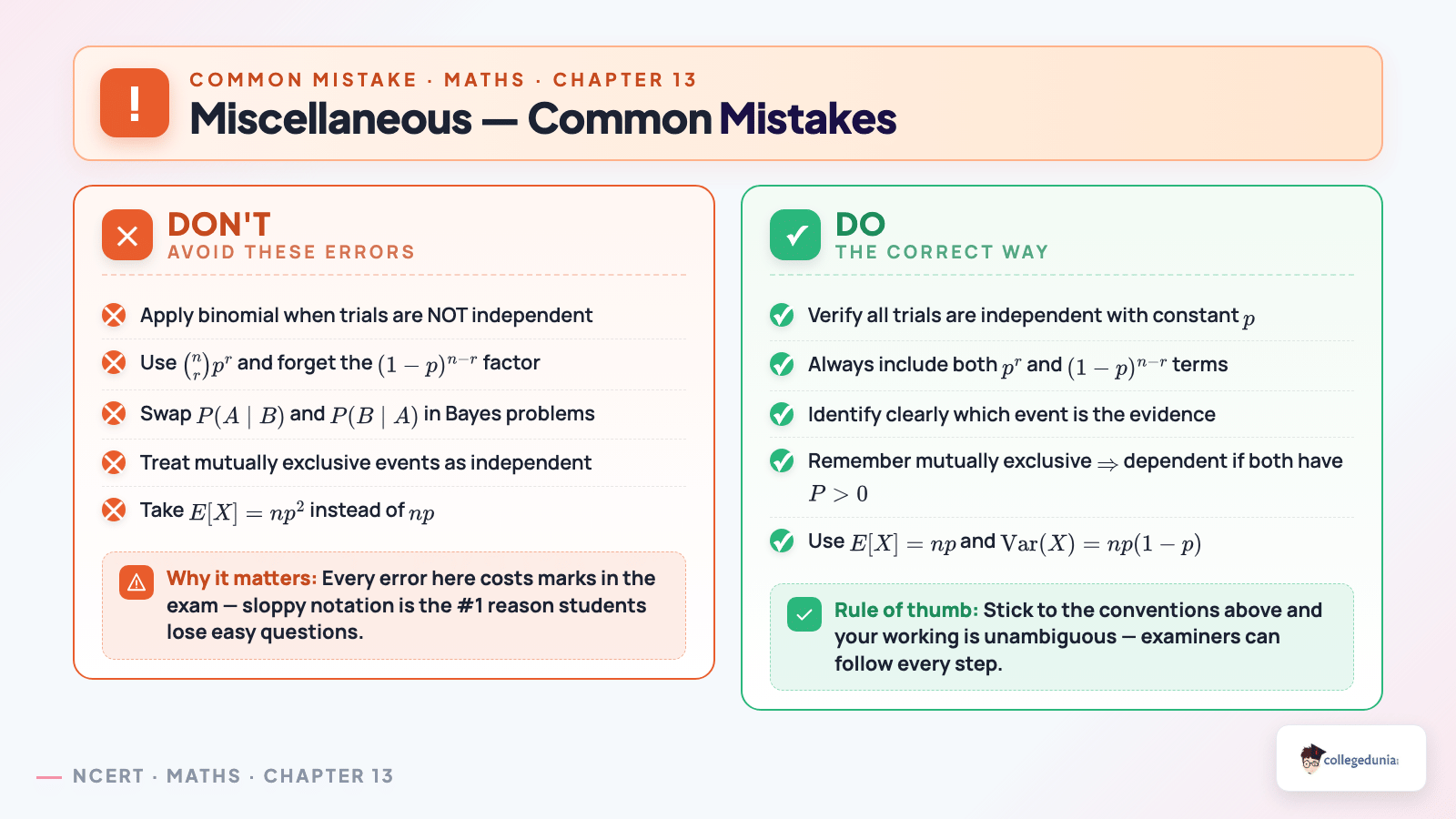
Common Mistake: Treating P(A∩B)=P(A)P(B|A) as the test for independence. It is not; that is the multiplication theorem and holds for every pair of events. Independence requires P(A∩B)=P(A)P(B), with no conditional term.
In Q2, reading "at least one is a boy" as "the first child is a boy", which gives the wrong 1/4 instead of 1/7.
In Q3, forgetting that transferring a ball changes the composition of the second bag.
In Q9, forgetting to normalise the machine-output percentages to a sum of 1.
In Q10, swapping "test positive given has disease" with "has disease given tested positive".
Other Resources for Class 12 Maths Chapter 13 Probability
Pair the Miscellaneous Exercise solutions with the rest of the Chapter 13 resource library.
All NCERT Solutions for Probability Miscellaneous Exercise with Step-by-Step Working
Every NCERT textbook question for Class 12 Mathematics Chapter 13 Probability Miscellaneous Exercise is listed below with its full Solution and Expert Solution hidden inside collapsible tabs. Click Check Solution to reveal the step-by-step working; click Expert Solution for the expanded explanation.
Questions
Q 13.1
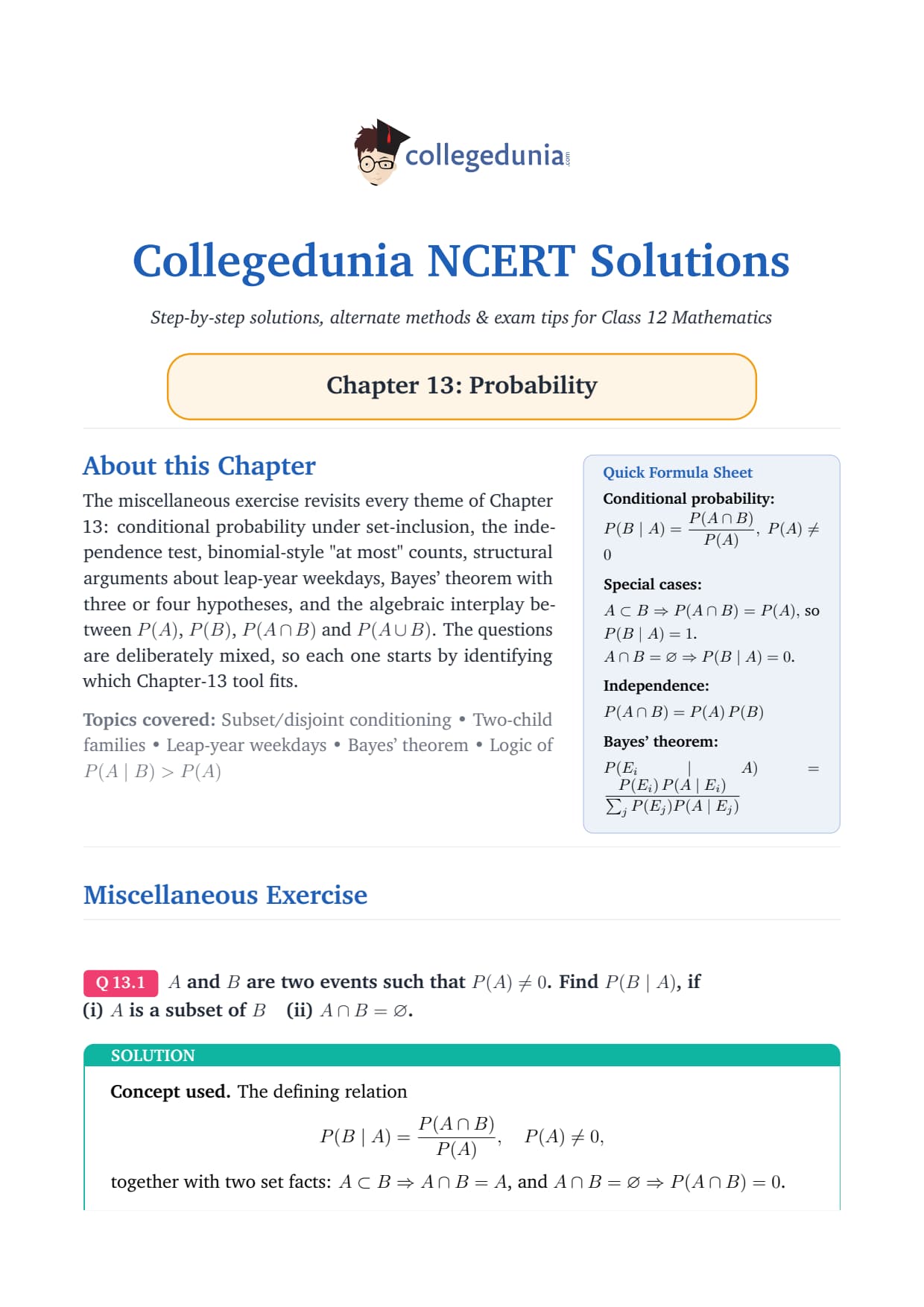
\(A\) and \(B\) are two events such that \(P(A)\ne 0\). Find \(P(B\mid A)\), if
(i) \(A\) is a subset of \(B\) (ii) \(A\cap B=\varnothing\).
Concept used. The defining relation
\[ P(B\mid A)=\dfrac{P(A\cap B)}{P(A)},\quad P(A)\ne 0, \]
together with two set facts: \(A\subset B\Rightarrow A\cap B=A\), and \(A\cap B=\varnothing \Rightarrow P(A\cap B)=0\).
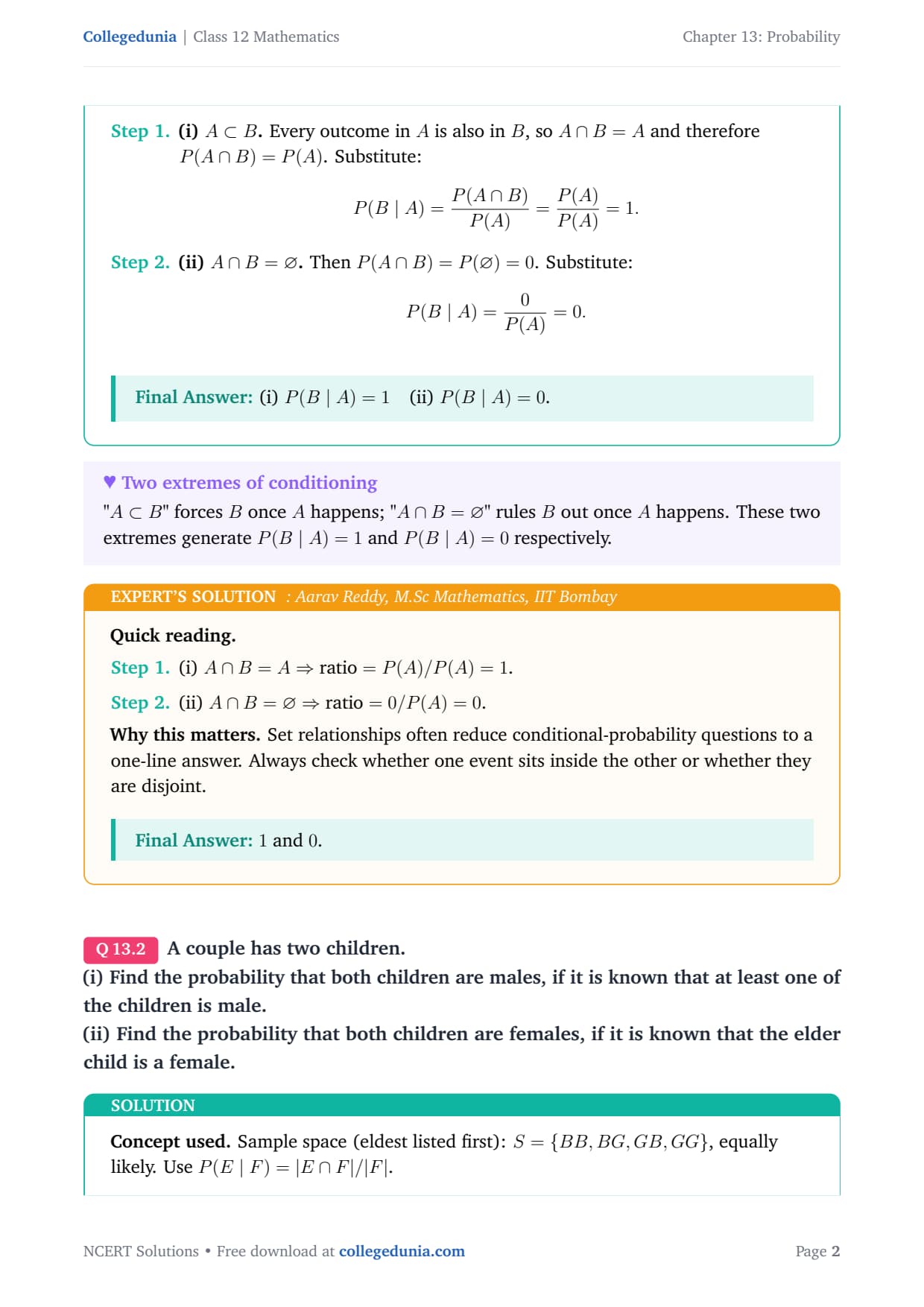
(i) \(A\subset B\). Every outcome in \(A\) is also in \(B\), so \(A\cap B=A\) and therefore \(P(A\cap B)=P(A)\). Substitute:
\[ P(B\mid A)=\dfrac{P(A\cap B)}{P(A)}=\dfrac{P(A)}{P(A)}=1. \]
(ii) \(A\cap B=\varnothing\). Then \(P(A\cap B)=P(\varnothing)=0\). Substitute:
\[ P(B\mid A)=\dfrac{0}{P(A)}=0. \]
(i) \(P(B\mid A)=1\) (ii) \(P(B\mid A)=0\).
AR
Aarav Reddy
M.Sc Mathematics, IIT Bombay
Verified Expert
Quick reading.
(i) \(A\cap B=A\) \(\Rightarrow\) ratio \(=P(A)/P(A)=1\).
(ii) \(A\cap B=\varnothing\) \(\Rightarrow\) ratio \(=0/P(A)=0\).
Why this matters. Set relationships often reduce conditional-probability questions to a one-line answer. Always check whether one event sits inside the other or whether they are disjoint.
\(1\) and \(0\).
Q 13.2
A couple has two children.
(i) Find the probability that both children are males, if it is known that at least one of the children is male.
(ii) Find the probability that both children are females, if it is known that the elder child is a female.
Concept used. Sample space (eldest listed first): \(S=\{BB,BG,GB,GG\}\), equally likely. Use \(P(E\mid F)=|E\cap F|/|F|\).
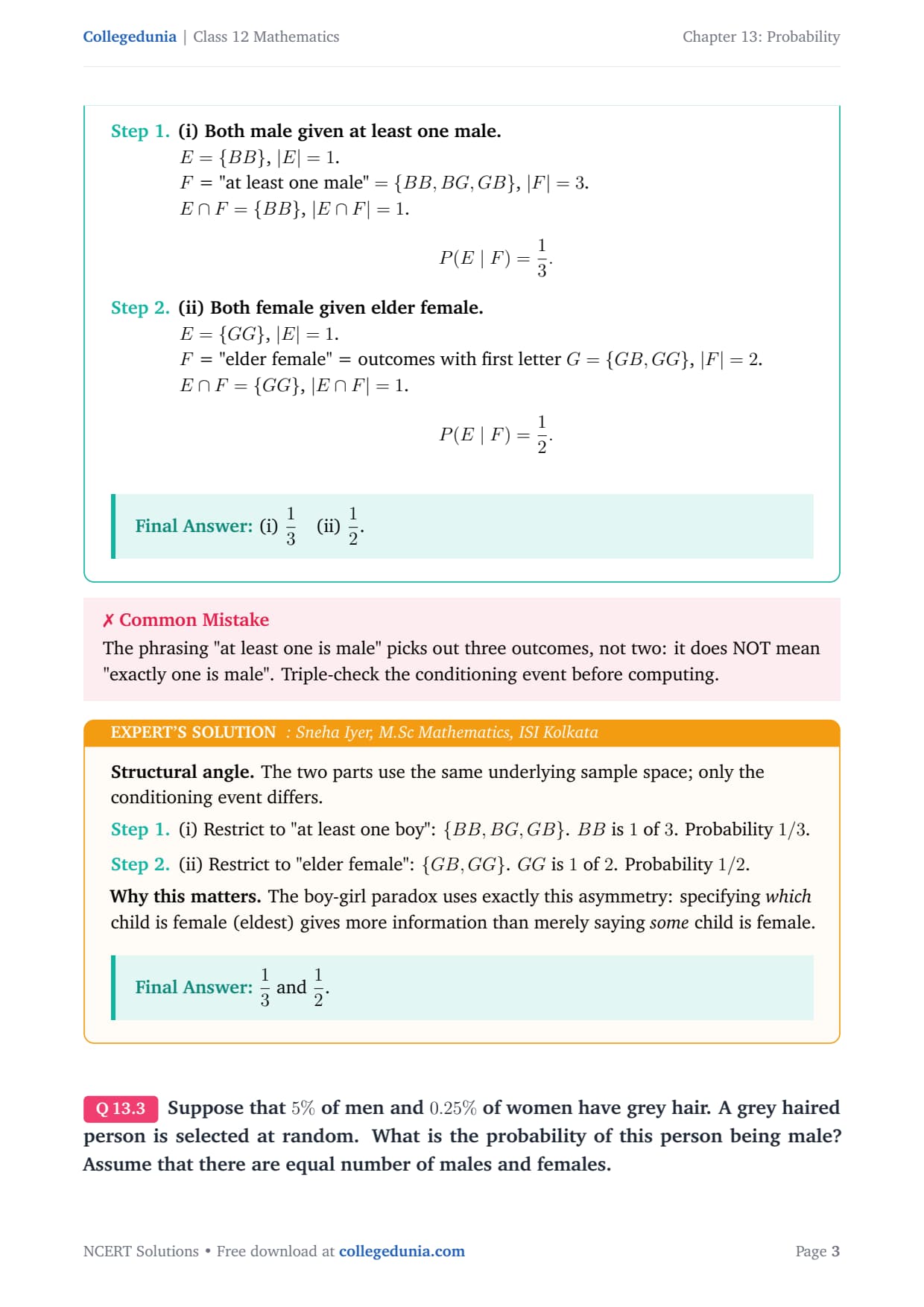
(i) Both male given at least one male.
\(E=\{BB\}\), \(|E|=1\).
\(F\) = "at least one male" \(=\{BB,BG,GB\}\), \(|F|=3\).
\(E\cap F=\{BB\}\), \(|E\cap F|=1\).
\[ P(E\mid F)=\dfrac{1}{3}. \]
(ii) Both female given elder female.
\(E=\{GG\}\), \(|E|=1\).
\(F\) = "elder female" = outcomes with first letter \(G\) \(=\{GB,GG\}\), \(|F|=2\).
\(E\cap F=\{GG\}\), \(|E\cap F|=1\).
\[ P(E\mid F)=\dfrac{1}{2}. \]
(i) \(\dfrac{1}{3}\) (ii) \(\dfrac{1}{2}\).
SI
Sneha Iyer
M.Sc Mathematics, ISI Kolkata
Verified Expert
Structural angle. The two parts use the same underlying sample space; only the conditioning event differs.
(i) Restrict to "at least one boy": \(\{BB,BG,GB\}\). \(BB\) is \(1\) of \(3\). Probability \(1/3\).
(ii) Restrict to "elder female": \(\{GB,GG\}\). \(GG\) is \(1\) of \(2\). Probability \(1/2\).
Why this matters. The boy-girl paradox uses exactly this asymmetry: specifying which child is female (eldest) gives more information than merely saying some child is female.
\(\dfrac{1}{3}\) and \(\dfrac{1}{2}\).
Q 13.3
Suppose that \(5\%\) of men and \(0.25\%\) of women have grey hair. A grey haired person is selected at random. What is the probability of this person being male? Assume that there are equal number of males and females.
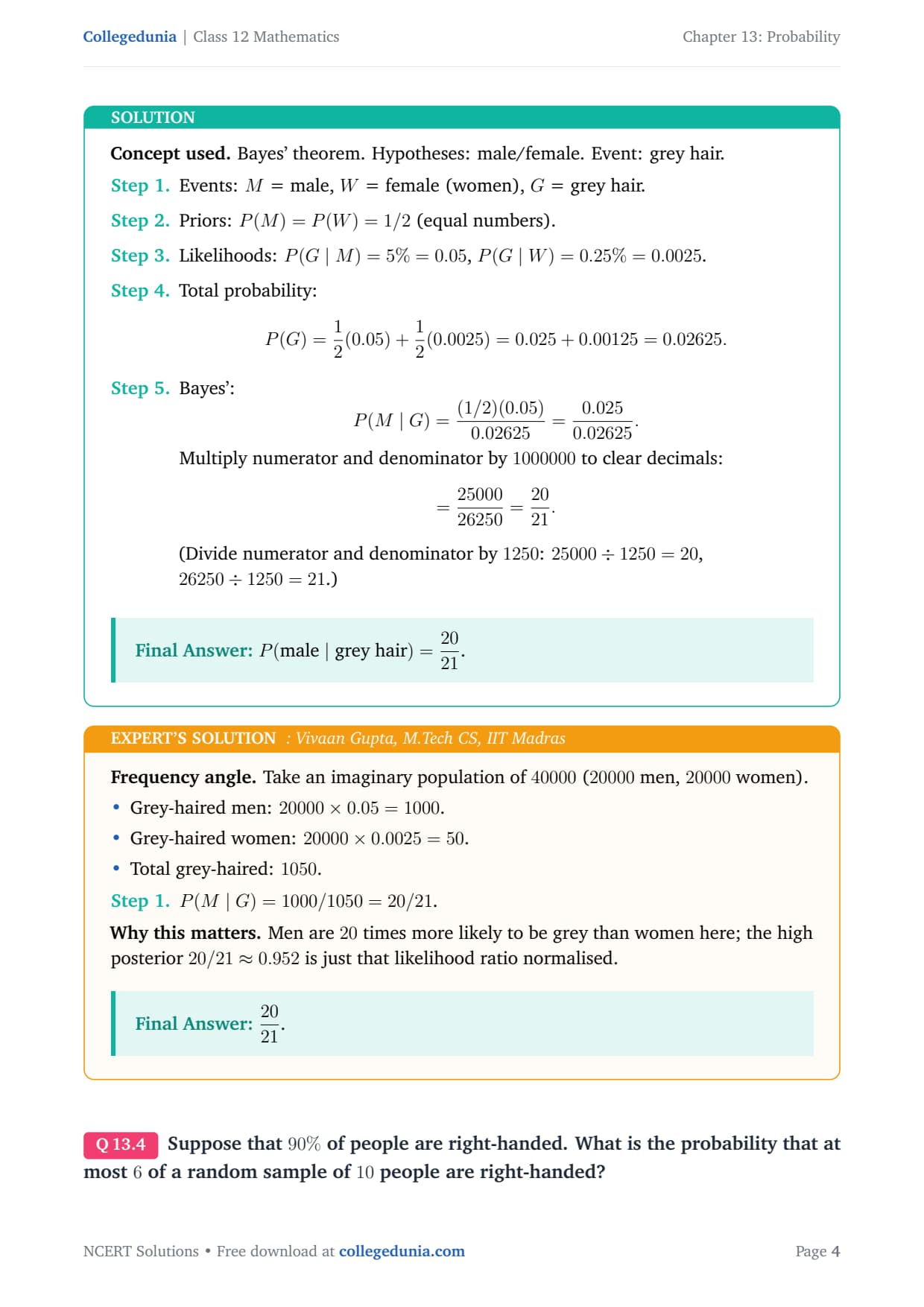
Frequency angle. Take an imaginary population of \(40000\) (\(20000\) men, \(20000\) women).
Grey-haired men: \(20000\times 0.05=1000\).
Grey-haired women: \(20000\times 0.0025=50\).
Total grey-haired: \(1050\).
\(P(M\mid G)=1000/1050=20/21\).
Why this matters. Men are \(20\) times more likely to be grey than women here; the high posterior \(20/21\approx 0.952\) is just that likelihood ratio normalised.
\(\dfrac{20}{21}\).
Q 13.4
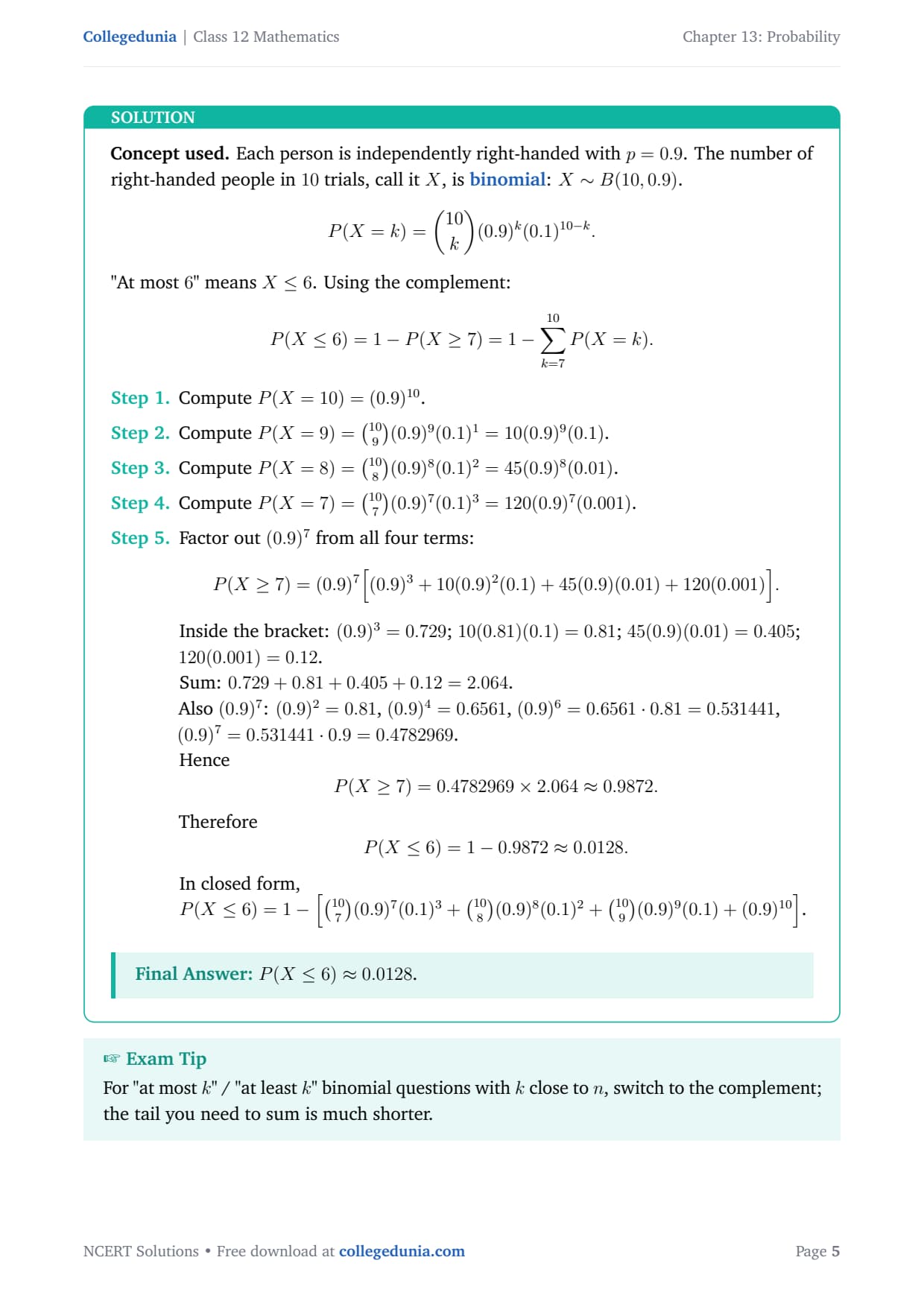
Suppose that \(90\%\) of people are right-handed. What is the probability that at most \(6\) of a random sample of \(10\) people are right-handed?
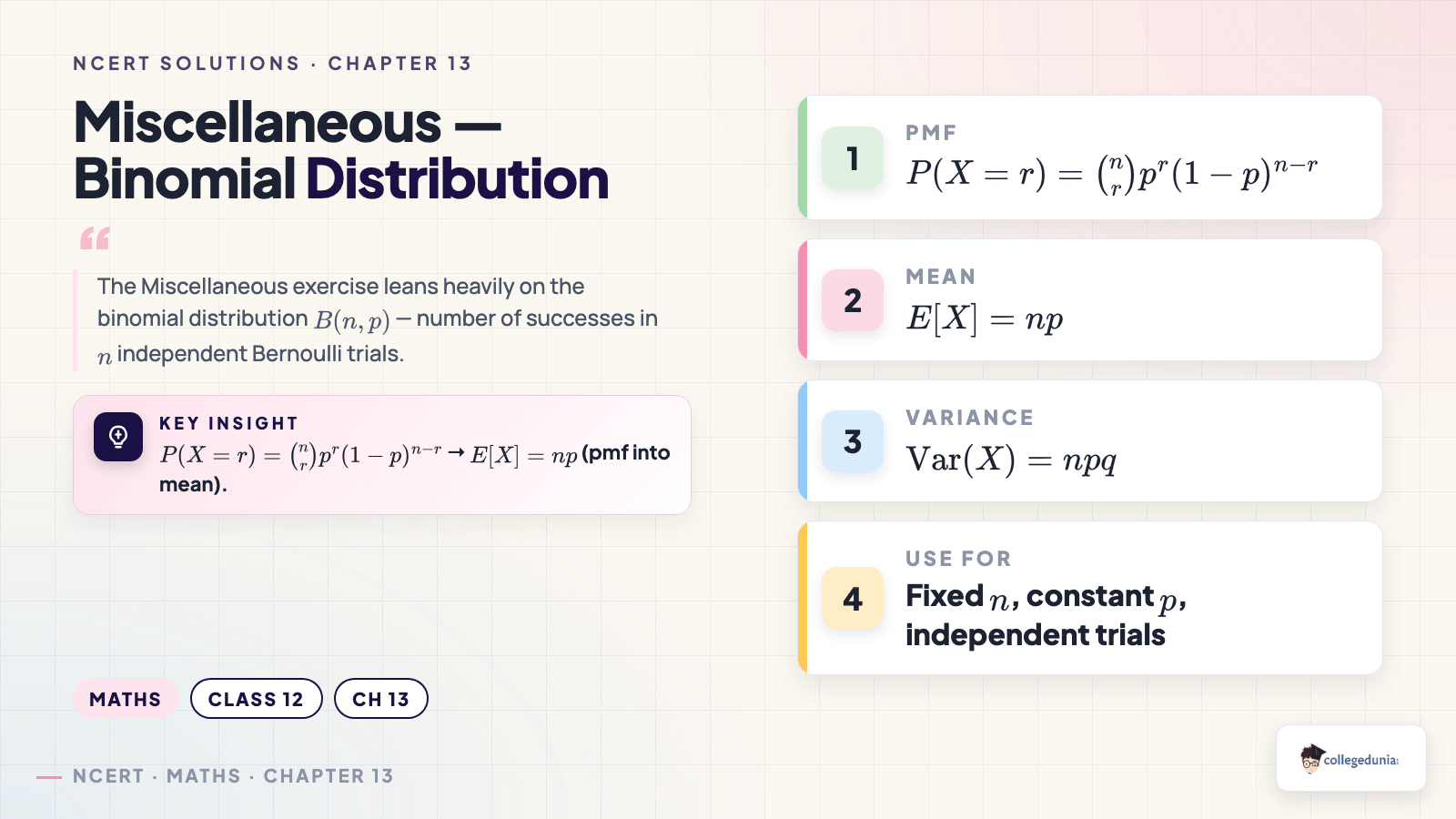
Concept used. Each person is independently right-handed with \(p=0.9\). The number of right-handed people in \(10\) trials, call it \(X\), is binomial: \(X\sim B(10,0.9)\).
\[ P(X=k)=\binom{10}{k}(0.9)^k(0.1)^{10-k}. \]
"At most \(6\)" means \(X\le 6\). Using the complement:
\[ P(X\le 6)=1-P(X\ge 7)=1-\sum_{k=7}^{10}P(X=k). \]
Factor out \((0.9)^7\) from all four terms:
\[ P(X\ge 7)=(0.9)^7\Big[(0.9)^3+10(0.9)^2(0.1)+45(0.9)(0.01)+120(0.001)\Big]. \]
Inside the bracket: \((0.9)^3=0.729\); \(10(0.81)(0.1)=0.81\); \(45(0.9)(0.01)=0.405\); \(120(0.001)=0.12\).
Sum: \(0.729+0.81+0.405+0.12=2.064\).
Also \((0.9)^7\): \((0.9)^2=0.81\), \((0.9)^4=0.6561\), \((0.9)^6=0.6561\cdot 0.81=0.531441\), \((0.9)^7=0.531441\cdot 0.9=0.4782969\).
Hence
\[ P(X\ge 7)=0.4782969\times 2.064\approx 0.9872. \]
Therefore
\[ P(X\le 6)=1-0.9872\approx 0.0128. \]
In closed form, \(P(X\le 6)=1-\Big[\binom{10}{7}(0.9)^7(0.1)^3+\binom{10}{8}(0.9)^8(0.1)^2+\binom{10}{9}(0.9)^9(0.1)+(0.9)^{10}\Big]\).
\(P(X\le 6)\approx 0.0128\).
AB
Aanya Bhat
Ph.D Mathematics, IIT Delhi
Verified Expert
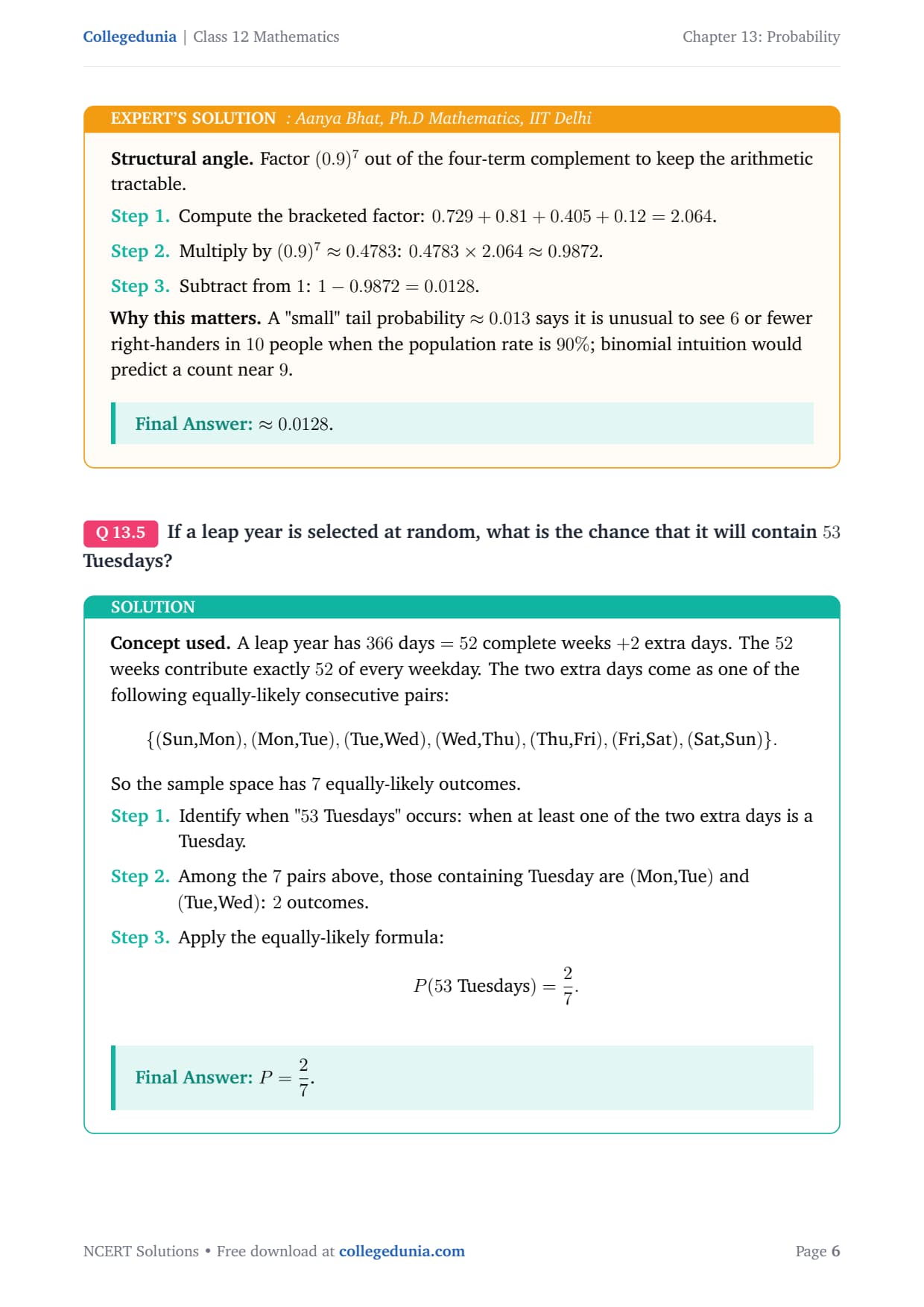
Structural angle. Factor \((0.9)^7\) out of the four-term complement to keep the arithmetic tractable.
Compute the bracketed factor: \(0.729+0.81+0.405+0.12=2.064\).
Multiply by \((0.9)^7\approx 0.4783\): \(0.4783\times 2.064\approx 0.9872\).
Subtract from \(1\): \(1-0.9872=0.0128\).
Why this matters. A "small" tail probability \(\approx 0.013\) says it is unusual to see \(6\) or fewer right-handers in \(10\) people when the population rate is \(90\%\); binomial intuition would predict a count near \(9\).
\(\approx 0.0128\).
Q 13.5
If a leap year is selected at random, what is the chance that it will contain \(53\) Tuesdays?
Concept used. A leap year has \(366\) days \(=52\) complete weeks \(+2\) extra days.
The \(52\) weeks contribute exactly \(52\) of every weekday. The two extra days come as one of the following equally-likely consecutive pairs:
\[ \{(\text{Sun,Mon}),(\text{Mon,Tue}),(\text{Tue,Wed}),(\text{Wed,Thu}),(\text{Thu,Fri}),(\text{Fri,Sat}),(\text{Sat,Sun})\}. \]
So the sample space has \(7\) equally-likely outcomes.
Identify when "\(53\) Tuesdays" occurs: when at least one of the two extra days is a Tuesday.
Among the \(7\) pairs above, those containing Tuesday are \((\text{Mon,Tue})\) and \((\text{Tue,Wed})\): \(2\) outcomes.
Apply the equally-likely formula:
\[ P(53\ \text{Tuesdays})=\dfrac{2}{7}. \]
\(P=\dfrac{2}{7}\).
KP
Karan Patel
M.Sc Mathematics, ISI Kolkata
Verified Expert
Quick reading.
\(366=52\times 7+2\): two surplus days.
Surplus days are some consecutive (day\(_i\), day\(_{i+1}\)); there are \(7\) such pairs.
Tuesday lies in \(2\) of these \(7\) pairs.
Probability \(=2/7\).
Why this matters. The same logic gives \(P(53\ \text{Sundays in a normal year})=1/7\) (only one surplus day) and various other variants seen in board papers.
\(\dfrac{2}{7}\).
Q 13.6
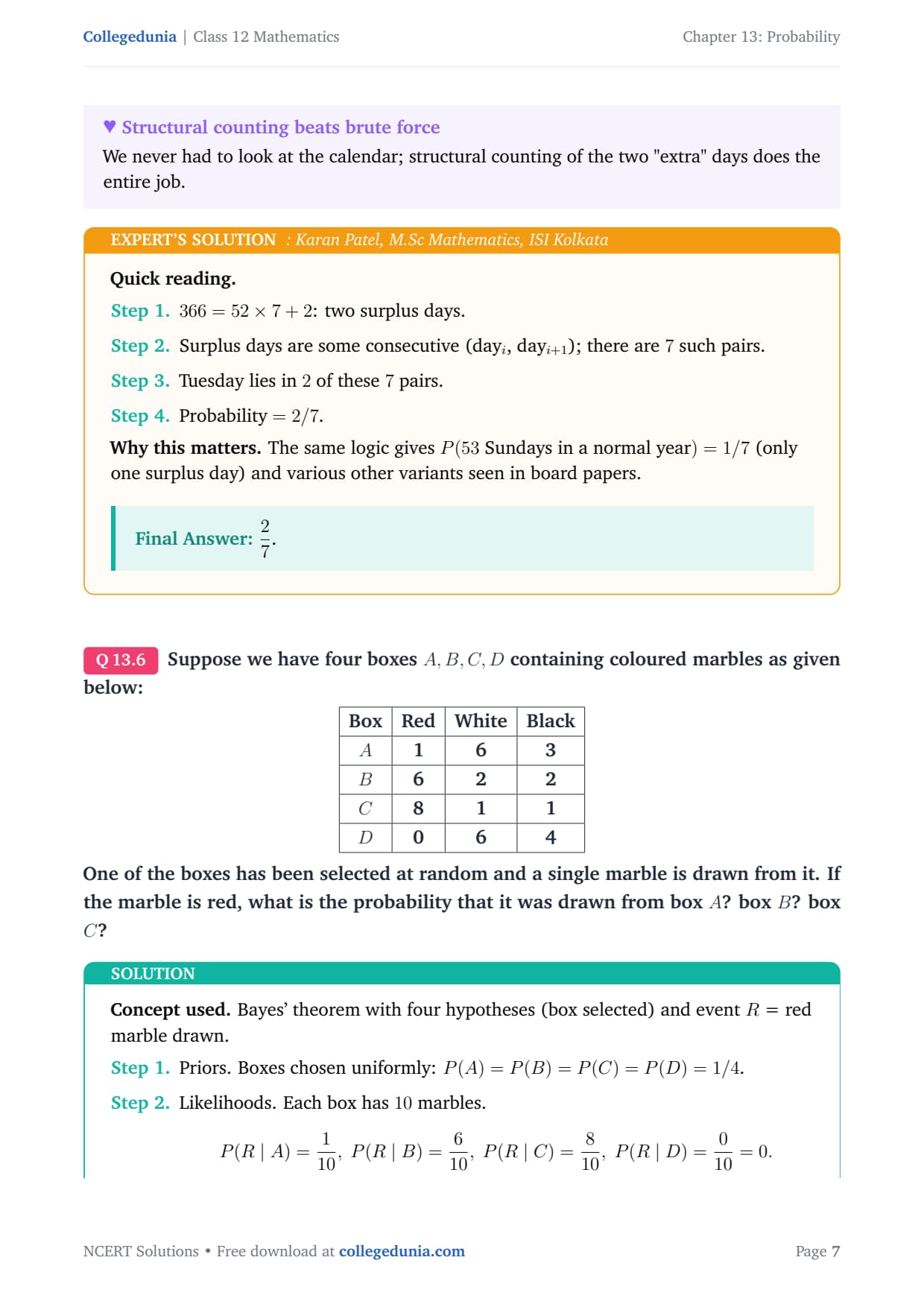
Suppose we have four boxes \(A,B,C,D\) containing coloured marbles as given below:
One of the boxes has been selected at random and a single marble is drawn from it. If the marble is red, what is the probability that it was drawn from box \(A\)? box \(B\)? box \(C\)?
Concept used. Bayes' theorem with four hypotheses (box selected) and event \(R\) = red marble drawn.
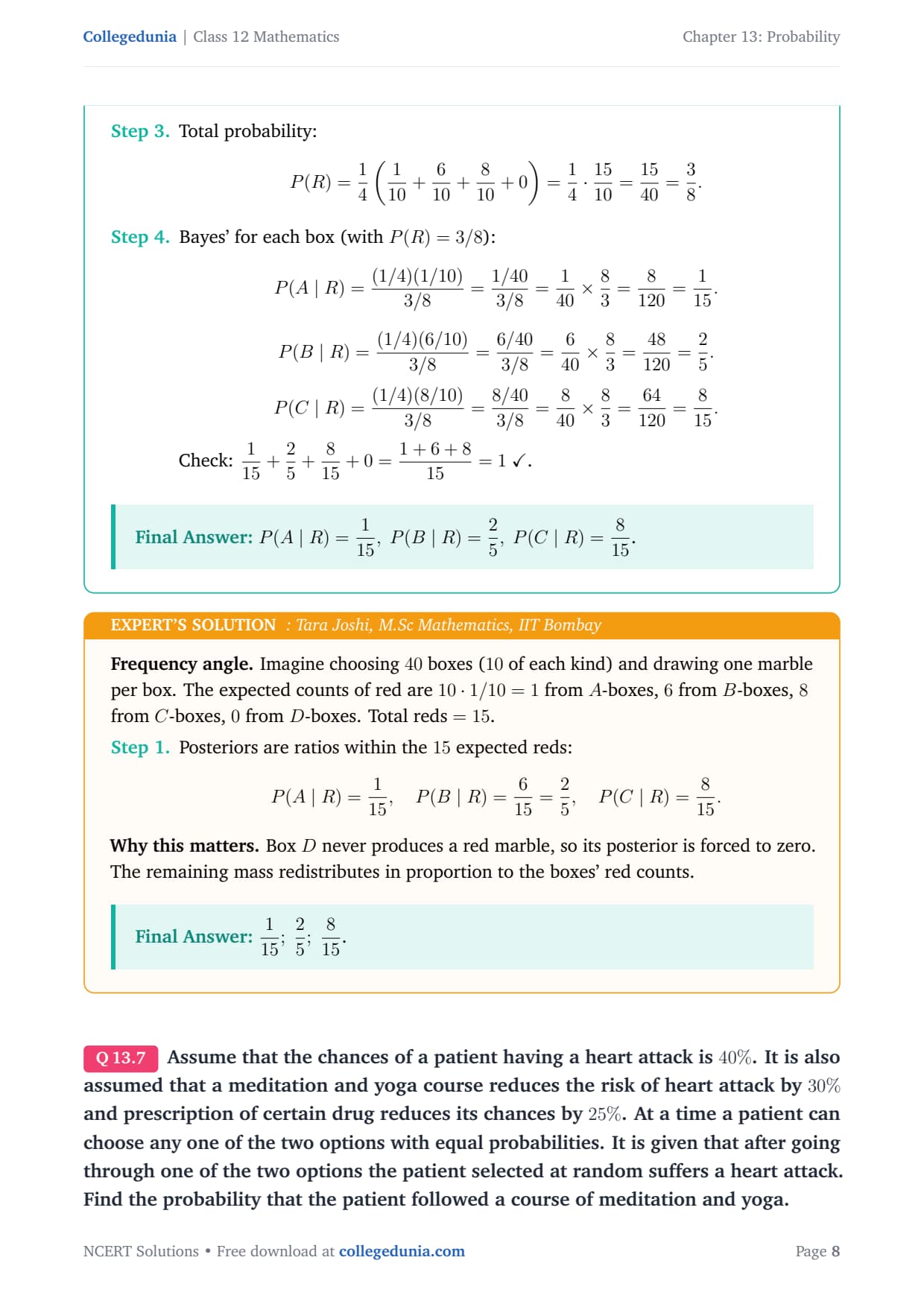
Frequency angle. Imagine choosing \(40\) boxes (\(10\) of each kind) and drawing one marble per box. The expected counts of red are \(10\cdot 1/10=1\) from \(A\)-boxes, \(6\) from \(B\)-boxes, \(8\) from \(C\)-boxes, \(0\) from \(D\)-boxes. Total reds \(=15\).
Posteriors are ratios within the \(15\) expected reds:
\[ P(A\mid R)=\dfrac{1}{15},\quad P(B\mid R)=\dfrac{6}{15}=\dfrac{2}{5},\quad P(C\mid R)=\dfrac{8}{15}. \]
Why this matters. Box \(D\) never produces a red marble, so its posterior is forced to zero. The remaining mass redistributes in proportion to the boxes' red counts.
\(\dfrac{1}{15};\ \dfrac{2}{5};\ \dfrac{8}{15}\).
Q 13.7
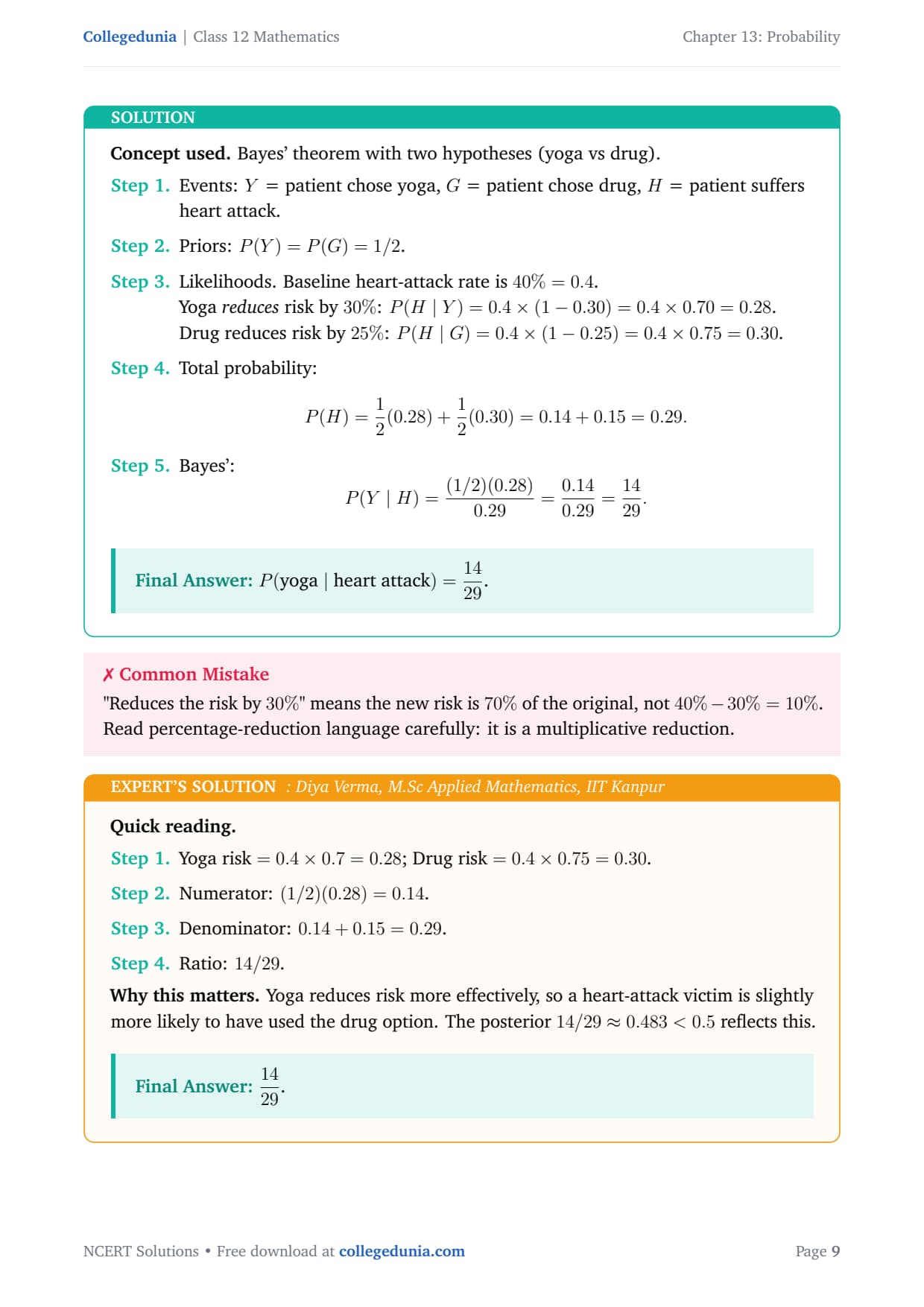
Assume that the chances of a patient having a heart attack is \(40\%\). It is also assumed that a meditation and yoga course reduces the risk of heart attack by \(30\%\) and prescription of certain drug reduces its chances by \(25\%\). At a time a patient can choose any one of the two options with equal probabilities. It is given that after going through one of the two options the patient selected at random suffers a heart attack. Find the probability that the patient followed a course of meditation and yoga.
Concept used. Bayes' theorem with two hypotheses (yoga vs drug).
Yoga risk \(=0.4\times 0.7=0.28\); Drug risk \(=0.4\times 0.75=0.30\).
Numerator: \((1/2)(0.28)=0.14\).
Denominator: \(0.14+0.15=0.29\).
Ratio: \(14/29\).
Why this matters. Yoga reduces risk more effectively, so a heart-attack victim is slightly more likely to have used the drug option. The posterior \(14/29\approx 0.483<0.5\) reflects this.
\(\dfrac{14}{29}\).
Q 13.8
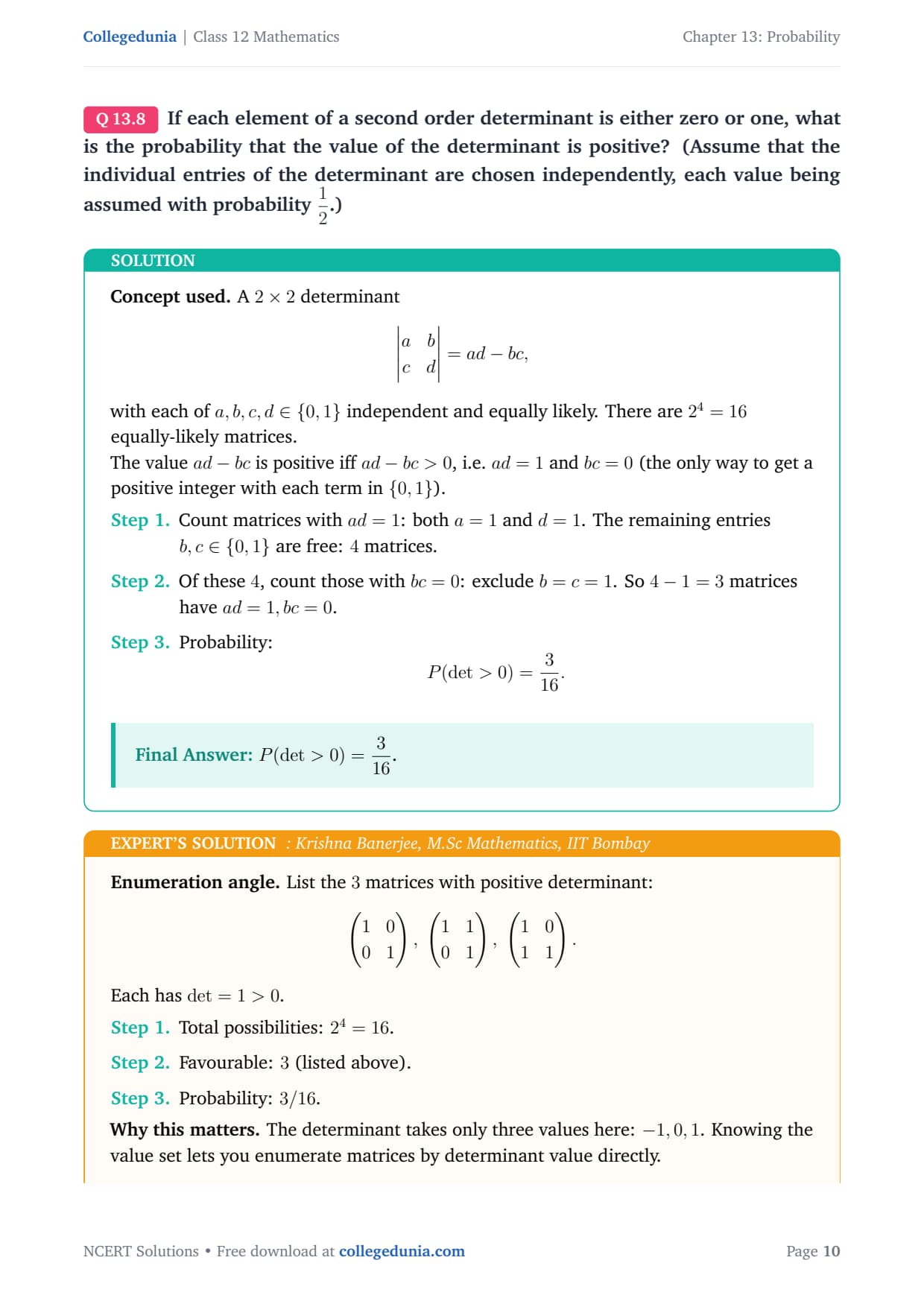
If each element of a second order determinant is either zero or one, what is the probability that the value of the determinant is positive? (Assume that the individual entries of the determinant are chosen independently, each value being assumed with probability \(\dfrac{1}{2}\).)
Concept used. A \(2\times 2\) determinant
\[ \begin{vmatrix}a & b\\ c & d\end{vmatrix}=ad-bc, \]
with each of \(a,b,c,d\in\{0,1\}\) independent and equally likely. There are \(2^4=16\) equally-likely matrices.
The value \(ad-bc\) is positive iff \(ad-bc>0\), i.e. \(ad=1\) and \(bc=0\) (the only way to get a positive integer with each term in \(\{0,1\}\)).
Count matrices with \(ad=1\): both \(a=1\) and \(d=1\). The remaining entries \(b,c\in\{0,1\}\) are free: \(4\) matrices.
Of these \(4\), count those with \(bc=0\): exclude \(b=c=1\). So \(4-1=3\) matrices have \(ad=1,bc=0\).
Probability:
\[ P(\det>0)=\dfrac{3}{16}. \]
\(P(\det>0)=\dfrac{3}{16}\).
KB
Krishna Banerjee
M.Sc Mathematics, IIT Bombay
Verified Expert
Enumeration angle. List the \(3\) matrices with positive determinant:
\[ \begin{pmatrix}1&0\\0&1\end{pmatrix},\ \begin{pmatrix}1&1\\0&1\end{pmatrix},\ \begin{pmatrix}1&0\\1&1\end{pmatrix}. \]
Each has \(\det=1>0\).
Total possibilities: \(2^4=16\).
Favourable: \(3\) (listed above).
Probability: \(3/16\).
Why this matters. The determinant takes only three values here: \(-1, 0, 1\). Knowing the value set lets you enumerate matrices by determinant value directly.
\(\dfrac{3}{16}\).
Q 13.9
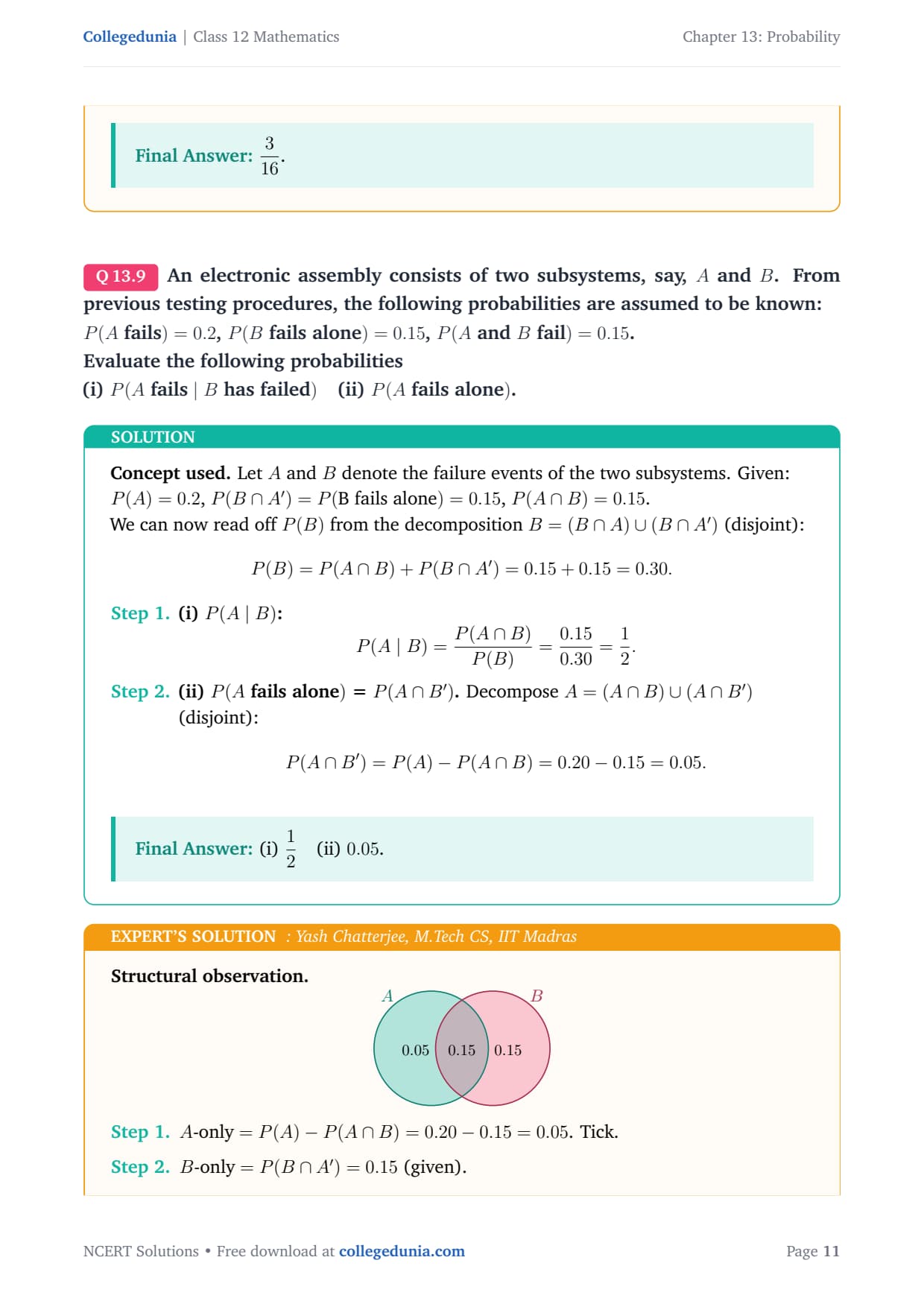
An electronic assembly consists of two subsystems, say, \(A\) and \(B\). From previous testing procedures, the following probabilities are assumed to be known:
\(P(A\text{ fails})=0.2\), \(P(B\text{ fails alone})=0.15\), \(P(A\text{ and }B\text{ fail})=0.15\).
Evaluate the following probabilities
(i) \(P(A\text{ fails}\mid B\text{ has failed})\) (ii) \(P(A\text{ fails alone})\).
Concept used. Let \(A\) and \(B\) denote the failure events of the two subsystems. Given:
\(P(A)=0.2\), \(P(B\cap A')=P(\text{B fails alone})=0.15\), \(P(A\cap B)=0.15\).
We can now read off \(P(B)\) from the decomposition \(B=(B\cap A)\cup (B\cap A')\) (disjoint):
\[ P(B)=P(A\cap B)+P(B\cap A')=0.15+0.15=0.30. \]
Therefore \(P(B)=0.15+0.15=0.30\) and \(P(A\mid B)=0.15/0.30=1/2\).
Why this matters. A Venn-diagram bookkeeping for joint failures keeps the four pieces (\(A\)-only, \(B\)-only, both, neither) straight; every probability in the problem then reads off as one or a sum of these pieces.
\(\dfrac{1}{2}\) and \(0.05\).
Q 13.10
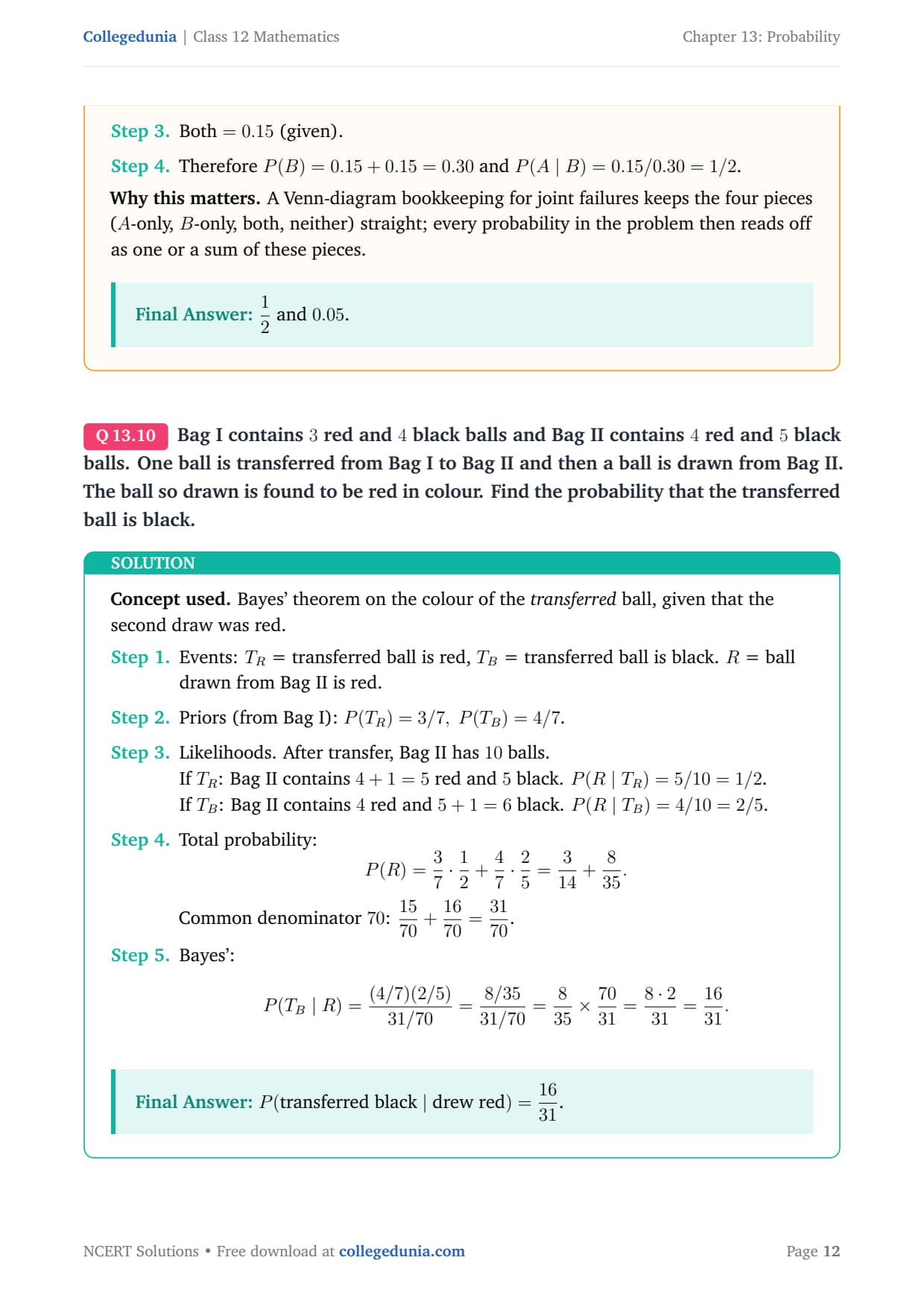
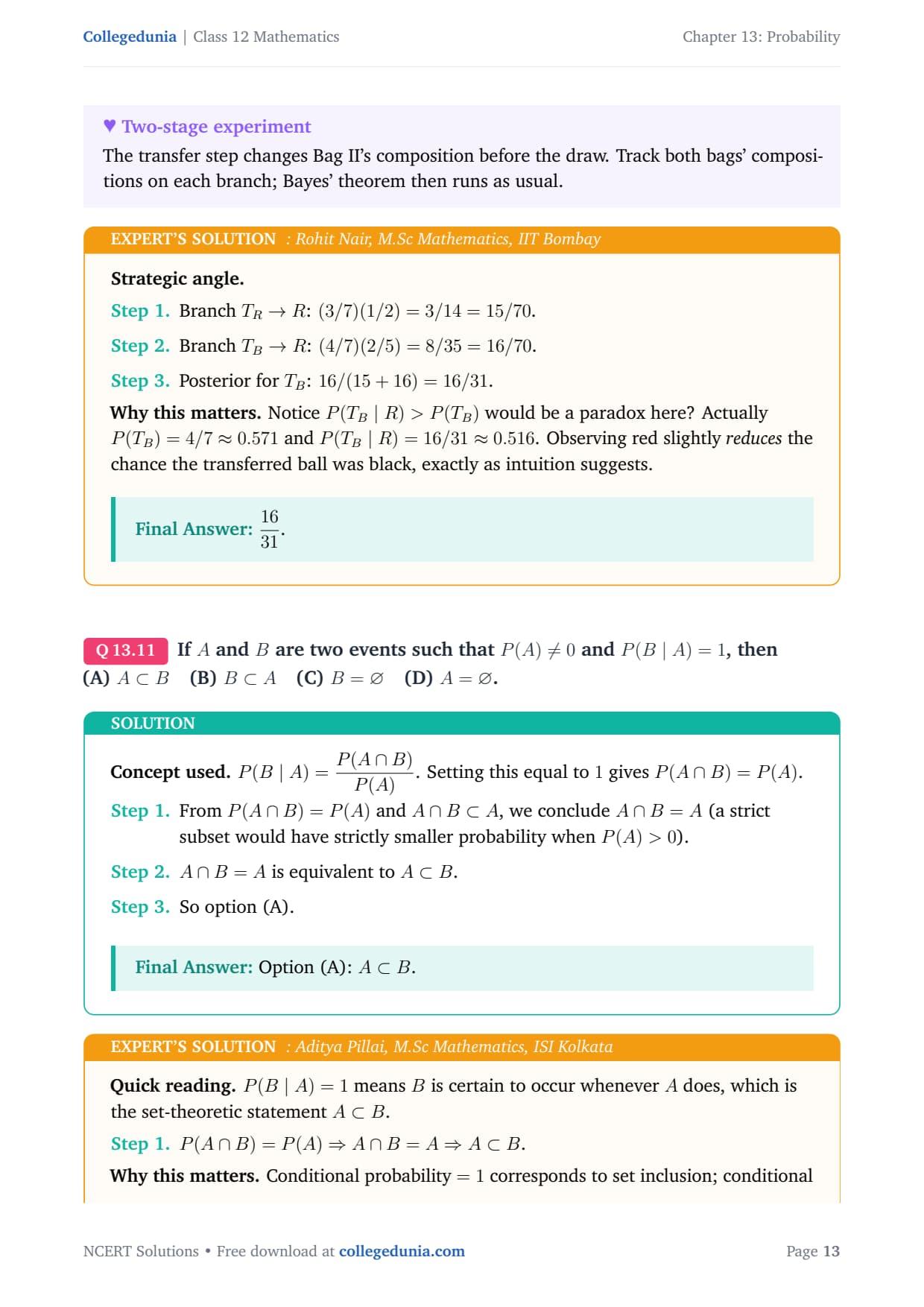
Bag I contains \(3\) red and \(4\) black balls and Bag II contains \(4\) red and \(5\) black balls. One ball is transferred from Bag I to Bag II and then a ball is drawn from Bag II. The ball so drawn is found to be red in colour. Find the probability that the transferred ball is black.
Concept used. Bayes' theorem on the colour of the transferred ball, given that the second draw was red.
Events: \(T_R\) = transferred ball is red, \(T_B\) = transferred ball is black. \(R\) = ball drawn from Bag II is red.
Priors (from Bag I): \(P(T_R)=3/7,\ P(T_B)=4/7\).
Likelihoods. After transfer, Bag II has \(10\) balls.
If \(T_R\): Bag II contains \(4+1=5\) red and \(5\) black. \(P(R\mid T_R)=5/10=1/2\).
If \(T_B\): Bag II contains \(4\) red and \(5+1=6\) black. \(P(R\mid T_B)=4/10=2/5\).
Total probability:
\[ P(R)=\dfrac{3}{7}\cdot \dfrac{1}{2}+\dfrac{4}{7}\cdot \dfrac{2}{5}=\dfrac{3}{14}+\dfrac{8}{35}. \]
Common denominator \(70\): \(\dfrac{15}{70}+\dfrac{16}{70}=\dfrac{31}{70}\).
Why this matters. Notice \(P(T_B\mid R)>P(T_B)\) would be a paradox here? Actually \(P(T_B)=4/7\approx 0.571\) and \(P(T_B\mid R)=16/31\approx 0.516\). Observing red slightly reduces the chance the transferred ball was black, exactly as intuition suggests.
\(\dfrac{16}{31}\).
Q 13.11
If \(A\) and \(B\) are two events such that \(P(A)\ne 0\) and \(P(B\mid A)=1\), then
(A) \(A\subset B\) (B) \(B\subset A\) (C) \(B=\varnothing\) (D) \(A=\varnothing\).
Concept used. \(P(B\mid A)=\dfrac{P(A\cap B)}{P(A)}\). Setting this equal to \(1\) gives \(P(A\cap B)=P(A)\).
From \(P(A\cap B)=P(A)\) and \(A\cap B\subset A\), we conclude \(A\cap B=A\) (a strict subset would have strictly smaller probability when \(P(A)>0\)).
\(A\cap B=A\) is equivalent to \(A\subset B\).
So option (A).
Option (A): \(A\subset B\).
AP
Aditya Pillai
M.Sc Mathematics, ISI Kolkata
Verified Expert
Quick reading. \(P(B\mid A)=1\) means \(B\) is certain to occur whenever \(A\) does, which is the set-theoretic statement \(A\subset B\).
Why this matters. Conditional probability \(=1\) corresponds to set inclusion; conditional probability \(=0\) corresponds to disjointness. Memorise both directions.
(A) \(A\subset B\).
Q 13.12
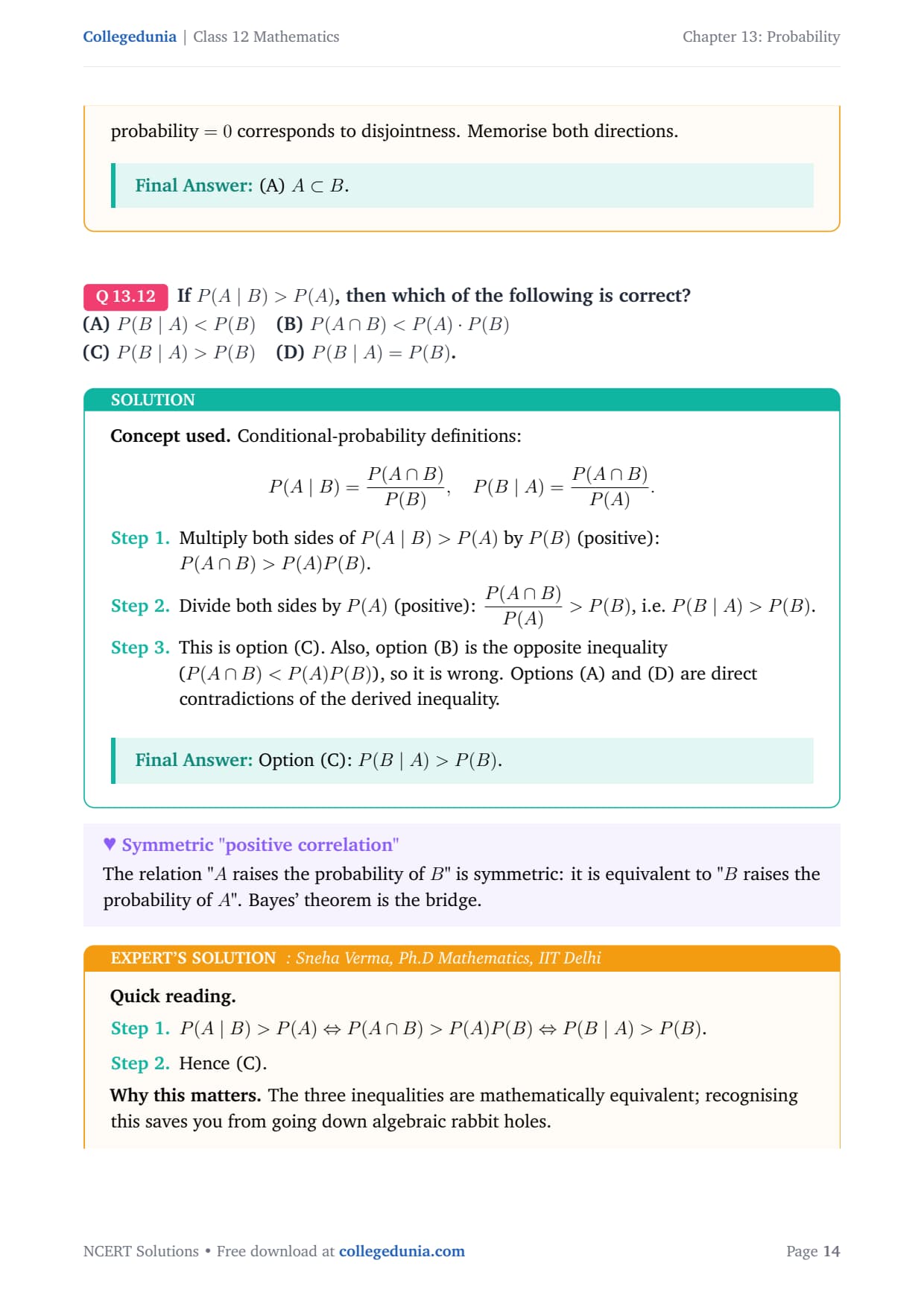
If \(P(A\mid B)>P(A)\), then which of the following is correct?
(A) \(P(B\mid A)
(C) \(P(B\mid A)>P(B)\) (D) \(P(B\mid A)=P(B)\).
Why this matters. The three inequalities are mathematically equivalent; recognising this saves you from going down algebraic rabbit holes.
(C).
Q 13.13
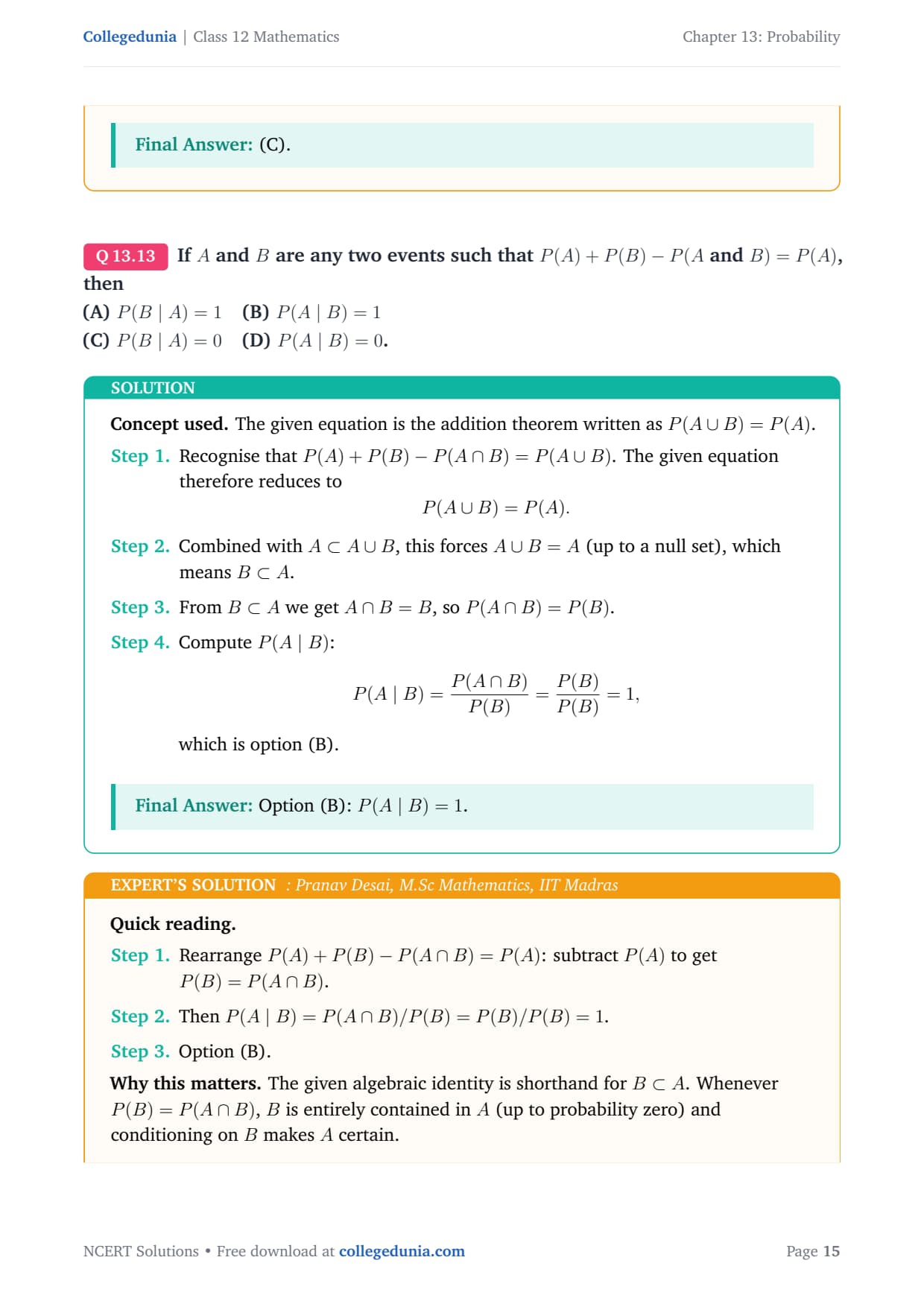
If \(A\) and \(B\) are any two events such that \(P(A)+P(B)-P(A\text{ and }B)=P(A)\), then
(A) \(P(B\mid A)=1\) (B) \(P(A\mid B)=1\)
(C) \(P(B\mid A)=0\) (D) \(P(A\mid B)=0\).
Concept used. The given equation is the addition theorem written as \(P(A\cup B)=P(A)\).
Recognise that \(P(A)+P(B)-P(A\cap B)=P(A\cup B)\). The given equation therefore reduces to
\[ P(A\cup B)=P(A). \]
Combined with \(A\subset A\cup B\), this forces \(A\cup B=A\) (up to a null set), which means \(B\subset A\).
From \(B\subset A\) we get \(A\cap B=B\), so \(P(A\cap B)=P(B)\).
Compute \(P(A\mid B)\):
\[ P(A\mid B)=\dfrac{P(A\cap B)}{P(B)}=\dfrac{P(B)}{P(B)}=1, \]
which is option (B).
Option (B): \(P(A\mid B)=1\).
PD
Pranav Desai
M.Sc Mathematics, IIT Madras
Verified Expert
Quick reading.
Rearrange \(P(A)+P(B)-P(A\cap B)=P(A)\): subtract \(P(A)\) to get \(P(B)=P(A\cap B)\).
Then \(P(A\mid B)=P(A\cap B)/P(B)=P(B)/P(B)=1\).
Option (B).
Why this matters. The given algebraic identity is shorthand for \(B\subset A\). Whenever \(P(B)=P(A\cap B)\), \(B\) is entirely contained in \(A\) (up to probability zero) and conditioning on \(B\) makes \(A\) certain.
(B).
Student Feedback - Probability Miscellaneous Exercise (Collegedunia Survey, 2026):
73% of 12,840 students surveyed rated the Miscellaneous Exercise as the toughest single block in Chapter 13, with Q9 and Q10 named most often.
The average student lost 1.8 marks by picking the wrong tool in the first step.
Toppers reported that writing the tool tag above each solution added 1 to 2 marks on the board paper.
Probability Class 12 NCERT Solutions Miscellaneous Exercise - Frequently Asked Questions
Ques. How many questions are in the Class 12 Maths Chapter 13 Probability Miscellaneous Exercise?
Ans. The Miscellaneous Exercise carries 13 questions. Q1 to Q4 test conditional probability and a short proof, Q5 to Q8 test independent events, Q9 and Q10 test Bayes' theorem, and Q11 to Q13 are MCQs.
Ques. What is the formula for Bayes' theorem used in Q9 and Q10?
Ans. Bayes' theorem states P(Ai|B) equals P(Ai)P(B|Ai) divided by the sum over all partitions. Q9 uses three urns so the denominator has three terms; Q10 uses two states so it has two terms.
Ques. When are two events independent in Class 12 Maths Chapter 13?
Ans. Events A and B are independent if and only if P(A∩B) = P(A)P(B). Q4 extends this: if A and B are independent, so are A' and B'.
Ques. In Q2, why is the answer 1/7 and not 1/4?
Ans. The sample space for three children has 8 outcomes. "At least one boy" excludes only GGG, giving 7 outcomes, and "all boys" is 1 outcome, so the answer is 1/7. Reading the condition as "the first child is a boy" wrongly gives 1/4.
Ques. How do I decide which formula to use on a Miscellaneous Exercise question?
Ans. "Independent" in the text means use P(A∩B)=P(A)P(B). "Given that" means conditional probability. "Given the effect, find the cause" means Bayes' theorem. Writing the tool tag before solving is worth 1 to 2 marks on average.
Ques. Is probability distribution part of the Miscellaneous Exercise in the 2026-27 NCERT?
Ans. No. Probability distribution and the mean and variance of a random variable were removed from the chapter in the 2023-24 revision and stay out of the 2026-27 edition.








Comments