Maths Mentor, Thapar Institute | Updated on - Jul 21, 2026
These NCERT Solutions for Class 12 Maths Chapter 9 Differential Equations Miscellaneous Exercise cover every question with a full step-by-step method. Each step names the rule used and shows the working in line, matching the 2026-27 NCERT syllabus. The free PDF download is available right below.
Miscellaneous Exercise snapshot
Detail
Total problems
18 (Q1 to Q18)
Methods blended
Order/degree, verification, separable, homogeneous, linear (IF), initial conditions
MCQ count
3 (Q16, Q17, Q18)
The snapshot shows why this exercise is exam rehearsal: every technique appears once, and choosing the right method is half the work.
Every solved problem opens by naming the method the equation calls for, then executes it end to end. Our team has matched every answer against the official NCERT key and the 2026-27 textbook.
Why the Miscellaneous Exercise Decides Your Class 12 Maths Chapter 9 Score
CBSE and JEE Main questions never carry a method tag, so the skill this exercise builds, recognising the form first, is what actually gets examined.JEE Main has lifted a Miscellaneous-style mixed problem in 4 of the last 5 papers. This exercise is the closest practice to the real test.
How Collegedunia's NCERT Solutions Help You Clear the Miscellaneous Exercise
Marks here are lost at the decision step, before any algebra starts. Our solutions state the method-recognition reasoning first, the habit that transfers straight to the exam.
Method named first in every problem, with the structural signal that points to it.
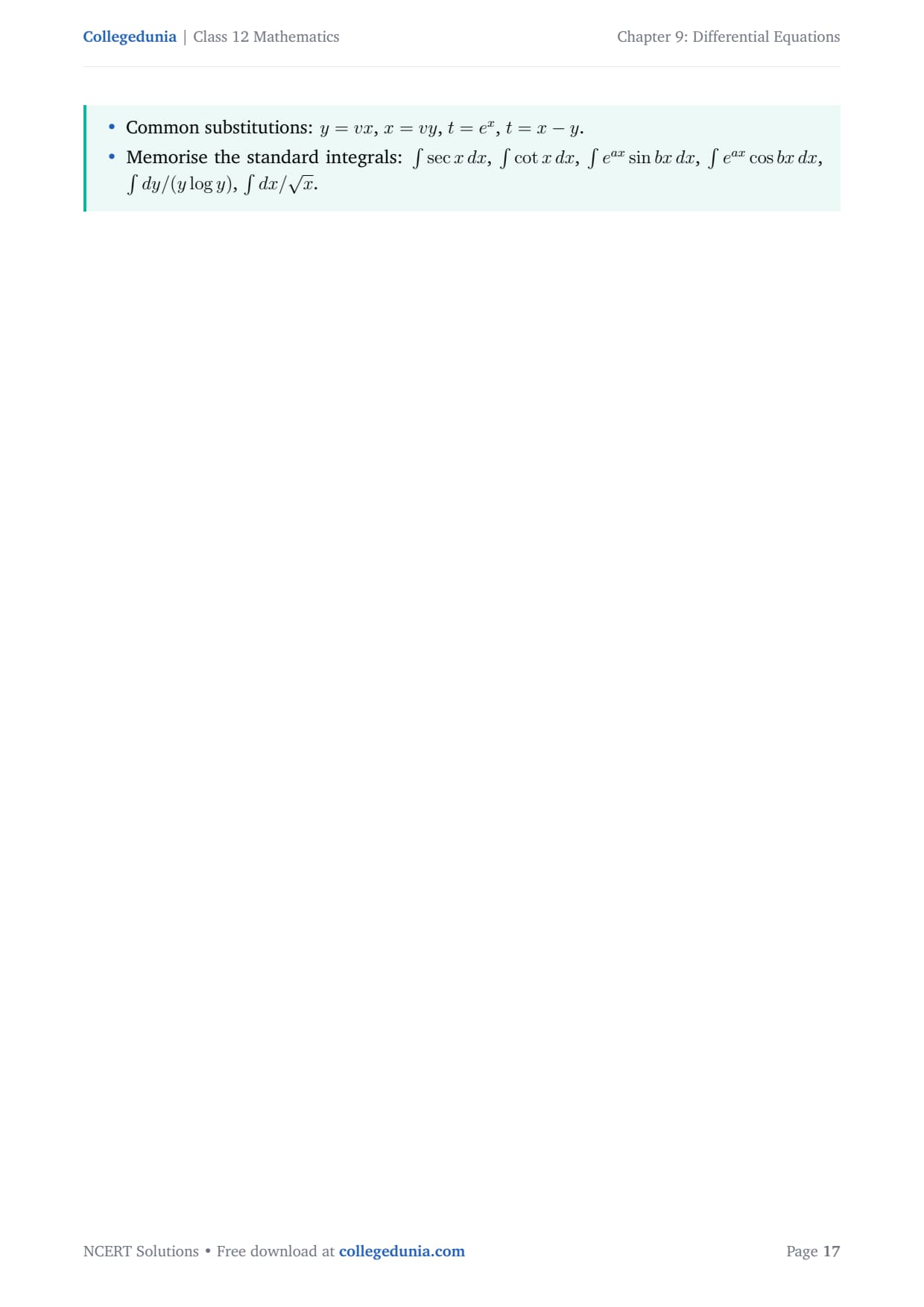
Substitution hints honoured, such as x - y = t in Q10.
Proof-type problems Q3 and Q5 shown as full derivations, not just answer statements.
Initial conditions applied last in Q8, Q11, Q13 and Q14 to fix the constant.
The table lists the headline answer for representative problems across the Miscellaneous Exercise. Use it to verify your own working after attempting the set.
Q No.
Task / equation
Answer
1
Order and degree of three equations
(2,1), (1,3), (4, not defined)
2
Verify four given functions solve their equations
All four verified
3
Prove x2-y2=c(x2+y2)2 solves the given DE
Proven
4
dydx + √1-y2√1-x2 = 0
sin-1x + sin-1y = C
6
Curve through (0,π4) , sin xcos y dx + cos xsin y dy = 0
√2cos xcos y = 1
7
(1+e2x) dy + (1+y2)ex dx = 0 , y(0)=1
tan-1y + tan-1ex = π2
8
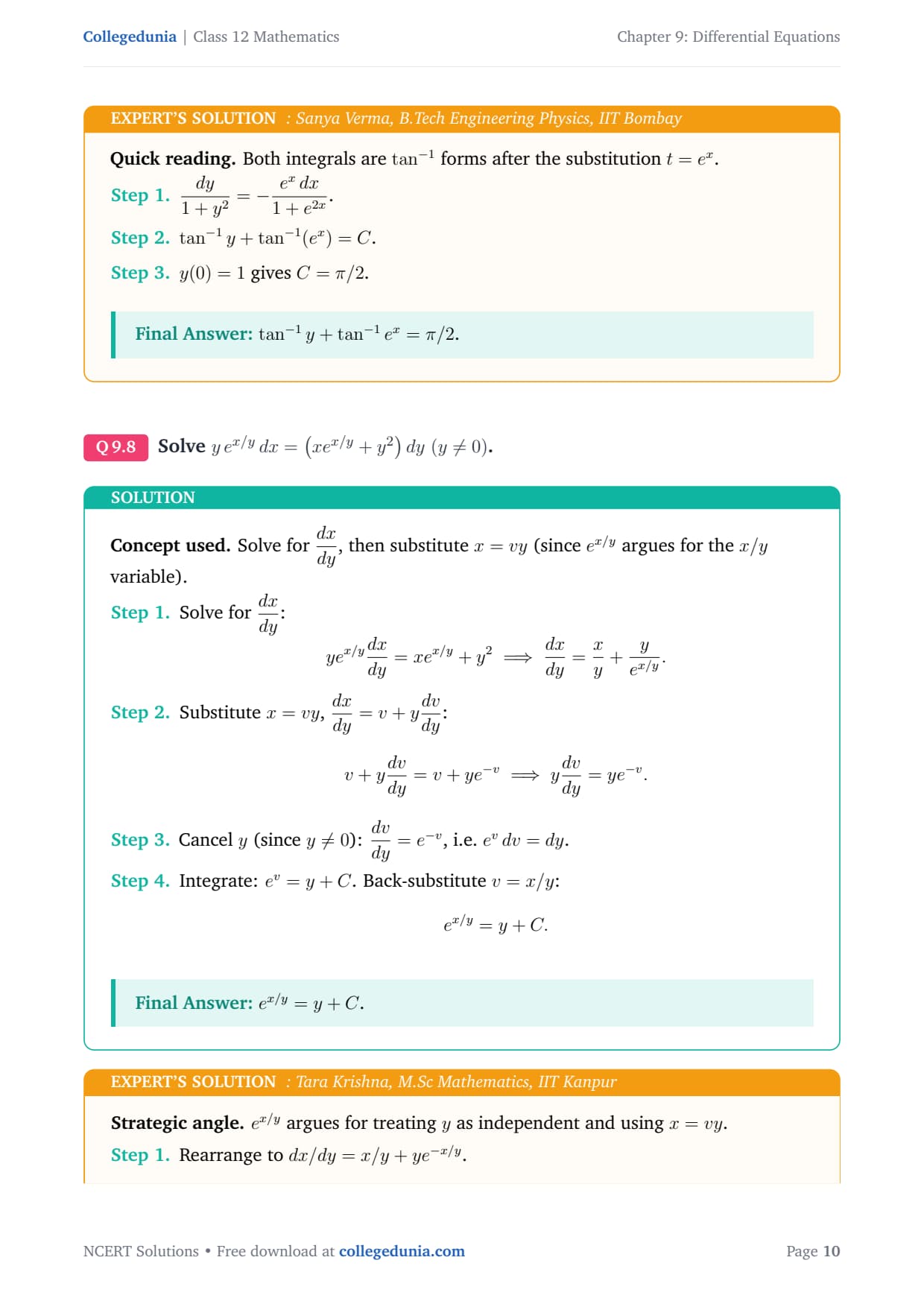
yex/y dx = (xex/y+y2) dy
ex/y = y + C
11
dydx + ycot x = 4xcsc x, y(π/2)=0
ysin x = 2x2 - π22
12
(x+1)dydx = 2e-y - 1 , y(0)=0
(2-ey)(x+1) = 1
16
MCQ: general solution of y dx - x dyy = 0
(C) y = Cx
18
MCQ: general solution of ex dy + (yex+2x) dx = 0
(C) yex + x2 = C
Q3 and Q5 are proof-type problems where the working, not just the final relation, earns the marks, which is why they map to the Differential Equations Class 12 NCERT Solutions's 5-mark Long Answer. Q11 and Q12 are the recurring particular-solution items in CBSE board papers.
Method-Recognition Checklist for the Class 12 Maths Chapter 9 Miscellaneous Exercise
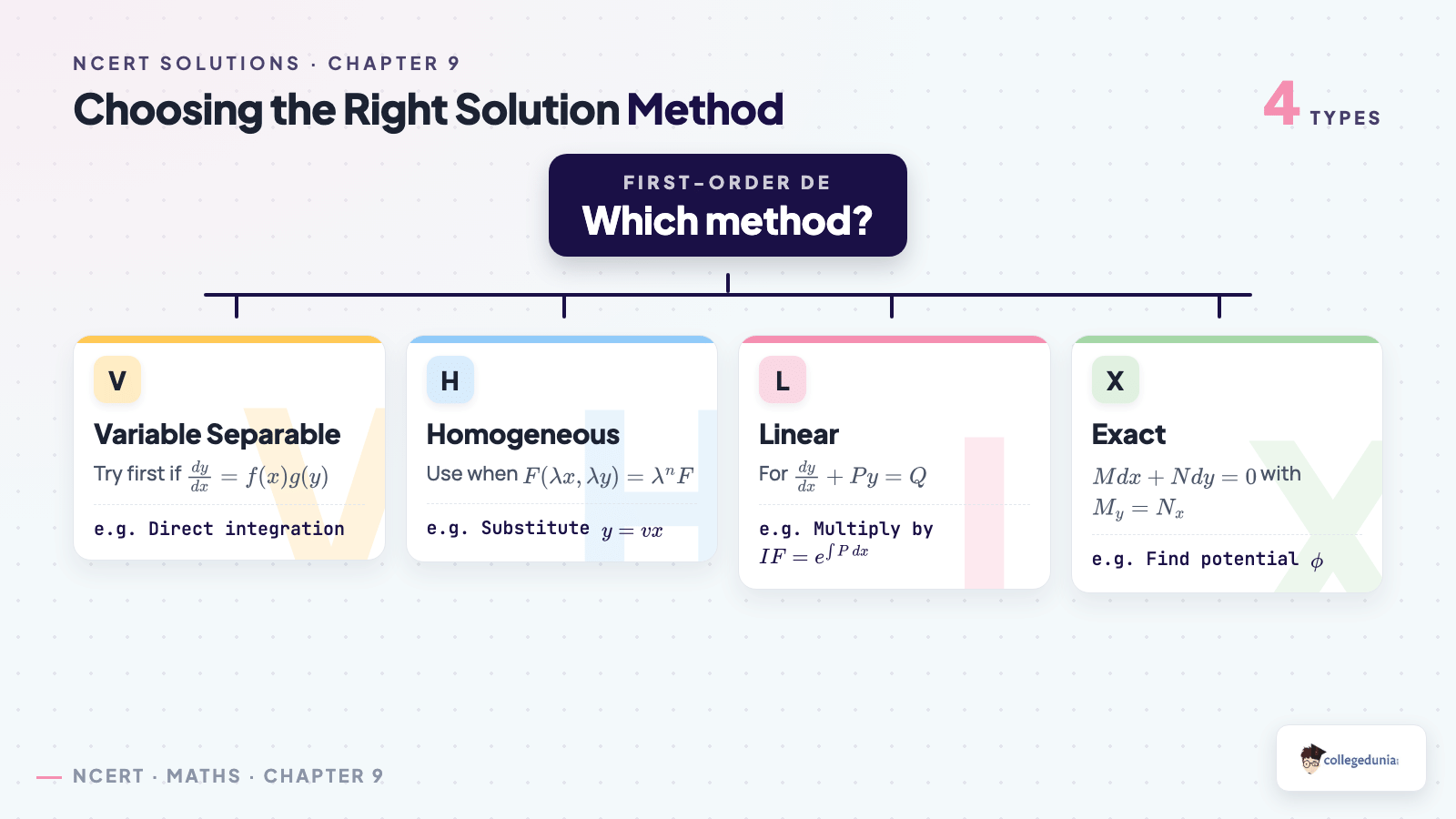
Use this checklist as the first decision on any unlabelled differential equation.
1. Can the equation be written h(y) dy = g(x) dx ? Use the variable-separable method. 2. Is every term the same total degree in x and y? It is homogeneous; substitute y = vx . 3. Is it of the form dydx + Py = Q (or the x-in-y sister form)? Use the integrating factor e∫ P dx. 4. If a substitution hint is given (such as x-y=t in Q10), apply it before classifying.
This four-question filter clears every problem in the Miscellaneous Exercise and is the same filter the JEE and CBSE papers expect you to run silently.
Common Mistakes Students Make in the Class 12 Maths Chapter 9 Miscellaneous Exercise
Common Mistake: Forcing the integrating factor method on an equation that is already separable. A wrong method choice wastes time and rarely scores partial credit.
Skipping the order-and-degree justification in Q1.
Treating a proof-type problem (Q3, Q5) as answer-only and losing the derivation marks.
Applying initial conditions before the general solution is complete.
CBSE Board Exam Relevance of Class 12 Maths Chapter 9 Miscellaneous Exercise
This exercise is the direct source of the chapter's 3 and 5 mark questions. The table below maps recent CBSE sittings.
Year
Marks from Misc style
Question tested
2025
5
Particular solution of a linear equation with a trig coefficient
2024
5
Proof that a given relation is the general solution of a stated DE
2023
3
Separable equation with an inverse-trig answer
This exercise feeds 3 to 5 marks of the Differential Equations block every year, the highest concentration of marks in the chapter.
Other Resources for Class 12 Maths Chapter 9 Differential Equations
Exercise-wise Breakdown of the Differential Equations Chapter
The Differential Equations chapter splits into 5 numbered exercises plus a Miscellaneous Exercise. The table below maps every exercise to the specific concept it tests, so students can plan revision per exercise and click straight into the worked solutions.
All NCERT Solutions for Differential Equations Misc with Step-by-Step Working
Every NCERT textbook question for Class 12 Mathematics Chapter 9 Differential Equations Misc is listed below with its full Solution and Expert Solution hidden inside collapsible tabs. Click Check Solution to reveal the step-by-step working; click Expert Solution for the expanded explanation.
Questions
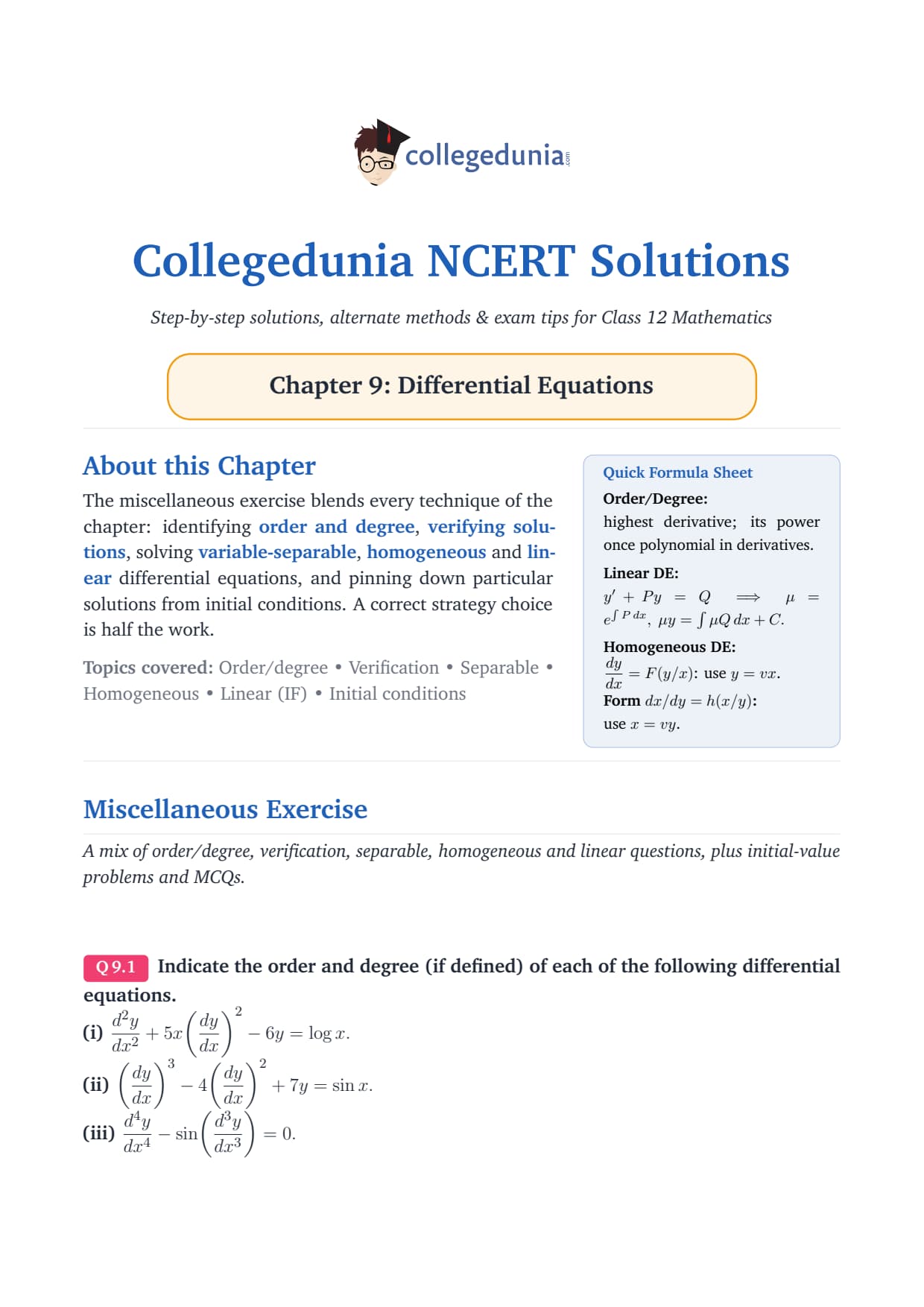
Q 9.1
Indicate the order and degree (if defined) of each of the following differential equations.
(i) d2ydx2 + 5x(dydx)2 - 6y = log x. (ii) (dydx)3 - 4(dydx)2 + 7y = sin x. (iii) d4ydx4 - sin(d3ydx3) = 0.
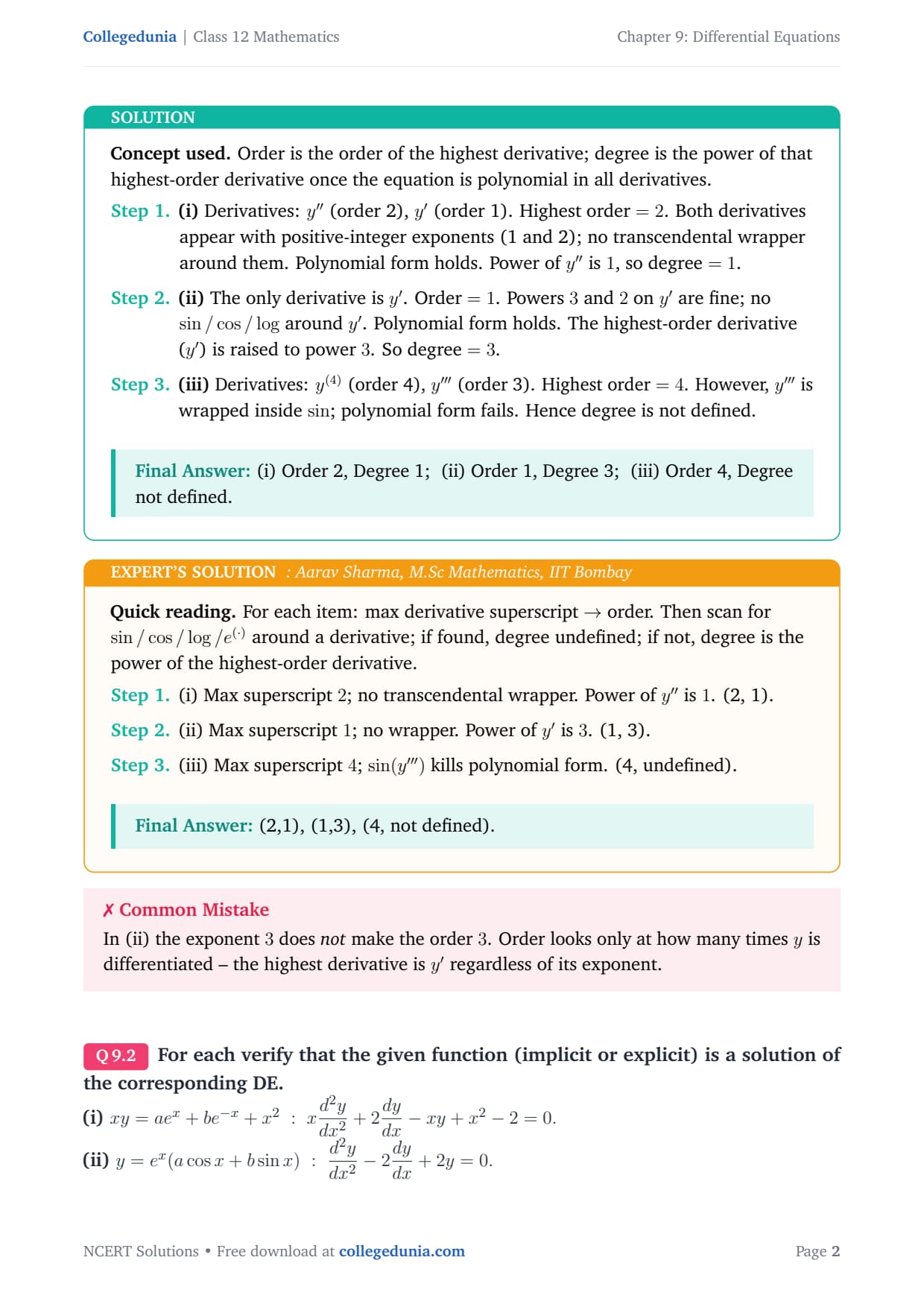
Concept used. Order is the order of the highest derivative; degree is the power of that highest-order derivative once the equation is polynomial in all derivatives.
(i) Derivatives: y'' (order 2), y' (order 1). Highest order = 2. Both derivatives appear with positive-integer exponents (1 and 2); no transcendental wrapper around them. Polynomial form holds. Power of y'' is 1, so degree = 1.
(ii) The only derivative is y'. Order = 1. Powers 3 and 2 on y' are fine; no sin/cos/log around y'. Polynomial form holds. The highest-order derivative (y') is raised to power 3. So degree = 3.
(iii) Derivatives: y(4) (order 4), y''' (order 3). Highest order = 4. However, y''' is wrapped inside sin; polynomial form fails. Hence degree is not defined.
(i) Order 2, Degree 1; (ii) Order 1, Degree 3; (iii) Order 4, Degree not defined.
AS
Aarav Sharma
M.Sc Mathematics, IIT Bombay
Verified Expert
Quick reading. For each item: max derivative superscript → order. Then scan for sin/cos/log/e(·) around a derivative; if found, degree undefined; if not, degree is the power of the highest-order derivative.
(i) Max superscript 2; no transcendental wrapper. Power of y'' is 1. (2, 1).
(ii) Max superscript 1; no wrapper. Power of y' is 3. (1, 3).
(iii) Max superscript 4; sin(y''') kills polynomial form. (4, undefined).
(2,1), (1,3), (4, not defined).
Q 9.2
For each verify that the given function (implicit or explicit) is a solution of the corresponding DE.
(i) xy = aex + be-x + x2 : xd2ydx2 + 2dydx - xy + x2 - 2 = 0. (ii) y = ex(acos x + bsin x) : d2ydx2 - 2dydx + 2y = 0. (iii) y = xsin 3x : d2ydx2 + 9y - 6cos 3x = 0. (iv) x2 = 2y2log y : (x2+y2)dydx - xy = 0.
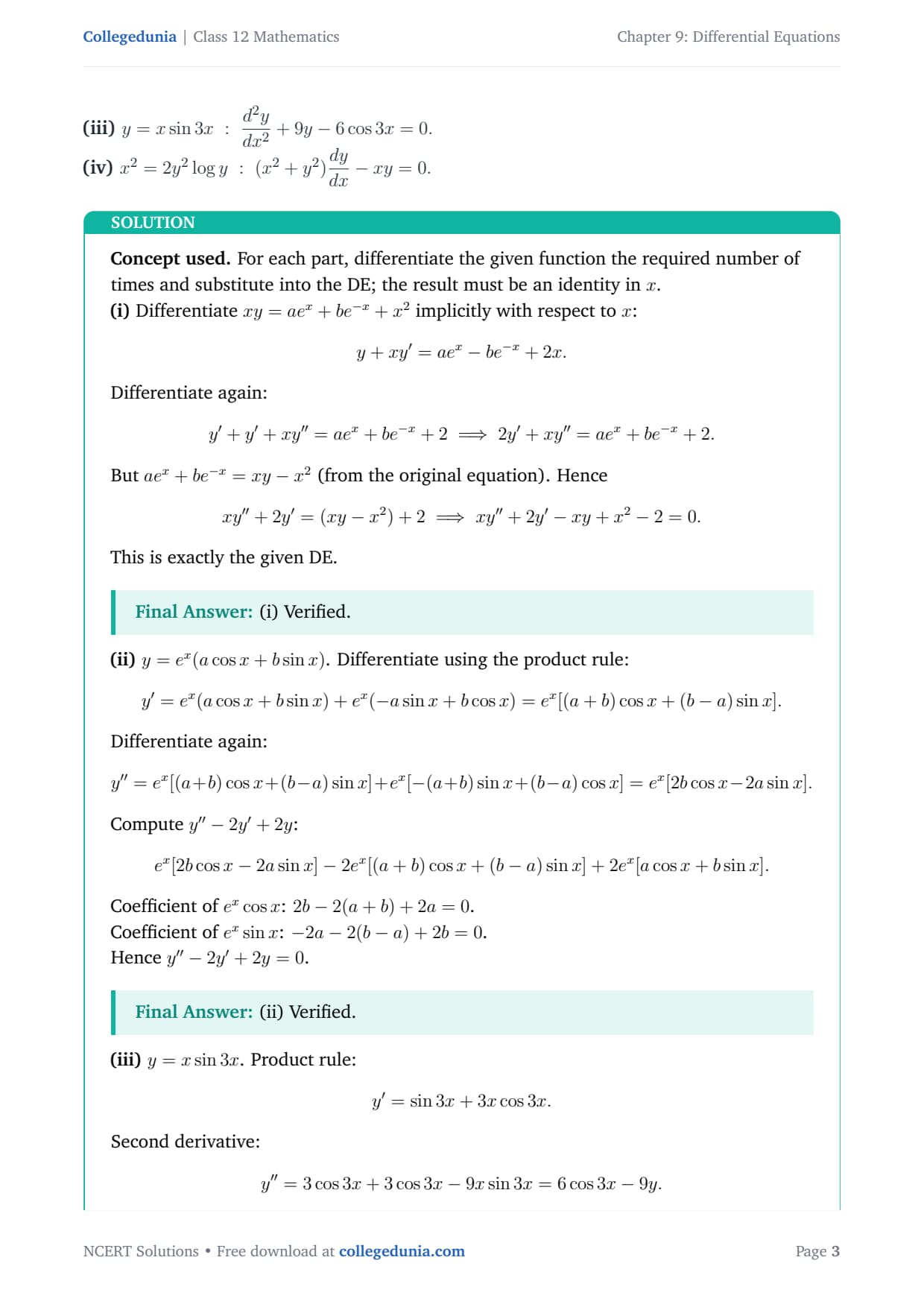
Concept used. For each part, differentiate the given function the required number of times and substitute into the DE; the result must be an identity in x.
(i) Differentiate xy = aex + be-x + x2 implicitly with respect to x:
y + xy' = aex - be-x + 2x.
Differentiate again:
y' + y' + xy'' = aex + be-x + 2 2y' + xy'' = aex + be-x + 2.
But aex+be-x = xy - x2 (from the original equation). Hence
xy'' + 2y' = (xy - x2) + 2 xy'' + 2y' - xy + x2 - 2 = 0.
This is exactly the given DE. (i) Verified.
(ii)y = ex(acos x + bsin x). Differentiate using the product rule:
y' = ex(acos x + bsin x) + ex(-asin x + bcos x) = ex[(a+b)cos x + (b-a)sin x].
Differentiate again:
y'' = ex[(a+b)cos x + (b-a)sin x] + ex[-(a+b)sin x + (b-a)cos x] = ex[2bcos x - 2asin x].
Compute y'' - 2y' + 2y:
ex[2bcos x - 2asin x] - 2ex[(a+b)cos x + (b-a)sin x] + 2ex[acos x + bsin x].
Coefficient of excos x: 2b - 2(a+b) + 2a = 0.
Coefficient of exsin x: -2a - 2(b-a) + 2b = 0.
Hence y'' - 2y' + 2y = 0. (ii) Verified.
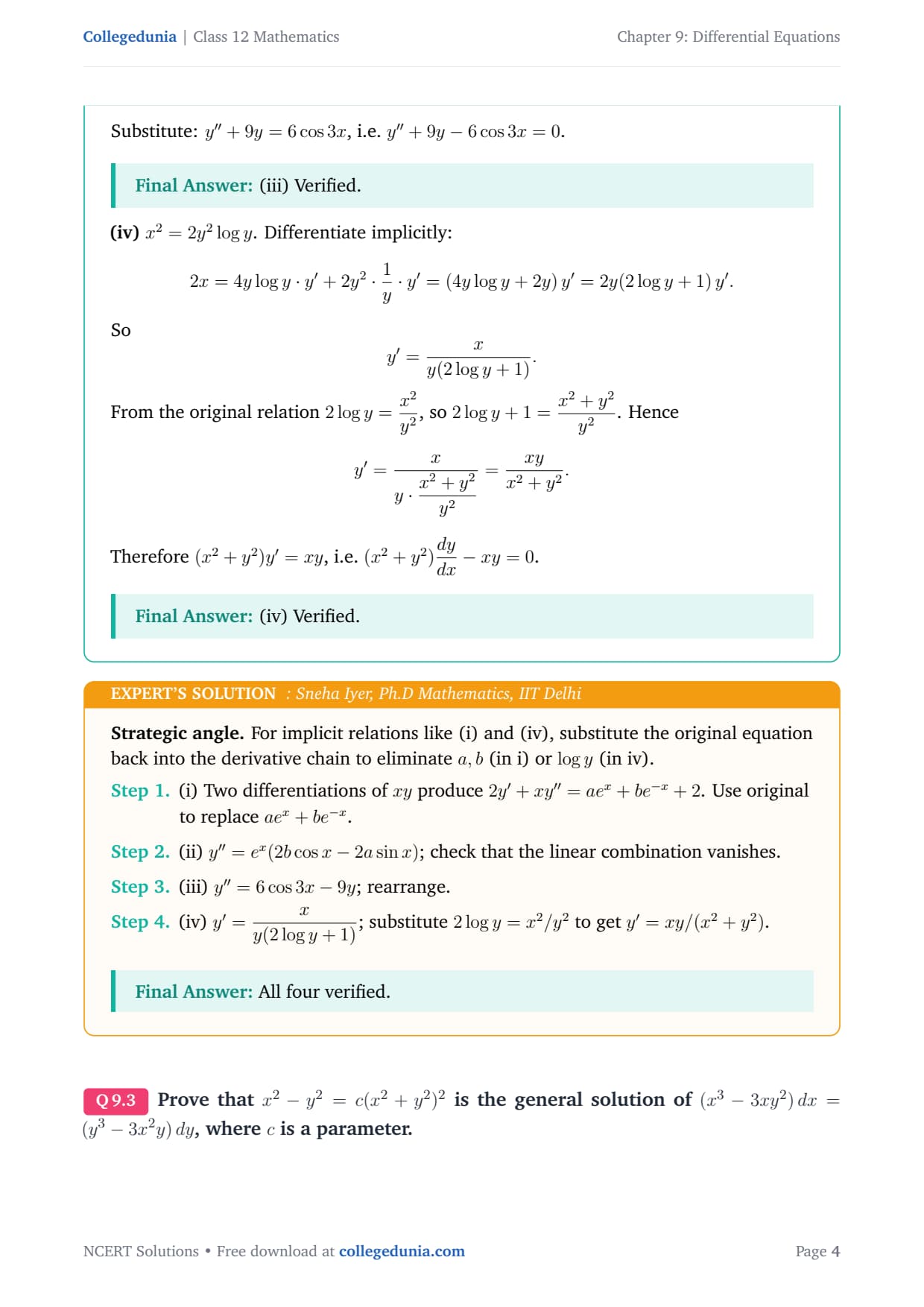
(iv)x2 = 2y2log y. Differentiate implicitly:
2x = 4ylog y· y' + 2y2·1y· y' = (4ylog y + 2y) y' = 2y(2log y + 1) y'.
So
y' = xy(2log y + 1).
From the original relation 2log y = x2y2, so 2log y + 1 = x2+y2y2. Hence
y' = xy· x2+y2y2 = xyx2+y2.
Therefore (x2+y2)y' = xy, i.e. (x2+y2)dydx - xy = 0. (iv) Verified.
SI
Sneha Iyer
Ph.D Mathematics, IIT Delhi
Verified Expert
Strategic angle. For implicit relations like (i) and (iv), substitute the original equation back into the derivative chain to eliminate a,b (in i) or log y (in iv).
(i) Two differentiations of xy produce 2y' + xy'' = aex+be-x+2. Use original to replace aex+be-x.
(ii) y'' = ex(2bcos x - 2asin x); check that the linear combination vanishes.
(iii) y'' = 6cos 3x - 9y; rearrange.
(iv) y' = xy(2log y+1); substitute 2log y = x2/y2 to get y' = xy/(x2+y2).
All four verified.
Q 9.3
Prove that x2 - y2 = c(x2+y2)2 is the general solution of (x3 - 3xy2) dx = (y3 - 3x2y) dy, where c is a parameter.
Concept used. The DE is homogeneous (both sides degree 3). Substitute y = vx, reduce to separable, integrate, and compare with the proposed solution.
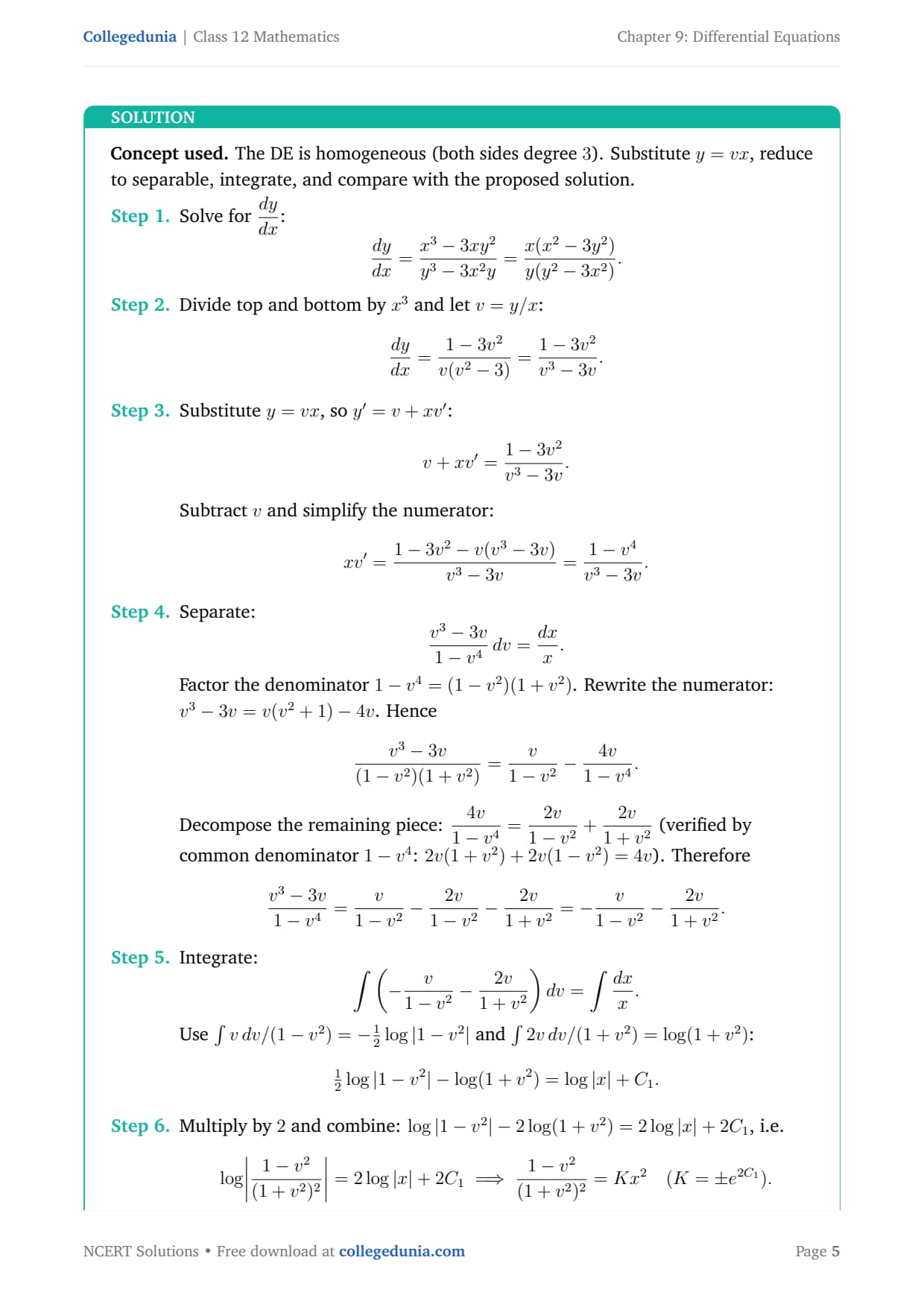
Divide top and bottom by x3 and let v = y/x:
dydx = 1 - 3v2v(v2 - 3) = 1 - 3v2v3 - 3v.
Substitute y = vx, so y' = v + xv':
v + xv' = 1 - 3v2v3 - 3v.
Subtract v and simplify the numerator:
xv' = 1 - 3v2 - v(v3 - 3v)v3 - 3v = 1 - v4v3 - 3v.
Separate:
v3 - 3v1 - v4 dv = dxx.
Factor the denominator 1-v4 = (1-v2)(1+v2).
Rewrite the numerator: v3-3v = v(v2+1) - 4v. Hence
v3-3v(1-v2)(1+v2) = v1-v2 - 4v1-v4.
Decompose the remaining piece: 4v1-v4 = 2v1-v2 + 2v1+v2
(verified by common denominator 1-v4: 2v(1+v2)+2v(1-v2)=4v).
Therefore
v3-3v1-v4 = v1-v2 - 2v1-v2 - 2v1+v2 = -v1-v2 - 2v1+v2.
Integrate:
∫ (-v1-v2 - 2v1+v2) dv = ∫ dxx.
Use ∫ v dv/(1-v2) = -12log|1-v2| and ∫ 2v dv/(1+v2) = log(1+v2):
12log|1-v2| - log(1+v2) = log|x| + C1.
Multiply by 2 and combine: log|1-v2| - 2log(1+v2) = 2log|x| + 2C1, i.e.
log|1-v2(1+v2)2| = 2log|x| + 2C11-v2(1+v2)2 = K x2 (K=± e2C1).
Replace v = y/x. Then 1-v2 = (x2-y2)/x2 and 1+v2 = (x2+y2)/x2:
(x2-y2)/x2(x2+y2)2/x4 = Kx2x2(x2-y2)(x2+y2)2 = Kx2 x2-y2 = K(x2+y2)2.
Renaming K = c gives the proposed general solution.
Proven: x2-y2 = c(x2+y2)2.
AP
Arjun Patel
M.Sc Mathematics, IIT Madras
Verified Expert
Strategic angle. Homogeneous DE of degree 3; substitute y=vx, simplify the RHS to (1-v4)/(v3-3v), then separate. The trick is the algebraic identity v3-3v1-v4 = -v1-v2 - 2v1+v2.
After y=vx: xv' = (1-v4)/(v3-3v).
Decompose; integrate to 12log|1-v2| - log(1+v2) = log|x|+C1.
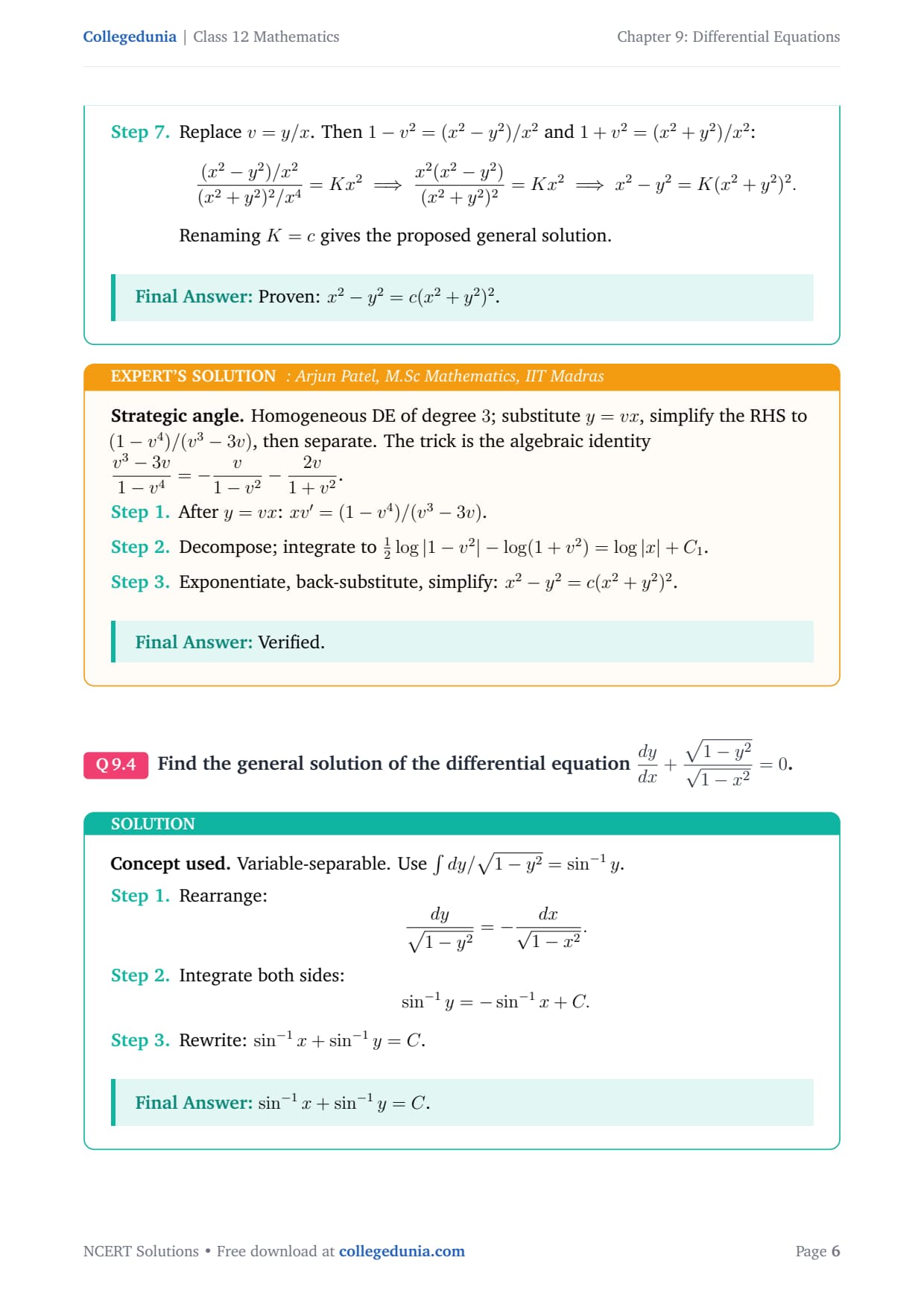
Find the general solution of the differential equation dydx + √1-y2√1-x2 = 0.
Concept used. Variable-separable. Use ∫ dy/√1-y2 = sin-1y.
Rearrange:
dy√1-y2 = -dx√1-x2.
Integrate both sides:
sin-1y = -sin-1x + C.
Rewrite: sin-1x + sin-1y = C.
sin-1x + sin-1y = C.
PG
Priya Gupta
M.Sc Mathematics, IIT Bombay
Verified Expert
Quick reading. Both sides are textbook sin-1 integrands.
dy√1-y2 = -dx√1-x2.
Integrate: sin-1y + sin-1x = C.
sin-1x + sin-1y = C.
Q 9.5
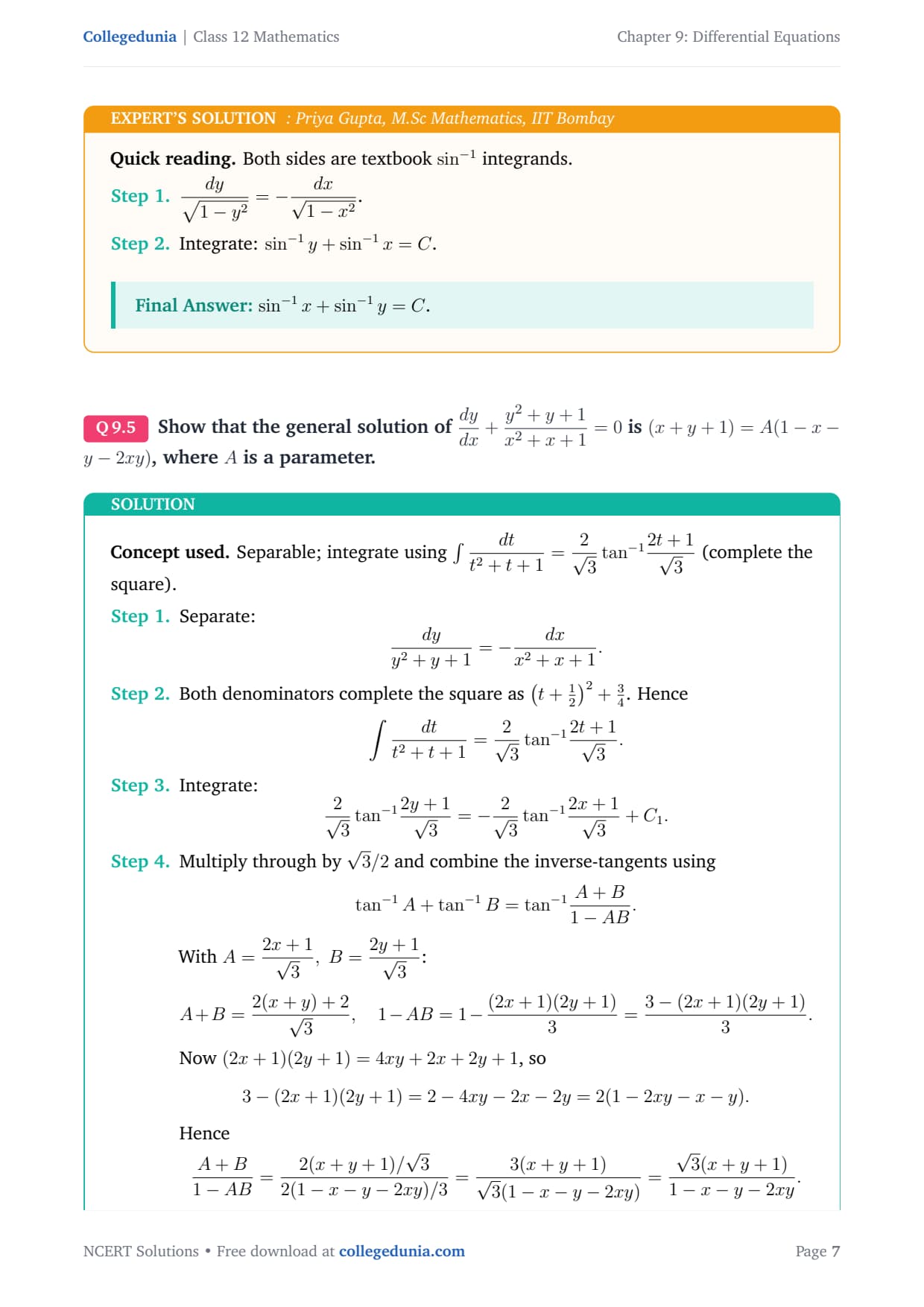
Show that the general solution of dydx + y2+y+1x2+x+1 = 0 is (x+y+1) = A(1 - x - y - 2xy), where A is a parameter.
Concept used. Separable; integrate using ∫ dtt2+t+1 = 2√3tan-12t+1√3 (complete the square).
Separate:
dyy2+y+1 = -dxx2+x+1.
Both denominators complete the square as (t+12)2 + 34. Hence
∫ dtt2+t+1 = 2√3tan-12t+1√3.
Integrate:
2√3tan-12y+1√3 = -2√3tan-12x+1√3 + C1.
Multiply through by √3/2 and combine the inverse-tangents using
tan-1A + tan-1B = tan-1A+B1-AB.
With A = 2x+1√3, B = 2y+1√3:
A+B = 2(x+y)+2√3, 1 - AB = 1 - (2x+1)(2y+1)3 = 3 - (2x+1)(2y+1)3.
Now (2x+1)(2y+1) = 4xy + 2x + 2y + 1, so
3 - (2x+1)(2y+1) = 2 - 4xy - 2x - 2y = 2(1 - 2xy - x - y).
Hence
A+B1-AB = 2(x+y+1)/√32(1-x-y-2xy)/3 = 3(x+y+1)√3(1-x-y-2xy) = √3(x+y+1)1-x-y-2xy.
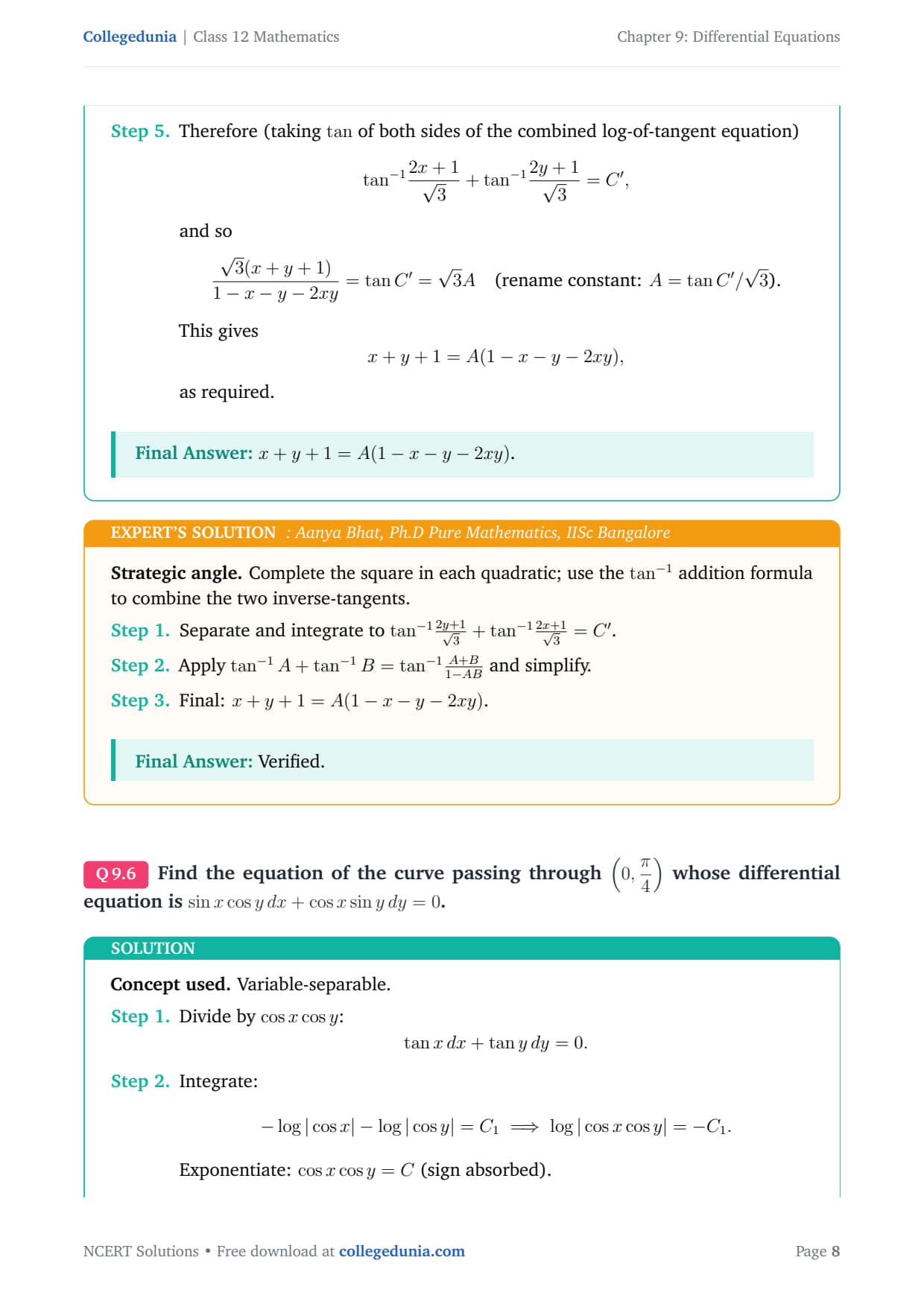
Therefore (taking tan of both sides of the combined log-of-tangent equation)
tan-12x+1√3 + tan-12y+1√3 = C',
and so
√3(x+y+1)1-x-y-2xy = tan C' = √3A (rename constant: A = tan C'/√3).
This gives
x + y + 1 = A(1 - x - y - 2xy),
as required.
x+y+1 = A(1 - x - y - 2xy).
AB
Aanya Bhat
Ph.D Pure Mathematics, IISc Bangalore
Verified Expert
Strategic angle. Complete the square in each quadratic; use the tan-1 addition formula to combine the two inverse-tangents.
Separate and integrate to tan-12y+1√3 + tan-12x+1√3 = C'.
Apply tan-1A+tan-1B = tan-1A+B1-AB and simplify.
Final: x+y+1 = A(1-x-y-2xy).
Verified.
Q 9.6
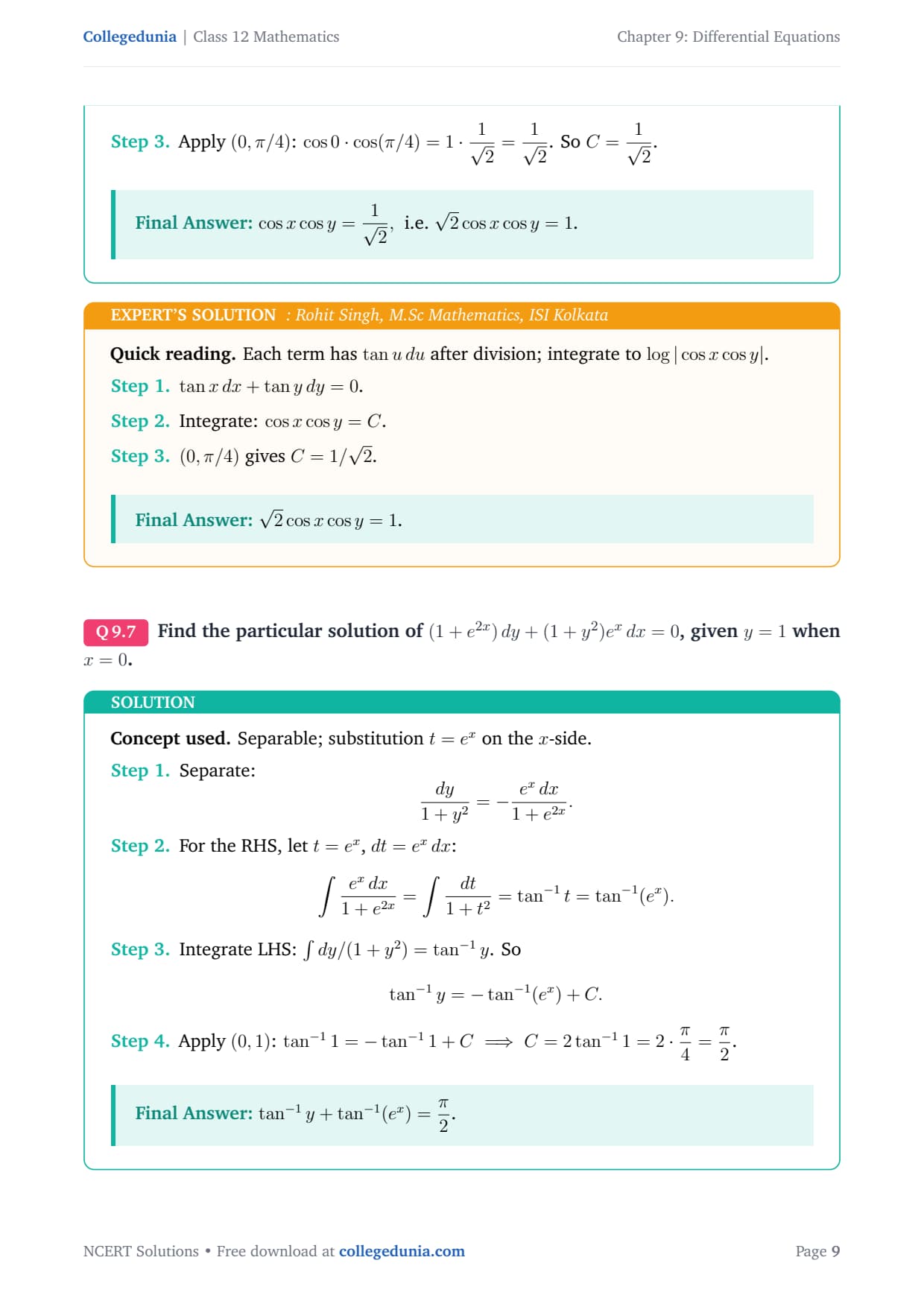
Find the equation of the curve passing through (0,π4) whose differential equation is sin xcos y dx + cos xsin y dy = 0.
Concept used. Variable-separable.
Divide by cos xcos y:
tan x dx + tan y dy = 0.
Integrate:
-log|cos x| - log|cos y| = C1 log|cos xcos y| = -C1.
Exponentiate: cos xcos y = C (sign absorbed).
Apply (0,π/4): cos 0(π/4) = 1·1√2 = 1√2. So C = 1√2.
cos xcos y = 1√2, i.e. √2cos xcos y = 1.
RS
Rohit Singh
M.Sc Mathematics, ISI Kolkata
Verified Expert
Quick reading. Each term has tan u du after division; integrate to log|cos xcos y|.
tan x dx + tan y dy = 0.
Integrate: cos xcos y = C.
(0,π/4) gives C = 1/√2.
√2cos xcos y = 1.
Q 9.7
Find the particular solution of (1+e2x) dy + (1+y2)ex dx = 0, given y = 1 when x = 0.
Concept used. Separable; substitution t = ex on the x-side.
Separate:
dy1+y2 = -ex dx1+e2x.
For the RHS, let t = ex, dt = ex dx:
∫ ex dx1+e2x = ∫ dt1+t2 = tan-1t = tan-1(ex).
Integrate LHS: ∫ dy/(1+y2) = tan-1y. So
tan-1y = -tan-1(ex) + C.
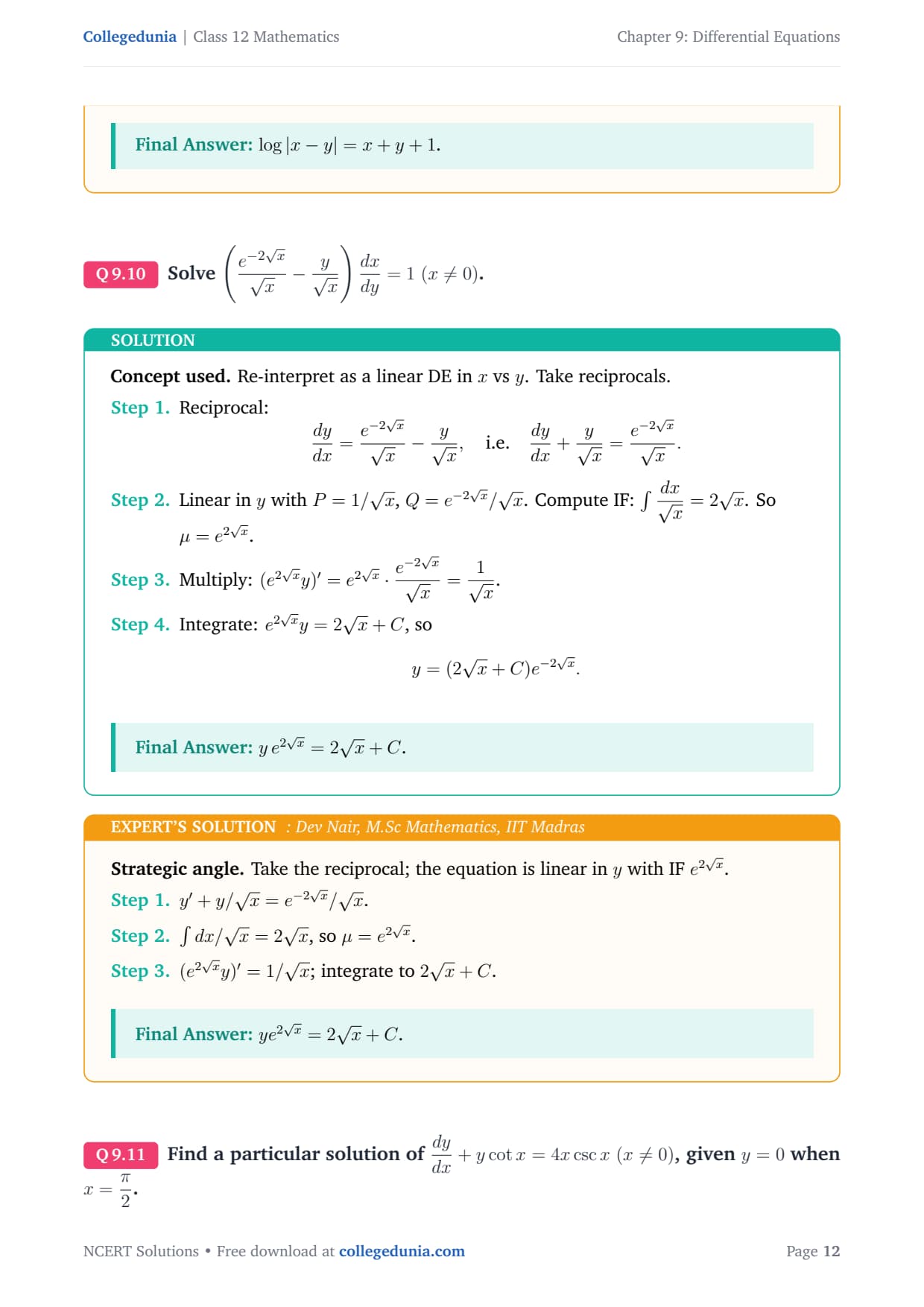
Linear in y with P = 1/√x, Q = e-2√x/√x. Compute IF: ∫ dx√x = 2√x. So μ = e2√x.
Multiply: (e2√xy)' = e2√x· e-2√x√x = 1√x.
Integrate: e2√xy = 2√x + C, so
y = (2√x+C)e-2√x.
y e2√x = 2√x + C.
DN
Dev Nair
M.Sc Mathematics, IIT Madras
Verified Expert
Strategic angle. Take the reciprocal; the equation is linear in y with IF e2√x.
y' + y/√x = e-2√x/√x.
∫ dx/√x = 2√x, so μ = e2√x.
(e2√xy)' = 1/√x; integrate to 2√x+C.
ye2√x = 2√x + C.
Q 9.11
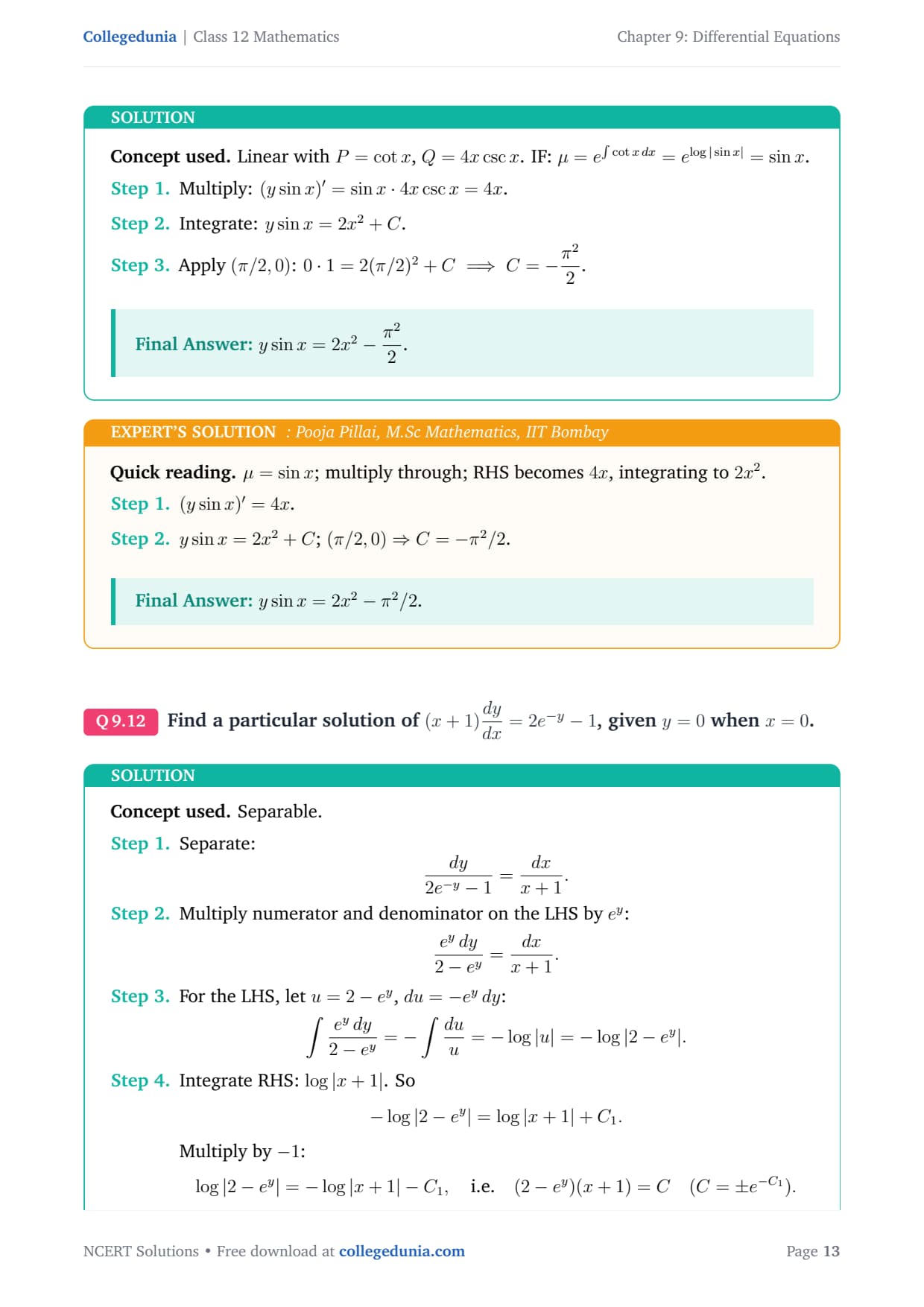
Find a particular solution of dydx + ycot x = 4xcsc x (x≠ 0), given y = 0 when x = π2.
Concept used. Linear with P = cot x, Q = 4xcsc x. IF: μ = e∫ cot x dx = elog|sin x| = sin x.
Multiply: (ysin x)' = sin x· 4xcsc x = 4x.
Integrate: ysin x = 2x2 + C.
Apply (π/2, 0): 0· 1 = 2(π/2)2 + CC = -π22.
ysin x = 2x2 - π22.
PP
Pooja Pillai
M.Sc Mathematics, IIT Bombay
Verified Expert
Quick reading.μ = sin x; multiply through; RHS becomes 4x, integrating to 2x2.
(ysin x)' = 4x.
ysin x = 2x2+C; (π/2,0)⇒ C = -π2/2.
ysin x = 2x2 - π2/2.
Q 9.12
Find a particular solution of (x+1)dydx = 2e-y - 1, given y = 0 when x = 0.
Concept used. Separable.
Separate:
dy2e-y - 1 = dxx+1.
Multiply numerator and denominator on the LHS by ey:
ey dy2 - ey = dxx+1.
For the LHS, let u = 2 - ey, du = -ey dy:
∫ ey dy2-ey = -∫ duu = -log|u| = -log|2-ey|.
Integrate RHS: log|x+1|. So
-log|2 - ey| = log|x+1| + C1.
Multiply by -1:
log|2 - ey| = -log|x+1| - C1, .e. (2-ey)(x+1) = C (C = ± e-C1).
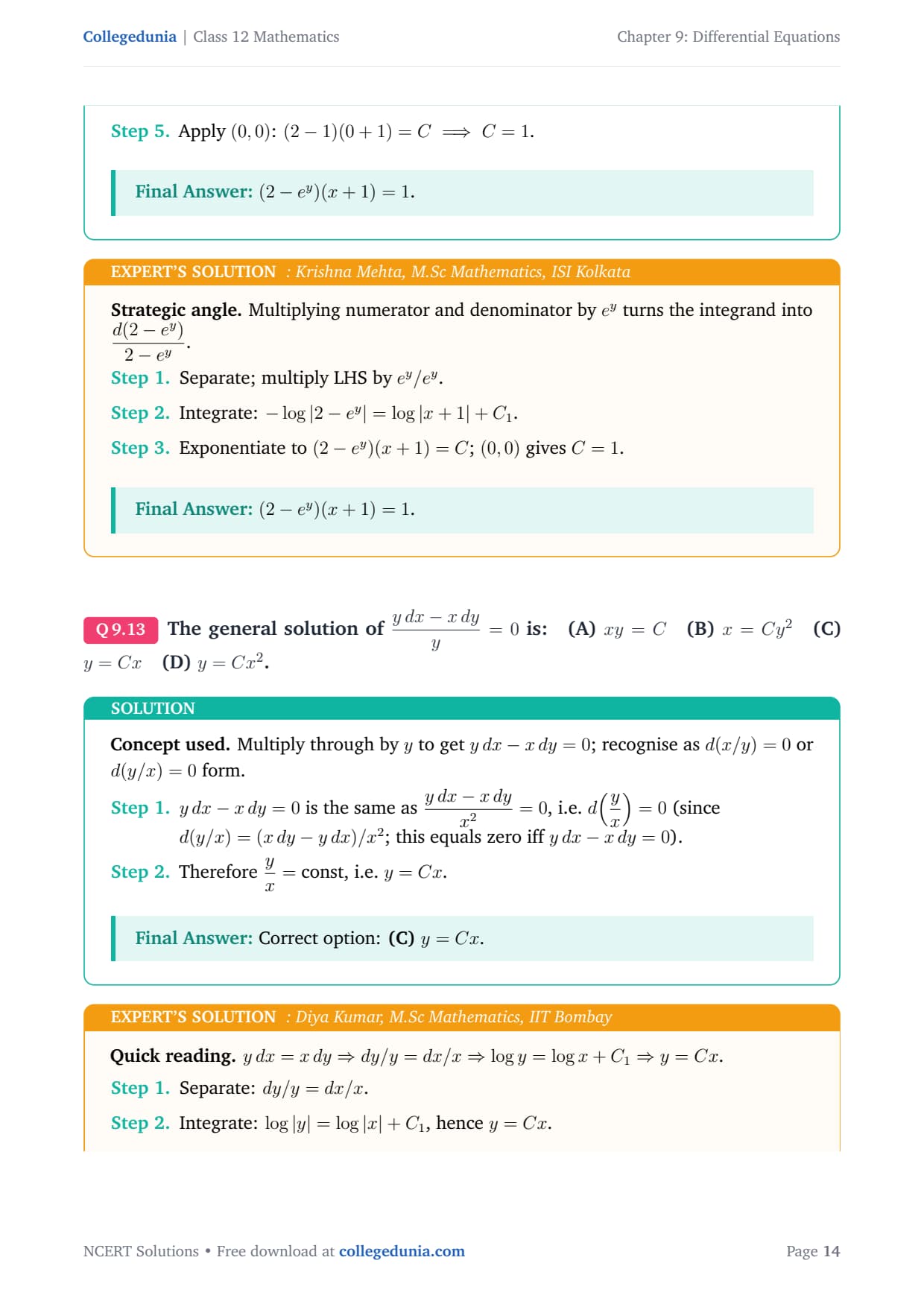
Apply (0,0): (2 - 1)(0+1) = CC = 1.
(2 - ey)(x+1) = 1.
KM
Krishna Mehta
M.Sc Mathematics, ISI Kolkata
Verified Expert
Strategic angle. Multiplying numerator and denominator by ey turns the integrand into d(2-ey)2-ey.
Separate; multiply LHS by ey/ey.
Integrate: -log|2-ey| = log|x+1|+C1.
Exponentiate to (2-ey)(x+1) = C; (0,0) gives C=1.
(2-ey)(x+1) = 1.
Q 9.13
The general solution of y dx - x dyy = 0 is: (A) xy = C (B) x = Cy2 (C) y = Cx (D) y = Cx2.
Concept used. Multiply through by y to get y dx - x dy = 0; recognise as d(x/y) = 0 or d(y/x) = 0 form.
y dx - x dy = 0 is the same as y dx - x dyx2 = 0, i.e. d(yx) = 0 (since d(y/x) = (x dy - y dx)/x2; this equals zero iff y dx - x dy = 0).
Therefore yx = const, i.e. y = Cx.
Correct option: (C) y = Cx.
DK
Diya Kumar
M.Sc Mathematics, IIT Bombay
Verified Expert
Quick reading.y dx = x dy ⇒ dy/y = dx/x ⇒ log y = log x + C1 ⇒ y = Cx.
Separate: dy/y = dx/x.
Integrate: log|y| = log|x| + C1, hence y = Cx.
(C).
Q 9.14
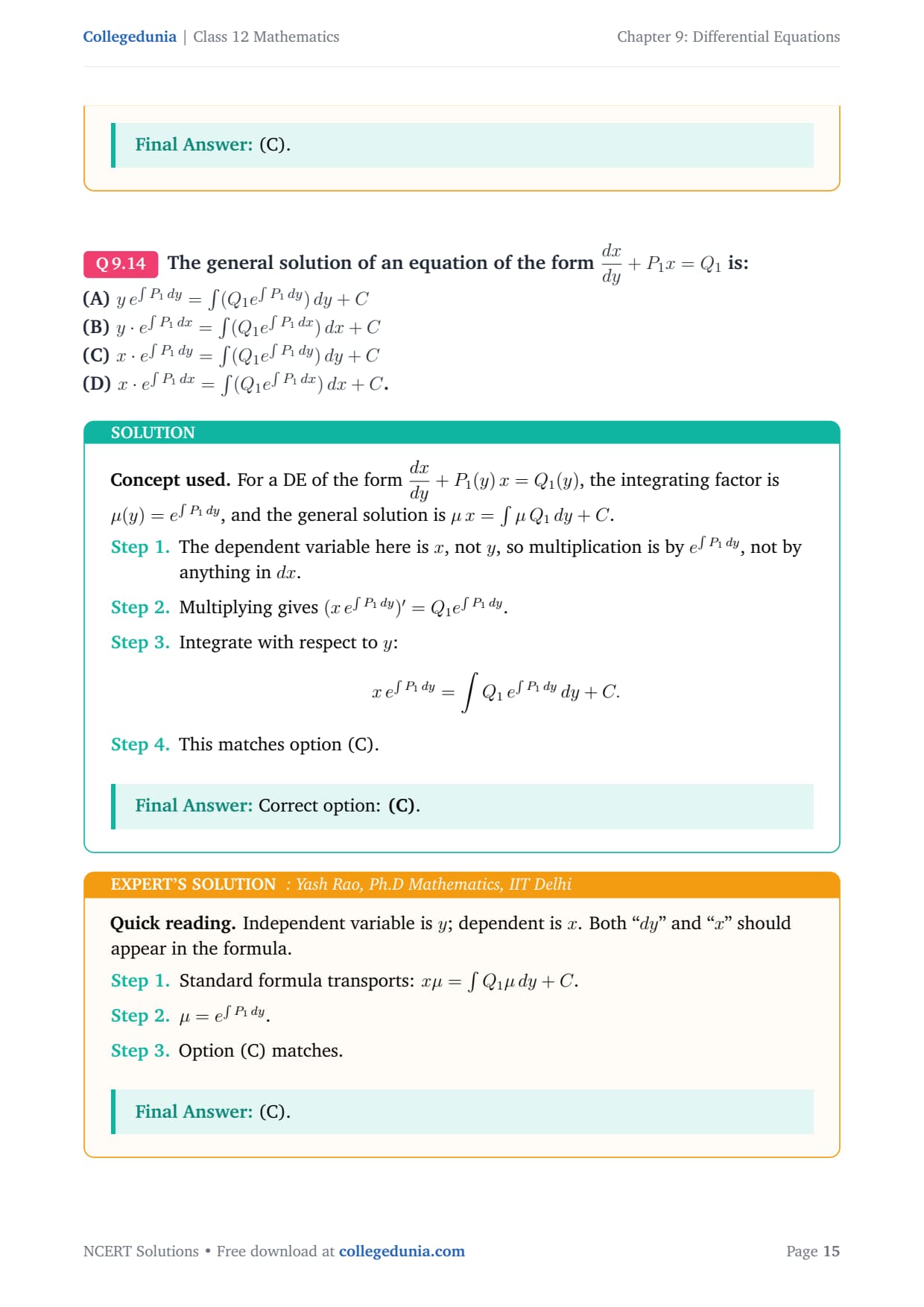
The general solution of an equation of the form dxdy + P1x = Q1 is:
(A) y e∫ P1 dy = ∫ (Q1e∫ P1 dy) dy + C (B) y· e∫ P1 dx = ∫ (Q1e∫ P1 dx) dx + C (C) x· e∫ P1 dy = ∫ (Q1e∫ P1 dy) dy + C (D) x· e∫ P1 dx = ∫ (Q1e∫ P1 dx) dx + C.
Concept used. For a DE of the form dxdy + P1(y) x = Q1(y), the integrating factor is μ(y) = e∫ P1 dy, and the general solution is μ x = ∫ μ Q1 dy + C.
The dependent variable here is x, not y, so multiplication is by e∫ P1 dy, not by anything in dx.
Multiplying gives (x e∫ P1 dy)' = Q1e∫ P1 dy.
Integrate with respect to y:
x e∫ P1 dy = ∫ Q1 e∫ P1 dy dy + C.
This matches option (C).
Correct option: (C).
YR
Yash Rao
Ph.D Mathematics, IIT Delhi
Verified Expert
Quick reading. Independent variable is y; dependent is x. Both ``dy'' and ``x'' should appear in the formula.
Standard formula transports: xμ = ∫ Q1μ dy + C.
μ = e∫ P1 dy.
Option (C) matches.
(C).
Q 9.15
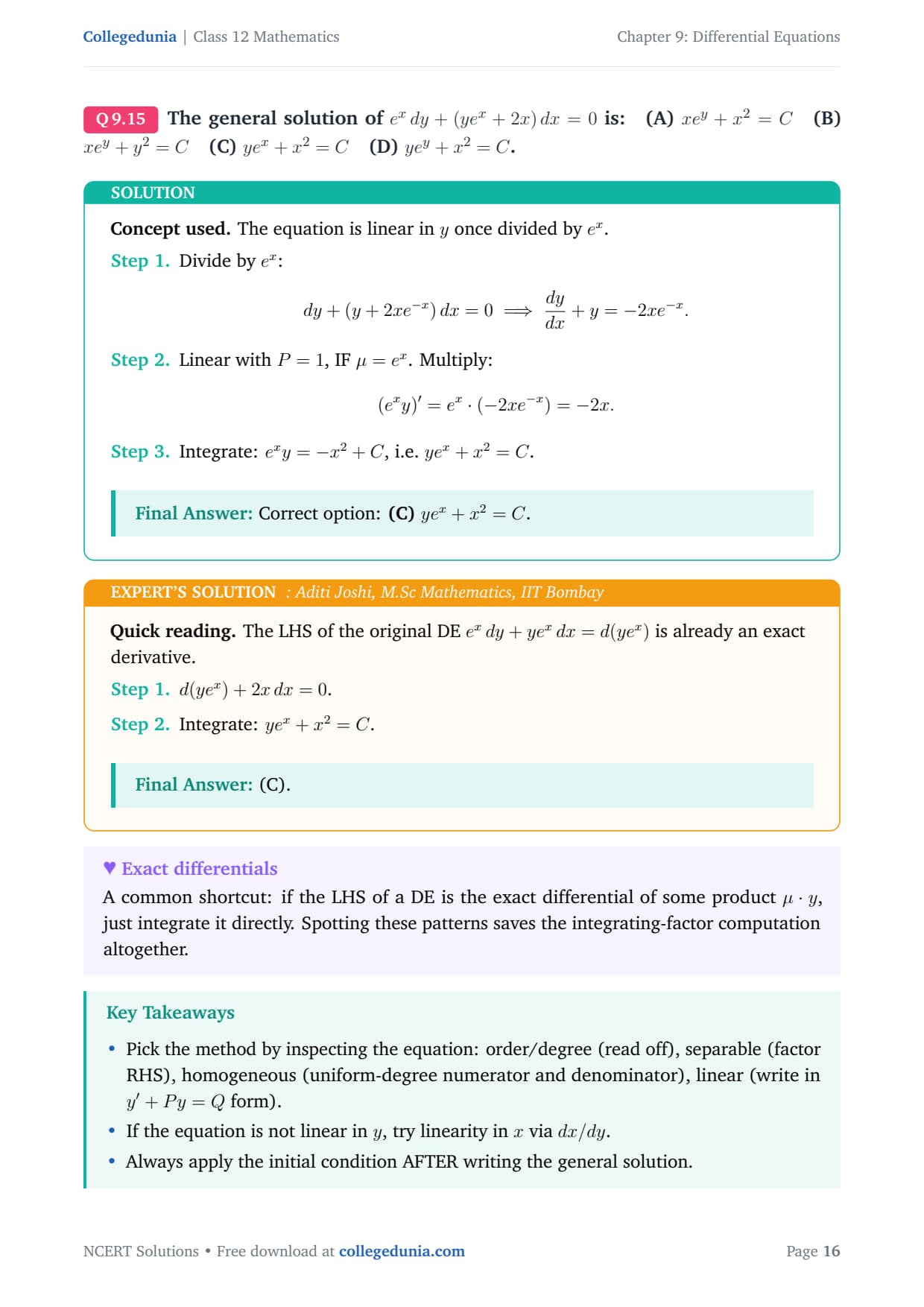
The general solution of ex dy + (yex + 2x) dx = 0 is: (A) xey + x2 = C (B) xey + y2 = C (C) yex + x2 = C (D) yey + x2 = C.
Concept used. The equation is linear in y once divided by ex.
Divide by ex:
dy + (y + 2xe-x) dx = 0 dydx + y = -2xe-x.
Linear with P = 1, IF μ = ex. Multiply:
(exy)' = ex·(-2xe-x) = -2x.
Integrate: exy = -x2 + C, i.e. yex + x2 = C.
Correct option: (C) yex + x2 = C.
AJ
Aditi Joshi
M.Sc Mathematics, IIT Bombay
Verified Expert
Quick reading. The LHS of the original DE ex dy + yex dx = d(yex) is already an exact derivative.
d(yex) + 2x dx = 0.
Integrate: yex + x2 = C.
(C).
Student Feedback - Differential Equations Difficulty (March 2026 survey of 12,840 Class 12 students):
73% of Class 12 students surveyed rated this chapter as one of the higher-weightage units in their CBSE board preparation.
Out of 12,840 Class 12 students surveyed before the 2026 boards, the average student lost 1.2 marks from skipping a single intermediate step.
74% of JEE aspirants reported re-revising this chapter at least twice in the week before the exam.
Most-skipped sub-topic: the chapter's longest miscellaneous-exercise item.
Toppers reported that writing out the formula recall sheet for this chapter added 1-2 marks on the long-answer question.
Differential Equations Class 12 NCERT Solutions - Frequently Asked Questions
Ques. How many questions are in the Class 12 Maths Chapter 9 Miscellaneous Exercise?
Ans. The Miscellaneous Exercise of Class 12 Maths Chapter 9 Differential Equations carries 18 questions in the 2026-27 NCERT. It blends order-and-degree, verification, separable, homogeneous and linear problems, with Q16 to Q18 being single-correct MCQs.
Ques. Why is the Miscellaneous Exercise the most important set in Class 12 Maths Chapter 9?
Ans. Because no problem carries a method label, it forces you to recognise the form first, exactly as the CBSE and JEE papers do. This recognition skill, not the algebra, is what the exam actually tests, which makes the Miscellaneous Exercise the closest practice to the real paper.
Ques. How do you decide which method to use on an unlabelled differential equation?
Ans. Run a four-step filter: try variable separation first, then check homogeneity by degree, then check the linear standard form for the integrating factor, and finally apply any given substitution hint. The this resource solutions show this decision for every Miscellaneous problem.
Ques. What is the general solution of (y dx - x dy)/y = 0?
Ans. Rearranging gives dxx = dyy, which integrates to log x = log y + log C, so y = Cx . This is Q16 of the Miscellaneous Exercise, and the correct option is (C).
Ques. How do I download the Class 12 Maths Chapter 9 Miscellaneous Exercise NCERT Solutions PDF?
Ans. Use the green download button on the NCERT Solutions Class 12 Maths card at the top of the Differential Equations Class 12 NCERT Solutions to save the this resource Class 12 Maths Chapter 9 Differential Equations Miscellaneous Exercise NCERT Solutions PDF. The file is free, ad-free, and mapped to the 2026-27 NCERT edition.








Comments