




The handwritten notes on Class 6 Mathematics Ganita Prakash Chapter 7 Fractions have been carefully prepared for quick 2026-27 revision. The PDF covers equal shares, fractional units, number line marking, mixed numbers, equivalent fractions, comparison, addition and subtraction.
- Best use: revise the full Fractions chapter before school tests and homework correction.
- PDF focus: unit fractions, mixed numbers, lowest terms and common-denominator work.
- Chapter value: Fractions builds the base for decimals, ratio and algebra later.
Chapter7FractionsHandwrittenNotes.pdf?page=1&dpi=150)
Chapter7FractionsHandwrittenNotes.pdf?page=2&dpi=150)
Chapter7FractionsHandwrittenNotes.pdf?page=3&dpi=150)
Chapter7FractionsHandwrittenNotes.pdf?page=4&dpi=150)
Chapter7FractionsHandwrittenNotes.pdf?page=5&dpi=150)
Chapter7FractionsHandwrittenNotes.pdf?page=6&dpi=150)
Chapter7FractionsHandwrittenNotes.pdf?page=7&dpi=150)
Chapter7FractionsHandwrittenNotes.pdf?page=8&dpi=150)
Chapter7FractionsHandwrittenNotes.pdf?page=9&dpi=150)
Chapter7FractionsHandwrittenNotes.pdf?page=10&dpi=150)
Chapter7FractionsHandwrittenNotes.pdf?page=11&dpi=150)
Chapter7FractionsHandwrittenNotes.pdf?page=12&dpi=150)
Chapter7FractionsHandwrittenNotes.pdf?page=13&dpi=150)
Chapter7FractionsHandwrittenNotes.pdf?page=14&dpi=150)
Chapter7FractionsHandwrittenNotes.pdf?page=15&dpi=150)
Chapter7FractionsHandwrittenNotes.pdf?page=16&dpi=150)
Chapter7FractionsHandwrittenNotes.pdf?page=17&dpi=150)
Chapter7FractionsHandwrittenNotes.pdf?page=18&dpi=150)
Chapter7FractionsHandwrittenNotes.pdf?page=19&dpi=150)
Chapter7FractionsHandwrittenNotes.pdf?page=20&dpi=150)
Chapter7FractionsHandwrittenNotes.pdf?page=21&dpi=150)
Chapter7FractionsHandwrittenNotes.pdf?page=22&dpi=150)
Chapter7FractionsHandwrittenNotes.pdf?page=23&dpi=150)
Chapter7FractionsHandwrittenNotes.pdf?page=24&dpi=150)
Chapter7FractionsHandwrittenNotes.pdf?page=25&dpi=150)
Chapter7FractionsHandwrittenNotes.pdf?page=26&dpi=150)
Chapter7FractionsHandwrittenNotes.pdf?page=27&dpi=150)
Chapter7FractionsHandwrittenNotes.pdf?page=28&dpi=150)
Chapter7FractionsHandwrittenNotes.pdf?page=29&dpi=150)
Chapter7FractionsHandwrittenNotes.pdf?page=30&dpi=150)
Download Class 6 Maths Chapter 7 Fractions Handwritten Notes PDF
Use the PDF for quick handwritten revision before tests and homework practice.
Each Fractions handwritten notes page is checked against the 2026-27 NCERT Class 6 Ganita Prakash textbook and arranged for fast revision.
Student Feedback: In a Collegedunia study check of 10,920 Class 6 students, most students found Fractions easier after they wrote the whole, denominator and numerator before solving.
|
Table of Contents |
Class 6 Mathematics Fractions Handwritten Notes Overview
Fractions teaches students to read a part as a share of one clear whole. The handwritten PDF starts with unit fractions and equal sharing. It then moves to number lines, mixed numbers, equivalent fractions, comparison, addition and subtraction.
The main check is simple: first ask what the whole is. After that, read the denominator as the number of equal parts and the numerator as the number of parts taken.
Fractions Video Revision for Class 6 Ganita Prakash
Source: Magnet Brains on YouTube
What the Fractions Handwritten Notes PDF Covers
The PDF has 21 handwritten pages. Each page focuses on one study point, so students can revise without reading the full textbook again.
- Meaning: equal shares, unit fractions and parts of a whole.
- Number line: fractions below 1 and fractions greater than 1.
- Forms: improper fractions, mixed numbers and lowest terms.
- Operations: comparison, addition and subtraction with common denominators.
Fractional Unit and Equal Shares in the Fractions Chapter
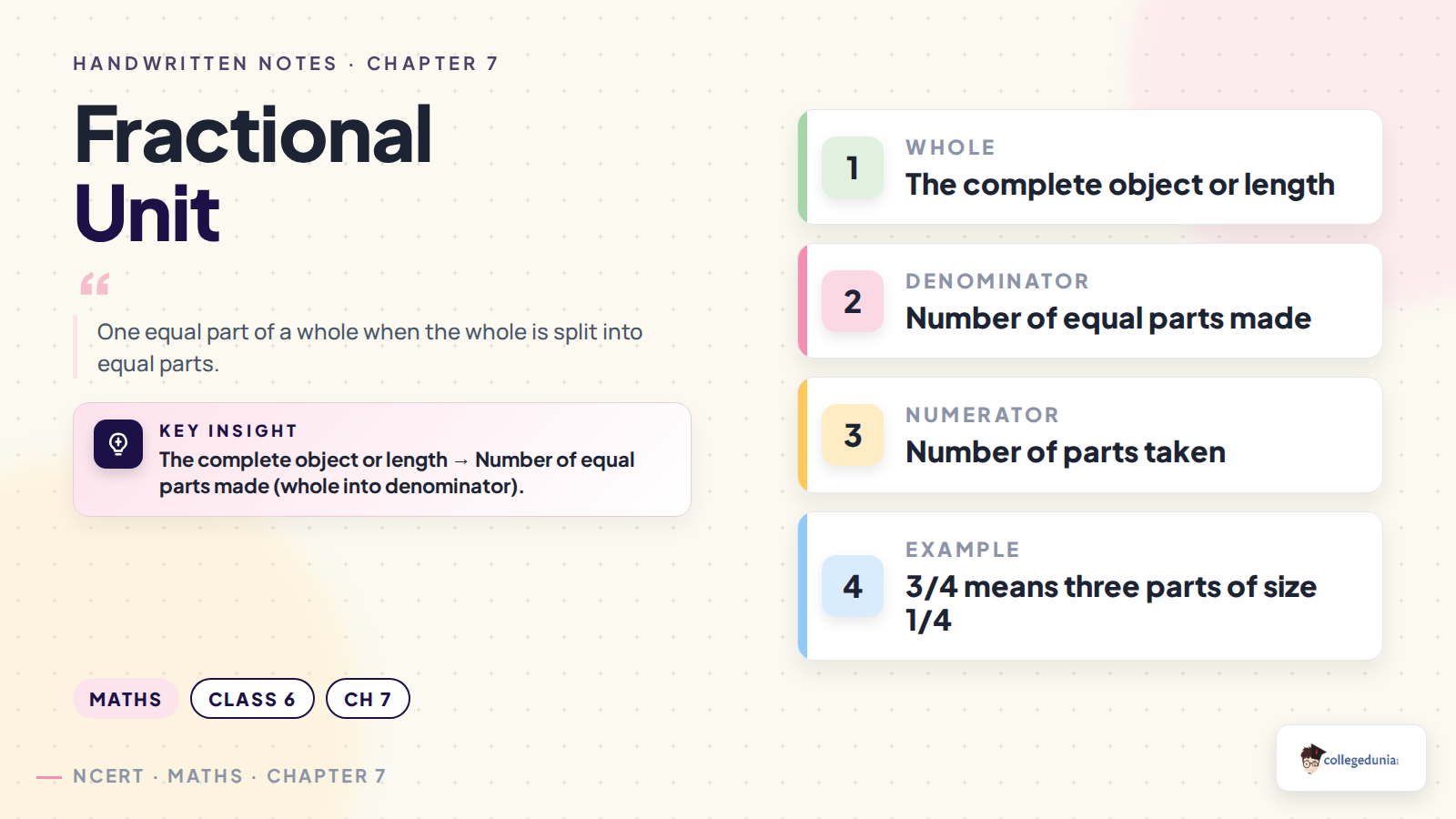
A fractional unit is one equal part of a whole. If one roti is shared by two children, each child gets 1/2. If the same roti is shared by four children, each child gets 1/4.
More children sharing the same whole means a smaller share. This is why 1/5 is bigger than 1/9, even though 9 is the bigger denominator.
| Term | Meaning | Example |
|---|---|---|
| Whole | The complete object or length | One roti or one strip |
| Denominator | Number of equal parts | 4 in 3/4 |
| Numerator | Number of parts taken | 3 in 3/4 |
Mixed Numbers and Equivalent Fractions in Class 6 Fractions
A fraction greater than 1 can be written as a mixed number. For example, 8/3 means two whole units and 2/3 more, so it becomes 2 2/3.
Equivalent fractions show the same share with different names. A fraction wall helps students see that 1/2, 2/4 and 4/8 are equal.
- To change 47/9, divide 47 by 9. The answer is 5 2/9.
- To change 3 1/4, multiply 3 by 4 and add 1. The answer is 13/4.
- To reduce 16/20, divide both numbers by 4. The answer is 4/5.
Comparing and Calculating Fractions with Common Denominators
Fractions are easier to compare when they use the same fractional unit. That means the denominators should match before comparing, adding or subtracting.
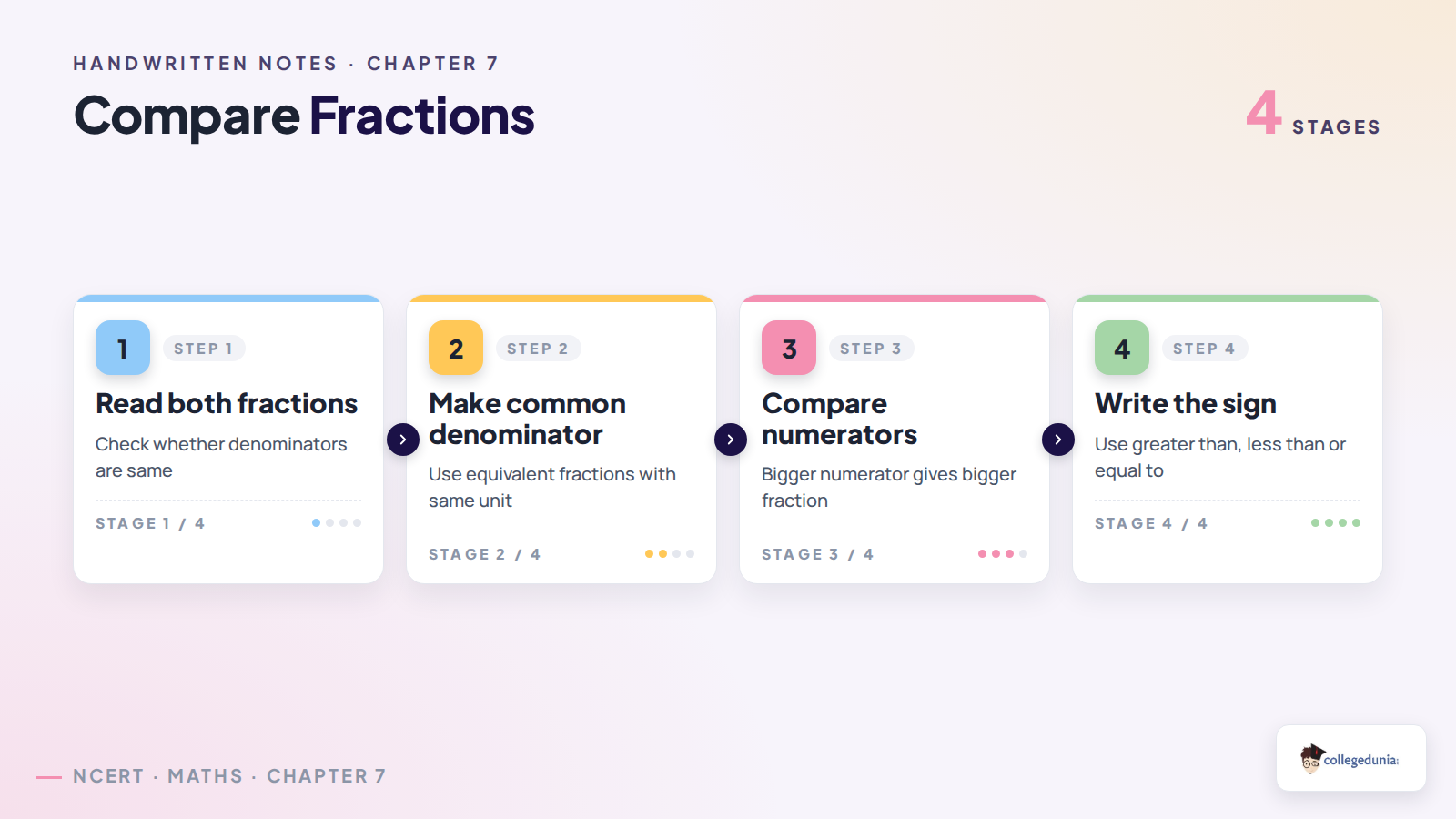
For example, to compare 3/4 and 7/10, use denominator 20. Then 3/4 becomes 15/20 and 7/10 becomes 14/20, so 3/4 is greater.
- Add like fractions by adding numerators only.
- Subtract like fractions by subtracting numerators only.
- For unlike fractions, make common denominators first.
Common Mistakes Students Make in the Fractions Chapter
Most wrong answers come from reading the denominator like an ordinary bigger number. The denominator actually tells how small each equal part is.
- Do not say 1/9 is bigger than 1/5.
- Do not add denominators while adding fractions.
- Do not compare unlike denominators without making a common denominator.
- Do not forget to reduce a fraction to lowest terms.
- Do not write a mixed number without checking the remainder.
Tip: draw a small strip when the comparison feels confusing. It shows the size of the share quickly.
Related NCERT Resources for Fractions Class 6
| Resource | Link |
|---|---|
| NCERT Solutions | Class 6 Mathematics Chapter 7 NCERT Solutions |
| NCERT Book PDF | Class 6 Mathematics Chapter 7 Book PDF |
| NCERT Notes | Class 6 Mathematics Chapter 7 Notes |
More Class 6 Mathematics Handwritten Notes
| Chapter | Handwritten Notes |
|---|---|
| Chapter 1 | Patterns in Mathematics |
| Chapter 2 | Lines and Angles |
| Chapter 3 | Number Play |
| Chapter 4 | Data Handling and Presentation |
| Chapter 5 | Prime Time |
| Chapter 6 | Perimeter and Area |
Fractions Class 6 Handwritten Notes FAQs
Ques. What is covered in Class 6 Fractions handwritten notes?
Ans. The notes cover equal shares, unit fractions, number line fractions, mixed numbers, equivalent fractions, comparison, addition and subtraction.
Ques. Are these Fractions notes based on the 2026-27 Ganita Prakash textbook?
Ans. Yes. The PDF follows Class 6 Mathematics Ganita Prakash Chapter 7 Fractions for the 2026-27 session.
Ques. How should students revise Fractions from this PDF?
Ans. Students should revise unit fractions first, then mixed numbers, equivalent fractions and common-denominator operations.
Ques. Why are handwritten notes useful for Fractions?
Ans. Handwritten notes keep each fraction rule beside a short example, which helps students remember the method faster.



Comments