




The handwritten notes on Class 6 Mathematics Ganita Prakash Chapter 9 Symmetry have been prepared for quick 2026-27 revision. The PDF covers line symmetry, reflection, paper folding, rotational symmetry, radial arms, circles and tile patterns.
- Best use: revise fold lines, turn angles and diagrams before school tests.
- PDF focus: short definitions, labelled sketches, common mistakes and final checks.
- Chapter value: symmetry builds visual reasoning for geometry and patterns.
Chapter9SymmetryHandwrittenNotes.pdf?page=1&dpi=150)
Chapter9SymmetryHandwrittenNotes.pdf?page=2&dpi=150)
Chapter9SymmetryHandwrittenNotes.pdf?page=3&dpi=150)
Chapter9SymmetryHandwrittenNotes.pdf?page=4&dpi=150)
Chapter9SymmetryHandwrittenNotes.pdf?page=5&dpi=150)
Chapter9SymmetryHandwrittenNotes.pdf?page=6&dpi=150)
Chapter9SymmetryHandwrittenNotes.pdf?page=7&dpi=150)
Chapter9SymmetryHandwrittenNotes.pdf?page=8&dpi=150)
Chapter9SymmetryHandwrittenNotes.pdf?page=9&dpi=150)
Chapter9SymmetryHandwrittenNotes.pdf?page=10&dpi=150)
Chapter9SymmetryHandwrittenNotes.pdf?page=11&dpi=150)
Chapter9SymmetryHandwrittenNotes.pdf?page=12&dpi=150)
Chapter9SymmetryHandwrittenNotes.pdf?page=13&dpi=150)
Chapter9SymmetryHandwrittenNotes.pdf?page=14&dpi=150)
Chapter9SymmetryHandwrittenNotes.pdf?page=15&dpi=150)
Chapter9SymmetryHandwrittenNotes.pdf?page=16&dpi=150)
Chapter9SymmetryHandwrittenNotes.pdf?page=17&dpi=150)
Chapter9SymmetryHandwrittenNotes.pdf?page=18&dpi=150)
Chapter9SymmetryHandwrittenNotes.pdf?page=19&dpi=150)
Chapter9SymmetryHandwrittenNotes.pdf?page=20&dpi=150)
Chapter9SymmetryHandwrittenNotes.pdf?page=21&dpi=150)
Chapter9SymmetryHandwrittenNotes.pdf?page=22&dpi=150)
Chapter9SymmetryHandwrittenNotes.pdf?page=23&dpi=150)
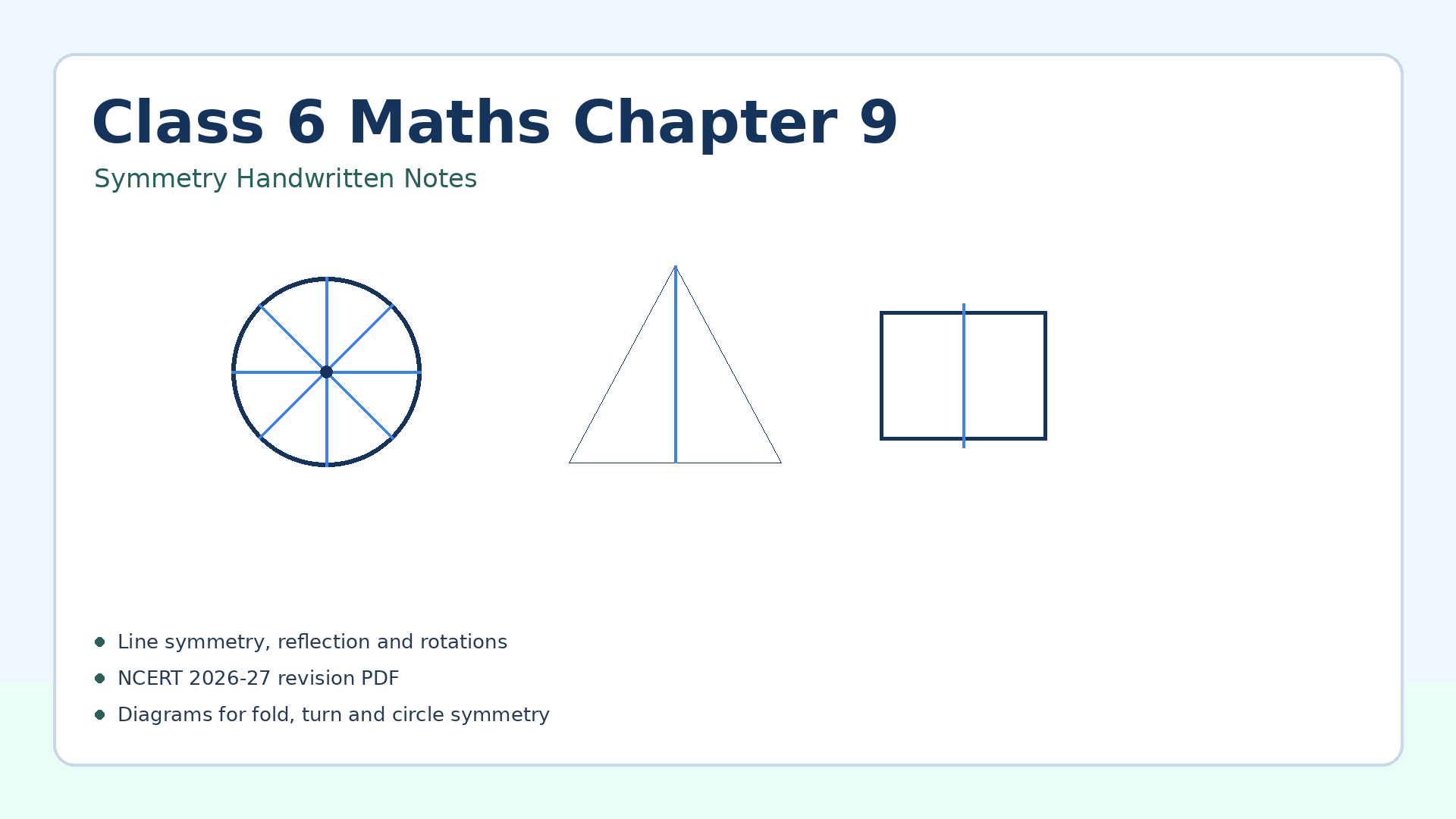
Each Symmetry handwritten notes page is checked against the 2026-27 NCERT Class 6 Ganita Prakash textbook and arranged for fast revision.
Student Feedback: In a Collegedunia study check of 9,640 Class 6 students, most students found rotational symmetry easier after drawing the centre point first.
Class 6 Mathematics Symmetry Handwritten Notes Overview
Symmetry teaches students to check whether a figure has repeated parts in a definite pattern. The handwritten PDF starts with mirror halves. It then moves to reflection, paper folding, punching, rotational symmetry and circle symmetry.
The main habit is simple: test the figure, do not guess from looks. For line symmetry, fold or imagine a mirror line. For rotational symmetry, mark the centre and turn the figure.
Symmetry Video Revision for Class 6 Ganita Prakash
Source: Magnet Brains on YouTube
What the Symmetry Handwritten Notes PDF Covers
The PDF has 23 handwritten pages. Each page focuses on one idea, so students can revise the chapter without reading the full textbook again.
- Line symmetry: fold lines, mirror halves and reflection of points.
- Paper work: ink blot, punching, cutting and grid completion tasks.
- Rotation: centre of rotation, smallest angle and order of symmetry.
- Revision checks: circle symmetry, regular polygons, tile game and common mistakes.
Line Symmetry and Reflection in Symmetry Chapter 9
A line of symmetry cuts a figure into two parts that exactly overlap when folded. This is why it is also called a mirror line.
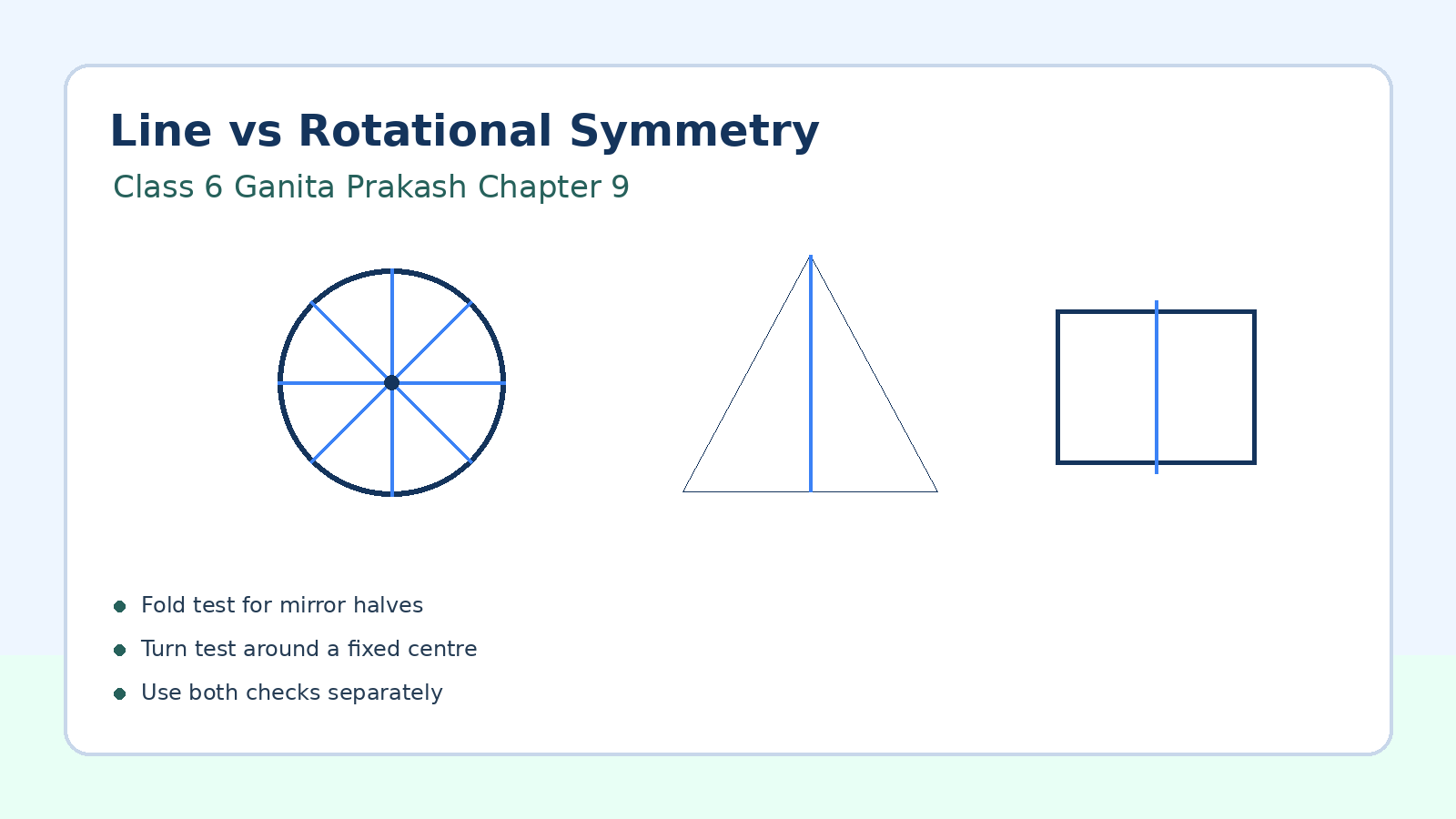
Reflection keeps the same distance from the mirror line. In a square, the vertical line swaps A with B and D with C. The diagonal line from A to C keeps A and C fixed while B and D change places.
| Figure | Line symmetry check | Useful memory |
|---|---|---|
| Square | 4 lines | Vertical, horizontal and both diagonals |
| Rectangle | 2 lines | Diagonal usually does not work |
| Equilateral triangle | 3 lines | One from each vertex |
Rotational Symmetry and Angles in Class 6 Symmetry
A figure has rotational symmetry when it looks exactly the same after a turn about a fixed point. The fixed point is called the centre of rotation.
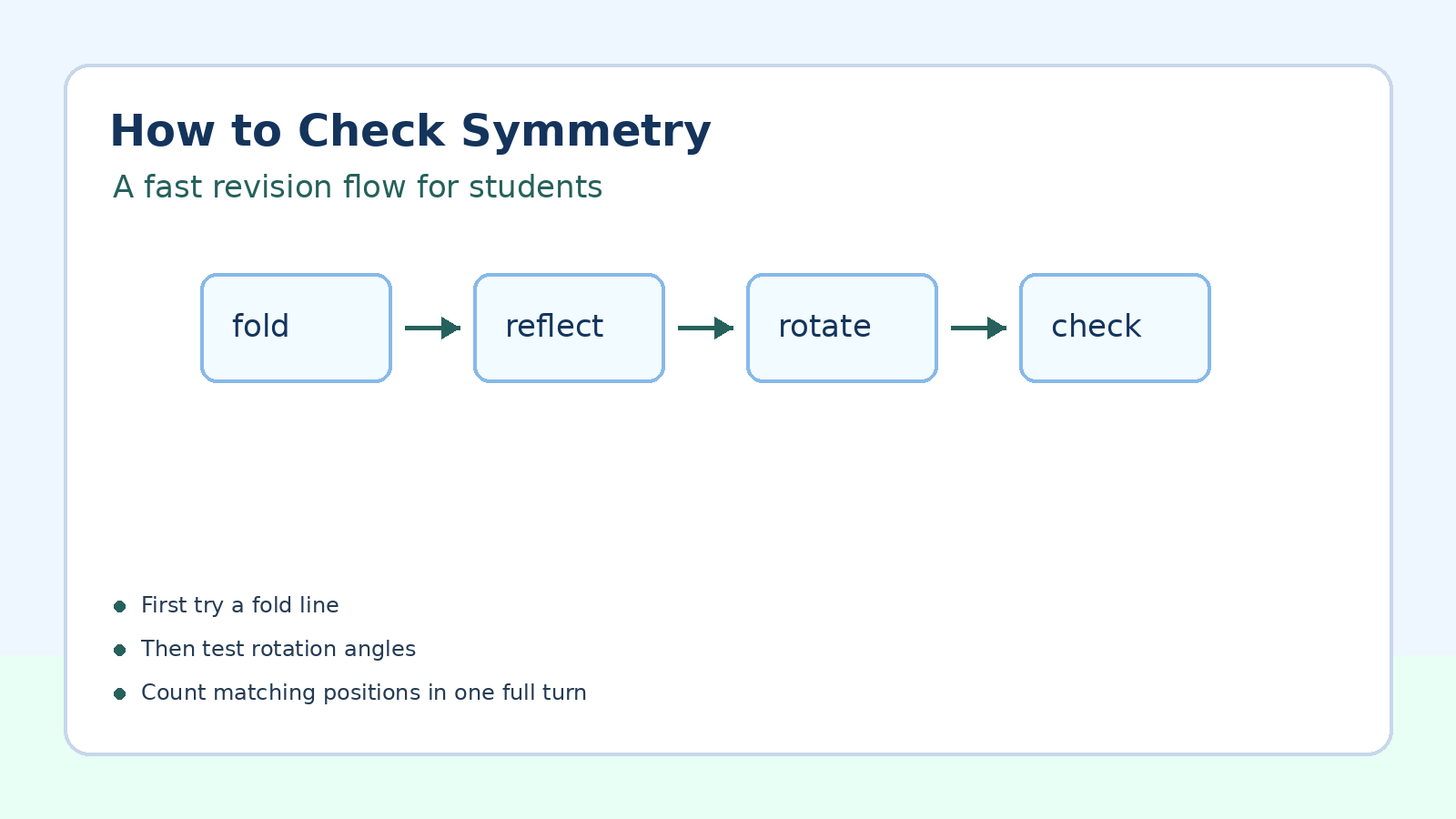
- A square matches after 90, 180, 270 and 360 degrees.
- Three equal radial arms need 120 degree gaps.
- Four equal radial arms need 90 degree gaps.
- Smallest angle is found by dividing 360 by the number of equal turns.
Tip: A full 360 degree turn always brings a figure back, but that alone is not counted as special rotational symmetry.
Circle, Polygons and Mixed Symmetry Examples
A circle has the richest symmetry in this chapter. Every diameter is a line of symmetry, and every rotation angle brings the circle back to itself.
Regular polygons follow a simple count. A regular triangle has 3 symmetry lines, a square has 4, and a regular hexagon has 6. The Ashoka Chakra has 24 lines and 24 rotation angles because it has 24 equally spaced spokes.
- Both line and turn symmetry: equilateral triangle, rectangle, regular hexagon.
- Line symmetry only: isosceles triangle and kite.
- Turn symmetry only: non-square parallelogram.
Common Mistakes Students Make in Symmetry
Most mistakes come from mixing a fold test with a turn test. A pinwheel may have rotational symmetry but no line symmetry. A rectangle may have two symmetry lines but its diagonal is not a symmetry line unless the rectangle is a square.
- Do not call a figure symmetrical only because it looks neat.
- Do not count every diagonal as a symmetry line.
- Do not forget the centre point in rotation questions.
- Do not use unequal angles between radial arms.
Final check: fold for line symmetry, turn for rotational symmetry, and count only exact matches.
Related NCERT Resources for Symmetry Class 6
| Resource | Link |
|---|---|
| NCERT Solutions | Class 6 Mathematics Chapter 9 NCERT Solutions |
| NCERT Book PDF | Class 6 Mathematics Chapter 9 Book PDF |
| NCERT Notes | Class 6 Mathematics Chapter 9 Notes |
More Class 6 Mathematics Handwritten Notes
| Chapter | Handwritten Notes |
|---|---|
| Chapter 1 | Patterns in Mathematics |
| Chapter 2 | Lines and Angles |
| Chapter 3 | Number Play |
| Chapter 4 | Data Handling and Presentation |
| Chapter 5 | Prime Time |
| Chapter 6 | Perimeter and Area |
| Chapter 7 | Fractions |
| Chapter 8 | Playing with Constructions |
Symmetry Class 6 Handwritten Notes FAQs
Ques. What is covered in Class 6 Symmetry handwritten notes?
Ans. The notes cover line symmetry, reflection, paper folding, rotational symmetry, circles, regular polygons and common mistakes.
Ques. Are these notes based on the 2026-27 Ganita Prakash textbook?
Ans. Yes. The PDF follows Class 6 Mathematics Ganita Prakash Chapter 9 Symmetry for the 2026-27 session.
Ques. How should students revise Symmetry from this PDF?
Ans. Students should revise line symmetry first, then reflection, paper cutting, rotational symmetry and circle symmetry.
Ques. Why are diagrams important in Symmetry handwritten notes?
Ans. Diagrams show the fold line, centre of rotation and matching parts, which makes the chapter easier to revise quickly.



Comments