




The NCERT Solutions for Class 6 Mathematics Chapter 8 Playing with Constructions cover compass work, circles, squares, rectangles, diagonals, and points that are the same distance from two given points. These solved answers follow the 2026-27 Ganita Prakash chapter and show how to plan each construction before drawing it.
- Core tools: ruler, compass, perpendicular lines, equal arcs, and rough diagrams.
- Question style: construction steps, property checks, dot-grid reasoning, and open drawing tasks.
- PDF support: 21 solution cards with quick answers, detailed steps, and expert explanations.
Chapter8PlayingwithConstructionsSolutions.pdf?page=1&dpi=150)
Chapter8PlayingwithConstructionsSolutions.pdf?page=2&dpi=150)
Chapter8PlayingwithConstructionsSolutions.pdf?page=3&dpi=150)
Chapter8PlayingwithConstructionsSolutions.pdf?page=4&dpi=150)
Chapter8PlayingwithConstructionsSolutions.pdf?page=5&dpi=150)
Chapter8PlayingwithConstructionsSolutions.pdf?page=6&dpi=150)
Chapter8PlayingwithConstructionsSolutions.pdf?page=7&dpi=150)
Chapter8PlayingwithConstructionsSolutions.pdf?page=8&dpi=150)
Chapter8PlayingwithConstructionsSolutions.pdf?page=9&dpi=150)
Chapter8PlayingwithConstructionsSolutions.pdf?page=10&dpi=150)
Chapter8PlayingwithConstructionsSolutions.pdf?page=11&dpi=150)
Chapter8PlayingwithConstructionsSolutions.pdf?page=12&dpi=150)
Chapter8PlayingwithConstructionsSolutions.pdf?page=13&dpi=150)
Chapter8PlayingwithConstructionsSolutions.pdf?page=14&dpi=150)
Chapter8PlayingwithConstructionsSolutions.pdf?page=15&dpi=150)
Chapter8PlayingwithConstructionsSolutions.pdf?page=16&dpi=150)
Chapter8PlayingwithConstructionsSolutions.pdf?page=17&dpi=150)
Chapter8PlayingwithConstructionsSolutions.pdf?page=18&dpi=150)
Chapter8PlayingwithConstructionsSolutions.pdf?page=19&dpi=150)
Chapter8PlayingwithConstructionsSolutions.pdf?page=20&dpi=150)
Chapter8PlayingwithConstructionsSolutions.pdf?page=21&dpi=150)
Chapter8PlayingwithConstructionsSolutions.pdf?page=22&dpi=150)
Chapter8PlayingwithConstructionsSolutions.pdf?page=23&dpi=150)
Chapter8PlayingwithConstructionsSolutions.pdf?page=24&dpi=150)
Chapter8PlayingwithConstructionsSolutions.pdf?page=25&dpi=150)
Chapter8PlayingwithConstructionsSolutions.pdf?page=26&dpi=150)
Chapter8PlayingwithConstructionsSolutions_flat_MobileCard.pdf?page=1&dpi=150)
Chapter8PlayingwithConstructionsSolutions_flat_MobileCard.pdf?page=2&dpi=150)
Chapter8PlayingwithConstructionsSolutions_flat_MobileCard.pdf?page=3&dpi=150)
Chapter8PlayingwithConstructionsSolutions_flat_MobileCard.pdf?page=4&dpi=150)
Chapter8PlayingwithConstructionsSolutions_flat_MobileCard.pdf?page=5&dpi=150)
Chapter8PlayingwithConstructionsSolutions_flat_MobileCard.pdf?page=6&dpi=150)
Chapter8PlayingwithConstructionsSolutions_flat_MobileCard.pdf?page=7&dpi=150)
Chapter8PlayingwithConstructionsSolutions_flat_MobileCard.pdf?page=8&dpi=150)
Chapter8PlayingwithConstructionsSolutions_flat_MobileCard.pdf?page=9&dpi=150)
Chapter8PlayingwithConstructionsSolutions_flat_MobileCard.pdf?page=10&dpi=150)
Chapter8PlayingwithConstructionsSolutions_flat_MobileCard.pdf?page=11&dpi=150)
Chapter8PlayingwithConstructionsSolutions_flat_MobileCard.pdf?page=12&dpi=150)
Chapter8PlayingwithConstructionsSolutions_flat_MobileCard.pdf?page=13&dpi=150)
Chapter8PlayingwithConstructionsSolutions_flat_MobileCard.pdf?page=14&dpi=150)
Chapter8PlayingwithConstructionsSolutions_flat_MobileCard.pdf?page=15&dpi=150)
Chapter8PlayingwithConstructionsSolutions_flat_MobileCard.pdf?page=16&dpi=150)
Chapter8PlayingwithConstructionsSolutions_flat_MobileCard.pdf?page=17&dpi=150)
Chapter8PlayingwithConstructionsSolutions_flat_MobileCard.pdf?page=18&dpi=150)
Chapter8PlayingwithConstructionsSolutions_flat_MobileCard.pdf?page=19&dpi=150)
Chapter8PlayingwithConstructionsSolutions_flat_MobileCard.pdf?page=20&dpi=150)
Chapter8PlayingwithConstructionsSolutions_flat_MobileCard.pdf?page=21&dpi=150)
Chapter8PlayingwithConstructionsSolutions_flat_MobileCard.pdf?page=22&dpi=150)
Chapter8PlayingwithConstructionsSolutions_flat_MobileCard.pdf?page=23&dpi=150)
Chapter8PlayingwithConstructionsSolutions_flat_MobileCard.pdf?page=24&dpi=150)
Chapter8PlayingwithConstructionsSolutions_flat_MobileCard.pdf?page=25&dpi=150)
Chapter8PlayingwithConstructionsSolutions_flat_MobileCard.pdf?page=26&dpi=150)
Chapter8PlayingwithConstructionsSolutions_flat_MobileCard.pdf?page=27&dpi=150)
Chapter8PlayingwithConstructionsSolutions_flat_MobileCard.pdf?page=28&dpi=150)
Chapter8PlayingwithConstructionsSolutions_flat_MobileCard.pdf?page=29&dpi=150)
Chapter8PlayingwithConstructionsSolutions_flat_MobileCard.pdf?page=30&dpi=150)
Chapter8PlayingwithConstructionsSolutions_flat_MobileCard.pdf?page=31&dpi=150)
Chapter8PlayingwithConstructionsSolutions_flat_MobileCard.pdf?page=32&dpi=150)
Chapter8PlayingwithConstructionsSolutions_flat_MobileCard.pdf?page=33&dpi=150)
Chapter8PlayingwithConstructionsSolutions_flat_MobileCard.pdf?page=34&dpi=150)
Chapter8PlayingwithConstructionsSolutions_flat_MobileCard.pdf?page=35&dpi=150)
Chapter8PlayingwithConstructionsSolutions_flat_MobileCard.pdf?page=36&dpi=150)
Chapter8PlayingwithConstructionsSolutions_flat_MobileCard.pdf?page=37&dpi=150)
Chapter8PlayingwithConstructionsSolutions_flat_MobileCard.pdf?page=38&dpi=150)
Chapter8PlayingwithConstructionsSolutions_flat_MobileCard.pdf?page=39&dpi=150)
Chapter8PlayingwithConstructionsSolutions_flat_MobileCard.pdf?page=40&dpi=150)
Chapter8PlayingwithConstructionsSolutions_flat_MobileCard.pdf?page=41&dpi=150)
Chapter8PlayingwithConstructionsSolutions_flat_MobileCard.pdf?page=42&dpi=150)
Chapter8PlayingwithConstructionsSolutions_flat_MobileCard.pdf?page=43&dpi=150)
Chapter8PlayingwithConstructionsSolutions_flat_MobileCard.pdf?page=44&dpi=150)
Chapter8PlayingwithConstructionsSolutions_flat_MobileCard.pdf?page=45&dpi=150)
Chapter8PlayingwithConstructionsSolutions_flat_MobileCard.pdf?page=46&dpi=150)
Chapter8PlayingwithConstructionsSolutions_flat_MobileCard.pdf?page=47&dpi=150)
These solutions are prepared for the 2026-27 NCERT Ganita Prakash textbook and keep construction checks easy to follow.
Student Feedback on Playing with Constructions
In a Collegedunia classroom poll of 8,940 Class 6 students, 72% said construction questions became easier after first drawing a rough figure.
Source: 2026-27 Class 6 Mathematics student poll
What Playing with Constructions Teaches
Playing with Constructions is the first serious ruler-and-compass chapter in Class 6 Mathematics. Students learn that a construction is not a freehand sketch. It is a drawing made by following a rule, such as keeping a fixed radius or making a right angle.
A compass is useful because it transfers the same distance again and again. This is why the chapter uses it for circles, waves, eyes, houses, and points equidistant from two fixed points.
| Chapter idea | Meaning | Where it appears |
|---|---|---|
| Radius | Fixed distance from the centre | Circles and compass arcs |
| Rectangle property | Opposite sides equal and all angles 90 degrees | Rectangle construction checks |
| Square property | All sides equal and all angles 90 degrees | Rotated square and square-inside-rectangle tasks |
| Equidistant point | A point at the same distance from two points | House construction and rhombus construction |
Construction Steps Students Should Remember
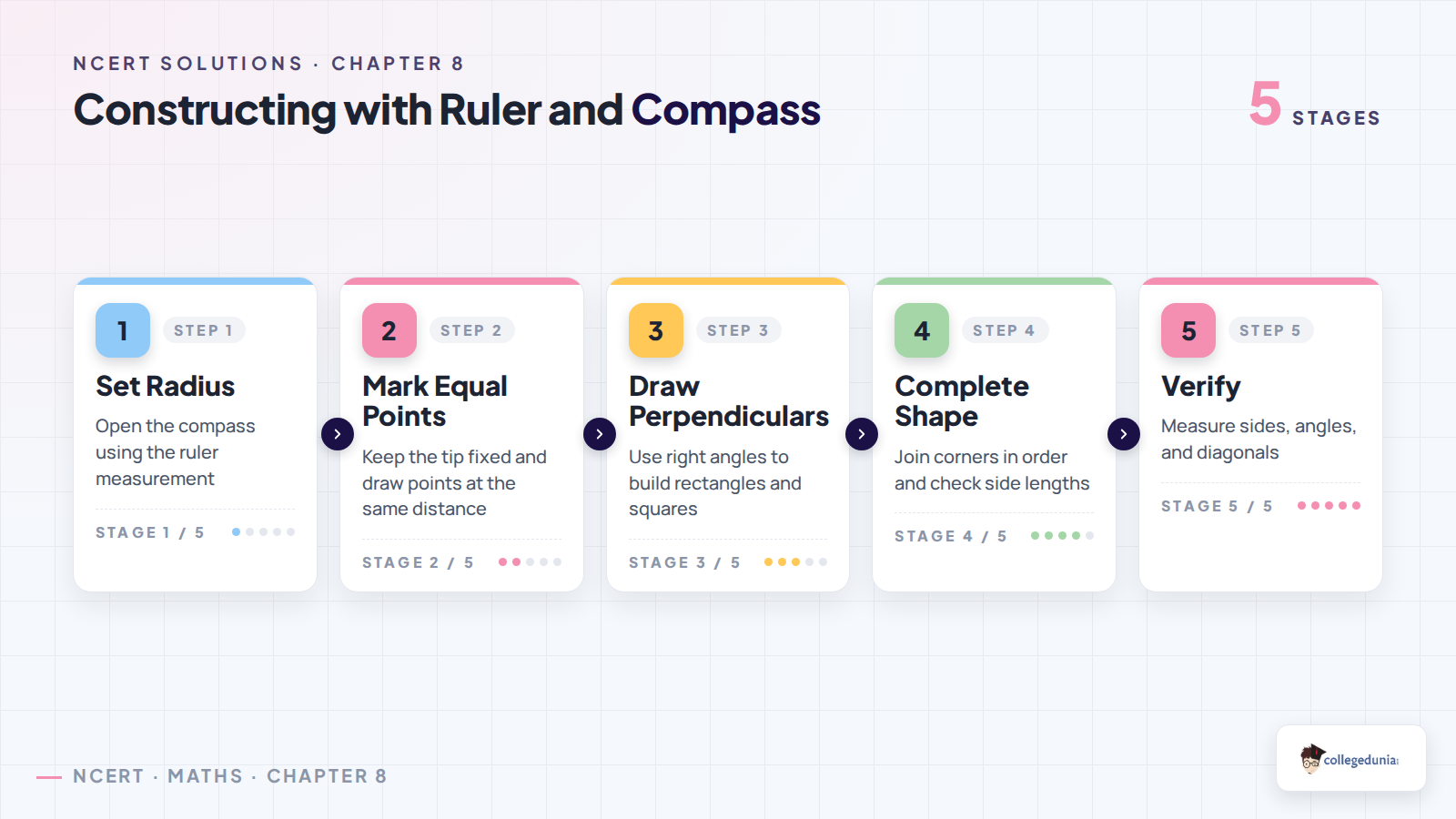
The chapter repeatedly asks students to decide the order of drawing. A good construction starts with the part already known, such as a base side, a radius, or a diagonal. The unknown point is then found using a perpendicular, an arc, or the intersection of two arcs.
- Draw the known side or line segment first.
- Use a perpendicular when a corner must be a right angle.
- Use a compass arc when a point must be at a fixed distance.
- Join the points in order around the boundary.
- Check the final side lengths and angles.
Students should not skip the rough diagram. It shows which point can be found first and which length must be transferred with the compass.
Playing with Constructions Video Lesson
Source: Magnet Brains on YouTube
Rectangle and Square Checks in Chapter 8
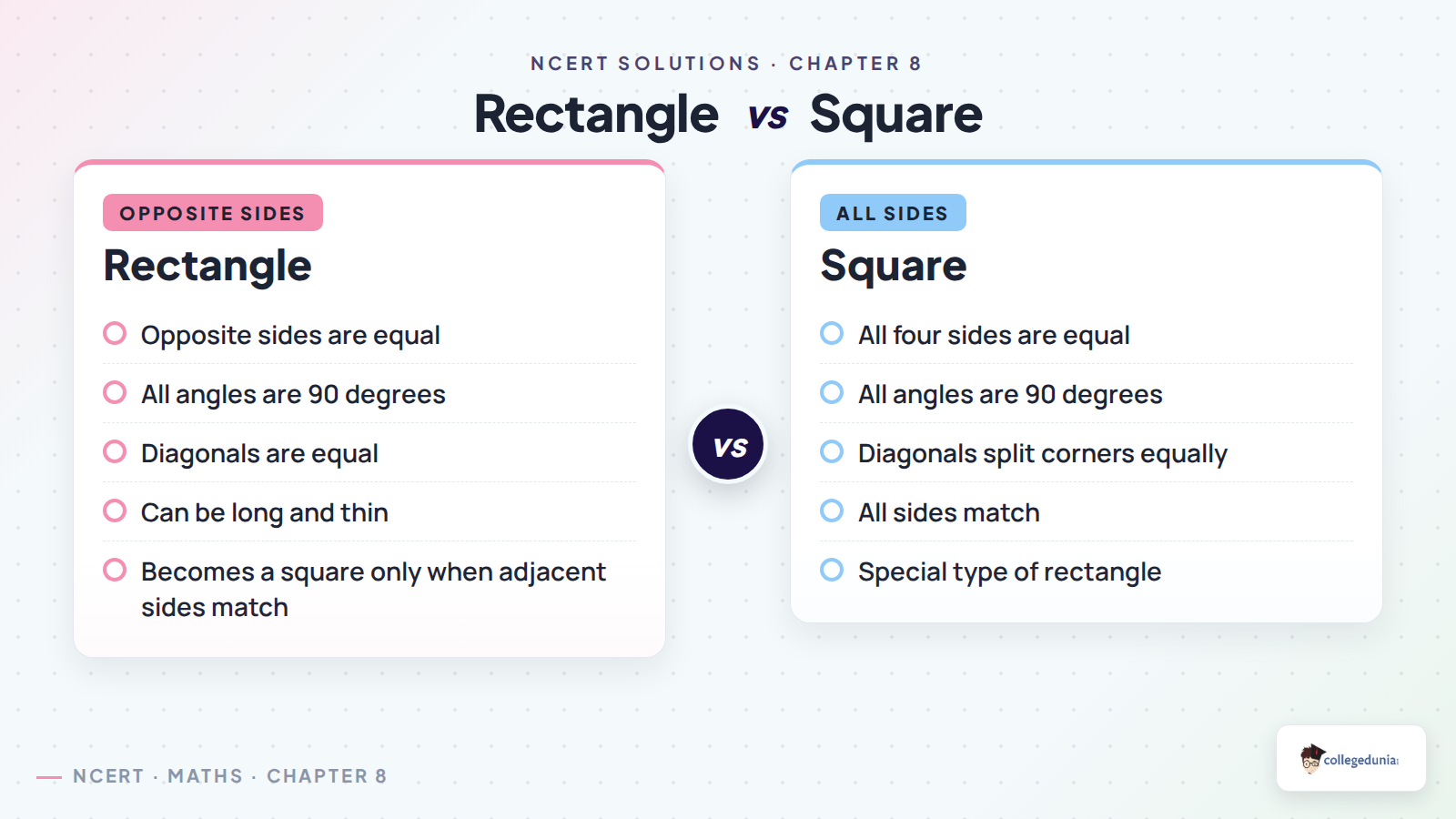
Squares and rectangles are tested through properties, not by how they look after rotation. A rotated square is still a square because rotation does not change side length or angle measure. A long thin rectangle is still a rectangle if its opposite sides are equal and all angles are right angles.
- Rectangle: opposite sides equal, all angles are 90 degrees.
- Square: all sides equal, all angles are 90 degrees.
- Diagonal: a line joining opposite corners.
- Special case: when a rectangle has adjacent sides equal, it becomes a square.
The diagonal divides the corner angles equally only when the rectangle is a square.
How the Chapter 8 PDF Helps with Homework
The solution PDF turns construction tasks into short steps. It covers the textbook questions from Artwork, Squares and Rectangles, Constructing Squares and Rectangles, Exploration in Rectangles, Diagonals, and Points Equidistant from Two Given Points.
| Question type | Best first step | Common check |
|---|---|---|
| Circle or arc task | Set compass radius | Every point stays the same distance from the centre |
| Rectangle task | Draw one known side | Opposite sides and right angles match |
| Diagonal task | Use the diagonal as a fixed distance | Arc intersects the perpendicular line |
| House or rhombus task | Use equal arcs from two points | Intersection point is equidistant from both points |
Each answer gives a quick solution, a detailed solution, and an expert solution. Students should read the construction order before copying the final answer, because most marks come from choosing the correct first point.
Practice question cards for Playing with Constructions
Use the expandable cards after reading the PDF solutions.
Common Mistakes in Playing with Constructions
Most mistakes happen when students draw by eye instead of using the ruler and compass condition. A construction should prove why the figure satisfies the property.
- Do not call a figure a square only because it looks nearly equal.
- Do not forget that polygon names must follow the boundary order.
- Do not draw the whole circle if a small arc is enough, unless the question asks for it.
- Do not use a ruler by trial and error when a fixed-distance arc can locate the point.
- Do not assume every equal-sided four-sided figure is a square.
Quick check: after every construction, ask which length or angle was fixed by the tool.
Related Resources for Playing with Constructions Class 6
Use these Collegedunia resources to read, revise, and practise the same chapter in different formats.
| Resource | What it offers |
|---|---|
| Playing with Constructions Notes | Key definitions, construction rules, and quick revision points |
| Playing with Constructions NCERT Book | Official source chapter and textbook diagrams |
| Playing with Constructions Handwritten Notes | Fast notebook-style revision for ruler-and-compass work |
| Playing with Constructions Question Cards | Expandable solutions and expert explanations |
NCERT Solutions for Class 6 Mathematics Ganita Prakash: All Chapters
Move between these solution pages while working through the Ganita Prakash textbook.
| Chapter | NCERT Solutions |
|---|---|
| Chapter 1 | Patterns in Mathematics Solutions |
| Chapter 2 | Lines and Angles Solutions |
| Chapter 3 | Number Play Solutions |
| Chapter 4 | Data Handling and Presentation Solutions |
| Chapter 5 | Prime Time Solutions |
| Chapter 6 | Perimeter and Area Solutions |
| Chapter 7 | Fractions Solutions |
| Chapter 8 | Playing with Constructions Solutions |
| Chapter 9 | Symmetry Solutions |
| Chapter 10 | The Other Side of Zero Solutions |
Playing with Constructions Class 6 Mathematics NCERT Solutions FAQs
Ques. What is covered in Class 6 Mathematics Chapter 8 Playing with Constructions NCERT Solutions?
Ans. The solutions cover compass arcs, circles, squares, rectangles, diagonals, equidistant points, and construction-based drawing tasks from Ganita Prakash Chapter 8.
Ques. Why is a compass important in Playing with Constructions?
Ans. A compass keeps a fixed distance from a centre. This helps students draw circles, equal arcs, waves, houses, and points that are equally far from two given points.
Ques. How should students start a construction question?
Ans. Students should draw a rough diagram, identify the known side or radius, and decide which point can be located first using a ruler, perpendicular, or compass arc.
Ques. Does the PDF include step-by-step answers for all Chapter 8 construction questions?
Ans. Yes. The PDF gives 21 solution groups with quick answers, detailed construction steps, and expert explanations for the 2026-27 NCERT chapter.



Comments