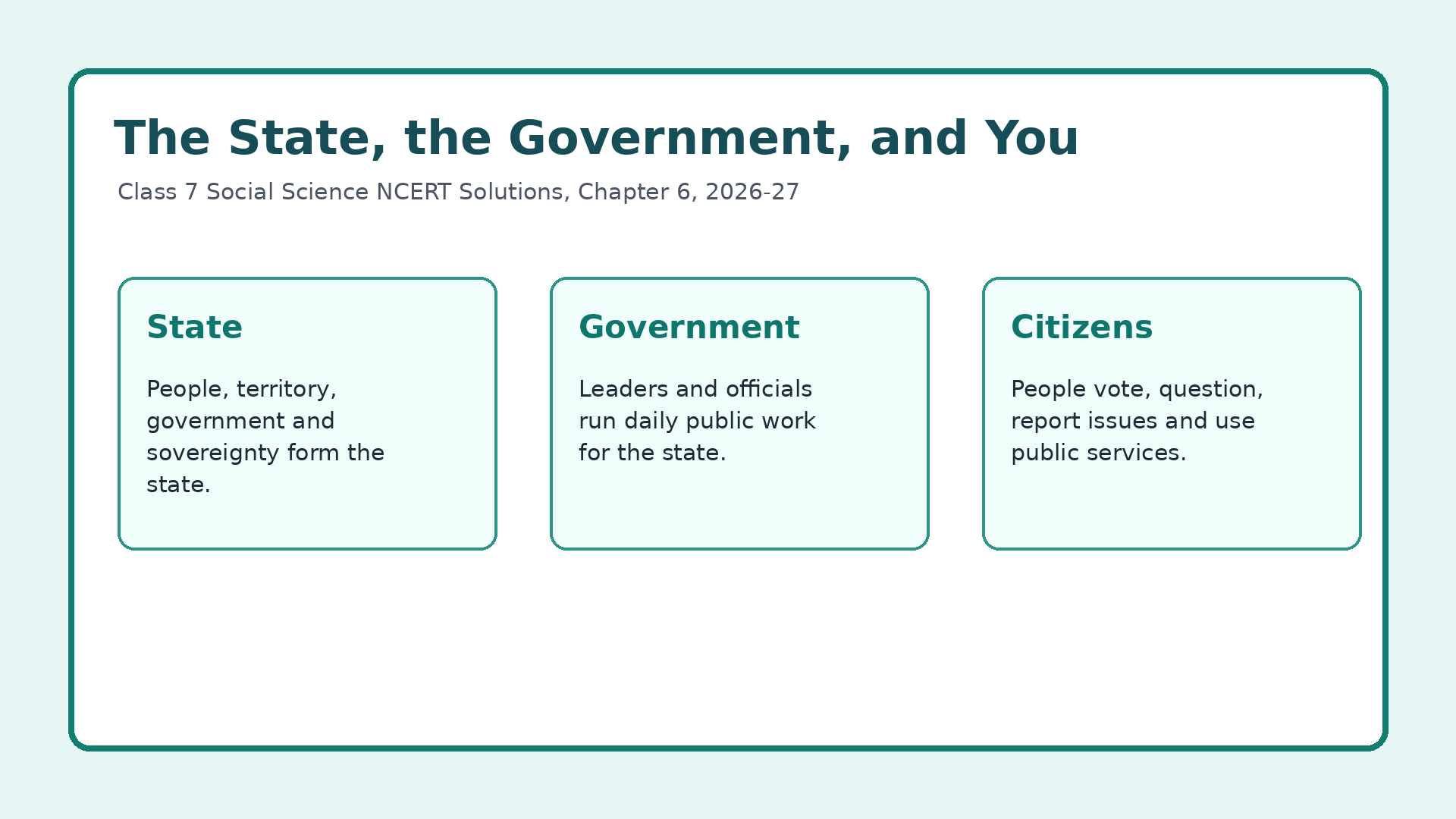
The NCERT Solutions for Class 7 Social Science Part 2 Chapter 6 The State, the Government, and You cover every exercise and activity question from the latest 2026-27 NCERT book. The chapter explains state, government, democracy, republic, decentralisation and how citizens work with public institutions.
The PDF solves 5 Questions and activities from the textbook exercise.
Key ideas include state versus government, republic versus democracy, checks and balances and local government.
Use the question cards below for direct answers and expert explanations.
Student Feedback: In a Collegedunia student survey of 8,740 Class 7 Social Science students, many students said this chapter became easier after they separated state, government, democracy and republic into four short definitions.
Each answer in this Class 7 Social Science Chapter 6 solutions PDF follows the 2026-27 NCERT exercise and keeps the wording school-exam ready.
The State, the Government, and You Exercise Pattern
The exercise is application based. Students have to explain ideas, compare institutions and classify real-life contact with government offices.
Question area
What it checks
Answer method
Democracy and republic
Concept difference
State true or false, then explain
Decentralisation
Need for local power
Give two clear reasons
School council example
Shared power and rights
Apply checks and balances
Parliament and Supreme Court
Constitutional limits
Compare roles under the Constitution
Family interview
Citizen engagement
Make a local, state and union table
The safest answer frame is claim, reason, example and constitutional limit. This keeps long civics answers clear.
Democracy, Republic and Constitutional Limits
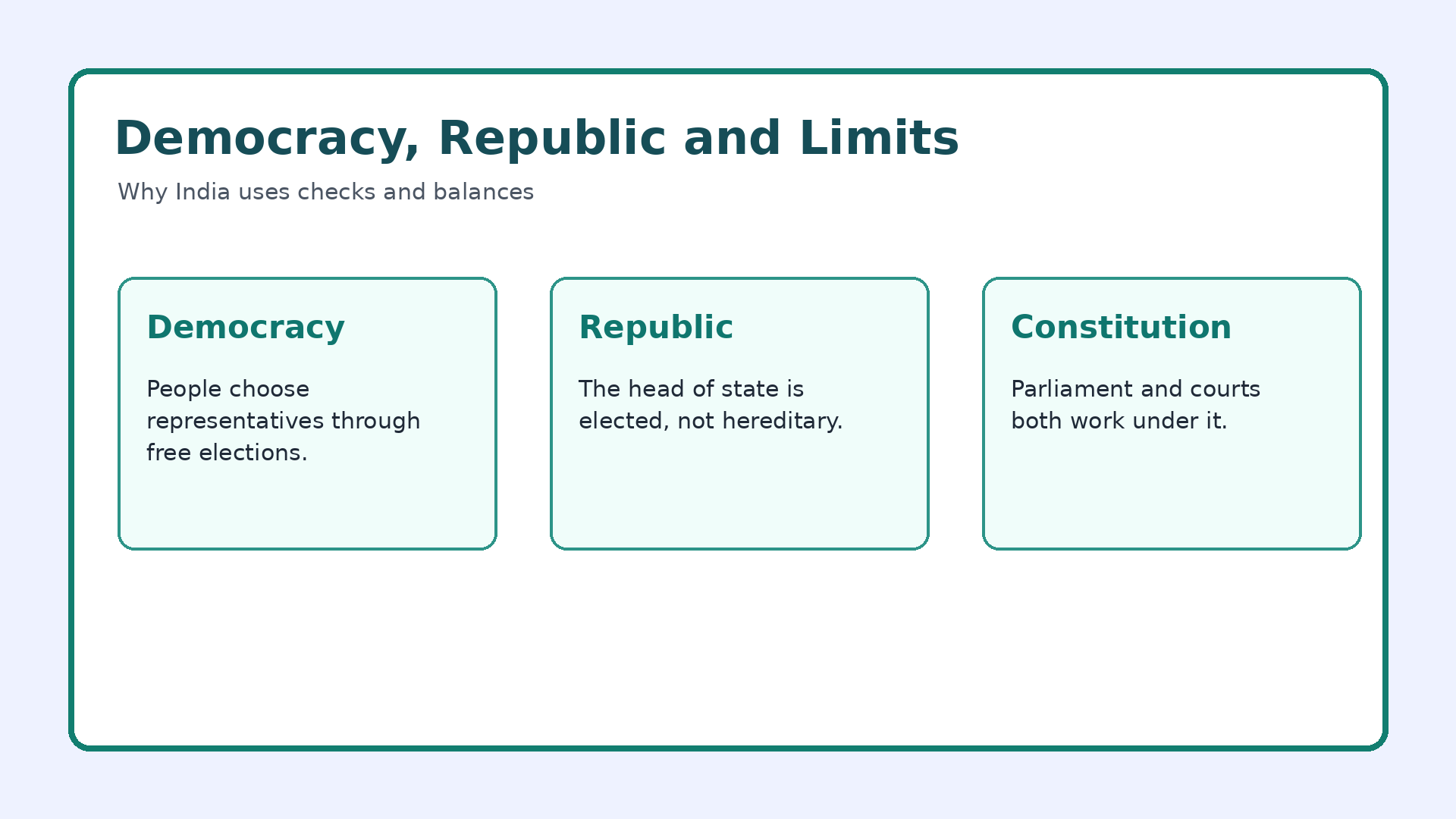
Democracy and republic are related, but they are not the same. Democracy says people choose the government. Republic says the head of state is elected, not hereditary.
India as democracy: citizens elect representatives through elections.
India as republic: the President is elected indirectly under the Constitution.
India as constitutional state: public institutions cannot ignore fundamental rights.
Write that the Constitution is above Parliament and the Supreme Court, while both institutions have their own roles.
Decentralisation and Citizen Engagement
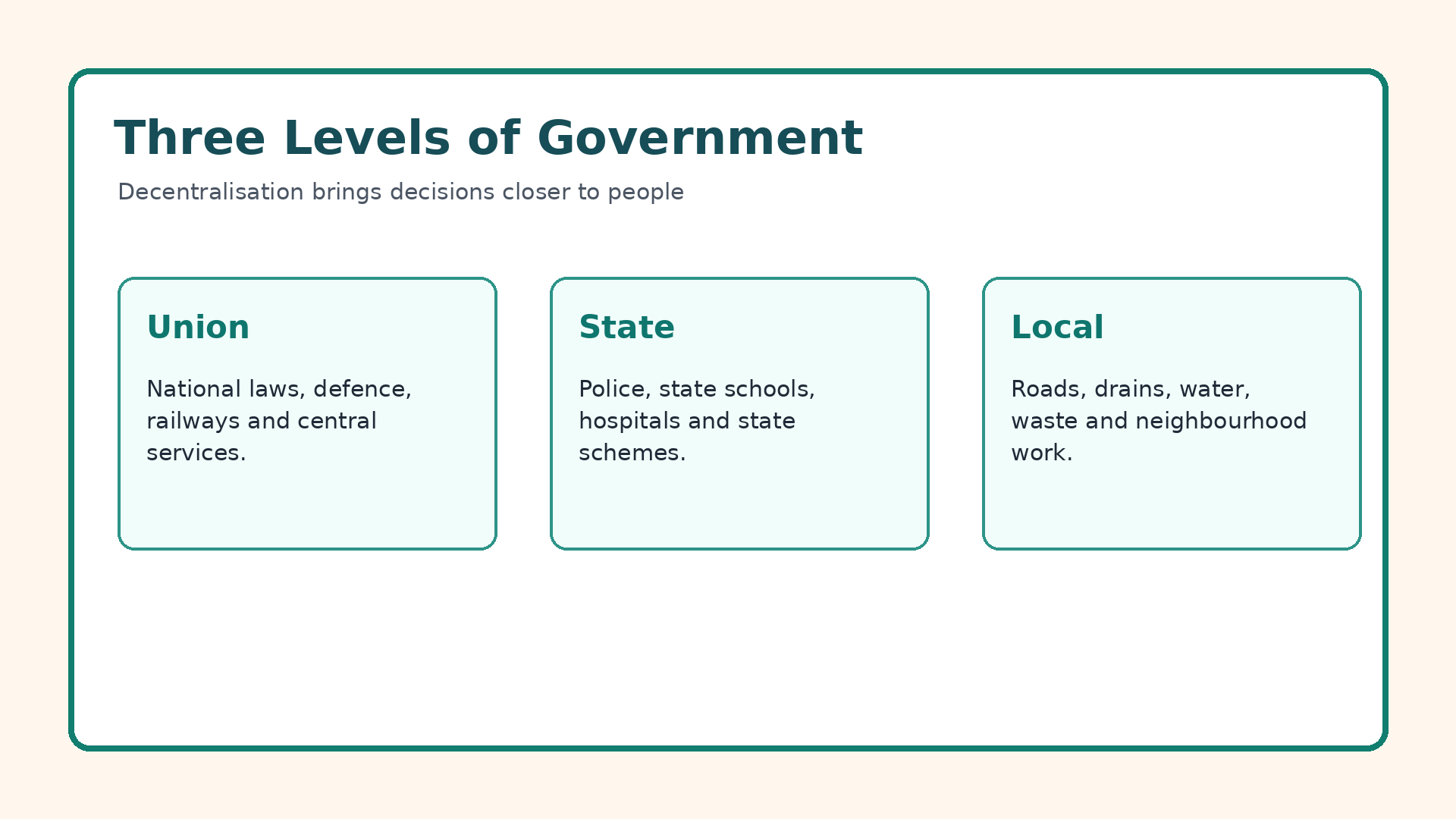
Decentralisation means sharing power across levels of government. In India, this matters because the country is large, diverse and full of local needs that cannot all be solved from one office.
Level
Examples students can mention
Why it matters
Union government
Railways, defence, national documents
Handles issues for the whole country
State government
Police, state hospitals, state schools
Handles state-level law and public services
Local government
Drains, local roads, water, waste
Solves nearby problems quickly
Common Mistakes in The State, the Government, and You Answers
Watch Out: Most wrong answers treat all institutions as if one of them has unlimited power.
Do not write that state and government are exactly the same.
Do not write that every democracy is automatically a republic.
Do not say Parliament can make any law without constitutional limits.
Do not classify every public service as central government work.
Exam tip: Use examples from school, family and neighbourhood life when the question asks you to apply the chapter.
How to Use the Class 7 Social Science Chapter 6 Solutions PDF
Use the PDF in three rounds. First, revise the four definitions: state, government, democracy and republic. Then read the decentralisation and checks-and-balances answers. Finally, practise the activity table with your own family examples.
For definition questions, write one clear difference before giving examples.
For application questions, connect the example to rights, shared power or accountability.
For the family activity, make a table with level of government and challenge faced.
Quick recall: state is larger, government changes, republic has an elected head, and decentralisation brings decisions closer to people.
All NCERT Solutions for Class 7 Social Science Chapter 6 The State, the Government, and You with Step-by-Step Solutions
The cards below include every exercise question. Use Check Solution for the direct answer and Expert Solution for a second explanation.
Each card keeps the direct answer and expert explanation separate.
The Parliament and Supreme Court card explains constitutional limits.
The family interview card gives a table method for activity work.
Questions and activities
Q 6.1
“Every democracy is a republic.” Is this statement true or false? Explain.
Quick solution. Concept: democracy and republic, Chapter 6. The statement is false because democracy means elected government, while republic means an elected, non-hereditary head of state.0.45em
Concept used. This answer uses the chapter ideas of state, government, democracy, republic, decentralisation, rights and constitutional limits.
Do not use democracy and republic as identical words.
Write the answer with a clear claim first, then give reasons from the chapter.
The statement is false.
A democracy means people choose the government through elections.
A republic means the head of state is elected and does not inherit the position.
Some countries have elected governments but still have a hereditary monarch as head of state.
India is both a democracy and a republic because citizens elect representatives and the President is elected indirectly.
False. Every republic may be democratic, but every democracy need not be a republic.
AR
Ananya Rao
M.A. Political Science, University of Delhi
Verified Expert
Exam reading. Read the question as an application of democratic government, not as a memory-only question.
Read the two words as answers to two different questions.
Democracy answers who chooses the government: the people.
Republic answers who can be the head of state: an elected person, not a hereditary ruler.
A constitutional monarchy can run democratic elections and still not be a republic.
India fits both terms because elections choose governments and the Constitution provides an elected President.
Why this matters. The chapter connects public power with citizen rights, participation and limits on authority.
False. Every republic may be democratic, but every democracy need not be a republic.
Q 6.2
Give two reasons why decentralisation is important in India.
Quick solution. Concept: decentralisation, Chapter 6. India needs local, state and union levels because local leaders understand nearby problems and citizens can question closer representatives more easily.0.45em
Concept used. This answer uses the chapter ideas of state, government, democracy, republic, decentralisation, rights and constitutional limits.
Use local needs plus people's participation as the two core reasons.
Write the answer with a clear claim first, then give reasons from the chapter.
Decentralisation means sharing power with union, state and local governments.
First, India is large and diverse, so local issues differ from place to place.
Local governments understand nearby needs such as roads, drains, schools, water and waste collection.
Second, decentralisation brings government closer to people.
Citizens can contact local representatives more easily and decisions can be made faster.
It helps local problems get local solutions, and it makes government more reachable and accountable.
KS
Kabir Sanyal
M.A. Public Policy, JNU
Verified Expert
Exam reading. Read the question as an application of democratic government, not as a memory-only question.
Think of decentralisation as matching the decision to the correct level.
A village road or ward drain should not wait for a distant national office.
Local representatives can inspect the problem, hear people directly and act faster.
State and union governments can then focus on wider issues such as state policy, national defence, railways or major laws.
This sharing of work reduces excessive centralisation and supports democracy.
Why this matters. The chapter connects public power with citizen rights, participation and limits on authority.
It helps local problems get local solutions, and it makes government more reachable and accountable.
Q 6.3
Imagine you are part of your school’s student council. The council works like a mini-parliament: it has members elected by students, debates issues and makes decisions. In this context, do you think it would be better if only the council president makes all the decisions or if power is to be shared among all members? Should the student council have the power to make rules about the food you eat, or the language you speak? What can go wrong if the student council is the most powerful body in your school and no one questions its decisions?
Quick solution. Concept: shared power and rights, Chapter 6. The council should share power, respect personal choices such as food and language, and remain open to questions.0.45em
Concept used. This answer uses the chapter ideas of state, government, democracy, republic, decentralisation, rights and constitutional limits.
Link the school example with democracy, rights and checks on power.
Write the answer with a clear claim first, then give reasons from the chapter.
Power should be shared among all elected members of the student council.
If only the president decides everything, the council becomes unfair and less democratic.
The council may suggest rules for shared school matters, but it should not control personal choices such as food or language.
Rules must respect students' rights, school policy and diversity.
If no one questions the council, it may misuse power, ignore minority voices and make unfair rules.
Power should be shared, limited and open to questions.
MN
Meera Nair
M.A. Civics Education, TISS Mumbai
Verified Expert
Exam reading. Read the question as an application of democratic government, not as a memory-only question.
The student council example shows why institutions need limits.
A president can lead meetings, but decisions should come after discussion and voting.
Food and language are sensitive personal and cultural matters, so a council cannot control them without clear need and school approval.
Unchecked power may silence students who disagree.
A healthy council keeps debate, voting, teacher guidance and complaint channels open.
This mirrors the chapter's larger point that elected bodies still need rules, rights and accountability.
So the best school council is not leaderless, but it is also not ruled by one person without checks.
Why this matters. The chapter connects public power with citizen rights, participation and limits on authority.
Power should be shared, limited and open to questions.
Q 6.4
Think about these real-life situations in India’s democracy: Should Parliament be the most powerful institution? Should Parliament make any law it wants, even if it affects rights? What could go wrong if lawmaking has no limits? Who is more powerful in India, Parliament or the Supreme Court?
Quick solution. Concept: checks and balances, Chapter 6. Parliament makes laws, the Supreme Court reviews them, and the Constitution places limits on both.0.45em
Concept used. This answer uses the chapter ideas of state, government, democracy, republic, decentralisation, rights and constitutional limits.
Write Constitution first, then Parliament and Supreme Court.
Write the answer with a clear claim first, then give reasons from the chapter.
Parliament is very powerful because it makes laws for the country, but it is not unlimited.
It should not make laws that violate the Constitution or take away fundamental rights unfairly.
If lawmaking has no limits, unjust laws can be passed and citizens' rights may be harmed.
In India, Parliament and the Supreme Court have different powers.
Parliament makes laws, while the Supreme Court checks whether laws follow the Constitution.
The Constitution is above both institutions.
Neither institution is absolutely more powerful. The Constitution is supreme, Parliament makes laws, and the Supreme Court reviews them.
RS
Rohan Sen
M.A. Political Science, Presidency University
Verified Expert
Exam reading. Read the question as an application of democratic government, not as a memory-only question.
This answer is about checks and balances.
Parliament expresses the people's will through elected representatives.
The Supreme Court protects constitutional limits and can strike down a law that violates the Constitution.
So the better answer is not Parliament versus Court as a fight.
Both are powerful within their own roles, and both work under the Constitution.
If Parliament had unlimited lawmaking power, a majority could pass laws that damage minority rights.
If courts made ordinary policy choices instead of reviewing constitutionality, elected lawmaking would weaken.
The chapter's balanced answer is that the Constitution sets the basic rules, Parliament legislates, and the Supreme Court guards rights through judicial review.
Why this matters. The chapter connects public power with citizen rights, participation and limits on authority.
Neither institution is absolutely more powerful. The Constitution is supreme, Parliament makes laws, and the Supreme Court reviews them.
Q 6.5
Ask your parents or guardians how they engaged with the government over the past year. Make a list and classify the items based on the level of government they had to work with. What challenges did they face?
Quick solution. Concept: citizen engagement, Chapter 6. Make a table of family interactions with local, state and union government, then add the challenge faced in each case.0.45em
Concept used. This answer uses the chapter ideas of state, government, democracy, republic, decentralisation, rights and constitutional limits.
Use real family examples. Do not invent a perfect experience if there were delays.
Write the answer with a clear claim first, then give reasons from the chapter.
This is an activity-based answer, so examples will vary by family.
A good response can list services such as paying electricity bills, applying for an identity document, visiting a hospital, reporting a road issue or contacting a school office.
Classify each example as local, state or union government.
Local government usually handles nearby services such as drains, waste, streetlights and local roads.
State government handles areas such as police, state hospitals, state schools and many welfare schemes.
Union government handles national documents, income tax, railways and central schemes.
Common challenges include long queues, unclear forms, delayed responses, lack of information and difficulty tracking complaints.
Make a three-level table: local, state and union, then add the challenge faced for each item.
DM
Diya Menon
M.A. Governance Studies, University of Hyderabad
Verified Expert
Exam reading. Read the question as an application of democratic government, not as a memory-only question.
The strongest activity answer uses a table instead of a paragraph.
Interview the parent or guardian first and write real examples.
Then ask which office handled each service.
If the issue is a neighbourhood matter, it is usually local.
If it is policing, state hospitals or state schooling, it usually belongs to the state level.
If it is a national document or central service, it belongs to the union level.
End with one line on how clearer information and faster grievance systems can help citizens.
For example, a streetlight complaint can go under local government, a police verification visit under state government, and a passport or railway service under union government.
The challenge column should be honest: delay, unclear forms, repeated visits, language difficulty or lack of online tracking are all valid observations.
This turns the activity into evidence of citizen engagement instead of a memorised list.
Why this matters. The chapter connects public power with citizen rights, participation and limits on authority.
Make a three-level table: local, state and union, then add the challenge faced for each item.
The State, the Government, and You Class 7 NCERT Solutions FAQs
Ques. How many questions are solved in Class 7 Social Science Chapter 6 The State, the Government, and You?
Ans. The PDF solves all 5 Questions and activities from the 2026-27 NCERT Class 7 Social Science Part 2 Chapter 6 textbook.
Ques. Is every democracy a republic?
Ans. No. A democracy means people choose the government, while a republic means the head of state is elected and not hereditary.
Ques. Why is decentralisation important in India?
Ans. Decentralisation is important because India is large and diverse. Local governments can understand nearby problems and respond faster.
Ques. Are these The State, the Government, and You solutions useful for the 2026-27 school exam?
Ans. Yes. The answers follow the latest 2026-27 NCERT exercise and explain state, government, democracy, republic, rights and citizen engagement in Class 7 language.




Chapter6TheState,theGovernment,andYouSolutions.pdf?page=1&dpi=150)
Chapter6TheState,theGovernment,andYouSolutions.pdf?page=2&dpi=150)
Chapter6TheState,theGovernment,andYouSolutions.pdf?page=3&dpi=150)
Chapter6TheState,theGovernment,andYouSolutions.pdf?page=4&dpi=150)
Chapter6TheState,theGovernment,andYouSolutions.pdf?page=5&dpi=150)
Chapter6TheState,theGovernment,andYouSolutions.pdf?page=6&dpi=150)
Chapter6TheState,theGovernment,andYouSolutions.pdf?page=7&dpi=150)
Chapter6TheState,theGovernment,andYouSolutions.pdf?page=8&dpi=150)
Chapter6TheState,theGovernment,andYouSolutions.pdf?page=9&dpi=150)
Chapter6TheState,theGovernment,andYouSolutions.pdf?page=10&dpi=150)
Chapter6TheState,theGovernment,andYouSolutions.pdf?page=11&dpi=150)
Chapter6TheState,theGovernment,andYouSolutions.pdf?page=12&dpi=150)
Chapter6TheState,theGovernment,andYouSolutions_flat_MobileCard.pdf?page=1&dpi=150)
Chapter6TheState,theGovernment,andYouSolutions_flat_MobileCard.pdf?page=2&dpi=150)
Chapter6TheState,theGovernment,andYouSolutions_flat_MobileCard.pdf?page=3&dpi=150)
Chapter6TheState,theGovernment,andYouSolutions_flat_MobileCard.pdf?page=4&dpi=150)
Chapter6TheState,theGovernment,andYouSolutions_flat_MobileCard.pdf?page=5&dpi=150)
Chapter6TheState,theGovernment,andYouSolutions_flat_MobileCard.pdf?page=6&dpi=150)
Chapter6TheState,theGovernment,andYouSolutions_flat_MobileCard.pdf?page=7&dpi=150)
Chapter6TheState,theGovernment,andYouSolutions_flat_MobileCard.pdf?page=8&dpi=150)
Chapter6TheState,theGovernment,andYouSolutions_flat_MobileCard.pdf?page=9&dpi=150)
Chapter6TheState,theGovernment,andYouSolutions_flat_MobileCard.pdf?page=10&dpi=150)
Chapter6TheState,theGovernment,andYouSolutions_flat_MobileCard.pdf?page=11&dpi=150)
Chapter6TheState,theGovernment,andYouSolutions_flat_MobileCard.pdf?page=12&dpi=150)
Chapter6TheState,theGovernment,andYouSolutions_flat_MobileCard.pdf?page=13&dpi=150)
Chapter6TheState,theGovernment,andYouSolutions_flat_MobileCard.pdf?page=14&dpi=150)
Chapter6TheState,theGovernment,andYouSolutions_flat_MobileCard.pdf?page=15&dpi=150)
Chapter6TheState,theGovernment,andYouSolutions_flat_MobileCard.pdf?page=16&dpi=150)
Chapter6TheState,theGovernment,andYouSolutions_flat_MobileCard.pdf?page=17&dpi=150)
Chapter6TheState,theGovernment,andYouSolutions_flat_MobileCard.pdf?page=18&dpi=150)
Chapter6TheState,theGovernment,andYouSolutions_flat_MobileCard.pdf?page=19&dpi=150)
Chapter6TheState,theGovernment,andYouSolutions_flat_MobileCard.pdf?page=20&dpi=150)



Comments