




The NCERT Solutions for Class 7 Social Science Chapter 1 The Story of Indian Farming cover every question and activity from the chapter, according to the latest 2026-27 NCERT syllabus. Each answer builds on the three Big Questions the chapter opens with, showing how climate, soil and water together shape farming across India.
- Question coverage: All 10 questions and activities, including the kharif, rabi and soil matching exercise.
- Exam weight: Farming, climate and soil questions carry 6 to 8 marks in the Class 7 Social Science annual paper.
- Also on this page: a kharif-rabi-zaid table, a six-soil-type chart and links to the Notes and Book PDF.

Every NCERT solution for Class 7 Social Science Chapter 1 The Story of Indian Farming in this Collegedunia compilation is curated by subject experts, checked against the 2026-27 rationalised NCERT print, and written in the plain language a Class 7 student actually needs.
Want the full worked answers, one question at a time? Open the dedicated question bank below for step-by-step solutions to every question and activity in The Story of Indian Farming, with the Column A and Column B matching answers laid out clearly.
View All Step-by-Step Solutions for The Story of Indian Farming
Why The Story of Indian Farming Matters for Class 7 Social Science
This chapter opens Part 2 of the Class 7 Social Science book, Exploring Society: India and Beyond, and it sets the tone for the rest of the year. Farming is not treated as a list of facts to memorise. The chapter builds around three Big Questions that NCERT wants students to keep asking as they read, and exam questions tend to circle back to these three ideas.
Roughly 46% of India's working population depends on agriculture and allied activities for a living, and the sector contributes about 18% of the country's total value of goods and services. Those two numbers alone explain why this chapter carries real weight in the paper, not just in the syllabus.
| Big Question from the chapter | What it really asks you to explain |
|---|---|
| What are the main characteristics of Indian agriculture? | The mix of traditional and modern methods, the three cropping seasons, and the six soil types |
| How are farming, climate, soil, and water interrelated? | Why the same crop grows in one state but not in another |
| How can traditional practices and contemporary ones complement each other? | Balancing Green Revolution output with sustainable, eco-friendly farming |
Most Class 7 papers frame at least one long answer question around one of these three ideas, so an answer that names the Big Question it is responding to usually scores better than one that just lists facts.
Kharif and Rabi Crops Explained
Source: Khan Academy India - English on YouTube
The Story of Indian Farming Question and Activity Breakdown
The chapter closes with 10 questions and activities, and they are not all the same type. Some ask for a short factual answer, some ask for a match, and a few are genuine class activities like a debate or a short essay. Knowing which is which saves time when you sit down to answer them.
| Question | What it covers | Answer type |
|---|---|---|
| Q1 | Why Kerala grows rice and Punjab grows wheat, and what happens if they swap | Short answer |
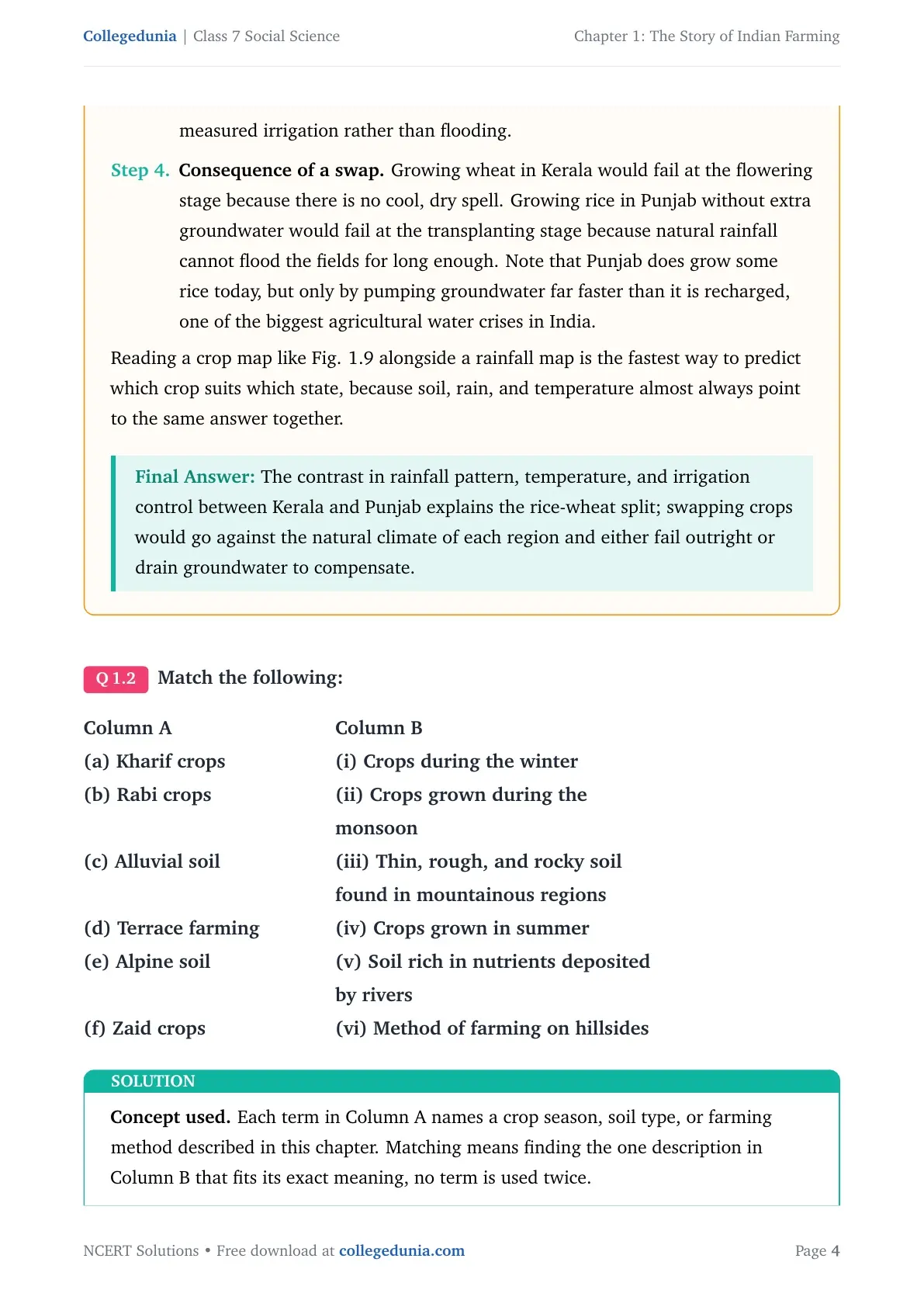
| Q2 | Match kharif, rabi, alluvial soil, terrace farming, alpine soil and zaid crops to their descriptions | Matching, 6 pairs |
| Q3 | Why certain crops thrive only in specific regions | Short answer |
| Q4 | How modern technology has helped farmers | Short answer |
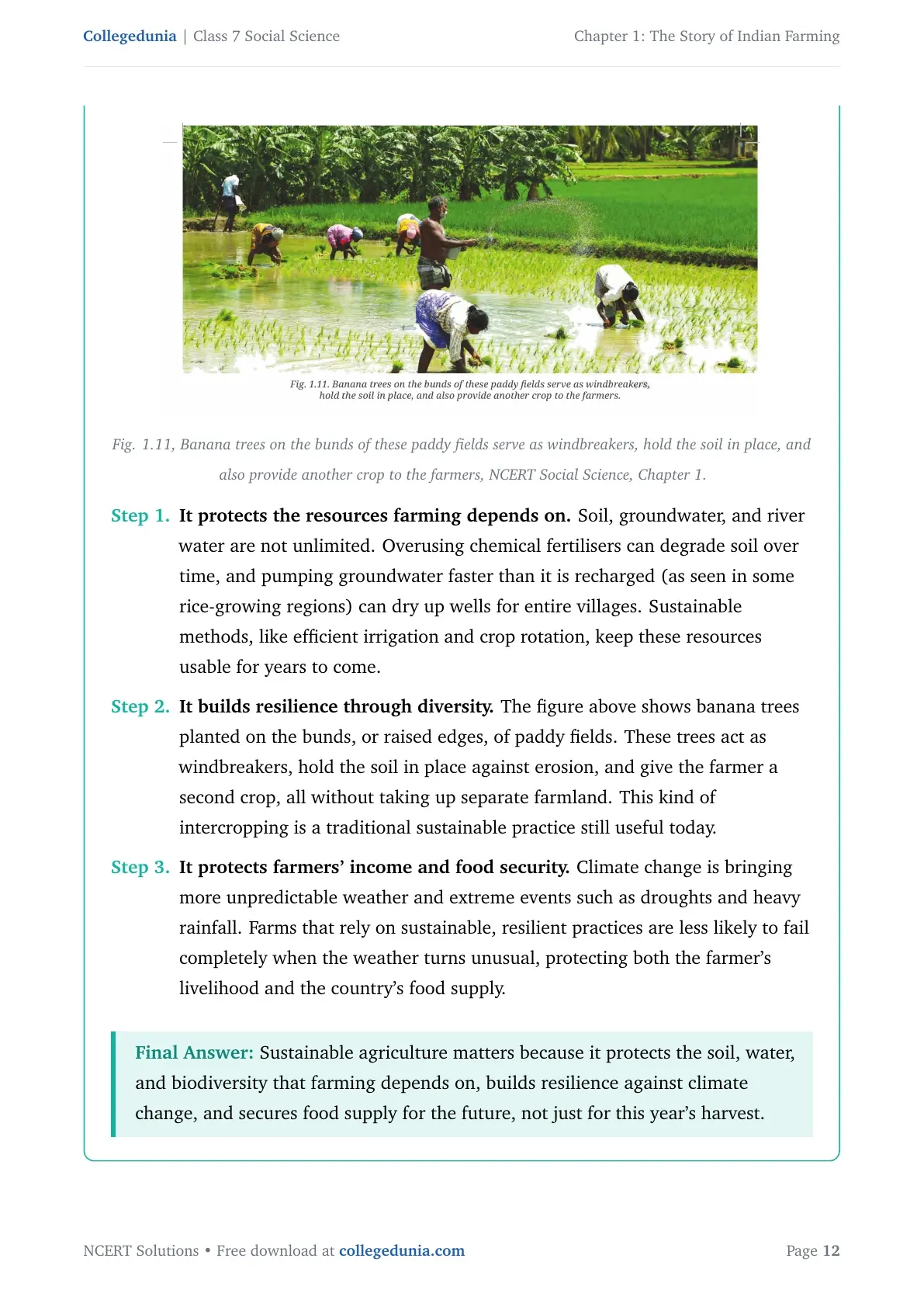
| Q5 | Why sustainable agriculture matters | Short note |
| Q6 | Challenges Indian farmers face today and their impact on people | Short answer |
| Q7 | Debate: traditional irrigation versus modern irrigation | Classroom activity |
| Q8 | Short essay imagining farming when you are 60 years old | Essay activity |
| Q9 | Group discussion and presentation on the Ganga basin | Group activity |
| Q10 | Which ancient crops from the chapter are still eaten at home | Reflection activity |
Six of the ten items are straight written answers, and the rest are activities meant for classroom discussion. Teachers usually pick from the written six when setting a periodic test, so Q1, Q2, Q3, Q5 and Q6 are the ones worth practising in full sentences first.
Kharif, Rabi and Zaid: The Three Cropping Seasons Explained
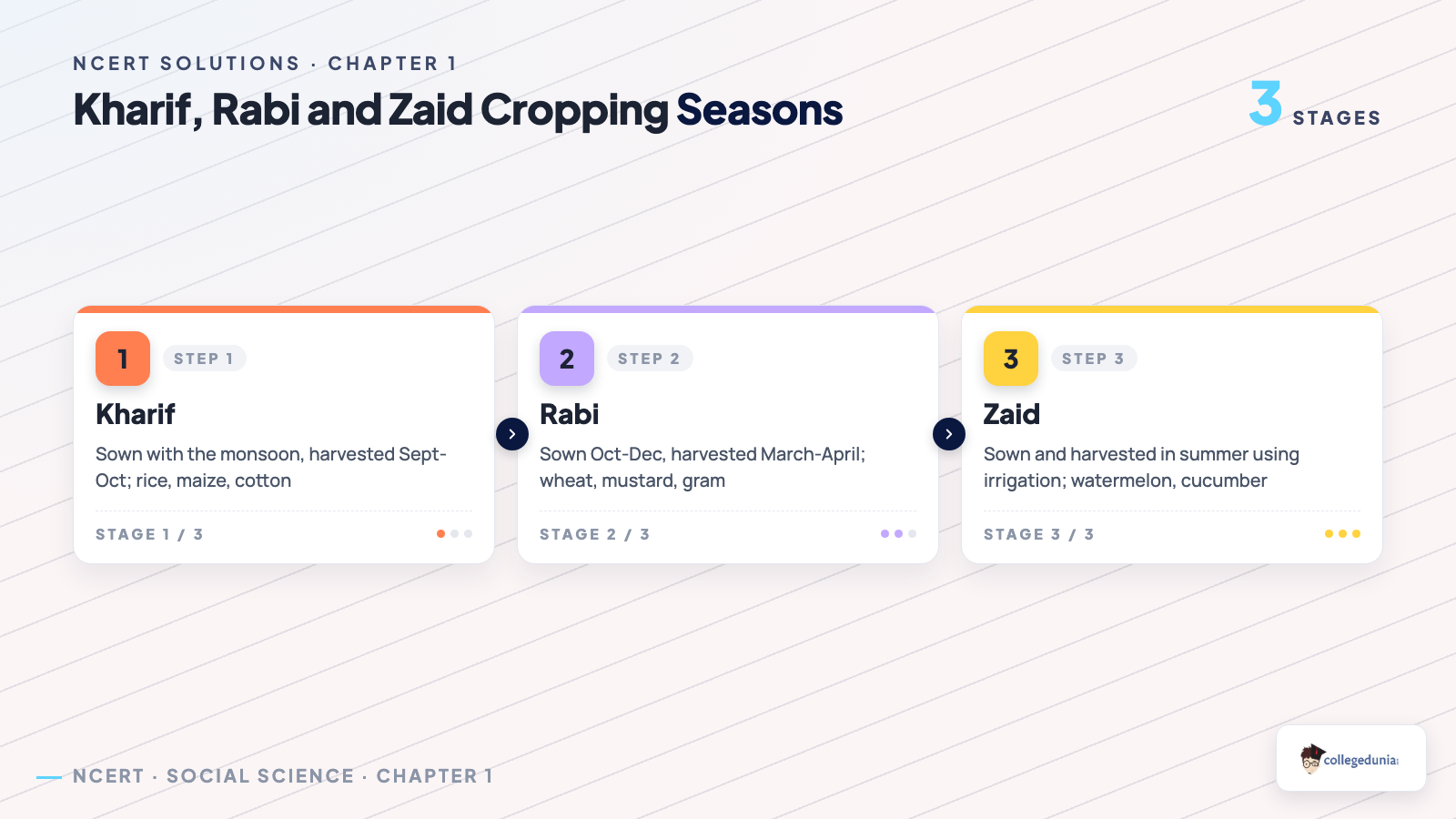
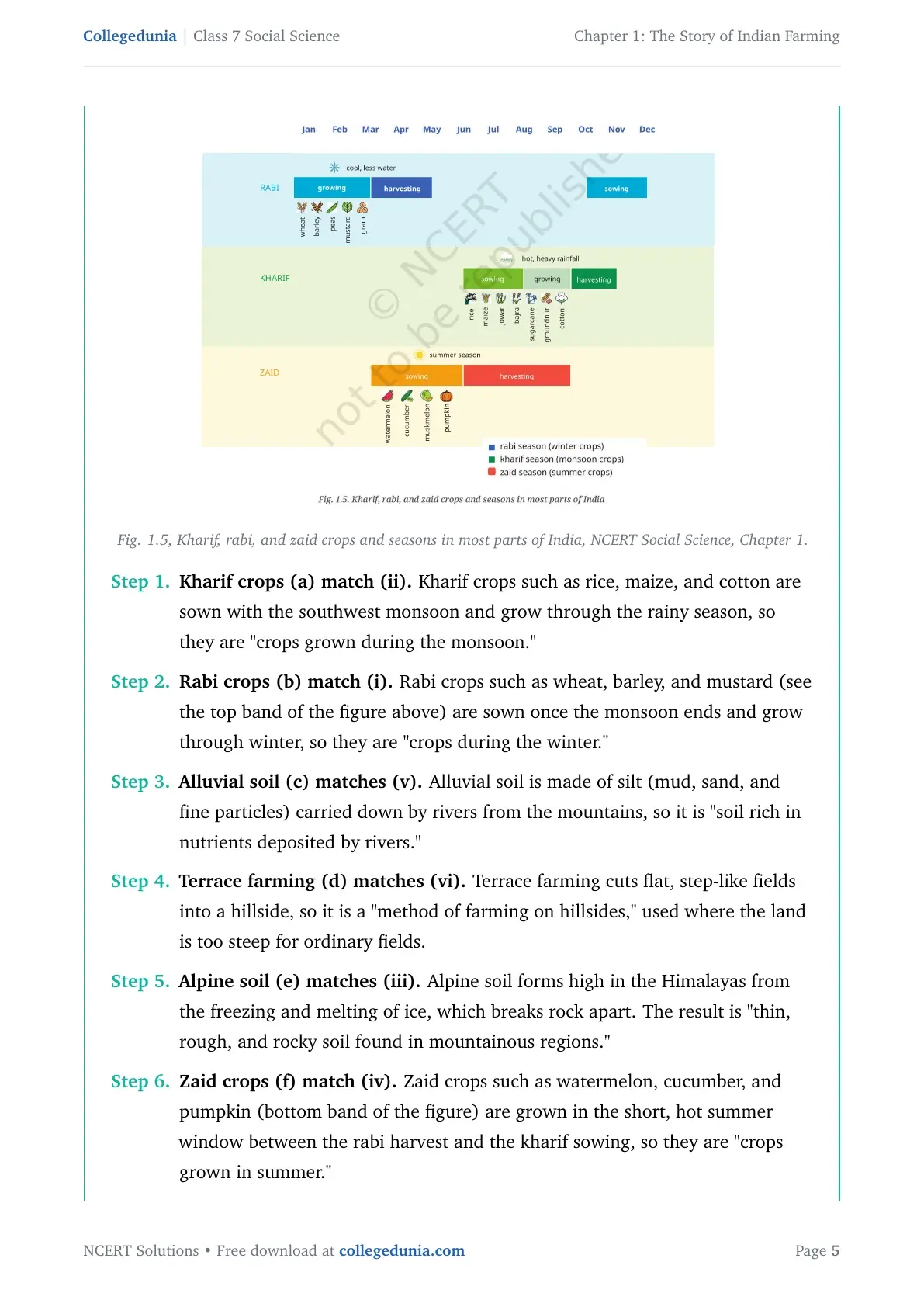
Indian farming runs on three cropping seasons: kharif, rabi, and zaid. The names come from Arabic and have been in use since Mughal times. Before that, they were called kedara (wet crops), haimana (winter crops), and graishmika (summer crops). Every match-the-column question in this chapter tests whether you can place a crop in the right season.
| Season | Sowing to harvest | Linked to | Main crops |
|---|---|---|---|
| Kharif | Sown with the monsoon, harvested Sept-Oct | Southwest monsoon (June-September) | Rice, maize, jowar, bajra, cotton, sugarcane, groundnut |
| Rabi | Sown Oct-Dec, harvested March-April | Winter, cool and less water | Wheat, barley, peas, mustard, gram |
| Zaid | Sown and harvested in the summer months | Irrigation, not the monsoon | Watermelon, muskmelon, cucumber, pumpkin |
The southwest monsoon (June to September) drives kharif sowing across northern and central India. The northeast monsoon (October to December) brings rain mainly to the east and south, which is why coastal states like Tamil Nadu, West Bengal and Andhra Pradesh can grow rice almost the whole year using both monsoons plus irrigation.
A trap question worth remembering: kharif crops depend on the monsoon arriving on time. Too little rain causes drought, but too much rain destroys the standing crop just as easily. Both extremes hurt the same harvest.
Six Major Soil Types of India and the Crops They Support
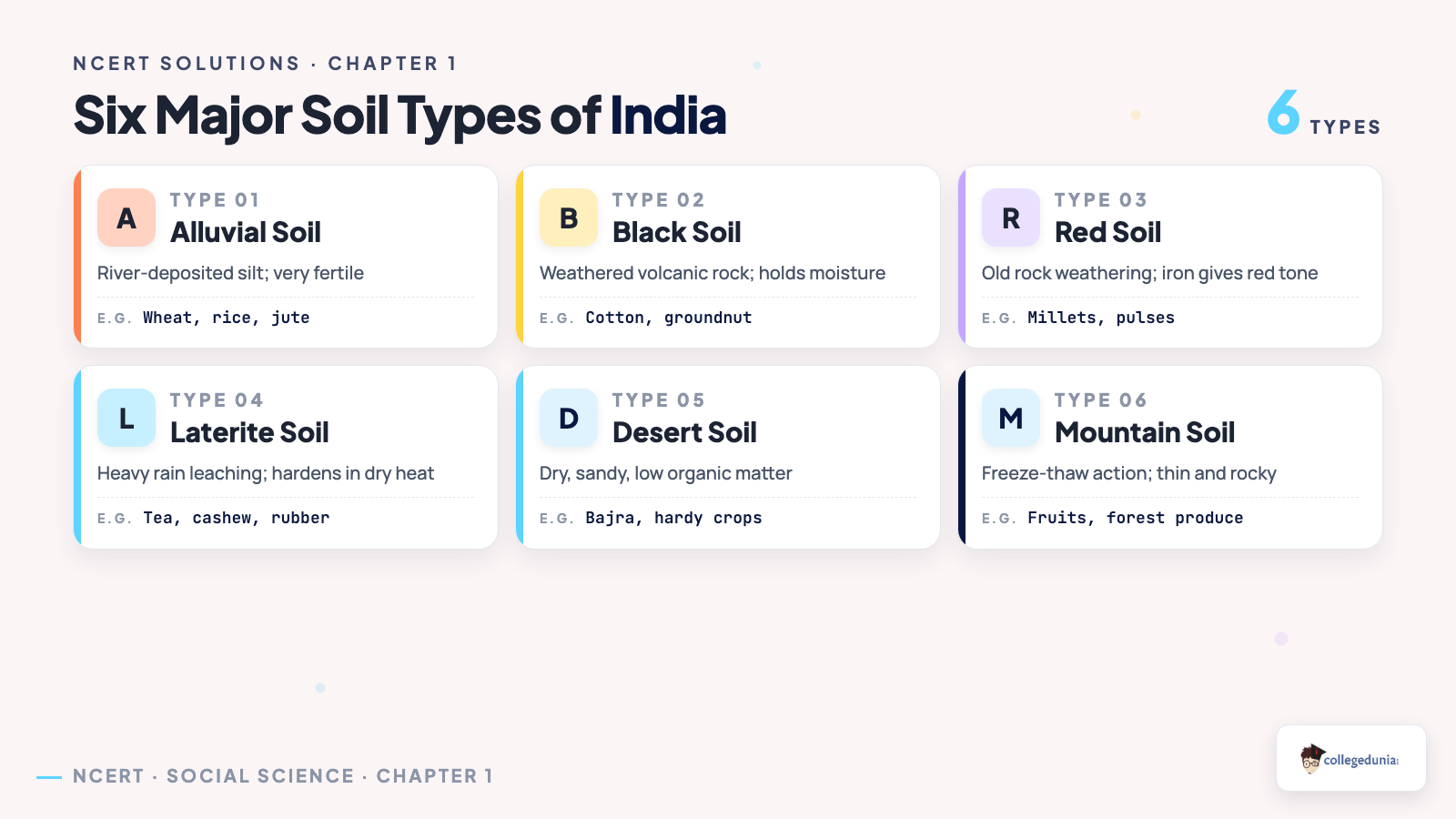
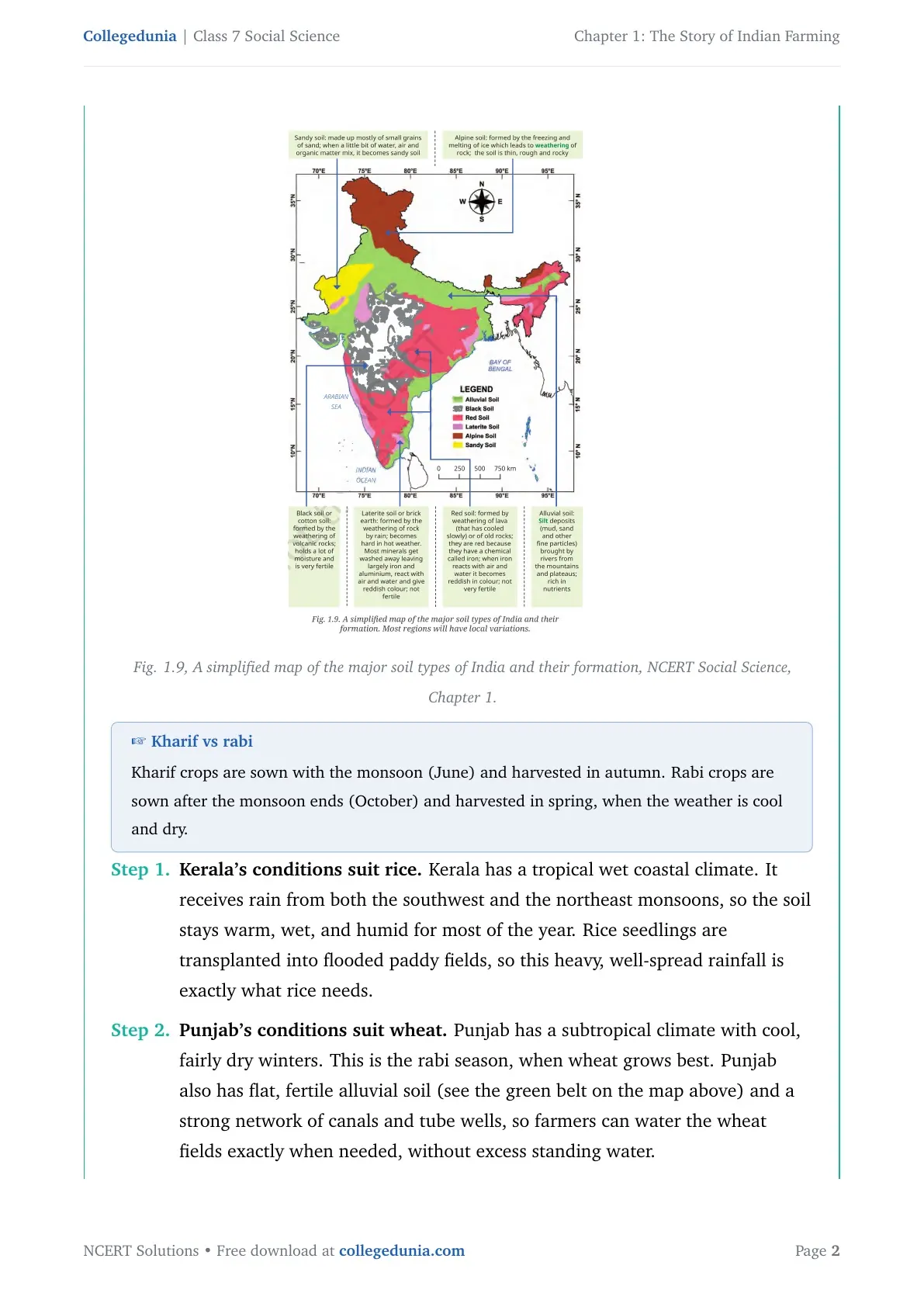
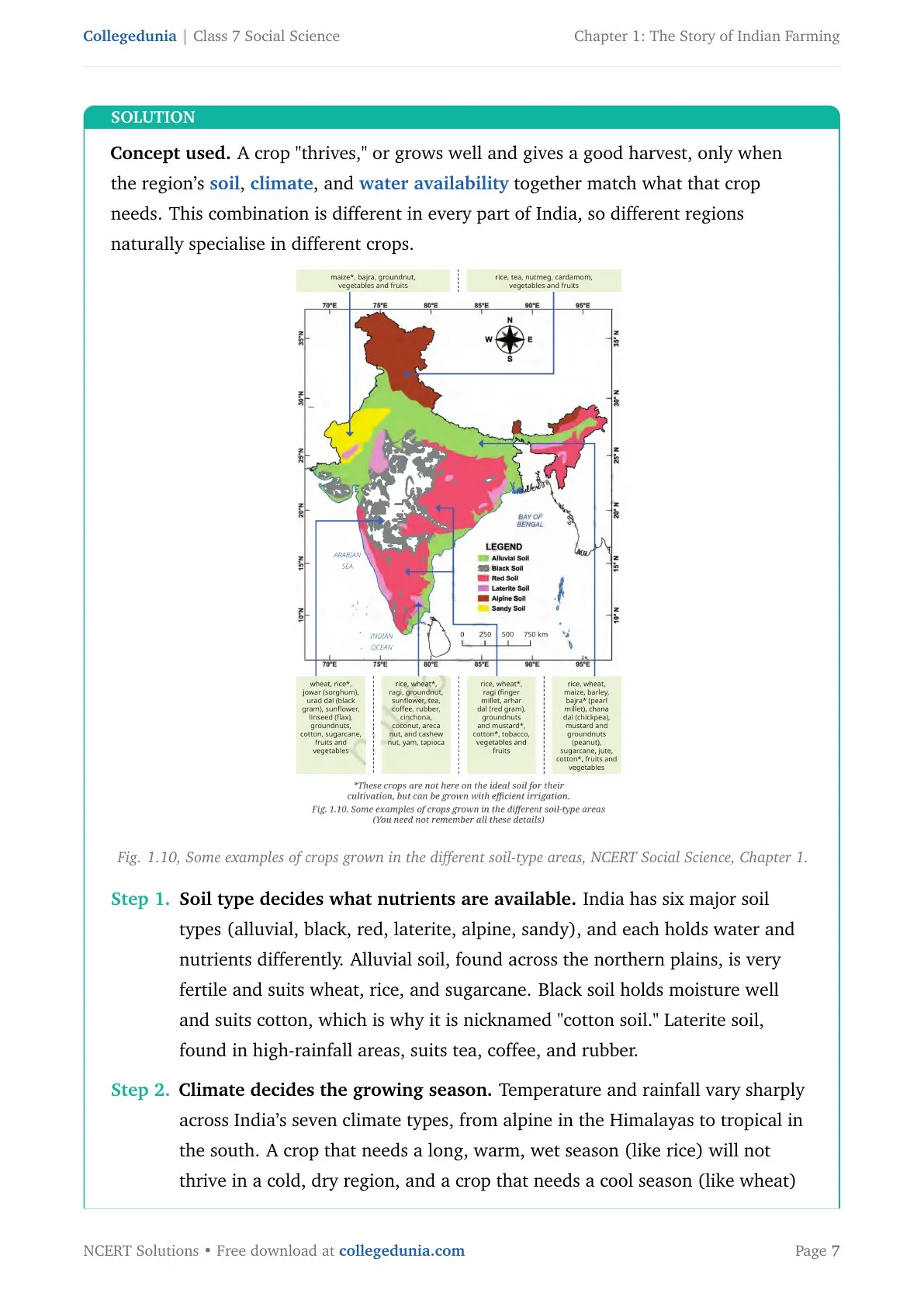
The chapter groups Indian soils into six major types, and this classification appears in nearly every worksheet built on this chapter. Ancient texts like the Amarakosha actually described twelve types of agricultural land by fertility, but the modern classification is simpler and easier to test.
| Soil type | How it forms | Fertility | Typical crops |
|---|---|---|---|
| Alluvial soil | Silt deposited by rivers from mountains and plateaus | Very fertile, rich in nutrients | Wheat, rice, sugarcane, jute |
| Black soil (cotton soil) | Weathering of volcanic rocks | Holds moisture well, very fertile | Cotton, groundnut, jowar |
| Red soil | Weathering of old rocks or cooled lava | Not very fertile, low iron content colours it red | Groundnut, millets, pulses |
| Laterite soil | Rock weathered heavily by rain, hardens in dry heat | Not fertile, most minerals wash away | Tea, cashew, coconut, rubber |
| Desert soil | Dry, sandy conditions with little organic matter | Poor fertility without irrigation | Bajra, drought-tolerant crops |
| Mountain / alpine soil | Freezing and melting of ice, thin and rocky | Thin and rough, low fertility | Fruits, forest produce |
Soil formation is slow. A simple diagram in the chapter shows bedrock breaking down into disintegrating rock, then into layered soil topped with humus, the dark, nutrient-rich layer formed from decayed plant and animal matter. This full process can take a century to several millennia, which is one reason farmers work so hard to protect the soil they already have.
Traditional soil-care methods still matter here. Crop rotation stops one field losing the same nutrient every season, multiple cropping spreads out the risk of pest damage, and contour ploughing follows a hill's natural curves to stop rainwater washing the topsoil away.
Rain-Fed and Irrigated Farming: India's Traditional and Modern Water Systems
Water decides how farming works in a region as much as soil does. The chapter splits irrigation into two broad types, and both have deep roots in Indian history.
- Rain-fed agriculture depends entirely on the monsoon, so farmers who use it face real risk from drought or unpredictable rainfall.
- Irrigated agriculture uses artificial methods, canals, wells, tanks and modern pipes, to supply water and reduce that dependence on the monsoon.
- Traditional water structures such as kund, ahar, khadin, eri and taḍāgam were built centuries before modern irrigation existed.
- Phad systems in Maharashtra and bamboo drip irrigation in the northeast are community-run systems still active today.
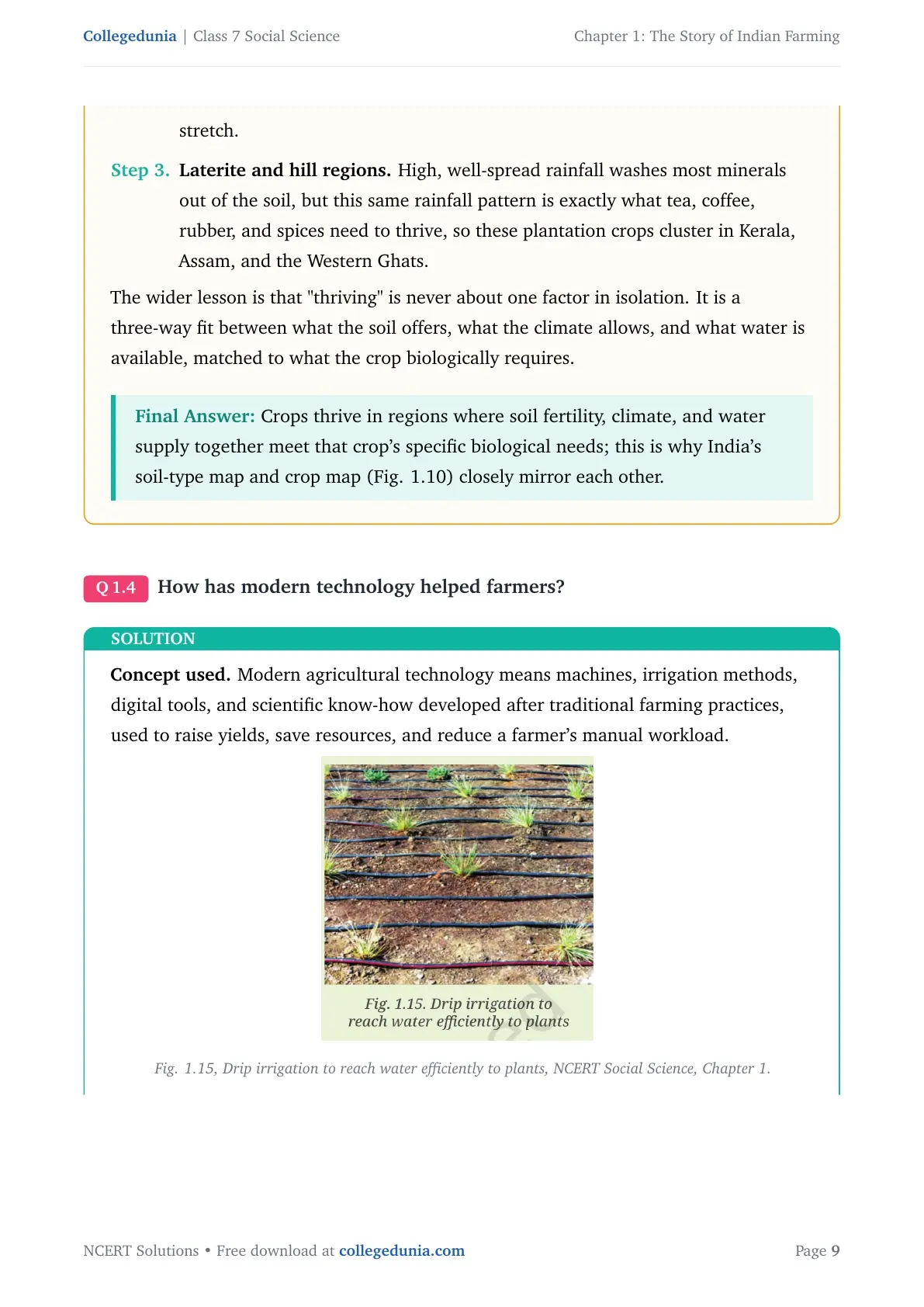
The Kallanai anicut across the Kaveri river, built around 1,800 years ago, is one of the oldest working water-diversion structures in the world and still irrigates thousands of hectares. Modern farming has added drip irrigation, which delivers water straight to the plant's roots through small tubes, and sprinkler irrigation, which sprays water over a field like artificial rain. Both cut water waste at a time when groundwater is falling fast in many parts of India.
From the Green Revolution to Sustainable Farming
The Green Revolution of the 1960s and 1970s is the pivot point this chapter returns to again and again, and it is a favourite long-answer topic in Class 7 exams. It changed Indian farming in ways still visible today, for better and for worse.
- What it introduced: high-yielding variety (HYV) seeds, expanded irrigation, chemical fertilisers and pesticides, and mechanised equipment like tractors and harvesters.
- What it achieved: India reached self-sufficiency in food grain, especially wheat and rice, under M.S. Swaminathan, who is often called its architect and later received the Bharat Ratna.
- What it cost: soil impoverishment, falling groundwater, pesticide contamination, and health effects on farming communities.
- What comes next: a shift toward organic farming, neem-based pesticides, and practices inspired by Indian Knowledge Systems (IKS).
Sikkim became the world's first fully organic state in 2014, after it banned chemical fertilisers and pesticides outright. The Food and Agriculture Organisation has separately recognised three Indian farming systems as globally significant heritage: saffron cultivation in Kashmir, forest-integrated farming in Odisha, and below-sea-level paddy and fish farming in Kerala. Newer methods like hydroponics, growing plants in nutrient-rich water without soil at all, are now used in cities where farmland is scarce.
Common Mistakes Students Make While Answering The Story of Indian Farming Questions
Read this list before your next test. Each mistake below has cost real marks on Class 7 papers.
- Mixing up kharif and rabi seasons. Kharif follows the monsoon, rabi follows winter. Wheat is rabi, rice is kharif, and swapping them is the single most common slip.
- Naming only four or five soil types instead of all six, alluvial, black, red, laterite, desert and mountain, when a question asks for the complete list.
- Calling the Green Revolution purely positive and leaving out its environmental cost, which the chapter treats as equally important.
- Confusing rain-fed with irrigated farming in one-line definitions, especially when a question gives an example and asks which type it is.
- Forgetting the reason behind a fact, such as writing that Kerala grows rice without explaining that it is the water availability from both monsoons that makes this possible.
Student Feedback: In a Collegedunia survey of 10,280 Class 7 students, 61% named the six soil types and their crops as the hardest part of this chapter to recall under exam pressure. Students who scored well reported one habit that helped, pairing each soil type with a state they had actually visited or knew about.
Source: 2026-27 Class 7 Social Science student survey. Sample of 10,280 students from CBSE schools across 13 states.
How to Study The Story of Indian Farming Effectively
This chapter mixes facts, geography and open-ended thinking, so a single reading rarely sticks. Splitting revision into short blocks works better than one long sitting, and it matches how the chapter itself is organised into clear sub-sections.
- Block 1, 30 minutes. Read India's Agricultural Landscape and Echoes from the Past, and note the three Big Questions.
- Block 2, 40 minutes. Learn the kharif, rabi and zaid table along with the six soil types and their crops.
- Block 3, 30 minutes. Cover irrigation, seeds, and the Green Revolution to sustainable farming shift.
- Night before, 20 minutes. Re-read the Common Mistakes list and answer Q1, Q2 and Q6 from memory.
More The Story of Indian Farming Class 7 Resources
Also Check: the same chapter is available in other formats on Collegedunia. Read the solutions first, then the notes for a deeper topic walk-through.
| Resource | Best used for | Open it |
|---|---|---|
| NCERT Notes | Topic-by-topic summary of climate, soil and irrigation | The Story of Indian Farming Class 7 Notes |
| NCERT Book PDF | The official 2026-27 chapter text with all figures | Class 7 Social Science Part 2 Chapter 1 Book PDF |
| Handwritten Notes | Quick one-sitting revision in clear handwriting | The Story of Indian Farming Class 7 Handwritten Notes |
NCERT Solutions for Class 7 Social Science Part 2: All Chapters
The table below lists NCERT Solutions for every chapter of Part 2, so you can move to the next chapter once this one is done.
The Story of Indian Farming Class 7 NCERT Solutions FAQs
Questions Students Ask About The Story of Indian Farming Solutions
Ques. Where can I download the NCERT Solutions for Class 7 Social Science Chapter 1 The Story of Indian Farming PDF?
Ans. Use the download option at the top of this page. The file is free, covers all 10 questions and activities from the chapter, and is available in both Normal and HD quality.
Ques. What are the three cropping seasons in Indian agriculture?
Ans. India's three cropping seasons are kharif, rabi, and zaid. Kharif crops are sown with the monsoon and harvested by October, rabi crops are sown in winter and harvested by April, and zaid crops are short-duration summer crops grown between the other two seasons.
Ques. How many major soil types does The Story of Indian Farming chapter describe?
Ans. The chapter groups Indian soils into six major types, alluvial, black, red, laterite, desert, and mountain or alpine soil. Each type supports different crops based on its fertility and how it holds water.
Ques. What is the difference between rain-fed and irrigated agriculture?
Ans. Rain-fed agriculture depends entirely on rainfall and is common where the monsoon is reliable. Irrigated agriculture uses artificial water sources such as canals, wells, and modern drip or sprinkler systems, which reduces a farmer's dependence on the monsoon alone.
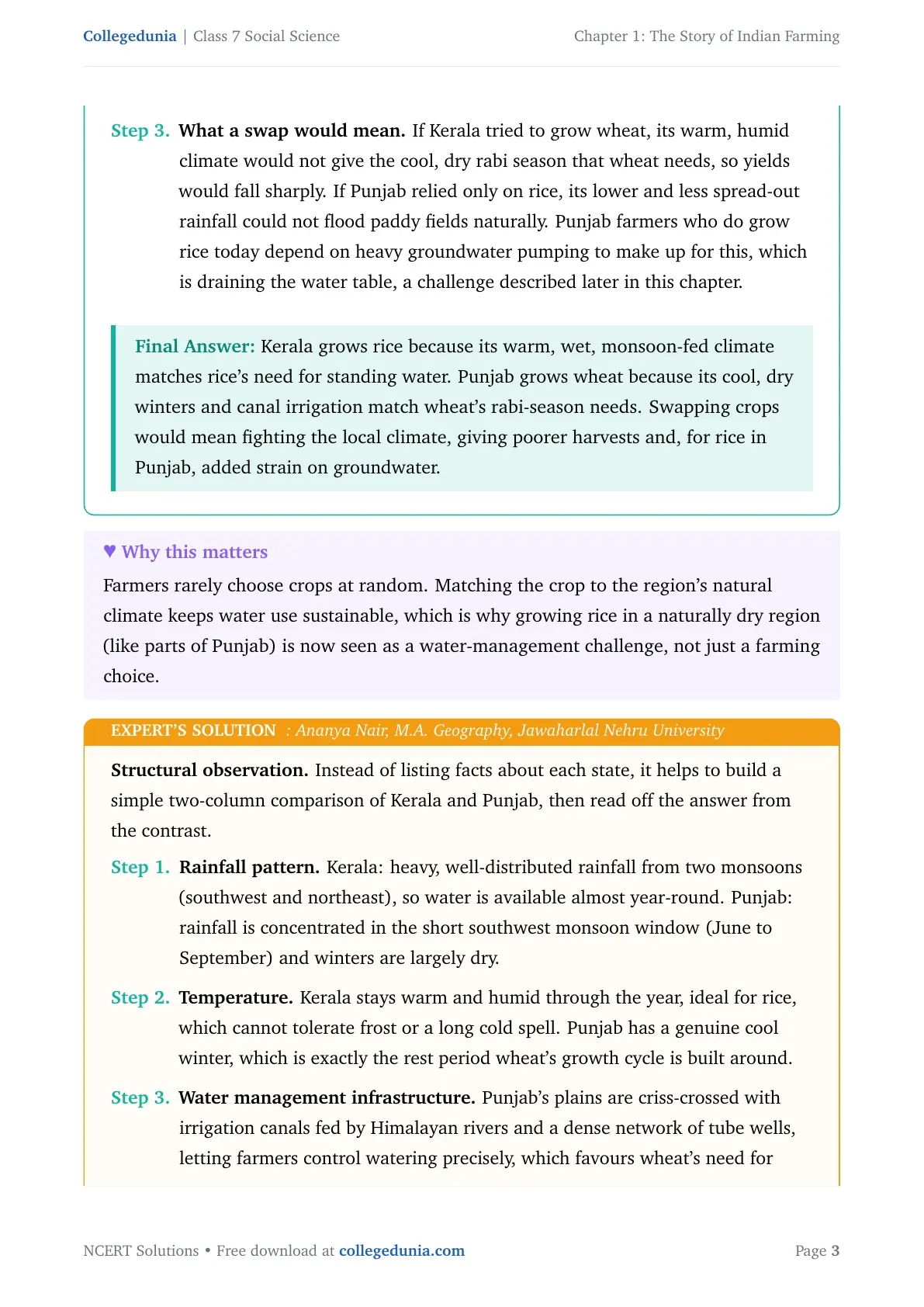
Ques. Why do farmers in Kerala grow rice while farmers in Punjab grow mostly wheat?
Ans. Kerala receives heavy rainfall from both the southwest and northeast monsoons and has warm, humid conditions suited to rice. Punjab has a drier climate with fertile alluvial soil and cooler winters, which favour wheat, a rabi crop. Swapping the crops would fail because each crop needs the climate and soil of its own region.
Ques. Is this NCERT Solutions PDF aligned with the 2026-27 syllabus?
Ans. Yes. This page follows the current 2026-27 edition of Exploring Society: India and Beyond, Grade 7 Part 2, and every answer matches the chapter content and question order printed in that edition.
Ques. What caused the Green Revolution and what were its effects?
Ans. The Green Revolution of the 1960s and 1970s introduced high-yielding variety seeds, expanded irrigation, chemical fertilisers and pesticides, and mechanised equipment. It made India self-sufficient in food grain but also caused soil impoverishment, falling groundwater levels, and pesticide contamination over time.
Ques. How many pages is the Class 7 Social Science Chapter 1 NCERT Solutions PDF?
Ans. The Solutions PDF runs to a compact length that covers all 10 questions and activities from The Story of Indian Farming, including the full Column A and Column B matching answers.
Ques. What is meant by sustainable agriculture in this chapter?
Ans. Sustainable agriculture combines the productivity of modern farming methods with eco-friendly, traditional practices. It includes organic farming, neem-based pesticides, and approaches inspired by Indian Knowledge Systems, aiming to protect soil and water for future harvests rather than only maximising today's yield.
Ques. Which challenges do Indian farmers face today, according to the chapter?
Ans. The chapter lists decreasing landholding size, difficulty affording modern machinery, climate change and unpredictable weather, groundwater depletion in river basins like the Ganga, and debt from crop loans as the main challenges Indian farmers face today.



Comments