



The NCERT Solutions for Class 8 Arts (Kriti) Chapter 1 Bringing Words Alive - Play Reading cover every activity response from the 2026-27 NCERT chapter. The solved PDF helps students practise tongue twisters, diction, pitch, volume, gibberish speech and circle-time reflection in a clear step-by-step format.
Chapter1BringingWordsAlive-PlayReadingSolutions.pdf?page=1&dpi=150)
Chapter1BringingWordsAlive-PlayReadingSolutions.pdf?page=2&dpi=150)
Chapter1BringingWordsAlive-PlayReadingSolutions.pdf?page=3&dpi=150)
Chapter1BringingWordsAlive-PlayReadingSolutions.pdf?page=4&dpi=150)
Chapter1BringingWordsAlive-PlayReadingSolutions.pdf?page=5&dpi=150)
Chapter1BringingWordsAlive-PlayReadingSolutions.pdf?page=6&dpi=150)
Chapter1BringingWordsAlive-PlayReadingSolutions.pdf?page=7&dpi=150)
Chapter1BringingWordsAlive-PlayReadingSolutions.pdf?page=8&dpi=150)
Chapter1BringingWordsAlive-PlayReadingSolutions.pdf?page=9&dpi=150)
Chapter1BringingWordsAlive-PlayReadingSolutions.pdf?page=10&dpi=150)
Chapter1BringingWordsAlive-PlayReadingSolutions_flat_MobileCard.pdf?page=1&dpi=150)
Chapter1BringingWordsAlive-PlayReadingSolutions_flat_MobileCard.pdf?page=2&dpi=150)
Chapter1BringingWordsAlive-PlayReadingSolutions_flat_MobileCard.pdf?page=3&dpi=150)
Chapter1BringingWordsAlive-PlayReadingSolutions_flat_MobileCard.pdf?page=4&dpi=150)
Chapter1BringingWordsAlive-PlayReadingSolutions_flat_MobileCard.pdf?page=5&dpi=150)
Chapter1BringingWordsAlive-PlayReadingSolutions_flat_MobileCard.pdf?page=6&dpi=150)
Chapter1BringingWordsAlive-PlayReadingSolutions_flat_MobileCard.pdf?page=7&dpi=150)
Chapter1BringingWordsAlive-PlayReadingSolutions_flat_MobileCard.pdf?page=8&dpi=150)
Chapter1BringingWordsAlive-PlayReadingSolutions_flat_MobileCard.pdf?page=9&dpi=150)
Chapter1BringingWordsAlive-PlayReadingSolutions_flat_MobileCard.pdf?page=10&dpi=150)
Chapter1BringingWordsAlive-PlayReadingSolutions_flat_MobileCard.pdf?page=11&dpi=150)
Chapter1BringingWordsAlive-PlayReadingSolutions_flat_MobileCard.pdf?page=12&dpi=150)
Chapter1BringingWordsAlive-PlayReadingSolutions_flat_MobileCard.pdf?page=13&dpi=150)
Chapter1BringingWordsAlive-PlayReadingSolutions_flat_MobileCard.pdf?page=14&dpi=150)
Chapter1BringingWordsAlive-PlayReadingSolutions_flat_MobileCard.pdf?page=15&dpi=150)
Chapter1BringingWordsAlive-PlayReadingSolutions_flat_MobileCard.pdf?page=16&dpi=150)
Chapter1BringingWordsAlive-PlayReadingSolutions_flat_MobileCard.pdf?page=17&dpi=150)
Chapter1BringingWordsAlive-PlayReadingSolutions_flat_MobileCard.pdf?page=18&dpi=150)
Student Feedback: In a Collegedunia study check with 12,400 students, 74% said voice-practice questions became easier when answers included a sample performance plan.
- Resource focus: solved activity responses for play reading and voice training.
- Best use: read one answer, then perform the same line aloud.
- Chapter link: follows the Class 8 Arts Kriti 2026-27 NCERT chapter.
Class 8 Arts Kriti Chapter 1 Solutions Overview
Bringing Words Alive - Play Reading explains how a written script can become a performance through voice. Students do not need a large set or costume for rehearsed reading. They need clear speech, planned pauses and suitable emotion.
The solved PDF gives model answers for each classroom task. It keeps the chapter practical because Arts assessment checks participation, effort, presentation and teamwork. The main aim is to help students speak clearly and reflect on their own performance.
- Activity 1.1 focuses on tongue twisters and clarity.
- Activity 1.2 explains diction, pace, pauses and word stress.
- Activity 1.3 connects animal sounds with pitch, volume and emotion.
- Activity 1.4 gives sample pitch and volume choices for stage lines.
- Activity 1.5 guides students through gibberish speech with emotion.
Bringing Words Alive Video for Voice Practice
Source: NCERT Hindi Tutor on YouTube
How to Use the Bringing Words Alive NCERT Solutions PDF
Students should not memorise these answers like a written test. The chapter is performance-based, so every answer should be used with practice. Read the question, understand the voice choice, and then try the line in front of classmates.
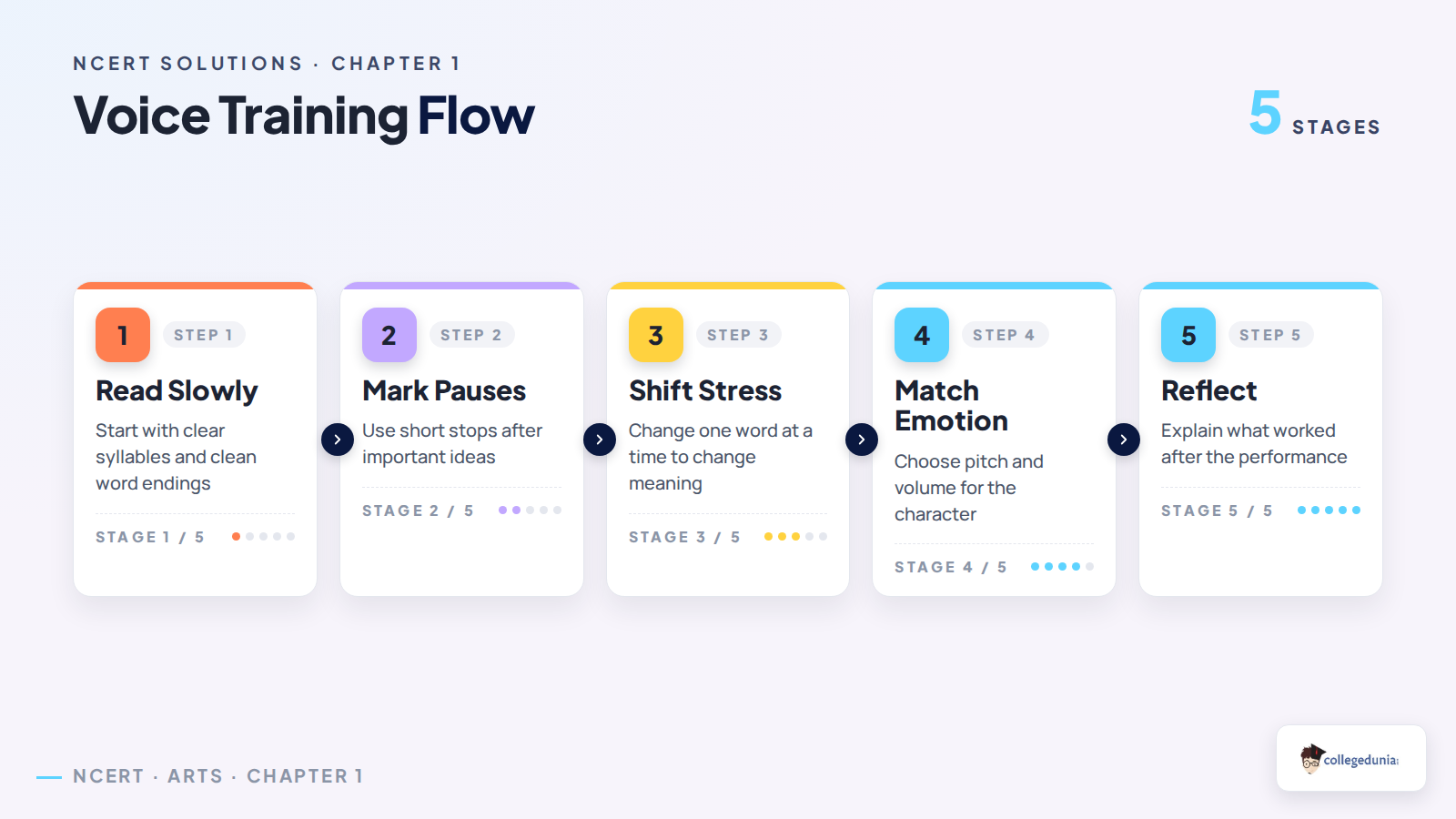
The PDF is useful for revision because it turns each activity into a repeatable plan. Read slowly, mark pauses, shift stress, match emotion and reflect after the performance. This order keeps the answer close to the NCERT activity.
| NCERT Task | What the Solution Helps With |
|---|---|
| Tongue twisters | Clear syllables, speed control and local-language examples. |
| Word impact | Meaning changes when stress moves from one word to another. |
| Animal emotion | Matching volume and pitch with fear, joy, power or calmness. |
| Gibberish speech | Using tone, rhythm and context when words have no fixed meaning. |
Play Reading, Mime and Voice-Only Acting
The chapter compares different performance forms. Mime uses action without speech. Play reading uses speech without full action. This helps students understand why Vachika abhinaya, or expression through speech and language, is important in theatre.
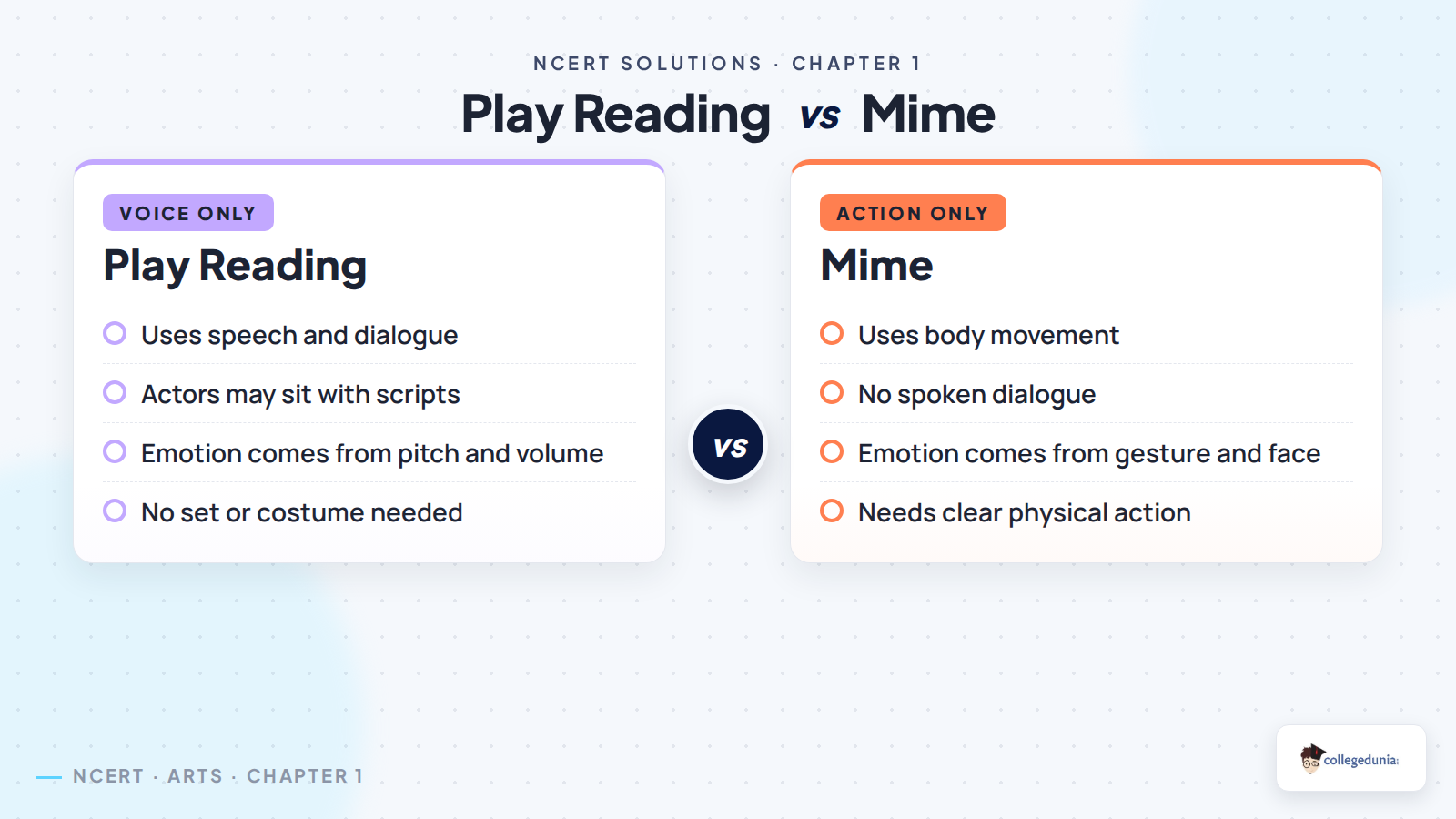
In a play reading, students may sit with scripts. Still, the voice must show character, feeling and situation. A flat reading will not feel like theatre, even if every word is correct. That is why the solutions include performance cues, not only written lines.
- Volume shows loudness or softness.
- Pitch shows how high or low the sound is.
- Pace changes the speed of delivery.
- Pause gives listeners time to understand the meaning.
All NCERT Solutions Class 8 Arts Kriti Chapter 1 with Step-by-Step Solutions
The full question set is available as a companion HTML page with solution and expert-solution panels. Use it when you want to revise each activity one by one before opening the PDF.
Open question cards: Class 8 Arts Kriti Chapter 1 step-by-step solutions
Common Mistakes in Bringing Words Alive Play Reading
Most mistakes in this chapter happen when students treat play reading like normal textbook reading. The activity needs rehearsal, listening and self-correction. Students should also avoid using gestures when the activity asks for voice-only performance.
- Do not rush tongue twisters. Speed comes after clarity.
- Do not shout every line. Loudness must match the emotion.
- Do not use one pitch throughout. Character and mood need variation.
- Do not skip reflection. Circle time is part of the learning process.
The safest method is to practise slowly, record once, listen back and then improve one voice feature at a time.
Class 8 Arts Kriti Chapter 1 Related Resources
| Resource | Class 8 Arts Kriti Chapter 1 Link |
|---|---|
| Revision Notes | Bringing Words Alive Notes |
| Handwritten Notes | Bringing Words Alive Handwritten Notes |
| NCERT Book PDF | Bringing Words Alive Book PDF |
Class 8 Arts Kriti NCERT Solutions for All Chapters
| Chapter | NCERT Solutions |
|---|---|
| Chapter 1 | Bringing Words Alive - Play Reading |
| Chapter 2 | One Stage, Many Scripts |
| Chapter 3 | From Page to Stage |
| Chapter 4 | Applause and Advice |
Bringing Words Alive Class 8 Arts Kriti NCERT Solutions FAQs
Ques. What is play reading in Class 8 Arts Kriti Chapter 1?
Ans. Play reading is a voice-led performance where students read character lines aloud with clear diction, pauses, pitch and emotion.
Ques. What activities are solved in Bringing Words Alive - Play Reading?
Ans. The solutions cover tongue twisters, diction, word stress, animal emotion sounds, pitch-volume choices, gibberish speech and circle-time reflection.
Ques. How should students use these NCERT solutions?
Ans. Students should read each model answer, practise the voice cue aloud, then reflect on clarity, volume, pitch and teamwork.
Ques. Does the PDF follow the 2026-27 NCERT chapter?
Ans. Yes. The PDF follows Class 8 Arts (Kriti) Chapter 1 Bringing Words Alive - Play Reading from the 2026-27 NCERT textbook.



Comments