The NCERT Solutions for Class 8 English Poorvi Chapter 1 Wit and Wisdom cover all major textbook questions from the latest 2026-27 NCERT unit. The PDF includes answers for The Wit that Won Hearts, A Concrete Example and Wisdom Paves the Way.
Chapter focus: wit, humour, wordplay, observation, deduction and wise judgement.
Included tasks: comprehension, extract questions, vocabulary, grammar, notice, letter and creative writing.
Best use: read the source text first, then use the PDF for answer structure and revision.
Student Feedback: In a Collegedunia study check with 7,860 Class 8 students, 72% found this unit easier after separating prose, poem and play answers into three revision blocks.
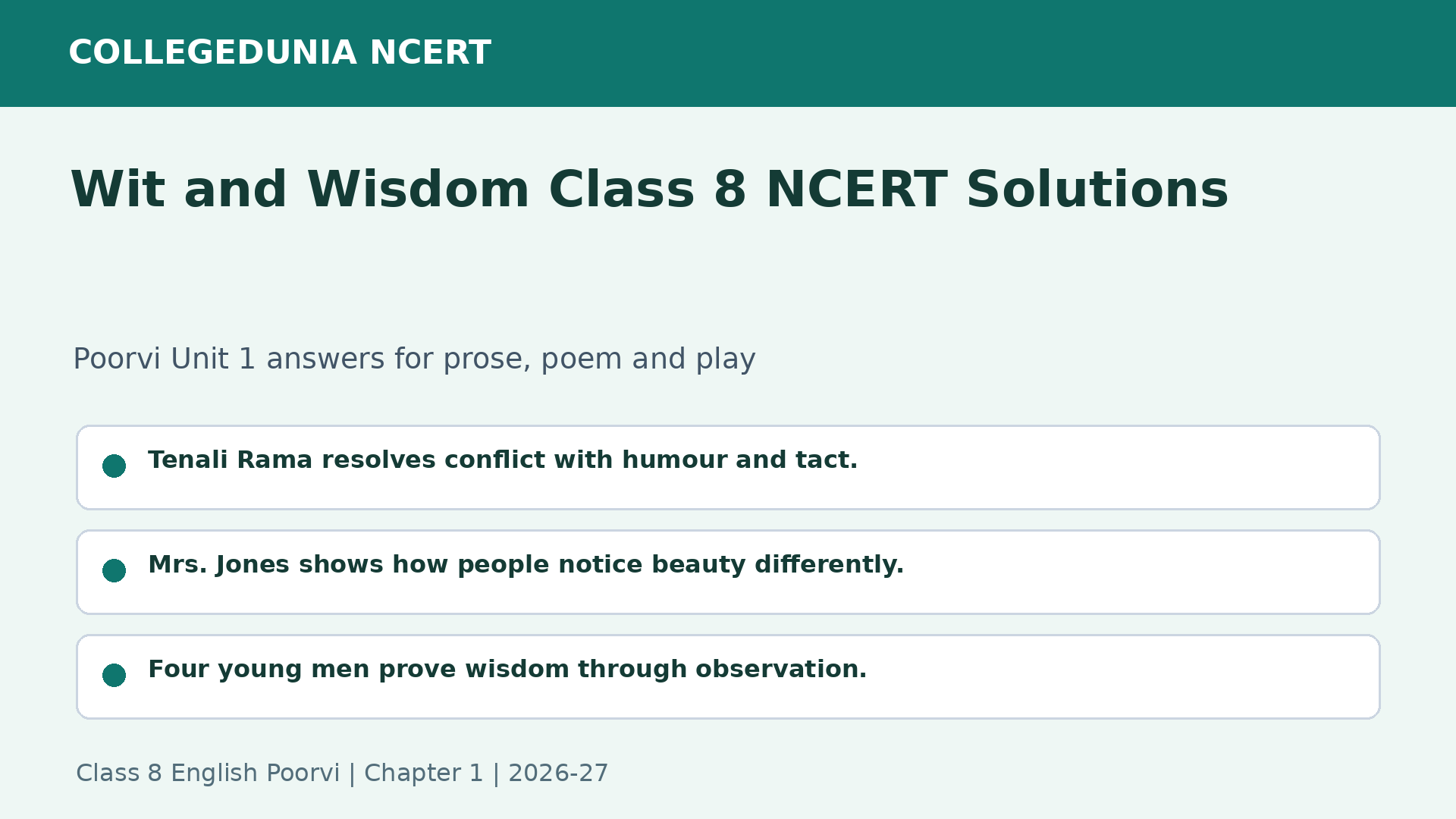
Chapter 1 is a unit with three different reading forms. The prose story shows Tenali Rama using tact. The poem uses humour and pun. The play shows four young men using evidence and deduction.
Text
Genre
Core skill
The Wit that Won Hearts
Story
Conflict resolution through wit
A Concrete Example
Poem
Humour, irony, pun and refrain
Wisdom Paves the Way
Play
Observation, deduction and justice
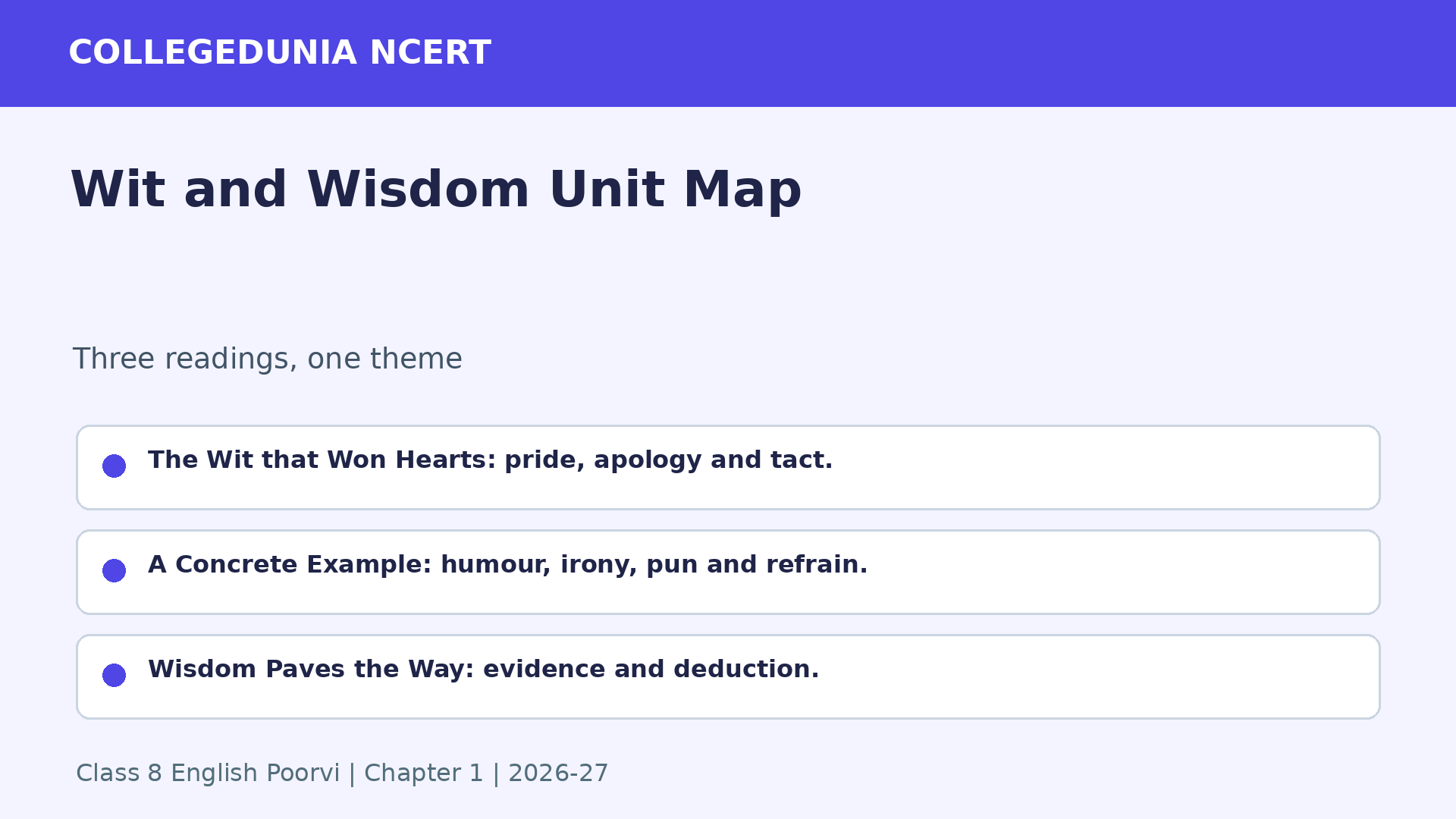
Wit and Wisdom Unit Map
The unit should be revised in three parts. First, learn the events of Tenali Rama's story. Next, revise the poem's literary devices. Finally, remember how each young man in the play deduces one fact about the camel.
Prose cue: pride, misunderstanding, strategy and apology.
Poem cue: stones, tiny flower, pun and surprise ending.
Play cue: tracks, leaves, blood drops and deep footprints.
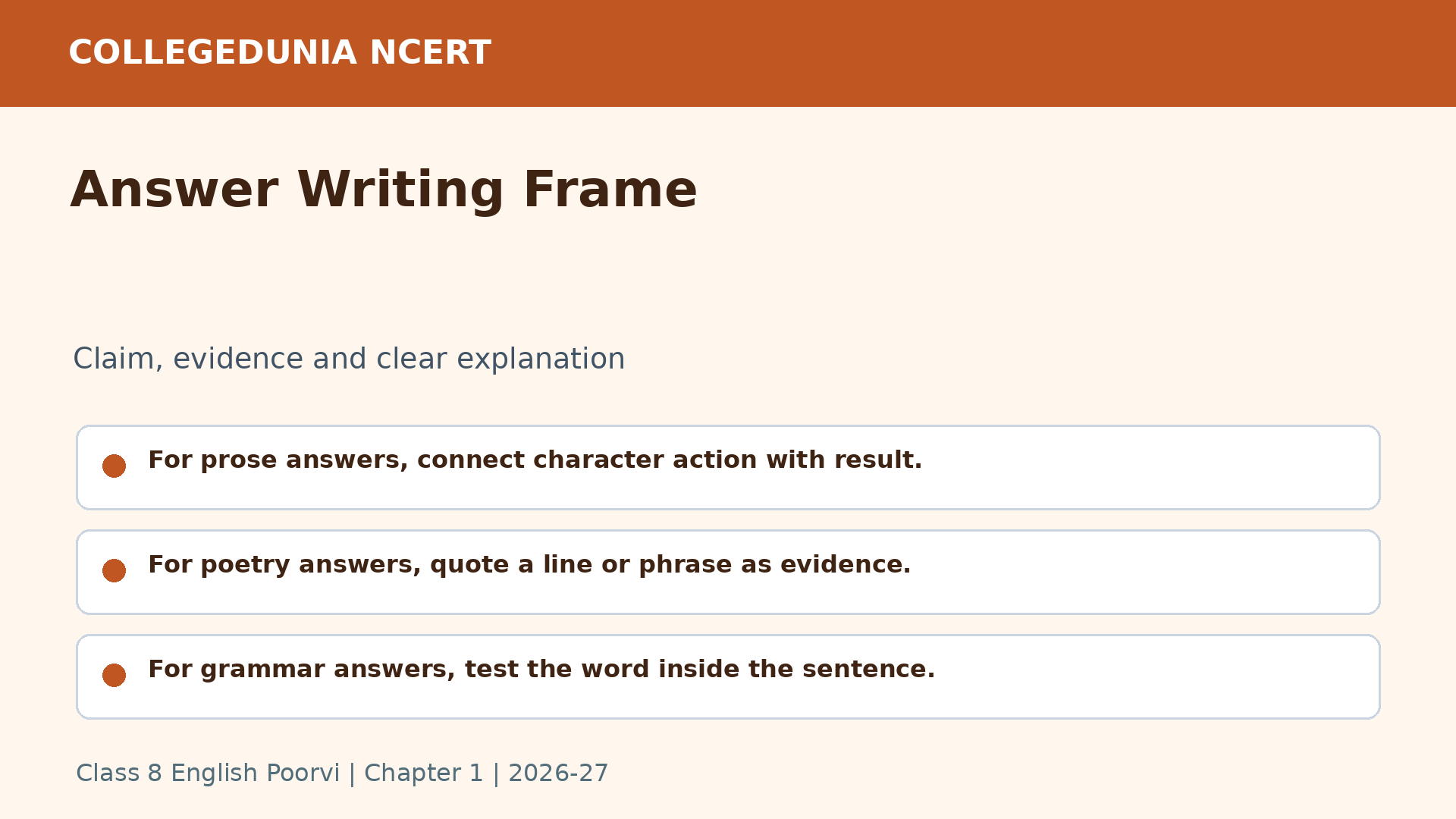
Answer Writing Method for Chapter 1
For comprehension answers, write a direct claim first. Then add one evidence point from the text. For poetry answers, mention the device and explain its effect. For grammar answers, test the word inside the full sentence.
Extract questions: identify the speaker, feeling and implied meaning.
Literary device questions: quote the exact phrase, then explain it.
Writing tasks: follow the required format before adding details.
All NCERT Solutions for Class 8 English Poorvi Chapter 1 Wit and Wisdom with Step-by-Step Solutions
The cards below include the main prose, poem, play, grammar and writing exercises. Use Check Solution for the direct answer and Expert Solution for a second explanation.
Q1. The Wit that Won Hearts: false statements
Rectify the five false statements from the prose text.
Final answer: The corrected statements show that the quarrel came from a misunderstanding, and Rama solved it indirectly through wit.
The queen did not insult the king by speaking against the poem. She yawned because she was exhausted after a tiring day.
Tenali Rama did not immediately go to the king. He planned a strategy and used the paddy seeds discussion in court.
The courtiers did not admire the poem. They avoided hearing it and made excuses.
The ministers were not eager to hear Rama's idea. Some courtiers mocked the special paddy seeds.
The king did realise his mistake. He apologised to Queen Thirumalambal that evening.
Ananya Rao, M.A. English, University of DelhiVerified Expert
A false-statement answer must replace the wrong detail with the exact event from the story.
Keep the correction factual and close to the story sequence.
Q2. The Wit that Won Hearts: extract 1
Answer the extract questions on the queen asking Tenali Rama for help.
Final answer: Rama understands that the king must realise the mistake by himself, not through direct criticism.
The queen believes only Rama can help because he is known for wit, patience and clever solutions.
The correct option is B: she regrets the unintended misunderstanding.
Rama's response shows wisdom because he does not rush. He says the matter needs a well-planned approach.
The blank is: takes great pride. The king is sensitive about his poetry.
Kabir Menon, M.A. Literature, JNU DelhiVerified Expert
The extract shows the queen's regret and Rama's calm problem-solving.
Notice the words thoughtful, strategy and understand.
Q3. The Wit that Won Hearts: extract 2
Answer the extract questions on the king's apology to the queen.
Final answer: The scene shows that accepting one's mistake can repair a relationship.
When the king says pride blinded him, he means his ego stopped him from judging the queen's yawn fairly.
The queen says they can leave the quarrel behind because she accepts his apology and wants peace restored.
The correct option is: maturity and self-awareness.
The queen's response shows forgiveness, patience and affection.
Meera Kapoor, M.Ed English Education, TISS MumbaiVerified Expert
The extract presents self-awareness, humility and forgiveness.
Use the king's changed tone as evidence.
Q4. The Wit that Won Hearts: short answers
Answer the six prose questions from Let us think and reflect.
Final answer: The prose story teaches that humour, tact and patience can solve a conflict better than direct blame.
Krishnadeva Raya's reign was called a Golden Era because art, literature, architecture and learning flourished.
Tenali Ramakrishna gained a special place through poetry, humour and clever solutions to difficult problems.
The quarrel made the palace quiet and unhappy because the king stopped visiting the queen.
Rama used a paddy seeds discussion to make the king understand that yawning is natural.
The courtiers reacted with sarcasm, whispers and laughter when Rama introduced the special seeds.
The story ends with the king apologising, the queen forgiving him and the palace becoming joyful again. The lesson is that wit can heal pride and misunderstanding.
Rohan Iyer, M.A. Linguistics, University of HyderabadVerified Expert
Short answers should connect character, action and result.
For every answer, name the person and the effect of the action.
Q5. The Wit that Won Hearts: vocabulary and grammar
Solve the expression, sound-word, compound-word and conditional-sentence exercises.
Final answer: The answers rely on context clues from the story and the grammar patterns of conditionals.
Expression paragraph: cast a shadow, rippled through, stormed off, murmur swept through the room, mind raced back, cast a shadow.
Example completions: if you do not complete the work; they had reached the station early; You will fall ill; she would help us; She would have passed; I would help my family and donate some money.
Diya Sen, M.A. English, Presidency UniversityVerified Expert
Language exercises test whether words fit the context, not only their dictionary meaning.
Check whether the sentence refers to real future, imagined present or impossible past.
Q6. A Concrete Example: summary and options
Complete the poem summary and choose the correct options.
Final answer: The poem presents an unusual garden through playful observation and gentle irony.
Nice word family answers: dice, rice, mice, vice. Soil word family answers: boil, toil, coil, foil.
Notice sample: School Nature Club, NOTICE, date, Inauguration of Herb Garden, Students of Grades 6 to 8 are informed that the Herb Garden will be inaugurated on Friday at 10:00 a.m. in the school garden. The Principal will be the chief guest. Interested students may contact the Nature Club secretary in Room 8.
Sara Thomas, M.Ed Language Pedagogy, Christ UniversityVerified Expert
These tasks check synonym choice, word families and formal notice format.
A notice is short, boxed and factual.
Q10. Wisdom Paves the Way: Scene I reasons
Complete the reasons from Scene I of the play.
Final answer: The reasons show that the young men observe calmly while the merchant reacts in haste.
Dev Datt says they should be united because all four want work and hope the king will recognise their talents.
Har Datt notices fresh tracks because a camel has recently passed that way.
Shiv Datt thinks the man is a merchant in trouble because he is running anxiously and looks distressed.
The merchant thinks Dev Datt may be a healer because Dev Datt correctly says the camel has stomach pain.
Dev Datt says they will wait under the banyan tree because they are innocent and ready to answer the king if called.
Vivaan Mehta, M.A. Comparative Literature, Jadavpur UniversityVerified Expert
Scene I shows observation before explanation.
Use because plus evidence from the scene.
Q11. Wisdom Paves the Way: Scene II order
Arrange the Scene II events in order.
Final answer: The correct sequence is 3, 8, 2, 5, 7, 6, 4, 1.
3: The King asks the merchant to clearly state his accusation.
8: The merchant accuses the four men of knowing much about his missing camel.
2: Ram Datt explains that the tracks show the camel is lame.
5: Shiv Datt explains that the camel ate only leaves on the left side.
7: Har Datt explains the short tail from mosquito bites and blood drops.
6: Dev Datt explains the camel's pain and careful movement.
4: The King praises the observations and dismisses the accusation.
1: The King makes the four young men his advisers.
Ishita Bose, M.A. English, Banaras Hindu UniversityVerified Expert
Ordering questions test the sequence of accusation, explanation, judgement and reward.
First comes the charge, then the evidence, then the judgement.
Q12. Wisdom Paves the Way: extract answers
Answer both extract question sets from the play.
Final answer: The play rewards careful reasoning and a ruler who listens before judging.
False statement: A is false. Dev Datt does not think employment is easy. He says they may wander more before finding suitable work.
Ram Datt's confidence shows self-belief and faith in the group's talents.
Press on means option B: moving forward with determination.
Har Datt is option C: cautious and thoughtful, preferring to plan ahead.
Assertion and Reason: option B. Both are true, but the King's offer is not the reason for the merchant's shame.
See beyond the obvious means option C: notice details that others might overlook.
Ram Datt says it is an honour because they had only hoped for employment, not appointment as royal advisers.
The King's offer shows that he values wisdom, justice and talent more than status.
Arjun Sethi, M.A. Education, Azim Premji UniversityVerified Expert
The extracts contrast patience, confidence, planning and just leadership.
Do not mix up the merchant's shame with the King's reward.
Q13. Wisdom Paves the Way: short answers
Answer the six play questions from Let us think and reflect.
Final answer: The four young men earn honour by using evidence, not guesswork.
The dusty road shows hardship, distance and uncertainty in the young men's search for work.
The merchant suspects them because they know exact details of the camel without claiming to have seen it. This shows he is anxious and quick to accuse.
Their observations become the turning point because they prove their intelligence before the king.
The King believes them because each gives a logical explanation based on evidence from the road.
Their observation, reasoning and calm speech make them suitable advisers.
The merchant feels ashamed because his accusation was false and based on anger, while the men were innocent and wise.
Naina Gill, M.A. Applied Linguistics, Delhi UniversityVerified Expert
The play teaches that wisdom is knowledge used with judgement.
Use words like observation, deduction and evidence.
Q14. Wisdom Paves the Way: word forms and expressions
Solve noun forms, expression meanings and polysemy exercises.
Final answer: The same word can change meaning by function and context.
Expression matches: with all our hearts-vi, to be precise-iv, gain a hearing with-v, catch his breath-vii, erupts in applause-ii, grand scheme of things-viii, taken aback-i, more than meets the eye-iii.
Face meanings: i-2, ii-4, iii-1, iv-3.
Bear meanings: i-4, ii-3, iii-2, iv-1.
Example expression sentence: The team accepted the task with all our hearts.
Omar Rahman, M.A. English Studies, Jamia Millia IslamiaVerified Expert
The language exercises build vocabulary from the play's context.
Read the whole sentence before selecting the meaning.
Q15. Wisdom Paves the Way: modals and letter
Solve modal-verb exercises and draft the complaint letter.
Final answer: A formal complaint letter should be polite, specific and action-oriented.
Modal functions: can-ix, must-v, shall-x, could-i, would-viii, would-ii, may-xi, May-vi, ought to-iii, need to-vii, as if-iv.
Story blanks: can, must, should, might, need to, may, could.
Rewrites: You need not worry about things beyond your control. A person cannot gain experience without taking risks. You must treat others with kindness. You must not interrupt when someone else is speaking.
Complaint letter points: mention the damaged kutcha road, potholes, stagnant water, danger of accidents and mosquitoes, then request urgent repair and drainage.
Kavya Pillai, M.A. Literature, University of KeralaVerified Expert
Modal verbs show ability, possibility, advice, command, necessity and obligation.
Use should for advice, must for obligation and can for ability.
Q16. Writing tasks: narrative essay, limerick and apology
Prepare model answers for the unit writing and speaking tasks.
Final answer: The writing tasks test structure, tone and suitability for students and listeners.
Narrative essay title: The Day I Learnt the Value of Teamwork. Start with a problem, narrate events in sequence, show feelings and end with the lesson.
Sample lesson line: I learnt that teamwork does not make one person less important. It helps every person do better.
Limerick pattern: five lines with a humorous final twist and AABBA rhyme.
Informal apology example: I am really sorry for eating your share of sweets. I did not mean to upset you.
Formal apology example: I owe you an apology for not submitting the assignment. I will submit it tomorrow and ensure this is not repeated.
Dev Arora, M.Ed English Education, Mumbai UniversityVerified Expert
Creative and functional writing should follow the stated format.
Match tone to the listener: informal for family and formal for school authority.
Wit and Wisdom Class 8 NCERT Solutions FAQs
Ques. What does Class 8 English Poorvi Chapter 1 Wit and Wisdom include?
Ans. It includes the prose story The Wit that Won Hearts, the poem A Concrete Example and the play Wisdom Paves the Way.
Ques. Are these Wit and Wisdom solutions based on the 2026-27 NCERT book?
Ans. Yes. The PDF follows the latest 2026-27 NCERT English Poorvi Unit 1 textbook exercises.
Ques. What is the main theme of Wit and Wisdom?
Ans. The unit shows that wit, humour, observation and wise judgement can solve problems better than anger or force.





Chapter1WitandWisdomSolutions.pdf?page=1&dpi=150)
Chapter1WitandWisdomSolutions.pdf?page=2&dpi=150)
Chapter1WitandWisdomSolutions.pdf?page=3&dpi=150)
Chapter1WitandWisdomSolutions.pdf?page=4&dpi=150)
Chapter1WitandWisdomSolutions.pdf?page=5&dpi=150)
Chapter1WitandWisdomSolutions.pdf?page=6&dpi=150)
Chapter1WitandWisdomSolutions.pdf?page=7&dpi=150)
Chapter1WitandWisdomSolutions.pdf?page=8&dpi=150)
Chapter1WitandWisdomSolutions.pdf?page=9&dpi=150)
Chapter1WitandWisdomSolutions.pdf?page=10&dpi=150)
Chapter1WitandWisdomSolutions.pdf?page=11&dpi=150)
Chapter1WitandWisdomSolutions.pdf?page=12&dpi=150)
Chapter1WitandWisdomSolutions.pdf?page=13&dpi=150)
Chapter1WitandWisdomSolutions.pdf?page=14&dpi=150)
Chapter1WitandWisdomSolutions.pdf?page=15&dpi=150)
Chapter1WitandWisdomSolutions.pdf?page=16&dpi=150)
Chapter1WitandWisdomSolutions.pdf?page=17&dpi=150)
Chapter1WitandWisdomSolutions.pdf?page=18&dpi=150)
Chapter1WitandWisdomSolutions.pdf?page=19&dpi=150)
Chapter1WitandWisdomSolutions.pdf?page=20&dpi=150)
Chapter1WitandWisdomSolutions.pdf?page=21&dpi=150)
Chapter1WitandWisdomSolutions.pdf?page=22&dpi=150)
Chapter1WitandWisdomSolutions.pdf?page=23&dpi=150)
Chapter1WitandWisdomSolutions.pdf?page=24&dpi=150)
Chapter1WitandWisdomSolutions.pdf?page=25&dpi=150)
Chapter1WitandWisdomSolutions.pdf?page=26&dpi=150)
Chapter1WitandWisdomSolutions.pdf?page=27&dpi=150)
Chapter1WitandWisdomSolutions.pdf?page=28&dpi=150)
Chapter1WitandWisdomSolutions.pdf?page=29&dpi=150)
Chapter1WitandWisdomSolutions.pdf?page=30&dpi=150)
Chapter1WitandWisdomSolutions.pdf?page=31&dpi=150)
Chapter1WitandWisdomSolutions.pdf?page=32&dpi=150)
Chapter1WitandWisdomSolutions.pdf?page=33&dpi=150)
Chapter1WitandWisdomSolutions_flat_MobileCard.pdf?page=1&dpi=150)
Chapter1WitandWisdomSolutions_flat_MobileCard.pdf?page=2&dpi=150)
Chapter1WitandWisdomSolutions_flat_MobileCard.pdf?page=3&dpi=150)
Chapter1WitandWisdomSolutions_flat_MobileCard.pdf?page=4&dpi=150)
Chapter1WitandWisdomSolutions_flat_MobileCard.pdf?page=5&dpi=150)
Chapter1WitandWisdomSolutions_flat_MobileCard.pdf?page=6&dpi=150)
Chapter1WitandWisdomSolutions_flat_MobileCard.pdf?page=7&dpi=150)
Chapter1WitandWisdomSolutions_flat_MobileCard.pdf?page=8&dpi=150)
Chapter1WitandWisdomSolutions_flat_MobileCard.pdf?page=9&dpi=150)
Chapter1WitandWisdomSolutions_flat_MobileCard.pdf?page=10&dpi=150)
Chapter1WitandWisdomSolutions_flat_MobileCard.pdf?page=11&dpi=150)
Chapter1WitandWisdomSolutions_flat_MobileCard.pdf?page=12&dpi=150)
Chapter1WitandWisdomSolutions_flat_MobileCard.pdf?page=13&dpi=150)
Chapter1WitandWisdomSolutions_flat_MobileCard.pdf?page=14&dpi=150)
Chapter1WitandWisdomSolutions_flat_MobileCard.pdf?page=15&dpi=150)
Chapter1WitandWisdomSolutions_flat_MobileCard.pdf?page=16&dpi=150)
Chapter1WitandWisdomSolutions_flat_MobileCard.pdf?page=17&dpi=150)
Chapter1WitandWisdomSolutions_flat_MobileCard.pdf?page=18&dpi=150)
Chapter1WitandWisdomSolutions_flat_MobileCard.pdf?page=19&dpi=150)
Chapter1WitandWisdomSolutions_flat_MobileCard.pdf?page=20&dpi=150)
Chapter1WitandWisdomSolutions_flat_MobileCard.pdf?page=21&dpi=150)
Chapter1WitandWisdomSolutions_flat_MobileCard.pdf?page=22&dpi=150)
Chapter1WitandWisdomSolutions_flat_MobileCard.pdf?page=23&dpi=150)
Chapter1WitandWisdomSolutions_flat_MobileCard.pdf?page=24&dpi=150)
Chapter1WitandWisdomSolutions_flat_MobileCard.pdf?page=25&dpi=150)
Chapter1WitandWisdomSolutions_flat_MobileCard.pdf?page=26&dpi=150)
Chapter1WitandWisdomSolutions_flat_MobileCard.pdf?page=27&dpi=150)
Chapter1WitandWisdomSolutions_flat_MobileCard.pdf?page=28&dpi=150)
Chapter1WitandWisdomSolutions_flat_MobileCard.pdf?page=29&dpi=150)
Chapter1WitandWisdomSolutions_flat_MobileCard.pdf?page=30&dpi=150)
Chapter1WitandWisdomSolutions_flat_MobileCard.pdf?page=31&dpi=150)
Chapter1WitandWisdomSolutions_flat_MobileCard.pdf?page=32&dpi=150)
Chapter1WitandWisdomSolutions_flat_MobileCard.pdf?page=33&dpi=150)
Chapter1WitandWisdomSolutions_flat_MobileCard.pdf?page=34&dpi=150)
Chapter1WitandWisdomSolutions_flat_MobileCard.pdf?page=35&dpi=150)
Chapter1WitandWisdomSolutions_flat_MobileCard.pdf?page=36&dpi=150)
Chapter1WitandWisdomSolutions_flat_MobileCard.pdf?page=37&dpi=150)
Chapter1WitandWisdomSolutions_flat_MobileCard.pdf?page=38&dpi=150)
Chapter1WitandWisdomSolutions_flat_MobileCard.pdf?page=39&dpi=150)
Chapter1WitandWisdomSolutions_flat_MobileCard.pdf?page=40&dpi=150)
Chapter1WitandWisdomSolutions_flat_MobileCard.pdf?page=41&dpi=150)
Chapter1WitandWisdomSolutions_flat_MobileCard.pdf?page=42&dpi=150)
Chapter1WitandWisdomSolutions_flat_MobileCard.pdf?page=43&dpi=150)
Chapter1WitandWisdomSolutions_flat_MobileCard.pdf?page=44&dpi=150)
Chapter1WitandWisdomSolutions_flat_MobileCard.pdf?page=45&dpi=150)
Chapter1WitandWisdomSolutions_flat_MobileCard.pdf?page=46&dpi=150)
Chapter1WitandWisdomSolutions_flat_MobileCard.pdf?page=47&dpi=150)
Chapter1WitandWisdomSolutions_flat_MobileCard.pdf?page=48&dpi=150)
Chapter1WitandWisdomSolutions_flat_MobileCard.pdf?page=49&dpi=150)



Comments