




NCERT Solutions Class 8 Maths Chapter 7 Area will help students solve every 2026-27 Ganita Prakash Part 2 question with clear geometry steps. The PDF covers rectangle grids, square decompositions, parallelograms, triangles, trapeziums, composite figures and real-life area conversions from the latest NCERT textbook.
- Download the PDF: 36 solved NCERT question blocks with expert solutions.
- Best for practice: rectangles, triangles, trapeziums, missing lengths and unit conversion questions.
- Use with questions page: open every answer in collapsible solution tabs.
Chapter7AreaSolutions.pdf?page=1&dpi=150)
Chapter7AreaSolutions.pdf?page=2&dpi=150)
Chapter7AreaSolutions.pdf?page=3&dpi=150)
Chapter7AreaSolutions.pdf?page=4&dpi=150)
Chapter7AreaSolutions.pdf?page=5&dpi=150)
Chapter7AreaSolutions.pdf?page=6&dpi=150)
Chapter7AreaSolutions.pdf?page=7&dpi=150)
Chapter7AreaSolutions.pdf?page=8&dpi=150)
Chapter7AreaSolutions.pdf?page=9&dpi=150)
Chapter7AreaSolutions.pdf?page=10&dpi=150)
Chapter7AreaSolutions.pdf?page=11&dpi=150)
Chapter7AreaSolutions.pdf?page=12&dpi=150)
Chapter7AreaSolutions.pdf?page=13&dpi=150)
Chapter7AreaSolutions.pdf?page=14&dpi=150)
Chapter7AreaSolutions.pdf?page=15&dpi=150)
Chapter7AreaSolutions.pdf?page=16&dpi=150)
Chapter7AreaSolutions.pdf?page=17&dpi=150)
Chapter7AreaSolutions.pdf?page=18&dpi=150)
Chapter7AreaSolutions.pdf?page=19&dpi=150)
Chapter7AreaSolutions.pdf?page=20&dpi=150)
Chapter7AreaSolutions.pdf?page=21&dpi=150)
Chapter7AreaSolutions.pdf?page=22&dpi=150)
Chapter7AreaSolutions.pdf?page=23&dpi=150)
Chapter7AreaSolutions.pdf?page=24&dpi=150)
Chapter7AreaSolutions.pdf?page=25&dpi=150)
Chapter7AreaSolutions.pdf?page=26&dpi=150)
Chapter7AreaSolutions.pdf?page=27&dpi=150)
Chapter7AreaSolutions.pdf?page=28&dpi=150)
Chapter7AreaSolutions.pdf?page=29&dpi=150)
Chapter7AreaSolutions.pdf?page=30&dpi=150)
Chapter7AreaSolutions.pdf?page=31&dpi=150)
Chapter7AreaSolutions.pdf?page=32&dpi=150)
Chapter7AreaSolutions.pdf?page=33&dpi=150)
Chapter7AreaSolutions.pdf?page=34&dpi=150)
Chapter7AreaSolutions.pdf?page=35&dpi=150)
Chapter7AreaSolutions.pdf?page=36&dpi=150)
Chapter7AreaSolutions.pdf?page=37&dpi=150)
Chapter7AreaSolutions.pdf?page=38&dpi=150)
Chapter7AreaSolutions.pdf?page=39&dpi=150)
Chapter7AreaSolutions.pdf?page=40&dpi=150)
Chapter7AreaSolutions.pdf?page=41&dpi=150)
Chapter7AreaSolutions.pdf?page=42&dpi=150)
Chapter7AreaSolutions.pdf?page=43&dpi=150)
Chapter7AreaSolutions_flat_MobileCard.pdf?page=1&dpi=150)
Chapter7AreaSolutions_flat_MobileCard.pdf?page=2&dpi=150)
Chapter7AreaSolutions_flat_MobileCard.pdf?page=3&dpi=150)
Chapter7AreaSolutions_flat_MobileCard.pdf?page=4&dpi=150)
Chapter7AreaSolutions_flat_MobileCard.pdf?page=5&dpi=150)
Chapter7AreaSolutions_flat_MobileCard.pdf?page=6&dpi=150)
Chapter7AreaSolutions_flat_MobileCard.pdf?page=7&dpi=150)
Chapter7AreaSolutions_flat_MobileCard.pdf?page=8&dpi=150)
Chapter7AreaSolutions_flat_MobileCard.pdf?page=9&dpi=150)
Chapter7AreaSolutions_flat_MobileCard.pdf?page=10&dpi=150)
Chapter7AreaSolutions_flat_MobileCard.pdf?page=11&dpi=150)
Chapter7AreaSolutions_flat_MobileCard.pdf?page=12&dpi=150)
Chapter7AreaSolutions_flat_MobileCard.pdf?page=13&dpi=150)
Chapter7AreaSolutions_flat_MobileCard.pdf?page=14&dpi=150)
Chapter7AreaSolutions_flat_MobileCard.pdf?page=15&dpi=150)
Chapter7AreaSolutions_flat_MobileCard.pdf?page=16&dpi=150)
Chapter7AreaSolutions_flat_MobileCard.pdf?page=17&dpi=150)
Chapter7AreaSolutions_flat_MobileCard.pdf?page=18&dpi=150)
Chapter7AreaSolutions_flat_MobileCard.pdf?page=19&dpi=150)
Chapter7AreaSolutions_flat_MobileCard.pdf?page=20&dpi=150)
Chapter7AreaSolutions_flat_MobileCard.pdf?page=21&dpi=150)
Chapter7AreaSolutions_flat_MobileCard.pdf?page=22&dpi=150)
Chapter7AreaSolutions_flat_MobileCard.pdf?page=23&dpi=150)
Chapter7AreaSolutions_flat_MobileCard.pdf?page=24&dpi=150)
Chapter7AreaSolutions_flat_MobileCard.pdf?page=25&dpi=150)
Chapter7AreaSolutions_flat_MobileCard.pdf?page=26&dpi=150)
Chapter7AreaSolutions_flat_MobileCard.pdf?page=27&dpi=150)
Chapter7AreaSolutions_flat_MobileCard.pdf?page=28&dpi=150)
Chapter7AreaSolutions_flat_MobileCard.pdf?page=29&dpi=150)
Chapter7AreaSolutions_flat_MobileCard.pdf?page=30&dpi=150)
Chapter7AreaSolutions_flat_MobileCard.pdf?page=31&dpi=150)
Chapter7AreaSolutions_flat_MobileCard.pdf?page=32&dpi=150)
Chapter7AreaSolutions_flat_MobileCard.pdf?page=33&dpi=150)
Chapter7AreaSolutions_flat_MobileCard.pdf?page=34&dpi=150)
Chapter7AreaSolutions_flat_MobileCard.pdf?page=35&dpi=150)
Chapter7AreaSolutions_flat_MobileCard.pdf?page=36&dpi=150)
Chapter7AreaSolutions_flat_MobileCard.pdf?page=37&dpi=150)
Chapter7AreaSolutions_flat_MobileCard.pdf?page=38&dpi=150)
Chapter7AreaSolutions_flat_MobileCard.pdf?page=39&dpi=150)
Chapter7AreaSolutions_flat_MobileCard.pdf?page=40&dpi=150)
Chapter7AreaSolutions_flat_MobileCard.pdf?page=41&dpi=150)
Chapter7AreaSolutions_flat_MobileCard.pdf?page=42&dpi=150)
Chapter7AreaSolutions_flat_MobileCard.pdf?page=43&dpi=150)
Chapter7AreaSolutions_flat_MobileCard.pdf?page=44&dpi=150)
Chapter7AreaSolutions_flat_MobileCard.pdf?page=45&dpi=150)
Chapter7AreaSolutions_flat_MobileCard.pdf?page=46&dpi=150)
Chapter7AreaSolutions_flat_MobileCard.pdf?page=47&dpi=150)
Chapter7AreaSolutions_flat_MobileCard.pdf?page=48&dpi=150)
Chapter7AreaSolutions_flat_MobileCard.pdf?page=49&dpi=150)
Chapter7AreaSolutions_flat_MobileCard.pdf?page=50&dpi=150)
Chapter7AreaSolutions_flat_MobileCard.pdf?page=51&dpi=150)
Chapter7AreaSolutions_flat_MobileCard.pdf?page=52&dpi=150)
Chapter7AreaSolutions_flat_MobileCard.pdf?page=53&dpi=150)
Chapter7AreaSolutions_flat_MobileCard.pdf?page=54&dpi=150)
Chapter7AreaSolutions_flat_MobileCard.pdf?page=55&dpi=150)
Chapter7AreaSolutions_flat_MobileCard.pdf?page=56&dpi=150)
Chapter7AreaSolutions_flat_MobileCard.pdf?page=57&dpi=150)
Chapter7AreaSolutions_flat_MobileCard.pdf?page=58&dpi=150)
Chapter7AreaSolutions_flat_MobileCard.pdf?page=59&dpi=150)
Chapter7AreaSolutions_flat_MobileCard.pdf?page=60&dpi=150)
Chapter7AreaSolutions_flat_MobileCard.pdf?page=61&dpi=150)
Chapter7AreaSolutions_flat_MobileCard.pdf?page=62&dpi=150)
Chapter7AreaSolutions_flat_MobileCard.pdf?page=63&dpi=150)
Chapter7AreaSolutions_flat_MobileCard.pdf?page=64&dpi=150)
Chapter7AreaSolutions_flat_MobileCard.pdf?page=65&dpi=150)
Chapter7AreaSolutions_flat_MobileCard.pdf?page=66&dpi=150)
Chapter7AreaSolutions_flat_MobileCard.pdf?page=67&dpi=150)
Chapter7AreaSolutions_flat_MobileCard.pdf?page=68&dpi=150)
Chapter7AreaSolutions_flat_MobileCard.pdf?page=69&dpi=150)
Chapter7AreaSolutions_flat_MobileCard.pdf?page=70&dpi=150)
Chapter7AreaSolutions_flat_MobileCard.pdf?page=71&dpi=150)
Chapter7AreaSolutions_flat_MobileCard.pdf?page=72&dpi=150)
Chapter7AreaSolutions_flat_MobileCard.pdf?page=73&dpi=150)
Chapter7AreaSolutions_flat_MobileCard.pdf?page=74&dpi=150)
Chapter7AreaSolutions_flat_MobileCard.pdf?page=75&dpi=150)
Chapter7AreaSolutions_flat_MobileCard.pdf?page=76&dpi=150)
Chapter7AreaSolutions_flat_MobileCard.pdf?page=77&dpi=150)
Chapter7AreaSolutions_flat_MobileCard.pdf?page=78&dpi=150)
Chapter7AreaSolutions_flat_MobileCard.pdf?page=79&dpi=150)
Chapter7AreaSolutions_flat_MobileCard.pdf?page=80&dpi=150)
Student Feedback: In a Collegedunia practice poll of 11,940 Class 8 Mathematics students, 81% said Area became easier after each shape was reduced to base, height and square-unit reasoning.
Area NCERT Solutions PDF Overview
The Class 8 Mathematics Chapter 7 solutions explain how to measure the region covered by a plane figure. Students first identify the shape, then choose the correct base, height or side length. The key idea is that every answer must end in square units, not ordinary length units.
| Topic | What the solution teaches | Quick check |
|---|---|---|
| Rectangles and squares | Area by multiplying perpendicular side lengths | Count equal square units |
| Parallelograms | Why sliding a triangle keeps the same area | Use base times height |
| Triangles | Why a triangle is half of a matching parallelogram | Use one half base times height |
| Trapeziums | How parallel sides combine before multiplying height | Add only the parallel sides |
Area Formula Video for Class 8
Source: Magnet Brains on YouTube
All NCERT Solutions for Area with Step-by-Step Solutions
Students can use the companion question page when they want each answer in a collapsible format. It contains the same 36 solved NCERT questions, with Check Solution and Expert Solution tabs for quick practice.
| Practice format | Best use | Open |
|---|---|---|
| Question cards | Revise one Area question at a time | Open Step-by-Step Solutions |
Area Formula Toolkit for Chapter 7
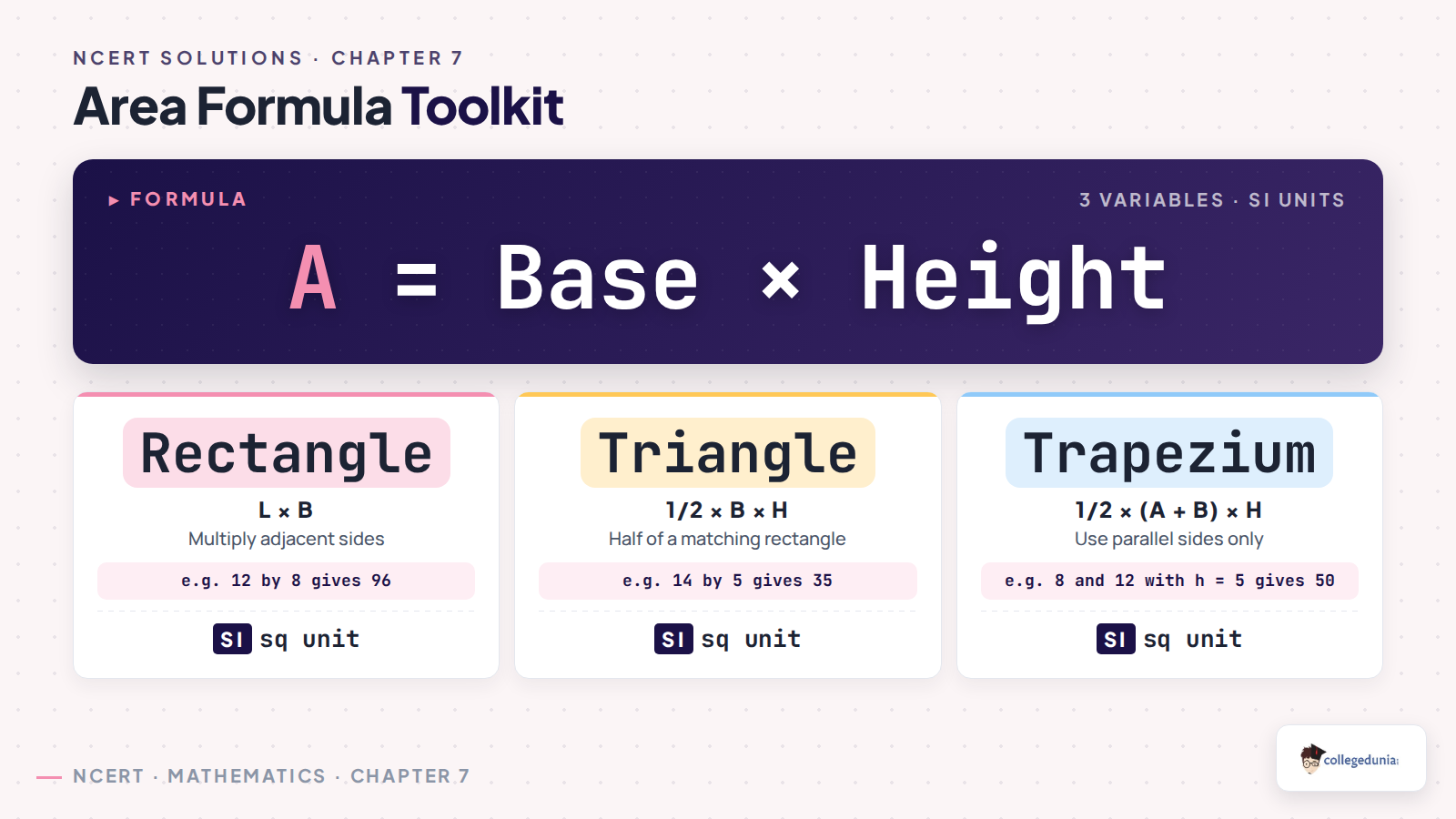
The Area chapter repeatedly uses the idea of base and perpendicular height. A rectangle uses length times breadth, a parallelogram uses base times height, a triangle uses one half base times height, and a trapezium uses one half times the sum of parallel sides times height.
- Rectangle: multiply two adjacent perpendicular sides.
- Triangle: multiply base and height first, then take half.
- Trapezium: add the two parallel sides before multiplying by height.
Rectangle, Triangle and Trapezium Questions
Many Area questions ask students to compare two ways of covering the same region. The solutions show that a parallelogram can be rearranged into a rectangle without changing its area, and a triangle is exactly half of a parallelogram with the same base and height.
Important: a slant side is not the height unless it is perpendicular to the base. This point is useful in triangle and trapezium questions where the drawing may tempt students to multiply the wrong side lengths.
| Shape | Formula used in the PDF | Common mistake avoided |
|---|---|---|
| Rectangle | Length times breadth | Using perimeter instead of area |
| Parallelogram | Base times height | Using the slant side as height |
| Triangle | One half base times height | Forgetting the half factor |
| Trapezium | One half times sum of parallel sides times height | Adding non-parallel sides |
Word Problems and Unit Conversion in Area
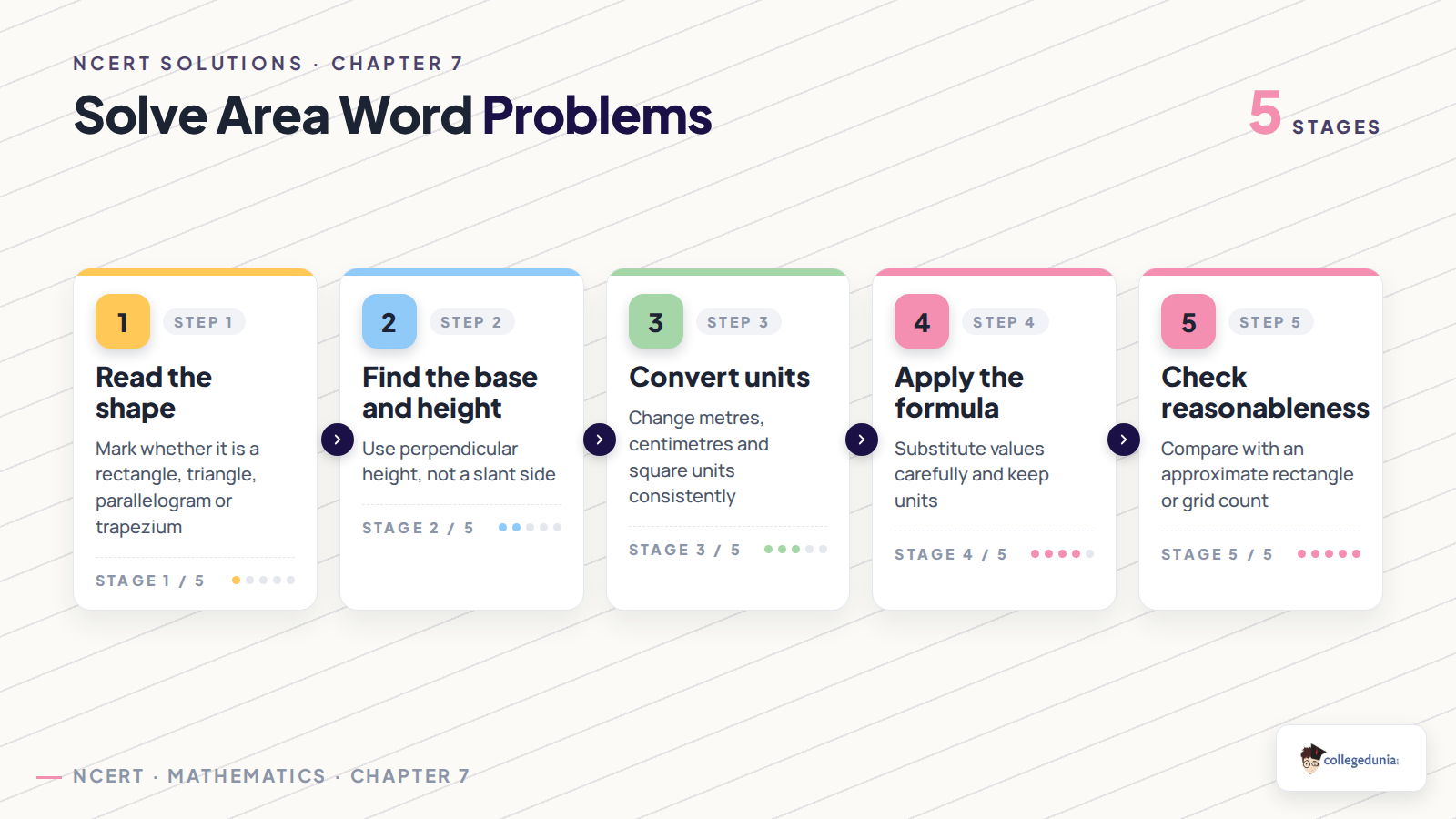
Area word problems in this chapter include garden layouts, paths, rectangular plots, triangular pieces and composite shapes. The PDF solves them by naming the required region first, then subtracting or adding smaller areas only when the shapes are clearly separated.
| Question type | Working method | Final-unit check |
|---|---|---|
| Missing side length | Divide area by known perpendicular length | Answer is in cm or m |
| Composite region | Split into rectangles or triangles | Answer is in square units |
| Path around a field | Outer area minus inner area | Both areas must use the same unit |
| Cost of covering | Area times cost per square unit | Answer is in rupees |
Related NCERT Class 8 Mathematics Chapter 7 Resources
Use these linked Chapter 7 resources when students need the official textbook, a revision summary or handwritten-style practice for the same topic.
| Resource | Best use | Link |
|---|---|---|
| NCERT Notes | Revise formulas and shape properties quickly | Open Notes |
| NCERT Book PDF | Read the official Ganita Prakash chapter | Open Book PDF |
| Handwritten Notes | Use for quick board-style revision | Open Handwritten Notes |
All Class 8 Mathematics Part 2 NCERT Solutions
The table below keeps the same resource type together, so students can move through Mathematics Part 2 chapter by chapter.
| Chapter | Chapter title | NCERT Solutions |
|---|---|---|
| Chapter 1 | Fractions in Disguise | NCERT Solutions page will be linked after publication |
| Chapter 2 | The Baudhayana-Pythagoras Theorem | Open NCERT Solutions |
| Chapter 3 | Proportional Reasoning 2 | Open NCERT Solutions |
| Chapter 4 | Exploring Some Geometric Themes | Open NCERT Solutions |
| Chapter 5 | Tales by Dots and Lines | Open NCERT Solutions |
| Chapter 6 | Algebra Play | Open NCERT Solutions |
| Chapter 7 | Area | Current NCERT Solutions |
NCERT Solutions Class 8 Maths Chapter 7 Area FAQs
Ques. What is covered in NCERT Solutions Class 8 Maths Chapter 7 Area?
Ans. The solutions cover rectangles, squares, parallelograms, triangles, trapeziums, composite shapes, paths and area conversion questions from the 2026-27 textbook.
Ques. How many solved questions are in the Area PDF?
Ans. The PDF includes 36 solved NCERT question blocks with main solutions and expert solutions for Chapter 7 Area.
Ques. Which formulas are most important in Area?
Ans. The important formulas are rectangle area equals length times breadth, triangle area equals one half base times height, and trapezium area equals one half times the sum of parallel sides times height.
Ques. What is the most common mistake in Area questions?
Ans. The most common mistake is using a slant side as height. Height must be perpendicular to the base before applying an area formula.



Comments