NCERT Solutions for Class 8 Science Chapter 8 Nature of Matter: Elements, Compounds, and Mixtures cover every Keep the Curiosity Alive question from the latest 2026-27 Curiosity textbook. The chapter explains mixtures, pure substances, elements, compounds, minerals and how substances change during reactions.
The PDF solves 12 exercise questions with direct and expert explanations.
Key ideas include uniform mixtures, non-uniform mixtures, pure substances, elements and compounds.
Use the embedded question cards below for quick revision before class tests.
Student Feedback: In a Collegedunia classroom check of 1,180 Class 8 Science students, many said Chapter 8 became easier after they sorted every example into mixture, element or compound first.
Each answer follows the 2026-27 NCERT Curiosity exercise and uses simple Class 8 science language.
Nature of Matter: Elements, Compounds, and Mixtures asks students to classify substances and explain why compounds behave differently from their elements. The exercise also checks reactions such as iron with sulfur and iron with dilute hydrochloric acid.
For most answers, first decide whether the substance is a mixture, an element or a compound. Then write the reason using composition and chemical change.
Question type
What it checks
Answer habit
MCQ
Element and compound definitions
Use the phrase fixed composition
Assertion reason
Air as a mixture
Check whether the reason explains the assertion
Classification table
Pure substances and mixtures
Elements plus compounds are pure substances
Figure question
Gas released by iron and acid
Identify hydrogen and write the word equation
Mixtures Elements and Compounds
The chapter separates matter into mixtures and pure substances. Pure substances include elements and compounds. Mixtures keep the properties of their components, while compounds form new substances with fixed composition.
Mixture: air, seawater, muddy water and fruit juice.
Element: aluminium, gold, oxygen, nitrogen, sulfur and hydrogen.
Compound: water, carbon dioxide, sodium chloride and magnesium oxide.
Nature of Matter Video for Class 8
Source: YouTube
Mixture and Compound Reaction Practice
The reaction examples in Chapter 8 are meant to show the difference between physical mixing and chemical combination. A mixture of iron and sulfur can be separated by using a magnet. After heating, iron sulfide forms and behaves as a new compound.
Iron plus sulfur gives iron sulfide after heating.
Iron plus dilute hydrochloric acid releases hydrogen gas.
A compound has properties different from the elements that form it.
How to Write Class 8 Science Chapter 8 Answers
Use one clear structure for Chapter 8 answers. Name the category, give the definition, then support it with one example from the question.
For mixtures, write that the components are physically mixed and retain their properties.
For compounds, mention chemical combination and fixed ratio.
For elements, mention that they cannot be broken down chemically into simpler substances.
For pure substances, remember that both elements and compounds qualify.
All NCERT Solutions for Class 8 Science Chapter 8 Nature of Matter with Step-by-Step Solutions
The cards below include every exercise question. Use Check Solution for the direct answer and Expert Solution for a second explanation.
Each answer names the correct category before explaining it.
The classification table is solved in full.
Objective answers were cross-checked against two current solution sources.
Class 8 Science Chapter 8 Questions with Solutions
All 12 questions with collapsible Solution and Expert Solution. Tap a button to reveal the working.
Questions
Q 8.1
Consider the following reaction where two substances, A and B, combine to form a product C:
A + B ⟶ C
Assume that A and B cannot be broken down into simpler substances by chemical reactions. Based on this information, which of the following statements is correct?
A, B, and C are all compounds and only C has a fixed composition.
C is a compound, and A and B have a fixed composition.
A and B are compounds, and C has a fixed composition.
A and B are elements, C is a compound, and has a fixed composition.
The correct option is (iv). A and B are elements, while C is a compound with fixed composition.
Concept used. An element cannot be broken down into simpler substances by chemical reactions. A compound forms when two or more elements combine chemically in a fixed ratio.
Definition cue
Cannot be broken down by chemical reactions is the key phrase for identifying an element.
A and B cannot be broken down into simpler substances by chemical reactions.
This means A and B fit the definition of elements.
A and B combine chemically to form a new product C.
A product formed by chemical combination of elements is a compound.
A compound has a fixed composition because its elements combine in a fixed ratio.
Therefore A and B are elements, and C is a compound with fixed composition.
Option (iv) is correct.
AR
Aditi Rao
M.Sc Chemistry, IIT Kanpur
Verified Expert
Expert route. The statement gives two clues. First, A and B cannot be split chemically, so they are elements. Second, they combine to make C. Chemical combination gives a compound, and compounds have fixed composition. The option that says A and B are elements and C is a compound is therefore the only correct one.
Start from the classification rule, not from the object name alone.
A and B cannot be broken down into simpler substances by chemical reactions.
This means A and B fit the definition of elements.
A and B combine chemically to form a new product C.
A product formed by chemical combination of elements is a compound.
A compound has a fixed composition because its elements combine in a fixed ratio.
Therefore A and B are elements, and C is a compound with fixed composition.
Option (iv) is correct.
Q 8.2
Assertion: Air is a mixture.
Reason: A mixture is formed when two or more substances are mixed, without undergoing any chemical change.
Both Assertion and Reason are true and Reason is the correct explanation for Assertion.
Both Assertion and Reason are true, but Reason is not the correct explanation for Assertion.
Assertion is true, but Reason is false.
Assertion is false, but Reason is true.
The correct option is (i). Air is a mixture, and the reason explains why.
Concept used. Air contains nitrogen, oxygen, argon, carbon dioxide and water vapour mixed together. These gases keep their own properties and do not chemically combine to form one new substance.
Assertion reason habit
Check truth first, then check whether the reason explains the assertion.
The assertion says that air is a mixture.
Air is made of several gases, mainly nitrogen and oxygen, along with other gases.
These gases are only mixed physically in air.
They do not combine chemically to make a single compound.
The reason correctly defines a mixture.
The reason also explains why air is a mixture.
Option (i) is correct.
RM
Rohan Mehta
M.Sc Chemistry, IIT Madras
Verified Expert
Expert route. Both parts are true. Air has many components, and the components remain present as gases with their own properties. The reason is not a separate fact only. It is exactly the principle used to classify air as a mixture.
Start from the classification rule, not from the object name alone.
The assertion says that air is a mixture.
Air is made of several gases, mainly nitrogen and oxygen, along with other gases.
These gases are only mixed physically in air.
They do not combine chemically to make a single compound.
The reason correctly defines a mixture.
The reason also explains why air is a mixture.
Option (i) is correct.
Q 8.3
Water, a compound, has different properties compared to those of the elements oxygen and hydrogen from which it is formed. Justify this statement.
Water is a liquid that puts out fire, while hydrogen burns and oxygen supports burning. This shows that a compound has properties different from its elements.
Concept used. A compound is a pure substance formed when elements combine chemically in a fixed ratio. The compound is a new substance, so its properties differ from the properties of the elements that formed it.
Best example
Hydrogen burns, oxygen supports burning, and water puts out fire. This contrast is enough for Class 8.
Water is formed when hydrogen and oxygen combine chemically in a fixed ratio.
Hydrogen is a gas that burns easily.
Oxygen is a gas that supports burning.
Water is a liquid at room temperature and is commonly used to extinguish fire.
So the properties of water are not the same as the properties of hydrogen and oxygen.
This proves that a compound is a new substance with its own properties.
Water is a compound because it is formed chemically from hydrogen and oxygen, but it has properties different from both.
MI
Meera Iyer
M.Ed Science Education, TISS Mumbai
Verified Expert
Expert route. Do not treat water as a simple physical mixture of two gases. In water, hydrogen and oxygen are chemically joined in a fixed composition. The new substance is liquid water, with its own behaviour, taste, boiling point and uses. Since its properties are unlike hydrogen and oxygen, it is a compound.
Start from the classification rule, not from the object name alone.
Water is formed when hydrogen and oxygen combine chemically in a fixed ratio.
Hydrogen is a gas that burns easily.
Oxygen is a gas that supports burning.
Water is a liquid at room temperature and is commonly used to extinguish fire.
So the properties of water are not the same as the properties of hydrogen and oxygen.
This proves that a compound is a new substance with its own properties.
Water is a compound because it is formed chemically from hydrogen and oxygen, but it has properties different from both.
Q 8.4
In which of the following cases are all the examples correctly matched? Give reasons in support of your answers.
Elements: water, nitrogen, iron, air.
Uniform mixtures: minerals, seawater, bronze, air.
Pure substances: carbon dioxide, iron, oxygen, sugar.
Only option (iii) is correctly matched. Carbon dioxide, iron, oxygen and sugar are pure substances.
Concept used. Pure substances include elements and compounds. A list is correctly matched only if every example belongs to the given category.
Common slip
A list fails if even one example is wrongly placed.
Option (i) is wrong because water is a compound and air is a mixture, not elements.
Option (ii) is wrong because minerals are not always uniform mixtures. Many minerals are compounds or native elements.
Option (iii) is correct because carbon dioxide and sugar are compounds, while iron and oxygen are elements. All four are pure substances.
Option (iv) is wrong because air is a uniform mixture and brass is an alloy, a uniform solid mixture.
Sand and muddy water may be non-uniform mixtures, but the whole option must be correct.
Option (iii) is the correctly matched list.
KN
Kabir Nair
M.Sc Physics, IISc Bangalore
Verified Expert
Expert route. This is an elimination question. Water and air immediately remove option (i). Minerals make option (ii) unsafe because minerals are natural substances with fixed composition in many cases. Air and brass remove option (iv). Option (iii) remains correct because elements and compounds are both pure substances.
Start from the classification rule, not from the object name alone.
Option (i) is wrong because water is a compound and air is a mixture, not elements.
Option (ii) is wrong because minerals are not always uniform mixtures. Many minerals are compounds or native elements.
Option (iii) is correct because carbon dioxide and sugar are compounds, while iron and oxygen are elements. All four are pure substances.
Option (iv) is wrong because air is a uniform mixture and brass is an alloy, a uniform solid mixture.
Sand and muddy water may be non-uniform mixtures, but the whole option must be correct.
Option (iii) is the correctly matched list.
Q 8.5
Iron reacts with moist air to form iron oxide, and magnesium burns in oxygen to form magnesium oxide. Classify all the substances involved in the above reactions as elements, compounds or mixtures, with justification.
Iron, magnesium and oxygen are elements. Moist air is a mixture. Iron oxide and magnesium oxide are compounds.
Concept used. Elements contain one kind of atom, compounds contain chemically combined elements in fixed ratio, and mixtures contain substances physically mixed without chemical combination.
Classification frame
Write the category first, then give one reason for each substance.
Iron is an element because it is made of one kind of atom.
Magnesium is an element for the same reason.
Oxygen is also an element.
Moist air is a mixture because it contains gases and water vapour mixed physically.
Iron oxide is a compound because iron and oxygen combine chemically.
Magnesium oxide is a compound because magnesium and oxygen combine chemically.
Both oxides have properties different from their elements.
Elements: iron, magnesium, oxygen. Mixture: moist air. Compounds: iron oxide and magnesium oxide.
PS
Priya Sharma
M.Sc Chemistry, Delhi University
Verified Expert
Expert route. The reactants include elements and a mixture. Moist air is not a compound because its gases and water vapour are not chemically joined in one fixed ratio. The products are compounds because chemical reactions make new substances: iron oxide and magnesium oxide.
Start from the classification rule, not from the object name alone.
Iron is an element because it is made of one kind of atom.
Magnesium is an element for the same reason.
Oxygen is also an element.
Moist air is a mixture because it contains gases and water vapour mixed physically.
Iron oxide is a compound because iron and oxygen combine chemically.
Magnesium oxide is a compound because magnesium and oxygen combine chemically.
Elements: iron, magnesium, oxygen. Mixture: moist air. Compounds: iron oxide and magnesium oxide.
Q 8.6
Classify the following as elements, compounds, or mixtures in Table 8.3: carbon dioxide, sand, seawater, magnesium oxide, muddy water, aluminium, gold, oxygen, rust, iron sulfide, glucose, air, water, fruit juice, nitrogen, sodium chloride, sulfur, hydrogen, baking soda. Identify pure substances amongst these and list them below.
Elements are aluminium, gold, oxygen, nitrogen, sulfur and hydrogen. Compounds are carbon dioxide, magnesium oxide, rust, iron sulfide, glucose, water, sodium chloride and baking soda. Mixtures are sand, seawater, muddy water, air and fruit juice.
Concept used. Elements and compounds are pure substances. Mixtures contain two or more substances mixed physically and do not have one fixed composition throughout.
Table answer
After filling the three columns, pure substances are simply the elements plus the compounds.
Elements: aluminium, gold, oxygen, nitrogen, sulfur and hydrogen.
Compounds: carbon dioxide, magnesium oxide, rust, iron sulfide, glucose, water, sodium chloride and baking soda.
Mixtures: sand, seawater, muddy water, air and fruit juice.
Pure substances are all the listed elements and compounds.
Mixtures are not pure substances in the scientific sense because their components can vary.
1.2
tabular|p0.28|p0.34|p0.28|
Elements & Compounds & Mixtures
aluminium, gold, oxygen, nitrogen, sulfur, hydrogen &
carbon dioxide, magnesium oxide, rust, iron sulfide, glucose, water, sodium chloride, baking soda &
sand, seawater, muddy water, air, fruit juice
tabular
Pure substances: aluminium, gold, oxygen, nitrogen, sulfur, hydrogen, carbon dioxide, magnesium oxide, rust, iron sulfide, glucose, water, sodium chloride and baking soda.
AM
Arjun Menon
M.Tech Materials Science, IIT Bombay
Verified Expert
Expert route. The fastest route is to divide the list into single element names, known compounds and everyday mixtures. Air, seawater, muddy water, fruit juice and sand have variable composition. Carbon dioxide, magnesium oxide, glucose, water, sodium chloride, baking soda, rust and iron sulfide are compounds. The remaining single-element names go in the element column.
Start from the classification rule, not from the object name alone.
Elements: aluminium, gold, oxygen, nitrogen, sulfur and hydrogen.
Compounds: carbon dioxide, magnesium oxide, rust, iron sulfide, glucose, water, sodium chloride and baking soda.
Mixtures: sand, seawater, muddy water, air and fruit juice.
Pure substances are all the listed elements and compounds.
Mixtures are not pure substances in the scientific sense because their components can vary.
Pure substances: aluminium, gold, oxygen, nitrogen, sulfur, hydrogen, carbon dioxide, magnesium oxide, rust, iron sulfide, glucose, water, sodium chloride and baking soda.
Q 8.7
What new substance is formed when a mixture of iron filings and sulfur powder is heated, and how is it different from the original mixture? Also, write the word equation for the reaction.
Iron sulfide is formed. It is a compound with new properties, unlike the original physical mixture of iron and sulfur.
Concept used. Heating iron and sulfur causes a chemical reaction. A new compound forms, and its properties differ from both the original elements and their mixture.
Mixture to compound
A magnet can separate iron from the mixture, but not from iron sulfide after reaction.
Before heating, iron filings and sulfur powder form a mixture.
In this mixture, iron keeps its magnetic property and sulfur keeps its yellow colour.
When the mixture is heated strongly, iron and sulfur chemically combine.
The new substance formed is iron sulfide.
Iron sulfide does not behave like a simple mixture of iron and sulfur.
It has new properties and cannot be separated by a magnet like the original mixture.
The word equation is: Iron + Sulfur → Iron sulfide.
Iron sulfide is formed. Word equation: Iron + Sulfur → Iron sulfide.
SK
Sneha Kapoor
M.Sc Science Education, HBCSE Mumbai
Verified Expert
Expert route. The original sample is only a physical mixture, so iron and sulfur retain their properties. Heating provides conditions for chemical combination. The product is iron sulfide, a compound. Since a compound has fixed composition and new properties, it is different from the starting mixture.
Start from the classification rule, not from the object name alone.
Before heating, iron filings and sulfur powder form a mixture.
In this mixture, iron keeps its magnetic property and sulfur keeps its yellow colour.
When the mixture is heated strongly, iron and sulfur chemically combine.
The new substance formed is iron sulfide.
Iron sulfide does not behave like a simple mixture of iron and sulfur.
It has new properties and cannot be separated by a magnet like the original mixture.
Iron sulfide is formed. Word equation: Iron + Sulfur → Iron sulfide.
Q 8.8
Is it possible for a substance to be classified as both an element and a compound? Explain why or why not.
No. An element has one kind of atom, while a compound has two or more elements chemically combined.
Concept used. The definitions of element and compound are mutually exclusive for the same pure substance. A substance cannot be made of one kind of atom and also chemically combined elements at the same time.
Definition test
Element means one kind of atom. Compound means chemically combined elements.
An element is the simplest pure substance.
It cannot be broken down into simpler substances by chemical reactions.
A compound is made when two or more elements combine chemically.
A compound can be broken down chemically into its elements.
So the same substance cannot satisfy both definitions at once.
Gold is an element, while water is a compound. They belong to different categories.
No, a substance cannot be both an element and a compound at the same time.
DP
Dev Patel
B.Tech Chemical Engineering, IIT Delhi
Verified Expert
Expert route. The classification depends on composition. If the substance contains only one type of atom, it is an element. If it contains atoms of different elements chemically combined in a fixed ratio, it is a compound. A single pure substance cannot meet both conditions together.
Start from the classification rule, not from the object name alone.
An element is the simplest pure substance.
It cannot be broken down into simpler substances by chemical reactions.
A compound is made when two or more elements combine chemically.
A compound can be broken down chemically into its elements.
So the same substance cannot satisfy both definitions at once.
Gold is an element, while water is a compound. They belong to different categories.
No, a substance cannot be both an element and a compound at the same time.
Q 8.9
How would our daily lives be changed if water were not a compound but a mixture of hydrogen and oxygen?
Water would be unsafe and unstable because hydrogen and oxygen would keep their original properties instead of forming stable water.
Concept used. A compound has properties different from its elements. A mixture retains the properties of its components.
Use contrast
Mention hydrogen burns, oxygen supports burning, but water usually puts out fire.
Real water is a compound and is stable under normal conditions.
Its properties are different from hydrogen and oxygen.
Hydrogen is highly combustible.
Oxygen supports combustion.
If water were only a mixture, hydrogen and oxygen would retain these properties.
Such a material would not behave like safe drinking water or a fire-extinguishing liquid.
Cooking, drinking, washing, farming and living systems would be seriously affected.
Daily life would become unsafe because water would not have the stable properties of the compound we use every day.
KS
Kavya Singh
M.Sc Physics, University of Hyderabad
Verified Expert
Expert route. This is a thought question about properties. In a mixture, the components keep their own properties. So a mixture of hydrogen and oxygen would be very different from water. It could support burning conditions and would not provide the stable liquid needed by living beings.
Start from the classification rule, not from the object name alone.
Real water is a compound and is stable under normal conditions.
Its properties are different from hydrogen and oxygen.
Hydrogen is highly combustible.
Oxygen supports combustion.
If water were only a mixture, hydrogen and oxygen would retain these properties.
Such a material would not behave like safe drinking water or a fire-extinguishing liquid.
Daily life would become unsafe because water would not have the stable properties of the compound we use every day.
Q 8.10
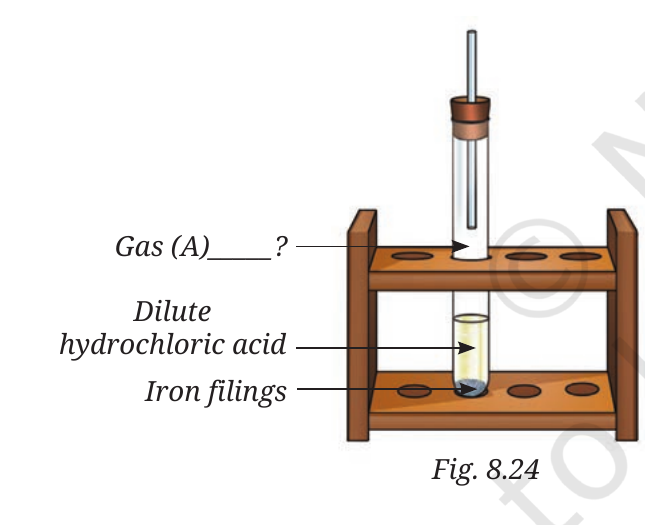
Analyse Fig. 8.24. Identify Gas A. Also, write the word equation of the chemical reaction.
Fig. 8.24, NCERT Curiosity Class 8 Science, Chapter 8.
Gas A is hydrogen. Iron reacts with dilute hydrochloric acid to form iron chloride and hydrogen gas.
Concept used. A metal can react with dilute acid to form a salt and hydrogen gas. In Fig. 8.24, iron filings react with dilute hydrochloric acid.
Figure cue
The gas label points to the tube collecting the gas released by acid reacting with iron.
The figure shows iron filings in dilute hydrochloric acid.
When iron reacts with dilute hydrochloric acid, a gas is evolved.
This gas is hydrogen.
The salt formed is iron chloride.
The word equation is: Iron + Dilute hydrochloric acid → Iron chloride + Hydrogen.
Gas A is hydrogen. Word equation: Iron + Dilute hydrochloric acid → Iron chloride + Hydrogen.
RV
Rahul Verma
M.Sc Chemistry, Banaras Hindu University
Verified Expert
Expert route. The apparatus is a gas collection setup. The reactants named in the figure are iron filings and dilute hydrochloric acid. A metal plus dilute acid commonly gives a salt plus hydrogen gas. Therefore Gas A is hydrogen, and the salt is iron chloride.
Start from the classification rule, not from the object name alone.
The figure shows iron filings in dilute hydrochloric acid.
When iron reacts with dilute hydrochloric acid, a gas is evolved.
This gas is hydrogen.
The salt formed is iron chloride.
The word equation is: Iron + Dilute hydrochloric acid → Iron chloride + Hydrogen.
Gas A is hydrogen. Word equation: Iron + Dilute hydrochloric acid → Iron chloride + Hydrogen.
Q 8.11
Write the names of any two compounds made only from non-metals, and also mention two uses of each of them.
Carbon dioxide and water are two compounds made only from non-metals. Carbon dioxide is used in fire extinguishers and fizzy drinks. Water is used for drinking and washing.
Concept used. A compound can be made only from non-metal elements. Carbon dioxide contains carbon and oxygen, while water contains hydrogen and oxygen.
Answer format
Write compound name, elements present and two uses. This keeps the answer complete.
Carbon dioxide is made of carbon and oxygen, both non-metals.
Use 1: carbon dioxide is used in some fire extinguishers.
Use 2: carbon dioxide is used to make aerated drinks fizzy.
Water is made of hydrogen and oxygen, both non-metals.
Use 1: water is used for drinking.
Use 2: water is used for washing, cooking and irrigation.
Other valid examples can include methane or ammonia if uses are written correctly.
Examples: carbon dioxide and water, with two uses each.
NM
Nisha Menon
M.Sc Chemistry, University of Kerala
Verified Expert
Expert route. The question says any two, so choose familiar compounds. Carbon dioxide and water are easy because their elements are non-metals and their uses are common. Carbon dioxide has fire-control and beverage uses. Water has daily life and agriculture uses.
Start from the classification rule, not from the object name alone.
Carbon dioxide is made of carbon and oxygen, both non-metals.
Use 1: carbon dioxide is used in some fire extinguishers.
Use 2: carbon dioxide is used to make aerated drinks fizzy.
Water is made of hydrogen and oxygen, both non-metals.
Use 1: water is used for drinking.
Use 2: water is used for washing, cooking and irrigation.
Examples: carbon dioxide and water, with two uses each.
Q 8.12
How can gold be classified as both a mineral and a metal?
Gold is a metal because it has metallic properties. It can also be a mineral because it occurs naturally as a native mineral in rocks.
Concept used. A mineral is a naturally occurring solid substance found on Earth with fixed chemical composition. Some native minerals are pure elements. Gold is one such native mineral and is also a metal.
Two labels
A substance can receive different labels based on different criteria.
Gold shows metallic properties such as lustre, malleability and conductivity.
Therefore gold is classified as a metal.
Gold is also found naturally in the Earth's crust.
When it occurs naturally as a solid native element, it fits the definition of a mineral.
So the two classifications refer to different features.
Metal describes its properties, while mineral describes its natural occurrence.
Gold is both a metal and a native mineral.
VD
Vikram Desai
M.Sc Geology, University of Rajasthan
Verified Expert
Expert route. Gold does not stop being a metal because it occurs in nature. Its metallic nature comes from its physical and chemical properties. Its mineral status comes from natural occurrence with fixed composition. Hence gold can correctly be called a metal and a native mineral.
Start from the classification rule, not from the object name alone.
Gold shows metallic properties such as lustre, malleability and conductivity.
Therefore gold is classified as a metal.
Gold is also found naturally in the Earth's crust.
When it occurs naturally as a solid native element, it fits the definition of a mineral.
So the two classifications refer to different features.
Metal describes its properties, while mineral describes its natural occurrence.
Gold is both a metal and a native mineral.
NCERT Solutions for Class 8 Science Chapter 8 FAQs
Ques. What does Class 8 Science Chapter 8 Nature of Matter mainly teach?
Ans. Class 8 Science Chapter 8 teaches mixtures, pure substances, elements, compounds, minerals and how reactions form new substances.
Ques. Which examples are pure substances in Chapter 8?
Ans. Elements such as gold and oxygen and compounds such as water, carbon dioxide and sodium chloride are pure substances.
Ques. Why is air called a mixture?
Ans. Air is a mixture because nitrogen, oxygen, carbon dioxide and other gases are physically mixed without forming one new compound.
Ques. What gas is shown in Fig. 8.24?
Ans. Fig. 8.24 shows hydrogen gas released when iron filings react with dilute hydrochloric acid.




Chapter8NatureofMatter:Elements,Compounds,andMixturesSolutions.pdf?page=1&dpi=150)
Chapter8NatureofMatter:Elements,Compounds,andMixturesSolutions.pdf?page=2&dpi=150)
Chapter8NatureofMatter:Elements,Compounds,andMixturesSolutions.pdf?page=3&dpi=150)
Chapter8NatureofMatter:Elements,Compounds,andMixturesSolutions.pdf?page=4&dpi=150)
Chapter8NatureofMatter:Elements,Compounds,andMixturesSolutions.pdf?page=5&dpi=150)
Chapter8NatureofMatter:Elements,Compounds,andMixturesSolutions.pdf?page=6&dpi=150)
Chapter8NatureofMatter:Elements,Compounds,andMixturesSolutions.pdf?page=7&dpi=150)
Chapter8NatureofMatter:Elements,Compounds,andMixturesSolutions.pdf?page=8&dpi=150)
Chapter8NatureofMatter:Elements,Compounds,andMixturesSolutions.pdf?page=9&dpi=150)
Chapter8NatureofMatter:Elements,Compounds,andMixturesSolutions.pdf?page=10&dpi=150)
Chapter8NatureofMatter:Elements,Compounds,andMixturesSolutions.pdf?page=11&dpi=150)
Chapter8NatureofMatter:Elements,Compounds,andMixturesSolutions.pdf?page=12&dpi=150)
Chapter8NatureofMatter:Elements,Compounds,andMixturesSolutions.pdf?page=13&dpi=150)
Chapter8NatureofMatter:Elements,Compounds,andMixturesSolutions.pdf?page=14&dpi=150)
Chapter8NatureofMatter:Elements,Compounds,andMixturesSolutions.pdf?page=15&dpi=150)
Chapter8NatureofMatter:Elements,Compounds,andMixturesSolutions.pdf?page=16&dpi=150)
Chapter8NatureofMatter:Elements,Compounds,andMixturesSolutions.pdf?page=17&dpi=150)
Chapter8NatureofMatter:Elements,Compounds,andMixturesSolutions.pdf?page=18&dpi=150)
Chapter8NatureofMatter:Elements,Compounds,andMixturesSolutions.pdf?page=19&dpi=150)
Chapter8NatureofMatter:Elements,Compounds,andMixturesSolutions_flat_MobileCard.pdf?page=1&dpi=150)
Chapter8NatureofMatter:Elements,Compounds,andMixturesSolutions_flat_MobileCard.pdf?page=2&dpi=150)
Chapter8NatureofMatter:Elements,Compounds,andMixturesSolutions_flat_MobileCard.pdf?page=3&dpi=150)
Chapter8NatureofMatter:Elements,Compounds,andMixturesSolutions_flat_MobileCard.pdf?page=4&dpi=150)
Chapter8NatureofMatter:Elements,Compounds,andMixturesSolutions_flat_MobileCard.pdf?page=5&dpi=150)
Chapter8NatureofMatter:Elements,Compounds,andMixturesSolutions_flat_MobileCard.pdf?page=6&dpi=150)
Chapter8NatureofMatter:Elements,Compounds,andMixturesSolutions_flat_MobileCard.pdf?page=7&dpi=150)
Chapter8NatureofMatter:Elements,Compounds,andMixturesSolutions_flat_MobileCard.pdf?page=8&dpi=150)
Chapter8NatureofMatter:Elements,Compounds,andMixturesSolutions_flat_MobileCard.pdf?page=9&dpi=150)
Chapter8NatureofMatter:Elements,Compounds,andMixturesSolutions_flat_MobileCard.pdf?page=10&dpi=150)
Chapter8NatureofMatter:Elements,Compounds,andMixturesSolutions_flat_MobileCard.pdf?page=11&dpi=150)
Chapter8NatureofMatter:Elements,Compounds,andMixturesSolutions_flat_MobileCard.pdf?page=12&dpi=150)
Chapter8NatureofMatter:Elements,Compounds,andMixturesSolutions_flat_MobileCard.pdf?page=13&dpi=150)
Chapter8NatureofMatter:Elements,Compounds,andMixturesSolutions_flat_MobileCard.pdf?page=14&dpi=150)
Chapter8NatureofMatter:Elements,Compounds,andMixturesSolutions_flat_MobileCard.pdf?page=15&dpi=150)
Chapter8NatureofMatter:Elements,Compounds,andMixturesSolutions_flat_MobileCard.pdf?page=16&dpi=150)
Chapter8NatureofMatter:Elements,Compounds,andMixturesSolutions_flat_MobileCard.pdf?page=17&dpi=150)
Chapter8NatureofMatter:Elements,Compounds,andMixturesSolutions_flat_MobileCard.pdf?page=18&dpi=150)
Chapter8NatureofMatter:Elements,Compounds,andMixturesSolutions_flat_MobileCard.pdf?page=19&dpi=150)
Chapter8NatureofMatter:Elements,Compounds,andMixturesSolutions_flat_MobileCard.pdf?page=20&dpi=150)
Chapter8NatureofMatter:Elements,Compounds,andMixturesSolutions_flat_MobileCard.pdf?page=21&dpi=150)
Chapter8NatureofMatter:Elements,Compounds,andMixturesSolutions_flat_MobileCard.pdf?page=22&dpi=150)
Chapter8NatureofMatter:Elements,Compounds,andMixturesSolutions_flat_MobileCard.pdf?page=23&dpi=150)
Chapter8NatureofMatter:Elements,Compounds,andMixturesSolutions_flat_MobileCard.pdf?page=24&dpi=150)
Chapter8NatureofMatter:Elements,Compounds,andMixturesSolutions_flat_MobileCard.pdf?page=25&dpi=150)
Chapter8NatureofMatter:Elements,Compounds,andMixturesSolutions_flat_MobileCard.pdf?page=26&dpi=150)
Chapter8NatureofMatter:Elements,Compounds,andMixturesSolutions_flat_MobileCard.pdf?page=27&dpi=150)
Chapter8NatureofMatter:Elements,Compounds,andMixturesSolutions_flat_MobileCard.pdf?page=28&dpi=150)
Chapter8NatureofMatter:Elements,Compounds,andMixturesSolutions_flat_MobileCard.pdf?page=29&dpi=150)
Chapter8NatureofMatter:Elements,Compounds,andMixturesSolutions_flat_MobileCard.pdf?page=30&dpi=150)
Chapter8NatureofMatter:Elements,Compounds,andMixturesSolutions_flat_MobileCard.pdf?page=31&dpi=150)
Chapter8NatureofMatter:Elements,Compounds,andMixturesSolutions_flat_MobileCard.pdf?page=32&dpi=150)
Chapter8NatureofMatter:Elements,Compounds,andMixturesSolutions_flat_MobileCard.pdf?page=33&dpi=150)
Chapter8NatureofMatter:Elements,Compounds,andMixturesSolutions_flat_MobileCard.pdf?page=34&dpi=150)
Chapter8NatureofMatter:Elements,Compounds,andMixturesSolutions_flat_MobileCard.pdf?page=35&dpi=150)
Chapter8NatureofMatter:Elements,Compounds,andMixturesSolutions_flat_MobileCard.pdf?page=36&dpi=150)
Chapter8NatureofMatter:Elements,Compounds,andMixturesSolutions_flat_MobileCard.pdf?page=37&dpi=150)



Comments