



NCERT Solutions for Class 8 Vocational Education Chapter 1 Hydroponics: Growing Plants without Soil help students answer the 2026-27 Kaushal Bodh project questions in clear steps. The PDF covers microgreens, wick method, DWC, NFT, compost tea and pH checks.
- Question type: activity reflections, observation tables and project-based reasoning.
- Best use: revise before writing the Hydroponics project file.
- PDF focus: safe setup, maintenance, crop choice and water-quality records.
Chapter1Hydroponics:GrowingPlantswithoutSoilSolutions.pdf?page=1&dpi=150)
Chapter1Hydroponics:GrowingPlantswithoutSoilSolutions.pdf?page=2&dpi=150)
Chapter1Hydroponics:GrowingPlantswithoutSoilSolutions.pdf?page=3&dpi=150)
Chapter1Hydroponics:GrowingPlantswithoutSoilSolutions.pdf?page=4&dpi=150)
Chapter1Hydroponics:GrowingPlantswithoutSoilSolutions.pdf?page=5&dpi=150)
Chapter1Hydroponics:GrowingPlantswithoutSoilSolutions.pdf?page=6&dpi=150)
Chapter1Hydroponics:GrowingPlantswithoutSoilSolutions.pdf?page=7&dpi=150)
Chapter1Hydroponics:GrowingPlantswithoutSoilSolutions.pdf?page=8&dpi=150)
Chapter1Hydroponics:GrowingPlantswithoutSoilSolutions.pdf?page=9&dpi=150)
Chapter1Hydroponics:GrowingPlantswithoutSoilSolutions.pdf?page=10&dpi=150)
Chapter1Hydroponics:GrowingPlantswithoutSoilSolutions.pdf?page=11&dpi=150)
Chapter1Hydroponics:GrowingPlantswithoutSoilSolutions.pdf?page=12&dpi=150)
Chapter1Hydroponics:GrowingPlantswithoutSoilSolutions.pdf?page=13&dpi=150)
Chapter1Hydroponics:GrowingPlantswithoutSoilSolutions.pdf?page=14&dpi=150)
Chapter1Hydroponics:GrowingPlantswithoutSoilSolutions.pdf?page=15&dpi=150)
Chapter1Hydroponics:GrowingPlantswithoutSoilSolutions.pdf?page=16&dpi=150)
Chapter1Hydroponics:GrowingPlantswithoutSoilSolutions.pdf?page=17&dpi=150)
Chapter1Hydroponics:GrowingPlantswithoutSoilSolutions.pdf?page=18&dpi=150)
Chapter1Hydroponics:GrowingPlantswithoutSoilSolutions.pdf?page=19&dpi=150)
Chapter1Hydroponics:GrowingPlantswithoutSoilSolutions.pdf?page=20&dpi=150)
Chapter1Hydroponics:GrowingPlantswithoutSoilSolutions.pdf?page=21&dpi=150)
Chapter1Hydroponics:GrowingPlantswithoutSoilSolutions.pdf?page=22&dpi=150)
Chapter1Hydroponics:GrowingPlantswithoutSoilSolutions.pdf?page=23&dpi=150)
Chapter1Hydroponics:GrowingPlantswithoutSoilSolutions.pdf?page=24&dpi=150)
Chapter1Hydroponics:GrowingPlantswithoutSoilSolutions.pdf?page=25&dpi=150)
Chapter1Hydroponics:GrowingPlantswithoutSoilSolutions.pdf?page=26&dpi=150)
Chapter1Hydroponics:GrowingPlantswithoutSoilSolutions_flat_MobileCard.pdf?page=1&dpi=150)
Chapter1Hydroponics:GrowingPlantswithoutSoilSolutions_flat_MobileCard.pdf?page=2&dpi=150)
Chapter1Hydroponics:GrowingPlantswithoutSoilSolutions_flat_MobileCard.pdf?page=3&dpi=150)
Chapter1Hydroponics:GrowingPlantswithoutSoilSolutions_flat_MobileCard.pdf?page=4&dpi=150)
Chapter1Hydroponics:GrowingPlantswithoutSoilSolutions_flat_MobileCard.pdf?page=5&dpi=150)
Chapter1Hydroponics:GrowingPlantswithoutSoilSolutions_flat_MobileCard.pdf?page=6&dpi=150)
Chapter1Hydroponics:GrowingPlantswithoutSoilSolutions_flat_MobileCard.pdf?page=7&dpi=150)
Chapter1Hydroponics:GrowingPlantswithoutSoilSolutions_flat_MobileCard.pdf?page=8&dpi=150)
Chapter1Hydroponics:GrowingPlantswithoutSoilSolutions_flat_MobileCard.pdf?page=9&dpi=150)
Chapter1Hydroponics:GrowingPlantswithoutSoilSolutions_flat_MobileCard.pdf?page=10&dpi=150)
Chapter1Hydroponics:GrowingPlantswithoutSoilSolutions_flat_MobileCard.pdf?page=11&dpi=150)
Chapter1Hydroponics:GrowingPlantswithoutSoilSolutions_flat_MobileCard.pdf?page=12&dpi=150)
Chapter1Hydroponics:GrowingPlantswithoutSoilSolutions_flat_MobileCard.pdf?page=13&dpi=150)
Chapter1Hydroponics:GrowingPlantswithoutSoilSolutions_flat_MobileCard.pdf?page=14&dpi=150)
Chapter1Hydroponics:GrowingPlantswithoutSoilSolutions_flat_MobileCard.pdf?page=15&dpi=150)
Chapter1Hydroponics:GrowingPlantswithoutSoilSolutions_flat_MobileCard.pdf?page=16&dpi=150)
Chapter1Hydroponics:GrowingPlantswithoutSoilSolutions_flat_MobileCard.pdf?page=17&dpi=150)
Chapter1Hydroponics:GrowingPlantswithoutSoilSolutions_flat_MobileCard.pdf?page=18&dpi=150)
Chapter1Hydroponics:GrowingPlantswithoutSoilSolutions_flat_MobileCard.pdf?page=19&dpi=150)
Chapter1Hydroponics:GrowingPlantswithoutSoilSolutions_flat_MobileCard.pdf?page=20&dpi=150)
Chapter1Hydroponics:GrowingPlantswithoutSoilSolutions_flat_MobileCard.pdf?page=21&dpi=150)
Chapter1Hydroponics:GrowingPlantswithoutSoilSolutions_flat_MobileCard.pdf?page=22&dpi=150)
Chapter1Hydroponics:GrowingPlantswithoutSoilSolutions_flat_MobileCard.pdf?page=23&dpi=150)
Chapter1Hydroponics:GrowingPlantswithoutSoilSolutions_flat_MobileCard.pdf?page=24&dpi=150)
Chapter1Hydroponics:GrowingPlantswithoutSoilSolutions_flat_MobileCard.pdf?page=25&dpi=150)
Chapter1Hydroponics:GrowingPlantswithoutSoilSolutions_flat_MobileCard.pdf?page=26&dpi=150)
Chapter1Hydroponics:GrowingPlantswithoutSoilSolutions_flat_MobileCard.pdf?page=27&dpi=150)
Chapter1Hydroponics:GrowingPlantswithoutSoilSolutions_flat_MobileCard.pdf?page=28&dpi=150)
Chapter1Hydroponics:GrowingPlantswithoutSoilSolutions_flat_MobileCard.pdf?page=29&dpi=150)
Chapter1Hydroponics:GrowingPlantswithoutSoilSolutions_flat_MobileCard.pdf?page=30&dpi=150)
Chapter1Hydroponics:GrowingPlantswithoutSoilSolutions_flat_MobileCard.pdf?page=31&dpi=150)
Chapter1Hydroponics:GrowingPlantswithoutSoilSolutions_flat_MobileCard.pdf?page=32&dpi=150)
Chapter1Hydroponics:GrowingPlantswithoutSoilSolutions_flat_MobileCard.pdf?page=33&dpi=150)
Chapter1Hydroponics:GrowingPlantswithoutSoilSolutions_flat_MobileCard.pdf?page=34&dpi=150)
Chapter1Hydroponics:GrowingPlantswithoutSoilSolutions_flat_MobileCard.pdf?page=35&dpi=150)
Chapter1Hydroponics:GrowingPlantswithoutSoilSolutions_flat_MobileCard.pdf?page=36&dpi=150)
Chapter1Hydroponics:GrowingPlantswithoutSoilSolutions_flat_MobileCard.pdf?page=37&dpi=150)
Chapter1Hydroponics:GrowingPlantswithoutSoilSolutions_flat_MobileCard.pdf?page=38&dpi=150)
Chapter1Hydroponics:GrowingPlantswithoutSoilSolutions_flat_MobileCard.pdf?page=39&dpi=150)
Chapter1Hydroponics:GrowingPlantswithoutSoilSolutions_flat_MobileCard.pdf?page=40&dpi=150)
Chapter1Hydroponics:GrowingPlantswithoutSoilSolutions_flat_MobileCard.pdf?page=41&dpi=150)
Chapter1Hydroponics:GrowingPlantswithoutSoilSolutions_flat_MobileCard.pdf?page=42&dpi=150)
Chapter1Hydroponics:GrowingPlantswithoutSoilSolutions_flat_MobileCard.pdf?page=43&dpi=150)
Chapter1Hydroponics:GrowingPlantswithoutSoilSolutions_flat_MobileCard.pdf?page=44&dpi=150)
Chapter1Hydroponics:GrowingPlantswithoutSoilSolutions_flat_MobileCard.pdf?page=45&dpi=150)
Chapter1Hydroponics:GrowingPlantswithoutSoilSolutions_flat_MobileCard.pdf?page=46&dpi=150)
Chapter1Hydroponics:GrowingPlantswithoutSoilSolutions_flat_MobileCard.pdf?page=47&dpi=150)
Chapter1Hydroponics:GrowingPlantswithoutSoilSolutions_flat_MobileCard.pdf?page=48&dpi=150)
Chapter1Hydroponics:GrowingPlantswithoutSoilSolutions_flat_MobileCard.pdf?page=49&dpi=150)
Chapter1Hydroponics:GrowingPlantswithoutSoilSolutions_flat_MobileCard.pdf?page=50&dpi=150)
Chapter1Hydroponics:GrowingPlantswithoutSoilSolutions_flat_MobileCard.pdf?page=51&dpi=150)
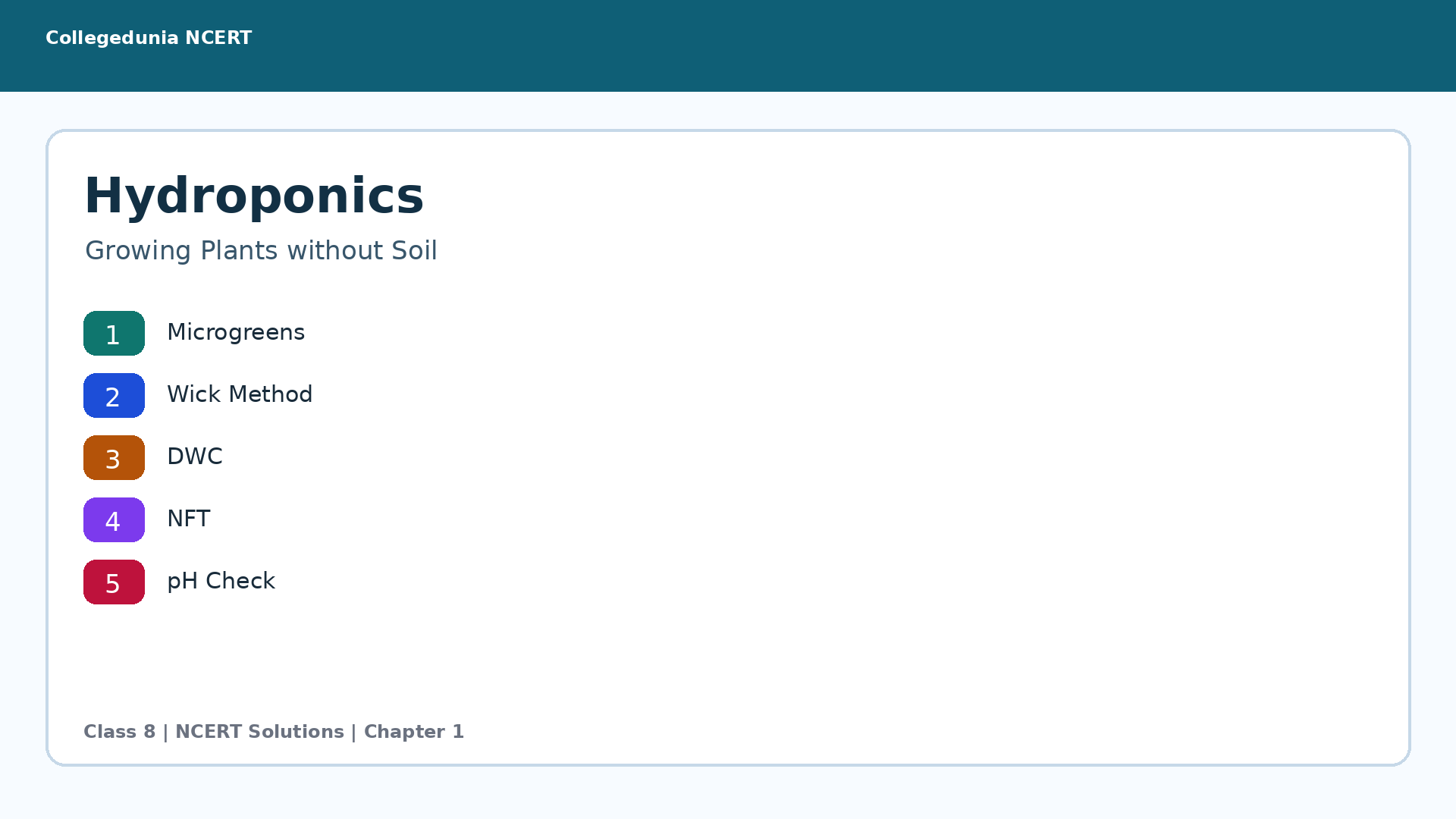
Each Hydroponics solution follows the 2026-27 NCERT Kaushal Bodh chapter and keeps the answer practical for school project work.
Student Feedback: In a Collegedunia classroom check of 1,180 middle-school students, most students found the project easier after they separated construction, maintenance and observation points.
|
Table of Contents |
Hydroponics Class 8 Solutions Overview
Hydroponics means growing plants in nutrient-rich water instead of depending fully on soil. The Class 8 chapter turns this idea into a school project with microgreens, wick bottles, DWC buckets, NFT pipes, compost tea and pH testing.
The main answer habit is simple: name the system, explain how water reaches roots and add one maintenance point. This works for most reflection questions in the chapter.
| System | How it works | Key care point |
|---|---|---|
| Wick method | Water rises through cotton by capillary action | Keep the wick touching water |
| DWC | Roots sit in aerated nutrient water | Check aerator and root colour |
| NFT | A thin film of water flows through pipes | Maintain slope and pump flow |
Hydroponics Systems Explained for Class 8 Kaushal Bodh
The chapter compares three systems so students can see how plant roots get water without open-field soil. Wick systems are simplest. DWC needs oxygen. NFT saves space but needs pump flow.
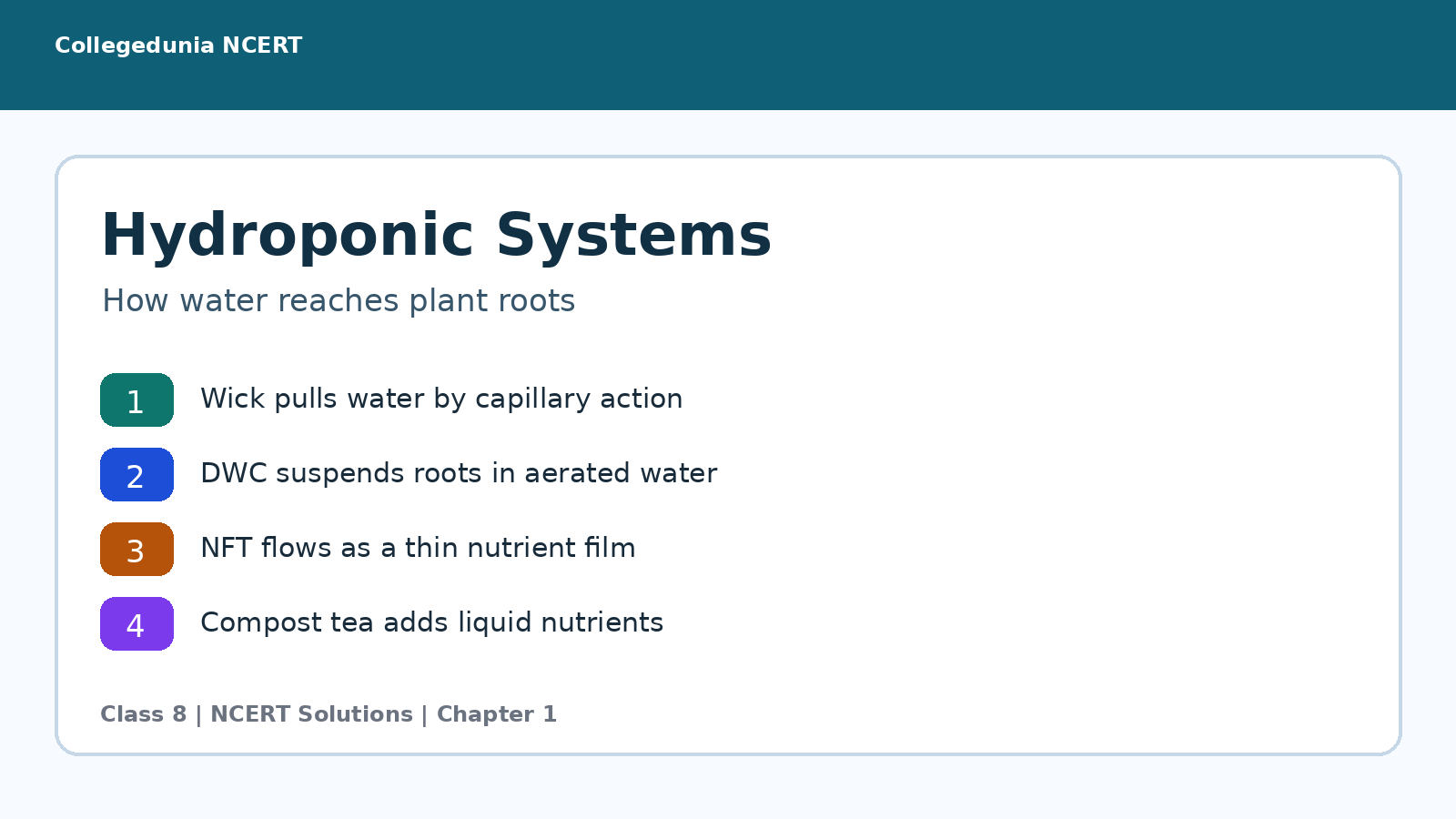
- Wick method: best for small leafy plants and low-cost school models.
- DWC: useful for leafy crops when aeration is steady.
- NFT: useful when many plants must fit in less space.
Hydroponics Video for Class 8 Students
Source: Science Buddies on YouTube
Water pH and Compost Tea Checks in Hydroponics
Water quality decides whether roots can use the nutrients present in the system. The NCERT chapter asks students to observe pH, compost tea colour, smell, dissolved oxygen and plant response.
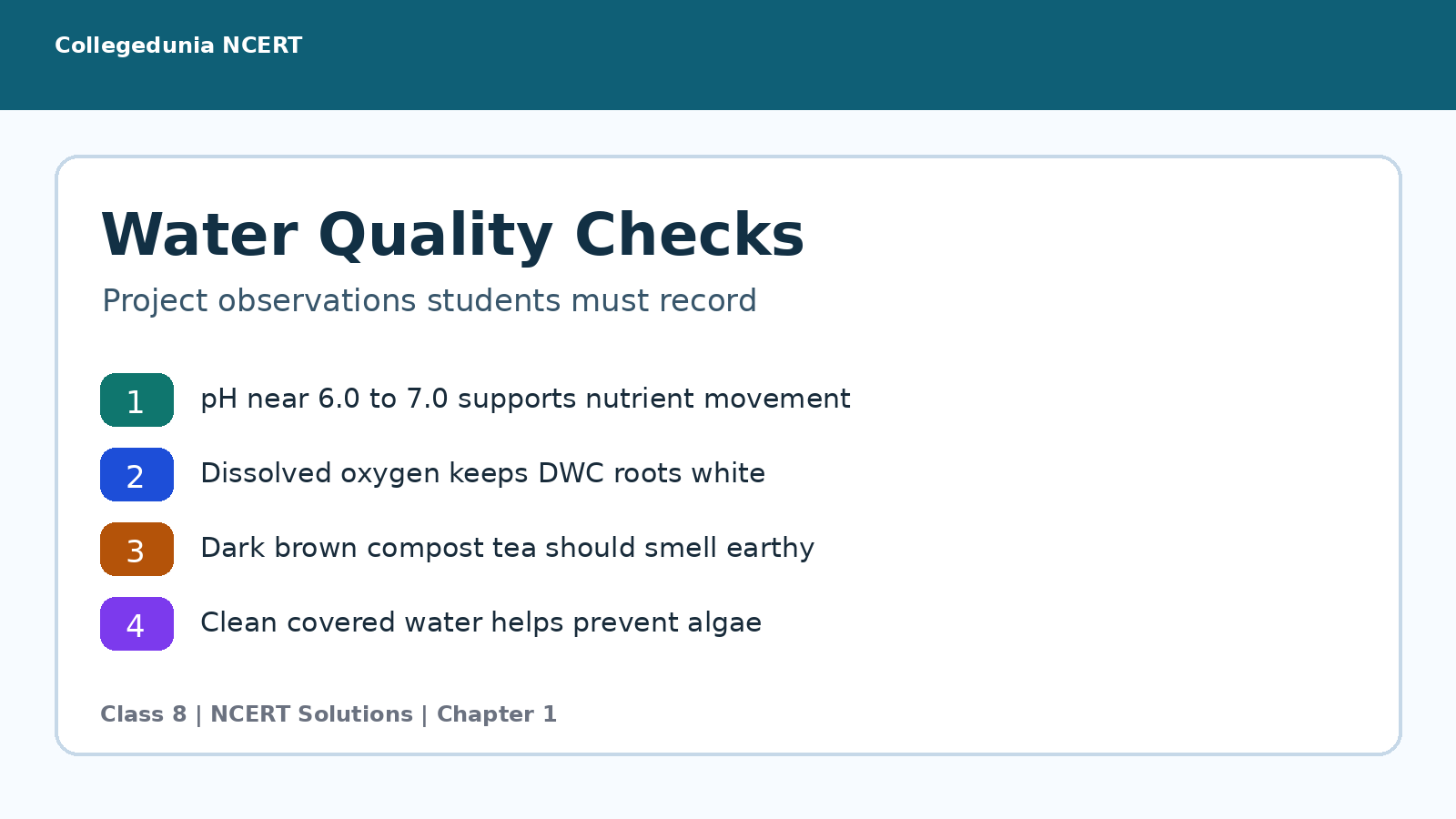
- pH range: nutrient movement is best around 6.0 to 7.0.
- Compost tea: good liquid compost is dark brown and smells earthy.
- DWC roots: healthy roots should look white, not brown.
How to Write Hydroponics Project Answers
Most answers in this chapter are not memory-only questions. They ask what students observed, what went wrong and how they would improve the setup next time.
- Start with the exact activity: microgreens, wick, DWC, NFT, compost tea or pH.
- Write the science idea in one line, such as capillary action or dissolved oxygen.
- Add one practical observation from the project table.
- End with a correction or next-step improvement.
This four-part structure makes project answers specific and easy to check.
Related Hydroponics Class 8 Resources
| Resource | Best use | Link |
|---|---|---|
| NCERT Solutions | Activity answers and project reflections | Open solutions |
| NCERT Book PDF | Official chapter text and activity tables | Open book PDF |
| Notes | Quick concept revision before project writing | Open notes |
All Vocational Education Class 8 NCERT Solutions
| Chapter | Topic | Solutions link |
|---|---|---|
| Chapter 1 | Hydroponics: Growing Plants without Soil | NCERT Solutions Chapter 1 |
| Chapter 2 | Feeding and Caring for Farm Animals | NCERT Solutions Chapter 2 |
| Chapter 3 | Working with Wood and Bamboo | NCERT Solutions Chapter 3 |
| Chapter 4 | Home Automation | NCERT Solutions Chapter 4 |
All NCERT Solutions for Class 8 Vocational Education Chapter 1 Hydroponics with Step-by-Step Solutions
The cards below cover the activity and reflection questions from the Hydroponics chapter. Use the Solution tab for a direct answer and the Expert Solution tab for a deeper project explanation.
Q1. What are the advantages and disadvantages of a hydroponics system?
Ans. Hydroponics is useful because it saves soil, water and space while giving better control over plant growth. Its limits are cost, equipment care, electricity dependence and the need to watch pH, oxygen and nutrients.
- Hydroponics grows plants in nutrient-rich water instead of ordinary soil.
- It can save space because systems can be placed vertically or inside small school areas.
- It can save water because the same water can be recirculated in many systems.
- It helps control nutrients, pH, light and moisture more precisely than open-field farming.
- It reduces soil degradation because the plant roots do not depend on tired or eroded soil.
- The disadvantages are cost, need for equipment, regular pH checks and risk of plant stress if pumps or aerators stop.
Hydroponics is efficient and soil-saving, but it is not maintenance-free. It needs correct nutrient water, oxygen and pH control.
- Hydroponics works best when students treat it as a controlled growing system, not as magic farming.
- The main advantage is control. Water, nutrients, spacing and light can be adjusted according to plant need.
- It also protects soil because plants do not need fertile land for every crop cycle.
- The main weakness is that small mistakes show quickly. A dry wick, failed pump or wrong pH can damage roots.
- So the system is efficient, but it asks for observation and maintenance.
Q2. Is there any difference in the method or tools used for harvesting, transport and storage in hydroponics?
Ans. Yes. Hydroponic crops are harvested with cleaner and gentler tools, transported in light protective packs and stored in cool conditions. The aim is to prevent wilting, crushing and contamination.
- Hydroponic plants are usually grown in cups, trays, pipes or tubs rather than open soil.
- Harvesting often uses clean scissors, knives or gentle hand-picking to avoid root and leaf damage.
- The produce may need less soil cleaning because it has not grown in muddy field soil.
- Leafy greens and microgreens are delicate, so they should be packed lightly.
- Transport should protect them from heat, crushing and water loss.
- Storage should be cool and clean because fresh hydroponic greens wilt quickly.
The tools may be simple, but hygiene and gentle packing matter more in hydroponic harvesting and storage.
- The difference comes from the product type.
- Hydroponic systems often produce leafy vegetables, herbs and microgreens with soft tissues.
- They do not need rough soil removal, but they need hygiene and careful handling.
- A dirty cutter, hot transport box or tight packing can spoil the crop faster than field produce.
- So the method shifts from heavy harvest handling to clean, careful post-harvest handling.
Q3. What are the advantages and disadvantages of growing microgreens using hydroponics?
Ans. Hydroponic microgreens are quick, space-saving and nutritious. Their limits are short shelf life, risk of fungal growth, need for clean water and unsuitability for large fruit or grain crops.
- Microgreens need little space, so trays can be kept near a window or under light.
- They grow quickly and can often be harvested in about 10 days after planting.
- They are useful in salads, soups, sandwiches and garnishing.
- The method is easy for school activities because it needs trays, seeds and moist medium.
- The disadvantage is that microgreens are short-term crops, not full crop plants.
- They can rot or grow fungus if the tray is too wet, crowded or poorly ventilated.
Microgreens make hydroponics easy to observe, but they must be grown cleanly and harvested quickly.
- Microgreens are ideal for a first hydroponics activity because the feedback is fast.
- Students can see sprouting, true leaves and harvest within a short project cycle.
- The system also teaches moisture control without needing a large farm area.
- The caution is that microgreens are not a complete model for every crop.
- They are fragile, and excess water can spoil the whole tray.
Q4. Have you used the microgreens? How did you use them as raw salad or garnish?
Ans. Microgreens can be used raw in salad or as garnish after gentle rinsing. They should be fresh, clean and free from bad smell or fungal growth.
- First harvest the microgreens with clean scissors just above the growing surface.
- Rinse them gently with clean water to remove dust or loose growing medium.
- They can be eaten raw in a salad because microgreens are young and tender.
- They can also be used as garnish on sandwiches, soups, pizza or simple snacks.
- Only healthy, fresh and clean microgreens should be used.
- If the tray smells bad or shows fungal growth, the microgreens should not be eaten.
Use microgreens only after clean harvesting and rinsing. Salad and garnish are the two simplest uses.
- A good student response should be honest and practical.
- If the class used mustard, fenugreek or coriander microgreens, mention the dish clearly.
- The safe-use part is important because microgreens are eaten without heavy cooking.
- Clean cutting, rinsing and quick use protect both taste and health.
- A reflective answer can also mention whether the taste was spicy, mild or crunchy.
Q5. Can microgreen production be applied to all crops? What are its probable limitations?
Ans. No, microgreen production cannot be applied to all crops. It suits quick edible seedlings, but not mature grain, fruit, tuber or large vegetable crops.
- Microgreen production works best with seeds that germinate quickly and produce edible young shoots.
- Leafy and herb crops such as mustard, fenugreek, coriander and wheat are suitable examples.
- It is not suitable for crops where the final food is a mature fruit, tuber, grain or large plant body.
- The crop is harvested early, so it does not give seeds, grains or fruits.
- Microgreens need clean water, clean trays, good ventilation and careful moisture control.
- They also have a short shelf life after harvest.
Microgreens are a quick fresh-food method, not a replacement for all farming.
- The limitation is biological and practical.
- A microgreen is not the same as the full crop.
- For example, a wheat microgreen can be eaten as a young shoot, but it will not give wheat grain at that stage.
- Similarly, tomato and brinjal are usually grown for mature fruits, not seedling shoots.
- So the method is useful, but its product is limited to edible young seedlings.
Q6. Which seeds, seedlings or plant cuttings can be used for the wick hydroponic system?
Ans. Suitable choices include spinach, coriander, fenugreek, mustard, mint cuttings and other small leafy plants. Large or heavy fruiting crops are not ideal for a simple wick system.
- The wick system uses a cotton strip or thread to pull water upward by capillary action.
- Small leafy plants are better because the system supplies water slowly.
- Seeds of spinach, coriander, fenugreek, mustard or mint cuttings can be used.
- Seedlings of leafy vegetables can also be placed in cocopeat or soil mix.
- Heavy fruiting crops need more water and support, so they are less suitable for a simple bottle wick system.
- The selected plant should match the bottle size, wick strength and available light.
Pick small leafy plants for the wick method because the water movement is slow and passive.
- A wick bottle is a low-flow system.
- That is why plant choice matters more than in a pumped system.
- Leafy plants with shallow roots are safer for school demonstrations.
- The wick must remain wet enough to supply the upper pot.
- If the plant is too large, the wick cannot keep pace with water demand.
Q7. Were you able to observe the soil getting wet in the upper pot of the wick system?
Ans. Yes. The upper pot should become moist when the wick pulls water upward by capillary action. If it stays dry, the wick position or contact with water must be corrected.
- In the wick system, the lower bottle part works as a water reservoir.
- The cotton wick passes through the bottle cap into the upper pot.
- When the wick touches water, water slowly rises through its fibres.
- The upper growth medium becomes moist around the wick.
- This movement is called capillary action.
- If the upper pot does not get wet, the wick may be too short, too dry, blocked or not touching water properly.
The soil or cocopeat gets wet because capillary action carries water from the reservoir to the upper pot.
- This observation is the main proof that the wick system is working.
- No motor pushes the water upward.
- Instead, narrow spaces inside the cotton fibres pull water along their surface.
- The growth medium then absorbs water from the wet wick.
- A dry upper pot means the water path is broken somewhere.
Q8. List three key difficulties faced while building the wick system. What can be done to overcome them?
Ans. Common difficulties are unsafe cutting, loose wick fitting and poor water movement. They can be solved with teacher help, a proper cap hole, a longer wick and regular water checks.
- Difficulty 1: cutting the PET bottle safely and evenly. This can be solved by working under teacher supervision.
- Difficulty 2: the wick may not pass firmly through the bottle cap. A correct-size hole and tight cotton strip can fix this.
- Difficulty 3: the upper medium may stay dry if the wick does not touch water.
- This can be solved by increasing the wick length and checking the reservoir level.
- Another issue can be algae or bad smell in standing water.
- Keep the bottle clean, avoid excess sunlight on the reservoir and change water when needed.
The three best fixes are safe cutting, tight wick placement and regular reservoir checking.
- The wick system is simple, but its small parts must connect correctly.
- A crooked bottle cut can make the planter unstable.
- A loose cap hole can let the wick shift away from water.
- A short wick stops capillary movement.
- These are not design failures. They are setup problems that can be corrected by careful fitting and observation.
Q9. List three key challenges faced during construction and maintenance of the DWC system. What should be done differently next time?
Ans. Three DWC challenges are firm cup fitting, continuous aeration and clean water. Next time, mark holes carefully, test the aerator daily and keep the reservoir covered.
- Challenge 1: making holes in the lid so that net pots fit firmly.
- Next time, mark equal spacing before cutting and check the cup size first.
- Challenge 2: keeping the aerator working so roots get dissolved oxygen.
- Next time, test the aerator daily and keep the hose and diffuser clear.
- Challenge 3: preventing algae and dirty water.
- Next time, cover the water surface from sunlight, remove old roots and replace weak seedlings on time.
In DWC, root oxygen and clean covered water decide plant health.
- DWC is easy to build, but it is less forgiving than a wick bottle.
- Roots sit in water, so oxygen shortage shows quickly as brown or weak roots.
- The lid must also hold plants upright without letting light enter the water.
- Maintenance is therefore part of the design.
- A good DWC system is stable, aerated and protected from algae.
Q10. Why is an aerator used in the DWC system but not in the NFT system?
Ans. DWC needs an aerator because roots sit in standing water. NFT usually does not need one because water flows as a thin film and keeps better contact with air.
- In the DWC system, plant roots remain suspended in standing nutrient water.
- Standing water can have low dissolved oxygen if it is not aerated.
- An aerator pushes air into the water and increases dissolved oxygen.
- Healthy roots need this oxygen for respiration and growth.
- In the NFT system, nutrient water flows as a thin film near the roots.
- The moving water and exposed root zone help maintain oxygen, so a separate aerator is usually not needed.
Aeration is compulsory in DWC because water stands still. NFT uses water movement to support root oxygen.
- The root environment is different in the two methods.
- DWC gives roots a deep water bath.
- That bath can become oxygen-poor unless air is pumped in.
- NFT gives roots a moving stream, not a still tub.
- The thin film and circulation expose roots and water to more air.
- So DWC needs an aerator, while NFT depends mainly on flow.
Q11. Make a comparative chart for DWC and NFT systems.
Ans. DWC is simpler and uses standing aerated water. NFT is more space-efficient and uses a flowing nutrient film, but it needs careful pipe slope and pump control.
- DWC uses a bucket or tub with roots suspended in nutrient water.
- NFT uses PVC pipes where nutrient water flows as a thin film.
- DWC needs an aerator because the water is mostly standing.
- NFT needs a water pump because water must circulate through pipes.
- DWC is easier to build for beginners, but it uses more horizontal space.
- NFT can support more plants in vertical or stacked layouts, but pipe slope and pump flow must be managed.
DWC is beginner-friendly; NFT is space-friendly. Both need careful water management.
- The comparison should focus on system logic.
- DWC is like a nutrient-water bucket with oxygen added.
- NFT is like a shallow stream passing the roots repeatedly.
- DWC is easier for a first class demonstration.
- NFT is better when the goal is to grow more plants in less space.
- Both need clean water, correct pH and regular observation.
Q12. How is compost tea prepared for a hydroponic system?
Ans. Compost tea is made by soaking 100 to 150 g compost in about 10 L water, adding 50 g jaggery or sugar and aerating it for 2 to 3 days.
- Take about 100 to 150 grams of ready-to-use compost.
- Place the compost in a muslin cloth and put it in a bucket.
- Add about 10 litres of water to the bucket.
- Add about 50 grams of jaggery or sugar and stir with a wooden stick.
- Use an aerator and brew the mixture for 2 to 3 days.
- After brewing, dilute the compost tea as needed before using it in hydroponic water.
Good compost tea needs compost, water, sugar food and oxygen.
- Compost tea is a liquid nutrient source.
- The compost supplies plant nutrients and microbes.
- The jaggery or sugar feeds microbial growth.
- The aerator supplies oxygen so the liquid does not turn foul quickly.
- A good compost tea should look brown and smell earthy, not rotten.
Q13. What usual observations are expected while making compost tea?
Ans. Usual compost tea observations include dark brown colour, earthy smell and sometimes foam. Bad smell, larvae or fungal growth show that aeration and hygiene need correction.
- The colour of compost tea is usually dark brown.
- If the liquid becomes very dark, it can be diluted with water.
- The smell should be earthy and pleasant.
- A bad smell can show poor aeration, too much compost or poor microbial balance.
- Foam may form on the surface during aeration.
- Maggots, mosquito larvae or fungal growth are warning signs that hygiene and storage need attention.
Compost tea should smell earthy. A bad smell means the process needs correction.
- The nose is a useful tool in this activity.
- Earthy smell means the compost tea is likely brewing in a healthy way.
- Rotten smell means the liquid may be poorly aerated or overloaded with organic matter.
- Foam alone is not always a problem because microbial activity can produce it.
- The key is to record observations and connect them with probable reasons.
Q14. Why is pH important in a hydroponic system?
Ans. pH is important because it controls nutrient availability. Hydroponic water is best kept near pH 6.0 to 7.0, with adjustment if it becomes too acidic or alkaline.
- Plants take nutrients from the nutrient solution through their roots.
- This nutrient movement works best only within a suitable pH range.
- The chapter states that nutrient mobility is best when water pH is in the range of 6.0 to 7.0.
- If pH is 7, the water is neutral.
- If pH is more than 7, the water is alkaline and may need a weak acid.
- If water becomes too acidic, a base is needed to adjust it back near 6.5 to 7.0.
Correct pH helps roots absorb nutrients from water.
- Hydroponics depends on dissolved nutrients.
- Those nutrients are useful only if roots can absorb them.
- Wrong pH can lock nutrients away even when they are present in water.
- That is why pH testing is not an extra activity. It is a plant-health check.
- Weak acids such as vinegar or lime juice are safer for school adjustment than strong acids.
Q15. How can the pH of hydroponic water be reduced safely in a school activity?
Ans. Use weak acids such as vinegar or lime juice, add them slowly and check pH with pH paper. Teacher supervision is needed for safe adjustment.
- Take about 1 litre of tap water and check its pH with pH paper.
- If the water is alkaline, add a small amount of weak acid.
- Vinegar contains acetic acid and lime juice contains citric acid.
- Mix the water and check the pH again using pH paper.
- Add the adjusted water to the hydroponic system only after teacher guidance.
- Observe the effect on plant roots and leaves after 2 to 3 days.
Reduce pH slowly with weak acids and pH-paper checks.
- Safe pH correction is a gradual process.
- A student should not pour acid directly into the system without checking.
- Weak acids are easier to handle than strong acids.
- The correct method is test, add a little, mix, retest and observe.
- Plant response after a few days is also part of the experiment.
Q16. Name three things learnt while setting up a hydroponic system.
Ans. Three key learnings are plant needs without soil, different water-supply methods and the importance of pH, oxygen and regular observation.
- First, plants need water, nutrients, light, air and support even when soil is absent.
- Second, different hydroponic systems supply water in different ways, such as wick action, standing aerated water and flowing film.
- Third, pH and dissolved oxygen affect root health.
- Students also learn safe cutting, measuring and observation skills.
- They learn that maintenance is as important as construction.
- They learn to record growth, root length, plant height and harvest quantity.
The project teaches plant science, design thinking and maintenance discipline.
- A strong reflection should show changed understanding.
- Before the activity, students may think soil is the only way to grow plants.
- After the activity, they see that water, nutrients and support can be arranged differently.
- They also learn that a system works only when it is maintained.
- That is the practical value of the project.
Q17. Do you think it is economical and practically feasible to grow all crops using hydroponics? Give reasons.
Ans. No. Hydroponics is economical and practical for selected high-value or space-saving crops, but not for all crops. Cost, electricity, maintenance and crop type decide feasibility.
- Hydroponics can be economical for high-value leafy greens, herbs and crops grown in limited space.
- It can also help in cities, poor-soil areas and controlled environments.
- However, it needs equipment such as pumps, pipes, net pots, aerators, reservoirs and pH-testing materials.
- It may also need electricity and regular monitoring.
- Large grain crops, deep-rooted crops and low-value field crops may not be economical in hydroponic systems.
- So hydroponics is practical for selected crops and situations, not for all crops everywhere.
Hydroponics is a smart option, not a universal replacement for soil farming.
- Hydroponics should be judged crop by crop.
- A small rooftop system for leafy greens can make sense.
- A hydroponic system for a large cereal crop may cost more than the value of the harvest.
- The method is powerful when land or soil quality is the main problem.
- It is less useful when open-field farming already works cheaply and reliably.
Q18. Identify a few jobs related to the hydroponics project.
Ans. Related jobs include gardener, farmer, botanist, agricultural scientist, horticulturist, hydroponic technician, nursery manager and water-quality assistant.
- A gardener grows and maintains plants in homes, schools or public spaces.
- A farmer uses growing methods to produce food crops.
- A botanist studies plants, their parts, growth and life processes.
- An agricultural scientist improves farming methods, crop health and resource use.
- A horticulturist works with vegetables, fruits, flowers and nursery plants.
- A hydroponic technician sets up pumps, pipes, nutrient tanks, pH control and system maintenance.
Hydroponics links plant care, food production, water testing and technical maintenance jobs.
- The project shows that farming now joins biology with engineering.
- Some jobs focus on plants, such as botanist and horticulturist.
- Some focus on production, such as farmer and nursery manager.
- Some focus on systems, such as hydroponic technician and water-quality assistant.
- This is why the chapter belongs in vocational education.
Q19. What can be done differently next time to improve the hydroponics project?
Ans. Next time, improve planning, labelling, pH testing, water-level checks, crop selection and growth records. These steps make the project easier to compare and repeat.
- Plan the weekly schedule before starting so that construction, observation and harvest happen on time.
- Use clean containers and mark plant names and dates on every system.
- Test pH and water level at fixed intervals.
- Keep a daily growth record with plant height, root colour and leaf condition.
- Choose crop types that match each system, such as leafy plants for wick and DWC.
- Take photos or videos to make a time-lapse record for discussion in class.
The next attempt should be cleaner, better recorded and easier to compare.
- A better project is one that can be repeated and compared.
- Labels, dates and measurements turn a classroom activity into evidence.
- Students can then see which system gave better root growth or harvest.
- They can also connect problems to causes, such as wrong pH or poor aeration.
- Improvement is therefore about better records as much as better equipment.
Hydroponics Class 8 NCERT Solutions FAQs
Ques. What does hydroponics mean in Class 8 Kaushal Bodh?
Ans. Hydroponics means growing plants in nutrient-rich water instead of depending fully on soil.
Ques. Which hydroponic systems are covered in Chapter 1?
Ans. The chapter covers microgreens, wick method, Deep Water Culture, Nutrient Film Technique, compost tea and pH checks.
Ques. Why is an aerator used in DWC?
Ans. DWC uses standing water, so an aerator adds dissolved oxygen for healthy root growth.
Ques. What pH is best for hydroponic nutrient movement?
Ans. Nutrient movement is best when water pH stays around 6.0 to 7.0.



Comments