NCERT Solutions for Class 8 Vocational Education Chapter 2 Feeding and Caring for Farm Animals help students complete the 2026-27 Kaushal Bodh project with clear activity answers. The PDF covers farm visits, livestock health records, vaccination, feed charts, silage, dry fodder and first-aid planning.
Question type: field-visit records, activity reflections, tables and project reasoning.
Best use: write the farm-animal care project file after a visit or classroom discussion.
PDF focus: safe observation, feed planning, health checks and practical livestock care.
Each answer follows the 2026-27 NCERT Kaushal Bodh chapter and keeps the response practical for school project work.
Student Feedback: In a Collegedunia classroom check of 1,160 middle-school students, most students found the chapter easier after separating observation, feed calculation and reflection answers.
Feeding and Caring for Farm Animals Solutions Overview
The NCERT Solutions for Class 8 Vocational Education Chapter 2 Feeding and Caring for Farm Animals cover all major project questions from the Kaushal Bodh textbook. Students learn how to identify farm animals, record care routines, prepare health records, estimate weight, plan feed and design a basic livestock first-aid box.
The chapter is project-based, so many answers depend on the local farm, animal owner or veterinary worker students interact with. The PDF gives model answers that students can adapt after adding their own observations. Do not copy local details blindly. Add the name of the place visited, animal type, breed, feed source and expert advice from your own locality.
Farm Visit and Animal Care Records
The first part of the chapter asks students to visit a farm, gaushala, tabela, stable or animal owner nearby. The answers explain how to record the place, owner, number of animals, daily activities and number of people involved. The care-aspect table should cover feeding, clean water, bathing, shelter, health care, waste use and any special observation.
Students should also write how animals respond to their owner. Many animals recognise familiar voices, smell, touch and feeding routines. This point helps students show that livestock care includes trust and calm handling, not only food and shelter.
Livestock Health, Vaccination and First Aid
The solutions explain vaccination drives, common infectious diseases, standard healthcare measures and safe first-aid planning. The chapter gives Foot and Mouth Disease as a vaccination-schedule example. Students can add local diseases only after checking with a veterinary centre or animal healthcare worker.
The first-aid answer includes cotton, gauze, bandage, antiseptic, thermometer, gloves, notebook and veterinary contact. It also records the textbook example for indigestion in large animals, with betel leaves, ginger, pepper, garlic and rock salt. Home remedies need exact measures and expert guidance. They should not replace veterinary treatment.
Weight Estimation and Feeding Chart
Body weight helps decide feed quantity, medicine dose, health monitoring and selling price. When a weighing scale is not available, the chapter uses body length and girth to estimate weight. For goats, the formula is length multiplied by girth squared, divided by 600. For cows or buffaloes, the divisor is 330.
The feeding-chart answer uses Dry Matter. Adult animals generally need Dry Matter equal to about 2 to 3 percent of live body weight daily. In the goat example, a 32 kg goat needs about 960 g Dry Matter, 240 g concentrate feed, 180 g dry fodder and about 2700 g actual green fodder.
Silage and Dry Fodder Activity Answers
Silage is preserved green fodder made in an airtight condition. The solutions describe collecting green fodder, chopping it into small pieces, pressing it tightly in a bag and sealing it for 2 to 3 weeks. Good silage should have no mould, golden brown colour, pleasant fruity smell and mildly acidic pH.
Dry fodder treatment uses chopped dry fodder with jaggery, salt and optional mineral mixture. The PDF explains why chopping fodder helps: it reduces wastage, improves mixing and makes feeding easier. If an animal refuses the prepared feed, students should ask the owner whether the animal is full, unfamiliar with the feed or disturbed by smell.
Feeding and Caring for Farm Animals Video
Source: Prof.Analysis
All NCERT Solutions Class 8 Vocational Education Chapter 2 with Step-by-Step Solutions
Q 2.1
Prepare a farm-visit record with the name of the place or animal owner, types and number of animals, important daily activities, number of people involved, and daily care activities.
Concept used. A farm-visit record is a field note. It should record what you saw, who you spoke to and how animals are cared for every day.
Study cue
Write real observations from your locality. If you did not visit a farm, use a model answer only as a format guide.
Name the place first, such as a dairy farm, gaushala, goat shed, poultry shed or family farm.
Record the owner or caretaker's name, because this tells the source of your information.
List the animal types and numbers, for example, 3 cows, 2 calves and 12 poultry birds.
Write the important activities of the day: feeding, watering, cleaning, milking, grazing and health checking.
Note how many people do the work and what each person does.
End with a short daily routine, from morning feed to evening cleaning.
A good farm-visit record includes the place, owner, animal types, animal count, daily activities, workers involved and a short description of feeding, watering, cleaning, shelter and health care.
NV
Nisha Verma
M.V.Sc Veterinary Extension, GADVASU Ludhiana
Verified Expert
Field angle. The best answer is not a paragraph copied from memory. It is a small report based on direct observation.
Start with identity details: farm name, location, owner and date of visit.
Then add animal details. Count separately, such as adult cows, calves, goats, sheep or poultry birds.
Next write the day routine in order. Morning feed, water, cleaning and milking should not be mixed randomly.
Mention the care routine too: bathing, waste storage, vaccines, medicines and shelter cleaning.
Close with one interesting observation, such as whether animals respond to the owner by voice or name.
This makes the record useful for later activities on weight, feed and health.
The record should read like a diary of real farm care, not only a list of animals.
Q 2.2
Answer the care-aspect questions for farm animals: feeding, water, bathing and cleaning, shelter, health, waste use and any other observation.
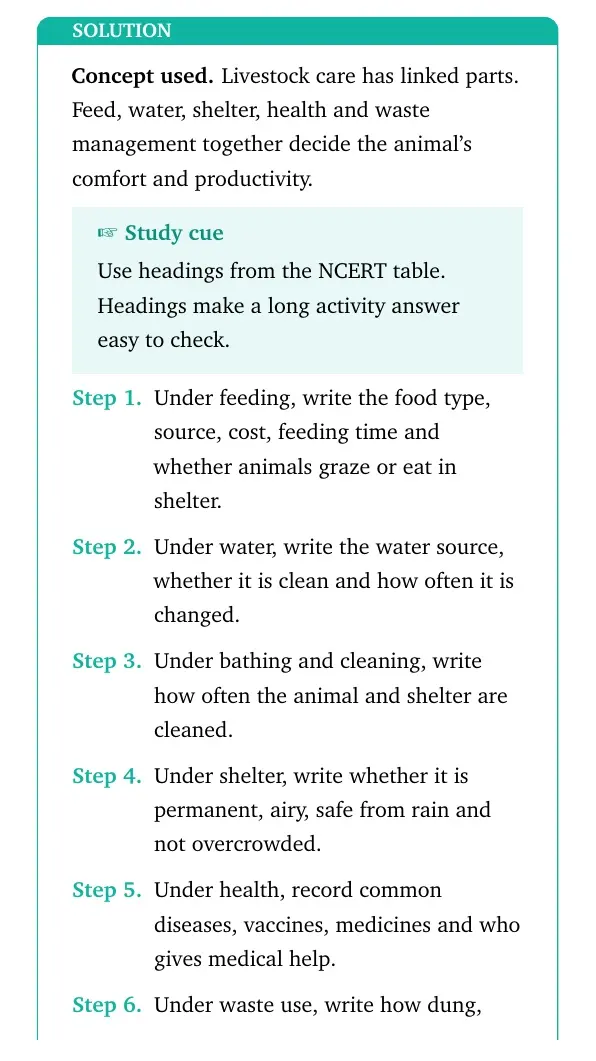
Concept used. Livestock care has linked parts. Feed, water, shelter, health and waste management together decide the animal's comfort and productivity.
Study cue
Use headings from the NCERT table. Headings make a long activity answer easy to check.
Under feeding, write the food type, source, cost, feeding time and whether animals graze or eat in shelter.
Under water, write the water source, whether it is clean and how often it is changed.
Under bathing and cleaning, write how often the animal and shelter are cleaned.
Under shelter, write whether it is permanent, airy, safe from rain and not overcrowded.
Under health, record common diseases, vaccines, medicines and who gives medical help.
Under waste use, write how dung, litter or urine is collected and used as manure or fuel.
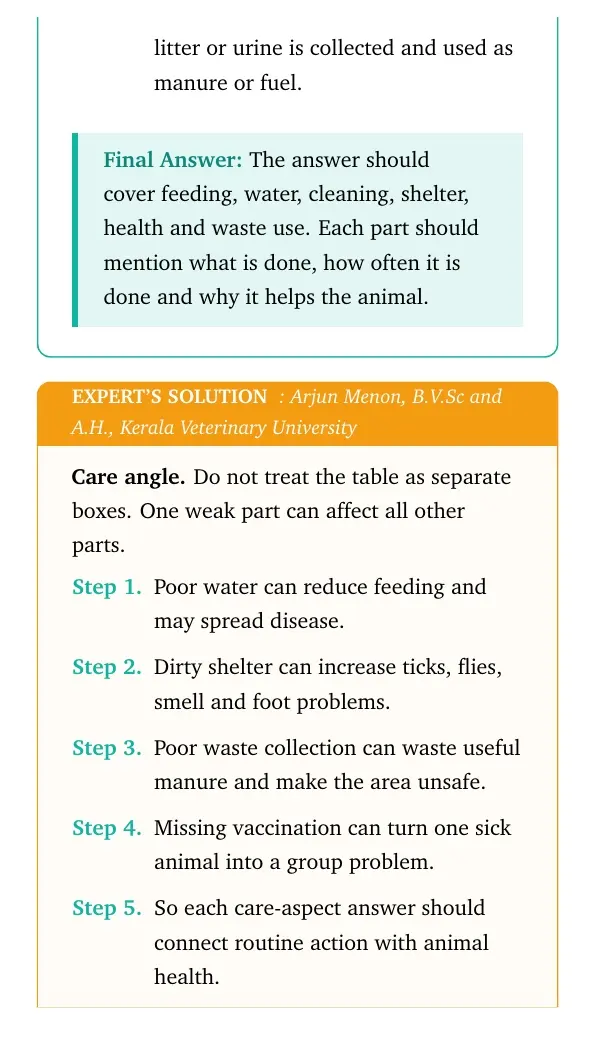
The answer should cover feeding, water, cleaning, shelter, health and waste use. Each part should mention what is done, how often it is done and why it helps the animal.
AM
Arjun Menon
B.V.Sc and A.H., Kerala Veterinary University
Verified Expert
Care angle. Do not treat the table as separate boxes. One weak part can affect all other parts.
Poor water can reduce feeding and may spread disease.
Dirty shelter can increase ticks, flies, smell and foot problems.
Poor waste collection can waste useful manure and make the area unsafe.
Missing vaccination can turn one sick animal into a group problem.
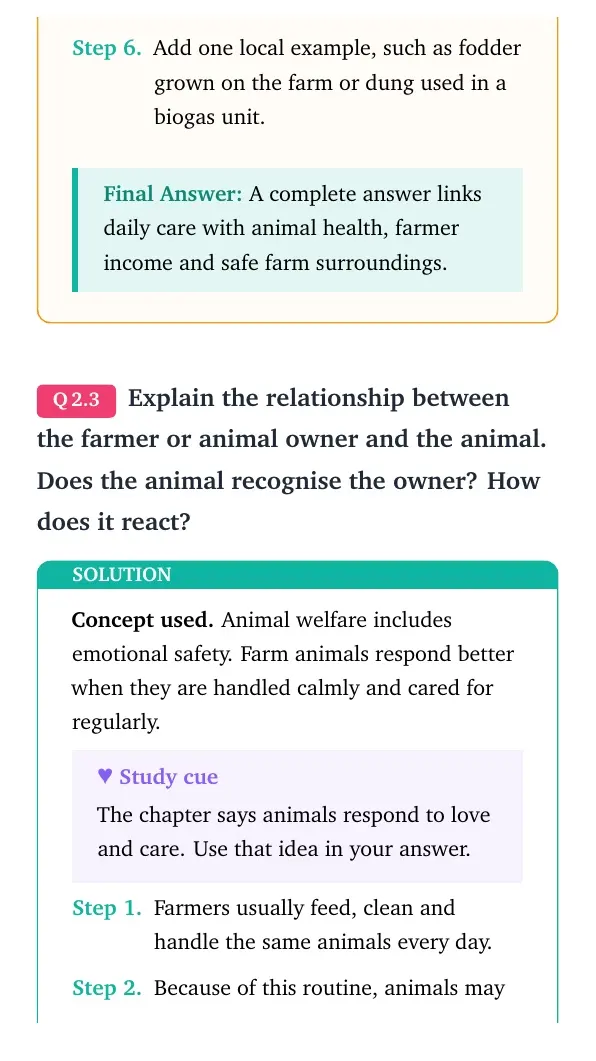
So each care-aspect answer should connect routine action with animal health.
Add one local example, such as fodder grown on the farm or dung used in a biogas unit.
A complete answer links daily care with animal health, farmer income and safe farm surroundings.
Q 2.3
Explain the relationship between the farmer or animal owner and the animal. Does the animal recognise the owner? How does it react?
Concept used. Animal welfare includes emotional safety. Farm animals respond better when they are handled calmly and cared for regularly.
Study cue
The chapter says animals respond to love and care. Use that idea in your answer.
Farmers usually feed, clean and handle the same animals every day.
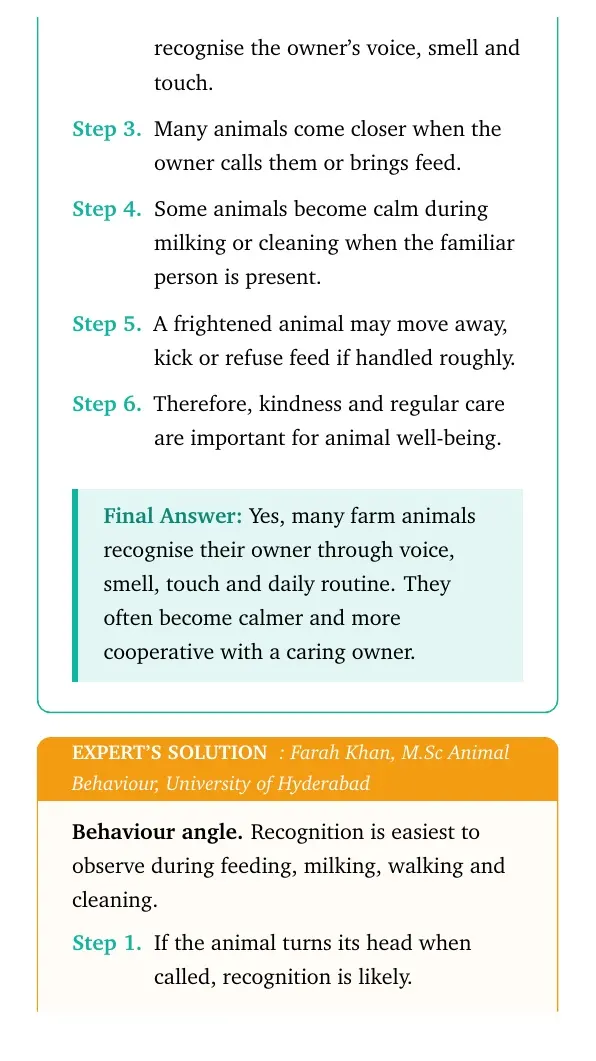
Because of this routine, animals may recognise the owner's voice, smell and touch.
Many animals come closer when the owner calls them or brings feed.
Some animals become calm during milking or cleaning when the familiar person is present.
A frightened animal may move away, kick or refuse feed if handled roughly.
Therefore, kindness and regular care are important for animal well-being.
Yes, many farm animals recognise their owner through voice, smell, touch and daily routine. They often become calmer and more cooperative with a caring owner.
FK
Farah Khan
M.Sc Animal Behaviour, University of Hyderabad
Verified Expert
Behaviour angle. Recognition is easiest to observe during feeding, milking, walking and cleaning.
If the animal turns its head when called, recognition is likely.
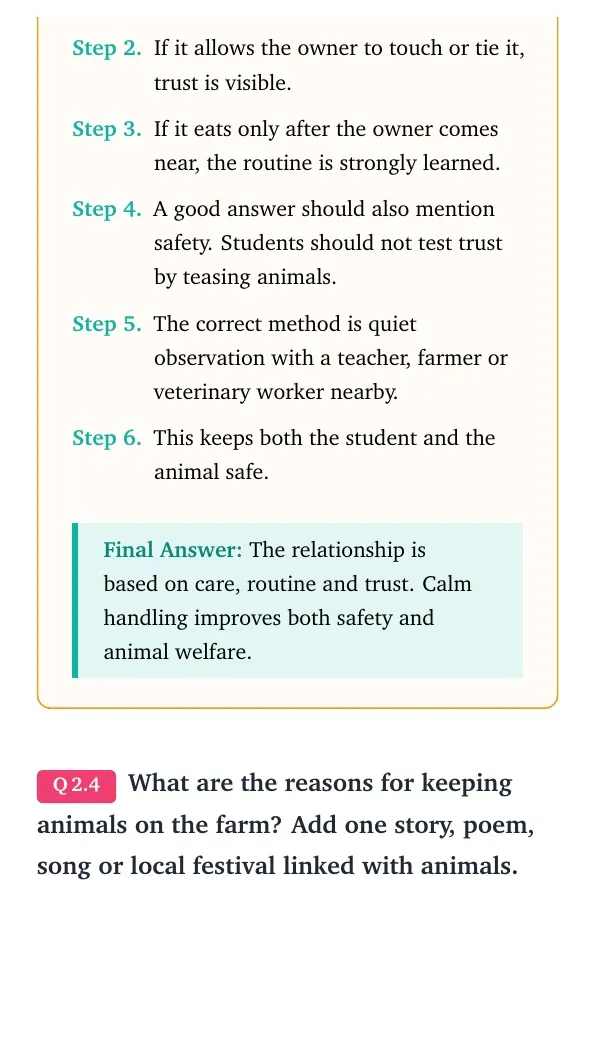
If it allows the owner to touch or tie it, trust is visible.
If it eats only after the owner comes near, the routine is strongly learned.
A good answer should also mention safety. Students should not test trust by teasing animals.
The correct method is quiet observation with a teacher, farmer or veterinary worker nearby.
This keeps both the student and the animal safe.
The relationship is based on care, routine and trust. Calm handling improves both safety and animal welfare.
Q 2.4
What are the reasons for keeping animals on the farm? Add one story, poem, song or local festival linked with animals.
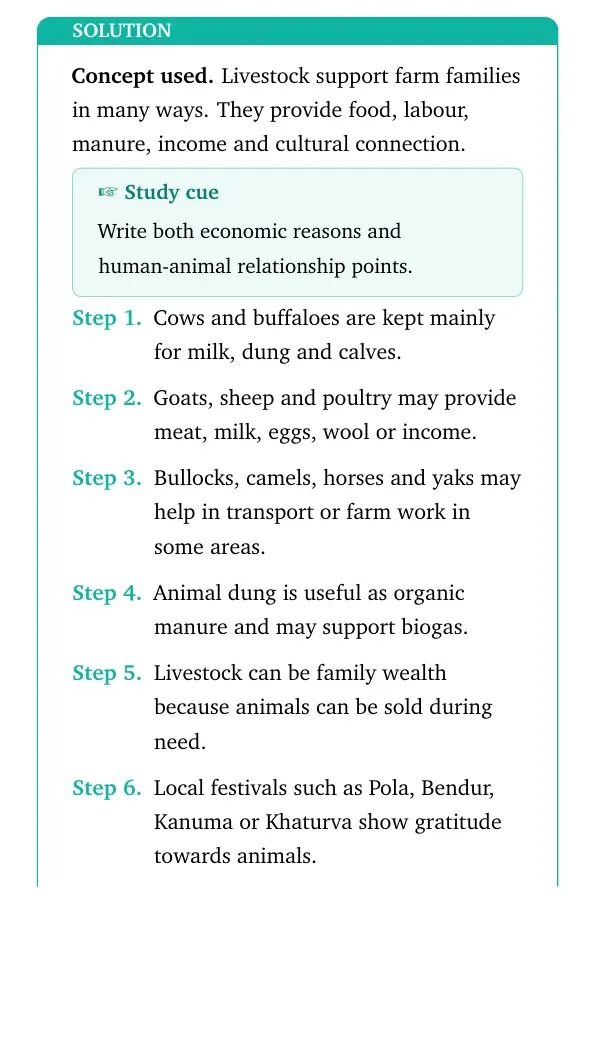
Concept used. Livestock support farm families in many ways. They provide food, labour, manure, income and cultural connection.
Study cue
Write both economic reasons and human-animal relationship points.
Cows and buffaloes are kept mainly for milk, dung and calves.
Goats, sheep and poultry may provide meat, milk, eggs, wool or income.
Bullocks, camels, horses and yaks may help in transport or farm work in some areas.
Animal dung is useful as organic manure and may support biogas.
Livestock can be family wealth because animals can be sold during need.
Local festivals such as Pola, Bendur, Kanuma or Khaturva show gratitude towards animals.
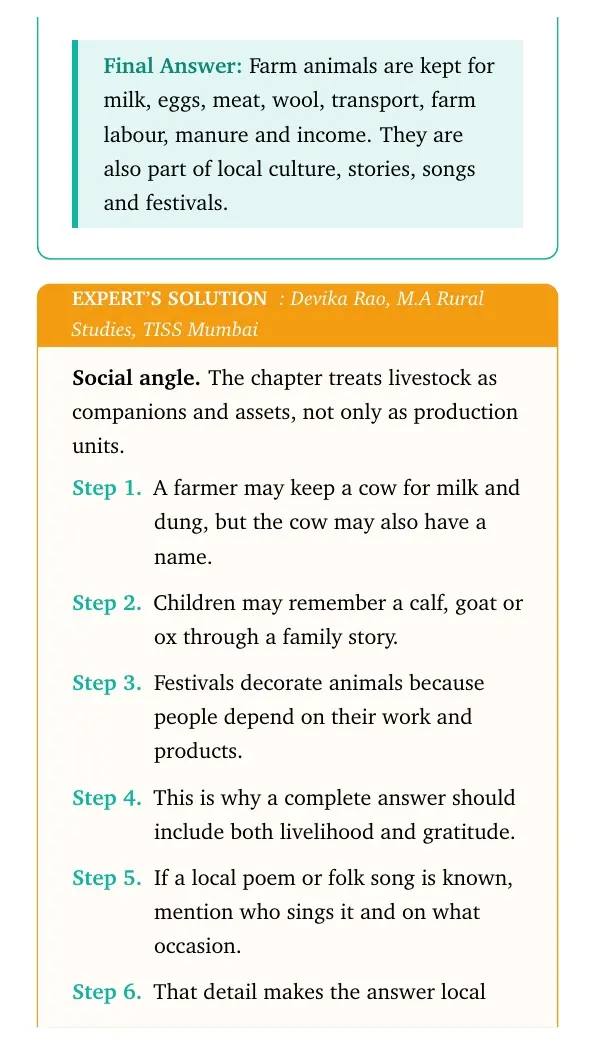
Farm animals are kept for milk, eggs, meat, wool, transport, farm labour, manure and income. They are also part of local culture, stories, songs and festivals.
DR
Devika Rao
M.A Rural Studies, TISS Mumbai
Verified Expert
Social angle. The chapter treats livestock as companions and assets, not only as production units.
A farmer may keep a cow for milk and dung, but the cow may also have a name.
Children may remember a calf, goat or ox through a family story.
Festivals decorate animals because people depend on their work and products.
This is why a complete answer should include both livelihood and gratitude.
If a local poem or folk song is known, mention who sings it and on what occasion.
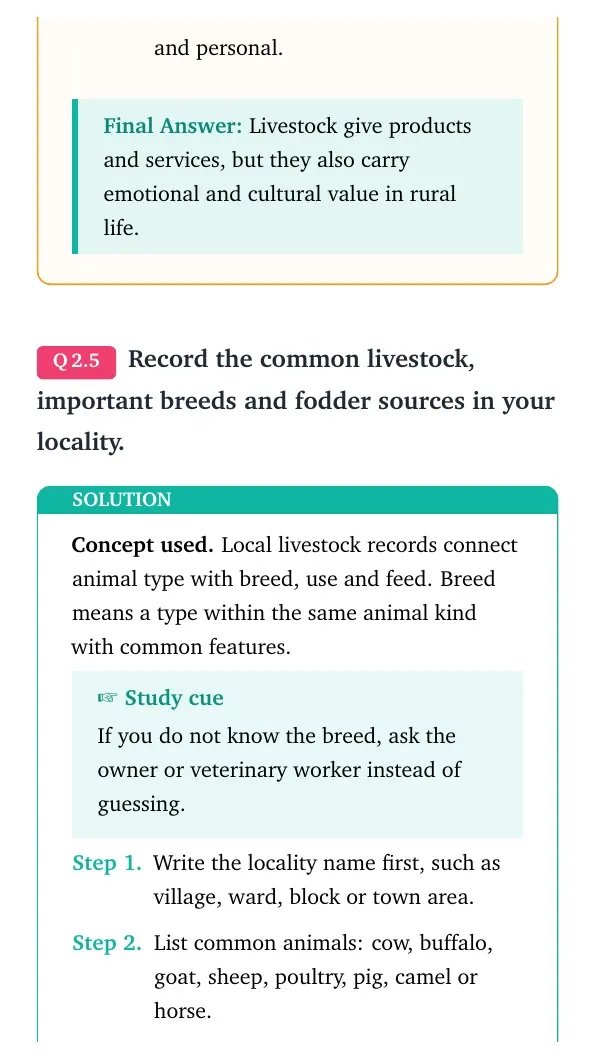
That detail makes the answer local and personal.
Livestock give products and services, but they also carry emotional and cultural value in rural life.
Q 2.5
Record the common livestock, important breeds and fodder sources in your locality.
Concept used. Local livestock records connect animal type with breed, use and feed. Breed means a type within the same animal kind with common features.
Study cue
If you do not know the breed, ask the owner or veterinary worker instead of guessing.
Write the locality name first, such as village, ward, block or town area.
List common animals: cow, buffalo, goat, sheep, poultry, pig, camel or horse.
Record breeds if known, such as Khilari cattle, HF cross, Sangamneri goat, broiler or deshi poultry.
Add the common use, such as milk, eggs, meat, wool, transport or manure.
Record green fodder sources: maize, Napier grass, berseem, lucerne or grazing.
Record dry fodder and feed: wheat straw, paddy straw, jowar straw, grains, oil cakes, bran and mineral mixture.
A complete local record includes animal type, breed, use and food source. The exact entries will vary by locality.
SS
Samarjit Singh
M.V.Sc Livestock Production, NDRI Karnal
Verified Expert
Survey angle. The table becomes useful only when each column answers a different question.
Animal type answers, "What animals are present?"
Breed answers, "Which local or crossbred type is common?"
Use answers, "Why is the animal reared?"
Fodder answers, "How is the animal fed in this area?"
For example, goats may depend more on grazing, shrubs and stall feeding.
Poultry may receive grains, commercial feed, kitchen waste and protein sources.
If two farmers give different breed names, write both and check with the veterinary worker.
If fodder changes by season, record summer and rainy-season feed separately.
This makes the survey more accurate than a single one-day list.
The record should connect local animals with their breed, use and regular feed.
Q 2.6
List common infectious diseases of livestock, three vaccination difficulties, and healthcare measures besides vaccination.
Concept used. Vaccination protects animals from infectious diseases. It works best when combined with hygiene, nutrition, observation and timely treatment.
Study cue
The chapter gives Foot and Mouth Disease as an example. Add other common diseases only after asking a reliable adult or expert.
Common infectious diseases include Foot and Mouth Disease, haemorrhagic septicaemia, black quarter, PPR in goats and fowl pox in poultry.
Farmers may face difficulty in transport, cost, vaccine availability, animal handling and lack of nearby veterinary staff.
Some farmers may fear temporary fever, milk drop or wrong beliefs after vaccination.
Healthcare measures besides vaccination include clean shelter, clean water, balanced feed and parasite control.
Regular observation of appetite, eyes, skin, stool and behaviour helps detect sickness early.
Sick animals should be separated and shown to a veterinary worker quickly.
Livestock vaccination prevents many infectious diseases, but farmers also need hygiene, good feed, clean shelter, parasite control, early observation and veterinary help.
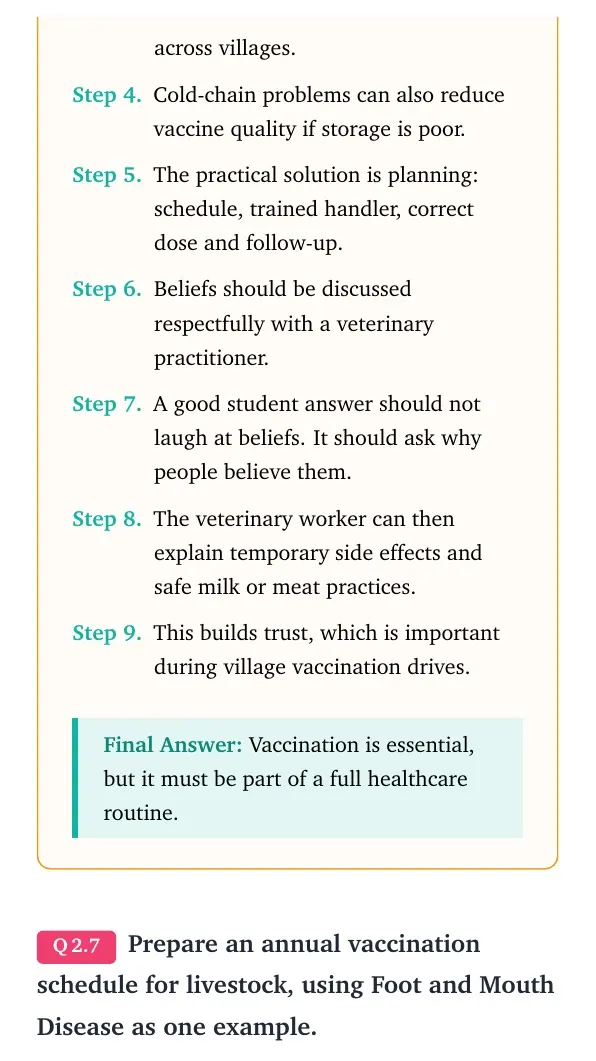
Health angle. A vaccination answer should not sound like one injection solves every problem.
Vaccines train the animal's body to fight a specific disease.
They do not replace feed, shelter, deworming or clean water.
Field difficulty is real because animals may be large, nervous or spread across villages.
Cold-chain problems can also reduce vaccine quality if storage is poor.
The practical solution is planning: schedule, trained handler, correct dose and follow-up.
Beliefs should be discussed respectfully with a veterinary practitioner.
A good student answer should not laugh at beliefs. It should ask why people believe them.
The veterinary worker can then explain temporary side effects and safe milk or meat practices.
This builds trust, which is important during village vaccination drives.
Vaccination is essential, but it must be part of a full healthcare routine.
Q 2.7
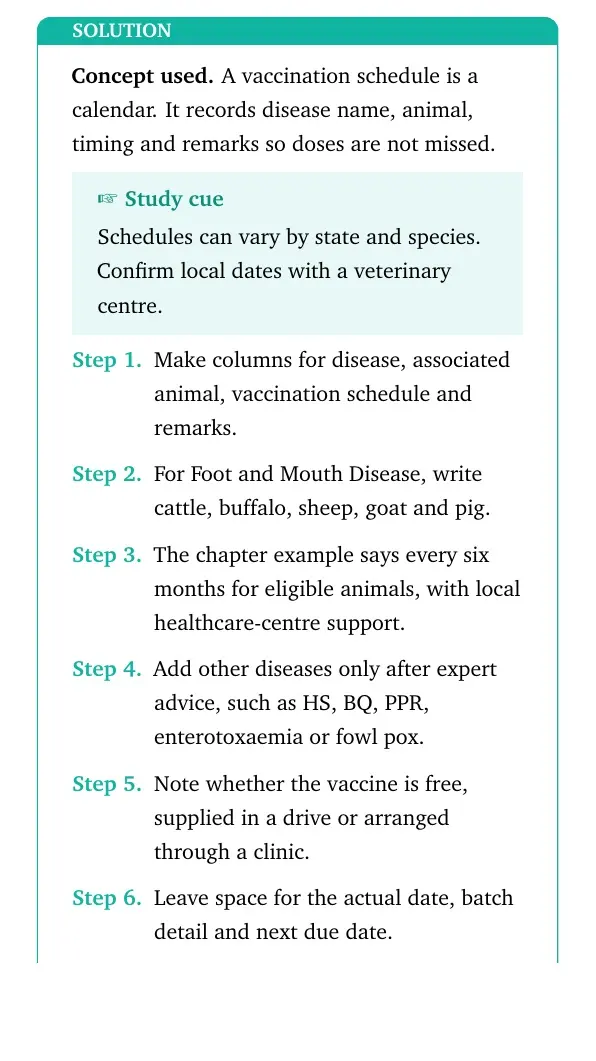
Prepare an annual vaccination schedule for livestock, using Foot and Mouth Disease as one example.
Concept used. A vaccination schedule is a calendar. It records disease name, animal, timing and remarks so doses are not missed.
Study cue
Schedules can vary by state and species. Confirm local dates with a veterinary centre.
Make columns for disease, associated animal, vaccination schedule and remarks.
For Foot and Mouth Disease, write cattle, buffalo, sheep, goat and pig.
The chapter example says every six months for eligible animals, with local healthcare-centre support.
Add other diseases only after expert advice, such as HS, BQ, PPR, enterotoxaemia or fowl pox.
Note whether the vaccine is free, supplied in a drive or arranged through a clinic.
Leave space for the actual date, batch detail and next due date.
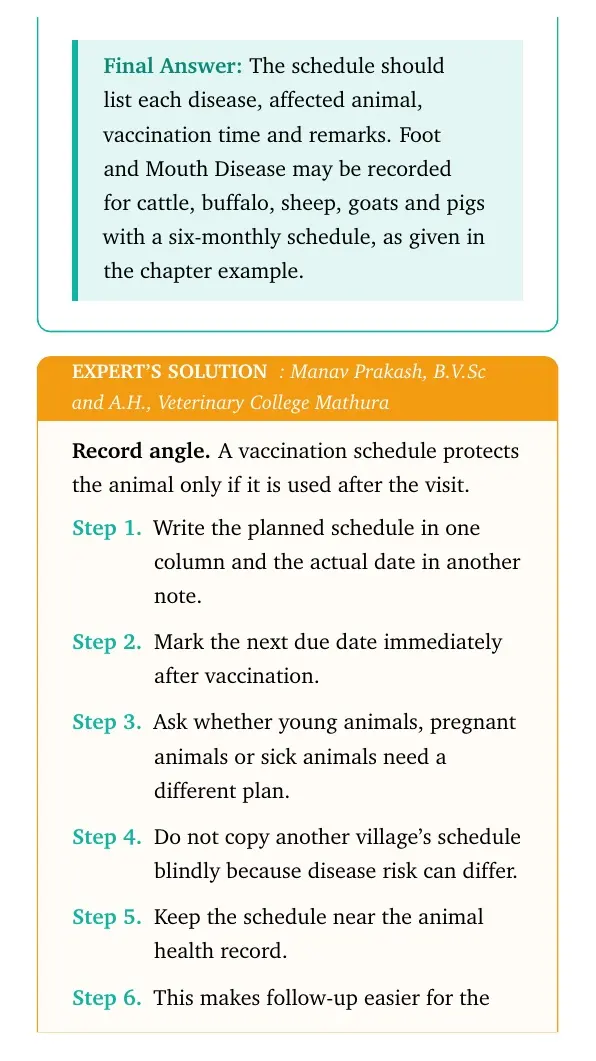
The schedule should list each disease, affected animal, vaccination time and remarks. Foot and Mouth Disease may be recorded for cattle, buffalo, sheep, goats and pigs with a six-monthly schedule, as given in the chapter example.
MP
Manav Prakash
B.V.Sc and A.H., Veterinary College Mathura
Verified Expert
Record angle. A vaccination schedule protects the animal only if it is used after the visit.
Write the planned schedule in one column and the actual date in another note.
Mark the next due date immediately after vaccination.
Ask whether young animals, pregnant animals or sick animals need a different plan.
Do not copy another village's schedule blindly because disease risk can differ.
Keep the schedule near the animal health record.
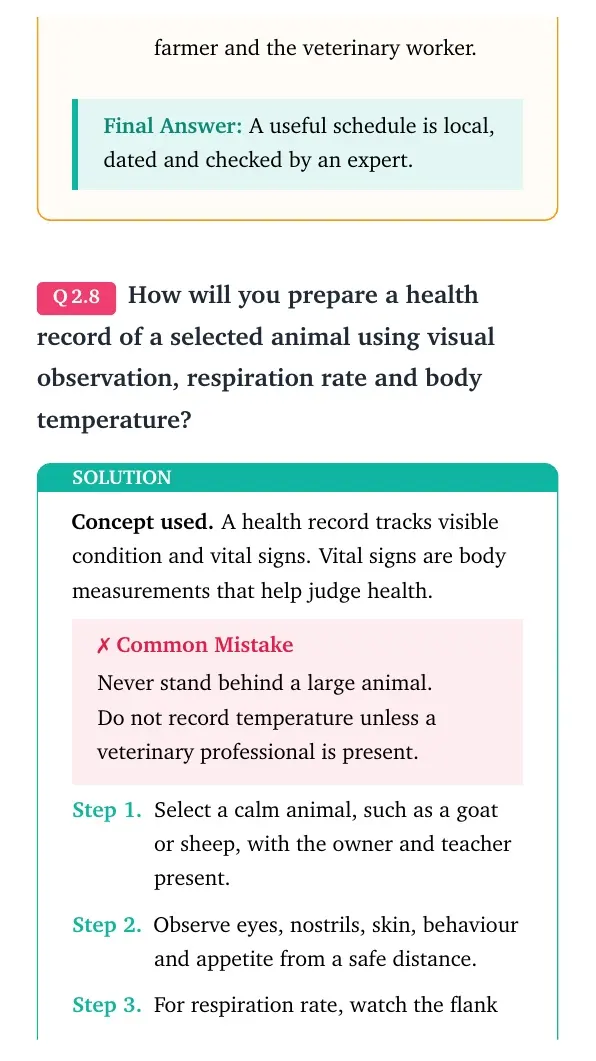
This makes follow-up easier for the farmer and the veterinary worker.
A useful schedule is local, dated and checked by an expert.
Q 2.8
How will you prepare a health record of a selected animal using visual observation, respiration rate and body temperature?
Concept used. A health record tracks visible condition and vital signs. Vital signs are body measurements that help judge health.
Never stand behind a large animal. Do not record temperature unless a veterinary professional is present.
Select a calm animal, such as a goat or sheep, with the owner and teacher present.
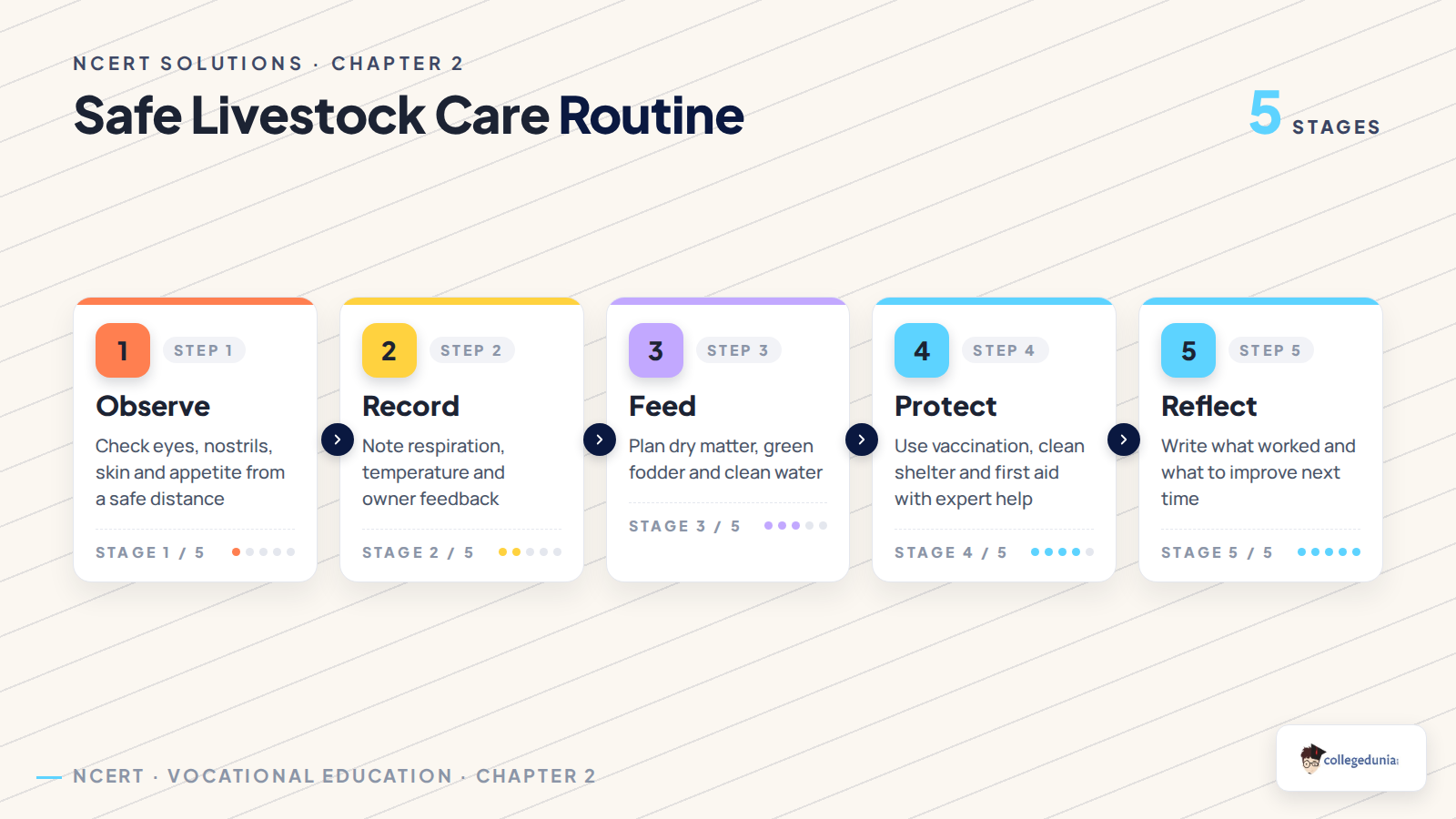
Observe eyes, nostrils, skin, behaviour and appetite from a safe distance.
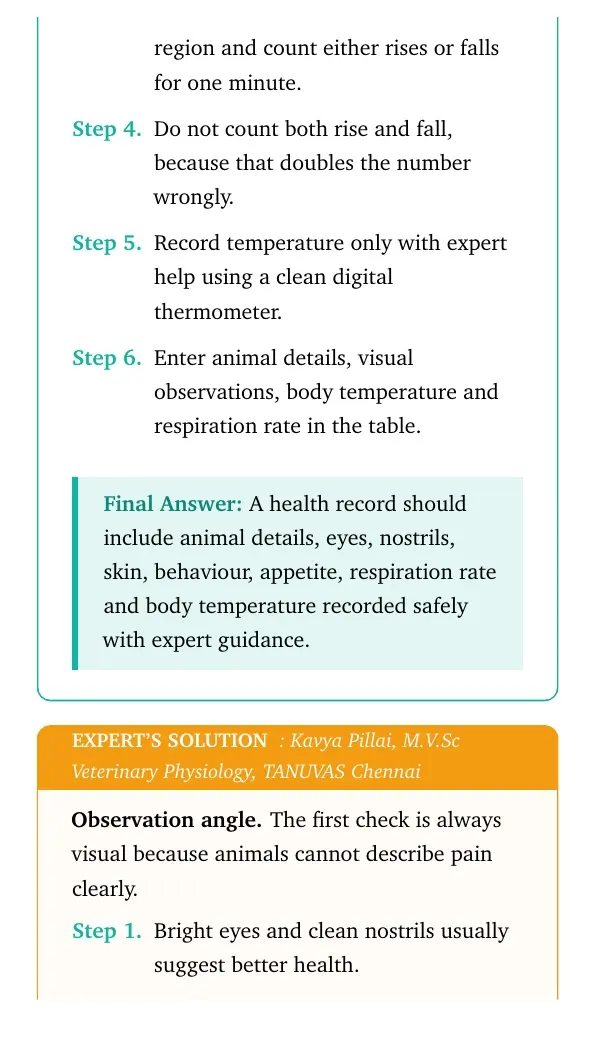
For respiration rate, watch the flank region and count either rises or falls for one minute.
Do not count both rise and fall, because that doubles the number wrongly.
Record temperature only with expert help using a clean digital thermometer.
Enter animal details, visual observations, body temperature and respiration rate in the table.
A health record should include animal details, eyes, nostrils, skin, behaviour, appetite, respiration rate and body temperature recorded safely with expert guidance.
KP
Kavya Pillai
M.V.Sc Veterinary Physiology, TANUVAS Chennai
Verified Expert
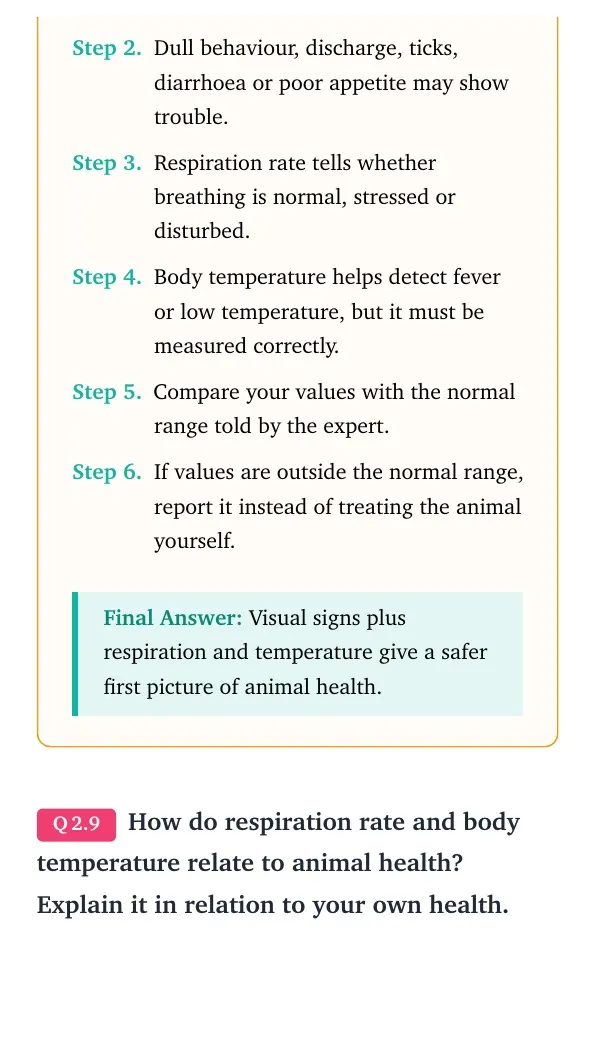
Observation angle. The first check is always visual because animals cannot describe pain clearly.
Bright eyes and clean nostrils usually suggest better health.
Dull behaviour, discharge, ticks, diarrhoea or poor appetite may show trouble.
Respiration rate tells whether breathing is normal, stressed or disturbed.
Body temperature helps detect fever or low temperature, but it must be measured correctly.
Compare your values with the normal range told by the expert.
If values are outside the normal range, report it instead of treating the animal yourself.
Visual signs plus respiration and temperature give a safer first picture of animal health.
Q 2.9
How do respiration rate and body temperature relate to animal health? Explain it in relation to your own health.
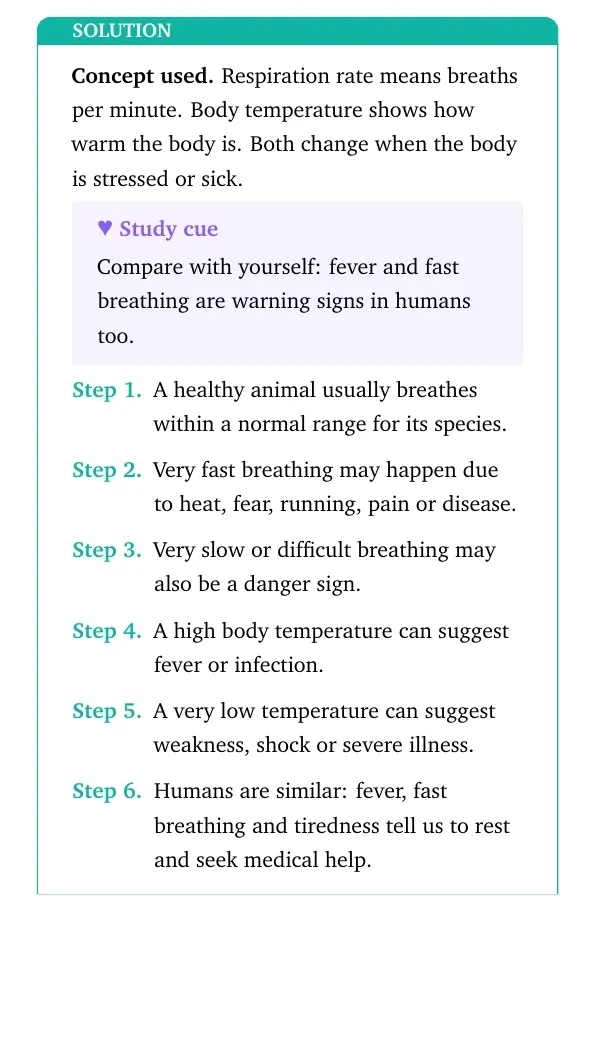
Concept used. Respiration rate means breaths per minute. Body temperature shows how warm the body is. Both change when the body is stressed or sick.
Study cue
Compare with yourself: fever and fast breathing are warning signs in humans too.
A healthy animal usually breathes within a normal range for its species.
Very fast breathing may happen due to heat, fear, running, pain or disease.
Very slow or difficult breathing may also be a danger sign.
A high body temperature can suggest fever or infection.
A very low temperature can suggest weakness, shock or severe illness.
Humans are similar: fever, fast breathing and tiredness tell us to rest and seek medical help.
Respiration rate and body temperature are early health indicators. Abnormal values may show stress, fever, infection, heat load or weakness, just as they do in humans.
RJ
Ritika Joshi
M.Sc Zoology, Banaras Hindu University
Verified Expert
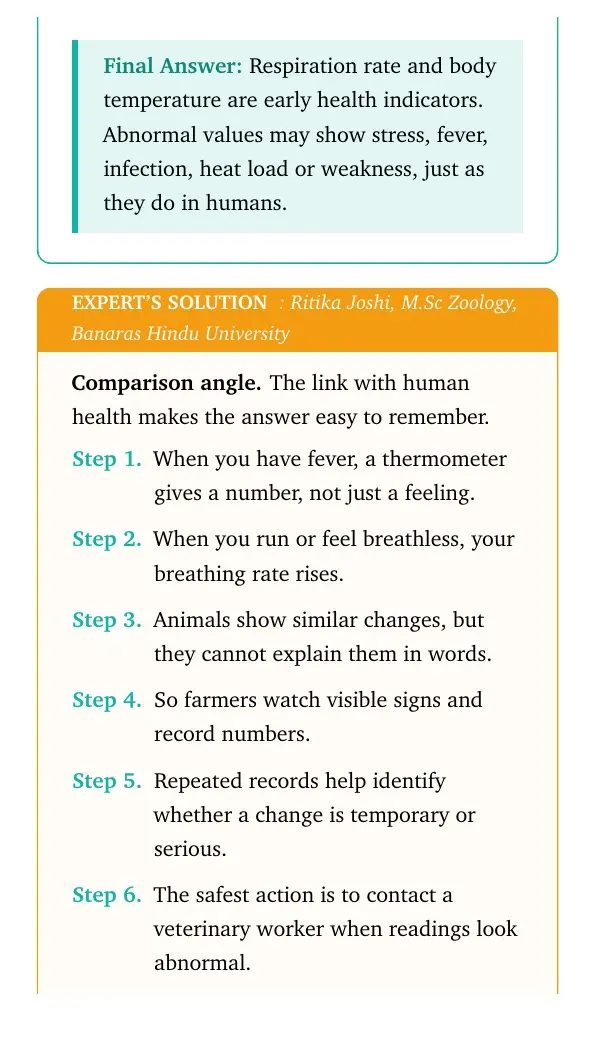
Comparison angle. The link with human health makes the answer easy to remember.
When you have fever, a thermometer gives a number, not just a feeling.
When you run or feel breathless, your breathing rate rises.
Animals show similar changes, but they cannot explain them in words.
So farmers watch visible signs and record numbers.
Repeated records help identify whether a change is temporary or serious.
The safest action is to contact a veterinary worker when readings look abnormal.
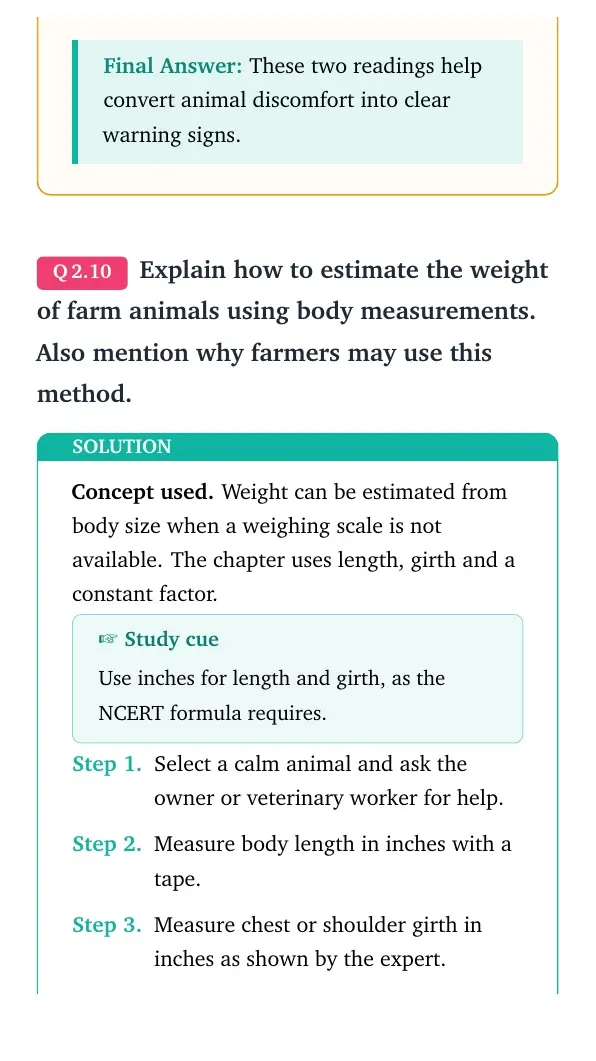
These two readings help convert animal discomfort into clear warning signs.
Q 2.10
Explain how to estimate the weight of farm animals using body measurements. Also mention why farmers may use this method.
Concept used. Weight can be estimated from body size when a weighing scale is not available. The chapter uses length, girth and a constant factor.
Study cue
Use inches for length and girth, as the NCERT formula requires.
Select a calm animal and ask the owner or veterinary worker for help.
Measure body length in inches with a tape.
Measure chest or shoulder girth in inches as shown by the expert.
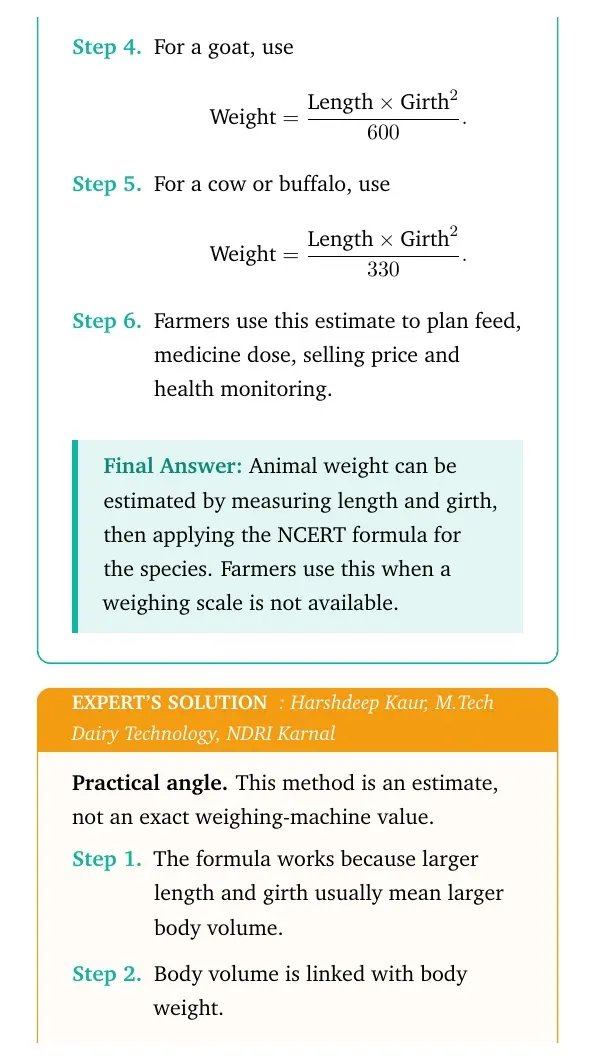
For a goat, use
extWeight= rac extLength imes extGirth2600.
For a cow or buffalo, use
extWeight= rac extLength imes extGirth2330.
Farmers use this estimate to plan feed, medicine dose, selling price and health monitoring.
Animal weight can be estimated by measuring length and girth, then applying the NCERT formula for the species. Farmers use this when a weighing scale is not available.
HK
Harshdeep Kaur
M.Tech Dairy Technology, NDRI Karnal
Verified Expert
Practical angle. This method is an estimate, not an exact weighing-machine value.
The formula works because larger length and girth usually mean larger body volume.
Body volume is linked with body weight.
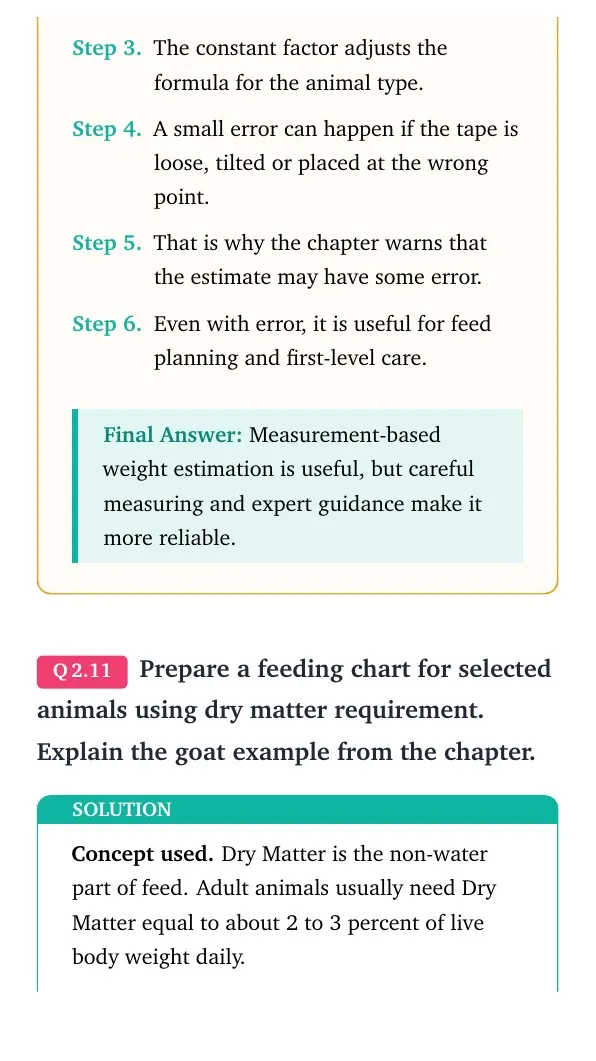
The constant factor adjusts the formula for the animal type.
A small error can happen if the tape is loose, tilted or placed at the wrong point.
That is why the chapter warns that the estimate may have some error.
Even with error, it is useful for feed planning and first-level care.
Measurement-based weight estimation is useful, but careful measuring and expert guidance make it more reliable.
Q 2.11
Prepare a feeding chart for selected animals using dry matter requirement. Explain the goat example from the chapter.
Concept used. Dry Matter is the non-water part of feed. Adult animals usually need Dry Matter equal to about 2 to 3 percent of live body weight daily.
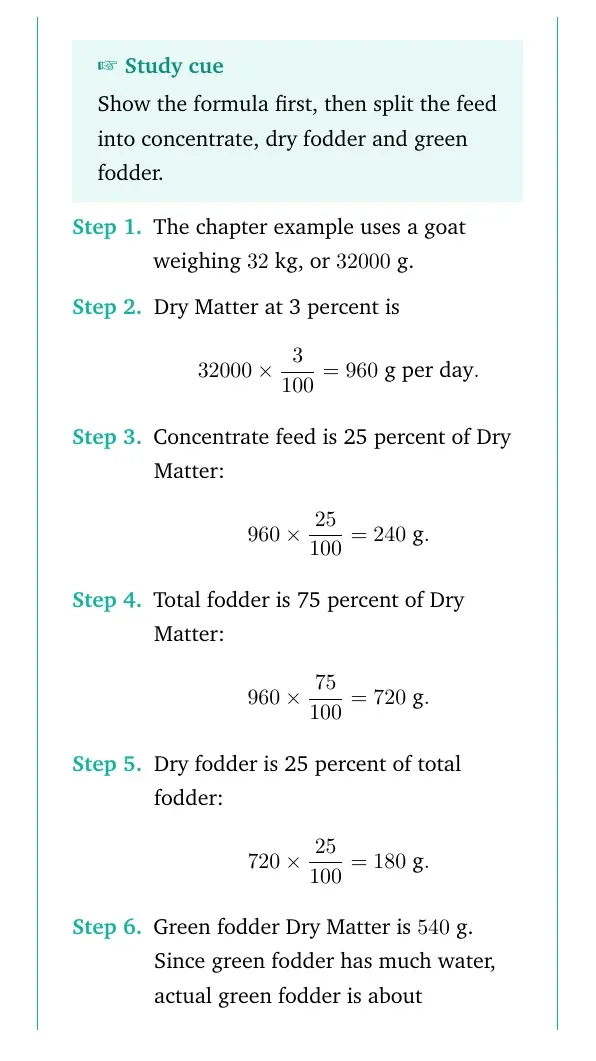
Study cue
Show the formula first, then split the feed into concentrate, dry fodder and green fodder.
The chapter example uses a goat weighing 32 extkg, or 32000 extg.
Dry Matter at 3 percent is
32000 imes rac3100=960 extg per day.
Concentrate feed is 25 percent of Dry Matter:
960 imes rac25100=240 extg.
Total fodder is 75 percent of Dry Matter:
960 imes rac75100=720 extg.
Dry fodder is 25 percent of total fodder:
720 imes rac25100=180 extg.
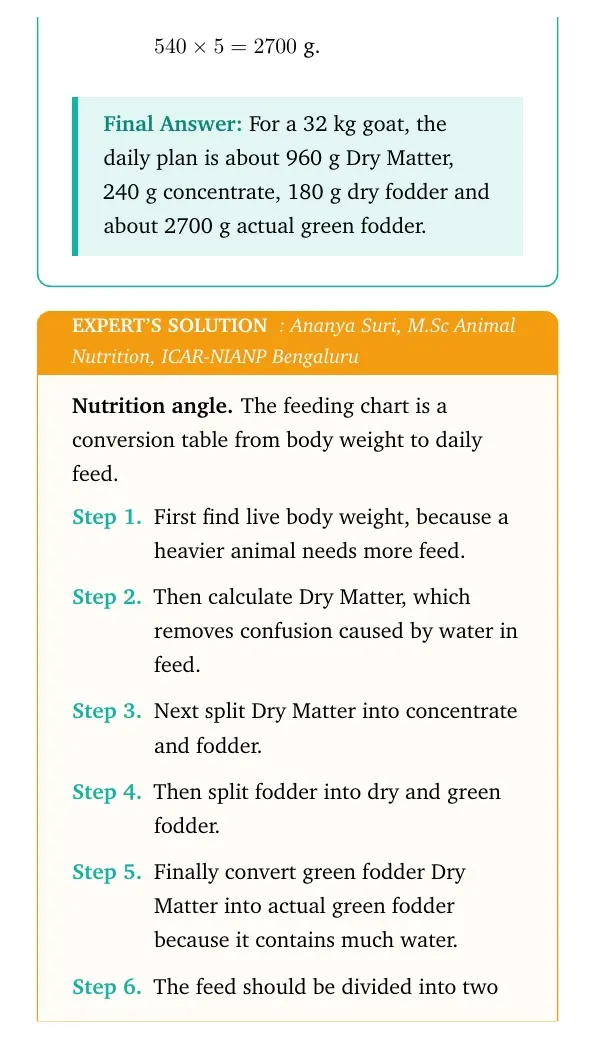
Green fodder Dry Matter is 540 extg. Since green fodder has much water, actual green fodder is about 540 imes 5=2700 extg.
For a 32 kg goat, the daily plan is about 960 g Dry Matter, 240 g concentrate, 180 g dry fodder and about 2700 g actual green fodder.
AS
Ananya Suri
M.Sc Animal Nutrition, ICAR-NIANP Bengaluru
Verified Expert
Nutrition angle. The feeding chart is a conversion table from body weight to daily feed.
First find live body weight, because a heavier animal needs more feed.
Then calculate Dry Matter, which removes confusion caused by water in feed.
Next split Dry Matter into concentrate and fodder.
Then split fodder into dry and green fodder.
Finally convert green fodder Dry Matter into actual green fodder because it contains much water.
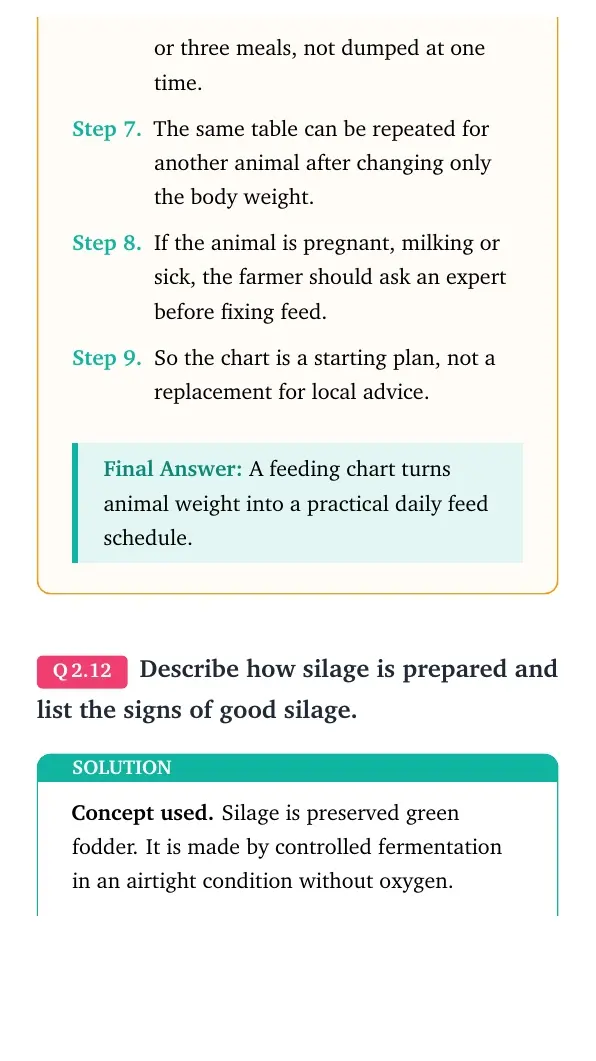
The feed should be divided into two or three meals, not dumped at one time.
The same table can be repeated for another animal after changing only the body weight.
If the animal is pregnant, milking or sick, the farmer should ask an expert before fixing feed.
So the chart is a starting plan, not a replacement for local advice.
A feeding chart turns animal weight into a practical daily feed schedule.
Q 2.12
Describe how silage is prepared and list the signs of good silage.
Concept used. Silage is preserved green fodder. It is made by controlled fermentation in an airtight condition without oxygen.
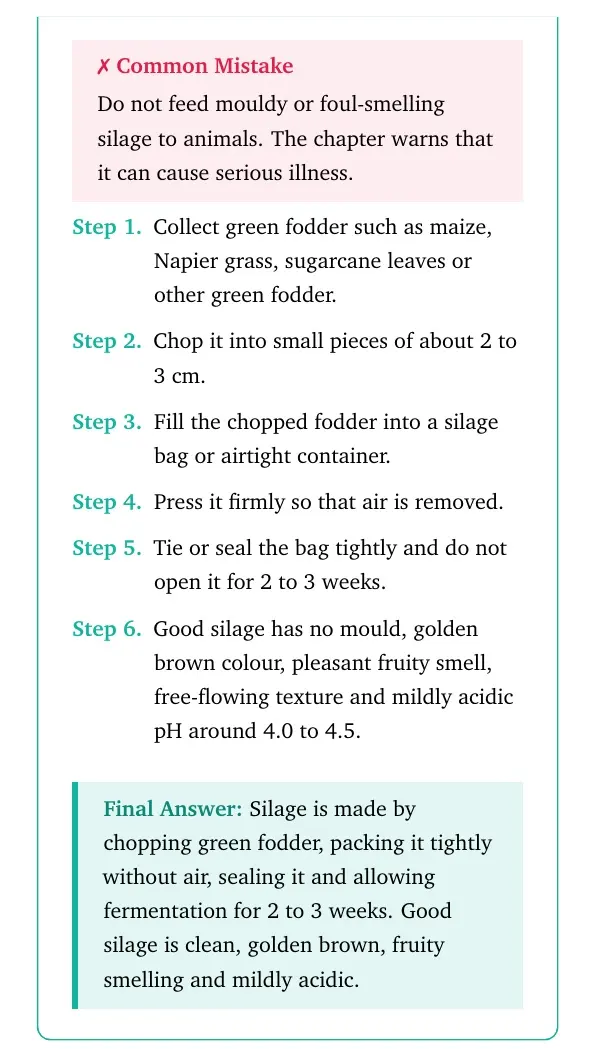
Do not feed mouldy or foul-smelling silage to animals. The chapter warns that it can cause serious illness.
Collect green fodder such as maize, Napier grass, sugarcane leaves or other green fodder.
Chop it into small pieces of about 2 to 3 cm.
Fill the chopped fodder into a silage bag or airtight container.
Press it firmly so that air is removed.
Tie or seal the bag tightly and do not open it for 2 to 3 weeks.
Good silage has no mould, golden brown colour, pleasant fruity smell, free-flowing texture and mildly acidic pH around 4.0 to 4.5.
Silage is made by chopping green fodder, packing it tightly without air, sealing it and allowing fermentation for 2 to 3 weeks. Good silage is clean, golden brown, fruity smelling and mildly acidic.
RB
Raghav Bhatia
M.Sc Agronomy, GBPUAT Pantnagar
Verified Expert
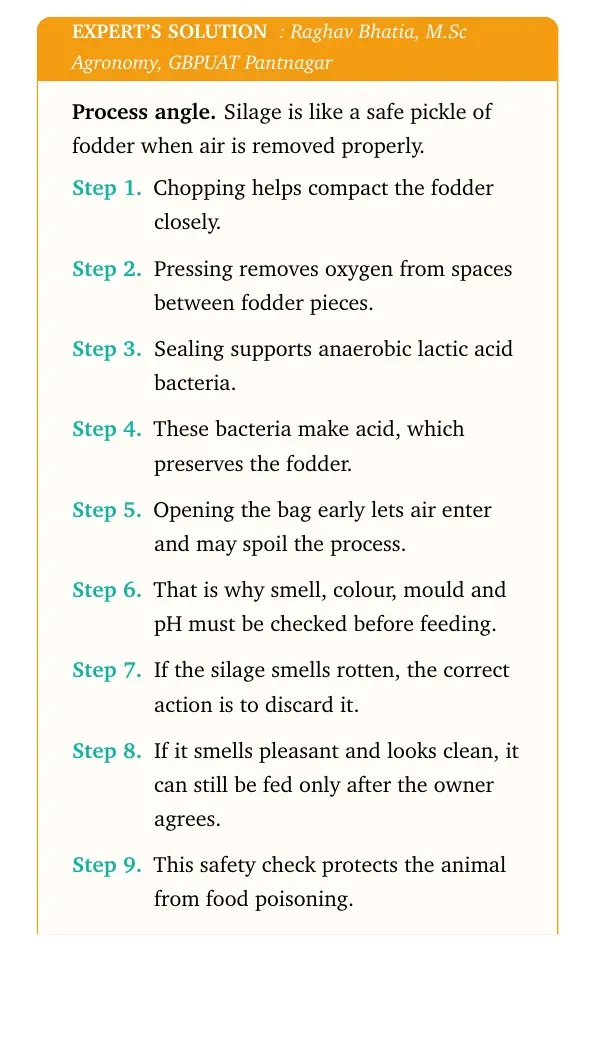
Process angle. Silage is like a safe pickle of fodder when air is removed properly.
Chopping helps compact the fodder closely.
Pressing removes oxygen from spaces between fodder pieces.
Sealing supports anaerobic lactic acid bacteria.
These bacteria make acid, which preserves the fodder.
Opening the bag early lets air enter and may spoil the process.
That is why smell, colour, mould and pH must be checked before feeding.
If the silage smells rotten, the correct action is to discard it.
If it smells pleasant and looks clean, it can still be fed only after the owner agrees.
This safety check protects the animal from food poisoning.
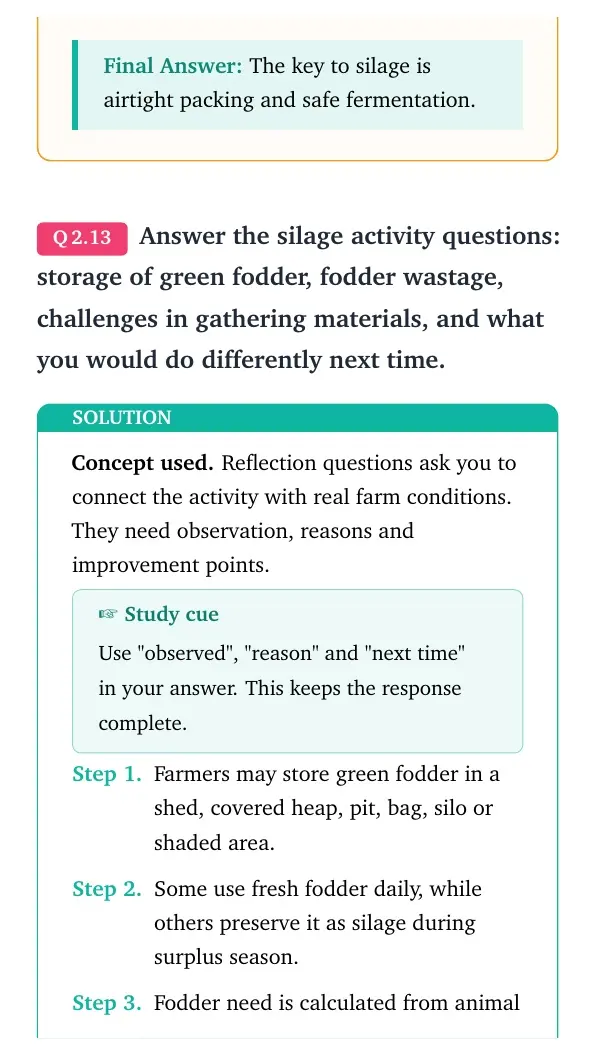
The key to silage is airtight packing and safe fermentation.
Q 2.13
Answer the silage activity questions: storage of green fodder, fodder wastage, challenges in gathering materials, and what you would do differently next time.
Concept used. Reflection questions ask you to connect the activity with real farm conditions. They need observation, reasons and improvement points.
Study cue
Use "observed", "reason" and "next time" in your answer. This keeps the response complete.
Farmers may store green fodder in a shed, covered heap, pit, bag, silo or shaded area.
Some use fresh fodder daily, while others preserve it as silage during surplus season.
Fodder need is calculated from animal type, body weight, production and daily Dry Matter requirement.
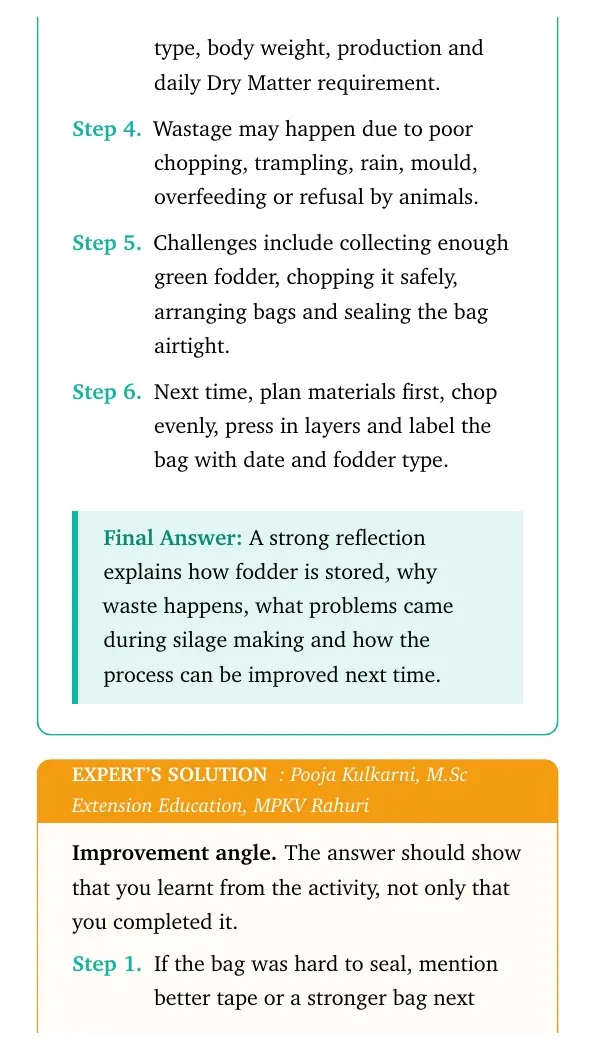
Wastage may happen due to poor chopping, trampling, rain, mould, overfeeding or refusal by animals.
Challenges include collecting enough green fodder, chopping it safely, arranging bags and sealing the bag airtight.
Next time, plan materials first, chop evenly, press in layers and label the bag with date and fodder type.
A strong reflection explains how fodder is stored, why waste happens, what problems came during silage making and how the process can be improved next time.
PK
Pooja Kulkarni
M.Sc Extension Education, MPKV Rahuri
Verified Expert
Improvement angle. The answer should show that you learnt from the activity, not only that you completed it.
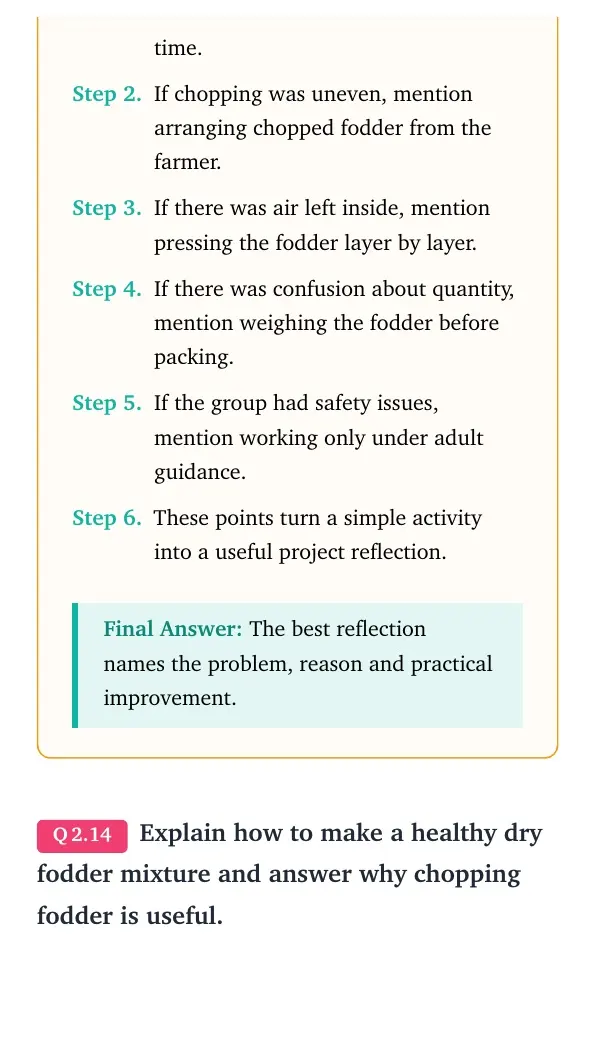
If the bag was hard to seal, mention better tape or a stronger bag next time.
If chopping was uneven, mention arranging chopped fodder from the farmer.
If there was air left inside, mention pressing the fodder layer by layer.
If there was confusion about quantity, mention weighing the fodder before packing.
If the group had safety issues, mention working only under adult guidance.
These points turn a simple activity into a useful project reflection.
The best reflection names the problem, reason and practical improvement.
Q 2.14
Explain how to make a healthy dry fodder mixture and answer why chopping fodder is useful.
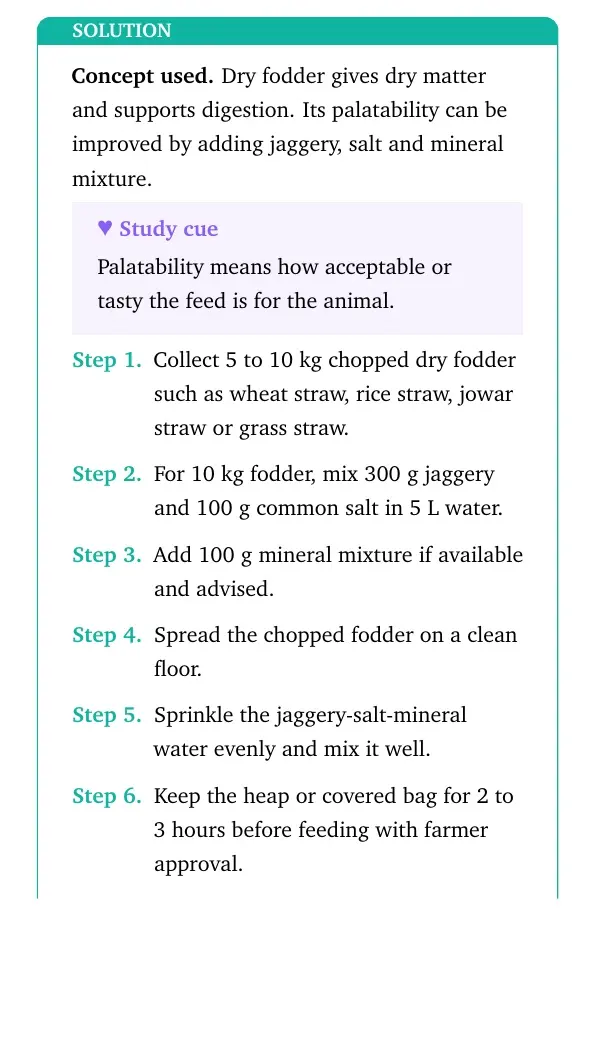
Concept used. Dry fodder gives dry matter and supports digestion. Its palatability can be improved by adding jaggery, salt and mineral mixture.
Study cue
Palatability means how acceptable or tasty the feed is for the animal.
Collect 5 to 10 kg chopped dry fodder such as wheat straw, rice straw, jowar straw or grass straw.
For 10 kg fodder, mix 300 g jaggery and 100 g common salt in 5 L water.
Add 100 g mineral mixture if available and advised.
Spread the chopped fodder on a clean floor.
Sprinkle the jaggery-salt-mineral water evenly and mix it well.
Keep the heap or covered bag for 2 to 3 hours before feeding with farmer approval.
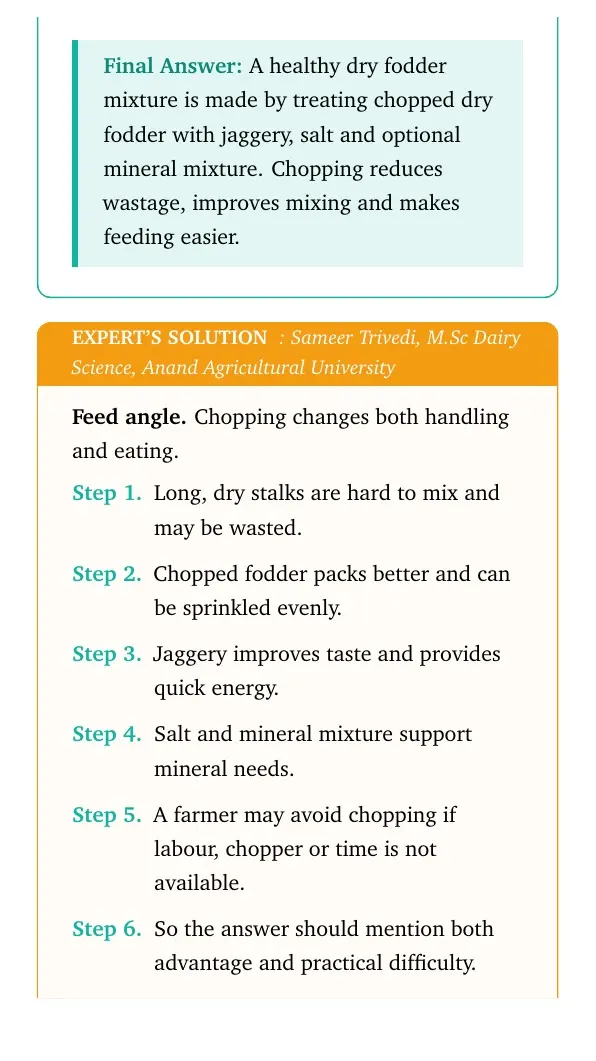
A healthy dry fodder mixture is made by treating chopped dry fodder with jaggery, salt and optional mineral mixture. Chopping reduces wastage, improves mixing and makes feeding easier.
ST
Sameer Trivedi
M.Sc Dairy Science, Anand Agricultural University
Verified Expert
Feed angle. Chopping changes both handling and eating.
Long, dry stalks are hard to mix and may be wasted.
Chopped fodder packs better and can be sprinkled evenly.
Jaggery improves taste and provides quick energy.
Salt and mineral mixture support mineral needs.
A farmer may avoid chopping if labour, chopper or time is not available.
So the answer should mention both advantage and practical difficulty.
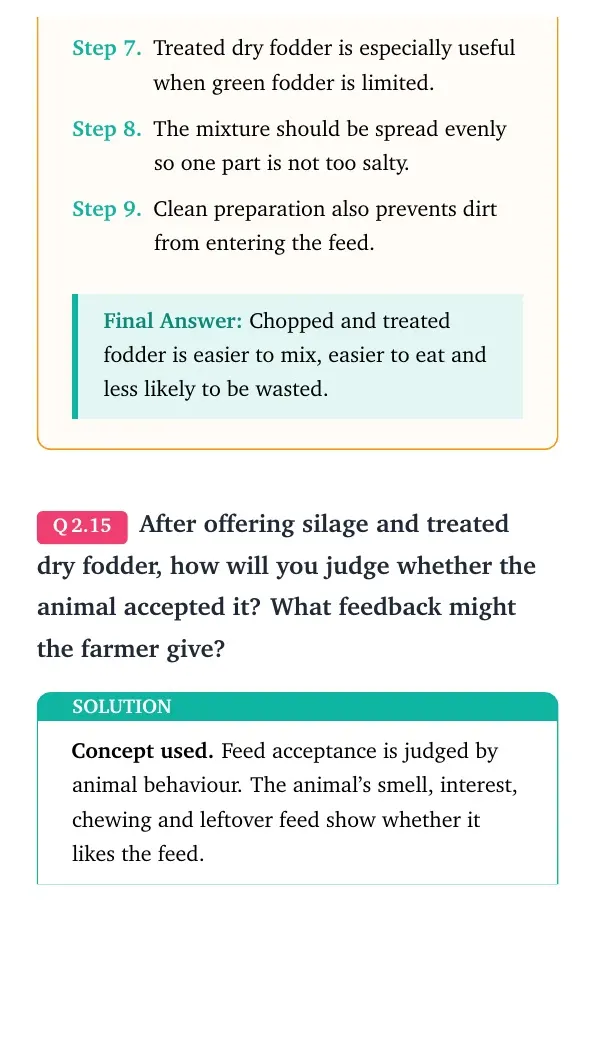
Treated dry fodder is especially useful when green fodder is limited.
The mixture should be spread evenly so one part is not too salty.
Clean preparation also prevents dirt from entering the feed.
Chopped and treated fodder is easier to mix, easier to eat and less likely to be wasted.
Q 2.15
After offering silage and treated dry fodder, how will you judge whether the animal accepted it? What feedback might the farmer give?
Concept used. Feed acceptance is judged by animal behaviour. The animal's smell, interest, chewing and leftover feed show whether it likes the feed.
Study cue
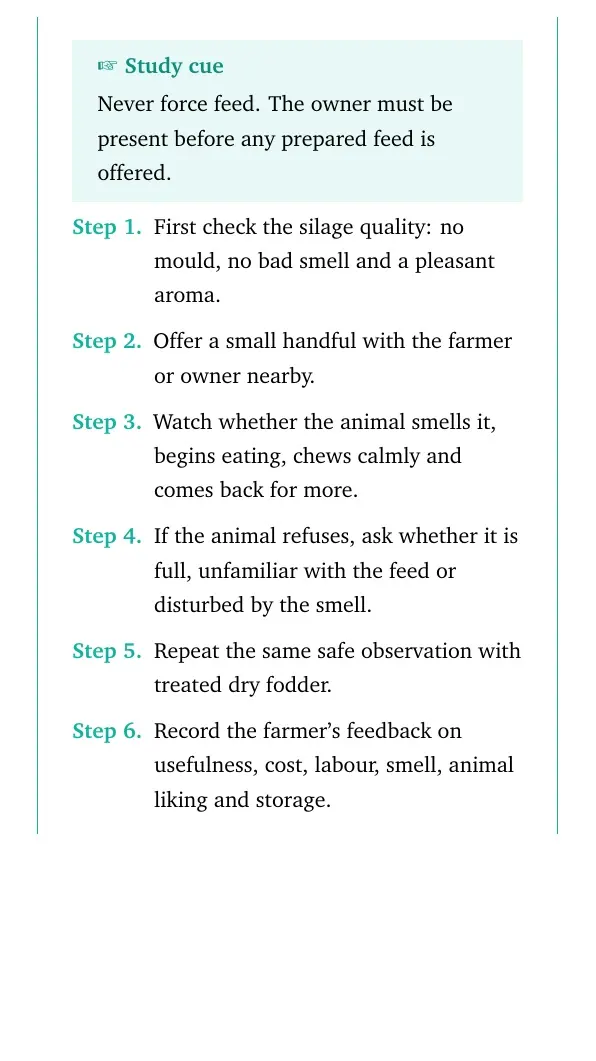
Never force feed. The owner must be present before any prepared feed is offered.
First check the silage quality: no mould, no bad smell and a pleasant aroma.
Offer a small handful with the farmer or owner nearby.
Watch whether the animal smells it, begins eating, chews calmly and comes back for more.
If the animal refuses, ask whether it is full, unfamiliar with the feed or disturbed by the smell.
Repeat the same safe observation with treated dry fodder.
Record the farmer's feedback on usefulness, cost, labour, smell, animal liking and storage.
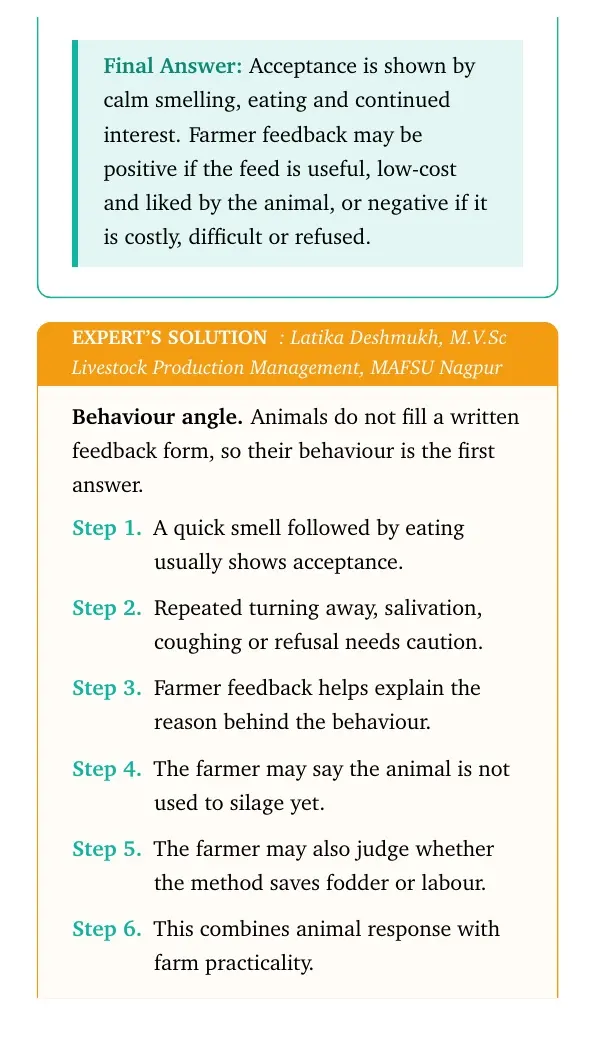
Acceptance is shown by calm smelling, eating and continued interest. Farmer feedback may be positive if the feed is useful, low-cost and liked by the animal, or negative if it is costly, difficult or refused.
LD
Latika Deshmukh
M.V.Sc Livestock Production Management, MAFSU Nagpur
Verified Expert
Behaviour angle. Animals do not fill a written feedback form, so their behaviour is the first answer.
A quick smell followed by eating usually shows acceptance.
Repeated turning away, salivation, coughing or refusal needs caution.
Farmer feedback helps explain the reason behind the behaviour.
The farmer may say the animal is not used to silage yet.
The farmer may also judge whether the method saves fodder or labour.
This combines animal response with farm practicality.
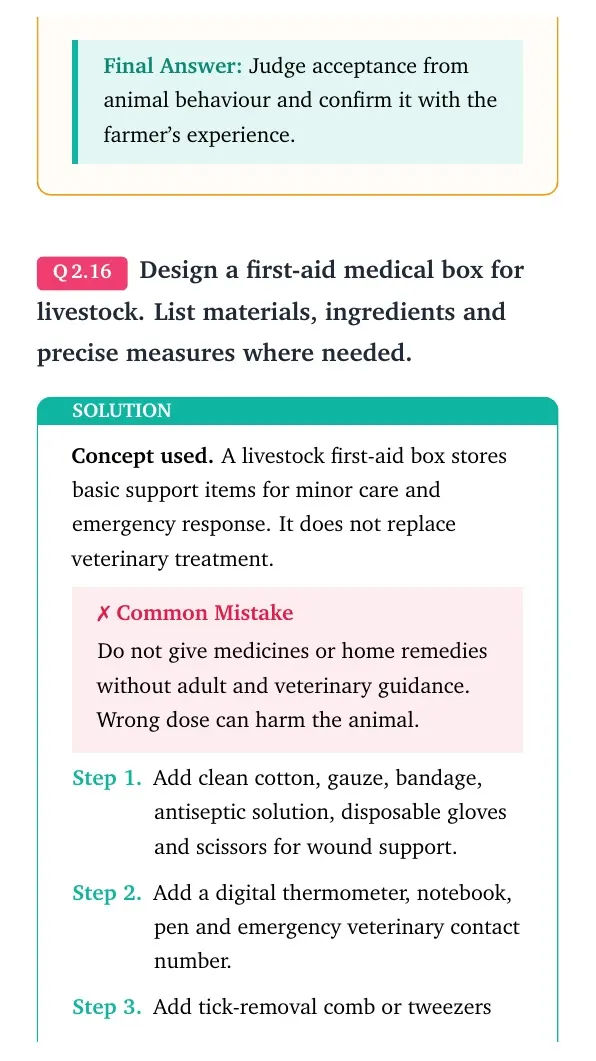
Judge acceptance from animal behaviour and confirm it with the farmer's experience.
Q 2.16
Design a first-aid medical box for livestock. List materials, ingredients and precise measures where needed.
Concept used. A livestock first-aid box stores basic support items for minor care and emergency response. It does not replace veterinary treatment.
Do not give medicines or home remedies without adult and veterinary guidance. Wrong dose can harm the animal.
Add clean cotton, gauze, bandage, antiseptic solution, disposable gloves and scissors for wound support.
Add a digital thermometer, notebook, pen and emergency veterinary contact number.
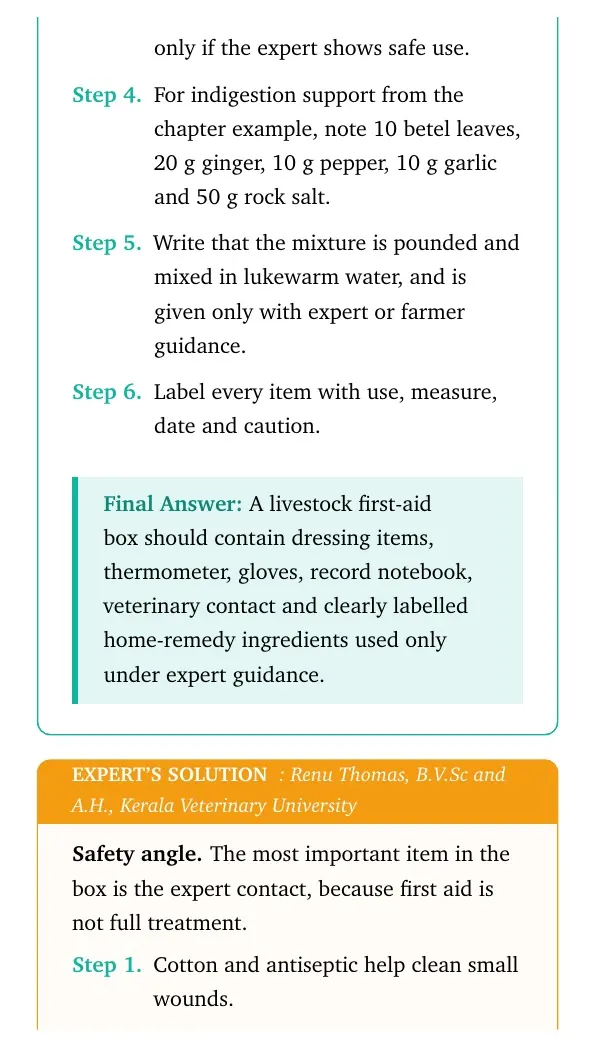
Add tick-removal comb or tweezers only if the expert shows safe use.
For indigestion support from the chapter example, note 10 betel leaves, 20 g ginger, 10 g pepper, 10 g garlic and 50 g rock salt.
Write that the mixture is pounded and mixed in lukewarm water, and is given only with expert or farmer guidance.
Label every item with use, measure, date and caution.
A livestock first-aid box should contain dressing items, thermometer, gloves, record notebook, veterinary contact and clearly labelled home-remedy ingredients used only under expert guidance.
RT
Renu Thomas
B.V.Sc and A.H., Kerala Veterinary University
Verified Expert
Safety angle. The most important item in the box is the expert contact, because first aid is not full treatment.
Cotton and antiseptic help clean small wounds.
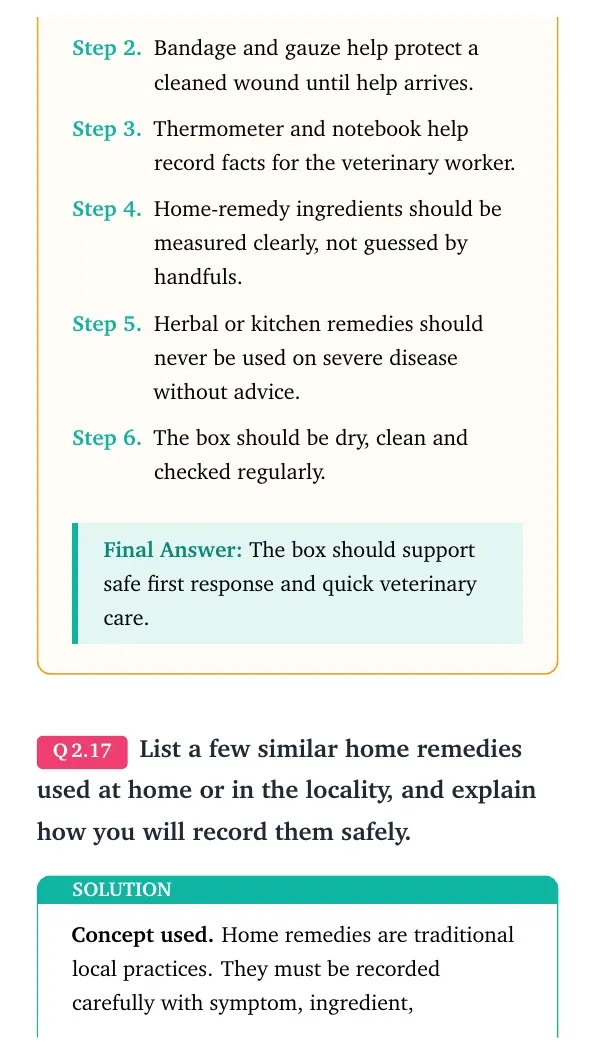
Bandage and gauze help protect a cleaned wound until help arrives.
Thermometer and notebook help record facts for the veterinary worker.
Home-remedy ingredients should be measured clearly, not guessed by handfuls.
Herbal or kitchen remedies should never be used on severe disease without advice.
The box should be dry, clean and checked regularly.
The box should support safe first response and quick veterinary care.
Q 2.17
List a few similar home remedies used at home or in the locality, and explain how you will record them safely.
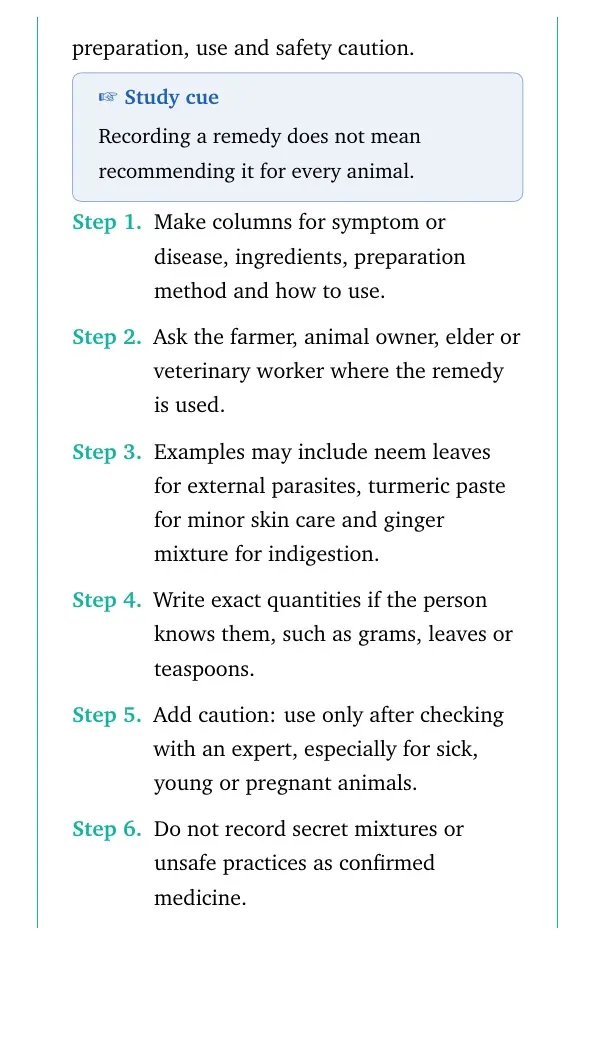
Concept used. Home remedies are traditional local practices. They must be recorded carefully with symptom, ingredient, preparation, use and safety caution.
Study cue
Recording a remedy does not mean recommending it for every animal.
Make columns for symptom or disease, ingredients, preparation method and how to use.
Ask the farmer, animal owner, elder or veterinary worker where the remedy is used.
Examples may include neem leaves for external parasites, turmeric paste for minor skin care and ginger mixture for indigestion.
Write exact quantities if the person knows them, such as grams, leaves or teaspoons.
Add caution: use only after checking with an expert, especially for sick, young or pregnant animals.
Do not record secret mixtures or unsafe practices as confirmed medicine.
Home remedies should be recorded with symptom, ingredients, method, use and caution. They should be treated as local knowledge, not a substitute for veterinary care.
MS
Mehul Shah
M.Pharm Pharmacognosy, MSU Baroda
Verified Expert
Documentation angle. Traditional knowledge becomes safer when it is written with measures and limits.
The same plant can be helpful in one use and harmful in another.
Quantity matters because animals differ in body weight.
Preparation matters because paste, wash and oral mixture are not the same.
Safety matters because ticks, fever or poisoning may need real treatment.
Therefore, every remedy entry should include who suggested it and when it was used.
This helps the teacher and veterinary worker check it later.
Safe recording needs exact details, source of information and expert caution.
Q 2.18
What did you learn from farmers, animal owners, friends and experts while doing the project? Name any three skills you learnt.
Concept used. Project learning includes knowledge, skill and attitude. In this chapter, students learn animal care by observing real people and doing activities.
Study cue
Write "I learnt" statements. They make reflection answers direct.
From farmers, you may learn daily feeding, cleaning, shelter care and animal handling.
From animal owners, you may learn names, habits and behaviour of individual animals.
From veterinary experts, you may learn vaccination, health signs and safe measurement.
From friends, you may learn teamwork, sharing tools and recording observations.
Three skills may be measuring body girth, preparing a feeding chart and making silage or treated fodder.
Other skills may include interviewing, table-making, safe observation and first-aid box planning.
The project teaches livestock care, safe observation, teamwork, record keeping, weight estimation, feeding-chart preparation, fodder treatment and respect for animals.
PS
Priyanka Sen
M.Ed Work Education, Azim Premji University
Verified Expert
Learning angle. This project is not only about animals. It also teaches how to learn from the community.
Farmers show practices that textbooks cannot fully show.
Veterinary experts connect those practices with science and safety.
Friends help divide tasks and compare observations.
The student learns to ask better questions and record answers clearly.
Skills become stronger when students repeat the activity with care.
Respect for animals is the attitude part of the learning.
The project builds practical skills, community learning and kindness towards livestock.
Q 2.19
Calculate the approximate number of periods spent on each activity and explain why time planning matters in this project.
Concept used. Time planning helps students understand effort, sequence and preparation. Each project activity needs a different amount of time.
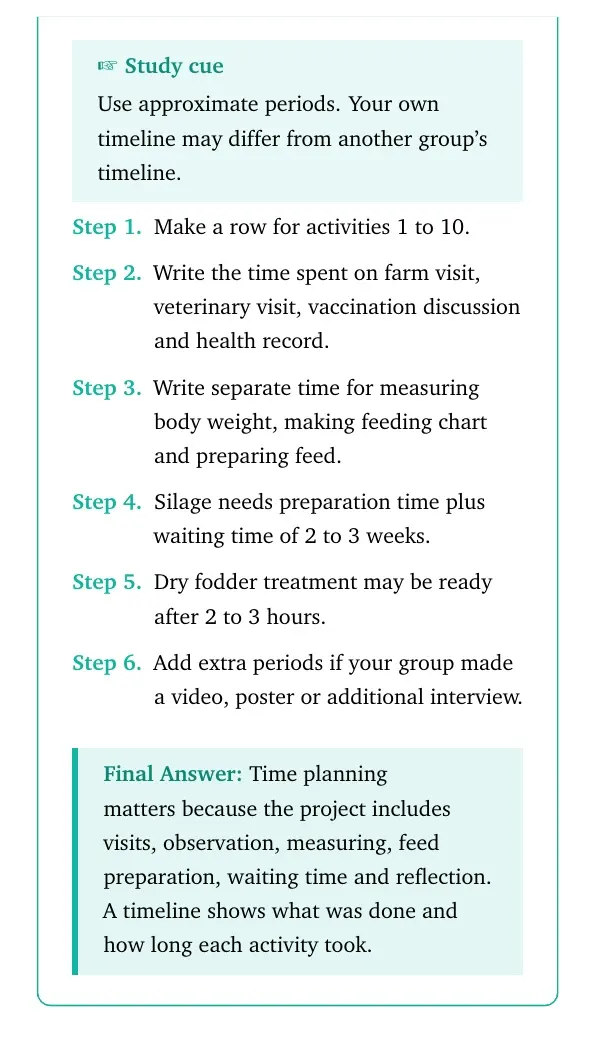
Study cue
Use approximate periods. Your own timeline may differ from another group's timeline.
Make a row for activities 1 to 10.
Write the time spent on farm visit, veterinary visit, vaccination discussion and health record.
Write separate time for measuring body weight, making feeding chart and preparing feed.
Silage needs preparation time plus waiting time of 2 to 3 weeks.
Dry fodder treatment may be ready after 2 to 3 hours.
Add extra periods if your group made a video, poster or additional interview.
Time planning matters because the project includes visits, observation, measuring, feed preparation, waiting time and reflection. A timeline shows what was done and how long each activity took.
AG
Aman Gill
M.A Education Planning, NUEPA Delhi
Verified Expert
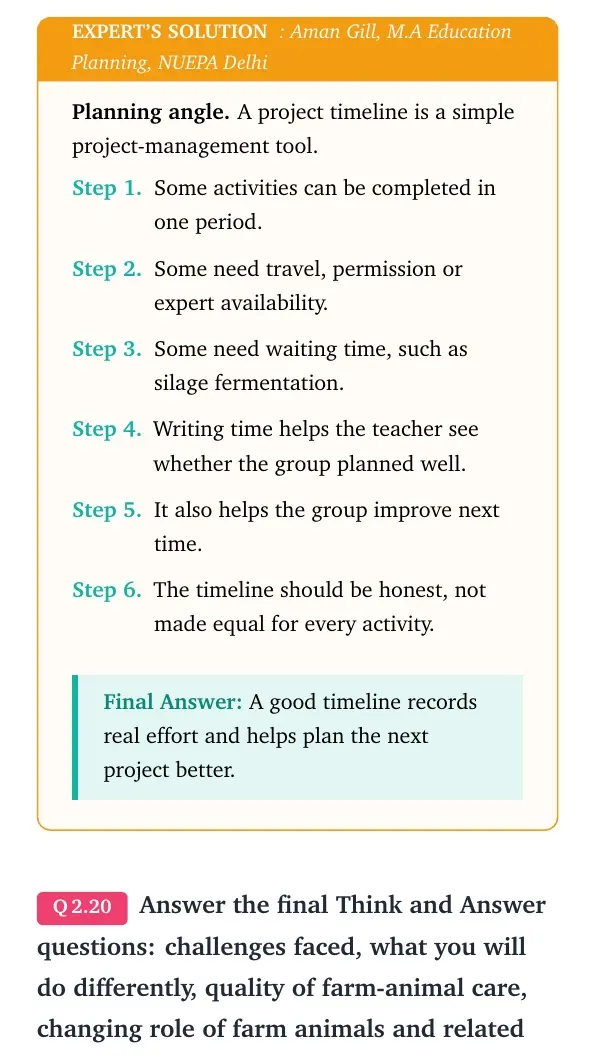
Planning angle. A project timeline is a simple project-management tool.
Some activities can be completed in one period.
Some need travel, permission or expert availability.
Some need waiting time, such as silage fermentation.
Writing time helps the teacher see whether the group planned well.
It also helps the group improve next time.
The timeline should be honest, not made equal for every activity.
A good timeline records real effort and helps plan the next project better.
Q 2.20
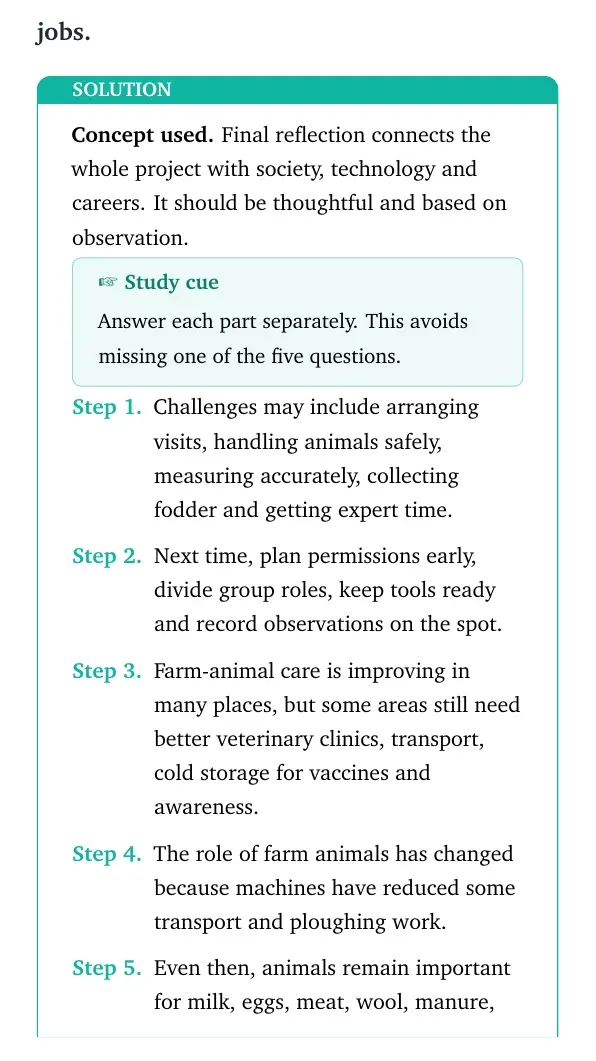
Answer the final Think and Answer questions: challenges faced, what you will do differently, quality of farm-animal care, changing role of farm animals and related jobs.
Concept used. Final reflection connects the whole project with society, technology and careers. It should be thoughtful and based on observation.
Study cue
Answer each part separately. This avoids missing one of the five questions.
Challenges may include arranging visits, handling animals safely, measuring accurately, collecting fodder and getting expert time.
Next time, plan permissions early, divide group roles, keep tools ready and record observations on the spot.
Farm-animal care is improving in many places, but some areas still need better veterinary clinics, transport, cold storage for vaccines and awareness.
The role of farm animals has changed because machines have reduced some transport and ploughing work.
Even then, animals remain important for milk, eggs, meat, wool, manure, income and companionship.
Related jobs include veterinarian, animal health worker, dairy farmer, herder, feed scientist, livestock scientist, poultry worker and fodder entrepreneur.
The project shows that animal care needs planning, safety, science, empathy and trained people. Farm animals still support food, income, manure and livelihoods, even as machinery changes their role.
SM
Sonal Mehra
Ph.D Rural Livelihoods, IRMA Anand
Verified Expert
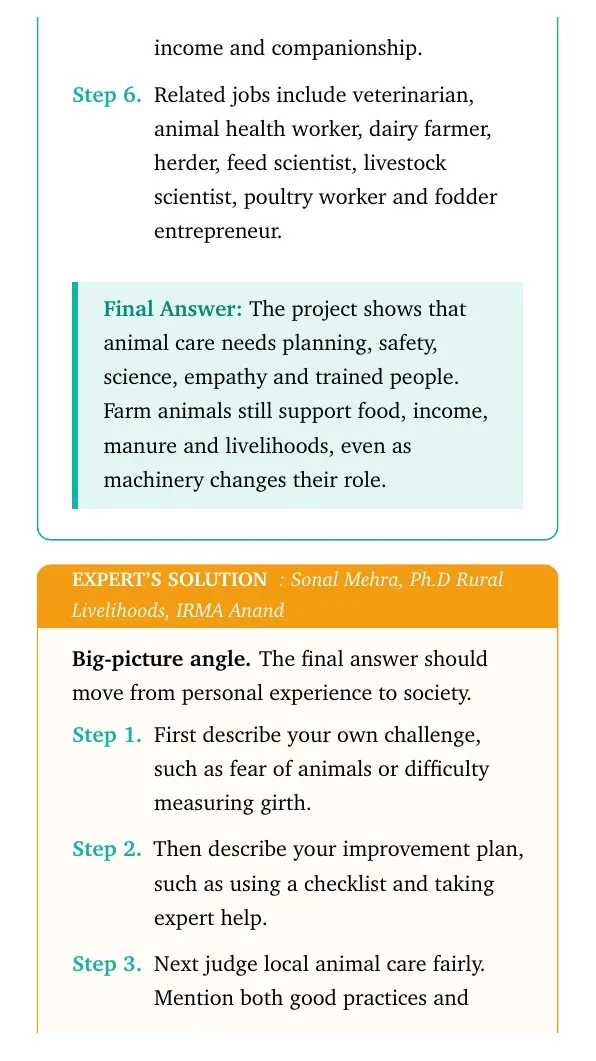
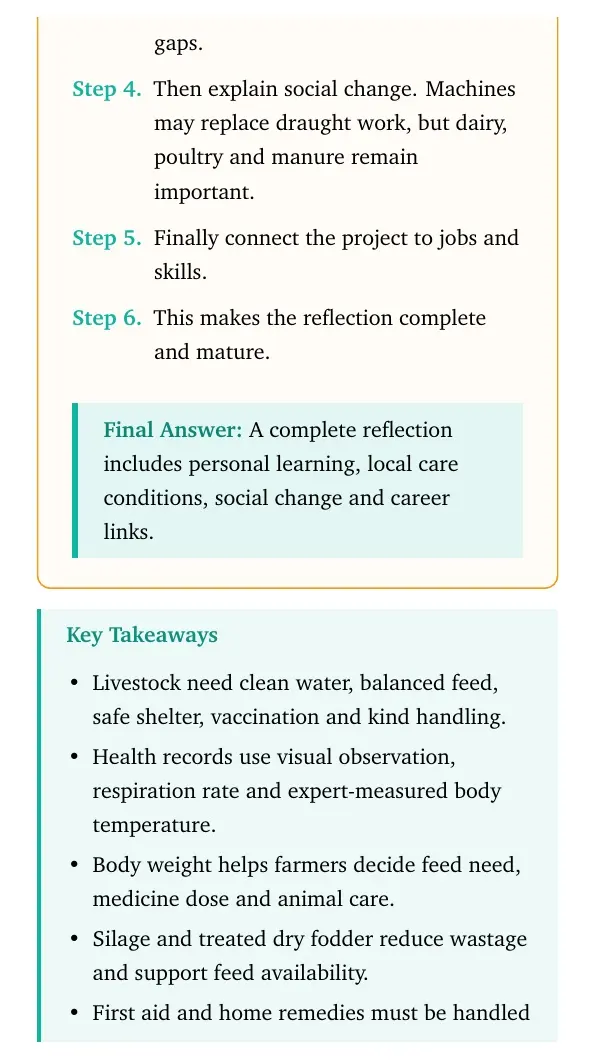
Big-picture angle. The final answer should move from personal experience to society.
First describe your own challenge, such as fear of animals or difficulty measuring girth.
Then describe your improvement plan, such as using a checklist and taking expert help.
Next judge local animal care fairly. Mention both good practices and gaps.
Then explain social change. Machines may replace draught work, but dairy, poultry and manure remain important.
Finally connect the project to jobs and skills.
This makes the reflection complete and mature.
A complete reflection includes personal learning, local care conditions, social change and career links.
Feeding and Caring for Farm Animals NCERT Solutions FAQs
Ques. What is covered in Class 8 Vocational Education Chapter 2?
Ans. The chapter covers livestock identification, farm visits, vaccination, health records, weight estimation, feeding charts, silage, dry fodder and first-aid planning.
Ques. How should students use these NCERT Solutions?
Ans. Students should use the model answers as a format guide, then add local observations from their farm visit, animal owner interview or veterinary discussion.
Ques. Why is animal weight estimation important?
Ans. Weight estimation helps farmers decide feed requirement, medicine dose, health monitoring and selling price when a weighing scale is not available.
Ques. What are the signs of good silage?
Ans. Good silage has no mould, golden brown colour, pleasant fruity smell, free-flowing texture and mildly acidic pH around 4.0 to 4.5.





Chapter2FeedingandCaringforFarmAnimalsSolutions.pdf?page=1&dpi=150)
Chapter2FeedingandCaringforFarmAnimalsSolutions.pdf?page=2&dpi=150)
Chapter2FeedingandCaringforFarmAnimalsSolutions.pdf?page=3&dpi=150)
Chapter2FeedingandCaringforFarmAnimalsSolutions.pdf?page=4&dpi=150)
Chapter2FeedingandCaringforFarmAnimalsSolutions.pdf?page=5&dpi=150)
Chapter2FeedingandCaringforFarmAnimalsSolutions.pdf?page=6&dpi=150)
Chapter2FeedingandCaringforFarmAnimalsSolutions.pdf?page=7&dpi=150)
Chapter2FeedingandCaringforFarmAnimalsSolutions.pdf?page=8&dpi=150)
Chapter2FeedingandCaringforFarmAnimalsSolutions.pdf?page=9&dpi=150)
Chapter2FeedingandCaringforFarmAnimalsSolutions.pdf?page=10&dpi=150)
Chapter2FeedingandCaringforFarmAnimalsSolutions.pdf?page=11&dpi=150)
Chapter2FeedingandCaringforFarmAnimalsSolutions.pdf?page=12&dpi=150)
Chapter2FeedingandCaringforFarmAnimalsSolutions.pdf?page=13&dpi=150)
Chapter2FeedingandCaringforFarmAnimalsSolutions.pdf?page=14&dpi=150)
Chapter2FeedingandCaringforFarmAnimalsSolutions.pdf?page=15&dpi=150)
Chapter2FeedingandCaringforFarmAnimalsSolutions.pdf?page=16&dpi=150)
Chapter2FeedingandCaringforFarmAnimalsSolutions.pdf?page=17&dpi=150)
Chapter2FeedingandCaringforFarmAnimalsSolutions.pdf?page=18&dpi=150)
Chapter2FeedingandCaringforFarmAnimalsSolutions.pdf?page=19&dpi=150)
Chapter2FeedingandCaringforFarmAnimalsSolutions.pdf?page=20&dpi=150)
Chapter2FeedingandCaringforFarmAnimalsSolutions.pdf?page=21&dpi=150)
Chapter2FeedingandCaringforFarmAnimalsSolutions.pdf?page=22&dpi=150)
Chapter2FeedingandCaringforFarmAnimalsSolutions.pdf?page=23&dpi=150)
Chapter2FeedingandCaringforFarmAnimalsSolutions.pdf?page=24&dpi=150)
Chapter2FeedingandCaringforFarmAnimalsSolutions.pdf?page=25&dpi=150)
Chapter2FeedingandCaringforFarmAnimalsSolutions.pdf?page=26&dpi=150)
Chapter2FeedingandCaringforFarmAnimalsSolutions.pdf?page=27&dpi=150)
Chapter2FeedingandCaringforFarmAnimalsSolutions.pdf?page=28&dpi=150)




Comments