




IISER Aptitude Test 2026 Question Paper is available for download. IISER conducted Aptitude Test 2026 on June 7 in single shift from 9 AM to 12 PM.
- IISER 2026 Question Paper consists of total 60 questions divided into 4 sections –Physics, Chemistry, Mathematics and Biology (15 questions each).
- As per the IISER 2026 exam pattern 4 marks are awarded for every correct answer and 1 mark is deducted for every wrong answer.
- The total duration of the exam is 3 hours.
Also Check: IISER Aptitude Test 2026 Answer Key
IISER Aptitude Test 2026 Question Paper with Solutions
| IISER Aptitude Test 2026 Question Paper | Download PDF | Check Solutions |
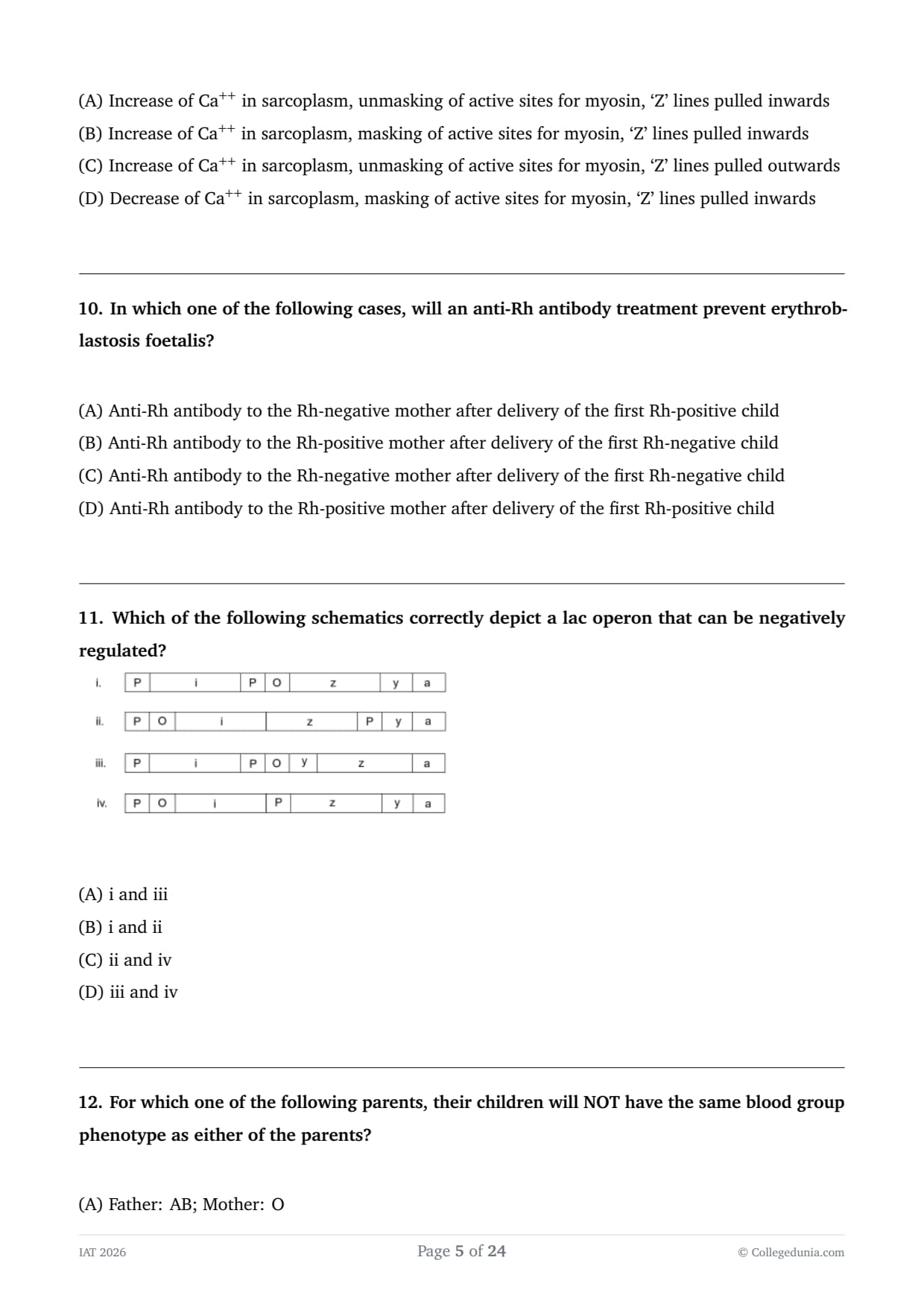
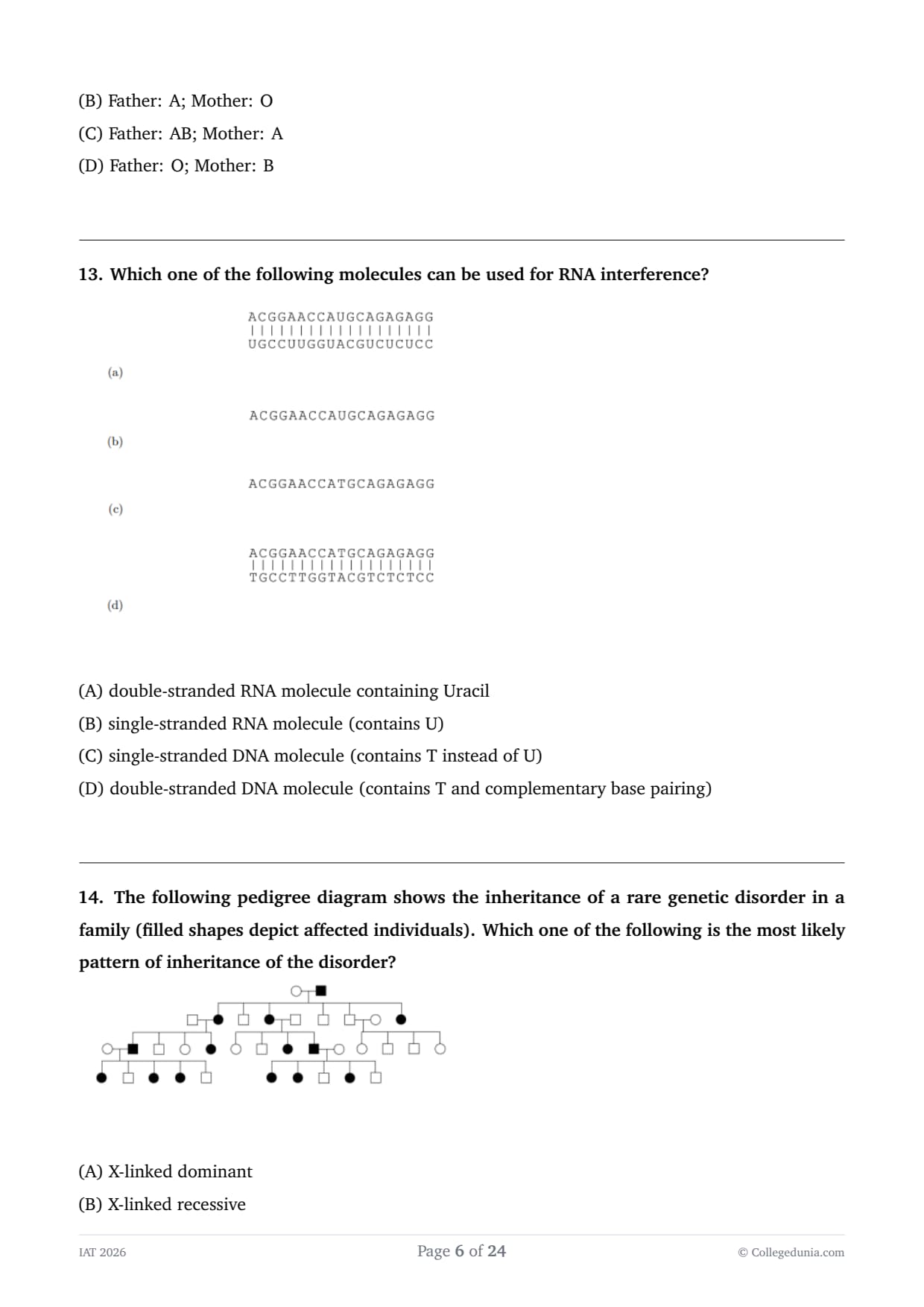
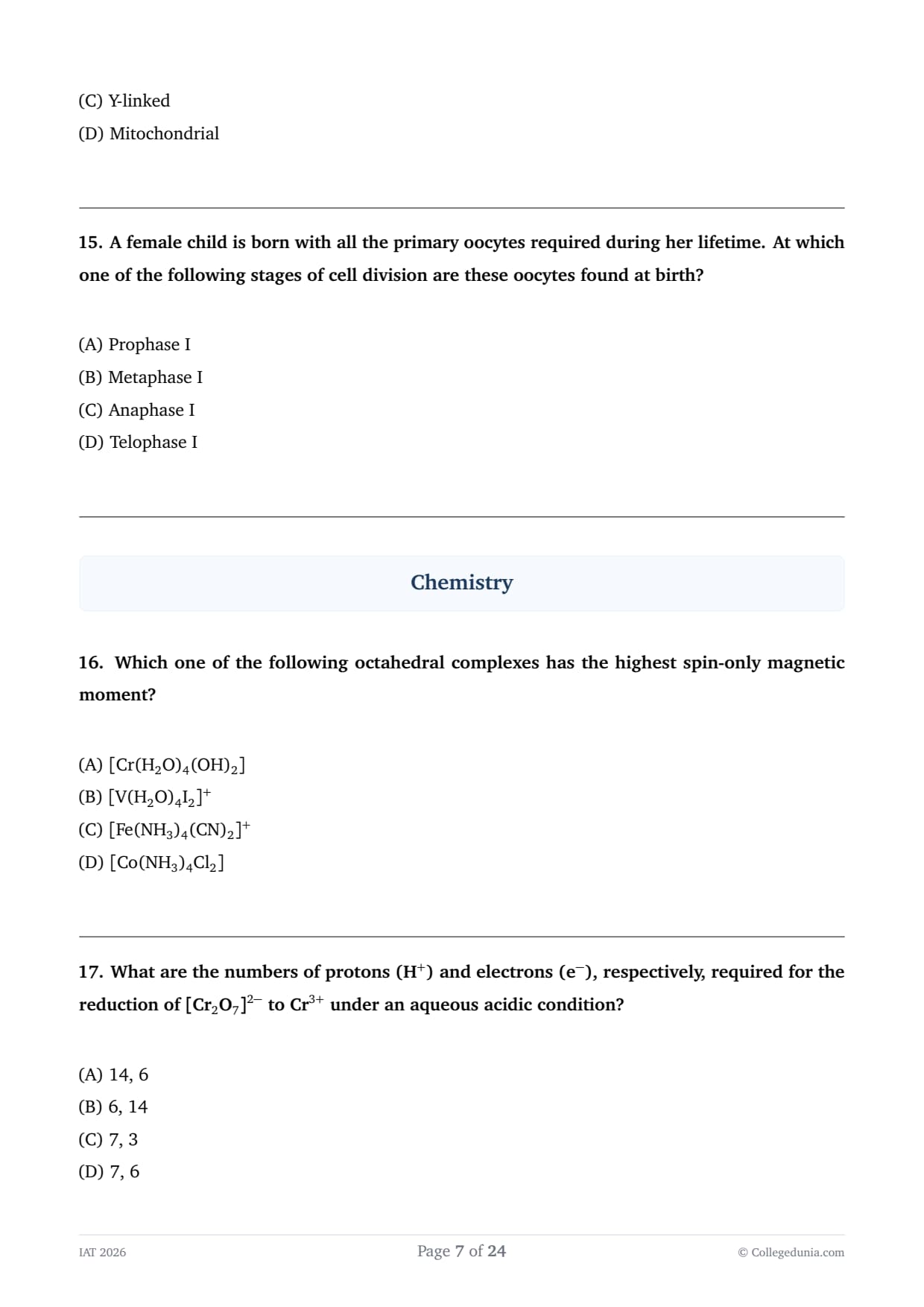
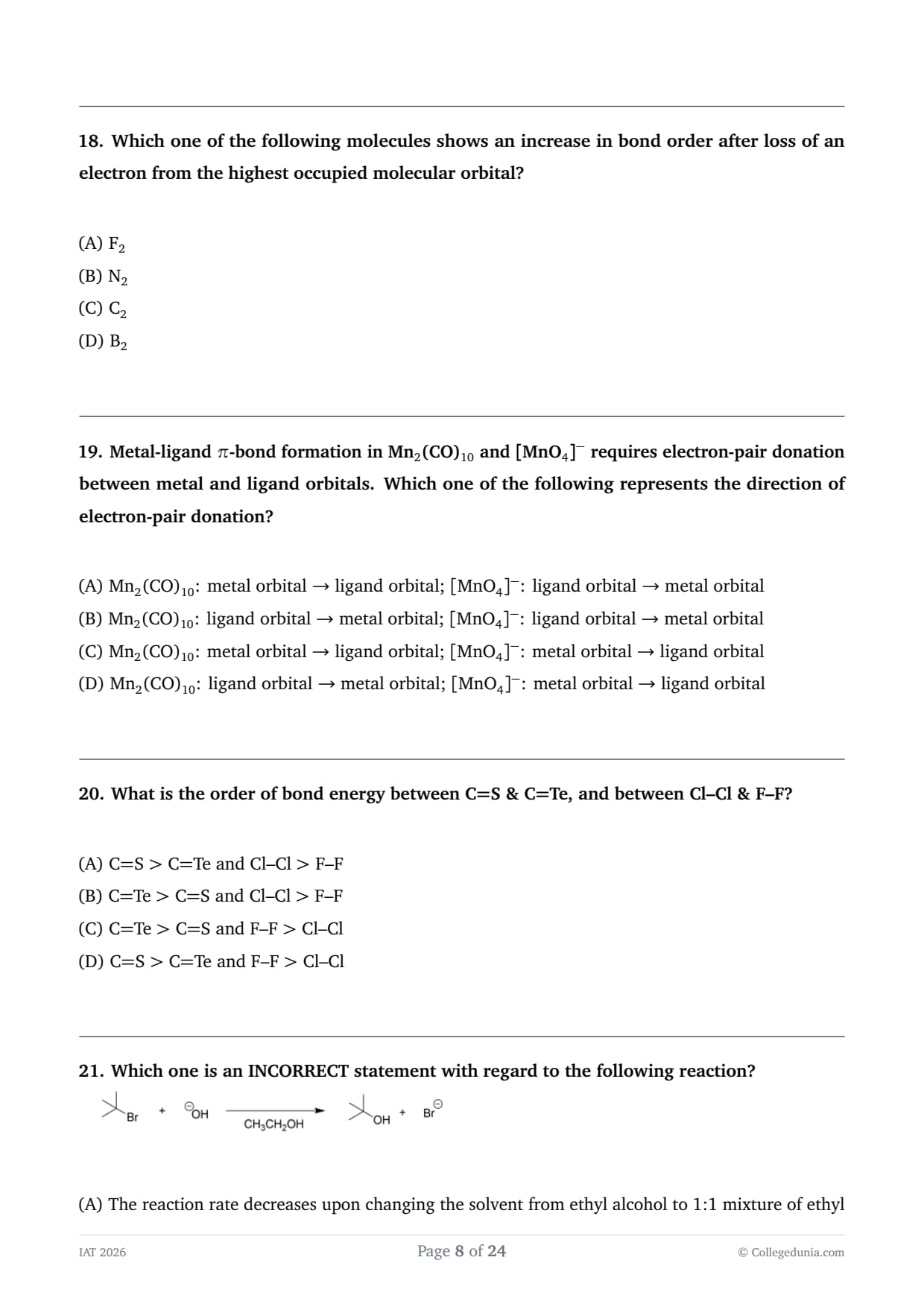
Which of the following processes result in development of a proton gradient across the thylakoid membrane during photosynthesis?
i. Release of protons into the lumen of the thylakoid by plastoquinone
ii. Consumption of protons in the stroma during the reduction of NADP\(^+\)
iii. Release of protons into the lumen of the thylakoid by ATP synthase
iv. Release of protons into the lumen of the thylakoid by water splitting reaction
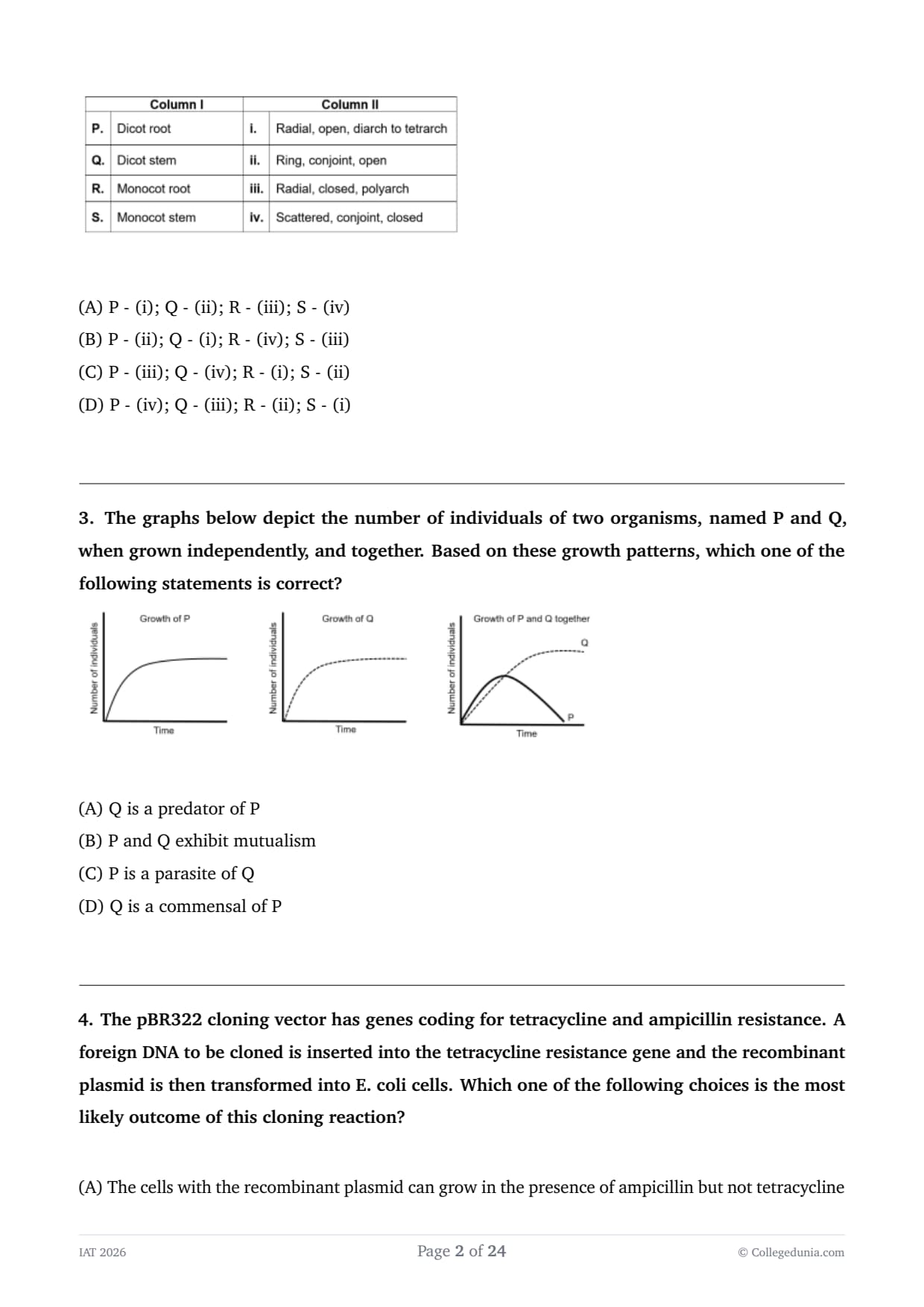
Which one of the following choices matches the organs in column I with their vascular system arrangement described in column II?

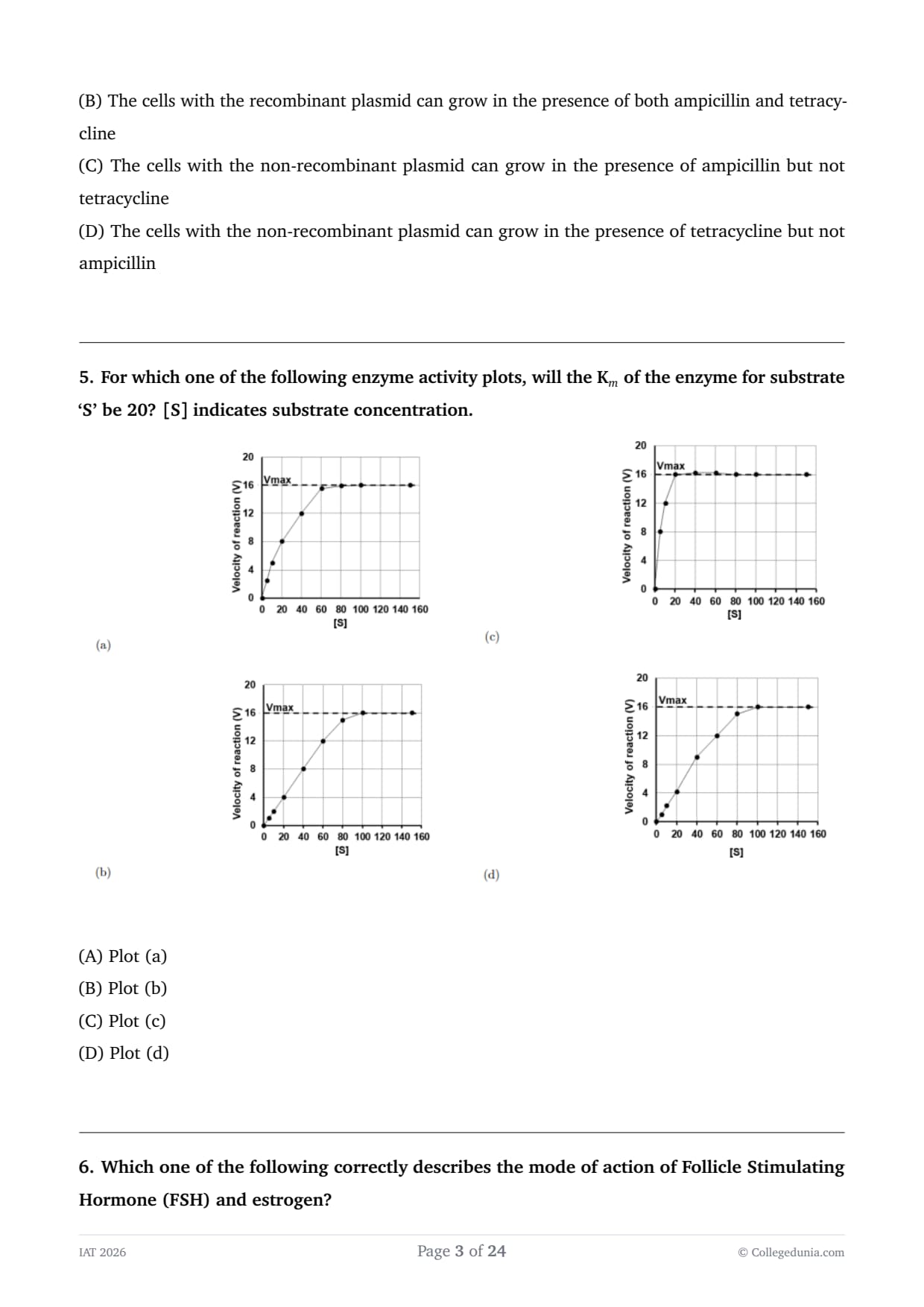
The graphs below depict the number of individuals of two organisms, named P and Q, when grown independently, and together. Based on these growth patterns, which one of the following statements is correct?

The pBR322 cloning vector has genes coding for tetracycline and ampicillin resistance. A foreign DNA to be cloned is inserted into the tetracycline resistance gene and the recombinant plasmid is then transformed into E. coli cells. Which one of the following choices is the most likely outcome of this cloning reaction?
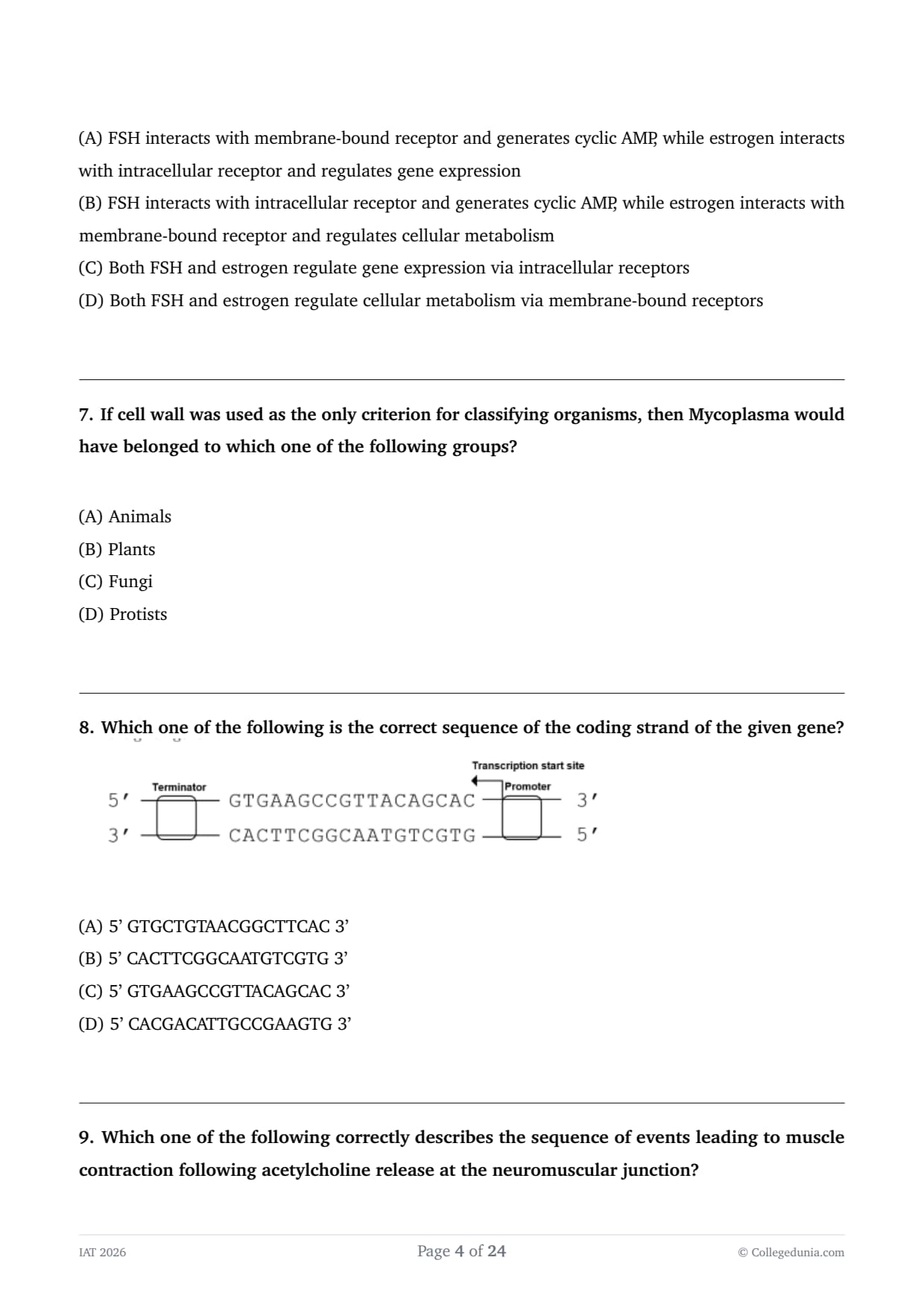
For which one of the following enzyme activity plots, will the K\(_m\) of the enzyme for substrate `S' be 20? [S] indicates substrate concentration.


Which one of the following correctly describes the mode of action of Follicle Stimulating Hormone (FSH) and estrogen?
If cell wall was used as the only criterion for classifying organisms, then Mycoplasma would have belonged to which one of the following groups?
Which one of the following is the correct sequence of the coding strand of the given gene?

Which one of the following correctly describes the sequence of events leading to muscle contraction following acetylcholine release at the neuromuscular junction?
In which one of the following cases, will an anti-Rh antibody treatment prevent erythroblastosis foetalis?
Which of the following schematics correctly depict a lac operon that can be negatively regulated?

For which one of the following parents, their children will NOT have the same blood group phenotype as either of the parents?
Which one of the following molecules can be used for RNA interference?

The following pedigree diagram shows the inheritance of a rare genetic disorder in a family (filled shapes depict affected individuals). Which one of the following is the most likely pattern of inheritance of the disorder?

A female child is born with all the primary oocytes required during her lifetime. At which one of the following stages of cell division are these oocytes found at birth?
Which one of the following octahedral complexes has the highest spin-only magnetic moment?
What are the numbers of protons (H\(^+\)) and electrons (e\(^-\)), respectively, required for the reduction of [Cr\(_2\)O\(_7\)]\(^{2-}\) to Cr\(^{3+}\) under an aqueous acidic condition?
Which one of the following molecules shows an increase in bond order after loss of an electron from the highest occupied molecular orbital?
Metal-ligand \(\pi\)-bond formation in Mn\(_2\)(CO)\(_{10}\) and [MnO\(_4\)]\(^-\) requires electron-pair donation between metal and ligand orbitals. Which one of the following represents the direction of electron-pair donation?
What is the order of bond energy between C=S \& C=Te, and between Cl–Cl \& F–F?
Which one is an INCORRECT statement with regard to the following reaction?

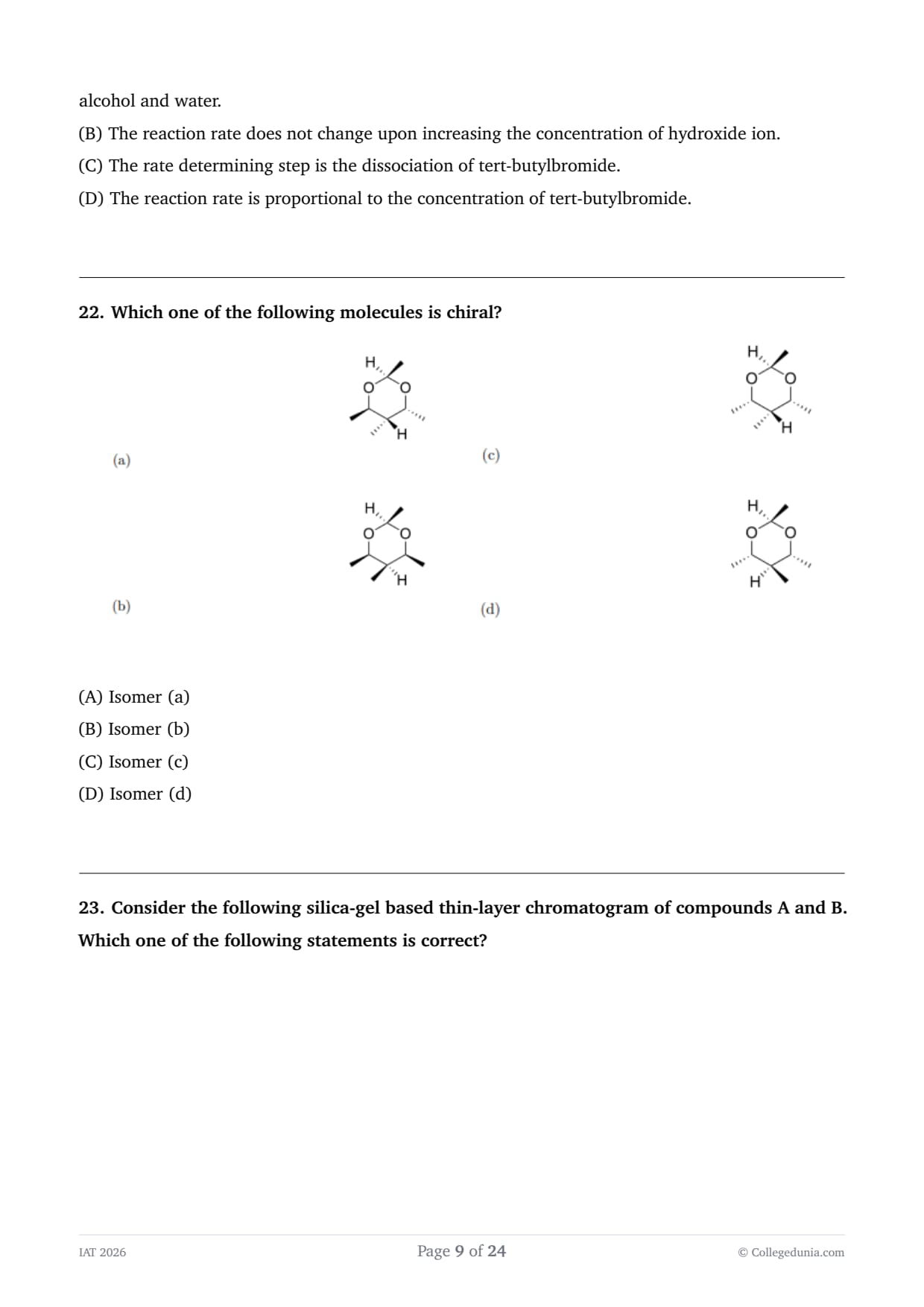
Which one of the following molecules is chiral?


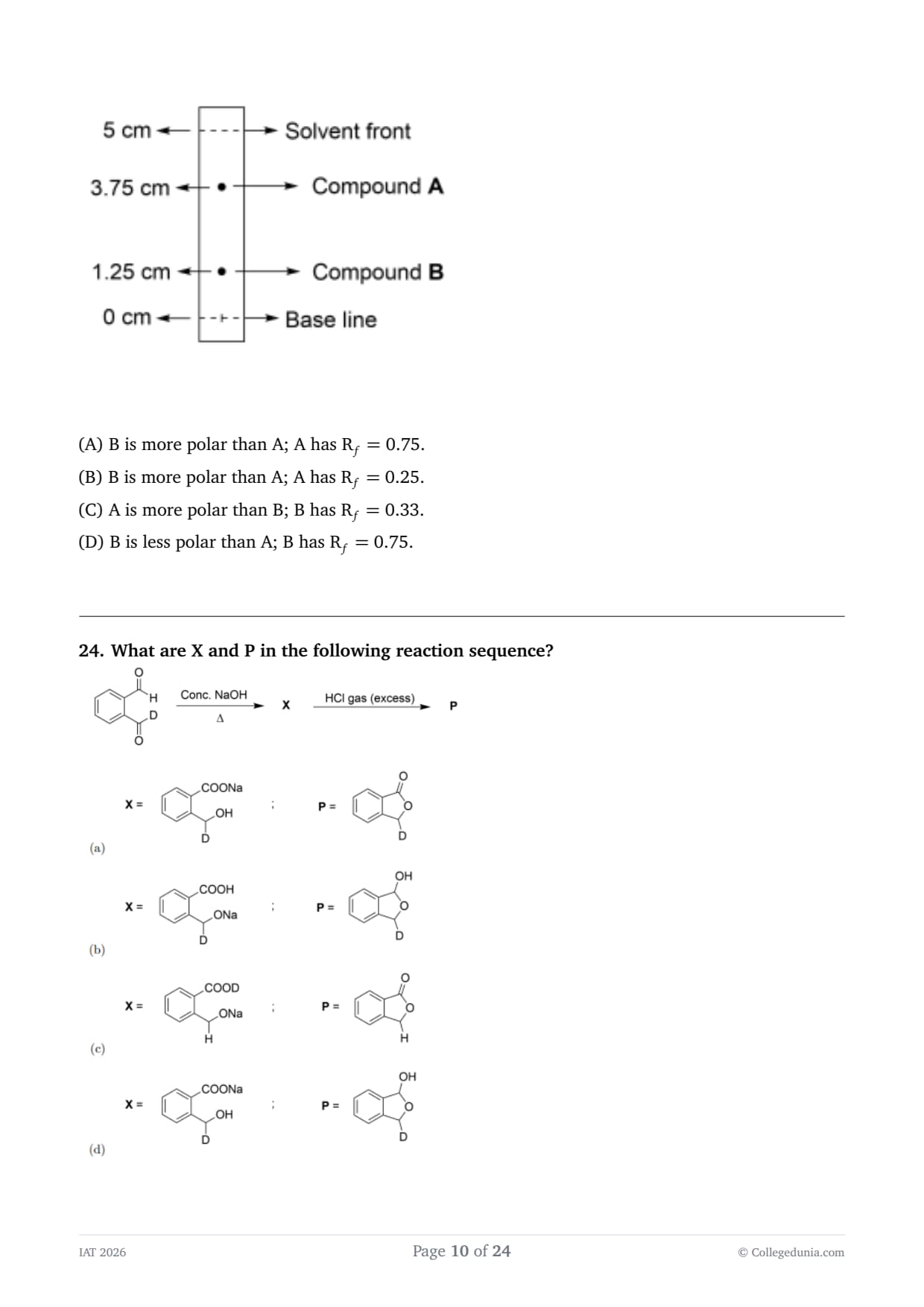
Consider the following silica-gel based thin-layer chromatogram of compounds A and B. Which one of the following statements is correct?

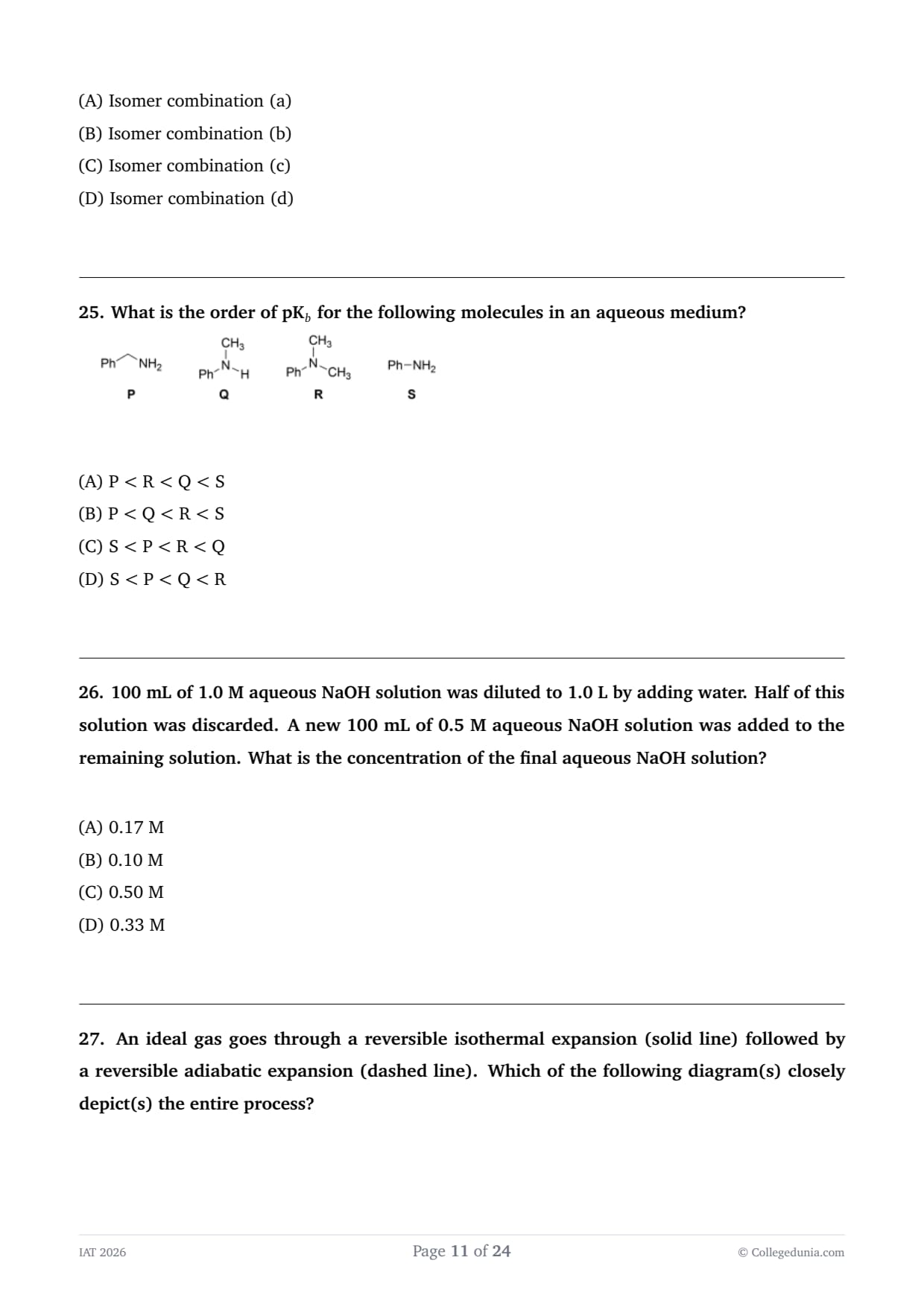
What are X and P in the following reaction sequence?


What is the order of pK\(_b\) for the following molecules in an aqueous medium?

100 mL of 1.0 M aqueous NaOH solution was diluted to 1.0 L by adding water. Half of this solution was discarded. A new 100 mL of 0.5 M aqueous NaOH solution was added to the remaining solution. What is the concentration of the final aqueous NaOH solution?
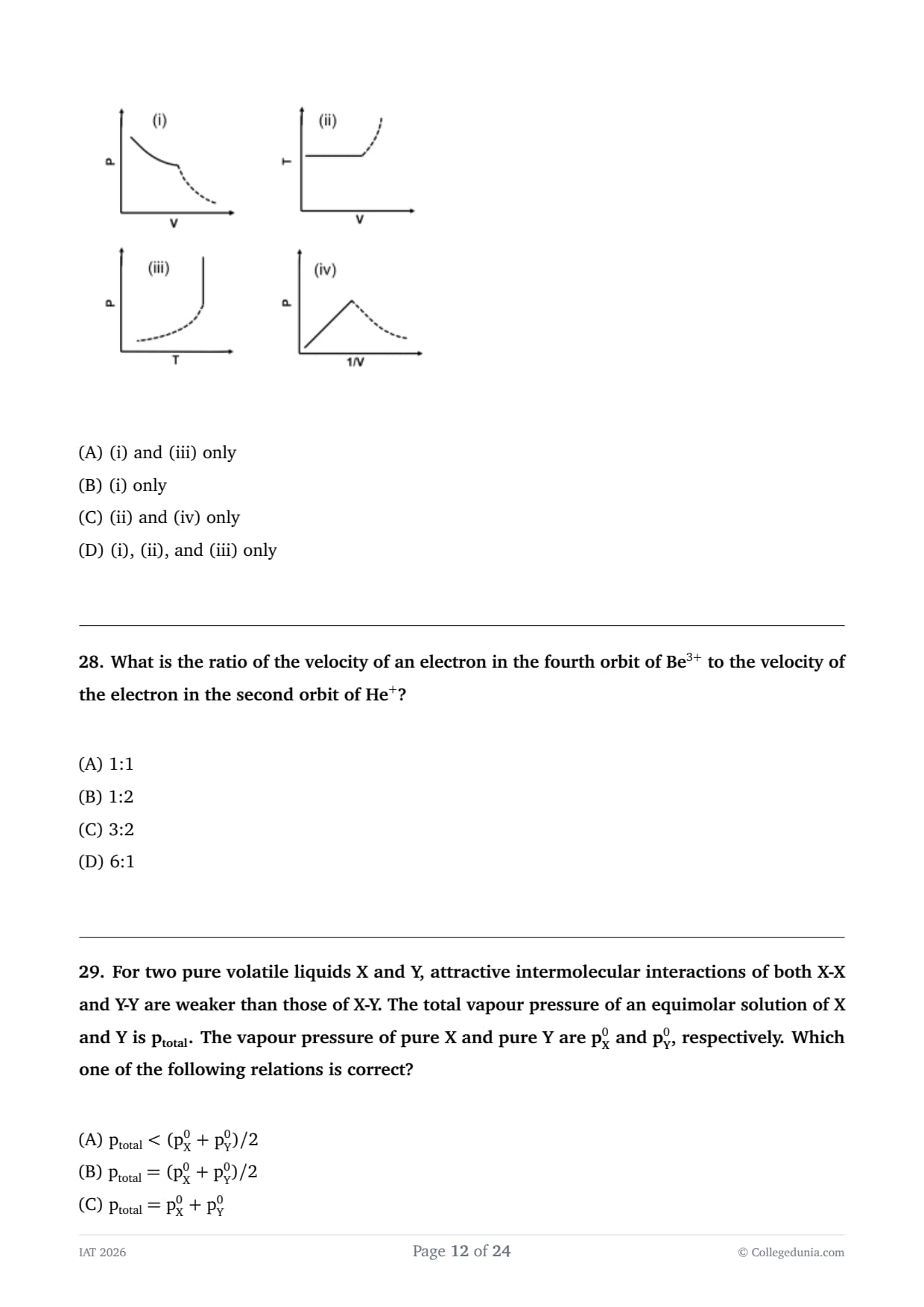
An ideal gas goes through a reversible isothermal expansion (solid line) followed by a reversible adiabatic expansion (dashed line). Which of the following diagram(s) closely depict(s) the entire process?

What is the ratio of the velocity of an electron in the fourth orbit of Be\(^{3+}\) to the velocity of the electron in the second orbit of He\(^{+}\)?
For two pure volatile liquids X and Y, attractive intermolecular interactions of both X-X and Y-Y are weaker than those of X-Y. The total vapour pressure of an equimolar solution of X and Y is p\(_{total}\). The vapour pressure of pure X and pure Y are p\(^0_{X}\) and p\(^0_{Y}\), respectively. Which one of the following relations is correct?
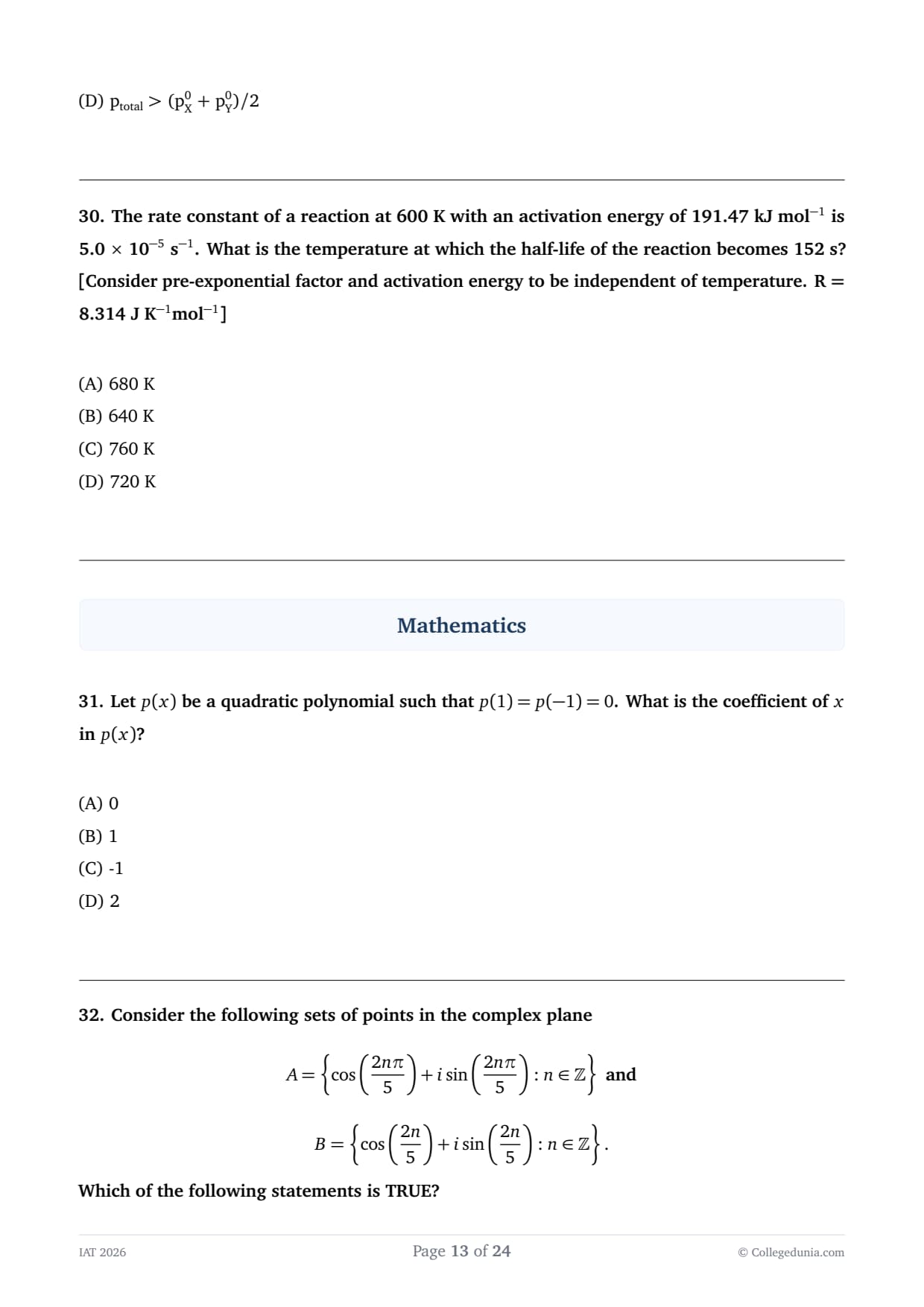
The rate constant of a reaction at 600 K with an activation energy of 191.47 kJ mol\(^{-1}\) is 5.0 \(\times\) 10\(^{-5}\) s\(^{-1}\). What is the temperature at which the half-life of the reaction becomes 152 s? [Consider pre-exponential factor and activation energy to be independent of temperature. R = 8.314 J K\(^{-1}\)mol\(^{-1}\)]
Let \(p(x)\) be a quadratic polynomial such that \(p(1) = p(-1) = 0\). What is the coefficient of \(x\) in \(p(x)\)?
Consider the following sets of points in the complex plane \[ A = \left\{ \cos \left( \frac{2n\pi}{5} \right) + i \sin \left( \frac{2n\pi}{5} \right) : n \in \mathbb{Z} \right\} and \] \[ B = \left\{ \cos \left( \frac{2n}{5} \right) + i \sin \left( \frac{2n}{5} \right) : n \in \mathbb{Z} \right\} . \]
Which of the following statements is TRUE?
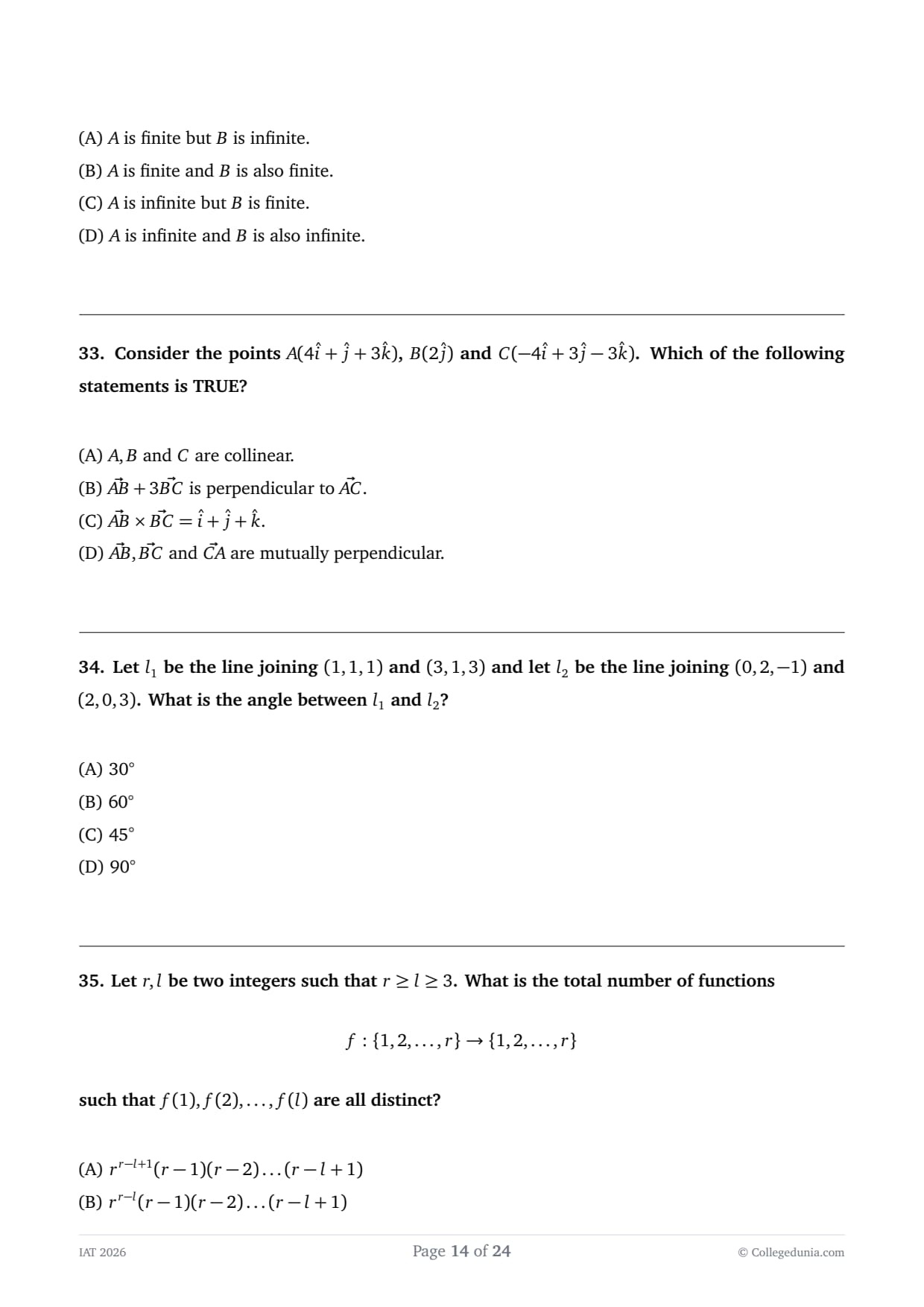
Consider the points \(A(4\hat{i} + \hat{j} + 3\hat{k})\), \(B(2\hat{j})\) and \(C(-4\hat{i} + 3\hat{j} - 3\hat{k})\). Which of the following statements is TRUE?
Let \(l_1\) be the line joining \((1, 1, 1)\) and \((3, 1, 3)\) and let \(l_2\) be the line joining \((0, 2, -1)\) and \((2, 0, 3)\). What is the angle between \(l_1\) and \(l_2\)?
Let \(r, l\) be two integers such that \(r \ge l \ge 3\). What is the total number of functions \[ f : \{1, 2, \dots, r\} \to \{1, 2, \dots, r\} \]
such that \(f(1), f(2), \dots, f(l)\) are all distinct?
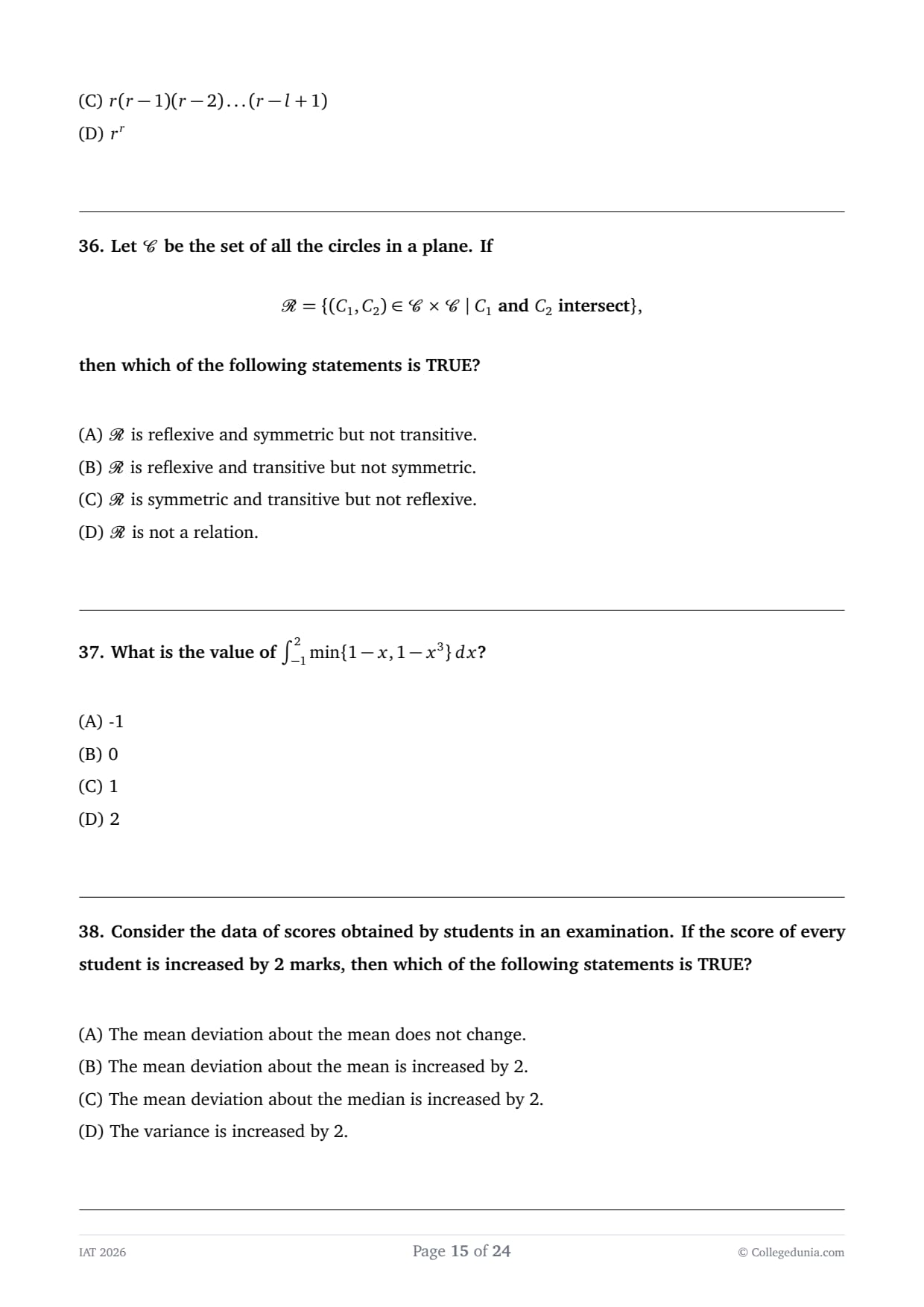
Let \(\mathcal{C}\) be the set of all the circles in a plane. If \[ \mathcal{R} = \{(C_1, C_2) \in \mathcal{C} \times \mathcal{C} \mid C_1 and C_2 intersect\} , \]
then which of the following statements is TRUE?
What is the value of \(\int_{-1}^{2} \min\{1 - x, 1 - x^3\} \, dx\)?
Consider the data of scores obtained by students in an examination. If the score of every student is increased by 2 marks, then which of the following statements is TRUE?
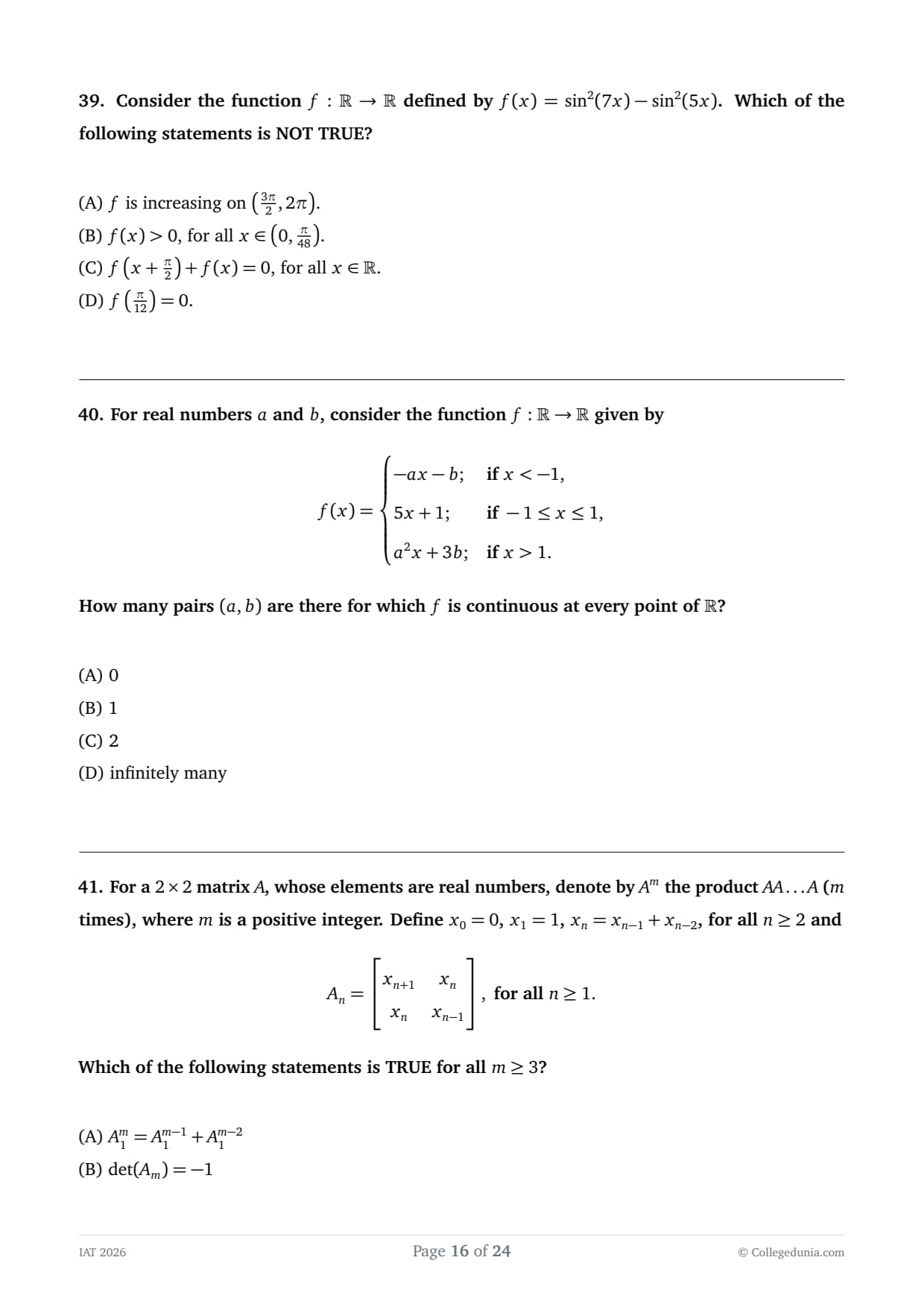
Consider the function \(f : \mathbb{R} \to \mathbb{R}\) defined by \(f(x) = \sin^2(7x) - \sin^2(5x)\). Which of the following statements is NOT TRUE?
For real numbers \(a\) and \(b\), consider the function \(f : \mathbb{R} \to \mathbb{R}\) given by \[ f(x) = \begin{cases} -ax - b ;& if x < -1, \\
5x + 1 ;& if -1 \le x \le 1, \\
a^2x + 3b ;& if x > 1 . \end{cases} \]
How many pairs \((a, b)\) are there for which \(f\) is continuous at every point of \(\mathbb{R}\)?
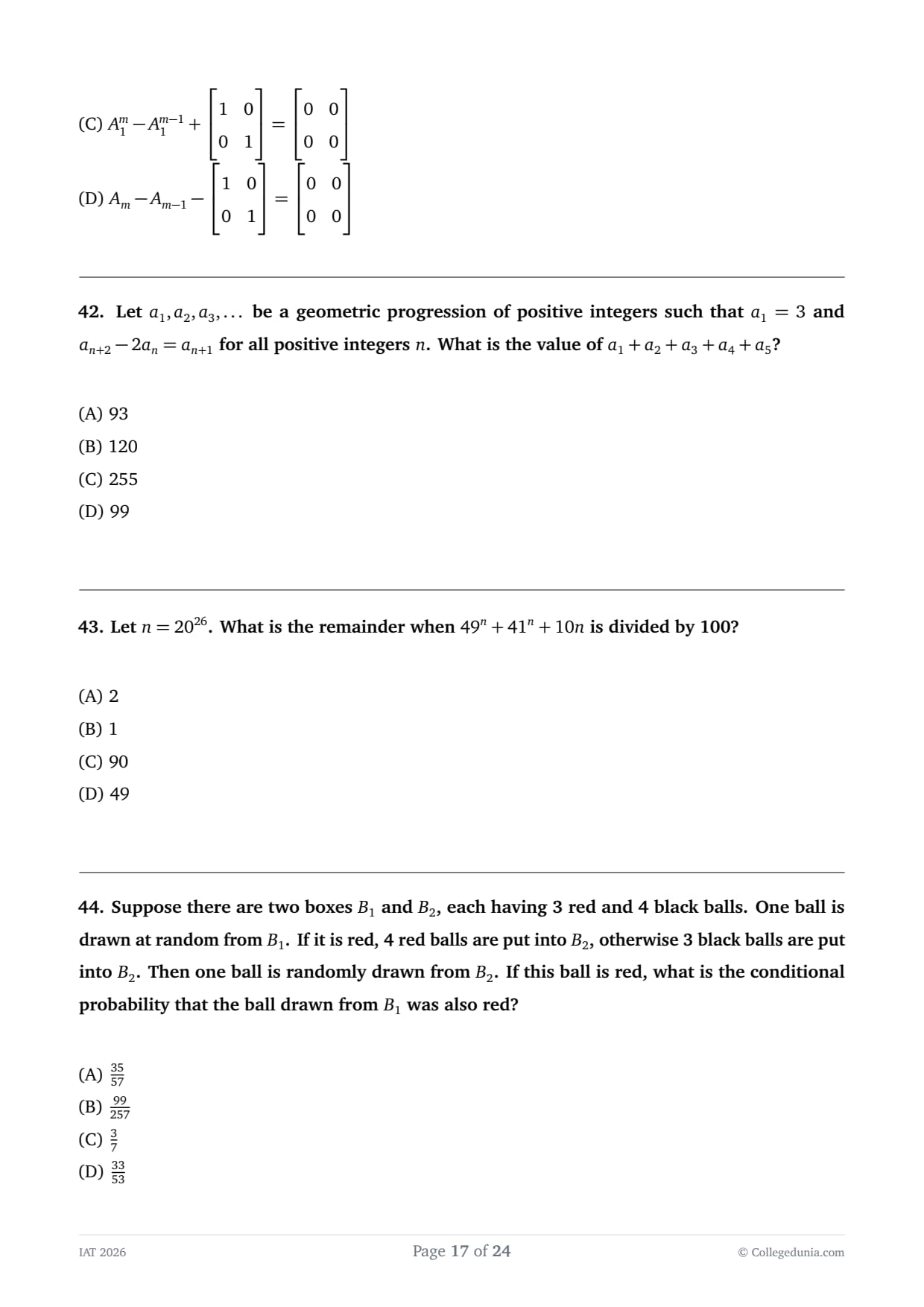
For a \(2 \times 2\) matrix \(A\), whose elements are real numbers, denote by \(A^m\) the product \(AA\dots A\) (\(m\) times), where \(m\) is a positive integer. Define \(x_0 = 0\), \(x_1 = 1\), \(x_n = x_{n-1} + x_{n-2}\), for all \(n \ge 2\) and \[ A_n = \begin{bmatrix} x_{n+1} & x_n
x_n & x_{n-1} \end{bmatrix}, for all n \ge 1. \]
Which of the following statements is TRUE for all \(m \ge 3\)?
Let \(a_1, a_2, a_3, \dots\) be a geometric progression of positive integers such that \(a_1 = 3\) and \(a_{n+2} - 2a_n = a_{n+1}\) for all positive integers \(n\). What is the value of \(a_1 + a_2 + a_3 + a_4 + a_5\)?
Let \(n = 20^{26}\). What is the remainder when \(49^n + 41^n + 10n\) is divided by 100?
Suppose there are two boxes \(B_1\) and \(B_2\), each having 3 red and 4 black balls. One ball is drawn at random from \(B_1\). If it is red, 4 red balls are put into \(B_2\), otherwise 3 black balls are put into \(B_2\). Then one ball is randomly drawn from \(B_2\). If this ball is red, what is the conditional probability that the ball drawn from \(B_1\) was also red?
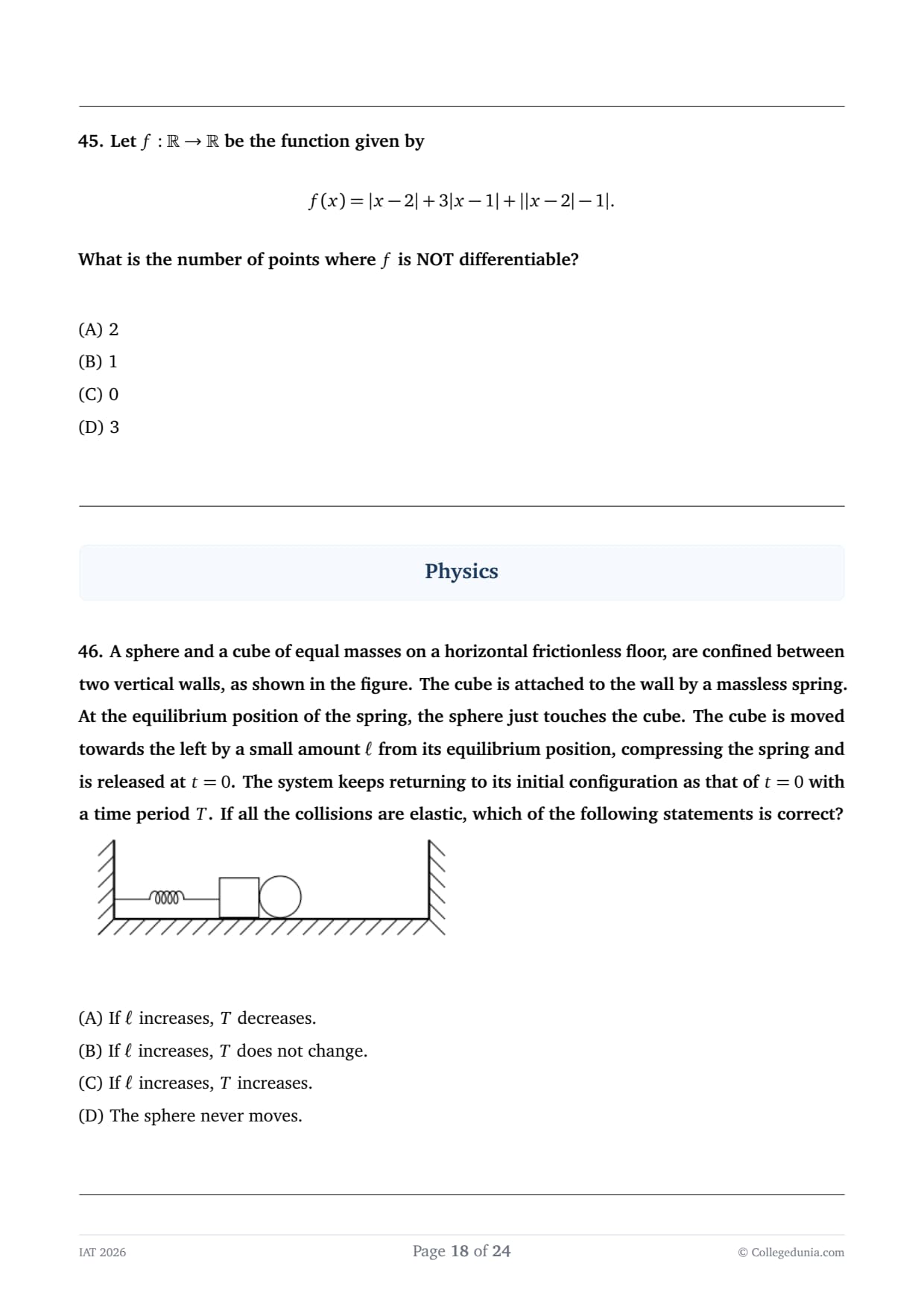
Let \(f : \mathbb{R} \to \mathbb{R}\) be the function given by \[ f(x) = |x - 2| + 3|x - 1| + ||x - 2| - 1| . \]
What is the number of points where \(f\) is NOT differentiable?
A sphere and a cube of equal masses on a horizontal frictionless floor, are confined between two vertical walls, as shown in the figure. The cube is attached to the wall by a massless spring. At the equilibrium position of the spring, the sphere just touches the cube. The cube is moved towards the left by a small amount \(\ell\) from its equilibrium position, compressing the spring and is released at \(t = 0\). The system keeps returning to its initial configuration as that of \(t = 0\) with a time period \(T\). If all the collisions are elastic, which of the following statements is correct?

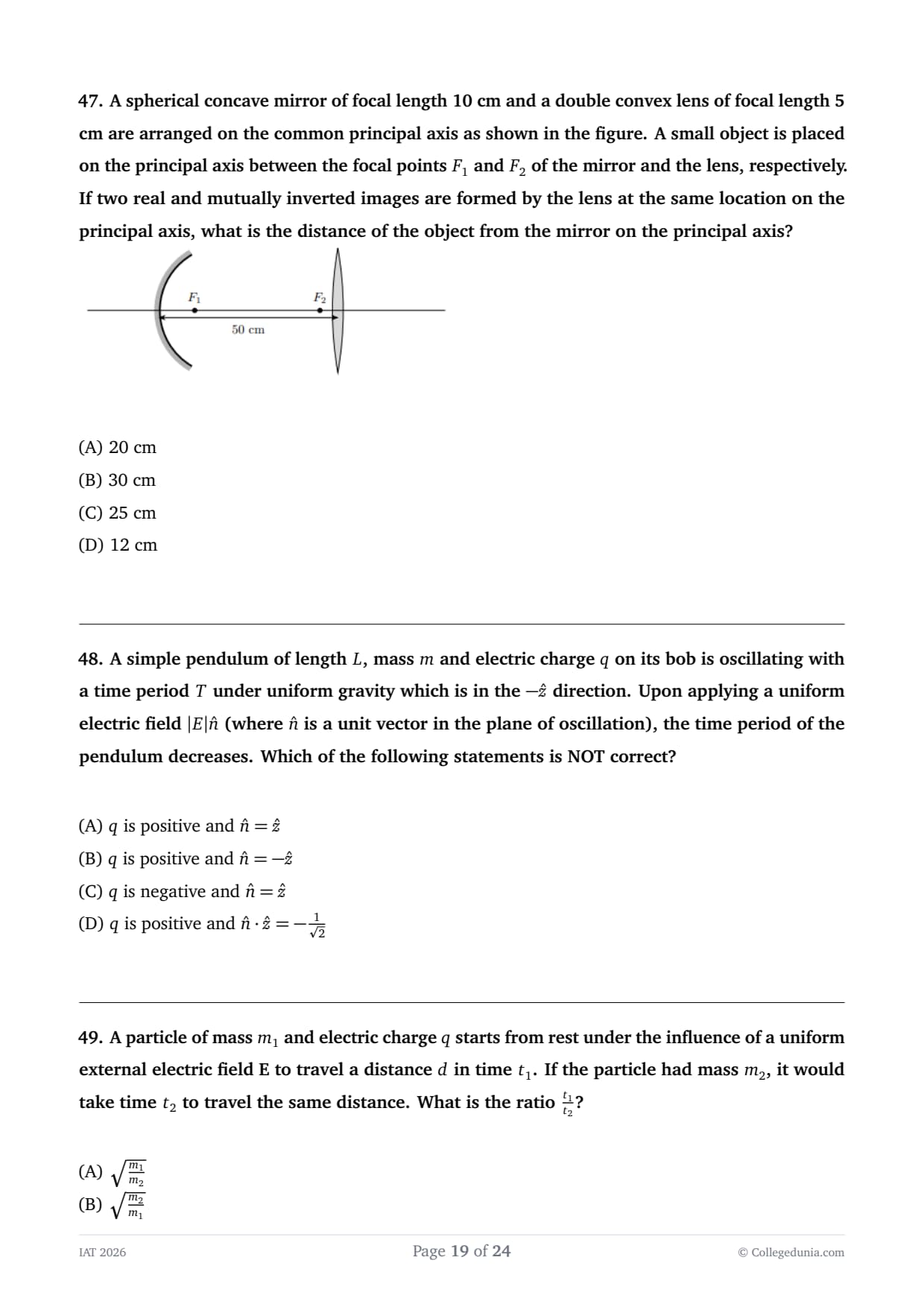
A spherical concave mirror of focal length 10 cm and a double convex lens of focal length 5 cm are arranged on the common principal axis as shown in the figure. A small object is placed on the principal axis between the focal points \(F_1\) and \(F_2\) of the mirror and the lens, respectively. If two real and mutually inverted images are formed by the lens at the same location on the principal axis, what is the distance of the object from the mirror on the principal axis?

A simple pendulum of length \(L\), mass \(m\) and electric charge \(q\) on its bob is oscillating with a time period \(T\) under uniform gravity which is in the \(-\hat{z}\) direction. Upon applying a uniform electric field \(|E|\hat{n}\) (where \(\hat{n}\) is a unit vector in the plane of oscillation), the time period of the pendulum decreases. Which of the following statements is NOT correct?
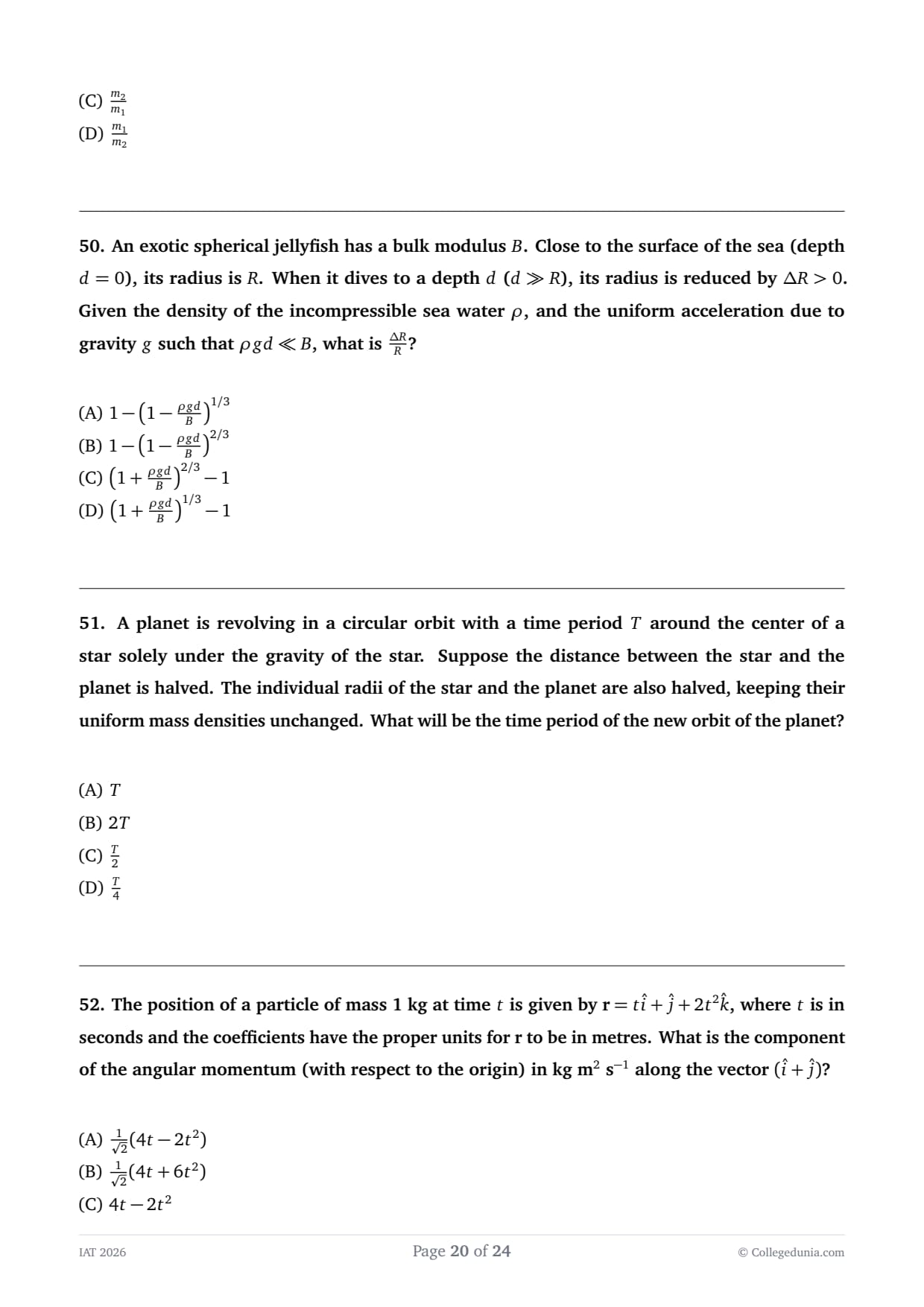
A particle of mass \(m_1\) and electric charge \(q\) starts from rest under the influence of a uniform external electric field \(\mathbf{E}\) to travel a distance \(d\) in time \(t_1\). If the particle had mass \(m_2\), it would take time \(t_2\) to travel the same distance. What is the ratio \(\frac{t_1}{t_2}\)?
An exotic spherical jellyfish has a bulk modulus \(B\). Close to the surface of the sea (depth \(d=0\)), its radius is \(R\). When it dives to a depth \(d\) (\(d \gg R\)), its radius is reduced by \(\Delta R > 0\). Given the density of the incompressible sea water \(\rho\), and the uniform acceleration due to gravity \(g\) such that \(\rho g d \ll B\), what is \(\frac{\Delta R}{R}\)?
A planet is revolving in a circular orbit with a time period \(T\) around the center of a star solely under the gravity of the star. Suppose the distance between the star and the planet is halved. The individual radii of the star and the planet are also halved, keeping their uniform mass densities unchanged. What will be the time period of the new orbit of the planet?
The position of a particle of mass 1 kg at time \(t\) is given by \(\mathbf{r} = t\hat{i} + \hat{j} + 2t^2\hat{k}\), where \(t\) is in seconds and the coefficients have the proper units for \(\mathbf{r}\) to be in metres. What is the component of the angular momentum (with respect to the origin) in kg m\(^2\) s\(^{-1}\) along the vector \((\hat{i} + \hat{j})\)?
A long solenoid of initial radius \(R_0\) is put in a region of uniform magnetic field \(\mathbf{B}\) with the axis of the solenoid aligned along the magnetic field. The solenoid is a part of a closed circuit that has no initial current running through it. If the radius of the solenoid starts increasing at a uniform rate, how do the magnetic field strength \(B_{in}\) and the associated magnetic energy \(U_{in}\) inside the solenoid change?
The acceleration of a point particle is given by the equation \[ \frac{d^2\mathbf{x}}{dt^2} = \alpha \frac{\mathbf{x}}{|\mathbf{x}|^7} + \beta \frac{d\mathbf{x}}{dt} \]
where \(\mathbf{x}\) denotes position and \(t\) denotes time. Which of the following relations show the correct dimensions for \(\alpha\) and \(\beta\)?
Consider normal incidence of a monochromatic beam of photons of power \(P\) on a flat surface. Of the incident beam, 10% gets absorbed, 10% gets transmitted, and the rest is reflected by the flat surface. If \(c\) is the speed of light, what is the force exerted on the flat surface by the beam?
An experimental study of the photoelectric effect involves a metal of work function \(\phi_0\). What is the smallest wavelength of the incident photon to photoemit an electron of mass \(m\) which has the same de Broglie wavelength as that of the incident photon? [Given \(h\) is the Planck's constant, \(c\) is the speed of light, and \(\phi_0 \ll mc^2\)]
The three numbers: (number of protons, number of neutrons, the radius) characterize a nucleus. What is the value of \(\frac{r_1}{r_2}\) for two nuclei characterized by \((1, 0, r_1)\) and \((4, 4, r_2)\)?
A jar is filled with two monoatomic non-interacting gases A and B with total masses \(M_A\) and \(M_B\), respectively. The molar mass of A is double the molar mass of B. If the jar is kept at temperature \(T\), what is the ratio of the total pressure of the combined gas to the partial pressure due to the gas A?
Three infinite plane sheets which have uniform positive surface charge densities \(\sigma\), \(\sigma\) and \(2\sigma\), are arranged parallel to each other with a separation of \(d\) as shown in the figure. A spherical Gaussian surface \(S\) of radius \(d/2\) has its center on the middle sheet. Which of the following statements regarding the electric flux \(\Phi_L\) through the left hemisphere and the electric flux \(\Phi_R\) through the right hemisphere of the Gaussian surface is correct?

Consider two Carnot engines of efficiencies \(\eta_1\) and \(\eta_2\). The first engine absorbs heat \(Q_1\) from a heat reservoir A and releases heat \(Q_2\) to a heat reservoir B. The second engine takes heat \(Q_2\) from B and releases heat \(Q_3\) to a heat reservoir C. If \(Q_1 > Q_2 > Q_3\), what is the net efficiency of this combination of the two Carnot engines?
IISER IAT 2026 Exam Pattern
| Parameter | Details |
|---|---|
| Exam Mode | Computer-Based Test (CBT) |
| Exam Duration | 3 hours; 4 hours for PwD (40%+ disability) |
| Language | Bilingual- English and Hindi |
| Total Questions | 60 MCQs |
| Total Marks | 240 |
| Question Type | Single-correct MCQs only |
| Marks per Correct Answer | +4 |
| Negative Marking | −1 per wrong answer |
| Unattempted Questions | 0 marks |



Comments